Since 2017 there has been a Chinese government policy called “Sinicization” in keeping with Xi Jinping’s Thought on Socialism with Chinese Characteristics for a New Era.
Sinicization requires all religious organizations to modify their doctrines and activities so that they match what is considered Han Chinese culture. Authorities have removed crosses from Christian churches and demolished minarets from Islamic mosques. Clergy from all religions are required to attend indoctrination courses on a regular basis. Chinese governments, both Nationalist and Communist, officially recognized five religions: Daoism, Buddhism, Islam, Catholicism and Protestantism.
Some religious groups are considered subversive and are outlawed and their members persecuted such as Falun Gong. During the “Cultural Revolution” (1966 to 1976, ending with the death of Chairman Mao Zedong), religion as such was considered to be one of the “four olds” to be destroyed. Churches and temples were closed. In Tibet, there was widespread destruction of temples. Monks were forced into civilian life. Today, the current policy is to keep religious organizations but to make sure that they do not slip out if control.
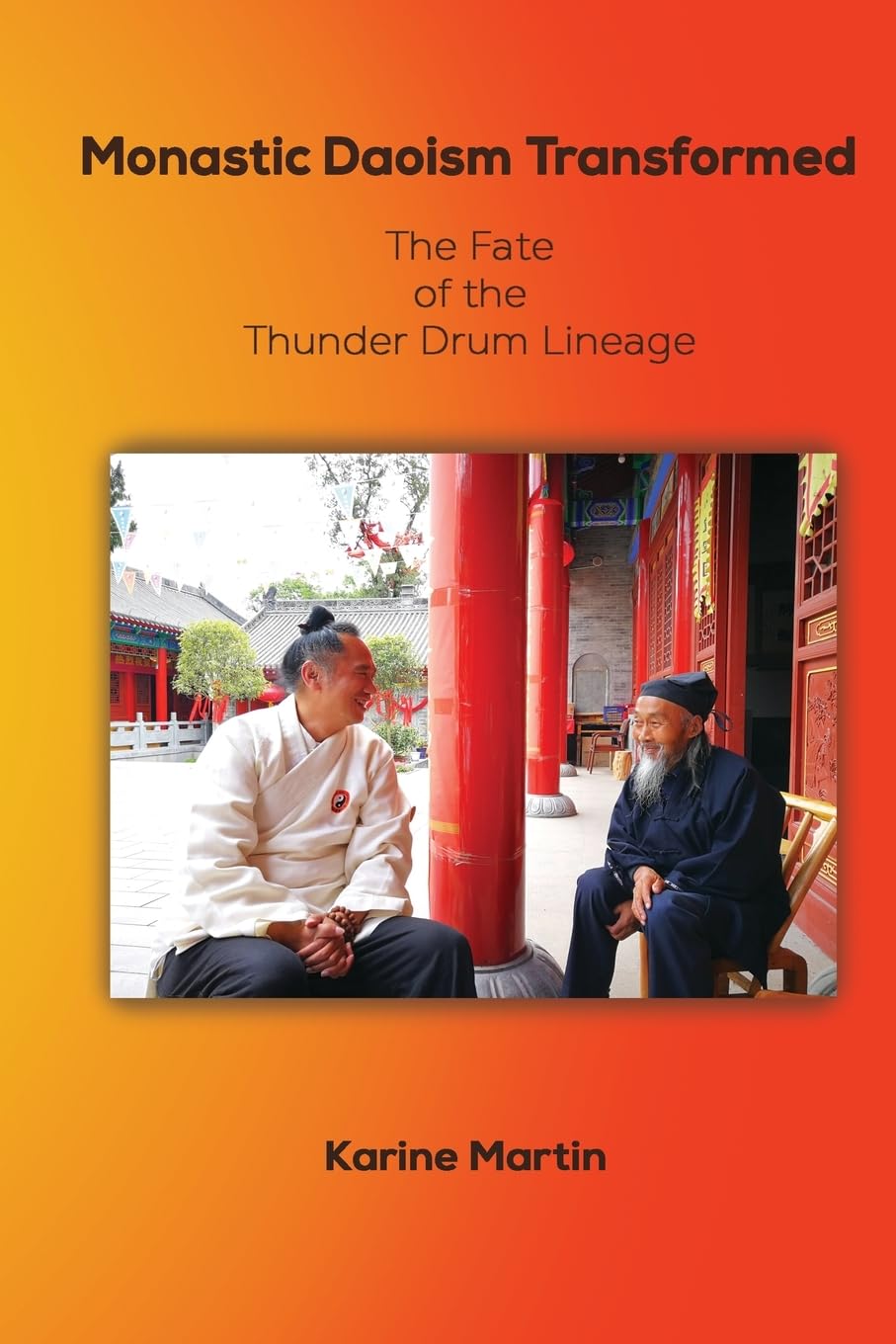
Karine Martin is a Western member of the Daoist monastic clergy (Taoism is now more often written as Daoism). In 2023, she was able to travel widely in China visiting more than 100 Daoist temples, especially those of the Thunder Drum lineage to which she belongs. As she writes,
“Everywhere I went, I found temples in a state of decline and disarray. There were no devotees, much fewer clergy, and minimal activities. Buildings were in disrepair, and there was very little renovation and construction. The overall atmosphere was one of desolation and despair… Temple websites – so strongly developed just a decade ago – now only speak about Xi Jinping Thought and ways of complying with government guidelines… Since all clergy were forced to rejoin secular society during the Cultural Revolution, many got married and had children yet later returned to their monasteries. The marriages often continued, if at long distance, allowing priests to fulfill their spiritual calling while yet having families. Now this is no longer possible, and monks either have to leave the monastery or produce a document that they have obtained a divorce and are properly celebrate.”
Karine Martin has written a very complete picture of monastic Daoism, a development of her Ph.D. thesis based on field observations. However, there is a cultural Daoism which colors Chinese life, its folk religious practices with village shrines – all difficult to control. Daoism places much emphasis on dreams during which the dreamer encounters immortals and advanced masters. Dreams are by their nature difficult to control from outside. The interpretation of the dream is also individual. Dreams can also lead to forms of deep personal meditation in order to understand the significance of the dreams.
Daoism also stresses good health and long life. Deep breathing, massages, herbal remedies and yoga-style movements such as Taijjiquan and Qigong can be carried out without belonging to a Daoist organization.
Daoism also places an emphasis on the appreciation of nature, especially mountains, rivers, forests and well-structured gardens. An ecological concern is growing in China without a specific link to organized Daoism.
While the government may try to control organized Daoist organizations, its cultural manifestations are ever slipping out of control and may one day be manifested in political terms.
Prof. René Wadlow is President of the Association of World Citizens.
On October 21, 2024, prior to the meeting of the Indian leader, Narendra Modi, and the Chinese leader, Xi Jinping, the Indian Minister of Foreign Affairs, Subrahmanyam Juishankar, announced that an accord had been reached between Indian and Chinese authorities for a reduction of tensions along the 3,500-kilometer frontier between the two countries.
In 2020, there had been exchanges of fire between Indian and Chinese forces in the Tibet-Ladakh frontier area. There then seemed to be real possibilities that the violence would escalate. Thus, the Association of World Citizens (AWC) had made an Urgent Appeal, posted in July 2020 on its website and sent widely to contacts that might be helpful in reducing tensions. Today, the AWC is pleased with the new agreement and re-publishes its original 2020 Appeal.
* * *
Can Track II Efforts Reduce China-India Frontier Tensions?
July 3, 2020 at 7:52 AM
By René Wadlow
In a June 24, 2020 message to the Secretary General of the Shanghai Cooperation Organization, Mr. Vladimir Novov, the Association of World Citizens (AWC) expressed its active concern with the June 15 death of Indian and Chinese military in the Galwan River Valley in Ladakh on the India-China frontier and the possibility that the tensions will increase. While there have been brief discussions among Indian and Chinese authorities to prevent escalation, there have been no real negotiations. Negotiation is a basic political decision-making process, to facilitate compromise without loss of essential objectives.
The Indian Ministry of External Affairs said on June 25 that since early May, the Chinese have been amassing a large contingent of troops and arms along the Line of Actual Control (LAC). Also, within India, there has been a good deal of media attention, highly critical of China, given to the events. In addition, there have been calls for a boycott of Chinese goods, and some Chinese products have been removed from Indian shops. Both Indian and Chinese spokespersons have made references to the 1962 war during which some 2,000 persons were killed.
The AWC believes that there is a need for prompt measures as the India-China tensions add to existing tensions between the USA and China as well as boundary issues with Asian States in the South China Sea.
There may be a role for “Track II” nongovernmental efforts and exchanges. Track I is official government to government diplomacy among instructed representative of States, usually diplomats from the Foreign Ministry. However, governments have a range of officials on whom to call: intelligence agencies, the military, and “friends of the President” – trusted individuals within the executive entourage.
Track II efforts are organized through nongovernmental organizations and sometimes by academic institutions. Such efforts can entail informal, behind the scene communications that take place in the absence of formal communication channels. The term “Track II” was coined by the U. S. diplomat Joseph Montville in The Arrow and the Olive Branch: A Case for Track II Diplomacy.
Track II efforts have grown as there is increasing recognition that there is a tragic disjunction between the United Nations tension-reduction mandate and its ability to intervene in conflicts when called upon. As Adam Curle, experienced in Quaker mediation efforts has written “In general governments achieve their results because they have power to influence events, including the ability to reward or to punish. Paradoxically, the strength of civilian peacemakers resides specifically in their lack of power. They are neither feared nor courted for what they can do. Instead, they are trusted and so may sometimes be enabled to play a part in peacemaking denied to most official diplomats.”
Those involved in Track II efforts must, nevertheless, have ready access to governmental decision-makers and Track I diplomats. As the World Citizen and Quaker economist Kenneth Boulding in a little verse writes,
“When Track One will not do, We have to travel on Track Two But for results to be abiding, The Tracks must meet upon some siding”.
In the China-India frontier tensions, both sides must be convinced that there is a considerable sentiment for peace among their own supporters. In this conflict, which could slip into greater violence, there is an understandable tendency to look for short term answers. Yet there is also a need for some involved in Track II efforts to have an over-all integrated perspective for both short as well as long-term transformation. Thus, there needs to be a “pool” of people with experience, skills and the ability to move fast when the need or the opportunity is there?
We are sure that there are groups in India and China which can rise to meet this challenge.
Prof. René Wadlow is President of the Association of World Citizens.
Muhammad Yunus, the founder of the microcredit banking system in Bangladesh, the Grameen Bank (which translates as “Village Bank”), was sworn in as the interim leader of the Bangladesh government on August 8, 2024. The former leader, Sheikh Hasina, resigned and then fled to India, driven out by the protests first of students and then by other sectors of the population during which some 400 persons were killed by the military and the police. Muhammed Yunus has called for calm and an end to uncontrolled violence often directed against the minority Hindu population.
Muhammad Yunus is an economist. Now 84 years old, he is retired from teaching, originally at the University of Chittagong, the port city of Bangladesh. As an economist, he was quickly aware of rural poverty in many parts of the country and the unrest of the tribal minorities in the Chittagong Hill Tracks. He developed the concept of the Grameen Bank, small loans, especially to women, in order to improve their trading efforts. Much of what is called “the informal sector” – marginal to the more developed economy – are the efforts of market women and women small producers. With small loans which must be repaid before a new loan is possible, women are able to have more security and can expand their business.
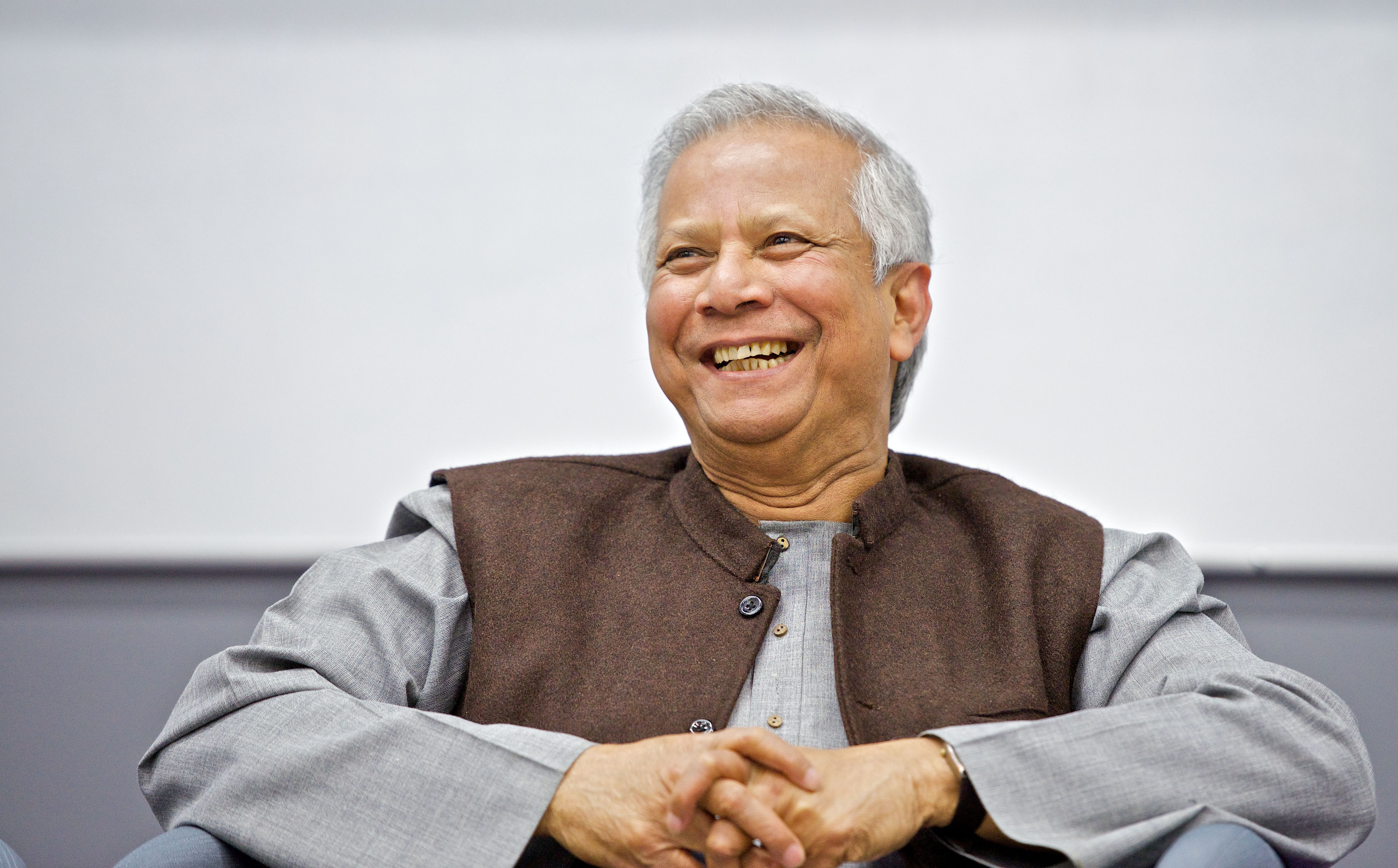
Prof. Muhammad Yunus at the University of Salford, UK, on May 18, 2013 (C) University of Salford Press Service
The Grameen Bank approach spread to nearly all areas of Bangladesh and then to other countries, especially in Africa. The success of the Grameen Bank approach has lifted many from the cycle of poverty and instability. In recognition of the impact of the Grameen Banks, Muhammad Yunus was awarded the Nobel Prize for Peace in 2006.
Muhammad Yunus has formed an interim government of 16 persons, mostly drawn from civil society organizations, including two, Nahid Islam and Asif Mahmud, both 26 years old, who were leaders of the student movements which overthrew Sheikh Hasina who had been in power for 15 years – whose government had become increasingly authoritarian. Muhammad Yunus has promised that elections will be held shortly but that calm must be restored first. He faces difficult tasks, but he is a fresh mind outside the narrow political milieu. We must wish him well in his vital efforts.
Prof. René Wadlow is President of the Association of World Citizens.
February 1 marks the anniversary of the military coup which overthrew the government of Aung San Suu Kyi in 2021. She was in practice the leader of the government but could not take the title of “President”. An earlier military junta had passed a law with her in mind saying that a person married to a foreigner could not become president. Aung San Suu Kyi had married a British anthropologist, Michael Aris, a specialist on Tibet who died in 1989 of cancer. Aung San Suu Kyi represented a new spirit – partly because she had lived most of her life outside Burma and was not linked to existing political compromises.
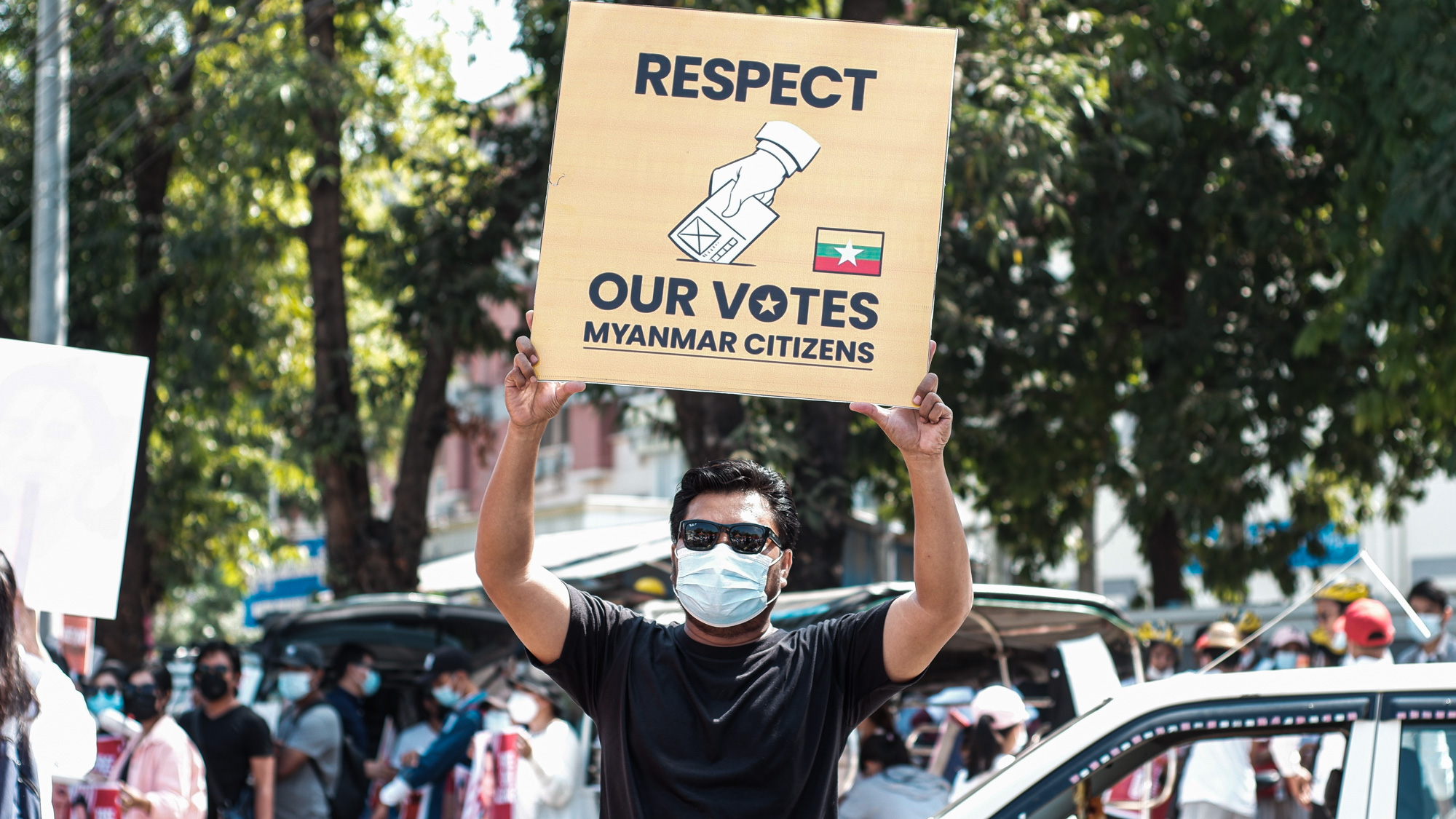
On February 14, 2021, a protest in Myanmar against the military coup (C) MgHla
Her father, Aung San, who died when Aung San Suu Kyi was two years old, was one of the original “Thirty Comrades” – student nationalists who were inspired by Second World War Japanese propaganda which appealed for a common Asian struggle against Western imperialism. Aung San went to Tokyo to assist the Japanese conquest of Burma. However, by 1944, the “Thirty Comrades” had decided that the Japanese were not liberators, that the occupation of Burma was carried out for Japanese rather than Burmese aims, and that the Japanese might lose the war. In the last year of the war, the “Thirty Comrades” cooperated with Lord Mountbatten.
Thus, on January 27, 1947, British Prime Minister Clement Attlee and Aung San signed an agreement for full independence of Burma within a year. On July 19, 1947, Aung San was assassinated by a political rival. He became a legend of Burmese independence.
Aung San Suu Kyi was educated in India (where her mother served as ambassador of Burma) and at Oxford University. She only returned to Burma in 1988 to take care of her dying mother. Her dynamism, combined with the legend of her father, led her to being named secretary of the National League for Democracy.
On June 14, 2012, Aung San Suu Kyi welcomed at the International Labor Organization’s premises in Geneva (C) Violaine Martin/UN Geneva
Since the military junta has taken power, it has intensified the struggle against the ethnic minorities – the Mon, Kachen, Karen, Shan, Wa, the Arakan Muslims, and others. The ethnic minorities represent some 40 percent of the population, the Burmese, some 60 percent. However, population statistics are not based on real population surveys. Decades of self-imposed isolation, fabricated statistics and an absence of social and economic research have left even the authorities without an accurate appreciation of the distribution of the population. The military have destroyed villages along the frontiers with China, India, Thailand, and Bangladesh.
While we are critical of the military government and their repressive policies, we must not idealize the forces of the ethnic insurgencies. In 1992-1993, I was involved in getting the National Council of the Union of Burma created by the insurgencies and democratic Burmese who had taken refuge in the ethnic minority zones to sign the Geneva Conventions of August 12, 1947 and the protocols additional which provide the basic rules of international humanitarian law in armed conflict. The Union President, General Saw Bo Myn of the Karen National Union, and the three Vice Presidents signed in January 1993. While the signature is symbolic – only governments may sign the Geneva conventions – the signature was widely noted and led the Myanmar government to sign the conventions which they had always refused to do until then. The signature led to a mutual release of war prisoners – but not to a formal exchange as the two sides in the conflict refused direct contact at the time.
Burma, now renamed Myanmar after 1988, faces two basic and related issues: the installation of democratic government and a constitutional system which allows autonomy to the minority peoples. Both tasks are difficult. There is little democratic tradition or ethos upon which to structure a democratic government. While a federal or con-federal system would be the most suited for a multi-ethnic state, what leadership exists both in the junta and the insurgencies is motivated by personal and clan-centered interests. The leaders recruit allies similarly motivated. Only peace will allow new leadership to emerge with broader motivations and allow all citizens to participate in a renewed political process.
Prof. René Wadlow is President of the Association of World Citizens.
Antony Blinken, the United States (U.S.) Secretary of State, has been again in the Middle East working to prevent the violence of the Gaza Strip of spreading to much of the area. The Gaza Strip conflict has already spread to the West Bank with increased violence between Jewish settlers and Palestinian inhabitants. There is increased violence along the frontier of Lebanon with the activities of the armed faction Hezbollah and the displacement of Israeli villages. Negotiations in good faith seem far off, and political speeches grow more conflictual. Could there be a role for unarmed, non-governmental peace brigades to monitor frontiers and lessen tensions?
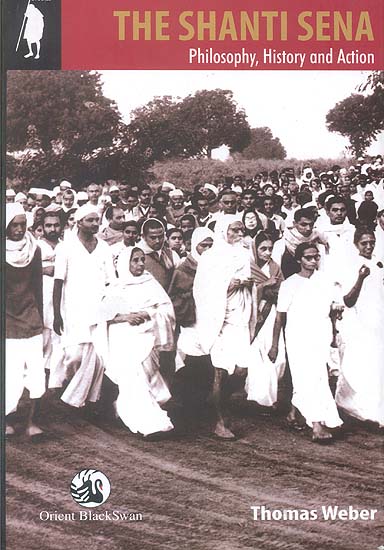
One possibility, inspired by the efforts of Shanti Sena (Peace Army) developed by followers of Mahatma Gandhi in India to deal with Hindu-Muslim violence is to place some nongovernmental teams on the frontier between antagonists in order to provide an opportunity for all parties to “cool off” and negotiate.
(C) Exotic India
One such effort in which I was directly involved was an effort to place a peace team on the Nicaraguan-Honduras frontier in 1981. At the time, it was thought that the 400 strong U.S. troops stationed in Honduras might cross the frontier to attack the Sandinista-leftest government in Nicaragua or to help actively the anti-Sandinista Contras to do so. A group of persons associated with the Santa Cruz Resource Center for Nonviolence in California and affiliated to the organization Peace Brigades International were able to put a team together and move to the Nicaragua-Honduras frontier on short notice. The group called itself “The Jalapa Brigade” after the small Nicaraguan city near the Honduran frontier where it was posted.
When the Jalapa Brigade was being put into place, the Ambassador of Nicaragua to the United Nations (UN) in Geneva was a former student of mine, and his brother, also a former student of mine, was the legal advisor to the President of Nicaragua. In fact, when the team arrived, Daniel Ortega, the President, introduced the team as “Friends of Humanity.”
Through the Ambassador, I was able to inform all the Central American Missions to the UN as to the aims and role of the Peace Brigade. In the end, the U.S. military did not cross the frontier. Perhaps it never intended to do so. It may also have been that the interposition of U.S. citizens with good organizational contacts helped to weigh in the U.S. military decision-making process. When the team left, the leader of the Protestant “Evangelical Committee for Development Aid” said “The proof of your triumph lies in the fact that no attacks were made while you were in the Jalapa area.”
There have been other such interposition efforts. One was the Gulf Peace Team created at the time of the 1990 Iraqi annexation of Kuwait. The aim of the 73-member Peace Team was to be an “international multicultural team working for peace and opposing any form of armed aggression by setting up one or more international peace camps between the opposing armed forces. Our object will be to withstand nonviolently any armed aggression by any party to the present Gulf dispute.” However, on January 27, 1991, the peace camp was closed by Iraq because the authorities had “decided that the continued presence of the camp was a security risk.”
Thus, the creation of interposition peace teams in the Israel-Palestine conflict would not be easy to create for political and logistic reasons. There are economic and logistic resources required and, more importantly, there is the need to raise enough volunteers who are mature, culturally sensitive, and analytically minded to achieve a critical mass that would make a difference in the decision-making of the conflicting parties. There is also the need to keep the unity of purpose within the teams if they have not worked together before. However, the current situation is very dangerous. The dangers are widely recognized. Therefore, all forms of conflict reduction need to be explored.
Prof. René Wadlow is President of the Association of World Citizens.
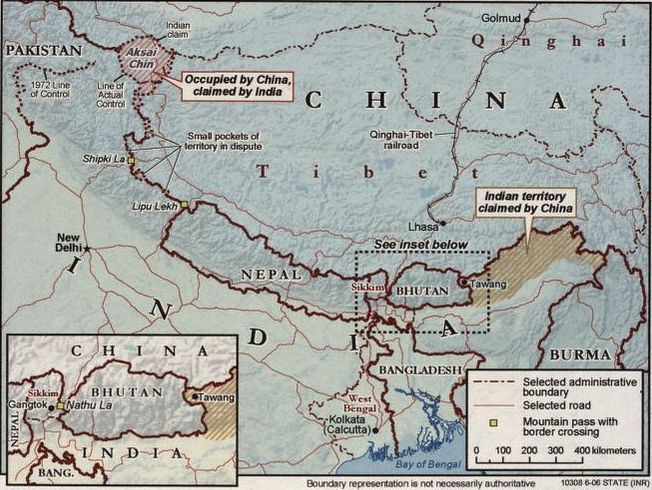
There has been a constant buildup of military forces by the governments of both India and China along their common frontiers. The Indian province of Arunachal Pradesh (called Zangman by the Chinese) with Itanagar as its capital is claimed by the Chinese. The frontier was drawn in 1914 and is called the McMahon Line. The frontier dispute led to the October-November 1962 India-China armed conflict with important consequences especially for Indian foreign-policy making.
In recent years there have been flashes of tension along the Line of Actual Control (LAC) as the military of both China and India have built new roads and observation posts along the LAC. Such tensions could grow as the relative political power of India and China grows and takes the form of a struggle for power. Currently there are no public negotiations between the Chinese and Indian governments. India, this year, is the chair of the G20 grouping of states. The Indian government has organized a number of G20 seminars on different issues in a number of Indian cities. However, for the moment, China has not sent representatives to these seminars.
The Association of World Citizens (AWC) has expressed its active concern with these tensions on the India-China frontier and the possibility that the tensions will increase. With the lack of formal India-China negotiations, the AWC raises the possibility of strong Track Two discussions.
The term Track Two was coined by the U.S. diplomat Joseph Montville in his book The Arrow and the Olive Branch. Track Two discussions are organized by nongovernmental organizations often with the help of academic institutions. Track Two discussions among non-officials of conflicting parties aim to clarify outstanding disputes and see on what issues negotiations might progress.
As Adam Curle, experienced in Quaker mediation efforts, has written, “In general, governments achieve their results because they have power to influence events, including the ability to reward or to punish. Paradoxically, the strength of civilian peacemaking resides specifically in their lack of power. They are neither feared nor courted for what they can do. Instead, they are trusted and so may sometimes be enabled to play a part in peacemaking denied to more official diplomats.”
Adam Curle
Thus, it will be important to follow as closely as possible the results of the G20 seminars in India and then build upon them in a Track Two pattern. Concerning the China-India frontier issues, both governments must be convinced that there is a considerable desire for peace among their citizens. There is also a need for some involved in Track Two efforts to have an integrated perspective of peacebuilding techniques and a long-term view of possibilities for transforming political relations.
Prof. René Wadlow is President of the Association of World Citizens.
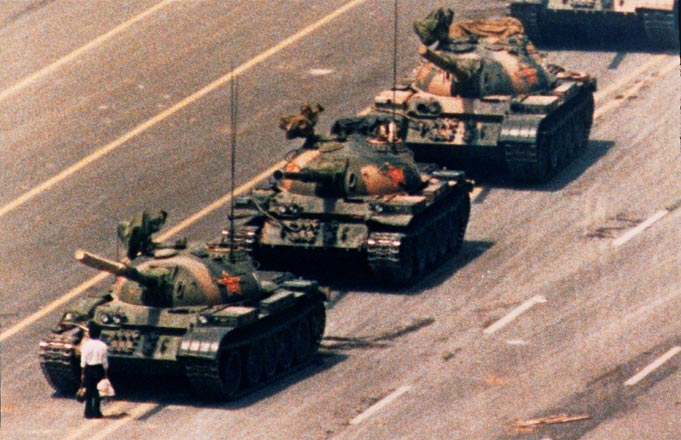
June 4 makes the security forces in China somewhat uneasy, especially in Hong Kong where, in the past, there were large memorial meetings to remind people of June 4, 1989, when the military and police moved against those who had been protesting publicly for over a month. Students from colleges and universities in China’s capital initiated protests after the death of the former General Secretary of the Communist Party, Hu Yaobang, on April 15, 1989 who was considered a liberal reformer. The movement then spread over a number of weeks to most of the major cities. Students made numerous demands, among them were calls for an end to government corruption, increased funding for education, and freedom of the press. As the movement went on, students were increasingly joined by industrial workers.
There were differences of opinion within the ruling government circle as to how to deal with the protests. As the protests continued, there was more and more international media attention, especially as there were an increasing number of journalists in Beijing in advance of the visit of the Soviet leader, Mikhail Gorbachev, with a large delegation of Soviet officials.
(C) Jeff Widener/Associated Press
Students and intellectuals started writing petitions setting out demands that were signed by more and more people. The decentralized structure of power and decision-making among groups in Tienanmen Square allowed for tactical innovation as each group was free to act as it desired and stress the symbols it wanted. Thus, art school students created the Goddess of Democracy, largely based on the Statue of Liberty in New York harbor. The growth in support for the student-led protests led the more anti-reformist faction in the government to order a crackdown by the military and the police. The tanks started to move into Tiananmen Square.
Since June 1989 there have been reforms within China – what we might call “democratization from below” but without large scale, highly visible public protests. ‘Stability’ and ‘harmony’ have been the stated government policy aims, colored by the breakup of the Soviet Union and fundamental changes in Eastern Europe. So, democratization needs to proceed quietly and gradually. Such democratization requires long-term vision and skillful leadership. Democratization is basically linked to individualization, to an ever-larger number of people thinking for themselves, creating their own lifestyles and ‘thinking outside the box’. It can be a slow process and repressive forces within the government watch events closely. However, it is likely that the direction of individualism is set and cannot be reversed.
Prof. René Wadlow is President of the Association of World Citizens.
The Human Rights Council, building on the earlier practice of the United Nations (UN) Commission on Human Rights, has a number of Special Rapporteurs devoted to certain themes – usually specific violations of human rights – or to specific countries. These Special Rapporteurs are independent experts selected by the Council. They usually report their findings at each session of the Council. When violations concern more than one issue, there can be joint Reports to the Council or joint Appeals to a government. Such a collective Appeal to the government of Pakistan sent on October 26, 2022 was made public on January 15, 2023.
The joint Appeal by six Special Rapporteurs concerned the sequence of rape of young women, forced conversion to Islam, followed by marriage to the rapist. The Appeal was led by the Special Rapporteur on Freedom of Religion or Belief, the Special Rapporteur on Sexual Exploitation of Children, the Special Rapporteur on Violence against Women and Girls, and the Special Rapporteur on Trafficking in Persons, especially Women and Children. The subject of the Appeal is not new, having been raised previously by Nongovernmental Organizations (NGOs), including by the Association of World Citizens (AWC).
However, the Appeal by the Special Rapporteurs clearly identifies a systemic problem on which the Pakistani government has failed to act. The girls raped are usually minors under 18 years of age and belong to Hindu and Christian minorities of the country, often rural and poor. Most Christians in Pakistan are converts from low caste or “untouchables” (Dalit) Hindus. Seeing no future within the Hindu-influenced caste system, they converted to Christianity which has no caste structure. Most of the Pakistani Hindus and Christians are illiterate and have little or no political influence.
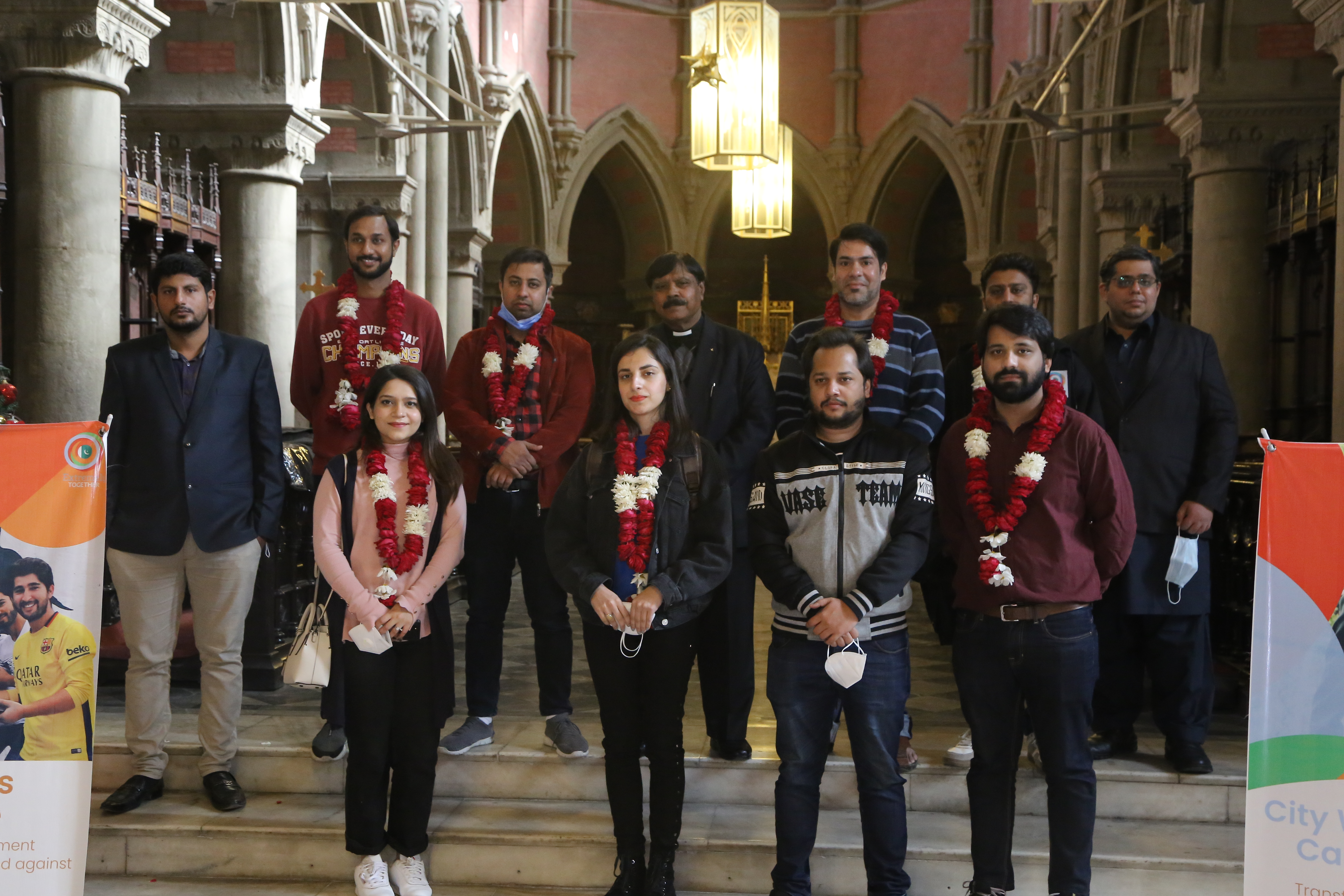
A peace tour arranged by different social activists and minority rights activists in Lahore, Pakistan, with the participation of Muslim, Christian and Hindu youth. (C) RedMiNote
The Pakistani police and the court employees are agents of these human rights violations. Illiterate parents sign with a thumbprint document that they do not understand and are then filled in by the police to attest that the girl is older than 18, the legal age for marriage. If the girl or her family agrees to the marriage with the rapist, the rapist cannot be arrested and tried for the rape. As the practice takes place usually in rural areas, there are few if any NGOs to take up the specific cases. Urbanized Christian groups in Pakistan have made some protests of the practice but are often unaware of the specific rural cases.
NGOs have brought evidence of the practice to the attention of the Geneva-based Special Rapporteurs. When a human rights violation is given to the UN human rights secretariat, it is sent on to the Geneva-based Ambassador of the country mentioned. The Ambassador may not reply at all or more usually will reply saying that the facts are incorrect or deliberately misleading. However, as in the Pakistani case, the evidence piles up. In this current situation, there is, two months ago, a newly appointed High Commissioner for Human Rights, Volker Turk, formerly UN Undersecretary-General for Policy. The Special Rapporteurs may have wanted to see how he will act on violations of a powerful country. The situation in Pakistan merits close watching.
Prof. René Wadlow is President of the Association of World Citizens.
October 2 is the United Nations (UN) General Assembly-designated Day of Nonviolence chosen as October 2 is the birth anniversary of Mahatma Gandhi.
Mahatma Gandhi, shortly after finishing his legal studies in England, went to South Africa and began working with Indian laborers, victims of discrimination. He looked for a term understandable to a largely English-speaking population to explain his efforts. “Passive resistance” was the most widely used term and had been used by Leo Tolstoy and others. However, Gandhi found the word “passive” misleading. There did exist a Hindu term, ahinsa – a meaning non- and hinsa, violence. The term was basically unknown among White South Africans, largely uninterested in Indian philosophical thought.
Gandhi wrote to a friend from his legal studies days in England, Edward Maitland. Maitland and Anna Kingsford were the leaders of the Esoteric Christian Union and the leaders of the London Lodge of the Theosophical Society. Maitland introduced Gandhi to the writings of the American New Thought writer Ralph Waldo Trine. Trine was a New Englander and his parents named him after Emerson. His best-known work from which Gandhi took the term for his actions in South Africa is In Tune with the Infinite or Fullness of Peace Power and Plenty. (1)
Trine uses the term “soul force” which Gandhi then used for his work in South Africa. Once back in India, Gandhi wanted an Indian rather than an English expression, and he coined the term satyagraha − holding on to truth: satya as Truth in a cosmic sense is an oft-used Hindu term while “soul” would need some explaining to Indian followers.
All of Trine’s writings contained the same message: soul force could be acquired by making oneself one with God, who was immanent, through love and service to one’s fellow men. The Christ Trine followed was one familiar to Gandhi − the supreme spiritual exemplar who showed men the way to union with their divine essence. Trine promised that the true seeker, fearless and forgetful of self-interest, will be so filled with the power of God working through him that “as he goes here and there, he can continually send out influences of the most potent and powerful nature that will reach the uttermost parts of the world.”
For Trine, thought was the way that a person came into tune with the Infinite. “Each is building his own world. We both build from within, and we attract from without. Thought is the force with which we build, for thoughts are forces. Like builds like and like attracts like. In the degree that thought is spiritualized does it become more subtle and powerful in its workings. This spiritualizing is in accordance with law and is within the power of all.
“Everything is first worked out in the unseen before it is manifested in the seen, in the ideal before it is realized in the real, in the spiritual before it shows forth in the material. The realm of the unseen is the realm of cause. The realm of the seen is the realm of effect. The nature of effect is always determined and conditioned by the nature of its cause.”
Thus, for Mahatma Gandhi, before a nonviolent action or campaign, there was a long period of spiritual preparation of both him and his close co-workers. Prayer, fasting, and meditation were used in order to focus the force of the soul, to visualize a positive outcome and to develop harmlessness to those opposed.
Another theme which Trine stressed and Gandhi constantly used in his efforts to build bridges between Hindus and Muslims was that there was a basic core common to all religions. Gandhi wrote “There is a golden thread that runs through every religion in the world. There is a golden thread that runs through the lives and the teachings of all the prophets, seers, sages, and saviors in the world’s history, through the lives of all men and women of truly great and lasting power. The great central fact of the universe is that the spirit of infinite life and power is back of all, manifests itself in and through all. This spirit of infinite life and power that is back of all is what I call God. I care not what term you may use, be it Kindly Light, Providence, the Over-Soul, Omnipotence or whatever term may be most convenient, so long as we are agreed in regard to the great central fact itself.”
Note:
(1) R.W. Trine, In Tune with the Infinite (New York: Whitecombe and Tombs, 1899, 175 pp.)
Prof. René Wadlow is President of the Association of World Citizens.
Dans un premier temps, il nous semble important de faire un rappel de l’état des lieux environnemental dans lequel se trouvent la terre et ses ressources, en considérant les interactions entre l’humanité et les écosystèmes qui y vivent.
Selon le Rapport Planète Vivante de WWF (2020), les activités humaines ont amené à une diminution de 68% des populations mondiales de mammifères, d’oiseaux, de poissons, de reptiles et d’amphibiens en 50 ans.
En Europe, par exemple, l’Union Internationale pour la Conservation de la Nature (UICN) indique la disparition de 36 espèces entre 2015 et aujourd’hui, et plus de 11% sont menacées d’extinctions (dont 58% d’arbres endémiques et 40% de poissons d’eau douce).
En Afrique, ce sont 700 millions d’hectares de terres (soit plus de dix fois la surface de la France), qui ont été dégradées par la pression humaine, et ce en lien avec la désertification et le surpâturage (source : la Banque mondiale, 2016). Cette situation crée un cercle vicieux, qui amène à une urgence alimentaire, laquelle nécessite à son tour une exploitation excessive des arbres et une sur-utilisation des engrais et pesticides[1].
Au niveau mondial, le stock de poissons a reculé de 50% entre 1970 et 2010, les côtes africaines étant les plus pillées au monde, notamment par la Chine[2]. Il se pourrait que les stocks halieutiques exploités par les êtres humains déclinent jusqu’à disparaître en 2048, si l’on en croit les prévisions d’Isabelle Autissier, présidente de WWF-France (jusqu’en janvier 2021).
Quant aux villes, si elles n’occupent que 3% de la surface continentale mondiale[3], elles concentrent 55% de la population mondiale et consomment plus des deux tiers de la demande énergétique mondiale (source : Rapport de situation 2019 sur les énergies renouvelables dans les villes de l’ONU). Elles sont, par ailleurs, particulièrement vulnérables aux changements climatiques et aux catastrophes naturelles du fait, entre autres, de leur forte concentration humaine, tout en étant en partie les causes de ces aléas climatiques[4].
L’histoire de l’humanité est en train de se jouer, en notre défaveur à tous ; il n’y a pas de région, de pays ou de continent épargnés. Il y a une réelle urgence à s’en préoccuper, car si nous n’agissons pas, c’est notre propre espèce que nous mettons en péril.
Une des premières conséquences de ces désordres environnementaux est d’obliger, inexorablement, des populations à se déplacer.
Bien que l’histoire de l’humanité soit faite de migrations, ces dernières se multiplient fortement, depuis quelques années. Auparavant, c’était les guerres, les violences, maintenant, ce sont aussi les aléas climatiques qui poussent les êtres humains à quitter la terre qui les a vus grandir et qui leur a permis de construire leurs identifications fondamentales.
Nous savons que, d’une manière générale, toute migration, à laquelle s’ajoute celle due à l’environnement, provoque des perturbations socioculturelles énormes, autant pour ceux qui la subissent que pour ceux qui l’accueillent. Elle engendre des souffrances humaines indicibles qui questionnent et violentent notre humanité.
Lequel d’entre nous n’a pas encore, en mémoire, ces images insoutenables des migrants noyés gisants sur les plages, en particulier sur les deux rives de la Méditerranée ?
Parmi ces migrants, combien sont des réfugiés climatiques ? Nous n’avons pas encore assez d’études qui nous renseignent avec précision sur cette question, mais il est avéré qu’ils sont de plus en plus nombreux.
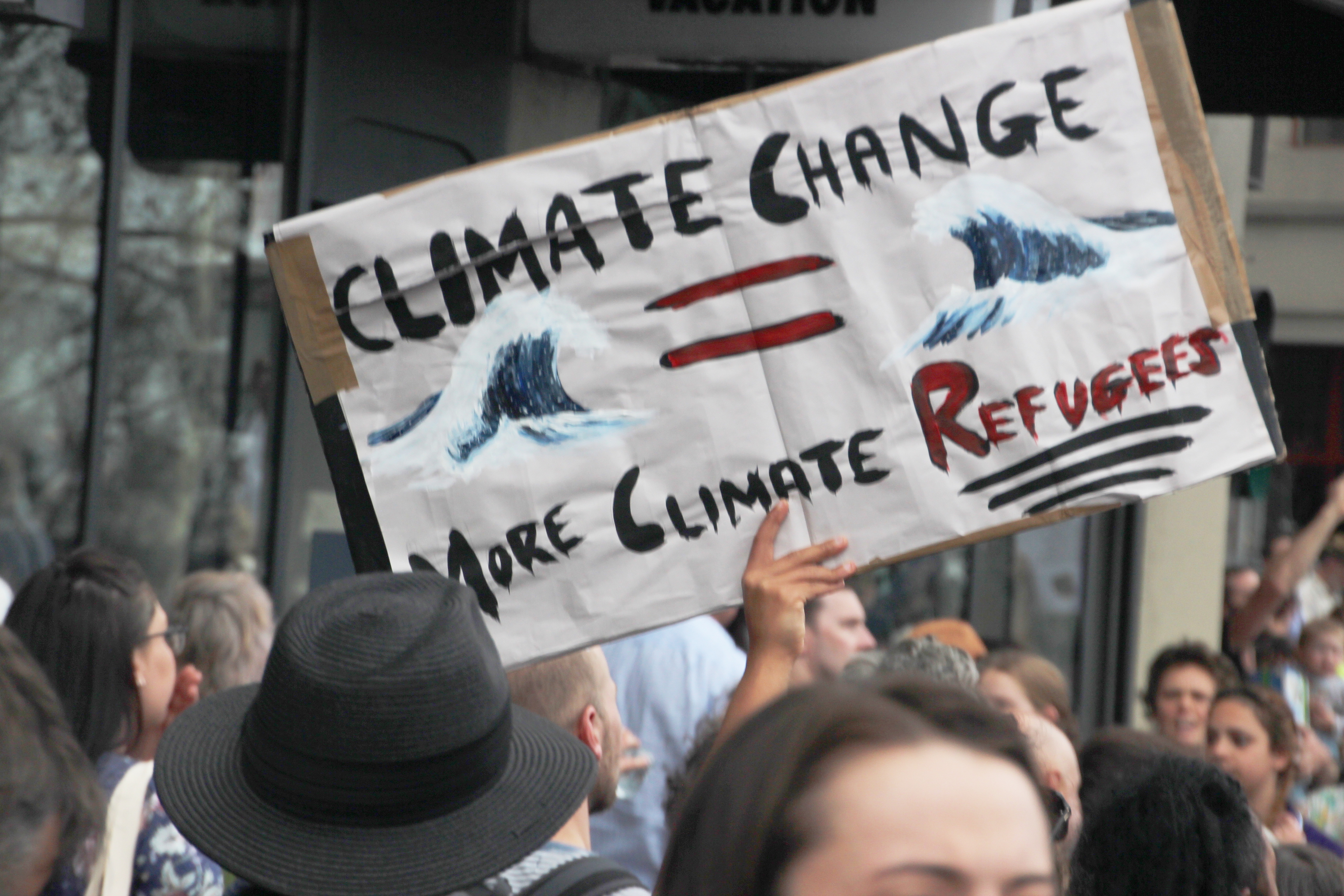
Pourtant, force est de constater que le sujet des réfugiés climatiques est le parent pauvre de la politique actuelle, le lien entre migration et réchauffement climatique faisant l’objet d’un silence assourdissant de la part de nos politiques. Pour autant, en 2013, un rapport du Conseil norvégien pour les réfugiés (NRC) fait état de 22 millions de personnes ayant été déplacées en raison de catastrophes naturelles, ce qui est trois fois plus élevé que le nombre des personnes fuyant un conflit.
Mais qui sont ces migrants, ces réfugiés de l’environnement ? Ce sont des personnes « qui sont forcées de quitter leur lieu de vie temporairement ou de façon permanente à cause d’une rupture environnementale (d’origine naturelle ou humaine) qui a mis en péril leur existence ou sérieusement affecté leurs conditions de vie »[5].
Alors comment sont catégorisés ces « réfugiés climatiques », appelés aussi « déplacés » ou « éco-migrants » ? Ils sont, d’emblée, intégrés aux seules catégories existantes: celles des « réfugiés économiques » ou des « réfugiés de la misère ». En effet, ils n’ont pas de statut juridique, car ils ne remplissent pas les critères de la Convention de Genève signée en 1951.
Cette dernière n’accorde l’assurance d’une protection aux réfugiés que dans certains cas, à savoir, « des situations de persécutions liées à la race, à la religion, à la nationalité, aux opinions politiques, ou à l’appartenance à certains groupes sociaux » (UNHCR).
De ce fait, les pays d’accueil, connus pour leur qualité de vie et leur sécurité, et vers lesquels se dirigent naturellement ces éco-migrants, ne disposent d’aucun budget pour recevoir ces derniers.
Selon le Rapport mondial sur le déplacement interne (2020) de l’ONG Internal Displacement Monitoring Center (IDMC), chaque année, plus de 20 millions de personnes qui sont déplacées, le sont pour cause de catastrophes naturelles, dont 86% de nature hydrométéorologique.
Alors, quels sont les changements environnementaux qui provoquent de tels flux migratoires ?
L’Ined (Institut national d’études démographiques) fait état de 3 phénomènes[6] principaux :
1) L’intensité accrue des catastrophes naturelles.
En effet, entre 1995 et 2015, plus de 600.000 personnes sont décédées du fait de ces catastrophes météorologiques. Plus de 4 milliards de personnes ont en été blessées, ou sont tombées dans une forte précarité à la suite de ces catastrophes. (Source : rapport du Bureau des Nations unies pour la réduction des risques de catastrophes)
2) La hausse du niveau des mers.
Elle risque de rendre inhabitables certaines zones basses à forte densité de population.
C’est le cas de nombreuses régions du Bangladesh[7], par exemple. Ce pays, tout comme l’Inde, a vu s’accroître ses problèmes socio-économiques et politiques en raison notamment du déplacement des Rohingyas, forcés de fuir le Myanmar.
3) La raréfaction des ressources hydriques, aussi appelée stress hydrique.
Elle engendre sécheresse et désertification. C’est notamment le cas des États du Sahel, où les modèles climatiques prédisent une aggravation de la sécheresse dans les années à venir. Cette situation a déjà été à l’origine de déplacements majeurs de populations et d’une perte importante du bétail dans cette région d’Afrique. Le bétail, rappelons-le, constitue la principale source de production agricole[8].
Par ailleurs, et depuis quelques années, on assiste à une augmentation des inondations meurtrières notamment en Afrique de l’Ouest. Ces évènements sont dus à différents phénomènes tels que le changement de l’usage des terres, la réduction des jachères, ou encore la déforestation et l’urbanisation. Tout ceci rend les sols incapables d’absorber les eaux diluviennes notamment dans la zone du Sahel[9].
Ainsi, en 2018, ce sont 250.000 Afghans qui ont dû fuir leurs villages en raison des fortes chaleurs, induisant une vulnérabilité extrême de cette population, déjà exposée aux conflits armés.
Selon un rapport du Conseil norvégien pour les réfugiés, « en 2013, les catastrophes naturelles ont fait presque trois fois plus de déplacés que les guerres » (INED) et 85% d’entre eux sontdes pays en développement.
Pour une grande partie de ces populations, c’est l’exode vers l’Occident, et particulièrement l’Europe, qui est le plus tentant et le plus tenté, dans l’espoir de vivre dignement, ou tout au moins de survivre …
Comment dès lors permettre à ces populations de vivre dans leurs territoires, d’y travailler et d’en utiliser les ressources ?
Certaines bonnes pratiques locales, simples d’accès, notamment pour les populations autochtones pourraient aider à lutter contre ces problématiques environnementales. Quelques-unes commencent d’ores et déjà à émerger et devraient faire, nous l’espérons, effet « boule de neige ».
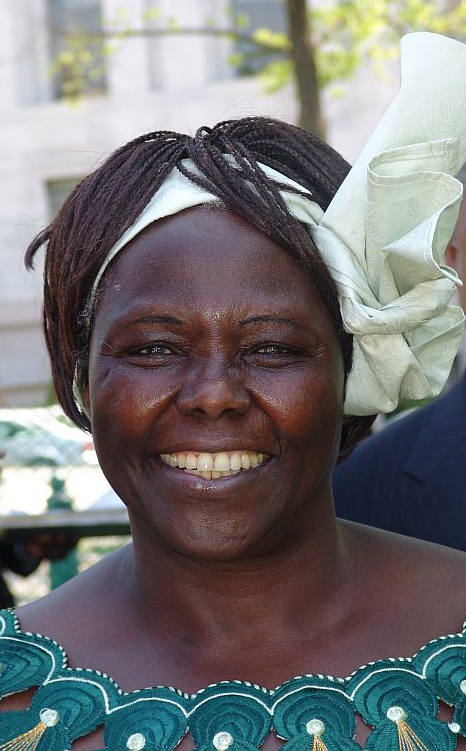
À titre d’exemple, citons le mouvement de la ceinture verte au Kenya (Green Belt Movement) qui a été lancé par la biologiste Wangari Maathai et qui encourage les femmes à planter des arbres, ce qui leur permet, à terme, d’améliorer leur niveau de vie.
En Mongolie, toute une muraille verte a également vu le jour, pour résister à l’avancée du désert de Gobi.
Au Burkina Faso, des paysans construisent des cuvettes en demi-lunes qui permettent de concentrer les précipitations et réduire le ruissellement[10].
Au Rajasthan, pour récupérer l’eau des moussons, recharger les nappes phréatiques et réalimenter les rivières, les paysans ont remis au goût du jour le « johad », une technique agricole ancestrale, qui consiste à collecter les eaux de pluie pendant la saison des moussons et les utiliser en les faisant filtrer dans le sous sol pendant la saison sèche[11].
Wangari Maathai
On peut aussi évoquer la transformation de la villa « ASSIE GAYE » au Sénégal en 2009-2010, qui s’est faite grâce à l’utilisation de matériaux locaux, comme la terre crue argileuse. Elle est alimentée en énergies renouvelables, grâce à un générateur éolien, un générateur photovoltaïque et un collecteur thermique. Ce qui en fait une maison durable, à la fois sur le plan écologique et économique[12].
Enfin, nous devons rappeler qu’il est indispensable pour l’humanité de relever le défi majeur de ces problématiques environnementales et humaines qui s’offrent à elle. Il nous faut intégrer tous les possibles en matière de changement climatique annoncés par les rapports du Groupe GIEC, dans le but d’y répondre.
Il serait ainsi plus urgent d’attribuer certains budgets étatiques à la prise en charge des réfugiés climatiques, plutôt que d’augmenter, par exemple, ceux inhérents à la défense et à l’armement.
Par ailleurs, la lutte contre le fléau de l’évasion fiscale pourrait, éventuellement, profiter à ces mêmes réfugiés et ainsi limiter la pression sur les pays d’origine ou encore sur les pays accueillant ces migrants.
Pour clôturer mon propos, j’emprunte un peu de sa sagesse à Wangari Maathai qui précise qu’« Aujourd’hui, nous affrontons un défi qui exige un renouvellement de notre mode de pensée, pour que l’humanité cesse de menacer le système qui assure sa propre survie. Nous sommes appelés à aider la terre à guérir ses blessures et, à guérir les nôtres – en fait, à embrasser la totalité de la création dans toute sa diversité, sa beauté et ses merveilles. »[13]
Nadia Belaala est architecte et ingénieure sociale, anciennement Officier du Développement durable de l’Association of World Citizens.
[5] Cournil, C. (2010). Les “réfugiés environnementaux” : enjeux et questionnements autour d’une catégorie émergente. Migrations Société, 2(2), 67-79. https://doi.org/10.3917/migra.128.0067
[7] Kholiquzzaman Ahmad, Q. (2006). Changement climatique, inondations et gestion des crues : le cas du Bangladesh. Hérodote, 2(2), 73-94. https://doi.org/10.3917/her.121.0073