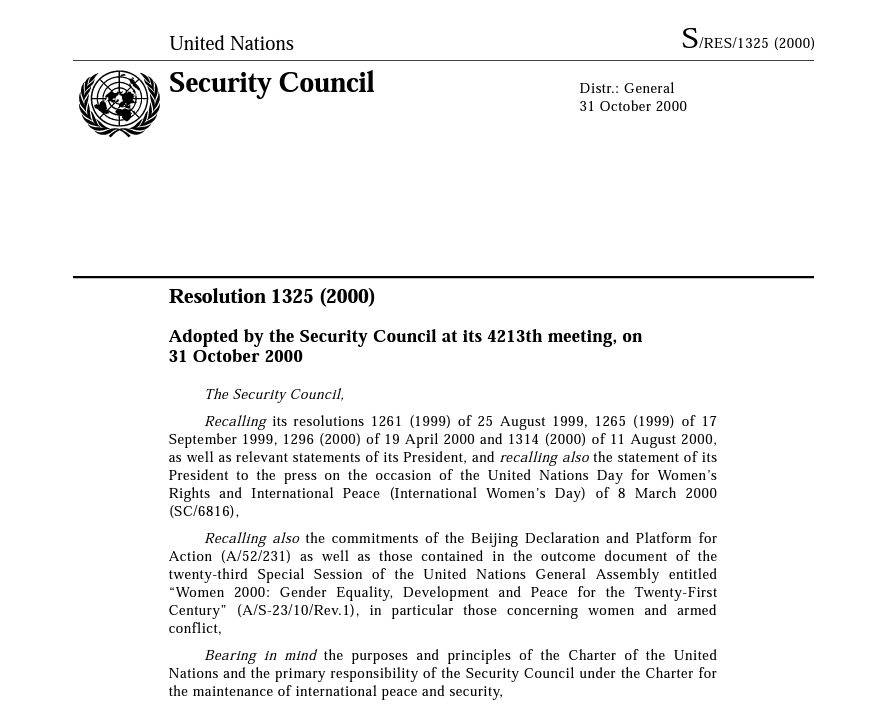
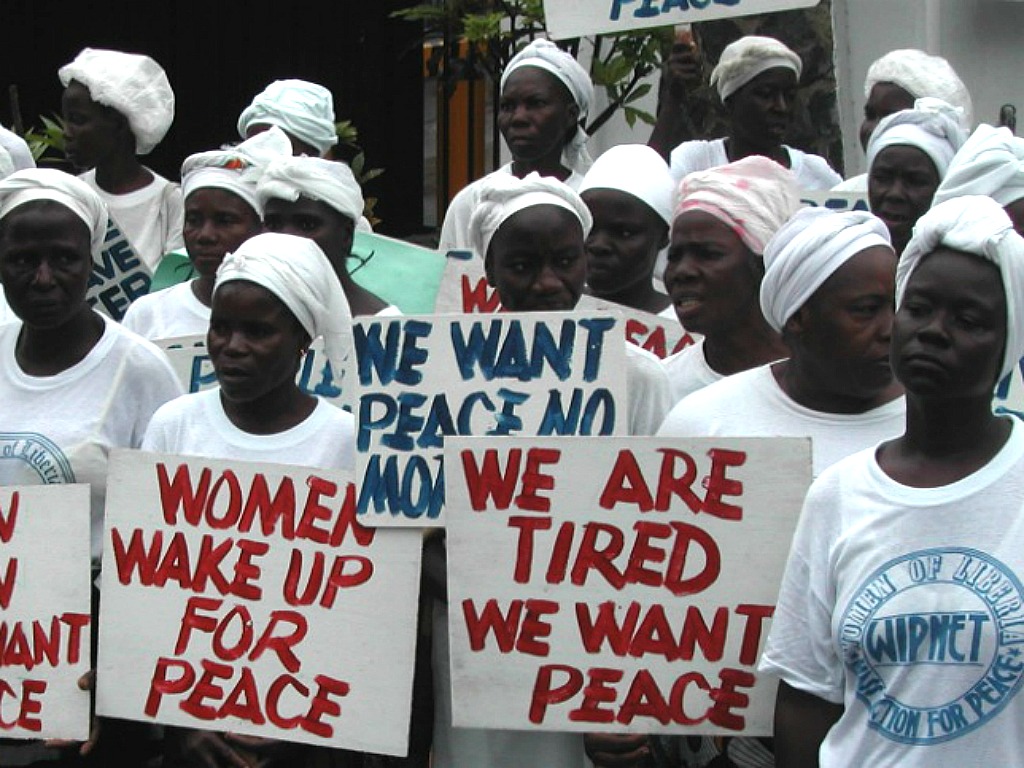
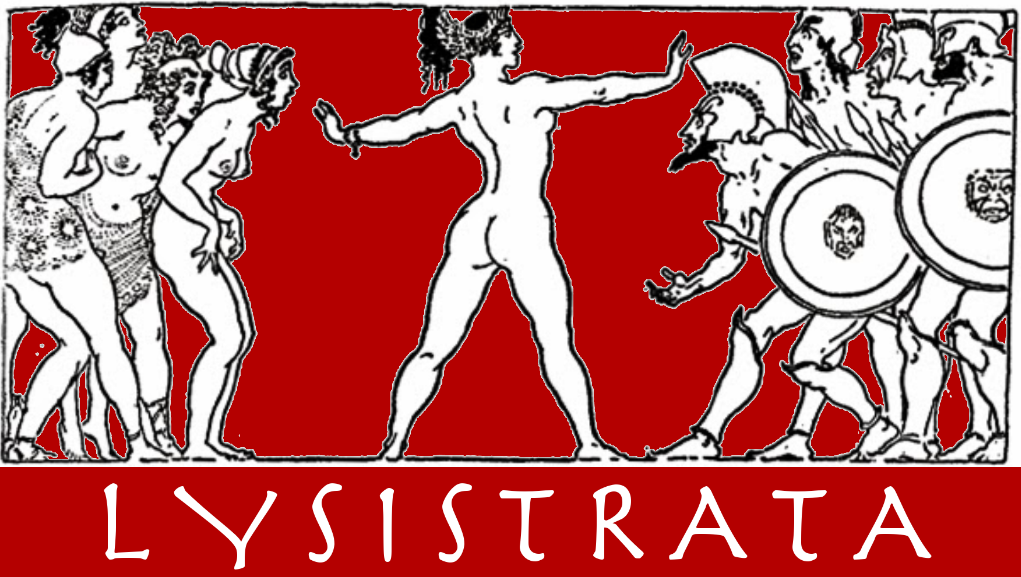
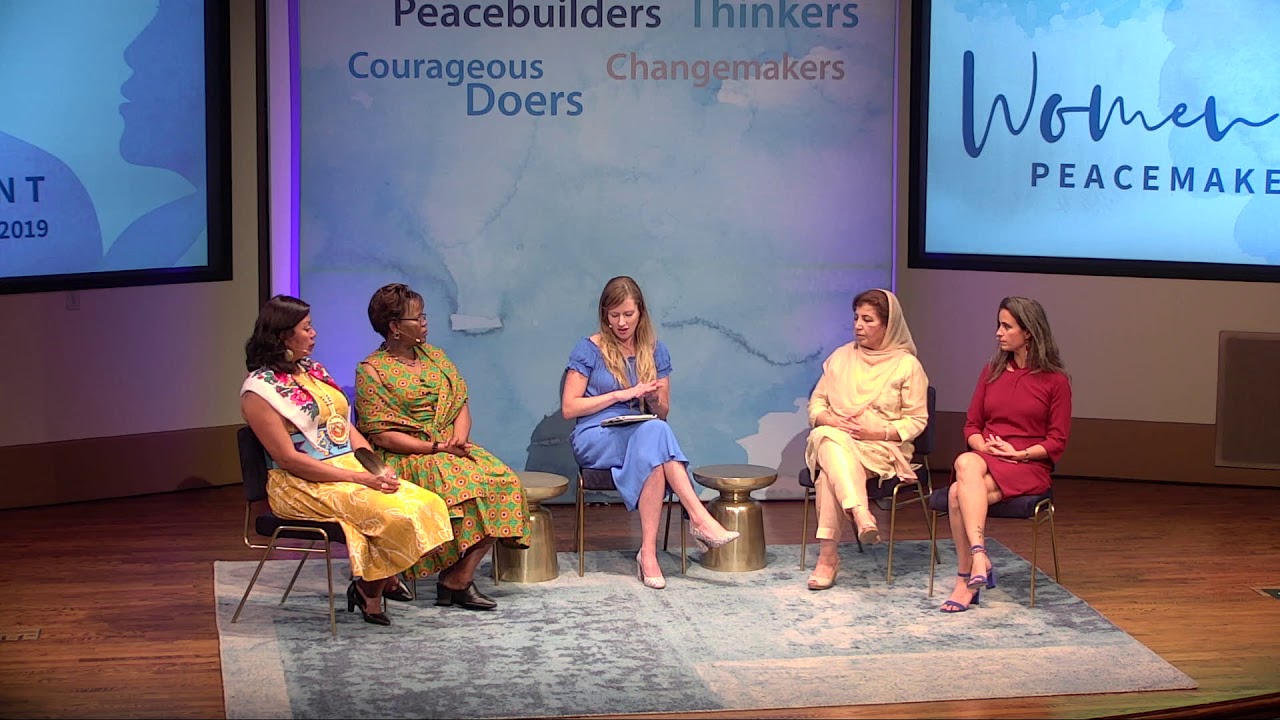
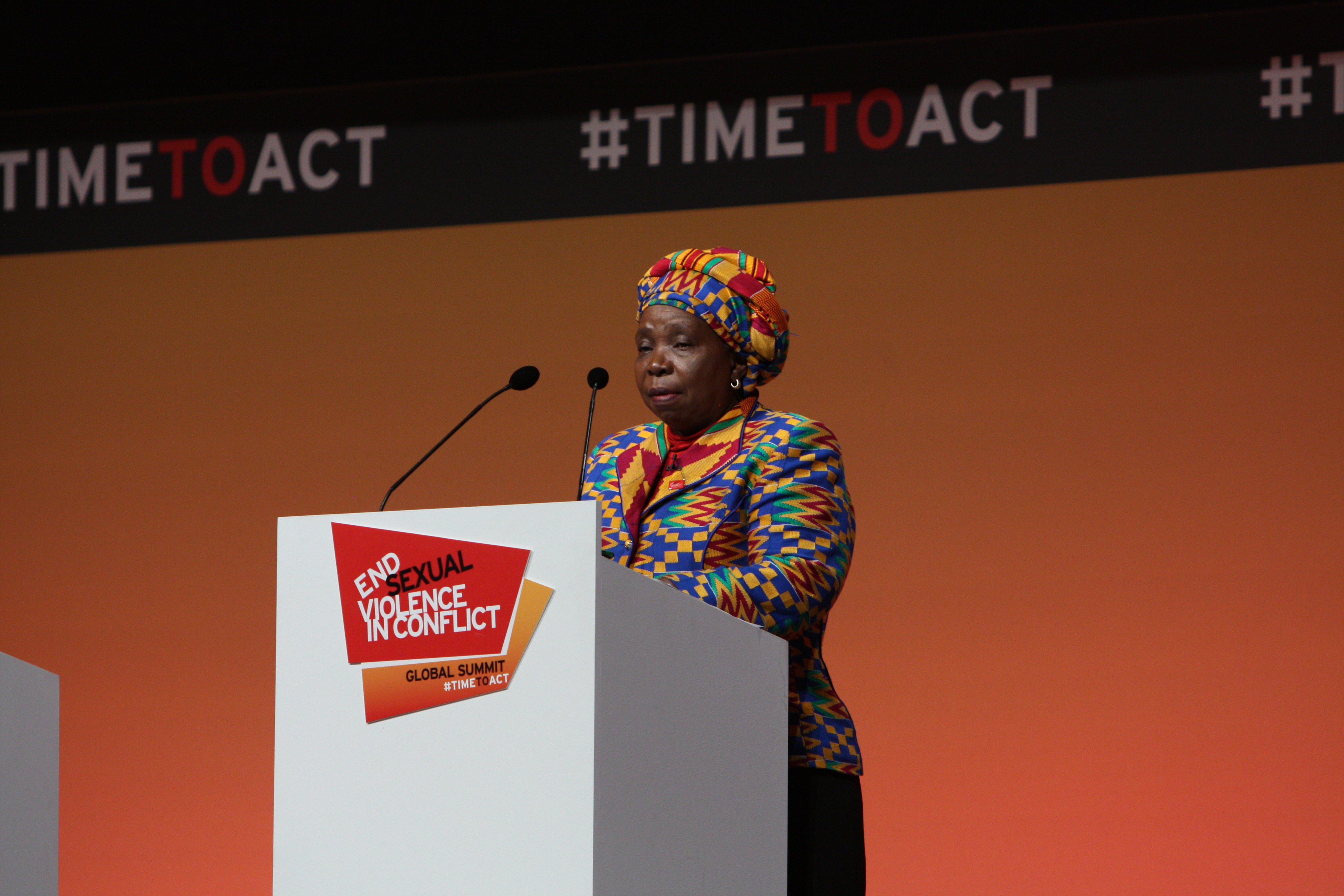
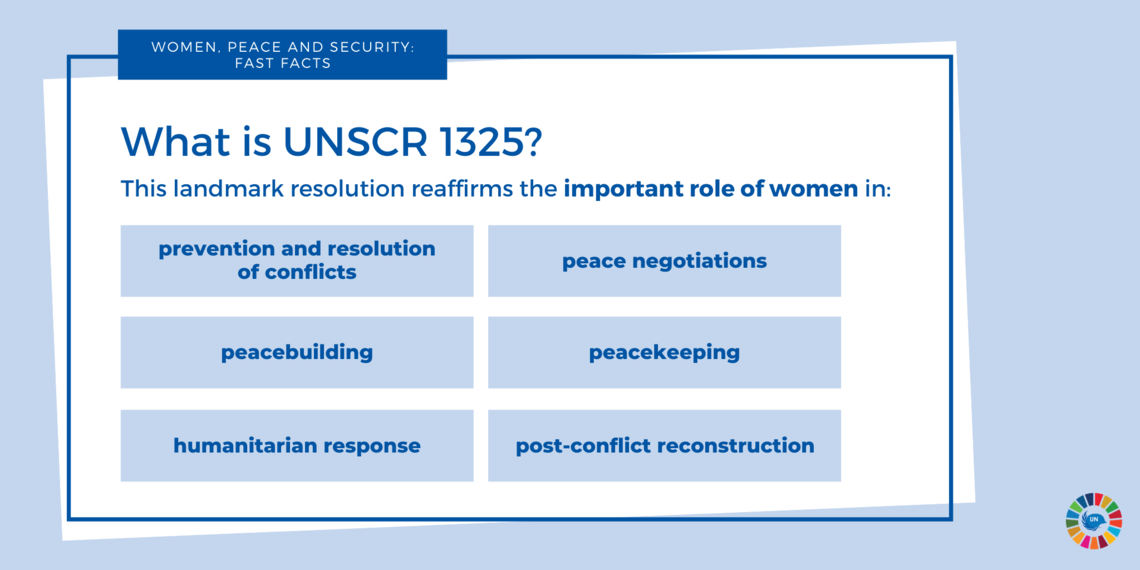
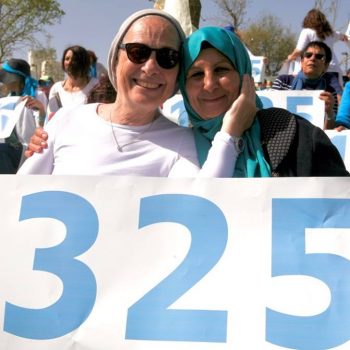
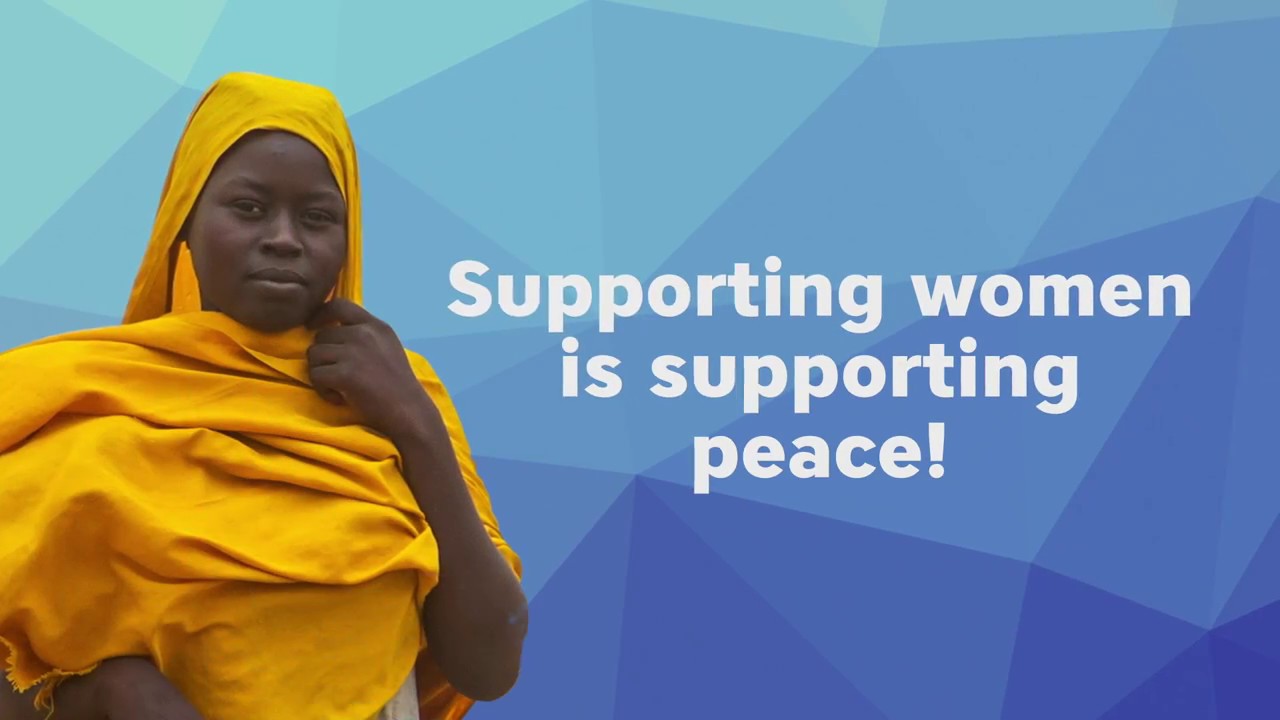
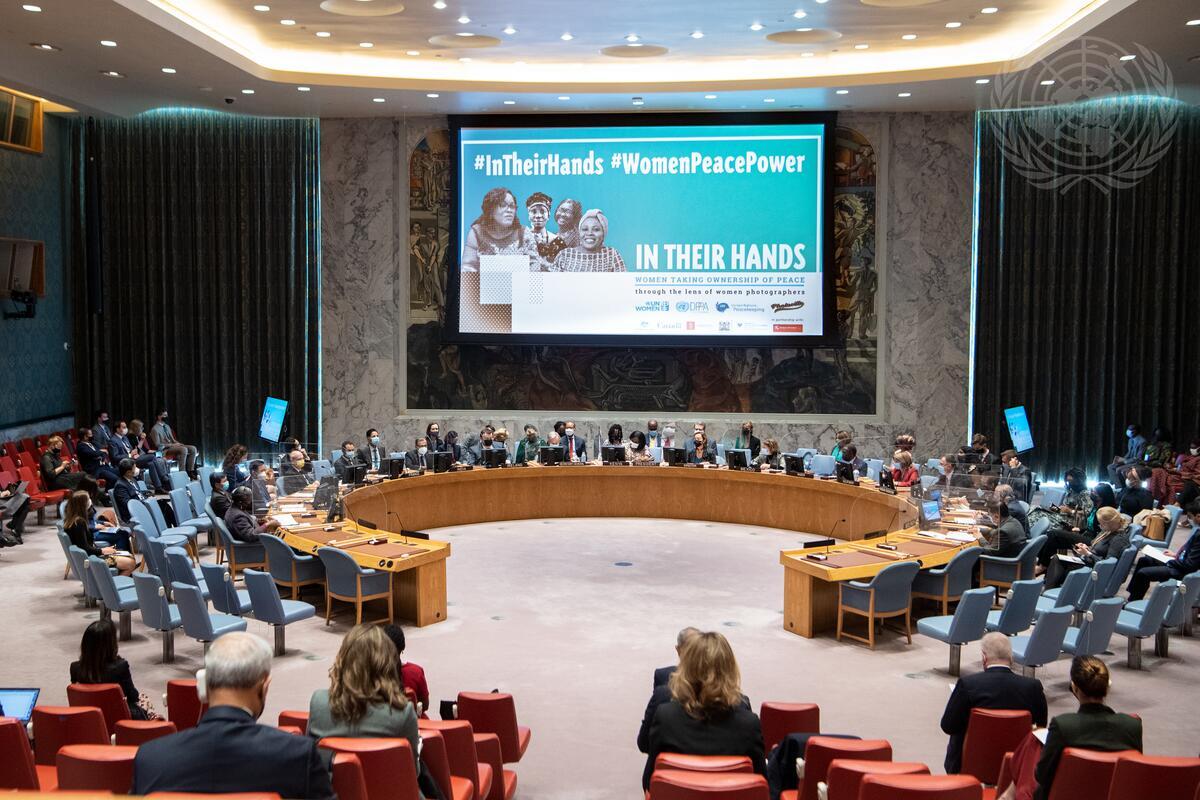
October 31 is the anniversary of the United Nations (UN) Security Council Resolution 1325 which calls for “the full and equal participation of women in conflict prevention, peace processes, and peacebuilding, thus creating opportunities for women to become fully involved in governance and leadership.” This historic Security Council Resolution 1325 of October 31, 2000 provides a mandate to incorporate gender perspectives in all areas of peace support.
Since 2000, there have been no radical changes in UN or governmental practices as a result of Resolution 1325, but the goal has been articulated and accepted.
As UN Secretary-General Antonio Guterres wrote in his 2023 Report on Women, Peace, and Security, “Despite our best efforts, women represented just sixteen percent of negotiators or delegates in the peace processes led, or co-led, by the United Nations.” Women were almost completely missing from peace processes in situations monitored by the UN Security Council such as Ethiopia, Sudan, Libya, and Myanmar.
There has been a growing awareness that women are not just victims in violent armed conflicts and wars – “collateral damage” – but are chosen targets. Recent conflicts have served to bring rape and other sexual atrocities as deliberate tools of war to the forefront of international attention. Such violations must be properly documented; the perpetrators brought to justice; and victims provided with redress.
However, women should not only be seen as victims of war. They are often significantly involved in taking initiatives to promote peace. Some writers have stressed the essential link between women, motherhood, and nonviolence, arguing that those in mothering work have distinct motives for rejecting war which run in tandem with their ability to resolve conflicts nonviolently. Others reject this position of a gender bias toward peace and stress rather that the same continuum of nonviolence to violence is found among women as among men.
In practice, it is never all women nor all men who are involved in peacemaking efforts. Sometimes, it is only a few persons, especially at the start of peacemaking efforts. The basic question is how best to use the talents, energies, and networks of both women and men for efforts at conflict resolution.
October 31 can serve as a day of rededication to inclusive processes for peacebuilding.
Prof. René Wadlow is the Association of World Citizens.
«Bâtir des châteaux en Espagne», que signifie cette expression devenue quelque peu désuète en français ? Elle désigne une personne qui se crée des rêves et des projets chimériques, qu’il ne lui sera jamais possible d’atteindre. L’expression remonterait au seizième siècle, se référant au manque de châteaux dans la péninsule ibérique où, après la Reconquista de 1492, ceux-ci avaient été détruits afin que les Maures, l’ennemi musulman chassé et rêvant de revanche comme le met en scène Corneille dans Le Cid, ne puisse en cas d’invasion les prendre et en faire des places fortes. Depuis lors, «bâtir des châteaux en Espagne» désigne ce qu’il est absurde d’envisager et ne peut exister.
Si l’Espagne est le lieu, au théâtre, des exploits du jeune Don Rodrigue, avant même Corneille et depuis l’Espagne même puisque Guillén de Castro avait écrit avant lui Les Enfances du Cid (Las Mocedades del Cid), elle est aussi celui, en littérature, de l’épopée de deux autres seigneurs, deux «Don», aux ambitions bien opposées.
En ce même dix-septième siècle, Tirso de Molina écrivait El Burlador de Sevilla y convidado de piedra, L’Abuseur de Séville et le convive de pierre, première évocation de Don Juan, séducteur sans scrupule, qui se vit par la suite transposé sur scène par Molière dans Dom Juan ou le festin de pierre puis à l’opéra par Mozart dans Don Giovanni.
C’est aussi l’époque où Miguel de Cervantes rédige son El ingenioso hidalgo don Quijote de la Mancha, L’Ingénieux Don Quichotte de la Mancha, où un hidalgo de basse noblesse se décrète chevalier du Moyen Age et décide de parcourir l’Espagne pour faire justice – fût-ce au prix de l’absurde et du ridicule, comme lorsqu’il décide de s’attaquer à des moulins à vent qu’il prend pour des géants.
En 1965, les Américains Dale Wasserman, Joe Darion et Mitch Leigh créèrent à partir du même personnage une comédie musicale intitulée Man of La Mancha (L’homme de la Mancha). Cervantes lui-même y est mis en scène et Don Quichotte, voulu par son auteur initial comme la satire d’une société espagnole par trop rigide et passéiste, devient un homme noble de naissance mais aussi d’esprit, porté par une «quête» qui le pousse à rechercher «l’inaccessible étoile». Portée à l’écran en 1972 par Arthur Hiller puis adaptée en français par Jacques Brel, la comédie musicale deviendra surtout connue pour sa chanson-phare La Quête, que reprendront ensuite sur scène plusieurs chanteurs français illustres comme Julien Clerc et Johnny Hallyday. «Tenter, sans force et sans armure, D’atteindre l’inaccessible étoile», je mentirais en disant que je n’y trouve pas une certaine inspiration, voire une inspiration certaine, certains jours de regard courbé – là et, à vrai dire, dans tout le reste de la chanson.
Hélas, depuis plusieurs semaines, les Cid et les Don Quichotte semblent avoir perdu le chemin de Madrid, là où les Don Juan, non pas les losers de la séduction chantés avec dérision par Claude Nougaro mais les vrais, ceux qui jouent des femmes comme d’objets et se voient engloutis par l’enfer – ou, du moins, prennent une sérieuse option sur un aller simple là-bas le jour venu de quitter ce monde, donnent le sentiment amer de retenir désormais toute l’attention de l’Espagne, et avec elle de toute la terre, pour des forfaits autrement plus graves que la séduction impertinente et égoïste d’un grand d’Espagne qui se rêvait aussi pourfendeur de Dieu lui-même.
Luis Rubiales soutenu par Woody Allen : «Il ne l’a pas violée»
Qui dit Coupe du Monde de Football disait jadis compétition, tous les quatre ans, entre des équipes d’hommes. C’était oublier que, depuis 1991, la Fédération internationale de Football Association (FIFA) organise aussi, tous les quatre ans, une Coupe du Monde Féminine de Football, créée en 1970 et donc «officielle» depuis plus de trente ans. Là où les éditions précédentes s’étaient tenues sans susciter grand intérêt chez les médias internationaux, l’édition 2023 a brisé les codes et mis le football féminin pour de bon sur la carte du sport mondial.
Le 20 août, à l’issue du match remporté par l’Espagne, Luis Rubiales, Président de la Royale Fédération espagnole de Football (FREF), vient féliciter l’attaquante Jenni Hermoso mais, sans demander la permission ni y être invité, lui agrippe l’entrejambes et l’embrasse sur les lèvres. La footballeuse confirme n’avoir jamais donné son consentement, ce qui fait du baiser forcé de Luis Rubiales une agression sexuelle.
Après les Américaines victorieuses en 2019, là où leurs homologues masculins ne rencontrent guère de succès lors des rencontres internationales, ce sont les Espagnoles qui ont remporté la Coupe cette année, en vainquant les Anglaises qui jouaient, sinon à domicile, du moins à l’intérieur du Commonwealth puisque l’organisation de la Coupe avait été confiée conjointement à l’Australie et la Nouvelle-Zélande. Mais tout juste derrière l’exploit sportif des Espagnoles se cachait une fin autrement plus dramatique de cette épopée sportive, une fin inadmissible en elle-même, plus encore en cette année 2023 où le film Barbie, érigé en conte philosophique pour les droits des femmes, a bouleversé le monde.
Aussitôt mis en cause, Luis Rubiales balaie toute accusation, se posant en victime de ce qu’il présente comme «un faux féminisme», alors que le monde entier l’a vu et que Jenni Hermoso confirme qu’elle n’était pas consentante. Le 26 août, la RFEF suspend Rubiales de la présidence, qu’il refuse cependant de quitter. En fin de compte, le 10 septembre, Rubiales annonce bel et bien sa démission, à l’issue d’une carrière de dirigeant de la RFEF déjà émaillée de scandales.
Il part non sans avoir reçu, pour son agression sexuelle contre Jenni Hermoso, le soutien de Woody Allen, le célèbre acteur-réalisateur américain lui-même accusé d’abus sexuels sur sa fille adoptive Dylan et qui vient donc affirmer des gestes de Rubiales sur Jenni Hermoso qu’il «ne l’a pas violée». Comme le dit l’expression américaine, With friends like these, who needs enemies?, Avec des amis pareils, on n’a plus besoin d’ennemis !
Isa Balado : «Tu as vraiment besoin de me toucher le cul ?»
A peine l’Espagne et le monde sortaient-ils du scandale Rubiales qu’un nouveau drame se produisait, une fois encore en public et en direct à la télévision. Et le lieu ne pouvait être plus annonciateur puisque l’agression s’est produite à Madrid, Place … Tirso de Molina.
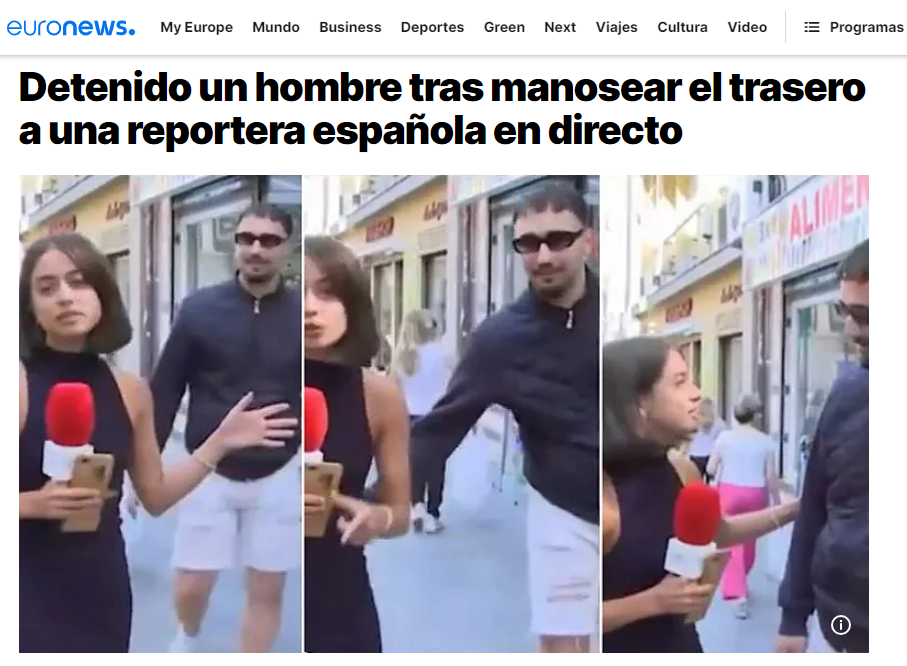
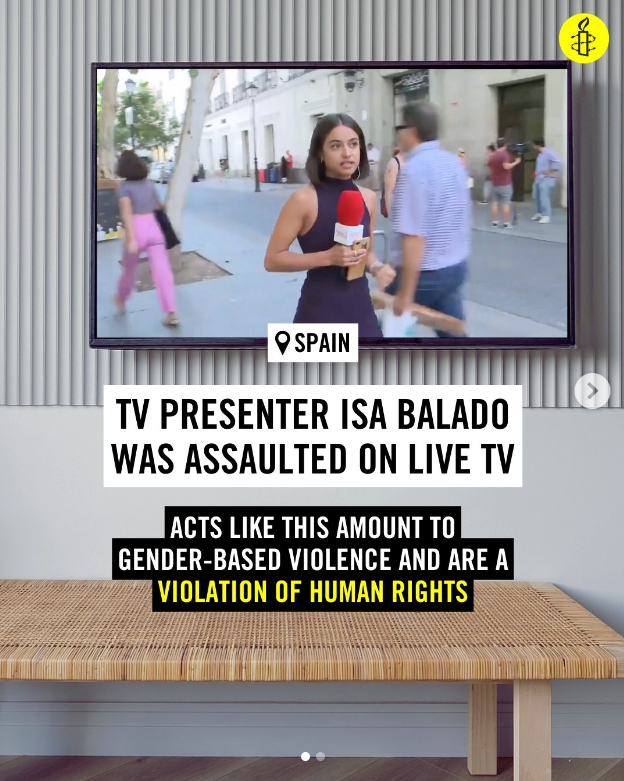
Le 12 septembre, lors de l’émission En Boca de Todos (Tout le Monde en Parle) de la chaîne espagnole Cuatro, la journaliste Isa Balado s’exprimait en extérieur face caméra. Arrivant par derrière, un homme lui a demandé pour quelle chaîne elle travaillait – mais non sans lui avoir, devant la caméra, touché les fesses.
Le présentateur de l’émission a demandé à Isa Balado de confirmer le geste abject de l’importun, ce qu’Isa Balado n’a pu que faire, embarrassée. Après qu’elle a fait remarquer son forfait au coupable, qui l’a nié, elle a ajouté que même lui demander pour quelle chaîne elle travaille n’autorisait pas un tel abus gestuel. «¿De verdad me tienes que tocar el culo?», «Tu as vraiment besoin de me toucher le cul ?» a lancé Isa Balado à son agresseur. Après avoir tenté cette fois de toucher les cheveux d’Isa Balado, qui a tourné la tête pour esquiver le geste, il a fini par s’en aller.
Le scandale fut immédiat, avec des réactions y compris au niveau du Gouvernement, et après un appel de Cuatro à la Police nationale espagnole, l’auteur des attouchements fut rapidement arrêté. Mais rien n’était pourtant réglé.
Malgré le flagrant délit, filmé en direct, le Tribunal de Première Instance N° 54 de Madrid rejeta les réquisitions du parquet qui exigeait l’interdiction pour l’agresseur de communiquer avec sa victime et de s’approcher à moins de trois cents mètres d’elle. Pour le président du tribunal, l’accusé «ne connaissait pas la victime jusqu’au moment des faits», bien qu’il reste à expliquer en quoi ce serait une excuse, et l’agression contre Isa Balado ne constituait pas «une situation de risque, d’urgence, de violence ou d’intimidation contre la journaliste», toute femme dans la rue devant donc selon lui se sentir en sécurité lorsqu’un inconnu vient toucher son corps sans permission ni demande de sa part.
L’affaire ayant été transmise à une autre juridiction pour compétence, les réquisitions du parquet peuvent toutefois encore être acceptées et mises en application. Il n’en demeure pas moins que, même en ce cas, le premier juge saisi aura bel et bien refusé d’agir contre l’auteur d’une agression sexuelle devant des millions de téléspectateurs … Avec tout ce que cela dit d’une société, Amnesty International elle-même qualifiant l’acte de «violation des Droits Humains«, là où un juge nommé par l’Etat et payé par le contribuable pense qu’une femme peut être la Barbie d’un homme non parce qu’elle lui fait comprendre qu’elle a des droits égaux aux siens mais parce qu’il pourrait la toucher tant qu’il le veut, où il le veut, quand il le veut, voire la déshabiller et l’abandonner à son dénuement s’il en trouve une autre plus divertissante.
(C) Amnesty International
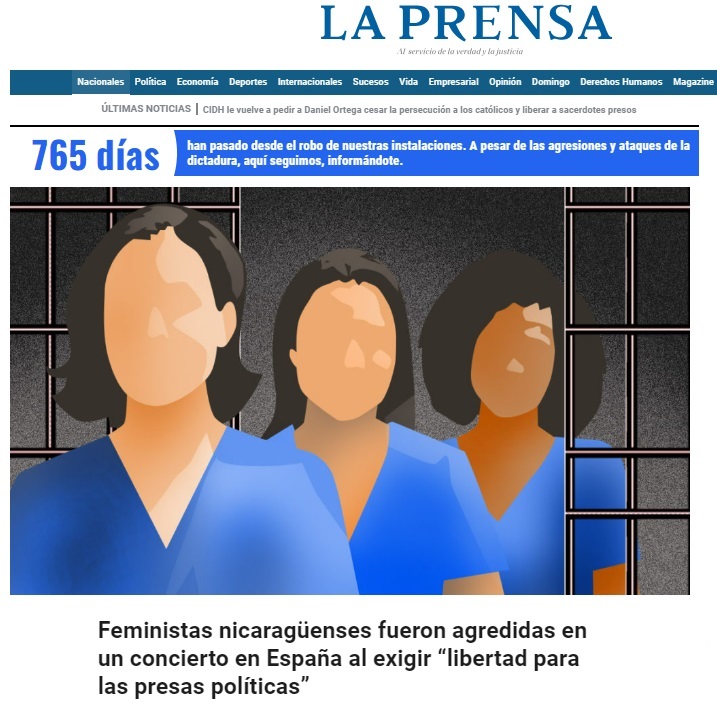
Agressées en Espagne pour avoir défendu les prisonnières politiques du Nicaragua
Ces deux affaires ayant eu lieu en Espagne, du moins entre des sujets espagnols, doivent-elles amener à conclure que le pays serait spécialement sexiste ? Deux malfaisants ne représenteront jamais tout un peuple, et bien que l’Espagne reste une société patriarcale comme toutes les sociétés du bassin méditerranéen où cohabitent les cultures chrétienne, juive et musulmane, les réactions fortes du Gouvernement espagnol démontrent que l’impunité en la matière y est révolue.
Le malheur, c’est que le Royaume d’Espagne est une nation de la WENA (Western Europe and North America ; Europe occidentale et Amérique du Nord) qui donne des leçons au monde entier sur les droits des femmes, et si ni l’Espagne entière ni, a fortiori, ses gouvernants ne sont ici en faute, leur attitude ayant justement été la bonne, il suffit de trois Espagnols, dont l’un agissant tout de même comme juge, pour donner le pire des exemples en Espagne même et partout ailleurs au monde.
Et le mauvais exemple a frappé au moins une fois déjà, les victimes en étant des ressortissantes du Nicaragua où Daniel Ortega et Rosario Murillo imposent désormais leur règne sans partage. Le pire, c’est que leurs agresseurs n’étaient pas des agents de l’Etat en uniforme, main sur la matraque ou prêts à tirer sur des femmes désarmées et prises pour cible sans les avoir provoqués, quelque part dans une ruelle sombre de Managua ou à l’abri du silence d’un village reculé. Il s’agissait de civils, eux aussi désarmés, et l’agression ne s’est pas produite au Nicaragua mais … En Espagne.
Le 24 août, lors du concert d’un chanteur péruvien dans une txosna, auberge traditionnelle accueillant des spectacles, au Pays Basque espagnol, un groupe de femmes nicaraguayennes avaient déployé le drapeau de leur pays accompagné de l’inscription Libertad a las presas políticas, Liberté pour les prisonnières politiques. Soudainement, un homme s’est approché d’elles, les invectivant sur l’inscription qu’elles brandissaient, et sitôt qu’elles ont répliqué qu’elles avaient le droit d’être là, l’homme s’est mis à pousser l’une d’elles avec violence. Une barrière humaine s’est aussitôt formée pour défendre les féministes nicaraguayennes, et après leur avoir crié qu’elles «ne connaissaient pas le passé du Nicaragua», rien de moins, l’homme a été contraint de s’en aller.
Se croyant délivrées de leur agresseur, les féministes n’étaient pourtant pas pour autant à l’abri. Peu après, un autre homme, qui s’est présenté comme membre d’Askapeña, organisation indépendantiste basque se réclamant de l’internationalisme marxiste, est venu les prendre à partie en exigeant qu’elles s’en aillent immédiatement. S’étant prévalues là encore de leur droit d’être présentes à la txosna en tant qu’espace de liberté, les féministes nicaraguayennes se sont entendu rétorquer par l’homme qu’il insistait pour qu’elles s’en aillent au nom de la «solidarité internationaliste», ajoutant que brandir leur drapeau en revendiquant la libération des prisonnières politiques était «une honte» et qu’elles n’avaient «aucune idée de ce qu’est la politique». Devant leur insistance, l’homme est monté sur la scène, interrompant le concert. Au micro, il a désigné les féministes à toute la salle, leur enjoignant de «s’attendre aux conséquences de leurs actes» puis les filmant avant de déployer sur la scène un drapeau du Frente Sandinista de Liberación Nacional, Front sandiniste de Libération nationale, le parti de facto unique de Daniel Ortega et Rosario Murillo au Nicaragua.
Il a fallu que les membres de deux organisations, basque et péruvienne, apportent leur secours aux féministes afin d’éviter un lynchage au nom de la «solidarité internationaliste», apparemment celle des dictateurs, des oppresseurs et, surtout, des hommes lâches qui s’en prennent aux femmes tels des loups en meute.
C’était le 24 août – donc après le baiser forcé et les attouchements sexuels de Luis Rubiales contre Jenni Hermoso, qui avaient d’ores et déjà fait le tour du monde et, sans que l’on puisse en douter, allaient ensuite inspirer l’agresseur d’Isa Balado. Pas d’abus sexuels cette fois-ci, dira-t-on ? Certes. Mais l’idée que les femmes sont inférieures et doivent se conformer aux volontés des hommes, même lorsqu’il s’agit d’idéaux politiques se réclamant du progressisme et qui devraient donc en toute logique inclure le féminisme, était bien présente dans toute son horreur. Dans cette Espagne de Don Juan piétinant sans remord l’amour des femmes envers lui, c’est plutôt ici à Tomás de Torquemada que l’on pense, le moine dominicain qui fut le maître d’œuvre de l’Inquisition au quinzième siècle. Si les dogmes changent, le dogmatisme reste, le bûcher se muant en imprécation verbale et les victimes, jadis les Juifs et les Musulmans, en devenant les femmes.
En Iran, les femmes en danger si l’Occident ignore le sexisme
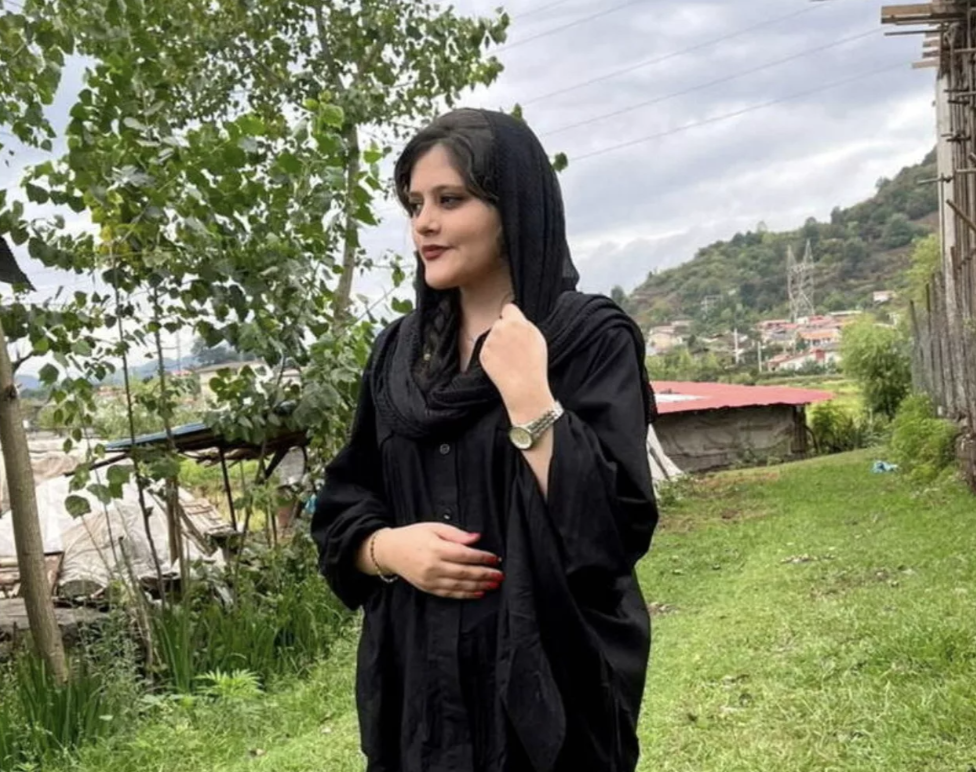
Plus que jamais, la pression doit être maintenue sur les gouvernements du monde qui ignoreraient, voire nieraient, les droits des femmes. Bien entendu sur l’Afghanistan des Talibans et leur apartheid de genre, mais aussi sur le voisin et ancien ennemi des Talibans, la République islamique d’Iran, où résonnait voilà un an le slogan kurde Jin, Jiyan, Azadî, Femme, Vie, Liberté, devenu depuis mondial, après le meurtre par la police des mœurs islamique de la jeune entraîneuse de natation et aspirante-médecin Mahsa Jina Amini, par ailleurs membre des minorités kurde et sunnite du pays. Si le régime des mollahs se maintient depuis à Téhéran, le mouvement populaire de septembre 2022 l’a considérablement affaibli et il le sait, tentant de maintenir une apparence de contrôle sur les esprits mais ne trompant plus personne.
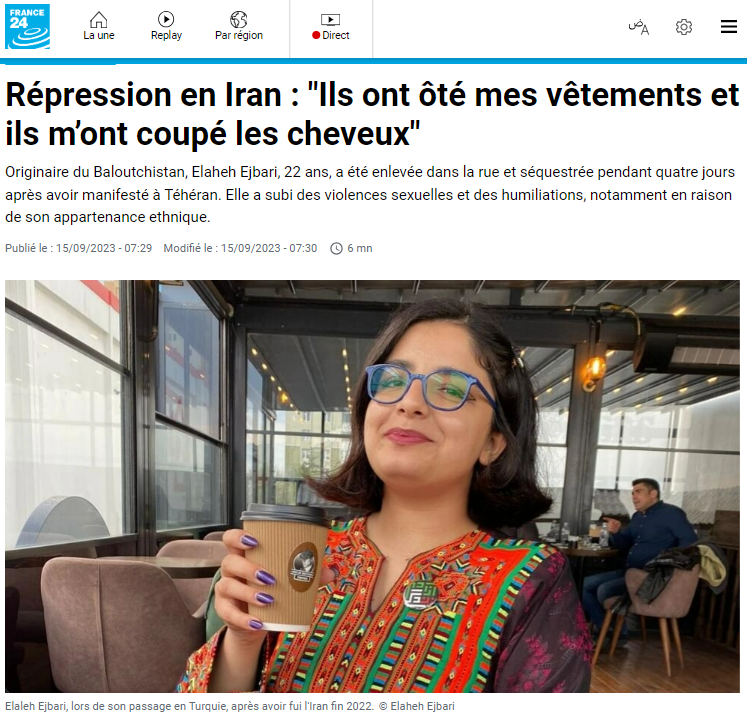
Une autre jeune femme issue d’une minorité ethnique, Elaheh Ejbari, âgée de vingt-deux ans, a récemment attiré l’attention en subissant des tortures qui ont manqué de faire d’elle une nouvelle Mahsa Amini. Elaheh Ejbari, qui est baloutche, avait fui son Sistan-Baloutchistan d’origine aux traditions patriarcales archaïques pour Téhéran où elle avait manifesté après le meurtre de Mahsa Amini. Elle y gagnait sa vie en dispensant des cours particuliers de langues.
Le 5 décembre dernier, revenant d’un cours, elle est enlevée par des inconnus qui la jettent dans une camionnette. L’insultant sur sa peau mate et son origine baloutche, ils l’accusent d’être à la solde de groupes d’opposition à l’étranger puis, après l’avoir frappée, ils lui coupent les cheveux de force, lui arrachent ses vêtements et en viennent – eux aussi – aux attouchements sexuels, lui disant tout leur mépris de la lutte des femmes d’Iran depuis un an.
«Tu aimes ça. Tu dis ‘Femme, vie, liberté’, tu veux te retrouver toute nue, c’est ça ton slogan ? Alors c’est que tu aimes ça. Tu devrais nous remercier.»
Après quatre jours de séquestration, où ils lui répétaient qu’ils ne la tueraient pas mais la renverraient au Baloutchistan pour que ses oncles s’en chargent, ils jettent Elaheh Ejbari en pleine rue. Elle retrouve ses amies, bien sûr inquiètes depuis quatre jours, et leur raconte son calvaire. Sa vie désormais détruite, ses élèves de cours de langues se désistant les uns après les autres et le propriétaire de son logement l’expulsant – peut-être, selon elle, par suite de pressions – elle finit par s’exiler en Turquie où elle vit aujourd’hui.
Difficile – ou hypocrite – de ne pas voir un lien entre les ravisseurs d’Elaheh Ejbari et les autorités iraniennes, qui se savent par trop scrutées désormais pour encore tenter par elles-mêmes au grand jour de tels actes de répression. Le seul langage des lâches alors même qu’ils violaient Elaheh Ejbari suffit à s’en convaincre, l’idée que les femmes sont soit soumises aux diktats masculins, en premier lieu vestimentaires, soit «toutes nues» et génératrices de tentations malsaines pour de pauvres petits hommes fragiles incapables de contrôler des pulsions animales en eux naturelles, constituant un moyen de blocage mental traditionnel du discours islamiste, et la République islamique d’Iran, bien que friande de liens avec l’extrême droite occidentale, islamophobe par excellence, n’en étant pas moins le premier régime islamiste du monde depuis la révolution de 1979.
Naturellement, quatre sujets du Royaume d’Espagne qui ne sont jamais allés en Iran ne peuvent être responsables de ce qui est arrivé à Elaheh Ejbari – et qui s’est produit de toute manière avant les faits qui les ont rendus tristement célèbres. Mais demain, si les dirigeants des pays de la WENA venaient à faiblir face au sexisme devant leurs propres peuples, ces quatre individus et ces mêmes dirigeants pourraient porter leur part de responsabilité dans les violences commises contre d’autres Elaheh Ejbari, Téhéran ne rêvant sans doute pas mieux que l’indifférence de l’Occident lorsqu’il retire toute liberté, voire toute vie, à une femme.
«Le trop de confiance attire le danger»
Même des gouvernements de bonne volonté dans la WENA ne sauront imposer l’idée que les droits des femmes ne sont pas et ne seront jamais solubles dans le discours politique, même lorsqu’il entend se parer de l’absolu de la religion, sans une fermeté exemplaire contre qui, dans la WENA même, se comporte en sens contraire, fût-ce avec le soutien malvenu d’un artiste connu – lui-même mis en cause pour des faits semblables – voire d’un juge.
Ces dernières semaines, l’Espagne a été touchée plus que d’habitude par le problème, mais demain, n’importe quelle nation de la WENA peut l’être à son tour et la nocivité du mauvais exemple ne serait pas moindre s’il s’agissait, loin de la Méditerranée aux traditions patriarcales, de Nordiques scandinaves ou canadiens. La même responsabilité se poserait alors au gouvernement du pays touché d’affirmer clairement qu’il n’existe pas, d’un côté, ses propres bonnes intentions et, de l’autre, l’horreur sexiste de ses administrés dont il s’indigne mais sans plus. Tout comme les politiques européens ont dû apprendre que contrer l’extrême droite xénophobe n’était plus depuis longtemps une seule question de morale, les partis populistes devant être contrés et combattus y compris et d’abord sur le plan substantiel, ils doivent aujourd’hui comprendre que la lutte contre le sexisme ne se satisfait pas davantage du seul anathème.
Autrement, comment la WENA pourrait-elle continuer à convaincre le reste du monde de l’importance des droits des femmes, tels que les définit la Convention sur l’élimination de toutes les formes de discrimination à l’égard des femmes (CEDAW) loin d’être encore ratifiée aussi universellement que l’est, à titre d’exemple, la Convention internationale des Droits de l’Enfant ? Comment rappeler encore et toujours les dispositions de la Résolution 1325 (2000) du Conseil de Sécurité des Nations Unies consacrant le rôle crucial des femmes dans la paix et, justement, la sécurité ? Comment soutenir encore les femmes œuvrant à travers le monde à la démocratie, au développement, à la protection de l’environnement, à la santé, à l’éducation ainsi que dans tous les autres domaines de la société ? Sans oublier toutes celles qui s’illustrent dans le journalisme comme Isa Balado, dans le sport comme Jenni Hermoso, et dans tout ce qui fait d’une civilisation et d’un mode de vie ce qu’ils sont, avec le sort qu’ils réservent aux femmes comme ultime indice de leur humanité.
«Le trop de confiance attire le danger», écrivait Corneille dans Le Cid, où ces mots étaient ceux du roi d’Espagne Don Fernand face à ses conseillers minimisant la montée d’une flotte d’invasion maure vers Séville, invasion qui allait être mise en échec par le jeune Don Rodrigue devenant ainsi «Le Cid» d’après sid, «seigneur» en arabe. «Le trop de confiance», c’est bien souvent ce qui mène à bâtir des châteaux en Espagne, et les derniers événements dans le pays ou liés à ses citoyens viennent rappeler, de manière aussi tragique qu’opportune, que le combat contre le sexisme n’a rien d’une charge de Don Quichotte contre un moulin à vent et que, pour les auteurs d’agressions sexuelles, l’enfer où se voit englouti Don Juan en châtiment de ses provocations répétées, c’est sur cette terre qu’il doit se trouver, ou plutôt, qu’il faut le créer. Cet enfer, ce sera le monde qui leur fait si peur, celui où plus jamais aucune femme n’aura peur.
Bernard J. Henry est Officier des Relations Extérieures de l’Association of World Citizens.
Repression of protests in Iran continues. A wave of protests swept across the country in the wake of the September 2022 death in custody of 22-year-old Mahsa Jina Animi, an ethnic Kurd and Sunni Muslim. It is estimated that the Iranian security forces have killed over 500 protesters and arrested some 20,000 persons of all ethnic and religious backgrounds.
In response to the State-led violence, on November 24, 2022, the United Nations (UN) Human Rights Council created the International Independent Fact-Finding Mission on the Islamic Republic of Iran with the chairmanship of Sera Hossain of Bangladesh.
Mahsa Amini
One aspect of the repression of protests is that religious leaders of the Sunni Muslim communities, especially in Iran’s Sistan and Baluchistan province and in the Kurdish provinces, are being increasingly targeted by the Islamic Republic’s authorities for arrest and imprisonment because of their peaceful criticism of the repression of protests. Iran is a majority Shia Muslim country, and Shiism is the official religion of the State.
Religious minorities include Sunni Muslims, Christians, Baha’is, Zoroastrians, Jews, and the Gonabadi Sufi community. Religious and ethnic identities in Iran often overlap. The Association of World Citizens (AWC) has repeatedly appealed to UN human rights bodies concerning the discrimination and repression of persons of the Baha’i faith.
Another aspect of the repression of protests has been the public hanging of some protesters. The AWC has repeatedly called upon governments for a moratorium on executions with a view of abolishing the death penalty – a penalty that extensive research has shown has little or no impact on the level of crime and too often opens doors to judicial errors and injustices.
The UN International Independent Fact-Finding Mission on the Islamic Republic of Iran has called on Nongovernmental Organizations for direct information. The broader community of NGOs needs to keep public attention focused on events in Iran.
Prof. René Wadlow is President of the Association of World Citizens.
In our current globalized world society, there is an increased role for politics without borders. Politics no longer stops at the water’s edge but must play an active role on the world stage. However, unlike politics at the national level which usually has a parliament at which the actors can recite their lines, the world has no world parliament as such. Thus, new and inventive ways must be found so that world public opinion can be heard and acted upon.
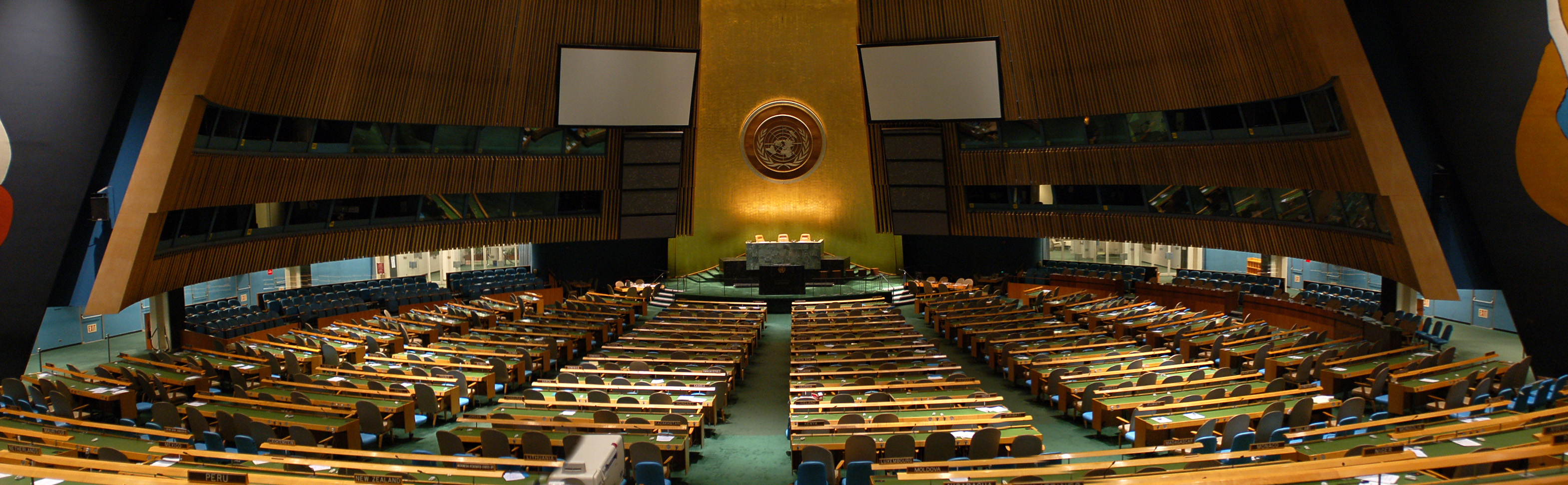
The United Nations (UN) General Assembly is the closest thing to a world parliament that we have today. However, all the official participants are diplomats appointed by their respective States – 195 member states. UN Secretariat members, the secretariat members of UN Specialized Agencies such as UNESCO and the ILO, are in the hallways or coffee shops to give advice. Secretariat members of the financial institutions such as the World Bank and the IMF are also there to give advice on costs and the limits of available funds. The representatives of Nongovernmental Organizations (NGO) in Consultative Status with the UN who can speak at sessions of the Economic and Social Council and the Human Rights Council cannot address the General Assembly directly. However, they are also in the coffee shops and may send documents to the UN missions of national governments.
(C) Jérôme Blum
Politics without borders requires finding ways to express views for action beyond the borders of individual countries. Today, most vital issues that touch the lives of many people go beyond the individual State: the consequences of climate change, the protection of biodiversity, the resolution of armed conflicts, the violations of human rights, and a more just world trade pattern. Thus we need to find ways of looking at the world with a global mind and an open heart. This perspective is an aim of world citizenship.
However, World Citizens are not yet so organized as to be able to impact political decisions at the UN and in enough individual States so as to have real influence. The policy papers and Appeals of the Association of World Citizens (AWC) are often read with interest by the government representatives to whom they are sent. However, the AWC is an NGO among many and does not have the number of staff as such international NGOs as Amnesty International, Human Rights Watch, and Greenpeace.
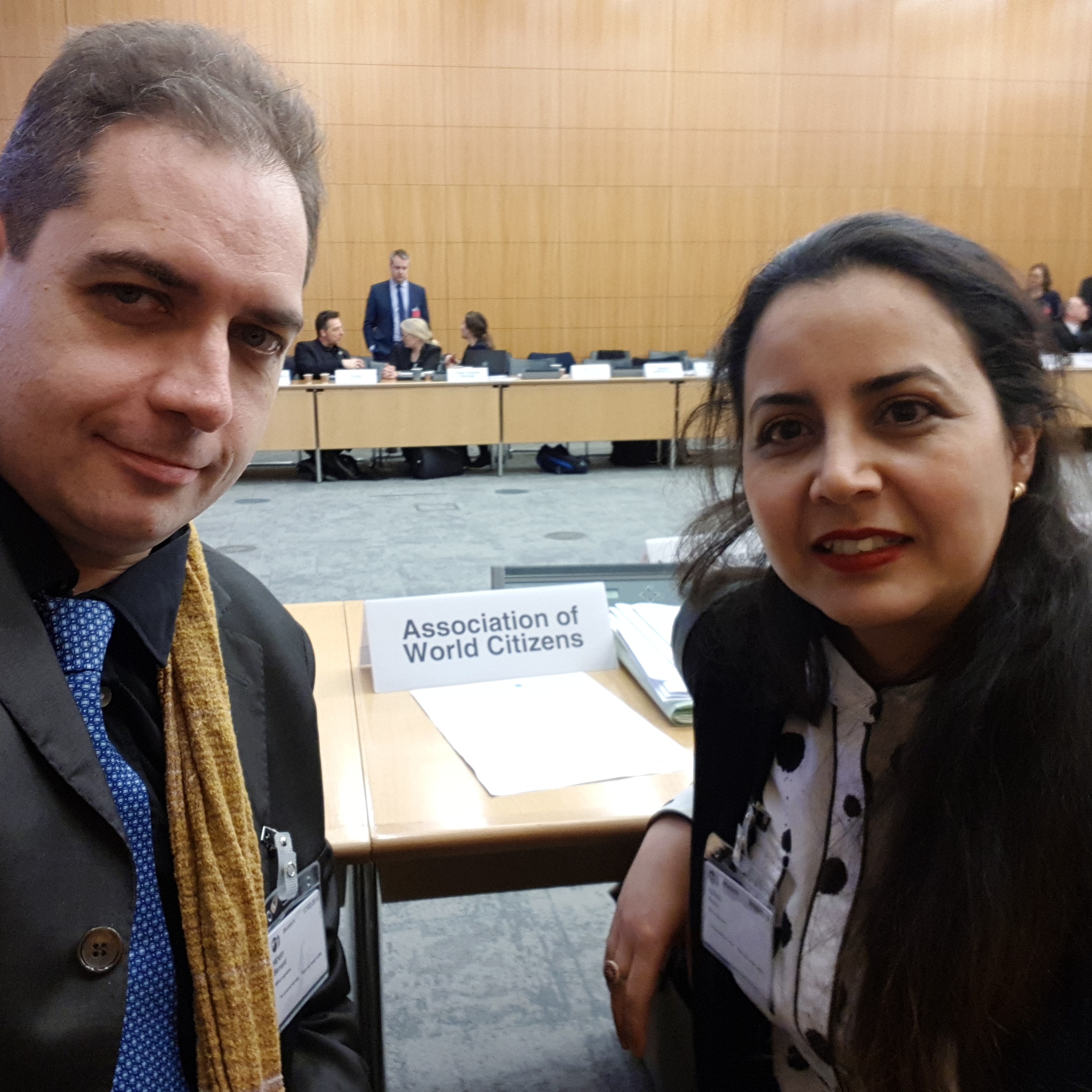
The First Officer and External Relations Officer, Bernard J. Henry, and the Legal and Mediation Officer, Attorney Noura Addad, representing the AWC at an OECD roundtable in March 2019 (C) Bernard J. Henry/AWC
We still need to find effective ways so that humanity can come together to solve global problems, that is, politics without borders. Prof. René Wadlow is President of the Association of World Citizens.
March 25 is the anniversary date of the start of 28 days on continued bombing of Yemen in 2015 by the Saudi-Arabia-led coalition (Bahrain, Egypt, Jordan, Kuwait, Morocco, Qatar, Sudan, United Arab Emirates helped by arms and “intelligence” from the USA and the UK). The aggression by the Saudi coalition turned what had been an internal struggle for power going on from the “Arab Spring” of 2011 into a war with regional dimensions which brought Iran into the picture. The role of Iran has been exaggerated both by the Iranian government itself and by those hostile to Iran. Nevertheless, the Iranian role is real.
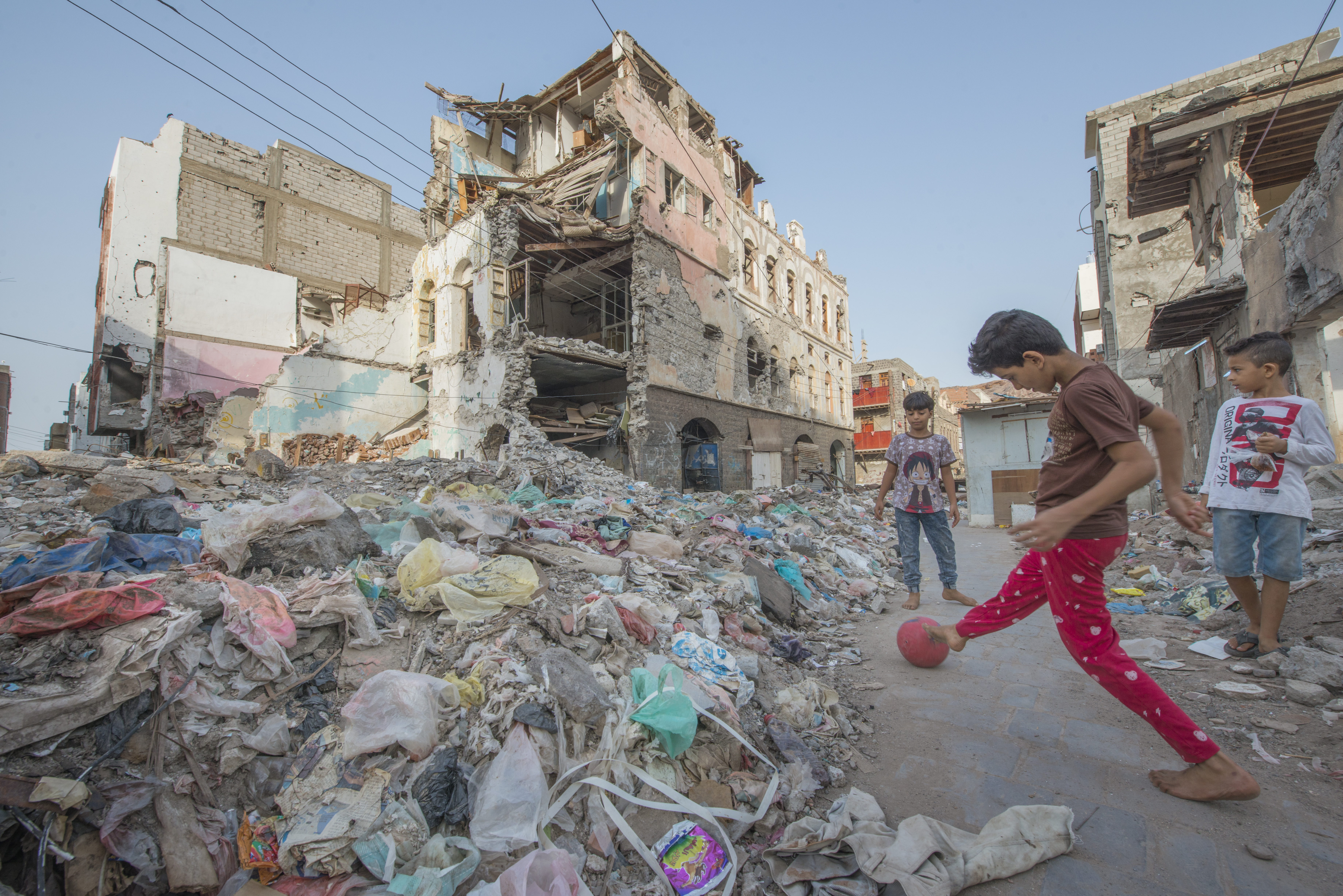
Yemeni children play in the rubble of buildings destroyed in an air raid. (C) Peter Biro/European Union
Since the Association of World Citizens (AWC) had been following possible constitutional developments in Yemen after the 2011 change of government, a couple of days after the March 25, 2015 bombing, the AWC sent to governmental missions to the United Nations (UN) an AWC Appeal for four steps of conflict resolution and negotiations in good faith:
1) An immediate ceasefire ending all foreign military attacks; 2) Humanitarian assistance, especially important for hard-to-reach zones; 3) A broad national dialogue; 4) Through this dialogue, the establishment of an inclusive unity government open to constitutional changes to facilitate better the wide geographic- tribal structure of the State.
While the constitutional form of the State structures depends on the will of the people of Yemen (provided they can express themselves freely), the AWC proposes consideration of con-federal forms of government which maintain cooperation within a decentralized framework. In 2014, a committee appointed by the then President, Abdu Rabbu Mansur Hadi, had proposed a six-region federation as the political structure for Yemen.
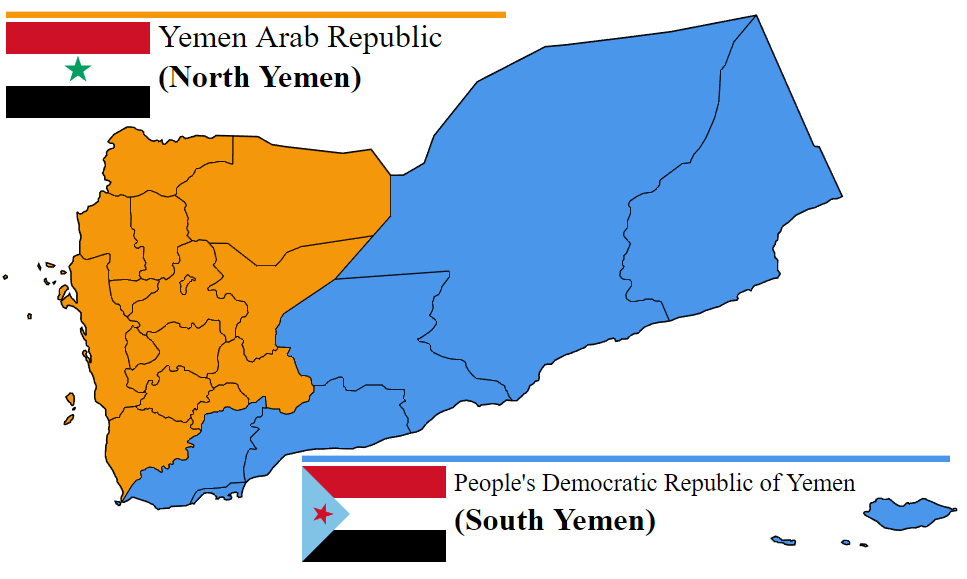
Until 1990, Yemen was two separate States: The People’s Democratic of Yemen in the south with Aden as the capital, and the Yemen Arab Republic in the north with Sana’a as its capital. In 1990, the two united to become the Republic of Yemen. The people in the south hoped that the union would bring the economic development which had been promised. Since, even before the Saudi-led war began, there had been very little economic and social development in the south, there started to grow strong “separatist” attitudes in the south. People of all political persuasions hoped to develop prosperity by ending unification and creating what some have started calling “South Arabia” Today, these separatist attitudes are very strong, but there is no agreement on what areas are to be included in a new southern state, and the is no unified separatist political leadership.
Very quickly after March 25, 2015, many governments saw the dangers of the conflict and the possible regional destabilization. Thus, there were UN-sponsored negotiations held in Geneva in June 2015. The AWC worked with other nongovernmental organizations (NGO) so that women should be directly involved in such negotiations. However, women have not been added to any of the negotiations and are largely absent from any leadership role in the many political factions of the country. There have been UN mediators active in trying to get ceasefires and then negotiations. There have been some temporary ceasefires, but no progress on real negotiations.
Today, the war continues with the country’s fragmentation, continued internal fighting and impoverishment leading to a disastrous humanitarian crisis. There is a glimmer of possible conflict resolution efforts due to the recent mutual recognition of Saudi Arabia and Iran under the sponsorship of the People’s Republic of China. However, creating a national society of individuals willing to cooperate will not be easy. Regional divisions will not be easy to bridge. There have already been divisions within the Saudi-led Coalition. Thus, positive action is still needed. NGOs should seek to have their voices heard.
Prof. René Wadlow is President of the Association of World Citizens.
Pramila Patten, the United Nations (UN) Human Rights Council Special Rapporteur on sexual violence in times of conflict reported mid-October 2022 that rape is increasingly used in the armed conflict in Ukraine as a weapon to humiliate and discourage the populations. There had been an earlier September 27 report to the High Commissioner for Human Rights setting out many of the same facts and calling for international action.
In the past, sexual violence had often been dismissed as acts of individual soldiers, rape being one of the spoils of war for whom rape of women was an entitlement. However, with the 2001 trials of war crimes in former Yugoslavia by the International Criminal Tribunal for ex-Yugoslavia, the first convictions of rape as a crime against humanity and violations of the laws or customs of war were handed down against Bosnian Serb soldiers. Bosnian Serb fighters were charged with mass rape and forced prostitution involving dozens of Muslim women and girls, some only 12 years old. The case had taken five years of investigations and more than 30 witnesses for the prosecution. The three soldiers being tried were given a sentence of 12 years imprisonment.
Since then, we have seen patterns of systematic rape become part of International Humanitarian Law, and since 2002 one of the crimes that can be prosecuted within the International Criminal Court. (1)
There have been reports of systematic rape in Ukraine since 2014 with the creation of the People’s Republics of Donetsk and Luhansk by both Ukrainian and separatist soldiers. However, little international attention was given to these reports. It is only with the invasion of Ukraine by Russian troops on February 24, 2022 that international attention has focused on reports of rape especially in areas that were for a time under the control of the Russian military or the militias of the two People’s Republics. (2)
Unfortunately, it would seem that the armed conflict in Ukraine will drag on. There are few signs of a willingness for a negotiated settlement. International Humanitarian Law moves slowly. Rape as a war weapon is used in other armed conflicts such as those in the Democratic Republic of Congo, Darfur, Sudan, and Syria. Strong nongovernmental pressure is needed to keep governmental and UN efforts going on.
Notes
1) For a good overview of both specific armed conflicts and the slow but steady international response, see Carol Rittner and John K. Roth (Eds), Rape: Weapon of War and Genocide (St. Paul, MN: Paragon House, 2012)
2) See Amnesty International “Ukraine 2021”: http://www.amnesty.org, Secretary-General’s Report, Organization for Security and Cooperation in Europe, http://www.osce.org
Prof. René Wadlow is President of the Association of World Citizens.
Seeing with eyes that are gender aware, women tend to make connections between the oppression that is the ostensible cause of conflict (ethnic or national oppression) in the light of another cross-cutting one: that of gender regime. Feminist work tends to represent war as a continuum of violence from the bedroom to the battlefield, traversing our bodies and our sense of self. We glimpse this more readily because as women we have seen that ‘the home’ itself is not the haven it is cracked up to be. Why, if it is a refuge, do so many women have to escape it to “refuges”? And we recognize, with Virginia Woolf, that ‘the public and private worlds are inseparably connected: that the tyrannies and servilities of one are the tyrannies and servilities of the other.
Cynthia Cockburn, Negotiating Gender and National Identities
October 31 is the anniversary of the United Nations (UN) Security Council Resolution 1325 which calls for full and equal participation of women in conflict prevention, peace processes, and peacebuilding, thus creating opportunities for women to become fully involved in governance and leadership. This historic Security Council resolution 1325 of October 31, 2000 provides a mandate to incorporate gender perspectives in all areas of peace support. Its adoption is part of a process within the UN system through its World Conferences on Women in Mexico City (1975), in Copenhagen (1980), in Nairobi (1985), in Beijing (1995), and at a special session of the UN General Assembly to study progress five years after Beijing (2000).
Since 2000, there have been no radical changes as a result of Resolution 1325, but the goal has been articulated and accepted. Now women must learn to take hold of and generate political power if they are to gain an equal role in peace-making. They must be willing to try new avenues and new approaches as symbolized by the actions of Lysistrata.
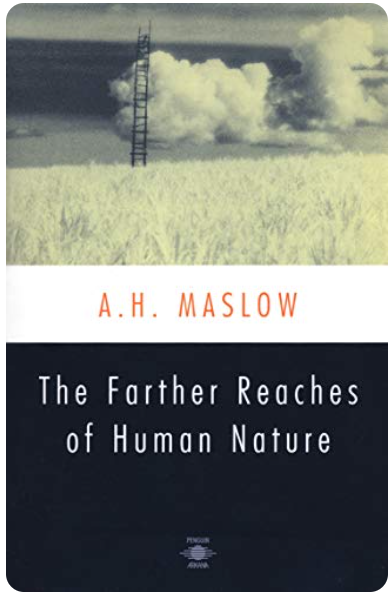
Lysistrata, immortalized by Aristophanes, mobilized women on both sides of the Athenian-Spartan War for a sexual strike in order to force men to end hostilities and avert mutual annihilation. In this, Lysistrata and her co-strikers were forerunners of the American humanistic psychologist Abraham Maslow who proposed a hierarchy of needs: water, food, shelter, and sexual relations being the foundation (see Abraham Maslow, The Farther Reaches of Human Nature). Maslow is important for conflict resolution work because he stresses dealing directly with identifiable needs in ways that are clearly understood by all parties and with which they are willing to deal at the same time.
Addressing each person’s underlying needs means that one moves toward solutions that acknowledge and value those needs rather than denying them. To probe below the surface requires redirecting the energy towards asking “What are your real needs here? What interests need to be serviced in this situation?” The answers to such questions significantly alter the agenda and provide a real point of entry into the negotiation process.
It is always difficult to find a point of entry into a conflict. An entry point is a subject on which people are willing to discuss because they sense the importance of the subject and all sides feel that “the time is ripe” to deal with the issue. The art of conflict resolution is highly dependent on the ability to get to the right depth of understanding and intervention into the conflict. All conflicts have many layers. If one starts off too deeply, one can get bogged down in philosophical discussions about the meaning of life. However, one can also get thrown off track by focusing on too superficial an issue on which there is relatively quick agreement. When such relatively quick agreement is followed by blockage on more essential questions, there can be a feeling of betrayal.
Since Lysistrata, women, individually and in groups, have played a critical role in the struggle for justice and peace in all societies. However, when real negotiations begin, women are often relegated to the sidelines. However, a gender perspective on peace, disarmament, and conflict resolution entails a conscious and open process of examining how women and men participate in and are affected by conflict differently. It requires ensuring that the perspectives, experiences and needs of both women and men are addressed and met in peace-building activities. Today, conflicts reach everywhere. How do these conflicts affect people in the society — women and men, girls and boys, the elderly and the young, the rich and poor, the urban and the rural?
There has been a growing awareness that women and children are not just victims of violent conflict and wars −’collateral damage’ − but they are chosen targets. Conflicts such as those in Rwanda, the former Yugoslavia and the Democratic Republic of Congo have served to bring the issue of rape and other sexual atrocities as deliberate tools of war to the forefront of international attention. Such violations must be properly documented, the perpetrators brought to justice, and victims provided with criminal and civil redress.
I would stress three elements which seem to me to be the ‘gender’ contribution to conflict transformation efforts:
1) The first is in the domain of analysis, the contribution of the knowledge of gender relations as indicators of power. Uncovering gender differences in a given society will lead to an understanding of power relations in general in that society, and to the illumination of contradictions and injustices inherent in those relations.
2) The second contribution is to make us more fully aware of the role of women in specific conflict situations. Women should not only be seen as victims of war: they are often significantly involved in taking initiatives to promote peace. Some writers have stressed that there is an essential link between women, motherhood and non-violence, arguing that those engaged in mothering work have distinct motives for rejecting war which run in tandem with their ability to resolve conflicts non-violently. Others reject this position of a gender bias toward peace and stress rather that the same continuum of non-violence to violence is found among women as among men. In practice, it is never all women nor all men who are involved in peace-making efforts. Sometimes, it is only a few, especially at the start of peace-making efforts. The basic question is how best to use the talents, energies, and networks of both women and men for efforts at conflict resolution.
3) The third contribution of a gender approach with its emphasis on the social construction of roles is to draw our attention to a detailed analysis of the socialization process in a given society. Transforming gender relations requires an understanding of the socialization process of boys and girls, of the constraints and motivations which create gender relations. Thus, there is a need to look at patterns of socialization, potential incitements to violence in childhood training patterns, and socially-approved ways of dealing with violence.
The Association of World Citizens has stressed that it is important to have women directly involved in peace-making processes. The strategies women have adapted to get to the negotiating table are testimony to their ingenuity, patience, and determination. Solidarity and organization are crucial elements. The path may yet be long, but the direction is set.
Prof. René Wadlow is President of the Association of World Citizens.
The United Nations (UN) General Assembly has proclaimed June 19 of each year to be the International Day for the Elimination of Sexual Violence in Conflict in order to raise awareness of the need to put an end to conflict-related sexual violence and to honor the victims and the survivors of sexual violence around the world. The date was chosen to commemorate the adoption on June 19, 2008 of Security Council Resolution 1820 in which the Council condemned sexual violence as a tactic of war and as an impediment to peacebuilding.
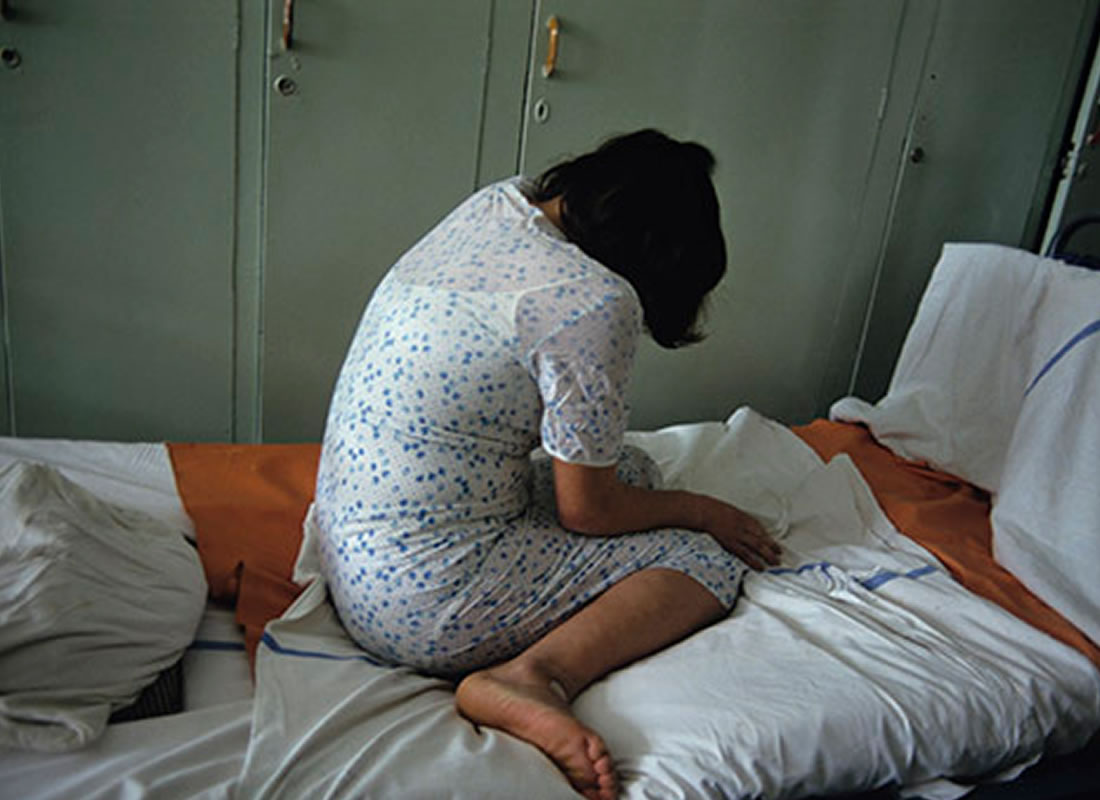
For the UN, “conflict-related sexual violence” refers to rape, sexual slavery, forced prostitution, forced abortion, and any other form of sexual violence of comparable gravity perpetrated against women, men, girls, and boys, linked to a conflict. The term also encompasses trafficking in persons when committed in situations of conflict for purposes of sexual violence or exploitation.
Dr. Nkosazuna Dlamini Zuma, Chairperson, African Union Commission speaking at the Global Summit to End Sexual Violence in Conflict, June 12, 2014. (C) Foreign and Commonwealth Office
There has been a slow growth of awareness-building trying to push UN Agencies to provide non-discriminatory and comprehensive health services including sexual and reproductive health services taking into account the special needs of persons with disabilities. A big step forward was the creation of the UN Special Representative of the Secretary-General on Sexual Violence in Conflict. The post is currently held since April 2017 by Under-Secretary-General Pramila Patten. She recently said “We see it too often in all corners of the globe from Ukraine to Tigray in northern Ethiopia to Syria and the Democratic Republic of Congo. Every new wave of warfare brings with it a rising tide of human tragedy including new waves of war’s oldest, most silenced and least-condemned crime.”
The Association of World Citizens (AWC) first raised the issue in the UN Commission on Human Rights in March 2001 citing the judgement of the International Court for Former Yugoslavia which maintained that there can be no time limitations on bringing the accused to trial. The tribunal also reinforced the possibility of universal jurisdiction that a person can be tried not only by his national court but by any court claiming universal jurisdiction and where the accused is present.
The AWC again stressed the use of rape as a weapon of war in the Special Session of the Commission on Human Rights on the Democratic Republic of Congo, citing the findings of Meredeth Turslen and Clotilde Twagiramariya in their book What Women Do in Wartime: Gender and Conflict in Africa (London: Zed Press, 1998), “There are numerous types of rape. Rape is committed to boast the soldiers’ morale, to feed soldiers’ hatred of the enemy, their sense of superiority, and to keep them fighting: rape is one kind of war booty; women are raped because war intensifies men’s sense of entitlement, superiority, avidity, and social license to rape: rape is a weapon of war used to spread political terror; rape can destabilize a society and break its resistance; rape is a form of torture; gang rapes in public terrorize and silence women because they keep the civilian population functioning and are essential to its social and physical continuity; rape is used in ethnic cleansing; it is designed to drive women from their homes or destroy their possibility of reproduction within or “for” their community; genocidal rape treats women as “reproductive vessels”; to make them bear babies of the rapists’ nationality, ethnicity, race or religion, and genocidal rape aggravates women’s terror and future stigma, producing a class of outcast mothers and children – this is rape committed with consciousness of how unacceptable a raped woman is to the patriarchal community and to herself. This list combines individual and group motives with obedience to military command; in doing so, it gives a political context to violence against women, and it is this political context that needs to be incorporated in the social response to rape.”
The prohibition of sexual violence in times of conflict is now part of international humanitarian law. However, there are two major weaknesses in the effectiveness of international humanitarian law. The first is that many people do not know that it exists and that they are bound by its norms. Thus, there is a role for greater promotional activities through education and training to create a climate conducive to the observance of internationally recognized norms. The second weakness is enforcement. We are still at the awareness-building stage. Strong awareness-building is needed.
Prof. René Wadlow is President of the Association of World Citizens.
Seeing with eyes that are gender aware, women tend to make connections between the oppression that is the ostensible cause of conflict (ethnic or national oppression) in the light of another cross-cutting one : that of gender regime. Feminist work tends to represent war as a continuum of violence from the bedroom to the battlefield, traversing our bodies and our sense of self. We glimpse this more readily because as women we have seen that ‘the home’ itself is not the haven it is cracked up to be. Why, if it is a refuge, do so many women have to escape it to ‘refuges’? And we recognize, with Virginia Woolf, that ‘the public and private worlds are inseparably connected: that the tyrannies and servilities of one are the tyrannies and servilities of the other.
Cynthia Cockburn, Negotiating Gender and National Identities
October 31 is the anniversary of the United Nations (UN) Security Council Resolution 1325 which calls for full and equal participation of women in conflict prevention, peace processes, and peacebuilding, thus creating opportunities for women to become fully involved in governance and leadership. This historic Security Council Resolution 1325 of October 31, 2000 provides a mandate to incorporate gender perspectives in all areas of peace support. Its adoption is part of a process within the UN system through its World Conferences on Women in Mexico City (1975), in Copenhagen (1980), in Nairobi (1985), in Beijing (1995), and at a special session of the UN General Assembly to study progress five years after Beijing (2000).
Since 2000, there have been no radical changes as a result of Resolution 1325, but the goal has been articulated and accepted. Now women must learn to take hold of and generate political power if they are to gain an equal role in peace-making. They must be willing to try new avenues and new approaches as symbolized by the actions of Lysistrata.
Lysistrata, immortalized by Aristophanes, mobilized women on both sides of the Athenian-Spartan War for a sexual strike in order to force men to end hostilities and avert mutual annihilation. In this, Lysistrata and her co-strikers were forerunners of the American humanistic psychologist Abraham Maslow who proposed a hierarchy of needs: water, food, shelter, and sexual relations being the foundation (see Abraham Maslow, The Farther Reaches of Human Nature). Maslow is important for conflict resolution work because he stresses dealing directly with identifiable needs in ways that are clearly understood by all parties and with which they are willing to deal at the same time.
Addressing each person’s underlying needs means that one moves toward solutions that acknowledge and value those needs rather than denying them. To probe below the surface requires redirecting the energy towards asking ‘what are your real needs here? What interests need to be serviced in this situation?’ The answers to such questions significantly alter the agenda and provide a real point of entry into the negotiation process.
It is always difficult to find a point of entry into a conflict. An entry point is a subject on which people are willing to discuss because they sense the importance of the subject and all sides feel that ‘the time is ripe’ to deal with the issue. The art of conflict resolution is highly dependent on the ability to get to the right depth of understanding and intervention into the conflict. All conflicts have many layers. If one starts off too deeply, one can get bogged down in philosophical discussions about the meaning of life. However, one can also get thrown off track by focusing on too superficial an issue on which there is relatively quick agreement. When such relatively quick agreement is followed by blockage on more essential questions, there can be a feeling of betrayal.
Since Lysistrata, women, individually and in groups, have played a critical role in the struggle for justice and peace in all societies. However, when real negotiations begin, women are often relegated to the sidelines. However, a gender perspective on peace, disarmament, and conflict resolution entails a conscious and open process of examining how women and men participate in and are affected by conflict differently. It requires ensuring that the perspectives, experiences and needs of both women and men are addressed and met in peacebuilding activities. Today, conflicts reach everywhere. How do these conflicts affect people in the society — women and men, girls and boys, the elderly and the young, the rich and poor, the urban and the rural?
There has been a growing awareness that women and children are not just victims of violent conflict and wars − ‘collateral damage’ − but they are chosen targets. Conflicts such as those in Rwanda, the former Yugoslavia and the Democratic Republic of Congo have served to bring the issue of rape and other sexual atrocities as deliberate tools of war to the forefront of international attention. Such violations must be properly documented, the perpetrators brought to justice, and victims provided with criminal and civil redress.
I would stress three elements which seem to me to be the ‘gender’ contribution to conflict transformation efforts:
1) The first is in the domain of analysis, the contribution of the knowledge of gender relations as indicators of power. Uncovering gender differences in a given society will lead to an understanding of power relations in general in that society, and to the illumination of contradictions and injustices inherent in those relations.
2) The second contribution is to make us more fully aware of the role of women in specific conflict situations. Women should not only be seen as victims of war: they are often significantly involved in taking initiatives to promote peace. Some writers have stressed that there is an essential link between women, motherhood, and nonviolence, arguing that those engaged in mothering work have distinct motives for rejecting war which run in tandem with their ability to resolve conflicts non-violently. Others reject this position of a gender bias toward peace and stress rather that the same continuum of non-violence to violence is found among women as among men. In practice, it is never all women nor all men who are involved in peacemaking efforts. Sometimes, it is only a few, especially at the start of peacemaking efforts. The basic question is how best to use the talents, energies, and networks of both women and men for efforts at conflict resolution.
3) The third contribution of a gender approach with its emphasis on the social construction of roles is to draw our attention to a detailed analysis of the socialization process in a given society. Transforming gender relations requires an understanding of the socialization process of boys and girls, of the constraints and motivations which create gender relations. Thus, there is a need to look at patterns of socialization, potential incitements to violence in childhood training patterns, and socially-approved ways of dealing with violence.
The Association of World Citizens has stressed that it is important to have women directly involved in peace-making processes. The strategies women have adapted to get to the negotiating table are testimony to their ingenuity, patience, and determination. Solidarity and organization are crucial elements. The path may yet be long, but the direction is set.
Prof. René Wadlow is President of the Association of World Citizens.
On October 31, 2002, the United Nations (UN) Security Council adopted unanimously Resolution 1325 (2000) urging “Member States to ensure increased representation of women at all decision-making levels in national, regional and international institutions and mechanisms for the prevention, management and resolution of conflicts.” Resolution 1325 on Women, Peace and Security was the first time that the UN Security Council acknowledged that women play a key role in promoting sustainable peace and stressed the participation of women in peace processes from the prevention of conflict, to negotiations, to postwar reconstruction and reconciliation.
Work for such a resolution in the Security Council had begun at least five years earlier at the 1995 Beijing Conference on Women with its Beijing Declaration and Platform for Action, and especially at the nongovernmental forum which had been held just outside Beijing, where peacemaking was an important theme. It was thought that a resolution by the UN Security Council would have the most impact since the Security Council rarely discussed social issues. There had been numerous resolutions of the UN Economic and Social Council or the UN Commission on Human Rights dealing with the equality and importance of women. However, such resolutions had had limited impact on national governments’ policy or UN agencies. A UN Security Council resolution would get more attention and indicate a link between the security of States — the chief mandate of the Security Council — and what was increasingly called ‘human security’, that is, the security of people.
It was important to find the balance between calling attention to the special needs of women and children in times of conflict and yet not to reinforce the stereotype of women as victims only. Thus, there was a need to stress the important positive role that women play as peacebuilders and their potential role in peace processes and negotiations.
Resolution 1325 is an important building tool for the role of women in peacemaking. The resolution, by itself, has not changed things radically. There are still few women at the table when serious peace negotiations or reconstruction planning is undertaken. In fact, there are relatively few formal peace negotiations to help resolve armed conflicts in Yemen, Syria, Afghanistan, Libya. The UN has provided mediators, but the armed groups are not speaking to each other at least not in public. For the moment, the best that can be done is to help create an atmosphere in which negotiations would be possible. Here women already play an active role, but more needs to be done. Resolution 1325 sets out the guidelines, and now NGOs, governments, and UN agencies can work to transform these guidelines and norms into practice.
Prof. René Wadlow is President of the Association of World Citizens.