“Is not this what I require of you … to snap every yoke and set free those who have been crushed?”
Isaiah, 58 v 6
There are many ways that we are held in chains as individuals through our own desires and habits. There are also many ways that society keeps others in chains. Our task is to help snap the individual bonds of slavery through our efforts at self-liberation and self-realization. To break the chains that society creates, we must work together cooperatively.
Slavery today, as in the past, can have one or more of the following characteristics: A slave is forced to work though mental or physical threat. The person is owned or controlled by an “employer” usually through mental or physical abuse and threats. The person is dehumanized by being treated as a commodity and bought and sold as if property. There are also restrictions placed on a person’s freedom of movement and kept isolated from those who might help to break the chains.
(C) Bernard J. Henry/AWC
Women are often the victims of diverse forms of servitude, and International Women’s Day is an appropriate time to analyze patterns and our efforts to liberate. Here we can look at four categories through there are often links among them.
A first category is debt bondage, especially practiced in South Asia. It is estimated that there are some 20 million people held in debt bondage throughout the world, even though debt bondage is forbidden by the Supplementary Convention of 1956 on the Abolition of Slavery, the Slave Trade and Institutions and Practices Similar to Slavery. Debt bondage is largely a rural practice, and local government officials and police often overlook its consequences. The debt is usually contracted in an emergency such as sickness or to cover expenses between harvests. However, often the person making the debt from money lenders or richer farmers cannot read and, therefore, has no idea of what “rates of interest” means, nor do they know when they have worked off the debt. It is often a child or younger member of the family who is “given” to work to pay off the debt. The debt is often never considered to have been paid and will go from one generation to the next.
Child labor is a second and related category of contemporary slavery. The International Labor Organization (ILO) estimates that there are some 180 million youth aged between 5 and 17 years old who are in the worst forms of child labor – work that is hazardous to their mental and physical health. The ILO Convention of 1999 (N° 182) is devoted to the “Worst Forms of Child Labor.” Translating these ILO efforts to the local workplace is a large job and needs to be done with care as some families depend heavily on income from children’s work.
Early and forced marriage is a third category of contemporary slavery. This form is often overlooked or excused as “custom” for it is usually carried out by the families themselves. In many societies, marriage is an alliance between families with elements of social control over wealth, power, and the sexuality of women as the motive. Women and girls are married without choice and often forced into lives of servitude. Because the girl child is seen in some communities as having lower priority, she is often denied access to such basic necessities as education which could ultimately protect her from exploitation.
A fourth category is human trafficking, often linked to prostitution which is the fastest-growing means by which people are enslaved today. Women, children and men are coerced and deceived by traffickers who promise work and good pay in areas far from their family and community. The reality is usually a harsh contrast. People are forced through the threat and use of violence to work against their will. Trafficking in persons is often carried out by groups which also traffic guns, drugs and pornography. These groups are willing to kill to keep their trade growing and often corrupt local officials and police.
Thus, on this International Women’s Day, we need to evaluate closely the challenges which face us within global society and to set out clearly the steps which must be undertaken for equality and justice.
The January 20, 2025 inauguration of President Donald Trump has brought into sharp focus the turbulent and complex world society in which we live. As peacebuilders and citizens of the world, we face the same challenges as President Trump but with a different style and with far fewer resources at our command. We make plans but then are called to work for conflict resolution in unanticipated ways.
There are four policy challenges which face both President Trump and World Citizens: armed conflicts, currently ongoing and potential, persistent poverty in many areas, the erosion of international law and faith in multinational institutions, particularly the United Nations (UN), and the consequences of climate change.
The ongoing and potential armed conflicts are neither new nor unexpected. The Israeli-Palestinian tensions exist at least since 1936 and increased after the creation of the State of Israel. There may be some possibilities for negotiations in good faith. We must keep an eye open for possible actions.
Tensions with Iran are not new. The Soviet forces in part of Iran was the first conflict with which the UN had to deal in its early days. However, the rule by the Ayatollahs has made matters more complex.
The Russian-Ukrainian war grinds on with a large number of persons killed, wounded, and uprooted. Again, we must look to see if a ceasefire and negotiations are possible.
In Asia, the armed conflict in Myanmar between the military in power and the ethnic militias dates from the creation of the Burmese State at the end of the Second World War. A potential armed conflict between Mainland China and Taiwan dates from 1949 and the Nationalist government’s retreat to Taiwan. The potential armed conflict between the two Korean States dates from 1950 and the start of the Korean War.
The armed conflicts in Africa are no longer in the headlines, but they date from the early 1960s and the breakup of the European Empires: the Democratic Republic of Congo, Sudan, the States of the Sahel.
Thus, we all have a poor record of armed conflict prevention and mediation. Armed conflicts should remain at the top of both the governmental and nongovernmental agenda for action.
(C) U.S. Embassy France on Instagram
Persistent Poverty: Despite the UN Decades for Development, the Sustainable Development Goals, and Article 22 of the Universal Declaration of Human Rights which states that everyone is entitled to the economic, social, and cultural rights indispensable for his dignity and free development of his personality, persistent poverty exists in many parts of the world. One consequence of persistent poverty is migration from poorer to richer areas, both within countries and from poorer to richer States. Migration is a hotly debated issue in many countries, as right-wing nationalist groups make anti-migration their battle cry. Migration is likely to become an even more heated topic of debate as President Trump tries to carry out his proposal for a mass deportation of immigrants from the USA.
Linked to persistent poverty are trade issues and the protectionist trends in many countries. President Trump has proposed higher tariffs for good coming into the USA. This policy may set off tariff wars. Obviously to counter persistent poverty, world development policies must be improved – easier said than done!
The Erosion of International Law and Faith in Multinational Institutions: Armed conflicts and persistent poverty are closely related to the third issue: the receding United States (U.S.) involvement with the UN, the World Bank, the IMF, the World Court and other multinational organizations. Some of the foreign policy authorities appointed by President Trump are overtly critical of the UN and the International Criminal Court. There has already been an Executive Order to halt U.S. funding of the World Health Organization. However, there is no unifying vision of what a new world society would involve. The battle cry of “Make America Great Again”, if repeated by each State for itself, “Make Panama Great Again”, could be a loud concert but not conducive to positive decision making.
The Consequences of Climate Change: The fourth major group of issues concerns the consequences of climate change and the ways to lessen its impact. During the campaign for the presidency, Trump threatened to pull the USA out of the Paris Climate Agreement, and he has now signed an Executive Order doing so. The issue of climate change has been brought to the world agenda by scientists on the one hand, and by Nongovernmental Organizations and popular, often youth-led efforts, on the other hand. It is likely that these vital efforts related to climate change will continue despite climate policy resistance by some in the Trump administration.
President Trump said during his inaugural ceremony that “The Golden Age of America begins now… We stand on the verge of the four greatest years in American history.” We will have to watch closely and judge in four years. What is sure for peacebuilders and citizens of the world is that we stand on the verge of four more years of serious challenges. Thus, there is a need for cooperative and courageous action.
Prof. René Wadlow is President of the Association of World Citizens.
The flight of the Syrian dictator Bashar al-Assad on December 7, 2024 from Damascus to Moscow has opened a radically new period for Syrian politics. There are many different armed militias, ethnic and religious factions working to gain influence in the post-Assad situation. There are also outside powers – Iran, Russia, Turkey, and the USA which have been playing a role for some time and are not likely to fade from the scene overnight.
Women played only a minor direct role in the al-Assad administration and only minor roles in the groups opposing the Assad government, especially once the opposition became militarized mid-2011. Now, we must strive so that women can play a positive and active role in developing the new structures for a new Syria. Excluding women from peacebuilding neglects a rich source of skills, insights and energy. It is important to recognize that women are not a homogeneous group: education, class, ethnic group identity condition how individuals are affected by conflict.
We have seen with the Taliban administration in Afghanistan what can happen when women are not actively structured to play a role before there is a change in government. While not as vocal as the Afghan Taliban, there are most likely men in Syria in Jihadist factions who wish to keep women secluded and powerless.
Thus, women activists need to promote a vision that goes beyond the negotiation table. Negotiations to structure the new government are likely to begin in the next few days. There had been earlier negotiations among Syrian factions held at the United Nations in Geneva in 2014 with few or no women involved. Women face major challenges to engage in formal peace negotiations. Exclusion is often the norm. Therefore, women need to organize quickly now to spearhead Syrian civil society and reconciliation activities.
In the period after mid-2011 when opposition to the al-Assad government became an armed uprising, many Syrians left Syria for neighboring countries such as Lebanon and Turkey but also more widely to other countries in Western Europe. Some of these refugees were whole families with men present. In many cases, it was women with their children. Women had to learn skills in order to earn a living. They also started to get organized in mutual help organizations. These skills can be used today as the refugees return to Syria.
With the departure of al-Assad, the prisons have been opened. Men, often activists and intellectuals, have been liberated. They will want to play a role in helping develop new structures. However, they are related to different opposition factions and may have different view of what should be a future Syria.
We, on the outside and who are not Syrians, can try to support Syrian women involved in peacebuilding initiatives that are inclusive of both women and men. There is a need for relevant and timely support. We must see what avenues are open and how local conditions evolve.
Prof. René Wadlow is the Association of World Citizens.
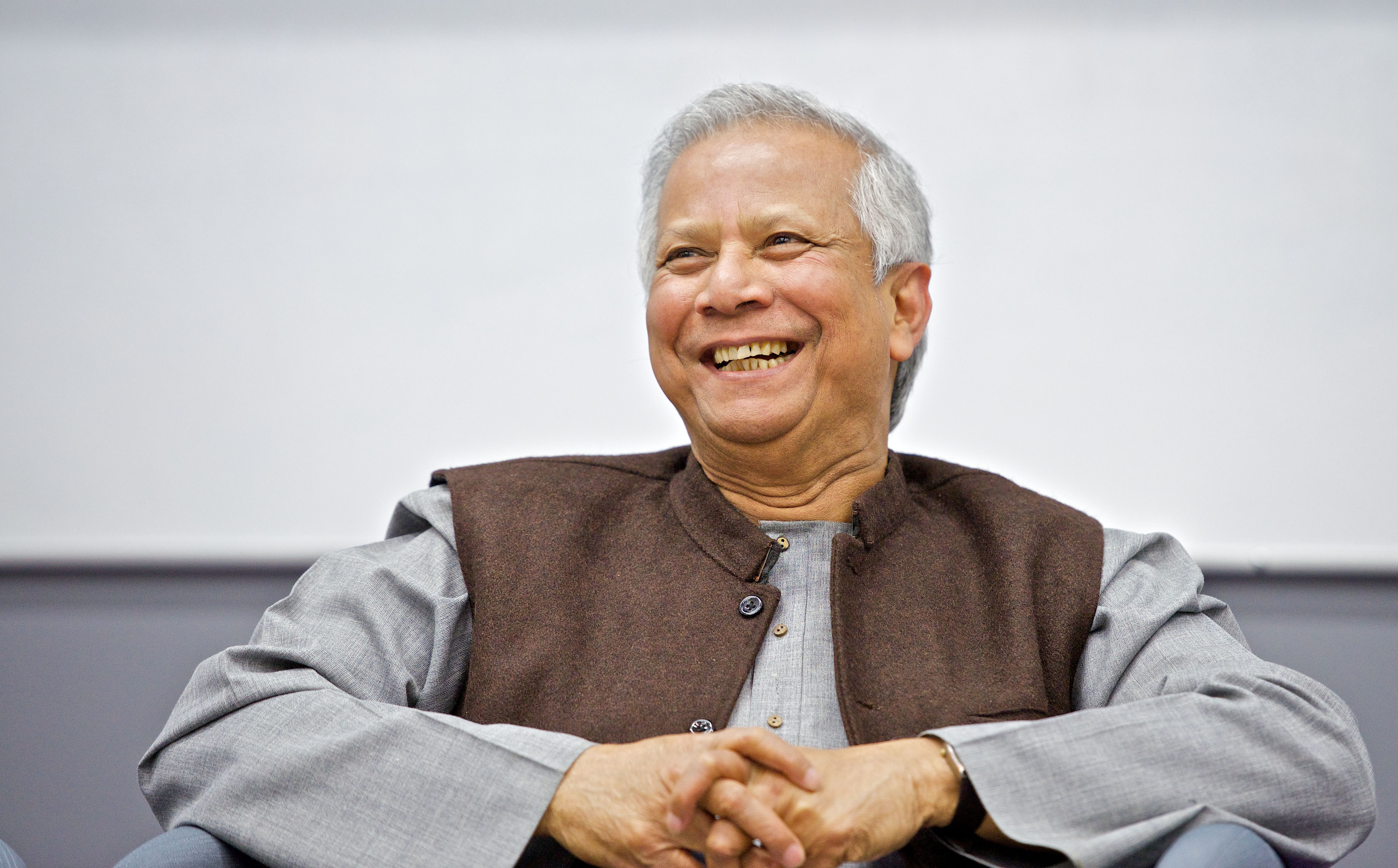
Muhammad Yunus, the founder of the microcredit banking system in Bangladesh, the Grameen Bank (which translates as “Village Bank”), was sworn in as the interim leader of the Bangladesh government on August 8, 2024. The former leader, Sheikh Hasina, resigned and then fled to India, driven out by the protests first of students and then by other sectors of the population during which some 400 persons were killed by the military and the police. Muhammed Yunus has called for calm and an end to uncontrolled violence often directed against the minority Hindu population.
Muhammad Yunus is an economist. Now 84 years old, he is retired from teaching, originally at the University of Chittagong, the port city of Bangladesh. As an economist, he was quickly aware of rural poverty in many parts of the country and the unrest of the tribal minorities in the Chittagong Hill Tracks. He developed the concept of the Grameen Bank, small loans, especially to women, in order to improve their trading efforts. Much of what is called “the informal sector” – marginal to the more developed economy – are the efforts of market women and women small producers. With small loans which must be repaid before a new loan is possible, women are able to have more security and can expand their business.
Prof. Muhammad Yunus at the University of Salford, UK, on May 18, 2013 (C) University of Salford Press Service
The Grameen Bank approach spread to nearly all areas of Bangladesh and then to other countries, especially in Africa. The success of the Grameen Bank approach has lifted many from the cycle of poverty and instability. In recognition of the impact of the Grameen Banks, Muhammad Yunus was awarded the Nobel Prize for Peace in 2006.
Muhammad Yunus has formed an interim government of 16 persons, mostly drawn from civil society organizations, including two, Nahid Islam and Asif Mahmud, both 26 years old, who were leaders of the student movements which overthrew Sheikh Hasina who had been in power for 15 years – whose government had become increasingly authoritarian. Muhammad Yunus has promised that elections will be held shortly but that calm must be restored first. He faces difficult tasks, but he is a fresh mind outside the narrow political milieu. We must wish him well in his vital efforts.
Prof. René Wadlow is President of the Association of World Citizens.
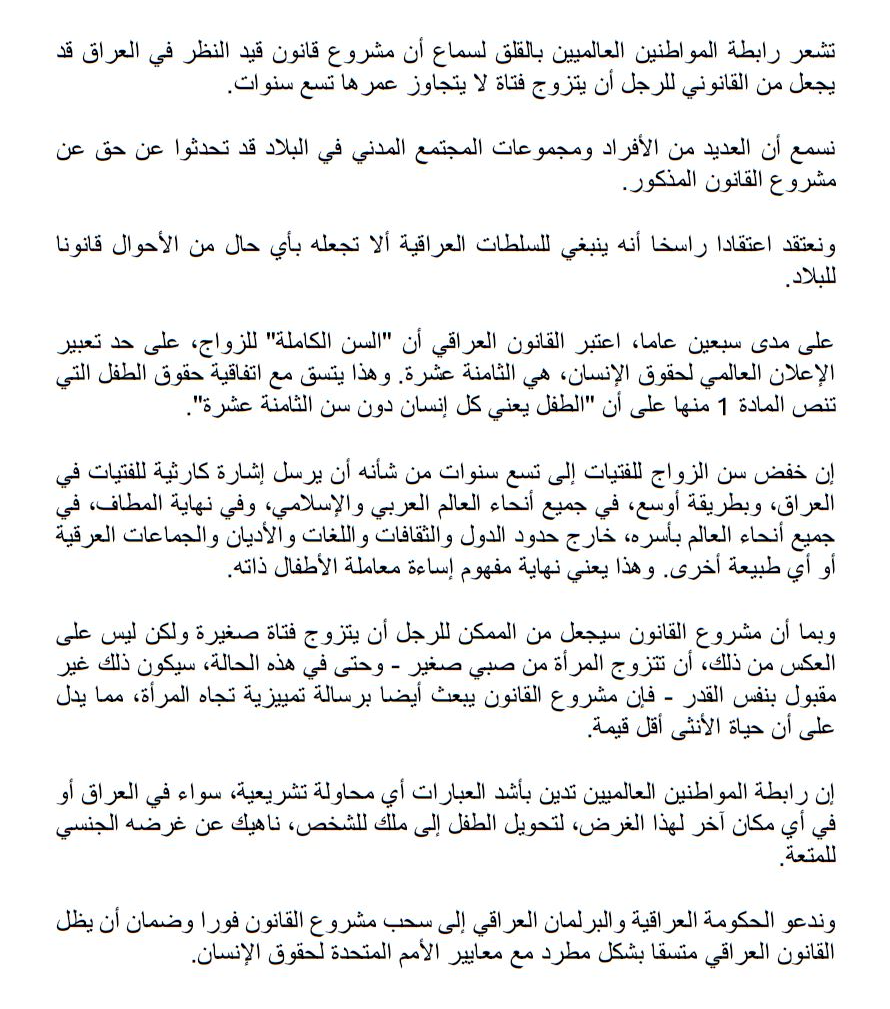
WORLD CITIZENS CALLON THE AUTHORITIES OF IRAQ TO WITHDRAW THEIR DRAFT LAW ALLOWING THE MARRIAGE OF 9-YEAR-OLD GIRLS
The AWC is alarmed to hear that a draft law under consideration in Iraq may make it legal for a man to marry a girl as young as nine.
We hear many individuals and civil society groups in the country have rightly spoken out about the said draft law.
We firmly believe the Iraqi authorities should by no means make it the law of the land.
For seventy years, Iraqi law has considered the “full age” for marriage, in the very words of the Universal Declaration of Human Rights, to be eighteen. That is consistent with the Convention on the Rights of Child under whose Article 1 “a child means every human being below the age of eighteen years”.
Lowering the marriageable age for girls to nine would send a disastrous signal for girls in Iraq and, in a broader manner, throughout the entire Arab and Muslim world and, ultimately, throughout the entire world, beyond the borders of states, cultures, languages, religions, ethnic groups or of any other nature. It would mean the end of the very notion of child abuse.
Since the draft law would make it possible for a man to marry a young girl but not, conversely, for a woman to marry a young boy – and, even then, it would only be equally condemnable – the draft law also sends a discriminatory message toward women, signifying that a female life is of lesser value.
The AWC condemns in the strongest terms any legislative attempt, whether in Iraq or anywhere else for this purpose, to turn a child into a person’s property, let alone their sexual object of pleasure.
We hereby call on the Iraqi Government and Parliament to immediately withdraw the draft bill and ensure that Iraqi law remains steadily consistent with UN human rights standards.
The founder of the Baha’i faith Baha’u’llah wrote,
“The world of humanity is possessed of two wings, the male and the female. So long as these two wings are not equivalent in strength, the bird will not fly.”
It is likely that the Taliban leaders of Afghanistan have not read Baha’i texts. In fact, when the Taliban were first in power from 1996-2001 and again now from August 2021, they have arrested, tortured and summarily executed members of minority religions such as the Hazara population who are Shia and members of Sufi orders.
However, it is against women and girls in general that the Taliban have systematically implemented restrictive policies and practices that deny women and girls their human rights. Over 50 repressive edicts and decrees address women and girls to limit employment possibilities and access to education and health care. Protests have been suppressed. Women’s rights activists have faced targeted killings, enforced disappearances, incommunicado detention, and other forms of harassment. In March 2024 the Taliban authorities announced that they will revive public stoning and flogging women to death on charges of adultery.
It is not clear what outside pressure can be brought on the Afghan government to modify its policies toward women and girls. The governments of China and Russia seem to have developed closer relations with the Taliban authorities. However, it is unlikely that the Chinese or Russian government will raise human rights violations. Thus, we must see what influence nongovernmental organizations can have. It is clear that economic and social development is clearly hindered by current Taliban policies and practices. Without equality, the birds will not fly.
Prof. René Wadlow is the President of the Association of World Citizens.
Voilà un mois tout juste, le 10 décembre dernier, la Déclaration universelle des Droits de l’Homme (DUDH) avait soixante-quinze ans. Pour le mouvement Citoyen du Monde, son adoption au Palais de Chaillot à Paris, qui accueillait cette année-là l’Assemblée générale de l’ONU, va de pair avec la venue de Garry Davis en France pour y renoncer à sa nationalité américaine puis tenter de venir camper sur le «territoire international» de l’ONU et, enfin, interrompre l’Assemblée générale avec Robert Sarrazac pour y exiger un gouvernement mondial et une assemblée des peuples. A l’autre bout du monde se créait la Société californienne des Citoyens du Monde d’où sortirait, en 1974, l’Association of World Citizens (AWC).
Un anniversaire, donc, mais pas une fête. Le pogrom antisémite du Hamas le 7 octobre dernier en Israël, la riposte entièrement démesurée du même Israël contre la population civile tout entière à Gaza, la répression toujours plus forte du régime de Vladimir Poutine en Russie à laquelle s’ajoute une campagne militaire déchaînée contre les civils dans son invasion de l’Ukraine, ainsi que les succès politiques en Europe, en Argentine et ailleurs de l’extrême droite, offrent à la vénérable doyenne du droit international des Droits Humains le bien triste cadeau de son oubli, du moins lorsqu’il s’agit de gouverner.
La veille, toutefois, avait déjà eu lieu un autre anniversaire, hélas passé inaperçu, celui d’une «proche parente» de la DUDH. Étaient-ce les soixante-quinze ans de la Convention pour la Prévention et la Répression du Crime de Génocide, adoptée le 9 décembre 1948 dans les mêmes murs du Palais de Chaillot ? C’est vrai aussi. Aînée d’un jour de la DUDH, la Convention a le mérite d’avoir su faire parler d’elle, jusqu’à aujourd’hui où, au milieu des accusations croissantes de «génocide» portées par la société civile palestinienne et internationale contre Israël au sujet de Gaza, d’aucuns se voient bien l’invoquer pour incriminer l’État hébreu devant les juridictions internationales. La «proche parente» dont l’anniversaire, qu’elle partage avec la Convention, a été oublié ou presque est autrement plus jeune, tout aussi essentielle à la société civile internationale que méconnue du grand public.
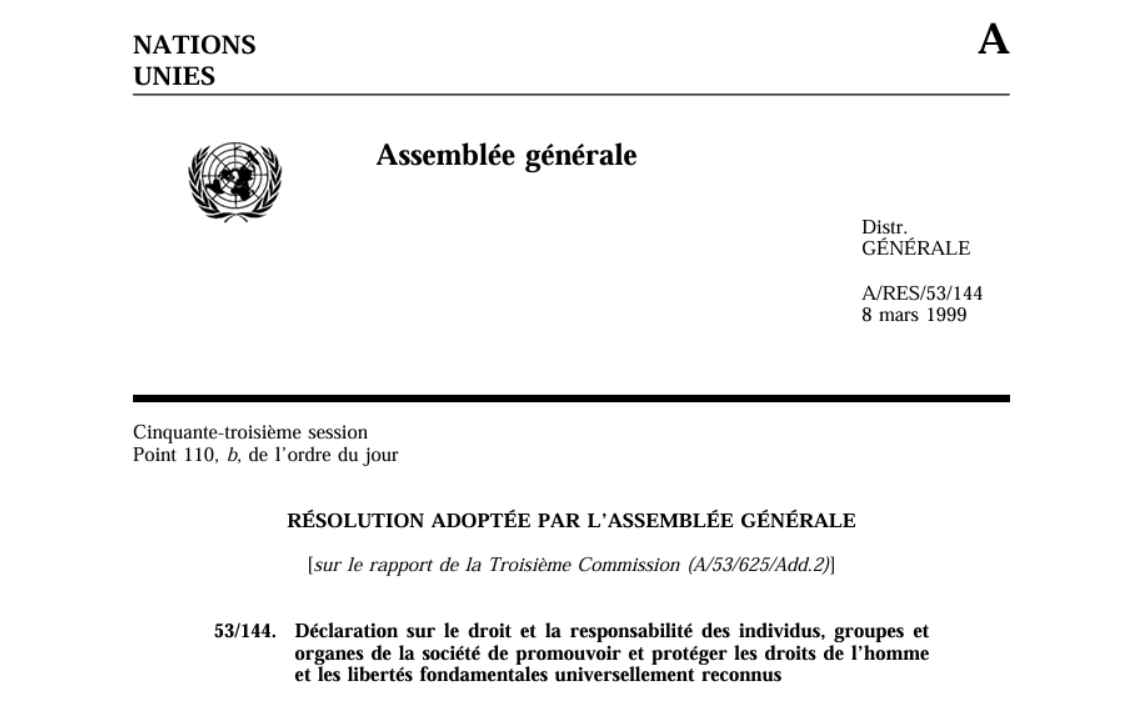
Née le 9 décembre 1998, soit un demi-siècle après la DUDH, à l’Assemblée générale des Nations Unies alors installée déjà de longue date en ses locaux attitrés de New York, elle porte un nom d’état-civil barbare : «Déclaration sur le droit et la responsabilité des individus, groupes et organes de la société de promouvoir et protéger les droits de l’homme et les libertés fondamentales universellement reconnus». Mais pour l’ONU elle-même, pour les juristes internationaux et pour les gens auxquels elle se destine, ces gens qui font partie de son nom même, elle s’appelle la Déclaration sur les Défenseurs des Droits de l’Homme (DDDH).
«Mieux vaut allumer une petite chandelle que maudire les ténèbres», affirme un proverbe chinois. Justement, en Chine, pour nombre de DDH persécutés, emprisonnés, parfois torturés par le pouvoir, qu’il s’agisse de Han, l’ethnie majoritaire à laquelle le monde résume souvent trop vite la population chinoise, ou de peuples envahis et occupés par la Chine comme les Tibétains ou les Ouïghours, la DUDH reste souvent cette dernière chandelle avant les ténèbres du désespoir sous les coups de la répression. En Chine d’où vient le proverbe, oui, «et, dans le monde, c’est partout pareil», comme le chantait Daniel Balavoine qui avait tant défendu les Droits Humains dans les textes de ses chansons.
Si la DUDH est une petite chandelle, alors, avec la DDDH, on en a deux et n’est-ce pas mieux encore ? Si, bien sûr. Et pourtant, la DDDH reste méconnue, dans l’ombre là où son illustre aînée demeure un phare même dans la pire nuit de tempête. C’est dommage. Tellement dommage, car, serait-elle tant soit peu mieux connue, la DDDH changerait bien des choses. Pour notre mouvement Citoyen du Monde, elle incarne notamment ce pour quoi les générations successives de nos militants se sont battues depuis Garry Davis – l’être humain, l’individu, libre de ses choix et responsable du bien commun au niveau du monde et de l’humanité.
La DDDH, inconnue parce qu’impuissante ?
Connaître mieux la DDDH commence par savoir déjà ce qu’elle est précisément. Une «déclaration» donc, adoptée par l’Assemblée générale de l’ONU en tant que résolution, tout comme la DUDH en son temps. Donc, un appel de pure portée symbolique et morale, et non une convention, un traité que signent et/ou ratifient des États qui, dans la théorie, rendent ainsi ses dispositions pour lui contraignantes, ces dispositions que l’État Partie s’engage à respecter et mettre en œuvre en vertu de sa propre loi. Toujours dans la théorie, la DDDH créerait donc moins d’obligations pour les États, donc moins de droits pour le citoyen, que, par exemple, la Convention européenne de Sauvegarde des Droits de l’Homme et des Libertés fondamentales (CEDH).
Pas si vite.
En Droits Humains, un texte écrit, autrement dit un instrument de «droit positif», n’a jamais suffi à créer un droit qui soit respecté dans les actes. Même les deux Pactes internationaux issus de la DUDH, relatifs pour l’un aux droits économiques, sociaux et culturels et, pour l’autre, aux droits civils et politiques, bien qu’étant des traités contraignants pour les États qui les ratifient, sont loin d’avoir jamais garanti le respect ou la mise en œuvre des droits qu’ils consacrent. A plus forte raison, de simples déclarations devraient être encore moins bien considérées et la DUDH n’aurait jamais dû être plus qu’un vœu pieux. Comment a-t-il pu en être autrement ?
Si le droit international est parfois décrié comme manquant de muscle, il faut en revanche lui reconnaître qu’il ne manque pas de tête. En l’absence de toute police ou force militaire spécialement chargée de faire respecter le droit international face aux violations les plus graves – sachant qu’un système international, centré sur la volonté politique des États, la rendrait de toute façon peu manœuvrable et que, quand bien même, sitôt cette force activée, d’aucuns auraient tôt fait de crier à la tyrannie ! – le droit international tire sa force, particulièrement en ce qui concerne les Droits Humains, de la coutume, celle qui voit les États se conformer, par leur seule volonté politique, à des règles auxquelles ils estiment devoir obéir car elles ont à leurs yeux une valeur contraignante.
Voilà pourquoi la DUDH n’est pas restée lettre morte, étant devenue tout au contraire la clé de voûte de tout le système juridique international en la matière. La DDDH, qui en est tout à la fois la cadette, l’héritière et la complémentaire, incarne ces mêmes règles de droit international qui n’ont pas au départ de caractère contraignant mais en revêtent un car les États le lui reconnaissent de leur propre initiative. La manière même dont elle a été adoptée par l’Assemblée générale de l’ONU le prouve, la DDDH étant devenue réalité non par un vote, comme l’avait fait la DUDH en 1948, mais par consensus, à savoir qu’il était tout simplement demandé aux États qui s’y opposaient de le faire savoir et aucun ne s’y est risqué. Par conviction profonde, magique de l’instant, de devoir respecter strictement ses dispositions ? Certainement beaucoup moins que par peur d’apparaître comme un État qui nie ouvertement toute importance aux DDH. C’est qu’un État, puissance souveraine ou pas, ça tient à son image …
Là où la DUDH avait été «élue» par l’Assemblée générale comme s’il s’était agi d’un parlement national, la DDDH a été «acceptée» selon une procédure quant à elle typique du droit international. Pour autant, sa nature est bien moins celle d’un instrument international que d’un texte de caractère mondial, car elle est née dans un monde lassé des nations toutes-puissantes et brûlant du désir de devenir un monde d’êtres humains.
La volonté du peuple du monde
Non, la DDDH n’est pas juste un cadeau d’anniversaire à une DUDH ayant atteint l’âge respectable de cinquante ans – respectable pour un texte de droit international, ses aïeux les traités de la Société des Nations pouvant la jalouser du fond de leurs tombes dans l’histoire du droit d’avoir eu autant de temps pour grandir. Elle est une enfant de son temps, une enfant de ces années 1990 où un monde sorti de la Guerre Froide découvrait que les atrocités de la Seconde Guerre Mondiale n’étaient pas si profondément enfouies dans l’histoire qu’il l’avait cru.
Un premier «réveil» avait eu lieu lors de la Conférence de Vienne en 1993, conférence sur les Droits Humains où le système en place jusqu’alors était apparu dans toute son inefficacité devant la purification ethnique en ex-Yougoslavie, cependant que la Somalie livrée au chaos et à la famine voyait l’opération internationale censée la secourir se transformer en une violente opération militaire contre le chef de l’une des factions de la guerre civile sur place.
Après la création du Tribunal pénal international pour l’ex-Yougoslavie le 25 mai, une première depuis les Tribunaux militaires internationaux de Nuremberg et de Tokyo, un pas important avait été franchi avec la création du poste de Haut Commissaire des Nations Unies pour les Droits Humains. Le choix du premier titulaire avait toutefois déçu, en la personne de l’ancien Ministre équatorien des Affaires Étrangères José Ayala Lasso, accusé d’avoir été jadis un acteur de la dictature militaire dans son pays.
Mais même ce faux départ ne pouvait étouffer une réalité criante, celle de la volonté du peuple du monde par-delà les langues, les religions, les cultures et les frontières politiques, celle de l’exigence d’institutions internationales qui défendent les droits de chaque être humain, ces droits nécrosés pendant tout un demi-siècle et qui, la Guerre Froide terminée, revenaient enfin à leurs titulaires et s’affirmaient même comme une criante urgence.
C’était encore sans compter sur les deux années à venir, avec le génocide du Rwanda et les massacres des forces serbes de Bosnie-Herzégovine à Srebrenica et Žepa. Dans le premier cas, un second Tribunal pénal international ad hoc allait être créé par l’ONU et, avec lui, l’idée ressurgissait du fond de son après-guerre d’un tribunal pénal international permanent et universel, évoquée après les procès de Nuremberg et Tokyo mais gelée elle aussi par cinquante ans de Guerre Froide.
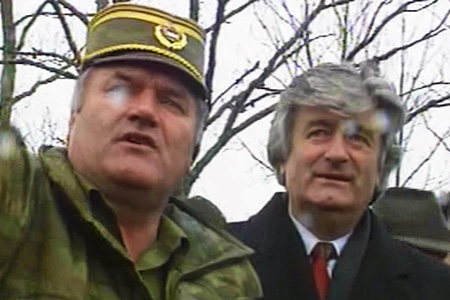
Le Général Ratko Mladić (g.) et le Président de la Republika Srpska, Radovan Karadžić, qui furent inculpés par le TPIY pour le massacre de Srebrenica en juillet 1995. (C) TPIY
C’est pourtant non sans mal que le 17 juillet 1998, à l’issue de la Conférence diplomatique de Rome, fut adopté le Statut de la Cour pénale internationale (CPI) sous réserve de sa ratification par soixante États, survenue en 2002. L’idée d’une juridiction internationale forte des Droits Humains avait plié sous le poids des réticences des gouvernements, notamment ceux des Etats-Unis et de France sur fond d’accusations d’abus commis par les troupes américaines en Somalie et françaises au Rwanda, ainsi qu’en Bosnie-Herzégovine où les Casques bleus français s’étaient vus accusés de partialité au profit de la Republika Srpska, la république serbe sécessionniste de Radovan Karadžić. A Rome même, les Etats-Unis s’étaient contentés de signer le Statut de la Cour pénale internationale sans le ratifier – signature ensuite retirée par l’Administration Bush – et la France, bien que devenue État Partie, ne s’était pas privée de dire tout le mal que lui inspirait l’idée du jugement de ses soldats par une juridiction non nationale.
L’idée restait toutefois la même : après la fin d’un demi-siècle de Guerre Froide avec, à la clé, la menace permanente d’une destruction nucléaire totale du monde, l’humanité n’accordait plus de crédit aux États pour leurs abus en matière de Droits Humains, et de ces institutions internationales censées incarner un nouvel ordre basé sur des règles universelles contraignantes, elle exigeait d’obliger les responsables de tels abus à payer cash.
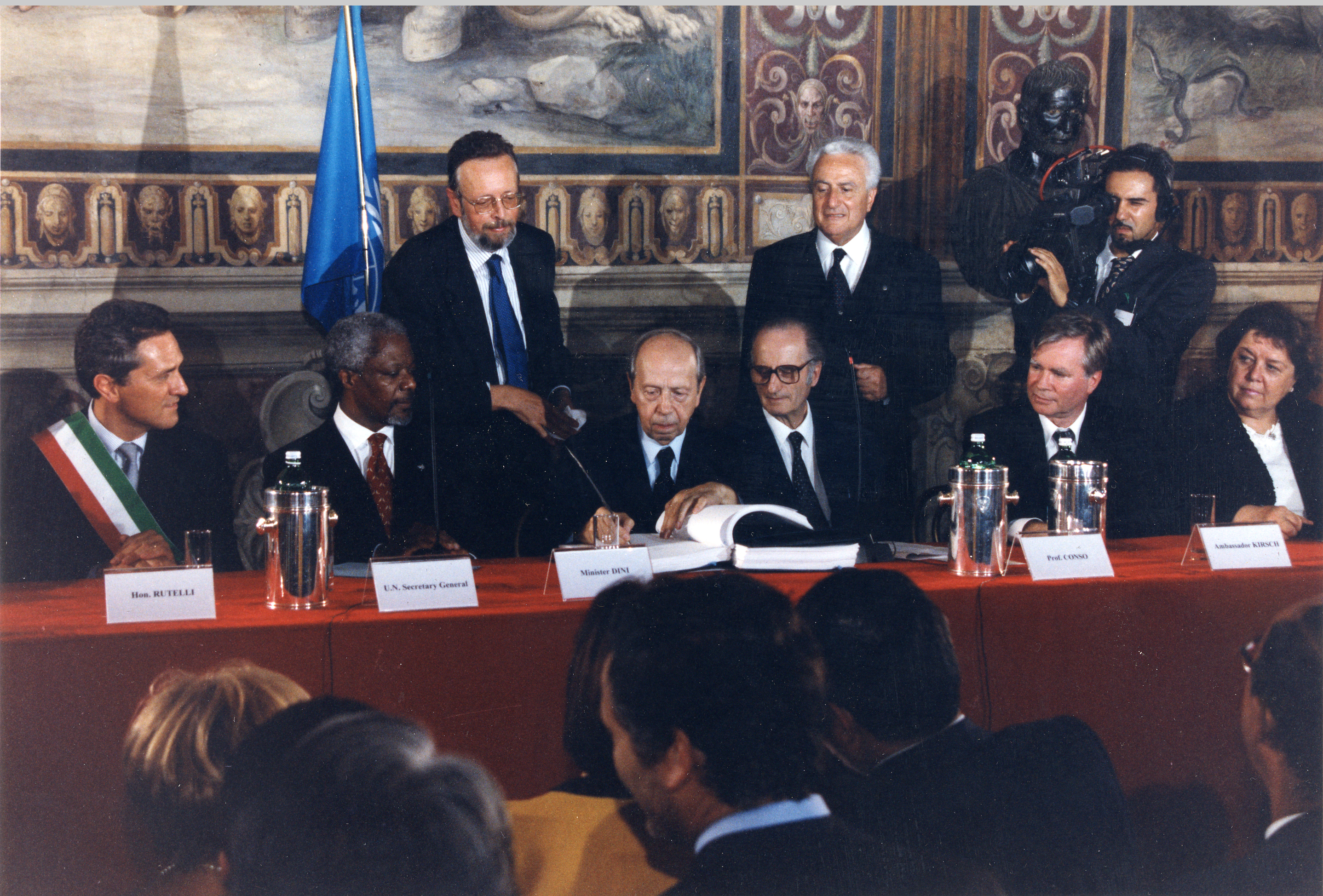
Lamberto Dini, Président du Conseil de la République italienne, signe le Statut de la CPI lors de la Conférence diplomatique de Rome. (C) Nations Unies
Avec cette évolution juridique et judiciaire de taille, un principe se voyait consacré qui venait s’inscrire en faux contre l’idée traditionnelle du droit international depuis le temps même de la Société des Nations, le principe qui faisait de l’État le seul sujet possible dudit droit international : désormais passible de poursuites pénales devant des juridictions internationales, l’individu devenait lui aussi sujet de droit international, quoique de la pire des manières et au pire titre qui soit. Il manquait une reconnaissance de l’individu qui lui soit favorable et positive dans son esprit. Cinq mois plus tard, elle était là.
Défendre les droits sans plus avoir à choisir un camp
Même avec l’adoption de la DUDH, dont Garry Davis avait déclaré de manière bien optimiste qu’elle constituait la reconnaissance politique de l’individu sur le plan mondial, le principe de l’État comme seul sujet possible de droit international n’était pas remis en question, car la Déclaration, simple résolution de l’Assemblée générale, ne créait aucune obligation envers les États. Plus encore, les États étant les destinataires des droits dont l’individu se voyait ainsi fait titulaire, la DUDH subordonnait précisément ces droits au bon vouloir des États. Les Pactes internationaux qui en ont découlé n’ont fait que renforcer encore ce principe, même les États les plus déterminés à les respecter ayant eu la possibilité de les ratifier en émettant des réserves, autrement dit, de les ratifier «à la carte» en omettant certaines de leurs dispositions qui, peut-être, ne les arrangeaient pas.
Comment, dès lors, penser que la DDDH, elle aussi simple résolution de l’Assemblée générale et que ne vient compléter pour l’heure aucun pacte international, apporterait une reconnaissance plus réelle, a fortiori plus importante, de l’individu au niveau mondial ? Tout simplement en sortant du seul champ du droit positif pour intégrer celui de l’histoire de la notion même de DDH.
Sous la Guerre Froide, qu’était-ce donc qu’un DDH ? Bien sûr, une personne qui s’employait à la défense des droits énoncés dans la DUDH, définition première du terme. Mais dans ce contexte d’affrontement entre deux blocs par pays interposés, l’une ou l’autre des deux grandes puissances tentant d’installer ici ou là un régime allié et, pour éviter qu’il cesse un jour de l’être, dictatorial – l’un des deux grands n’ayant parfois fait qu’y remplacer l’autre, comme l’URSS à Cuba et au Nicaragua où avaient été délogés des tyrans alliés de Washington – un DDH était plus souvent perçu comme quelqu’un qui, dans un État tyrannique, défendait les droits en s’adossant au modèle proposé par celle des grandes puissances dont la tyrannie locale ne dépendait pas.
A l’Est, l’image d’Alexandre Soljenitsyne, auteur du légendaire Archipel du Goulag et exilé aux Etats-Unis où il habitait le Vermont, et à l’Ouest, celle du Chilien Pablo Neruda, homme politique communiste et surtout poète de renom, mort douze jours après le coup d’État du 11 septembre 1973 qui ouvrit la voie à la dictature militaire du Général Augusto Pinochet, officiellement d’un cancer de la prostate mais, selon d’autres sources persistantes, empoisonné par la dictature pro-américaine, trônaient dans les imaginaires des partisans d’un camp ou de l’autre, pour lesquels défendre les Droits Humains voulait dire au premier plan fustiger le camp adverse. Les critiques «internes» dans chaque camp se faisaient autrement plus rares, comme lorsque dans la France des années 1980, le Parti communiste se refusait à toute condamnation du tyran roumain Nicolae Ceausescu sur la même base que celle de la dictature de Pinochet au Chili ou quand le Front National, parti emblématique de l’extrême droite professant un anticommunisme reaganien, refusait de condamner l’apartheid en Afrique du Sud et appelait au contraire à ne pas «juger la RSA [acronyme de Republic of South Africa] selon des critères occidentaux». En ce qui concerne ce second parti, l’incohérence était telle qu’on le voyait prendre fait et cause pour les Juifs d’URSS empêchés par Moscou de rejoindre Israël alors même qu’en France, il qualifiait la Shoah de «point de détail» de l’histoire de la Seconde Guerre Mondiale …
Quoi qu’il en soit, lorsque les DDH se voyaient persécutés et qu’il fallait agir auprès de leurs gouvernements nationaux afin de les aider, il n’existait aucun texte international qui permît de mettre en avant la légitimité de leur travail, notamment pas pour les différencier de militants politiques plus classiques. De là à laisser entendre que la défense des Droits Humains était une simple option politique, pas plus défendable que celle choisie par le gouvernement qui décidait ainsi de réprimer ses DDH, il n’y avait qu’un pas, souvent très vite franchi.
En 1991, lorsque l’URSS a disparu et la Guerre Froide avec, cette iconographie du DDH défendant les victimes de l’un des deux systèmes au nom des valeurs défendues par l’autre avait fait long feu. Dès 1988, dans un monde où le Mur de Berlin était toujours debout, l’assassinat au Brésil du militant syndical et écologiste Francisco Alves Mendes Filho, dit Chico Mendes, avait mis en lumière la réalité du droit à l’environnement, non pas seulement contre les États mais aussi contre les entreprises multinationales tentées de le sacrifier pour le profit. Quatre ans plus tard, en 1992, l’an zéro de l’après-Guerre Froide, le Prix Nobel de la Paix remis à la militante guatémaltèque Rigoberta Menchú inaugurait l’image nouvelle du DDH, défendant des droits concrets, dans des contextes concrets, pour des populations concrètes, un DDH au sens réellement international du terme, traitant des questions pouvant exister partout dans le monde, un DDH avec lequel la grille de lecture jusqu’alors en vigueur perdait tout son sens. Il n’en fallait pas davantage pour que la Conférence de Vienne ne puisse que constater, l’année suivante, en 1993, que les mécanismes interétatiques de défense des Droits Humains nés sous la Guerre Froide avaient fait leur temps.
C’est dans ce contexte et au bout de ce processus d’évolution qu’a été adoptée fin 1998 la DDDH, consacrant l’individu non comme un acteur souverain et distinct des États comme le concevait Garry Davis, mais comme un acteur légitime du droit international et, à sa manière, des relations internationales qui échappaient désormais aux seules interactions entre les nations pour créer davantage un «espace mondial» selon la formule de Bertrand Badie, libéré du chantage permanent et systématique aux droits et libertés de la Guerre Froide et consacrant la défense des Droits Humains comme ce qui serait désormais le principe moteur de la vie politique mondiale. La Déclaration se montre à ce sujet sans ambiguïté puisqu’adoptée, dans les termes mêmes de son Préambule, en «[c]onsidérant les liens qui existent entre la paix et la sécurité internationales, d’une part, et la jouissance des droits de l’homme et des libertés fondamentales, d’autre part, et consciente du fait que l’absence de paix et de sécurité internationales n’excuse pas le non-respect de ces droits et libertés».
La préséance donnée à l’être humain sur l’État et, par voie de conséquence, à l’intérieur du système international lui-même est énoncée on ne peut plus clairement dans les deux premiers articles :
«Article premier
Chacun a le droit, individuellement ou en association avec d’autres, de promouvoir la protection et la réalisation des droits de l’homme et des libertés fondamentales aux niveaux national et international.
Article 2
1. Chaque État a, au premier chef, la responsabilité et le devoir de protéger, promouvoir et rendre effectifs tous les droits de l’homme et toutes les libertés fondamentales, notamment en adoptant les mesures nécessaires pour instaurer les conditions sociales, économiques, politique et autres ainsi que les garanties juridiques voulues pour que toutes les personnes relevant de sa juridiction puissent, individuellement ou en association avec d’autres, jouir en pratique de tous ces droits et de toutes ces libertés.
2. Chaque État adopte les mesures législatives, administratives et autres nécessaires pour assurer la garantie effective des droits et libertés visés par la présente Déclaration».
Sous la houlette d’Eleanor Roosevelt et René Cassin, la DUDH proclamait que l’ordre international d’après la Seconde Guerre Mondiale aurait au cœur de ses principes les Droits Humains. Cinquante ans plus tard, la DDDH venait proclamer à son tour que l’ordre international de l’après-Guerre Froide serait celui de la défense des droits des individus par les individus, non pas en dehors ou au mépris de l’État, mais en ayant droit à son soutien.
Si, un quart de siècle plus tard, le constat en la matière ne peut certes être que triste en ce qui concerne les résultats, pour ce qui est de l’urgence de la cause, il ne peut être qu’alarmant.
La WENA, une lumière qui s’éteint ?
En un quart de siècle, à travers le monde, les DDH se sont élevés et imposés comme une force politique internationale incontournable. Plusieurs Organisations Non-Gouvernementales (ONG) comme FrontLine Defenders et l’International Service for Human Rights (ISHR) consacrent toute leur action à les défendre. Qu’il s’agisse des droits civils et politiques mais aussi des droits sociaux, économiques, culturels, des droits des peuples autochtones et minorités ethniques, des droits liés à l’orientation sexuelle et l’identité de genre, des droits liés à la migration, à l’environnement, au développement, mais aussi des droits des femmes qui se trouvent systématiquement violés dès que tous ces types de violations apparaissent, les DDH sont actifs partout, sur tous les continents, que ce soit à un niveau local, au niveau national voire sur le plan international. Seulement, si la DDDH s’adressait au départ aux pays extérieurs à la WENA (Western Europe and North America, Europe occidentale et Amérique du Nord), une génération plus tard, la région considérée historiquement comme le berceau des Droits Humains peut se voir opposer à son tour la Déclaration tant il n’y est plus acquis d’être un DDH sans devoir en payer le prix.
C’est vrai ne serait-ce que pour un type précis de droits, ceux liés à la migration. Que ce soit aux Etats-Unis, tant sous Donald Trump qu’avec l’administration actuelle de Joe Biden, au Royaume-Uni sous les gouvernements conservateurs et l’impulsion notamment de la ministre Suella Braverman, ou encore en France avec l’adoption récente d’une «loi immigration» fortement empreinte des thèses de l’extrême droite pourtant vaincue à l’élection présidentielle de 2022 et dans l’opposition au Parlement, mais aussi de par les récents succès électoraux de l’extrême droite aux Pays-Bas ou en Suisse, le rejet des migrants et la xénophobie sous toutes ses formes n’ont cessé de progresser dans la WENA. Le rejet des migrants, et avec lui, celui de quiconque les aide à titre humanitaire ou les soutient face à la justice et aux pouvoirs publics. Ces DDH n’échappent plus à la pénalisation, comme ce fut le cas en France pour Martine Landry d’Amnesty International, Loan Torondel, Cédric Herrou et ceux que l’on a surnommés «les 7 de Briançon».
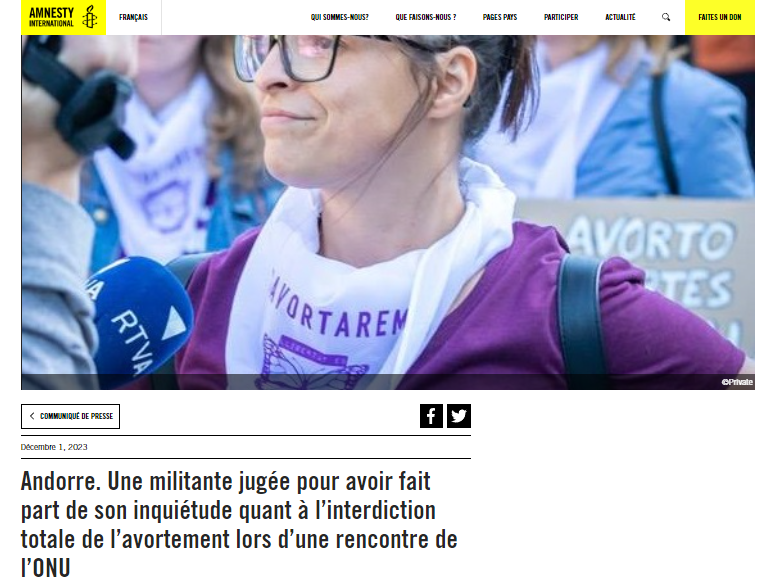
Aux droits des migrants s’ajouteront peut-être bientôt, dans cette WENA oublieuse de ses principes historiques, les droits des femmes. C’est ce que semble démontrer le cas de Vanessa Mendoza Cortés, psychologue et présidente d’une association féministe en Andorre, que le gouvernement de la petite principauté blottie entre France et Espagne a traînée en justice pour être allée s’exprimer sur les droits des femmes devant les Nations Unies – la nouvelle «mode» en matière de représailles contre les DDH étant en effet de pénaliser celles et ceux qui coopèrent avec les agences de l’ONU sur des thématiques locales ou nationales dans leur pays. L’intervention de l’AWC en sa faveur fut la première qui nous vit utiliser, dans l’une de nos interpellations écrites aux gouvernements nationaux en matière de Droits Humains, la langue catalane qui est officielle en Andorre !
Capture d’écran Amnesty International France
Pour Paulo Coelho, «Le monde change par votre exemple et non par votre opinion». Dans une WENA dont les gouvernements sont souvent prompts à donner des leçons en matière de Droits Humains au reste du monde, non dans une moindre mesure aux BRICS dont les membres, issus du Global South ou «Sud Mondial», s’en veulent les porte-parole dans une alternative économique – et politique – à l’hégémonie de la même WENA, un exemple aussi diamétralement opposé à l’opinion professée sera difficilement de nature à impressionner les gouvernements mis en cause, ou a fortiori à rassurer des DDH locaux regardant vers la WENA pour trouver encore inspiration et courage face aux coups portés par leurs gouvernants.
Dans leur essai de 2020 intitulé en anglais The Light that Failed, d’après un ouvrage de Rudyard Kipling intitulé en français La lumière qui s’éteint, Ivan Krastev et Stephen Holmes analysent l’échec de la WENA comme modèle pour les démocraties nouvelles issues de la fin de l’URSS et, a contrario, l’inspiration que d’aucuns dans les pays concernés, à commencer par Viktor Orban en Hongrie, ont fournie aux tenants du populisme en WENA comme Donald Trump. N’en déplaise à ces derniers, si l’on peut tenter de forcer le présent à singer le passé, aucun dictateur, aussi implacable soit-il, ne pourra jamais retourner la flèche du temps vers l’arrière, pas plus que ne le pourra jamais le vote le plus démocratique qui soit. L’an zéro de l’après-Guerre Froide, l’année 1992, est loin derrière nous, comme le sont 1993 et la Conférence de Vienne. Impossible de repartir à zéro sur la base d’un espoir failli. Mais rien n’empêche d’en créer un nouveau, qui soit cette fois pour le monde entier, WENA comprise. Et depuis vingt-cinq ans, un instrument du droit international des Droits Humains existe pour nous y aider. Il serait temps que l’on s’en rende compte et que l’on en fasse bon usage.
L’incarnation en droit international de la Citoyenneté Mondiale
Lorsque la DDDH a été adoptée par l’Assemblée générale de l’ONU, dans ce qui est depuis 1952 sa résidence permanente sur l’East River à New York, l’histoire du mouvement Citoyen du Monde n’a pas retenu la présence de quiconque ayant tenté de camper devant les Nations Unies, ni d’une quelconque tentative d’interruption des débats pour lire une déclaration rédigée par un écrivain célèbre du moment. Tout s’est déroulé dans le calme le plus parfait, la procédure du consensus ayant même permis aux États les moins décidés, voire les plus réticents, de sauver tant soit peu la face. A vrai dire, la DDDH est même une œuvre anonyme, le temps des Roosevelt et des Cassin appartenant à l’histoire et les projets de résolutions étant désormais l’œuvre de professionnels spécialisés, qui sont et resteront donc, à la différence des légendaires promoteurs de la DUDH, des Inconnus dans la maison, pour reprendre le titre d’un ouvrage de Georges Simenon porté à l’écran en 1992 par Georges Lautner – dont ce fut la dernière réalisation – et où Jean-Paul Belmondo, jusqu’alors habitué aux films d’action et aux cascades, interprétait un rôle autrement moins exigeant sur le plan physique puisqu’il y incarnait un avocat.
«Inconnue dans la maison», celle des Citoyens du Monde, c’est ce qu’est la DDDH encore aujourd’hui. Elle qui, pourtant, incarne une forme de Citoyenneté Mondiale sans précédent dans l’histoire, celle d’une consécration de l’action civique individuelle en termes mondiaux, même à un pur niveau local, et de l’exigence de coopération signifiée aux autorités étatiques. Elle qui, à sa manière, incarne la Citoyenneté Mondiale telle que la conçoit l’AWC, «entièrement engagée» auprès des Nations Unies, selon les mots de feu notre Président-fondateur Douglas Mattern, et pour laquelle la Citoyenneté Mondiale se conçoit en plus de la citoyenneté nationale, non pas à la place, ce que rien ne prévoit non plus, du reste, au sein du système des Nations Unies. Elle qui, mieux connue et plus souvent revendiquée, ne pourrait que changer la vie publique pour le meilleur.
La DDDH ne crée pas d’immunité judiciaire ou diplomatique, elle n’est pas une charte de privilèges exonérant le citoyen de ses devoirs envers la communauté où il vit. Héritée du temps où le monde sortait d’une prise en otage permanente de son présent et de son avenir par deux pays le menaçant chacun d’un holocauste nucléaire, elle représente aujourd’hui la traduction en droit international public d’un droit devenu plus fondamental que jamais – celui de ne pas laisser aux seules autorités nationales la protection des droits de chaque personne et de prendre entre ses mains, pour elle-même et pour les autres, la défense de ces droits.
Invoquant lui aussi la Guerre Froide, alors qu’elle se profilait à l’horizon de l’automne 1948, ainsi que ce même droit de prendre sa vie et ses droits entre ses mains, Garry Davis était allé à l’ambassade américaine à Paris rendre sa nationalité et son passeport pour se déclarer Citoyen du Monde. Il s’attendait à être suivi de manière massive, mais si ses idées avaient en effet porté, les ambassades des divers États indépendants de la planète, autrement moins nombreux qu’aujourd’hui en ce temps-là, n’ont en revanche pas vu d’afflux de leurs citoyens venus leur rendre leurs passeports. Depuis un quart de siècle, la DDDH affirme que le civisme mondial n’implique aucune rupture avec l’État-nation et ne se définit pas par la seule possession d’une carte d’identité «mondiale» avec photo, mais par une prise de responsabilité altruiste et universaliste à la portée de toutes et tous.
En un mot, la Citoyenneté Mondiale existe déjà, non pas à titre symbolique mais en pur et vrai droit international. Et parce qu’elle la rend possible, la DDDH, l’inconnue dans la maison des Citoyens du Monde, mérite qu’on la connaisse plus. Et surtout mieux.
Bernard J. Henry est Officier des Relations Extérieures de l’Association of World Citizens.
The Association of World Citizens (AWC) first raised the issue of the use of sexual torture in time of violent conflicts in the United Nations (UN) Commission on Human Rights in March 2001, citing the judgement of the International Criminal Tribunal for the former Yugoslavia, which maintained that there can be no time limitations on bringing the accused to trial.
The AWC presentation highlighted sexual violence in the conflicts in what is today the Democratic Republic of Congo, formerly Zaire. Conflict related sexual violence refers to rape, sexual slavery, forced prostitution, forced abortion and other ways to humiliate. To the best of my knowledge, no person in Zaire/DRC was tried. Awareness building and enforcement measures develop slowly.
The UN Human Rights Council, the current incarnation of what was once the Commission on Human Rights, has developed a pattern of having Special Rapporteurs on specific topics or countries. The Special Rapporteur is not a UN or a national civil servant and is not paid, though work-related expenses are covered and UN Secretariat help is given. This independence, it is hoped, gives greater freedom to speak out. There has been a Special Rapporteur on Torture nearly from the start of Special Rapporteurs.
The current Special Rapporteur on Torture is Prof. Alice Jill Edwards, originally from Australia and now an academic research fellow in Geneva. She has worked in the past both for the UN and for Nongovernmental Organizations (NGOs). She has worked with rape victims in Bosnia-Herzegovina and has long argued that rape should qualify as a form of torture.
She was recently in Ukraine, a first mission in time of war. As she said,
“We are living in an era of war, and we have lost the art of mediation, compromise and acceptance of each other.”
While her findings have not yet been presented, she gave an overview of persons met and situations faced. She was concerned with the use of torture both by Russian military and by Ukrainian military and police. From her interviews in Ukraine, she holds that it is Russian state policy to use torture for military ends – whether to obtain intelligence, to humiliate and debase the enemy, and to keep the community in a state of fear.
The Ukrainian military and police are also willing to use torture on Russian prisoners of war as well as on alleged collaborators – Ukrainians who would have helped the Russian forces in different ways or who had administered areas that came under Russian control.
There are also NGO representatives who are collecting information, but many victims of torture have been traumatized and recalling accurately specific events is often difficult.
It is difficult to know what the state of justice will be once the armed conflict ends. In many cases, there is a reluctance to bring perpetrators to trial in order not to “open fresh wounds”. It is a vital issue that we must follow closely.
Prof. René Wadlow is President of the Association of World Citizens.
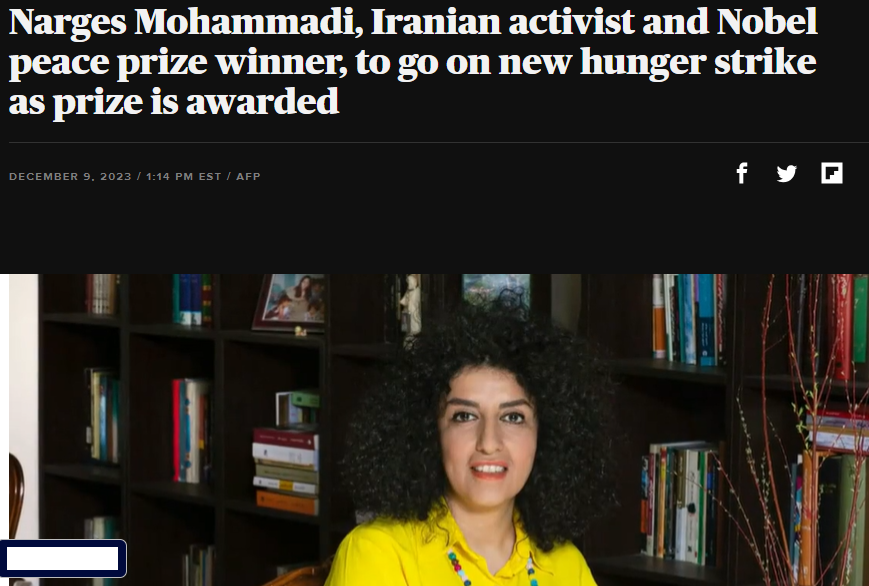
On the traditional date of December 10, the Nobel Prize for Peace was awarded to the Iranian woman human rights activist Narges Mohammadi. She is in Evin Prison in Iran, called by some “The University of Evin” for the large number of intellectuals held there. Thus, the award was received by her twin children Ali and Kiana who live in exile in Paris with their father Taghi Rahmani, also a human rights activist.
Narges Mohammadi was put in prison for her human rights writings in 2016 and liberated in 2020, only to be put back in prison in November 2021 where living conditions are very difficult and her health has weakened.
In honoring Narges Mohammadi, the Nobel Committee was honoring the many women (and some men) who have taken to the streets and the school yards to protest the death at the hands of the “morality police” of Mahsa Amini with the battle cry of “Woman, Life, Liberty.”
The protests began on September 3, 2022 at the announcement of the death of 22-year-old Mahsa Amini in police custody, having been arrested by the “morality police” for having some of her hair beyond the hijab (veil). She was an ethnic Kurd. The protests began in the Kurdish areas but soon spread to all ethnic groups and to many parts of the country.
Women have been a central focus of the social policy of the Iranian Islamic government. Even before coming to power in 1979, Ayatollah Khomeini from his exile in France had said that the overly great liberty of women was a chief obstacle to his policies. Repressive policies against women with compulsory veiling laws were quickly put into place once in power.
Unlike what happened in Afghanistan because of the Taliban, women have not been barred from higher education. It is estimated that some 65 per cent of university students are women. Many women play important roles within society but must keep a low profile, dress according to the dress code, and be under the control of a man at least when visible in public.
However, things are changing. Increasingly, the symbolic themes of the protests are shifting from a focus on the restrictions on women to the nature of the clerical regime itself. The conservative president Ebrahim Raissi is called into question. As Narges Mohammadi has said, “Can you hear the first sounds of the walls which are cracking? Soon you will hear the walls falling into dust by the strength and determination of the Iranians.”
Prof. René Wadlow is President of the Association of World Citizens.