The Official Blog of the

Archive for the ‘Religious Freedom’ Category

Peyman Farahavar, poète de la liberté en Iran : «Le poète a dit la vérité, il doit être exécuté»

In Being a World Citizen, Cultural Bridges, Current Events, Human Rights, Literature, Middle East & North Africa, Poetry, Religious Freedom, Solidarity, Spirituality on October 19, 2025 at 7:00 AM

Par Bernard J. Henry

«Le poète a dit la vérité, il doit être exécuté».

C’est ce que chantait Guy Béart en 1968, alors que la révolte politique grondait en France et ailleurs. Au départ inspiré pour sa chanson La vérité par l’une des premières anecdotes sur le dopage dans le cyclisme, Béart a élargi sa chanson à l’assassinat de John F. Kennedy, à la répression des écrivains en URSS et même au calvaire de Jésus-Christ, rendant hommage aux victimes du refus de la liberté d’expression et, in fine, se mettant lui-même en scène en tant que victime potentielle des «murmures» et des «tomates mûres» de son public qu’il voyait déjà, à son tour, l’exécuter ! Heureusement non, pas plus qu’après Les couleurs du temps l’année passée, chanson qui est pour moi un hymne personnel.

Aujourd’hui hélas, les autorités de l’Iran, où l’assassinat de la jeune Masha Jina Amini par les Gardiens de la Révolutions (Pasdaran) en septembre 2022 a fait naître des revendications de liberté sous le slogan «Femme, Vie, Liberté» qui, même réprimées, ne se sont jamais tues, semblent avoir pris ce refrain de Guy Béart au pied de la lettre puisqu’elles entendent précisément exécuter un poète, Peyman Farahavar.

De la part de la théocratie chiite de Téhéran, rivale par excellence de celle sunnite d’Arabie saoudite qui est aussi pour elle une solide concurrente en termes de violations des Droits Humains, rien de bien surprenant, certes. Qui croit tirer son pouvoir politique de la parole divine n’admet aucune œuvre de l’esprit humain. Pourtant, Peyman Farahavar a bien d’autres raisons, en fait toutes les raisons, de déplaire au régime des mollahs.
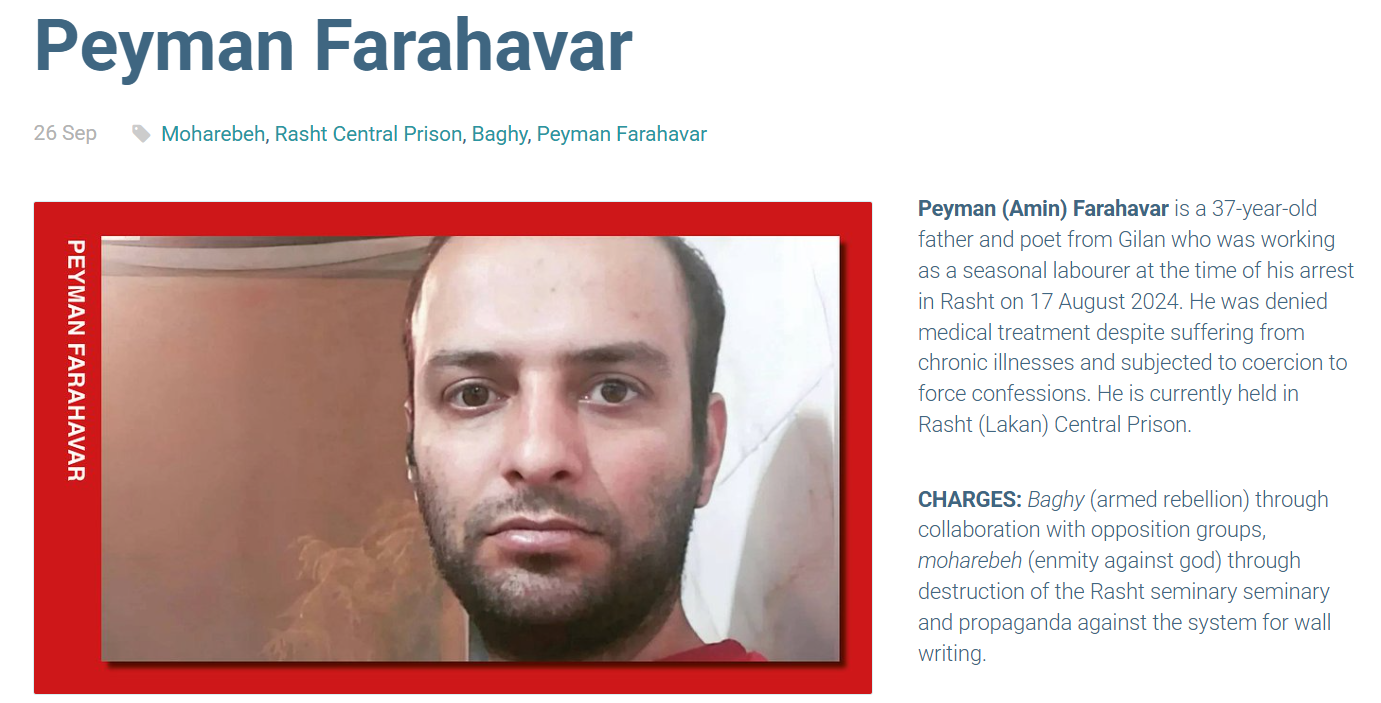
(C) Iran Human Rights

Trop croyant pour devenir théocrate

Quand une idéologie de libération fonde un système politique qui, lui-même, évolue ou plutôt dégénère en dictature, il y a toujours des gens qui, même soutenant le système, s’accrochent aux idéaux et aux principes de la libération rêvée en croyant les pérenniser par leur adhésion à l’institution. Certains resteront fidèles au système quoi qu’il arrive, persuadés de pouvoir le changer de l’intérieur par leur seule intégrité – et bien souvent voués à rester déçus –, tandis que d’autres, poussés au bout du dégoût, le quitteront s’ils le peuvent. Dans la défunte Tchécoslovaquie, un Alexander Dubček rêvant d’un «communisme à visage humain» avait tôt fait d’irriter les tenants moscovites d’un communisme répressif, puis de voir s’abattre sur son Printemps de Prague, en plein cœur de l’été, l’hiver des chars.

Promis à un avenir de mollah réprimant lui aussi son peuple, au nom d’un chiisme vidé de sa substance pour devenir l’instrument pérenne du totalitarisme, Peyman Farahavar s’y est refusé. Aux yeux du pouvoir de Téhéran, première faute.

A trente-sept ans, Peyman Farahavar, également prénommé Amin, originaire de la province de Gilan bordée par la Mer Caspienne et voisine de l’Azerbaïdjan, n’a pas toujours été le primeur de rue et père de famille comme tant d’autres qu’il est aujourd’hui. Comme le révèle IranWire, il était au départ séminariste. Comme son gouvernement, il avait fait de la religion et du culte des martyrs de la révolution islamique les piliers de sa vie. A la ville, il portait les robes des dignitaires chiites que la République islamique érige en aristocratie. A cette différence près que Peyman Farahavar, religieux dans l’âme, ne voyait pas le chiisme comme un instrument d’oppression.

Ecœuré par la manière dont les autorités de Téhéran avaient transformé la religion et la mémoire de la révolution en un «business», il s’était défroqué et avait abandonné sa vie cléricale pour devenir vendeur de rue, primeur spécialiste des fruits, travaillant chaque jour avec son frère pour gagner sa vie et nourrir son petit garçon de dix ans.

Il fustigeait désormais sans concession ces autorités qu’il en était venu à détester, s’opposant farouchement à l’oppression du peuple qu’il reprochait à ces gens auxquels son parcours le vouait au départ à ressembler. La robe des mollahs était devenue pour lui symbole de cette oppression. Pour lui, plus question de la porter encore, et l’enlever voulait dire rejeter non pas la religion, mais le régime qui se faisait oppresseur en son nom.

Devenu voix des sans-voix, Peyman Farahavar criblait sur ses réseaux sociaux «la supériorité autoproclamée du clergé chiite en Iran», ainsi que l’exploitation par le gouvernement «du sang et de la religion des martyrs». Il s’était indigné publiquement du sort de la jeune Mardak Maryaneh, jeune fille de seize ans qui, arrêtée et détenue, s’était suicidée après sa libération.

La prison, Peyman Farahavar allait la découvrir lui-même en mai 2022, avant que l’Iran ne résonne du slogan «Femme, Vie, Liberté». Arrêté une nouvelle fois le 18 août 2024 à Racht, capitale du Gilan, Peyman Farahavar fut détenu vingt-six jours au secret avant d’être transféré à la Section de sécurité de la Prison de Lakan, toujours à Racht. Avant même sa condamnation à mort, il allait bientôt être arraché violemment au monde des vivants.

Une poésie belle et forte à mourir

Dans des prisons iraniennes dont la réputation de barbarie n’est plus à faire, encore moins à ignorer, Peyman Farahavar n’avait aucune chance d’échapper au sort le plus barbare, dont les autorités, pénitentiaires et autres, comptaient sur le fait qu’il demeure aussi le sort le plus ignoré. Par bonheur, pari perdu.

Les sources d’IranWire évoquent des tortures si extrêmes qu’un jour, Peyman Farahavar en a perdu connaissance pendant vingt-quatre heures, mais aussi des saignements gastro-intestinaux persistants, des dérèglements lymphatiques provoquant des furoncles douloureux sur tout le corps, et pas le moindre traitement médical qu’il se voit constamment refuser. Au-delà du corps, l’esprit et le cœur souffrent aussi, de l’absence d’un fils auquel il n’est jamais permis de voir son père, ce qui serait voulu, poursuit IranWire, par une ex-belle-famille vindicative adossée aux Gardiens de la Révolution.

A bien y réfléchir, pourquoi les autorités ménageraient-elles Peyman Farahavar alors que, tout au contraire, elles s’acharnent sur lui pour des aveux ? A coups de «graves tortures psychologiques et physiques», elles exigent qu’il avoue. Avouer ? Mais quoi, au juste ? Qu’il aurait, comme l’en accusent les autorités, déclenché un incendie volontaire sur un chantier ? En pareil cas, Peyman Farahavar n’aurait pas été autant interrogé sur ses écrits, littérale obsession de ses geôliers.

«Le crayon sera sa clé, les feuilles son issue», chantait la regrettée Teri Moise dans Les poèmes de Michelle, son hommage aux enfants travailleurs en un temps où l’on n’en parlait encore que peu. Les Gardiens de la Révolution islamique, redoutables miliciens théocrates de Téhéran, ont bien compris que c’est aussi le cas de Peyman Farahavar, insupportablement libre même dans sa cellule, puisqu’ils se sont employés à détruire ses carnets de notes où figuraient ses poèmes, même lisibles de ses seuls codétenus, car c’était apparemment déjà trop.

Vivant de peu, suivi par seulement quelques centaines de personnes sur Instagram, Peyman Farahavar n’en a pas moins fait suffisamment peur à l’Etat, comme le relève IranWire, pour se retrouver frappé d’une peine de mort. Ces fameux Gardiens de la Révolution, il leur avait fait un sort dans un poème que l’un de ses anciens codétenus décrit comme «très implacable et très beau», lui qui se souvient de Peyman Farahavar comme d’un poète doué pour la satire contestataire et, surtout, pour l’improvisation, à tel point qu’il suffisait d ’ «attiser» en lui la verve poétique pour qu’elle explose en bouquets de vers subversifs d’un savoureux vitriol.

Rien ni personne n’était épargné parmi ce qui révoltait l’ancien mollah en devenir. Incendiaire, oui, il l’était sur la corruption enracinée dans les institutions, les questions liées à l’environnement, mais aussi la fierté culturelle de la population du Gilan. Peyman Farahavar fustigeait les ventes, devenues monnaie courante, de terres agricoles du Gilan à des Iraniens d’autres parties du pays, ainsi que le gaspillage des ressources naturelles de la province par les sociétés immobilières. Jaloux de son identité provinciale, il proclamait son admiration pour les héros locaux, dont Mirza Kuchik Khan, homme politique et chef militaire du début du vingtième siècle. Voix des sans-voix, remarque encore IranWire, Peyman Farahavar portait celle d’un peuple oublié, celle des pauvres, celle des villageois dont la souffrance n’intéressait pas Téhéran.

Pour les mollahs, voilà bien de quoi vouloir exécuter un poète, la peine prononcée contre Peyman Farahavar ayant été confirmée y compris par la Cour suprême iranienne le 24 septembre.

Ecrivez sa liberté

«A quoi sert une chanson si elle est désarmée ?», demandait Julien Clerc en 1993 dans Utile, citant une expression chilienne, «La chanson sans armes ne sert à rien, la chanson sans balles n’affronte pas le fusil». La chanson, Maurice Druon y voyait la «forme moderne de la poésie», bien que la forme traditionnelle n’ait jamais cessé d’exister. Dix ans avant Julien Clerc, Daniel Balavoine évoquait la torture d’un poète dans Frappe avec ta tête. Neuf ans auparavant encore, Michel Delpech ouvrait la voie en unissant poésie et chanson dans Rimbaud chanterait, imaginant un Arthur Rimbaud ayant vécu à cette époque et qui, là où le dix-neuvième siècle l’a vu poète, aurait été chanteur, «lui, l’homme fou, l’ami, le déserteur».

A quoi servait à Guy Béart de chanter La vérité en 1968 ? Les étudiants français en révolte contre le système savaient tout au moins à quoi leur servait la chanson, qu’ils entonnaient parfois dans leurs meetings face à un pouvoir politique en lequel ils voyaient un ultime censeur.

Aujourd’hui, le poète qui a «dit la vérité» se nomme Peyman Farahavar, et dans une illustration insupportablement littérale des vers de Guy Béart, Téhéran entend l’exécuter, sous des motifs fantoches, pour sa seule poésie. Une poésie qui n’a pas besoin de dire à quoi elle sert, car les actes parlent, comme les mots dérangent.

Même pour qui n’est pas poète, un langage poli et un ton décidé suffisent pour dire non au massacre d’un innocent. Il y a toujours une ambassade iranienne, ou bien une mission auprès des Nations Unies à New York, Genève ou Vienne, dans le pire des cas une délégation permanente à l’UNESCO, à contacter. Il serait dommage de priver d’un tel soutien Peyman Farahavar, ainsi que de s’en priver soi-même lorsque l’on peut écrire et dire la vérité sans craindre d’être, comme Téhéran le lui promet, exécuté.

Bernard J. Henry est Officier des Relations Extérieures de l’Association of World Citizens.
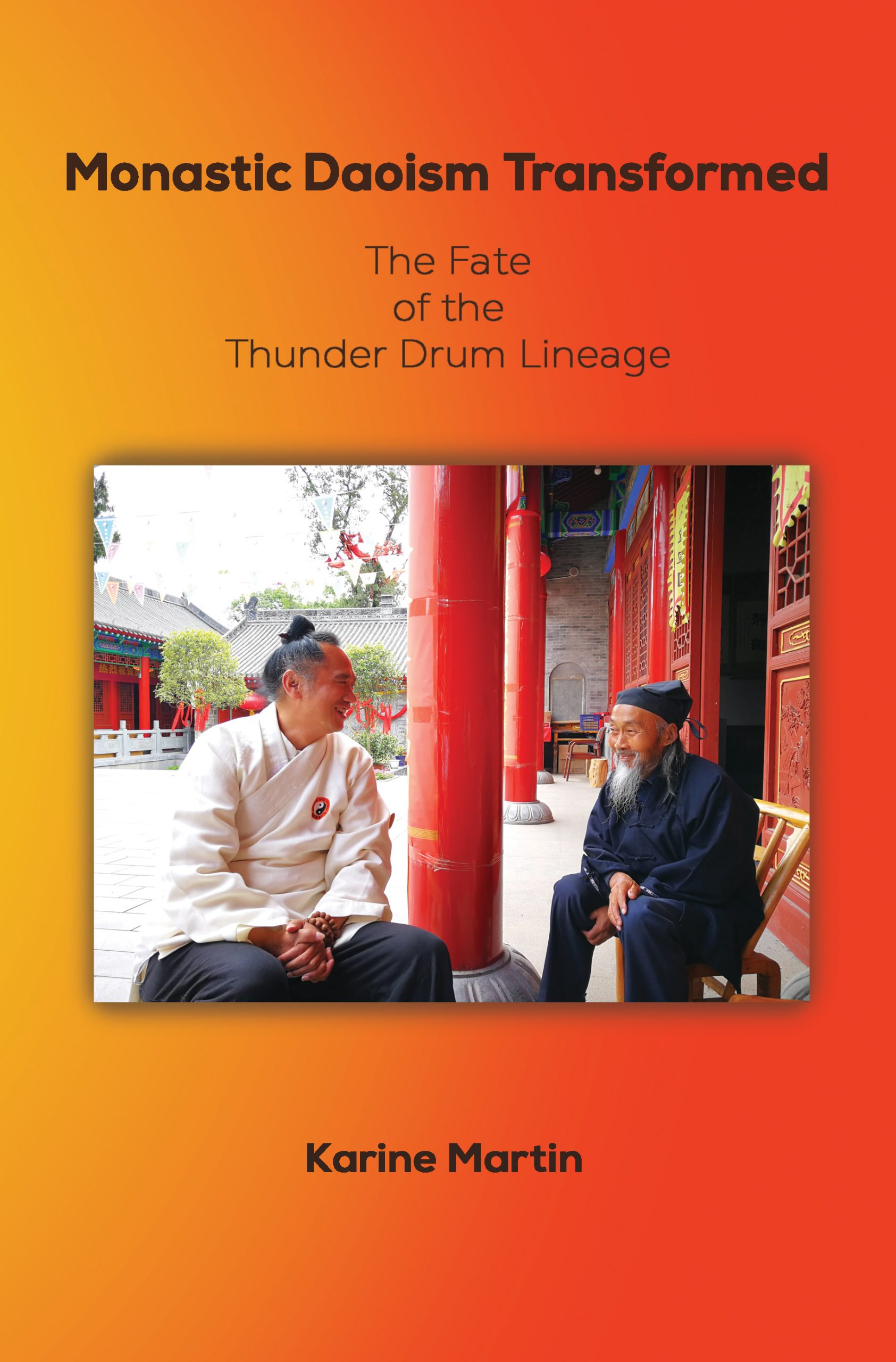
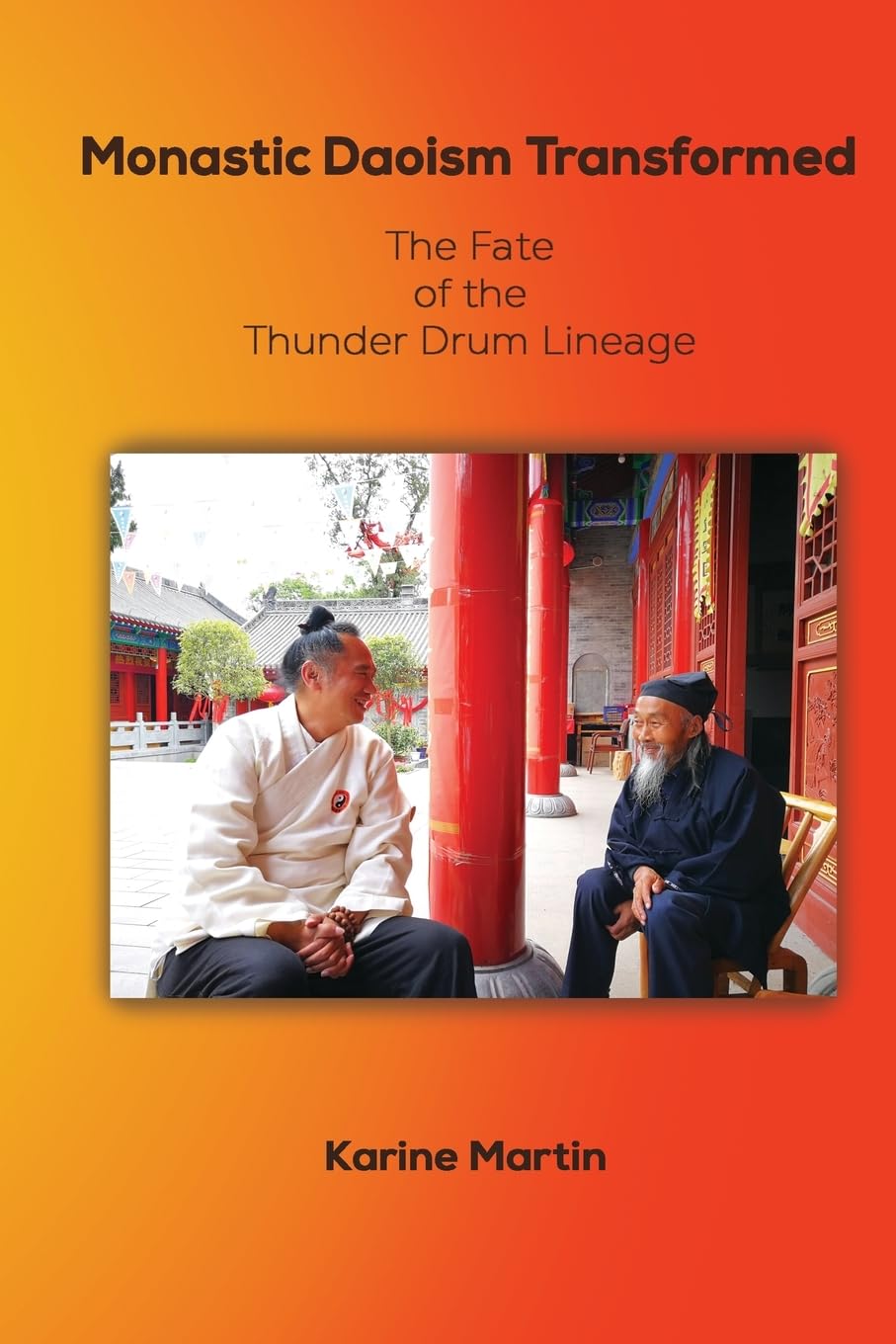
BOOK REVIEW: Karine Martin, “Monastic Daoism Transformed: The Fate of the Thunder Drum Lineage”

In Asia, Book Review, Cultural Bridges, Human Rights, Religious Freedom, Spirituality on August 14, 2025 at 6:20 AM

By René Wadlow

Karine Martin, Monastic Daoism Transformed: The Fate of the Thunder Drum Lineage.

Three Pines Press, 2025, 177pp.

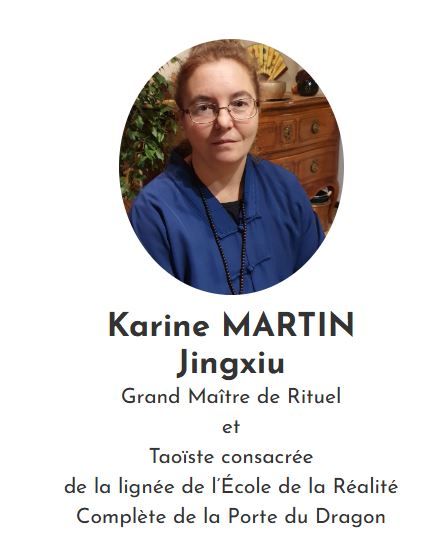
Karine Martin, author of this useful overview of the Chinese Government’s attitude toward Daoist clergy, was able to travel widely in China, visiting more than 100 Daoist temples, especially those of the Thunder Drum lineage to which she belongs.

Since 2017, there has been a Chinese government policy called “Sinicization” in keeping with Xi Jinping’s Thought on Socialism with Chinese Characteristics for a New Era.

Sinicization requires all religious organizations to modify their doctrines and activities so that they match what is considered Han Chinese culture. Authorities have removed crosses from Christian churches and demolished minarets from Islamic mosques. Clergy from all religions are required to attend indoctrination courses on a regular basis. Chinese governments, both Nationalist and Communist, officially recognized five religions: Daoism, Buddhism, Islam, Catholicism and Protestantism.

Some religious groups are considered subversive and are outlawed and their members persecuted such as Falun Gong. During the “Cultural Revolution” (1966 to 1976, ending with the death of Chairman Mao Zedong), religion as such was considered to be one of the “four olds” to be destroyed. Churches and temples were closed. In Tibet, there was widespread destruction of temples. Monks were forced into civilian life. Today, the current policy is to keep religious organizations but to make sure that they do not slip out of control.

As Karine Martin writes,

“Everywhere I went, I found temples in a state of decline and disarray. There were no devotees, much fewer clergy, and minimal activities. Buildings were in disrepair, and there was very little renovation and construction. The overall atmosphere was one of desolation and despair… Temple websites – so strongly developed just a decade ago – now only speak about Xi Jinping Thought and ways of complying with government guidelines… Since all clergy were forced to rejoin secular society during the Cultural Revolution, many got married and had children yet later returned to their monasteries. The marriages often continued, if at long distance, allowing priests to fulfill their spiritual calling while yet having families. Now this is no longer possible, and monks either have to leave the monastery or produce a document that they have obtained a divorce and are properly celebrate.”

Karine Martin has written a very complete picture of monastic Daoism, a development of her Ph.D. thesis based on field observations. However, there is a cultural Daoism which colors Chinese life, its folk religious practices with village shrines – all difficult to control. Daoism places much emphasis on dreams during which the dreamer encounters immortals and advanced masters. Dreams are by their nature difficult to control from outside. The interpretation of the dream is also individual. Dreams can also lead to forms of deep personal meditation in order to understand the significance of the dreams.

Daoism also stresses good health and long life. Deep breathing, massages, herbal remedies and yoga-style movements such as Taijjiquan and Qigong can be carried out without belonging to a Daoist organization.

Daoism also places an emphasis on the appreciation of nature, especially mountains, rivers, forests and well-structured gardens. An ecological concern is growing in China without a specific link to organized Daoism.

While the government may try to control organized Daoist organizations, its cultural manifestations are ever slipping out of control and may one day be manifested in political terms.

Prof. René Wadlow is President of the Association of World Citizens.
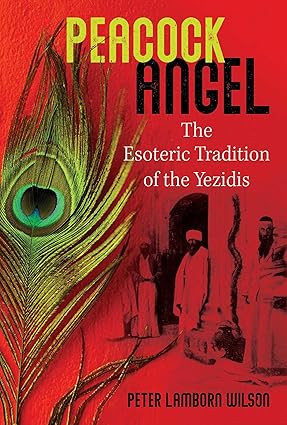
BOOK REVIEW: Peter L. Wilson, “Peacock Angel: The Esoteric Tradition of the Yezidis”

In Being a World Citizen, Book Review, Conflict Resolution, Cultural Bridges, Human Rights, Humanitarian Law, International Justice, Middle East & North Africa, Modern slavery, Peacebuilding, Refugees, Religious Freedom, Solidarity, Spirituality, Syria, The Search for Peace, United Nations, War Crimes, Women's Rights, World Law on August 4, 2025 at 5:55 PM

By René Wadlow

Peter L. Wilson, Peacock Angel: The Esoteric Tradition of the Yezidis.

Rochester, VT, Inner Traditions, 2022, 272pp.

Peter Wilson, a specialist on the Middle East, has written a useful book on the religious framework of the Yezidis as seen by someone outside the Yezidi faith. A Yezidi website has been established by Yezidis living in Nebraska, USA: https://yeziditruth.org.

The yearly Sakharov Prize for Freedom of Thought awarded by the European Parliament was given on October 27, 2016 to Nadia Murad who is also the co-laureate of the 2018 Nobel Peace Prize. She had been taken captive by the forces of the Islamic State in Iraq and Syria (ISIS) in August 2014 and then sold into sexual slavery and forced marriage. She was able to escape with the help of a compassionate Muslim family and went to Germany as a refugee. She has become a spokesperson for the Yezidi, especially Yezidi women.

There are some 500,000 Yezidis, a Kurdish-speaking religious community living in northern Iraq. There were also some 200,000 Yezidis among the Kurds of Türkiye, but nearly all have migrated to Western Europe, primarily Germany as well as to Australia, Canada, and the USA.

There are also some Yezidi among Kurds living in Syria, Iran and Armenia. The Yezidis do not convert people. Thus, the religion continues only through birth into the community.

The structure of the Yezidi religious system is Zoroastrian, a faith born in Persia proclaiming that two great cosmic forces, that of light and good and that of darkness and evil are in constant battle. Humans are called upon to help light overcome darkness.

However, the strict dualistic thinking of Zoroastrianism was modified by another Persian prophet, Mani of Ctesiphon in the third century of the Common Era. Mani tried to create a synthesis of religious teachings that were increasingly coming into contact through travel and trade: Buddhism and Hinduism from India, Jewish and Christian thought, Hellenistic Gnostic philosophy from Egypt and Greece as well as many small belief systems.

Mani kept the Zoroastrian dualism as the most easily understood intellectual framework, though giving it a somewhat more Taoist (yin/yang) flexibility, Mani having traveled to China. He developed the idea of the progression of the soul by individual effort through reincarnation. Unfortunately, only the dualistic Zoroastrian framework is still attached to Mani’s name – Manichaeism. This is somewhat ironic as it was the Zoroastrian Magi who had him put to death as a dangerous rival.

Within the Mani-Zoroastrian framework, the Yezidi added the presence of angels who are to help humans in the constant battle for light and good, in particular Melek Tawsi, the peacock angel. Although there are angels in Islam, angels that one does not know could well be demons. Thus, the Yezidis are regularly accused of being “demon worshipers”.

The Yezidis have always been looked down upon by both their Muslim and Christian neighbors as “pagans”. The government of Saddam Hussein was opposed to the Yezidis not so much for their religious beliefs but rather because some Yezidis played important roles in the Kurdish community, seen as largely opposed to the government. The Yezidi community is still in socio-economic difficulty given the instability of the situation in Iraq.

Peter Wilson has written a useful introduction to this little-known faith.

Prof. René Wadlow is President of the Association of World Citizens.

Opposing the Death Penalty: The Fight Goes On

In Current Events, Democracy, Human Rights, International Justice, Middle East & North Africa, NGOs, Religious Freedom, Solidarity, United Nations, World Law on July 29, 2025 at 7:45 PM

By René Wadlow

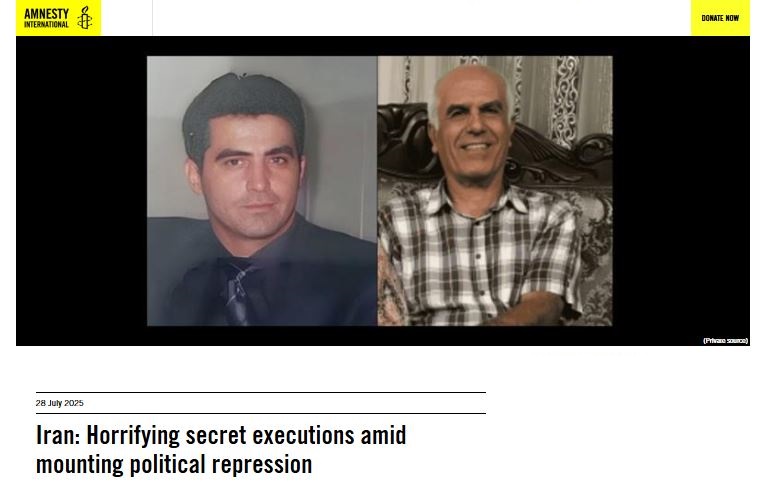
In a July 28, 2025 statement, the United Nations (UN) High Commissioner for Human Rights, Volker Türk, called for a moratorium on capital punishment in Iran where at least 48 persons are currently on death row. According to information gathered by the UN Human Rights Office in Geneva, at least 612 persons were reportedly executed in the first half of 2025. Minorities continue to be disproportionately affected by executions.

Religious minorities in Iran include Sunni Muslims, Christians, Baha’is, Zoroastrians, Jews, and the Gonabali Sufi community. Religious and ethnic identities in Iran often overlap.

Türk added, “Information received by my Office also indicates that judicial proceedings in a number of cases, often held behind closed doors, have consistently failed to meet due process and fair trial guarantees…The death penalty is incompatible with the right to life and irreconcilable with human dignity. Instead of accelerating executions, I urge Iran join the worldwide movement abolishing capital punishment starting with a moratorium on all executions.”

The Association of World Citizens has repeatedly called upon governments for a moratorium on executions with a view of abolishing the death penalty – a penalty that extensive research has shown has little or no impact on the level of crime and too often opens doors to judicial errors and injustices.

Prof. René Wadlow is President of the Association of World Citizens.

Human Rights Education: A Vital Need

In Being a World Citizen, Human Rights, International Justice, NGOs, Nonviolence, Peacebuilding, Refugees, Religious Freedom, Social Rights, Solidarity, The Search for Peace, United Nations, World Law on July 26, 2025 at 6:30 AM

By René Wadlow

Education for human rights is a vital need in order to create a universal culture of human rights. Such a culture of human rights can be built around peoples’ needs and current struggles. A human rights culture is more than knowing and respecting the provisions of the Universal Declaration of Human Rights. It is a break in the cycle of humiliation, abuses of power and violence in which too many people are caught today. People want to know that they are in full control of their lives and that their society embodies their uniqueness as people with the full development of their personality and sense of dignity.

Knowledge requires appropriate pedagogical techniques for imparting human rights information, and therefore there is a need to train teachers at all levels of formal education in the teaching of human rights. There is a need to develop innovative material for use especially in professional training for the judiciary, law enforcement, military, medical and social work. The need to develop innovative teaching material and techniques is true for the efforts against torture especially on persons held in custody.

In addition to human rights education within formal educational institutions, an emphasis can be placed on popular education and the informal sector. There is a role for writers and anthropologists to collect stories and songs that evoke the historical memory of people about hope, respect, equality and human dignity. Likewise, the media can play an important role both in giving information and in developing respect for human rights and dignity.

Human rights education is an indispensable tool in the empowerment of peoples. Learning of human rights leads to participation, reciprocity and accountability on all levels of society. This strengthens the democratic process as persons become aware of their rights and responsibilities, of the full dimension of equal respect between women and men, and among peoples of different cultural and ethnic identities.

There is much to be done, and many can play a role. Join in this vital effort for human rights education!

Prof. René Wadlow is President of the Association of World Citizens.

China’s Taoists: Slipping Out of Control?

In Asia, Cultural Bridges, Human Rights, Literature, Religious Freedom, Solidarity, Spirituality on February 17, 2025 at 8:00 AM

By René Wadlow

A review of Monastic Daoism Transformed: The Fate of the Thunder Drum Lineage by Karine Martin (Three Pines Press, 2025, 177 pages)

Since 2017 there has been a Chinese government policy called “Sinicization” in keeping with Xi Jinping’s Thought on Socialism with Chinese Characteristics for a New Era.

Sinicization requires all religious organizations to modify their doctrines and activities so that they match what is considered Han Chinese culture. Authorities have removed crosses from Christian churches and demolished minarets from Islamic mosques. Clergy from all religions are required to attend indoctrination courses on a regular basis. Chinese governments, both Nationalist and Communist, officially recognized five religions: Daoism, Buddhism, Islam, Catholicism and Protestantism.

Some religious groups are considered subversive and are outlawed and their members persecuted such as Falun Gong. During the “Cultural Revolution” (1966 to 1976, ending with the death of Chairman Mao Zedong), religion as such was considered to be one of the “four olds” to be destroyed. Churches and temples were closed. In Tibet, there was widespread destruction of temples. Monks were forced into civilian life. Today, the current policy is to keep religious organizations but to make sure that they do not slip out if control.

Karine Martin is a Western member of the Daoist monastic clergy (Taoism is now more often written as Daoism). In 2023, she was able to travel widely in China visiting more than 100 Daoist temples, especially those of the Thunder Drum lineage to which she belongs. As she writes,

“Everywhere I went, I found temples in a state of decline and disarray. There were no devotees, much fewer clergy, and minimal activities. Buildings were in disrepair, and there was very little renovation and construction. The overall atmosphere was one of desolation and despair… Temple websites – so strongly developed just a decade ago – now only speak about Xi Jinping Thought and ways of complying with government guidelines… Since all clergy were forced to rejoin secular society during the Cultural Revolution, many got married and had children yet later returned to their monasteries. The marriages often continued, if at long distance, allowing priests to fulfill their spiritual calling while yet having families. Now this is no longer possible, and monks either have to leave the monastery or produce a document that they have obtained a divorce and are properly celebrate.”

Karine Martin has written a very complete picture of monastic Daoism, a development of her Ph.D. thesis based on field observations. However, there is a cultural Daoism which colors Chinese life, its folk religious practices with village shrines – all difficult to control. Daoism places much emphasis on dreams during which the dreamer encounters immortals and advanced masters. Dreams are by their nature difficult to control from outside. The interpretation of the dream is also individual. Dreams can also lead to forms of deep personal meditation in order to understand the significance of the dreams.

Daoism also stresses good health and long life. Deep breathing, massages, herbal remedies and yoga-style movements such as Taijjiquan and Qigong can be carried out without belonging to a Daoist organization.

Daoism also places an emphasis on the appreciation of nature, especially mountains, rivers, forests and well-structured gardens. An ecological concern is growing in China without a specific link to organized Daoism.

While the government may try to control organized Daoist organizations, its cultural manifestations are ever slipping out of control and may one day be manifested in political terms.

Prof. René Wadlow is President of the Association of World Citizens.

Pact for the Future: A Partly Open Door for NGO-UN Cooperation

In Being a World Citizen, Conflict Resolution, Cultural Bridges, Current Events, Human Development, Human Rights, NGOs, Refugees, Religious Freedom, Social Rights, Solidarity, Sustainable Development, The Search for Peace, Track II, United Nations, World Law on October 4, 2024 at 6:00 AM

By René Wadlow

The Pact for the Future was accepted by the United Nations (UN) General Assembly in a three-stage process. The first stage was a nearly year-long drafting of the document with many small revisions in the 56 paragraphs setting out the goal of a renewed UN better able to guarantee peace and development. The second stage was a last moment motion by the Russian Federation which asked for a vote, finding some of the wording, especially on human rights, too strong. The Russian motion was put to a vote with 143 States voting for the text of the Pact, 15 abstentions, and 7 opposed (Russia, Belarus, North Korea, Iran, Syria, Sudan, and Nicaragua.)

After this vote, the President of the General Assembly called for a vote by acclamation. Everyone applauded, some more vigorously than others. Thus, the Pact was adopted by consensus.

The Pact should be seen as a springboard for action rather than as an end point. With the 193 UN members potentially involved in drafting the document, there was a need for compromises and general ideas rather than any new specific proposals. The Pact is a reaffirmation of the goals and processes of the UN system, but it also notes the need for constant renewal. In paragraph 6, the Pact states, “We recognize that the multilateral system and its institutions, with the United Nations and its Charter at the center, must be strengthened to keep pace with a changing world. They must be fit for the present and the future – effective and capable, prepared for the future, just, democratic, equitable and representative of today’s world, inclusive, interconnected and financially stable.”

Paragraph 9 states, “We also reaffirm that the three pillars of the United Nations – sustainable development – peace and security, and human rights – are equally important, interlinked and mutually reinforcing. We cannot have one without the others.”

In practice, it was easier to stress sustainable development since the 2030 Sustainable Development Goals had already been set out, through progress is very uneven. For peace and security, there are Articles 25 and 26 stating that, “We will advance the goal of a world free of nuclear weapons. We will uphold our disarmament obligations and commitments.” A culture of peace is mentioned in a number of places, but no specific steps are set out.

For two days prior to the governments’ discussion and voting on the Pact, there was what were called “Action Days” to which were invited Nongovernmental Organizations (NGOs), academics working on UN issues, and the representatives of business corporations involved in international trade. The two days were certainly a time for networking if not for “action”.

The Pact is a partially open door for UN cooperation with NGOs stating in a general way the “participation of relevant stakeholders in appropriate formats.” More specifically, the Pact calls to “Facilitate more structured, meaningful and inclusive engagement of nongovernmental organizations in consultative status with the Economic and Social Council in the activities of the Council in line with ECOSOC resolution 1996/21”. The door of the Pact was most open to youth calling for an increase in the representation of youth, which can only be via NGOs. We will have to see what, as NGO representatives, we can make of the partly open door.

Prof. René Wadlow is President of the Association of World Citizens.

La AWC Llama a las Autoridades de Nicaragua a Derogar la Prohibición Anunciada de 1.500 Organizaciones No Gubernamentales

In Being a World Citizen, Current Events, Democracy, Human Rights, Latin America, NGOs, Religious Freedom, Social Rights, Solidarity, The Search for Peace, United Nations, World Law on August 20, 2024 at 8:45 PM

LA AWC LLAMA A LAS AUTORIDADES DE NICARAGUA A DEROGAR LA PROHIBICIÓN ANUNCIADA DE 1.500 ORGANIZACIONES NO GUBERNAMENTALES

La Association of World Citizens (Asociación de Ciudadanos del Mundo; AWC) expresa su alarma al aprender que las autoridades de la República de Nicaragua anunciaron el 19 de agosto la prohibición de 1.500 organizaciones no gubernamentales (ONG), la mayoría de ellas organizaciones de beneficencia católicas romanas, aunque, lamentablemente, la medida también ha afectado a la Cruz Roja Nicaragüense.

Desde abril de 2018, el Gobierno encabezado por el Presidente Daniel Ortega ha adoptado un cariz abiertamente autoritario, tras las protestas cuya violenta represión, según las Naciones Unidas (ONU), ha dejado más de 300 muertos. En este contexto, casi todos los opositores políticos han sido encarcelados o forzados al exilio.

En cuanto a los grupos de la sociedad civil, esta última medida eleva a 5.000 el número de ONG prohibidas por las autoridades en los últimos seis años. Todos los grupos prohibidos han visto sus bienes confiscados por el Gobierno. Aunque la razón oficial esgrimida es que estas ONG no han declarado sus ingresos, la semana pasada se aprobó una normativa que obliga a las ONG a establecer “alianzas de asociación” con las autoridades, con lo que prácticamente se acaba su carácter “no gubernamental”.

La Oficina del Alto Comisionado de las Naciones Unidas para los Derechos Humanos ha pedido “a las autoridades nicaragüenses que dejen de imponer restricciones severas a los espacios cívicos y democráticos del país y que garanticen el respeto de los derechos humanos, de conformidad con las obligaciones internacionales de Nicaragua en materia de derechos humanos”.

La AWC respalda sin reservas este llamamiento, instando al Gobierno de Nicaragua a rescindir de inmediato su prohibición anunciada y a restablecer a todas las ONG ilegalizadas desde 2018 su estatus jurídico y financiero inicial, garantizando además que sean libres de operar como consideren conveniente, un requisito básico para cualquier país que pretenda defender el Estado de derecho.

The AWC Calls on the Authorities of Nicaragua to Rescind Their Announced Ban on 1,500 Nongovernmental Organizations

In Being a World Citizen, Current Events, Democracy, Human Rights, Latin America, NGOs, Nicaragua, Religious Freedom, Social Rights, Solidarity, The Search for Peace, United Nations, World Law on August 20, 2024 at 8:45 PM

THE AWC CALLS ON THE AUTHORITIES OF NICARAGUA TO RESCIND THEIR ANNOUNCED BAN ON 1,500 NONGOVERNMENTAL ORGANIZATIONS

The Association of World Citizens (AWC) is alarmed to hear that the authorities of the Republic of Nicaragua announced on August 19 that they were banning 1,500 Nongovernmental Organizations (NGOs), most of them Roman Catholic charities – even though, regrettably, the Nicaraguan Red Cross has been struck by the measure too.

Since April 2018, the Government led by President Daniel Ortega has taken an openly authoritarian turn, after protests whose violent repression the United Nations (UN) claims left more than 300 people dead. In this context, nearly all political opponents have been jailed or forced into exile.

As for civil society groups, this latest move brings to 5,000 the number of NGOs banned by the authorities over the last six years. All groups thus banned have had their assets seized by the Government.

Even though the official reason put forward is that these NGOs have failed to declare their income, last week, a regulation was passed requiring NGOs to enter “partnership alliances” with the authorities, therefore practically ending their “nongovernmental” nature.

The Office of the UN High Commissioner for Human Rights has called “on the Nicaraguan authorities to stop imposing severe restrictions on civic and democratic spaces in the country, and to ensure that human rights are respected, in line with Nicaragua’s international human rights obligations.”

The AWC unreservedly endorses this call, urging the Nicaraguan Government to rescind immediately its announced ban and restore all NGOs outlawed since 2018 to their initial legal and financial status, further ensuring that they are free to operate as they see fit, a basic requirement for any country which claims to be upholding the rule of law.

Politics Beyond National Frontiers

In Being a World Citizen, Conflict Resolution, Cultural Bridges, Democracy, Environmental protection, Human Development, Human Rights, Humanitarian Law, International Justice, Migration, Modern slavery, NGOs, Nonviolence, Refugees, Religious Freedom, Social Rights, Solidarity, Sustainable Development, The Search for Peace, Track II, United Nations, Women's Rights, World Law on May 24, 2023 at 6:38 AM

By René Wadlow

In our current globalized world society, there is an increased role for politics without borders. Politics no longer stops at the water’s edge but must play an active role on the world stage. However, unlike politics at the national level which usually has a parliament at which the actors can recite their lines, the world has no world parliament as such. Thus, new and inventive ways must be found so that world public opinion can be heard and acted upon.

The United Nations (UN) General Assembly is the closest thing to a world parliament that we have today. However, all the official participants are diplomats appointed by their respective States – 195 member states. UN Secretariat members, the secretariat members of UN Specialized Agencies such as UNESCO and the ILO, are in the hallways or coffee shops to give advice. Secretariat members of the financial institutions such as the World Bank and the IMF are also there to give advice on costs and the limits of available funds. The representatives of Nongovernmental Organizations (NGO) in Consultative Status with the UN who can speak at sessions of the Economic and Social Council and the Human Rights Council cannot address the General Assembly directly. However, they are also in the coffee shops and may send documents to the UN missions of national governments.

(C) Jérôme Blum

Politics without borders requires finding ways to express views for action beyond the borders of individual countries. Today, most vital issues that touch the lives of many people go beyond the individual State: the consequences of climate change, the protection of biodiversity, the resolution of armed conflicts, the violations of human rights, and a more just world trade pattern. Thus we need to find ways of looking at the world with a global mind and an open heart. This perspective is an aim of world citizenship.

However, World Citizens are not yet so organized as to be able to impact political decisions at the UN and in enough individual States so as to have real influence. The policy papers and Appeals of the Association of World Citizens (AWC) are often read with interest by the government representatives to whom they are sent. However, the AWC is an NGO among many and does not have the number of staff as such international NGOs as Amnesty International, Human Rights Watch, and Greenpeace.

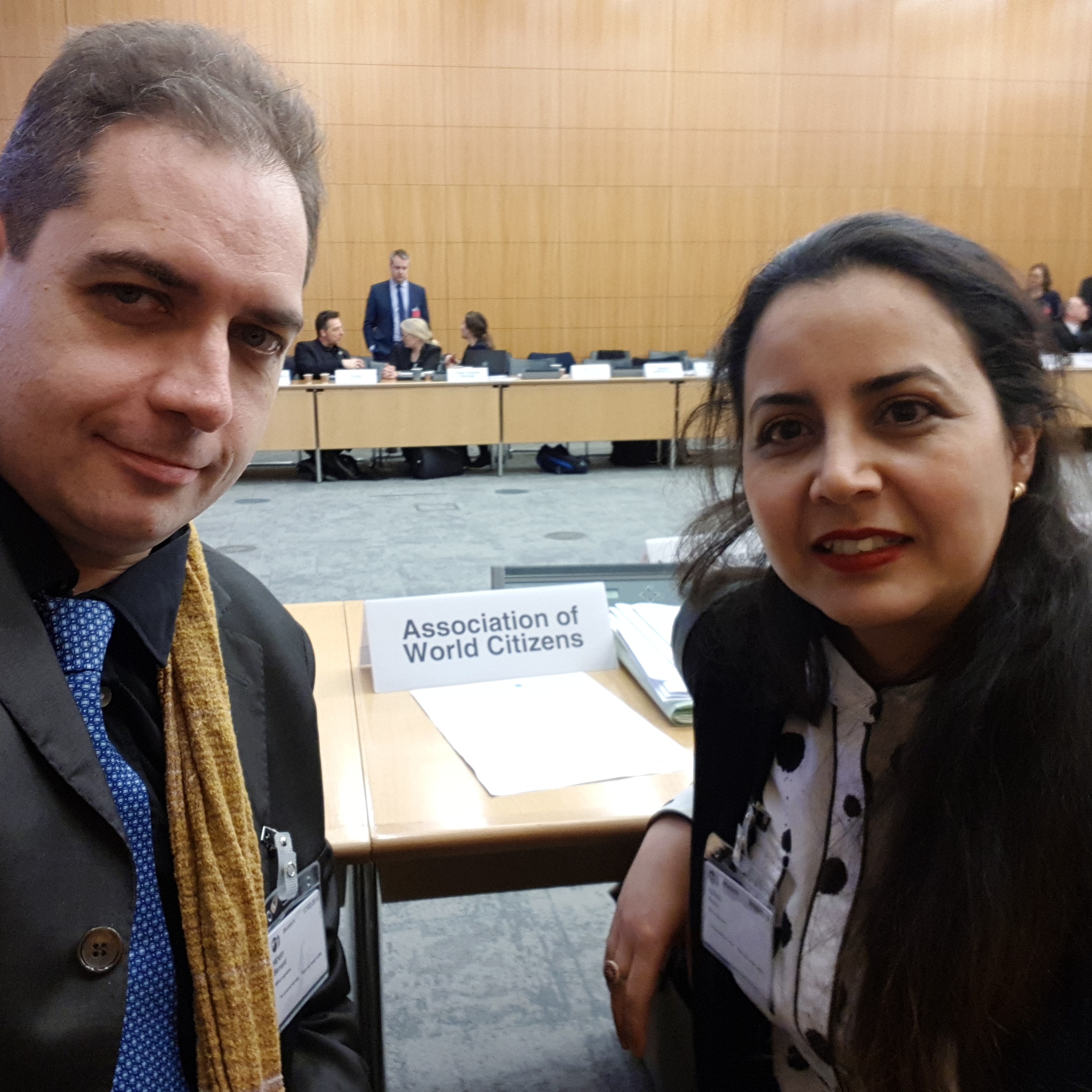
The First Officer and External Relations Officer, Bernard J. Henry, and the Legal and Mediation Officer, Attorney Noura Addad, representing the AWC at an OECD roundtable in March 2019 (C) Bernard J. Henry/AWC

We still need to find effective ways so that humanity can come together to solve global problems, that is, politics without borders. Prof. René Wadlow is President of the Association of World Citizens.