“Always we have to remember that the wide, free sense of equality and kinship which lies at the root of Internationalism is the real goal. Always, we have to press on toward that great and final liberation – the realization of our common humanity, the recognition of the same great soul slumbering under all forms in the hearts of all races – the one guarantee and assurance of the advent of world peace.”
Edward Carpenter, The Healing of Nations, 1914.
As we approach the end of 2024 and make plans for 2025, it is useful to see the challenges which confront us in our conscious commitment to world citizenship. We are all able to envision a better future in which there is global cooperation. Such positive goals require leadership and the active participation of world citizens from around the globe. We need to make a personal commitment to be Earth stewards, protecting the planet for future generations. We need to break down barriers between people in order to reduce suspicions and tensions. Enormous creativity and effort are required to develop a safe and sustainable world society.
While we plan these positive steps, we must not underestimate the strength of the narrow nationalist currents planning to build new walls or enlarge existing walls. One could list the examples in many parts of the world. Narrow nationalists are in power in a number of countries or are waiting on the edges of power.
Thus, as Edward Carpenter wrote as the First World War broke out, we must press on to the realization of our common humanity.
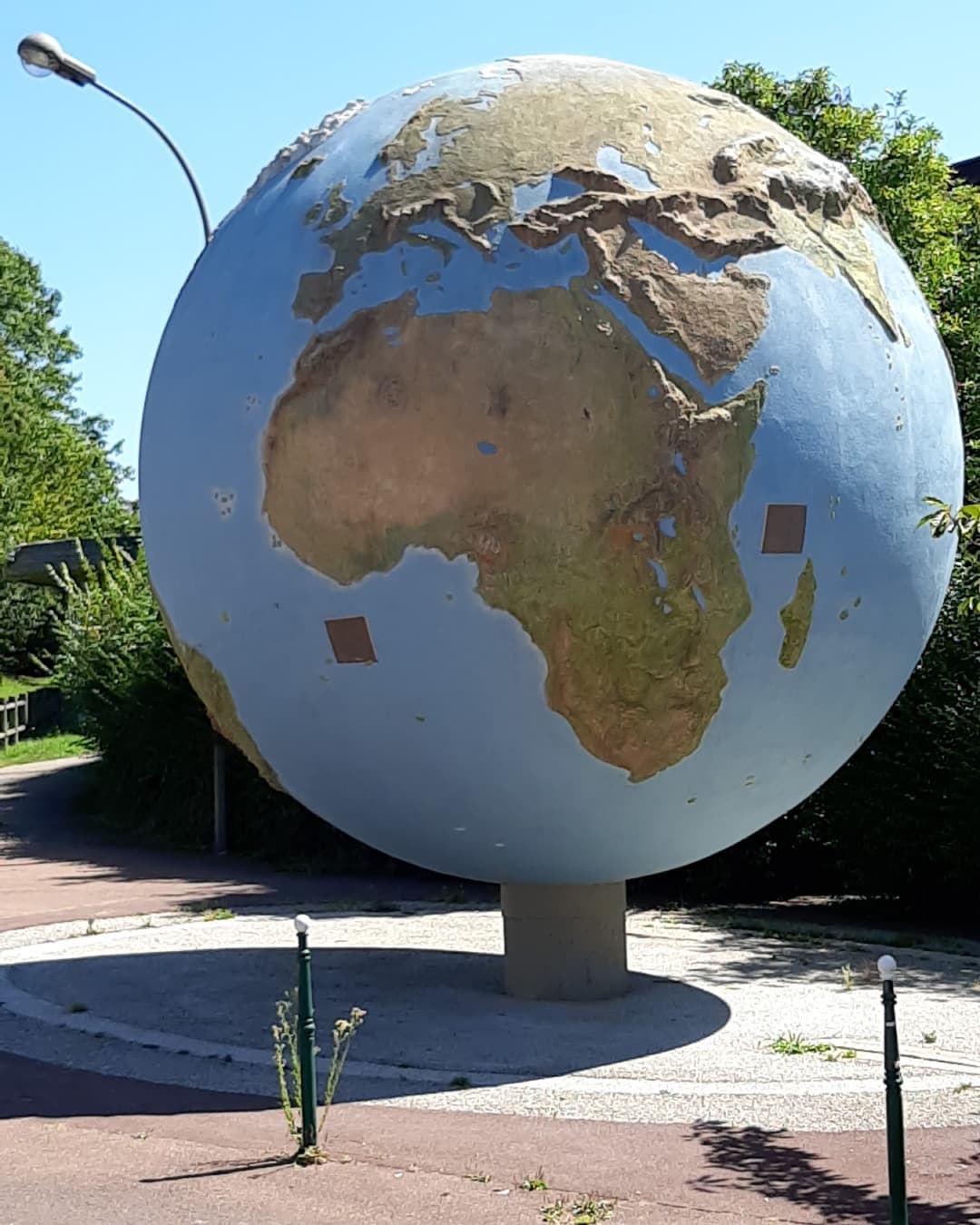
Earth is our common home, Let’s protect it together (C) Bernard J. Henry/AWC
Prof. René Wadlow is President of the Association of World Citizens.
War and armed violence are highly destructive of the lives of persons, but also of works of art and elements of cultural heritage. Knowledge and understanding of people’s past can help current inhabitants to develop their identity and to appreciate the value of their culture and heritage. Such knowledge and understanding enriches their lives and enables them to manage contemporary problems more successfully.
Since September 23, 2024, the armed conflict between the Israeli armed forces and the Hezbollah militia in Lebanon has led to increased air attacks by Israeli forces on different parts of Lebanon, resulting in deaths and the uprooting of a large number of people. Hezbollah had begun hostilities on October 8, 2023 by shelling Israeli positions in support of Hamas.
The Association of World Citizens (AWC) had called for a reduction of Israeli-Hezbollah tensions and has since called for a ceasefire and for the return of persons displaced in the areas on both sides of the Israel-Lebanon frontier. (See our Appeal of September 2024).
This AWC Appeal concerns the protection of cultural heritage as Israeli attacks have already harmed cultural heritage sites in Baalbek and Tyr as well as other culutral sites. Lebanon has a rich past going back to Biblical and Roman times.
After the Second World War, UNESCO had developed international conventions on the protection of cultural and educational bodies in time of armed conflict. The most important of these is the 1954 Hague Convention for the Protection of Cultural Property in the Event of Armed Conflict. The Hague Convention has been signed by a large number of States.
The 1954 Hague Convention builds on the Roerich Peace Pact first proposed by the Russian painter and champion of Asian culture, Nicholas Roerich. The Roerich Peace Pact was signed on April 15, 1935 by 21 States in a Pan American Union ceremony at the White House in Washington, D.C.
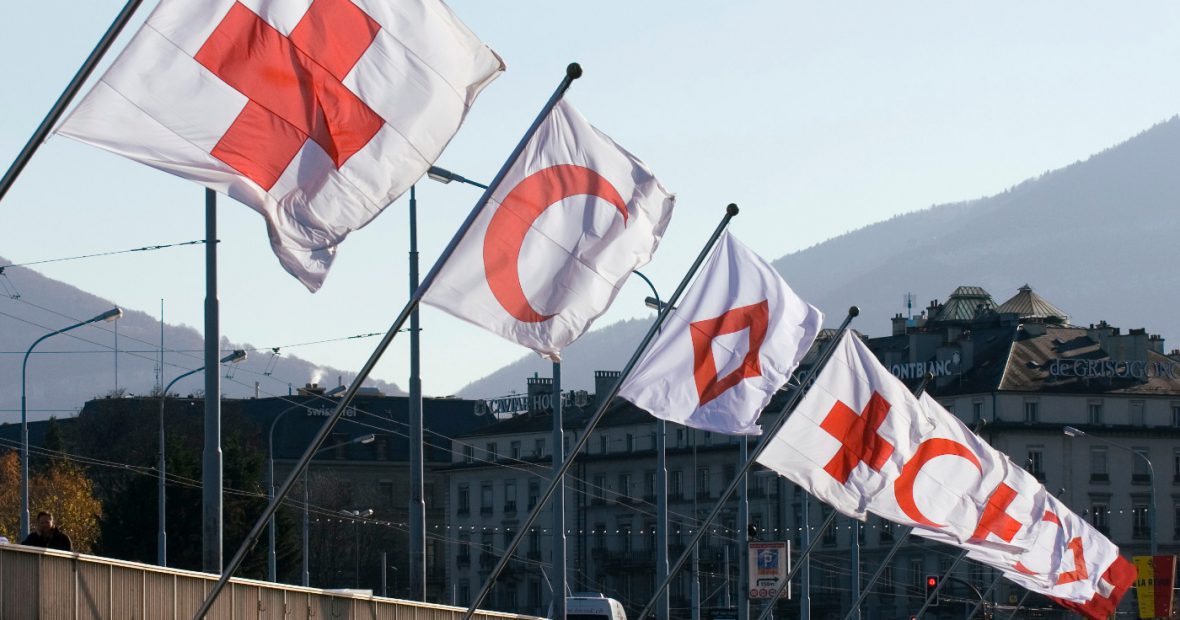
The Banner of Peace (Pax Cultura), as defined by the Roerich Pact of 1935 (C) Kwamikagami
At the signing, Henry A. Wallace, then United States (U.S.) Secretary of Agriculture and later Vice-President, said, “At no time has such an ideal been more needed. It is high time for the idealists who make the reality of tomorrow, to rally around such a symbol of international cultural unity. It is time that we appeal to that appreciation of beauty, science, education which runs across all national boundaries to strengthen all that we hold dear in our particular governments and customs. Its acceptance signifies the approach of a time when those who truly love their own nation will appreciate in addition the unique contributions of other nations and also do reverence to that common spiritual enterprise which draws together in one fellowship all artists, scientists, educators and truly religious of whatever faith. Thus we build a world civilization which places that which is fine in humanity above that which is low, sordid and mean, that which is hateful and grabbing.”
We still have efforts to make so that what is fine in humanity is above what is hateful and grabbing. The AWC strives so that a start will begin in Lebanon and spread to the wider Middle East.
Prof. René Wadlow is President of the Association of World Citizens.
The armed conflicts in the Middle East: Israel-Palestine, Lebanon, Syria, Iraq, Iran, Yemen have led to increased violations of International Humanitarian Law. Medical facilities and medical personnel have been attacked; civilians have been targeted, educational facilities destroyed. Therefore, the Association of World Citizens (AWC) makes an urgent call for the respect of International Humanitarian Law. This must be a joint effort of governments and Nongovernmental Organizations.
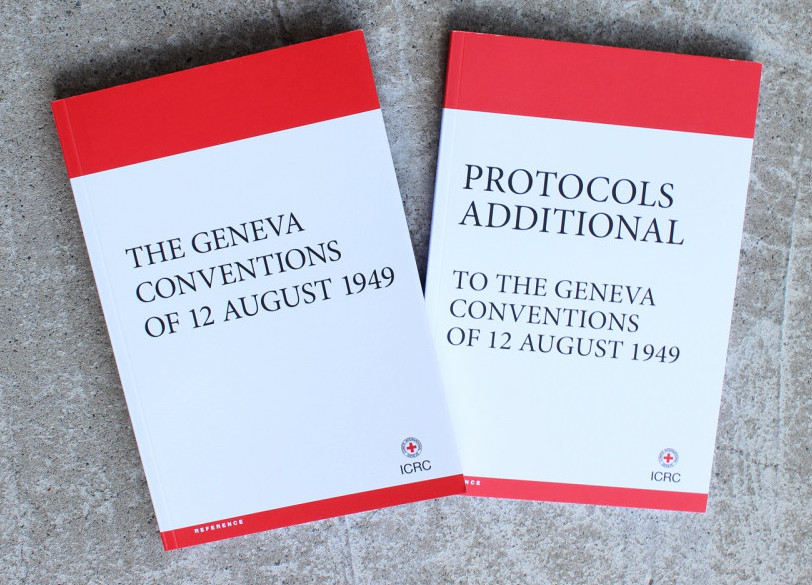
Regular military personnel of all countries are theoretically informed of the rules of the Geneva Conventions of August 12, 1949, and the Protocol Additional adopted in 1977.
When the 1949 Geneva Conventions were drafted and adopted, it was possible to spell out in considerable detail rules regarding prisoners of war and the protection of civilians, in particular Common Article 3 (so called because it is found in all four Conventions) provides that “each Party to the conflict shall be bound to apply, as a minimum, the following provisions: Persons taking no active part in the hostilities … shall in all circumstances be treated humanely without any adverse distinction founded on race, color, religion or faith, sex, birth or wealth, or any other similar criteria.”
The importance of Common Article 3 should not be underestimated. It sets out in straightforward terms important protections that all parties to a conflict must respect. In order to meet the need for additional protection, international humanitarian law has evolved to cover not only international armed conflict but also internal armed conflict. Today, international human rights standards are also considered part of international humanitarian law, thus providing additional protection for vulnerable population groups such as women, children, and minorities.
As situations of internal violence and strife proliferate, abuses committed by non-State actors, such as armed militias, are increasing concerns. Fundamental standards of international humanitarian law are intended to ensure the effective protection of human beings in all situations. The standards are clear. (1)
There are two major weaknesses in the effectiveness of international humanitarian law. The first is that many people do not know that it exists and that they are bound by its norms. Thus, there is an important role for greater promotional activities, the dissemination of information through general education, specific training of the military, outreach to armed militias, and cooperation with a wide range of nongovernmental organizations.
The second weakness is that violations of international humanitarian law are rarely punished. Governments too often tolerate these violations. Few soldiers are tried, or courtmartialed, for the violations of international humanitarian law. This weakness is even more true of nongovernmental militias and armed groups.
In fact, most violations of international humanitarian law are not actions of individual soldiers or militia members carried away by a sudden rush of anger, fear, a desire of revenge or a sudden sexual urge to rape a woman. Soldiers and militia members violating the norms of international humanitarian law are acting on orders of their commanders.
Thus, the only sold response is an act of conscience to refuse an order of a military or militia higher up and refuse to torture, to bomb a medical facility, to shoot a prisoner, to harm a child, and to rape a woman. Conscience, that inner voice which discerns what is right from wrong and encourages right action is the value on which we can build the defense of international humanitarian law. The defense of conscience to refuse unjust orders is a large task but a crucial action for moving toward a law-based world society.
Notes
(1) For useful guides to international humanitarian law see:
D. Schindler and J. Toman, The Laws of Armed Conflicts (Martinus Nihjoff Publishers, 1988)
H. McCoubrey and N.D. White, International Law and Armed Conflicts (Dartmouth Publishing Co., 1992)
Prof. René Wadlow is President of the Association of World Citizens.
October 7-8, 2024 will mark one year of armed conflict between Israeli forces and the Hamas militia – an armed conflict which grinds on and has spread.
On October 8, 2023, in light of the October 7 Hamas attack and the start of the Israeli response in the Gaza Strip, the Association of World Citizens called for five immediate steps that it hoped would create a climate of dialogue and the start of negotiations in good faith. The proposals were posted on the World Citizens’ website, sent to the Israeli Missions to the United Nations (UN) and to groups that might have avenues of communication with Hamas.
“As Citizens of the World, we call for a ceasefire in the Israeli-Palestinian armed conflict;
For the release of all hostages held by Hamas and other Palestinian groups;
For the release of all Palestinian prisoners held in Israeli jails, often under administrative detention without trial;
For preventing the extension of the conflict to the Lebanon frontier through negotiations with Hezbollah;
For preventing an increase in violence on the West Bank among Israeli settlers and Palestinian villages;
For the start of negotiations in good faith for a political solution that ensures freedom and the collective safety of Israelis and Palestinians.”
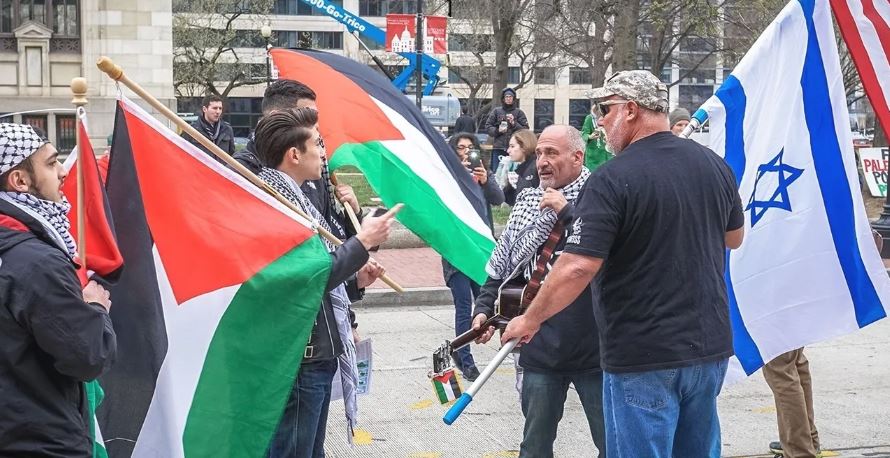
(C) Ted Eytan
A year later, the armed violence has increased: in Gaza with a high number of persons killed, wounded and displaced, on the West Bank, in Lebanon, has expanded to Iran and brought in elements of the conflict in Yemen.
There have been relevant resolutions of the UN General Assembly, of the International Court of Justice, and appeals for a ceasefire and negotiations from many Nongovernmental Organizations (NGOs).
Due to the spiraling growth of destruction, as NGOs we must continue and increase our efforts.
Prof. René Wadlow is President of the Association of World Citizens.
September 21 is the United Nations (UN) designated International Peace Day, set out in 1981 by a UN General Assembly resolution as being a day close to the start of the General Assembly. The Day is devoted to creating a culture of peace through dialogue in a spirit of mutual understanding and a consciousness of the unity of humanity. As the psychoanalyst Erick Fromm wrote, “I believe that the One World which is emerging can come into existence only if a new man comes into being – a man who has emerged from the archaic ties of blood and soil, who feels himself to be a Citizen of the World, whose loyalty is to the human race and to life.”
This year, September 21 is one of the two Action Days of the Summit for the Future being held at the UN in New York. We are all aware that in many parts of the world there is armed conflict, political rivalries and growing tensions. The current heavily State-centered approaches to world politics hampers the effectiveness of the UN and its Specialized Agencies. In these times of insecurity when many people feel uncertain about the future, when anxieties and fears are promoted and then exploited by political populists, old-fashioned nationalists and religious fundamentalists, we need to present a positive vision and to build bridges of understanding over the current divides of nationalism, ethnicity and social classes.
Today, the revolutionary character of our times is recognized by many observers. Those who live in the midst of swift social change confront the upheaval of their way of life. We are entering a period of change for which there are no blueprints. Therefore, it is essential that we learn to work together. We celebrate our similarities rather than our differences. Thus, on this Day of Peace, we are called to new levels of creativity and constructive action.
Prof. René Wadlow is President of the Association of World Citizens.
With the armed conflict in the Gaza Strip continuing to increase the number of dead, wounded, and displaced and the danger of the conflict spreading to other areas of the Middle East, renewed efforts of conflict resolution need to be made. The United Nations (UN) has been active especially in relief efforts, and many Nongovernmental Organizations (NGOs) have expressed their concern. NGOs have also been active in relief efforts. However, the inadequate amount of relief supplies that enter the Gaza Strip limits the impact of nongovernmental activity.
From the start of the Gaza conflict more than 100 days ago, NGOs such as the Association of World Citizens have been highlighting positive steps on the path to negotiations. They have stressed four major steps:
1) An immediate ceasefire;
2) Release of hostages held by Hamas and other Palestinian armed groups, release of Palestinian prisoners held in Israeli jails – often under administrative detention without trial;
3) Preventing the extension of the conflict to Lebanon’s frontier through negotiations with Hezbollah;
4) Preventing an increase in violence in the West Bank between Israeli settlers and Palestinian villages.
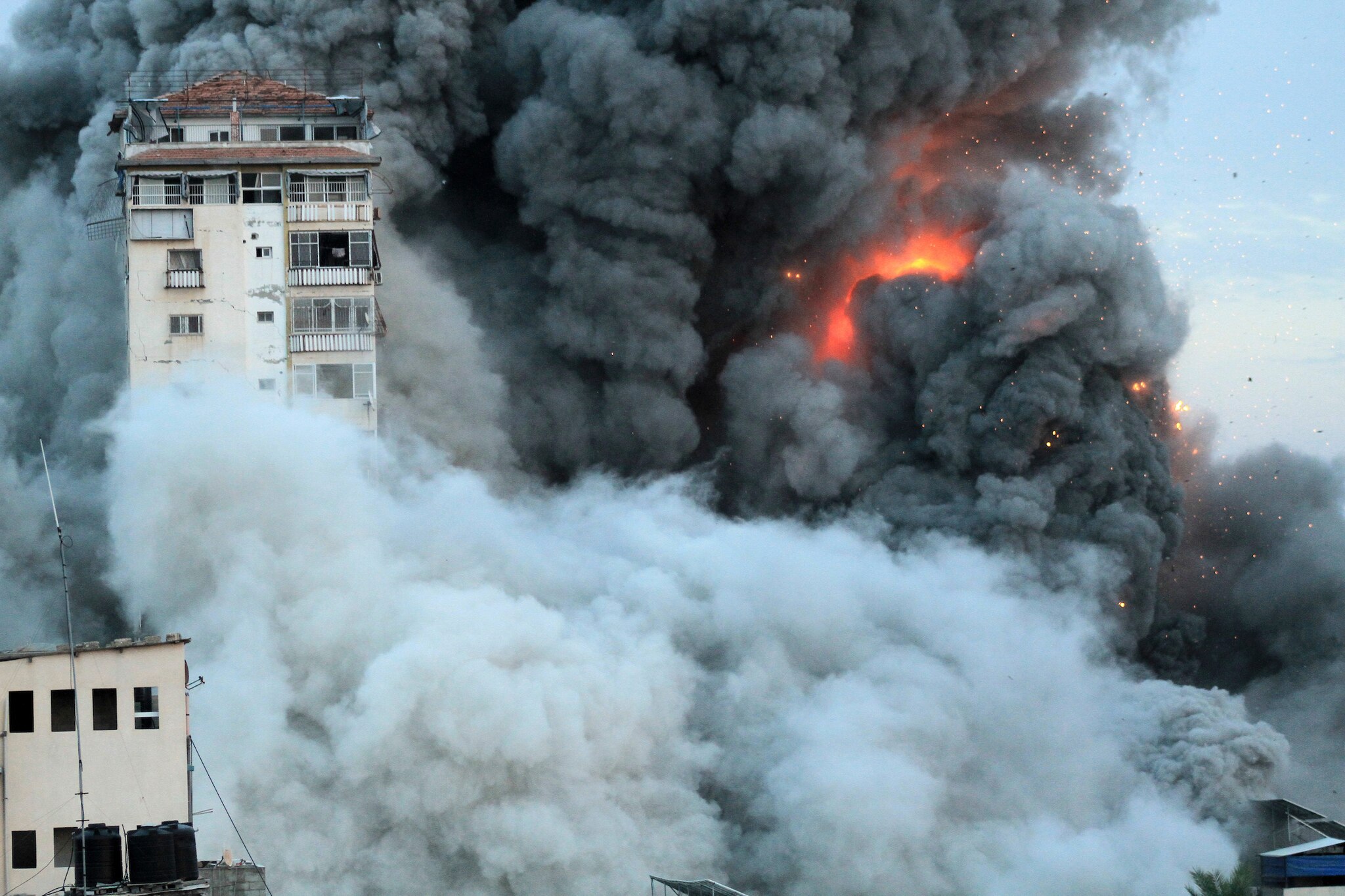
In October 2023, a building destroyed in Gaza (C) Ali Hamad/APAimages
The start of hearings on the charge of genocide at the International Court of Justice has added international attention to the Gaza Strip situation and more broadly to the Israel-Palestine drama.
The need for conflict resolution action is great. The proposals of NGOs hold a light of hope.
Prof. René Wadlow is President of the Association of World Citizens.
Antony Blinken, the United States (U.S.) Secretary of State, has been again in the Middle East working to prevent the violence of the Gaza Strip of spreading to much of the area. The Gaza Strip conflict has already spread to the West Bank with increased violence between Jewish settlers and Palestinian inhabitants. There is increased violence along the frontier of Lebanon with the activities of the armed faction Hezbollah and the displacement of Israeli villages. Negotiations in good faith seem far off, and political speeches grow more conflictual. Could there be a role for unarmed, non-governmental peace brigades to monitor frontiers and lessen tensions?
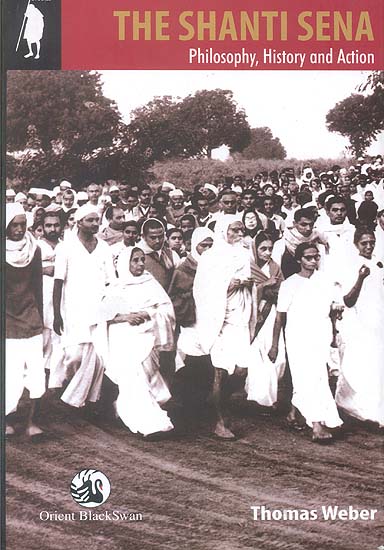
One possibility, inspired by the efforts of Shanti Sena (Peace Army) developed by followers of Mahatma Gandhi in India to deal with Hindu-Muslim violence is to place some nongovernmental teams on the frontier between antagonists in order to provide an opportunity for all parties to “cool off” and negotiate.
(C) Exotic India
One such effort in which I was directly involved was an effort to place a peace team on the Nicaraguan-Honduras frontier in 1981. At the time, it was thought that the 400 strong U.S. troops stationed in Honduras might cross the frontier to attack the Sandinista-leftest government in Nicaragua or to help actively the anti-Sandinista Contras to do so. A group of persons associated with the Santa Cruz Resource Center for Nonviolence in California and affiliated to the organization Peace Brigades International were able to put a team together and move to the Nicaragua-Honduras frontier on short notice. The group called itself “The Jalapa Brigade” after the small Nicaraguan city near the Honduran frontier where it was posted.
When the Jalapa Brigade was being put into place, the Ambassador of Nicaragua to the United Nations (UN) in Geneva was a former student of mine, and his brother, also a former student of mine, was the legal advisor to the President of Nicaragua. In fact, when the team arrived, Daniel Ortega, the President, introduced the team as “Friends of Humanity.”
Through the Ambassador, I was able to inform all the Central American Missions to the UN as to the aims and role of the Peace Brigade. In the end, the U.S. military did not cross the frontier. Perhaps it never intended to do so. It may also have been that the interposition of U.S. citizens with good organizational contacts helped to weigh in the U.S. military decision-making process. When the team left, the leader of the Protestant “Evangelical Committee for Development Aid” said “The proof of your triumph lies in the fact that no attacks were made while you were in the Jalapa area.”
There have been other such interposition efforts. One was the Gulf Peace Team created at the time of the 1990 Iraqi annexation of Kuwait. The aim of the 73-member Peace Team was to be an “international multicultural team working for peace and opposing any form of armed aggression by setting up one or more international peace camps between the opposing armed forces. Our object will be to withstand nonviolently any armed aggression by any party to the present Gulf dispute.” However, on January 27, 1991, the peace camp was closed by Iraq because the authorities had “decided that the continued presence of the camp was a security risk.”
Thus, the creation of interposition peace teams in the Israel-Palestine conflict would not be easy to create for political and logistic reasons. There are economic and logistic resources required and, more importantly, there is the need to raise enough volunteers who are mature, culturally sensitive, and analytically minded to achieve a critical mass that would make a difference in the decision-making of the conflicting parties. There is also the need to keep the unity of purpose within the teams if they have not worked together before. However, the current situation is very dangerous. The dangers are widely recognized. Therefore, all forms of conflict reduction need to be explored.
Prof. René Wadlow is President of the Association of World Citizens.
The armed conflict in the eastern area of the Democratic Republic of Congo (RDC) on the frontier with Rwanda seems to be growing worse and is impacting in a negative way the lives of people. The current fighting adds to the insecurity of the area and has virtually stopped cross-frontier activities largely done by women small traders. As a result, the price of existing food supplies has increased greatly, and shortages are to be feared.
The current armed conflict is among a Tutsi-led militia, the Mouvement du 23 Mars (M23), the forces of the RDC government and different ethnic militias. The President of the RDC, Felix Tshisekedi, sponsored the creation of local militias to help government soldiers, but the government does not control these militias. The United Nations (UN) Stabilization Mission in the Congo (MONUSCO) which has been in the RDC since 1999 is the largest UN peacekeeping force with some 15,000 members. However, it has been unable to halt the fighting or to protect civilians. In fact, the area of conflict has grown and engendered a catastrophic humanitarian crisis, causing the displacement of more than one million civilians in North Kivu Province. The M23 has recently launched attempts to win allies in South Kivu Province, in particular the armed group Twirwaneko, with the objective of opening a front in South Kivu.
The government of Rwanda has become increasingly involved in the Kivu conflict with direct intervention by the Rwanda Defense Force (RDF) and, despite a theoretical UN sponsored arms embargo, with weapons and other military equipment. The M23 is also fighting against the Forces démocratiques de Libération du Rwanda (FDLR) a Hutu-led group hostile to the government of Rwanda.
Recent attacks by M23 on populations associated with, or presumed to support the FDLR, have grown. Incidents of rape, including gang rape, by M23 combatants are prevalent but are not limited to the M23. The armed conflict is colored by a tense political situation with general elections, most significantly a presidential election, scheduled for December 2023.
The increased violence indicates the need for local non-governmental peacebuilding efforts which can be also facilitated by international nongovernmental organizations (NGOs). There is also a greater need to build respect for International Humanitarian Law (IHL). When the framework of current IHL as drafted in the 1948 Geneva Conventions in light of the experiences of World War II, the focus was upon the actions of national armies. Today, much violence and strife is due to non-State actors and armed militias such as those in the RDC.
There are two major weaknesses in the effectiveness of IHL. (1) The first is that many people do not know that it exists and that they are bound by its norms. Thus, there is an important role for greater educational activities, the dissemination of information to the wider public, specific training of the military, outreach to armed militias, and cooperation with a wide range of NGOs.
The second weakness is that those violating IHL are rarely punished. Few soldiers are tried or court-martialed. This weakness is even more true for non-state militias and armed groups. There is yet much to do for the realization of the rule of law.
Note
1) For useful guides to International Humanitarian Law see:
D. Schindler and J. Toman, The Laws of Armed Conflict (Martinus Nihjoff Publishers, 1988)
H. McCoubrey and N.D. White, International Law and Armed Conflict (Dartmouth Publishing Co. 1992)
Prof. René Wadlow is President of the Association of World Citizens.
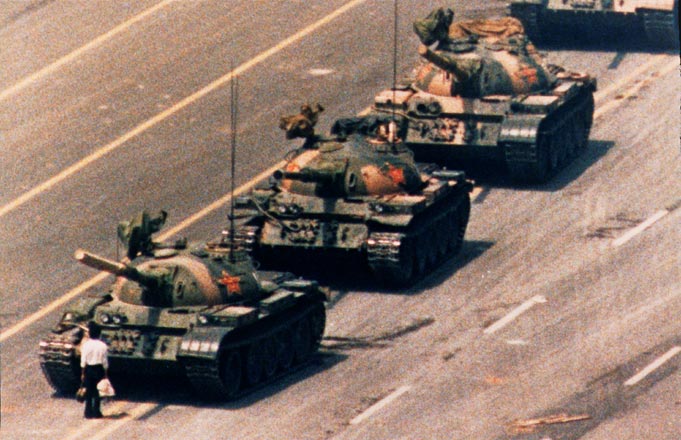
June 4 makes the security forces in China somewhat uneasy, especially in Hong Kong where, in the past, there were large memorial meetings to remind people of June 4, 1989, when the military and police moved against those who had been protesting publicly for over a month. Students from colleges and universities in China’s capital initiated protests after the death of the former General Secretary of the Communist Party, Hu Yaobang, on April 15, 1989 who was considered a liberal reformer. The movement then spread over a number of weeks to most of the major cities. Students made numerous demands, among them were calls for an end to government corruption, increased funding for education, and freedom of the press. As the movement went on, students were increasingly joined by industrial workers.
There were differences of opinion within the ruling government circle as to how to deal with the protests. As the protests continued, there was more and more international media attention, especially as there were an increasing number of journalists in Beijing in advance of the visit of the Soviet leader, Mikhail Gorbachev, with a large delegation of Soviet officials.
(C) Jeff Widener/Associated Press
Students and intellectuals started writing petitions setting out demands that were signed by more and more people. The decentralized structure of power and decision-making among groups in Tienanmen Square allowed for tactical innovation as each group was free to act as it desired and stress the symbols it wanted. Thus, art school students created the Goddess of Democracy, largely based on the Statue of Liberty in New York harbor. The growth in support for the student-led protests led the more anti-reformist faction in the government to order a crackdown by the military and the police. The tanks started to move into Tiananmen Square.
Since June 1989 there have been reforms within China – what we might call “democratization from below” but without large scale, highly visible public protests. ‘Stability’ and ‘harmony’ have been the stated government policy aims, colored by the breakup of the Soviet Union and fundamental changes in Eastern Europe. So, democratization needs to proceed quietly and gradually. Such democratization requires long-term vision and skillful leadership. Democratization is basically linked to individualization, to an ever-larger number of people thinking for themselves, creating their own lifestyles and ‘thinking outside the box’. It can be a slow process and repressive forces within the government watch events closely. However, it is likely that the direction of individualism is set and cannot be reversed.
Prof. René Wadlow is President of the Association of World Citizens.
In our current globalized world society, there is an increased role for politics without borders. Politics no longer stops at the water’s edge but must play an active role on the world stage. However, unlike politics at the national level which usually has a parliament at which the actors can recite their lines, the world has no world parliament as such. Thus, new and inventive ways must be found so that world public opinion can be heard and acted upon.
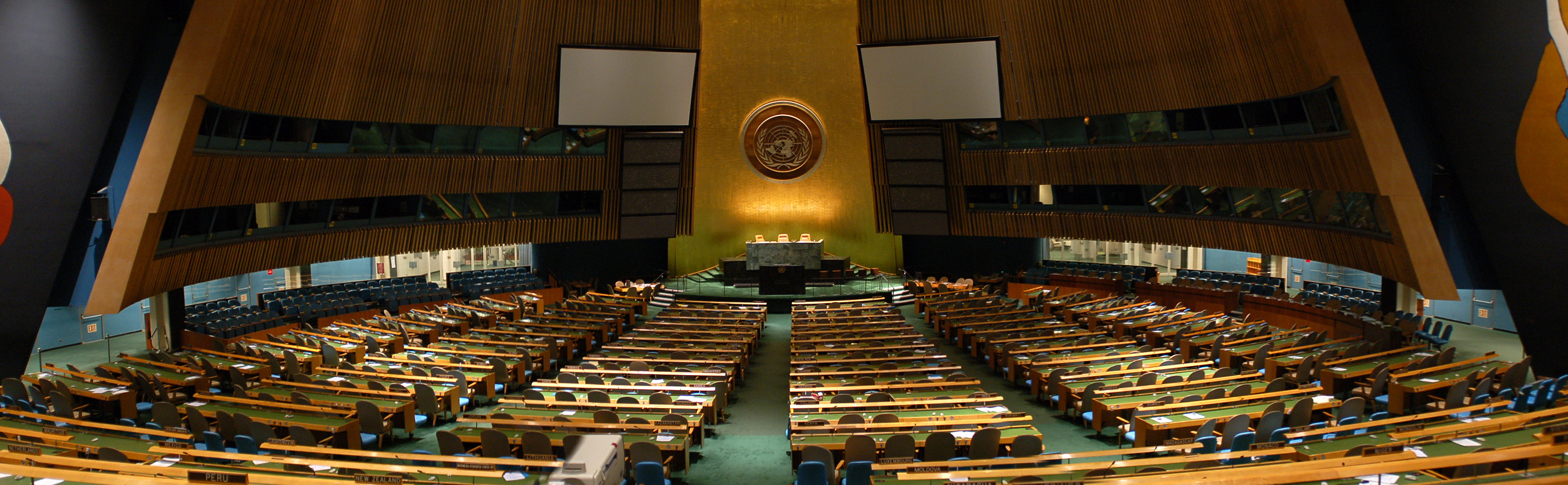
The United Nations (UN) General Assembly is the closest thing to a world parliament that we have today. However, all the official participants are diplomats appointed by their respective States – 195 member states. UN Secretariat members, the secretariat members of UN Specialized Agencies such as UNESCO and the ILO, are in the hallways or coffee shops to give advice. Secretariat members of the financial institutions such as the World Bank and the IMF are also there to give advice on costs and the limits of available funds. The representatives of Nongovernmental Organizations (NGO) in Consultative Status with the UN who can speak at sessions of the Economic and Social Council and the Human Rights Council cannot address the General Assembly directly. However, they are also in the coffee shops and may send documents to the UN missions of national governments.
(C) Jérôme Blum
Politics without borders requires finding ways to express views for action beyond the borders of individual countries. Today, most vital issues that touch the lives of many people go beyond the individual State: the consequences of climate change, the protection of biodiversity, the resolution of armed conflicts, the violations of human rights, and a more just world trade pattern. Thus we need to find ways of looking at the world with a global mind and an open heart. This perspective is an aim of world citizenship.
However, World Citizens are not yet so organized as to be able to impact political decisions at the UN and in enough individual States so as to have real influence. The policy papers and Appeals of the Association of World Citizens (AWC) are often read with interest by the government representatives to whom they are sent. However, the AWC is an NGO among many and does not have the number of staff as such international NGOs as Amnesty International, Human Rights Watch, and Greenpeace.
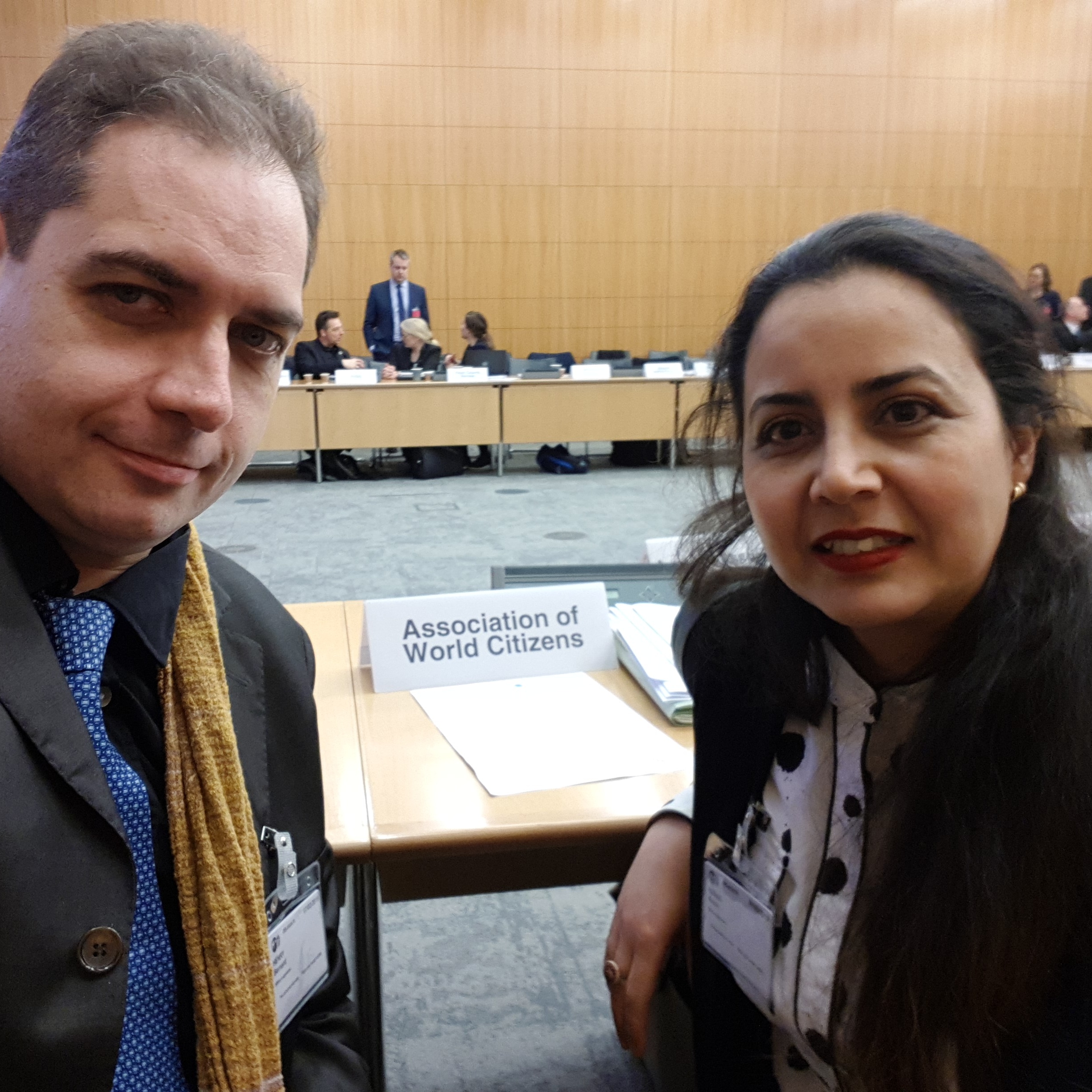
The First Officer and External Relations Officer, Bernard J. Henry, and the Legal and Mediation Officer, Attorney Noura Addad, representing the AWC at an OECD roundtable in March 2019 (C) Bernard J. Henry/AWC
We still need to find effective ways so that humanity can come together to solve global problems, that is, politics without borders. Prof. René Wadlow is President of the Association of World Citizens.