The Association of World Citizens (AWC), devoted to the resolution of armed conflicts through negotiations in good faith, is deeply concerned with the October 7 outbreak of violence between Hamas and Israel and the possible extension of the conflict to Hezbollah and Lebanon. The AWC stresses the need in the world society for systems of world law such as those standards expressed in International Humanitarian Law. Thus, we call for resolute action on the violations of humanitarian law in the Hamas-Israel conflict with the indiscriminate killing of civilians, the holding of hostages, and the destruction of medical and educational infrastructure.
Regular military personnel of all countries are theoretically informed of the rules of the Geneva Conventions of August 12, 1949, and the Protocol Additional adopted in 1977.
When the 1949 Geneva Conventions were drafted and adopted, it was possible to spell out in considerable detail rules regarding prisoners of war and the protection of civilians, in particular Common Article 3 (so called because it is found in all four Conventions) provides that “each Party to the conflict shall be bound to apply, as a minimum, the following provisions: Persons taking no active part in the hostilities…shall in all circumstances be treated humanely without any adverse distinction founded on race, color, religion or faith, sex, birth or wealth, or any other similar criteria.”
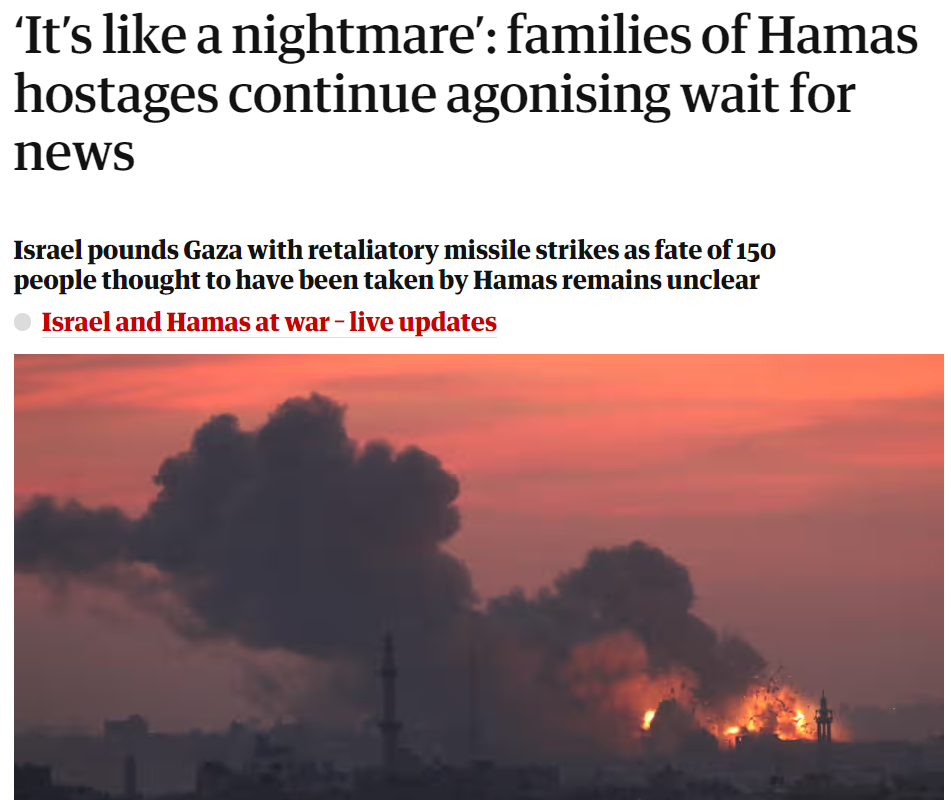
(C) The Guardian (UK)
The importance of Common Article 3 should not be underestimated. It sets out in straightforward terms important protections that all parties to a conflict must respect. In order to meet the need for additional protection, international humanitarian law has evolved to cover not only international armed conflict but also internal armed conflict. Today, international human rights standards are also considered part of international humanitarian law, thus providing additional protection for vulnerable population groups such as women, children, and minorities.
As situations of internal violence and strife proliferate, abuses committed by non-State actors, such as armed militias, are increasing concerns. Fundamental standards of international humanitarian law are intended to ensure the effective protection of human beings in all situations. The standards are clear. (1)
There are two major weaknesses in the effectiveness of international humanitarian law. The first is that many people do not know that it exists and that they are bound by its norms. Thus, there is an important role for greater promotional activities, the dissemination of information through general education, specific training of the military, outreach to armed militias, and cooperation with a wide range of nongovernmental organizations.
The second weakness is that violations of international humanitarian law are rarely punished. Governments too often tolerate these violations. Few soldiers are tried, or courtmartialed, for the violations of international humanitarian law. This weakness is even more true of nongovernmental militias and armed groups.
(C) World Health Organization
In fact, most violations of international humanitarian law are not actions of individual soldiers or militia members carried away by a sudden rush of anger, fear, a desire of revenge or a sudden sexual urge to rape a woman. Soldiers and militia members violating the norms of international humanitarian law are acting on orders of their commanders.
Thus, the only sold response is an act of conscience to refuse an order of a military or militia higher up and refuse to torture, to bomb a medical facility, to shoot a prisoner, to harm a child, and to rape a woman. Conscience, that inner voice which discerns what is right from wrong and encourages right action is the value on which we can build the defense of international humanitarian law. The defense of conscience to refuse unjust orders is a large task but a crucial action for moving toward a law-based world society.
Notes
(1) For useful guides to international humanitarian law see:
D. Schindler and J. Toman, The Laws of Armed Conflicts (Martinus Nihjoff Publishers, 1988)
H. McCoubrey and N.D. White, International Law and Armed Conflicts (Dartmouth Publishing Co., 1992)
Prof. René Wadlow is President of the Association of World Citizens.
LES CITOYENS DU MONDE APPELLENT A UNE FIN IMMEDIATE
DES HOSTILITES ENTRE ISRAEL ET LE HAMAS
ET A UN EFFORT VERITABLE DE CONSTRUCTION DE LA PAIX
POUR LE MOYEN-ORIENT
L’AWC, Organisation Non-Gouvernementale dotée du Statut Consultatif auprès de l’ONU et active à ce titre au sein du Conseil des Droits de l’Homme, est profondément alarmée de la dernière flambée de violence entre les milices armées du Mouvement de la Résistance islamique palestinien (Hamas) et les Forces de Défense israéliennes (Tsahal). Plus encore, nous sommes consternés des conséquences des attaques délibérées, perpétrées par les deux côtés, contre les droits des civils en Israël et dans la Bande de Gaza.
Depuis les attaques lancées par ses forces au petit matin du 7 octobre, le Hamas prend pour cible des civils en Israël, étant allé jusqu’à capturer des citoyens israéliens, tant civils que soldats de Tsahal, pour les garder en otage. La cause légitime d’un peuple privé de longue date de sa propre terre, cause que même l’ONU reconnaît comme légitime sur le plan international, ne saurait être servie dans la dignité par de telles méthodes qui s’inscrivent en faux contre le droit international.
Le gouvernement actuel d’Israël n’a fait que repousser les limites du mépris pour ce même droit international, à travers des déclarations et mesures répétées et insistantes visant à la discrimination systématique contre le peuple palestinien dans les Territoires palestiniens occupés (TPO). A l’intérieur même des frontières internationalement reconnues d’Israël, le gouvernement israélien actuel a également semé les graines de la discorde et de l’affrontement politique en tentant d’amoindrir les prérogatives du pouvoir judiciaire et, ce faisant, de mettre fin à la tradition de démocratie épaulée de contrepouvoirs qui est celle d’Israël.
Cette conduite mal inspirée s’avère nuisible tant au peuple palestinien qu’aux citoyens d’Israël. Elle crée à présent un chaos nouveau dans la région qui revient, selon les termes du Chapitre VII de la Charte des Nations Unies, à une menace contre la paix et la sécurité internationales. La situation risque de s’aggraver encore maintenant que le Hezbollah, notoirement soutenu par l’Iran, vient en dépit de toute sagesse de rejoindre le combat depuis le sud du Liban.
Une fois de plus, les droits des civils en Israël et dans la Bande de Gaza sont réduits à l’état de victimes de la haine et de la violence qu’ont déchaîné les deux côtés en l’absence d’un effort international, faisant cruellement défaut mais se voyant constamment refusé, pour résoudre le conflit du Moyen-Orient en s’attaquant à ses causes premières mêmes, au nombre desquelles l’exigence de justice qui est celle du peuple palestinien et le besoin de sécurité qui est celui de l’Etat d’Israël.
En conséquence, l’AWC réitère son appel à la fin immédiate des hostilités en Israël et dans la Bande de Gaza. Nous appelons également à la libération de toute personne, qu’il s’agisse d’un civil ou d’un militaire, prise en otage par le Hamas.
Nous en appelons de surcroît à la communauté internationale pour enfin entreprendre un effort authentique de construction de la paix en Israël et dans les TPO, ce en prenant pleinement en compte les causes premières du conflit et en faisant droit comme il convient à la légitime revendication du peuple palestinien pour la justice ainsi qu’à la revendication tout aussi légitime du peuple israélien pour la sécurité.
AND FOR A GENUINE PEACEBUILDING EFFORT IN THE MIDDLE EAST
The AWC, a Nongovernmental Organization in Consultative Status with the United Nations (UN) and accredited with the UN Human Rights Council, is deeply alarmed at the latest flare of violence between the armed militias of the Palestinian Islamic Resistance Movement (Hamas) and the Israeli Defense Force (IDF). Most importantly, we are appalled at the consequences of the deliberate attacks from both sides on the rights of civilians in Israel and the Gaza Strip.
Since the attacks launched by its forces in the early morning of October 7, Hamas has been targeting civilians in Israel, even capturing Israeli citizens, both civilians and IDF soldiers, to keep them as hostages. The legitimate cause of a people long deprived of their own land, a cause that even the UN recognizes as internationally legitimate, cannot be served in dignity by such methods that run counter to international law.
The current government of Israel has been constantly pushing the limits of disregard for the same international law, through repeated and insistent statements and practices aiming at systematic discrimination against the Palestinian people in the Occupied Palestinian Territory (OPT). Within the internationally recognized borders of the State of Israel, the current Israeli Government has also sowed the seeds of discord and political strife by trying to lessen the powers of the judicial branch and, in so doing, to end Israel’s tradition of democracy with checks and balances.
This misguided conduct has proved harmful to both the Palestinian people and the citizenry of Israel. It is now creating new chaos in the region amounting to, in the very words of Chapter VII of the UN Charter, a threat to international peace and security. The situation could get even worse as Hezbollah, notoriously backed by Iran, has now unwisely joined the fight from South Lebanon.
Once more, the rights of civilians in Israel and the Gaza Strip are falling victim to the hatred and violence unleashed by both sides in the absence of a badly needed but constantly denied international effort to tackle the Middle East conflict right from its root causes, including the Palestinian people’s demand for justice and the State of Israel’s need for security.
Consequently, the AWC reiterates its call for an immediate end to hostilities in Israel and the Gaza Strip. We also call for the release of every person, civilian or military, taken hostage by Hamas.
We further urge the international community to finally undertake a genuine peacebuilding effort in Israel and the OPT by addressing the root causes of the conflict and duly acting on the legitimate claim of the Palestinian people for justice and the equally legitimate claim of the Israeli people for security.
Ces paroles écrites par Charles Aznavour, né Sharnough Aznavourian, font partie de Pour toi Arménie, la chanson dont il était l’auteur avec son beau-frère et complice musical de toujours Georges Garvarentz en 1988. Cet hommage amoureux à la terre de ses racines familiales, le plus célèbre des artistes franco-arméniens ne l’avait pas écrit seulement par un élan du cœur. Cette chanson était une urgence – l’urgence d’aider son Arménie frappée par un tremblement de terre meurtrier et dont la population déjà démunie s’était trouvée abandonnée à son sort.
Le 7 décembre 1988, la ville de Spitak, au nord de ce qui était alors la République socialiste soviétique d’Arménie au sein de l’URSS vivant la perestroïka de Mikhaïl Gorbatchev, à 11H41 très précises, un séisme de 6,9 sur l’échelle de Richter dévaste la ville. Dans cette Union soviétique qui avoue désormais ses faiblesses, les services de secours ne parviennent à sauver que quatre-vingts personnes des ruines des immeubles effondrés, tandis que vingt-cinq à trente mille personnes trouvent la mort, plus de quinze mille en sortent blessées et cinq cent trente mille n’ont désormais plus nulle part où vivre. Moscou et son affidée d’alors Erevan dépassées par l’ampleur du drame, la diaspora arménienne prend le relais et l’aide à la terre d’origine meurtrie s’organise – en dehors de l’Arménie.
Suivant l’exemple américain de Harry Belafonte, Quincy Jones et Lionel Richie en 1985 avec We Are the Worldpour l’Ethiopie, Aznavour rassemble quatre-vingt-huit autres chanteurs, acteurs et personnalités de la télévision avec lesquels il enregistre Pour toi Arménie en annonçant que tous les profits du 45 tours, en cette époque sans le streaming et où l’on achète encore des disques vinyles, iront à l’aide humanitaire sur place. Et le public répond présent, le 45 tours entrant directement premier au Top 50, le classement national hebdomadaire des ventes, dont il gardera la première place pendant plusieurs semaines. C’est Aznavour lui-même qui conclut la chanson par le nom de l’Arménie dans la langue nationale, «Hayastan !», tant en français qu’en italien et même en anglais, dans une version américaine que sa notoriété internationale lui permet d’enregistrer avec le soutien de nombreuses célébrités des écrans, grand et petit, ainsi que de la chanson comme Dionne Warwick.
Le 1er octobre prochain verra les cinq ans de la disparition de Charles Aznavour, artiste de légende, humanitaire mais aussi ambassadeur d’Arménie à l’UNESCO puis au Palais des Nations, dont l’Association of World Citizens (AWC) a un jour croisé le chemin pour venir en aide à une habitante de Erevan chassée de son domicile par des violences conjugales. S’il était encore des nôtres, comment réagirait-il au drame que vit actuellement l’Arménie, drame qui, contrairement à celui de Spitak en 1988, n’est pas le fait de la nature mais d’un ennemi bien plus dangereux encore pour l’être humain – lui-même ?
La seule absence de combat ne sera jamais la paix
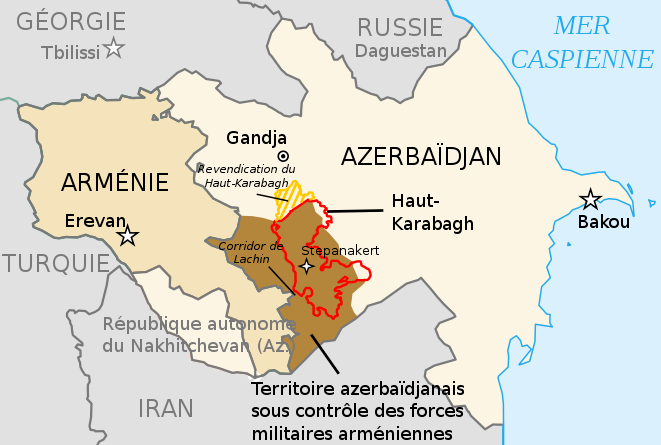
Entre 1988 et 1994, l’Arménie et son voisin de l’est, l’Azerbaïdjan, républiques soviétiques avant de devenir indépendantes à la faveur de la disparition de l’Union soviétique fin 1991, se sont affrontées militairement autour d’un territoire voisin de l’Arménie, peuplé pour l’essentiel d’Arméniens mais appartenant juridiquement à l’Azerbaïdjan – le Haut-Karabakh, ou Nagorno-Karabakh, sur une partie duquel se tient la République d’Artsakh reconnue par Erevan. Soutenu par Gorbatchev du temps de l’URSS, l’Azerbaïdjan avait refusé tout transfert de souveraineté du Haut-Karabakh à l’Arménie, position qu’il a maintenue en tant qu’État souverain et maintient encore aujourd’hui.
(C) Bourrichon
En 1992, après plusieurs années d’un conflit dominé par l’Azerbaïdjan doté d’un large soutien du monde musulman, l’Arménie remporte de premières victoires décisives. Deux ans plus tard, en mai, c’est un Azerbaïdjan désormais épuisé par une nette domination militaire arménienne qui accepte une trêve, qui ne règle pas le conflit du Haut-Karabakh mais le «gèle» sans solution, laissant le territoire indépendant de facto mais non reconnu sur le plan international. Au cours des années, les liens avec l’Arménie vont se resserrer, culminant avec l’élection en 2008 d’un natif du Haut-Karabakh, Serge Sarkissian, à la présidence de l’Arménie qu’il occupera pendant dix ans. Entre l’Arménie et le Haut-Karabakh, un seul lien terrestre direct : le corridor de Latchine, large de quelques cinq kilomètres et long de soixante-cinq. Au-delà, l’Azerbaïdjan vaincu, rêvant d’une revanche au détour de l’histoire.
Fin septembre 2020, après le traumatisme d’une année marquée par la pandémie de Covid-19 et qui verra le monde quasi mis à l’arrêt, avec un tiers de la population de la planète confinée à son domicile, l’Azerbaïdjan prend de court une communauté internationale encore sous le choc en lançant une violente offensive contre le Haut-Karabakh. Cette fois, Bakou garde l’ascendant du début à la fin des hostilités, qui vient le 10 novembre avec un cessez-le-feu conclu à l’issue d’une médiation de la Fédération de Russie, avec de lourdes pertes de territoire pour l’Arménie qui doit de céder un tiers du Haut-Karabakh et en retirer ses troupes, Moscou déployant les siennes pour maintenir le cessez-le-feu. Pour les civils arméniens, c’est le temps de l’exil, non sans avoir pour beaucoup d’entre eux brûlé leur maison plutôt que de la voir accueillir des Azerbaïdjanais.
A Latchine, ce sont les forces de maintien de la paix russes qui prennent position, l’Arménie conservant le droit d’utiliser le passage terrestre avec le Haut-Karabakh. Seulement, à partir de février 2022, les mêmes forces armées russes qui maintiennent la paix entre Arménie et Azerbaïdjan deviennent aussi les forces d’invasion de l’Ukraine, qui vaut à Moscou une vaste et légitime condamnation internationale. Qui peut prétendre assurer la paix entre deux belligérants qui, dans le même temps, envahit son voisin ? L’Azerbaïdjan ne va pas tarder à le comprendre. Et dans cette paix qui n’en était pas une depuis la trêve de 1994, l’étant encore moins depuis le cessez-le-feu de 2020, Bakou va en tirer parti. De la pire manière qui soit.
En novembre 2020, des Yazidis se portent volontaires pour rejoindre les forces armées arméniennes et combattre au Haut-Karabakh (C) Armenian Army Media
L’arme de la faim et la «guerre sale» de Bakou
En cet automne 2020, entre Arménie et Azerbaïdjan, sur le Haut-Karabakh, match nul. Le bon moment, sans doute, pour entamer des discussions de paix entre les deux pays qui savent désormais chacun ce que c’est que d’être vainqueur et vaincu. Mais personne ne s’y aventure, et tout comme en 1994, la situation semble gelée sans espoir d’un dénouement définitif du conflit après plus de trente ans. Lorsque survient, du côté de l’Azerbaïdjan, l’impensable.
Le 12 décembre 2022, des Azerbaïdjanais se présentant comme des «militants écologistes» prennent position à l’entrée du corridor de Latchine, entendant bloquer une «exploitation illégale» de minerais locaux. Niant tout lien avec ces «militants écologistes» chez lesquels les slogans pour l’environnement cohabitent avec le drapeau azerbaïdjanais, le Président Ilham Aliyev se montre envers eux étonnamment indulgent par rapport à ses habitudes envers la société civile, habitudes dont nombre de militants ont payé le prix en cellule. Et pour cause, la société civile, la vraie, détient les preuves du lien direct entre ces «militants écologistes» et Bakou.
La preuve ultime, c’est justement Bakou qui la fournira lui-même, le 11 juillet dernier. Ce jour-là, ses propres troupes, drapeaux en main, bloquent désormais officiellement Latchine, accusant la Croix-Rouge de «contrebande» à l’occasion de ses livraisons d’aide humanitaire au Haut-Karabakh. L’organisation nie farouchement l’accusation, en effet de mauvaise foi puisque l’Azerbaïdjan prend pour prétexte les méfaits de quatre chauffeurs extérieurs à la Croix-Rouge qui, dans leurs véhicules personnels, ont tenté de faire passer «des marchandises commerciales» au Haut-Karabakh, bien sûr à l’insu de l’institution humanitaire qui a aussitôt mis fin à leurs contrats.
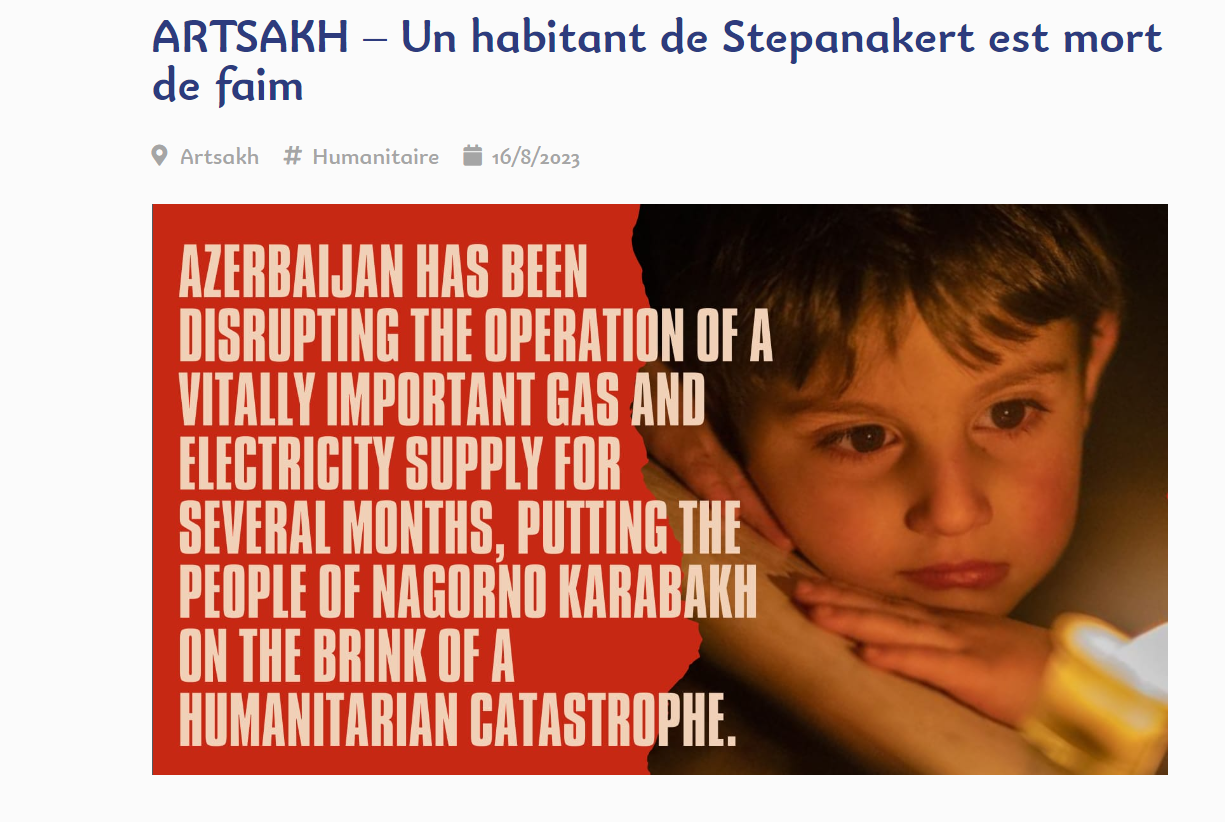
Mais, pour avoir tenté de réaliser un profit dérisoire, ces quatre malfaiteurs se voient toujours moins punis que le sont les Arméniens du Haut-Karabakh. Le territoire arménien en terre d’Azerbaïdjan se trouve désormais soumis à un blocus total, contraint à un rationnement de la nourriture et du gaz, et tout transfert médical d’urgence de patients vers Erevan est devenu impossible. Après avoir vaincu l’Arménie par les armes conventionnelles, l’Azerbaïdjan use désormais sans complexe contre les Arméniens de l’arme ultime, plus impitoyable encore que l’arme nucléaire qui abrégerait en quelques secondes les souffrances de celles et ceux qu’elle frapperait – l’arme de la faim.
Sous peu, le monde entier s’indigne. Fin août, un convoi humanitaire emmené par plusieurs élus politiques français de diverses tendances idéologiques, à l’exception notable et habituelle de l’extrême droite, se présente à Latchine en tentant de faire route vers le Haut-Karabakh. Pas de surprise – refoulé. Depuis l’Arménie, les dirigeants d’un think tank en appellent à la mise en place d’un pont aérien, à l’image de celui créé par les Alliés durant le blocus de Berlin en 1949. Fait exceptionnel, encore plus depuis le début de l’invasion de l’Ukraine en février 2022, Washington et Moscou se voient unanimes dans leur demande à Bakou en vue d’une levée du blocus du corridor de Latchine.
Au-delà de la politique, c’est le droit qui ne tarde pas à se manifester, le droit international pénal qui sait tout ce que le nom de l’Arménie signifie pour lui et pour son histoire.
D’un litige sur la souveraineté d’un territoire donné, le conflit prend soudain un goût amer de déjà-vu. Entre les Azerbaïdjanais descendants des Ottomans d’avant la Première Guerre Mondiale et les Arméniens victimes du génocide ottoman en 1915, c’est maintenant le souvenir du génocide qui se rallume dans les esprits, en Arménie et au Haut-Karabakh bien sûr mais, plus encore, dans le reste du monde.
Ronald Suny, professeur de science politique à l’Université du Michigan, cité par CNN, déclare : «Maintenant qu’il a gagné la guerre de 2020 contre l’Arménie, l’Azerbaïdjan a pour but ultime de chasser les Arméniens d’Artsakh hors de l’Azerbaïdjan. Mais plutôt que de recourir directement à la violence, qui susciterait les condamnations à l’étranger, Bakou est décidée à rendre la vie impossible aux Arméniens, les affamer et faire pression sur eux pour qu’ils partent». Pour l’International Association of Genocide Scholars (IAGS), aucun doute, le blocus du Haut-Karabakh engendre un risque de génocide.
Quant à Luis Moreno Ocampo, le premier Procureur de la Cour pénale internationale à sa création en 2002, dans une Opinion d’Expert datée du 7 août, il monte encore d’un cran en écrivant d’entrée «Il est en train de se produire un génocide contre 120 000 Arméniens vivant au Nagorno-Karabakh, également connu sous le nom d’Artsakh».
Sur le blog Social Europe, le spécialiste gréco-arménien des relations internationales George Meneshian appelle enfin l’Europe à «se réveiller» à la réalité du conflit entre l’Arménie et l’Azerbaïdjan, sous peine de devenir «complice de génocide».
Vouloir vaincre son adversaire en affamant sa population civile, c’est déjà en soi inhumain et lâche, surtout lorsqu’une victoire militaire nette vous place en position de force pour négocier un accord de paix. De la part de l’Azerbaïdjan, pourtant, ce n’est même pas le pire. Parler de génocide, c’est parler de la volonté d’exterminer un peuple, et qui parle d’exterminer un peuple parle d’une notion simple et claire – le racisme.
Capture d’écran de Nor Haratch, publication en ligne arménienne basée en France.
Contre le racisme envers les Arméniens d’Azerbaïdjan, l’arme du droit
Dans son argumentaire expert de vingt-huit pages, Luis Moreno Ocampo, montrant qu’il se souvient que la juridiction dont il a été le premier procureur est née de l’expérience aussi douloureuse qu’indispensable des Tribunaux pénaux internationaux pour l’ex-Yougoslavie (TPIY) et le Rwanda (TPIR), cite une abondance jurisprudence de l’un et de l’autre pour établir que, parce que le génocide ne s’avoue jamais, il peut et doit donc se déduire des actes du génocidaire, actes qu’il écrit reconnaître dans le blocus par l’Azerbaïdjan du corridor de Latchine.
Mais le magistrat sait aussi mettre un nom sur le premier mal qui frappe les Arméniens, sur la première faute de l’Azerbaïdjan, sur les premiers fondements de cette guerre de la faim. Un mal «prenant naissance dans l’esprit des hommes», dans les mots de l’Acte constitutif de l’UNESCO, tout comme le droit prend naissance dans l’esprit de l’être humain et, selon l’adage romain, ubi societas, ibi jus, là où il y a la société, il y a le droit. Et dans une société où sévit, voire règne, le racisme, il faut bien qu’il y ait le droit, celui de la Société Humaine Universelle que définit Olivier de Frouville, contre celui de la Société des Etats Souverains qu’il lui oppose et qui, comme jadis par exemple en Afrique du Sud, peut décider que le racisme est loi.
Bien que l’Arménie revendique le Haut-Karabakh et que la République d’Artsakh se veuille arménienne, techniquement et juridiquement parlant, les Arméniens du Haut-Karabakh demeurent des habitants de l’Azerbaïdjan, derrière le corridor de Latchine qui, sous blocus, ne peut plus jouer son rôle de lien terrestre unique avec l’Arménie. Derrière la rhétorique guerrière de Bakou et l’exemple qu’elle constitue de «création de l’ennemi» au sens que lui donne John Paul Lederach, ce que voient les instances internationales, à commencer par l’ONU, c’est bel et bien du racisme, celui des Azéris majoritaires en Azerbaïdjan contre les Arméniens de ce même pays qui demeurent, aux yeux de la communauté internationale, des Azerbaïdjanais. Et sur le racisme que subissent ces Azerbaïdjanais arméniens de la part de leurs compatriotes azéris, ce ne sont ni les faits ni les réactions qui manquent.
Le 21 avril 2023, le Représentant permanent de l’Arménie auprès du Siège des Nations Unies écrivait au Secrétaire Général, Antonio Guterres, en rappelant l’un des épisodes les plus tragiques de l’histoire des Arméniens d’Azerbaïdjan. Il parlait du massacre de Soumgaït, ville où, alors que l’Arménie soviétique commençait à revendiquer le Haut-Karabakh, un pogrom azéri avait décimé la population arménienne locale, causant des dizaines de morts, encore plus de blessés, des viols, des pillages et des destructions, toujours contre les mêmes – les Arméniens. Il rappelait les multiples condamnations de l’Azerbaïdjan, morales ou judiciaires, de la part des instances internationales, établissant un lien entre Soumgaït et la haine raciale contemporaine contre les Arméniens.
Et de la part de Erevan, il ne s’agissait pas de lawfare, de cette guerre judiciaire que l’on mène lorsque les armes n’ont pu vous apporter la victoire. Le racisme d’Etat azerbaïdjanais contre les Arméniens n’est pas une simple proclamation politique ; il est une réalité de terrain, et pour Bakou, il s’est mué en une excuse commode pour employer une arme sale, l’arme de la faim, contre le Haut-Karabakh.
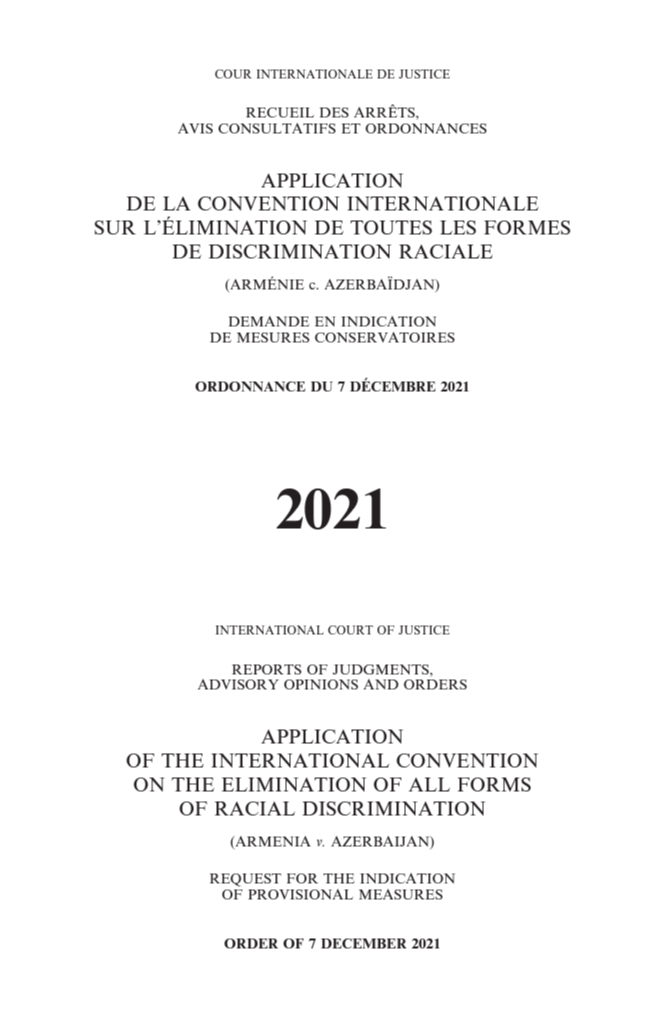
Le 7 décembre 2021, à peine plus d’un an après la reprise des combats et la défaite arménienne, la Cour internationale de Justice statuait, saisie par l’Arménie, sur une demande de mesures conservatoires pour le respect de la Convention internationale sur l’Élimination de Toutes les Formes de Discrimination raciale (CIEDR), Erevan demandant à la Cour d’ordonner à l’Azerbaïdjan de changer d’attitude
«— en s’abstenant de se livrer à des pratiques de nettoyage ethnique contre les Arméniens ;
— en s’abstenant de commettre, de glorifier, de récompenser ou de cautionner des actes de racisme contre les Arméniens, y compris les prisonniers de guerre, les otages et d’autres détenus ;
— en s’abstenant de tenir ou de tolérer des discours haineux visant les Arméniens, y compris dans les ouvrages pédagogiques ;
— en s’abstenant de bannir la langue arménienne, de détruire le patrimoine culturel arménien ou d’éliminer de toute autre manière l’existence de la présence culturelle historiquearménienne, ou d’empêcher les Arméniens d’avoir accès à celle‑ci et d’en jouir ;
— en punissant tout acte de discrimination raciale contre les Arméniens, qu’il soit commis dans la sphère publique ou privée, y compris lorsqu’il est le fait d’agents de l’État ;
— en garantissant aux Arméniens, y compris les prisonniers de guerre, les otages et d’autres détenus, la jouissance de leurs droits dans des conditions d’égalité ;
— en adoptant la législation nécessaire pour s’acquitter des obligations que lui fait la CIEDR ;
— en garantissant aux Arméniens un traitement égal devant les tribunaux et tout autre organe administrant la justice ainsi qu’une protection et une voie de recours effectives contre les actes de discrimination raciale ;
— en s’abstenant d’entraver l’enregistrement et les activités des ONG et d’arrêter, de détenir et de condamner les militants des droits de l’homme ou toute autre personne œuvrant pour la réconciliation avec l’Arménie et les Arméniens; et
— en prenant des mesures efficaces pour combattre les préjugés contre les Arméniens et des mesures spéciales pour assurer comme il convient le développement de ce groupe».
Dans sa décision, la Cour internationale de Justice avait finalement estimé que
«1) La République d’Azerbaïdjan doit, conformément aux obligations que lui impose la convention internationale sur l’élimination de toutes les formes de discrimination raciale,
a) Par quatorze voix contre une,
Protéger contre les voies de fait et les sévices toutes les personnes arrêtées en relation avec le conflit de 2020 qui sont toujours en détention et garantir leur sûreté et leur droit à l’égalité devant la loi ;
b) A l’unanimité,
Prendre toutes les mesures nécessaires pour empêcher l’incitation et l’encouragement à la haine et à la discrimination raciales, y compris par ses agents et ses institutions publiques, à l’égard des personnes d’origine nationale ou ethnique arménienne ;
c) Par treize voix contre deux,
Prendre toutes les mesures nécessaires pour empêcher et punir les actes de dégradation et de profanation du patrimoine culturel arménien, notamment, mais pas seulement, les églises et autres lieux de culte, monuments, sites, cimetières et artefacts ;
2) A l’unanimité,
Les deux Parties doivent s’abstenir de tout acte qui risquerait d’aggraver ou d’étendre le différend dont la Cour est saisie ou d’en rendre le règlement plus difficile».
La haute juridiction onusienne reconnaissait ainsi que la question du Haut-Karabakh n’était pas, ou n’était plus, seulement celle de la souveraineté sur ce territoire de l’un ou de l’autre des deux pays qui le réclamait. Il s’agissait bien, au-delà d’une simple dispute territoriale, de racisme.
Et comme le relève Luis Moreno Ocampo dans son Opinion d’Expert, le 22 septembre 2022, dans ses Observations finales concernant le rapport de l’Azerbaïdjan valant dixième à douzième rapports périodiques, le Comité CIEDR fustigeait le pays pour «[l’]incitation à la haine raciale et la propagation de stéréotypes racistes à l’encontre de personnes d’origine nationale ou ethnique arménienne, notamment sur Internet et dans les médias sociaux, ainsi que par des personnalités publiques et des hauts responsables, et le manque d’informations détaillées sur les enquêtes, les poursuites, les déclarations de culpabilité et les sanctions liées à de tels actes». Une constante de racisme par trop voyante pour que Bakou puisse réduire le blocus du Haut-Karabakh à une simple protestation d’écologistes ou, aujourd’hui, à une mesure devant empêcher la contrebande, excuses si faciles qu’elles en deviennent insultantes.
Notre époque a appris, et Luis Moreno Ocampo a bien compris que c’était là qu’il fallait frapper d’entrée, à oublier les génocides, du moins à les minimiser. Là où jadis, l’évocation de la Shoah juive, du Samudaripen rom ou, justement, du génocide arménien amenait une autorité morale au propos tenu, aujourd’hui, sous prétexte de «point Godwin», il devient quasi disqualifiant d’y faire référence. Admettons, entendu, soulever un génocide, c’est un pathos alarmiste. Mais alors, que dire de l’effroyable niveau de racisme contre les Arméniens constaté et condamné plus d’une fois par l’ONU en Azerbaïdjan, sinon qu’il est la meilleure preuve que le blocus du corridor de Latchine représente, si ce n’est un génocide en soi, du moins son ultime prélude ?
Une certaine conception de l’humanité mise à l’épreuve
S’il s’était parfois mis dans la peau des losers, comme dans Je m’voyais déjà, Poker et Je ne peux pas rentrer chez moi, Charles Aznavour chantait aussi pour dénoncer l’injustice, chantant Comme ils disent en 1972 alors que l’homosexualité est en France réprimée comme un délit, Mourir d’aimer sur l’affaire Gabrielle Russier et Les émigrants en pleine ascension du Front National et de ses thèses xénophobes. Légitime à écrire et produire Pour toi Arménie, il ne l’était pas du seul fait d’être arménien d’origine mais parce que son travail d’artiste parlait pour lui. Autrement, qui sait si l’initiative aurait rencontré le même succès ?
De même que Pour toi Arménie n’avait rien d’un phénomène «de fait», ici le fait d’un chanteur français d’origine arménienne, il n’existe aucune paix «de fait» après un conflit, la paix se construisant, sinon avant la fin des hostilités, du moins dès qu’elle intervient puis sans cesse jusqu’à ce que les belligérants comprennent qu’un accord, ou traité, formel doit sceller pour toujours leur bonne volonté et ouvrir la voie à l’avenir. Ce travail réalisé en 1994, l’offensive azerbaïdjanaise de 2020 serait devenue bien moins probable, et avec elle, cette guerre de la faim d’aujourd’hui.
En Ukraine se joue la survie d’une certaine conception du droit international, celle qui veut que l’agresseur ne soit pas récompensé de sa conduite contre l’agressé, sanctions de divers ordres à l’appui contre Moscou. Plus au nord, au Haut-Karabakh, l’enjeu n’a pas besoin pour se définir d’un manuel de droit. Lorsque l’arme choisie contre l’ennemi désigné est la faim, c’est bien une certaine conception de l’humanité qui est mise à l’épreuve, une conception qui transcende les frontières des États, qu’elles soient ou non reconnues par les autres États, une conception qui accorde toute sa valeur au droit, même s’il ne produit pas d’effet immédiat car il n’en incarne pas moins les principes qui guident une conscience. Cette conception, soit le monde agit pour la défendre au Haut-Karabakh, soit il s’expose à ce qu’elle ne soit plus garantie nulle part.
Bernard J. Henry est Officier des Relations Extérieures de l’Association of World Citizens.
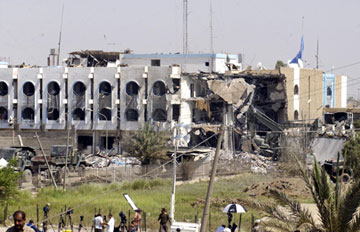
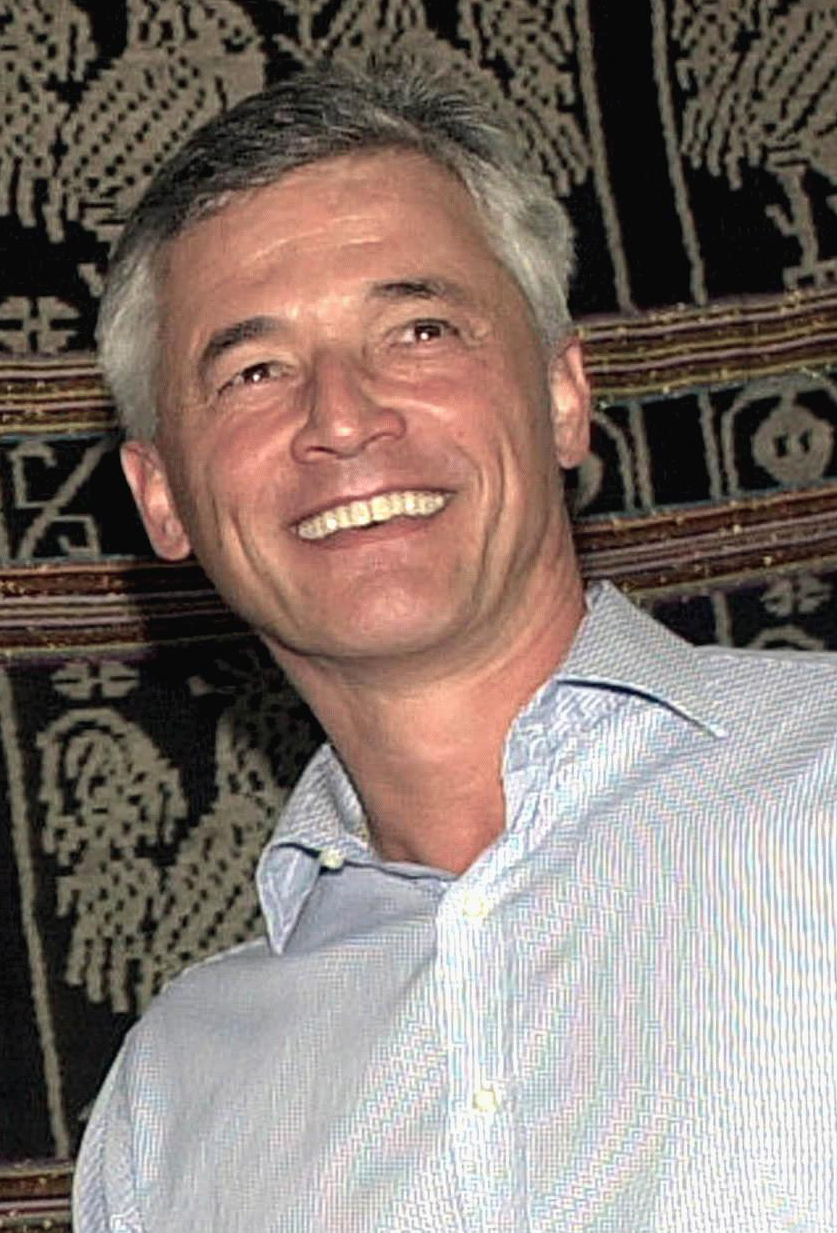
The United Nations (UN) General Assembly has designated August 19 as “World Humanitarian Day” to pay tribute to aid workers in humanitarian service in difficult and often dangerous conditions. August 19 was designated in memory of the August 19, 2003 bombing of the UN office building in Baghdad, Iraq in which Sergio Vieira de Mello, United Nations (UN) High Commissioner for Human Rights and, at the time, Special Representative of the UN Secretary General was killed along with 21 UN staff members. Over 200 UN employees were injured. The exact circumstances of the attack are not known, and why USA and UN security around the building was not tighter is still not clear. A truck with explosives was able to dive next to the building and then blew itself up.
Sergio Vieira de Mello had spent his UN career in humanitarian efforts, often with the Office of the High Commissioner for Refugees and at other times as Special Representative of the UN Secretary General. As a Nongovernmental Organization’s (NGO’s) representative to the UN in Geneva and active on human rights issues, I knew him during his short 2002-2003 tenure as High Commissioner for Human Rights. Many of us had high hopes that his dynamism, relative youth – he was 54 – and wide experience in conflict resolution efforts would provide new possibilities for human rights efforts. His death along with the death of others who had been Geneva-based was a stark reminder of the risks that exist for all engaged in humanitarian and conflict resolution work.
This year, the risks and dangers are not just memories but are daily news. On May 3, 2016, the UN Security Council unanimously adopted Resolution 2286 calling for greater protection for health care institutions and personnel considering recent attacks against hospitals and clinics in Syria, Iraq, Yemen, South Sudan, Democratic Republic of Congo, and Afghanistan. These attacks on medical facilities are too frequent to be considered “collateral damage.” The attacks indicate a dangerous trend of non-compliance with world law by both State and non- State agents. The protection of medical personnel and the treatment of all the wounded − both allies and enemies − goes back to the start of humanitarian law.
The Association of World Citizens (AWC) has stressed the need for accountability, including by investigation of alleged violations of the laws of war. The grave violations by the Islamic State in Iraq and al-Sham (ISIS) must be countered by as wide a coalition of concerned voices as possible. There is a real danger that as ISIS disintegrates and no longer controls as much territory, it will increase terrorist actions.
The laws of war, now more often called humanitarian law, have two wings, one dealing with the treatment of medical personnel in armed conflict situations, the military wounded, prisoners of war, and the protection of civilians. This wing is represented by the Geneva (Red Cross) Conventions. The second wing, often called The Hague Conventions limit or ban outright the use of certain categories of weapons. These efforts began at The Hague with the 1900 peace conferences and have continued even if the more recent limitations on land mines, cluster weapons and chemical weapons have been negotiated elsewhere.
Sergio Vieira de Mello (C) Wilson Dias/ABr
The ban on the use of weapons is binding only on States which have ratified the convention. Thus, the current use of United States (U.S.)-made cluster weapons in Yemen by the Saudi Arabia-led coalition is, in a narrow sense, legal as the USA, Saudi Arabia and Yemen have not signed the cluster weapon ban. The AWC was one of the NGOs leading the campaign against cluster weapons. My position is that when a large number of States ratify a convention, as is the case with the cluster-weapons ban, then the convention becomes world law and so must be followed by all States and non-State actors even if they have not signed or ratified the convention. The same holds true for the use of land mines currently being widely used by ISIS in Syria and Iraq.
The current situation concerning refugees and internally displaced persons can also be considered as part of humanitarian law. Therefore, those working with refugees and the displaced within their country are also to be honored by the World Humanitarian Day. To prevent and alleviate human suffering, to protect life and health and to ensure respect for the human person − these are the core values of humanitarian law.
There needs to be a wide public outcry in the defense of humanitarian law so that violations can be reduced. The time for action is now.
Prof. René Wadlow is President of the Association of World Citizens.
Currently, there is at the highest foreign policy-making level in the USA a debate concerning the United States (U.S.) sending cluster bombs to Ukraine to support the ongoing counteroffensive. The Ukraine military forces have used most of the cluster bombs they had. It would take a good bit of time to manufacture new cluster weapons. Hence the request for cluster munitions from the U.S.A. However, cluster weapons have been outlawed by a Cluster Weapons Convention signed by many states.
In a remarkable combination of civil society pressure and leadership from a small number of progressive states, a strong ban on the use, manufacture and stocking of cluster bombs was agreed by 111 countries in Dublin, Ireland on May 30, 2008. However, bright sunshine casts a dark shadow. In this case, the dark shadow is the fact that the major makers and users of cluster munitions were deliberately absent from the agreement: Brazil, China, India, Israel, Pakistan, Russia, and the U.S.A.
As arms negotiations at the United Nations (UN) go, the cluster bomb ban has been swift. They began in Oslo, Norway in February 2007 and were often called the “Oslo Process.” The negotiations were a justified reaction to their wide use by Israel in Lebanon during the July-August 2006 conflict. The UN Mine Action Coordination Center working in southern Lebanon reported that their density there is higher than in Kosovo and Iraq, especially in built-up areas, posing a constant threat to hundreds of thousands of people as well as to UN peacemakers. It is estimated that one million cluster bombs were fired in south Lebanon during the 34 days of war, many during the last two days of war when a ceasefire was a real possibility. The Hezbollah militia also shot rockets with cluster bombs into northern Israel.
Cluster munitions are warheads that scatter scores of smaller bombs. Many of these sub-munitions fail to detonate on impact, leaving them scattered on the ground, ready to kill and maim when disturbed or handled. Reports from humanitarian organizations have shown that civilians make up the vast majority of the victims of cluster bombs, especially children attracted by their small size and often bright colors.
The failure rate of cluster munitions is high, ranging from 30 to 80 per cent. But “failure” may be the wrong word. They may, in fact, be designed to kill later. The large number of unexploded cluster bombs means that farmlands and forests cannot be used or used with great danger. Most people killed and wounded by cluster bombs in the 21 conflicts where they have been used are civilians, often young. Such persons often suffer severe injuries such as loss of limbs and loss of sight. It is difficult to resume work or schooling.
Discussions on a ban on cluster weapons had begun in 1979 during the negotiations in Geneva which led to the 1980 “Convention on Prohibition on the Use of Certain Conventional Weapons which May be Deemed to be Excessively Injurious or to Have Indiscriminate Effects.” The indiscriminate impact of cluster bombs was raised by the representative of the Quaker United Nations Office in Geneva and by myself for the Association of World Citizens. My Nongovernmental Organization text of August 1979 “Anti-Personnel Fragmentation Weapons” called for a ban based on the 1868 St. Petersbourg Declaration and recommended the creation of “permanent verification and dispute-settlement procedures which may investigate all charges of the use of prohibited weapons whether in inter-State or internal conflicts and that such a permanent body include a consultative committee of experts who could begin their work without a prior resolution of the UN Security Council.”
At the start of the review conference of the “Convention on Prohibition on the Use of Certain Conventional Weapons” then UN Secretary-General Kofi Annan called for a freeze on the transfer of cluster munitions – the heart of the current debate on U.S. transfers of cluster weapons to Ukraine.
There was little public outcry at the use by Ukrainian forces of cluster weapons since they were fighting against a stronger enemy. However, the debate in the U.S.A. may raise the awareness of the use of cluster weapons and lead to respect for the aim of the cluster weapon ban.
Prof. René Wadlow is President of the Association of World Citizens.
The armed conflict in the eastern area of the Democratic Republic of Congo (RDC) on the frontier with Rwanda seems to be growing worse and is impacting in a negative way the lives of people. The current fighting adds to the insecurity of the area and has virtually stopped cross-frontier activities largely done by women small traders. As a result, the price of existing food supplies has increased greatly, and shortages are to be feared.
The current armed conflict is among a Tutsi-led militia, the Mouvement du 23 Mars (M23), the forces of the RDC government and different ethnic militias. The President of the RDC, Felix Tshisekedi, sponsored the creation of local militias to help government soldiers, but the government does not control these militias. The United Nations (UN) Stabilization Mission in the Congo (MONUSCO) which has been in the RDC since 1999 is the largest UN peacekeeping force with some 15,000 members. However, it has been unable to halt the fighting or to protect civilians. In fact, the area of conflict has grown and engendered a catastrophic humanitarian crisis, causing the displacement of more than one million civilians in North Kivu Province. The M23 has recently launched attempts to win allies in South Kivu Province, in particular the armed group Twirwaneko, with the objective of opening a front in South Kivu.
The government of Rwanda has become increasingly involved in the Kivu conflict with direct intervention by the Rwanda Defense Force (RDF) and, despite a theoretical UN sponsored arms embargo, with weapons and other military equipment. The M23 is also fighting against the Forces démocratiques de Libération du Rwanda (FDLR) a Hutu-led group hostile to the government of Rwanda.
Recent attacks by M23 on populations associated with, or presumed to support the FDLR, have grown. Incidents of rape, including gang rape, by M23 combatants are prevalent but are not limited to the M23. The armed conflict is colored by a tense political situation with general elections, most significantly a presidential election, scheduled for December 2023.
The increased violence indicates the need for local non-governmental peacebuilding efforts which can be also facilitated by international nongovernmental organizations (NGOs). There is also a greater need to build respect for International Humanitarian Law (IHL). When the framework of current IHL as drafted in the 1948 Geneva Conventions in light of the experiences of World War II, the focus was upon the actions of national armies. Today, much violence and strife is due to non-State actors and armed militias such as those in the RDC.
There are two major weaknesses in the effectiveness of IHL. (1) The first is that many people do not know that it exists and that they are bound by its norms. Thus, there is an important role for greater educational activities, the dissemination of information to the wider public, specific training of the military, outreach to armed militias, and cooperation with a wide range of NGOs.
The second weakness is that those violating IHL are rarely punished. Few soldiers are tried or court-martialed. This weakness is even more true for non-state militias and armed groups. There is yet much to do for the realization of the rule of law.
Note
1) For useful guides to International Humanitarian Law see:
D. Schindler and J. Toman, The Laws of Armed Conflict (Martinus Nihjoff Publishers, 1988)
H. McCoubrey and N.D. White, International Law and Armed Conflict (Dartmouth Publishing Co. 1992)
Prof. René Wadlow is President of the Association of World Citizens.
In our current globalized world society, there is an increased role for politics without borders. Politics no longer stops at the water’s edge but must play an active role on the world stage. However, unlike politics at the national level which usually has a parliament at which the actors can recite their lines, the world has no world parliament as such. Thus, new and inventive ways must be found so that world public opinion can be heard and acted upon.
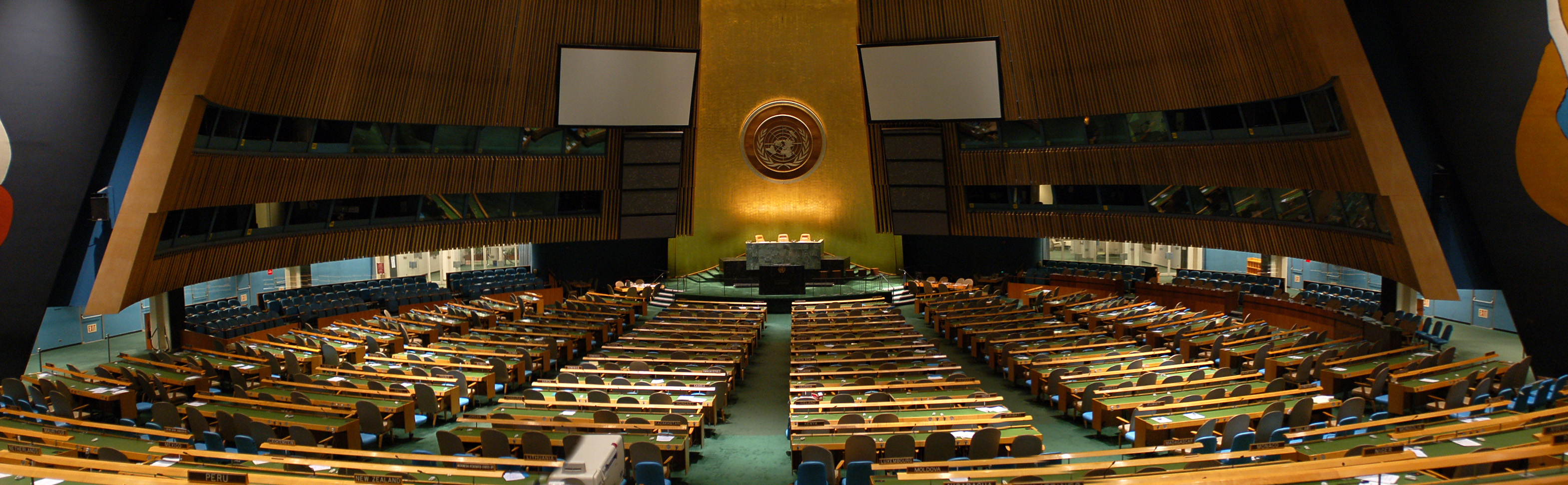
The United Nations (UN) General Assembly is the closest thing to a world parliament that we have today. However, all the official participants are diplomats appointed by their respective States – 195 member states. UN Secretariat members, the secretariat members of UN Specialized Agencies such as UNESCO and the ILO, are in the hallways or coffee shops to give advice. Secretariat members of the financial institutions such as the World Bank and the IMF are also there to give advice on costs and the limits of available funds. The representatives of Nongovernmental Organizations (NGO) in Consultative Status with the UN who can speak at sessions of the Economic and Social Council and the Human Rights Council cannot address the General Assembly directly. However, they are also in the coffee shops and may send documents to the UN missions of national governments.
(C) Jérôme Blum
Politics without borders requires finding ways to express views for action beyond the borders of individual countries. Today, most vital issues that touch the lives of many people go beyond the individual State: the consequences of climate change, the protection of biodiversity, the resolution of armed conflicts, the violations of human rights, and a more just world trade pattern. Thus we need to find ways of looking at the world with a global mind and an open heart. This perspective is an aim of world citizenship.
However, World Citizens are not yet so organized as to be able to impact political decisions at the UN and in enough individual States so as to have real influence. The policy papers and Appeals of the Association of World Citizens (AWC) are often read with interest by the government representatives to whom they are sent. However, the AWC is an NGO among many and does not have the number of staff as such international NGOs as Amnesty International, Human Rights Watch, and Greenpeace.
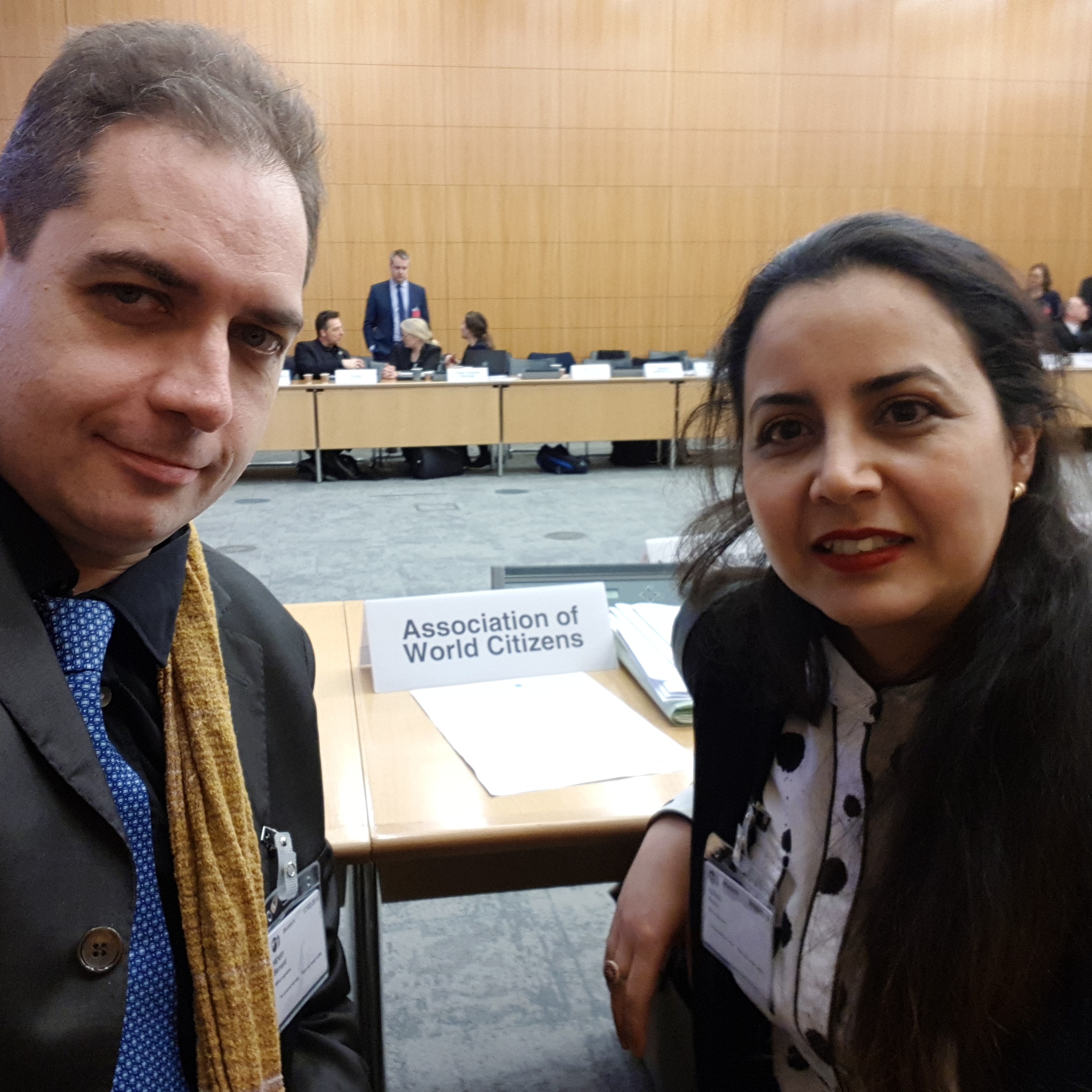
The First Officer and External Relations Officer, Bernard J. Henry, and the Legal and Mediation Officer, Attorney Noura Addad, representing the AWC at an OECD roundtable in March 2019 (C) Bernard J. Henry/AWC
We still need to find effective ways so that humanity can come together to solve global problems, that is, politics without borders. Prof. René Wadlow is President of the Association of World Citizens.
War and armed violence are highly destructive of the lives of persons, but also of works of art and elements of cultural heritage. The war in Ukraine has highlighted the destructive power of war in a dramatic way. Thus, this May 18, “International Museum Day”, we outline some of the ways in which UNESCO is working to protect the cultural heritage in Ukraine in time of war.
May 18 has been designated by UNESCO as the International Day of Museums to highlight the role that museums play in preserving beauty, culture, and history. Museums come in all sizes and are often related to institutions of learning and libraries. Increasingly, churches and centers of worship have taken on the character of museums as people visit them for their artistic value, even they do not share the faith of those who built them.
Knowledge and understanding of a people’s past can help current inhabitants to develop and sustain identity and to appreciate the value of their own culture and heritage. This knowledge and understanding enriches their lives. It enables them to manage contemporary problems more successfully.
It is widely believed in Ukraine that one of the chief aims of the Russian armed intervention is to eliminate all traces of a separate Ukrainian culture, to highlight a common Russian motherland. In order to do this, there is a deliberate destruction of cultural heritage and a looting of museums, churches, and libraries in areas when under Russian military control. Museums, libraries, and churches elsewhere in Ukraine have been targeted by Russian artillery attacks.
After the Second World War, UNESCO had developed international conventions on the protection of cultural and educational bodies in times of conflict. The most important of these is the 1954 Hague Convention for the Protection of Cultural Property in the Event of Armed Conflict. The Hague Convention has been signed by a large number of States including the USSR to which both the Russian Federation and Ukraine are bound.
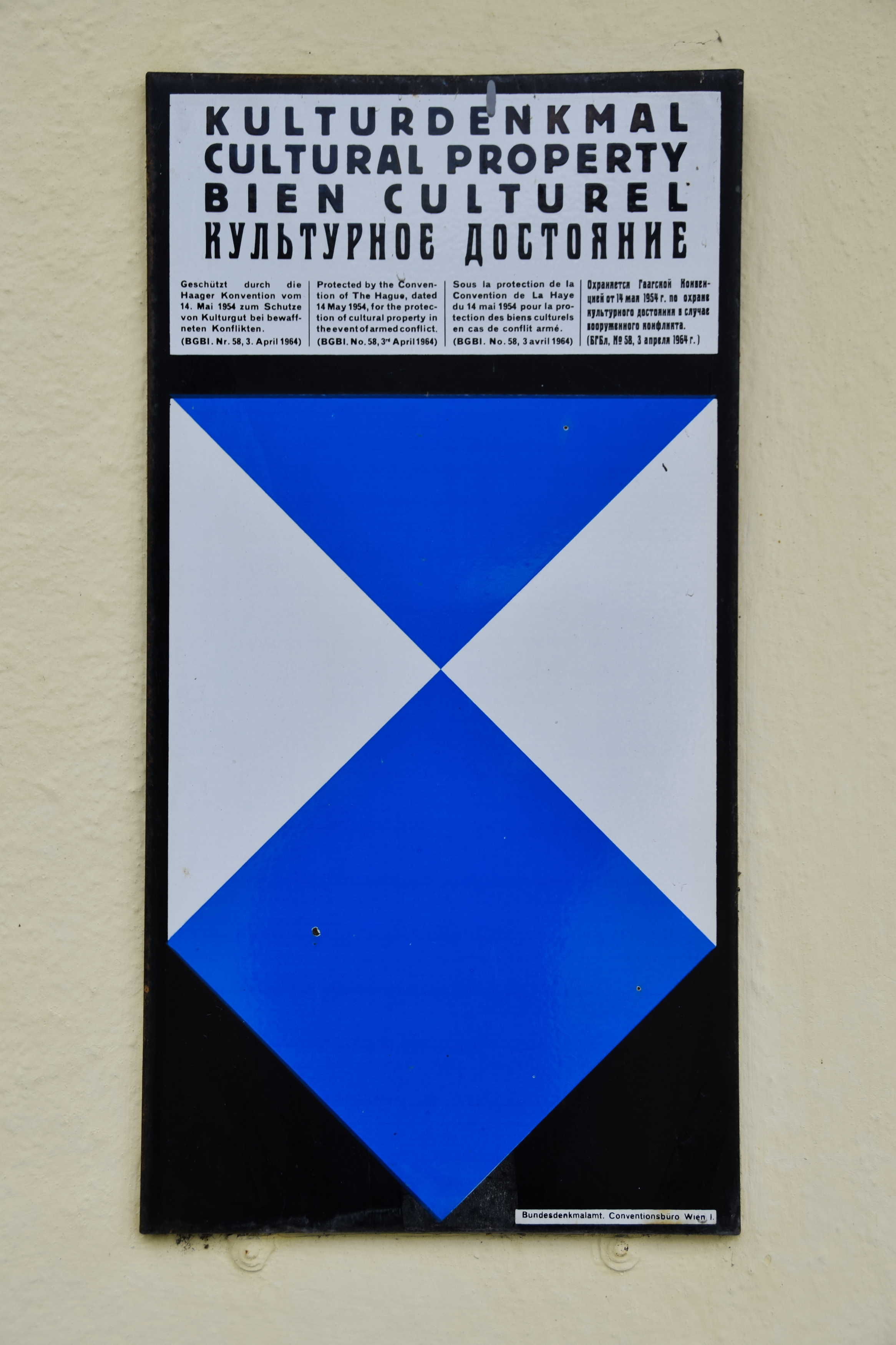
A Blue Shield in Vienna, Austria (C) Mosbatho, CC BY 4.0
UNESCO has designed a Blue Shield as a symbol of a protected site. Audrey Azoulay, Director-General of UNESCO, has brought a number of these Blue Shields herself to Ukraine to highlight UNESCO’s vital efforts.
The 1954 Hague Convention builds on the efforts of the Roerich Peace Pact signed on April 15, 1935 by 21 States in a Pan-American Union ceremony at the White House in Washington, D.C. In addition to the Latin American States of the Pan American Union, the following States also signed: Kingdom of Albania, Kingdom of Belgium, Republic of China, Republic of Czechoslovakia, Republic of Greece, Irish Free State, Empire of Japan, Republic of Lithuania, Kingdom of Persia, Republic of Poland, Republic of Portugal, Republic of Spain, Confederation of Switzerland, Kingdom of Yugoslavia.
At the signing, Henry A. Wallace, then U.S. Secretary of Agriculture and later Vice-President, said, “At no time has such an ideal been more needed. It is high time for the idealists who make the reality of tomorrow, to rally around such a symbol of international cultural unity. It is time that we appeal to that appreciation of beauty, science, education which runs across all national boundaries to strengthen all that we hold dear in our particular governments and customs. Its acceptance signifies the approach of a time when those who truly love their own nation will appreciate in addition the unique contributions of other nations and also do reverence to that common spiritual enterprise which draws together in one fellowship all artists, scientists, educators and truly religious of whatever faith. Thus we build a world civilization which places that which is fine in humanity above that which is low, sordid and mean, that which is hateful and grabbing.”
We still have efforts to make so that what is fine in humanity is above what is hateful and grabbing. However, the road signs set out the direction clearly.
Prof. René Wadlow is President of the Association of World Citizens.
March 25 is the anniversary date of the start of 28 days on continued bombing of Yemen in 2015 by the Saudi-Arabia-led coalition (Bahrain, Egypt, Jordan, Kuwait, Morocco, Qatar, Sudan, United Arab Emirates helped by arms and “intelligence” from the USA and the UK). The aggression by the Saudi coalition turned what had been an internal struggle for power going on from the “Arab Spring” of 2011 into a war with regional dimensions which brought Iran into the picture. The role of Iran has been exaggerated both by the Iranian government itself and by those hostile to Iran. Nevertheless, the Iranian role is real.
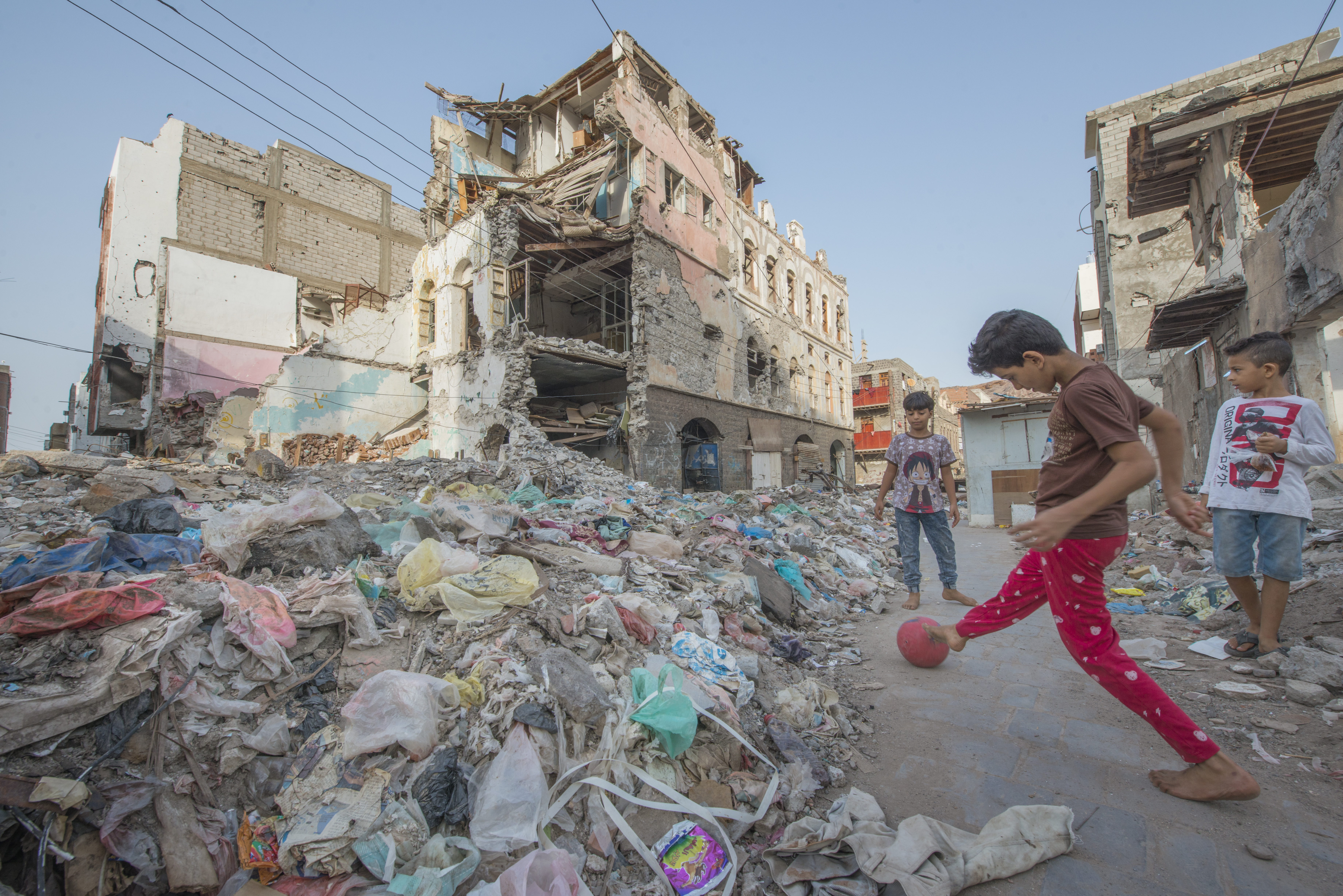
Yemeni children play in the rubble of buildings destroyed in an air raid. (C) Peter Biro/European Union
Since the Association of World Citizens (AWC) had been following possible constitutional developments in Yemen after the 2011 change of government, a couple of days after the March 25, 2015 bombing, the AWC sent to governmental missions to the United Nations (UN) an AWC Appeal for four steps of conflict resolution and negotiations in good faith:
1) An immediate ceasefire ending all foreign military attacks; 2) Humanitarian assistance, especially important for hard-to-reach zones; 3) A broad national dialogue; 4) Through this dialogue, the establishment of an inclusive unity government open to constitutional changes to facilitate better the wide geographic- tribal structure of the State.
While the constitutional form of the State structures depends on the will of the people of Yemen (provided they can express themselves freely), the AWC proposes consideration of con-federal forms of government which maintain cooperation within a decentralized framework. In 2014, a committee appointed by the then President, Abdu Rabbu Mansur Hadi, had proposed a six-region federation as the political structure for Yemen.
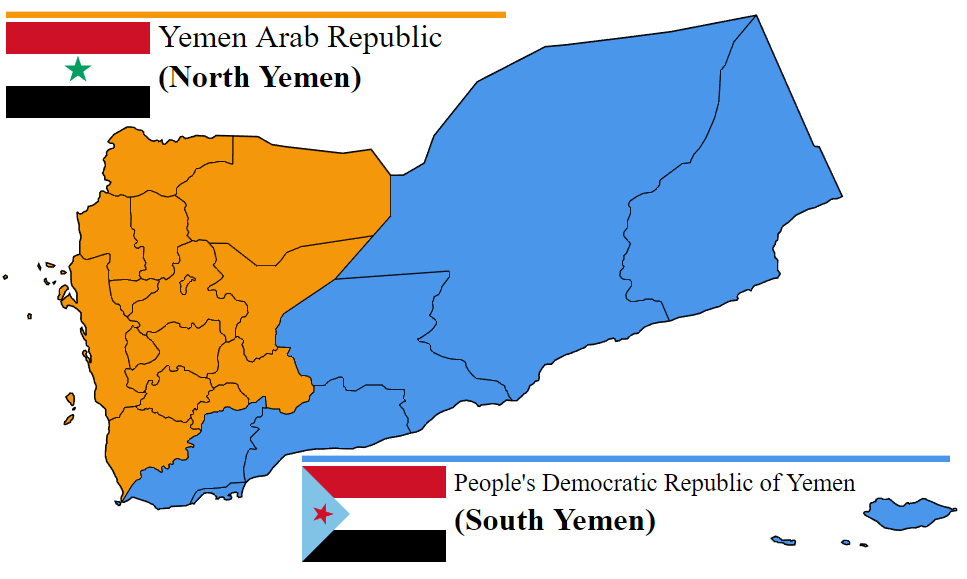
Until 1990, Yemen was two separate States: The People’s Democratic of Yemen in the south with Aden as the capital, and the Yemen Arab Republic in the north with Sana’a as its capital. In 1990, the two united to become the Republic of Yemen. The people in the south hoped that the union would bring the economic development which had been promised. Since, even before the Saudi-led war began, there had been very little economic and social development in the south, there started to grow strong “separatist” attitudes in the south. People of all political persuasions hoped to develop prosperity by ending unification and creating what some have started calling “South Arabia” Today, these separatist attitudes are very strong, but there is no agreement on what areas are to be included in a new southern state, and the is no unified separatist political leadership.
Very quickly after March 25, 2015, many governments saw the dangers of the conflict and the possible regional destabilization. Thus, there were UN-sponsored negotiations held in Geneva in June 2015. The AWC worked with other nongovernmental organizations (NGO) so that women should be directly involved in such negotiations. However, women have not been added to any of the negotiations and are largely absent from any leadership role in the many political factions of the country. There have been UN mediators active in trying to get ceasefires and then negotiations. There have been some temporary ceasefires, but no progress on real negotiations.
Today, the war continues with the country’s fragmentation, continued internal fighting and impoverishment leading to a disastrous humanitarian crisis. There is a glimmer of possible conflict resolution efforts due to the recent mutual recognition of Saudi Arabia and Iran under the sponsorship of the People’s Republic of China. However, creating a national society of individuals willing to cooperate will not be easy. Regional divisions will not be easy to bridge. There have already been divisions within the Saudi-led Coalition. Thus, positive action is still needed. NGOs should seek to have their voices heard.
Prof. René Wadlow is President of the Association of World Citizens.

 Association of World Citizens