The Official Blog of the

Archive for the ‘Being a World Citizen’ Category

«Pour toi Arménie» le monde doit faire cesser le blocus du Haut-Karabakh

In Being a World Citizen, Conflict Resolution, Current Events, Europe, Fighting Racism, Human Rights, Humanitarian Law, International Justice, NGOs, Spirituality, The former Soviet Union, The Search for Peace, United Nations, World Law on September 14, 2023 at 7:16 AM

Par Bernard J. Henry

«Même si tu maudis ton sort,

Dans tes yeux, je veux voir,

Arménie, une lueur d’espoir,

Une flamme, une envie

De prendre ton destin entre tes mains,

A bras le corps …»

Ces paroles écrites par Charles Aznavour, né Sharnough Aznavourian, font partie de Pour toi Arménie, la chanson dont il était l’auteur avec son beau-frère et complice musical de toujours Georges Garvarentz en 1988. Cet hommage amoureux à la terre de ses racines familiales, le plus célèbre des artistes franco-arméniens ne l’avait pas écrit seulement par un élan du cœur. Cette chanson était une urgence – l’urgence d’aider son Arménie frappée par un tremblement de terre meurtrier et dont la population déjà démunie s’était trouvée abandonnée à son sort.

Le 7 décembre 1988, la ville de Spitak, au nord de ce qui était alors la République socialiste soviétique d’Arménie au sein de l’URSS vivant la perestroïka de Mikhaïl Gorbatchev, à 11H41 très précises, un séisme de 6,9 sur l’échelle de Richter dévaste la ville. Dans cette Union soviétique qui avoue désormais ses faiblesses, les services de secours ne parviennent à sauver que quatre-vingts personnes des ruines des immeubles effondrés, tandis que vingt-cinq à trente mille personnes trouvent la mort, plus de quinze mille en sortent blessées et cinq cent trente mille n’ont désormais plus nulle part où vivre. Moscou et son affidée d’alors Erevan dépassées par l’ampleur du drame, la diaspora arménienne prend le relais et l’aide à la terre d’origine meurtrie s’organise – en dehors de l’Arménie.

Suivant l’exemple américain de Harry Belafonte, Quincy Jones et Lionel Richie en 1985 avec We Are the World pour l’Ethiopie, Aznavour rassemble quatre-vingt-huit autres chanteurs, acteurs et personnalités de la télévision avec lesquels il enregistre Pour toi Arménie en annonçant que tous les profits du 45 tours, en cette époque sans le streaming et où l’on achète encore des disques vinyles, iront à l’aide humanitaire sur place. Et le public répond présent, le 45 tours entrant directement premier au Top 50, le classement national hebdomadaire des ventes, dont il gardera la première place pendant plusieurs semaines. C’est Aznavour lui-même qui conclut la chanson par le nom de l’Arménie dans la langue nationale, «Hayastan !», tant en français qu’en italien et même en anglais, dans une version américaine que sa notoriété internationale lui permet d’enregistrer avec le soutien de nombreuses célébrités des écrans, grand et petit, ainsi que de la chanson comme Dionne Warwick.

Le 1er octobre prochain verra les cinq ans de la disparition de Charles Aznavour, artiste de légende, humanitaire mais aussi ambassadeur d’Arménie à l’UNESCO puis au Palais des Nations, dont l’Association of World Citizens (AWC) a un jour croisé le chemin pour venir en aide à une habitante de Erevan chassée de son domicile par des violences conjugales. S’il était encore des nôtres, comment réagirait-il au drame que vit actuellement l’Arménie, drame qui, contrairement à celui de Spitak en 1988, n’est pas le fait de la nature mais d’un ennemi bien plus dangereux encore pour l’être humain – lui-même ?

La seule absence de combat ne sera jamais la paix

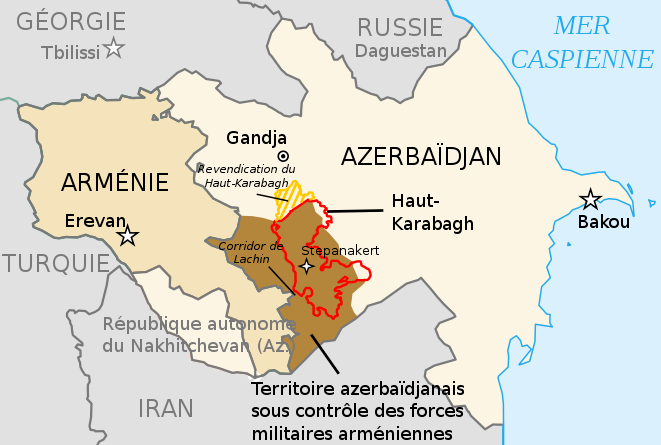
Entre 1988 et 1994, l’Arménie et son voisin de l’est, l’Azerbaïdjan, républiques soviétiques avant de devenir indépendantes à la faveur de la disparition de l’Union soviétique fin 1991, se sont affrontées militairement autour d’un territoire voisin de l’Arménie, peuplé pour l’essentiel d’Arméniens mais appartenant juridiquement à l’Azerbaïdjan – le Haut-Karabakh, ou Nagorno-Karabakh, sur une partie duquel se tient la République d’Artsakh reconnue par Erevan. Soutenu par Gorbatchev du temps de l’URSS, l’Azerbaïdjan avait refusé tout transfert de souveraineté du Haut-Karabakh à l’Arménie, position qu’il a maintenue en tant qu’État souverain et maintient encore aujourd’hui.
(C) Bourrichon

En 1992, après plusieurs années d’un conflit dominé par l’Azerbaïdjan doté d’un large soutien du monde musulman, l’Arménie remporte de premières victoires décisives. Deux ans plus tard, en mai, c’est un Azerbaïdjan désormais épuisé par une nette domination militaire arménienne qui accepte une trêve, qui ne règle pas le conflit du Haut-Karabakh mais le «gèle» sans solution, laissant le territoire indépendant de facto mais non reconnu sur le plan international. Au cours des années, les liens avec l’Arménie vont se resserrer, culminant avec l’élection en 2008 d’un natif du Haut-Karabakh, Serge Sarkissian, à la présidence de l’Arménie qu’il occupera pendant dix ans. Entre l’Arménie et le Haut-Karabakh, un seul lien terrestre direct : le corridor de Latchine, large de quelques cinq kilomètres et long de soixante-cinq. Au-delà, l’Azerbaïdjan vaincu, rêvant d’une revanche au détour de l’histoire.

Fin septembre 2020, après le traumatisme d’une année marquée par la pandémie de Covid-19 et qui verra le monde quasi mis à l’arrêt, avec un tiers de la population de la planète confinée à son domicile, l’Azerbaïdjan prend de court une communauté internationale encore sous le choc en lançant une violente offensive contre le Haut-Karabakh. Cette fois, Bakou garde l’ascendant du début à la fin des hostilités, qui vient le 10 novembre avec un cessez-le-feu conclu à l’issue d’une médiation de la Fédération de Russie, avec de lourdes pertes de territoire pour l’Arménie qui doit de céder un tiers du Haut-Karabakh et en retirer ses troupes, Moscou déployant les siennes pour maintenir le cessez-le-feu. Pour les civils arméniens, c’est le temps de l’exil, non sans avoir pour beaucoup d’entre eux brûlé leur maison plutôt que de la voir accueillir des Azerbaïdjanais.

A Latchine, ce sont les forces de maintien de la paix russes qui prennent position, l’Arménie conservant le droit d’utiliser le passage terrestre avec le Haut-Karabakh. Seulement, à partir de février 2022, les mêmes forces armées russes qui maintiennent la paix entre Arménie et Azerbaïdjan deviennent aussi les forces d’invasion de l’Ukraine, qui vaut à Moscou une vaste et légitime condamnation internationale. Qui peut prétendre assurer la paix entre deux belligérants qui, dans le même temps, envahit son voisin ? L’Azerbaïdjan ne va pas tarder à le comprendre. Et dans cette paix qui n’en était pas une depuis la trêve de 1994, l’étant encore moins depuis le cessez-le-feu de 2020, Bakou va en tirer parti. De la pire manière qui soit.

En novembre 2020, des Yazidis se portent volontaires pour rejoindre les forces armées arméniennes et combattre au Haut-Karabakh (C) Armenian Army Media

L’arme de la faim et la «guerre sale» de Bakou

En cet automne 2020, entre Arménie et Azerbaïdjan, sur le Haut-Karabakh, match nul. Le bon moment, sans doute, pour entamer des discussions de paix entre les deux pays qui savent désormais chacun ce que c’est que d’être vainqueur et vaincu. Mais personne ne s’y aventure, et tout comme en 1994, la situation semble gelée sans espoir d’un dénouement définitif du conflit après plus de trente ans. Lorsque survient, du côté de l’Azerbaïdjan, l’impensable.

Le 12 décembre 2022, des Azerbaïdjanais se présentant comme des «militants écologistes» prennent position à l’entrée du corridor de Latchine, entendant bloquer une «exploitation illégale» de minerais locaux. Niant tout lien avec ces «militants écologistes» chez lesquels les slogans pour l’environnement cohabitent avec le drapeau azerbaïdjanais, le Président Ilham Aliyev se montre envers eux étonnamment indulgent par rapport à ses habitudes envers la société civile, habitudes dont nombre de militants ont payé le prix en cellule. Et pour cause, la société civile, la vraie, détient les preuves du lien direct entre ces «militants écologistes» et Bakou.

La preuve ultime, c’est justement Bakou qui la fournira lui-même, le 11 juillet dernier. Ce jour-là, ses propres troupes, drapeaux en main, bloquent désormais officiellement Latchine, accusant la Croix-Rouge de «contrebande» à l’occasion de ses livraisons d’aide humanitaire au Haut-Karabakh. L’organisation nie farouchement l’accusation, en effet de mauvaise foi puisque l’Azerbaïdjan prend pour prétexte les méfaits de quatre chauffeurs extérieurs à la Croix-Rouge qui, dans leurs véhicules personnels, ont tenté de faire passer «des marchandises commerciales» au Haut-Karabakh, bien sûr à l’insu de l’institution humanitaire qui a aussitôt mis fin à leurs contrats.

Mais, pour avoir tenté de réaliser un profit dérisoire, ces quatre malfaiteurs se voient toujours moins punis que le sont les Arméniens du Haut-Karabakh. Le territoire arménien en terre d’Azerbaïdjan se trouve désormais soumis à un blocus total, contraint à un rationnement de la nourriture et du gaz, et tout transfert médical d’urgence de patients vers Erevan est devenu impossible. Après avoir vaincu l’Arménie par les armes conventionnelles, l’Azerbaïdjan use désormais sans complexe contre les Arméniens de l’arme ultime, plus impitoyable encore que l’arme nucléaire qui abrégerait en quelques secondes les souffrances de celles et ceux qu’elle frapperait – l’arme de la faim.

Sous peu, le monde entier s’indigne. Fin août, un convoi humanitaire emmené par plusieurs élus politiques français de diverses tendances idéologiques, à l’exception notable et habituelle de l’extrême droite, se présente à Latchine en tentant de faire route vers le Haut-Karabakh. Pas de surprise – refoulé. Depuis l’Arménie, les dirigeants d’un think tank en appellent à la mise en place d’un pont aérien, à l’image de celui créé par les Alliés durant le blocus de Berlin en 1949. Fait exceptionnel, encore plus depuis le début de l’invasion de l’Ukraine en février 2022, Washington et Moscou se voient unanimes dans leur demande à Bakou en vue d’une levée du blocus du corridor de Latchine.

Au-delà de la politique, c’est le droit qui ne tarde pas à se manifester, le droit international pénal qui sait tout ce que le nom de l’Arménie signifie pour lui et pour son histoire.

D’un litige sur la souveraineté d’un territoire donné, le conflit prend soudain un goût amer de déjà-vu. Entre les Azerbaïdjanais descendants des Ottomans d’avant la Première Guerre Mondiale et les Arméniens victimes du génocide ottoman en 1915, c’est maintenant le souvenir du génocide qui se rallume dans les esprits, en Arménie et au Haut-Karabakh bien sûr mais, plus encore, dans le reste du monde.

Ronald Suny, professeur de science politique à l’Université du Michigan, cité par CNN, déclare : «Maintenant qu’il a gagné la guerre de 2020 contre l’Arménie, l’Azerbaïdjan a pour but ultime de chasser les Arméniens d’Artsakh hors de l’Azerbaïdjan. Mais plutôt que de recourir directement à la violence, qui susciterait les condamnations à l’étranger, Bakou est décidée à rendre la vie impossible aux Arméniens, les affamer et faire pression sur eux pour qu’ils partent». Pour l’International Association of Genocide Scholars (IAGS), aucun doute, le blocus du Haut-Karabakh engendre un risque de génocide.

Quant à Luis Moreno Ocampo, le premier Procureur de la Cour pénale internationale à sa création en 2002, dans une Opinion d’Expert datée du 7 août, il monte encore d’un cran en écrivant d’entrée «Il est en train de se produire un génocide contre 120 000 Arméniens vivant au Nagorno-Karabakh, également connu sous le nom d’Artsakh».

Sur le blog Social Europe, le spécialiste gréco-arménien des relations internationales George Meneshian appelle enfin l’Europe à «se réveiller» à la réalité du conflit entre l’Arménie et l’Azerbaïdjan, sous peine de devenir «complice de génocide».

Vouloir vaincre son adversaire en affamant sa population civile, c’est déjà en soi inhumain et lâche, surtout lorsqu’une victoire militaire nette vous place en position de force pour négocier un accord de paix. De la part de l’Azerbaïdjan, pourtant, ce n’est même pas le pire. Parler de génocide, c’est parler de la volonté d’exterminer un peuple, et qui parle d’exterminer un peuple parle d’une notion simple et claire – le racisme.
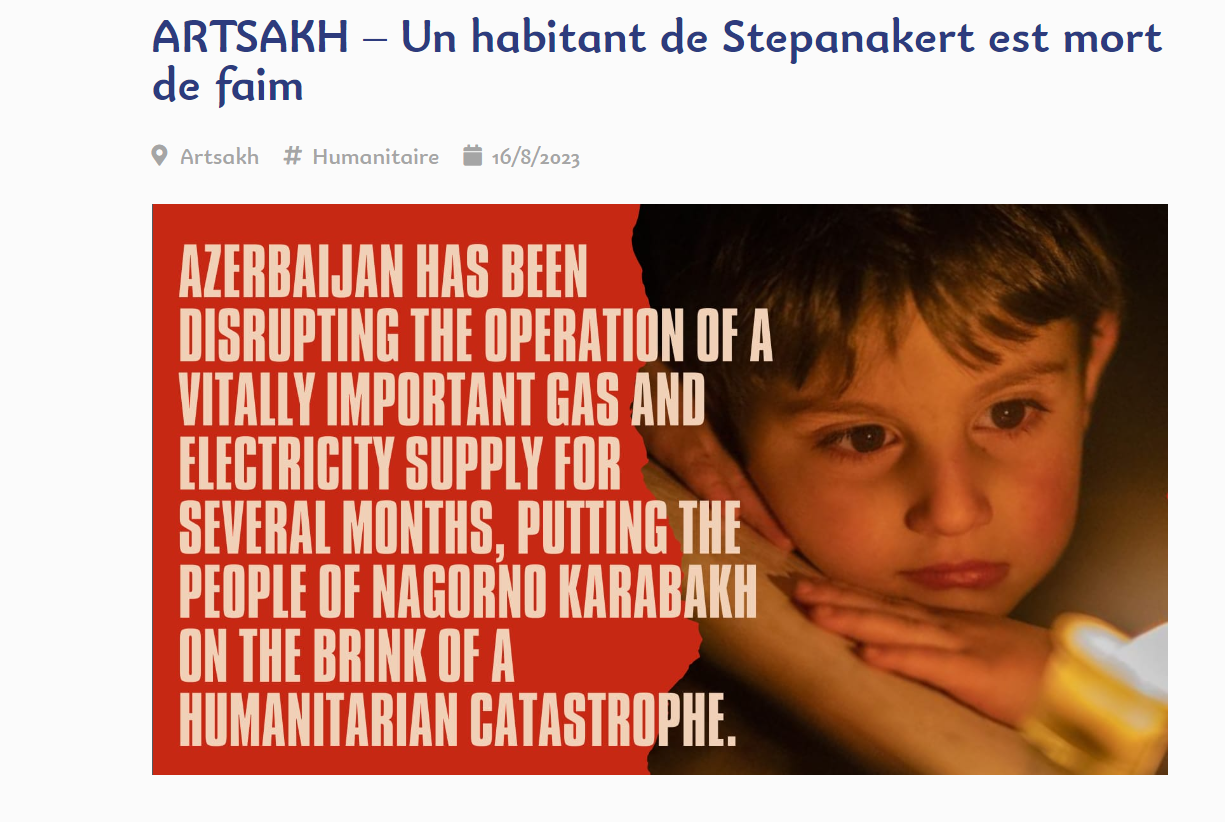
Capture d’écran de Nor Haratch, publication en ligne arménienne basée en France.

Contre le racisme envers les Arméniens d’Azerbaïdjan, l’arme du droit

Dans son argumentaire expert de vingt-huit pages, Luis Moreno Ocampo, montrant qu’il se souvient que la juridiction dont il a été le premier procureur est née de l’expérience aussi douloureuse qu’indispensable des Tribunaux pénaux internationaux pour l’ex-Yougoslavie (TPIY) et le Rwanda (TPIR), cite une abondance jurisprudence de l’un et de l’autre pour établir que, parce que le génocide ne s’avoue jamais, il peut et doit donc se déduire des actes du génocidaire, actes qu’il écrit reconnaître dans le blocus par l’Azerbaïdjan du corridor de Latchine.

Mais le magistrat sait aussi mettre un nom sur le premier mal qui frappe les Arméniens, sur la première faute de l’Azerbaïdjan, sur les premiers fondements de cette guerre de la faim. Un mal «prenant naissance dans l’esprit des hommes», dans les mots de l’Acte constitutif de l’UNESCO, tout comme le droit prend naissance dans l’esprit de l’être humain et, selon l’adage romain, ubi societas, ibi jus, là où il y a la société, il y a le droit. Et dans une société où sévit, voire règne, le racisme, il faut bien qu’il y ait le droit, celui de la Société Humaine Universelle que définit Olivier de Frouville, contre celui de la Société des Etats Souverains qu’il lui oppose et qui, comme jadis par exemple en Afrique du Sud, peut décider que le racisme est loi.

Bien que l’Arménie revendique le Haut-Karabakh et que la République d’Artsakh se veuille arménienne, techniquement et juridiquement parlant, les Arméniens du Haut-Karabakh demeurent des habitants de l’Azerbaïdjan, derrière le corridor de Latchine qui, sous blocus, ne peut plus jouer son rôle de lien terrestre unique avec l’Arménie. Derrière la rhétorique guerrière de Bakou et l’exemple qu’elle constitue de «création de l’ennemi» au sens que lui donne John Paul Lederach, ce que voient les instances internationales, à commencer par l’ONU, c’est bel et bien du racisme, celui des Azéris majoritaires en Azerbaïdjan contre les Arméniens de ce même pays qui demeurent, aux yeux de la communauté internationale, des Azerbaïdjanais. Et sur le racisme que subissent ces Azerbaïdjanais arméniens de la part de leurs compatriotes azéris, ce ne sont ni les faits ni les réactions qui manquent.

Le 21 avril 2023, le Représentant permanent de l’Arménie auprès du Siège des Nations Unies écrivait au Secrétaire Général, Antonio Guterres, en rappelant l’un des épisodes les plus tragiques de l’histoire des Arméniens d’Azerbaïdjan. Il parlait du massacre de Soumgaït, ville où, alors que l’Arménie soviétique commençait à revendiquer le Haut-Karabakh, un pogrom azéri avait décimé la population arménienne locale, causant des dizaines de morts, encore plus de blessés, des viols, des pillages et des destructions, toujours contre les mêmes – les Arméniens. Il rappelait les multiples condamnations de l’Azerbaïdjan, morales ou judiciaires, de la part des instances internationales, établissant un lien entre Soumgaït et la haine raciale contemporaine contre les Arméniens.

Et de la part de Erevan, il ne s’agissait pas de lawfare, de cette guerre judiciaire que l’on mène lorsque les armes n’ont pu vous apporter la victoire. Le racisme d’Etat azerbaïdjanais contre les Arméniens n’est pas une simple proclamation politique ; il est une réalité de terrain, et pour Bakou, il s’est mué en une excuse commode pour employer une arme sale, l’arme de la faim, contre le Haut-Karabakh.

Le 7 décembre 2021, à peine plus d’un an après la reprise des combats et la défaite arménienne, la Cour internationale de Justice statuait, saisie par l’Arménie, sur une demande de mesures conservatoires pour le respect de la Convention internationale sur l’Élimination de Toutes les Formes de Discrimination raciale (CIEDR), Erevan demandant à la Cour d’ordonner à l’Azerbaïdjan de changer d’attitude

«— en s’abstenant de se livrer à des pratiques de nettoyage ethnique contre les Arméniens ;

— en s’abstenant de commettre, de glorifier, de récompenser ou de cautionner des actes de racisme contre les Arméniens, y compris les prisonniers de guerre, les otages et d’autres détenus ;

— en s’abstenant de tenir ou de tolérer des discours haineux visant les Arméniens, y compris dans les ouvrages pédagogiques ;

— en s’abstenant de bannir la langue arménienne, de détruire le patrimoine culturel arménien ou d’éliminer de toute autre manière l’existence de la présence culturelle historique arménienne, ou d’empêcher les Arméniens d’avoir accès à celle‑ci et d’en jouir ;

— en punissant tout acte de discrimination raciale contre les Arméniens, qu’il soit commis dans la sphère publique ou privée, y compris lorsqu’il est le fait d’agents de l’État ;

— en garantissant aux Arméniens, y compris les prisonniers de guerre, les otages et d’autres détenus, la jouissance de leurs droits dans des conditions d’égalité ;

— en adoptant la législation nécessaire pour s’acquitter des obligations que lui fait la CIEDR ;

— en garantissant aux Arméniens un traitement égal devant les tribunaux et tout autre organe administrant la justice ainsi qu’une protection et une voie de recours effectives contre les actes de discrimination raciale ;

— en s’abstenant d’entraver l’enregistrement et les activités des ONG et d’arrêter, de détenir et de condamner les militants des droits de l’homme ou toute autre personne œuvrant pour la réconciliation avec l’Arménie et les Arméniens; et

— en prenant des mesures efficaces pour combattre les préjugés contre les Arméniens et des mesures spéciales pour assurer comme il convient le développement de ce groupe».

Dans sa décision, la Cour internationale de Justice avait finalement estimé que

«1) La République d’Azerbaïdjan doit, conformément aux obligations que lui impose la convention internationale sur l’élimination de toutes les formes de discrimination raciale,

a) Par quatorze voix contre une,

Protéger contre les voies de fait et les sévices toutes les personnes arrêtées en relation avec le conflit de 2020 qui sont toujours en détention et garantir leur sûreté et leur droit à l’égalité devant la loi ;

b) A l’unanimité,

Prendre toutes les mesures nécessaires pour empêcher l’incitation et l’encouragement à la haine et à la discrimination raciales, y compris par ses agents et ses institutions publiques, à l’égard des personnes d’origine nationale ou ethnique arménienne ;

c) Par treize voix contre deux,

Prendre toutes les mesures nécessaires pour empêcher et punir les actes de dégradation et de profanation du patrimoine culturel arménien, notamment, mais pas seulement, les églises et autres lieux de culte, monuments, sites, cimetières et artefacts ;

2) A l’unanimité,

Les deux Parties doivent s’abstenir de tout acte qui risquerait d’aggraver ou d’étendre le différend dont la Cour est saisie ou d’en rendre le règlement plus difficile».
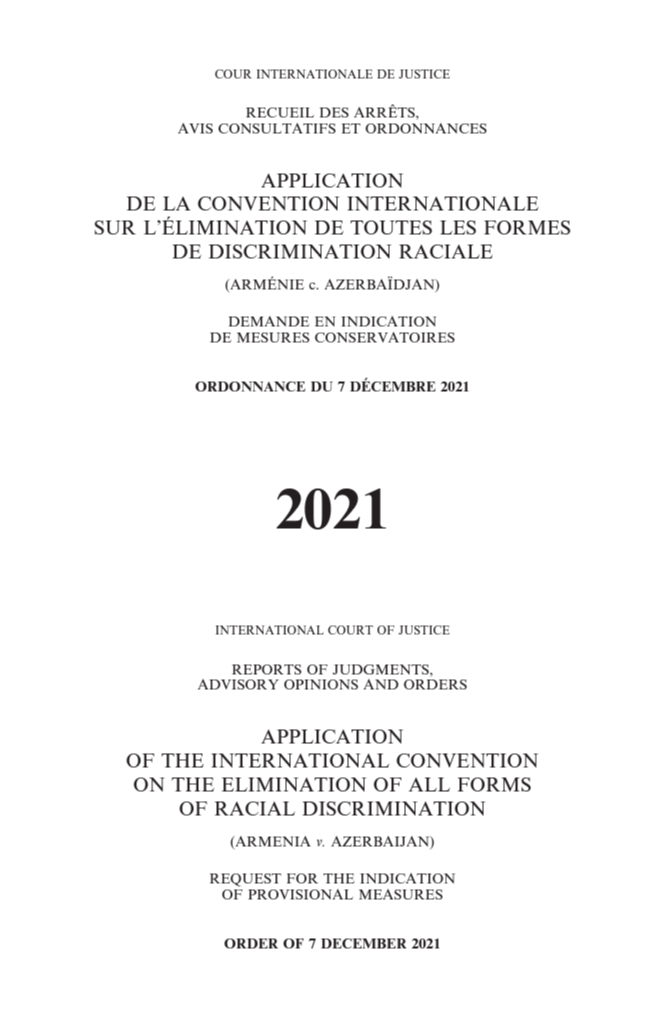
La haute juridiction onusienne reconnaissait ainsi que la question du Haut-Karabakh n’était pas, ou n’était plus, seulement celle de la souveraineté sur ce territoire de l’un ou de l’autre des deux pays qui le réclamait. Il s’agissait bien, au-delà d’une simple dispute territoriale, de racisme.

Et comme le relève Luis Moreno Ocampo dans son Opinion d’Expert, le 22 septembre 2022, dans ses Observations finales concernant le rapport de l’Azerbaïdjan valant dixième à douzième rapports périodiques, le Comité CIEDR fustigeait le pays pour «[l’]incitation à la haine raciale et la propagation de stéréotypes racistes à l’encontre de personnes d’origine nationale ou ethnique arménienne, notamment sur Internet et dans les médias sociaux, ainsi que par des personnalités publiques et des hauts responsables, et le manque d’informations détaillées sur les enquêtes, les poursuites, les déclarations de culpabilité et les sanctions liées à de tels actes». Une constante de racisme par trop voyante pour que Bakou puisse réduire le blocus du Haut-Karabakh à une simple protestation d’écologistes ou, aujourd’hui, à une mesure devant empêcher la contrebande, excuses si faciles qu’elles en deviennent insultantes.

Notre époque a appris, et Luis Moreno Ocampo a bien compris que c’était là qu’il fallait frapper d’entrée, à oublier les génocides, du moins à les minimiser. Là où jadis, l’évocation de la Shoah juive, du Samudaripen rom ou, justement, du génocide arménien amenait une autorité morale au propos tenu, aujourd’hui, sous prétexte de «point Godwin», il devient quasi disqualifiant d’y faire référence. Admettons, entendu, soulever un génocide, c’est un pathos alarmiste. Mais alors, que dire de l’effroyable niveau de racisme contre les Arméniens constaté et condamné plus d’une fois par l’ONU en Azerbaïdjan, sinon qu’il est la meilleure preuve que le blocus du corridor de Latchine représente, si ce n’est un génocide en soi, du moins son ultime prélude ?

Une certaine conception de l’humanité mise à l’épreuve

S’il s’était parfois mis dans la peau des losers, comme dans Je m’voyais déjà, Poker et Je ne peux pas rentrer chez moi, Charles Aznavour chantait aussi pour dénoncer l’injustice, chantant Comme ils disent en 1972 alors que l’homosexualité est en France réprimée comme un délit, Mourir d’aimer sur l’affaire Gabrielle Russier et Les émigrants en pleine ascension du Front National et de ses thèses xénophobes. Légitime à écrire et produire Pour toi Arménie, il ne l’était pas du seul fait d’être arménien d’origine mais parce que son travail d’artiste parlait pour lui. Autrement, qui sait si l’initiative aurait rencontré le même succès ?

De même que Pour toi Arménie n’avait rien d’un phénomène «de fait», ici le fait d’un chanteur français d’origine arménienne, il n’existe aucune paix «de fait» après un conflit, la paix se construisant, sinon avant la fin des hostilités, du moins dès qu’elle intervient puis sans cesse jusqu’à ce que les belligérants comprennent qu’un accord, ou traité, formel doit sceller pour toujours leur bonne volonté et ouvrir la voie à l’avenir. Ce travail réalisé en 1994, l’offensive azerbaïdjanaise de 2020 serait devenue bien moins probable, et avec elle, cette guerre de la faim d’aujourd’hui.

En Ukraine se joue la survie d’une certaine conception du droit international, celle qui veut que l’agresseur ne soit pas récompensé de sa conduite contre l’agressé, sanctions de divers ordres à l’appui contre Moscou. Plus au nord, au Haut-Karabakh, l’enjeu n’a pas besoin pour se définir d’un manuel de droit. Lorsque l’arme choisie contre l’ennemi désigné est la faim, c’est bien une certaine conception de l’humanité qui est mise à l’épreuve, une conception qui transcende les frontières des États, qu’elles soient ou non reconnues par les autres États, une conception qui accorde toute sa valeur au droit, même s’il ne produit pas d’effet immédiat car il n’en incarne pas moins les principes qui guident une conscience. Cette conception, soit le monde agit pour la défendre au Haut-Karabakh, soit il s’expose à ce qu’elle ne soit plus garantie nulle part.

Bernard J. Henry est Officier des Relations Extérieures de l’Association of World Citizens.
Iran Repression Continues: NGO Action Needed

In Being a World Citizen, Current Events, Democracy, Fighting Racism, Human Rights, Middle East & North Africa, NGOs, Solidarity, Track II, United Nations, Women's Rights on August 22, 2023 at 5:23 PM

By René Wadlow

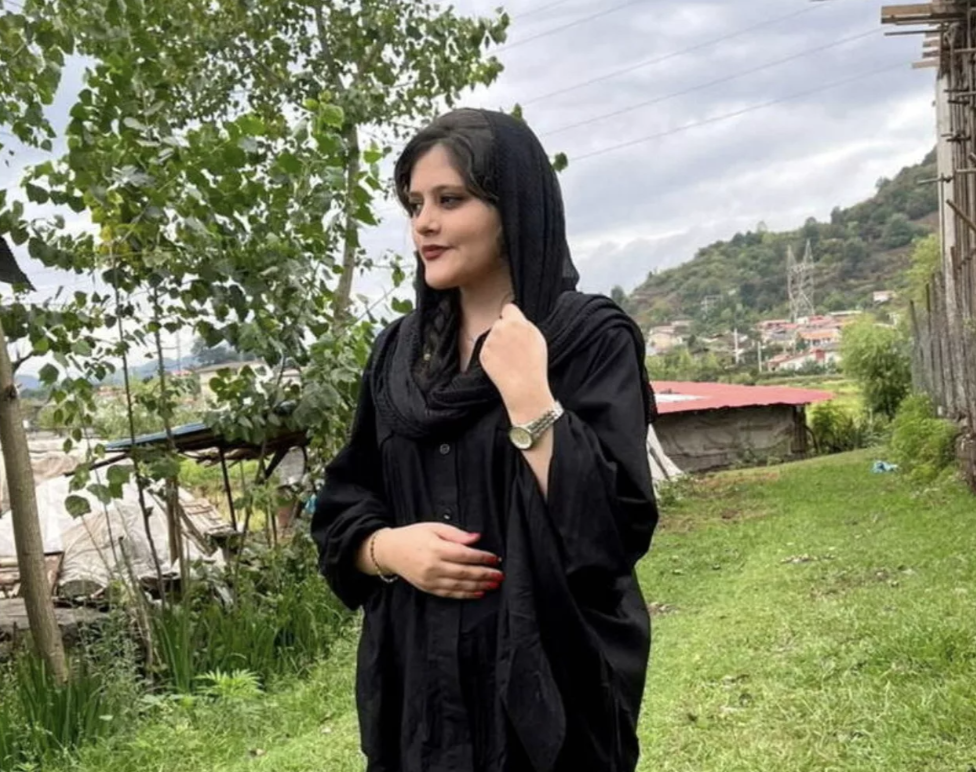
Repression of protests in Iran continues. A wave of protests swept across the country in the wake of the September 2022 death in custody of 22-year-old Mahsa Jina Animi, an ethnic Kurd and Sunni Muslim. It is estimated that the Iranian security forces have killed over 500 protesters and arrested some 20,000 persons of all ethnic and religious backgrounds.

In response to the State-led violence, on November 24, 2022, the United Nations (UN) Human Rights Council created the International Independent Fact-Finding Mission on the Islamic Republic of Iran with the chairmanship of Sera Hossain of Bangladesh.

Mahsa Amini

One aspect of the repression of protests is that religious leaders of the Sunni Muslim communities, especially in Iran’s Sistan and Baluchistan province and in the Kurdish provinces, are being increasingly targeted by the Islamic Republic’s authorities for arrest and imprisonment because of their peaceful criticism of the repression of protests. Iran is a majority Shia Muslim country, and Shiism is the official religion of the State.

Religious minorities include Sunni Muslims, Christians, Baha’is, Zoroastrians, Jews, and the Gonabadi Sufi community. Religious and ethnic identities in Iran often overlap. The Association of World Citizens (AWC) has repeatedly appealed to UN human rights bodies concerning the discrimination and repression of persons of the Baha’i faith.

Another aspect of the repression of protests has been the public hanging of some protesters. The AWC has repeatedly called upon governments for a moratorium on executions with a view of abolishing the death penalty – a penalty that extensive research has shown has little or no impact on the level of crime and too often opens doors to judicial errors and injustices.

The UN International Independent Fact-Finding Mission on the Islamic Republic of Iran has called on Nongovernmental Organizations for direct information. The broader community of NGOs needs to keep public attention focused on events in Iran.

Prof. René Wadlow is President of the Association of World Citizens.
June 4: Memories of Tiananmen Square

In Asia, Being a World Citizen, Democracy, Europe, Human Rights, NGOs, Nonviolence, Solidarity, The former Soviet Union, Track II on June 4, 2023 at 4:55 PM

By René Wadlow

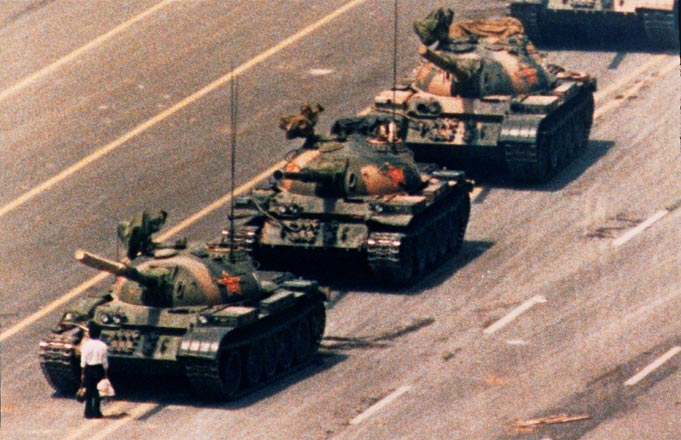
June 4 makes the security forces in China somewhat uneasy, especially in Hong Kong where, in the past, there were large memorial meetings to remind people of June 4, 1989, when the military and police moved against those who had been protesting publicly for over a month. Students from colleges and universities in China’s capital initiated protests after the death of the former General Secretary of the Communist Party, Hu Yaobang, on April 15, 1989 who was considered a liberal reformer. The movement then spread over a number of weeks to most of the major cities. Students made numerous demands, among them were calls for an end to government corruption, increased funding for education, and freedom of the press. As the movement went on, students were increasingly joined by industrial workers.

There were differences of opinion within the ruling government circle as to how to deal with the protests. As the protests continued, there was more and more international media attention, especially as there were an increasing number of journalists in Beijing in advance of the visit of the Soviet leader, Mikhail Gorbachev, with a large delegation of Soviet officials.

(C) Jeff Widener/Associated Press

Students and intellectuals started writing petitions setting out demands that were signed by more and more people. The decentralized structure of power and decision-making among groups in Tienanmen Square allowed for tactical innovation as each group was free to act as it desired and stress the symbols it wanted. Thus, art school students created the Goddess of Democracy, largely based on the Statue of Liberty in New York harbor. The growth in support for the student-led protests led the more anti-reformist faction in the government to order a crackdown by the military and the police. The tanks started to move into Tiananmen Square.

Since June 1989 there have been reforms within China – what we might call “democratization from below” but without large scale, highly visible public protests. ‘Stability’ and ‘harmony’ have been the stated government policy aims, colored by the breakup of the Soviet Union and fundamental changes in Eastern Europe. So, democratization needs to proceed quietly and gradually. Such democratization requires long-term vision and skillful leadership. Democratization is basically linked to individualization, to an ever-larger number of people thinking for themselves, creating their own lifestyles and ‘thinking outside the box’. It can be a slow process and repressive forces within the government watch events closely. However, it is likely that the direction of individualism is set and cannot be reversed.

Prof. René Wadlow is President of the Association of World Citizens.

Politics Beyond National Frontiers

In Being a World Citizen, Conflict Resolution, Cultural Bridges, Democracy, Environmental protection, Human Development, Human Rights, Humanitarian Law, International Justice, Migration, Modern slavery, NGOs, Nonviolence, Refugees, Religious Freedom, Social Rights, Solidarity, Sustainable Development, The Search for Peace, Track II, United Nations, Women's Rights, World Law on May 24, 2023 at 6:38 AM

By René Wadlow

In our current globalized world society, there is an increased role for politics without borders. Politics no longer stops at the water’s edge but must play an active role on the world stage. However, unlike politics at the national level which usually has a parliament at which the actors can recite their lines, the world has no world parliament as such. Thus, new and inventive ways must be found so that world public opinion can be heard and acted upon.

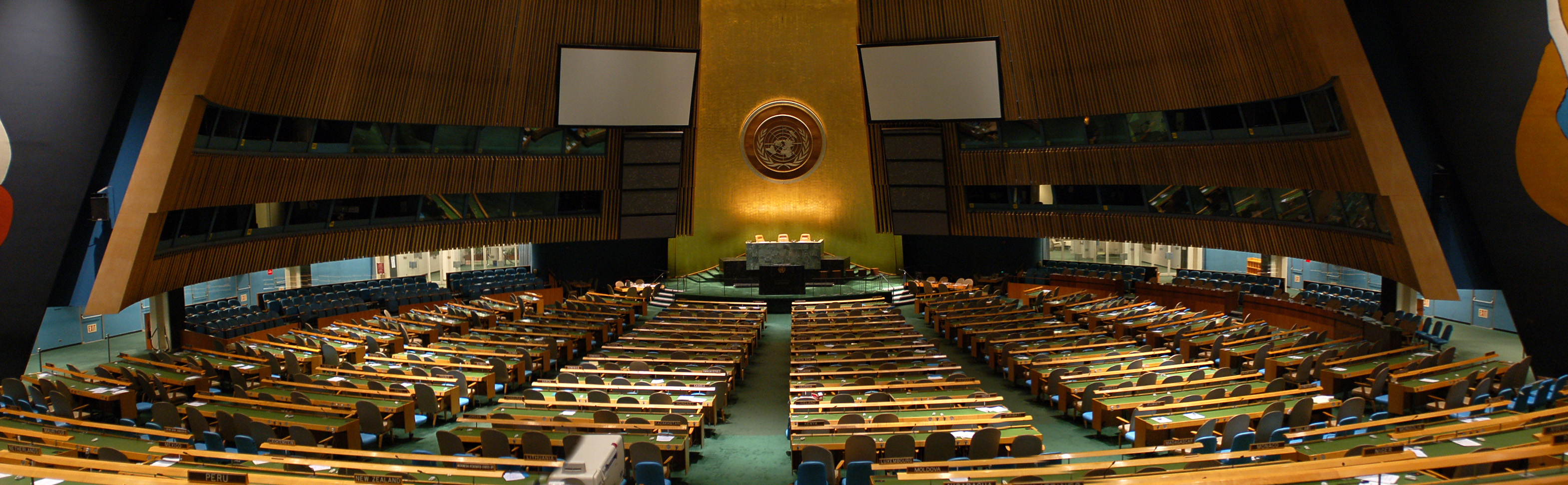
The United Nations (UN) General Assembly is the closest thing to a world parliament that we have today. However, all the official participants are diplomats appointed by their respective States – 195 member states. UN Secretariat members, the secretariat members of UN Specialized Agencies such as UNESCO and the ILO, are in the hallways or coffee shops to give advice. Secretariat members of the financial institutions such as the World Bank and the IMF are also there to give advice on costs and the limits of available funds. The representatives of Nongovernmental Organizations (NGO) in Consultative Status with the UN who can speak at sessions of the Economic and Social Council and the Human Rights Council cannot address the General Assembly directly. However, they are also in the coffee shops and may send documents to the UN missions of national governments.

(C) Jérôme Blum

Politics without borders requires finding ways to express views for action beyond the borders of individual countries. Today, most vital issues that touch the lives of many people go beyond the individual State: the consequences of climate change, the protection of biodiversity, the resolution of armed conflicts, the violations of human rights, and a more just world trade pattern. Thus we need to find ways of looking at the world with a global mind and an open heart. This perspective is an aim of world citizenship.

However, World Citizens are not yet so organized as to be able to impact political decisions at the UN and in enough individual States so as to have real influence. The policy papers and Appeals of the Association of World Citizens (AWC) are often read with interest by the government representatives to whom they are sent. However, the AWC is an NGO among many and does not have the number of staff as such international NGOs as Amnesty International, Human Rights Watch, and Greenpeace.

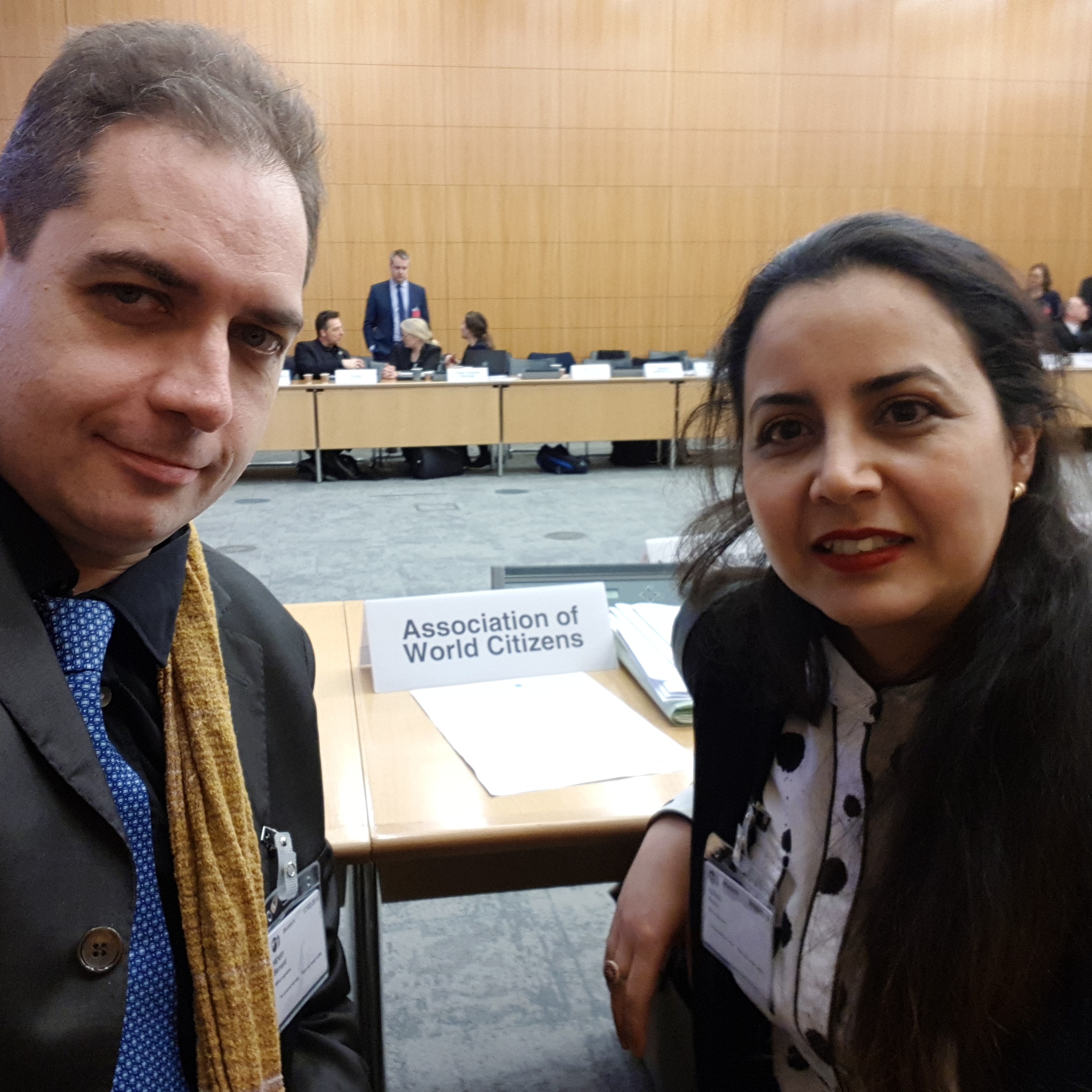
The First Officer and External Relations Officer, Bernard J. Henry, and the Legal and Mediation Officer, Attorney Noura Addad, representing the AWC at an OECD roundtable in March 2019 (C) Bernard J. Henry/AWC

We still need to find effective ways so that humanity can come together to solve global problems, that is, politics without borders. Prof. René Wadlow is President of the Association of World Citizens.
Protecting Cultural Heritage in Time of War

In Arts, Being a World Citizen, Conflict Resolution, Cultural Bridges, Current Events, Europe, Humanitarian Law, NGOs, Solidarity, The Search for Peace, Track II, UKRAINE, United Nations, War Crimes, World Law on May 18, 2023 at 7:56 AM

By René Wadlow

War and armed violence are highly destructive of the lives of persons, but also of works of art and elements of cultural heritage. The war in Ukraine has highlighted the destructive power of war in a dramatic way. Thus, this May 18, “International Museum Day”, we outline some of the ways in which UNESCO is working to protect the cultural heritage in Ukraine in time of war.

May 18 has been designated by UNESCO as the International Day of Museums to highlight the role that museums play in preserving beauty, culture, and history. Museums come in all sizes and are often related to institutions of learning and libraries. Increasingly, churches and centers of worship have taken on the character of museums as people visit them for their artistic value, even they do not share the faith of those who built them.

Knowledge and understanding of a people’s past can help current inhabitants to develop and sustain identity and to appreciate the value of their own culture and heritage. This knowledge and understanding enriches their lives. It enables them to manage contemporary problems more successfully.

It is widely believed in Ukraine that one of the chief aims of the Russian armed intervention is to eliminate all traces of a separate Ukrainian culture, to highlight a common Russian motherland. In order to do this, there is a deliberate destruction of cultural heritage and a looting of museums, churches, and libraries in areas when under Russian military control. Museums, libraries, and churches elsewhere in Ukraine have been targeted by Russian artillery attacks.

After the Second World War, UNESCO had developed international conventions on the protection of cultural and educational bodies in times of conflict. The most important of these is the 1954 Hague Convention for the Protection of Cultural Property in the Event of Armed Conflict. The Hague Convention has been signed by a large number of States including the USSR to which both the Russian Federation and Ukraine are bound.

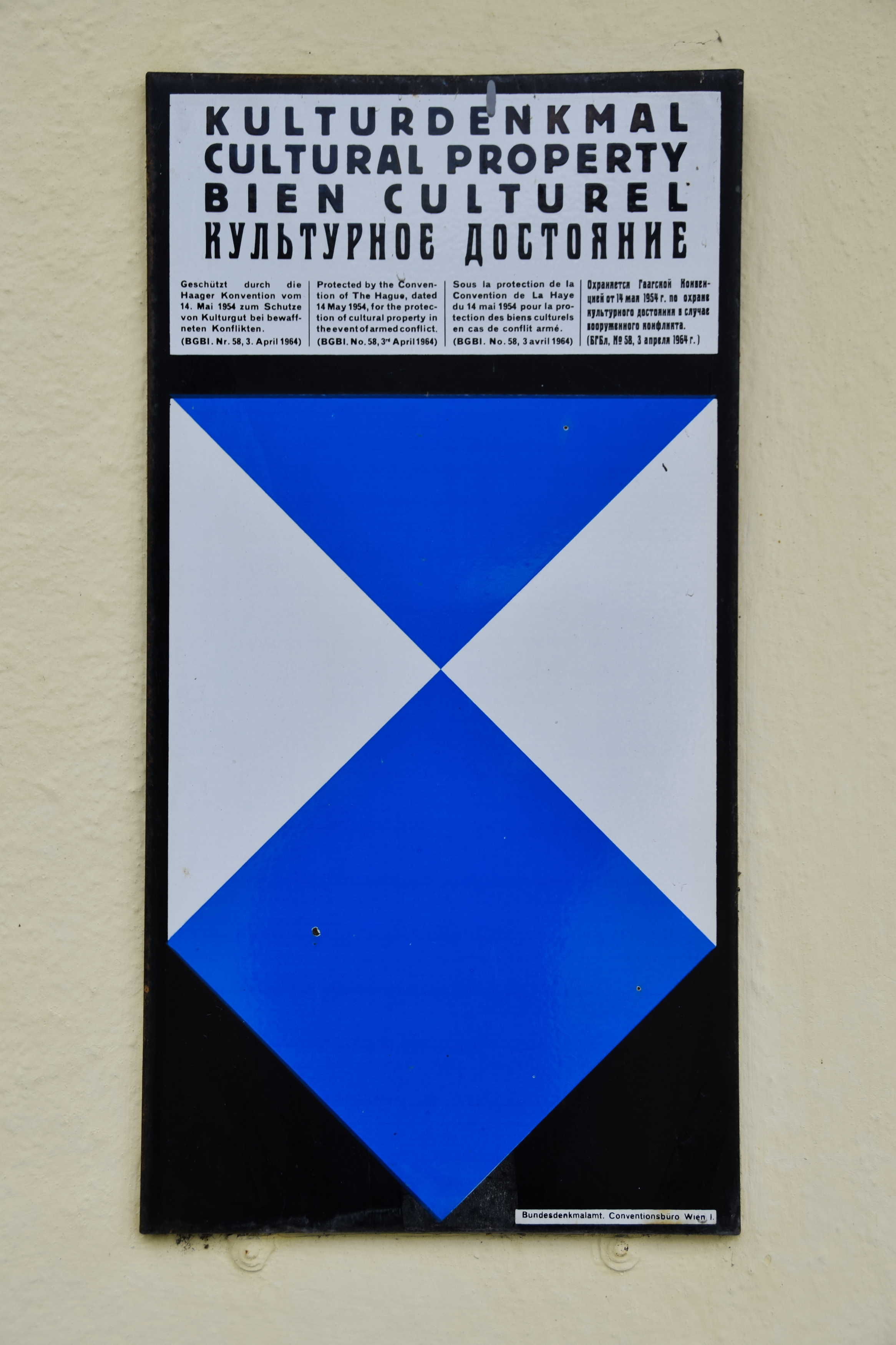
A Blue Shield in Vienna, Austria (C) Mosbatho, CC BY 4.0

UNESCO has designed a Blue Shield as a symbol of a protected site. Audrey Azoulay, Director-General of UNESCO, has brought a number of these Blue Shields herself to Ukraine to highlight UNESCO’s vital efforts.

The 1954 Hague Convention builds on the efforts of the Roerich Peace Pact signed on April 15, 1935 by 21 States in a Pan-American Union ceremony at the White House in Washington, D.C. In addition to the Latin American States of the Pan American Union, the following States also signed: Kingdom of Albania, Kingdom of Belgium, Republic of China, Republic of Czechoslovakia, Republic of Greece, Irish Free State, Empire of Japan, Republic of Lithuania, Kingdom of Persia, Republic of Poland, Republic of Portugal, Republic of Spain, Confederation of Switzerland, Kingdom of Yugoslavia.

At the signing, Henry A. Wallace, then U.S. Secretary of Agriculture and later Vice-President, said, “At no time has such an ideal been more needed. It is high time for the idealists who make the reality of tomorrow, to rally around such a symbol of international cultural unity. It is time that we appeal to that appreciation of beauty, science, education which runs across all national boundaries to strengthen all that we hold dear in our particular governments and customs. Its acceptance signifies the approach of a time when those who truly love their own nation will appreciate in addition the unique contributions of other nations and also do reverence to that common spiritual enterprise which draws together in one fellowship all artists, scientists, educators and truly religious of whatever faith. Thus we build a world civilization which places that which is fine in humanity above that which is low, sordid and mean, that which is hateful and grabbing.”

We still have efforts to make so that what is fine in humanity is above what is hateful and grabbing. However, the road signs set out the direction clearly.

Prof. René Wadlow is President of the Association of World Citizens.

When There Are No Governmental Negotiations: Build Stronger Track Two Networks

In Being a World Citizen, Conflict Resolution, Current Events, NGOs, Nonviolence, Solidarity, The Search for Peace, Track II, UKRAINE, United Nations, World Law on May 8, 2023 at 6:00 PM

By René Wadlow

The continuing armed conflict in Ukraine and the lack of any formal governmental negotiations forces us to ask if more can be done on the part of nongovernmental organizations (NGOs) to encourage negotiations in good faith. The same lack of formal governmental negotiations exists in the tension-filled relations between China and Taiwan.

On the Ukraine conflict, there have been efforts at mediation through the United Nations (UN) Secretary-General and leaders of individual States to encourage ceasefires and the start of negotiations, but without visible results for the moment.

These governmental efforts can be called Track One. Track One diplomacy is official government negotiations with backup resources of government research and intelligence agencies. There can also be Track One “back channels” of informal or unofficial contacts.

Track Two diplomacy is a non-official effort, usually by an NGO, academic institutions, sometimes business corporations. The use of non-official mediators is increasing as the recognition grows that there is a tragic disjuncture between the UN’s mandates to keep peace and its ability to intervene in internal conflicts within a State – often confrontations between armed groups and government forces and sometimes among different armed groups.

Track Two talks are discussions held by non-officials of conflicting parties in an attempt to clarify outstanding disputes and to explore the options for resolving them in settings that are less sensitive than those associated with formal negotiations. The participants usually include scholars, senior journalists, former government officials, and former military officers. They must be in close contact with national leaders and the secretariat of international organizations such as the UN who may be able to help in the peace process.

(C) SIWI/Shared Waters Partnership

As a study of Track Two efforts points out “Track Two talks can be defined by what they are not: neither academic conferences nor secret diplomacy conducted by government representatives… Track Two talks are convened specifically to foster informal interaction among participants regarding the political issues dividing their nations and to find ways of reducing the conflict between them… The purposes of Track Two talks vary, but they are all related to reducing tensions and facilitating the resolution of a conflict. At a minimum, Track Two talks are aimed at an exchange of views, perceptions, and information between the parties to improve each side’s understanding of the other’s positions and policies.” (1)

By informing contacts within government of the insights they have gained, participants may indirectly contribute to the formation of new national political priorities and policies. Much depends on the caliber and dedication of the participants and their relations with governmental leadership.

As Kenneth Boulding, the Quaker economist who often participated in Track Two efforts, wrote,

“When Track One will not do,
We have to travel on Track Two.
But for results to be abiding,
The Tracks must meet upon some siding.” (2)

Notes

(1) Hussein Agha, Shai Feldman, Ahmad Khalidi, Zeev Schiff, Track II Diplomacy: Lessons from the Middle East (Cambridge, MA: The MIT Press, 2003, 225 pp.)

(2) Quoted in John W. McDonald with Noa Zanolli, The Shifting Grounds of Conflict and Peacebuilding: Stories and Lessons (Lanham, MD: Lexington Books, 2008, 341 pp.)

Prof. René Wadlow is President of the Association of World Citizens.
UN Security Council Focus on World Hunger

In Africa, Being a World Citizen, Conflict Resolution, Current Events, Human Rights, NGOs, Social Rights, Solidarity, Sustainable Development, The Search for Peace, Track II, UKRAINE, United Nations, World Law on May 8, 2023 at 12:00 PM

By René Wadlow

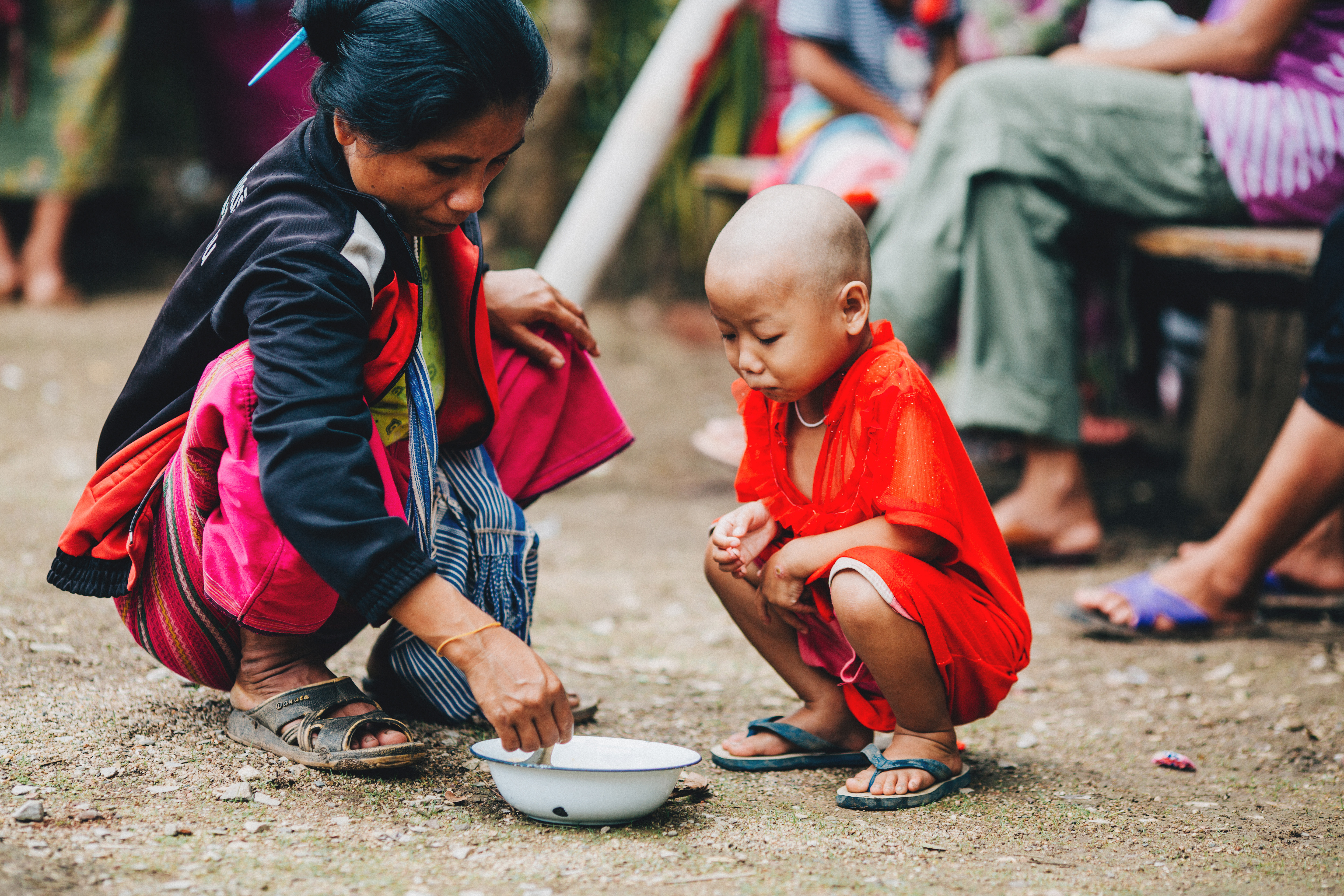
On May 23, the United Nations (UN) Security Council will hold a special briefing to address the issue of food insecurity under the chairmanship of Mr. Alain Berset, President of the Swiss Confederation. During May, the rotating chairmanship is held by Switzerland led by the Swiss Ambassador to the UN in New York, Ms. Pascale Baeriswyl. The meeting will have as background a May 3 report of the Food and Agriculture Organization (FAO) concerning early warning on areas facing acute food insecurity. The report highlights that some 250 million persons are living in this situation of acute food insecurity with the Democratic Republic of Congo leading the list with some 27 million persons due to armed violence and the breakdown of governmental structures. The Congo is followed by Ethiopia, largely due to fighting in the Tigray area. The war in Ukraine is also having a negative impact limiting production and export of food goods – a principal export of Ukraine. In addition to armed conflict, there is the growing impact of the consequences of climate change.

Today, cooperation on food insecurity is needed among the UN family of agencies, national governments, nongovernmental organizations, and the millions of food producers to respond to this food crisis. These measures will have to be taken in a holistic way with actions going from the local level of the individual farmer, the national level with new governmental policies, to measures at the multi-State regional level such as the European Union and the African Union, and at the world level with better coordinated action through the UN system.

(C) Feed My Starving Children

There is a need for swift, short-term measures to help people now suffering from lack of food and malnutrition due to high food prices, inadequate distribution, and situations of violence. Such short-term action requires additional funding for the UN World Food Program and the release of national food stocks. However, it is on the longer-range and structural issues on which we must focus our attention.

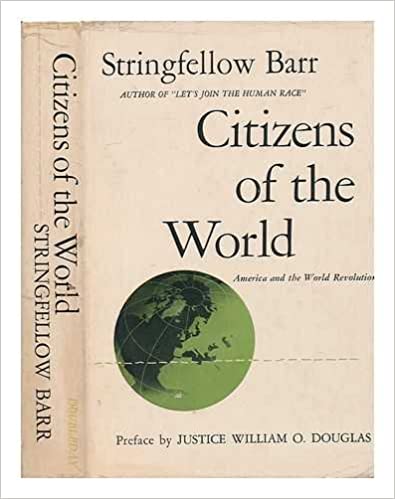
The Association of World Citizens has taken a lead in the promotion of a coordinated world food policy with an emphasis on the small-scale farmer and a new awareness that humans are part of Nature with a special duty to care and respect for the Earth’s inter-related life-support system. As Stringfellow Barr wrote in Citizens of the World (1952), “Since the hungry in the world community believe that we can all eat if we set our common house in order, they believe also that it is unjust that some die because it is too much trouble to arrange for them to live.”

A central theme which Citizens of the World have long stressed is that there needs to be a world food policy and that such a world food policy is more than the sum of national food security programs. John Boyd Orr, the first Director General of the FAO, proposed a World Food Board to stabilize food prices and supplies. He resigned as Director General when the food board proposal was not accepted and then devoted much of his energy to the world citizen movement.

For World Citizens, the emphasis must be placed on creating a world food policy which draws upon improving local self-reliance while not creating nationalistic policies which harm neighbors. Food is a key aspect of deep structural issues in the world society and thus must be seen in a holistic framework. The briefing and debate of the UN Security Council may give us strong elements on which to promote a world food policy.

Prof. René Wadlow is President of the Association of World Citizens.
Caresse Crosby: A World Citizen’s Passionate Years

In Being a World Citizen, Cultural Bridges, Europe, Literature, Poetry, The Search for Peace, United States on April 22, 2023 at 8:22 AM

By René Wadlow

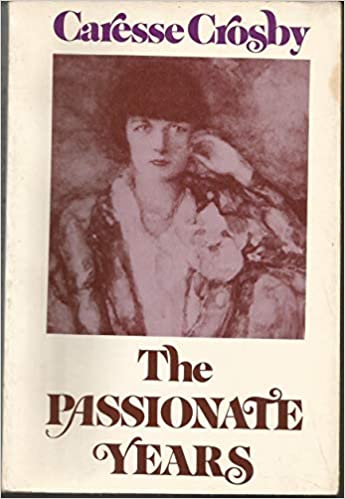
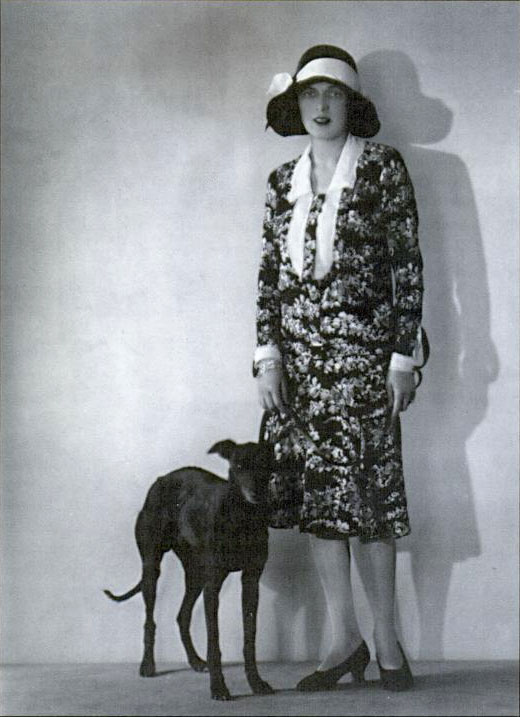
Caresse Crosby (April 20, 1891 – January 24, 1970) was one of the more colorful figures of the early world citizens movement, heading the World Citizen Information Center in Washington, D. C. Her autobiography The Passionate Years was first published in 1953 and more recently republished by the Southern Illinois University Press in 1968. The Southern Illinois University Library holds her papers.

Most of The Passionate Years concerns Caresse Crosby’s life in Paris as the publisher of the Black Sun Press, at the center of the United States (U. S.) writers living in Paris in the 1920s – what has been called the Lost Generation – Ernest Hemingway, Ezra Pound, F. Scott Fitzgerald, Archibald MacLeish. She had moved to Paris in 1922 from Boston with her then husband, Harry Crosby. Harry Crosby was a nephew of J. P. Morgan, the banker. Harry had a short-term job at the Paris branch of the Morgan Bank, but he was not interested in banking and had a reasonable income from a trust fund. Thus, he started a small publishing house to publish in fine but limited editions books of his own poems and those of his friends. Harry Crosby was always preoccupied with the idea of death, having seen it closely as a medical worker in France during the last part of the First World War. Hence the name of Black Sun, a symbol of death overcoming the light of the Sun for the publishing house. On a trip back to New York in 1929 in what may have been a suicide pact, Harry Crosby first shot a woman friend and then himself with her in his arms. (1)

Caresse stayed on in Paris to continue the Black Sun publishing house, opening it also to French writers she liked such as Antoine de Saint-Exupéry. In 1936, seeing the clouds of tensions growing in Europe, she moved back to the USA, living in New York City and Washington, D. C. It was at this time that she began promoting the idea of world citizenship to counter the narrow nationalism she had seen firsthand in visits to Italy and Germany.

Right at the end of the Second World War, she wanted to create a Center for World Peace at Delphi, Greece – a place of inspiration from the Greek gods. However, the Greek Government still weak from the German occupation and the anti-Communist civil war did not want such a center with an ideology that it did not understand. The Greek Government refused the visas. Caresse then moved the idea to Cyprus and created the World Man Center with a geodesic dome designed by Buckminster Fuller, who had become her lover at the time. Cyprus, then under British control, was somewhat out of the way for the sort of visiting writers, painters, and intellectuals that Caresse usually attracted. Thus, she bought a castle north of Rome, the Castello di Rocca Sinibalda, and established an artists’ colony for young artists. She divided her time between this Rome area and her New York and Washington quarters.

For Caresse Crosby, World Citizenship was an aesthetic rather than a political concept, but she did plant seeds in the minds of people largely untouched by geopolitical considerations.

Caresse Crosby and her whippet, Clytoris (1922, author unknown)

1) See Geoffrey Wolff, Black Sun: The Brief Transit and Violent Eclipse of Harry Crosby (New York: New York Review of Books, 2003).

Prof. René Wadlow is President of the Association of World Citizens.

Benjamin Ferencz, Champion of World Law, Leaves a Strong Heritage on Which to Build

In Africa, Being a World Citizen, Conflict Resolution, Current Events, Europe, Human Rights, International Justice, NGOs, The Balkan Wars, The Search for Peace, Track II, United Nations, United States, War Crimes, World Law on April 18, 2023 at 7:11 AM

By René Wadlow

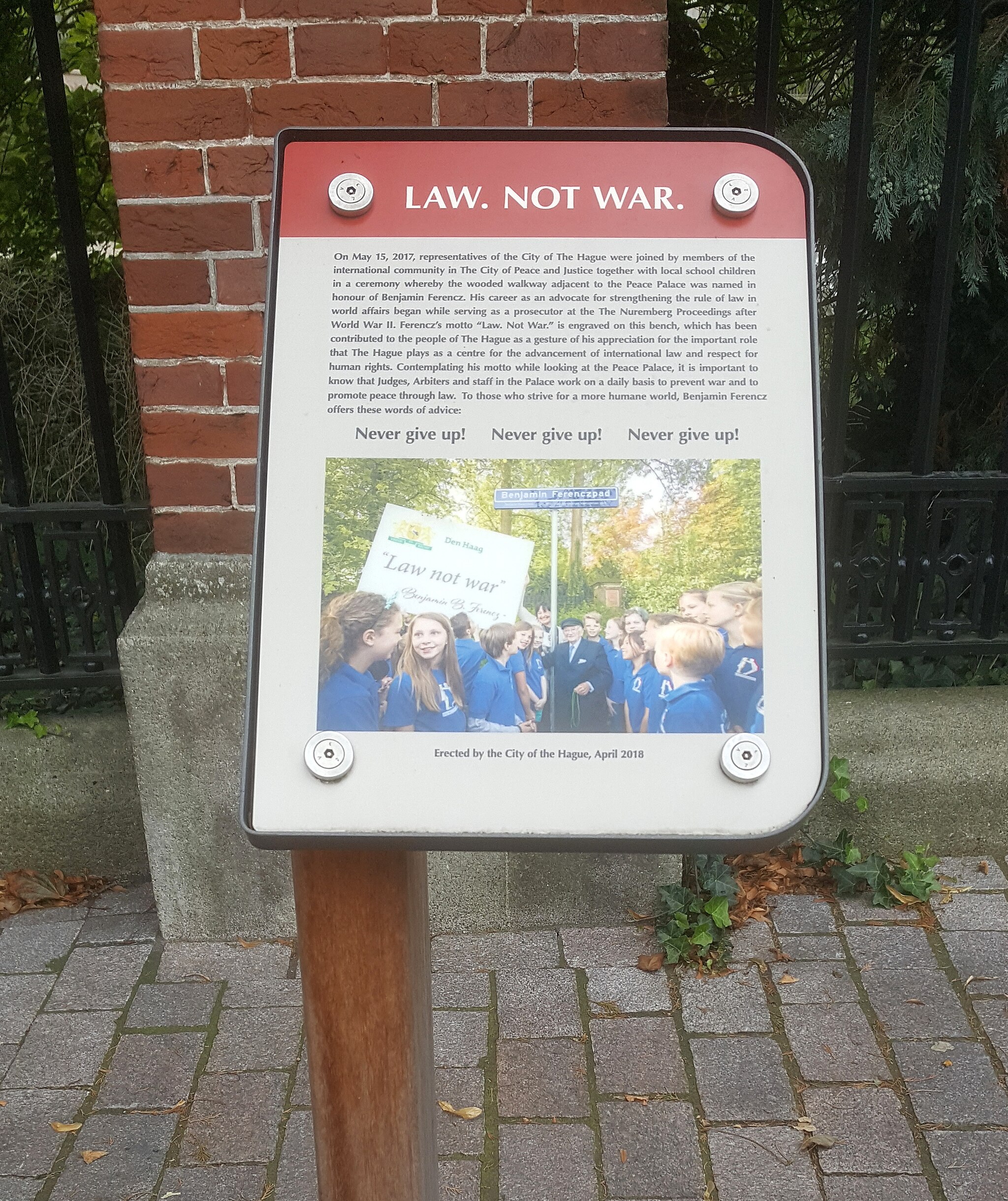
Benjamin Ferencz, champion of World Law and World Citizenship, died on April 7, 2023 at the age of 103, leaving a strong heritage of action for world law. He was particularly active in the creation of the International Criminal Court (ICC) located in the Hague.

He was born in March 1920 in what is now Romania, close to the frontiers of Hungary and Ukraine. In the troubled period after the end of the First World War, the parents of Ferencz, who were Jews, decided to emigrate to New York with the help of the Hebrew Immigrant Aid Society. They settled in New York City, and Ferencz changed his Yiddish name Berrel to Benjamin and studied in the New York school system. He did his undergraduate work at City College and then received a scholarship to Harvard Law School, a leading United States (U. S.) law school.

(C) United States Holocaust Memorial Museum

At the end of his law studies at Harvard, he was taken into the U. S. Army and in 1944, he was in Europe with the Army legal section, the Judge-Advocate General Corps. By conviction and interest, he began to collect information on the Nazi concentration camps. He was able to find photos, letters, and other material that he later was able to use as one of the prosecution team in the Nuremberg trials of Germans accused of war crimes. He was also a staff member of the Joint Restitution Successor Organization concerned with the restoration or compensation of goods having belonged to Jewish families. Thus, he developed close cooperation with the then recently created state of Israel.

(C) Leit

From his experiences with the German trials and the many difficulties that the trials posed to be more than the justice of the victors and also the need not to antagonize the recently created Federal Republic of Germany, Ferencz became a strong advocate of an international legal system such as the Tribunals on ex-Yugoslavia of 1993 and on Rwanda (1994). Much of his effort was directed to the creation of the ICC, a creation that owes much to efforts of nongovernmental organizations, such as the Association of World Citizens. It was during this effort for the creation of the ICC that we came into contact.

Benjamin Ferencz leaves a heritage on which we can build. The development of world law is often slow and meets opposition. However, the need is great, and strong efforts at both national and international levels continue.

(C) Adam Jones

(1) See Benjamin B. Ferencz, A Common Sense Guide to World Peace (Dobbs Ferry, NY: Oceana Publications, 1985).

Prof. René Wadlow is President of the Association of World Citizens.

Yemen: Positive Action Still Needed

In Being a World Citizen, Conflict Resolution, Current Events, Humanitarian Law, Middle East & North Africa, NGOs, Spirituality, The Search for Peace, Track II, United Nations, War Crimes, Women's Rights, World Law, Yemen on April 16, 2023 at 9:07 AM

By René Wadlow

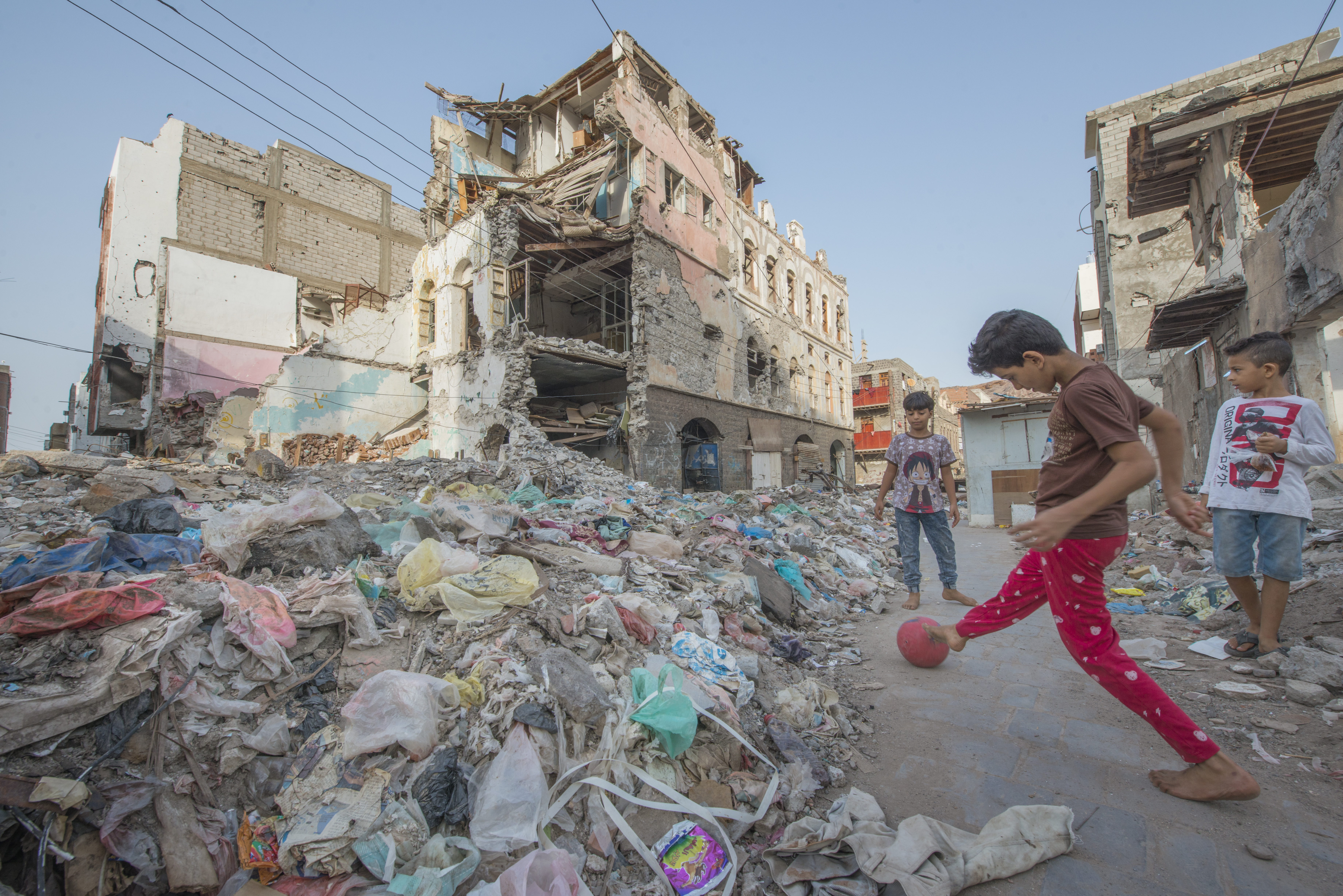
March 25 is the anniversary date of the start of 28 days on continued bombing of Yemen in 2015 by the Saudi-Arabia-led coalition (Bahrain, Egypt, Jordan, Kuwait, Morocco, Qatar, Sudan, United Arab Emirates helped by arms and “intelligence” from the USA and the UK). The aggression by the Saudi coalition turned what had been an internal struggle for power going on from the “Arab Spring” of 2011 into a war with regional dimensions which brought Iran into the picture. The role of Iran has been exaggerated both by the Iranian government itself and by those hostile to Iran. Nevertheless, the Iranian role is real.

Yemeni children play in the rubble of buildings destroyed in an air raid. (C) Peter Biro/European Union

Since the Association of World Citizens (AWC) had been following possible constitutional developments in Yemen after the 2011 change of government, a couple of days after the March 25, 2015 bombing, the AWC sent to governmental missions to the United Nations (UN) an AWC Appeal for four steps of conflict resolution and negotiations in good faith:

1) An immediate ceasefire ending all foreign military attacks;
2) Humanitarian assistance, especially important for hard-to-reach zones;
3) A broad national dialogue;
4) Through this dialogue, the establishment of an inclusive unity government open to constitutional changes to facilitate better the wide geographic- tribal structure of the State.

While the constitutional form of the State structures depends on the will of the people of Yemen (provided they can express themselves freely), the AWC proposes consideration of con-federal forms of government which maintain cooperation within a decentralized framework. In 2014, a committee appointed by the then President, Abdu Rabbu Mansur Hadi, had proposed a six-region federation as the political structure for Yemen.

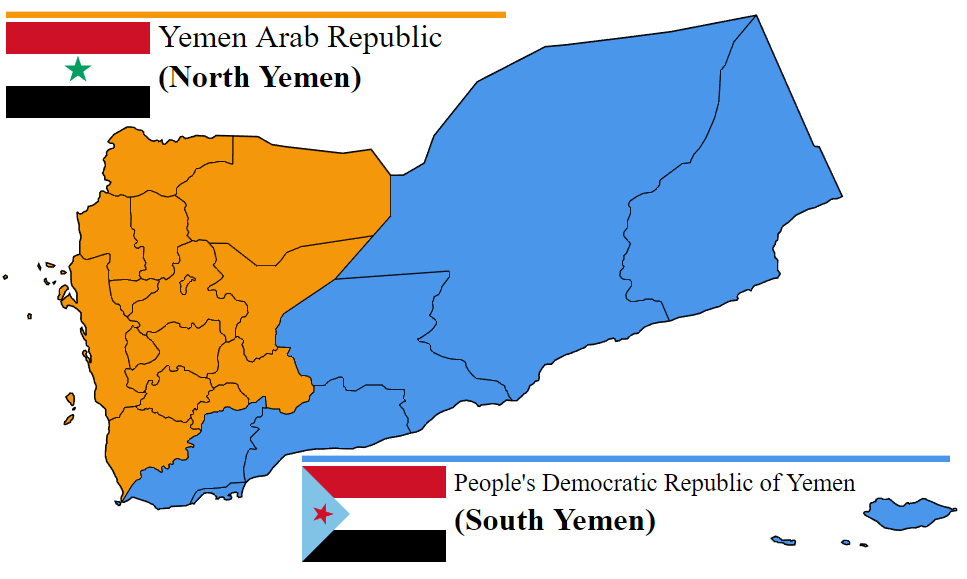
Until 1990, Yemen was two separate States: The People’s Democratic of Yemen in the south with Aden as the capital, and the Yemen Arab Republic in the north with Sana’a as its capital. In 1990, the two united to become the Republic of Yemen. The people in the south hoped that the union would bring the economic development which had been promised. Since, even before the Saudi-led war began, there had been very little economic and social development in the south, there started to grow strong “separatist” attitudes in the south. People of all political persuasions hoped to develop prosperity by ending unification and creating what some have started calling “South Arabia” Today, these separatist attitudes are very strong, but there is no agreement on what areas are to be included in a new southern state, and the is no unified separatist political leadership.

Very quickly after March 25, 2015, many governments saw the dangers of the conflict and the possible regional destabilization. Thus, there were UN-sponsored negotiations held in Geneva in June 2015. The AWC worked with other nongovernmental organizations (NGO) so that women should be directly involved in such negotiations. However, women have not been added to any of the negotiations and are largely absent from any leadership role in the many political factions of the country. There have been UN mediators active in trying to get ceasefires and then negotiations. There have been some temporary ceasefires, but no progress on real negotiations.

Today, the war continues with the country’s fragmentation, continued internal fighting and impoverishment leading to a disastrous humanitarian crisis. There is a glimmer of possible conflict resolution efforts due to the recent mutual recognition of Saudi Arabia and Iran under the sponsorship of the People’s Republic of China. However, creating a national society of individuals willing to cooperate will not be easy. Regional divisions will not be easy to bridge. There have already been divisions within the Saudi-led Coalition. Thus, positive action is still needed. NGOs should seek to have their voices heard.

Prof. René Wadlow is President of the Association of World Citizens.