The Official Blog of the

Archive for the ‘Africa’ Category

Renewed Appeal for Mediation in Sudan Civil War

In Africa, Being a World Citizen, Conflict Resolution, Current Events, Human Rights, Humanitarian Law, International Justice, NGOs, Peacebuilding, Solidarity, Sudan, The Search for Peace, Track II, United Nations, War Crimes, World Law on November 3, 2025 at 7:45 AM

By René Wadlow

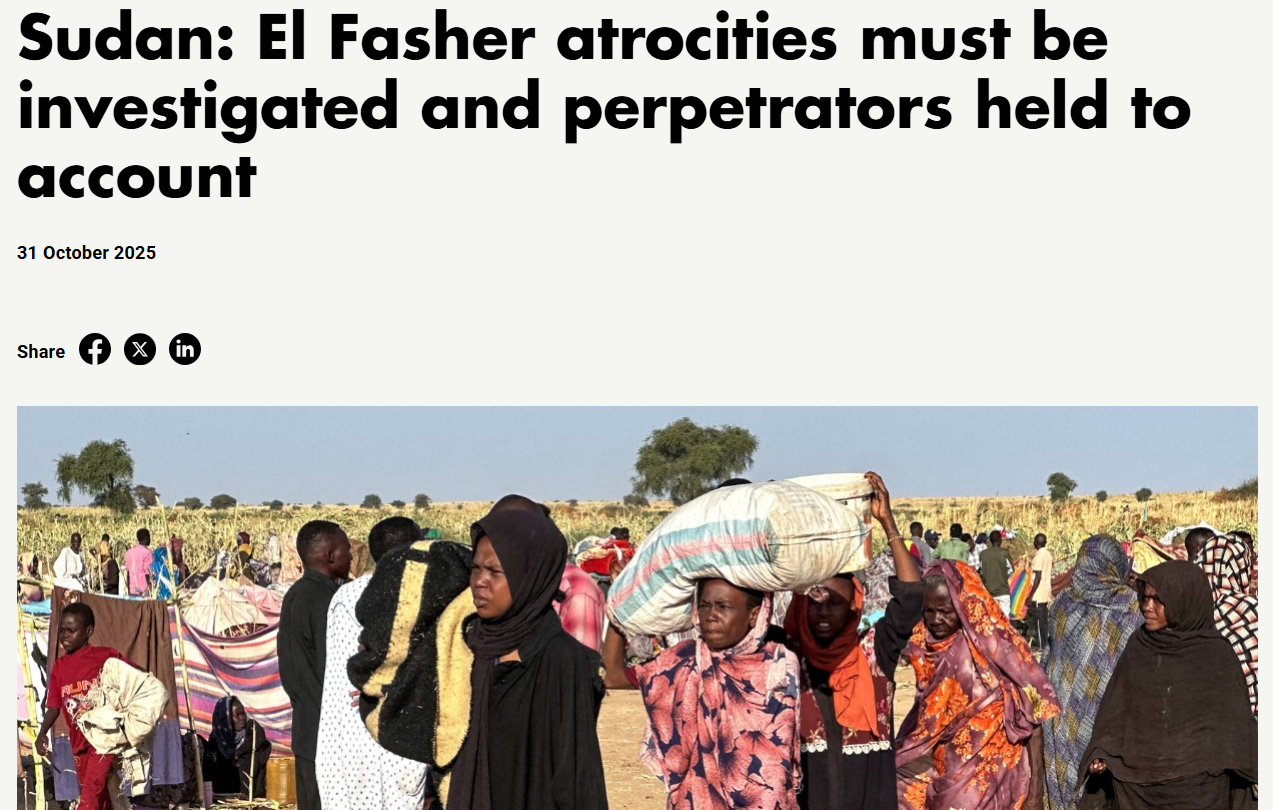
In response to the reports of mass killings earlier this month, including persons in hospital beds in El-Fasher, Sudan, by members of the Rapid Support Forces (RSF), the Association of World Citizens (AWC) has called for strong UN efforts to mediate an end to the civil war in Sudan.

A civil war has gone on since April 2023 in Sudan between the Rapid Support Forces led by General Mohamed Hamdan, known by his battle name of Hemedti, and the Sudanese Armed Forces then led by General Abdul Fattah al-Burham. Each of the two generals has created local militias which rob, torture, rape, and create conditions of disorder.  Many of these militias use child soldiers in violation of UN treaties on the protection of children.  The civil war has led to some 150,000 persons killed and 10 million displaced.

The capture of El-Fasher came after more than 500 days of siege. Already on June 13, 2024, the UN Security Council called for an end to the siege of El-Fasher, capital of the North Darfur Province of Sudan. The Council requested all parties to enable lifesaving aid to enter El-Fasher, the center of the most vicious fighting in the province. Unfortunately, the Security Council appeal fell on deaf ears.

The AWC does not underestimate the difficulties of mediation to end the Sudan Civil War.  There has been armed conflict in Sudan since the eve of independence in the mid-1950s. These conflicts were organized along ethnic and religious lines. The conflicts led to the creation of a new state, South Sudan, where tensions are also strong.

Mediation efforts should be carried out under UN responsibility. However, Nongovernmental Organizations (NGOs) may play a positive role.

Mediation is about men and women, and the attitudes that make for conflict between them. The attempt to bring about a change in understanding will include continual interpretation of what the others are saying, explanations of their attitudes, and exposure of false rumors – roles which NGOs can play.

Prof. René Wadlow is President of the Association of World Citizens.
Albert Schweitzer: Respect for Life Against Nuclear Death

In Africa, Being a World Citizen, Conflict Resolution, Human Rights, Nonviolence, Nuclear weapons, Peacebuilding, The Search for Peace, World Law on September 8, 2025 at 7:00 PM

By René Wadlow

Civilization is made up of four ideals: the ideal of the individual; the ideal of social and political organization; the ideal of spiritual and religious organization; the ideal of humanity as a whole. On the basis of these four ideals, thought tries conclusions with progress.

Albert Schweitzer, The Philosophy of Civilization

Albert Schweitzer was concerned with the ways that these four ideals of civilization are developed into a harmonious whole. Late in his life, when I knew him in the early 1960s, he was most concerned with the ideal of humanity as a whole.

He had come out strongly against nuclear weapons, weapons which were the opposite of respect for life which was the foundation of his ethical values. (1) “Man can hardly recognize the devils of his creation. Let me give you a definition of ethics. It is good to maintain and further life. It is bad to damage and destroy life. By having reverence for life, we enter into a spiritual relation with the world. By practicing respect for life, we become of the human family and our good, deep and alive.”

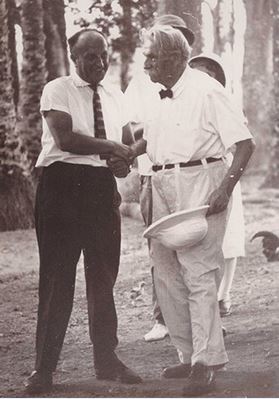
For Schweitzer, our sense of unity of the human family and our obligation to future generations was threatened as never before in the two World Wars that he had seen. I had been active since the mid-1950s in efforts to ban testing of nuclear weapons in the atmosphere – a focus of anti-nuclear efforts at the time. I had also worked with the world citizen Norman Cousins who had visited Lambaréné and had written a lively book on his exchanges with Schweitzer. (2) Thus I was well received by Schweitzer at his hospital in Lambaréné; and we had useful discussions. I was working for the Ministry of Education at the time and was at the Protestant Secondary School which was a mile down the Ogowe River from the hospital.

René Wadlow and Albert Schweitzer (C) René Wadlow (personal archives)

It was Norman Cousins, active in disarmament efforts in the USA, who urged Schweitzer to speak out against nuclear weapons. Schweitzer had been awarded the Nobel Peace Prize for his humanitarian efforts in Africa. Thus, he came into ever greater contact with people working for peace. However, he was reluctant to make statements on issues on which he was not expert. As he said to Cousins, “All my life, I have carefully stayed away from making pronouncements on public matters. Groups would come to me for statements or I would be asked to sign joint letters or the press would ask me for my views on certain political questions. And always I would feel forced to say no.” However, he went on “The world needs a system of enforceable law to prevent aggression and deal with the threats to the peace, but the important thing to do is to make a start somewhere…I think maybe the place to take hold is with the matter of nuclear testing…If a ban on nuclear testing can be put into effect then perhaps the stage can be set for other and broader measures related to peace.

Schweitzer’s 1958 appeal Peace or Atomic War was an important contribution to the growing protests against nuclear testing and their fallout of radiation. On October 16, 1963, the Treaty Banning Nuclear Weapons Tests in the Atmosphere, in Outer Space and Under Water (more commonly called the Partial Test Ban) came into force.

Today, we still need those other and broader measures related to peace and for a constant affirmation of respect for life.

Prof. René Wadlow is President of the Association of World Citizens.
Notes

1) See Albert Schweitzer, Peace or Atomic War (New York: Henry Holt, 1958)

2) See Norman Cousins, Dr Schweitzer of Lambaréné (New York: Harper and Brothers, 1960)

South Sudan: Continued Disintegration

In Africa, Being a World Citizen, Conflict Resolution, Current Events, Humanitarian Law, NGOs, Solidarity, The Search for Peace, Track II, United Nations, World Law on June 5, 2025 at 11:00 AM

By René Wadlow

On May 23, 2025, the United Nations (UN) High Commissioner for Human Rights, Volker Türk, gave a stark warning about the rapidly deteriorating human rights situation in the state of South Sudan. He stated that, “The escalating hostilities in South Sudan portend a real risk of further exacerbating the already dire human rights and humanitarian situation.” It is estimated that some 125,000 persons have been displaced within the country between March and mid-April 2025. In addition, there are refugees present fleeing the armed conflict in the state of Sudan. South Sudan is filled with arms from the long years of civil war: 1956-1972 and 1982-2005 between the north – largely Muslim and Arabized and the south which followed traditional tribal religions with southern leaders largely Christian. In 2011, there was a referendum in which southern Sudan voted to become the independent state of South Sudan. The Association of World Citizens was among the Nongovernmental Organizations (NGOs) observing the independence referendum.

Since independence, political life has been structured by the tensions between the President, Salva Kiir, and the Vice-president, Rick Machar. There was an armed conflict between the two from December 2013 and August 2015 in which many persons were killed. There were multiple violations of international humanitarian law and human rights abuses. In addition to the forces under the control of the two political leaders, there are a host of armed militias usually based on ethnic-clanic structures.

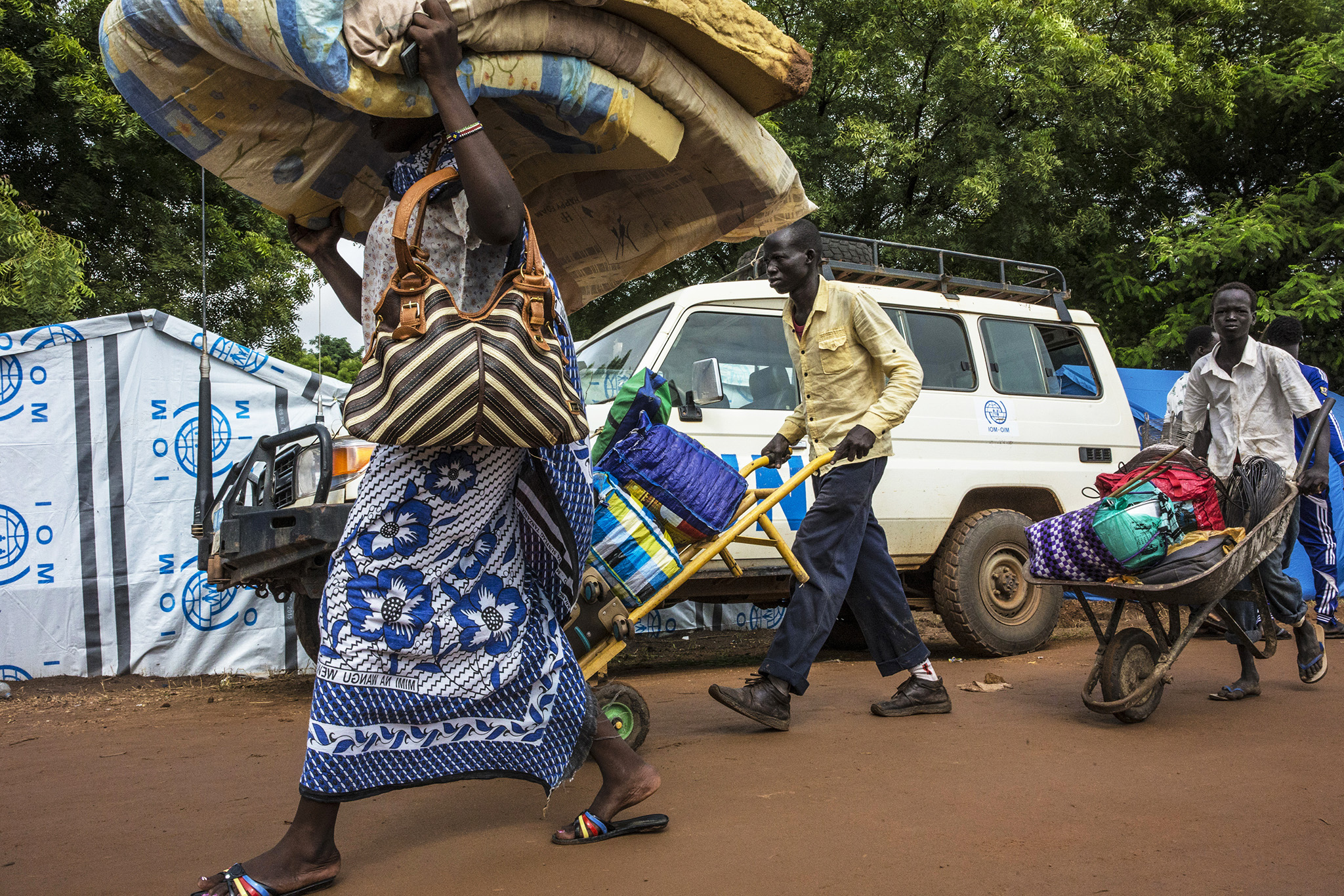
In July 2016, internally displaced persons in Juba, the capital of South Sudan, relocating to a cleaner, drier location across town, under the protection of the United Nations Mission in South Sudan (UNMISS).
(C) Isaac Billy/UN Photo

The UN and the African Union have made efforts to reach peace agreements among the parties, but the provisions of the peace agreements have not been put into practice. There is a lack of trust on all sides. It is difficult to see how progress can be made given the intensity of the resentments. There is no doubt a need for new leadership, but there are no signs of any leaders leaving the scene. Elections are not in the style of the country. South Sudan is a situation which merits observation and reconciliation efforts when possible.

Prof. René Wadlow is President of the Association of World Citizens.
NGOs in an Evolving World Society

In Africa, Being a World Citizen, Cultural Bridges, Human Development, Human Rights, NGOs, Social Rights, Solidarity, Sustainable Development, The Search for Peace, Track II, United Nations, World Law on March 25, 2025 at 8:00 AM

By René Wadlow

The United Nations (UN) Charter begins with the promising words “We the Peoples…”. However, thereafter the peoples’ voice fades and that of governments takes over. Yet today, Nongovernmental Organizations (NGOs) with consultative status with the UN play an effective role in shaping global policy. Many NGOs are transnational with members in different countries and cultures. This is one of their strengths and helps the UN to serve better all peoples.

For NGOs, there is a need to look outside the framework of the existing UN system to grasp the importance of new issues. This was the case in the late 1960s when some NGOs began to raise the issue of the environment and ecological protection before these issues were on the governmental agenda for action. Today, such an issue is the increasing amount of rural productive land that is falling under the control of urban elites, sometimes urban elites in other countries. Landownership inevitably deals with the distribution of power within a society. No development project, no matter how small or how technical, is without an impact on the distribution of power. A new well dug in a village is not simply an added social service. The new well calls into question the power of those who controlled access to water prior to digging the new well.

Although in many countries there are unions of agricultural workers, peasant leagues, agricultural cooperatives, and rural credit unions, it is nevertheless generally true that rural organizations have rarely achieved the degree of national power that has been reached by industrial workers’ unions.

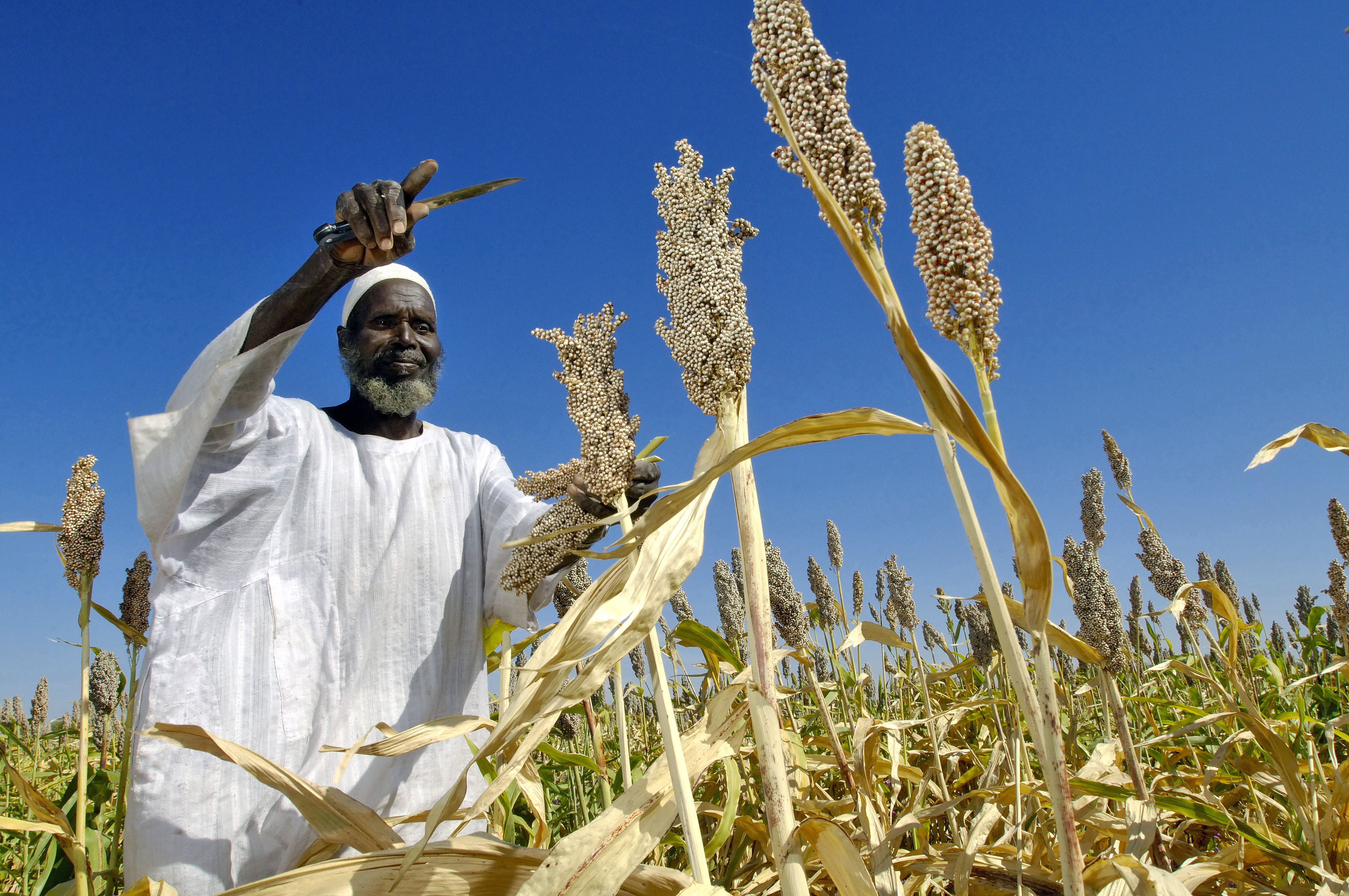
A Sudanese farmer harvesting sorghum plants from seeds donated by the Food and Agriculture Organization. (C) Fred Noy/UN Photo

One answer to why the rural poor stay poor is that they are rarely well organized. Especially the least powerful among the rural poor – the tenant farmers, the landless laborers, the untouchables, the members of tribal societies – are the least well organized, the most easily divided and blocked. The economic and political power structure in many countries does not encourage the active participation of small, marginal farmers and rural workers. If measures are not taken to facilitate the peaceful participation of the rural poor, it is likely that the rural poor will turn to armed violence.

It is true that nonviolent techniques have been used to organize the powerless in rural areas. One of the first actions of Mahatma Gandhi on his return to India from South Africa was to investigate and then mediate the struggle of the rural indigo pickers. Cesar Chavez was a leading advocate of nonviolence in his efforts to organize agricultural workers in the western United States. In Sri Lanka, the Sarvodaya movement has applied Buddhist values of compassion to construct a social and economic infrastructure based on a strong community spirit.

The role of the marginalized in rural areas is not a new problem but it is one that has not received the attention it deserves. NGOs can help to focus on the issue within the UN system and so advance reform measures.

Prof. René Wadlow is President of the Association of World Citizens.
Citizens of the World Strive Against Rape as a Weapon of War

In Africa, Being a World Citizen, Children's Rights, Current Events, Europe, Human Rights, Humanitarian Law, International Justice, NGOs, Peacebuilding, Solidarity, Sudan, The Balkan Wars, The Search for Peace, Track II, United Nations, War Crimes, Women's Rights, World Law on March 8, 2025 at 6:45 PM

By René Wadlow

On March 6, 2025, the United Nations (UN) Children’s Fund (UNICEF) warned that many children in the conflicts among militias in Sudan are at risk of rape and other forms of sexual violence which are being used as weapons of war. In November 2024, the Association of World Citizens (AWC) had highlighted that rape was being used as a weapon of war in the Sudan conflicts and that strong counter measures are needed.

As Meredeth Turshen and Clotilde Twagiramariya point out in their book What Women Do in Wartime: Gender and Conflict in Africa (London: Zed Press, 1998),

“There are numerous types of rape. Rape is committed to boast the soldiers’ morale, to feed soldiers’ hatred of the enemy, their sense of superiority, and to keep them fighting; rape is one kind of war booty; women are raped because war intensifies men’s sense of entitlement, superiority, avidity and social license to rape; rape is a weapon of war used to spread political terror; rape can destabilize a society and break its resistance; rape is a form of torture; gang rapes in public terrorize and silence women and force them to flee homes, families and communities; rape targets women because they keep the civilian population functioning and are essential to its social and physical continuity; rape is used in ethnic cleansing; it is designed to drive women from their homes or destroy the possibility of reproduction; genocidal rape treats women as reproductive vessels to make them bear babies of the rapists’ nationality, ethnicity, race or religion, and genocidal rape aggravates women’s terror and future stigma, producing a class of outcast mothers and children – this is rape committed with consciousness of how unacceptable a raped woman is to the patriarchal community and to herself. This list combines individual and group motives with obedience to military command; in doing so, it gives a political context to violence against women, and it is this political context that needs to be incorporated in the social response to rape.”

The AWC first raised the issue of rape as a weapon of war in the UN Commission on Human Rights in March 2001 after the judgement of the International Criminal Tribunal for the Former Yugoslavia (ICTY) maintained that there can be no time limitation on bringing an accused to trial. The Tribunal also reinforced the possibility of universal jurisdiction – that a person can be tried not only by his national court but by any court claiming universal jurisdiction and where the accused is present.

As Citizens of the World, we need to have a peace-building approach which asks: How does a political conflict degenerate into pervasive mass violence, generating new crises and new forms of violent conflict in the future? Even after a war ends, the effects of sexual violence continue in the form of unwanted pregnancies, sexually transmitted infections, discrimination and ostracizing of victims and often lasting psychological damage. Thus, we must ask how a community pulls itself out from the cycle of violence and creates new attitudes to promote human dignity and develop new institutions of conflict resolution.

Prof. René Wadlow is President of the Association of World Citizens.
Child Soldiers: From International Norms to Local Practice

In Africa, Being a World Citizen, Children's Rights, Conflict Resolution, Current Events, Human Rights, Humanitarian Law, International Justice, NGOs, Peacebuilding, Solidarity, The Search for Peace, Track II, United Nations, War Crimes, World Law on February 28, 2025 at 10:00 AM

By René Wadlow

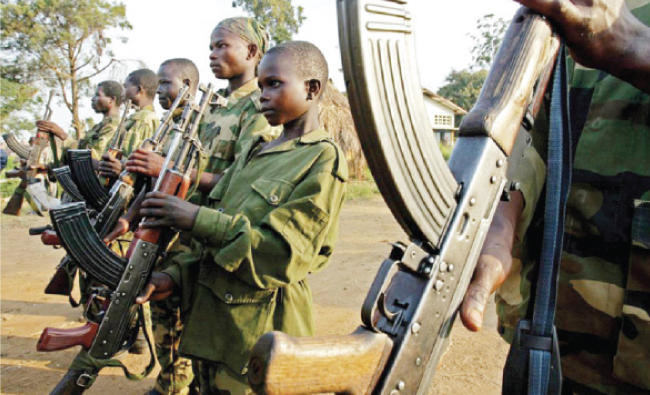
The conquest of the city of Goma, North-Kivu, a city of two million people in the Democratic Republic of Congo in November-December 2024, followed by the conquest by the same forces of Bukavu, the capital of South-Kivu in January-February 2025, a city of one million persons, has brought to attention the use of “child soldiers”, very young people mobilized to kill and destroy. The armed forces, the regular Army of the Democratic Republic of Congo, not having been paid in some time, faded away and left the fighting largely to militias organized along clanic or ethnic lines. There are real possibilities that the fighting will spread to Rwanda and Burundi, perhaps even Uganda.

The issue of child soldiers had gained attention in the ethnic-based fighting in Liberia. Young people had also been used in fighting in Colombia, South America. Child soldiers were often accused of sexual abuse, and there were difficulties in reintegrating the youth in their home villages when the fighting stopped.

Nongovernmental Organizations (NGOs) active in Geneva in the United Nations’ (UN’s) human rights bodies felt that action was needed on the issue of child soldiers and began to organize on the issue. In practice, what gives NGOs their influence is not what an individual NGO can do alone but what they can do collectively. “Networking” is a key method of progress. NGOs make networks which facilitate the trans-national movement of norms and information. Such networks tend to be temporary and highly personalized. However, at the UN, they are bound together in a common desire to protect the planet and advance the welfare of humanity.

In 1979 a Special Working Group on the Rights of the Child was created under the chairmanship of the Polish representative, the legal specialist Adam Lopatka. Government and NGO representatives worked together from 1979 to 1988 for one week each year in Geneva. There was a core group, including the Association of World Citizens (AWC), which worked steadily together. Representatives of the International Committee of the Red Cross and the International Labor Organization were brought into the sessions.

The Working Group managed to come to a consensus on a final version in time for the UN General Assembly to adopt the Convention on the Rights of the Child on November 20, 1989. By creating a common legal framework of world law, the Convention on the Rights of the Child has increased levels of government accountability, bringing about legislative and institutional reforms and increasing international cooperation. As James P. Grant, then UNICEF’s Executive Director, said at the time, “Transcending its detailed provisions, the Convention on the Rights of the Child embodies the fundamental principle that the lives and the normal development of children should have first call on society’s concerns and capacities and that children should be able to depend upon that commitment in good times and bad, in normal times and in times of emergency, in times of peace and in times of war, in times of prosperity and in times of recession.”

The Convention of the Rights of the Child has an important provision banning the recruitment and use in hostilities of persons under 15 years of age. The same provision has been placed in the Rome Statute creating the International Criminal Court. These international legal standards are tools which can be used. It is difficult to reach out to the armed militias active in Congo. However, we must try, as Citizens of the World, to make world law known and put into practice.

Prof. René Wadlow is President of the Association of World Citizens.
Strengthening Respect for International Humanitarian Law

In Africa, Being a World Citizen, Current Events, Human Rights, Humanitarian Law, International Justice, Middle East & North Africa, NGOs, Solidarity, The former Soviet Union, The Search for Peace, Track II, UKRAINE, War Crimes, World Law on February 10, 2025 at 8:00 AM

By René Wadlow

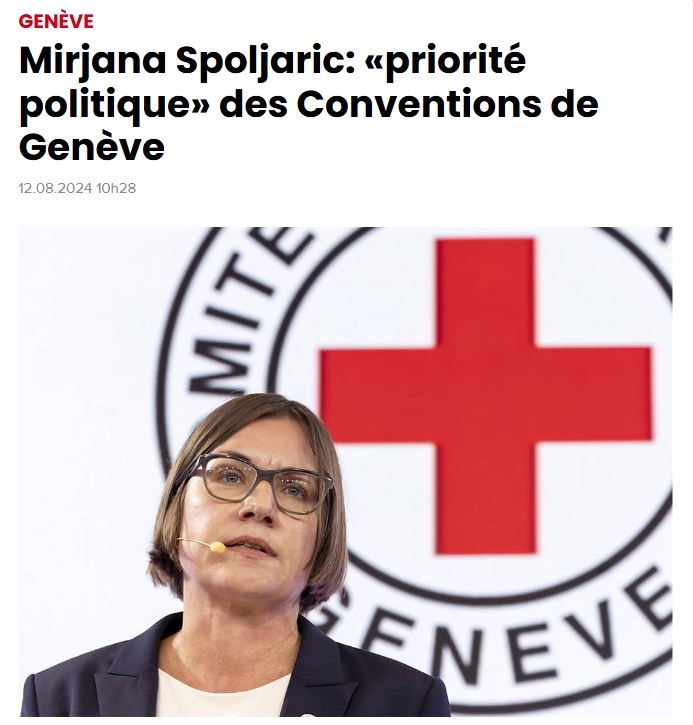
Mirjana Spoljaric, President of the International Committee of the Red Cross (ICRC), warned on February 6, 2025 that there is a serious erosion of respect for international humanitarian law. The ICRC is, through agreements signed with most governments, the chief agency for the respect of the Geneva Conventions, the heart of international humanitarian law.

The armed conflict in Ukraine now spreading to a part of Russia and the conflict between Israelis and Palestinians, especially in the Gaza Strip, have led to the destruction of medical and educational facilities. Civilians have been directly targeted, prisoners of war abused, and hostages taken – all violations of international humanitarian law.

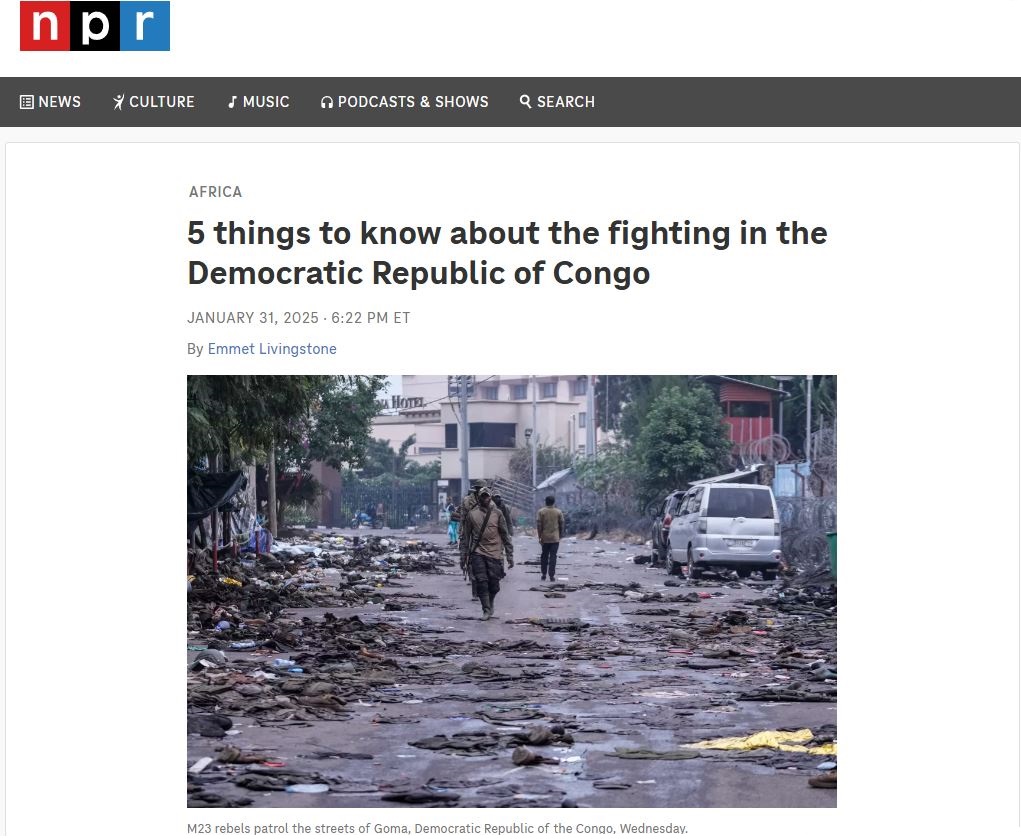
To this sad record of recent abuses must now be added the situation in Goma and the eastern area of the Democratic Republic of Congo. Humanitarian law should be respected by nongovernmental militias such as the M23 in Goma, but they have never signed an agreement to respect the Geneva Conventions. There have been discussions within the ICRC and other humanitarian aid agencies as to the role of nongovernmental militias with respect to international humanitarian law. These are vital discussions as the role of nongovernmental militias has become more frequent in armed conflicts.

The Association of World Citizens (AWC) played a key role in having a coalition of armed groups fighting in Burma to sign the Geneva Conventions. The signature was deposited with the Swiss Government which is the depository power for the Conventions. The signature was considered as only “symbolic” as not involving a government. However, the signature by the militias led to an exchange of prisoners showing that it was taken seriously by the Burmese government.

The AWC has strongly supported the strengthening of international humanitarian law. International humanitarian law is a central core of the broader body of world law. The strengthening of respect for humanitarian law develops a base for the application of international law and such institutions as the World Court.

As Mirjana Spoljaric, a Swiss diplomat before she became President of the ICRC, has stressed, the world society is at a crucial moment. There is a need to reaffirm respect for humanitarian law. Unfortunately, such reaffirmation is not a high priority for most Ministries of Foreign Affairs. Thus, as the AWC has urged, most recently through its appeals of March 2022, October 2023 and October 2024, there is a real possibility for NGOs to take the lead.

Prof. René Wadlow is President of the Association of World Citizens.
Congo: Dangerous Disintegration

In Africa, Being a World Citizen, Conflict Resolution, Current Events, Peacebuilding, Solidarity, The Search for Peace, United Nations, World Law on February 2, 2025 at 8:00 AM

By René Wadlow

On January 26, 2025, we published an article “Goma: Cry of the Imburi” on the possible attack on Goma, the capital of North Kivu Province of the Democratic Republic of Congo. The forces of the M23 (short for Movement of March 23) militia and some three to four thousand regular military of Rwanda were advancing toward Goma. Two days later, on January 28, Goma fell to M23. There were one million inhabitants in Goma and another million living in nearby camps as refugees. They had fled from violence in the neighboring area.

There are a multitude of armed militias, each with their own interests which they advance violently. One grouping of militias, known as the Wazalendo, a term for “patriots” in Swahili, is opposed to M23 but is not part of the regular Democratic Republic military. There has been a great amount of sexual and gender-based violence.

Demonstrators linked to President Félix Tshisekedi’s party in power have demonstrated in the capital Kinshasa, some 2,000 miles away, in front of the embassies of France, Belgium, the United Kingdom, and the U.S.A. for having done nothing to prevent Goma from being attacked. The European governments have replied, as did the French Foreign Minister Jean-Noel Barrot, that they deplore the violence and are in solidarity with the Democratic Republic of Congo.

The United Nations (UN) Security Council met in an emergency session and called for a ceasefire, but no follow-up measures were made public. The UN already has peacekeepers in the area (Monusco) with the aim of stabilizing the mineral-rich region. However, there is no peace to keep. The UN troops are called by the local population “the tourists”. They come only to watch what is going on. In reality, the UN forces are national military and police “lent” to the UN by member governments. The military and police come nearly all from developing countries trained in the British way: Pakistan, Nepal, Bangladesh, Nigeria and Ghana. They have no desire to be killed in armed conflicts which do not concern their country.

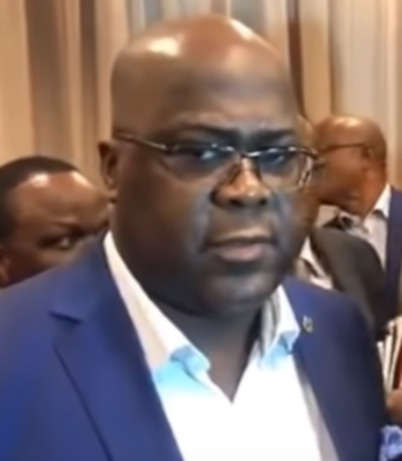
DRC President Félix Tshisekedi

There have been African-led efforts at mediation. In 2022, the African Union asked Angola’s President to mediate which led to a short-lived ceasefire in July 2024, but the ceasefire collapsed shortly after. At this stage, the dangerous disintegration of the Democratic Republic of Congo – democratic in name only – is likely to continue as there is not only armed violence but also a constitutional crisis as President Tshisekedi is trying to change the constitution so that he can stay longer in power. The restoration of legitimate authority and effective stabilization may still be in an unknown future.

Prof. René Wadlow is President of the Association of World Citizens.
Goma: Cry of the Imburi

In Africa, Being a World Citizen, Conflict Resolution, Current Events, Human Rights, Humanitarian Law, NGOs, Refugees, Solidarity, The Search for Peace, Track II, United Nations, World Law on January 26, 2025 at 8:00 AM

By René Wadlow

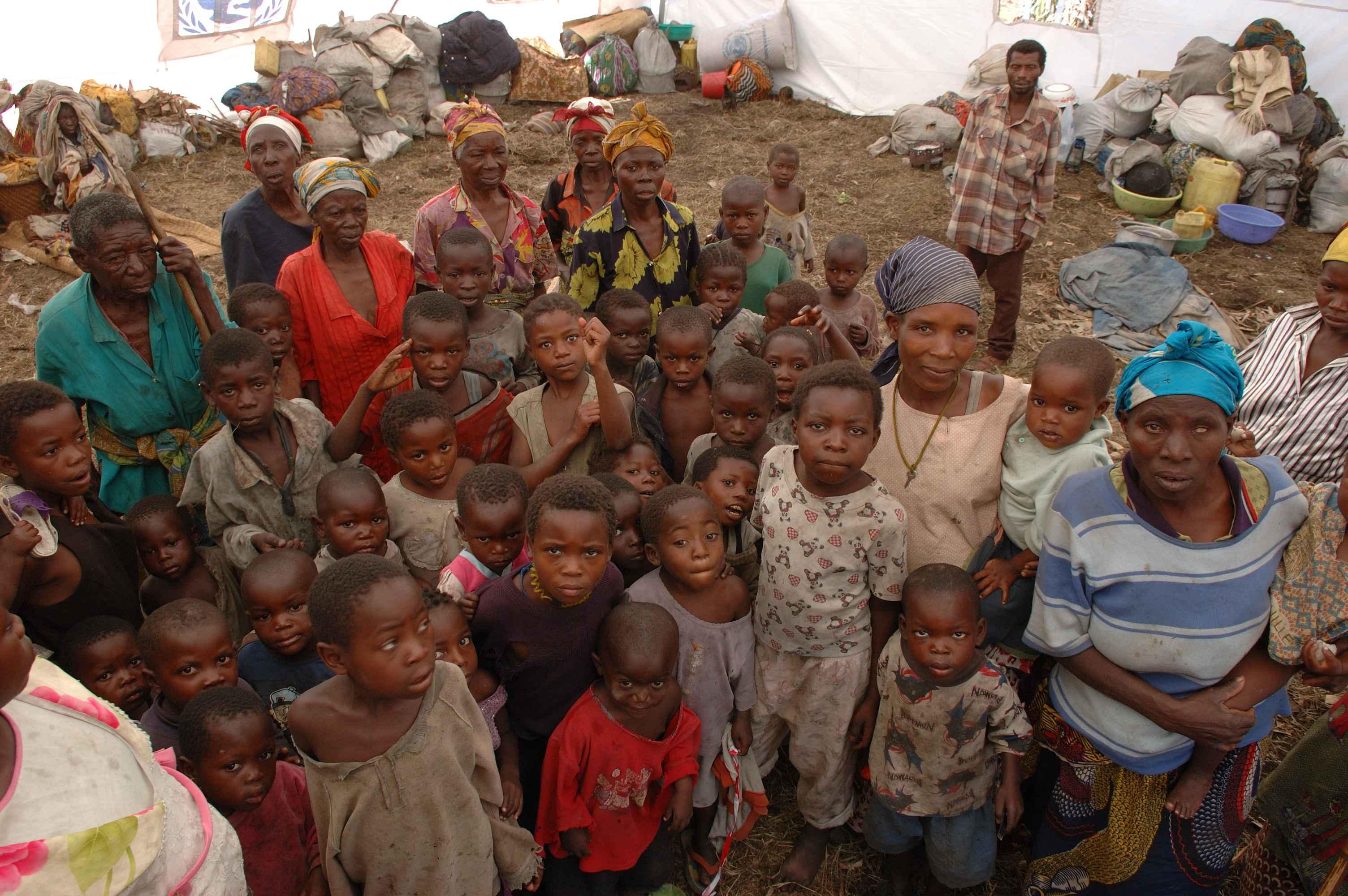
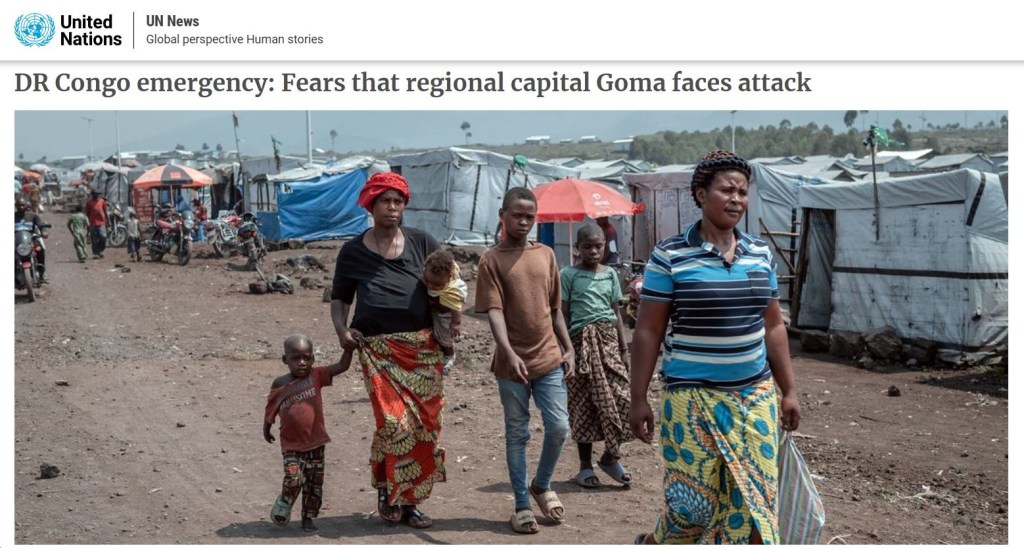
The Imburi are spirits that are said to inhabit the forests of Gabon, in Equatorial Africa, and who cry out for those who can hear them at times of impending violence and danger. The Imburi are now crying out loudly on the increasing dangers and forced migration in Goma, capital of the North Kivu province of the Democratic Republic of Congo – democratic in name only.

The July 31, 2024 ceasefire agreement – never fully effective – has now been broken. Troops of the Tutsi-led militia known as M23 along with regular military of Rwanda are advancing toward Goma, the capital of North Kivu. The Association of World Citizens has members in Goma who keep us informed of the critical situation there – getting worse each day.

(C) UN News

People in the neighboring province of South Kivu are frightened and have started to flee. There are a large number of displaced persons in both North and South Kivu, and some have fled across the frontier into Burundi. Many people are living in displaced persons camps in difficult situations despite the efforts of the United Nations (UN), the International Committee of the Red Cross, and humanitarian aid organizations.

This eastern area of the Congo has been the scene of fighting at least since 1998 – in part as a result of the genocide in neighboring Rwanda in 1994. In mid-1994, more than one million Rwandan Hutu refugees poured into the Kivus, fleeing the advance of the Tutsi-led Rwandan Patriotic Front, which now comprises the government of Rwanda. Many of these Hutu were still armed, among them the “génocidaires” who, a couple of months before, had participated in the killing of some 800,000 Tutsi and moderate Hutu in Rwanda.

Today, there is still large-scale occurrence of serious violations of human rights and international humanitarian law by all parties with massive displacement of populations, plundering of villages, systematic rape of women, summary executions and the use of child soldiers. There is a report from the UN Group of Experts on the Democratic Republic of Congo of December 27, 2024 which outlines clearly the disintegrating situation.

Thus, there is a need to create an enabling political environment which would help develop the rule of law and a vital civil society – a vast task that the Imburi are not sure will be carried quickly enough.

Prof. René Wadlow is President of the Association of World Citizens.
Rape as a Weapon of War in Sudan: Counter Measures Needed

In Africa, Being a World Citizen, Conflict Resolution, Current Events, Human Rights, Humanitarian Law, International Justice, Modern slavery, NGOs, Refugees, Solidarity, Sudan, The Search for Peace, Track II, United Nations, War Crimes, World Law on November 25, 2024 at 8:00 AM

By René Wadlow

Sudan’s armed conflict which began on April 15, 2023 is between two former allies. On one side is General Abdel Fattah Al Burham of the Sudanese Armed Forces; on the other side is General Mohamed Hamdan Dagulo, known by his battle name of Hemedhi of the Rapid Support Forces. The conflict, which has spread to 14 of the 18 provinces of Sudan, has killed and wounded tens of thousands of civilians, displaced nearly 8 million people, and forced over two million to flee to neighboring countries. The agriculture of the country is disorganized, and many people face acute hunger.

There has been an appalling range of human rights and international humanitarian law violations including indiscriminate airstrikes and shelling against civilians, hospitals, and vital water services. The warring parties and their respective militia allies have made rape a weapon of war and have organized markets where women are sold for sexual slavery.

Rape harms not only the woman raped but also the whole family system. Often, the husband repudiates his wife. The whole family may scorn her. In a country where “the family” is a wide circle of people, the repudiated woman has few people to whom to turn for support. As was done by the “Islamic State” (IS, or Da’esh) in Iraq and Syria, sexual slave markets have been created where women are bought or exchanged.

So far, efforts by the United Nations (UN) and regional governments for a ceasefire and negotiations have not led to constructive action. Thus, the conflictual situation requires close cooperation among UN agencies, humanitarian and peace Nongovernmental Organizations.

Prof. René Wadlow is President of the Association of World Citizens.