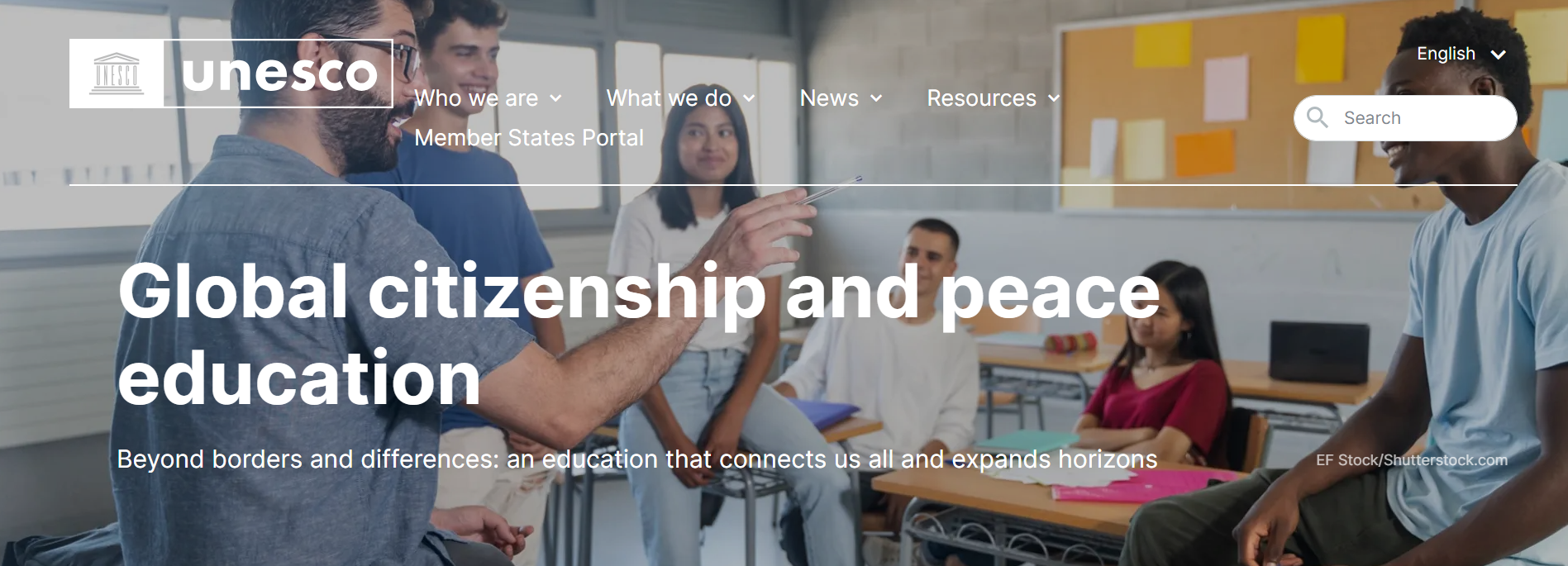
L’épanouissement de la culture constitue une réponse importante aux grands défis mondiaux tels que les conflits armés, la pauvreté persistante, l’intensification des migrations et les conséquences du changement climatique. Le programme d’éducation à la citoyenneté mondiale mené par l’UNESCO met l’accent sur l’objectif de développer un sentiment d’appartenance à une humanité commune, en partageant des valeurs et des responsabilités communes avec empathie et solidarité. Il est donc nécessaire d’agir efficacement aux niveaux local, national et mondial pour une société mondiale pacifique et harmonieuse.
L’éducation à la citoyenneté mondiale se veut transformatrice : elle vise à développer les connaissances, les compétences, les valeurs et les attitudes nécessaires pour contribuer à une société mondiale plus inclusive, plus juste et plus pacifique. Elle s’inscrit dans une perspective d’apprentissage tout au long de la vie, commençant dès l’enfance et se poursuivant à tous les niveaux d’enseignement, à travers des approches à la fois formelles et extrascolaires.
La culture joue un rôle essentiel dans la compréhension des valeurs communes, tout en développant l’appréciation et le respect des différences et de la diversité en matière de langue, de littérature, de musique et de religion. Compte tenu de la position dominante de la culture occidentale sur la scène mondiale, il est nécessaire de mieux comprendre les philosophies asiatiques que sont le confucianisme, le taoïsme, le bouddhisme, l’hindouisme et l’islam.
Nous constatons de plus en plus une prise de conscience croissante de l’harmonie et de l’unité de l’humanité. Néanmoins, il existe encore de forts courants de peur, de méfiance et de rejet de « l’autre » que nous devons surmonter. Nous sommes appelés à adopter une morale active et universelle, ainsi que l’idéal de liberté qui en est l’expression politique. L’avenir sera le fruit de nos choix à tous les niveaux d’action. Faisons des choix créatifs et profonds !
Le Professeur René Wadlow est Président de l’Association of World Citizens.
A flowering of culture is an important response to major world challenges such as armed conflicts, persistent poverty, increased migration, and the consequences of climate change. The UNESCO-led program of Education for Global Citizenship stresses the aim of developing a sense of belonging to a common humanity, sharing common values and responsibilities with empathy and solidarity. Thus, there is a need to act effectively at the local, national and global levels for a peaceful and harmonious world society.
Education for Global Citizenship aims to be transformative, building the knowledge, skills, values, and attitudes needed to contribute to a more inclusive, just, and peaceful world society. Education for Global Citizenship applies a lifelong learning perspective, beginning from childhood and continuing through all levels of education, with both formal and extracurricular approaches.
Culture plays a vital role in understanding shared values, and at the same time developing an appreciation of, and respect for, differences and diversity with respect to language, literature, music, and religion. Given the strong position of Western culture on the world scene, there is a need for a greater understanding of the Asian philosophies of Confucianism, Taoism, Buddhism, Hinduism, and Islam.
Increasingly, we see the growth of the awareness of harmony and the unity of humanity. Nevertheless, there are still strong currents of fear, mistrust, and rejection of “the other” which we must overcome. We are summoned to embrace an active, world-embracing morality and the ideal of freedom which is the political expression of that morality. The future will be the result of our choices at every level of activity. Let us make creative and profound choices!
Prof. René Wadlow is President of the Association of World Citizens.
As the armed conflict among the USA, Israel, and the Islamic Republic of Iran grows ever more complex and violent, Yemen is being increasingly drawn into the conflict.
The Houthis, allied with the Islamic Republic of Iran, can menace shipping through the Bab Al-Mandab at the entry of the Red Sea, with a result of a strong increase in in the price of oil and a renewal of hostility with Saudi Arabia. The Houthis control the capital city, Sanaa, while the former government controls much of south Yemen.
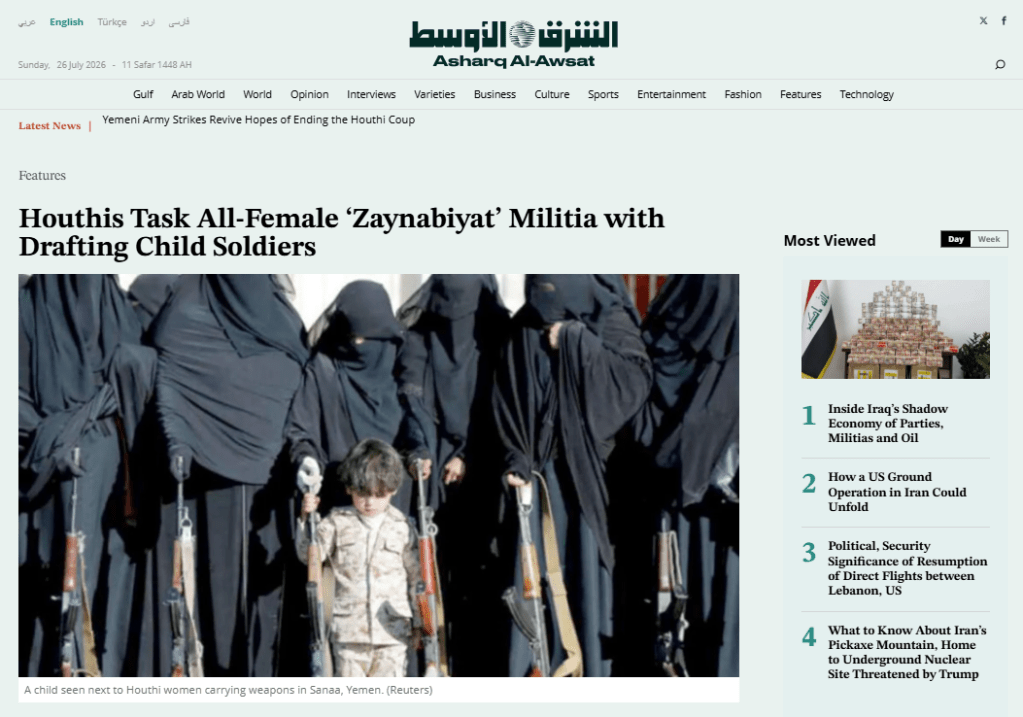
The Houthis have used child soldiers since the start of their quest for power in 2014, including an all-women brigade of young women, the Zainabiyat. The governmental forces have also used child soldiers.
As tensions increase, there are signs of a large recruitment of child soldiers by both the Houthis and governmental forces.
The Association of World Citizens which has Consultative Status with the United Nations played an active role in the drafting of the Convention on the Rights of the Child banning the use of child soldiers. Today, there must be a renewed effort to negotiate the broader armed conflict and to prevent the use of child soldiers.
Prof. René Wadlow is President of the Association of World Citizens.
LES CITOYENS DU MONDE APPELLENT A DES MESURES EFFECTIVES POUR METTRE FIN AUX ATTAQUES CONTRE LES CIVILS ET BATIR LA PAIX AU LIBAN
Il y a quarante ans, le groupe pop français Gold grimpait en haut des classements avec une ballade intitulée Ville de Lumière, chanson dont le personnage était un combattant de l’une des factions en guerre au Liban. Pleurant sa chère capitale, Beyrouth, dont il était éloigné, le soldat concluait : «Je sais, je ne te reverrai pas, Ville de Lumière, Qu’ont-ils fait de moi ?».
L’Association of World Citizens (AWC) est consternée de voir qu’une chanson d’il y a quarante ans, qui devrait être aujourd’hui un beau souvenir musical, pourrait avoir été écrite juste hier. Une fois de plus, le Liban est déchiré par la violence, avec les civils libanais pris pour cible par la Force de Défense israélienne (Tsahal) qui a envahi le pays, tandis que les civils israéliens sont attaqués par la milice oppressive du Hezbollah et, par-delà la frontière syrienne, là où la milice soutenue par l’Iran assistait autrefois la guerre barbare de la dynastie Assad contre son propre peuple, tant Tsahal que le Hezbollah frappent une nation qui commence à peine à guérir et se construire un autre avenir.
Aucun de ces trois pays n’a besoin ou envie de voir davantage de combattants périr les armes à la main, ou davantage de civils massacrés par des forces d’invasion. Aucun de ces trois pays n’a besoin ou envie de voir ses propres «villes de lumière» sombrer pour toujours dans l’obscurité. Même si les négociations entreprises par les Etats-Unis et l’Iran semblent offrir un rayon de lumière, rien ne peut être réellement résolu si le but est seulement, comme c’est le cas de manière quasi systématique au Moyen-Orient, d’atteindre un cessez-le-feu qui ne sera qu’une solution de bricolage sans autre issue.
Bien qu’il ne fasse aucun doute qu’il faut des négociations, il est essentiel que celles-ci traitent enfin les problèmes de fond au long terme qui alimentent l’hostilité et le conflit entre Israël et le Liban, avec la Syrie désormais également impliquée malgré elle en tant que tierce partie. Obtenir la fin des hostilités tout en mettant de côté les causes du conflit n’a mené dans le passé qu’à des massacres tels que celui de Sabra et Chatila en 1982, Qana en 1996, et une nouvelle fois Qana en 2006. Chaque jour qui passe expose les trois pays au risque d’une nouvelle tragédie de telle nature.
C’est pourquoi l’AWC appelle à des négociations urgentes, de bonne foi et exhaustives entre toutes les parties prenantes afin de mettre un terme aux violences en cours entre le Liban, Israël et la Syrie, ainsi que de traiter enfin les questions de fond entre Israël et le Liban auxquelles il a déjà été permis d’engendrer bien plus d’inhumanité qu’une terre de trois croyances peut tolérer. Il incombe à présent aux dirigeants de toutes les parties au conflit en cours de faire en sorte que, pour le quarantième anniversaire de la chanson, cette fois-ci, aucune «ville de lumière» ne se fasse éteindre.
Prof. René WADLOW Président
Bernard HENRY Officier des Relations Extérieures
Cherifa MAAOUI Officier de Liaison, Afrique du Nord & Moyen-Orient
WORLD CITIZENS CALL FOR EFFECTIVE MEASURES TO STOP ATTACKS ON CIVILIANS AND BUILD PEACE IN LEBANON
Forty years ago, the French pop band Gold topped the charts with a ballad called Ville de Lumière (City of Light), a song whose protagonist was a fighter from one of the warring factions in Lebanon. Crying from afar over his beloved capital, Beirut, the soldier concluded, “I know I will never see you again, City of Light, What have they made of me?”.
The Association of World Citizens (AWC) is appalled to see that a forty-year-old song which should be a beautiful musical memory by now might as well have been written yesterday. Once again, Lebanon is being torn apart by violence, with Lebanese civilians being targeted by the invading Israeli Defense Force (IDF) while Israeli citizens come under attack from the oppressive Hezbollah militia and, over the Syrian border where the Iran-backed militia used to assist the Assad dynasty’s barbaric war on their own people, both the IDF and Hezbollah are striking a nation and people barely starting to heal and build a new future.
None of these three countries needs to have more fighters killed in combat or civilians slaughtered by invading forces. None of the three countries needs to have its own “cities of light” turn dark forever. While the negotiations undertaken between the United States and Iran appear to offer a ray of hope, nothing can be truly resolved if the goal is only, as happens all but systematically in the Middle East, to reach a quick-fix, dead-end ceasefire.
Even though negotiations are undoubtedly needed, these need to finally address the long-term core issues fueling hostility and conflict between Israel and Lebanon, now also involving Syria as an unwilling third party. Having hostilities cease while leaving the causes for conflict unaddressed has only led in the past to such massacres as Sabra and Shatila in 1982, Qana in 1996, and Qana a second time in 2006. Every day that passes places all three countries at risk of a new tragedy of that nature.
Therefore, the AWC calls for urgent, honest, and comprehensive negotiations between all stakeholders with a view to ending the ongoing violence between Lebanon, Israel, and Syria, as well as to finally addressing the core issues between Israel and Lebanon which have already been allowed to create more inhumanity than a land of three faiths can possibly tolerate.
It is up to the leaders of all parties to the current conflict to ensure that, as the song turns forty, no “city of light” gets turned off this time.
Prof. René Wadlow President
Bernard J. Henry External Relations Officer
Cherifa Maaoui Liaison Officer, Middle East & North Africa
Il est des gens qui ont si longue vie que l’on se dit qu’ils restent pour éclairer la voie lorsque les ténèbres l’absorbent toujours un peu plus. Lorsqu’ils partent, celles et ceux qui se tournaient vers eux sont frappés non seulement de deuil, mais d’une soudaine solitude et, plus encore, de la peur d’un avenir qu’il faudra bâtir avec leurs mots, leur héritage, mais sans leur autorité morale.
Depuis le 29 mai dernier, médias et réseaux sociaux vibrent de tels sentiments mêlés pour Edgar Morin, célèbre sociologue et philosophe français qui s’est éteint à 104 ans.
La biographie d’Edgar Morin a été retracée de manière si vaste et exhaustive que nous n’aurions que vainement la prétention d’y rien ajouter d’utile. Ce qui est peut-être moins dit, c’est que, même si Edgar Morin n’avait jamais soutenu de manière ouverte et directe l’un des groupes composant le mouvement Citoyen du Monde, ni l’Association of World Citizens (AWC) ni un autre, il portait en lui ce que nous représentons et c’est dans toute son œuvre que se lisent et s’entendent nos combats et nos valeurs.
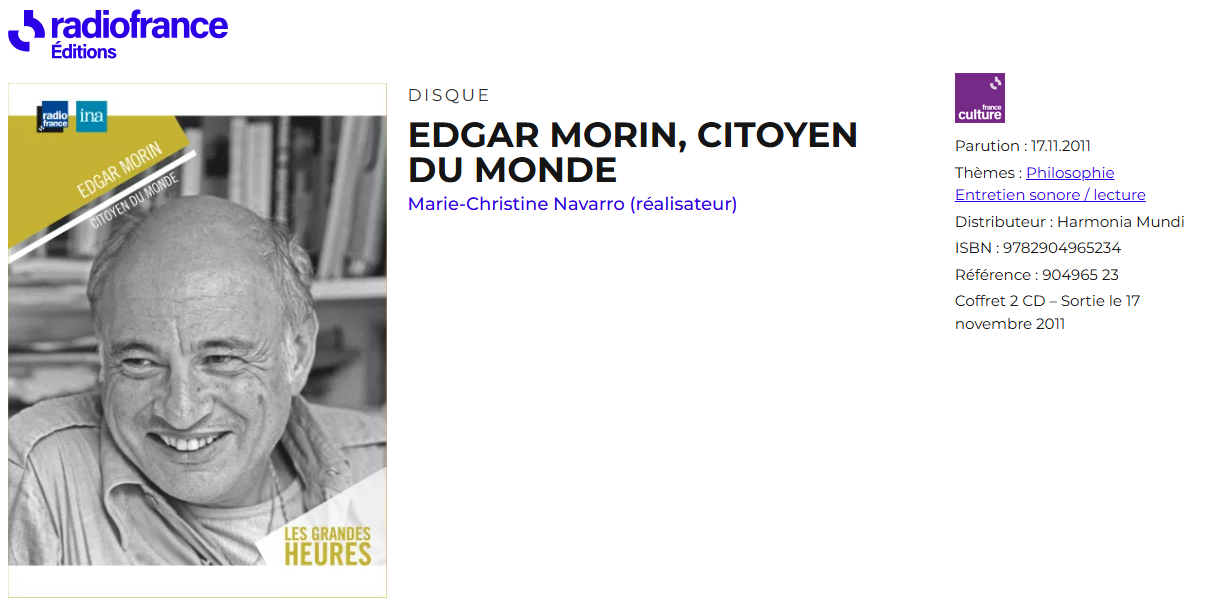
En 2011, Radio France avait même publié un disque reprenant ses entretiens avec Marie-Christine Navarro ayant pour titre Edgar Morin, citoyen du monde, et ce n’était en rien une exagération. Au-delà d’une œuvre prolifique, il n’est pas excessif de dire de lui que, comme l’avait écrit Gandhi à son propre sujet, sa vie même était son message. Certes, personne ne peut se résumer à sa naissance ou même son passé. Il est des gens, pourtant, qui semblent avoir en eux un talent unique d’en tirer le meilleur parti. Edgar Morin était de ces gens-là.
Edgar Morin est né trois fois. Sa première naissance a eu lieu le 8 juillet 1921 à Paris, sous le nom de David Salomon Nahoum, de parents juifs grecs de Salonique. La deuxième, en 1943, fut celle d’un Résistant, militant libertaire antifasciste pendant la guerre d’Espagne, membre du Parti Communiste Français (PCF) à partir de 1941, officier dans la Résistance en 1943, qui tenta de prendre le pseudonyme d’Edgar Magnin en hommage à L’Espoir d’André Malraux mais le vit mal retranscrit en Morin, sans tenter de rectifier. La troisième, ce fut lorsqu’un tribunal parisien lui accorda, le 12 août 1993, le droit de substituer le prénom Edgar à ses deux prénoms de naissance.
Après la Libération, Edgar Morin a suivi la voie académique – mais d’une manière qui était loin de l’être. Morin l’avouait lui-même, il était autodidacte, titulaire d’une licence en histoire-géographie et d’une licence de droit, ayant suivi des cours de philosophie, d’économie et de sciences politiques, mais sans avoir obtenu de diplôme. «J’ai pourtant fait une carrière au CNRS. J’ai été élu maître de recherche sans avoir écrit de thèse de doctorat», déclarait-il en 2009 au CNRS qu’il avait intégré en 1950.
Dans les années 1960, il enseigne au Chili puis, aux Etats-Unis, jette les bases de ce qui sera le concept-phare de sa vie, le concept épistémologique de pensée complexe, l’adjectif étant ici pris dans son sens étymologique latin, complexus, désignant un tissage d’enlacements, pour mettre en avant les liens entre chaque champ de la pensée et l’approche transdisciplinaire du savoir.
A la tête du Centre d’études des communications de masse (CECMAS) de 1973 à 1989, Morin deviendra l’initiateur de la revue Arguments, publiée de 1956 à 1962, la Revue française de sociologie en 1960, et enfin Communications.
Entre 1977 et 2004, il rédige son ouvrage majeur, La Méthode, somme en six volumes où il développe sa méthodologie de la transdisciplinarité. Il y décrit sa pensée comme constructiviste, mais non au sens traditionnel du terme en relations internationales : pour lui, il s’agit d’une collaboration entre le monde extérieur et l’esprit humain pour construire la réalité.
Dans cette approche académique nouvelle se décèle déjà un esprit Citoyen du Monde, la transdisciplinarité, concept parfois remplacé par celui d’interdisciplinarité, étant aussi au cœur de l’Institut d’Etudes mondialistes créé en 1977. Cet esprit qui est le nôtre, Morin en tirerait un essai, en 1993, puis un livre à quatre mains en 2011.
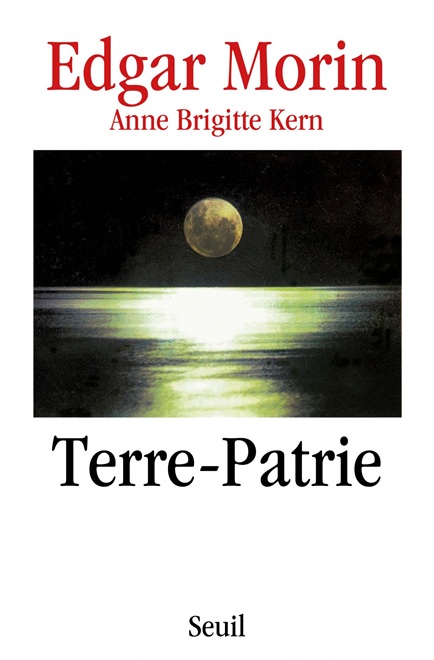
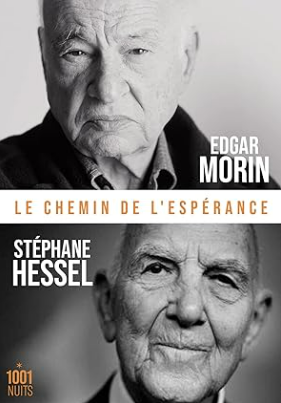
Dans le premier ouvrage, Terre-Patrie, avec Anne Brigitte Kern, Morin alerte sur la barbarie qui suit la fin de la Guerre Froide et sur la cause qui en est, selon lui, «l’impuissance de l’humanité à devenir l’humanité», proposant un nouveau mode de pensée dans un «tout planétaire», ainsi que de découvrir notre «carte d’identité terrienne» dans une «matrie terrestre», la Terre-Patrie. Dans le second, Le Chemin de l’espérance, Morin et Stéphane Hessel qui voyait en lui un «frère de lutte» revendiquent de «dénoncer le cours pervers d’une politique aveugle qui conduit au désastre, d’énoncer une voie politique de salut public et d’annoncer une nouvelle espérance», le concept de «Terre-mère» y étant également central.
«Je sens présente en moi l’humanité dont je fais partie. Non seulement, je suis une une petite partie dans le tout, mais le tout est à l’intérieur de moi-même. C’est peut-être cela qui me donne l’énergie de continuer sur la voie qui est la mienne. Et à un moment donné, sans que vous ne sachiez pourquoi, c’est comme une catalyse, quelque chose qui se passe, se transforme, bascule … C’est cela l’espoir.»
L’Espoir, un mot qui suivait Edgar Morin depuis qu’il y avait trouvé son nom de guerre dans la Résistance, en s’inspirant du roman d’André Malraux. Dans la pensée contemporaine, Edgar Morin a incarné les valeurs du mouvement Citoyen du Monde d’une manière unique et indélébile. Chaque disparition oblige davantage celles et ceux qui restent à poursuivre la lutte, à entretenir la flamme, à sentir en leur être l’humanité dont elles et ils font partie. A nous maintenant.
Bernard J. Henry est Officier des Relations Extérieures de l’Association of World Citizens.
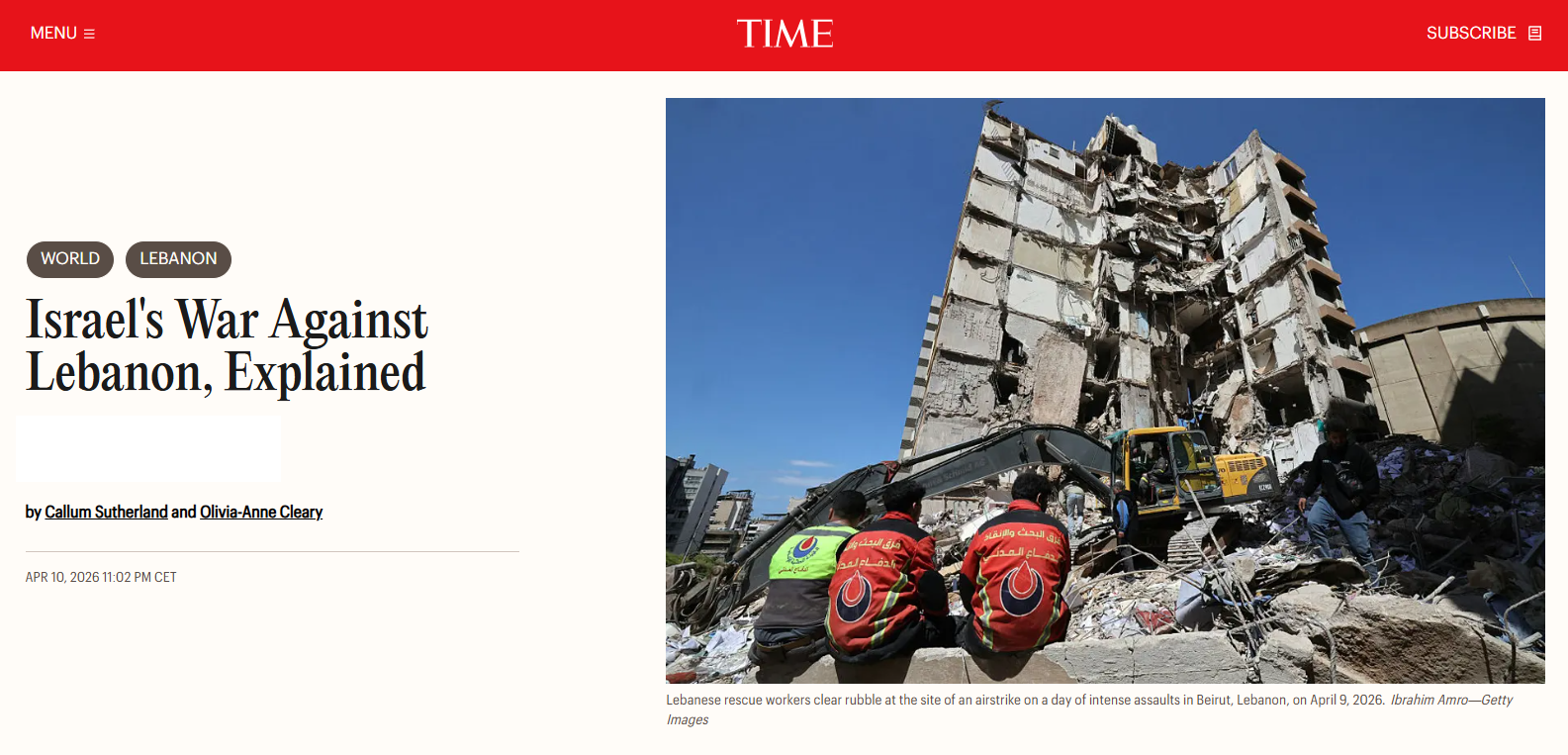
The armed conflict in Lebanon is multidimensional and growing more violent as the conflict spreads to more areas of the country. Nongovernmental Organizations (NGOs) in Consultative Status with the United Nations (UN), such as the Association of World Citizens (AWC), are calling for speedy UN action to bring the fighting to a halt.
Israel’s current attacks in Lebanon against the armed militia Hezbollah are related to the United States (U.S.)-Israeli attacks against Iran, but they are separate from the U.S.-Iran negotiations that just took place in Pakistan. Hezbollah had fired rockets at Israel in support of Hamas. In the Gaza Strip, Hamas is also backed by the Iranian government.
Now in Lebanon, more than 1,000 persons have been killed and a million people displaced in a country of six million inhabitants. The Israeli attacks may be the beginning of an Israeli invasion and subsequent occupation of southern Lebanon.
The political-strategic situation in the wider Middle East is complex. In light of the dangers and uncertainties, NGOs are calling for action by the UN. There are some possibilities of UN mediation and good offices. We support these NGO calls for UN action.
Prof. René Wadlow is President of the Association of World Citizens.
Since the month-old United States (U.S.) and Israeli military attacks against the Islamic Republic of Iran began, the Association of World Citizens (AWC) has called for negotiations in good faith to bring the war to a halt. The war is destructive of life and property. From the very start, it has been in danger of spreading to other countries. There are real dangers of miscalculations by the military that will lead to deeper military escalation.
The AWC has stressed that the war is a violation of international law as structured in the Charter of the United Nations. The war has also led to violations of international humanitarian law as structured in the Geneva Conventions. There have been attacks on schools, health facilities, and essential economic infrastructure. The war has led to a large number of persons being displaced.
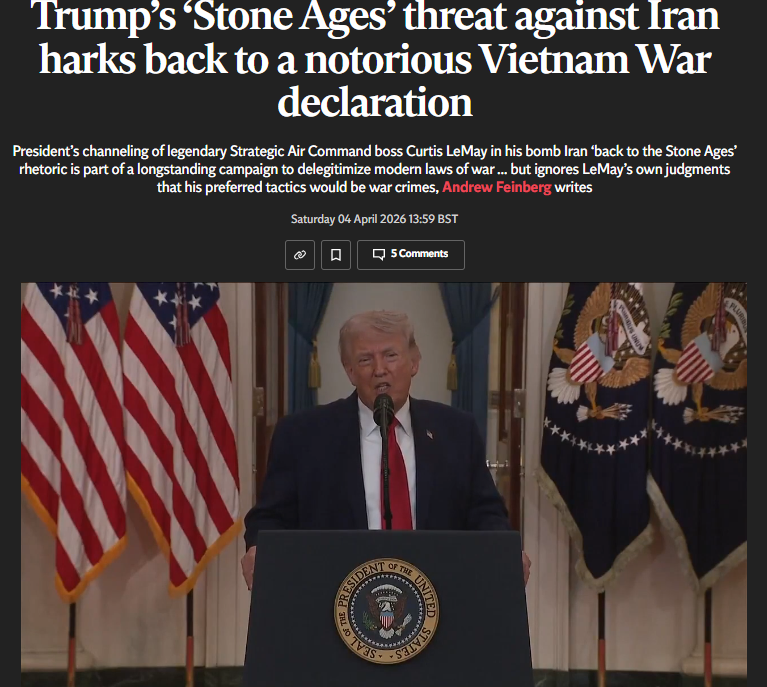
U.S. President Donald Trump has recently warned the Iranian authorities that the USA could bomb Iran “back to the Stone Age” if the Iranian authorities did not meet U.S. demands for an agreement. In reality, Iran and Persia before it had long left the Stone Age and made important contributions to world culture.
Thus, strong efforts must be made through both the United Nations and Nongovernmental Organizations such as AWC for an end to the armed conflict and the start of a harmonious regional society. Your help in these vital efforts is much appreciated.
Prof. René Wadlow is President of the Association of World Citizens.
At this time when there is armed conflict and strong political tensions in world society, broadly-based efforts are needed to develop a harmonious political culture based on world law. A political culture is a set of attitudes and beliefs which give order and meaning to a political process. Such a positive political culture is a product of both the collective history of a political system and the life histories of the members of that system.
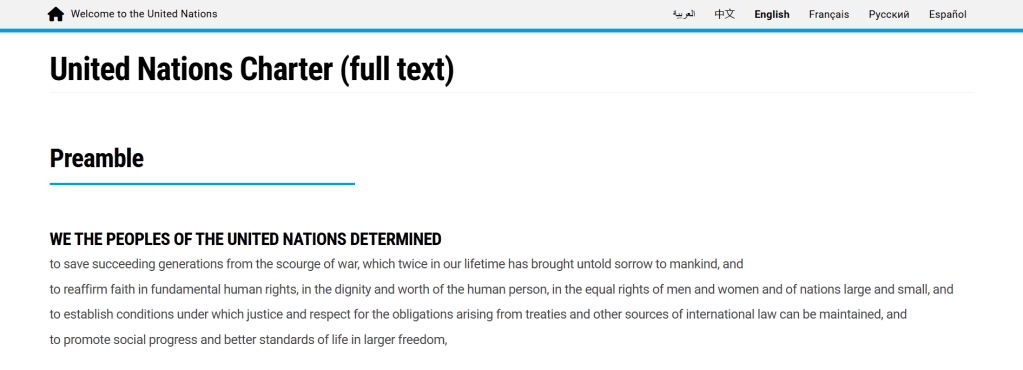
“To establish conditions under which justice and the respect for the obligations arising from treaties and other sources of international law can be maintained” is one of the four objectives of the United Nations (UN) as set out in the preamble to the Charter, firmly related to the three other aims: the prevention of war, respect for human rights, and social progress. The phrasing of the aims rightly stresses not the enactment of international law but rather the need to “establish conditions” under which justice and respect for international law is possible.
Respect for international law should place limitations upon the number of options open to a government in choosing how to carry out a policy in foreign affairs. The most fundamental limitation is the prohibition on using military action except in self-defense against aggression.
When abuse of State power, denial of human rights, corruption, and the absence of participation in decision-making are the daily routine, people look upon law as a method to establish justice. The rule of law at both the international and national level must be based on a social consensus.
Nongovernmental Organizations (NGOs) can play a vital role in developing this social consensus on the rule of law. NGOs have proven that they can respond effectively to the challenges faced by today’s world society. Thus, there is a growing role for NGOs within the UN system in the making and implementation of policies. NGOs are involved more than ever before in global policy-making and project implementation. They bring citizens’ concerns to governments and advocate specific policies.
Today, with armed violence ongoing in many parts of the world, cooperative peacebuilding efforts are urgently needed. NGOs are playing an increasing role in such peacebuilding efforts and must be encouraged.
Prof. René Wadlow is President of the Association of World Citizens.
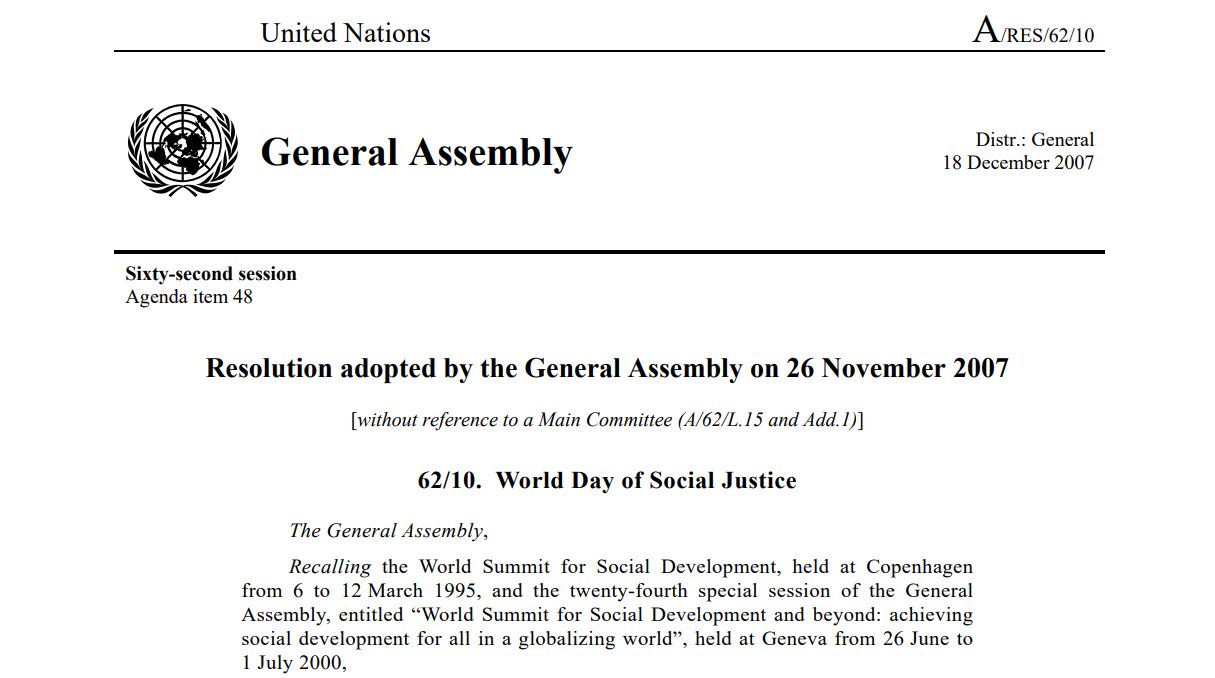
The United Nations (UN) General Assembly by Resolution 62/10 set February 20 of each year as the World Day of Social Justice. Today, as Citizens of the World, we can highlight world-wide gains in education, the reduction of extreme poverty, and the reduction of child labor.
Nevertheless, there are strong threats to social justice with inaction and apathy toward human misery. There is famine in parts of the world, armed conflicts, and uprooted and displaced populations.
The UN system is called upon to respond to these very diversified situations, often involving provisions of crucial direct aid to people in deep distress. At the national level, there is a need to place social justice at the core of policy making and to provide universal social protection.
A particular aspect of the lack of social protection is the fate of small rural farmers. There is an increasing amount of rural productive land that is falling under the control of urban elites, sometimes urban elites in other countries. Land ownership inevitably involves the distribution of power within a society. One answer to why the rural poor stay poor is that they are rarely well organized. The least powerful among the rural poor – the tenant farmers, the landless laborers, the members of tribal societies – are the least well organized, the most easily divided and blocked.
Thus, there is a need for renewed efforts for social justice carried out by persons with a long-range holistic vision able to see trends and the links between different social situations. There is a need for long-term cooperation among universities, religious groups, and Nongovernmental Organizations. The World Day of Social Justice is a time for a rededication for positive action.
Prof. René Wadlow is President of the Association of World Citizens.