NAJET LAABIDI, AVOCATE ENGAGÉE POUR L’ÉTAT DE DROIT EN TUNISIE
Par Bernard Henry
«L’Etat de droit, ce n’est certainement pas le droit de l’Etat». Le 5 mai dernier, Frédéric Sicard, Bâtonnier de l’Ordre des Avocats de Paris, accueillait dans la bibliothèque du Palais de Justice les élèves-avocats qui venaient de prêter serment en audience solennelle. A deux jours du second tour d’une élection présidentielle de tous les dangers où, comme quinze ans auparavant, le choix allait être entre les valeurs républicaines et l’extrême droite, le premier des avocats parisiens avait pour les nouveaux entrants des paroles très politiques – sans bien sûr l’être tout-à-fait, réserve de l’avocat oblige.
Maître Sicard n’aurait aucune raison de se réjouir, encore moins sa Vice-bâtonnière Dominique Attias, native de Tunis, s’il savait quel est, par-delà la Méditerranée, le sort de sa consœur Najet Laabidi dans cette Tunisie présentée comme le seul et unique succès des révolutions arabes, là où l’Egypte est revenue au point de départ et où Libye et Syrie ont sombré dans le chaos et la guerre.
Une militante acharnée des Droits de l’Homme
Originaire de Siliana, dans le nord-ouest voisin de l’Algérie, Najet Laabidi s’inscrit à la Faculté des Sciences juridiques, politiques et sociales de Tunis, la plus réputée du pays. Elle prête serment en 2008 à Tunis et ouvre son cabinet dans le quartier universitaire d’El Manar.

Immédiatement, la jeune avocate s’implique dans la défense des Droits de l’Homme. Dans ce qui est encore la Tunisie des Ben Ali-Trabelsi, où les opposants vivent dans la clandestinité ou se retrouvent derrière les barreaux au moindre mot de trop, elle s’engage dans des procès touchant à la liberté d’expression. Ses plaidoiries attirent l’attention d’autres avocats engagés, tels que Khaled Krichi, Mohamed Nouri et Samir Dilou – qui deviendra quelques années plus tard ministre au nom du parti islamiste Ennahda.
Désormais reconnue par ses pairs et camarades de combat, Najet Laabidi rejoint l’association Liberté Equité, dont elle entre bientôt au Conseil d’administration. Puis vient la révolution en 2011, et pour l’avocate, ce n’est que le début du combat.
A l’épreuve de la justice «révolutionnaire»
Le 8 novembre 2011, choisie et contactée pour représenter des victimes de mauvais traitements dans l’affaire Barakat Essahel, l’avocate subit un déluge d’insultes et de menaces de la part de proches d’anciens officiels de l’Etat poursuivis en justice pour avoir torturé des prisonniers politiques sous Ben Ali. D’abord par téléphone avant le procès, puis le jour venu, en pleine salle d’audience.
La police militaire évacue les auteurs des injures et menaces, mais ne lève pas le petit doigt pour protéger l’avocate. Il lui est ordonné de ne pas quitter le prétoire jusqu’à ce que tout le monde soit sorti. Elle décline une proposition de la raccompagner en voiture. Le ton est donné de ce que seront les années qui suivent pour Najet Laabidi.
Quatre ans plus tard, deuxième round. Le 26 novembre 2015, elle plaide lors d’une audience d’opposition contre Ezzedine Jenayeh, ancien Directeur de la Sûreté nationale sous Ben Ali, condamné par contumace pour délit de violences dans l’affaire Baraket Essahel et qui conteste le jugement. D’entrée, la procédure consacre l’arbitraire.
«Quand il a fait opposition, contrairement à la loi et au Code de procédure pénale, il s’est présenté en prévenu libre et la Chambre correctionnelle a refusé la présence des avocats des parties civiles, dans l’ignorance totale du principe du droit à la défense et du procès équitable». La Présidente du Tribunal militaire permanent, Leila Hammami, rejette en bloc les constitutions des parties civiles, niant aux avocats jusqu’au droit de représenter leurs clients. Najet Laabidi et son confrère Abderraouf Ayadi dénoncent des vices de procédure, et aussitôt, Leila Hammami porte plainte contre les deux avocats pour «outrage à un fonctionnaire de l’ordre judiciaire». Rien que ça.
Dans le viseur d’une justice (toujours) politique
Entretemps, aux côtés d’Abderraouf Ayadi, Najet Laabidi est devenue membre de la direction d’un parti politique, Attayar, ou en français, le Courant Démocrate, fondé par l’ancien ministre Mohamed Abbou qui fut lui-même avocat et détenu politique puis gréviste de la faim sous Ben Ali. Et comme par hasard, eux deux et eux seuls sont visés par la plainte.
Ils se retrouvent convoqués le 17 décembre 2015 devant le juge d’instruction du Tribunal militaire permanent de première instance de Tunis. Ils ne vont pas à sa rencontre, demeurant à l’extérieur, entourés de confrères et de sympathisants. Ce sont le Président de la Section des Avocats de Tunis, en quelque sorte le Bâtonnier local de l’Ordre tunisien qui est unitaire et national, et une délégation d’avocats qui se rendent chez le magistrat à leur place par solidarité.
Devant le Tribunal militaire, les deux avocats avaient accusé Leila Hammami de partialité, les propos de Najet Laabidi ayant été filmés puis diffusés sur les réseaux sociaux. «Dans ma vidéo,» rappelle l’avocate, «j’ai évoqué les circonstances de l’impunité, j’ai souligné que le Tribunal militaire ne pouvait pas consacrer les principes d’un procès équitable car, dans ce corps d’Etat, il y a toujours la corruption». Nouvelle plainte de Leila Hammami le 21 décembre 2015, la magistrate versant au dossier un CD de l’enregistrement de Najet Laabidi lui disant ses quatre vérités.
Il n’en faut pas plus au Procureur général près la Cour d’appel de Tunis pour lancer des poursuites sur le fondement de l’Article 128 du Code pénal pour «outrage à un fonctionnaire public». Convoquée le 1er février 2016 devant le juge d’instruction du Tribunal de première instance de Tunis, Najet Laabidi refuse de comparaître. Le 12 octobre 2016, elle est condamnée par contumace à un an d’emprisonnement.

Informée de sa condamnation seulement le 24 avril dernier, l’avocate y fait opposition. A l’issue de son audience le 10 mai dernier, Najet Laabidi est condamnée à six mois de prison, décision dont elle interjette immédiatement appel. Mais qui n’aurait jamais dû intervenir en premier lieu, puisque ce qu’on lui reproche, outre peut-être son appartenance à un parti politique d’opposition, c’est d’avoir agi comme ce qu’elle est – une avocate.
Symbole d’un Etat de droit introuvable
Poursuivie pour l’exemple, Najet Laabidi l’est sans nul doute. Mais au-delà de l’exemple, de par l’acharnement judiciaire dont elle fait l’objet depuis les premiers mois de la Tunisie du 14 janvier, elle est devenue un symbole. Le symbole d’un Etat de droit que tous appellent de leurs vœux, dont chacun(e) se dit le meilleur espoir pour peu qu’on lui confie le pouvoir, mais qui, dans les faits, plus de six ans après la fuite de Ben Ali et sa famille, demeure introuvable en Tunisie.
Lors des premières poursuites contre Najet Laabidi en 2011, l’Association of World Citizens (AWC) était intervenue auprès des autorités tunisiennes pour la soutenir. Nous l’avons fait cette fois encore, conscients de ce que représentent des poursuites contre un avocat dans un pays qui, six ans et demi après avoir renversé la dictature dans une révolution inattendue du monde, en particulier des «orientalistes», peine encore à asseoir l’Etat de droit. Quel que soit le système juridique que l’on se choisit, jamais un tel résultat ne peut être atteint si l’on ne respecte pas la liberté d’exercice professionnel des avocats.
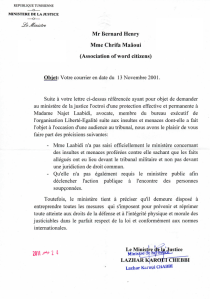
Najet Laabidi a elle aussi bien conscience de la portée, bien au-delà du simple cadre judiciaire, du procès en conscience professionnelle dont elle fait l’objet. «Ce dossier démontre que l’impunité persiste, que le système de corruption existe encore, avec l’absence d’une volonté politique d’assurer l’indépendance de la justice ainsi que le respect des avocats et de leur immunité.»
L’avocate ne cache pas son dépit devant les fruits amers d’une révolution saluée de par le monde et qui, selon elle, n’a rien réglé des maux anciens de la Tunisie. «L’Etat de droit réside dans le respect des lois, et surtout, de l’égalité pour tous devant la règle de droit, chose qui n’existe malheureusement toujours pas en Tunisie,» n’hésite-t-elle pas à conclure. «Aujourd’hui, les victimes de la torture, mais aussi celles de la corruption, n’ont pas réussi ni à avoir leurs droits, ni à poursuivre les tortionnaires et les corrompus».
Sous Ben Ali, un silence aussi pesant que feutré entourait les dissidents et défenseurs des Droits de l’Homme pourchassés par le régime. Couronné «rempart contre l’islamisme», l’ancien Premier Ministre de Habib Bourguiba, dont il avait été le «tombeur» en 1987, n’avait rien à craindre des grands de la Méditerranée. Jacques Chirac lui-même avait déclaré à Tunis en 2003 : «Le premier des Droits de l’Homme, c’est de manger», autrement dit, Tunisiens taisez-vous et finissez vos assiettes.
Depuis la révolution, la Tunisie où, jadis, le simple fait d’être membre d’Ennahda faisait de vous un terroriste a connu successivement le retour de bâton islamiste, puis le retour en grâce des anciens du Rassemblement constitutionnel démocratique de Ben Ali à travers le nouveau parti Nidaa Tounes. Les anciens refuzniks non-islamistes, qu’ils se nomment Taoufik Ben Brik, Sihem Ben Sedrine, Radhia Nasraoui ou Hamma Hammami, ont connu, libres et au grand jour, des destins et des fortunes diverses. La Tunisie n’est plus telle que Ben Ali la tenait, mais elle n’est pas pour autant telle que les opposants au dictateur la rêvaient. On y mange moins qu’avant, les prix des denrées alimentaires ayant flambé, et l’on y est à peine plus libre.
Mais l’Etat de droit voulu par la révolution, crié dans les «Dégage !» des Tunisiens à Ben Ali en janvier 2011, vit toujours. Il vit dans l’esprit et le cœur d’une avocate comme Najet Laabidi, dont le prénom signifie «délivrance» et qui, un jour, sera peut-être celle de son peuple en laquelle elle croit tant.
Bernard J. Henry est Officier des Relations Extérieures de l’Association of World Citizens.