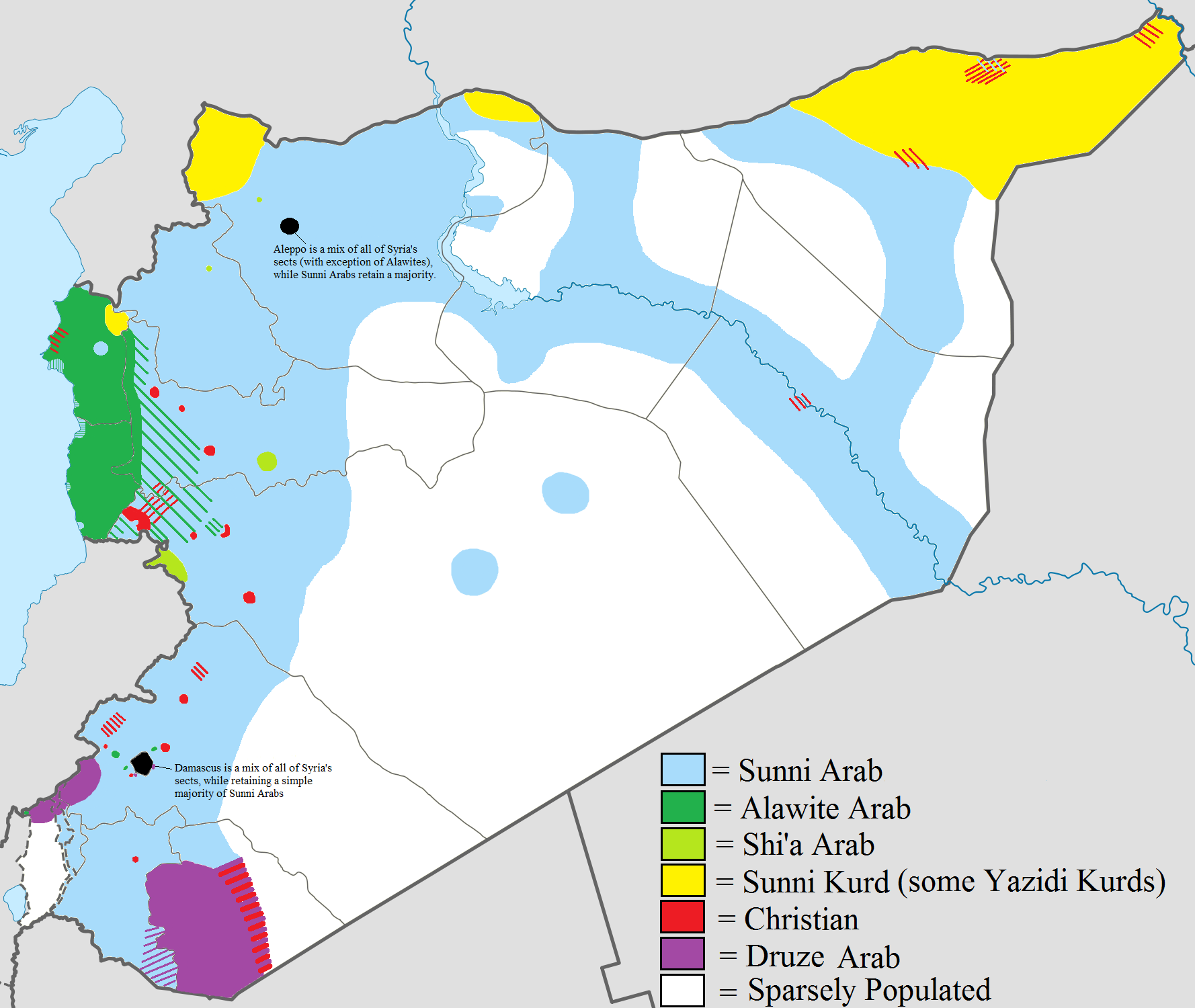
With the end of the long dictatorship of Bachar al-Assad and the naming of Ahmed al-Sharaa, leader of the militia Hayat Tahrir al-Sham (HTS), as President, there is a need for the Syrians to consider the structures of the state. Like its neighbor Lebanon, Syria is home to a number of religious and ethnic groups, sometimes mixed, especially in the major cities. In other places, one group is dominant and usually controls both the economic and political life of the area. Thus, there have been suggestions that Syria should be re-structured as a federal or confederal state.
On March 17, 2016, the “federal democratic system of Rojava” (a Kurdish term for northern Syria) was proclaimed officially. Some 150 representatives of Kurdish, Arab, and Assyrian (largely Christian) groups met in the city of Rmeilan in northeast Syria and voted in favor of the union of three ‘cantons’ largely populated by Kurds − the cantons of Afrin, Kobani, and Jezireh.
The government as well as a major opposition group stated their refusal of a federalist system which they saw as a first step to the breakup of Syria.
While the Kurdish issues in Turkey have attracted international attention, and the largely autonomous Kurdish region of Iraq is a major player in Iraqi politics, the Kurds in Syria have been less discussed.
The Kurds of Syria had not been as visible a factor as other ethnic or sectarian groups. As Michael Gunter, a specialist on the Kurdish world, writes,
On July 19, 2012, the previously almost unheard Syrian Kurds suddenly emerged as a potential game changer in the Syrian civil war and what its aftermath might hold for the future in the Middle East when in an attempt to consolidate their increasingly desperate position, government troops were abruptly pulled out of the major Kurdish areas. The Kurds in Syria had suddenly become autonomous, a situation that also gravely affected neighboring Turkey and the virtually independent Kurdistan Regional Government in Iraq. Indeed, the precipitous rise of the Kurds in Syria bid to become a tipping point that might help change the artificial borders of the Middle East established after the First World War following the notorious Sykes-Picot Agreement. (1)
In a hope of keeping the Kurds out of the growing armed conflict, shortly after the March 15, 2011 start of the Syrian armed conflict, in April 2011, Bashar al-Assad had granted Syrian citizenship to some 220,000 Kurds that had been long waiting to be considered as citizens or who had been stripped of their citizenship in a 1962 census.
However, armed conflict spread, and the Islamic State started to control territory near Kurdish majority areas. Some observers saw the Kurds as “objective allies” of Bashar as they had many of the same enemies.
Working with the regime had largely saved the Kurdish areas from government bombardment and allowed Kurdish leadership to build alternative forms of government. Gunter discusses in some detail the influence among some Kurdish leaders in Turkey and Syria of the writings of Murray Bookchin (1921-2006) and his views of ecologically-sound autonomous governance – “democratic autonomy”.
In the first years of the French mandate of Syria after the First World War, the French had created a form of ‘federal’ administration.
It is very unlikely that the Kurdish propositions will be on the agenda for new governmental structures in Syria now in 2025. The current Syrian leadership is heavily influenced by the government of Turkey, strongly opposed to anything Kurdish. The future development of the Syrian state is an issue to watch closely.
Prof. René Wadlow is President of the Association of World Citizens.
Notes
(1) Michael M. Gunter, Out of Nowhere: The Kurds of Syria in Peace and War (London: Hurst and Co, 2014, p.1)
The January 20, 2025 inauguration of President Donald Trump has brought into sharp focus the turbulent and complex world society in which we live. As peacebuilders and citizens of the world, we face the same challenges as President Trump but with a different style and with far fewer resources at our command. We make plans but then are called to work for conflict resolution in unanticipated ways.
There are four policy challenges which face both President Trump and World Citizens: armed conflicts, currently ongoing and potential, persistent poverty in many areas, the erosion of international law and faith in multinational institutions, particularly the United Nations (UN), and the consequences of climate change.
The ongoing and potential armed conflicts are neither new nor unexpected. The Israeli-Palestinian tensions exist at least since 1936 and increased after the creation of the State of Israel. There may be some possibilities for negotiations in good faith. We must keep an eye open for possible actions.
Tensions with Iran are not new. The Soviet forces in part of Iran was the first conflict with which the UN had to deal in its early days. However, the rule by the Ayatollahs has made matters more complex.
The Russian-Ukrainian war grinds on with a large number of persons killed, wounded, and uprooted. Again, we must look to see if a ceasefire and negotiations are possible.
In Asia, the armed conflict in Myanmar between the military in power and the ethnic militias dates from the creation of the Burmese State at the end of the Second World War. A potential armed conflict between Mainland China and Taiwan dates from 1949 and the Nationalist government’s retreat to Taiwan. The potential armed conflict between the two Korean States dates from 1950 and the start of the Korean War.
The armed conflicts in Africa are no longer in the headlines, but they date from the early 1960s and the breakup of the European Empires: the Democratic Republic of Congo, Sudan, the States of the Sahel.
Thus, we all have a poor record of armed conflict prevention and mediation. Armed conflicts should remain at the top of both the governmental and nongovernmental agenda for action.
(C) U.S. Embassy France on Instagram
Persistent Poverty: Despite the UN Decades for Development, the Sustainable Development Goals, and Article 22 of the Universal Declaration of Human Rights which states that everyone is entitled to the economic, social, and cultural rights indispensable for his dignity and free development of his personality, persistent poverty exists in many parts of the world. One consequence of persistent poverty is migration from poorer to richer areas, both within countries and from poorer to richer States. Migration is a hotly debated issue in many countries, as right-wing nationalist groups make anti-migration their battle cry. Migration is likely to become an even more heated topic of debate as President Trump tries to carry out his proposal for a mass deportation of immigrants from the USA.
Linked to persistent poverty are trade issues and the protectionist trends in many countries. President Trump has proposed higher tariffs for good coming into the USA. This policy may set off tariff wars. Obviously to counter persistent poverty, world development policies must be improved – easier said than done!
The Erosion of International Law and Faith in Multinational Institutions: Armed conflicts and persistent poverty are closely related to the third issue: the receding United States (U.S.) involvement with the UN, the World Bank, the IMF, the World Court and other multinational organizations. Some of the foreign policy authorities appointed by President Trump are overtly critical of the UN and the International Criminal Court. There has already been an Executive Order to halt U.S. funding of the World Health Organization. However, there is no unifying vision of what a new world society would involve. The battle cry of “Make America Great Again”, if repeated by each State for itself, “Make Panama Great Again”, could be a loud concert but not conducive to positive decision making.
The Consequences of Climate Change: The fourth major group of issues concerns the consequences of climate change and the ways to lessen its impact. During the campaign for the presidency, Trump threatened to pull the USA out of the Paris Climate Agreement, and he has now signed an Executive Order doing so. The issue of climate change has been brought to the world agenda by scientists on the one hand, and by Nongovernmental Organizations and popular, often youth-led efforts, on the other hand. It is likely that these vital efforts related to climate change will continue despite climate policy resistance by some in the Trump administration.
President Trump said during his inaugural ceremony that “The Golden Age of America begins now… We stand on the verge of the four greatest years in American history.” We will have to watch closely and judge in four years. What is sure for peacebuilders and citizens of the world is that we stand on the verge of four more years of serious challenges. Thus, there is a need for cooperative and courageous action.
Prof. René Wadlow is President of the Association of World Citizens.
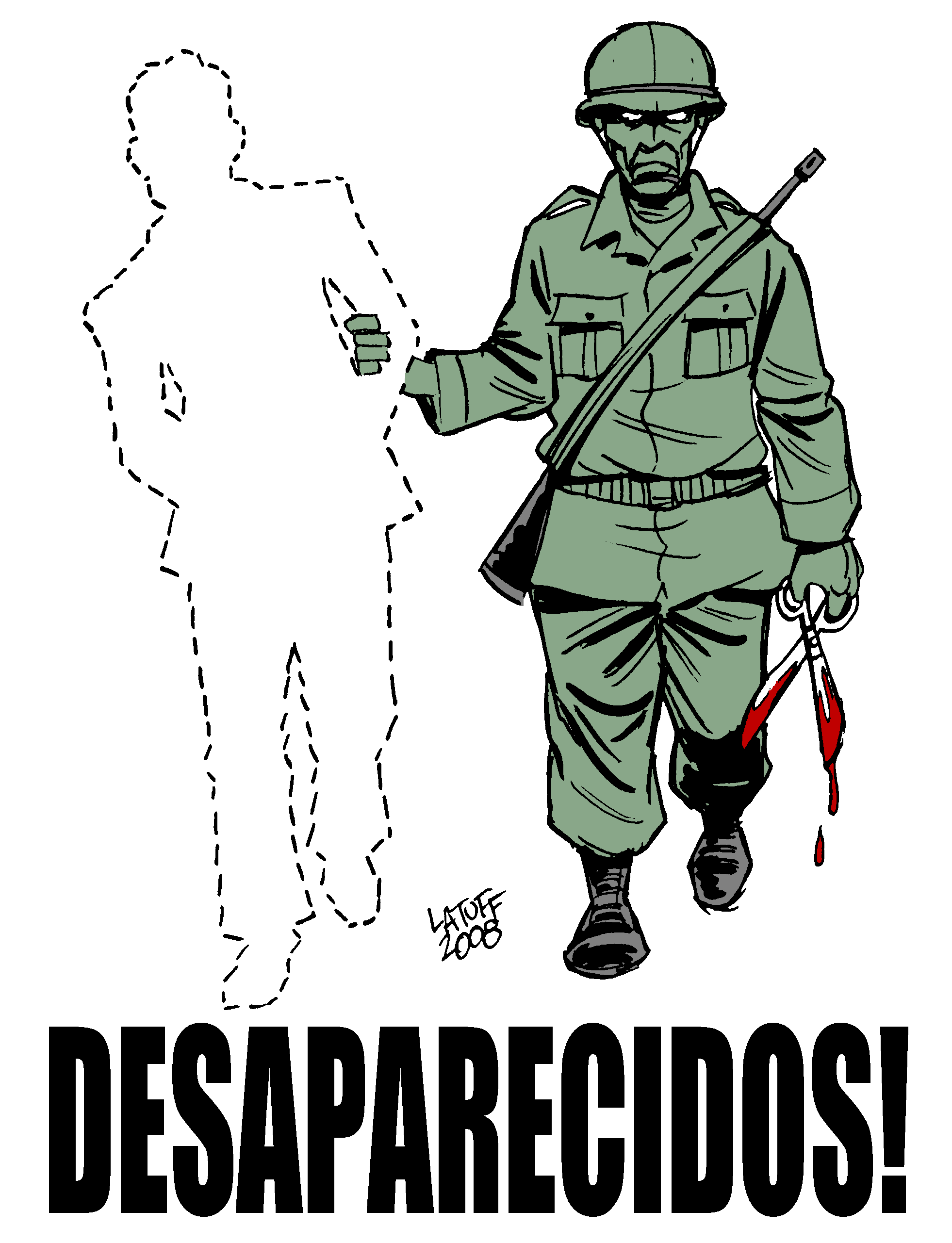
August 30 each year is the International Day of the Victims of Enforced Disappearances. The Day highlights the United Nations (UN) General Assembly Declaration on the Protection of All Persons from Enforced Disappearances of December 18, 1992.
In a good number of countries, there are State-sponsored “death squads” – persons affiliated to the police or to the intelligence agencies who kill “in the dark of the night”, unofficially. These deaths avoid a trial which might attract attention. A shot in the back of the head is faster. In many cases, the bodies of those killed are destroyed. Death is suspected but not proved. Family members hope for a return. In addition to governments, nongovernmental armed groups and criminal gangs have the same practices.
Disappearances was one of the first issues to be raised, largely by Nongovernmental Organizations (NGOs) such as the Association of World Citizens (AWC), when the UN Secretariat for Human Rights with a new director, Theo van Boven, moved from New York to Geneva in 1977.
In 1976, Argentina’s military seized power and set out to kill opposition figures. This situation was quickly raised in the UN human rights bodies in Geneva. In 1980 a UN Working Group on Enforced or Involuntary Disappearances was created and has done important work.[i] However, continued action is needed by both the UN and national NGOs.
Prof. René Wadlow is President of the Association of World Citizens.
[i] See Iain Guest, Behind the Disappearances: Argentina’s Dirty War Against Human Rights and the United Nations (Philadelphia: University of Pennsylvania Press, 1990). Iain Guest was the Geneva UN correspondent for the International Herald Tribune. He had access to Argentine confidential documents once the military left power. He interviewed many diplomats and NGO representatives active in Geneva-based human rights work. This book is probably the most detailed look at how human rights efforts are carried out in the UN Geneva-based human rights bodies.
LA AWC LLAMA A LAS AUTORIDADES DE NICARAGUA A DEROGAR LA PROHIBICIÓN ANUNCIADA DE 1.500 ORGANIZACIONES NO GUBERNAMENTALES
La Association of World Citizens (Asociación de Ciudadanos del Mundo; AWC) expresa su alarma al aprender que las autoridades de la República de Nicaragua anunciaron el 19 de agosto la prohibición de 1.500 organizaciones no gubernamentales (ONG), la mayoría de ellas organizaciones de beneficencia católicas romanas, aunque, lamentablemente, la medida también ha afectado a la Cruz Roja Nicaragüense.
Desde abril de 2018, el Gobierno encabezado por el Presidente Daniel Ortega ha adoptado un cariz abiertamente autoritario, tras las protestas cuya violenta represión, según las Naciones Unidas (ONU), ha dejado más de 300 muertos. En este contexto, casi todos los opositores políticos han sido encarcelados o forzados al exilio.
En cuanto a los grupos de la sociedad civil, esta última medida eleva a 5.000 el número de ONG prohibidas por las autoridades en los últimos seis años. Todos los grupos prohibidos han visto sus bienes confiscados por el Gobierno. Aunque la razón oficial esgrimida es que estas ONG no han declarado sus ingresos, la semana pasada se aprobó una normativa que obliga a las ONG a establecer “alianzas de asociación” con las autoridades, con lo que prácticamente se acaba su carácter “no gubernamental”.
La Oficina del Alto Comisionado de las Naciones Unidas para los Derechos Humanos ha pedido “a las autoridades nicaragüenses que dejen de imponer restricciones severas a los espacios cívicos y democráticos del país y que garanticen el respeto de los derechos humanos, de conformidad con las obligaciones internacionales de Nicaragua en materia de derechos humanos”.
La AWC respalda sin reservas este llamamiento, instando al Gobierno de Nicaragua a rescindir de inmediato su prohibición anunciada y a restablecer a todas las ONG ilegalizadas desde 2018 su estatus jurídico y financiero inicial, garantizando además que sean libres de operar como consideren conveniente, un requisito básico para cualquier país que pretenda defender el Estado de derecho.
THE AWC CALLS ON THE AUTHORITIES OF NICARAGUA TO RESCIND THEIR ANNOUNCED BAN ON 1,500 NONGOVERNMENTAL ORGANIZATIONS
The Association of World Citizens (AWC) is alarmed to hear that the authorities of the Republic of Nicaragua announced on August 19 that they were banning 1,500 Nongovernmental Organizations (NGOs), most of them Roman Catholic charities – even though, regrettably, the Nicaraguan Red Cross has been struck by the measure too.
Since April 2018, the Government led by President Daniel Ortega has taken an openly authoritarian turn, after protests whose violent repression the United Nations (UN) claims left more than 300 people dead. In this context, nearly all political opponents have been jailed or forced into exile.
As for civil society groups, this latest move brings to 5,000 the number of NGOs banned by the authorities over the last six years. All groups thus banned have had their assets seized by the Government.
Even though the official reason put forward is that these NGOs have failed to declare their income, last week, a regulation was passed requiring NGOs to enter “partnership alliances” with the authorities, therefore practically ending their “nongovernmental” nature.
The Office of the UN High Commissioner for Human Rights has called “on the Nicaraguan authorities to stop imposing severe restrictions on civic and democratic spaces in the country, and to ensure that human rights are respected, in line with Nicaragua’s international human rights obligations.”
The AWC unreservedly endorses this call, urging the Nicaraguan Government to rescind immediately its announced ban and restore all NGOs outlawed since 2018 to their initial legal and financial status, further ensuring that they are free to operate as they see fit, a basic requirement for any country which claims to be upholding the rule of law.
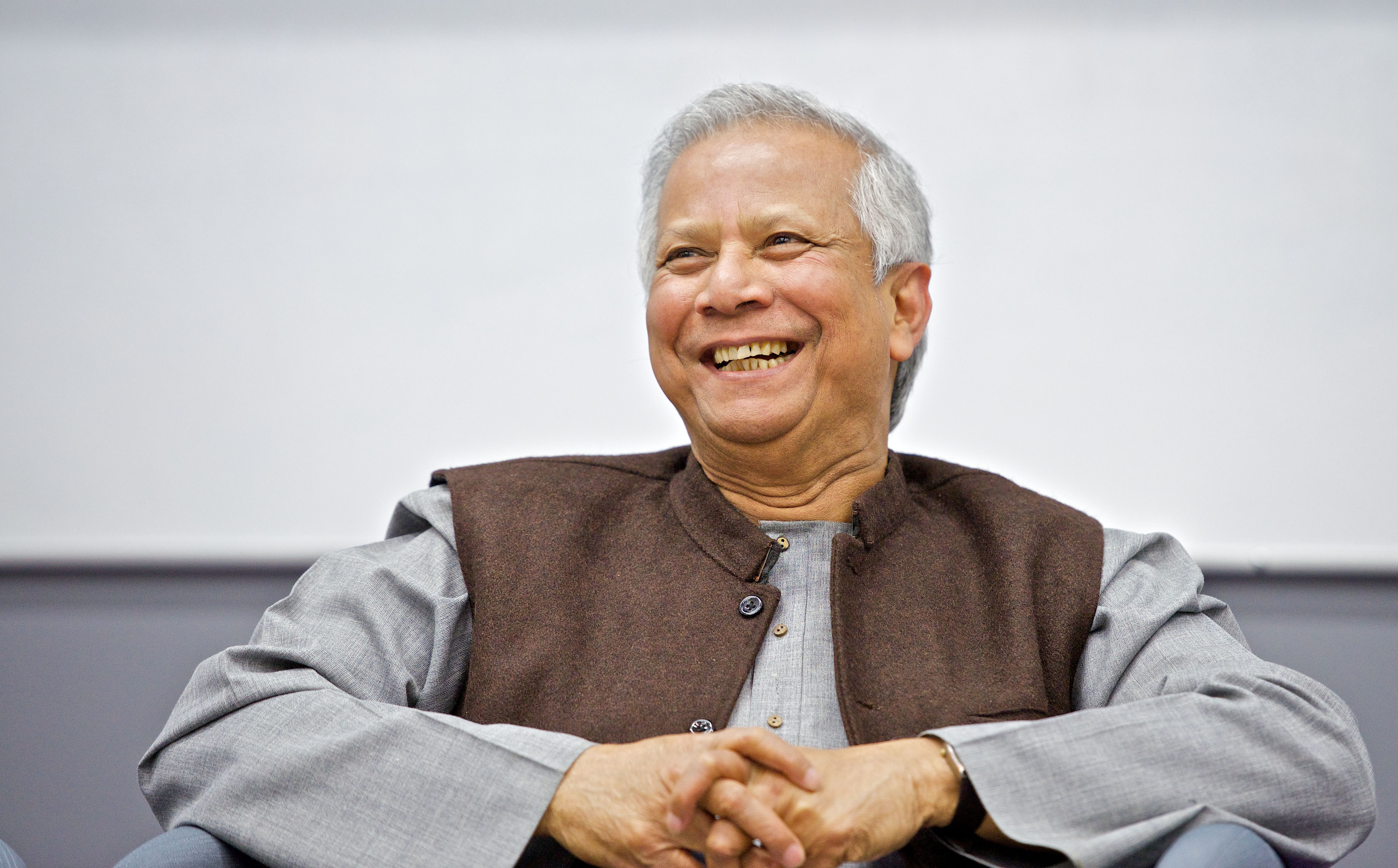
Muhammad Yunus, the founder of the microcredit banking system in Bangladesh, the Grameen Bank (which translates as “Village Bank”), was sworn in as the interim leader of the Bangladesh government on August 8, 2024. The former leader, Sheikh Hasina, resigned and then fled to India, driven out by the protests first of students and then by other sectors of the population during which some 400 persons were killed by the military and the police. Muhammed Yunus has called for calm and an end to uncontrolled violence often directed against the minority Hindu population.
Muhammad Yunus is an economist. Now 84 years old, he is retired from teaching, originally at the University of Chittagong, the port city of Bangladesh. As an economist, he was quickly aware of rural poverty in many parts of the country and the unrest of the tribal minorities in the Chittagong Hill Tracks. He developed the concept of the Grameen Bank, small loans, especially to women, in order to improve their trading efforts. Much of what is called “the informal sector” – marginal to the more developed economy – are the efforts of market women and women small producers. With small loans which must be repaid before a new loan is possible, women are able to have more security and can expand their business.
Prof. Muhammad Yunus at the University of Salford, UK, on May 18, 2013 (C) University of Salford Press Service
The Grameen Bank approach spread to nearly all areas of Bangladesh and then to other countries, especially in Africa. The success of the Grameen Bank approach has lifted many from the cycle of poverty and instability. In recognition of the impact of the Grameen Banks, Muhammad Yunus was awarded the Nobel Prize for Peace in 2006.
Muhammad Yunus has formed an interim government of 16 persons, mostly drawn from civil society organizations, including two, Nahid Islam and Asif Mahmud, both 26 years old, who were leaders of the student movements which overthrew Sheikh Hasina who had been in power for 15 years – whose government had become increasingly authoritarian. Muhammad Yunus has promised that elections will be held shortly but that calm must be restored first. He faces difficult tasks, but he is a fresh mind outside the narrow political milieu. We must wish him well in his vital efforts.
Prof. René Wadlow is President of the Association of World Citizens.
WORLD CITIZENS CALLON THE AUTHORITIES OF IRAQ TO WITHDRAW THEIR DRAFT LAW ALLOWING THE MARRIAGE OF 9-YEAR-OLD GIRLS
The AWC is alarmed to hear that a draft law under consideration in Iraq may make it legal for a man to marry a girl as young as nine.
We hear many individuals and civil society groups in the country have rightly spoken out about the said draft law.
We firmly believe the Iraqi authorities should by no means make it the law of the land.
For seventy years, Iraqi law has considered the “full age” for marriage, in the very words of the Universal Declaration of Human Rights, to be eighteen. That is consistent with the Convention on the Rights of Child under whose Article 1 “a child means every human being below the age of eighteen years”.
Lowering the marriageable age for girls to nine would send a disastrous signal for girls in Iraq and, in a broader manner, throughout the entire Arab and Muslim world and, ultimately, throughout the entire world, beyond the borders of states, cultures, languages, religions, ethnic groups or of any other nature. It would mean the end of the very notion of child abuse.
Since the draft law would make it possible for a man to marry a young girl but not, conversely, for a woman to marry a young boy – and, even then, it would only be equally condemnable – the draft law also sends a discriminatory message toward women, signifying that a female life is of lesser value.
The AWC condemns in the strongest terms any legislative attempt, whether in Iraq or anywhere else for this purpose, to turn a child into a person’s property, let alone their sexual object of pleasure.
We hereby call on the Iraqi Government and Parliament to immediately withdraw the draft bill and ensure that Iraqi law remains steadily consistent with UN human rights standards.
Despite strong protests from Georgian Nongovernmental Organizations (NGOs) and street protests for three weeks in the capital Tbilisi, the Georgian Parliament adopted on May 14, 2024 the controversial law on “foreign influence”. The vote was 84 in favor and 30 opposed. The law is likely to be vetoed by the Georgian President, Salomé Zourabichvili, a former French diplomat, but there are probably enough favorable votes in the Parliament to override the veto.
The law is very close to a similar law of 2012 in the Russian Federation used to hinder NGOs often considered to be “enemy agents” voicing opposition to the government. The law obliges NGOs and media to publish all financing from foreign governments, foundations, and individuals if it amounts to 20 or more percent of the funds of the organization. The law has been strongly opposed by officials of the European Union and the United States. Georgia has a candidate status for joining the European Union.
(C) Euronews
The former Prime Minister and leader of the Georgian Dream Party in power for the last 12 years, Bidzina Ivanichvili, has attacked those opposed to the law as “people without a country” – a term used in the Soviet Union in the 1930s. He has been playing with a fear among some in power in Georgia that NGOs with foreign funding could create a “color revolution” to overthrow the government as was done elsewhere.
In the days prior to the vote, there was strong government pressure against journalists and NGO representatives, some being beaten and many threatened by telephone calls. As Citizens of the World concerned with the role of NGOs and freedom of the press, we need to watch developments in Georgia closely.
Prof. René Wadlow is President of the Association of World Citizens.
Aussi étonnant que cela puisse paraître à qui connaît mal le mouvement Citoyen du Monde, lorsqu’il s’est manifesté pour la première fois sous sa forme contemporaine pendant l’Assemblée générale de l’ONU au Palais de Chaillot, à Paris, en novembre 1948, ce fut sous la conduite de deux hommes qui avaient porté les armes de leurs pays respectifs, les Etats-Unis et la France, pendant la Seconde Guerre Mondiale.
Pour les Etats-Unis, c’était bien sûr Garry Davis, acteur et danseur à Broadway qui rêvait d’une carrière à Hollywood. Après la mort au combat de son frère Bud à Salerno, en Italie, dévasté par le chagrin puis embrasé par le désir de vengeance, le jeune artiste était devenu pilote de bombardier dans l’U. S. Air Force et, désormais sous-lieutenant, il avait participé à un raid sur la base allemande de Peenemünde où officiait Wernher von Braun qui, après la capitulation de l’Allemagne nazie, a joué un rôle majeur dans le programme spatial américain. En 1948, pris de remords d’avoir contribué à détruire des villes et bombarder des civils, Davis choisira de se rendre à Paris pour renoncer à son passeport américain et se proclamer Premier Citoyen du Monde.
Pour la France, c’était Robert Soulage, dit Sarrazac, instituteur de formation. A l’occasion de son service militaire comme élève-officier de réserve, le jeune Soulage avait fait la connaissance du lieutenant Henri Frenay qui, après le départ de l’armée de Soulage en 1942, l’avait entraîné avec lui dans la Résistance où il était devenu Sarrazac. Arrêté en janvier 1944, il était parvenu à s’évader et, ayant réintégré la Résistance, il avait organisé les maquis puis participé à la Libération. En 1947, il sera parmi les fondateurs du Front humain des Citoyens du Monde.
C’est ensemble que les deux anciens soldats, à présent unis dans une cause sans nation ni drapeau et, surtout, sans arme ni victime, interrompront l’Assemblée générale de l’ONU pour y lire à haute voix la Déclaration d’Oran écrite par Albert Camus.
Traditionnellement synonyme de pacifisme inconditionnel et de refus des frontières nationales, même si c’est là un résumé bien sommaire et réducteur de ce qu’elle représente – et, si on l’applique à l’AWC, une description si simpliste de son action qu’elle en serait tout simplement inexacte –, la Citoyenneté Mondiale contemporaine est donc bien issue de la Seconde Guerre Mondiale, plus spécifiquement de la lutte contre le nazisme. C’est aussi le cas des Nations Unies, organisation intergouvernementale par excellence depuis 1945 mais, auparavant, alliance militaire contre l’Axe, née du suprême paradoxe historique qui faisait du patriotisme armé de l’instant présent la condition sine qua non de l’universalisme pacifiste de l’avenir.
Qui, à l’époque, pouvait prétendre avoir le choix ? Pour ne parler que de l’Allemagne hitlérienne, le danger du fascisme tel qu’il se manifestait à travers l’Europe depuis les années 1930 et, dans un monde en guerre, l’horreur qu’inspirait l’idée d’un Axe vainqueur et dominant le monde pour un millier d’années, comme en rêvait Adolf Hitler, imposait de prendre les armes et, au besoin, de se joindre à un rival dont l’on se méfiait, comme s’y étaient résignés Churchill et de Gaulle, voire à son pire adversaire idéologique, comme l’avaient fait Roosevelt et Staline, pour vaincre un ennemi commun et empêcher à tout prix sa victoire. Les frontières ne comptaient plus, qu’elles soient nationales, idéologiques ou autres, face au péril fasciste.
Ce 21 février 2024, en France, un pays où l’extrême droite n’a jamais été politiquement aussi forte depuis la Libération d’août 1944 invite au Panthéon, lieu symbolique où reposent les plus grandes gloires du pays, un homme et son épouse qui sont deux symboles des plus vibrants de la lutte antifasciste de cette époque – Missak et Mélinée Manouchian, membres actifs de la Résistance, le premier ayant été pour cela fusillé voilà très précisément quatre-vingts-ans aujourd’hui. Un hommage aussi mérité et bienvenu qu’il est tardif, et qui ne peut que nous rappeler qu’aucun hommage au passé ne vaut s’il n’en sort un acte de vigilance pour le présent et l’avenir, tant éloigné que plus proche.
Manouchian, mort pour la France – qui ne voulait pas de lui
Né en 1906 dans l’actuelle Turquie, alors le siège de l’Empire ottoman, le jeune Missak a neuf ans lorsque son père tombe les armes à la main dans la résistance arménienne au génocide qui vient de débuter. Poussé vers l’exil avec sa mère et ses frères, devenu vite orphelin, Missak se retrouve en orphelinat d’abord en Turquie puis au Liban, confié avec son frère Garabed à des enseignants arméniens.
C’est en 1924 qu’il débarque en France, y rejoignant Garabed à Marseille où ils travaillent comme ouvriers. L’année suivante, les deux frères s’installent à Paris, économisant jusqu’à pouvoir faire venir à leurs côtés leur frère Haïg depuis la Syrie. Après avoir été brièvement interné en psychiatrie après le décès de Garabed en mars 1927 qu’il ne parvient pas à surmonter, Missak Manouchian, admirateur des Encyclopédistes inspirateurs de la Révolution française, athlète et poète tout à la fois, rencontre la Confédération générale du Travail (CGT), syndicat historiquement lié au Parti Communiste Français (PCF) auquel il adhère en 1934, encore sous le choc de la tentative de coup d’Etat des ligues fascistes du 6 février à Paris.
Missak Manouchian
Dans le même temps, Missak Manouchian devient membre de la section française du Comité de secours pour l’Arménie (Hay(astani) Oknoutian Gomidé ; HOG) et y fait la connaissance d’une jeune femme, Mélinée Assadourian. En 1935, les deux jeunes gens sont élus à la direction du HOG et, l’année suivante, ils se marient – plus exactement, ils obtiennent un «certificat de coutume en vue de mariage» car ils sont, l’un et l’autre, apatrides. Après la dissolution du HOG en 1937 et jusqu’en 1939, le rôle militant de Missak Manouchian s’accroît au sein du PCF, et pour la première fois en France, le jeune survivant du génocide arménien rencontre la répression.
Début septembre 1939, depuis le pacte germano-soviétique signé le mois précédent, les députés du PCF sont interdits de siéger, le parti et ses organisations connexes sont interdits et ses cadres sont en prison. Arrêté le 2, veille de la déclaration de la guerre, Missak Manouchian, qui a tenté en 1933 de devenir français mais sans succès, est libéré le mois suivant et, toujours apatride, il rejoint comme engagé volontaire une unité militaire en Bretagne, demandant une nouvelle fois sa naturalisation en janvier 1940 et essuyant un nouveau refus.
Après l’armistice de juin 1940, Missak Manouchian est maintenu de force en usine dans la Sarthe. C’est en 1941 qu’il s’en enfuit pour revenir à Paris, où le militant communiste jadis arrêté sous la République à cause du pacte germano-soviétique l’est de nouveau, cette fois par les autorités d’occupation, peu après la rupture du même pacte par l’Allemagne nazie et son invasion de l’URSS le 22 juin. Emprisonné à Compiègne, il est libéré sans charge et retrouve Mélinée à Paris.
Mélinée Assadourian Manouchian
En 1943, Missak Manouchian, désormais Michel, devient membre des Francs-tireurs et Partisans – Main-d’œuvre immigrée (FTP-MOI) de Paris, groupe de Résistance issu du PCF, où ses camarades sont pour l’essentiel des Juifs de Roumanie et de Hongrie ainsi que des Arméniens comme lui, quoique moins nombreux. En août, Michel Manouchian est promu Commissaire militaire de la Région parisienne des FTP-MOI, multipliant les actions contre l’occupant dans son secteur de juridiction en novembre. Mais le 16 au matin, la Police française, de longue date sur ses traces, l’arrête à la gare d’Évry Petit-Bourg avec son supérieur politique Joseph Epstein.
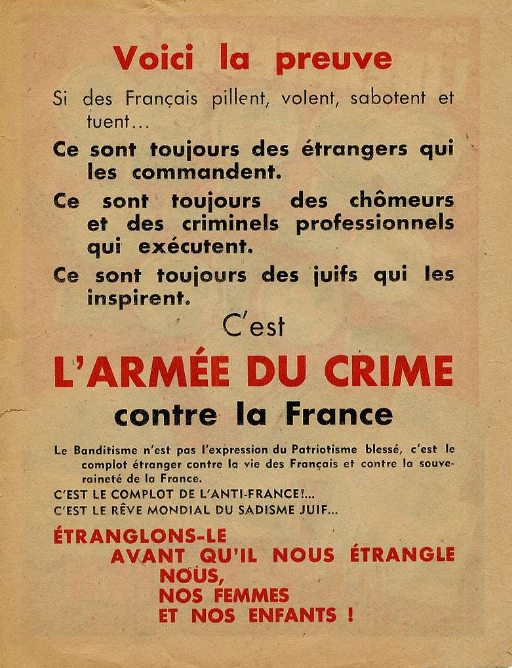
Torturé d’entrée, Michel Manouchian est traduit devant le Tribunal militaire allemand du Grand-Paris le 19 février 1944, lors d’un simulacre de procès mis en scène pour la presse collaborationniste qui se régale du lynchage de ceux de l’Affiche rouge, placardée à l’envi par les services de Vichy, reprenant les visages de Manouchian et des membres de son groupe, chacun y étant fustigé sur son origine étrangère et/ou sa judéité auxquelles sont accolés ses faits d’armes qualifiés d’«attentats», la question en haut de l’affiche «Des libérateurs ?» trouvant sa réponse en bas : «La Libération par l’armée du crime !».
L’Affiche rouge, recto-verso
Sans surprise, le tribunal condamne à mort vingt-trois des accusés. Et le 21 février 1944, à Suresnes, dans l’actuel Département des Hauts-de-Seine, au sein de la Forteresse du Mont Valérien, jadis symbole de la résistance du peuple français à l’armée allemande pendant la guerre de 1870 et, inéluctablement, sous contrôle ennemi depuis 1940, Michel Manouchian, qui a refusé d’avoir les yeux bandés devant le peloton d’exécution, tombe sous les balles du fascisme. Deux fois refusé à la naturalisation, Missak Manouchian, apatride né dans la communauté arménienne de l’Empire ottoman, mourait ainsi pour la France alors qu’elle n’avait jamais voulu de lui parmi les siens.
Le 11 avril, Joseph Epstein subira le même sort au même endroit.
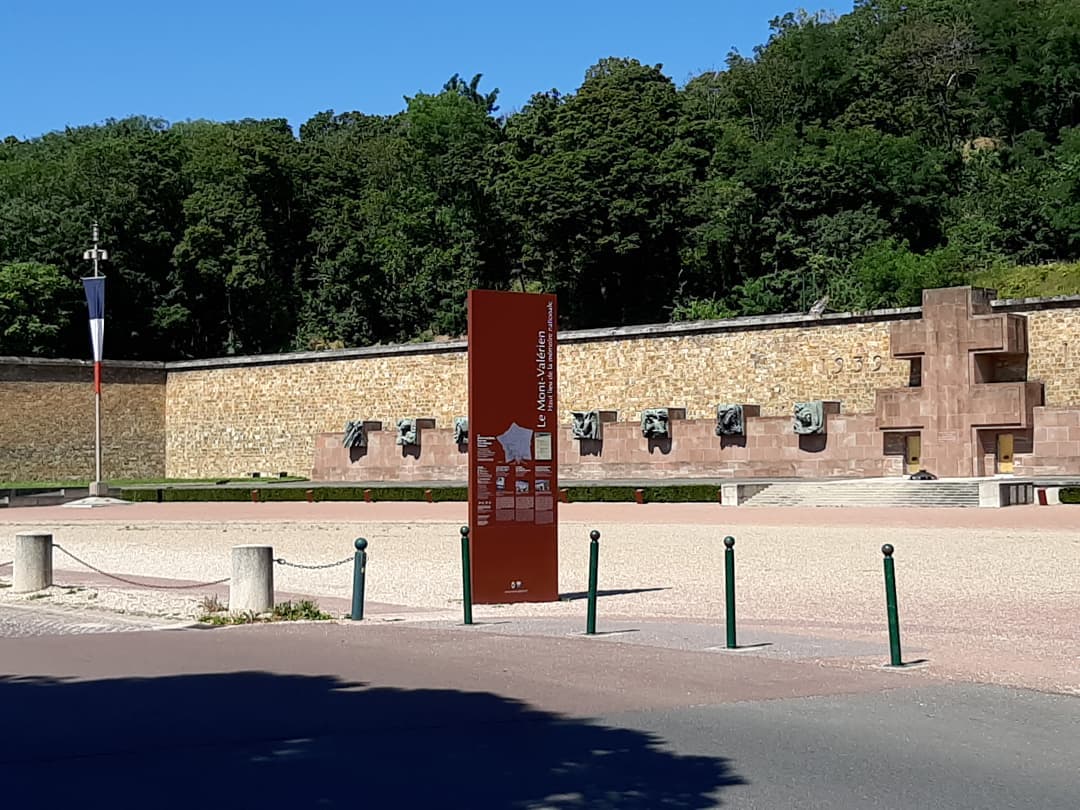
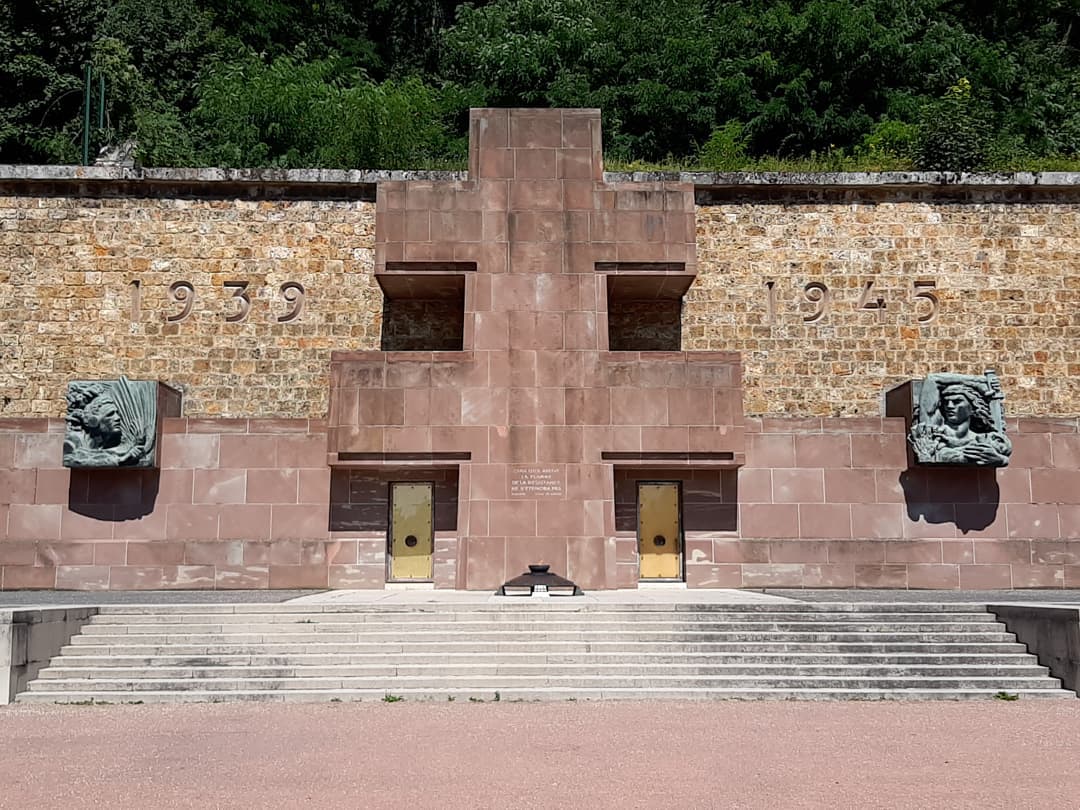
En tout, ce sont plus d’un millier de combattants de la France Libre qui seront fusillés à la Forteresse du Mont Valérien. Le 18 juin 1960, Charles de Gaulle, général et chef de la France Libre devenu Président de la République en 1958, y inaugurera le Mémorial de la France Combattante. Chaque année à la même date, le chef de l’Etat français y retrouve les autorités locales pour un hommage au pied du sanctuaire orné d’une croix de Lorraine, symbole de la Résistance gaulliste, et d’une flamme entretenue jour et nuit dont il est écrit sur place que «la flamme de la Résistance ne doit pas s’éteindre et ne s’éteindra pas».
Le Mémorial de la France Combattante du Mont Valérien(C) Bernard J. Henry/AWC
En 1959, Léo Ferré, chanteur franco-monégasque aux idées anarchistes assumées, donc hostile tant au gaullisme qu’au communisme, met en musique les Strophes pour se souvenir de Louis Aragon parues quatre ans plus tôt, sous le titre L’Affiche rouge que reprendra en 1976 le cinéaste Frank Cassenti pour raconter sur grand écran l’histoire de Michel Manouchian et ses frères d’armes dans la Résistance. Malgré ces vibrants hommages artistiques, ce n’est qu’en novembre 1978 que la ville d’Ivry-sur-Seine, dans l’actuel Département du Val-de-Marne, érigera un monument à ceux de l’Affiche rouge et les y fera inhumer. Selon l’idéologie qui animait les Résistants français, toutes leurs mémoires ne se valaient pas.
Mélinée, veuve, biographe et gardienne de la mémoire
Quant à Mélinée, ayant d’abord pris la fuite avec l’aide d’une famille arménienne résistante de Paris, les Aznavourian, dont le fils Shahnourh deviendra plus tard le chanteur Charles Aznavour, elle poursuit la lutte au sein du milieu arménien de la Résistance. Après la Libération, elle publie un recueil des poèmes de feu son époux qu’elle a traduits de l’arménien.
En 1947, répondant à l’appel de l’URSS à ses anciens ressortissants pour venir œuvrer au repeuplement, elle part pour Erevan, capitale de l’Arménie soviétique, où elle enseigne le français. Mais son dégoût du stalinisme et un cancer mal soigné la poussent à vouloir revenir en France, ce qu’elle n’est autorisée à faire qu’en 1960 avec l’avènement de Nikita Khrouchtchev.
Première biographe de Missak Manouchian, elle consacrera sa vie à promouvoir sa mémoire et celle des Arméniens de la Résistance. Après une vive polémique dans les années 1980 avec la direction du PCF sur le rôle du parti dans la mise en danger de Missak Manouchian qu’elle avait alors cherché à protéger, Mélinée s’éteint en 1989. Inhumée à Ivry-sur-Seine près de son époux mais non avec lui, elle le rejoint finalement en 1994, cinquante ans après l’exécution au Mont Valérien.
Aujourd’hui, sur la décision du Président de la République française, Emmanuel Macron, c’est ensemble qu’ils entrent au Panthéon.
Une histoire personnelle
J’habite Suresnes depuis plus de quinze ans. Je suis né à Saint-Cloud, ville voisine, et suis originaire de Rueil-Malmaison, autre ville voisine, toutes deux situées en partie comme Suresnes et Nanterre sur le Plateau du Mont Valérien. L’histoire des fusillés de la forteresse occupée est dans ma vie depuis toujours. Si je ne suis pas arménien et n’ai pas une goutte de sang en commun avec Missak Manouchian, son histoire est aussi mon histoire, l’histoire de la France et, pour moi, une histoire personnelle.
Pendant l’Occupation, une partie de ma famille maternelle habitait Nanterre, et en cette époque de bruit urbain autrement moins important qu’aujourd’hui – amoindri plus encore par les restrictions de circulation des autorités allemandes – lorsqu’une exécution avait lieu au Mont Valérien, les coups de feu s’entendaient jusque chez eux, sur le Plateau. Pour ces immigrés du nord de l’Italie, eux aussi membres de la Résistance alors que certains n’avaient jamais pu obtenir la nationalité française du temps de la Troisième République, c’était aussitôt la pensée qu’un jour, peut-être, ce serait leur tour de se retrouver devant les fusils.
Même ceux d’entre eux qui étaient toujours italiens avaient porté les armes pour la France. Non mobilisés en 1939 puisque n’étant pas citoyens français, mais sujets du Royaume d’Italie qui vivait depuis octobre 1922 sous la terreur fasciste de Benito Mussolini, c’est pourtant vers l’armée qu’ils se sont tournés en octobre 1940, lorsque Rome a rejoint son allié allemand dans la guerre contre la France. Désormais ressortissants d’un État ennemi, ils se voyaient déjà soit internés dans un camp, l’un de ces camps d’étrangers créés par le gouvernement issu du Front populaire à partir de 1938, soit déportés vers cette Italie qu’ils avaient fuie. Unanimement, ils se sont engagés dans l’armée française où leur origine italienne leur a valu d’être versés dans les Chasseurs alpins pour aller, à la frontière sud-est du pays, tirer sur leurs compatriotes. Prisonniers de guerre, certains n’obtinrent finalement la nationalité française qu’en 1953, huit ans après la fin de la Seconde Guerre Mondiale. Et aucune décoration que je sache.
Durant son «procès» devant le Tribunal militaire allemand du Grand-Paris, Missak Manouchian a jeté à la face de ses juges «La nationalité française, vous l’avez héritée, et nous, nous l’avons méritée». Mes proches ancêtres à moi l’ont eue, au risque même de leurs vies, et pourtant, les Français qui l’ont «héritée» ne se sont jamais privés de leur faire remarquer qu’ils étaient au départ des étrangers. Entre qui voulait seulement défendre sa terre ancestrale passée sous la botte de l’ennemi héréditaire s’étant montré plus fort au combat et qui voulait défendre le pays incarnant à ses yeux une idée, une liberté et presque un droit, tout le monde en France n’avait pas rejoint la même Résistance.
L’histoire de Missak Manouchian et de ceux de l’Affiche Rouge, c’est aussi mon histoire à moi, celle de la migration ouvrière et de la résistance au fascisme par-delà les nationalités et les idéologies. L’histoire du pays qui envoie aujourd’hui même le couple Manouchian reposer parmi ses plus grands mais qui, ne serait-ce qu’à travers ses dirigeants, à coups de lois sur la migration à forte teneur xénophobe et de discours «de patience malvenue», comme le chante Louis Chedid dans Anne ma sœur Anne, affirme de plus en plus fort que les héritiers politiques des Français qui ont collaboré avec l’occupant allemand ne sont pas plus dangereux que ceux des Résistants, au risque de leur offrir bientôt le pouvoir et leur permettre y compris d’anéantir, ne serait-ce que de décharner, l’histoire de la Résistance au-delà de celle de Français n’ayant cherché qu’à chasser de chez eux un ennemi étranger, sans forcément dire non à une forme de fascisme «maison» à la place.
Tout le monde en France n’a pas, comme moi, la Résistance en héritage familial. Dans d’autres familles, c’est au contraire la collaboration avec l’Allemagne nazie qui forme le passif, ou bien encore l’absence de choix d’un camp, peut-être au profit du seul impératif de survie. Une chose est sûre toutefois : le pays où nous vivons, cette France libre et démocratique, c’est bel et bien l’œuvre des Manouchian, de Robert Sarrazac et de leurs camarades de la Résistance, ce n’est pas l’État français du Maréchal Pétain auquel auraient succédé les Quatrième puis Cinquième République, comme en Espagne où la monarchie a succédé au franquisme même sans en poursuivre les politiques fascistes, à l’inverse du Portugal voisin où la Révolution des Œillets avait marqué une rupture claire et nette avec le salazarisme. Renier ou minimiser l’héritage de la Résistance, le reléguer en quelque façon au rang de passé révolu tout juste digne de la cave ou du grenier, pour chaque Française ou Français, c’est scier la branche où l’on est assis.
Comment dès lors, et surtout pourquoi, chercher à honorer dans le passé ce que l’on démonétise dans le présent ? Les honneurs rendus aux Manouchian sont-ils le premier pas vers un changement plus qu’attendu, celui du retour aux «leçons de l’histoire» chères à Elie Wiesel et George Santayana, ou bien un solde de tout compte avant de dire pour de bon que la France d’aujourd’hui ne doit plus rien à la Résistance ?
Le monde reconnaissant ?
Bien sûr, la politique de l’oubli ne touche pas que la France. Avec Donald Trump, les Etats-Unis avaient eux aussi cédé à la tentation d’oublier les grands combats de leur histoire, qu’il s’agisse de la Guerre de Sécession ou de l’héroïsme des G.I. en Normandie voilà quatre-vingts ans, et le risque existe toujours de voir, en novembre prochain, un retour à ce choix de l’oubli après quatre ans d’administration démocrate. En Italie, les héritiers politiques de Mussolini ont conquis le pouvoir. En Argentine, un candidat d’inspiration semblable, Javier Milei, a pris la présidence, et aux Pays-Bas, le parti populiste de Geert Wilders a lui aussi remporté une majorité parlementaire mais sans pouvoir quant à lui former un gouvernement. Dans l’ancien monde communiste, la Hongrie, le Belarus et bien sûr la Russie se distinguent comme les plus tragiques exemples de l’abandon d’un extrême pour verser dans son opposé. La liste n’étant hélas pas exhaustive.
Les derniers témoins de la Seconde Guerre Mondiale, en ce compris de la Shoah en Europe, disparaissent. Ce temps était voué à arriver un jour ou l’autre. Mais leurs souvenirs, leurs récits, leurs mises en garde pour le présent, leurs avertissements pour l’avenir sont aussi nombreux qu’ils sont éternels. Que les témoins de l’horreur rejoignent le monde qui attend chacune et chacun au bout de l’existence, rien que de très normal. Mais qu’ils le fassent en un temps où leur héritage se voit si méprisé, voire dans certains cas contesté, cela ne peut que résonner comme un assourdissant signal d’alarme.
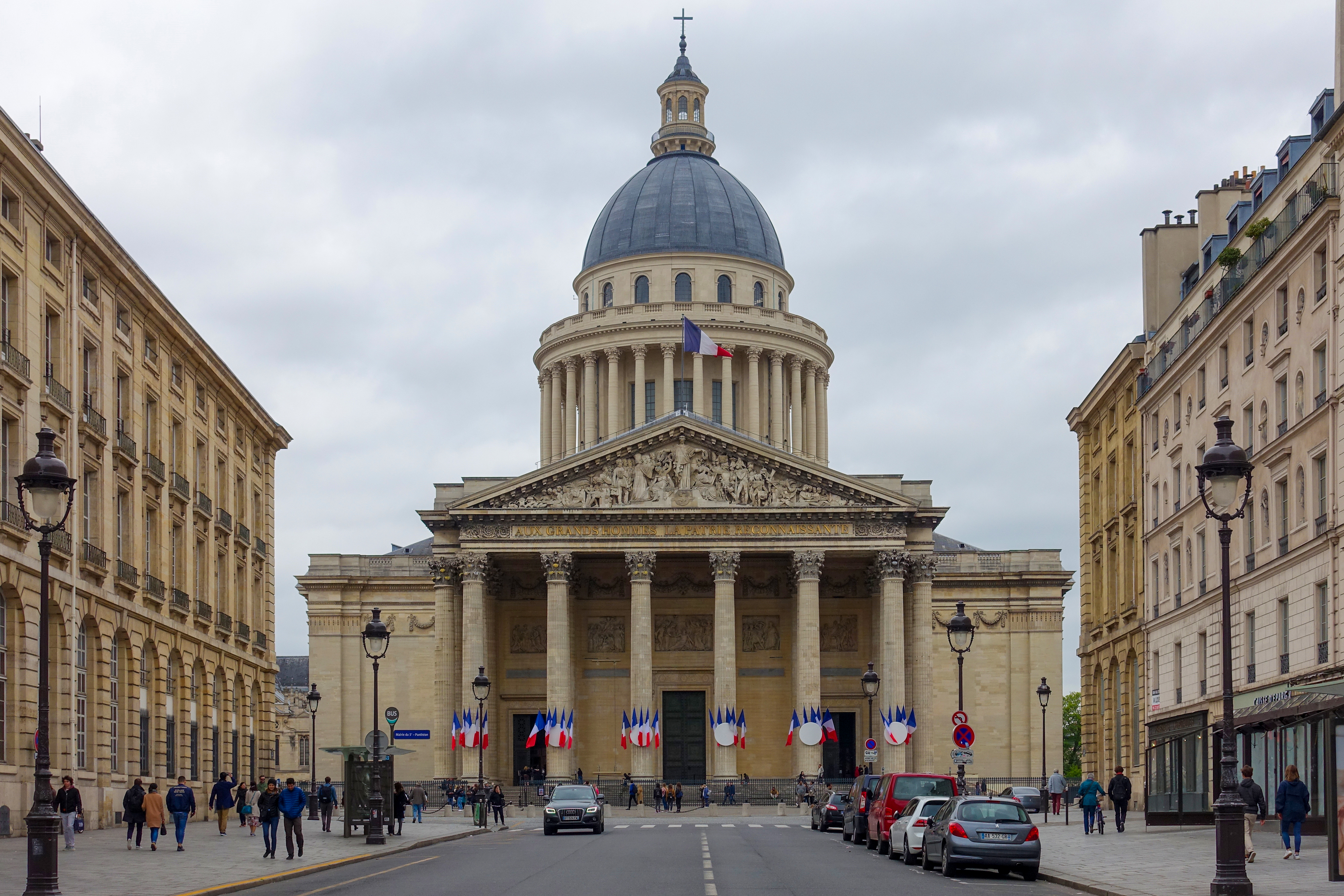
A Paris, le Panthéon porte en son fronton l’inscription «Aux grands hommes la Patrie reconnaissante», reliquat d’un temps où les femmes n’étaient pas jugées dignes de cette reconnaissance. Ce n’est qu’en 1995, avec Marie Curie, qu’une femme fut enfin admise au Panthéon, du moins pour ses mérites, la toute première ayant été, en 1907, Sophie Berthelot, l’épouse du chimiste Marcellin Berthelot qui n’avait fait que suivre le sort de son mari.
Le Panthéon à Paris (C) Guilhem Vellut
Parmi ces «grands hommes» et donc aussi désormais «grandes femmes» reposent déjà d’autres figures de la Résistance. En 1964, André Malraux y accueillait un autre ancien Résistant, légendaire préfet cadre puis martyr de la France libre, par ces mots devenus eux aussi légendaires, «Entre ici, Jean Moulin, avec ton terrible cortège», André Malraux qui rejoignit à son tour le Panthéon en 1996, où il prenait place aux côtés de deux autres figures de la Résistance, Félix Éboué et René Cassin, père de la Déclaration universelle des Droits de l’Homme. En 2015, quatre autres Résistants intégraient la crypte sacrée de la République – Pierre Brossolette, Geneviève de Gaulle-Anthonioz, Germaine Tillion et Jean Zay.
Ce n’est pas que «la Patrie», comme l’appellent les Français du haut du Panthéon, qui peut et doit leur être reconnaissante ainsi qu’aux Manouchian. C’est un monde qui, tout entier, jusqu’aux confins de la Cordillère des Andes dans une Amérique latine qui n’a jamais vu la Seconde Guerre Mondiale sur son sol, a été façonné par la lutte contre le fascisme et tout ce qu’elle a produit après la victoire.
Tout d’abord, la Déclaration universelle des Droits de l’Homme, promue par Cassin aux côtés d’Eleanor Roosevelt et que Garry Davis qualifiait, bien optimiste, de «reconnaissance politique de l’être humain». Ensuite, l’idée qu’il n’existait aucune raison pour qu’une partie du monde continue à s’approprier comme dans les temps anciens la terre, la population, les ressources et le travail de peuples en habitant d’autres, ce qui amena la fin du colonialisme occidental.
Enfin, le principe fondamental, mais si violemment bousculé depuis le début de la décennie, que la guerre de conquête et l’extermination de masse ne se justifient pas même par la guerre, ni dans les Sudètes, en Tchécoslovaquie ou en Pologne à l’époque, ni en Syrie, en Ukraine ou en Israël et dans les Territoires palestiniens aujourd’hui.
Le soldat français tué en tentant de défendre un village en mai 1940, le soldat anglais tué sur son sol natal lors du Blitz allemand, le soldat soviétique tué par la Wehrmacht dans l’ouest de la Russie après la rupture par Hitler de son pacte avec Staline, le soldat américain tué le 6 juin 1944 sur une plage de Normandie, le Résistant ou partisan tué au combat en France, en Italie ou ailleurs, tous ces héros inconnus et qui le resteront, tous méritent la reconnaissance. Mais aujourd’hui, Missak Manouchian est mis à l’honneur par celui des cinq Membres permanents du Conseil de Sécurité qui fut à la fois le plus meurtri en son territoire et le plus actif au combat contre l’Axe durant la Seconde Guerre Mondiale. C’est là un acte qui est tout autant à saluer qu’à interroger.
Quel exemple, quelle leçon, entend en tirer la France aux Nations Unies et dans sa politique étrangère – mais aussi, car le besoin en est réel, intérieure ? Quel engagement solennel, quel acte de vigilance pour l’avenir proche et lointain, viendra valider cet hommage au passé ? Quelle reconnaissance de la France, mais aussi du monde, à Missak Manouchian, «grand homme» à partir d’aujourd’hui, et à Mélinée Manouchian qui rejoint ainsi Simone Veil et Joséphine Baker, sortira de cette canonisation laïque si elle n’est un pur vœu pieux ?
La réponse se trouvera dans notre aptitude à, et/ou notre volonté de, savoir délaisser les congratulations officielles pour embrasser l’esprit et, c’est là que le mot convient le mieux, la lettre de ce qu’écrivait Missak, ou Michel, Manouchian dans son poème «Privation» :
«Quand j’erre dans les rues d’une métropole,
Toutes les misères, tous les dénuements,
Lamentation et révolte l’une à l’autre,
Mes yeux les rassemblent, mon âme les loge».
A Paris, au Quartier Latin, nous verrons passer Manouchian depuis son éternité, errant dans les rues de la métropole, et ses combats, nous les ferons nôtres. Ou bien, à Paris et partout dans le monde, enchaînés de plein gré dans notre ingratitude envers ces combats qui écrivirent toute son histoire, toute la nôtre, toute celle du monde, nous perdrons tout.
Bernard J. Henry est Officier des Relations Extérieures de l’Association of World Citizens.
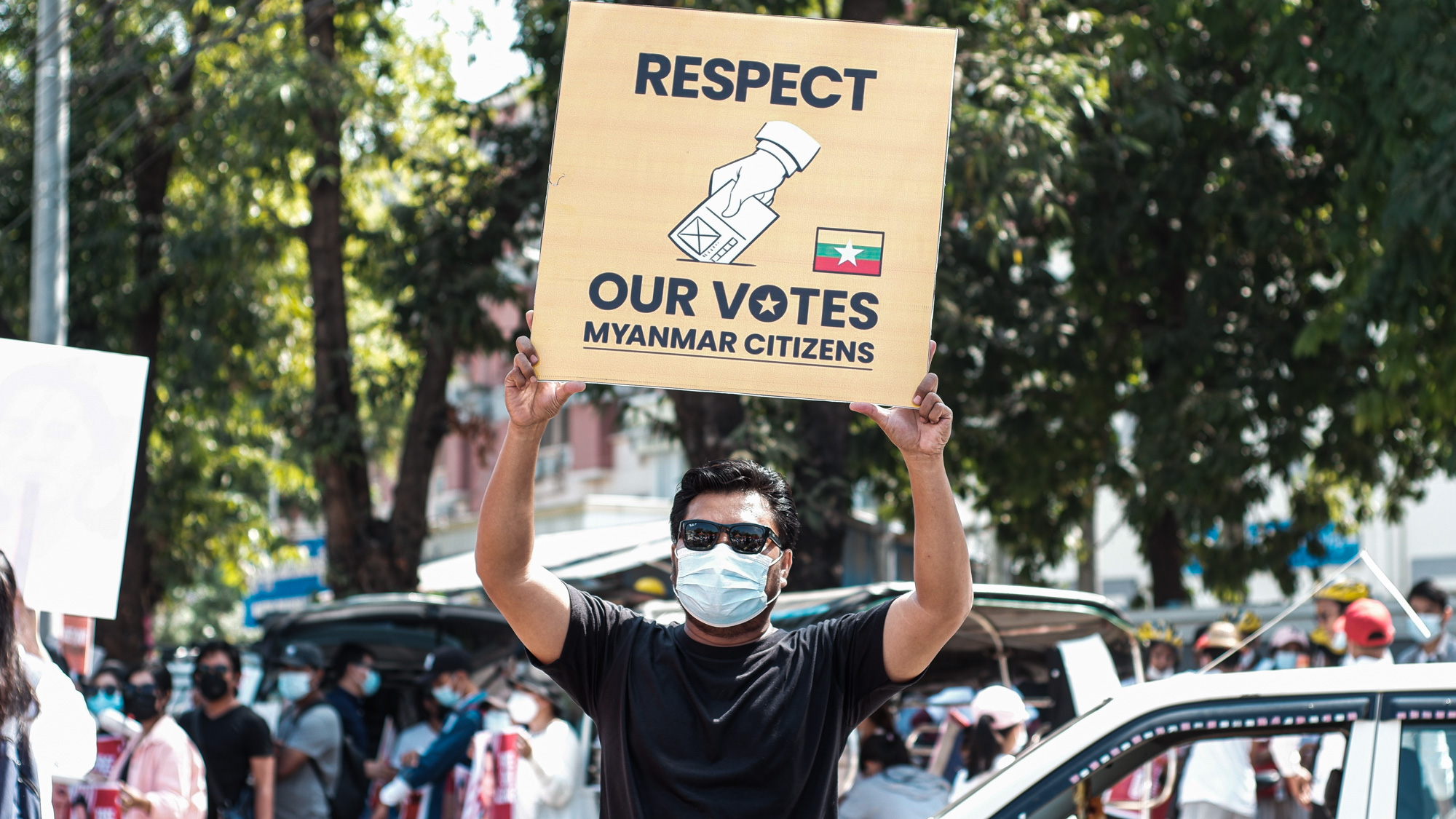
February 1 marks the anniversary of the military coup which overthrew the government of Aung San Suu Kyi in 2021. She was in practice the leader of the government but could not take the title of “President”. An earlier military junta had passed a law with her in mind saying that a person married to a foreigner could not become president. Aung San Suu Kyi had married a British anthropologist, Michael Aris, a specialist on Tibet who died in 1989 of cancer. Aung San Suu Kyi represented a new spirit – partly because she had lived most of her life outside Burma and was not linked to existing political compromises.
On February 14, 2021, a protest in Myanmar against the military coup (C) MgHla
Her father, Aung San, who died when Aung San Suu Kyi was two years old, was one of the original “Thirty Comrades” – student nationalists who were inspired by Second World War Japanese propaganda which appealed for a common Asian struggle against Western imperialism. Aung San went to Tokyo to assist the Japanese conquest of Burma. However, by 1944, the “Thirty Comrades” had decided that the Japanese were not liberators, that the occupation of Burma was carried out for Japanese rather than Burmese aims, and that the Japanese might lose the war. In the last year of the war, the “Thirty Comrades” cooperated with Lord Mountbatten.
Thus, on January 27, 1947, British Prime Minister Clement Attlee and Aung San signed an agreement for full independence of Burma within a year. On July 19, 1947, Aung San was assassinated by a political rival. He became a legend of Burmese independence.
Aung San Suu Kyi was educated in India (where her mother served as ambassador of Burma) and at Oxford University. She only returned to Burma in 1988 to take care of her dying mother. Her dynamism, combined with the legend of her father, led her to being named secretary of the National League for Democracy.
On June 14, 2012, Aung San Suu Kyi welcomed at the International Labor Organization’s premises in Geneva (C) Violaine Martin/UN Geneva
Since the military junta has taken power, it has intensified the struggle against the ethnic minorities – the Mon, Kachen, Karen, Shan, Wa, the Arakan Muslims, and others. The ethnic minorities represent some 40 percent of the population, the Burmese, some 60 percent. However, population statistics are not based on real population surveys. Decades of self-imposed isolation, fabricated statistics and an absence of social and economic research have left even the authorities without an accurate appreciation of the distribution of the population. The military have destroyed villages along the frontiers with China, India, Thailand, and Bangladesh.
While we are critical of the military government and their repressive policies, we must not idealize the forces of the ethnic insurgencies. In 1992-1993, I was involved in getting the National Council of the Union of Burma created by the insurgencies and democratic Burmese who had taken refuge in the ethnic minority zones to sign the Geneva Conventions of August 12, 1947 and the protocols additional which provide the basic rules of international humanitarian law in armed conflict. The Union President, General Saw Bo Myn of the Karen National Union, and the three Vice Presidents signed in January 1993. While the signature is symbolic – only governments may sign the Geneva conventions – the signature was widely noted and led the Myanmar government to sign the conventions which they had always refused to do until then. The signature led to a mutual release of war prisoners – but not to a formal exchange as the two sides in the conflict refused direct contact at the time.
Burma, now renamed Myanmar after 1988, faces two basic and related issues: the installation of democratic government and a constitutional system which allows autonomy to the minority peoples. Both tasks are difficult. There is little democratic tradition or ethos upon which to structure a democratic government. While a federal or con-federal system would be the most suited for a multi-ethnic state, what leadership exists both in the junta and the insurgencies is motivated by personal and clan-centered interests. The leaders recruit allies similarly motivated. Only peace will allow new leadership to emerge with broader motivations and allow all citizens to participate in a renewed political process.
Prof. René Wadlow is President of the Association of World Citizens.







 Association of World Citizens