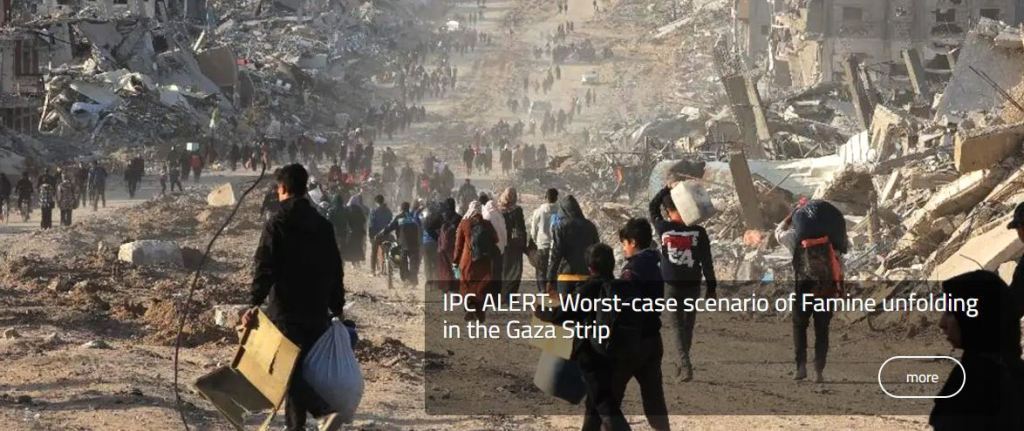
On August 22, 2025, the United Nations (UN)-related Integrated Food Security Phase Classification (IPC) highlighted that famine conditions were taking place in Gaza City and that famine is expected to spread to other parts of the Gaza Strip in the coming weeks if improvements in food supply are not made.
The IPC Report stresses that for over 90% of the children under two years old, the lack of healthy food hinders the children’s immunity and development. The scarcity also impacts pregnant and breastfeeding women, compromising the health of both mother and child. Many healthcare facilities in the Gaza Strip have been destroyed, making care for children difficult and often impossible.
The IPC report comes just as the Israeli military prepares for a full-scale takeover of Gaza City, the epicenter of the famine. When the takeover begins, it will be even harder for civilians to access the food they need to survive. Many people will be forced to move, which many persons in Gaza have already done several times.
Famine in Gaza is the result of deliberate obstruction of food and life-saving aid. There are ample food supplies at the Gaza Strip frontier ready to enter. However, the Israeli authorities have not permitted sufficient aid to enter the Gaza Strip. The basic humanitarian needs of those living in the Gaza Strip are not being met.
The Association of World Citizens is among the many Nongovernmental Organizations and aid groups which have called for a radical modification of Israeli policy so that basic needs can be met. Such radical modifications will require negotiations in good faith. The IPC report is a strong addition to these calls for positive action.
Prof. René Wadlow is President of the Association of World Citizens.
The continuing armed conflicts in Ukraine and the Gaza Strip, increased tensions between Mainland China and Taiwan with the lack of any formal governmental negotiations forces us to ask if more can be done on the part of Nongovernmental Organizations (NGOs) to encourage negotiations in good faith.
Governmental efforts, bilateral or within the United Nations (UN) can be called Track One. Track One diplomacy is official government negotiations with the backup resources of government research and intelligence agencies. There can also be Track One “back channels” of informal or unofficial contacts.
Track Two diplomacy is a non-official effort usually by an NGO or an academic institution. The use of non-official mediators is also increasing as awareness grows that there is a tragic disjuncture between the UN mandate to keep peace and its inability to intervene in conflicts within a State – often confrontations between armed groups and government forces and sometimes among different armed groups.
Track Two talks are discussions held by non-officials of conflicting parties in an attempt to clarify outstanding disputes and to explore the options for resolving them in settings that are less sensitive than those associated with formal negotiations. The participants usually include scholars, senior journalists, former government officials and former military officers. They should be in close contact with national leaders and decision-makers. The purposes of Track Two talks vary, but they are all related to reducing tensions. Much depends on the caliber and dedication of the participants and their relations with governmental leadership.
Citizens of the World were involved in one of the earliest continuing Track Two efforts. In 1959 President Eisenhower asked the world citizen Norman Cousins, editor of the New York-based journal The Saturday Review of Literature, if there were some way that could be arranged to get private Soviet and United States (U.S.) citizens together to discuss U.S.-Soviet relations.
The first meeting was held at Dartmouth College and became known as the Dartmouth Conferences held in many different places in the USA. David Rockefeller, chief of the Chase Manhattan Bank, whose name as a capitalist was known by most Soviets, was one of the active participants. Rockefeller and his family had many contacts with U.S. intellectuals and scholars on whom they could call to participate in the Dartmouth meetings.
A Russian-American Conference, Dartmouth Group, October 1962 (C) Phillips Academy Archives and Special Collections, CC BY-SA 2.0
As Kenneth Boulding, a Quaker economist who often participated in Track Two efforts wrote:
“When Track One will not do,
We have to travel on Track Two.
But for results to be abiding,
The Tracks must meet upon some siding.” (1)
Note:
1) Quoted in John W. McDonald with Noa Zanolli, The Shifting Grounds of Conflict and Peacebuilding (Lanham, MD: Lexington Books, 2008, 241 pp)
Prof. René Wadlow is President of the Association of World Citizens.
A. Fonseca Pimentel, Democratic World Government and the United Nations. Brasilia, Escopa Editions, 1980, 158pp.
The United Nations (UN) was created in the spirit of world citizenship (“We the Peoples…”). The history of the UN can be seen as the development of world citizen values and world law. The world community is in a period of vast transformation being brought about by powerful economic, political, and cultural agents to cope with the challenges of growing interdependence among all peoples and the growing impact of people on the natural environment.
Structures of world law are needed to provide a framework for this transformation. The UN General Assembly has proclaimed the standards of international law such as the Universal Declaration of Human Rights (1948) which has become the world standard and guide for both regional and national human rights law. Such declarations are part of a trend of building and strengthening a world peace structure composed of world law and intergovernmental institutions which command such general acceptance that resort to world law will replace unilateral actions of States based on narrow domestic political considerations. Governments, business corporations, and transnational social movements are increasingly convinced that they all possess a stake in an orderly world society which can be endangered by the use of force.
However, as Pimentel points out, an orderly world society is not a world society without change. No rule of law is possible without sufficient methods for solving grievances.
Fonseca Pimentel was a Brazilian scholar and economist with long experience in public administration and as a UN advisor on administrative reforms. As he notes, “The dilemma facing the United Nations is to find a way to go further on the road to world citizenship.” At this time when there is armed violence in many parts of the world and consistent violations of human rights, he sets out the challenges clearly.
Prof. René Wadlow is President of the Association of World Citizens.
The Association of World Citizens (AWC) expresses deep concern over the rising political tensions and military clashes between Thailand and Cambodia which has led to a large displacement of civilians from the border areas.
On July 24, 2025, Cambodian forces launched artillery attacks on civilian targets in Thai territory, and Thailand responded with airstrikes on Cambodia. Landmines have been set in the contested border areas. The AWC has long been active against the use of landmines. This escalation of Thai-Cambodian tensions risks a destabilization of both governments and societies.
Therefore, the AWC calls for an immediate ceasefire and the start of negotiations in good faith.
Prof. René Wadlow, President of the Association of World Citizens
July 12 has been set by the United Nations (UN) General Assembly as the International Day of Hope to be celebrated each year as a moment of light in dark times. Hope is a powerful force for positive change and for a brighter future. Hope is an important element in developing a culture of peace. Hope helps us to overcome the serious challenges which face the world society.
The Association of World Citizens was among those working with progressive governments so that on March 4, 2025, the UN General Assembly voted to set July 12 each year as the Day of Hope. Hope must, of course, be translated into action. However, at this time when many felt hopeless in the light of armed violence and wide-spread violations of human rights, a day devoted to hope agreed to by such a large number of countries is a sign of common efforts for progress.
Hope can be encouraged by programs in schools and cultural centers – a possibility for creative action by all of us.
Prof. René Wadlow is President of the Association of World Citizens.
On May 23, 2025, the United Nations (UN) High Commissioner for Human Rights, Volker Türk, gave a stark warning about the rapidly deteriorating human rights situation in the state of South Sudan. He stated that, “The escalating hostilities in South Sudan portend a real risk of further exacerbating the already dire human rights and humanitarian situation.” It is estimated that some 125,000 persons have been displaced within the country between March and mid-April 2025. In addition, there are refugees present fleeing the armed conflict in the state of Sudan. South Sudan is filled with arms from the long years of civil war: 1956-1972 and 1982-2005 between the north – largely Muslim and Arabized and the south which followed traditional tribal religions with southern leaders largely Christian. In 2011, there was a referendum in which southern Sudan voted to become the independent state of South Sudan. The Association of World Citizens was among the Nongovernmental Organizations (NGOs) observing the independence referendum.
Since independence, political life has been structured by the tensions between the President, Salva Kiir, and the Vice-president, Rick Machar. There was an armed conflict between the two from December 2013 and August 2015 in which many persons were killed. There were multiple violations of international humanitarian law and human rights abuses. In addition to the forces under the control of the two political leaders, there are a host of armed militias usually based on ethnic-clanic structures.
In July 2016, internally displaced persons in Juba, the capital of South Sudan, relocating to a cleaner, drier location across town, under the protection of the United Nations Mission in South Sudan (UNMISS). (C) Isaac Billy/UN Photo
The UN and the African Union have made efforts to reach peace agreements among the parties, but the provisions of the peace agreements have not been put into practice. There is a lack of trust on all sides. It is difficult to see how progress can be made given the intensity of the resentments. There is no doubt a need for new leadership, but there are no signs of any leaders leaving the scene. Elections are not in the style of the country. South Sudan is a situation which merits observation and reconciliation efforts when possible.
Prof. René Wadlow is President of the Association of World Citizens.
After the April 22 attack and death of 26 Indian tourists at Pahalgam in the Indian-administered area of Kashmir, tensions between India and Pakistan grew quickly. Pakistan was accused by India of backing the terrorists who had carried out the attack – a charge which Pakistan denied. Prime Minister Narendra Modi gave the Indian military “complete operational freedom”. A combination of bellicose rhetoric, domestic pressures, and political agitation led to daily exchanges of armed fire, and the shooting down of Indian jet fighters. The frontiers between the two countries were closed and diplomats withdrawn. The dangers of escalation between the two nuclear-armed countries were obvious to many.
Fortunately, outside voices called for an immediate ceasefire: U.S. President Donald Trump and his Secretary of State Marco Rubio, Antonio Guterres, Secretary-General of the United Nations (UN), and some member governments of the UN Security Council which met in closed session, as well as a good number of Nongovernmental Organizations (NGOs) involved in conflict resolution efforts such as the International Peace Bureau and the Association of World Citizens (AWC). One must now strive so that the ceasefire will hold.
The next step is to facilitate negotiations between the Indian and Pakistani governments. A first step is to create a number of confidence-building measures so that the ceasefire holds. Then there is a need to develop longer-range negotiations. There are a good number of outstanding issues, such as Kashmir, which go back to the founding of the two countries.
It may be that the current steps back from the nuclear brink will drive home the need for serious negotiations. NGOs in both India and Pakistan may help to see on what issues progress may be made. Those of us on the outside must do all we can to facilitate creative dialogue between Indians and Pakistanis.
Prof. René Wadlow is President of the Association of World Citizens.
On April 22, 2025, four gunmen killed 26 people and injured others in the Kashmir tourist center of Pahalgam, Kashmir, India. The Resistance Front claimed responsibility for the Pahalgam attack, but the group is little known. Indian officials have blamed Pakistan as being behind the attackers saying that Pakistan has a fundamentally criminal disposition in its deep state membership. Pakistan is host to Islamic militants that carry out terrorist raids in India but does not necessarily control them.
As a result of the Pahalgam attack, India has closed its border crossings into Pakistan and suspended India’s 1960 Water Treaty with Pakistan. Anti-Pakistan protests have erupted in India’s capital New Delhi and in several other cities raising fears that anti-Muslim sentiment will grow in India. Pakistan responded by closing its border crossings with India and closed its air space to Indian aircraft.
In 2019, India modified the special self-governing status of Jammu and Kashmir, and security measures have been very tight since. Nevertheless, Kashmir is an important location for tourism within India. Within 48 hours, 90 percent of the tourists in Kashmir left – a blow to farmers who sold their food to tourists and to handicraft makers. The image of a young bride sitting beside her husband’s lifeless body has been viewed multiple times and is fixed into the Indian national consciousness as the symbol of the drama.
As tensions within Jammu and Kashmir have led to armed conflicts between India and Pakistan in the past, the governments of Russia, China, Saudi Arabia and Iran have offered their good offices as mediators. On April 25, Abbas Araghchi, the Iranian Foreign Minister, said that both India and Pakistan are “brother nations” and that Iran was prepared to play a mediation role.
A ‘Beating of Retreat’ ceremony in Wagha, Pakistan, just next to India, on December 5, 2010. (C) Koshy Koshy
It may be that the governments of Russia, China, Saudi Arabia, and Iran are all too involved with advancing their own political interests in world politics to be taken as neutral mediators. Nevertheless, the India-Pakistan tensions are very dangerous and may easily grow worse if steps to reduce tensions are not taken very soon.
As Citizens of the World, we are particularly called to help create a climate for negotiations in good faith and to reduce tensions. Therefore, we need to use our worldwide links in a creative way to reduce tensions. We devote ourselves to the safeguard, restoration, and construction of peace through dialogue, cooperation and reconciliation.
One approach in which World Citizens participate is called Track Two. Track One is official government-to-government diplomacy among instructed representatives of the State although there can be “back channels” and informal contacts among the representatives of governments. Track Two consists of discussions held among non-officials of conflicting parties in an effort to clarify outstanding disputes and to explore the options for resolving them in settings that are less sensitive and often less structured and with less media attention than those associated with official negotiations. Those involved in Track Two talks usually include scholars, senior journalists, former government officials and businesspeople. Depending on the aims and styles of these meetings, the profile of Track Two participants will differ.
The specific purposes of Track Two talks vary, but they are all related to reducing tensions. By informing their respective publics, participants, may indirectly contribute to the formation of new priorities and policies.
Track Two is not the end of the story for insights gained must be incorporated into the positions of government negotiators. There is a little verse by the Quaker economist Kenneth Boulding who participated in many Track Two efforts,
When Track One will not do, We have to travel on Track Two. But for results to be abiding, The Tracks must meet upon some siding.
Today, discussions among Nongovernmental Organizations with avenues of communication to Indian and Pakistani officials should begin now. Time may be in short supply.
Prof. René Wadlow is President of the Association of World Citizens.
Early April 2025, Finland’s Prime Minister announced the state’s intention to withdraw from the 1997 Convention on the Prohibition of Anti-Personnel Mines, called for short the Ottawa Convention – reflecting the vital role that Canada played in its creation.
The Convention, which came into force on March 1, 1999, prohibits the use, production, stockpiling, and transfer of anti-personnel landmines. Over the decades, such anti-personnel mines have caused civilian harm, often of children, long after the hostilities have ended as they can be set off many years after they have been placed. The Convention has also advanced mine clearing operations, thus significantly reducing landmine-related harm and bolstered assistance for survivors.
As of March 2025, 165 states have ratified or acceded to the Convention. However, some major military powers including the USA, China, the Russian Federation, India, and Pakistan are still outside the treaty. Given the armed conflict in Ukraine, some states which have a land frontier with the Russian Federation have also indicated that they have started a withdrawal process: Finland with 1,340 km of frontier with the Russian Federation, Estonia with 294 km, Latvia with 284 km, Lithuania with 297 and Poland with 232 km.
In the same spirit as the Landmine Convention, a combination of progressive states such as Norway and Ireland and a combination of Nongovernmental Organizations (NGOs) including the Association of World Citizens (AWC) worked for the creation of the Convention on Cluster Munitions which came into force in August 2010. This Convention bans the use, production, and transfer of cluster munitions and sets deadlines for stockpile destruction and clearance of contaminated land.
Landmines and explosive remnants of a war site in South Sudan (C) UNMISS
Cluster munitions are warheads that scatter scores of smaller bombs. Many of these sub-munitions fail to detonate on impact, leaving them scattered on the ground ready to kill or maim when disturbed or handled. Reports from humanitarian organizations and mine-clearing groups have shown that civilians make up the vast majority of the victims of cluster bombs, especially children attracted by their small size and often bright colors.
The issue of the indiscriminate impact of cluster bombs was raised by the representative of the Quaker United Nations (UN) Office in Geneva and by me for the Association of World Citizens, starting in 1979. (1) Many of the same NGOs active on anti-personnel mines were also active on the cluster bomb issue – a combination of disarmament and humanitarian groups.
The withdrawal of states from the Landmine Convention is a dangerous weakening of an important arms control effort. Thus, as Citizens of the World, we ask states tempted to withdraw from the Convention on Landmines to reconsider their position. We call upon the government of Canada to reaffirm its support for the Ottawa Convention.
Note
(1) See René Wadlow, “Banning Cluster Bombs: Light in the Darkness of Conflicts”, Journal of Humanitarian Medicine, Palermo, Italy, July-September 2010.
Prof. René Wadlow is President of the Association of World Citizens.
Recent violence and growing tensions along religious, ethnic and social class lines in Syria have highlighted the need to create a framework for cooperation among civil society groups. The Peacebuilding Section of the United Nations (UN) Secretariat was created because of the difficulties of creating a peaceful and just society after a period of armed conflict. It has been noted that violence often starts up again if strong measures of reconciliation and cooperative action are not undertaken as soon as the armed conflict ends. A spirit of revenge is often present, especially among those who consider themselves as victims. Thus, there needs to an interweaving of economic improvement with social reconciliation and the creation of trust among factions.
The long, multi-layered conflict in Syria from 2011 to the departure of Bashar al-Assad in December 2024 had increased tensions among groups, but the tensions were already there, clashing over values and interests. “Pity the nation divided into fragments, each fragment deeming itself a nation” wrote Khalil Gibran in The Garden of the Prophet thinking about his home country Lebanon, but it can also be said of neighboring Syria.
External countries had quickly stepped into the armed conflict after 2011 projecting their rivalries onto Syria and jockeying for regional preeminence. Syrian civil society members had cooperated during the efforts of mediation during the early years of the conflict. The first mediator was Mr. Kofi Annan as the joint envoy of the UN and the League of Arab States in February 2012.
Kofi Annan (C) Magyar ENSZ Társaság
Kofi Annan, a former UN Secretary General, had spent his entire career in the UN system and was a seasoned mediator. From his discussions and observations, he proposed first steps based on a ceasefire with effective UN supervision, a release of arbitrarily detained persons, increased humanitarian aid, and freedom of association within Syria. The implementation of his proposals did not follow, and he resigned his mandate on August 2, 2012.
I knew somewhat Kofi Annan and knew better some members of his staff. I also knew fairly well the Secretary General of the League of Arab States Nabil al-Araby, a longtime Ambassador of Egypt to the UN in Geneva. Thus, on behalf of the Association of World Citizens (AWC), I became involved with the armed conflict in Syria.
I had discussions with Dr. Faysal Khabbaz Hamouri, the Ambassador of Syria to the UN in Geneva, to see what issues might be negotiable and if an agenda could be fixed. I also had discussions with Syrian Nongovernmental Organization (NGO) members who had come to Geneva because of the negotiations. NGO representatives, such as I for the AWC, have no standing as official mediators but can play some role through their contacts with diplomats and UN Secretariat members. From these discussions, I came to realize how deeply divided was the Syrian community involved in the political aspects of the armed conflict. There were no public negotiations in Geneva after 2015. In September 2015, Russian military troops started their heavy support of the al-Assad government.
Today, it is difficult to know what those of us who are not Syrians and who are outside of Syria can do to help build a society of social cohesion in Syria. The wider Middle East is filled with violence and tensions among Israelis and Palestinians, in Lebanon, Yemen and Iran. We have to keep our spirits open for new possibilities of positive action.
(C) Khaled Fozan
Prof. René Wadlow is President of the Association of World Citizens.