Calls from both governments and nongovernmental organizations (NGOs) for a ceasefire in the Hamas-Israel armed conflict having not been acted upon. Attention is now centered on a potential Israeli military land invasion of the Gaza Strip. Attacks from the air have already been very destructive of civilian institutions. Many persons have had their homes destroyed and have taken shelter in schools and other public buildings. There are signs that the situation will grow more violent. There are no negotiations in sight.
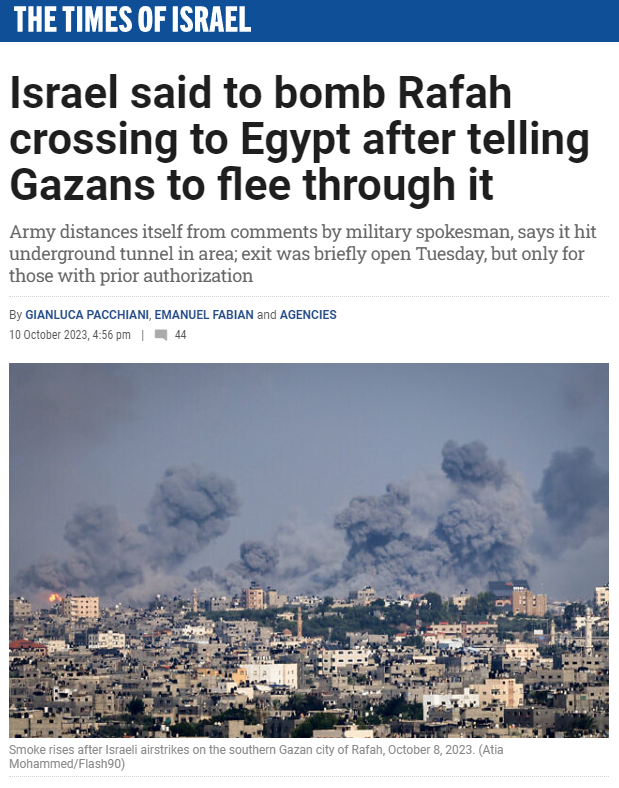
Thus, many people living in Gaza would want to leave and find safety. Passage to Israel is impossible; the frontier is now blocked, and the Israeli government considers all those living in Gaza as potential enemies. Thus, the only frontier post open is that of Rafah, leading to the Egyptian territory of Sinai. However, for the moment, the Egyptian government, fearing a mass exodus, refuses to open the Rafah post to a large number of people.
Some Palestinians fear that if there is a mass migration to Sinai, that would be a form of “ethnic cleansing” of Gaza. The population would then be replaced by Israelis. On a more positive note, potentially, the Rafah crossing could be used to bring in humanitarian supplies for Gaza collected in Egypt and elsewhere.
At this point, there should be governmental and NGO appeals to the Egyptian government to open the Rafah post to a large number of people. Facilities to meet the needs of refugees should be prepared. It is unlikely that people will spend 40 years in Sinai waiting to enter the promised land. However, current security is vital, and negotiations for longer-range conflict settlements need to start.
Prof. René Wadlow is President of the Association of World Citizens.
The Association of World Citizens (AWC), devoted to the resolution of armed conflicts through negotiations in good faith, is deeply concerned with the October 7 outbreak of violence between Hamas and Israel and the possible extension of the conflict to Hezbollah and Lebanon. The AWC stresses the need in the world society for systems of world law such as those standards expressed in International Humanitarian Law. Thus, we call for resolute action on the violations of humanitarian law in the Hamas-Israel conflict with the indiscriminate killing of civilians, the holding of hostages, and the destruction of medical and educational infrastructure.
Regular military personnel of all countries are theoretically informed of the rules of the Geneva Conventions of August 12, 1949, and the Protocol Additional adopted in 1977.
When the 1949 Geneva Conventions were drafted and adopted, it was possible to spell out in considerable detail rules regarding prisoners of war and the protection of civilians, in particular Common Article 3 (so called because it is found in all four Conventions) provides that “each Party to the conflict shall be bound to apply, as a minimum, the following provisions: Persons taking no active part in the hostilities…shall in all circumstances be treated humanely without any adverse distinction founded on race, color, religion or faith, sex, birth or wealth, or any other similar criteria.”
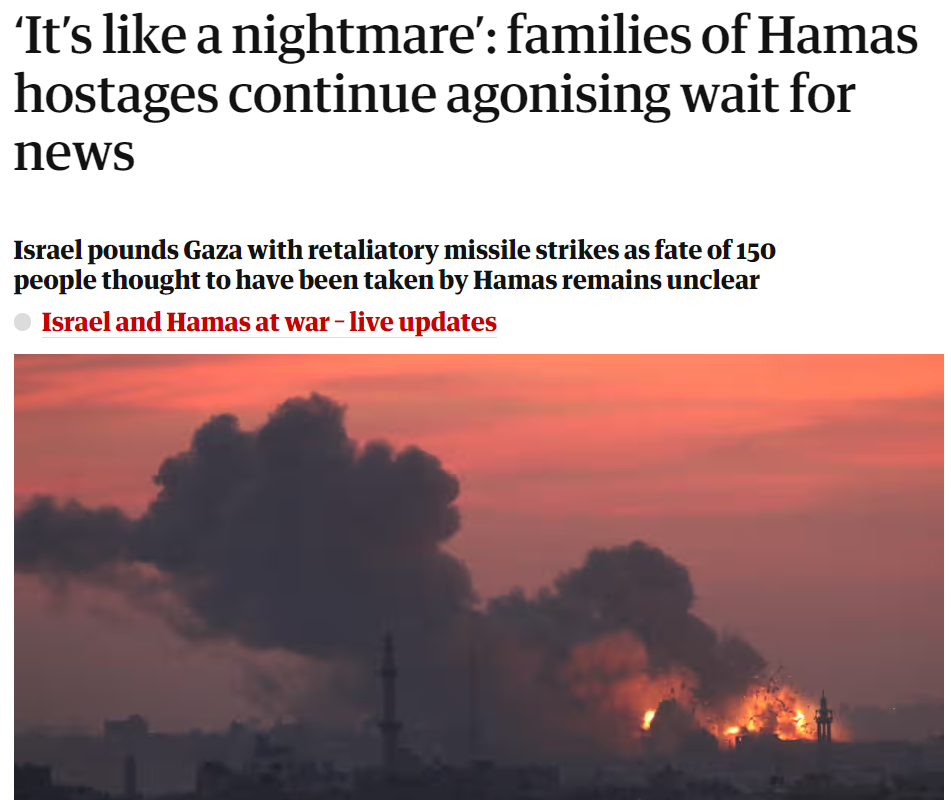
(C) The Guardian (UK)
The importance of Common Article 3 should not be underestimated. It sets out in straightforward terms important protections that all parties to a conflict must respect. In order to meet the need for additional protection, international humanitarian law has evolved to cover not only international armed conflict but also internal armed conflict. Today, international human rights standards are also considered part of international humanitarian law, thus providing additional protection for vulnerable population groups such as women, children, and minorities.
As situations of internal violence and strife proliferate, abuses committed by non-State actors, such as armed militias, are increasing concerns. Fundamental standards of international humanitarian law are intended to ensure the effective protection of human beings in all situations. The standards are clear. (1)
There are two major weaknesses in the effectiveness of international humanitarian law. The first is that many people do not know that it exists and that they are bound by its norms. Thus, there is an important role for greater promotional activities, the dissemination of information through general education, specific training of the military, outreach to armed militias, and cooperation with a wide range of nongovernmental organizations.
The second weakness is that violations of international humanitarian law are rarely punished. Governments too often tolerate these violations. Few soldiers are tried, or courtmartialed, for the violations of international humanitarian law. This weakness is even more true of nongovernmental militias and armed groups.
(C) World Health Organization
In fact, most violations of international humanitarian law are not actions of individual soldiers or militia members carried away by a sudden rush of anger, fear, a desire of revenge or a sudden sexual urge to rape a woman. Soldiers and militia members violating the norms of international humanitarian law are acting on orders of their commanders.
Thus, the only sold response is an act of conscience to refuse an order of a military or militia higher up and refuse to torture, to bomb a medical facility, to shoot a prisoner, to harm a child, and to rape a woman. Conscience, that inner voice which discerns what is right from wrong and encourages right action is the value on which we can build the defense of international humanitarian law. The defense of conscience to refuse unjust orders is a large task but a crucial action for moving toward a law-based world society.
Notes
(1) For useful guides to international humanitarian law see:
D. Schindler and J. Toman, The Laws of Armed Conflicts (Martinus Nihjoff Publishers, 1988)
H. McCoubrey and N.D. White, International Law and Armed Conflicts (Dartmouth Publishing Co., 1992)
Prof. René Wadlow is President of the Association of World Citizens.
LES CITOYENS DU MONDE APPELLENT A UNE FIN IMMEDIATE
DES HOSTILITES ENTRE ISRAEL ET LE HAMAS
ET A UN EFFORT VERITABLE DE CONSTRUCTION DE LA PAIX
POUR LE MOYEN-ORIENT
L’AWC, Organisation Non-Gouvernementale dotée du Statut Consultatif auprès de l’ONU et active à ce titre au sein du Conseil des Droits de l’Homme, est profondément alarmée de la dernière flambée de violence entre les milices armées du Mouvement de la Résistance islamique palestinien (Hamas) et les Forces de Défense israéliennes (Tsahal). Plus encore, nous sommes consternés des conséquences des attaques délibérées, perpétrées par les deux côtés, contre les droits des civils en Israël et dans la Bande de Gaza.
Depuis les attaques lancées par ses forces au petit matin du 7 octobre, le Hamas prend pour cible des civils en Israël, étant allé jusqu’à capturer des citoyens israéliens, tant civils que soldats de Tsahal, pour les garder en otage. La cause légitime d’un peuple privé de longue date de sa propre terre, cause que même l’ONU reconnaît comme légitime sur le plan international, ne saurait être servie dans la dignité par de telles méthodes qui s’inscrivent en faux contre le droit international.
Le gouvernement actuel d’Israël n’a fait que repousser les limites du mépris pour ce même droit international, à travers des déclarations et mesures répétées et insistantes visant à la discrimination systématique contre le peuple palestinien dans les Territoires palestiniens occupés (TPO). A l’intérieur même des frontières internationalement reconnues d’Israël, le gouvernement israélien actuel a également semé les graines de la discorde et de l’affrontement politique en tentant d’amoindrir les prérogatives du pouvoir judiciaire et, ce faisant, de mettre fin à la tradition de démocratie épaulée de contrepouvoirs qui est celle d’Israël.
Cette conduite mal inspirée s’avère nuisible tant au peuple palestinien qu’aux citoyens d’Israël. Elle crée à présent un chaos nouveau dans la région qui revient, selon les termes du Chapitre VII de la Charte des Nations Unies, à une menace contre la paix et la sécurité internationales. La situation risque de s’aggraver encore maintenant que le Hezbollah, notoirement soutenu par l’Iran, vient en dépit de toute sagesse de rejoindre le combat depuis le sud du Liban.
Une fois de plus, les droits des civils en Israël et dans la Bande de Gaza sont réduits à l’état de victimes de la haine et de la violence qu’ont déchaîné les deux côtés en l’absence d’un effort international, faisant cruellement défaut mais se voyant constamment refusé, pour résoudre le conflit du Moyen-Orient en s’attaquant à ses causes premières mêmes, au nombre desquelles l’exigence de justice qui est celle du peuple palestinien et le besoin de sécurité qui est celui de l’Etat d’Israël.
En conséquence, l’AWC réitère son appel à la fin immédiate des hostilités en Israël et dans la Bande de Gaza. Nous appelons également à la libération de toute personne, qu’il s’agisse d’un civil ou d’un militaire, prise en otage par le Hamas.
Nous en appelons de surcroît à la communauté internationale pour enfin entreprendre un effort authentique de construction de la paix en Israël et dans les TPO, ce en prenant pleinement en compte les causes premières du conflit et en faisant droit comme il convient à la légitime revendication du peuple palestinien pour la justice ainsi qu’à la revendication tout aussi légitime du peuple israélien pour la sécurité.
AND FOR A GENUINE PEACEBUILDING EFFORT IN THE MIDDLE EAST
The AWC, a Nongovernmental Organization in Consultative Status with the United Nations (UN) and accredited with the UN Human Rights Council, is deeply alarmed at the latest flare of violence between the armed militias of the Palestinian Islamic Resistance Movement (Hamas) and the Israeli Defense Force (IDF). Most importantly, we are appalled at the consequences of the deliberate attacks from both sides on the rights of civilians in Israel and the Gaza Strip.
Since the attacks launched by its forces in the early morning of October 7, Hamas has been targeting civilians in Israel, even capturing Israeli citizens, both civilians and IDF soldiers, to keep them as hostages. The legitimate cause of a people long deprived of their own land, a cause that even the UN recognizes as internationally legitimate, cannot be served in dignity by such methods that run counter to international law.
The current government of Israel has been constantly pushing the limits of disregard for the same international law, through repeated and insistent statements and practices aiming at systematic discrimination against the Palestinian people in the Occupied Palestinian Territory (OPT). Within the internationally recognized borders of the State of Israel, the current Israeli Government has also sowed the seeds of discord and political strife by trying to lessen the powers of the judicial branch and, in so doing, to end Israel’s tradition of democracy with checks and balances.
This misguided conduct has proved harmful to both the Palestinian people and the citizenry of Israel. It is now creating new chaos in the region amounting to, in the very words of Chapter VII of the UN Charter, a threat to international peace and security. The situation could get even worse as Hezbollah, notoriously backed by Iran, has now unwisely joined the fight from South Lebanon.
Once more, the rights of civilians in Israel and the Gaza Strip are falling victim to the hatred and violence unleashed by both sides in the absence of a badly needed but constantly denied international effort to tackle the Middle East conflict right from its root causes, including the Palestinian people’s demand for justice and the State of Israel’s need for security.
Consequently, the AWC reiterates its call for an immediate end to hostilities in Israel and the Gaza Strip. We also call for the release of every person, civilian or military, taken hostage by Hamas.
We further urge the international community to finally undertake a genuine peacebuilding effort in Israel and the OPT by addressing the root causes of the conflict and duly acting on the legitimate claim of the Palestinian people for justice and the equally legitimate claim of the Israeli people for security.
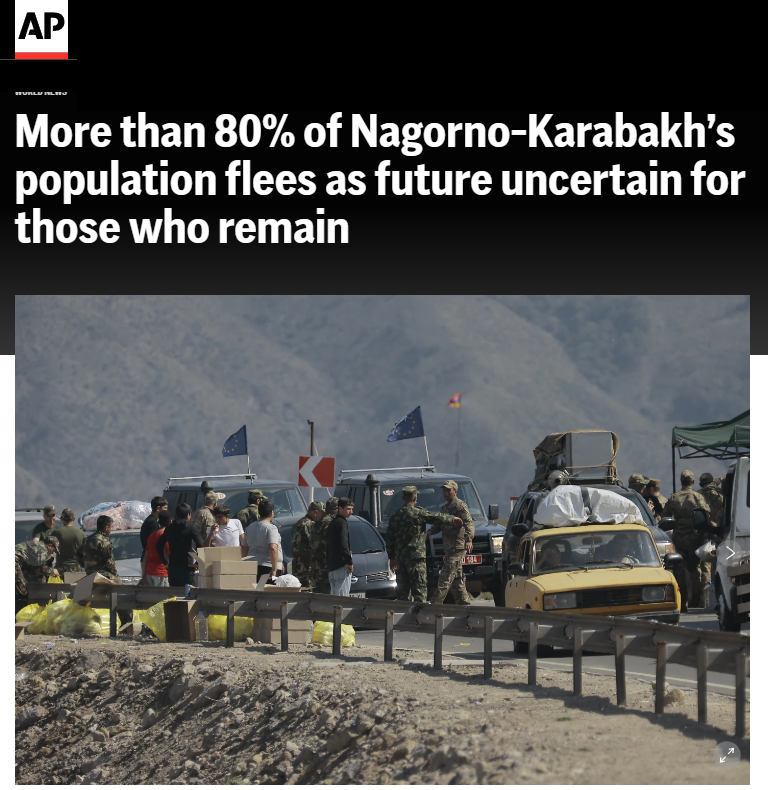
Recent events in Nagorno-Karabakh in the conflict between Azerbaijan and Armenia have raised the issue of possible genocide and the role that the 1948 Convention on Genocide may play.
Genocide is the most extreme consequence of racial discrimination and ethnic hatred. Genocide has as its aim the destruction, wholly or in part, of a national, ethnic, racial, or religious group as such. The term was proposed by the legal scholar Raphael Lemkin, drawing on the Greek genos (people or tribe) and the Latin –cide (to kill) (1). The policies and war crimes of the Nazi German government were foremost on the minds of those who drafted the Genocide Convention, but the policy was not limited to the Nazis (2).
The Genocide Convention is a landmark in the efforts to develop a system of universally accepted standards which promote an equitable world order for all members of the human family to live in dignity. Four articles are at the heart of this Convention and are here quoted in full to understand the process of implementation proposed by the Association of World Citizens (AWC), especially of the need for an improved early warning system.
Article I
In the present Convention, genocide means any of the following acts committed with intent to destroy, in whole or in part, a national, ethnical, racial or religious group, as such:
(a) Killing members of the group; (b) Causing serious bodily or mental harm to members of the group; (c) Deliberately inflicting on the group conditions of life calculated to bring about its physical destruction in whole or in part; (d) Imposing measures intended to prevent births within the group; (e) Forcibly transferring children of the group to another group.
Unlike most humanitarian international law which sets out standards but does not establish punishment, Article III sets out that the following acts shall be punishable:
(a) Genocide; (b) Conspiracy to commit genocide; (c) Direct and public incitement to commit genocide; (d) Attempt to commit genocide; (e) Complicity in genocide
Article IV
Persons committing genocide or any of the other acts enumerated in article III shall be punished, whether they are constitutionally responsible rulers, public officials or private individuals.
Article VIII
Any Contracting Party may call upon the competent organs of the United Nations to take such action under the Charter of the United Nations as they consider appropriate for the prevention and suppression of acts of genocide or any of the other acts enumerated in article III.
Numerous reports have reached the Secretariat of the United Nations (UN) of actual, or potential, situations of genocide: mass killings; cases of slavery and slavery-like practices, in many instances with a strong racial, ethnic, and religious connotation — with children as the main victims, in the sense of article II (b) and (c). Despite factual evidence of these genocides and mass killings as in Sudan, the former Yugoslavia, Rwanda, Burundi, the Democratic Republic of Congo, Sierra Leone and in other places, no Contracting Party to the Genocide Convention has called for any action under article VIII of the Convention.
As Mr. Nicodème Ruhashyankiko of the Sub-Commission on Prevention of Discrimination and Protection of Minorities wrote in his study of proposed mechanisms for the study of information on genocide and genocidal practices “A number of allegations of genocide have been made since the adoption of the 1948 Convention. In the absence of a prompt investigation of these allegations by an impartial body, it has not been possible to determine whether they were well-founded. Either they have given rise to sterile controversy or, because of the political circumstances, nothing further has been heard about them.”
Raphael Lemkin
Yet the need for speedy preventive measures has been repeatedly underlined by UN Officials. On December 8, 1998, in his address at UNESCO, UN Secretary-General Kofi Annan said “Many thought, no doubt, that the horrors of the Second World War — the camps, the cruelty, the exterminations, the Holocaust — could not happen again. And yet they have, in Cambodia, in Bosnia and Herzegovina, In Rwanda. Our time — this decade even — has shown us that man’s capacity for evil knows no limits. Genocide — the destruction of an entire people on the basis of ethnic or national origins — is now a word of our time, too, a stark and haunting reminder of why our vigilance must be eternal.”
In her address Translating words into action to the UN General Assembly on December 10, 1998, the then High Commissioner for Human Rights, Ms. Mary Robinson, declared “The international community’s record in responding to, let alone preventing, gross human rights abuses does not give grounds for encouragement. Genocide is the most flagrant abuse of human rights imaginable. Genocide was vivid in the minds of those who framed the Universal Declaration, working as they did in the aftermath of the Second World War. The slogan then was ‘never again’. Yet genocide and mass killing have happened again — and have happened before the eyes of us all — in Rwanda, Cambodia, the former Yugoslavia and other parts of the globe.”
We need to heed the early warning signs of genocide. Officially directed massacres of civilians of whatever numbers cannot be tolerated, for the organizers of genocide must not believe that more widespread killing will be ignored. Yet killing is not the only warning sign. The Convention drafters, recalling the radio addresses of Hitler and the constant flow of words and images, set out as punishable acts “direct and public incitement to commit genocide”. The Genocide Convention, in its provisions concerning public incitement, sets the limits of political discourse. It is well documented that public incitement — whether by Governments or certain non-governmental actors, including political movements — to discriminate against, to separate forcibly, to deport or physically eliminate large categories of the population of a given State, or the population of a State in its entirety, just because they belong to certain racial, ethnic, or religious groups, sooner or later leads to war. It is also evident that, at the present time, in a globalized world, even local conflicts have a direct impact on international peace and security in general. Therefore, the Genocide Convention is also a constant reminder of the need to moderate political discourse, especially constant and repeated accusations against a religious, ethnic, and social category of persons. Had this been done in Rwanda, with regard to the Radio Mille Collines, perhaps that premeditated and announced genocide could have been avoided or mitigated.
For the UN to be effective in the prevention of genocide, there needs to be an authoritative body which can investigate and monitor a situation well in advance of the outbreak of violence. As has been noted, any Party to the Genocide Convention (and most States are Parties) can bring evidence to the UN Security Council, but none has. In the light of repeated failures and due to pressure from nongovernmental organizations, the Secretary-General has named an individual advisor on genocide to the UN Secretariat. However, he is one advisor among many, and there is no public access to the information that he may receive.
Therefore, a relevant existing body must be strengthened to be able to deal with the first signs of tensions, especially ‘direct and public incitement to commit genocide.” The Committee for the Elimination of Racial Discrimination (CERD) created to monitor the 1965 International Convention on the Elimination of All Forms of Racial Discrimination would be the appropriate body to strengthen, especially by increasing its resources and the number of UN Secretariat members which service the CERD. Through its urgent procedure mechanisms, CERD has the possibility of taking early-warning measures aimed at preventing existing strife from escalating into conflicts, and to respond to problems requiring immediate attention. A stronger CERD more able to investigate fully situations should mark the world’s commitment to the high standards of world law set out in the Genocide Convention.
Notes
1) Raphael Lemkin. Axis Rule in Occupied Europe (Washington: Carnegie Endowment for World Peace, 1944).
2) For a good overview, see: Samantha Power. A Problem from Hell: America and the Age of Genocide (New York: Basic Books, 2002)
3) William Schabas, Genocide in International Law (Cambridge: Cambridge University Press, 2000)
4) E/CN.4/Sub.2/1778/416, Para 614
Prof. René Wadlow is President of the Association of World Citizens.
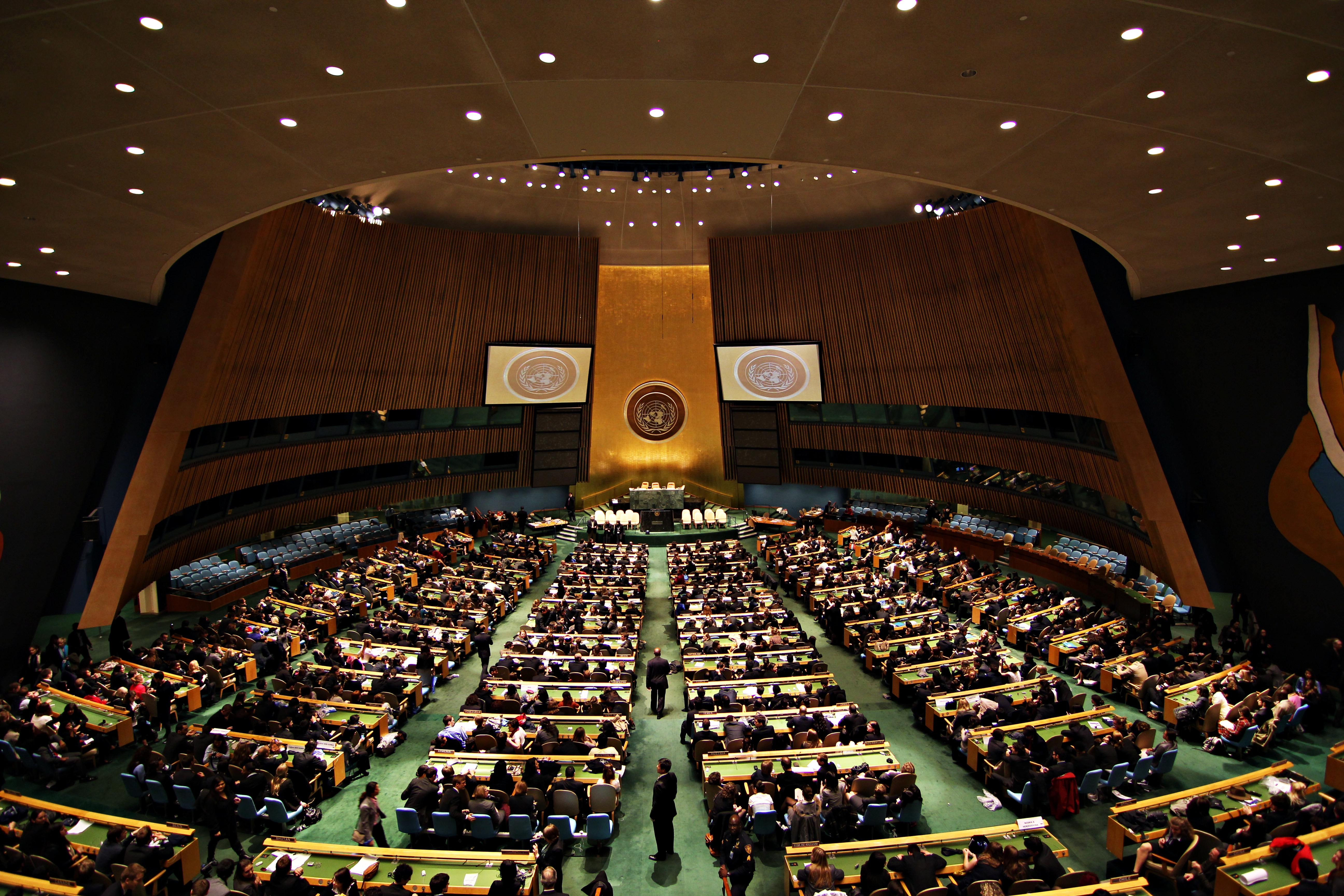
With the United Nations (UN) General Assembly starting on September 19, there is a good deal of reflection among governments and Nongovernmental Organizations (NGOs) as to the effectiveness of the UN to meet the challenges facing the world community.
In 1992, the then Secretary-General, Boutros Boutros-Ghali, outlined a post-Cold War Agenda for Peace. He built his Agenda on four key pillars for UN action: Preventive Diplomacy, Peacemaking, Peacekeeping, and Post-conflict Peacebuilding. Today, these four pillars remain the heart of UN action. What is new from 1992 is the increased role of NGOs and potentially of the international business community, both in preventive diplomacy and post-conflict peacebuilding.
Preventive diplomacy is the more important and requires creative action when there are signs of tensions which can develop into armed conflict unless preventive measures are taken on a variety of fronts. There were at least four months of protests and nonviolent efforts in Syria before the armed violence and counterviolence exploded. This period might have been used to see if needed reforms could be put into place.
(C) Basil D. Soufi/GPA Photo Archive
Likewise, signs of growing tensions between the Russian Federation and Ukraine were visible to many prior to the Russian attack. There had been the “Normandy Effort” – Russia, Ukraine, France, and Germany. There was no visible UN leadership and few NGO efforts to build on this mediation effort to create new constitutional structures within Ukraine.
Today, there are other tension situations that require preventive action: India-China frontier disputes, South China Sea delimitation issues, China-Taiwan tensions, increasing tensions within Myanmar which are already violent but can easily spread if things continue as they are going, the struggle for power in Sudan, and increased Israeli-Palestinian tensions.
For NGOs concerned with peacemaking, there is a need to create mediation teams which can act quickly and have already developed avenues of communication with the authorities, media, and significant actors in those countries where tensions are growing. The winds of violence usually give signs before they are full blown. Creative preventive diplomacy is urgently needed.
Prof. René Wadlow is President of the Association of World Citizens.
«Bâtir des châteaux en Espagne», que signifie cette expression devenue quelque peu désuète en français ? Elle désigne une personne qui se crée des rêves et des projets chimériques, qu’il ne lui sera jamais possible d’atteindre. L’expression remonterait au seizième siècle, se référant au manque de châteaux dans la péninsule ibérique où, après la Reconquista de 1492, ceux-ci avaient été détruits afin que les Maures, l’ennemi musulman chassé et rêvant de revanche comme le met en scène Corneille dans Le Cid, ne puisse en cas d’invasion les prendre et en faire des places fortes. Depuis lors, «bâtir des châteaux en Espagne» désigne ce qu’il est absurde d’envisager et ne peut exister.
Si l’Espagne est le lieu, au théâtre, des exploits du jeune Don Rodrigue, avant même Corneille et depuis l’Espagne même puisque Guillén de Castro avait écrit avant lui Les Enfances du Cid (Las Mocedades del Cid), elle est aussi celui, en littérature, de l’épopée de deux autres seigneurs, deux «Don», aux ambitions bien opposées.
En ce même dix-septième siècle, Tirso de Molina écrivait El Burlador de Sevilla y convidado de piedra, L’Abuseur de Séville et le convive de pierre, première évocation de Don Juan, séducteur sans scrupule, qui se vit par la suite transposé sur scène par Molière dans Dom Juan ou le festin de pierre puis à l’opéra par Mozart dans Don Giovanni.
C’est aussi l’époque où Miguel de Cervantes rédige son El ingenioso hidalgo don Quijote de la Mancha, L’Ingénieux Don Quichotte de la Mancha, où un hidalgo de basse noblesse se décrète chevalier du Moyen Age et décide de parcourir l’Espagne pour faire justice – fût-ce au prix de l’absurde et du ridicule, comme lorsqu’il décide de s’attaquer à des moulins à vent qu’il prend pour des géants.
En 1965, les Américains Dale Wasserman, Joe Darion et Mitch Leigh créèrent à partir du même personnage une comédie musicale intitulée Man of La Mancha (L’homme de la Mancha). Cervantes lui-même y est mis en scène et Don Quichotte, voulu par son auteur initial comme la satire d’une société espagnole par trop rigide et passéiste, devient un homme noble de naissance mais aussi d’esprit, porté par une «quête» qui le pousse à rechercher «l’inaccessible étoile». Portée à l’écran en 1972 par Arthur Hiller puis adaptée en français par Jacques Brel, la comédie musicale deviendra surtout connue pour sa chanson-phare La Quête, que reprendront ensuite sur scène plusieurs chanteurs français illustres comme Julien Clerc et Johnny Hallyday. «Tenter, sans force et sans armure, D’atteindre l’inaccessible étoile», je mentirais en disant que je n’y trouve pas une certaine inspiration, voire une inspiration certaine, certains jours de regard courbé – là et, à vrai dire, dans tout le reste de la chanson.
Hélas, depuis plusieurs semaines, les Cid et les Don Quichotte semblent avoir perdu le chemin de Madrid, là où les Don Juan, non pas les losers de la séduction chantés avec dérision par Claude Nougaro mais les vrais, ceux qui jouent des femmes comme d’objets et se voient engloutis par l’enfer – ou, du moins, prennent une sérieuse option sur un aller simple là-bas le jour venu de quitter ce monde, donnent le sentiment amer de retenir désormais toute l’attention de l’Espagne, et avec elle de toute la terre, pour des forfaits autrement plus graves que la séduction impertinente et égoïste d’un grand d’Espagne qui se rêvait aussi pourfendeur de Dieu lui-même.
Luis Rubiales soutenu par Woody Allen : «Il ne l’a pas violée»
Qui dit Coupe du Monde de Football disait jadis compétition, tous les quatre ans, entre des équipes d’hommes. C’était oublier que, depuis 1991, la Fédération internationale de Football Association (FIFA) organise aussi, tous les quatre ans, une Coupe du Monde Féminine de Football, créée en 1970 et donc «officielle» depuis plus de trente ans. Là où les éditions précédentes s’étaient tenues sans susciter grand intérêt chez les médias internationaux, l’édition 2023 a brisé les codes et mis le football féminin pour de bon sur la carte du sport mondial.
Le 20 août, à l’issue du match remporté par l’Espagne, Luis Rubiales, Président de la Royale Fédération espagnole de Football (FREF), vient féliciter l’attaquante Jenni Hermoso mais, sans demander la permission ni y être invité, lui agrippe l’entrejambes et l’embrasse sur les lèvres. La footballeuse confirme n’avoir jamais donné son consentement, ce qui fait du baiser forcé de Luis Rubiales une agression sexuelle.
Après les Américaines victorieuses en 2019, là où leurs homologues masculins ne rencontrent guère de succès lors des rencontres internationales, ce sont les Espagnoles qui ont remporté la Coupe cette année, en vainquant les Anglaises qui jouaient, sinon à domicile, du moins à l’intérieur du Commonwealth puisque l’organisation de la Coupe avait été confiée conjointement à l’Australie et la Nouvelle-Zélande. Mais tout juste derrière l’exploit sportif des Espagnoles se cachait une fin autrement plus dramatique de cette épopée sportive, une fin inadmissible en elle-même, plus encore en cette année 2023 où le film Barbie, érigé en conte philosophique pour les droits des femmes, a bouleversé le monde.
Aussitôt mis en cause, Luis Rubiales balaie toute accusation, se posant en victime de ce qu’il présente comme «un faux féminisme», alors que le monde entier l’a vu et que Jenni Hermoso confirme qu’elle n’était pas consentante. Le 26 août, la RFEF suspend Rubiales de la présidence, qu’il refuse cependant de quitter. En fin de compte, le 10 septembre, Rubiales annonce bel et bien sa démission, à l’issue d’une carrière de dirigeant de la RFEF déjà émaillée de scandales.
Il part non sans avoir reçu, pour son agression sexuelle contre Jenni Hermoso, le soutien de Woody Allen, le célèbre acteur-réalisateur américain lui-même accusé d’abus sexuels sur sa fille adoptive Dylan et qui vient donc affirmer des gestes de Rubiales sur Jenni Hermoso qu’il «ne l’a pas violée». Comme le dit l’expression américaine, With friends like these, who needs enemies?, Avec des amis pareils, on n’a plus besoin d’ennemis !
Isa Balado : «Tu as vraiment besoin de me toucher le cul ?»
A peine l’Espagne et le monde sortaient-ils du scandale Rubiales qu’un nouveau drame se produisait, une fois encore en public et en direct à la télévision. Et le lieu ne pouvait être plus annonciateur puisque l’agression s’est produite à Madrid, Place … Tirso de Molina.
Le 12 septembre, lors de l’émission En Boca de Todos (Tout le Monde en Parle) de la chaîne espagnole Cuatro, la journaliste Isa Balado s’exprimait en extérieur face caméra. Arrivant par derrière, un homme lui a demandé pour quelle chaîne elle travaillait – mais non sans lui avoir, devant la caméra, touché les fesses.
Le présentateur de l’émission a demandé à Isa Balado de confirmer le geste abject de l’importun, ce qu’Isa Balado n’a pu que faire, embarrassée. Après qu’elle a fait remarquer son forfait au coupable, qui l’a nié, elle a ajouté que même lui demander pour quelle chaîne elle travaille n’autorisait pas un tel abus gestuel. «¿De verdad me tienes que tocar el culo?», «Tu as vraiment besoin de me toucher le cul ?» a lancé Isa Balado à son agresseur. Après avoir tenté cette fois de toucher les cheveux d’Isa Balado, qui a tourné la tête pour esquiver le geste, il a fini par s’en aller.
Le scandale fut immédiat, avec des réactions y compris au niveau du Gouvernement, et après un appel de Cuatro à la Police nationale espagnole, l’auteur des attouchements fut rapidement arrêté. Mais rien n’était pourtant réglé.
Malgré le flagrant délit, filmé en direct, le Tribunal de Première Instance N° 54 de Madrid rejeta les réquisitions du parquet qui exigeait l’interdiction pour l’agresseur de communiquer avec sa victime et de s’approcher à moins de trois cents mètres d’elle. Pour le président du tribunal, l’accusé «ne connaissait pas la victime jusqu’au moment des faits», bien qu’il reste à expliquer en quoi ce serait une excuse, et l’agression contre Isa Balado ne constituait pas «une situation de risque, d’urgence, de violence ou d’intimidation contre la journaliste», toute femme dans la rue devant donc selon lui se sentir en sécurité lorsqu’un inconnu vient toucher son corps sans permission ni demande de sa part.
L’affaire ayant été transmise à une autre juridiction pour compétence, les réquisitions du parquet peuvent toutefois encore être acceptées et mises en application. Il n’en demeure pas moins que, même en ce cas, le premier juge saisi aura bel et bien refusé d’agir contre l’auteur d’une agression sexuelle devant des millions de téléspectateurs … Avec tout ce que cela dit d’une société, Amnesty International elle-même qualifiant l’acte de «violation des Droits Humains«, là où un juge nommé par l’Etat et payé par le contribuable pense qu’une femme peut être la Barbie d’un homme non parce qu’elle lui fait comprendre qu’elle a des droits égaux aux siens mais parce qu’il pourrait la toucher tant qu’il le veut, où il le veut, quand il le veut, voire la déshabiller et l’abandonner à son dénuement s’il en trouve une autre plus divertissante.
(C) Amnesty International
Agressées en Espagne pour avoir défendu les prisonnières politiques du Nicaragua
Ces deux affaires ayant eu lieu en Espagne, du moins entre des sujets espagnols, doivent-elles amener à conclure que le pays serait spécialement sexiste ? Deux malfaisants ne représenteront jamais tout un peuple, et bien que l’Espagne reste une société patriarcale comme toutes les sociétés du bassin méditerranéen où cohabitent les cultures chrétienne, juive et musulmane, les réactions fortes du Gouvernement espagnol démontrent que l’impunité en la matière y est révolue.
Le malheur, c’est que le Royaume d’Espagne est une nation de la WENA (Western Europe and North America ; Europe occidentale et Amérique du Nord) qui donne des leçons au monde entier sur les droits des femmes, et si ni l’Espagne entière ni, a fortiori, ses gouvernants ne sont ici en faute, leur attitude ayant justement été la bonne, il suffit de trois Espagnols, dont l’un agissant tout de même comme juge, pour donner le pire des exemples en Espagne même et partout ailleurs au monde.
Et le mauvais exemple a frappé au moins une fois déjà, les victimes en étant des ressortissantes du Nicaragua où Daniel Ortega et Rosario Murillo imposent désormais leur règne sans partage. Le pire, c’est que leurs agresseurs n’étaient pas des agents de l’Etat en uniforme, main sur la matraque ou prêts à tirer sur des femmes désarmées et prises pour cible sans les avoir provoqués, quelque part dans une ruelle sombre de Managua ou à l’abri du silence d’un village reculé. Il s’agissait de civils, eux aussi désarmés, et l’agression ne s’est pas produite au Nicaragua mais … En Espagne.
Le 24 août, lors du concert d’un chanteur péruvien dans une txosna, auberge traditionnelle accueillant des spectacles, au Pays Basque espagnol, un groupe de femmes nicaraguayennes avaient déployé le drapeau de leur pays accompagné de l’inscription Libertad a las presas políticas, Liberté pour les prisonnières politiques. Soudainement, un homme s’est approché d’elles, les invectivant sur l’inscription qu’elles brandissaient, et sitôt qu’elles ont répliqué qu’elles avaient le droit d’être là, l’homme s’est mis à pousser l’une d’elles avec violence. Une barrière humaine s’est aussitôt formée pour défendre les féministes nicaraguayennes, et après leur avoir crié qu’elles «ne connaissaient pas le passé du Nicaragua», rien de moins, l’homme a été contraint de s’en aller.
Se croyant délivrées de leur agresseur, les féministes n’étaient pourtant pas pour autant à l’abri. Peu après, un autre homme, qui s’est présenté comme membre d’Askapeña, organisation indépendantiste basque se réclamant de l’internationalisme marxiste, est venu les prendre à partie en exigeant qu’elles s’en aillent immédiatement. S’étant prévalues là encore de leur droit d’être présentes à la txosna en tant qu’espace de liberté, les féministes nicaraguayennes se sont entendu rétorquer par l’homme qu’il insistait pour qu’elles s’en aillent au nom de la «solidarité internationaliste», ajoutant que brandir leur drapeau en revendiquant la libération des prisonnières politiques était «une honte» et qu’elles n’avaient «aucune idée de ce qu’est la politique». Devant leur insistance, l’homme est monté sur la scène, interrompant le concert. Au micro, il a désigné les féministes à toute la salle, leur enjoignant de «s’attendre aux conséquences de leurs actes» puis les filmant avant de déployer sur la scène un drapeau du Frente Sandinista de Liberación Nacional, Front sandiniste de Libération nationale, le parti de facto unique de Daniel Ortega et Rosario Murillo au Nicaragua.
Il a fallu que les membres de deux organisations, basque et péruvienne, apportent leur secours aux féministes afin d’éviter un lynchage au nom de la «solidarité internationaliste», apparemment celle des dictateurs, des oppresseurs et, surtout, des hommes lâches qui s’en prennent aux femmes tels des loups en meute.
C’était le 24 août – donc après le baiser forcé et les attouchements sexuels de Luis Rubiales contre Jenni Hermoso, qui avaient d’ores et déjà fait le tour du monde et, sans que l’on puisse en douter, allaient ensuite inspirer l’agresseur d’Isa Balado. Pas d’abus sexuels cette fois-ci, dira-t-on ? Certes. Mais l’idée que les femmes sont inférieures et doivent se conformer aux volontés des hommes, même lorsqu’il s’agit d’idéaux politiques se réclamant du progressisme et qui devraient donc en toute logique inclure le féminisme, était bien présente dans toute son horreur. Dans cette Espagne de Don Juan piétinant sans remord l’amour des femmes envers lui, c’est plutôt ici à Tomás de Torquemada que l’on pense, le moine dominicain qui fut le maître d’œuvre de l’Inquisition au quinzième siècle. Si les dogmes changent, le dogmatisme reste, le bûcher se muant en imprécation verbale et les victimes, jadis les Juifs et les Musulmans, en devenant les femmes.
En Iran, les femmes en danger si l’Occident ignore le sexisme
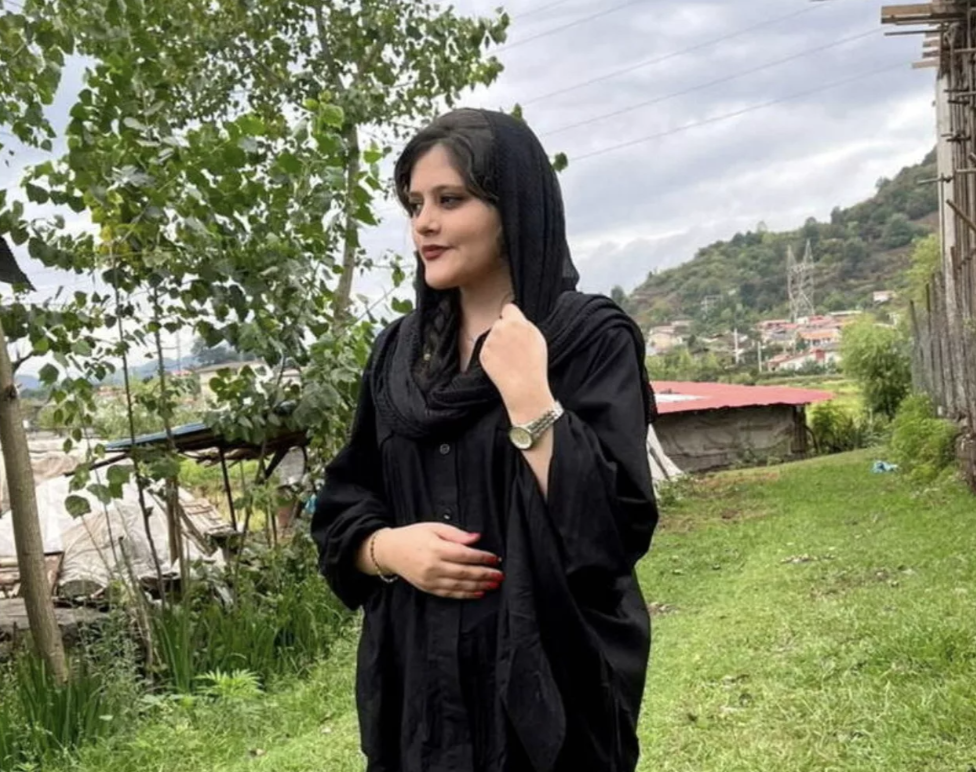
Plus que jamais, la pression doit être maintenue sur les gouvernements du monde qui ignoreraient, voire nieraient, les droits des femmes. Bien entendu sur l’Afghanistan des Talibans et leur apartheid de genre, mais aussi sur le voisin et ancien ennemi des Talibans, la République islamique d’Iran, où résonnait voilà un an le slogan kurde Jin, Jiyan, Azadî, Femme, Vie, Liberté, devenu depuis mondial, après le meurtre par la police des mœurs islamique de la jeune entraîneuse de natation et aspirante-médecin Mahsa Jina Amini, par ailleurs membre des minorités kurde et sunnite du pays. Si le régime des mollahs se maintient depuis à Téhéran, le mouvement populaire de septembre 2022 l’a considérablement affaibli et il le sait, tentant de maintenir une apparence de contrôle sur les esprits mais ne trompant plus personne.
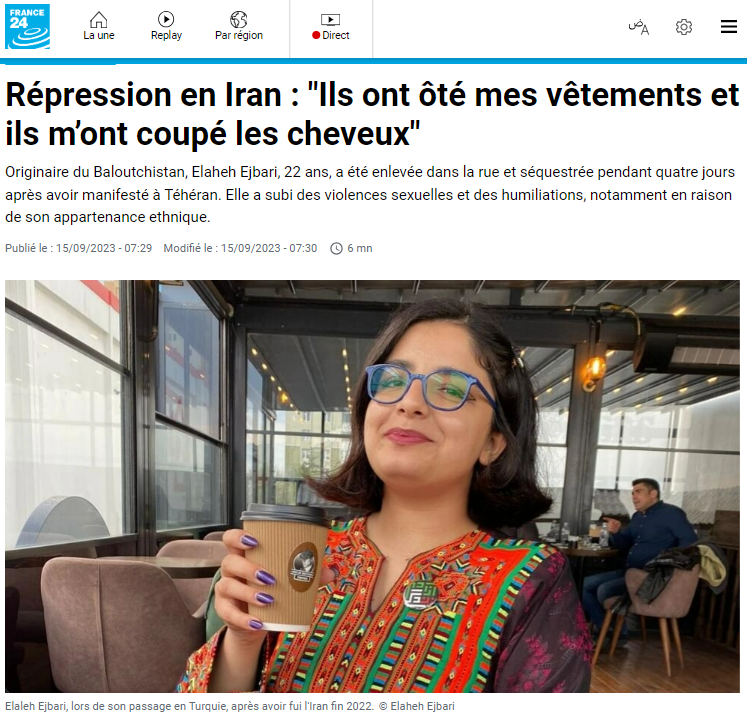
Une autre jeune femme issue d’une minorité ethnique, Elaheh Ejbari, âgée de vingt-deux ans, a récemment attiré l’attention en subissant des tortures qui ont manqué de faire d’elle une nouvelle Mahsa Amini. Elaheh Ejbari, qui est baloutche, avait fui son Sistan-Baloutchistan d’origine aux traditions patriarcales archaïques pour Téhéran où elle avait manifesté après le meurtre de Mahsa Amini. Elle y gagnait sa vie en dispensant des cours particuliers de langues.
Le 5 décembre dernier, revenant d’un cours, elle est enlevée par des inconnus qui la jettent dans une camionnette. L’insultant sur sa peau mate et son origine baloutche, ils l’accusent d’être à la solde de groupes d’opposition à l’étranger puis, après l’avoir frappée, ils lui coupent les cheveux de force, lui arrachent ses vêtements et en viennent – eux aussi – aux attouchements sexuels, lui disant tout leur mépris de la lutte des femmes d’Iran depuis un an.
«Tu aimes ça. Tu dis ‘Femme, vie, liberté’, tu veux te retrouver toute nue, c’est ça ton slogan ? Alors c’est que tu aimes ça. Tu devrais nous remercier.»
Après quatre jours de séquestration, où ils lui répétaient qu’ils ne la tueraient pas mais la renverraient au Baloutchistan pour que ses oncles s’en chargent, ils jettent Elaheh Ejbari en pleine rue. Elle retrouve ses amies, bien sûr inquiètes depuis quatre jours, et leur raconte son calvaire. Sa vie désormais détruite, ses élèves de cours de langues se désistant les uns après les autres et le propriétaire de son logement l’expulsant – peut-être, selon elle, par suite de pressions – elle finit par s’exiler en Turquie où elle vit aujourd’hui.
Difficile – ou hypocrite – de ne pas voir un lien entre les ravisseurs d’Elaheh Ejbari et les autorités iraniennes, qui se savent par trop scrutées désormais pour encore tenter par elles-mêmes au grand jour de tels actes de répression. Le seul langage des lâches alors même qu’ils violaient Elaheh Ejbari suffit à s’en convaincre, l’idée que les femmes sont soit soumises aux diktats masculins, en premier lieu vestimentaires, soit «toutes nues» et génératrices de tentations malsaines pour de pauvres petits hommes fragiles incapables de contrôler des pulsions animales en eux naturelles, constituant un moyen de blocage mental traditionnel du discours islamiste, et la République islamique d’Iran, bien que friande de liens avec l’extrême droite occidentale, islamophobe par excellence, n’en étant pas moins le premier régime islamiste du monde depuis la révolution de 1979.
Naturellement, quatre sujets du Royaume d’Espagne qui ne sont jamais allés en Iran ne peuvent être responsables de ce qui est arrivé à Elaheh Ejbari – et qui s’est produit de toute manière avant les faits qui les ont rendus tristement célèbres. Mais demain, si les dirigeants des pays de la WENA venaient à faiblir face au sexisme devant leurs propres peuples, ces quatre individus et ces mêmes dirigeants pourraient porter leur part de responsabilité dans les violences commises contre d’autres Elaheh Ejbari, Téhéran ne rêvant sans doute pas mieux que l’indifférence de l’Occident lorsqu’il retire toute liberté, voire toute vie, à une femme.
«Le trop de confiance attire le danger»
Même des gouvernements de bonne volonté dans la WENA ne sauront imposer l’idée que les droits des femmes ne sont pas et ne seront jamais solubles dans le discours politique, même lorsqu’il entend se parer de l’absolu de la religion, sans une fermeté exemplaire contre qui, dans la WENA même, se comporte en sens contraire, fût-ce avec le soutien malvenu d’un artiste connu – lui-même mis en cause pour des faits semblables – voire d’un juge.
Ces dernières semaines, l’Espagne a été touchée plus que d’habitude par le problème, mais demain, n’importe quelle nation de la WENA peut l’être à son tour et la nocivité du mauvais exemple ne serait pas moindre s’il s’agissait, loin de la Méditerranée aux traditions patriarcales, de Nordiques scandinaves ou canadiens. La même responsabilité se poserait alors au gouvernement du pays touché d’affirmer clairement qu’il n’existe pas, d’un côté, ses propres bonnes intentions et, de l’autre, l’horreur sexiste de ses administrés dont il s’indigne mais sans plus. Tout comme les politiques européens ont dû apprendre que contrer l’extrême droite xénophobe n’était plus depuis longtemps une seule question de morale, les partis populistes devant être contrés et combattus y compris et d’abord sur le plan substantiel, ils doivent aujourd’hui comprendre que la lutte contre le sexisme ne se satisfait pas davantage du seul anathème.
Autrement, comment la WENA pourrait-elle continuer à convaincre le reste du monde de l’importance des droits des femmes, tels que les définit la Convention sur l’élimination de toutes les formes de discrimination à l’égard des femmes (CEDAW) loin d’être encore ratifiée aussi universellement que l’est, à titre d’exemple, la Convention internationale des Droits de l’Enfant ? Comment rappeler encore et toujours les dispositions de la Résolution 1325 (2000) du Conseil de Sécurité des Nations Unies consacrant le rôle crucial des femmes dans la paix et, justement, la sécurité ? Comment soutenir encore les femmes œuvrant à travers le monde à la démocratie, au développement, à la protection de l’environnement, à la santé, à l’éducation ainsi que dans tous les autres domaines de la société ? Sans oublier toutes celles qui s’illustrent dans le journalisme comme Isa Balado, dans le sport comme Jenni Hermoso, et dans tout ce qui fait d’une civilisation et d’un mode de vie ce qu’ils sont, avec le sort qu’ils réservent aux femmes comme ultime indice de leur humanité.
«Le trop de confiance attire le danger», écrivait Corneille dans Le Cid, où ces mots étaient ceux du roi d’Espagne Don Fernand face à ses conseillers minimisant la montée d’une flotte d’invasion maure vers Séville, invasion qui allait être mise en échec par le jeune Don Rodrigue devenant ainsi «Le Cid» d’après sid, «seigneur» en arabe. «Le trop de confiance», c’est bien souvent ce qui mène à bâtir des châteaux en Espagne, et les derniers événements dans le pays ou liés à ses citoyens viennent rappeler, de manière aussi tragique qu’opportune, que le combat contre le sexisme n’a rien d’une charge de Don Quichotte contre un moulin à vent et que, pour les auteurs d’agressions sexuelles, l’enfer où se voit englouti Don Juan en châtiment de ses provocations répétées, c’est sur cette terre qu’il doit se trouver, ou plutôt, qu’il faut le créer. Cet enfer, ce sera le monde qui leur fait si peur, celui où plus jamais aucune femme n’aura peur.
Bernard J. Henry est Officier des Relations Extérieures de l’Association of World Citizens.
Ces paroles écrites par Charles Aznavour, né Sharnough Aznavourian, font partie de Pour toi Arménie, la chanson dont il était l’auteur avec son beau-frère et complice musical de toujours Georges Garvarentz en 1988. Cet hommage amoureux à la terre de ses racines familiales, le plus célèbre des artistes franco-arméniens ne l’avait pas écrit seulement par un élan du cœur. Cette chanson était une urgence – l’urgence d’aider son Arménie frappée par un tremblement de terre meurtrier et dont la population déjà démunie s’était trouvée abandonnée à son sort.
Le 7 décembre 1988, la ville de Spitak, au nord de ce qui était alors la République socialiste soviétique d’Arménie au sein de l’URSS vivant la perestroïka de Mikhaïl Gorbatchev, à 11H41 très précises, un séisme de 6,9 sur l’échelle de Richter dévaste la ville. Dans cette Union soviétique qui avoue désormais ses faiblesses, les services de secours ne parviennent à sauver que quatre-vingts personnes des ruines des immeubles effondrés, tandis que vingt-cinq à trente mille personnes trouvent la mort, plus de quinze mille en sortent blessées et cinq cent trente mille n’ont désormais plus nulle part où vivre. Moscou et son affidée d’alors Erevan dépassées par l’ampleur du drame, la diaspora arménienne prend le relais et l’aide à la terre d’origine meurtrie s’organise – en dehors de l’Arménie.
Suivant l’exemple américain de Harry Belafonte, Quincy Jones et Lionel Richie en 1985 avec We Are the Worldpour l’Ethiopie, Aznavour rassemble quatre-vingt-huit autres chanteurs, acteurs et personnalités de la télévision avec lesquels il enregistre Pour toi Arménie en annonçant que tous les profits du 45 tours, en cette époque sans le streaming et où l’on achète encore des disques vinyles, iront à l’aide humanitaire sur place. Et le public répond présent, le 45 tours entrant directement premier au Top 50, le classement national hebdomadaire des ventes, dont il gardera la première place pendant plusieurs semaines. C’est Aznavour lui-même qui conclut la chanson par le nom de l’Arménie dans la langue nationale, «Hayastan !», tant en français qu’en italien et même en anglais, dans une version américaine que sa notoriété internationale lui permet d’enregistrer avec le soutien de nombreuses célébrités des écrans, grand et petit, ainsi que de la chanson comme Dionne Warwick.
Le 1er octobre prochain verra les cinq ans de la disparition de Charles Aznavour, artiste de légende, humanitaire mais aussi ambassadeur d’Arménie à l’UNESCO puis au Palais des Nations, dont l’Association of World Citizens (AWC) a un jour croisé le chemin pour venir en aide à une habitante de Erevan chassée de son domicile par des violences conjugales. S’il était encore des nôtres, comment réagirait-il au drame que vit actuellement l’Arménie, drame qui, contrairement à celui de Spitak en 1988, n’est pas le fait de la nature mais d’un ennemi bien plus dangereux encore pour l’être humain – lui-même ?
La seule absence de combat ne sera jamais la paix
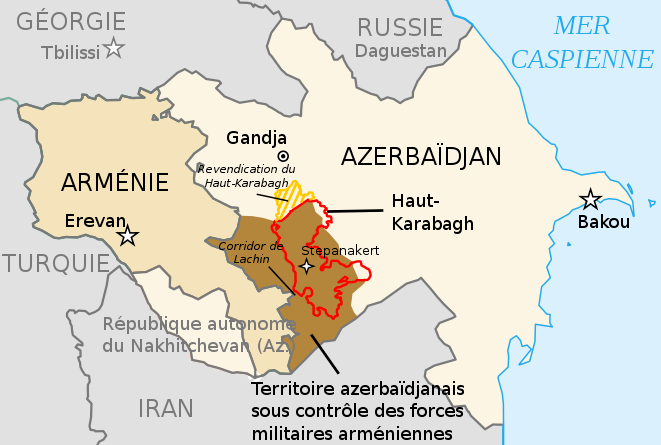
Entre 1988 et 1994, l’Arménie et son voisin de l’est, l’Azerbaïdjan, républiques soviétiques avant de devenir indépendantes à la faveur de la disparition de l’Union soviétique fin 1991, se sont affrontées militairement autour d’un territoire voisin de l’Arménie, peuplé pour l’essentiel d’Arméniens mais appartenant juridiquement à l’Azerbaïdjan – le Haut-Karabakh, ou Nagorno-Karabakh, sur une partie duquel se tient la République d’Artsakh reconnue par Erevan. Soutenu par Gorbatchev du temps de l’URSS, l’Azerbaïdjan avait refusé tout transfert de souveraineté du Haut-Karabakh à l’Arménie, position qu’il a maintenue en tant qu’État souverain et maintient encore aujourd’hui.
(C) Bourrichon
En 1992, après plusieurs années d’un conflit dominé par l’Azerbaïdjan doté d’un large soutien du monde musulman, l’Arménie remporte de premières victoires décisives. Deux ans plus tard, en mai, c’est un Azerbaïdjan désormais épuisé par une nette domination militaire arménienne qui accepte une trêve, qui ne règle pas le conflit du Haut-Karabakh mais le «gèle» sans solution, laissant le territoire indépendant de facto mais non reconnu sur le plan international. Au cours des années, les liens avec l’Arménie vont se resserrer, culminant avec l’élection en 2008 d’un natif du Haut-Karabakh, Serge Sarkissian, à la présidence de l’Arménie qu’il occupera pendant dix ans. Entre l’Arménie et le Haut-Karabakh, un seul lien terrestre direct : le corridor de Latchine, large de quelques cinq kilomètres et long de soixante-cinq. Au-delà, l’Azerbaïdjan vaincu, rêvant d’une revanche au détour de l’histoire.
Fin septembre 2020, après le traumatisme d’une année marquée par la pandémie de Covid-19 et qui verra le monde quasi mis à l’arrêt, avec un tiers de la population de la planète confinée à son domicile, l’Azerbaïdjan prend de court une communauté internationale encore sous le choc en lançant une violente offensive contre le Haut-Karabakh. Cette fois, Bakou garde l’ascendant du début à la fin des hostilités, qui vient le 10 novembre avec un cessez-le-feu conclu à l’issue d’une médiation de la Fédération de Russie, avec de lourdes pertes de territoire pour l’Arménie qui doit de céder un tiers du Haut-Karabakh et en retirer ses troupes, Moscou déployant les siennes pour maintenir le cessez-le-feu. Pour les civils arméniens, c’est le temps de l’exil, non sans avoir pour beaucoup d’entre eux brûlé leur maison plutôt que de la voir accueillir des Azerbaïdjanais.
A Latchine, ce sont les forces de maintien de la paix russes qui prennent position, l’Arménie conservant le droit d’utiliser le passage terrestre avec le Haut-Karabakh. Seulement, à partir de février 2022, les mêmes forces armées russes qui maintiennent la paix entre Arménie et Azerbaïdjan deviennent aussi les forces d’invasion de l’Ukraine, qui vaut à Moscou une vaste et légitime condamnation internationale. Qui peut prétendre assurer la paix entre deux belligérants qui, dans le même temps, envahit son voisin ? L’Azerbaïdjan ne va pas tarder à le comprendre. Et dans cette paix qui n’en était pas une depuis la trêve de 1994, l’étant encore moins depuis le cessez-le-feu de 2020, Bakou va en tirer parti. De la pire manière qui soit.
En novembre 2020, des Yazidis se portent volontaires pour rejoindre les forces armées arméniennes et combattre au Haut-Karabakh (C) Armenian Army Media
L’arme de la faim et la «guerre sale» de Bakou
En cet automne 2020, entre Arménie et Azerbaïdjan, sur le Haut-Karabakh, match nul. Le bon moment, sans doute, pour entamer des discussions de paix entre les deux pays qui savent désormais chacun ce que c’est que d’être vainqueur et vaincu. Mais personne ne s’y aventure, et tout comme en 1994, la situation semble gelée sans espoir d’un dénouement définitif du conflit après plus de trente ans. Lorsque survient, du côté de l’Azerbaïdjan, l’impensable.
Le 12 décembre 2022, des Azerbaïdjanais se présentant comme des «militants écologistes» prennent position à l’entrée du corridor de Latchine, entendant bloquer une «exploitation illégale» de minerais locaux. Niant tout lien avec ces «militants écologistes» chez lesquels les slogans pour l’environnement cohabitent avec le drapeau azerbaïdjanais, le Président Ilham Aliyev se montre envers eux étonnamment indulgent par rapport à ses habitudes envers la société civile, habitudes dont nombre de militants ont payé le prix en cellule. Et pour cause, la société civile, la vraie, détient les preuves du lien direct entre ces «militants écologistes» et Bakou.
La preuve ultime, c’est justement Bakou qui la fournira lui-même, le 11 juillet dernier. Ce jour-là, ses propres troupes, drapeaux en main, bloquent désormais officiellement Latchine, accusant la Croix-Rouge de «contrebande» à l’occasion de ses livraisons d’aide humanitaire au Haut-Karabakh. L’organisation nie farouchement l’accusation, en effet de mauvaise foi puisque l’Azerbaïdjan prend pour prétexte les méfaits de quatre chauffeurs extérieurs à la Croix-Rouge qui, dans leurs véhicules personnels, ont tenté de faire passer «des marchandises commerciales» au Haut-Karabakh, bien sûr à l’insu de l’institution humanitaire qui a aussitôt mis fin à leurs contrats.
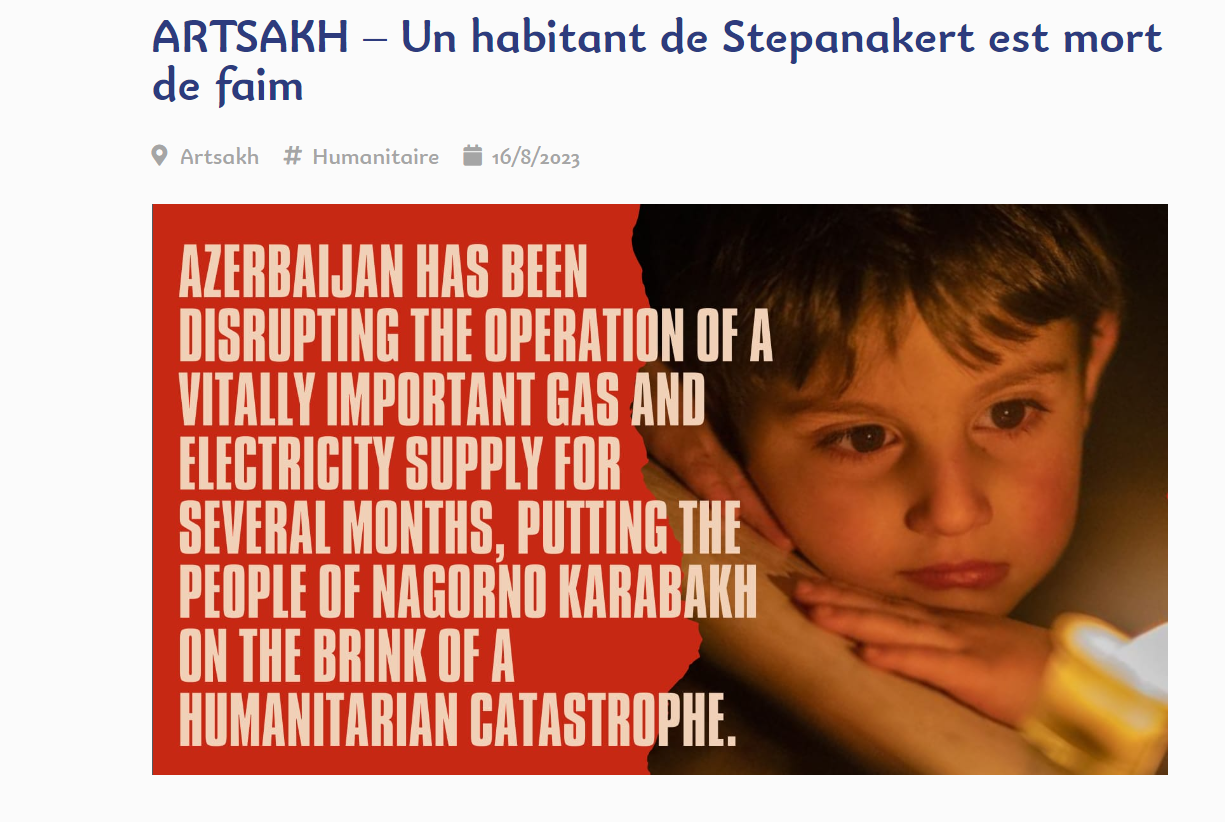
Mais, pour avoir tenté de réaliser un profit dérisoire, ces quatre malfaiteurs se voient toujours moins punis que le sont les Arméniens du Haut-Karabakh. Le territoire arménien en terre d’Azerbaïdjan se trouve désormais soumis à un blocus total, contraint à un rationnement de la nourriture et du gaz, et tout transfert médical d’urgence de patients vers Erevan est devenu impossible. Après avoir vaincu l’Arménie par les armes conventionnelles, l’Azerbaïdjan use désormais sans complexe contre les Arméniens de l’arme ultime, plus impitoyable encore que l’arme nucléaire qui abrégerait en quelques secondes les souffrances de celles et ceux qu’elle frapperait – l’arme de la faim.
Sous peu, le monde entier s’indigne. Fin août, un convoi humanitaire emmené par plusieurs élus politiques français de diverses tendances idéologiques, à l’exception notable et habituelle de l’extrême droite, se présente à Latchine en tentant de faire route vers le Haut-Karabakh. Pas de surprise – refoulé. Depuis l’Arménie, les dirigeants d’un think tank en appellent à la mise en place d’un pont aérien, à l’image de celui créé par les Alliés durant le blocus de Berlin en 1949. Fait exceptionnel, encore plus depuis le début de l’invasion de l’Ukraine en février 2022, Washington et Moscou se voient unanimes dans leur demande à Bakou en vue d’une levée du blocus du corridor de Latchine.
Au-delà de la politique, c’est le droit qui ne tarde pas à se manifester, le droit international pénal qui sait tout ce que le nom de l’Arménie signifie pour lui et pour son histoire.
D’un litige sur la souveraineté d’un territoire donné, le conflit prend soudain un goût amer de déjà-vu. Entre les Azerbaïdjanais descendants des Ottomans d’avant la Première Guerre Mondiale et les Arméniens victimes du génocide ottoman en 1915, c’est maintenant le souvenir du génocide qui se rallume dans les esprits, en Arménie et au Haut-Karabakh bien sûr mais, plus encore, dans le reste du monde.
Ronald Suny, professeur de science politique à l’Université du Michigan, cité par CNN, déclare : «Maintenant qu’il a gagné la guerre de 2020 contre l’Arménie, l’Azerbaïdjan a pour but ultime de chasser les Arméniens d’Artsakh hors de l’Azerbaïdjan. Mais plutôt que de recourir directement à la violence, qui susciterait les condamnations à l’étranger, Bakou est décidée à rendre la vie impossible aux Arméniens, les affamer et faire pression sur eux pour qu’ils partent». Pour l’International Association of Genocide Scholars (IAGS), aucun doute, le blocus du Haut-Karabakh engendre un risque de génocide.
Quant à Luis Moreno Ocampo, le premier Procureur de la Cour pénale internationale à sa création en 2002, dans une Opinion d’Expert datée du 7 août, il monte encore d’un cran en écrivant d’entrée «Il est en train de se produire un génocide contre 120 000 Arméniens vivant au Nagorno-Karabakh, également connu sous le nom d’Artsakh».
Sur le blog Social Europe, le spécialiste gréco-arménien des relations internationales George Meneshian appelle enfin l’Europe à «se réveiller» à la réalité du conflit entre l’Arménie et l’Azerbaïdjan, sous peine de devenir «complice de génocide».
Vouloir vaincre son adversaire en affamant sa population civile, c’est déjà en soi inhumain et lâche, surtout lorsqu’une victoire militaire nette vous place en position de force pour négocier un accord de paix. De la part de l’Azerbaïdjan, pourtant, ce n’est même pas le pire. Parler de génocide, c’est parler de la volonté d’exterminer un peuple, et qui parle d’exterminer un peuple parle d’une notion simple et claire – le racisme.
Capture d’écran de Nor Haratch, publication en ligne arménienne basée en France.
Contre le racisme envers les Arméniens d’Azerbaïdjan, l’arme du droit
Dans son argumentaire expert de vingt-huit pages, Luis Moreno Ocampo, montrant qu’il se souvient que la juridiction dont il a été le premier procureur est née de l’expérience aussi douloureuse qu’indispensable des Tribunaux pénaux internationaux pour l’ex-Yougoslavie (TPIY) et le Rwanda (TPIR), cite une abondance jurisprudence de l’un et de l’autre pour établir que, parce que le génocide ne s’avoue jamais, il peut et doit donc se déduire des actes du génocidaire, actes qu’il écrit reconnaître dans le blocus par l’Azerbaïdjan du corridor de Latchine.
Mais le magistrat sait aussi mettre un nom sur le premier mal qui frappe les Arméniens, sur la première faute de l’Azerbaïdjan, sur les premiers fondements de cette guerre de la faim. Un mal «prenant naissance dans l’esprit des hommes», dans les mots de l’Acte constitutif de l’UNESCO, tout comme le droit prend naissance dans l’esprit de l’être humain et, selon l’adage romain, ubi societas, ibi jus, là où il y a la société, il y a le droit. Et dans une société où sévit, voire règne, le racisme, il faut bien qu’il y ait le droit, celui de la Société Humaine Universelle que définit Olivier de Frouville, contre celui de la Société des Etats Souverains qu’il lui oppose et qui, comme jadis par exemple en Afrique du Sud, peut décider que le racisme est loi.
Bien que l’Arménie revendique le Haut-Karabakh et que la République d’Artsakh se veuille arménienne, techniquement et juridiquement parlant, les Arméniens du Haut-Karabakh demeurent des habitants de l’Azerbaïdjan, derrière le corridor de Latchine qui, sous blocus, ne peut plus jouer son rôle de lien terrestre unique avec l’Arménie. Derrière la rhétorique guerrière de Bakou et l’exemple qu’elle constitue de «création de l’ennemi» au sens que lui donne John Paul Lederach, ce que voient les instances internationales, à commencer par l’ONU, c’est bel et bien du racisme, celui des Azéris majoritaires en Azerbaïdjan contre les Arméniens de ce même pays qui demeurent, aux yeux de la communauté internationale, des Azerbaïdjanais. Et sur le racisme que subissent ces Azerbaïdjanais arméniens de la part de leurs compatriotes azéris, ce ne sont ni les faits ni les réactions qui manquent.
Le 21 avril 2023, le Représentant permanent de l’Arménie auprès du Siège des Nations Unies écrivait au Secrétaire Général, Antonio Guterres, en rappelant l’un des épisodes les plus tragiques de l’histoire des Arméniens d’Azerbaïdjan. Il parlait du massacre de Soumgaït, ville où, alors que l’Arménie soviétique commençait à revendiquer le Haut-Karabakh, un pogrom azéri avait décimé la population arménienne locale, causant des dizaines de morts, encore plus de blessés, des viols, des pillages et des destructions, toujours contre les mêmes – les Arméniens. Il rappelait les multiples condamnations de l’Azerbaïdjan, morales ou judiciaires, de la part des instances internationales, établissant un lien entre Soumgaït et la haine raciale contemporaine contre les Arméniens.
Et de la part de Erevan, il ne s’agissait pas de lawfare, de cette guerre judiciaire que l’on mène lorsque les armes n’ont pu vous apporter la victoire. Le racisme d’Etat azerbaïdjanais contre les Arméniens n’est pas une simple proclamation politique ; il est une réalité de terrain, et pour Bakou, il s’est mué en une excuse commode pour employer une arme sale, l’arme de la faim, contre le Haut-Karabakh.
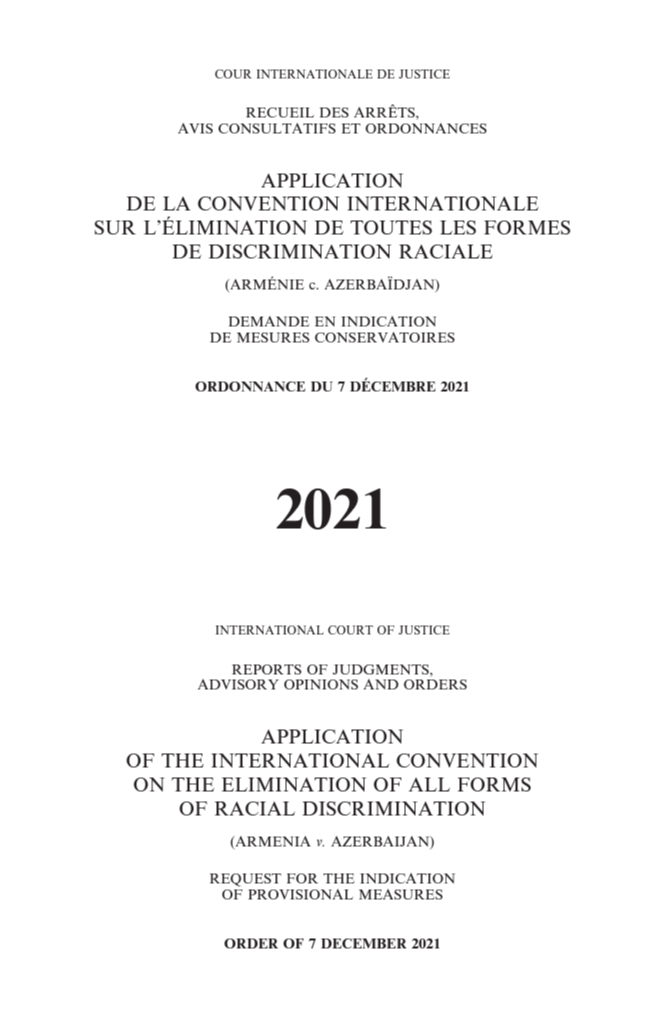
Le 7 décembre 2021, à peine plus d’un an après la reprise des combats et la défaite arménienne, la Cour internationale de Justice statuait, saisie par l’Arménie, sur une demande de mesures conservatoires pour le respect de la Convention internationale sur l’Élimination de Toutes les Formes de Discrimination raciale (CIEDR), Erevan demandant à la Cour d’ordonner à l’Azerbaïdjan de changer d’attitude
«— en s’abstenant de se livrer à des pratiques de nettoyage ethnique contre les Arméniens ;
— en s’abstenant de commettre, de glorifier, de récompenser ou de cautionner des actes de racisme contre les Arméniens, y compris les prisonniers de guerre, les otages et d’autres détenus ;
— en s’abstenant de tenir ou de tolérer des discours haineux visant les Arméniens, y compris dans les ouvrages pédagogiques ;
— en s’abstenant de bannir la langue arménienne, de détruire le patrimoine culturel arménien ou d’éliminer de toute autre manière l’existence de la présence culturelle historiquearménienne, ou d’empêcher les Arméniens d’avoir accès à celle‑ci et d’en jouir ;
— en punissant tout acte de discrimination raciale contre les Arméniens, qu’il soit commis dans la sphère publique ou privée, y compris lorsqu’il est le fait d’agents de l’État ;
— en garantissant aux Arméniens, y compris les prisonniers de guerre, les otages et d’autres détenus, la jouissance de leurs droits dans des conditions d’égalité ;
— en adoptant la législation nécessaire pour s’acquitter des obligations que lui fait la CIEDR ;
— en garantissant aux Arméniens un traitement égal devant les tribunaux et tout autre organe administrant la justice ainsi qu’une protection et une voie de recours effectives contre les actes de discrimination raciale ;
— en s’abstenant d’entraver l’enregistrement et les activités des ONG et d’arrêter, de détenir et de condamner les militants des droits de l’homme ou toute autre personne œuvrant pour la réconciliation avec l’Arménie et les Arméniens; et
— en prenant des mesures efficaces pour combattre les préjugés contre les Arméniens et des mesures spéciales pour assurer comme il convient le développement de ce groupe».
Dans sa décision, la Cour internationale de Justice avait finalement estimé que
«1) La République d’Azerbaïdjan doit, conformément aux obligations que lui impose la convention internationale sur l’élimination de toutes les formes de discrimination raciale,
a) Par quatorze voix contre une,
Protéger contre les voies de fait et les sévices toutes les personnes arrêtées en relation avec le conflit de 2020 qui sont toujours en détention et garantir leur sûreté et leur droit à l’égalité devant la loi ;
b) A l’unanimité,
Prendre toutes les mesures nécessaires pour empêcher l’incitation et l’encouragement à la haine et à la discrimination raciales, y compris par ses agents et ses institutions publiques, à l’égard des personnes d’origine nationale ou ethnique arménienne ;
c) Par treize voix contre deux,
Prendre toutes les mesures nécessaires pour empêcher et punir les actes de dégradation et de profanation du patrimoine culturel arménien, notamment, mais pas seulement, les églises et autres lieux de culte, monuments, sites, cimetières et artefacts ;
2) A l’unanimité,
Les deux Parties doivent s’abstenir de tout acte qui risquerait d’aggraver ou d’étendre le différend dont la Cour est saisie ou d’en rendre le règlement plus difficile».
La haute juridiction onusienne reconnaissait ainsi que la question du Haut-Karabakh n’était pas, ou n’était plus, seulement celle de la souveraineté sur ce territoire de l’un ou de l’autre des deux pays qui le réclamait. Il s’agissait bien, au-delà d’une simple dispute territoriale, de racisme.
Et comme le relève Luis Moreno Ocampo dans son Opinion d’Expert, le 22 septembre 2022, dans ses Observations finales concernant le rapport de l’Azerbaïdjan valant dixième à douzième rapports périodiques, le Comité CIEDR fustigeait le pays pour «[l’]incitation à la haine raciale et la propagation de stéréotypes racistes à l’encontre de personnes d’origine nationale ou ethnique arménienne, notamment sur Internet et dans les médias sociaux, ainsi que par des personnalités publiques et des hauts responsables, et le manque d’informations détaillées sur les enquêtes, les poursuites, les déclarations de culpabilité et les sanctions liées à de tels actes». Une constante de racisme par trop voyante pour que Bakou puisse réduire le blocus du Haut-Karabakh à une simple protestation d’écologistes ou, aujourd’hui, à une mesure devant empêcher la contrebande, excuses si faciles qu’elles en deviennent insultantes.
Notre époque a appris, et Luis Moreno Ocampo a bien compris que c’était là qu’il fallait frapper d’entrée, à oublier les génocides, du moins à les minimiser. Là où jadis, l’évocation de la Shoah juive, du Samudaripen rom ou, justement, du génocide arménien amenait une autorité morale au propos tenu, aujourd’hui, sous prétexte de «point Godwin», il devient quasi disqualifiant d’y faire référence. Admettons, entendu, soulever un génocide, c’est un pathos alarmiste. Mais alors, que dire de l’effroyable niveau de racisme contre les Arméniens constaté et condamné plus d’une fois par l’ONU en Azerbaïdjan, sinon qu’il est la meilleure preuve que le blocus du corridor de Latchine représente, si ce n’est un génocide en soi, du moins son ultime prélude ?
Une certaine conception de l’humanité mise à l’épreuve
S’il s’était parfois mis dans la peau des losers, comme dans Je m’voyais déjà, Poker et Je ne peux pas rentrer chez moi, Charles Aznavour chantait aussi pour dénoncer l’injustice, chantant Comme ils disent en 1972 alors que l’homosexualité est en France réprimée comme un délit, Mourir d’aimer sur l’affaire Gabrielle Russier et Les émigrants en pleine ascension du Front National et de ses thèses xénophobes. Légitime à écrire et produire Pour toi Arménie, il ne l’était pas du seul fait d’être arménien d’origine mais parce que son travail d’artiste parlait pour lui. Autrement, qui sait si l’initiative aurait rencontré le même succès ?
De même que Pour toi Arménie n’avait rien d’un phénomène «de fait», ici le fait d’un chanteur français d’origine arménienne, il n’existe aucune paix «de fait» après un conflit, la paix se construisant, sinon avant la fin des hostilités, du moins dès qu’elle intervient puis sans cesse jusqu’à ce que les belligérants comprennent qu’un accord, ou traité, formel doit sceller pour toujours leur bonne volonté et ouvrir la voie à l’avenir. Ce travail réalisé en 1994, l’offensive azerbaïdjanaise de 2020 serait devenue bien moins probable, et avec elle, cette guerre de la faim d’aujourd’hui.
En Ukraine se joue la survie d’une certaine conception du droit international, celle qui veut que l’agresseur ne soit pas récompensé de sa conduite contre l’agressé, sanctions de divers ordres à l’appui contre Moscou. Plus au nord, au Haut-Karabakh, l’enjeu n’a pas besoin pour se définir d’un manuel de droit. Lorsque l’arme choisie contre l’ennemi désigné est la faim, c’est bien une certaine conception de l’humanité qui est mise à l’épreuve, une conception qui transcende les frontières des États, qu’elles soient ou non reconnues par les autres États, une conception qui accorde toute sa valeur au droit, même s’il ne produit pas d’effet immédiat car il n’en incarne pas moins les principes qui guident une conscience. Cette conception, soit le monde agit pour la défendre au Haut-Karabakh, soit il s’expose à ce qu’elle ne soit plus garantie nulle part.
Bernard J. Henry est Officier des Relations Extérieures de l’Association of World Citizens.
Repression of protests in Iran continues. A wave of protests swept across the country in the wake of the September 2022 death in custody of 22-year-old Mahsa Jina Animi, an ethnic Kurd and Sunni Muslim. It is estimated that the Iranian security forces have killed over 500 protesters and arrested some 20,000 persons of all ethnic and religious backgrounds.
In response to the State-led violence, on November 24, 2022, the United Nations (UN) Human Rights Council created the International Independent Fact-Finding Mission on the Islamic Republic of Iran with the chairmanship of Sera Hossain of Bangladesh.
Mahsa Amini
One aspect of the repression of protests is that religious leaders of the Sunni Muslim communities, especially in Iran’s Sistan and Baluchistan province and in the Kurdish provinces, are being increasingly targeted by the Islamic Republic’s authorities for arrest and imprisonment because of their peaceful criticism of the repression of protests. Iran is a majority Shia Muslim country, and Shiism is the official religion of the State.
Religious minorities include Sunni Muslims, Christians, Baha’is, Zoroastrians, Jews, and the Gonabadi Sufi community. Religious and ethnic identities in Iran often overlap. The Association of World Citizens (AWC) has repeatedly appealed to UN human rights bodies concerning the discrimination and repression of persons of the Baha’i faith.
Another aspect of the repression of protests has been the public hanging of some protesters. The AWC has repeatedly called upon governments for a moratorium on executions with a view of abolishing the death penalty – a penalty that extensive research has shown has little or no impact on the level of crime and too often opens doors to judicial errors and injustices.
The UN International Independent Fact-Finding Mission on the Islamic Republic of Iran has called on Nongovernmental Organizations for direct information. The broader community of NGOs needs to keep public attention focused on events in Iran.
Prof. René Wadlow is President of the Association of World Citizens.
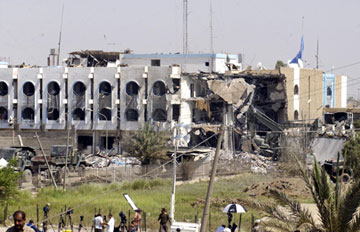
The United Nations (UN) General Assembly has designated August 19 as “World Humanitarian Day” to pay tribute to aid workers in humanitarian service in difficult and often dangerous conditions. August 19 was designated in memory of the August 19, 2003 bombing of the UN office building in Baghdad, Iraq in which Sergio Vieira de Mello, United Nations (UN) High Commissioner for Human Rights and, at the time, Special Representative of the UN Secretary General was killed along with 21 UN staff members. Over 200 UN employees were injured. The exact circumstances of the attack are not known, and why USA and UN security around the building was not tighter is still not clear. A truck with explosives was able to dive next to the building and then blew itself up.
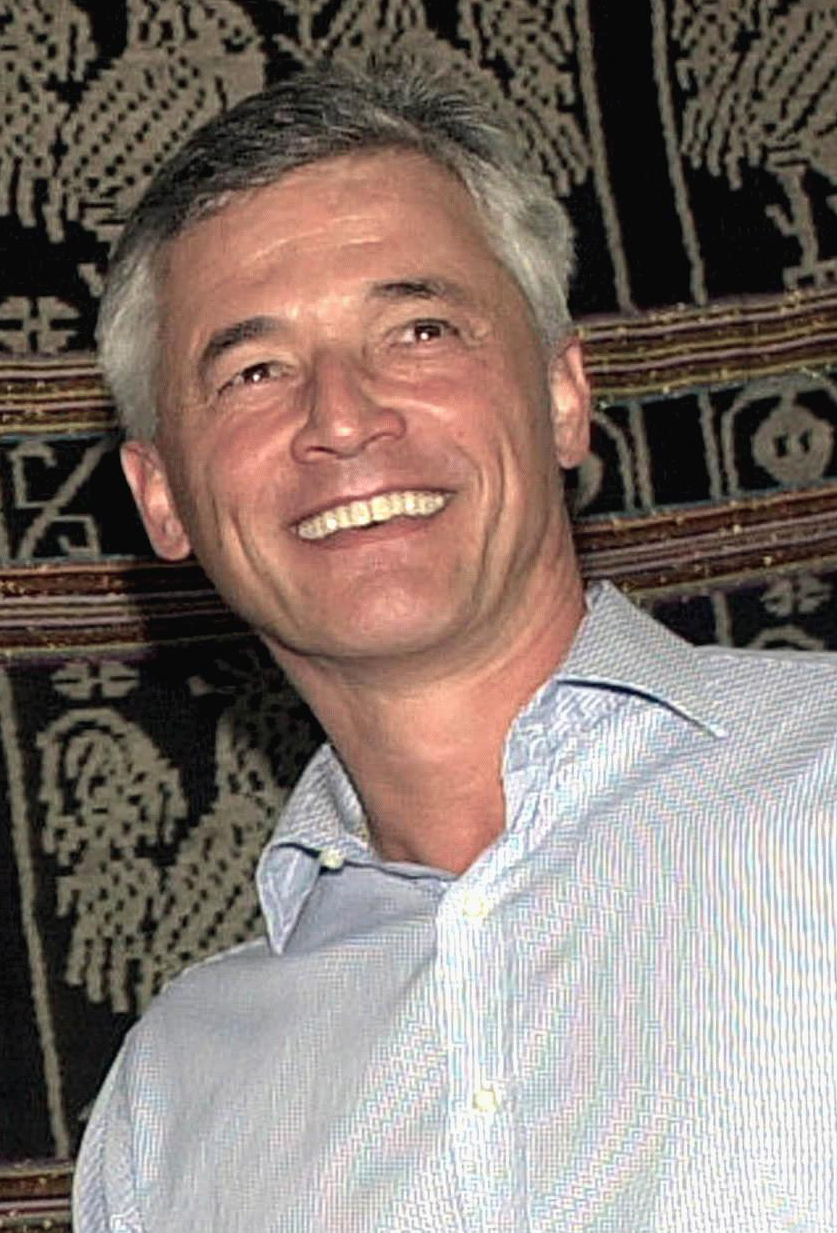
Sergio Vieira de Mello had spent his UN career in humanitarian efforts, often with the Office of the High Commissioner for Refugees and at other times as Special Representative of the UN Secretary General. As a Nongovernmental Organization’s (NGO’s) representative to the UN in Geneva and active on human rights issues, I knew him during his short 2002-2003 tenure as High Commissioner for Human Rights. Many of us had high hopes that his dynamism, relative youth – he was 54 – and wide experience in conflict resolution efforts would provide new possibilities for human rights efforts. His death along with the death of others who had been Geneva-based was a stark reminder of the risks that exist for all engaged in humanitarian and conflict resolution work.
This year, the risks and dangers are not just memories but are daily news. On May 3, 2016, the UN Security Council unanimously adopted Resolution 2286 calling for greater protection for health care institutions and personnel considering recent attacks against hospitals and clinics in Syria, Iraq, Yemen, South Sudan, Democratic Republic of Congo, and Afghanistan. These attacks on medical facilities are too frequent to be considered “collateral damage.” The attacks indicate a dangerous trend of non-compliance with world law by both State and non- State agents. The protection of medical personnel and the treatment of all the wounded − both allies and enemies − goes back to the start of humanitarian law.
The Association of World Citizens (AWC) has stressed the need for accountability, including by investigation of alleged violations of the laws of war. The grave violations by the Islamic State in Iraq and al-Sham (ISIS) must be countered by as wide a coalition of concerned voices as possible. There is a real danger that as ISIS disintegrates and no longer controls as much territory, it will increase terrorist actions.
The laws of war, now more often called humanitarian law, have two wings, one dealing with the treatment of medical personnel in armed conflict situations, the military wounded, prisoners of war, and the protection of civilians. This wing is represented by the Geneva (Red Cross) Conventions. The second wing, often called The Hague Conventions limit or ban outright the use of certain categories of weapons. These efforts began at The Hague with the 1900 peace conferences and have continued even if the more recent limitations on land mines, cluster weapons and chemical weapons have been negotiated elsewhere.
Sergio Vieira de Mello (C) Wilson Dias/ABr
The ban on the use of weapons is binding only on States which have ratified the convention. Thus, the current use of United States (U.S.)-made cluster weapons in Yemen by the Saudi Arabia-led coalition is, in a narrow sense, legal as the USA, Saudi Arabia and Yemen have not signed the cluster weapon ban. The AWC was one of the NGOs leading the campaign against cluster weapons. My position is that when a large number of States ratify a convention, as is the case with the cluster-weapons ban, then the convention becomes world law and so must be followed by all States and non-State actors even if they have not signed or ratified the convention. The same holds true for the use of land mines currently being widely used by ISIS in Syria and Iraq.
The current situation concerning refugees and internally displaced persons can also be considered as part of humanitarian law. Therefore, those working with refugees and the displaced within their country are also to be honored by the World Humanitarian Day. To prevent and alleviate human suffering, to protect life and health and to ensure respect for the human person − these are the core values of humanitarian law.
There needs to be a wide public outcry in the defense of humanitarian law so that violations can be reduced. The time for action is now.
Prof. René Wadlow is President of the Association of World Citizens.





 Association of World Citizens
