The Official Blog of the

Archive for the ‘Track II’ Category

The Disintegrating Donbass. Is there a future for a con-federal Ukraine?

In Being a World Citizen, Conflict Resolution, Current Events, Europe, Human Rights, NGOs, Solidarity, The former Soviet Union, The Search for Peace, Track II, United Nations, World Law on November 27, 2017 at 8:22 AM

By René Wadlow

The flight on November 23, 2017 of Igor Plotinitsky, President of the separatist Ukrainian area of the Lugansk People’s Republic is a sign of the continuing difficulties of developing appropriate forms of constitutional government in the Ukraine. Plotinitsky was in open conflict with his “Minister of the Interior” Igor Konet whom he had fired but who refused to give up his position. It is reported that military troops are moving from Donetsk, the other People’s Republic of the Donbass, and perhaps other troops from Russia but without signs of identification.

Much of the fate of the two Donbass People’s Republics is in the hands of Russian President Vladimir Putin, but he is unwilling to take public responsibility. Some have argued that two people’s republics in Donbass is one too many and that the two republics will be unified under the leadership of President Alexandre Zakhartchenko of Donetsk. Meanwhile the Ukrainian government has reinforced its troops on the frontier with the separatist zone.

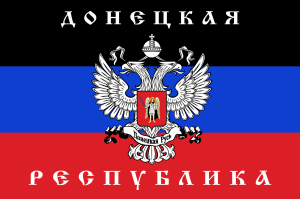
Flag_of_the_Donetsk_Republic_(Organisation).svg

The flag of the “Republic of Donetsk” as written in the Russian Cyrillic alphabet

Officially the Donbass is under an agreement signed in Minsk on February 12, 2015 among Russia, Germany, France, and Ukraine acting under a mandate of the Organization for Security and Cooperation in Europe (OSCE). The agreement called for a ceasefire, local elections, a reintegration into the State of Ukraine but with constitutional reforms giving greater local autonomy. In practice, the Minsk accords have never been carried out.

The new crisis may return to the status quo of continuing tensions, occasional artillery exchanges, a lack of any effective cooperation, and a continuing economic decline. It is estimated that some 10,000 persons have been killed in the conflict since April 2014. However, there is a danger that the conflict slips out of control, and violence increases. The secretariat of the OSCE must be on high alert.

A crisis can at times be a moment to reconsider the possibilities and to seek a more long-lasting agreement. At the start of the Ukraine conflict in April 2014, the Association of World Citizens (AWC) had proposed the creation of a Ukrainian confederation with decentralization, respect for cultural autonomy, economic cooperation among the Russian Federation, Ukraine, and the European Union. Some of the ideas are reflected in the Minsk agreement, but distrust is so high that no practical steps have been taken.

The current crisis may serve as a reminder of how dangerous a disintegrating Donbass can be. An alternative would be to study seriously the possibilities of a con-federal Ukraine.

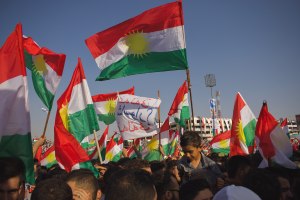
The AWC has a longstanding interest in developing appropriate constitutional structures for States facing the possibilities of prolonged or intensified armed conflicts. In the recent past, we have proposed con-federal structures to deal with conflict situations in Mali, Ukraine, Myanmar, Libya and Cyprus as well as Kurdistan which involves both the structure of Iraq as well as positive cooperation among Kurds living in Iraq, Syria, Turkey and Iran.

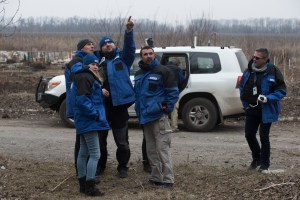
OSCE_SMM_monitoring_the_movement_of_heavy_weaponry_in_eastern_Ukraine_(16544233550)

OSCE Special Monitoring Mission members monitoring the movement of heavy weaponry in eastern Ukraine

Con-federation and autonomy are broad concepts, capable of covering a multitude of visions extending from very limited local initiatives to complete control over everything other than foreign policy. Autonomy can therefore incorporate all situations between nearly total subordination to the center to nearly total independence. The ways in which the elements and patterns of autonomy are put together requires political imagination, far-sighted political leadership, a willingness to compromise, and constant dialogue.
In none of the six situations on which we have made proposals have we found much of a climate for meaningful negotiations although there have been formal negotiation processes carried out in the Ukraine case by the OSCE and on Cyprus by the United Nations.

Negotiations means a joint undertaking by disputants with the aim of settling their disputes on the basis of mutual compromise. Negotiation is a basic political decision-making process, a way of finding common interests, to facilitate compromise without loss of what each considers to be essential objectives. For the parties in a conflict to seek a compromise requires a certain climate – an informed public opinion that will accept the compromise and build better future relations on the agreement.

The challenges posed by the conflicts in Mali, Ukraine, Myanmar, Libya, Cyprus and Kurdistan need to be measured against the broad concept of security. Barry Buzan of the University of Copenhagen sets out four types of security. “Political security concerns the organizational stability of states, systems of government, and the ideologies that give them legitimacy. Economic security concerns access to the resources, finances and markets necessary to sustain acceptable levels of welfare. Societal security concerns the sustainability within acceptable conditions of the evolution of traditional patterns of language, culture, religions and customs. Environmental security concerns the maintenance of the local and the planetary biosphere as the essential support system on which all other human enterprises depend.”

One of the difficulties in each situation is what I would call “the frozen image of the other”. In each case, the group or groups demanding new State structures are seen in the minds of the current government authorities as being the same people with the same aspirations as when the demands were first made: the Karen of Myanmar today are the same as the Karen of the Union of Burma in 1947; the Tuareg of north Mali today are the same as those calling for the creation of an independent State in 1940 when the withdrawal of French troops to Dakar had left a political vacuum.

However, there have been evolutions in policy proposals and in the level of education and experience of new leadership of those demanding autonomy. Yet “frozen images” exist and need to be overcome within all decision-makers involved. The modification of “frozen images” is one of the tasks of nongovernmental organizations and Track II diplomatic efforts.

Prof. René Wadlow is President of the Association of World Citizens.
Increased Korean Tensions: Time for Concerted Nongovernmental Efforts

In Asia, Conflict Resolution, Current Events, Korean Peninsula, NGOs, The Search for Peace, Track II, United Nations, World Law on October 1, 2017 at 9:35 AM

By René Wadlow

An escalation of verbal exchanges between the Presidents of the USA and North Korea, missile flights over Japan, United States (U. S.) war planes close to the sea frontier of North Korea – one can hardly think of additional ways that governments can increase tensions short of an armed attack which probably all governments want to avoid. But there are always dangers of events slipping out of control. The Security Council of the United Nations (UN) has voted to tighten economic sanctions on North Korea. However, to date, sanctions have diminished the socio-economic conditions of the majority without modifying government policy.

For the moment, we look in vain for enlightened governmental leadership. The appeals for calm by the Chinese authorities have not been followed by specific proposals for actions to decrease tensions.

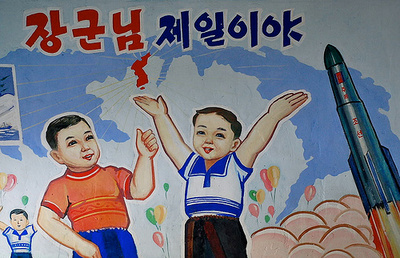
kor01_400_01

The one positive sign which may help to change the political atmosphere both for governmental negotiations and for Track II (nongovernmental) discussions is the large number of States which have signed the Treaty on the Prohibition of Nuclear Weapons on 20 September, the first day that the Treaty was open for signature. Signature is the first step in the process of ratification. As a light in the darkness, the Holy See (the Vatican) both signed and ratified the Treaty at the same time. Guyana and Thailand also signed and ratified the Treaty, the three first ratifications of the 50 needed for the Treaty to come into force.

The Vatican leads by moral example; its Swiss Guard army is only lightly armed. The Holy See, although a State, is a bridge to the world of nongovernmental organizations (NGO). The torch of action must now be taken up by a wider range of organizations than those, which had been in the lead for the abolition of nuclear weapons. The strength of “one-issue” NGOs is that its message is clear. This was seen in the earlier efforts to ban a single category of weapons: land mines, chemical weapons, cluster munitions and the long-running efforts on nuclear weapons.

Some of us have long worked on the abolition of nuclear weapons. I recall as a university student in the early 1950s, I would cross Albert Einstein who liked to walk from his office to his home. I would say “Good evening, Professor Einstein”, and he would reply “Good evening, young man”. I knew that he had developed some theories, which I did not understand but that were somehow related to atomic energy. I was happy that we were both against atomic bombs under the slogan “One World or None!”.

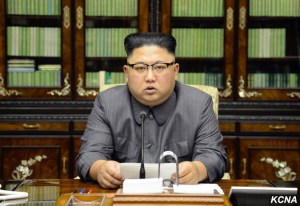
Kim_Jong_Un_Makes_Statement_(2017)

The current Treaty on the Prohibition of Nuclear Weapons did not grow from the usual arms control negotiations, such as the Treaty on the Non-Proliferation of Nuclear Weapons or the chemical weapons ban, both of which were negotiated in Geneva, both over a 10-year period. The Nuclear Weapons ban was largely negotiated elsewhere, Vienna and New York, in the humanitarian law tradition of banning weapons that cause unnecessary suffering, such as the ban on napalm after its wide use in the Vietnam War. The contribution of both “ban-the-bomb” groups and the humanitarian organizations such as the International Committee of the Red Cross was great in reaching the successful outcome.

Thus, today, there is a need for a coming together of nongovernmental organizations who are primarily focused on the resolution of armed conflicts such as the International Crisis Group, International Alert, and the Association of World Citizens (AWC) with those groups concerned with the abolition of nuclear weapons. The current Korean tensions are based on the development of nuclear weapons and missile systems and the pressures and threats to prevent their development.

One proposal which seems to me to be a common ground on which many could cooperate has been called a “double-freeze” – a freeze on North Korea’s nuclear-weapon and missile programs with a reciprocal freeze on the yearly U. S.-South Korea war exercises and a progressive reduction of U. S. troops stationed in South Korea and elsewhere in Asia, especially Japan.

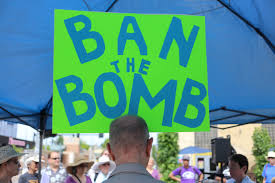
Ban the bomb.jpg

There are also proposals for economic cooperation, greater meetings among separated family members, and cultural exchanges. However, given the heat of the current saber rattling, the “double-freeze” proposal seems to be the one that addresses most directly the security situation. We need to build on this common ground.

Prof. René Wadlow is President of the Association of World Citizens.
Korean Tensions: Confidence-building Measures Needed

In Asia, Conflict Resolution, Current Events, Humanitarian Law, NGOs, The Search for Peace, Track II, United Nations on August 15, 2017 at 9:00 AM

By René Wadlow

In a May 12, 2017 article “Korea: Back from the Brink, Small Steps Forward” I hoped that the May 9 election of Moon Jae-in as President of the Republic of Korea may have applied the brakes to a dangerous increase in tensions between the two Korean States, the USA, China, Japan and Russia. I thought that “there may be a possibility of small steps that build confidence between the two Koreas and that do not overly worry the USA and China who watch events closely and who may do more than watch … It is unlikely that any progress will be made in the foreseeable future concerning denuclearization of the Korean Peninsula or unification. Small steps are probably the ‘order of the day’. However, Track II – informal discussions which are not negotiations but a clarification of possible common interests and areas of joint action – can be helpful.”

Track II efforts have not been on a scale to quell tensions over North Korea’s nuclear weapons and missile advances, and the saber rattling of governments has done nothing to reduce tensions. “Fire and fury like the world has never seen” is probably not the vocabulary that leads to negotiations. Nor is an editorial in the Chinese government English-language newspaper Global Times which quotes a spokesperson saying, “If the US and South Korea carry out strikes and try to overthrow the North Korean regime and change the political pattern of the Korea Peninsula, China will prevent them from doing so”.

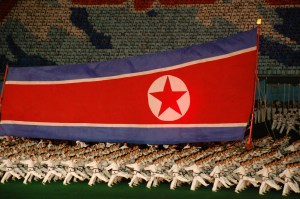
1028111184_d35cc51c6b_b

It is hard to know how seriously to take the saber rattling, but the sound is loud enough and the sabers are sharp enough that calmer spirits need to propose confidence-building measures. The Association of World Citizens had proposed to the then Secretary-General of the United Nations, Ban Ki-moon to have a U.N.-led conference to transform the Korean War Armistice of 1953 into a Korean Peace Treaty. Such a Peace Treaty would confirm the international legitimacy of the two Korean States while not preventing at a later date a con-federation or other form of re-unification. Such a conference and Peace Treaty could play an important role in reducing regional tensions. However, such a conference would require a good deal of negotiations as all conditions would have to be agreed upon in advance. Diplomatic conferences “bless” efforts made before in private. A successful diplomatic conference rarely starts from zero.

Another avenue of confidence-building measures is what the University of Illinois psychology professor Charles Osgood called GRIT – Graduated Reciprocation in Tension Reduction. He recommended an incremental series of conciliatory unilateral initiatives. They should be varied in nature, announced ahead of time without bargaining and continued only in response to comparable actions from the other party – a sort of “arms race in reverse”. Unilateral initiatives should, whenever possible, take advantage of mutual self-interest, mutual self-restraints and opportunities for cooperative enterprise.

As Osgood wrote, “The real problem is not the unavailability of actions that meet the criterion of mutual self-interest, but rather the psychological block against seeing them that way. The operation of psycho-logic on both sides makes it difficult for us to see anything that is good for them as being anything other than bad for ourselves. This is the familiar ‘if they are for it, we must be against it’ mechanism”. (1)

7587227518_2d72888f5c_b

Osgood directed his proposals for dealing with tension reduction so as to ease fear, foster more circumspect decisions in which many alternatives are considered, and modify the perceptual biases that fan the flames of distrust and suspicion. The most favorable feature of the GRIT approaches that it offers a means whereby one party can take the initiative in international relations rather than constantly reacting to the acts of others.

Such GRIT efforts were carried out concerning Korea in the early 1990s between Presidents George H. W. Bush and Kim Il-sung but rarely since. Currently, the governments of Russia and China have proposed a GRIT-type proposal of a “double freeze” – a temporary freeze on North Korea’s nuclear and missile tests in return for a sharp reduction of US military presence in South Korea.

A “double freeze” may be too large a shift at this stage. In my article, I had proposed such steps as increased family contacts, cultural exchanges, increased food aid to the Democratic People’s Republic, a lessening of economic sanctions and an increase in trade.

There is a need to halt the automatic reaction to every provocation, and to “test the waters” for a reduction of tensions. Real negotiations may take some time to put into place, but GRIT-type unilateral measures are a possibility worth trying.

******************************************

Note

(1) Charles E. Osgood, An Alternative to War or Surrender (Urbana, IL: University of Illinois Press, 1962).

******************************************

Prof. René Wadlow is President of the Association of World Citizens.