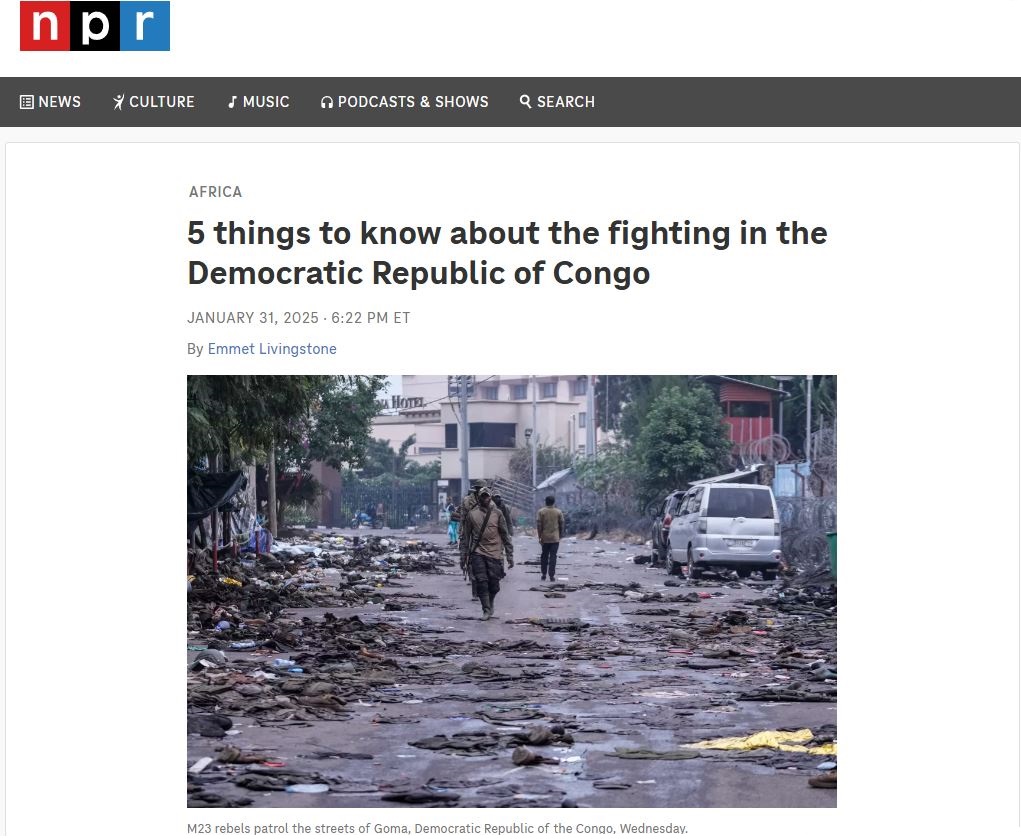
On January 26, 2025, we published an article “Goma: Cry of the Imburi” on the possible attack on Goma, the capital of North Kivu Province of the Democratic Republic of Congo. The forces of the M23 (short for Movement of March 23) militia and some three to four thousand regular military of Rwanda were advancing toward Goma. Two days later, on January 28, Goma fell to M23. There were one million inhabitants in Goma and another million living in nearby camps as refugees. They had fled from violence in the neighboring area.
There are a multitude of armed militias, each with their own interests which they advance violently. One grouping of militias, known as the Wazalendo, a term for “patriots” in Swahili, is opposed to M23 but is not part of the regular Democratic Republic military. There has been a great amount of sexual and gender-based violence.
Demonstrators linked to President Félix Tshisekedi’s party in power have demonstrated in the capital Kinshasa, some 2,000 miles away, in front of the embassies of France, Belgium, the United Kingdom, and the U.S.A. for having done nothing to prevent Goma from being attacked. The European governments have replied, as did the French Foreign Minister Jean-Noel Barrot, that they deplore the violence and are in solidarity with the Democratic Republic of Congo.
The United Nations (UN) Security Council met in an emergency session and called for a ceasefire, but no follow-up measures were made public. The UN already has peacekeepers in the area (Monusco) with the aim of stabilizing the mineral-rich region. However, there is no peace to keep. The UN troops are called by the local population “the tourists”. They come only to watch what is going on. In reality, the UN forces are national military and police “lent” to the UN by member governments. The military and police come nearly all from developing countries trained in the British way: Pakistan, Nepal, Bangladesh, Nigeria and Ghana. They have no desire to be killed in armed conflicts which do not concern their country.
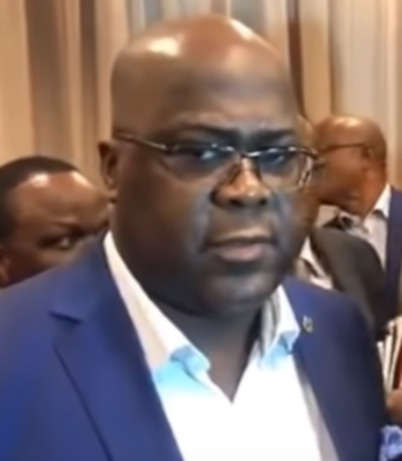
DRC President Félix Tshisekedi
There have been African-led efforts at mediation. In 2022, the African Union asked Angola’s President to mediate which led to a short-lived ceasefire in July 2024, but the ceasefire collapsed shortly after. At this stage, the dangerous disintegration of the Democratic Republic of Congo – democratic in name only – is likely to continue as there is not only armed violence but also a constitutional crisis as President Tshisekedi is trying to change the constitution so that he can stay longer in power. The restoration of legitimate authority and effective stabilization may still be in an unknown future.
Prof. René Wadlow is President of the Association of World Citizens.
The Imburi are spirits that are said to inhabit the forests of Gabon, in Equatorial Africa, and who cry out for those who can hear them at times of impending violence and danger. The Imburi are now crying out loudly on the increasing dangers and forced migration in Goma, capital of the North Kivu province of the Democratic Republic of Congo – democratic in name only.
The July 31, 2024 ceasefire agreement – never fully effective – has now been broken. Troops of the Tutsi-led militia known as M23 along with regular military of Rwanda are advancing toward Goma, the capital of North Kivu. The Association of World Citizens has members in Goma who keep us informed of the critical situation there – getting worse each day.
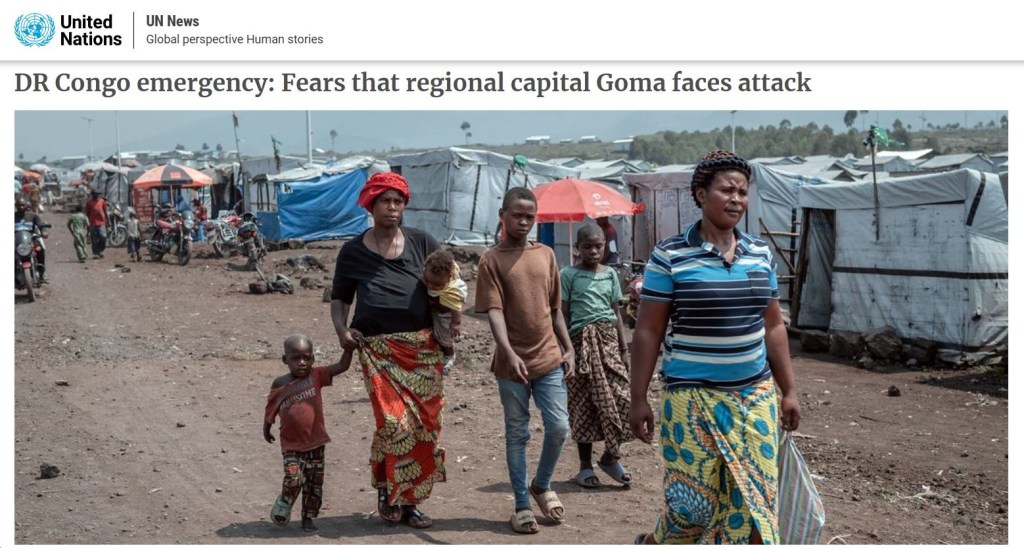
(C) UN News
People in the neighboring province of South Kivu are frightened and have started to flee. There are a large number of displaced persons in both North and South Kivu, and some have fled across the frontier into Burundi. Many people are living in displaced persons camps in difficult situations despite the efforts of the United Nations (UN), the International Committee of the Red Cross, and humanitarian aid organizations.
This eastern area of the Congo has been the scene of fighting at least since 1998 – in part as a result of the genocide in neighboring Rwanda in 1994. In mid-1994, more than one million Rwandan Hutu refugees poured into the Kivus, fleeing the advance of the Tutsi-led Rwandan Patriotic Front, which now comprises the government of Rwanda. Many of these Hutu were still armed, among them the “génocidaires” who, a couple of months before, had participated in the killing of some 800,000 Tutsi and moderate Hutu in Rwanda.
Today, there is still large-scale occurrence of serious violations of human rights and international humanitarian law by all parties with massive displacement of populations, plundering of villages, systematic rape of women, summary executions and the use of child soldiers. There is a report from the UN Group of Experts on the Democratic Republic of Congo of December 27, 2024 which outlines clearly the disintegrating situation.
Thus, there is a need to create an enabling political environment which would help develop the rule of law and a vital civil society – a vast task that the Imburi are not sure will be carried quickly enough.
Prof. René Wadlow is President of the Association of World Citizens.
The January 20, 2025 inauguration of President Donald Trump has brought into sharp focus the turbulent and complex world society in which we live. As peacebuilders and citizens of the world, we face the same challenges as President Trump but with a different style and with far fewer resources at our command. We make plans but then are called to work for conflict resolution in unanticipated ways.
There are four policy challenges which face both President Trump and World Citizens: armed conflicts, currently ongoing and potential, persistent poverty in many areas, the erosion of international law and faith in multinational institutions, particularly the United Nations (UN), and the consequences of climate change.
The ongoing and potential armed conflicts are neither new nor unexpected. The Israeli-Palestinian tensions exist at least since 1936 and increased after the creation of the State of Israel. There may be some possibilities for negotiations in good faith. We must keep an eye open for possible actions.
Tensions with Iran are not new. The Soviet forces in part of Iran was the first conflict with which the UN had to deal in its early days. However, the rule by the Ayatollahs has made matters more complex.
The Russian-Ukrainian war grinds on with a large number of persons killed, wounded, and uprooted. Again, we must look to see if a ceasefire and negotiations are possible.
In Asia, the armed conflict in Myanmar between the military in power and the ethnic militias dates from the creation of the Burmese State at the end of the Second World War. A potential armed conflict between Mainland China and Taiwan dates from 1949 and the Nationalist government’s retreat to Taiwan. The potential armed conflict between the two Korean States dates from 1950 and the start of the Korean War.
The armed conflicts in Africa are no longer in the headlines, but they date from the early 1960s and the breakup of the European Empires: the Democratic Republic of Congo, Sudan, the States of the Sahel.
Thus, we all have a poor record of armed conflict prevention and mediation. Armed conflicts should remain at the top of both the governmental and nongovernmental agenda for action.
(C) U.S. Embassy France on Instagram
Persistent Poverty: Despite the UN Decades for Development, the Sustainable Development Goals, and Article 22 of the Universal Declaration of Human Rights which states that everyone is entitled to the economic, social, and cultural rights indispensable for his dignity and free development of his personality, persistent poverty exists in many parts of the world. One consequence of persistent poverty is migration from poorer to richer areas, both within countries and from poorer to richer States. Migration is a hotly debated issue in many countries, as right-wing nationalist groups make anti-migration their battle cry. Migration is likely to become an even more heated topic of debate as President Trump tries to carry out his proposal for a mass deportation of immigrants from the USA.
Linked to persistent poverty are trade issues and the protectionist trends in many countries. President Trump has proposed higher tariffs for good coming into the USA. This policy may set off tariff wars. Obviously to counter persistent poverty, world development policies must be improved – easier said than done!
The Erosion of International Law and Faith in Multinational Institutions: Armed conflicts and persistent poverty are closely related to the third issue: the receding United States (U.S.) involvement with the UN, the World Bank, the IMF, the World Court and other multinational organizations. Some of the foreign policy authorities appointed by President Trump are overtly critical of the UN and the International Criminal Court. There has already been an Executive Order to halt U.S. funding of the World Health Organization. However, there is no unifying vision of what a new world society would involve. The battle cry of “Make America Great Again”, if repeated by each State for itself, “Make Panama Great Again”, could be a loud concert but not conducive to positive decision making.
The Consequences of Climate Change: The fourth major group of issues concerns the consequences of climate change and the ways to lessen its impact. During the campaign for the presidency, Trump threatened to pull the USA out of the Paris Climate Agreement, and he has now signed an Executive Order doing so. The issue of climate change has been brought to the world agenda by scientists on the one hand, and by Nongovernmental Organizations and popular, often youth-led efforts, on the other hand. It is likely that these vital efforts related to climate change will continue despite climate policy resistance by some in the Trump administration.
President Trump said during his inaugural ceremony that “The Golden Age of America begins now… We stand on the verge of the four greatest years in American history.” We will have to watch closely and judge in four years. What is sure for peacebuilders and citizens of the world is that we stand on the verge of four more years of serious challenges. Thus, there is a need for cooperative and courageous action.
Prof. René Wadlow is President of the Association of World Citizens.
Edward Said, the late Palestinian-American scholar (and my Princeton University classmate), said, “Writing is the final resistance that we have against the inhuman practices and injustices that disfigure human history.”
Today, we see inhumanity, injustice, and armed violence in the wider Middle East: the Gaza Strip, the West Bank, the Golan Heights, Lebanon, Syria, Yemen with an impact in Iraq, Iran, and Turkey.
In many of these Middle East conflicts, there were no contacts to be cut. The process of creating contacts must start from point zero. Thus, peacebuilders must develop political legitimacy by trying to develop contacts with politically active groups and by bringing in new voices such as feminist constituencies. There is a need to engage conflicting parties – governments, armed groups and militias – so that there can be negotiations in good faith and an end to armed conflicts. The increasingly complex nature of conflicts requires diverse forms and levels of peacebuilding. This complexity makes the remaking of communications difficult. There needs to be flexibility, innovation, and cooperation.
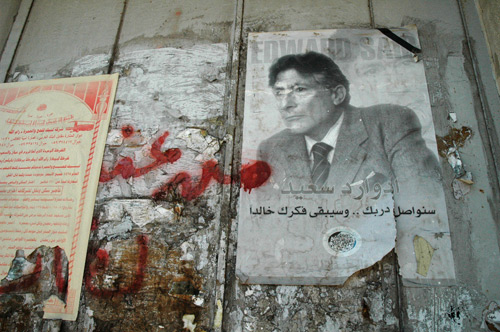
A poster of Edward Said on the West Bank separation wall in Ramallah, Palestine (C) Justin McIntosh
Both formal and informal efforts are needed to create a web of alternative approaches with the ability to seize the initiative when there is an opportunity for action. Our focus here is on informal approaches which can be carried out by Nongovernmental Organizations (NGOs) such as the Association of World Citizens (AWC).
Social media is a recent form of contact beyond the older face-to-face approach. Social media has become an important mobilizing force. It can drive debates and political change, but it can also be used to divide societies, incite violence and xenophobia. For peacebuilders, social media allows direct access to the general public. Thus, for peacebuilders, they need to learn to use social media creatively.
For NGOs such as the AWC, the first step is an analysis of the nature and the parties in the conflict. Information can be gathered from people already active on the issue such as academics and members of other NGOs. For the wider Middle East conflicts, there are citizens from these countries living in Europe and the U.S.A. as well as persons who visit Middle East countries regularly. It is important to get a wide range of views. For organizations such as the AWC, with consultative status at the United Nations (UN), it is possible to discuss with UN Secretariat members and with diplomats.
Resolving armed conflicts and lowering persistent tensions involves a change in the attitudes that are at the core of the conflict. We work to create possibilities for dialogue and confidence-building so as to increase mutual trust. Remaking contacts is a way of facilitating better communications between leaders holding antagonistic views, thus promoting cross-cultural communications. As we begin 2025 with tensions in the Middle East at a high level, creative action is needed. Join in this vital process.
Prof. René Wadlow is President of the Association of World Citizens.
“Always we have to remember that the wide, free sense of equality and kinship which lies at the root of Internationalism is the real goal. Always, we have to press on toward that great and final liberation – the realization of our common humanity, the recognition of the same great soul slumbering under all forms in the hearts of all races – the one guarantee and assurance of the advent of world peace.”
Edward Carpenter, The Healing of Nations, 1914.
As we approach the end of 2024 and make plans for 2025, it is useful to see the challenges which confront us in our conscious commitment to world citizenship. We are all able to envision a better future in which there is global cooperation. Such positive goals require leadership and the active participation of world citizens from around the globe. We need to make a personal commitment to be Earth stewards, protecting the planet for future generations. We need to break down barriers between people in order to reduce suspicions and tensions. Enormous creativity and effort are required to develop a safe and sustainable world society.
While we plan these positive steps, we must not underestimate the strength of the narrow nationalist currents planning to build new walls or enlarge existing walls. One could list the examples in many parts of the world. Narrow nationalists are in power in a number of countries or are waiting on the edges of power.
Thus, as Edward Carpenter wrote as the First World War broke out, we must press on to the realization of our common humanity.
Earth is our common home, Let’s protect it together (C) Bernard J. Henry/AWC
Prof. René Wadlow is President of the Association of World Citizens.
The flight of the Syrian dictator Bashar al-Assad on December 7, 2024 from Damascus to Moscow has opened a radically new period for Syrian politics. There are many different armed militias, ethnic and religious factions working to gain influence in the post-Assad situation. There are also outside powers – Iran, Russia, Turkey, and the USA which have been playing a role for some time and are not likely to fade from the scene overnight.
Women played only a minor direct role in the al-Assad administration and only minor roles in the groups opposing the Assad government, especially once the opposition became militarized mid-2011. Now, we must strive so that women can play a positive and active role in developing the new structures for a new Syria. Excluding women from peacebuilding neglects a rich source of skills, insights and energy. It is important to recognize that women are not a homogeneous group: education, class, ethnic group identity condition how individuals are affected by conflict.
We have seen with the Taliban administration in Afghanistan what can happen when women are not actively structured to play a role before there is a change in government. While not as vocal as the Afghan Taliban, there are most likely men in Syria in Jihadist factions who wish to keep women secluded and powerless.
Thus, women activists need to promote a vision that goes beyond the negotiation table. Negotiations to structure the new government are likely to begin in the next few days. There had been earlier negotiations among Syrian factions held at the United Nations in Geneva in 2014 with few or no women involved. Women face major challenges to engage in formal peace negotiations. Exclusion is often the norm. Therefore, women need to organize quickly now to spearhead Syrian civil society and reconciliation activities.
In the period after mid-2011 when opposition to the al-Assad government became an armed uprising, many Syrians left Syria for neighboring countries such as Lebanon and Turkey but also more widely to other countries in Western Europe. Some of these refugees were whole families with men present. In many cases, it was women with their children. Women had to learn skills in order to earn a living. They also started to get organized in mutual help organizations. These skills can be used today as the refugees return to Syria.
With the departure of al-Assad, the prisons have been opened. Men, often activists and intellectuals, have been liberated. They will want to play a role in helping develop new structures. However, they are related to different opposition factions and may have different view of what should be a future Syria.
We, on the outside and who are not Syrians, can try to support Syrian women involved in peacebuilding initiatives that are inclusive of both women and men. There is a need for relevant and timely support. We must see what avenues are open and how local conditions evolve.
Prof. René Wadlow is the Association of World Citizens.
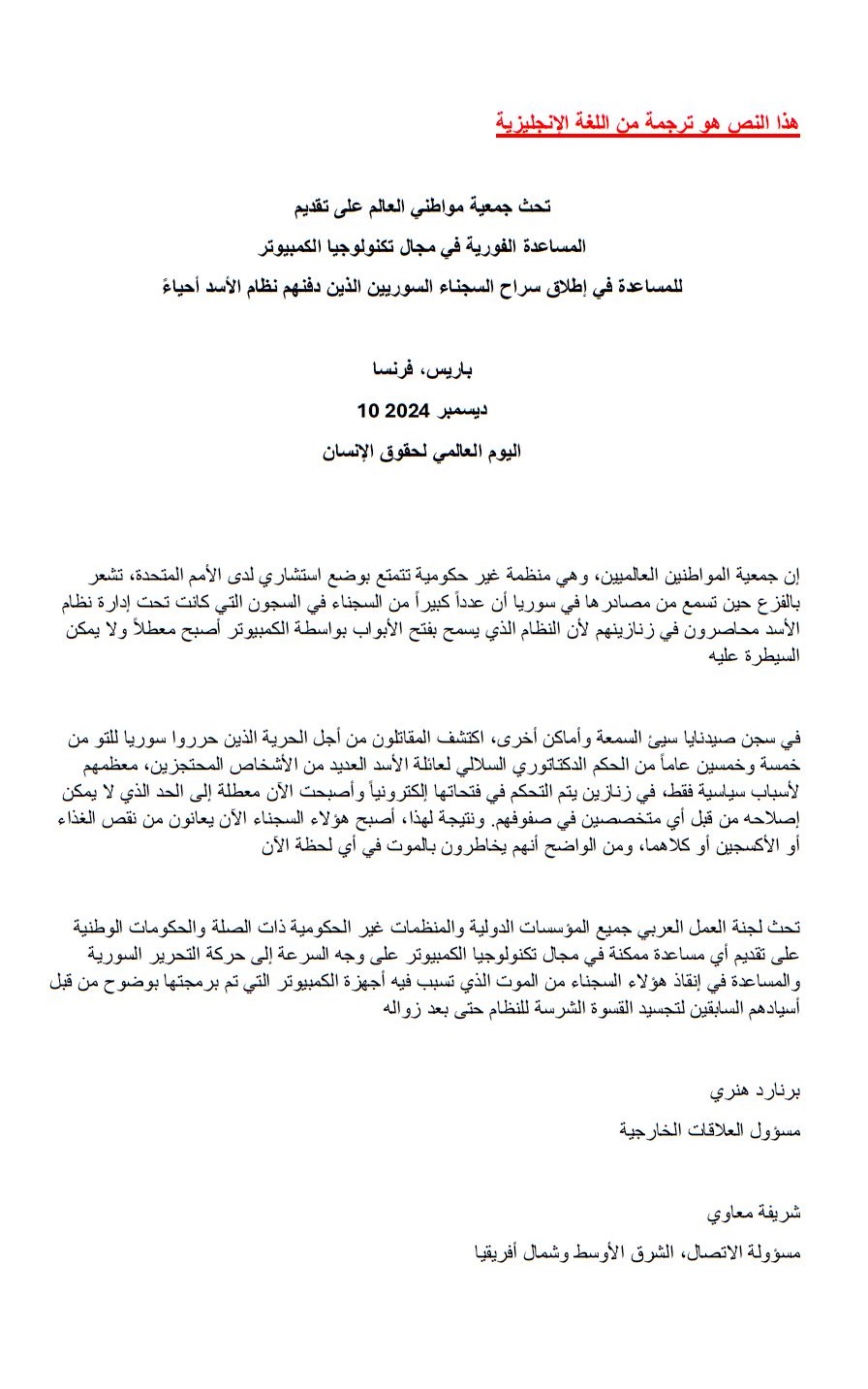
THE ASSOCIATION OF WORLD CITIZENS URGES IMMEDIATE ASSISTANCE IN COMPUTER TECHNOLOGY TO HELP FREE SYRIA’S INMATES BURIED ALIVE BY THE ASSAD REGIME
Paris, France December 10, 2024 International Human Rights Day
The Association of World Citizens (AWC), a Nongovernmental Organization (NGO) in Consultative Status with the United Nations (UN) is alarmed to hear from its sources in Syria that a considerable number of inmates in the prisons once run by the Assad regime are trapped in their cells because the computer-based system allowing the opening of the doors has been jammed and cannot be brought under control.
In the infamous prison of Sednaya and other places, the freedom fighters who just liberated Syria from fifty-five years of dictatorial, dynastic rule by the Assad family have discovered many people held, most of them merely on political grounds, in cells whose opening is electronically managed and is now jammed beyond any possible repair by any specialists in their ranks. As a result, those inmates are now running out of food or oxygen when not both, obviously risking death any moment now.
The AWC urges all international institutions, relevant NGOs and national governments to urgently bring whatever computer technology assistance possible to the Syrian liberation movement and help save those inmates from death caused by computers evidently programmed by their former masters to embody the vicious cruelty of the regime even after its demise.
Bernard Henry External Relations Officer
Cherifa Maaoui Liaison Officer, Middle East & North Africa
L’ASSOCIATION OF WORLD CITIZENS APPELLE A UNE ASSISTANCE INFORMATIQUE IMMEDIATE POUR LIBERER LES PRISONNIERS DE SYRIE ENTERRES VIVANTS PAR LE REGIME ASSAD
Paris, France 10 décembre 2024 Journée internationale des Droits Humains
L’Association of World Citizens (AWC), Organisation Non-Gouvernementale dotée du Statut Consultatif auprès de l’ONU et active à ce titre au sein du Conseil des Droits de l’Homme, s’alarme d’apprendre de ses sources en Syrie qu’un nombre considérable de détenus dans les prisons jadis dirigées par le régime sont pris au piège dans leurs cellules car le système informatique permettant l’ouverture des portes est bloqué et ne peut être ramené sous contrôle.
A la prison de sinistre mémoire de Sednaya et en d’autres endroits, les combattants de la liberté qui viennent de libérer la Syrie de cinquante-cinq ans de règne dictatorial et dynastique de la famille Assad ont découvert de nombreuses personnes détenues, la plupart pour de pures raisons politiques, dans des cellules dont l’ouverture est gérée électroniquement et se trouve aujourd’hui bloquée au-delà de toute réparation possible par des spécialistes combattant dans leurs rangs. Le résultat en est que ces détenus arrivent à court de nourriture ou d’oxygène, quand ce n’est pas des deux, chaque instant les rapprochant plus encore, bien entendu, de la mort.
L’AWC appelle toutes les institutions internationales, toutes les ONG compétentes et tous les gouvernements nationaux à apporter en urgence toute assistance informatique possible au mouvement de libération syrien et d’aider à sauver ces détenus d’une mort que leur causeraient des ordinateurs programmés, à l’évidence, par leurs anciens maîtres pour incarner la vicieuse cruauté du régime même après sa chute.
Bernard Henry Officier des Relations Extérieures
Cherifa Maaoui Officier de Liaison, Afrique du Nord & Moyen-Orient
Genocide is the most extreme consequence of racial discrimination and ethnic hatred. Genocide has as its aim the destruction, wholly or in part, of a national, ethnic, racial, or religious group as such. The term was proposed by the legal scholar Raphael Lemkin, drawing on the Greek genos (people or tribe) and the Latin –cide (to kill) (1). The policies and war crimes of the Nazi German government were foremost on the minds of those who drafted the Genocide Convention, but the policy was not limited to the Nazis (2).
The Genocide Convention is a landmark in the efforts to develop a system of universally accepted standards which promote an equitable world order for all members of the human family to live in dignity. Four articles are at the heart of this Convention and are here quoted in full to understand the process of implementation proposed by the Association of World Citizens (AWC), especially of the need for an improved early warning system.
Article I
In the present Convention, genocide means any of the following acts committed with intent to destroy, in whole or in part, a national, ethnical, racial or religious group, as such:
(a) Killing members of the group;
(b) Causing serious bodily or mental harm to members of the group;
(c) Deliberately inflicting on the group conditions of life calculated to bring about its physical destruction in whole or in part;
(d) Imposing measures intended to prevent births within the group;
(e) Forcibly transferring children of the group to another group.
Unlike most humanitarian international law which sets out standards but does not establish punishment, Article III sets out that the following acts shall be punishable:
(a) Genocide;
(b) Conspiracy to commit genocide;
(c) Direct and public incitement to commit genocide;
(d) Attempt to commit genocide;
(e) Complicity in genocide
Article IV
Persons committing genocide or any of the other acts enumerated in article III shall be punished, whether they are constitutionally responsible rulers, public officials or private individuals.
Article VIII
Any Contracting Party may call upon the competent organs of the United Nations to take such action under the Charter of the United Nations as they consider appropriate for the prevention and suppression of acts of genocide or any of the other acts enumerated in article III.
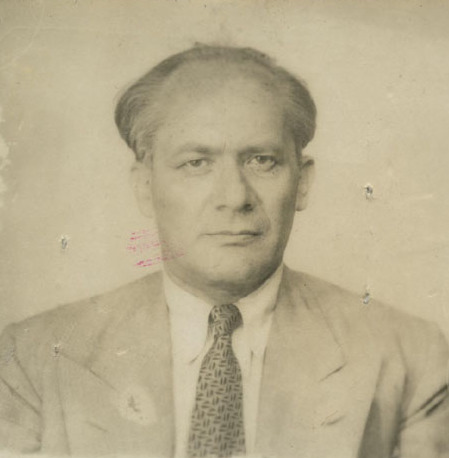
Raphael Lemkin (C) Center for Jewish History, New York City
Numerous reports have reached the Secretariat of the United Nations (UN) of actual, or potential, situations of genocide: mass killings; cases of slavery and slavery-like practices, in many instances with a strong racial, ethnic, and religious connotation — with children as the main victims, in the sense of article II (b) and (c). Despite factual evidence of these genocides and mass killings as in Sudan, the former Yugoslavia, Rwanda, Burundi, the Democratic Republic of Congo, Sierra Leone and in other places, no Contracting Party to the Genocide Convention has called for any action under article VIII of the Convention.
As Mr. Nicodème Ruhashyankiko of the Sub-Commission on Prevention of Discrimination and Protection of Minorities wrote in his study of proposed mechanisms for the study of information on genocide and genocidal practices “A number of allegations of genocide have been made since the adoption of the 1948 Convention. In the absence of a prompt investigation of these allegations by an impartial body, it has not been possible to determine whether they were well-founded. Either they have given rise to sterile controversy or, because of the political circumstances, nothing further has been heard about them.”
Yet the need for speedy preventive measures has been repeatedly underlined by UN Officials. On December 8, 1998, in his address at UNESCO, UN Secretary-General Kofi Annan said “Many thought, no doubt, that the horrors of the Second World War — the camps, the cruelty, the exterminations, the Holocaust — could not happen again. And yet they have, in Cambodia, in Bosnia and Herzegovina, in Rwanda. Our time — this decade even — has shown us that man’s capacity for evil knows no limits. Genocide — the destruction of an entire people on the basis of ethnic or national origins — is now a word of our time, too, a stark and haunting reminder of why our vigilance must be eternal.”
In her address Translating words into action to the UN General Assembly on December 10, 1998, the then High Commissioner for Human Rights, Ms. Mary Robinson, declared “The international community’s record in responding to, let alone preventing, gross human rights abuses does not give grounds for encouragement. Genocide is the most flagrant abuse of human rights imaginable. Genocide was vivid in the minds of those who framed the Universal Declaration, working as they did in the aftermath of the Second World War. The slogan then was ‘never again’. Yet genocide and mass killing have happened again — and have happened before the eyes of us all — in Rwanda, Cambodia, the former Yugoslavia and other parts of the globe.”
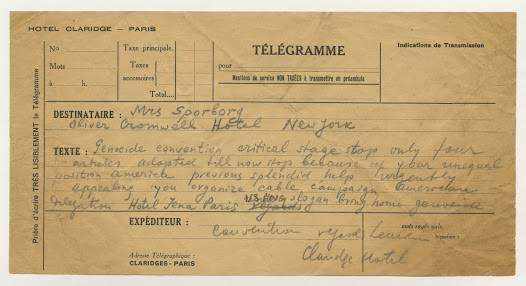
In a telegram sent from Paris in December 1948, Raphael Lemkin asked Ms. William Dick Sporberg, a member of the United States Committee for a United Nations (UN) Genocide Convention, to organize a cable campaign to persuade the United States Mission to the UN to support the adoption of the convention. Until the very last minute, no efforts were to be spared if the Genocide Convention was to come to existence and make the hopes of a whole generation traumatized by wide-scale extermination come true. (C) Google Cultural Institute/Center for Jewish History
We need to heed the early warning signs of genocide. Officially directed massacres of civilians of whatever numbers cannot be tolerated, for the organizers of genocide must not believe that more widespread killing will be ignored. Yet killing is not the only warning sign. The Convention drafters, recalling the radio addresses of Hitler and the constant flow of words and images, set out as punishable acts “direct and public incitement to commit genocide”. The Genocide Convention, in its provisions concerning public incitement, sets the limits of political discourse. It is well documented that public incitement — whether by Governments or certain non-governmental actors, including political movements — to discriminate against, to separate forcibly, to deport or physically eliminate large categories of the population of a given State, or the population of a State in its entirety, just because they belong to certain racial, ethnic, or religious groups, sooner or later leads to war. It is also evident that, at the present time, in a globalized world, even local conflicts have a direct impact on international peace and security in general. Therefore, the Genocide Convention is also a constant reminder of the need to moderate political discourse, especially constant and repeated accusations against a religious, ethnic, and social category of persons. Had this been done in Rwanda, with regard to the Radio Mille Collines, perhaps that premeditated and announced genocide could have been avoided or mitigated.
For the UN to be effective in the prevention of genocide, there needs to be an authoritative body which can investigate and monitor a situation well in advance of the outbreak of violence. As has been noted, any Party to the Genocide Convention (and most States are Parties) can bring evidence to the UN Security Council, but none has. In the light of repeated failures and due to pressure from nongovernmental organizations, the Secretary-General has named an individual advisor on genocide to the UN Secretariat. However, he is one advisor among many, and there is no public access to the information that he may receive.
Therefore, a relevant existing body must be strengthened to be able to deal with the first signs of tensions, especially “direct and public incitement to commit genocide.” The Committee for the Elimination of Racial Discrimination (CERD) created to monitor the 1965 International Convention on the Elimination of All Forms of Racial Discrimination would be the appropriate body to strengthen, especially by increasing its resources and the number of UN Secretariat members which service the CERD. Through its urgent procedure mechanisms, CERD has the possibility of taking early-warning measures aimed at preventing existing strife from escalating into conflicts, and to respond to problems requiring immediate attention. A stronger CERD more able to investigate fully situations should mark the world’s commitment to the high standards of world law set out in the Genocide Convention.
————————————————————————————–
Notes
1) Raphael Lemkin, Axis Rule in Occupied Europe (Washington: Carnegie Endowment for World Peace, 1944)
2) For a good overview, see: Samantha Power, A Problem from Hell: America and the Age of Genocide (New York: Basic Books, 2002)
3) E/CN.4/Sub.2/1778/416, Para 61
Prof. René Wadlow is President of the Association of World Citizens.