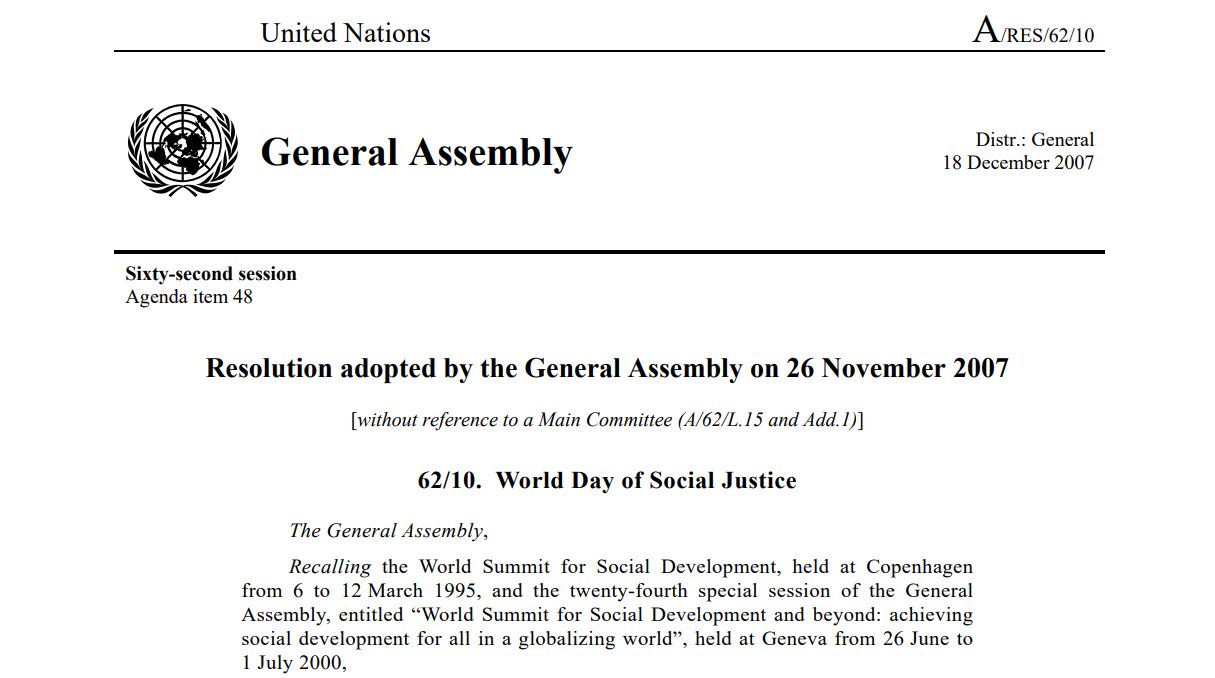
The United Nations (UN) General Assembly by Resolution 62/10 set February 20 of each year as the World Day of Social Justice. Today, as Citizens of the World, we can highlight world-wide gains in education, the reduction of extreme poverty, and the reduction of child labor.
Nevertheless, there are strong threats to social justice with inaction and apathy toward human misery. There is famine in parts of the world, armed conflicts, and uprooted and displaced populations.
The UN system is called upon to respond to these very diversified situations, often involving provisions of crucial direct aid to people in deep distress. At the national level, there is a need to place social justice at the core of policy making and to provide universal social protection.
A particular aspect of the lack of social protection is the fate of small rural farmers. There is an increasing amount of rural productive land that is falling under the control of urban elites, sometimes urban elites in other countries. Land ownership inevitably involves the distribution of power within a society. One answer to why the rural poor stay poor is that they are rarely well organized. The least powerful among the rural poor – the tenant farmers, the landless laborers, the members of tribal societies – are the least well organized, the most easily divided and blocked.
Thus, there is a need for renewed efforts for social justice carried out by persons with a long-range holistic vision able to see trends and the links between different social situations. There is a need for long-term cooperation among universities, religious groups, and Nongovernmental Organizations. The World Day of Social Justice is a time for a rededication for positive action.
Prof. René Wadlow is President of the Association of World Citizens.
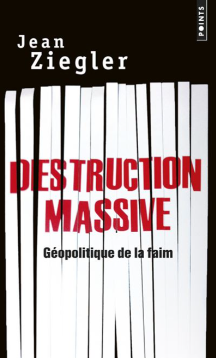
Jean Ziegler, Destruction Massive: Géopolitique de la faim.
Paris: Editions du Seuil, 2011, 343pp.
Translated into English and published as
Jean Ziegler, Betting on Famine: Why the World Still Goes Hungry
New York: The New Press, 2013
The First Millennium Goals set in 2000 were to half poverty and hunger by 2015.
Hunger and malnutrition are major causes of deprivation and suffering. As there has been no rapid progress in reducing hunger, other goals, such as reduced child mortality and improved maternal health, have not been met either. Many years of empirical evidence point to the negative impact of hunger and malnutrition on health, education, and labor productivity.
The impact of hunger has been known for some time. Jean Ziegler pays tribute to the research and action of a mutual friend, Josue de Castro, Brazilian nutritionist and World Citizen.
De Castro had pointed out in the late 1930s that hunger in Brazil was not a fatality of nature but the result of unjust human structures. Thus, things could change with enlightened action by farmers with the help of enlightened governments. He helped to organize peasant leagues and was elected to the parliament of Brazil. He undertook visits and studies in other Latin American countries. These studies convinced him of the socio-economic causes of hunger and of their wide geopolitical impact. The Geopolitics of Hunger is de Castro’s most widely read book and serves as the subtitle of Jean Ziegler’s book as hunger remains a geopolitical issue, not simply a question of locally improved agricultural techniques.
De Castro had been the independent president of the Executive Council of the Food and Agriculture Organization (FAO) of the United Nations (UN) from 1952 to 1955, at which time the governments decided to abolish the post of independent president. The Executive Council has been chaired by national diplomats since. While at the FAO, de Castro was invited to look at agriculture in a good number of countries. He had created in 1957 a Nongovernmental Organization, World Campaign against Hunger (Association mondiale de lutte contre la faim), ASCOFAM from its title in French. He drew on persons active in the world citizen movement such as l’Abbé Pierre, René Dumont and Max Habicht.
When I arrived in Geneva to teach at the Graduate Institute of Development Studies in September 1963, de Castro was the Ambassador of Brazil to the UN in Geneva, and I went to see him shortly afterwards to discuss development issues. Then in April 1964, the military led by General Castelo Bianco took power in Brazil. Their right-wing and brutal dictatorship lasted from 1964 to 1985. De Castro was quickly replaced as Ambassador and moved to Paris to teach and work with NGOs on hunger and agricultural issues. I saw him a number of times in Paris. He died in Paris in September 1973, aged only 65, but he left a heritage of study and action on the power dynamics of hunger and agricultural policies. Jean Ziegler, a sociologist of African societies and for a good number of years a Socialist member of the Swiss parliament, was from 2000 to 2008 the UN Commission on Human Rights’ Special Rapporteur on the Right to Food. Much of the research for the book was carried out with his UN team but is presented in a fiery style not found in UN reports.
Increased action to improve rural life needs to be taken quickly. As the recent UN-sponsored Millennium Ecosystem Assessment states, “Human activity is putting such strain on the natural functions of Earth that the ability of the planet’s ecosystem to sustain future generations can no longer be taken for granted. It is becoming ever more apparent that human society has a rapidly shrinking window of opportunity to alter its path.”
However, as Ziegler points out, it is not general human activity that is causing a strain, but the human activities of the powerful, the pred$atory sharks and financial speculators. He stresses the dangers of the increasing use of ethanol and other biofuels, often without consideration of the impact of the production of biofuels on land use and food production.
Their use should be limited at present so that the consequences of their use can be studied and biofuels developed from non-food sources. Ziegler also stresses that there needs to be a detailed analysis and then action on the role of speculation in the rise of commodity prices.
Banks and hedge funds, having lost money in real estate mortgage packages, are now investing massively in commodities. For the moment, there is little governmental regulation of this speculation. There needs to be an analysis of these financial flows and their techniques of operation − the wide use of offshore banks and holdings − and their impact on the price of grains and other foods.
Ziegler also stresses relatively new dangers to a just world food system. In many developing countries, the urban elite have been buying farmland as an investment, not necessarily to increase agricultural production with improved techniques, but to resell later when prices go up. Ziegler also stresses the sale or long-term rent of agricultural lands, especially in Africa, to governments or State-related companies of the Arab Gulf States and China. Again, the land is often not used for current agricultural improvement but is held for future use or sale. Thus, rather than seeing land reform, we are seeing dangerous trends of an increasing number of landless agricultural workers.
Jean Ziegler highlights the need for cooperation among the UN system of agencies, national governments, non-governmental organizations, and the millions of food producers.
There is a need for swift, short-term measures to help people now suffering from lack of food and malnutrition due to high food prices, the systems of food distribution, and situations of violence. However, it is the longer-range and structural issues on which we must focus our attention. The world requires a holistic World Food Policy and a clear Plan of Action. A knowledge of the geopolitics of hunger is a necessary first step.
Prof. René Wadlow is President of the Association of World Citizens.
Since the “12-day war” of Israel and the USA last June, Iran has been a powder keg with unresolved political tensions, deepening economic turmoil, and rising domestic dissent. With the start of 2026, the keg has exploded. Protests have started in some 32 cities and larger towns throughout the country.
The protests were first focused on economic issues symbolized by the sharp collapse of the rial, the national money, and the inflation exceeding 40 percent. These dynamics have turned the bazaaris – the merchants – traditionally a more conservative social group, into key participants in the protests. Economic hardship has become a daily experience for a wide segment of the population.
Although the protests began with economic demands, reports from across the country indicate that slogans have increasingly shifted toward explicitly political and anti-governmental messages, including chants directed at the Iranian leadership and the political system as a whole. Universities have once again emerged as key protest centers with action by both students and professors.
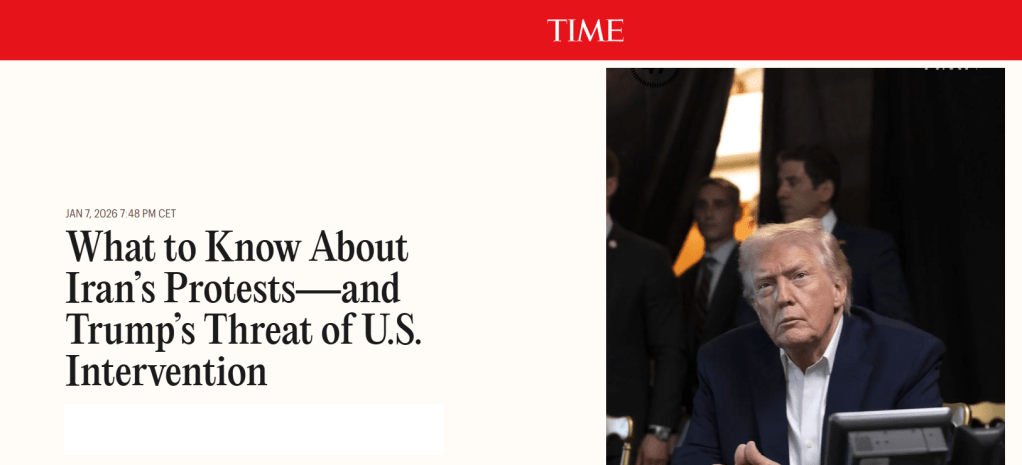
The government led by President Masoud Pezeshkian has promised economic reforms, but there is no protest leadership with which to negotiate. The security forces have increased repression with a large number of people arrested. A number of persons have been killed. Funerals for the protesters killed have become occasions for additional protests. The repression has led the United States (U.S.) President, Donald Trump, to say, “If Iran violently kills peaceful protesters, which is their custom, the United States of America will come to their rescue. We are locked and loaded and ready to go.”
The U.S. threats in the Iran situation are very unhelpful. It is time to unlock and unload. Rather, the Association of World Citizens calls on the Iranian authorities to cease immediately the use of force against peaceful protesters and to release those arbitrarily detained. This will create space for genuine dialogue and the needed reforms for economic justice.
Prof. René Wadlow is President of the Association of World Citizens.
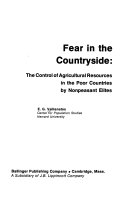
E.G. Vallianatos, a former member of the United Nations (UN) Secretariat, shows the connection between the lack of power and the lack of productivity. He highlights that most economic and political power in developing countries is concentrated in urban areas. Agrarian structures and access to essential resources often do not favor the majority of rural people, especially the poorest groups. Policies on development priorities and allocation of resources and services often help the politically powerful urban sector. An increasing amount of rural productive land is falling under the control of urban elites.
One answer to why the rural poor stay poor is that they rarely are well organized so as to be able to participate meaningfully in decision-making. Especially the least powerful among the rural poor – the tenant farmers, the landless laborers, members of tribal societies – are the least well organized, the most easily divided and blocked.
Social change is inevitably a challenge to the status quo. No development project, no matter how small or how technical, is without an impact on the distribution of power. A new well dug in a village is not simply an added social service. The new well calls into question the power of those who controlled the access to water prior to digging the new well.
If measures are not taken to facilitate the peaceful participation of the rural poor, it is likely that the rural poor will turn to armed violence, thus creating fear in the countryside. Non-violent techniques have been used to organize the powerless in rural areas. One of the first efforts of Mahatma Gandhi on his return to India from South Africa was to investigate and then mediate in the struggle of the indigo pickers. Cesar Chavez in the USA was a leading advocate of non-violence in his efforts to organize agricultural workers. The Sarvodoya Movement in Sri Lanka has applied the Buddhist values of compassion to construct a social and economic infrastructure based on a strong community spirit. There is a need to study the wide range of situations and the opportunities for constructive action.
Prof. René Wadlow is President of the Association of World Citizens.
Education for human rights is a vital need in order to create a universal culture of human rights. Such a culture of human rights can be built around peoples’ needs and current struggles. A human rights culture is more than knowing and respecting the provisions of the Universal Declaration of Human Rights. It is a break in the cycle of humiliation, abuses of power and violence in which too many people are caught today. People want to know that they are in full control of their lives and that their society embodies their uniqueness as people with the full development of their personality and sense of dignity.
Knowledge requires appropriate pedagogical techniques for imparting human rights information, and therefore there is a need to train teachers at all levels of formal education in the teaching of human rights. There is a need to develop innovative material for use especially in professional training for the judiciary, law enforcement, military, medical and social work. The need to develop innovative teaching material and techniques is true for the efforts against torture especially on persons held in custody.
In addition to human rights education within formal educational institutions, an emphasis can be placed on popular education and the informal sector. There is a role for writers and anthropologists to collect stories and songs that evoke the historical memory of people about hope, respect, equality and human dignity. Likewise, the media can play an important role both in giving information and in developing respect for human rights and dignity.
Human rights education is an indispensable tool in the empowerment of peoples. Learning of human rights leads to participation, reciprocity and accountability on all levels of society. This strengthens the democratic process as persons become aware of their rights and responsibilities, of the full dimension of equal respect between women and men, and among peoples of different cultural and ethnic identities.
There is much to be done, and many can play a role. Join in this vital effort for human rights education!
Prof. René Wadlow is President of the Association of World Citizens.
The United Nations (UN) Charter begins with the promising words “We the Peoples…”. However, thereafter the peoples’ voice fades and that of governments takes over. Yet today, Nongovernmental Organizations (NGOs) with consultative status with the UN play an effective role in shaping global policy. Many NGOs are transnational with members in different countries and cultures. This is one of their strengths and helps the UN to serve better all peoples.
For NGOs, there is a need to look outside the framework of the existing UN system to grasp the importance of new issues. This was the case in the late 1960s when some NGOs began to raise the issue of the environment and ecological protection before these issues were on the governmental agenda for action. Today, such an issue is the increasing amount of rural productive land that is falling under the control of urban elites, sometimes urban elites in other countries. Landownership inevitably deals with the distribution of power within a society. No development project, no matter how small or how technical, is without an impact on the distribution of power. A new well dug in a village is not simply an added social service. The new well calls into question the power of those who controlled access to water prior to digging the new well.
Although in many countries there are unions of agricultural workers, peasant leagues, agricultural cooperatives, and rural credit unions, it is nevertheless generally true that rural organizations have rarely achieved the degree of national power that has been reached by industrial workers’ unions.
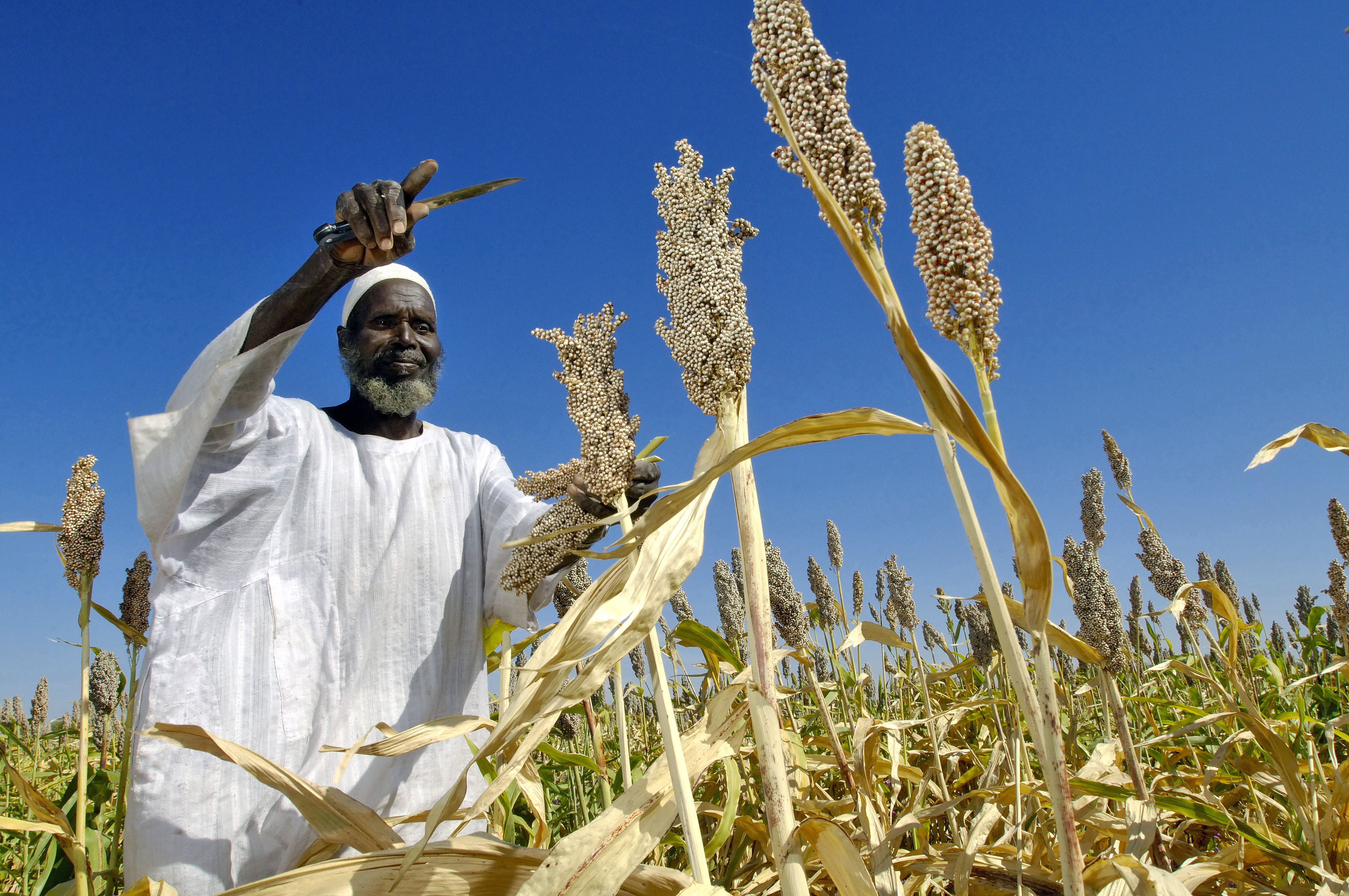
A Sudanese farmer harvesting sorghum plants from seeds donated by the Food and Agriculture Organization. (C) Fred Noy/UN Photo
One answer to why the rural poor stay poor is that they are rarely well organized. Especially the least powerful among the rural poor – the tenant farmers, the landless laborers, the untouchables, the members of tribal societies – are the least well organized, the most easily divided and blocked. The economic and political power structure in many countries does not encourage the active participation of small, marginal farmers and rural workers. If measures are not taken to facilitate the peaceful participation of the rural poor, it is likely that the rural poor will turn to armed violence.
It is true that nonviolent techniques have been used to organize the powerless in rural areas. One of the first actions of Mahatma Gandhi on his return to India from South Africa was to investigate and then mediate the struggle of the rural indigo pickers. Cesar Chavez was a leading advocate of nonviolence in his efforts to organize agricultural workers in the western United States. In Sri Lanka, the Sarvodaya movement has applied Buddhist values of compassion to construct a social and economic infrastructure based on a strong community spirit.
The role of the marginalized in rural areas is not a new problem but it is one that has not received the attention it deserves. NGOs can help to focus on the issue within the UN system and so advance reform measures.
Prof. René Wadlow is President of the Association of World Citizens.
“Is not this what I require of you … to snap every yoke and set free those who have been crushed?”
Isaiah, 58 v 6
There are many ways that we are held in chains as individuals through our own desires and habits. There are also many ways that society keeps others in chains. Our task is to help snap the individual bonds of slavery through our efforts at self-liberation and self-realization. To break the chains that society creates, we must work together cooperatively.
Slavery today, as in the past, can have one or more of the following characteristics: A slave is forced to work though mental or physical threat. The person is owned or controlled by an “employer” usually through mental or physical abuse and threats. The person is dehumanized by being treated as a commodity and bought and sold as if property. There are also restrictions placed on a person’s freedom of movement and kept isolated from those who might help to break the chains.
(C) Bernard J. Henry/AWC
Women are often the victims of diverse forms of servitude, and International Women’s Day is an appropriate time to analyze patterns and our efforts to liberate. Here we can look at four categories through there are often links among them.
A first category is debt bondage, especially practiced in South Asia. It is estimated that there are some 20 million people held in debt bondage throughout the world, even though debt bondage is forbidden by the Supplementary Convention of 1956 on the Abolition of Slavery, the Slave Trade and Institutions and Practices Similar to Slavery. Debt bondage is largely a rural practice, and local government officials and police often overlook its consequences. The debt is usually contracted in an emergency such as sickness or to cover expenses between harvests. However, often the person making the debt from money lenders or richer farmers cannot read and, therefore, has no idea of what “rates of interest” means, nor do they know when they have worked off the debt. It is often a child or younger member of the family who is “given” to work to pay off the debt. The debt is often never considered to have been paid and will go from one generation to the next.
Child labor is a second and related category of contemporary slavery. The International Labor Organization (ILO) estimates that there are some 180 million youth aged between 5 and 17 years old who are in the worst forms of child labor – work that is hazardous to their mental and physical health. The ILO Convention of 1999 (N° 182) is devoted to the “Worst Forms of Child Labor.” Translating these ILO efforts to the local workplace is a large job and needs to be done with care as some families depend heavily on income from children’s work.
Early and forced marriage is a third category of contemporary slavery. This form is often overlooked or excused as “custom” for it is usually carried out by the families themselves. In many societies, marriage is an alliance between families with elements of social control over wealth, power, and the sexuality of women as the motive. Women and girls are married without choice and often forced into lives of servitude. Because the girl child is seen in some communities as having lower priority, she is often denied access to such basic necessities as education which could ultimately protect her from exploitation.
A fourth category is human trafficking, often linked to prostitution which is the fastest-growing means by which people are enslaved today. Women, children and men are coerced and deceived by traffickers who promise work and good pay in areas far from their family and community. The reality is usually a harsh contrast. People are forced through the threat and use of violence to work against their will. Trafficking in persons is often carried out by groups which also traffic guns, drugs and pornography. These groups are willing to kill to keep their trade growing and often corrupt local officials and police.
Thus, on this International Women’s Day, we need to evaluate closely the challenges which face us within global society and to set out clearly the steps which must be undertaken for equality and justice.
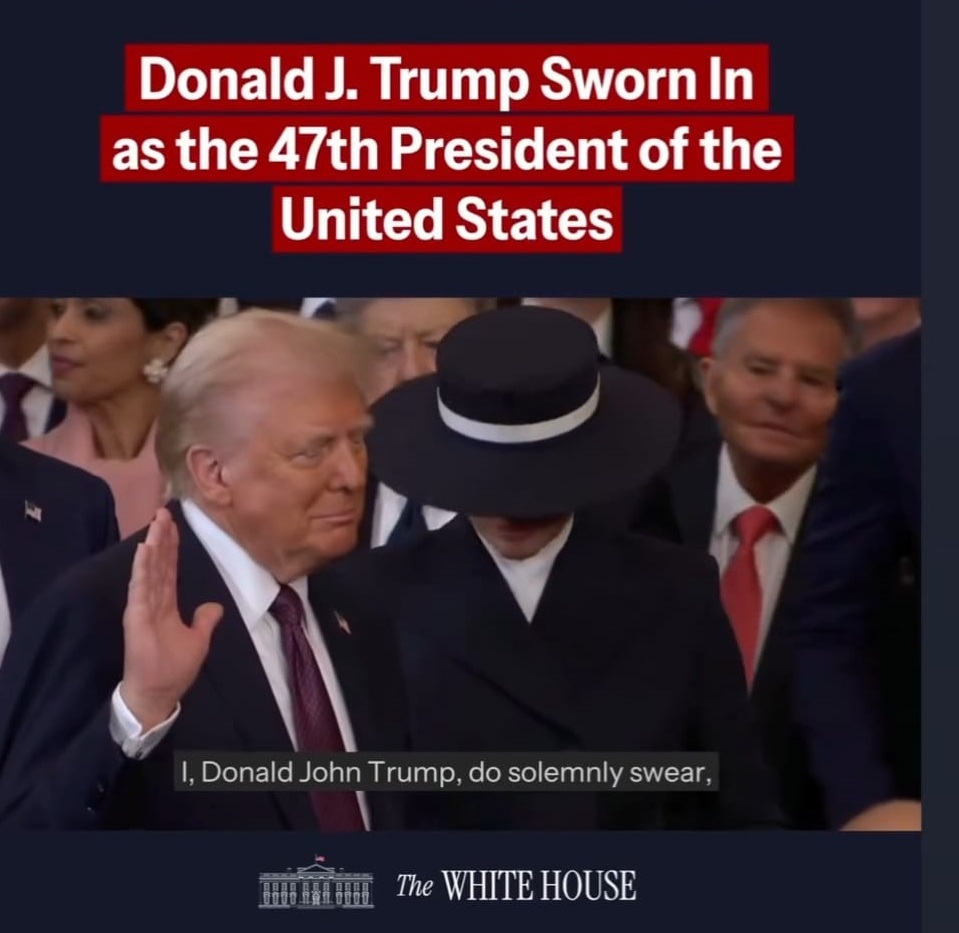
The January 20, 2025 inauguration of President Donald Trump has brought into sharp focus the turbulent and complex world society in which we live. As peacebuilders and citizens of the world, we face the same challenges as President Trump but with a different style and with far fewer resources at our command. We make plans but then are called to work for conflict resolution in unanticipated ways.
There are four policy challenges which face both President Trump and World Citizens: armed conflicts, currently ongoing and potential, persistent poverty in many areas, the erosion of international law and faith in multinational institutions, particularly the United Nations (UN), and the consequences of climate change.
The ongoing and potential armed conflicts are neither new nor unexpected. The Israeli-Palestinian tensions exist at least since 1936 and increased after the creation of the State of Israel. There may be some possibilities for negotiations in good faith. We must keep an eye open for possible actions.
Tensions with Iran are not new. The Soviet forces in part of Iran was the first conflict with which the UN had to deal in its early days. However, the rule by the Ayatollahs has made matters more complex.
The Russian-Ukrainian war grinds on with a large number of persons killed, wounded, and uprooted. Again, we must look to see if a ceasefire and negotiations are possible.
In Asia, the armed conflict in Myanmar between the military in power and the ethnic militias dates from the creation of the Burmese State at the end of the Second World War. A potential armed conflict between Mainland China and Taiwan dates from 1949 and the Nationalist government’s retreat to Taiwan. The potential armed conflict between the two Korean States dates from 1950 and the start of the Korean War.
The armed conflicts in Africa are no longer in the headlines, but they date from the early 1960s and the breakup of the European Empires: the Democratic Republic of Congo, Sudan, the States of the Sahel.
Thus, we all have a poor record of armed conflict prevention and mediation. Armed conflicts should remain at the top of both the governmental and nongovernmental agenda for action.
(C) U.S. Embassy France on Instagram
Persistent Poverty: Despite the UN Decades for Development, the Sustainable Development Goals, and Article 22 of the Universal Declaration of Human Rights which states that everyone is entitled to the economic, social, and cultural rights indispensable for his dignity and free development of his personality, persistent poverty exists in many parts of the world. One consequence of persistent poverty is migration from poorer to richer areas, both within countries and from poorer to richer States. Migration is a hotly debated issue in many countries, as right-wing nationalist groups make anti-migration their battle cry. Migration is likely to become an even more heated topic of debate as President Trump tries to carry out his proposal for a mass deportation of immigrants from the USA.
Linked to persistent poverty are trade issues and the protectionist trends in many countries. President Trump has proposed higher tariffs for good coming into the USA. This policy may set off tariff wars. Obviously to counter persistent poverty, world development policies must be improved – easier said than done!
The Erosion of International Law and Faith in Multinational Institutions: Armed conflicts and persistent poverty are closely related to the third issue: the receding United States (U.S.) involvement with the UN, the World Bank, the IMF, the World Court and other multinational organizations. Some of the foreign policy authorities appointed by President Trump are overtly critical of the UN and the International Criminal Court. There has already been an Executive Order to halt U.S. funding of the World Health Organization. However, there is no unifying vision of what a new world society would involve. The battle cry of “Make America Great Again”, if repeated by each State for itself, “Make Panama Great Again”, could be a loud concert but not conducive to positive decision making.
The Consequences of Climate Change: The fourth major group of issues concerns the consequences of climate change and the ways to lessen its impact. During the campaign for the presidency, Trump threatened to pull the USA out of the Paris Climate Agreement, and he has now signed an Executive Order doing so. The issue of climate change has been brought to the world agenda by scientists on the one hand, and by Nongovernmental Organizations and popular, often youth-led efforts, on the other hand. It is likely that these vital efforts related to climate change will continue despite climate policy resistance by some in the Trump administration.
President Trump said during his inaugural ceremony that “The Golden Age of America begins now… We stand on the verge of the four greatest years in American history.” We will have to watch closely and judge in four years. What is sure for peacebuilders and citizens of the world is that we stand on the verge of four more years of serious challenges. Thus, there is a need for cooperative and courageous action.
Prof. René Wadlow is President of the Association of World Citizens.
The Pact for the Future was accepted by the United Nations (UN) General Assembly in a three-stage process. The first stage was a nearly year-long drafting of the document with many small revisions in the 56 paragraphs setting out the goal of a renewed UN better able to guarantee peace and development. The second stage was a last moment motion by the Russian Federation which asked for a vote, finding some of the wording, especially on human rights, too strong. The Russian motion was put to a vote with 143 States voting for the text of the Pact, 15 abstentions, and 7 opposed (Russia, Belarus, North Korea, Iran, Syria, Sudan, and Nicaragua.)
After this vote, the President of the General Assembly called for a vote by acclamation. Everyone applauded, some more vigorously than others. Thus, the Pact was adopted by consensus.
The Pact should be seen as a springboard for action rather than as an end point. With the 193 UN members potentially involved in drafting the document, there was a need for compromises and general ideas rather than any new specific proposals. The Pact is a reaffirmation of the goals and processes of the UN system, but it also notes the need for constant renewal. In paragraph 6, the Pact states, “We recognize that the multilateral system and its institutions, with the United Nations and its Charter at the center, must be strengthened to keep pace with a changing world. They must be fit for the present and the future – effective and capable, prepared for the future, just, democratic, equitable and representative of today’s world, inclusive, interconnected and financially stable.”
Paragraph 9 states, “We also reaffirm that the three pillars of the United Nations – sustainable development – peace and security, and human rights – are equally important, interlinked and mutually reinforcing. We cannot have one without the others.”
In practice, it was easier to stress sustainable development since the 2030 Sustainable Development Goals had already been set out, through progress is very uneven. For peace and security, there are Articles 25 and 26 stating that, “We will advance the goal of a world free of nuclear weapons. We will uphold our disarmament obligations and commitments.” A culture of peace is mentioned in a number of places, but no specific steps are set out.
For two days prior to the governments’ discussion and voting on the Pact, there was what were called “Action Days” to which were invited Nongovernmental Organizations (NGOs), academics working on UN issues, and the representatives of business corporations involved in international trade. The two days were certainly a time for networking if not for “action”.
The Pact is a partially open door for UN cooperation with NGOs stating in a general way the “participation of relevant stakeholders in appropriate formats.” More specifically, the Pact calls to “Facilitate more structured, meaningful and inclusive engagement of nongovernmental organizations in consultative status with the Economic and Social Council in the activities of the Council in line with ECOSOC resolution 1996/21”. The door of the Pact was most open to youth calling for an increase in the representation of youth, which can only be via NGOs. We will have to see what, as NGO representatives, we can make of the partly open door.
Prof. René Wadlow is President of the Association of World Citizens.
Où est-il ? Où est ce «monde d’après» que l’on nous annonçait tel un Grand Soir durant le Premier Confinement lié à la pandémie de Covid-19 en France, en cette époque où un tiers de la planète devait rester enfermé chez lui et, pour certains dirigeants mal avisés comme Donald Trump et Jair Bolsonaro, il n’était pas question de le décréter même alors que la vie même de leur peuple en dépendait ? Où est cette ère nouvelle où l’être humain, confronté à une Troisième Guerre Mondiale qui n’opposait finalement pas deux blocs militaires mais toute l’humanité à un coronavirus, devait connaître enfin la paix et la solidarité comme n’auraient jamais osé en rêver même les fondateurs du mouvement Citoyen du Monde après 1945 ? Où est-il donc, le «monde d’après» ?
Aujourd’hui débutent à Paris les Jeux Paralympiques 2024, après des Jeux Olympiques inoubliables au cours desquels ont volé en éclats les préjugés sexistes et où les nationalités politiques ont été balayées au profit des seuls exploits sportifs. Les premières Olympiades depuis la fin officielle de l’urgence médicale mondiale liée à la Covid-19 l’an dernier seraient-elles donc vraiment celles du «monde d’après» ? Mieux vaut ne pas s’habituer à le croire.
Pas d’athlètes russes ou bélarusses, car depuis février 2022, la Russie agresse militairement l’Ukraine et le Bélarus d’Alexandre Loukachenko, voisin et meilleur élève de Vladimir Poutine, lui apporte son soutien actif ; pas de place pour l’un ou l’autre des deux pays agresseurs aux Olympiades. Une délégation israélienne malmenée par des spectateurs et une délégation palestinienne à laquelle il manquait des membres, tués avant d’avoir pu concourir, double résultat de l’atroce attaque terroriste commise en Israël par le Hamas palestinien le 7 octobre 2023 puis de la campagne militaire meurtrière à Gaza de l’armée israélienne en représailles, chaque jour sans discontinuer depuis l’attentat, l’horreur répondant à l’horreur comme trop souvent au Proche-Orient mais cette fois dans des proportions plus que jamais encore inhumaines et inacceptables.
En France même, le pays hôte, une crise politique et constitutionnelle avec un gouvernement démissionnaire qui jouait les prolongations du fait d’élections législatives anticipées convoquées dans un mouvement de vexation malvenue par le Président Emmanuel Macron et qui, sans un sursaut républicain de l’électorat, auraient vu s’installer au pouvoir l’extrême droite raciste et xénophobe – entre autres fléaux qu’elle a choisi de promouvoir. Le Nouveau Front Populaire, coalition des partis de gauche, l’a finalement emporté contre toute attente mais, dans un ultime acte de déni, le chef de l’État battu au Parlement a refusé de nommer tout de suite un nouveau gouvernement, contraignant ses ministres démissionnaires à retarder sine die leur départ.
Et la guerre qui fait rage une nouvelle fois au Soudan, la dictature qui ronge le Venezuela au point d’avoir jeté le quart de son peuple sur les routes, l’extrême droite nationaliste aux affaires en Argentine, en Italie, en Inde et ailleurs, le virus Mpox qui menace l’Afrique et potentiellement aussi l’Europe …
Le «monde d’après» ? On en regretterait presque le «monde d’avant» !
Alors que débutent ces Jeux Paralympiques, le «monde d’après» ne me paraît guère plus rassurant que son devancier pour une personne handicapée, sachant combien la pandémie était devenue une épreuve plus qu’olympique pour quiconque devait déjà, à chaque moment de sa vie, aller chercher la victoire contre les effets dans sa vie du handicap – et les Nations Unies ne s’y sont pas trompées, ayant su informer et guider pour agir au sujet de la maladie qui, en notre temps, aura sans nul doute engendré le plus de mensonge et de désinformation, au risque même de la vie de qui aura voulu y croire.
«Et ma grande raison», comme l’écrivait Molière, de m’en inquiéter, c’est que je suis moi-même une personne handicapée. Dans le «monde d’avant», j’en avais parlé ici même, le 3 décembre 2018, Journée internationale des Personnes handicapées, pas seulement de moi mais de nous toutes et tous à travers le monde. Et c’est lié. La Citoyenneté Mondiale que promeut l’Association of World Citizens (AWC) en est une qui, plutôt que d’être exclusivement idéologique comme dans d’autres mouvements, doit revêtir pour qui la proclame un sens personnel. Pour nous, écrire «je», ce n’est donc pas un acte d’arrogance mais une preuve, la plus importante même, celle que l’on est Citoyen(ne) du Monde y compris lorsqu’il faut plus que des mots.
Les Agitos, symboles paralympiques internationaux
Paris, le 3 décembre 2018
Qu’est-ce qu’une «tribu isolée» ? Allez, vous en avez entendu parler. C’est une communauté autochtone vivant dans son habitat traditionnel forestier ou insulaire, suivant un mode de vie millénaire fondé sur la nature et refusant tout contact avec le monde extérieur. Depuis que Jair Bolsonaro, le candidat d’extrême droite à la présidence du Brésil, a remporté les élections du 28 octobre, l’avenir des tribus isolées brésiliennes est en jeu, car Bolsonaro s’est engagé lors de sa campagne à éliminer toutes ces tribus[i].
On supposerait qu’une tribu isolée est en toute logique un peuple vivant dans un seul et même endroit, et non un groupe dispersé à travers le monde, ce qui lui vaudrait alors d’être appelé «diaspora isolée», même si l’expression n’aurait guère de sens. Si c’est ce que vous pensez, alors détrompez-vous.
Notre monde abrite en effet une tribu isolée mondiale. La tribu a un nom : les personnes handicapées. Et il se trouve que j’en fais partie. Si ce n’est pas votre cas, alors estimez-vous heureux.
Les damnés de la terre, les vrais
Si vous êtes convaincu que vous ne pourriez jamais vivre avec un seul de vos droits violé ou mal appliqué, alors réjouissez-vous de ne pas être des nôtres. Les personnes handicapées, qui représentent actuellement un milliard de personnes, soit 15% de la population mondiale, constituent la plus grande minorité au monde et, dans l’indignité la plus entière, la catégorie d’êtres humains dont les droits sont les plus ouvertement ignorés et bafoués.
La pauvreté nous frappe de plein fouet car, selon l’Organisation mondiale de la santé (OMS), 80% des personnes handicapées vivent dans des pays en développement, et les études de l’Organisation pour la Coopération et le Développement Économiques (OCDE) montrent que les taux d’invalidité sont nettement plus élevés parmi les groupes de population les moins éduqués dans les États membres de l’OCDE. Selon la Banque mondiale, parmi les personnes les plus pauvres au monde, 20% souffrent d’une forme de handicap et leur communauté elle-même les considère comme les plus défavorisés de ses membres.
Le handicap n’épargne pas même les femmes et les enfants. Une enquête réalisée en 2004 à Orissa, en Inde, a révélé que pratiquement toutes les femmes et filles handicapées étaient violentées au sein du foyer, que 25% des femmes présentant un handicap intellectuel avaient été violées et que 6% des femmes handicapées avaient été stérilisées de force. Le Fonds des Nations Unies pour l’Enfance (UNICEF) rapporte que 30% des jeunes des rues sont handicapés d’une manière ou d’une autre. La mortalité des enfants handicapés peut atteindre 80% dans les pays où, globalement, la mortalité des mineurs est pourtant tombée sous les 20%, affirme le Ministère britannique du Développement international, ajoutant que dans certains cas, les enfants sont «arrachés» comme les mauvaises herbes d’un jardin. A cause de la malnutrition, des maladies, du travail des enfants et pour d’autres raisons encore, le nombre d’enfants handicapés dans les pays en développement devrait augmenter au cours des trente prochaines années.
Lorsque l’on ne nous condamne pas à l’ignorance, l’OCDE estimant qu’en moyenne, 19% des personnes les moins instruites sont handicapées contre 11% parmi les personnes les plus instruites, nous restons sans défense contre les conséquences des conflits armés et de la violence. L’OMS estime que, pour chaque enfant tué au cours d’une guerre, trois autres sont blessés et conservent une forme permanente de handicap. Dans certains pays, jusqu’à un quart des handicaps résultent de blessures et de violences.
Alors que les tribus isolées ici et là s’efforcent de rester à l’écart de la «civilisation», nous, la tribu isolée mondiale, nous essayons de nous intégrer mais sommes repoussés par tout le monde, partout. En tant que tribu mondiale, les problèmes auxquels nous sommes confrontés peuvent à juste titre être qualifiés de problèmes mondiaux. Mais il est rare que des solutions mondiales soient trouvées, encore moins recherchées au départ.
Un peuple mondial sans droits mondiaux
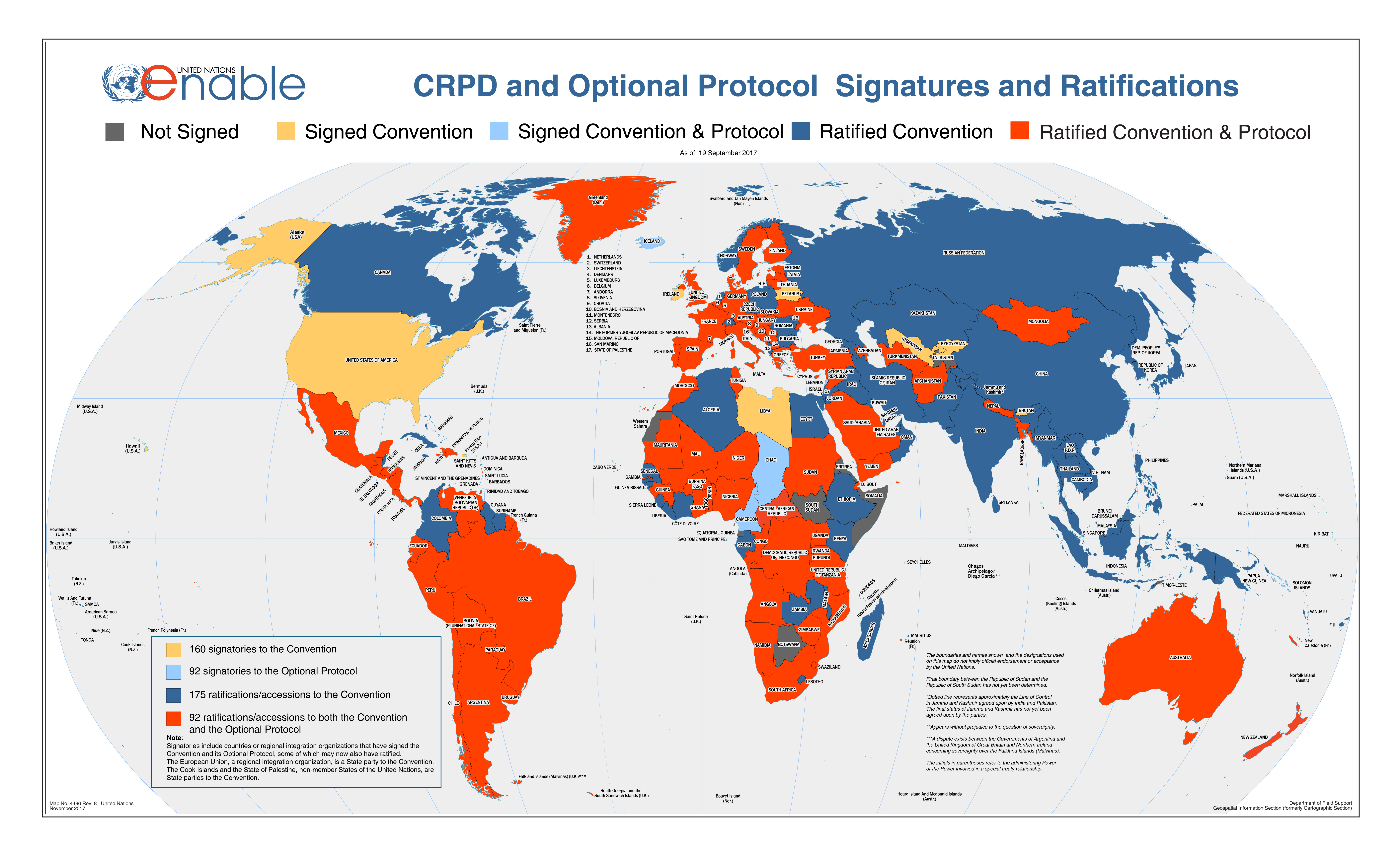
Ce n’est qu’en 2006 qu’un milliard d’habitants de la planète Terre ont vu leurs droits formellement consacrés dans un traité légalement contraignant : la Convention relative aux Droits des Personnes handicapées, signée le 30 mars 2007. La Convention est entrée en vigueur le 3 mai 2008 et, à ce jour, 177 pays y sont États Parties. Une agence des Nations Unies (ONU) spécifiquement dédiée, UN Enable, est chargée de veiller à ce que la Convention soit respectée et appliquée dans le monde entier. Et même en arriver à ce résultat fut tout sauf évident.
En 2004, l’Administration américaine, alors dirigée par le Président George W. Bush et en froid avec la majeure partie du monde du fait de sa guerre en Irak, s’était opposée de toutes ses forces à la Convention, soutenant que les lois nationales de chaque pays seraient toujours meilleures qu’un traité mondial. A ceci près que seuls quarante-cinq pays disposent de lois anti-discrimination et autres lois spécifiques au handicap, dont le contexte varie considérablement d’un pays à l’autre et rend impossible l’émergence d’un modèle juridique mondial commun à partir des législations nationales.
Aux États-Unis, les personnes handicapées ont participé au mouvement des droits civiques dans les années 1960, ce qui leur a valu des lois qui leur accordent des droits formels contraignants pour les gouvernements et tribunaux fédéraux, de chaque Etat et au niveau local. En France, en revanche, les personnes handicapées ont obtenu de premiers droits spécifiques au lendemain de la Première Guerre Mondiale, lorsque de nombreux soldats sont revenus du champ de bataille criblés de blessures à vie, ayant désormais besoin soit de pensions sociales spécifiques soit d’une aide pour trouver un emploi. Dans ce second cas, les personnes handicapées françaises ont dû attendre 1975 pour qu’apparaisse une loi plus large, à laquelle a succédé seulement en 2005 une loi plus complète encore, les deux fois grâce à la détermination d’un seul homme – Jacques Chirac, Premier Ministre en 1975 et Président en 2005, dont la fille Laurence, décédée en 2016, était gravement handicapée. La France est un État partie à la Convention, alors que les États-Unis n’en sont que signataires.
La Convention ne confère pas à l’ONU le pouvoir de reconnaître et d’enregistrer des individus comme personnes handicapées lorsqu’il n’existe pas de cadre légal national, à la manière du HCR qui enregistre les réfugiés dans les pays dépourvus d’une agence nationale de l’asile. Un honteux exemple de ce qui se passe lorsque la souveraineté nationale ignore les limitations à lui apporter pour garantir le plus grand bien de toutes et tous. Et qui nous isole davantage encore, nous, personnes handicapées, la tribu isolée mondiale.
Nous sommes des Citoyens du Monde – et parfois même ses dirigeants
Sommes-nous condamnés à rester à jamais des exclus du monde, une tribu isolée mondiale puisque personne ne veut nous contacter, du moins sans porter de jugement ou se montrer paternaliste à notre égard ? Pourrons-nous un jour nous intégrer pleinement dans la société ? Pour emprunter une citation de Mark Twain, certains d’entre nous «ne savaient pas que c’était impossible, alors ils l’ont fait». Et leurs noms pourraient bien vous étonner.
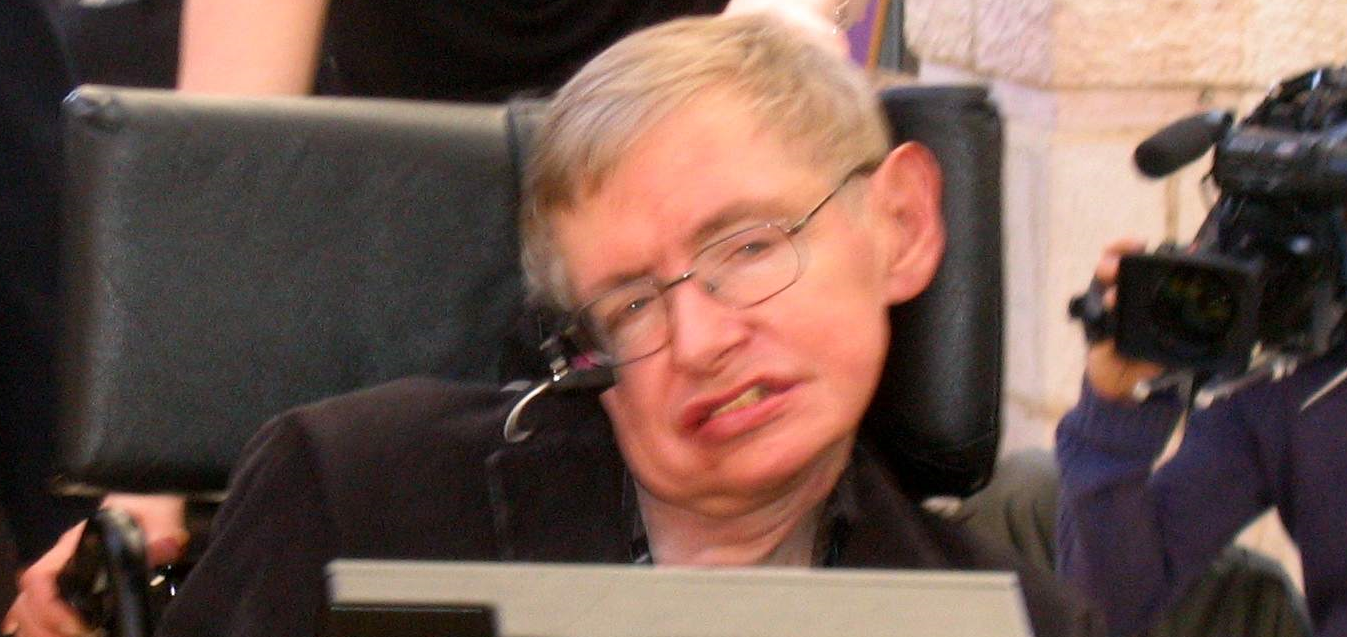
Stephen Hawking, légende britannique de la physique théorique. John Nash, mathématicien américain dont la vie a inspiré le film Un homme d’exception (A Beautiful Mind). Vincent Van Gogh. Ludwig van Beethoven. Frida Kahlo. Tom Cruise. Robin Williams. Stevie Wonder. Ladyhawke, chanteuse et musicienne néo-zélandaise devenue mondialement célèbre en 2008 avec son tube mondial Paris is Burning. Pour n’en citer que quelques-uns.
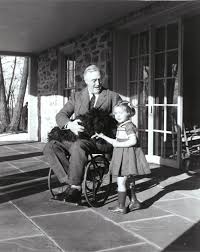
D’autres encore ont gravi les échelons jusqu’au sommet du pouvoir politique. Joaquín Balaguer, ancien Président de la République dominicaine. Wolfgang Schaüble[ii], plusieurs fois ministre fédéral et aujourd’hui Président de l’Assemblée fédérale allemande (Bundestag). Gordon Brown, ancien Premier Ministre du Royaume-Uni. Aux États-Unis, Robert Dole, longtemps Sénateur du Kansas et candidat républicain à la présidentielle de 1996, ainsi que son collègue récemment décédé[iii], lui aussi Sénateur et ancien candidat républicain à la présidence, John McCain, de l’Arizona – et, plus important encore, deux anciens Présidents, tous deux issus du Parti Démocrate, Woodrow Wilson et Franklin Delano Roosevelt, rien de moins.
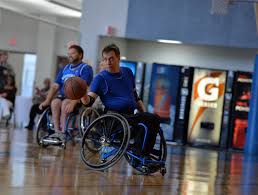
Ce dernier a remporté quatre élections présidentielles, sorti son pays d’une crise économique et sociale majeure, gagné la Seconde Guerre Mondiale et créé les Nations Unies – tout cela depuis un fauteuil roulant. Alors, pour une tribu isolée, difficile de nous considérer pour autant comme une partie totalement inutile de la population mondiale !
Ne regardez pas notre nom – regardez nos êtres
Même le terme «personnes handicapées», inventé par les non-handicapés pour nous désigner, semble être devenu plus que ce monde peut supporter. Certains utilisent désormais l’appellation «d’une aptitude différente» (en anglais, differently abled), au risque même de souligner combien nous sommes différents alors que nous avons besoin d’être reconnus, oui, pour nos spécificités, mais aussi pour nos similitudes avec les personnes dites «valides». Quelle importance peut revêtir un nom ? Celle qu’il ne devrait pas.
Les personnes handicapées doivent être vues comme elles sont : des personnes contraintes de vivre avec un handicap qui nécessite une attention particulière de la part de la société, tandis que chacune d’elles conserve sa propre personnalité, ses compétences et, contrairement à ce que notre nom indique, sa validité individuelle.
Le 3 décembre a été proclamé Journée internationale des Personnes handicapées en 1992, à travers la Résolution 47/3 de l’Assemblée générale des Nations Unies. Chaque année, la même question est posée au peuple du monde : pourquoi avez-vous si peur de la tribu isolée mondiale ? Qu’est-ce qui vous fait penser qu’elle ne peut être qu’un fardeau pour la société ? Ne vaudrait-il pas mieux pour vous et pour elle de choisir un mode de vie plus inclusif qui créât l’égalité des chances, quelle que soit votre (in)validité ?
Et le monde s’interroge encore. Il nous voit, nous, la tribu isolée mondiale. Il nous parle. Mais dans une langue que nous ne pouvons comprendre, car ses mots ne peuvent pas porter ce que nous, nous pensons. Et nous restons donc isolés.
Si vous voulez vraiment nous contacter, commencez par admettre l’idée que ce que vous appelez «handicap» est une création de votre propre esprit. Nous, la tribu isolée mondiale, renfermons des fortunes de connaissance et d’expérience, différentes des vôtres et qui vous restent inconnues. Alors, laissez-nous donc vous aider à faire de ce Monde un endroit meilleur pour ses Citoyen(ne)s – toutes et tous, mais cette fois, vraiment.
Bernard J. Henry est Officier des Relations Extérieures de l’Association of World Citizens.
[i] Jair Bolsonaro a quitté ses fonctions le 1er janvier 2023 après sa défaite électorale contre Luiz Inácio ‘Lula’ da Silva.
[ii] Wolfgang Schaüble a quitté son poste le 26 octobre 2021. Il est décédé le 26 décembre 2023.

 Association of World Citizens