The Official Blog of the

Archive for the ‘Middle East & North Africa’ Category

International Decade of Water for Sustainable Development 2018-2028

In Africa, Being a World Citizen, Current Events, Environmental protection, Human Development, Human Rights, Middle East & North Africa, Social Rights, Solidarity, The Search for Peace, United Nations, World Law on April 10, 2018 at 7:50 AM

By René Wadlow

On March 22, World Water Day, the United Nations (UN) General Assembly proclaimed “The International Decade for Action: Water for Sustainable Development 2018-2028. The Decade seeks to forge new partnerships and to strengthen capacity to manage fresh water supplies and sustainable use. Ecologically-sound water use is one of the UN’s Sustainable Development Goals, N°6 “Ensure the availability and sustainable management of water and sanitation for all.” The aim of the Water Decade is to raise the profile of water in the global agenda of governments and nongovernmental organizations.

There have already been two UN-sponsored Water Decades: 1981-1990, and a second decade called UN Water for Life Decade, 2005-2015. Water and sanitation have been set out as human rights and the UN Human Rights Council has a Special Rapporteur for the Human Right to Water and Sanitation, most recently Mr. Leo Heller. However, real difficulties remain. Some 660 million people still draw water from an unimproved source. Urbanization, population growth, desertification, drought and climate change all put pressure on water supply and use.

We will look briefly at an aspect of the world-wide water challenge: desertification and at some of the steps which the UN along with non-governmental organizations in consultative status with the UN are taking to meet this challenge creatively.

water-861588_960_720

UN efforts began in 1977 with the United Nations Conference on Desertification held in Nairobi. The desertification conference was convened by the UN General Assembly in the midst of a series of catastrophic droughts in the Sudan-Sahelian region of Africa. The conference was designed to be the centerpiece of a massive world-wide attack to arrest the spread of deserts or desert-like conditions not only in Africa south of the Sahara but wherever such conditions encroached on the livelihood of those who lived in the desert or in its destructive path. The history of the conference is vividly recalled by James Wallis in his book Land, Men and Sand (New York: Macmillan, 1980)

At the conference, there was a call for the mobilization of human and financial resources to hold and then push back the advancing desert. “Attack” may have been the wrong word and “mobilization” too military a metaphor for the very inadequate measures taken after the conference in the Sudan-Sahelian area. Today, there are still real possibilities of famine in West and East Africa on the edges of the desert. Niger and Mali and parts of Senegal and Chad in the Sahel belt are facing the consequences of serious drought as are parts of northern Kenya and Somalia.

7458286624_c926d92f99_k

The most dramatic case is that of Darfur, Sudan which partakes of the Sahel drought but which also faces a war in which conflicts between pastoralists and settled agriculturalists have become politicized. It is estimated that over 300,000 people have been killed since the start of the war in late 2003. Some two and a half million people have been uprooted. The agricultural infrastructure of homes, barns and well have been deliberately destroyed. It will be difficult and costly to repair this destruction. The Darfur conflict highlights the need for a broader approach to the analysis and interpretation of active and potential armed conflicts in the Sahel region. This analysis needs to take into consideration the impact of environmental scarcity and climate variation in complex situations.

What are the causes of the desertification process? The destruction of land that was once productive does not stem from mysterious and remorseless forces of nature but from the action of humans. Desertification is a social phenomenon. Humans are both the despoiler and the victim of the process. Increasingly, populations are eking out a livelihood on a dwindling resource, hemmed in by encroaching plantations and sedentary agriculturalists, by towns and roads.

Desertification is a plague that upsets the traditional balance between people, their habitat, and the socio-economic system by which they live. Because desertification disturbs a region’s natural resource base, it promotes insecurity. Insecurity leads to strife. If allowed to degenerate, strife results in inter-clan feuding, cross-border raiding and military confrontation.

450px-Dripping_faucet_1

Only with a lessening of insecurity can pastoralists and cultivators living in or near deserts turn their attention to adapting traditional systems of compromise between the two. There can be no reversion to purely traditional systems. For insecurity to abate, a lengthy process of conciliation must begin and forms of conflict resolution must be strengthened. People must be encouraged to understand that diversity is a crucial element of ecologically-sound development. Judicious resource management breeds security and an improved quality of life for everyone. We can see what efforts can be made to encourage reforestation and to slow the unwanted advances of deserts.

Desertification needs to be seen in a broad way. If we see desertification only as aridity, we may miss areas of impact such as in the humid tropics. We need to consider the special problems of water-logging, salinity and alkalinity of irrigation systems that destroy land each year. We need to identify major clusters of problems, bringing the best minds to bear on them so as to have a scientific and social base on which common political will can be found and from which action will follow.

Prof. René Wadlow is President of the Association of World Citizens.
COMMUNIQUE DE PRESSE – 2018-04-01-16-25-FRA

In Being a World Citizen, Conflict Resolution, Current Events, Human Rights, Middle East & North Africa, Solidarity, The Search for Peace, United Nations, World Law on April 1, 2018 at 2:26 PM

-- Logo 2017 --


COMMUNIQUE DE PRESSE


Paris, le 1er avril 2018


LES CITOYENS DU MONDE DEMANDENT UNE ENQUÊTE INDÉPENDANTE

SUR LES VIOLENCES COMMISES PENDANT LE RASSEMBLEMENT

DE LA GRANDE MARCHE DU RETOUR LE 30 MARS

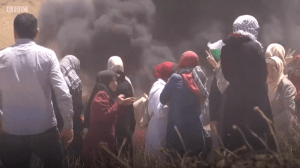
L’Association of World Citizens (AWC) se joint aux appels de l’ONU et de l’Union européenne (UE) pour une enquête indépendante sur les affrontements entre la Force de Défense israélienne et des manifestants palestiniens le 30 mars dernier dans la Bande de Gaza, lors desquels seize Palestiniens ont été tués et des centaines d’autres blessés.

L’usage de balles réelles, de billes de plomb enrobées de caoutchouc, et de gaz lacrymogènes par la Force de Défense israélienne contre des manifestants aux intentions pacifiques paraît difficilement justifié et appelle un examen impartial pour déterminer les violations des Droits Humains commises durant ces événements.

Une telle enquête est d’autant plus importante qu’il est prévu que la Grande Marche du Retour se poursuive et ait lieu également aux frontières de la Cisjordanie.

Bien que déplorant la tendance actuelle du Gouvernement israélien à isoler le pays de la communauté mondiale – non dans une moindre mesure par l’annonce du retrait du pays de l’UNESCO – l’AWC appelle à une pleine coopération avec l’ONU et l’UE en direction d’une enquête internationale sur les violences qui ont gâché la manifestation de la Grande Marche du Retour.

Faire partie de la communauté mondiale des peuples et des nations implique des devoirs et responsabilités. Respecter le droit à la protestation pacifique en fait partie. Le monde entier regarde et il faut à cette crise une issue juste et honorable.

Tout être humain a droit à la vérité et à la justice. Sur ce qui s’est produit, les Citoyens du Monde exigent l’action.

PRESS RELEASE – 2018-04-01-16-20-ENG

In Being a World Citizen, Conflict Resolution, Current Events, Human Rights, International Justice, Middle East & North Africa, Solidarity, The Search for Peace, United Nations, World Law on April 1, 2018 at 2:20 PM

-- Logo 2017 --


PRESS RELEASE


Paris, April 1, 2018


WORLD CITIZENS CALL FOR AN INDEPENDENT INVESTIGATION

INTO THE VIOLENCE

DURING THE GREAT MARCH OF RETURN PROTEST ON MARCH 30

The Association of World Citizens (AWC) joins the United Nations (UN) and the European Union (EU) in calling for an independent investigation into the clashes between the Israeli Defense Force (IDF) and Palestinian protesters that took place in the Gaza Strip on March 30, killing 16 Palestinians and injuring hundreds more.

The use of live fire, rubber-coated steel pellets, and teargas by the IDF against protesters with peaceful intentions can hardly appear justified and thus warrants an impartial examination with a view to assessing the violations of human rights committed during these events.

Such an investigation is especially important as the Great March of Return is planned to continue and take place on the West Bank’s boundaries as well.

While deploring the Israeli Government’s latest tendency to isolate the country from the global community – not least by announcing the country’s withdrawal from UNESCO – the AWC calls for full cooperation with the UN and EU toward an international investigation into the violence that marred the Great March of Return protest.

Being part of the global community of peoples and nations implies duties and responsibilities. Respecting the right to peaceful protest is one of them. The world is watching and there must be a fair, honorable outcome to this crisis.

Every human being has a right to truth and justice. World Citizens want action on this issue.

– 30 –

Maître Najet Laabidi de nouveau visée par les autorités tunisiennes

In Being a World Citizen, Children's Rights, Current Events, Disabled people, Human Rights, International Justice, Middle East & North Africa, NGOs, Social Rights, Solidarity, United Nations, World Law on March 18, 2018 at 7:29 AM

Par Bernard Henry

Si l’on juge un pays sur la manière dont il traite les personnes handicapées, alors la Tunisie a besoin d’un bon avocat. Et si l’on juge un pays au respect que les pouvoirs publics accordent aux avocats, alors la terre du Jasmin semble en chute libre vers l’indéfendable.

Une fois de plus, l’avocate tunisienne Najet Laabidi, poursuivie depuis 2011 pour avoir voulu représenter ses clients comme il est naturel pour un avocat, est dans le collimateur. Et cette fois, l’injustice est plus criante encore, car les clients que l’on veut l’empêcher de représenter sont, comment le comprendre, des personnes handicapées.

Enfants autistes, elles les maltraitent

Dans un courrier du 8 mars à la Rapporteuse spéciale de l’ONU sur les Droits des Personnes handicapées, Catalina Devandas-Aguilar, le Comité de Soutien de l’Affaire des Enfants autistes violentés et de Défense des Droits des Enfants/Personnes Autistes/Handicapé(e)s sonne l’alarme sur les faits dont il tire son nom, des faits remontant à février dernier seulement et qui, dans une Tunisie qui ne cesse de s’éloigner des espoirs de la révolution qui ouvrit en 2011 le « printemps arabe », sonnent comme un implacable constat d’échec – et un déchirant appel au secours.

« Le 17 février 2018, » écrit le Comité, « une vidéo a été mise en ligne sur les réseaux sociaux présentant des actes de violence (de maltraitance) d’enfants autistes dans un centre privé de prise en charge et d’éducation spécialisée à Tunis. » Sur cet enregistrement, réalisé par un employé du centre, l’on voit trois enfants se faire agresser par deux éducatrices du même centre.

La politique prise en défaut …

Les réactions n’ont pas tardé. Le 19 février, le Chef du Gouvernement tunisien affirmait son indignation, ordonnant une prise en charge psychologique immédiate pour les enfants du centre. Les premières consultations débutèrent le 6 mars.

Du côté des autres ministres, les suites furent moins reluisantes. Ministère de la Femme, de la Famille et de l’Enfance, Ministère des Affaires Sociales et Ministère de l’Education se jetèrent la patate chaude, chacun niant que le centre relève de sa juridiction. Et pour cause. En Tunisie, les centres pour enfants ou personnes handicapées sont gérées par des associations, elles-mêmes affiliées au Ministère des Affaires Sociales. Au mieux. Car le centre ne possède qu’un simple statut d’école privée, avec agrément du Ministère de l’Education, et n’abrite aucun professionnel qualifié pour la prise en charge des enfants autistes ou des personnes handicapées.

Côté grand public enfin, ce n’est pas la publicité qui a manqué à la vidéo, pas plus que les débats, à la radio, à la télévision et ailleurs. Débats où les enfants autistes ne trouvent pas que des défenseurs. C’est ainsi qu’un intervenant est allé jusqu’à justifier les violences, qu’il qualifiait d’ «intervention thérapeutique scientifique reconnue dans le cas des enfants autistes» …

Capture d'écran 2018-03-17 19.36.43.png

Avec l’affaire relayée y compris dans les médias internationaux, le scandale a de loin dépassé les seules frontières de la Tunisie. (Capture d’écran)

Mais l’essentiel de la population a bel et bien pris parti pour les enfants victimes, les familles d’enfants autistes et personnes handicapées, les Défenseurs des Droits Humains, les juristes et les organisations de personnes handicapées ayant été au premier rang de l’indignation générale.

Créé dans la foulée, le Comité de Soutien de l’Affaire des Enfants autistes violentés et de Défense des Droits des Enfants/Personnes Autistes/Handicapé(e)s appela au rassemblement devant la Présidence du Gouvernement. Le 20 février, à l’issue de la manifestation, des représentants du comité rencontrèrent des officiels gouvernementaux, auxquels ils rappelèrent les annonces du Chef du Gouvernement. Leurs exigences étaient simples et claires – des solutions pour les enfants du centre qui avaient dû, suite au scandale, être ramenés dans leurs familles, et des mesures à moyen et long terme pour que jamais de tels faits ne se reproduisent.

Des politiques mis au pied du mur entendaient enfin une légitime colère.

… Et le droit en déshérence

Dans tout Etat se voulant un Etat de droit, qui dit violences avérées dit procédure pénale. Au moins sur ce point, la Tunisie ne déçoit pas. Enfin, pas tout de suite.

Devant les plaintes déposées contre le centre et sa directrice par les parents des jeunes victimes, pour les besoins de l’instruction, l’une des éducatrices est en détention mais l’autre, ainsi que la directrice, ont été relâchées sous contrôle judiciaire. Malgré la gravité des faits, le centre lui-même n’a pas été fermé.

Plus incompréhensible encore, plusieurs parents des pensionnaires du centre ont pris la défense de la directrice et affirmé son innocence. Incompréhensible, certes – si l’on oublie que ces mêmes parents bénéficient d’une prise en charge de leurs enfants entièrement gratuite, là où le centre facture 700 à 900 dinars tunisiens, soit 230 à 300 euros, chaque mois. Une directrice «chèrement» défendue donc.

Et dont les soutiens ne s’arrêtent pas à des parents-clients, puisque, le 5 mars, la Commission parlementaire de la Santé et des Affaires sociales la recevait en tant que représentante d’une association sur l’autisme et porte-parole … Des centres pour enfants autistes. Rencontre diffusée le soir même au JT. Une conception bien singulière de l’exemplarité.

Elle porte plainte au nom des témoins, les gendarmes portent plainte contre elle

A l’horreur de la situation et au mépris du droit qui l’entoure, il fallait bien que viennent s’ajouter des manœuvres d’intimidation envers une avocate défendant les Droits Humains. Et il fallait que cette avocate soit, une fois encore, Najet Laabidi.

«En France, on laisse au repos ceux qui allument les incendies et on persécute ceux qui sonnent le tocsin», notait Chamfort en son temps. Apparemment une malheureuse exportation française vers la Tunisie, puisque, le 7 mars, l’auteure de la vidéo montrant les deux éducatrices «à l’œuvre» contre les enfants autistes a été retenue sans justification, et en violation de la loi, au poste de Garde nationale, la gendarmerie tunisienne, pour un supplément d’enquête à son endroit. Et à ses côtés, également retenue sans ménagement, se trouvait son avocate, Maître Najet Laabidi.

A ce jour, les deux témoins sont harcelés, sans que la maréchaussée tunisienne s’en inquiète outre mesure. Quant à Najet Laabidi, qui a déposé plainte en leur nom pour ces abus et s’en est ouverte dans la presse, elle aussi fait l’objet d’une plainte, déposée contre elle par la Garde nationale de Ben Arous et qui lui a valu une convocation devant le Procureur général de la Cour d’appel.

fidh.png

Pour qui en douterait, il en faudra pourtant bien plus pour faire baisser la garde à Najet Laabidi, qui réaffirme sans ambiguïté sa détermination dans ce qui est, pour elle, bien plus qu’un dossier d’avocat. «Pour moi, lutter pour les droits des enfants autistes, lutter pour un Etat de droit, un Etat de bonne gouvernance, c’est une obligation, un rêve, jamais je ne renoncerai. Même si l’on continue à m’intimider, par des poursuites judiciaires ou par d’autres moyens, je continuerai mon combat.»

Personnes handicapées et avocats, deux luttes du droit mondial

Jadis garde-frontière officieuse des Etats européens, en renversant son tyran et en déjouant ainsi tous les pronostics des « orientalistes » occidentaux, la Tunisie a acquis une aura toute nouvelle à travers le monde. Mais en s’inscrivant ainsi en faux contre deux luttes mondiales de Droits Humains, le pays risque de se voir bientôt décrire, une nouvelle fois, moins selon sa victoire contre l’arbitraire que selon son désolant retour vers la répression.

Car, oui, les droits des personnes handicapées sont une lutte mondiale de Droits Humains, l’ONU ne les ayant d’ailleurs jamais considérés autrement, là où le grand public les aurait vus bien plus comme une question relevant de la santé ou des affaires sociales. L’adoption en 2006 de la Convention internationale relative aux Droits des Personnes handicapées en est la meilleure preuve, ainsi que la création d’une agence spécialisée des Nations Unies consacrée au handicap, UN Enable.

Depuis bien plus longtemps encore, l’ONU consacre les droits des avocats, à travers les Principes de Base relatifs au Rôle du Barreau adoptés en 1990 et qui, pour n’être pas contraignants envers les Etats, n’en sont pas moins, à l’instar de tout le droit international, des dispositions dont aucune violation n’est sans conséquence, interne ou externe, sur le plan politique.

L’on voit donc mal comment et pourquoi une Tunisie passée contre toute attente à un despotisme clanique à un Etat bâti sur le souvenir des martyrs Mohamed Bouazizi, Chokri Belaïd et Mohamed Brahmi pourrait vouloir à présent devenir, aux yeux du monde, un Etat handiphobe et qui n’a – décidément – que mépris pour ses avocats.

C’est ce qui se passerait si les enfants du centre n’obtenaient pas justice, et si, plus encore, Najet Laabidi continuait à être harcelée, en lien avec cette affaire ou sur quelque autre sujet. Même en étant capables de s’attendre à tout, y compris à une bonne surprise, c’est en tout cas plus que les Citoyen(ne)s du Monde laisseront jamais passer.

Bernard Henry est Officier des Relations Extérieures de l’Association of World Citizens.


Syria: From a ceasefire to comprehensive negotiations?

In Conflict Resolution, Current Events, Middle East & North Africa, NGOs, Refugees, Solidarity, Syria, The Search for Peace, Track II, United Nations on February 27, 2018 at 9:16 PM

By René Wadlow

After multiple delays to reach agreement with the Russian ambassador, on February 24 the United Nations (UN) Security Council adopted a resolution for a 30-day ceasefire “without delay” in Syria. The truce would allow for the delivery of emergency aid and the evacuation of the wounded, including the beleaguered Eastern Ghouta, home to some 350,000 people near Damascus. Now, we need to work to have the ceasefire honored.

Eastern Ghouta is near Damascus and has been a contested zone since early in the 2011 uprising. Ghouta is close enough to Damascus so that opposition mortars can be fired on districts in Damascus – close enough also so that rockets and barrel bombs from government helicopters can increasingly fall on the zone. Hospitals have been hit in Ghouta, probably deliberately.

Afrin, the scene of new fighting, is in the Aleppo Governorate. It has a large Kurdish population. The Turkish government suspects all organized Kurdish groups to be “terrorists” or potential terrorists. Moreover, the demands for independence of the Kurdish Autonomous Administration in Iraq being linked to a possible similar Kurdish zone in Syria is considered by the Turkish government as an active threat to be countered by force. Thus, for the past 10 days, Turkish troops in the misnamed “Operation Olive Branch” have been attacking Afrin and its surrounding area. As an element in complicated Kurdish politics and alliances, a pro-Syrian government Kurdish militia has joined the battle to defend Afrin.

Capture d'écran 2018-02-27 21.37.00

The fighting between Turkey and the YPG in and around Afrin has made the headlines lately. (Screenshot)

It is too early to know if the ceasefire will be respected. There have been ceasefires in the past which did not hold. However, a ceasefire is not an end in itself. It is a time which may create a “breathing space” during which there are potentially increased possibilities for negotiations on the end to the armed conflict which began in the Spring of 2011.

Currently, there are two sets of inter-related but separate official negotiations undertaken. The most comprehensive is that of the UN carried out largely in Geneva but also at times in Vienna. The second is sponsored largely by the Russian Federation with some support at different times from Iran and Turkey. There may be less public discussions carried out in the shadows of the official mediations about which little is made public and which probably involves only a number of the actors in the conflict.

Mediation is the action taken by a third party to facilitate two (occasionally more) hostile parties coming together to negotiate. Mediation is not negotiation. Negotiation is the process of bargaining and compromise by which those directly in conflict can reach an agreement. The function of the mediator is to remove the obstacles to negotiation, in part by bringing the conflicting parties together for direct discussions.

The impartial mediator sees no enemies but only the mental and physical suffering of war, as much among “the aggressors” as among the victims. The hatred and suspicions that nourish the conflict makes the conflict increasingly complicated. Part of the mediators’ task is psychological, to lessen the negative emotions so that a slight change of understanding can occur. But this psychological task must be carried on as though one is discussing political and military issues. Mediators must present their efforts in such a way that they will be listened to, avoiding words or ideas that evoke automatically a hostile response.

luncheon

Left to right: Kofi Annan, Ban ki-moon and Lakhdar Brahimi. Under Ban as Secretary-General of the United Nations, Annan and Brahimi successively served as UN mediators for Syria, both unsuccessfully. (International Peace Institute)

Mediation is an on-going process with many steps both forward and backward. If skillfully carried out, psychological advances may be made; some tensions may be eased, some misconceptions dispelled, some fixed ideas diminished. For parties in a conflict to seek compromise, there needs to be a certain “atmosphere” – an informed public opinion that will accept the compromise and build better future relations based on an agreement.

The official mediator’s role is not to suggest the constitutional or political nature of the settlement to which the protagonists should arrive. The official mediator can only suggest how constitutional structures might be discussed.

It is chiefly on the issue of constitutional structures that there is a difference between efforts carried out by the UN and the Russian Federation and what can be done by a nongovernmental organization such as the Association of World Citizens (AWC). Non-official mediators must be able to speak to the wide range of protagonists in the Syrian-Iraq conflicts without being seen as supporting one faction or another.

The AWC has been concerned with possible con-federal structures for both Syria and Iraq. The AWC has a long-standing interest in helping to develop appropriate constitutional structures for States facing the possibility of prolonged or intensified armed conflicts. An emphasis is placed on the possibilities of con-federation, autonomy, renewal, and trans-frontier cooperation. The AWC continues the con-federal, trans-frontier tradition of the world citizens Denis de Rougemont (1906-1985) and Alexandre Marc (1904-2000) (1). In the recent past, the Association has proposed con-federal structures to deal with conflicts situations in Mali, Ukraine, Myanmar, Sri Lanka, Libya, Sudan and Cyprus.

The AWC has been actively concerned with Kurdistan issues which involves structures of both Iraq and Syria as well as positive cooperation among Kurds living in Iraq, Syria, Turkey, and Iran. While the AWC does not sponsor Kurdish demands as such, we believe that the Kurdish issues in Syria, Iraq and Turkey merit close attention. Con-federation and autonomy are broad concepts, capable of covering a multitude of visions extending from very limited local initiatives to complete control over everything other than foreign policy. The ways in which the elements and patterns of autonomy are put together require political imagination, far-sighted political leadership, a willingness to compromise, and constant dialogue.

Kurdistan_Referendum_and_Independence_Rally_at_Franso_Hariri_Stadium_in_Erbil,_Kurdistan_Region_of_Iraq_03

In September 2017 a majority of Iraqi Kurds voted for independence. Who knows what lies ahead for a historically stateless Kurdish people now? (C) Levi Clancy

There are legitimate fears among some in Syria and also in Iraq that consideration of con-federal structures opens the door to having Syria and Iraq broken into separate zones of influence, dependent on outside powers – the USA, Russia, Iran, Turkey. Thus, we need to stress that autonomy does not mean division. There is also a need to stress trans-frontier cooperation among groups.

Some sectors demanding greater recognition are not primarily geographically based. The Sunni-Shi’a divisions cut across zones though there are zones which have a majority of one particular religious tradition. Religion is not the only dividing factor: Kurd, Turkmen can be considered ethnic factors.

Comprehensive negotiations on the future of Syria and Iraq within the context of the wider Middle East are difficult to organize. It is not sure that the ceasefire in Syria will hold long enough to create an atmosphere leading to serious official negotiations. For those of us in the nongovernmental field, we must use every opportunity to promote a broader, more cooperative framework to consider the challenges and to facilitate serious discussions.

Note:

1) See Christian Roy, Alexandre Marc et la Jeune Europe (Presse de l’Europe, 1998); J. Laubert de Boyle, Les non-conformistes des années 30 (Seuil, 1969); Michel Winock, Esprit. Des intellectuels dans la cité. 1930-1950 (Seuil 1996)

Prof. René Wadlow is President of the Association of World Citizens.
Syria Conflicts Highlight Violations of Humanitarian International Law

In Conflict Resolution, Current Events, Human Rights, Humanitarian Law, International Justice, Middle East & North Africa, NGOs, Refugees, Solidarity, The Search for Peace, Track II, United Nations, War Crimes, World Law on February 23, 2018 at 9:58 PM

By René Wadlow

A recent wave of fighting in Syria, especially in the Eastern Ghouta zone near Damascus and in Afrin, a largely Kurdish area near the frontier with Turkey has highlighted the violations of humanitarian international law. Calls from United Nations (UN) officials for at least a month-long truce so that food and medical supplies could reach the civilian population have not been honored. The scale of the violations is such that they can be considered as a deliberate policy and not as events of “collateral damage” in the fog of war. These violations of long-established humanitarian international law are evidence that the laws of war are increasingly being undermined with few governmental reactions.

The Association of World Citizens (AWC) again calls for respect of humanitarian international law and for a world-wide effort for the re-affirmation of humanitarian international law. (1)

TOPSHOT-SYRIA-CONFLICT-KURDS-TURKEY

The Kurdish city of Afrin, in the north of Syria, under heavy shelling by the Turkish army

Eastern Ghouta is near Damascus and has been a contested zone since early in the 2011 uprising. Ghouta is close enough to Damascus so that opposition mortars can be fired on districts in Damascus – close enough also so that rockets and barrel bombs from government helicopters can increasingly fall on the zone. Hospitals have been hit, probably deliberately. Eastern Ghouta is one of the deescalation zones agreed to by Russia, Iran and Turkey. However not all the opposition groups are party to the deescalation agreement which opens the door to ever-escalating violence.

Afrin is in the Aleppo Governorate and in an area with a large Kurdish population. The Turkish government suspects all organized Kurdish groups to be “terrorists” or potential terrorists. Moreover, the demands for independence of the Kurdish Autonomous Administration in Iraq linking to a possible similar Kurdish zone in Syria is considered by the Turkish government as an active threat to be countered by force. Thus, for the past month, Turkish troops in the mis-named “Operation Olive Branch” have been attacking Afrin and its surrounding area. As an element in complicated Kurdish politics and alliances, a pro-Syrian government Kurdish militia has joined the battle to defend Afrin. The dangers of escalation and greater loss of civilian life are very real. For the moment, negotiations on a resolution of the armed conflict within all of Syria seems to be at a dead point, at least in terms of public negotiations.

With the current impossibility to reach an overall resolution to the conflict, the best we can hope for is an honest application of humanitarian international law and a broader, worldwide re-affirmation of humanitarian international law.

1024px-Ghouta_massacre4

Syrian civilians, including children, killed in the first chemical attack on the Ghouta, back in August 2013

Current armed conflicts in Afghanistan, Yemen, Syria-Iraq-ISIS-Turkey, Libya, Somalia and elsewhere have led to repeated and conscious violations of humanitarian international law such as attacks on medical facilities and personnel, killing of prisoners-of-war, the taking and killing of hostages, the use of civilians as “human shields” and the use of weapons which have been banned by treaties.

Thus, there is a pressing need for actions to be taken to implement humanitarian international law in response to increased challenges. Citizens of the World stress the need for a UN-led conference on the re-affirmation of humanitarian international law including its application by non-State parties. Non-State actors such as ISIS or the Afghan Taliban, are increasingly involved in armed conflicts but were largely not envisaged when humanitarian international law was being drawn up by governments Thus, the conference would highlight the need to apply humanitarian international law both to States and to non-State actors. (2)

Such a conference would bring together into a coherent synthesis the four avenues of humanitarian international law: (3)

1) The Geneva Conventions – Red Cross-mandated treaties;

2) The Hague Convention traditions dealing with prohibited weapons, highlighting recent treaties such as those on land mines and cluster munitions;

3) Human rights conventions and standards, valid at all time but especially violated in times of armed conflicts;

4) The protection of sites and monuments which have been designated by UNESCO as part of the cultural heritage of humanity, highlighting the August 2016 decision of the International Criminal Court on the destruction of Sufi shrines in northern Mali. (4)

Such a re-affirmation of humanitarian international law should be followed by efforts to influence public consciousness of the provisions and spirit of humanitarian international law. This can be done, in part, by the creation of teaching manuals for different audiences and action guides. (5)

22805364530_76de57d168_k

A protest by Biafran activists in London on November 13, 2015 (C) David Holt

I would cite a precedent for this re-affirmation of humanitarian international law from personal experience. During the Nigeria-Biafra civil war, I was part of a working group created by the International Committee of the Red Cross to respond adequately to the challenges of this conflict which was the first African armed conflict that did not involve a colonial power. The blocking of food flows to Biafra and thus starvation as a tool of war was stressed in our work. (6)


One conclusion of the working group was the need to re-affirm the Geneva Conventions and especially to have them more widely known in Africa by writing Africa-focused teaching manuals. Thus, as at the time I was professor and Director of Research of the Graduate Institute of Development Studies, Geneva, I collaborated with Professor Jiri Toman, Director of the Institut Henri Dunant on the creation of such a manual to be used in Africa. Today, such culturally-sensitive manuals could be developed to explain humanitarian international law.

Such a re-affirmation conference would be welcomed by civil society organizations related to relief, refugees, human rights and conflict resolution. A certain number of these organizations have already called attention to violations and the need for international action. There is a need for some governmental leadership for the re-affirmation of humanitarian international law as a basis of world law dealing with the protection and dignity of each person.

** Notes **

1) Hilaire McCoubrey and Nigel D. White. International Law and Armed Conflict (Aldershot: Dartmouth, 1992)

2) see Andrew Clapham. Human Rights Obligations of Non-State Actors (Oxford: Oxford University Press, 2006)

3) see Sydney D. Bailey. Prohibitions and Restraints in War (Oxford: Oxford University Press, 1972)

4) see Rene Wadlow “Guilty Plea in Cultural Destruction Case” Peace Magazine (Canada) Oct-Dec 2016

5) see Jacques Freymond. Guerres, Révolutions, Croix-Rouge (Geneva: Institut Universitaire de Hautes Etudes Internationales, 1976) and Thierry Hentsch. Face au blocus. La Croix Rouge internationale dans le Nigéria en guerre (Geneva: Institut Universitaire de Hautes Etudes Internationales, 1973)

6) see as a good example of an action guide Paul Bonard. Les Modes d’Action des Acteurs Humanitaires. Critères d’une Complémentarité Opérationnelle (Geneva, CICR, no date given)

Prof. René Wadlow is President of the Association of World Citizens.
Con-federation, Constitutional Reforms, Renewal and Trans-frontier Cooperation

In Conflict Resolution, Current Events, Democracy, Middle East & North Africa, NGOs, The Search for Peace, Track II, United Nations on January 5, 2018 at 8:58 PM

By René Wadlow

The Association of World Citizens (AWC) has a longstanding interest in developing appropriate constitutional structures for States facing the possibilities of prolonged or intensified armed conflicts. An emphasis is placed on the possibilities of con-federation, autonomy, renewal, and trans-frontier cooperation. The AWC continues the con-federal, de-centralist, trans-frontier cooperation tradition of World Citizens Denis de Rougemont (1906-1985) and Alexandre Marc (1904-2000). (1)

In the recent past, this association has proposed con-federal structures to deal with conflict situations in Mali, Ukraine, Myanmar, Libya and Cyprus as well as Kurdistan, which involves both the structure of Iraq as well as positive cooperation among Kurds living in Iraq, Syria, Turkey and Iran. While the AWC does not sponsor the Kurdish demands as such, we believe that the Kurdish issues in Syria, Iraq and Turkey merit attention.

The current AWC emphasis is on the wider Middle East as this is an area where current armed conflicts may slip out of the control of conflict management techniques and institutions. The wider Middle East is an area of unrest, often without avenues for dialogue and compromise among the parties. Even in those States where there is no armed fighting such as Iran, Lebanon, Egypt, Israel-Palestine, there are strong tensions which can get worse and also spread. For the parties in these conflicts to seek a compromise, there needs to be a certain “atmosphere” – an informed public opinion that will accept the compromise and build better future relations based on an agreement. It is in the creation of such an atmosphere that citizens of the world have an important role to play. We see the dangers of calling into question of the nuclear agreement with Iran, especially by the United States (U. S.) administration.

Kantone_der_Schweiz.svg

In today’s world, only one nation-state claims to be a con-federation – Switzerland, officially the Swiss Confederation, a country of high political stability, harmonious ethnic and linguistic diversity, and a long-running tradition of informal diplomacy toward conflict resolution too.

As a nongovernmental organization (NGO), we can have little influence on who will be the “leaders” of these States, but we can play a role in proposing new con-federal constitutional structures linked to new attitudes, what I call ‘renewal’ within the existing social-ethnic-religious groups involved. New constitutional forms by themselves will not reduce the current antagonisms. However, if people now caught up in the ‘fog of conflict’ see that there may be possibilities for changes in the structures of government that will recognize their identity and views, doors may open for compromise.

Proclamation_Canadian_Confederation

Canada, the world’s second largest country, is organized as a confederation. The northernmost nation in the Americas stands out as a model of democracy, decentralized government, and coexistence between various ethnic and linguistic groups.

Con-federation and autonomy are broad concepts, capable of covering a multitude of visions extending from very limited local initiatives to complete control over everything other than foreign policy. Autonomy can therefore incorporate all situations between nearly total subordination to the center to nearly total independence. The ways in which the elements and patterns of autonomy are put together require political imagination, far-sighted political leadership, a willingness to compromise, and constant dialogue.

In none of the wider Middle East situations: Yemen, Syria, Iraq, Libya, on which we have made proposals have we found much of a climate for meaningful negotiations . Our “track record” outside the Middle East has not been much better: Sri Lanka, Burma, Mali, Sudan, and Ukraine. I think that from our contacts with diplomats at the United Nations (UN) in Geneva and New York, our proposals for new constitutional structures are not brushed off lightly, but they are not acted upon either. National political leaders often have a short attention span for issues unless there are strong domestic reasons for remaining involved. Diplomats often share this short-term point of view. “We are concerned with a ceasefire, with stopping the flow of Middle East refugees to Europe. After that, it is up to the people in each State to work out their constitutional structures. We thank you for sharing your ideas on the future of the Middle East. When the smoke clears, please come back to see us, but, of course, I may have retired by then.”

1024px-Claimed_and_de_facto_territory_of_Rojava

Rojava, a state-like entity formed by the Kurds of Syria, claims in its Constitution to be based on “democratic confederalism” and vows to be a part of a future “federal Syria”. Can that claim ever be realized, or is it bound to remain only wishful thinking?

Negotiations means a joint undertaking by disputants with the aim of settling their disputes on the basis of mutual compromise. Negotiation is a basic political decision-making process, a way of finding common interests, to facilitate compromise without loss of what each considers to be essential objectives.

The challenges posed by the conflicts in Mali, Ukraine, Myanmar, Libya, and Kurdistan need to be measured against the broad concept of security. Barry Buzan of the University of Copenhagen sets out four types of security:
1. Political security concerns the organizational stability of states, systems of government, and the ideologies that give them legitimacy.
2. Economic security concerns access to the resources, finances and markets necessary to sustain acceptable levels of welfare.
3. Societal security concerns the sustainability within acceptable conditions of the evolution of traditional patterns of language, culture, religions and customs.
4. Environmental security concerns the maintenance of the local and the planetary biosphere as the essential support system on which all other human enterprises depend.

One of the difficulties in each situation is what I would call “the frozen image of the other”. In each case, the group or groups demanding new State structures are seen in the minds of the current government authorities as being the same people with the same aspirations as when the demands were first made: the Karen of Myanmar today are the same as the Karen of the Union of Burma in 1947; the Tuareg of north Mali today are the same as those calling for the creation of an independent State in 1940 when the withdrawal of French troops to Dakar had left a political vacuum.

However, there have been evolutions in policy proposals and in the level of education and experience of new leadership of those demanding autonomy. Yet “frozen images” exist and need to be overcome within all decision-makers involved. The modification of “frozen images” is one of the tasks of non-governmental organizations and Track II diplomatic efforts. This is what I call “renewal”, the ability to think in new terms, so see things in a different way, to see the “Other” as part of the same humanity.

Notes

(1) See: Christian Roy, Alexandre Marc et la Jeune Europe : L’Ordre nouveau aux origines du personnalisme (Presse de l’Europe, 1998)
Jean-Louis Loubet del Bayle, Les non-conformistes des années 30 : Une tentative de renouvellement de la pensée politique francaise (Seuil, 1969)
Michel Winock, Esprit: Des intellectuels dans la cité, 1930-1950 (Seuil, 1996)
Denis de Rougemont, The Future Is Within Us (Pegamon Press, 1983)

Prof. René Wadlow is President of the Association of World Citizens.
Strangled by Saudi-led War, Famine and Internal Divisions, Yemen Faces a Possible Turning Point

In Conflict Resolution, Current Events, Democracy, Human Rights, International Justice, Middle East & North Africa, NGOs, Solidarity, The Search for Peace, Track II, United Nations, War Crimes, World Law, Yemen on December 6, 2017 at 11:13 PM

By René Wadlow

The assassination on December 4, 2017 of former Yemen President Ali Abdullah Saleh has potentially opened a new chapter in the ongoing struggle for power in Yemen. There might be a possibility that with a major actor pushed off the stage, the lesser actors might accept the good offices of the United Nations (UN) mediator Ismail Ould Cheikh Ahmed and form an inclusive central government. There is also a real possibility that the armed conflict becomes even more protracted as factions see increased opportunities to advance their interests.

The Saudi Arabian leadership had expected a quick victory when in March 2015 they launched their operation at the time called “Decisive Storm”. Despite limitless weapons from the USA and Great Britain, including the use of U. S.-made cluster weapons now banned by world law, the Saudi-led coalition made relatively few territorial gains beyond those tribal areas within Yemen that were already favorable to the Saudis, tribes that often existed on both sides of the frontier.

President_Ali_Abdullah_Saleh.jpg

Ali Abdullah Saleh

Both Saudi Arabia and Iran have been backing separate and opposing factions. The lack of progress as well as the costs of the military operations may create a climate favorable to stopping the fighting. However, Saudi Arabia and its coalition are directly involved in the fighting while Iran only supplies some weapons and political support to its allies. Thus, of the outside actors, most responsibility for a change lies with the Saudi decision-makers.

There are two major issues that shape the future. The first is the possibility or not of forming a decentralized but relatively inclusive central government. Yemen remains largely a tribal society with political decisions made by the tribal head. Tribes usually have a specific geographic base. Thus, a central government requires participation by members from the major tribal groups. However, through economic development, people from different tribes now live in the cities and larger towns. These more urbanized populations do not depend as much on the decisions or views of tribal chiefs.

The relative strength of the central government has been based on patronage strategies, offering major tribal leaders some economic advantages. Until March 2011, most people had little say as to government policy. In March 2011, in the spirit of the “Arab Spring”, there were popular demonstrations throughout the country demanding jobs, the end of corruption and some respect for all citizens. By the end of 2011 Ali Abdullah Saleh, who had been in power for 33 years, was pushed out and replaced by his Vice-president Abdu Rabbu Mansur Hadi who has the same governing style but who was considered as a change without upsetting too much the governing pattern.

Saleh, however, never really accepted the idea of giving up power and its material benefits. He formed an alliance with a religious movement that drew its members from the same geographic region. Saleh had combated this Huthi movement, including by force of arms, when he was president. But for a time, the alliance seemed to be mutually beneficial. The alliance broke sharply this November. Fighting among the Huthi forces and those loyal to Saleh broke out in the capital Sana’a in November and on December 4, Huthi troops shot Saleh in his auto as he was trying to leave the city.

Capture d'écran 2017-12-07 00.04.38

The second major issue concerns the ability of Yemen to remain as one State or again to split into two with Sana’a as the capital of one State in the north and Aden as the capital of another State in the south. The two States were the political structure until 1990 when the People’s Democratic Republic of Yemen, with its center in Aden, combined with the Yemen Arab Republic in the north to become the Republic of Yemen. Leading up to 1990, there was wide hope that the union of the two States would lead to increased economic well-being. In practice, there has been little improvement. If there has been an improvement, it is because of external economic factors and not directly linked to the union. The lack of improvement in the south has led to resentment in the south and on the part of some persons, a desire for southern separation. Now, some in the south have formed militias. It is difficult to know how far they will push for separation and the creation of an independent State. Already in 1994, there had been armed attacks to push for a return to an Aden-based State.

The Association of World Citizens (AWC) has been concerned with three issues in the Yemen conflict:

         1) The violation of international humanitarian law, involving attacks on medical facilities, medical personnel and the use of weapons banned by international treaties, especially cluster munitions. The AWC had been particularly active in promoting a treaty on the prohibition of cluster munitions.

         2) Humanitarian relief, especially food aid. With the Saudi-led blockage of ports and air fields, it has been difficult for the UN or relief organizations to bring in food supplies. It is estimated that some eight million people suffer from famine-like conditions and that some 17 million others are in conditions of food insecurity. The fighting makes certain roads unsafe, preventing the delivery of food and other relief supplies.

         3) The creation of a Yemen confederation. While the form of State structures depends on the will of the people of Yemen (if they were able to express themselves freely), the AWC proposes con-federal forms of government which maintain cooperation within a decentralized framework as an alternative to the creation of new independent States. In 2014, a committee appointed by then president Abu Hadi proposed a six-region federation as the political structure for Yemen. The AWC believes that this proposal merits close attention and could serve as a base of a renewal for an inclusive Yemen government.

22792442_10212777529168066_8045826512212193364_o

A Yemeni rally in Paris on October 28 (C) Bernard J. Henry/AWC

Today, the choice between an end to the armed conflict with negotiations for a renewal of a Yemeni State on the basis of the con-federal system proposed and continued fighting in the hope that one faction become a “winner-take-all” is relatively clear. The AWC is resolutely for an end to the armed conflict with serious negotiations on the structure of a future State. We encourage others to support such a policy.

Prof. René Wadlow is President of the Association of World Citizens.

To Snap Every Yoke: World Law to End Slavery in Libya

In Africa, Being a World Citizen, Conflict Resolution, Current Events, Human Development, Human Rights, International Justice, Middle East & North Africa, Migration, Modern slavery, NGOs, Refugees, Solidarity, The Search for Peace, United Nations, World Law on November 29, 2017 at 4:25 PM

By René Wadlow

“Is not this what I require of you… to snap every yoke and set free those who have been crushed?” Isaiah, 58 v 6

There are many ways that an individual can be held in chains through his desires and emotions. These chains need to be broken by the development of the will and strong efforts of self-realization through mediation and therapy.

However, it is contemporary forms of slavery in its literal and not symbolic sense that must concern us today. The League of Nations on September 25, 1926 facilitated a Convention on Slavery which was a high-water mark in the world-wide consensus on the need to abolish slavery begun some 100 years before by small groups of anti-slavery activists in England, France and the USA. However as with many League of Nations conventions, there were no mechanisms written into the convention for monitoring, investigation and enforcement. Although the Slavery Convention outlawed slavery and associated practices, it not only failed to establish procedures for reviewing the incidences of slavery in States parties, but also neglected to create an international body which could evaluate and pursue allegations of violations.

1926ConventionContreEsclavageBNM11573.png

Within the United Nations (UN) system, there have been advances made, especially in investigation both making public through official UN documents the investigations of nongovernmental organizations (NGOs) and through the work of Special Rapporteurs of UN human rights bodies.

Thus, in a UN report on “Trafficking of Children and Prostitution in India” the authors write “Nepal appears to be the most significant, identifiable source of child prostitution for Indian brothels. Thousands of Nepalese females under the age of 20 have been identified in India by various studies. The average age of the Nepalese girl entering an Indian brothel is said to be 10-14 years, some 5,000-7,000 of them being trafficked between Nepal and India annually.”

Child_Labour_in_Brick_Kilns_of_Nepal

As Professor Vitit Muntarbhorn, a former UN Special Rapporteur on the Sale of Children, has written, “Gender discrimination victimizes the girl child. Precisely because the girl child in seen in some communities as having lower priority, she is often denied access to such basic necessities as education which could ultimately protect her from exploitation. Another disquieting form of discrimination is based upon race and social origin, interwoven with issues of class and caste. It has become increasingly obvious that many children used in labor and sexual exploitation are lured from particular racial or social groups such as hill tribes, rather than the well-endowed groups in power.”

Today, it is the fate of migrants blocked in Libya, forced into forms of slavery one thought had disappeared, which rightly has focused UN and NGO concern. The UN High Commissioner for Human Rights, Prince Zeid Raad Al Hussein, has said that “the suffering of migrants detained in Libya is an outrage to the conscience of humanity.” His evaluation is based in part on the in-depth field investigation of UN teams which have highlighted that the majority of the 34 detention centers in Libya are concentration camps in which abuse, torture, forced work and all sorts of violence are everyday occurrences. Smugglers of people are often free to do as they please with the complicity of police officials at all levels. The risk of women being captured and raped is so high that some women and girls who are often fleeing from conflict conditions in their home countries take massage doses of birth control pills before entering Libya so that they can avoid getting pregnant. However, this can often cause irreversible injuries.

Capture d'écran 2017-11-29 17.20.08.png

There have been reports and filming of “slave auctions” especially in Sabba, the capital of the Fezzan province where routes from Sudan, Chad, and Niger meet and where roads leading north to the Mediterranean start. The UN also has reports from NGOs, especially humanitarian organizations, and from investigators of the International Criminal Court.

The issue which faces us now is what can be done. The League of Nations and the UN anti-slavery conventions are based on the idea that a State has a government. Unfortunately, Libya is a “failed State”. It has two rival governments, a host of armed groups, and more-or-less independent tribes.

The Association of World Citizens has proposed that there could be created a Libyan confederation with a good deal of regional autonomy but with a central government which would be responsible for living up to international treaties and UN standards. For the moment, there has been no progress in that direction or in the direction of any other constitutional system.

Slavery is a consequence of disorder. Without a minimum of legal structure, there will always be those who arise to make short-term gains including by the selling of people. The conscience of humanity of which the High Commissioner for Human Rights spoke must now speak out boldly to break the yoke of slavery. NGOs need to take a lead. Governments are likely to follow.

Prof. René Wadlow is President of the Association of World Citizens.

COMMUNIQUE DE PRESSE – 2017-11-17-21-30-FRA

In Being a World Citizen, Conflict Resolution, Current Events, Human Rights, Humanitarian Law, International Justice, Middle East & North Africa, Press release, Solidarity, The Search for Peace, United Nations, War Crimes, World Law on November 17, 2017 at 8:24 PM

-- Logo 2017 --

COMMUNIQUE DE PRESSE


Paris, le 17 novembre 2017


LES CITOYENS DU MONDE APPELLENT LA FEDERATION DE RUSSIE

A CESSER DE FERMER LES YEUX

SUR L’UTILISATION D’ARMES CHIMIQUES EN SYRIE


L’Association of World Citizens (AWC) est profondément déçue du veto opposé par la Fédération de Russie au renouvellement par le Conseil de Sécurité de l’ONU du mandat du Mécanisme Commun d’Enquête sur les armes chimiques en Syrie.

L’AWC soutient fortement depuis le départ la nécessité d’enquêtes internationales sur l’utilisation d’armes interdites par le droit mondial.

Un rapport de l’ONU publié en octobre établit la responsabilité des forces armées de la République arabe syrienne, notoirement soutenues par la force militaire russe, dans l’attaque au gaz sarin contre Khan Cheikhoun en avril dernier.

Les armes chimiques sont prohibées en vertu du droit humanitaire international et leur utilisation par quelque partie que ce soit dans le conflit syrien constitue donc un crime de guerre, susceptible d’être jugé comme tel par la Cour pénale internationale, les tribunaux nationaux ou toute institution ad hoc qui viendrait à être créée à cette fin.

L’AWC appelle la Fédération de Russie, le Conseil de Sécurité de l’ONU, et tous les Etats membres de l’ONU à apporter leur plein soutien aux enquêtes existantes et à mener sur l’utilisation d’armes illégales en Syrie, au premier rang desquelles les armes chimiques.