The Official Blog of the

Archive for the ‘Middle East & North Africa’ Category

To Snap Every Yoke: World Law to End Slavery in Libya

In Africa, Being a World Citizen, Conflict Resolution, Current Events, Human Development, Human Rights, International Justice, Middle East & North Africa, Migration, Modern slavery, NGOs, Refugees, Solidarity, The Search for Peace, United Nations, World Law on November 29, 2017 at 4:25 PM

By René Wadlow

“Is not this what I require of you… to snap every yoke and set free those who have been crushed?” Isaiah, 58 v 6

There are many ways that an individual can be held in chains through his desires and emotions. These chains need to be broken by the development of the will and strong efforts of self-realization through mediation and therapy.

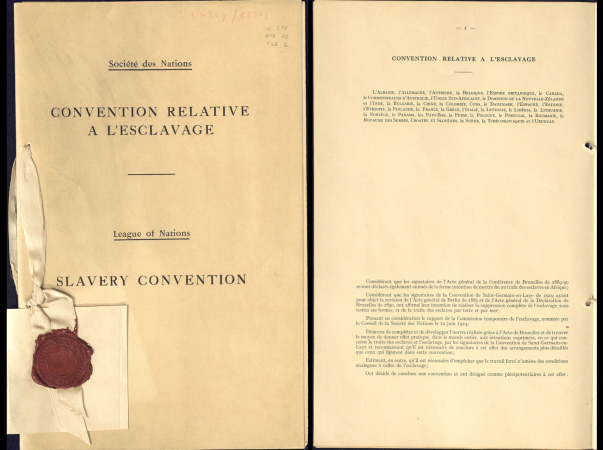
However, it is contemporary forms of slavery in its literal and not symbolic sense that must concern us today. The League of Nations on September 25, 1926 facilitated a Convention on Slavery which was a high-water mark in the world-wide consensus on the need to abolish slavery begun some 100 years before by small groups of anti-slavery activists in England, France and the USA. However as with many League of Nations conventions, there were no mechanisms written into the convention for monitoring, investigation and enforcement. Although the Slavery Convention outlawed slavery and associated practices, it not only failed to establish procedures for reviewing the incidences of slavery in States parties, but also neglected to create an international body which could evaluate and pursue allegations of violations.

1926ConventionContreEsclavageBNM11573.png

Within the United Nations (UN) system, there have been advances made, especially in investigation both making public through official UN documents the investigations of nongovernmental organizations (NGOs) and through the work of Special Rapporteurs of UN human rights bodies.

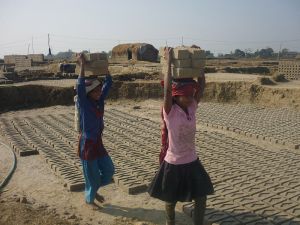
Thus, in a UN report on “Trafficking of Children and Prostitution in India” the authors write “Nepal appears to be the most significant, identifiable source of child prostitution for Indian brothels. Thousands of Nepalese females under the age of 20 have been identified in India by various studies. The average age of the Nepalese girl entering an Indian brothel is said to be 10-14 years, some 5,000-7,000 of them being trafficked between Nepal and India annually.”

Child_Labour_in_Brick_Kilns_of_Nepal

As Professor Vitit Muntarbhorn, a former UN Special Rapporteur on the Sale of Children, has written, “Gender discrimination victimizes the girl child. Precisely because the girl child in seen in some communities as having lower priority, she is often denied access to such basic necessities as education which could ultimately protect her from exploitation. Another disquieting form of discrimination is based upon race and social origin, interwoven with issues of class and caste. It has become increasingly obvious that many children used in labor and sexual exploitation are lured from particular racial or social groups such as hill tribes, rather than the well-endowed groups in power.”

Today, it is the fate of migrants blocked in Libya, forced into forms of slavery one thought had disappeared, which rightly has focused UN and NGO concern. The UN High Commissioner for Human Rights, Prince Zeid Raad Al Hussein, has said that “the suffering of migrants detained in Libya is an outrage to the conscience of humanity.” His evaluation is based in part on the in-depth field investigation of UN teams which have highlighted that the majority of the 34 detention centers in Libya are concentration camps in which abuse, torture, forced work and all sorts of violence are everyday occurrences. Smugglers of people are often free to do as they please with the complicity of police officials at all levels. The risk of women being captured and raped is so high that some women and girls who are often fleeing from conflict conditions in their home countries take massage doses of birth control pills before entering Libya so that they can avoid getting pregnant. However, this can often cause irreversible injuries.

Capture d'écran 2017-11-29 17.20.08.png

There have been reports and filming of “slave auctions” especially in Sabba, the capital of the Fezzan province where routes from Sudan, Chad, and Niger meet and where roads leading north to the Mediterranean start. The UN also has reports from NGOs, especially humanitarian organizations, and from investigators of the International Criminal Court.

The issue which faces us now is what can be done. The League of Nations and the UN anti-slavery conventions are based on the idea that a State has a government. Unfortunately, Libya is a “failed State”. It has two rival governments, a host of armed groups, and more-or-less independent tribes.

The Association of World Citizens has proposed that there could be created a Libyan confederation with a good deal of regional autonomy but with a central government which would be responsible for living up to international treaties and UN standards. For the moment, there has been no progress in that direction or in the direction of any other constitutional system.

Slavery is a consequence of disorder. Without a minimum of legal structure, there will always be those who arise to make short-term gains including by the selling of people. The conscience of humanity of which the High Commissioner for Human Rights spoke must now speak out boldly to break the yoke of slavery. NGOs need to take a lead. Governments are likely to follow.

Prof. René Wadlow is President of the Association of World Citizens.

COMMUNIQUE DE PRESSE – 2017-11-17-21-30-FRA

In Being a World Citizen, Conflict Resolution, Current Events, Human Rights, Humanitarian Law, International Justice, Middle East & North Africa, Press release, Solidarity, The Search for Peace, United Nations, War Crimes, World Law on November 17, 2017 at 8:24 PM

-- Logo 2017 --

COMMUNIQUE DE PRESSE


Paris, le 17 novembre 2017


LES CITOYENS DU MONDE APPELLENT LA FEDERATION DE RUSSIE

A CESSER DE FERMER LES YEUX

SUR L’UTILISATION D’ARMES CHIMIQUES EN SYRIE


L’Association of World Citizens (AWC) est profondément déçue du veto opposé par la Fédération de Russie au renouvellement par le Conseil de Sécurité de l’ONU du mandat du Mécanisme Commun d’Enquête sur les armes chimiques en Syrie.

L’AWC soutient fortement depuis le départ la nécessité d’enquêtes internationales sur l’utilisation d’armes interdites par le droit mondial.

Un rapport de l’ONU publié en octobre établit la responsabilité des forces armées de la République arabe syrienne, notoirement soutenues par la force militaire russe, dans l’attaque au gaz sarin contre Khan Cheikhoun en avril dernier.

Les armes chimiques sont prohibées en vertu du droit humanitaire international et leur utilisation par quelque partie que ce soit dans le conflit syrien constitue donc un crime de guerre, susceptible d’être jugé comme tel par la Cour pénale internationale, les tribunaux nationaux ou toute institution ad hoc qui viendrait à être créée à cette fin.

L’AWC appelle la Fédération de Russie, le Conseil de Sécurité de l’ONU, et tous les Etats membres de l’ONU à apporter leur plein soutien aux enquêtes existantes et à mener sur l’utilisation d’armes illégales en Syrie, au premier rang desquelles les armes chimiques.

PRESS RELEASE – 2017-11-17-21-30-ENG

In Being a World Citizen, Conflict Resolution, Current Events, Human Rights, Humanitarian Law, International Justice, Middle East & North Africa, Press release, Solidarity, The Search for Peace, United Nations, War Crimes, World Law on November 17, 2017 at 8:24 PM

-- Logo 2017 --

PRESS RELEASE


Paris, November 17, 2017


WORLD CITIZENS CALL ON THE RUSSIAN FEDERATION

TO STOP CONDONING THE USE OF CHEMICAL WEAPONS IN SYRIA


The Association of World Citizens (AWC) is deeply disappointed by the veto opposed by the Russian Federation to a renewal by the United Nations (UN) Security Council of the mandate of the Joint Investigative Mechanism on chemical weapons in Syria.

The AWC has strongly supported the need for international investigations on the use of weapons prohibited by world law.

A UN report released in October established the responsibility of the armed forces of the Syrian Arab Republic, known to be backed by the Russian military, in the sarin gas attack on Khan Sheikhoun last April.

Chemical weapons are prohibited under international humanitarian law and their use by whichever party to the Syrian conflict is thus a war crime, liable to be tried as such by the International Criminal Court, national courts, or whatever ad hoc institution may be created to that end in the future.

The AWC calls on the Russian Federation, the UN Security Council, and all UN Member States to bring their full support to investigations on the use of illegal weapons in Syria, starting with chemical weapons.

– 30 –

The Hidden Stakes of the Independence Vote in Iraqi Kurdistan

In Conflict Resolution, Current Events, Democracy, Middle East & North Africa, The Search for Peace on September 19, 2017 at 10:06 PM

By Bernard J. Henry

A new nation may soon emerge in the Middle East. A nation that has been in the hearts and minds of its people for centuries, but nowhere to be found in geography textbooks or diplomatic directories. A nation named Kurdistan, carved out of what is currently the autonomous northernmost part of Iraq.

On September 25, all native Kurdistanis – people born in Iraqi Kurdistan, whether they are Kurds or from the area’s solid ethnic minorities – will have to answer a question asked by the President of the Kurdish Regional Government, Massoud Barzani: “Do you want the Kurdistan region and the Kurdistani areas outside the region’s administration to become an independent state?”.

Yet behind the possibility of a “Kurdexit” driving the region away from the federal government in Baghdad, there may be more to the vote than meets the eye.

Capture d'écran 2017-09-19 23.15.13

In green on this map, Iraqi Kurdistan

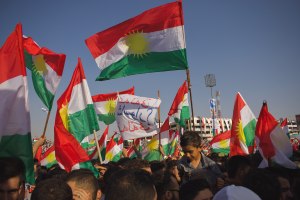
1280px-Flag_of_Kurdistan.svg

The Kurdish flag

Seeking independence – from dissent at home?

Since 2014, the ruling Kurdish Democratic Party (KDP) of President Massoud Barzani and its archrival, the leftist Patriotic Union of Kurdistan (PUK) once led by former Iraqi President Jalal Talabani, have been at odds with a third contender for leadership – Gorran, “Change” in Kurdish, a center-left movement that spawned from rejection of the two main parties’ policies.

Barzani

Massoud Barzani

Barzani, who had reneged on leaving his post and reluctantly agreed in the end, cited the rise of Da’esh, the “Islamic State”, to maintain himself in power. Created in 2009, Gorran quickly secured a blocking majority in parliament, forcing the election of one of its members as speaker as well as many concessions from Barzani, who appeared too eager to push back the PUK and along with it any attempt to remove him from power.

When the referendum was announced, Gorran immediately voiced opposition, not out of heartfelt rejection of independence and die-hard loyalty to Iraq but because Barzani was felt as using the issue to stifle any debate on domestic issues, whether with Gorran or the PUK.

“Most of those voters who will say no will not be rejecting independence, but really telling Barzani they want a fair presidential election first,” comments Emran Mensour, a Kurdish lawyer from Syria living in exile in Paris. “The political feud between Barzani and Talabani stops where independence is at stake. But domestically, rivalry never stops.” Even though breaches have since appeared within Gorran and some members have started voicing support for the referendum, the party apparatus continues to stand up to Barzani.

With an estimated 80% of likely voters supporting independence, Gorran appears unlikely to block Barzani’s plans. But the party has made its point and the President of a future independent Kurdistan will know that (s)he must reckon with the third force.

Minding the “big brothers”

Already struggling with dissent at home, alienating others beyond borders is the last thing Barzani needs. In a September 10 official message, the Kurdistani leader called on referendum campaigners to observe the “spirit of brotherhood that binds the people of Kurdistan with the Iraqi people”. He had no choice as the debate on independence is spilling over to neighboring countries, especially Iran and Turkey, the “big brothers” the Shi’a majority in Iraq and the Turkmen minority in Kurdistan look to, respectively.

The Iraqi government and most Iraqi political parties have spoken out against the referendum, as have the governments of Iran, Syria, and Turkey, Ankara’s opposition being echoed in Kurdistan proper by a Turkmen party, the Iraqi Turkmen Front. Understandably, the three countries besides Iraq on whose national territory historic Kurdistan spreads cannot live with the thought that “their” own Kurds may choose independence someday, if only by joining a former Iraqi Kurdistan turned independent. Even then, the main issue will not be with either of the “big brothers”.

Emran_Mensour

Emran Mensour

“Kurds in all four countries are not bound together with the same strength,” Emran Mensour comments. “There is a strong bond between the Kurds of Iraq and Syria”, the former being now organized in a self-declared autonomous entity, Rojava – the Kurdish for “west” –, led by the Syrian branch of Turkey’s Marxist-Leninist Kurdish Workers Party (PKK).

Like its Iraqi counterpart, Rojava has been at the forefront of the military struggle against Da’esh, while also antagonizing the Syrian opposition forces and thus becoming an objective ally of the Damascus regime. Yet Barzani’s paternalistic style of leadership hardly matches the democratic confederal structure of Rojava, at least on paper, and an alliance or a merger between the two looks the least probable outcome of a successful independence vote.

Short-circuiting a “Shi’a crescent”

If not the creation of a greater, mightier Kurdistan, another stake of the referendum is the influence of Shi’a Muslims in an area whose politics have been dictated predominantly by Sunni leaders. “If Assad should remain in power in Syria,” Mensour adds, “he and his counterparts in Iran and Iraq would be able to form a ‘Shi’a crescent’ in the Middle East, obviously a scary thought for every Sunni country in the region”.

No wonder both King Abdullah of Jordan and Israeli Prime Minister Benyamin Netanyahu – none the keener about an independence referendum in Palestine – have expressed support for the vote.

King_Abdullah_portrait

King Abdullah of Jordan

As for Turkey, the main Sunni power west of Iraq, though its President turned autocrat, Reçep Tayyip Erdogan, recently tried to sway King Abdullah, the monarch held firm. Now it is uncertain that Ankara, in business with Iraqi Kurdistan through an oil deal struck outside of Baghdad’s authority, will have the leverage, let alone the will, to resist an independent Kurdistan on the long run. Especially if Erdogan should decide to durably play (the former) Iraqi Kurdistan against the PKK at the helm in Rojava.

More than independence

If any region in the world knows that independence does not guarantee freedom, let alone stability, the Middle East does.

On September 25, Kurdistanis will have to decide on a lot more than independence or not. Should the vote be positive, the ball will be in the court of a world that has shunned peace and human dignity in the Middle East for much too long.

Bernard J. Henry is the External Relations Officer of the Association of World Citizens.

A letter to the President to the Turkish Republic

In Being a World Citizen, Current Events, Democracy, Europe, Human Rights, Middle East & North Africa, NGOs, Solidarity, United Nations, World Law on July 19, 2017 at 8:58 AM

-- AWC-UN Geneva Logo --

TRANSMITTED BY FAX AND EMAIL

July 18, 2017

Hon. Recep Tayyip Erdogan
President of the Turkish Republic
Ankara
Turkey

Honorable President Erdogan:

As a Nongovernmental Organization in Consultative Status with the United Nations (UN) and accredited with the UN Human Rights Council, the Association of World Citizens (AWC) wrote on June 12 expressing concern over the arrest by police of Mr. Taner Kiliç, Attorney at Law, Chair of Amnesty International Turkey.

A month has passed and Attorney Kiliç remains in detention. More preoccupying still, we hear a court in Turkey has just sent six Human Rights Defenders (HRDs) to prison, including Amnesty International’s Turkey Director, Ms. Idil Eser, less than a month after jailing Attorney Kiliç.

It appears that other HRDs have also been arrested, namely Günal Kursun and Veli Acu (Human Rights Agenda Association), Özlem Dalkiran (Citizens’ Assembly), Ali Gharavi, an IT strategy consultant, and Peter Steudtner, a nonviolence and well-being trainer. They are being held pending trial on the suspicion of “assisting an armed terrorist organization”.

Four HRDs were charged but released on bail – Nalan Erkem (Citizens Assembly), Ilknur Üstün (Women’s Coalition), Nejat Tastan (Equal Rights Watch Association) and Seyhmus Özbekli (Rights Initiative).

The AWC is sorry to hear that the Turkish authorities have arrested and jailed these HRDs just when they are needed most. As your country is still trying to make sense of the major constitutional crisis that took place with the failed coup d’état against the democratically-elected government of Turkey last year, there is a need for all positive, useful energies to get involved in the search for a more inclusive, participatory form of governance in Turkey.

We understand that the charges brought against the abovementioned people are related to the Fethullah Gülen Terrorist Organization. While the AWC certainly understands Turkey has been under pressure from terrorist groups for a number of years, especially in connection with the ongoing conflict in Syria where your country supports the people’s democratic revolution, like we do, we believe that charges related to terrorism must not be brought too lightly or quickly against an individual or an association – also bearing in mind the many existing cases throughout the world of HRDs who were branded “supporters of terrorism” only because they had denounced human rights violations by state agents, while they were also being targeted by those very terrorist groups they were being accused of supporting.

A year and a day ago, our President, Prof. René Wadlow, highlighted precisely this phenomenon and the risks induced thereby in an article published in Foreign Policy News. We are attaching a copy thereof for your reference and you can access it online here:
http://foreignpolicynews.org/2016/07/17/prepare-defend-human-rights-turkey/

The AWC believes that Turkey has reached a turning point in its history and a country with as great a culture and past as yours cannot afford to put its future in jeopardy by shutting out – or locking up – people who are so precious to its present and future.

Therefore, we are sure that your Government will make all efforts to immediately and unconditionally release Attorney Taner Kiliç, Ms. Idil Eser, as well as HRDs Günal Kursun, Veli Acu, Özlem Dalkiran, Ali Gharavi and Peter Steudtner.

The AWC further urges you to have all existing restrictions imposed on HRDs Nalan Erkem, Ilknur Üstün, Nejat Tastan and Seyhmus Özbekli lifted.

We thank you very much in advance for bringing Turkey back in line with UN standards.

Please accept, Honorable President Erdogan, the assurances of our highest consideration.

Prof. René Wadlow
President

Bernard Henry
External Relations Officer

Cherifa Maaoui
Liaison Officer,
Middle East & North Africa

Noura Addad, Attorney at Law
Legal Officer

June 20: World Refugee Day

In Being a World Citizen, Conflict Resolution, Current Events, Democracy, Europe, Human Rights, Humanitarian Law, International Justice, Middle East & North Africa, Migration, NGOs, Refugees, Solidarity, The Search for Peace, United Nations, War Crimes, World Law on June 20, 2017 at 8:19 AM

Refugees_are_human_beings.jpg

JUNE 20: WORLD REFUGEE DAY
By René Wadlow

June 20 is the United Nations (UN)-designated World Refugee Day marking the signing in 1951 of the Convention on Refugees. The condition of refugees and migrants has become a “hot” political issue in many countries, and the policies of many governments have been very inadequate to meet the challenges. The UN-led World Humanitarian Summit held in Istanbul, Turkey on May 23-24, 2016 called for efforts to prevent and resolve conflicts by “courageous leadership, acting early, investing in stability, and ensuring broad participation by affected people and other stakeholders.”

If there were more courageous political leadership, we might not have the scope and intensity of the problems that we now face. Care for refugees is the area in which there is the closest cooperation between nongovernmental organizations (NGOs) and the UN system. As one historian of the work of the UN High Commissioner for Refugees (UNHCR) has written “No element has been more vital to the successful conduct of the programs of the UNHCR than the close partnership between UNHCR and the non-governmental organizations.”

Refugee Rights Protest at Broadmeadows, Melbourne

The 1956 flow of refugees from Hungary was the first emergency operation of the UNHCR. The UNHCR turned to the International Committee of the Red Cross and the League of Red Cross Societies which had experience and the finances to deal with such a large and unexpected refugee departure and resettlement. Since 1956, the UNHCR has increased the number of NGOs, both international and national, with which it works given the growing needs of refugees and the increasing work with internally displaced persons who were not originally part of the UNHCR mandate.

Along with emergency responses − tents, water, medical facilities − there are longer-range refugee needs, especially facilitating integration into host societies. It is the integration of refugees and migrants which has become a contentious political issue. Less attention has been given to the concept of “investing in stability”. One example:

The European Union (EU), despite having pursued in words the design of a Euro-Mediterranean Community, in fact did not create the conditions to approach its achievement. The Euro-Mediterranean partnership, launched in 1995 in order to create a free trade zone and promote cooperation in various fields, has failed in its purpose. The EU did not promote a plan for the development of the countries of North Africa and the Middle East and did nothing to support the democratic currents of the Arab Spring. Today, the immigration crisis from the Middle East and North Africa has been dealt with almost exclusively as a security problem.

An_Aerial_View_of_the_Za'atri_Refugee_Camp

Za’atari, Jordan. The biggest refugee camp in the world.

The difficulties encountered in the reception of refugees do not lie primarily in the number of refugees but in the speed with which they have arrived in Western Europe. These difficulties are the result of the lack of serious reception planning and weak migration policies. The war in Syria has gone on for six years. Turkey, Lebanon and Jordan, not countries known for their planning skills, have given shelter to nearly four million persons, mostly from the Syrian armed conflicts. That refugees would want to move further is hardly a surprise. That the refugees from war would be joined by “economic” and “climate” refugees is also not a surprise. The lack of adequate planning has led to short-term “conflict management” approaches. Fortunately, NGOs and often spontaneous help have facilitated integration, but the number of refugees and the lack of planning also impacts NGOs.

Thus, there is a need on the part of both governments and NGOs to look at short-term emergency humanitarian measures and at longer-range migration patterns, especially at potential climate modification impact. World Refugee Day can be a time to consider how best to create a humanist, cosmopolitan society.

Prof. René Wadlow is President of the Association of World Citizens.

Battle for Raqqa: Protests needed on violations of humanitarian law

In Conflict Resolution, Current Events, Human Rights, Humanitarian Law, International Justice, Middle East & North Africa, NGOs, Solidarity, The Search for Peace, United Nations, War Crimes, World Law on June 16, 2017 at 9:06 AM

BATTLE FOR RAQQA: PROTESTS NEEDED ON VIOLATIONS OF HUMANITARIAN LAW

By René Wadlow

The battle for Raqqa, a symbolic city for the Islamic State or, under its Arabic acronym, “Daesh” (ISIS/DAESH) in Syria is underway with ever-increasing dangers to civilian populations caught in the cross-fire of ISIS/DAESH and the advancing Kurdish-led Syrian Democratic Forces, supported by air strikes of the United States (U. S.)-led coalition.

The United Nations (UN) Secretariat has raised an alarm concerning the fate of families held by the ISIS/DAESH forces for possible use as “human shields” in the battle for the city of Raqqa held by ISIS/DAESH since 2014. The use of civilians as “human shields” is a violation of the laws of war set out in the Geneva Conventions. ISIS/DAESH leaders have been repeatedly warned by the International Committee of the Red Cross, which, by treaty, is responsible for the respect and application of the Geneva Conventions.

SDF_infantry_in_northern_Raqqa_countryside_(December_2016)

Infantry soldiers with the Syrian Democratic Forces patrolling the Raqqa countryside in December 2016. (C) VOA

In addition to the families which have been rounded up or are prevented from leaving, there are a large number of children trapped in the city and who may be used in military ways, either to fight or as suicide bombers.

The danger from the disintegrating ISIS/DAESH is that there are no longer the few restraints that existed among some of the ISIS/DAESH leadership for the laws of war. As troops have drawn closer to Raqqa, they have found mass graves with both soldiers and civilians killed. One of the fundamental aspects of the laws of war is the protection of prisoners of war. Once a person is no longer able to combat, he must be treated as a prisoner and no longer a combatant. Not killing a prisoner is a core value of humanitarian law, and ISIS/DAESH has deliberately violated this norm.

There is a real danger that, as the “caliphate” disintegrates and no longer controls territory, ISIS/DAESH will increase terrorist actions and deliberate violations of the laws of war. The Association of World Citizens has stressed that the laws of war have become part of world law and are binding upon States and non-State actors even if they have not signed the Geneva Conventions and the 1977 Additional Protocols. Therefore, the Association of World Citizens (AWC) calls for the re-affirmation of humanitarian international law. The AWC calls to the soldiers and militia members in armed conflicts to refuse orders to violate international law by refusing to use weapons outlawed by international treaties such as chemical weapons, land mines, cluster munitions and white phosphorus munitions. We must defend all who use their individual conscience to refuse to follow orders to violate humanitarian international law

YPG-SDF_fighters_near_the_Euphrates_east_of_Raqqa

Fighters with the YPG Kurdish units and the SDF near the Euphrates east of Raqqa. (C) VOA

World law does not destroy violence unless it is bound up with an organized, stable and relatively just society. No society can be stable unless it is broadly based in which all sectors of the population are involved. Such stability does not exist in either Syria or Iraq. However repeated violations of the laws of war will increase the divide among groups and communities.

Only by a wide public outcry in defense of humanitarian law can this danger be reduced. These grave violations by ISIS/DAESH and others must be protested by as wide a coalition of concerned voices as possible. The time for action is now.

Prof. René Wadlow is President of the Association of World Citizens.

Najet Laabidi, avocate engagée pour l’Etat de droit en Tunisie

In Democracy, Human Rights, Middle East & North Africa, NGOs, Solidarity, World Law on May 27, 2017 at 8:35 AM

NAJET LAABIDI, AVOCATE ENGAGÉE POUR L’ÉTAT DE DROIT EN TUNISIE

Par Bernard Henry

«L’Etat de droit, ce n’est certainement pas le droit de l’Etat». Le 5 mai dernier, Frédéric Sicard, Bâtonnier de l’Ordre des Avocats de Paris, accueillait dans la bibliothèque du Palais de Justice les élèves-avocats qui venaient de prêter serment en audience solennelle. A deux jours du second tour d’une élection présidentielle de tous les dangers où, comme quinze ans auparavant, le choix allait être entre les valeurs républicaines et l’extrême droite, le premier des avocats parisiens avait pour les nouveaux entrants des paroles très politiques – sans bien sûr l’être tout-à-fait, réserve de l’avocat oblige.

Maître Sicard n’aurait aucune raison de se réjouir, encore moins sa Vice-bâtonnière Dominique Attias, native de Tunis, s’il savait quel est, par-delà la Méditerranée, le sort de sa consœur Najet Laabidi dans cette Tunisie présentée comme le seul et unique succès des révolutions arabes, là où l’Egypte est revenue au point de départ et où Libye et Syrie ont sombré dans le chaos et la guerre.

Une militante acharnée des Droits de l’Homme

Originaire de Siliana, dans le nord-ouest voisin de l’Algérie, Najet Laabidi s’inscrit à la Faculté des Sciences juridiques, politiques et sociales de Tunis, la plus réputée du pays. Elle prête serment en 2008 à Tunis et ouvre son cabinet dans le quartier universitaire d’El Manar.

FrontLine Defenders

Immédiatement, la jeune avocate s’implique dans la défense des Droits de l’Homme. Dans ce qui est encore la Tunisie des Ben Ali-Trabelsi, où les opposants vivent dans la clandestinité ou se retrouvent derrière les barreaux au moindre mot de trop, elle s’engage dans des procès touchant à la liberté d’expression. Ses plaidoiries attirent l’attention d’autres avocats engagés, tels que Khaled Krichi, Mohamed Nouri et Samir Dilou – qui deviendra quelques années plus tard ministre au nom du parti islamiste Ennahda.

Désormais reconnue par ses pairs et camarades de combat, Najet Laabidi rejoint l’association Liberté Equité, dont elle entre bientôt au Conseil d’administration. Puis vient la révolution en 2011, et pour l’avocate, ce n’est que le début du combat.

A l’épreuve de la justice «révolutionnaire»

Le 8 novembre 2011, choisie et contactée pour représenter des victimes de mauvais traitements dans l’affaire Barakat Essahel, l’avocate subit un déluge d’insultes et de menaces de la part de proches d’anciens officiels de l’Etat poursuivis en justice pour avoir torturé des prisonniers politiques sous Ben Ali. D’abord par téléphone avant le procès, puis le jour venu, en pleine salle d’audience.

La police militaire évacue les auteurs des injures et menaces, mais ne lève pas le petit doigt pour protéger l’avocate. Il lui est ordonné de ne pas quitter le prétoire jusqu’à ce que tout le monde soit sorti. Elle décline une proposition de la raccompagner en voiture. Le ton est donné de ce que seront les années qui suivent pour Najet Laabidi.

Quatre ans plus tard, deuxième round. Le 26 novembre 2015, elle plaide lors d’une audience d’opposition contre Ezzedine Jenayeh, ancien Directeur de la Sûreté nationale sous Ben Ali, condamné par contumace pour délit de violences dans l’affaire Baraket Essahel et qui conteste le jugement. D’entrée, la procédure consacre l’arbitraire.

«Quand il a fait opposition, contrairement à la loi et au Code de procédure pénale, il s’est présenté en prévenu libre et la Chambre correctionnelle a refusé la présence des avocats des parties civiles, dans l’ignorance totale du principe du droit à la défense et du procès équitable». La Présidente du Tribunal militaire permanent, Leila Hammami, rejette en bloc les constitutions des parties civiles, niant aux avocats jusqu’au droit de représenter leurs clients. Najet Laabidi et son confrère Abderraouf Ayadi dénoncent des vices de procédure, et aussitôt, Leila Hammami porte plainte contre les deux avocats pour «outrage à un fonctionnaire de l’ordre judiciaire». Rien que ça.

Dans le viseur d’une justice (toujours) politique

Entretemps, aux côtés d’Abderraouf Ayadi, Najet Laabidi est devenue membre de la direction d’un parti politique, Attayar, ou en français, le Courant Démocrate, fondé par l’ancien ministre Mohamed Abbou qui fut lui-même avocat et détenu politique puis gréviste de la faim sous Ben Ali. Et comme par hasard, eux deux et eux seuls sont visés par la plainte.

Ils se retrouvent convoqués le 17 décembre 2015 devant le juge d’instruction du Tribunal militaire permanent de première instance de Tunis. Ils ne vont pas à sa rencontre, demeurant à l’extérieur, entourés de confrères et de sympathisants. Ce sont le Président de la Section des Avocats de Tunis, en quelque sorte le Bâtonnier local de l’Ordre tunisien qui est unitaire et national, et une délégation d’avocats qui se rendent chez le magistrat à leur place par solidarité.

Devant le Tribunal militaire, les deux avocats avaient accusé Leila Hammami de partialité, les propos de Najet Laabidi ayant été filmés puis diffusés sur les réseaux sociaux. «Dans ma vidéo,» rappelle l’avocate, «j’ai évoqué les circonstances de l’impunité, j’ai souligné que le Tribunal militaire ne pouvait pas consacrer les principes d’un procès équitable car, dans ce corps d’Etat, il y a toujours la corruption». Nouvelle plainte de Leila Hammami le 21 décembre 2015, la magistrate versant au dossier un CD de l’enregistrement de Najet Laabidi lui disant ses quatre vérités.

Il n’en faut pas plus au Procureur général près la Cour d’appel de Tunis pour lancer des poursuites sur le fondement de l’Article 128 du Code pénal pour «outrage à un fonctionnaire public». Convoquée le 1er février 2016 devant le juge d’instruction du Tribunal de première instance de Tunis, Najet Laabidi refuse de comparaître. Le 12 octobre 2016, elle est condamnée par contumace à un an d’emprisonnement.

FIDH.png

Informée de sa condamnation seulement le 24 avril dernier, l’avocate y fait opposition. A l’issue de son audience le 10 mai dernier, Najet Laabidi est condamnée à six mois de prison, décision dont elle interjette immédiatement appel. Mais qui n’aurait jamais dû intervenir en premier lieu, puisque ce qu’on lui reproche, outre peut-être son appartenance à un parti politique d’opposition, c’est d’avoir agi comme ce qu’elle est – une avocate.

Symbole d’un Etat de droit introuvable

Poursuivie pour l’exemple, Najet Laabidi l’est sans nul doute. Mais au-delà de l’exemple, de par l’acharnement judiciaire dont elle fait l’objet depuis les premiers mois de la Tunisie du 14 janvier, elle est devenue un symbole. Le symbole d’un Etat de droit que tous appellent de leurs vœux, dont chacun(e) se dit le meilleur espoir pour peu qu’on lui confie le pouvoir, mais qui, dans les faits, plus de six ans après la fuite de Ben Ali et sa famille, demeure introuvable en Tunisie.

Lors des premières poursuites contre Najet Laabidi en 2011, l’Association of World Citizens (AWC) était intervenue auprès des autorités tunisiennes pour la soutenir. Nous l’avons fait cette fois encore, conscients de ce que représentent des poursuites contre un avocat dans un pays qui, six ans et demi après avoir renversé la dictature dans une révolution inattendue du monde, en particulier des «orientalistes», peine encore à asseoir l’Etat de droit. Quel que soit le système juridique que l’on se choisit, jamais un tel résultat ne peut être atteint si l’on ne respecte pas la liberté d’exercice professionnel des avocats.

Capture d'écran 2017-05-27 00.21.12

Najet Laabidi a elle aussi bien conscience de la portée, bien au-delà du simple cadre judiciaire, du procès en conscience professionnelle dont elle fait l’objet. «Ce dossier démontre que l’impunité persiste, que le système de corruption existe encore, avec l’absence d’une volonté politique d’assurer l’indépendance de la justice ainsi que le respect des avocats et de leur immunité.»

L’avocate ne cache pas son dépit devant les fruits amers d’une révolution saluée de par le monde et qui, selon elle, n’a rien réglé des maux anciens de la Tunisie. «L’Etat de droit réside dans le respect des lois, et surtout, de l’égalité pour tous devant la règle de droit, chose qui n’existe malheureusement toujours pas en Tunisie,» n’hésite-t-elle pas à conclure. «Aujourd’hui, les victimes de la torture, mais aussi celles de la corruption, n’ont pas réussi ni à avoir leurs droits, ni à poursuivre les tortionnaires et les corrompus».

Sous Ben Ali, un silence aussi pesant que feutré entourait les dissidents et défenseurs des Droits de l’Homme pourchassés par le régime. Couronné «rempart contre l’islamisme», l’ancien Premier Ministre de Habib Bourguiba, dont il avait été le «tombeur» en 1987, n’avait rien à craindre des grands de la Méditerranée. Jacques Chirac lui-même avait déclaré à Tunis en 2003 : «Le premier des Droits de l’Homme, c’est de manger», autrement dit, Tunisiens taisez-vous et finissez vos assiettes.

Depuis la révolution, la Tunisie où, jadis, le simple fait d’être membre d’Ennahda faisait de vous un terroriste a connu successivement le retour de bâton islamiste, puis le retour en grâce des anciens du Rassemblement constitutionnel démocratique de Ben Ali à travers le nouveau parti Nidaa Tounes. Les anciens refuzniks non-islamistes, qu’ils se nomment Taoufik Ben Brik, Sihem Ben Sedrine, Radhia Nasraoui ou Hamma Hammami, ont connu, libres et au grand jour, des destins et des fortunes diverses. La Tunisie n’est plus telle que Ben Ali la tenait, mais elle n’est pas pour autant telle que les opposants au dictateur la rêvaient. On y mange moins qu’avant, les prix des denrées alimentaires ayant flambé, et l’on y est à peine plus libre.

Mais l’Etat de droit voulu par la révolution, crié dans les «Dégage !» des Tunisiens à Ben Ali en janvier 2011, vit toujours. Il vit dans l’esprit et le cœur d’une avocate comme Najet Laabidi, dont le prénom signifie «délivrance» et qui, un jour, sera peut-être celle de son peuple en laquelle elle croit tant.

Bernard J. Henry est Officier des Relations Extérieures de l’Association of World Citizens.

Yemen: Effective Humanitarian Aid Depends on a Peace Accord

In Conflict Resolution, Current Events, Human Rights, Humanitarian Law, International Justice, Middle East & North Africa, NGOs, Refugees, The Search for Peace, United Nations, World Law on April 26, 2017 at 10:42 PM

YEMEN: EFFECTIVE HUMANITARIAN AID DEPENDS ON A PEACE ACCORD

By René Wadlow

The United Nations (UN) together with the governments of Sweden and Switzerland which have often led humanitarian issues in the UN system held a high-level pledging conference in Geneva on April 25, 2017 to again draw attention to the deepening humanitarian crisis in war-torn Yemen, currently the largest food security emergency in the world. Some 60% of the population are in a food-insecure situation.

More than 3.5 million people have been displaced in the cycle of escalating violence. “We are witnessing the starving and the crippling of an entire generation. We must act now, to save lives” said Secretary-General Antonio Guterres who presided over the conference. Realistically, he stressed that funding and humanitarian aid alone will not reverse the fortunes of the millions of people impacted. Diplomatically, he called for a cessation of hostilities and a political settlement with talks facilitated by the Special Envoy of the Secretary General, the Mauritanian diplomat Ismail Ould Chekh Ahmed.

António_Guterres_2012

UN Secretary-General Antonio Guterres

UN officials and most diplomats are reluctant to call the armed conflict by its real name: “a war of aggression”. The aggression of the Saudi Arabia-led coalition (Bahrain, Egypt, Jordan, Kuwait, Morocco, Qatar, Sudan, and the United Arab Emirates) against Yemen began on March 24, 2015.

The Saudi-led coalition is helped with arms and “intelligence” by the USA and the UK which appreciate Saudi money for arms and do not want to antagonize a large segment of the Arab world when the conflicts of Syria-Iraq-Kurds-Turkey is still “on the table.”

However, the aggression of the Saudi coalition is what has turned an internal Yemen struggle for power between the current and the former President of Yemen into a war with regional implications, now drawing Iran into the picture.

Intellectually, the “political solution” is clear. There needs to be an end to the Saudi bombing and a withdrawal of its coalition troops. Then, the different factions in Yemen can try to develop some sort of inclusive government. The Swiss Foreign Minister, a co-host of the conference, hinted to the issue in suggesting very briefly that, if asked, Switzerland could provide expertise on forms of decentralization and con-federal government.

Destroyed_house_in_the_south_of_Sanaa_12-6-2015-3

A destroyed house in the south of Sana’a, Yemen.

The effort to create a centralized Yemen government has failed. The future lies in a very decentralized government with great autonomy for the regions, taking into consideration the diverse tribal configuration of the country. With intelligence and patience – always in short supply – a single, highly decentralized State might be developed.

The most difficult first-step is ending Saudi-led aggression, after which an effective humanitarian aid and development program can be put into effect.

Prof. René Wadlow is President of the Association of World Citizens.

Syria: Chemical Weapon Use, Destruction of Children, The Ethical Vacuum

In Being a World Citizen, Conflict Resolution, Current Events, Human Rights, Humanitarian Law, International Justice, Middle East & North Africa, NGOs, Refugees, The Search for Peace, United Nations, War Crimes, World Law on April 12, 2017 at 12:22 PM

SYRIA: CHEMICAL WEAPON USE, DESTRUCTION OF CHILDREN, THE ETHICAL VACUUM

By René Wadlow

The defense of those using their conscience to uphold humanitarian international law.

The Association of World Citizens (AWC) calls for the re-affirmation of humanitarian international law. It is a call to the soldiers and militia members in armed conflicts to refuse orders to violate humanitarian international law by refusing to use weapons outlawed by international treaties such as chemical weapons, landmines, cluster munitions or any weapon to attack civilians, especially children and women. We must defend all who use their individual conscience to refuse to follow orders to violate humanitarian international law.

“At the heart of this growing phenomenon of mass violence and social disintegration is a crisis of values. Perhaps the most fundamental loss a society can suffer is the collapse of its own value system. Many societies exposed to protracted conflicts have seen their community values radically undermined if not shattered altogether. This has given rise to an ethical vacuum, a setting in which international standards are ignored with impunity and where local value systems have lost their sway.”

-Olara Otunnu, then Special Representative of the United Nations (UN) Secretary-General for Children and Armed Conflict, Report to UN General Assembly, 1998.

The attack on Khan Sheikhoon in Idlib Province of Syria on April 4, 2017 raises at least two essential issues concerning humanitarian international law and the protection of children in times of armed conflict.

B9711633296Z.1_20170405122424_000+G1I8R2IML.2-0

A major issue is the use of chemical weapons, probably sarin or a sarin-like substance in violation of the 1925 Geneva Protocol for the Prohibition of the Use in War of Asphyxiating, Poisonous or other Gases, and of Bacteriological Methods of Warfare of which Syria was a party, among the 135 governments which have signed. The attack was also a violation of the Convention on the Prohibition of the Development, Production, Stockpiling and Use of Chemical Weapons and on their Destruction which came into force in 1997. The Convention created The Hague-based Organization for the Prohibition of Chemical Weapons (OPCW). Syria signed the Convention in 2013 as part of a compromise decision to have its chemical-weapon stock destroyed.

The use of poison gas strikes deep, partly subconscious, reactions not provoked in the same way as seeing someone shot by a machine gun. The classic Greeks and Romans had a prohibition against the use of poison in war, especially poisoning water well because everyone needs to drink. Likewise poison gas is abhorred because everyone needs to breath to live.

There is a real danger that the Geneva Protocol of 1925, one of the oldest norms of humanitarian international law will be undermined and the use of chemical weapons “normalized”. The Organization for the Prohibition of Chemical Weapons is already investigating the use of chemical weapons in seven other locations in Syria.

Chemical weapons have been used in armed conflicts in the Middle East before. Although Egypt had signed the 1925 Geneva Protocol, Egyptian forces used chemical weapons widely in their support of the republican forces in the Yemen Civil War (1962-1967) with very few international outcries. As a result of the lack of any sanctions against Egypt, Syria requested Egyptian technical assistance in developing its own chemical weapons capabilities shortly after 1967 – well before the al-Assad dynasty came to power.

17834033_10211018305268568_50252574586113453_o

Humanitarian international law is largely based on self-imposed restraints. Although the International Criminal Court has a mandate to try crimes of war and crimes against humanity, its impact on the way armed conflicts are currently carried out is small. Thus, restraints need to rest on the refusal of soldiers and militia members to carry out actions that they know to be against both humanitarian international law and the local value system. This is especially true of the non-harming of children in times of armed conflict.

Humanitarian international law creates an obligation to maintain the protection of all non-combatants caught in the midst of violent conflicts as set out in the Geneva Conventions of 1949 and their Additional Protocols of 1977. Moreover, there is an urgent need to focus special attention on the plight of children. They are the least responsible for the conflict and yet are most vulnerable. They need special protection. The norms to protect children in armed conflicts are set out clearly in the Additional Protocols which has 25 articles specifically pertaining to children. The norms are also clearly stated in the Convention on the Rights of the Child, the most universally ratified international treaty. The Convention calls for the protection of the child’s right to life, education, health, and other fundamental needs. These provisions apply equally in times of armed conflict and in times of peace.

As with the use of weapons prohibited by international treaty: chemical weapons, land mines, cluster munitions, the protection of children must be embodied in local values and practice. The classic Chinese philosopher Mencius, in maintaining that human were basically good, used the example of a child about to fall into a well who would be saved by anyone regardless of status or education.

The AWC has called for a UN-led conference on the re-affirmation of humanitarian, international law. There needs to be a world-wide effort on the part of governments and non-governmental organizations to re-affirm humanitarian values and the international treaties which make them governmental obligations. Such a conference would bring together into a coherent synthesis the four avenues of humanitarian international law:

1) The Geneva Conventions – Red Cross-mandated treaties;

2) The Hague Convention tradition dealing with prohibited weapons, highlighting recent treaties such as those on land mines and cluster munitions;

3) Human rights conventions and standards, valid at all time but especially violated in times of armed conflicts;

4) The protection of sites and monuments which have been designated by UNESCO as part of the cultural heritage of humanity, highlighting the August 2016 decision of the International Criminal Court on the destruction of Sufi shrines in northern Mali.

There is also a need to use whatever avenues of communication we have to stress to those living in Syria-Iraq-ISIS-Kurd-majority areas-and Turkey that they have a moral duty to disobey orders that violate humanitarian international law. We on the outside must do all we can to protect those who so act humanely in accord with their conscience.

-- AWC-UN Geneva Logo --

Prof. René Wadlow is President of the Association of World Citizens.