Dozens of people were killed in an air raid on July 3, 2019 on a detention center holding migrants in a camp at Tajoura, a suburb of Tripoli according to the United Nations (UN) Support Mission in Libya. Most of those killed and wounded were Africans from Sudan, Eritrea and Somalia who had hoped to reach Europe but were blocked in Libya. Others held in the detention center had been returned to Libya, arrested trying to cross the Mediterranean Sea.
In 2018, some 15,000 persons were intercepted on boats at sea and returned to Libya, placed in detention centers without charge and with no date set for release. The detention centers are officially under the control of the Government of National Accord’s Department for Combating Illegal Migration. In practice, most of the detention centers are controlled by militias. The former UN High Commissioner for Human Rights has described the conditions in these detention centers as “an outrage to the conscience of humanity.”
Since the outbreak of armed conflict on the outskirts of Tripoli on April 3, 2019, many persons have been killed or wounded in what General Khalifa Haftar hoped would be a blitzkrieg advance. He badly underestimated the degree of military response that he would meet from the militias loyal to the Government of National Accord led by Prime Minister Fayez al-Sarraj. Since the blitzkrieg bogged down, in the absence of a ceasefire, the humanitarian situation is dramatically degenerating.
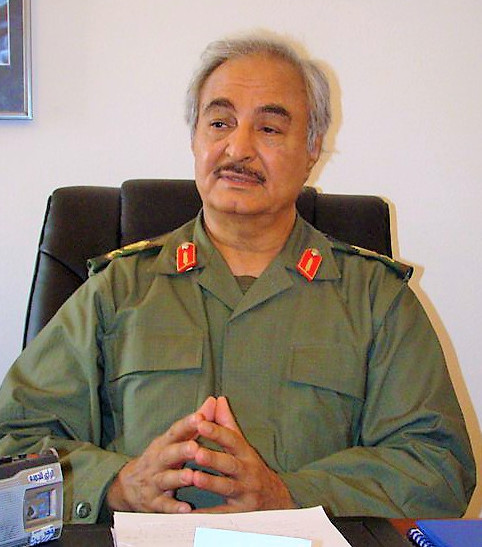
General Khalifa Haftar
The dramatic conditions in Libya have a double aspect. One is the need to create a stable administrative structure of government taking into consideration the geographic and ethnic diversity of the country. The second aspect is the humane treatment of refugees and migrants from other countries who have tried to cross Libya or have been returned from failed crossings of the Mediterranean.
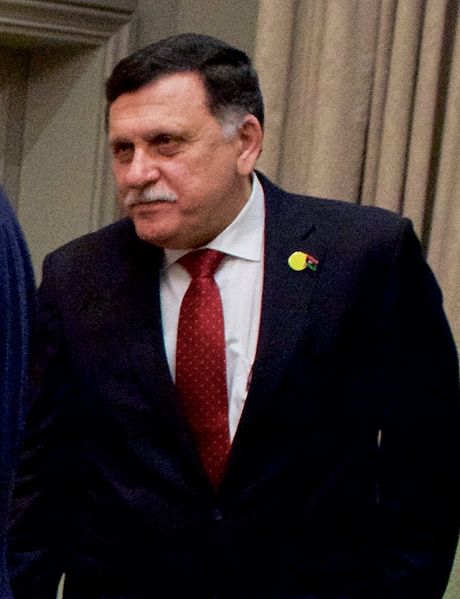
Libyan Prime Minister Fayez al-Sarraj
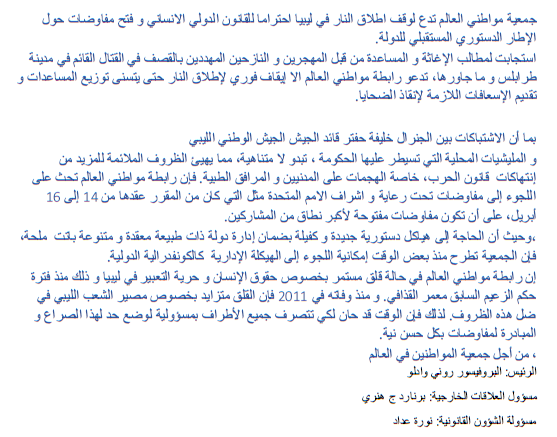
Therefore, the Association of World Citizens (AWC), as an immediate step, calls for a humanitarian ceasefire and the resumption of UN-led negotiations in good faith among a broad spectrum of Libyan political parties and tribal representatives.
Secondly, the AWC calls for an end of returning refugees and migrants to Libya. Other countries must welcome migrants while longer-range cooperative structures are put into place. Migration issues will continue to challenge the world society.
Prof. René Wadlow is President of the Association of World Citizens.
L’ASSOCIATION OF WORLD CITIZENS APPELLE A UN CESSEZ-LE-FEU EN LIBYE, AU RESPECT DU DROIT HUMANITAIRE INTERNATIONAL ET A L’OUVERTURE DE NÉGOCIATIONS DE BONNE FOI SUR LA FUTURE STRUCTURE CONSTITUTIONNELLE DE L’ÉTAT
L’Association of World
Citizens, réagissant aux appels à l’aide de personnes déplacées et menacées par
les bombardements dans les combats aux alentours et au cœur même de Tripoli,
appelle à un cessez-le-feu immédiat qui permît de distribuer de l’aide humanitaire,
ainsi que de sauver des vies.
Les affrontements ne donnant
pas signe de fin entre, d’un côté, le Général Khalifa Haftar à la tête de son
Armée nationale libyenne et, de l’autre, les milices locales contrôlées par le
Gouvernement, créent toutes les conditions d’une intensification des atteintes
aux lois de la guerre, en particulier d’attaques contre les civils et les
installations médicales.
L’Association of World Citizens
appelle instamment à ce que des négociations aient lieu sous l’égide de
médiateurs des Nations Unies, comme il était prévu qu’elles aient lieu du 14 au
16 avril, et à ce que ces négociations soient ouvertes à un éventail de
participants qui soit aussi large que possible. Il faut des structures
constitutionnelles nouvelles et adéquates pour assurer l’administration d’un
Etat par nature complexe et diversifié. Depuis un certain temps, notre
association met en avant l’éventualité de structures administratives de type
confédéral au sein de l’Etat.
L’Association of World
Citizens, qui s’était préoccupée de la situation des Droits Humains et de la
liberté d’expression en Libye du temps où Mu’ammar Kadhafi dirigeait le pays, demeure
préoccupée par le sort du peuple libyen depuis la mort de l’ancien leader en
2011. A présent, le temps est venu pour toutes les parties d’agir de manière
responsable pour mettre fin aux combats et entamer des négociations de bonne
foi.
THE ASSOCIATION OF WORLD CITIZENS CALLS FOR A CEASEFIRE IN LIBYA, THE RESPECT OF INTERNATIONAL HUMANITARIAN LAW AND THE START OF NEGOTIATIONS IN GOOD FAITH ON THE FUTURE CONSTITUTIONAL STRUCTURE OF THE STATE
The Association of World Citizens, responding to calls for assistance
from persons displaced and in danger of bomb attacks by the fighting in and
around Tripoli, calls for an immediate ceasefire so that humanitarian aid can
be provided, and lives saved.
Continued fighting by the forces of General Khalifa Haftar and his Libyan
National Army opposed by local militias under the control of the Government is
likely to lead to increased violations of the laws of war, especially attacks
upon civilians and medical facilities.
The Association of World Citizens urges that negotiations under the
leadership of United Nations mediators, originally to be held April 14-16, be
undertaken with a range of participants as wide as possible. New and
appropriate constitutional structures are needed for the administration of a
complex and diversified State. This association has proposed the possibility of
con-federal administrative structures for the State.
The Association of World Citizens had been concerned with human rights
and freedom of expression in Libya during the time of the leadership of Mu’ammar
Gaddafi and has continued to be concerned with the fate of the people of Libya
since his death in 2011. Now is the time for responsible action by all parties
for an end to the fighting and the start of negotiations in good faith.
With the
administrative-political situation in Libya badly stalemated and a meeting for
negotiations to be held April 14-16 unlikely to make progress, on Thursday, April
4, 2019, General Khalifa Haftar, one of the key players in the drama decided to
start a “March on Tripoli” and to take overall power by force.
Most of the
significant buildings in Libyan cities were built by Italians during the
Fascist period, when Libya was an Italian colony. Thus, General Haftar has
patterned himself on Mussolini’s 1922 “March on Rome”. In 1922, the diplomats
of most States looked away when Mussolini marched or the diplomats took it as a
domestic affair.
In 2019, the “March
on Tripoli” has drawn more international attention and concern. The United Nations
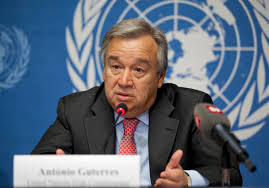
(UN) Secretary-General, Antonio Guterres, met with Haftar a few hours before
the March began. Guterres was in Libya to facilitate the April 14-16 meeting on
which his Special Representative, Ghassan Salamé, has been working for some
time in the hope of drawing a road map for long-delayed elections. On Friday,
April 5, the UN Security Council held a closed-door emergency meeting. The
Security Council called for a halt to the March on Tripoli and the de-escalation
of the growing armed conflict.
The Security
Council recognized the real possibilities of broader armed conflict and its
consequences on the civilian population. In the recent past, the Libyan armed
factions have violated the laws of war and have a sad record of abuses against
civilians.
We will now have
to see if Khalifa Haftar is more open to international appeals than was Benito
Mussolini. My impression is that the goal of holding overall power is stronger
than the respect of international law. However, even a successful “March on
Tripoli” will not create the conditions for an administration of a culturally
and geographically-diverse country. New and appropriate constitutional
structures must be developed.
There cannot be a
return to the earlier Italian colonial structures, nor to the forms of
government at independence developed by King Idris al Sanussi which depended
largely on his role as a religious leader using religious orders, nor the
complicated pattern of “direct democracy” developed by Muammar al-Qadhafi.
The Association of World Citizens has proposed the possibility of con-federal
structures.
The post 2011
Libyan society faces large and complex issues. Resolving the institutional,
economic and political issues is urgent and cannot be settled by elections
alone. There are three distinct regions which must have some degree of
autonomy: Tripolitania and Cyrenaica both bordering the Mediterranean and
Fezzan in the southern Sahara. Within each of the three regions there are
differing and often rival tribal societies which are in practice more kinship
lines than organized tribes. (1) There are differing economic interests and
there are differing ideologies ranging from “Arab Socialism” to the
Islamist ideology of the Islamic State which has spread from its Syrian-Iraqi
base.
The situation is
critical, and the next few days may be crucial for the future of the country.
Note
1) See J. Davis. Libyan Politics, Tribes and Revolution (London: I. B. Tauris, 1987)
Prof. René Wadlow is President of the Association of World Citizens.
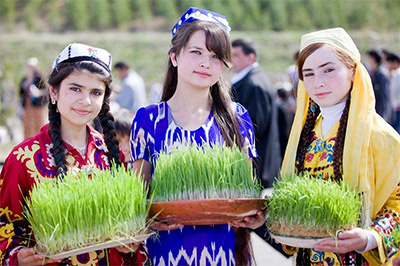
Navroz, usually
celebrated on March 21 in Iran and Central Asia, is the “New Day”, the end of
the old year with its hardships and deceptions and the start of the New Year to
be filled with hope and optimism. With each periodical festival, the
participants find the same sacred time – the same that had been manifested in
the festival of the previous year or the festival of a century earlier. It is a
day for spiritual renewal and physical rejuvenation and is usually a time for
reciting devotional poetry, presenting food with symbolic meaning to guests,
and visits among family and close friends.
Navroz, which
coincides with the Spring Equinox, is related to myths focused on the sun and
thus symbolizes the connections of humans to Nature. In some of the myths, Navroz
is considered as symbolizing the first day of creation − thus a time when all
can be newly created. It is a day between times − old time has died; new time
will start the day after Navroz. In this one-day period without time, all is
possible. The seeds are planted for a new birth. Among some who celebrate
Navroz, real seeds are planted, usually in seven pots with symbolic meanings of
virtues. Their growth is an indication of how these virtues will manifest
themselves in the coming year. Among those influenced by Islam and
Christianity, Navroz is the day when God will raise the dead for the final
judgment and the start of eternal life.
Navroz has an
ancient Persian origin, related to Abura Mazda, the high god who was symbolized
by the sun and manifested by fire. Navroz is also related to the opposite of
fire, that is, water. However, water can also be considered not as opposite but
as complementary, and thus fire-water can become symbols of harmony. Fire – as
light, as an agent of purification, as a manifestation of the basic energy of
life − played a large role in Zoroastrian thought and in the teachings of
Zarathoustra. Thus, we find fire as a central symbol and incorporated into
rituals among the Parsis in India, originally of Iranian origin.
From what is today
Iran, Zoroastrian beliefs and ritual spread along the “Silk Road” through
Central Asia to China, and in the other direction to the Arab world. As much of
this area later came under the influence of Islam, elements of Navroz were
given Islamic meanings to the extent that some today consider Navroz an
“Islamic holiday”. Navroz is also celebrated among the Alawites in Syria, the
Baha’i, the Yezidis, and the Kurds, each group adapting Navroz to its spiritual
framework.
In Turkey, for
many years, Navroz was officially banned as being too related to the Kurds and
thus to Kurdish demands for autonomy or an independent Kurdistan. I recall a
number of years ago being invited to participate in a non-violent Kurdish
protest in Turkey on Navroz to protest the ban. I declined as the idea of going
from Geneva to be put in a Turkish jail was not on top of my list of
priorities. Fortunately, for the last few years, the ban has been lifted.
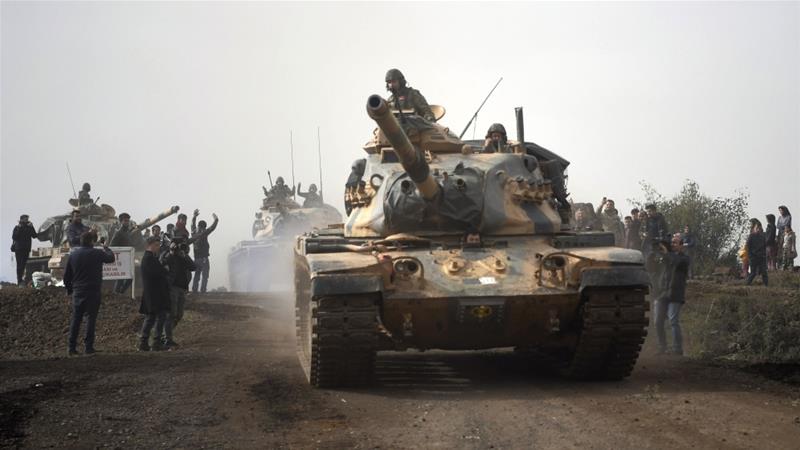
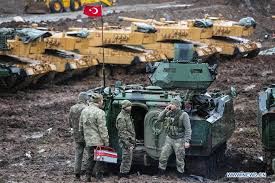
Navroz was marked
in 2018 in the Syrian Kurdish area of Afrin by the arrival of Turkish troops
and their Syrian allies. One of the first acts of the Turkish troops was to
pull down and destroy a statue of Kawa, a mythological founder of the Kurdish
people. In the myth, Kawa is a blacksmith who melted iron to make swords and
liberate the people from an evil ruler who had been helped by spirits.
2018 Navroz was also the end of a seven-year cycle begun in March 2011, the uprising and then war in Syria. Seven years in many traditions is a significant number.
Thus, Navroz as a day outside of time can be a moment of reflection on the armed conflict in Syria, and on our inability as peace makers to facilitate negotiations in good faith. Now, a new cycle of secular time has begun, made even more complex by the arrival of Turkish troops.
The armed conflict
in Syria is complex with outside official players: Iran, Russia, USA, Turkey,
the United Nations, the Arab League and more shadowy characters: the Islamic
State, a host of intelligence agencies, money and fighters from a variety of
sources. We find some of the same players in the war in Yemen. There is,
however, agreement among all that killing those who disagree is the only
realistic policy. It is a very old and wide-spread idea found in most cultures.
The techniques of killing have become more sophisticated – drones and car bombs
– but the idea has remained the same and is easily understood.
In contrast, ideas
of conflict reduction through changes in structure are more complex: broadening
the base of the Syrian government by bringing in individuals from groups
largely excluded, creating con-federal forms of association among the Kurds
without necessarily creating a separate State, creating a cosmopolitan,
humanist society which meets the basic needs of all. Moreover, we on the
outside can suggest approaches, but the effort will have to be made by local
people.
Those who advocate (and carry out) killing have funds and staff which conflict resolution nongovernmental organizations lack. Yet conflict resolution efforts must continue and grow stronger. A new, even more complex cycle of time has started. The old approach of killing those who disagree remains strong. Yet, I believe that there are possibilities of renewal and cooperative action for a more peaceful and just wider Middle East.
Prof. René Wadlow is President of the Association of
World Citizens.
World law, as World Citizens use the term, is more
than current international law. World law has, as its base, universally-recognized
international law but also the human rights declarations and standards, the
oft-repeated declarations of the United Nations (UN) General Assembly as well
as the international legal bodies such as the World Court and the International
Criminal Court (ICC). The International Criminal Court is the most recent of
the world courts, and its Rome Status has not been ratified by all UN Member
States, the United States (U. S.) being a significant holdout.
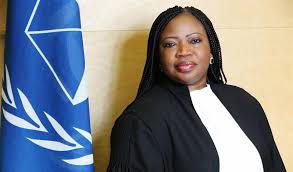
ICC Prosecutor Fatou Bensouda
Some States have withdrawn from the ICC and other
States do not cooperate with it, such as the Sudan. The ICC can act only after
the relevant national courts have acted or when national courts are unable to
act (the case of some ‘failed States’) or when there is an unjustified
unwillingness of national courts to act when crimes against humanity have been
committed.
The Association of World Citizens (AWC) has repeatedly
stressed that humanitarian law (international law in times of war, primarily
the Geneva Conventions) are being systematically violated and that there should
be a UN-led World Conference for the Re-affirmation of Humanitarian Law.
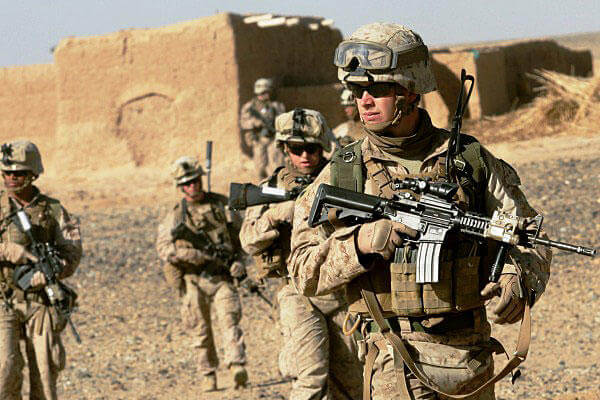
In the armed conflicts in Afghanistan, there have been
repeated violations of humanitarian law by all sides: violations in the
treatment of prisoners of war, violation of the prohibition of torture,
prohibition of attacking medical facilities and medical personnel. The ICC has
undertaken preliminary investigations to collect evidence. Among those who have
violated humanitarian law are U. S. troops, and thus evidence should be
collected.
Although most evidence could be collected within
Afghanistan itself, it would be useful to interview persons who had served in
Afghanistan but now have returned to the U. S. and to see written reports no
longer stored in Afghanistan. Thus, the ICC plans to send investigators to the
U. S. to interview and collect documentation.
However, Secretary of State Mike Pompeo announced on
March 15, 2019 that the U. S. will revoke or deny visas to ICC personnel
investigating allegations of torture or other war crimes committed in the
conflicts in Afghanistan. Pompeo also announced that the U. S. will consider
imposing financial sanctions and restrictions on “persons who take or have
taken action to request or further such ICC investigation”. He could have
added imprisonment if we recall those who provided evidence of war crimes in
Iraq.
Unfortunately, Pompeo sends the wrong message to all
other parties that torture, rape, attacks on medical facilities will not be
tried. Pompeo helps to undermine further international humanitarian law.
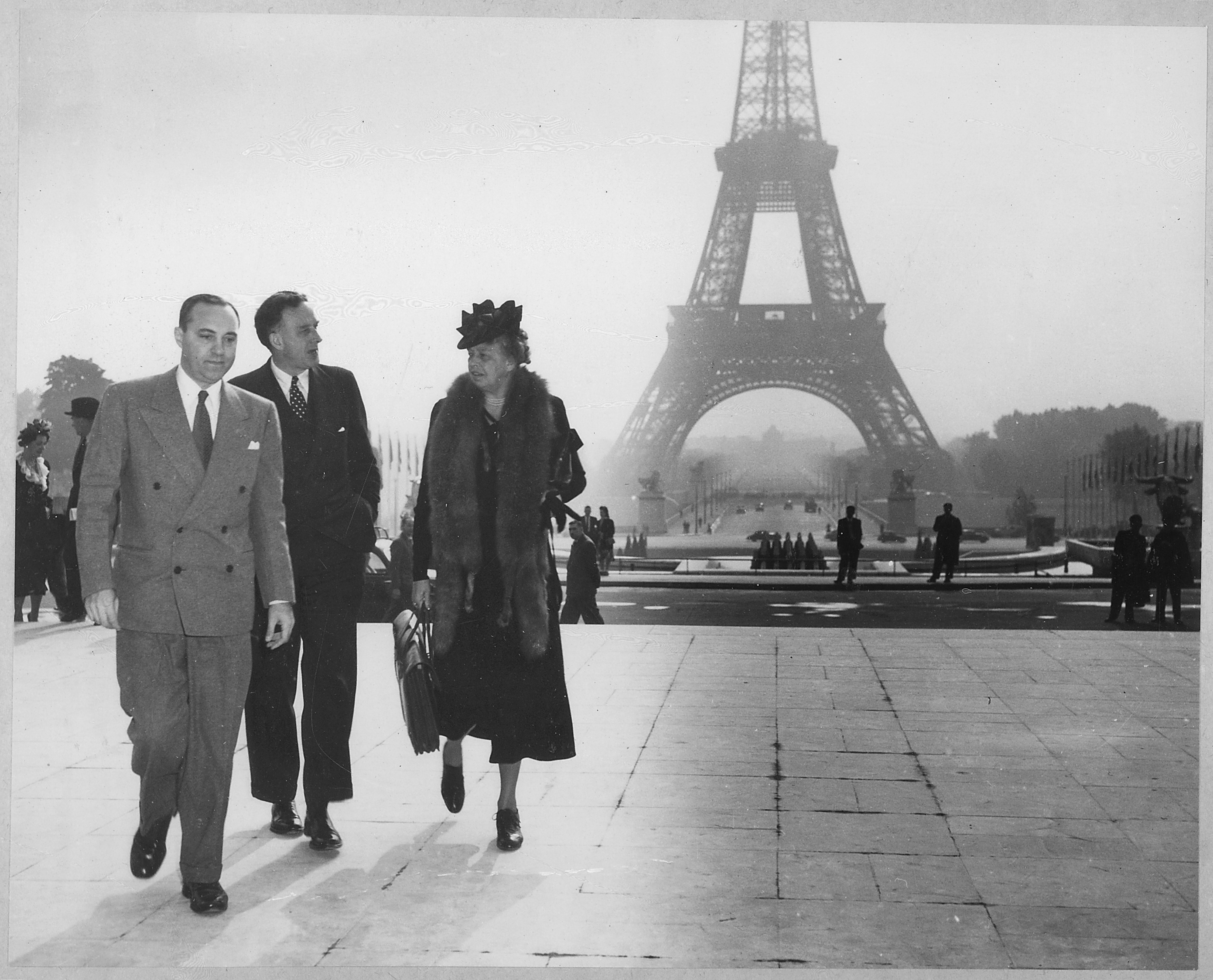
We have to think back to 1947-1948 and the leadership
of Mrs. Eleanor Roosevelt as chair of the UN Commission on Human Rights to
recall any U.S. leadership on world law. Unfortunately, law has never been part
of U. S. culture. The lone cowboy taking the law into his own hands by shooting
it out on a dusty street seen in many films remains the U. S. ideal.
As mentioned, most of the necessary evidence can be
found in Afghanistan itself. Bringing anyone from any party to trial for crimes
in Afghanistan seems to me unlikely. Nevertheless, as world citizens, we need
to keep the standards of world law in mind. These standards should be clear. Thus,
our repeated call for a UN-led conference on the re-affirmation of
international humanitarian law.
Prof. René Wadlow is
President of the Association of World Citizens.
March 15 is widely used as the date on which the conflict in Syria began. March 15, 2011 was the first “Day of Rage” held in a good number of localities to mark opposition to the repression of youth in the southern city of Daraa, where a month earlier young people had painted anti-government graffiti on some of the walls, followed by massive arrests.
I think that it is important for us to look at why organizations that promote nonviolent action and conflict resolution in the US and Western Europe were not able to do more to aid those in Syria who tried to use nonviolence during the first months of 2011. By June 2011, the conflict had largely become one of armed groups against the government forces, but there were at least four months when there were nonviolent efforts before many started to think that a military “solution” was the only way forward. There were some parts of the country where nonviolent actions continued for a longer period.
There had been early on an effort on the part of some Syrians to develop support among nonviolent and conflict resolution groups. As one Syrian activist wrote concerning the ‘Left’ in the US and Europe but would also be true for nonviolent activists “I am afraid that it is too late for the leftists in the West to express any solidarity with the Syrians in their extremely hard struggle. What I always found astonishing in this regard is that mainstream Western leftists know almost nothing about Syria, its society, its regime, its people, its political economy, its contemporary history. Rarely have I found a useful piece of information or a genuinely creative idea in their analyses “(1)
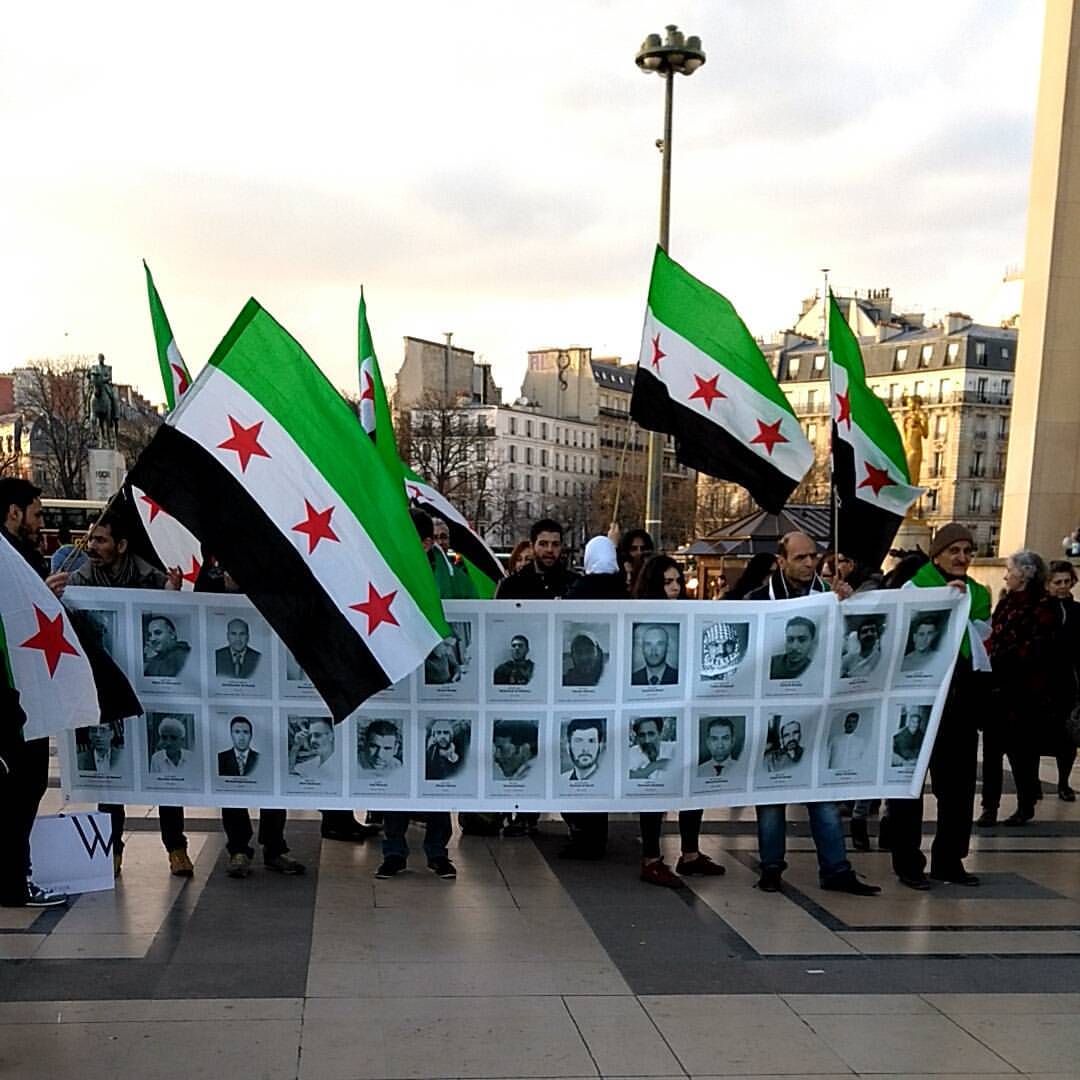
A Syrian opposition rally in Paris (C) Bernard J. Henry/AWC
In December 2011, there was the start of a short-lived Observer Mission of the League of Arab States. In a February 9, 2012 message to the Secretary General of the League of Arab States, Ambassador Nabil el-Araby, the Association of World Citizens (AWC) proposed a renewal of the Arab League Observer Mission with the inclusion of a greater number of non-governmental organization observers and a broadened mandate to go beyond fact-finding and thus to play an active conflict resolution role at the local level in the hope to halt the downward spiral of violence and killing. In response, members from two Arab human rights nongovernmental organizations (NGO) were added for the first time. However, opposition to the conditions of the Arab League Observers from Saudi Arabia let to the end of the Observer Mission.
On many occasions since, the AWC has indicated to the United Nations (UN), the Government of Syria and opposition movements the potentially important role of NGOs, both Syrian and international, in facilitating armed conflict resolution measures.
In these years of war, the AWC, along with others, has highlighted six concerns:
1) The widespread violation of humanitarian law (international law in time of war) and thus the need for a UN-led conference for the re-affirmation of humanitarian law.
2) The widespread violations of human rights standards.
3) The deliberate destruction of monuments and sites on the UNESCO World Heritage list.
4) The use of chemical weapons in violation of the 1925 Geneva Protocol signed by Syria at the time, as well as in violation of the more recent treaty banning chemical weapons.
5) The situation of the large number of persons displaced within the country as well as the large number of refugees and their conditions in Turkey, Lebanon, and Jordan. In addition, there is the dramatic fate of those trying to reach Europe.
6) The specific conditions of the Kurds and the possibility of the creation of a trans-frontier Kurdistan without dividing the current States of Syria, Iraq, Turkey and Iran.
These issues have been raised with diplomats and others participating in negotiations in Geneva as well as with the UN-appointed mediators. In addition, there have been articles published and then distributed to NGOs and others of potential influence.
The Syrian situation has grown increasingly complex since 2011 with more death and destruction as well as more actors involved and with a larger number of refugees and displaced persons. Efforts have been made to create an atmosphere in which negotiations in good faith could be carried out. Good faith is, alas, in short supply. Efforts must continue. An anniversary is a reminder of the long road still ahead.
Notes:
(1) Yassin al-Haj Saleh in Robin Yassin-Kassal and Leila Al-Shami, Burning Country, Syrians in Revolution and War (London: Pluto Press, 2015, p. 210)
Prof. René Wadlow is President of the Association of World Citizens.
The present era of globalization of the economy is not new, but as a term and also as an organizing concept for policy making, it dates from 1991 and the formal end of the Soviet zone of influence which had some of the structures of an alternative trading system.
Earlier, dating from the 1970s the term used was “interdependence”. The emphasis was on economic relations but there was also some emphasis on cultural and political factors. In a July 1975 speech, United States Secretary of State Henry Kissinger who had an academic background and kept himself informed of theoretical trends said “All of us – allies and rivals, new nations and old nations, the rich and the poor – constitute one world community. The interdependence on our planet is becoming the central fact of our diplomacy… The reality is that the world economy is a single global system of trade and monetary relations on which hinges the development of all our economies. An economic system thrives if all who take part in it thrive.”
Interdependence was to help build a world society based on equality, justice, and mutual benefit. As Secretary Kissinger said the need was “to transform the concept of world community from a slogan into an attitude.”
Interdependence was to be articulated into policies leading to disarmament, peaceful change, improved welfare especially for the poorest and respect for human rights. However, in practice the continuing USA-USSR tensions, questions of access to oil especially in the Middle East and the difficulties of establishing rules and controls for the world trade system kept “interdependence” as a slogan and not as a framework for policies and decisions of major governments.
The term “globalization” has progressively replaced that of “interdependence” The concept of globalization continues the interdependence focus on global economic linkages but adds an emphasis on the organization of social life on a global scale and the growth of a global consciousness. Global consciousness is the essential starting point of world citizenship. Globalization is a socio-economic process in which the constraints of geography on social and cultural patterns recede and in which people become increasingly away that these geographic constraints are receding.
The rapid pace of globalization requires that research and practice keep up with the speed of changes in order to reduce unnecessary risks and to provide legitimacy and confidence in the world system. However, within the world society – as within national societies – there are many different interests. At the world level, there are not yet the web of consensus-building techniques found in public and private institutions at the national level.
There were recently two intergovernmental conferences being held at the same time which indicated the possibilities and the difficulties of reaching agreement among most of the States of th World: COP 24 held in Katowice, Poland devoted to issues of climate change and the conference on the Global Compact for Safe, Orderly and Regular Migration, held in Marrakech, Morocco.
The COP 24 had the advantage of building on the 2015 Paris Climate Accord and on the serious scientific research carried out by the Intergovernmental Panel on Climate Change (IPCC). The Katowice conference was to develop a common system of rules, reporting and measurement for the Paris Climate Accord. This “rule book” was largely accomplished. A sub-theme was to show that the international spirit which had led to the Paris Agreement was still alive and well despite criticism and a lack of visible progress.
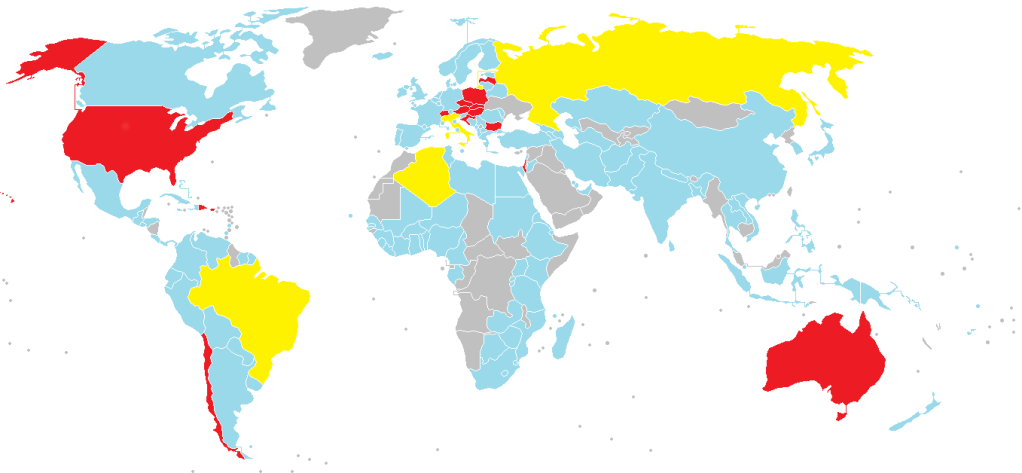
The Global Compact for Safe, Orderly and Regular Migration is the first of its kind, although there are earlier agreements on the status of refugees. In many countries, there has been sharp debates on immigration policy – often with more heat than light. Some States have already indicated that they will not sign the Compact even though it has been repeatedly pointed out that the Compact is not a treaty and thus not legally binding. The Compact sets out aspirations and strengthens some of the processes already in practice. The representatives of some States which signed indicated that they will be “selective” in the processes which they will put into practice.
Blue: Will adopt the Compact, Red: Will not adopt the Compact, Yellow: Considering not adopting, Gray: Undetermined
There was an agreement to hold a review conference in 2022. There is a growing tendency in inter-governmental treaties to set a review conference every four or five years to analyze implementation and the changing political and economic situation.
The Association of World Citizens (AWC) has been stressing for some years the importance of migration issues. Migration is likely to increase as climate changes have their impact. Thus, the AWC calls upon Nongovernmental Organizations to focus cooperatively and strongly on migration and the standards of the Global Compact.
Prof. René Wadlow is President of the Association of World Citizens.
Life without love is like a tree without blossom and fruit. And love without beauty is like flowers without scent and fruits without seed… For Love is the only flower that grows and blossoms without the aid of seasons… Love is a rose, its heart opens at dawn.”
Khalil Gibran (1883-1931) the Lebanese poet, whose birth anniversary we mark on January 6, in many ways represents the deeper spirit of Lebanon though he lived most of his life outside the country: in Paris as an art student and in the USA where he started to write directly in English. His best known book The Prophet was written directly in English.
In “My Birthday”, written in Paris on January 6, 1908 Gibran wrote “Thus have I walked round the sun twenty and five times. And I know not how many times the moon has encircled me. Yet I have not unveiled the secrets of life, neither have I known the hidden things of darkness… Much have I loved in these five and twenty years. And much that I have loved is hateful to people, and much that I have hated is by them admired… I have loved freedom, and my love has grown with the growth of my knowledge of the bondage of people to falsehood and deceit… Love is the only freedom in the world because it so elevates the spirit that the laws of humanity and the phenomena of nature do not alter its course.”
In a vision that was correct, he added in the 1908 birthday essay “And today, today I stand in remembrance as a tired wayfarer who stands mid-way on the ascending road.” He died in 1931 at the age of 48. (1)
For Gibran, Love and Beauty are the foundations of existence. As he wrote in an essay which gave the title to the book “A Tear and a Smile” Then my heart drew near to wisdom, the daughter of Love and Beauty, saying ‘Give me wisdom that I may carry it to humankind’. She answered ‘Say that happiness begins in the holy of holies of the spirit and comes not from without.
A Tear and a Smile sums up well Gibran’s attitude toward life which is always made up of contrasts: light and dark, knowledge and doubt.
How beautiful is life, beloved. Tis like the heart of a poet, Full of light and spirit, How harsh is life, beloved Tis like an evildoer’s heart Full of guilt and fear.
In “The Hymn of Man”, nearly a credo of his views, he stresses the ‘both/and’ of contrasts:
I have hearkened to the teachings of Confucius and listened to the wisdom of Brahma, and sat beside the Buddha beneath the tree of knowledge. Behold me now contending with ignorance and unbelieving.
I have borne the harshness of insatiable conquerors, and felt the oppression of tyrants and the bondage of the powerful. Yet I am strong to do the battle with the days.
I was, And I am. So shall I be to the end of Time. For I am without end.
(1) Quotations are from Khalil Gibran A Tear and A Smile. Translated from the Arabic by H.M. Nahmad (London: William Heinemann, 1930)
Painting: Age of Women by Khalil Gibran
Prof. René Wadlow is President of the Association of World Citizens.


 Association of World Citizens