At this time when there is armed conflict and strong political tensions in world society, broadly-based efforts are needed to develop a harmonious political culture based on world law. A political culture is a set of attitudes and beliefs which give order and meaning to a political process. Such a positive political culture is a product of both the collective history of a political system and the life histories of the members of that system.
“To establish conditions under which justice and the respect for the obligations arising from treaties and other sources of international law can be maintained” is one of the four objectives of the United Nations (UN) as set out in the preamble to the Charter, firmly related to the three other aims: the prevention of war, respect for human rights, and social progress. The phrasing of the aims rightly stresses not the enactment of international law but rather the need to “establish conditions” under which justice and respect for international law is possible.
Respect for international law should place limitations upon the number of options open to a government in choosing how to carry out a policy in foreign affairs. The most fundamental limitation is the prohibition on using military action except in self-defense against aggression.
When abuse of State power, denial of human rights, corruption, and the absence of participation in decision-making are the daily routine, people look upon law as a method to establish justice. The rule of law at both the international and national level must be based on a social consensus.
Nongovernmental Organizations (NGOs) can play a vital role in developing this social consensus on the rule of law. NGOs have proven that they can respond effectively to the challenges faced by today’s world society. Thus, there is a growing role for NGOs within the UN system in the making and implementation of policies. NGOs are involved more than ever before in global policy-making and project implementation. They bring citizens’ concerns to governments and advocate specific policies.
Today, with armed violence ongoing in many parts of the world, cooperative peacebuilding efforts are urgently needed. NGOs are playing an increasing role in such peacebuilding efforts and must be encouraged.
Prof. René Wadlow is President of the Association of World Citizens.
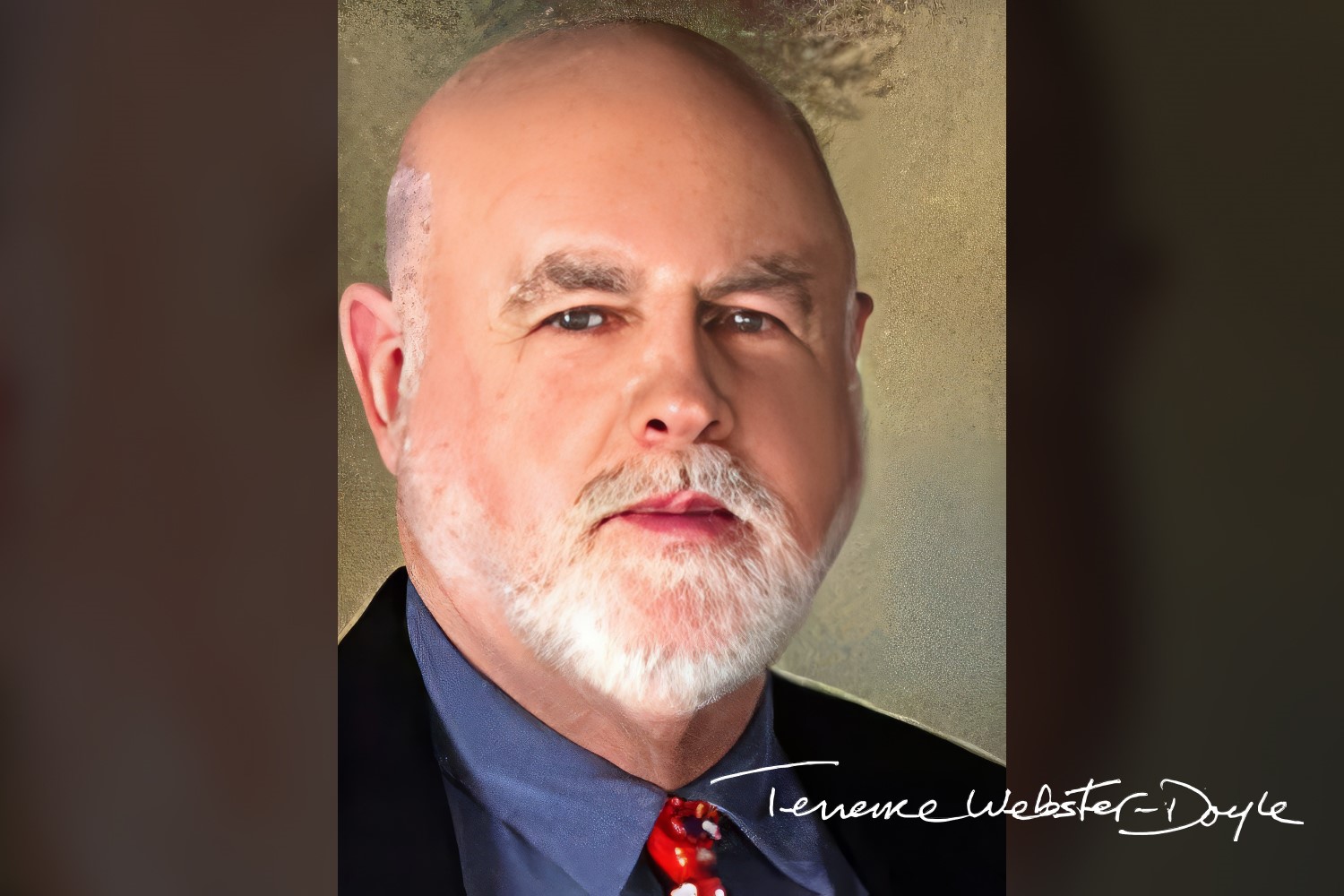
One of the most renowned authors and educators in the field of peace education, Dr. Terrence Webster-Doyle, passed away at noon on Friday, June 16, 2023, in Paonia, Colorado, USA. He was 83.
Dr. Terrence Webster-Doyle (1940-2023) was the founder and director of the Atrium Peace Institute and the Brave New Child Peace Museum Exhibits. He had a sixth-degree black belt in martial arts and was a co-founder of the Martial Arts for Peace Safety Awareness Response System Program (MAP STARS). Holding a Ph.D. in Health and Human Services, a Master’s Degree in Humanistic Psychology, he taught at Sonoma State University and Santa Rosa Community College in California.
He was the author of more than 150 scientific and methodological works, including 15 monographs, 20 textbooks and 23 curricula; the developer of a series of conflict resolution courses for adolescents; a ten-time recipient of the Benjamin Franklin Lifetime Achievement Award for excellence in independent publishing. He was awarded the Robert Burns Medal by the Albert Schweitzer Society of Austria for outstanding service in promoting peace. Recipient of the Benjamin Franklin Gold Medal for his book “Fighting the Invisible Enemy. Understanding the Effects of Conditionality”.
Dr. Terrence Webster-Doyle’s books have been widely recognized by the professional community as an important resource in conflict prevention and resolution. He is the author of the first seminal book on bullying “Why Is Everybody Always Picking on Me? A Guide to Handling Bullies”. Dr. Webster-Doyle is credited to have given a human face back to the culture of peace.
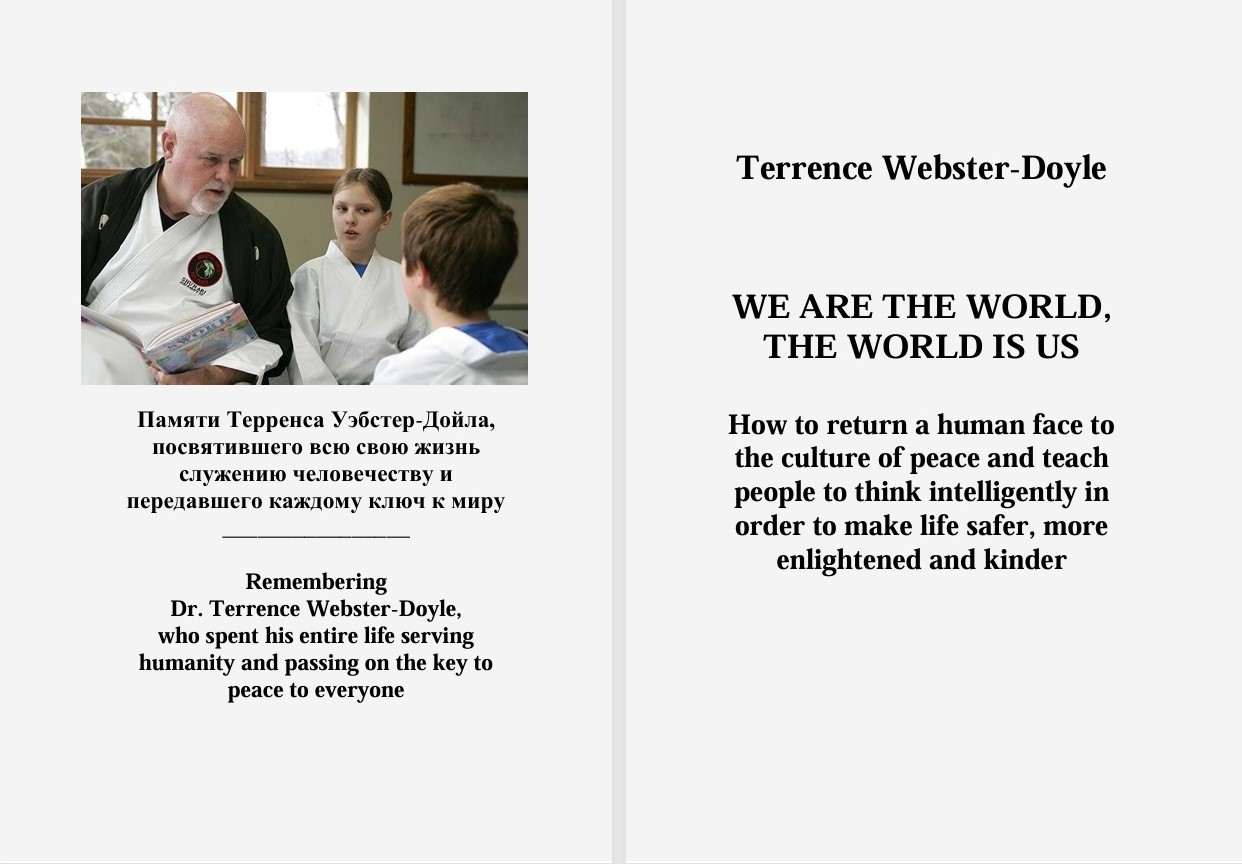
A two-page spread of Terrence Webster-Doyle’s last book, We are the World, the World is Us (Samara, 2024. – 236 p.)
In one of his latest books, A Mini Museum on Understanding the Roots of Prejudice and Discord. Learn More about How to Make Life Safer and Kinder (Samara, 2022), T. Webster-Doyle invites young people to take a fascinating page-by-page museum tour through the illustrated ideas, images, and stories in the book, and learn more about the anthropological, psychological, historical, and social roots of reprehensible thinking and hostility between people, cultures, and nations. The author thrives to show that freeing oneself from prejudice and understanding the root causes of fear and violence in human life is the way to make life better, more peaceful and kinder.
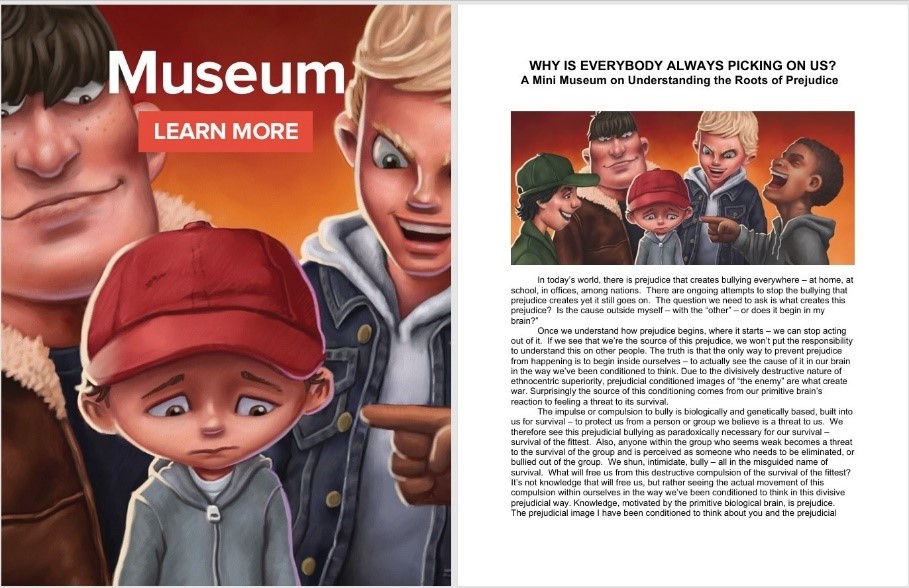
A two-page spread of the book Museum: Learn More. Why is Everybody Always Picking on Us? A Mini Museum on Understanding the Roots of Prejudice (English Edition, Atrium Society Publications, USA, 2019. – 75 p.)
In his writings, Webster-Doyle sought to show that all the best in a person is tied to peace. To achieve peace, we must understand what hinders it, and what hinders it is our very predisposition to ethno- and sociocentrism. The origins of conflicts lie in our prehistory, in the biological predisposition of our brain to protect itself from external threats – imaginary and real. Sometimes a person does not notice how he/she himself/herself becomes a victim of his/her own prejudices. No image. No enemy. No war. It is important to be able to observe and recognize situations that challenge us based on cultural resistance and behavioral stereotypes, and not succumb to outbursts of intolerance, hostility, and aggression.
Once in a conversation with me, T. Webster-Doyle shared the thought that “peace is a given, but only as a premise, a potential, under attack every time by prejudice and preconceptions. Peace requires a true awakening of the mind, here and now, but peace does not require multiple and endless theoretical constructions. Therefore, it is important to understand what creates it, and how one can achieve a real, rather than an imaginary peace”.
Т. Webster-Doyle thought a lot about why people cannot create a lasting peace and find harmony with each other. He began to ask questions: how to bring cultures closer together, to deal with mistrust and enmity, to learn how to build peace on the basis of reasonable, virtuous and humanistic principles. In my search for answers to these questions, I began to use the training materials he developed on peacebuilding pedagogy.
Terrence Webster-Doyle never ceased to remind people that “understanding is the key to peace”. But how can we find the key to understanding itself? Maybe it is the works of T. Webster-Doyle that could become such a key, opening the doors to dialogue, peace and harmony among peoples, cultures and nations.
Vladimir Ionesov, Doctor of Cultural Studies, Candidate of Historical Sciences, Professor with the Department of Cultural Studies, Museology and Art History at Samara State Institute of Culture. Developer of the concept of cultural transformation and models of civilization viability in transition. Full member of the European Academy of Sciences and Arts. Deputy Chairperson, Research Advisory Council, “Personality. Culture. Peace” Scientific and Enlightening Center of Samarkand International University of Technology (SIUT).
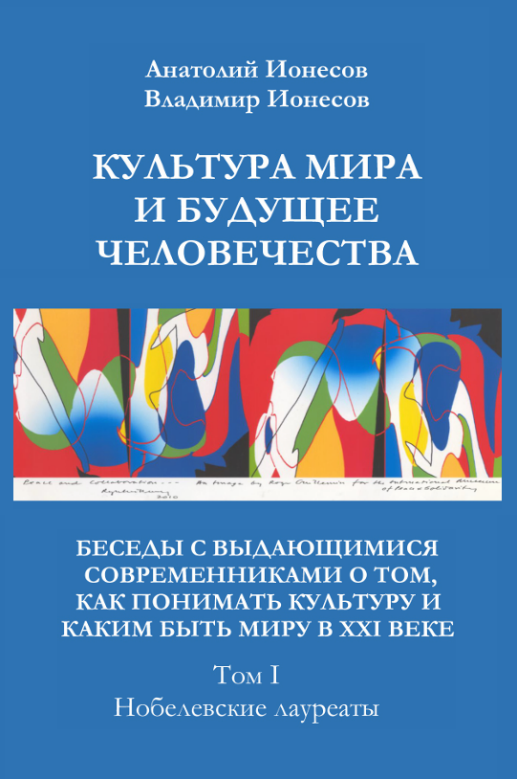
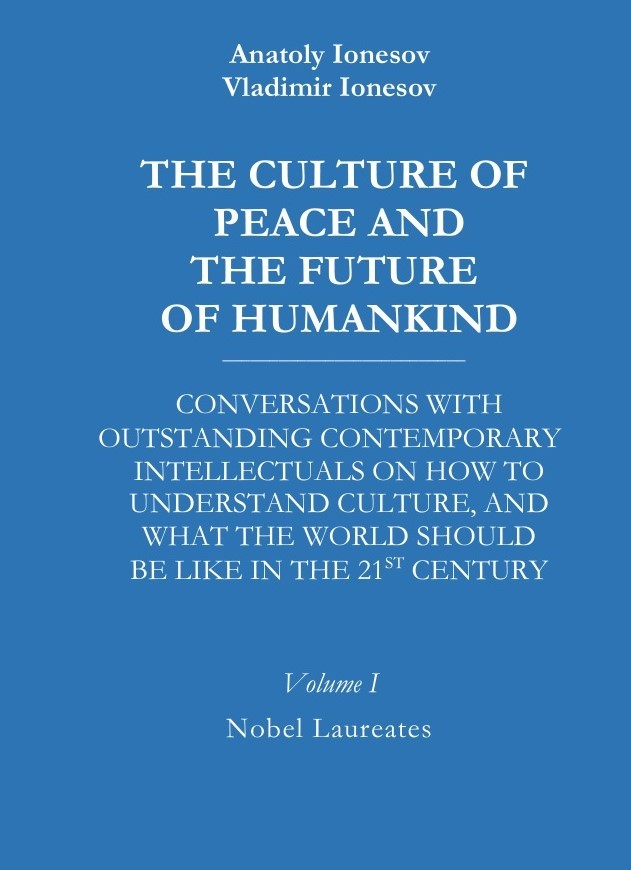
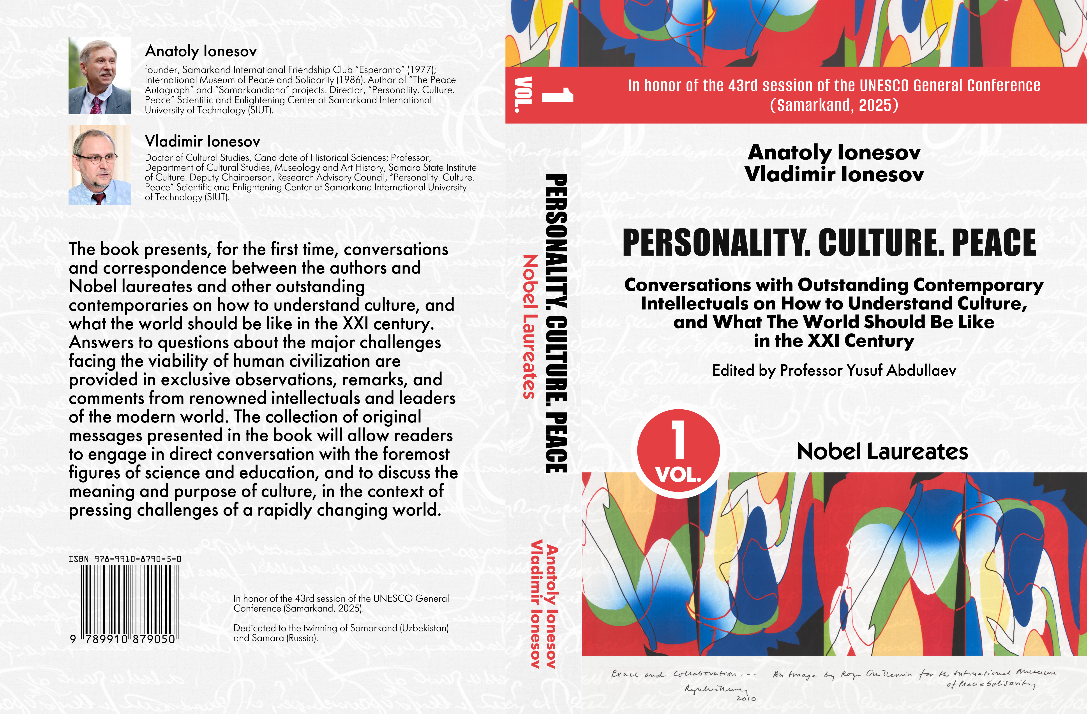
Anatoly I. Ionesov & Vladimir I. Ionesov, The Culture of Peace and the Future of Humankind: Conversations with Outstanding Contemporary Intellectuals on How to Understand Culture, and What the World Should Be Like in the 21st Century
Vol. I-IV. [Volume I. Nobel Laureates]
Samara-Samarkand: Samara Scientific Center, 2025. 500 p.
The real essence of life is not in what it has,
But in what one believes there should be.
Iosif A. Brodsky (1940-1996)
This new book by Anatoly and Vladimir Ionesov contains and presents in four volumes the authors’ extensive materials on the culture of peace and citizen diplomacy, formed on the basis of direct conversation, correspondence, meetings and idea exchanges with outstanding intellectuals of our time. For 40 years, the authors have developed and maintained a dialogue with recognized global leaders in science, education, art, business, politics and sports. This has resulted in a diverse collection of unique written messages and tangible artifacts that have been designed as an International Archives of the Culture of Peace.
The Samarkand International Friendship Club “Esperanto” (Uzbekistan) and the Samara Society for Cultural Studies “Artefact – Cultural Diversity” (Russia), both led by the authors of this publication, created this archive through the organizations’ long-term activities. On the Samarkand site, the International Museum of Peace and Solidarity (1986) was established, and the Peace Autograph Project was initiated; while on the second – Samara city site, the project “Culture of Peace Personalities: People Who Changed the World” (1994) was conceived, launched and implemented. The latter was in direct dialogue on pressing issues of the philosophy of peacemaking and the viability of modern civilization with recognized experts in the field.
Thanks to these joint projects and other types of partnership activities, it was possible to include the two sister cities – Samarkand, the ancient pearl of the East, and Samara, the ‘Space Capital’ of Russia, in the dialogue with the wider world. Through correspondence, interviews, meetings, conversations, creative projects, scientific connections, educational exchange, and other cultural practices of citizen diplomacy, communication was established with contemporaries who, through their ideas, visions, achievements, and professional experience, showed how life can be changed for the better. The authors, using the example of these personalities, their spoken or written word, proposed thoughts, insightful intuition and skillfully embodied deeds, sought to testify to unique examples of personal selfless devotion in culture. And, thereby, convey their main message: any individual may cope with the challenges of the changing world if he or she relies on knowledge, creativity, morality, humanism and free thinking.
At different stages of the project, participants in dialogue with the authors included thousands of individuals. Their visions for solving the most pressing challenges help to better understand how to build and promote a culture of peace, a philosophy of nonviolence and tolerance in the multicultural diversity of humankind. This way we discussed multiple problems the world is facing today with the people who have probably managed to implement those principles into life most fully.
The participants in the direct conversation were a variety of personalities from a Nobel Prize laureate to a simple teacher of a provincial school, from an outstanding politician to an ordinary citizen, from a famous preacher to an inconspicuous volunteer, from a professional traveler and explorer to an ordinary wanderer and creator. Each of them has their own view of the world, their own visions, interests, values, preferences. Their answers to questions, remarks and comments are unequal, as are their biographies and professional activities. In short, they are as varied as life itself.
The materials included in each volume of this publication are divided into two main sections 1. Answers to Questions, Letters and Reflections and 2. Remarks, Comments, Greetings, and two Appendices. The personal messages are placed in alphabetical order without chronological sequence. Each separate block consists of three parts: information about the person, a photo with an autograph or gift inscription, and the text of the reply. All correspondence is represented by original texts – personal messages addressed to the authors in Samarkand or Samara. The Appendix provides a consolidated list of Nobel Prize laureates who have sent their feedback (messages, etc.) to the authors and a small photo chronicle.
The first volume consists of replies, letters, remarks and comments of 72 Nobel Prize laureates representing 20 countries of the world (Argentina, Belgium, Great Britain, East Timor (Timor Leste), China (territory of Tibet), Egypt, Finland, France, Germany, India, Ireland, Japan, Mexico, Nigeria, Netherlands, Russia, former USSR, South Africa, Switzerland, USA). All the authors of the messages placed in the book are arranged in alphabetical order.
Our interlocutors are distinguished intellectuals in the field of scientific research whose works have changed the world for the better through revolutionary inventions and major contributions to the culture and development of society. Among the intellectual leaders of our time included in this volume who have shared with the authors their visions on how to understand culture and what the world should be like in the twenty-first century are Nobel Prize laureates in Chemistry (19), Physics (15), Physiology or Medicine (11), Economics (7), Literature (4), and for promoting world Peace (16).
The authors of the book are grateful to their distinguished interlocutors, who, in addition to answering questions, have also kindly provided the texts of their articles and other materials as expanded commentary on a given topic for translation and inclusion in this edition.
The book concludes with a list of all Nobel laureates who responded to the dialogue with the authors, including the names of those whose comments and greetings, although not included in this edition, have become an important and inspiring part of the project.
In total, responses were received from 253 Nobelists in six fields (including three scientists who were awarded this prize twice): 49 laureates in chemistry, 68 – in physics, 63 – in physiology or medicine, 30 – in economics, 13 – in literature and 30 participants of the project were awarded the Nobel Peace Prize.
It should be noted that the “Culture of Peace Personalities” project, launched and implemented by the authors, inspired the creation and suggested the name of the newly established “Personality. Culture. Peace” Scientific and Enlightening Center at Samarkand International University of Technology (SIUT). It is gratifying that it was the Center that became the main venue for the completion of such a significant book project.
The authors consider this publication as another step in strengthening partnership and twinning between Samarkand and Samara. They hope that their work will contribute to the development of not only the two sister cities, but also of the Commonwealth of Independent States (CIS). In this regard, it is noteworthy that by the decision of the CIS Council of Heads of State, Samarkand has acquired another landmark status for itself – becoming the cultural capital of the Commonwealth in 2024.
When the first volume was ready to go to press, the authors of the book received a message from a Canadian scientist, Nobel Laureate in Physics (2015) Arthur B. McDonald (b. 1943). It contained remarkable words that insightfully reflect the main idea behind this publication: “The openness and international cooperation between basic scientists seeking and understanding of the world we live in can be a model for everyone and a direction for world peace”. – Arthur B. McDonald, March 23, 2023, Canada.
It remains to be hoped that an interested reader, within the dialogue space with the authors and participants of this edition, will find useful answers to pressing questions and gain clarity on complex issues in the current agenda of our turbulent times.
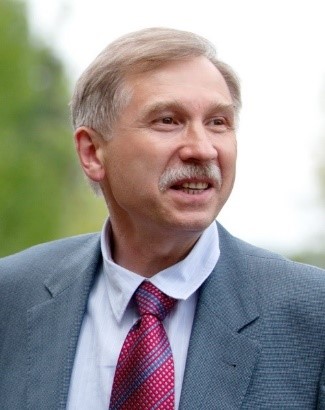
Anatoly Ionesov, founder, Samarkand International Friendship Club “Esperanto” (1977); International Museum of Peace and Solidarity (1986). Author of “The Peace Autograph” and “Samarkandiana” projects. Director, “Personality. Culture. Peace” Scientific and Enlightening Center of Samarkand International University of Technology (SIUT).
Vladimir Ionesov, Doctor of Cultural Studies, Candidate of Historical Sciences; Professor, Department of Cultural Studies, Museology and Art History, Samara State Institute of Culture. Developer of the concept of cultural transformation and models of civilization viability in transition. Full member of the European Academy of Sciences and Arts. Deputy Chairperson, Research Advisory Council, “Personality. Culture. Peace” Scientific and Enlightening Center of Samarkand International University of Technology (SIUT).
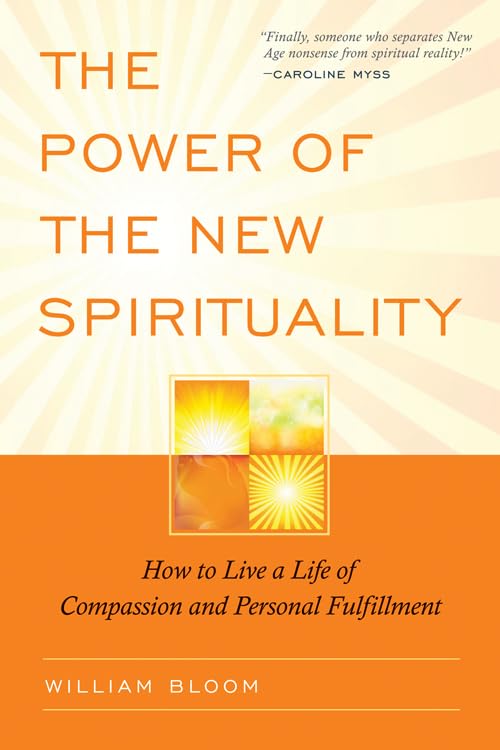
William Bloom who combines a long-standing interest in New Age approaches to spirituality with an identity focus in international relations (1), has written “We are in changing times. Our culture and technology are continually transforming, and the intellectual certainties of the last few hundred years are no longer secure…It is our need to find a new authenticity in our spiritual lives — to bring back fully into our consciousness — the sacred dimension of life, but we want to do this in a way that honours personal freedom and personal growth. In essence, then, we are turning to the teachings and experiences of what is called the ageless wisdom, but we are doing so with completely new attitudes”.
A key element of our changing culture is that we are discarding old religious forms and re-creating our spiritual and sacred world. Creative new attitudes, practices, and forms have been an emphasis of William Bloom. (2) As he writes, “As a teacher and author I often feel conflicted: on the one hand, I want to inspire and encourage people about their innate goodness and the wonders of creation; on the other hand, I do not want to support naiveté about the human condition. We are magnificent beings with cosmic consciousness, and yet at the same time we are also insecure and can do harm.
“Yet the current emergence and creation of a new culture is not always an easy process. It feels as if everything is being created anew. At the same time, we know that we are working with dimensions which have always been and which always shall be.”
The basis of many New Age approaches is that we live in a vast field of energy. Vibrations and atmospheres can move like waves through this field to impact others. Our thoughts, feelings and actions can cooperate with this vitality, energy and consciousness for our development and to benefit others. We find this use of energy fields in many schools of spiritual healing such as reiki, in yoga and martial arts. (3)
William Bloom sets out a three-step process for deepening and expanding our awareness, developing our hearts, and building a just, creative and benevolent world. He sets out some core skills.
The first is centering — a calm awareness, an integration of body, mind and spirit. This is best done through silent meditation, but some find music or ritual helpful. “Whatever works for you” is basically his approach. This is an approach called “mindfulness” in some Buddhist traditions and can also be helped by breathing exercises and other techniques.
The second step is to focus the heart on compassion. Visualization is one approach, such as visualizing ever wider circles of persons or places held within the field of compassion. Focusing on the Sacred Heart of Jesus is used in certain Catholic traditions.
The third step is to direct the energy field so that it is of service to others. When we are centered and heart-focused, with an encouraging psychological attitude, we create a vibration that is supportive for those around us and can be a positive influence in the wider world.
William Bloom has written a clear and helpful presentation for personal fulfillment and service to humanity.
Notes:
1) William Bloom, Personal Identity, National Identity and International Relations (Cambridge: Cambridge University Press, 1993) 2) William Bloom, First Steps: An Introduction to Spiritual Practice (Forres, Scotland: Findhorn Press, 1993) 3) Barbara Ann Brennan, Hands of Light: Guide to Healing Through the Human Energy Field (New York: Bantam, 1990)
Prof. René Wadlow is President of the Association of World Citizens.
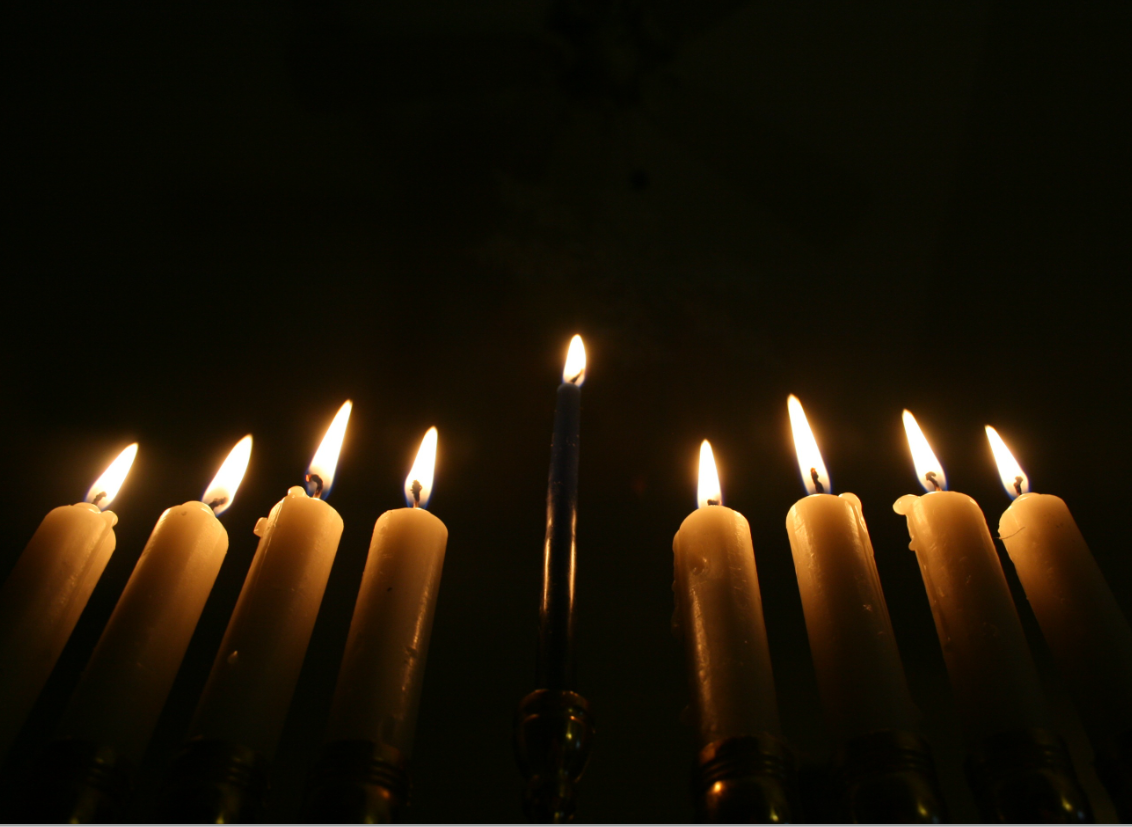
There is a tale of a Rabbi who enters into a discussion with his students about the night. He asks them, “When can one know that the night has ended and the day has begun?”. One student suggests, “When you can tell the difference between a sheep and a dog.” Another student suggests, “When you can see the difference between an olive tree and a fig tree”. “No”, replies the Rabbi, “It is the moment when you can look at a face never seen before and recognize the stranger as a brother or sister. Until that moment, no matter how bright the day, it is still night.”
In much of the world, it is still night. In 2026, the greatest challenge facing the world society is to release the enormous financial, technical, and human resources still used for military and narrow nationalist goals for ecologically-sound development. These resources will be provided only as more persons develop a profound sense of responsibility for the fate of the planet and for the well-being of the entire human family. We seek to develop a sustainable and just world. If we work together, 2026 can be a strong light for the world.
Prof. René Wadlow is President of the Association of World Citizens.
The Association of World Citizens (AWC) calls for an urgent ceasefire in the renewed armed conflict between Thailand and Cambodia which flared up again on December 8, 2025 with the Thai military launching airstrikes on Cambodia.
A ceasefire had been agreed to in July 2025 in negotiations led by U.S. mediators. There is a 500-mile frontier between the two countries. The frontier was drawn when Cambodia was under French rule. Thailand contests the frontier lines.
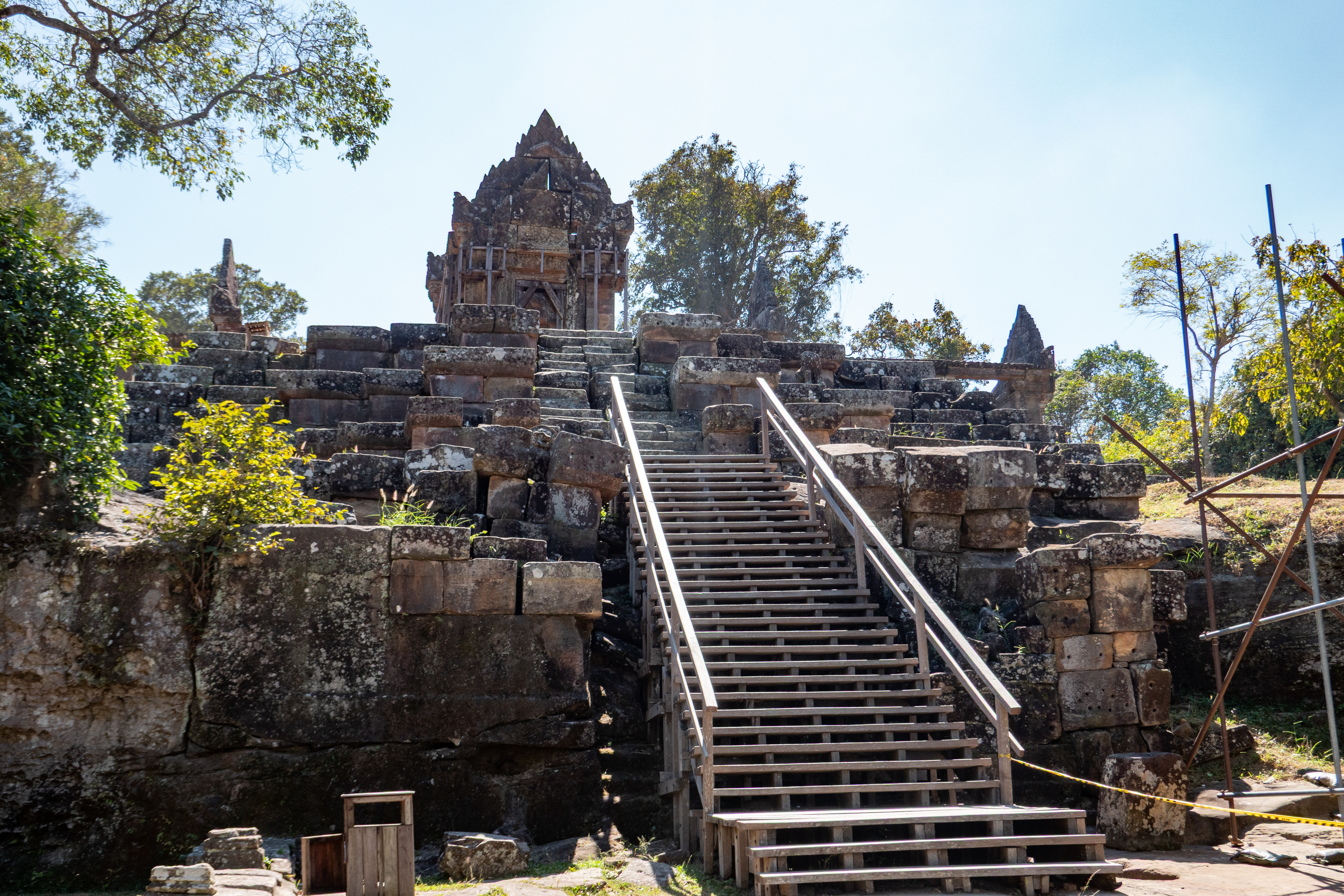
Prasat Preah Vihear, the temple claimed by both Thailand and Cambodia (C) PsamatheM
The decades-long dispute has already displaced many persons on both sides of the frontier. The frontier area on both sides has a large number of landmines planted making the whole area unsafe. The disputed area contains a Buddhist temple which should be a symbol of peace and harmony but is now a factor in the dispute.
The AWC stresses that urgent measures of conflict resolution should be undertaken. Nongovernmental Organizations may be able to play a positive role in such efforts. Contacts should be undertaken now.
Prof. René Wadlow is President of the Association of World Citizens.
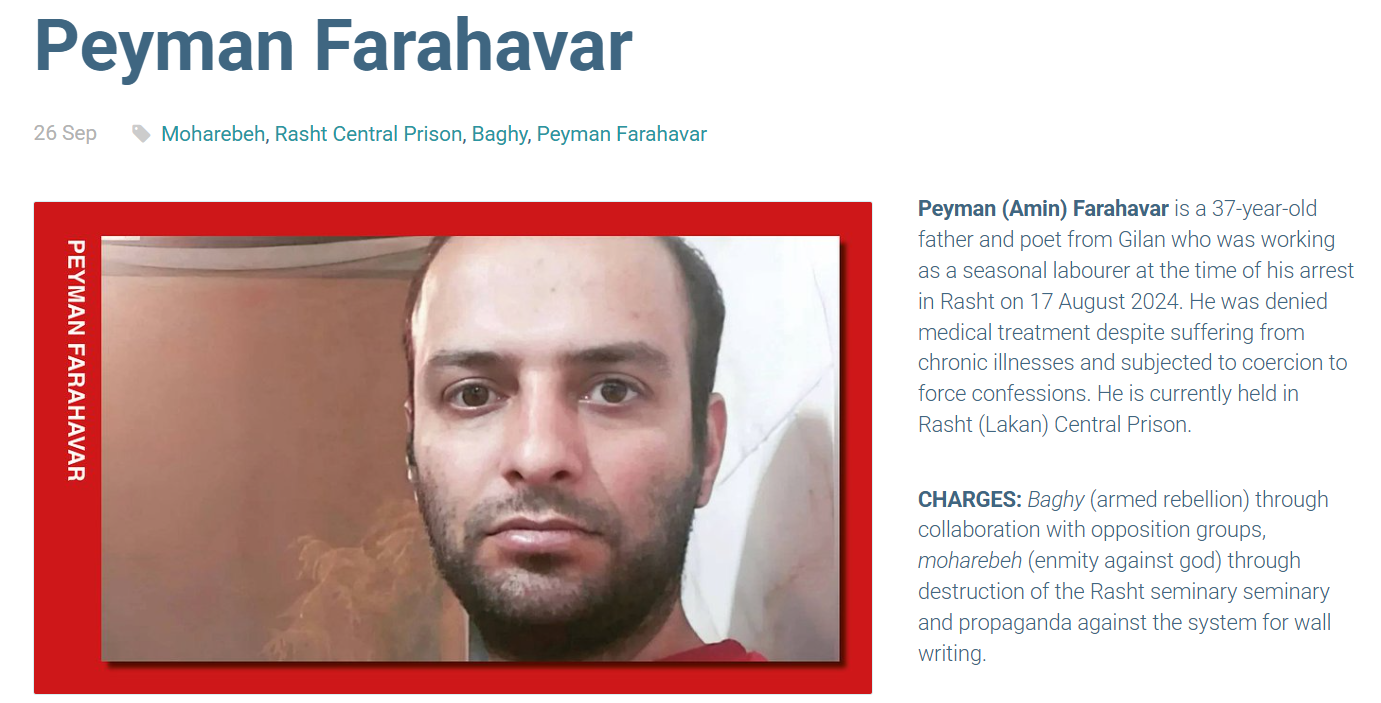
C’est ce que chantait Guy Béart en 1968, alors que la révolte politique grondait en France et ailleurs. Au départ inspiré pour sa chanson La vérité par l’une des premières anecdotes sur le dopage dans le cyclisme, Béart a élargi sa chanson à l’assassinat de John F. Kennedy, à la répression des écrivains en URSS et même au calvaire de Jésus-Christ, rendant hommage aux victimes du refus de la liberté d’expression et, in fine, se mettant lui-même en scène en tant que victime potentielle des «murmures» et des «tomates mûres» de son public qu’il voyait déjà, à son tour, l’exécuter ! Heureusement non, pas plus qu’après Les couleurs du temps l’année passée, chanson qui est pour moi un hymne personnel.
Aujourd’hui hélas, les autorités de l’Iran, où l’assassinat de la jeune Masha Jina Amini par les Gardiens de la Révolutions (Pasdaran) en septembre 2022 a fait naître des revendications de liberté sous le slogan «Femme, Vie, Liberté» qui, même réprimées, ne se sont jamais tues, semblent avoir pris ce refrain de Guy Béart au pied de la lettre puisqu’elles entendent précisément exécuter un poète, Peyman Farahavar.
De la part de la théocratie chiite de Téhéran, rivale par excellence de celle sunnite d’Arabie saoudite qui est aussi pour elle une solide concurrente en termes de violations des Droits Humains, rien de bien surprenant, certes. Qui croit tirer son pouvoir politique de la parole divine n’admet aucune œuvre de l’esprit humain. Pourtant, Peyman Farahavar a bien d’autres raisons, en fait toutes les raisons, de déplaire au régime des mollahs.
(C) Iran Human Rights
Trop croyant pour devenir théocrate
Quand une idéologie de libération fonde un système politique qui, lui-même, évolue ou plutôt dégénère en dictature, il y a toujours des gens qui, même soutenant le système, s’accrochent aux idéaux et aux principes de la libération rêvée en croyant les pérenniser par leur adhésion à l’institution. Certains resteront fidèles au système quoi qu’il arrive, persuadés de pouvoir le changer de l’intérieur par leur seule intégrité – et bien souvent voués à rester déçus –, tandis que d’autres, poussés au bout du dégoût, le quitteront s’ils le peuvent. Dans la défunte Tchécoslovaquie, un Alexander Dubček rêvant d’un «communisme à visage humain» avait tôt fait d’irriter les tenants moscovites d’un communisme répressif, puis de voir s’abattre sur son Printemps de Prague, en plein cœur de l’été, l’hiver des chars.
Promis à un avenir de mollah réprimant lui aussi son peuple, au nom d’un chiisme vidé de sa substance pour devenir l’instrument pérenne du totalitarisme, Peyman Farahavar s’y est refusé. Aux yeux du pouvoir de Téhéran, première faute.
A trente-sept ans, Peyman Farahavar, également prénommé Amin, originaire de la province de Gilan bordée par la Mer Caspienne et voisine de l’Azerbaïdjan, n’a pas toujours été le primeur de rue et père de famille comme tant d’autres qu’il est aujourd’hui. Comme le révèle IranWire, il était au départ séminariste. Comme son gouvernement, il avait fait de la religion et du culte des martyrs de la révolution islamique les piliers de sa vie. A la ville, il portait les robes des dignitaires chiites que la République islamique érige en aristocratie. A cette différence près que Peyman Farahavar, religieux dans l’âme, ne voyait pas le chiisme comme un instrument d’oppression.
Ecœuré par la manière dont les autorités de Téhéran avaient transformé la religion et la mémoire de la révolution en un «business», il s’était défroqué et avait abandonné sa vie cléricale pour devenir vendeur de rue, primeur spécialiste des fruits, travaillant chaque jour avec son frère pour gagner sa vie et nourrir son petit garçon de dix ans.
Il fustigeait désormais sans concession ces autorités qu’il en était venu à détester, s’opposant farouchement à l’oppression du peuple qu’il reprochait à ces gens auxquels son parcours le vouait au départ à ressembler. La robe des mollahs était devenue pour lui symbole de cette oppression. Pour lui, plus question de la porter encore, et l’enlever voulait dire rejeter non pas la religion, mais le régime qui se faisait oppresseur en son nom.
Devenu voix des sans-voix, Peyman Farahavar criblait sur ses réseaux sociaux «la supériorité autoproclamée du clergé chiite en Iran», ainsi que l’exploitation par le gouvernement «du sang et de la religion des martyrs». Il s’était indigné publiquement du sort de la jeune Mardak Maryaneh, jeune fille de seize ans qui, arrêtée et détenue, s’était suicidée après sa libération.
La prison, Peyman Farahavar allait la découvrir lui-même en mai 2022, avant que l’Iran ne résonne du slogan «Femme, Vie, Liberté». Arrêté une nouvelle fois le 18 août 2024 à Racht, capitale du Gilan, Peyman Farahavar fut détenu vingt-six jours au secret avant d’être transféré à la Section de sécurité de la Prison de Lakan, toujours à Racht. Avant même sa condamnation à mort, il allait bientôt être arraché violemment au monde des vivants.
Une poésie belle et forte à mourir
Dans des prisons iraniennes dont la réputation de barbarie n’est plus à faire, encore moins à ignorer, Peyman Farahavar n’avait aucune chance d’échapper au sort le plus barbare, dont les autorités, pénitentiaires et autres, comptaient sur le fait qu’il demeure aussi le sort le plus ignoré. Par bonheur, pari perdu.
Les sources d’IranWire évoquent des tortures si extrêmes qu’un jour, Peyman Farahavar en a perdu connaissance pendant vingt-quatre heures, mais aussi des saignements gastro-intestinaux persistants, des dérèglements lymphatiques provoquant des furoncles douloureux sur tout le corps, et pas le moindre traitement médical qu’il se voit constamment refuser. Au-delà du corps, l’esprit et le cœur souffrent aussi, de l’absence d’un fils auquel il n’est jamais permis de voir son père, ce qui serait voulu, poursuit IranWire, par une ex-belle-famille vindicative adossée aux Gardiens de la Révolution.
A bien y réfléchir, pourquoi les autorités ménageraient-elles Peyman Farahavar alors que, tout au contraire, elles s’acharnent sur lui pour des aveux ? A coups de «graves tortures psychologiques et physiques», elles exigent qu’il avoue. Avouer ? Mais quoi, au juste ? Qu’il aurait, comme l’en accusent les autorités, déclenché un incendie volontaire sur un chantier ? En pareil cas, Peyman Farahavar n’aurait pas été autant interrogé sur ses écrits, littérale obsession de ses geôliers.
«Le crayon sera sa clé, les feuilles son issue», chantait la regrettée Teri Moise dans Les poèmes de Michelle, son hommage aux enfants travailleurs en un temps où l’on n’en parlait encore que peu. Les Gardiens de la Révolution islamique, redoutables miliciens théocrates de Téhéran, ont bien compris que c’est aussi le cas de Peyman Farahavar, insupportablement libre même dans sa cellule, puisqu’ils se sont employés à détruire ses carnets de notes où figuraient ses poèmes, même lisibles de ses seuls codétenus, car c’était apparemment déjà trop.
Vivant de peu, suivi par seulement quelques centaines de personnes sur Instagram, Peyman Farahavar n’en a pas moins fait suffisamment peur à l’Etat, comme le relève IranWire, pour se retrouver frappé d’une peine de mort. Ces fameux Gardiens de la Révolution, il leur avait fait un sort dans un poème que l’un de ses anciens codétenus décrit comme «très implacable et très beau», lui qui se souvient de Peyman Farahavar comme d’un poète doué pour la satire contestataire et, surtout, pour l’improvisation, à tel point qu’il suffisait d ’ «attiser» en lui la verve poétique pour qu’elle explose en bouquets de vers subversifs d’un savoureux vitriol.
Rien ni personne n’était épargné parmi ce qui révoltait l’ancien mollah en devenir. Incendiaire, oui, il l’était sur la corruption enracinée dans les institutions, les questions liées à l’environnement, mais aussi la fierté culturelle de la population du Gilan. Peyman Farahavar fustigeait les ventes, devenues monnaie courante, de terres agricoles du Gilan à des Iraniens d’autres parties du pays, ainsi que le gaspillage des ressources naturelles de la province par les sociétés immobilières. Jaloux de son identité provinciale, il proclamait son admiration pour les héros locaux, dont Mirza Kuchik Khan, homme politique et chef militaire du début du vingtième siècle. Voix des sans-voix, remarque encore IranWire, Peyman Farahavar portait celle d’un peuple oublié, celle des pauvres, celle des villageois dont la souffrance n’intéressait pas Téhéran.
Pour les mollahs, voilà bien de quoi vouloir exécuter un poète, la peine prononcée contre Peyman Farahavar ayant été confirmée y compris par la Cour suprême iranienne le 24 septembre.
Ecrivez sa liberté
«A quoi sert une chanson si elle est désarmée ?», demandait Julien Clerc en 1993 dans Utile, citant une expression chilienne, «La chanson sans armes ne sert à rien, la chanson sans balles n’affronte pas le fusil». La chanson, Maurice Druon y voyait la «forme moderne de la poésie», bien que la forme traditionnelle n’ait jamais cessé d’exister. Dix ans avant Julien Clerc, Daniel Balavoine évoquait la torture d’un poète dans Frappe avec ta tête. Neuf ans auparavant encore, Michel Delpech ouvrait la voie en unissant poésie et chanson dans Rimbaud chanterait, imaginant un Arthur Rimbaud ayant vécu à cette époque et qui, là où le dix-neuvième siècle l’a vu poète, aurait été chanteur, «lui, l’homme fou, l’ami, le déserteur».
A quoi servait à Guy Béart de chanter La vérité en 1968 ? Les étudiants français en révolte contre le système savaient tout au moins à quoi leur servait la chanson, qu’ils entonnaient parfois dans leurs meetings face à un pouvoir politique en lequel ils voyaient un ultime censeur.
Aujourd’hui, le poète qui a «dit la vérité» se nomme Peyman Farahavar, et dans une illustration insupportablement littérale des vers de Guy Béart, Téhéran entend l’exécuter, sous des motifs fantoches, pour sa seule poésie. Une poésie qui n’a pas besoin de dire à quoi elle sert, car les actes parlent, comme les mots dérangent.
Même pour qui n’est pas poète, un langage poli et un ton décidé suffisent pour dire non au massacre d’un innocent. Il y a toujours une ambassade iranienne, ou bien une mission auprès des Nations Unies à New York, Genève ou Vienne, dans le pire des cas une délégation permanente à l’UNESCO, à contacter. Il serait dommage de priver d’un tel soutien Peyman Farahavar, ainsi que de s’en priver soi-même lorsque l’on peut écrire et dire la vérité sans craindre d’être, comme Téhéran le lui promet, exécuté.
Bernard J. Henry est Officier des Relations Extérieures de l’Association of World Citizens.
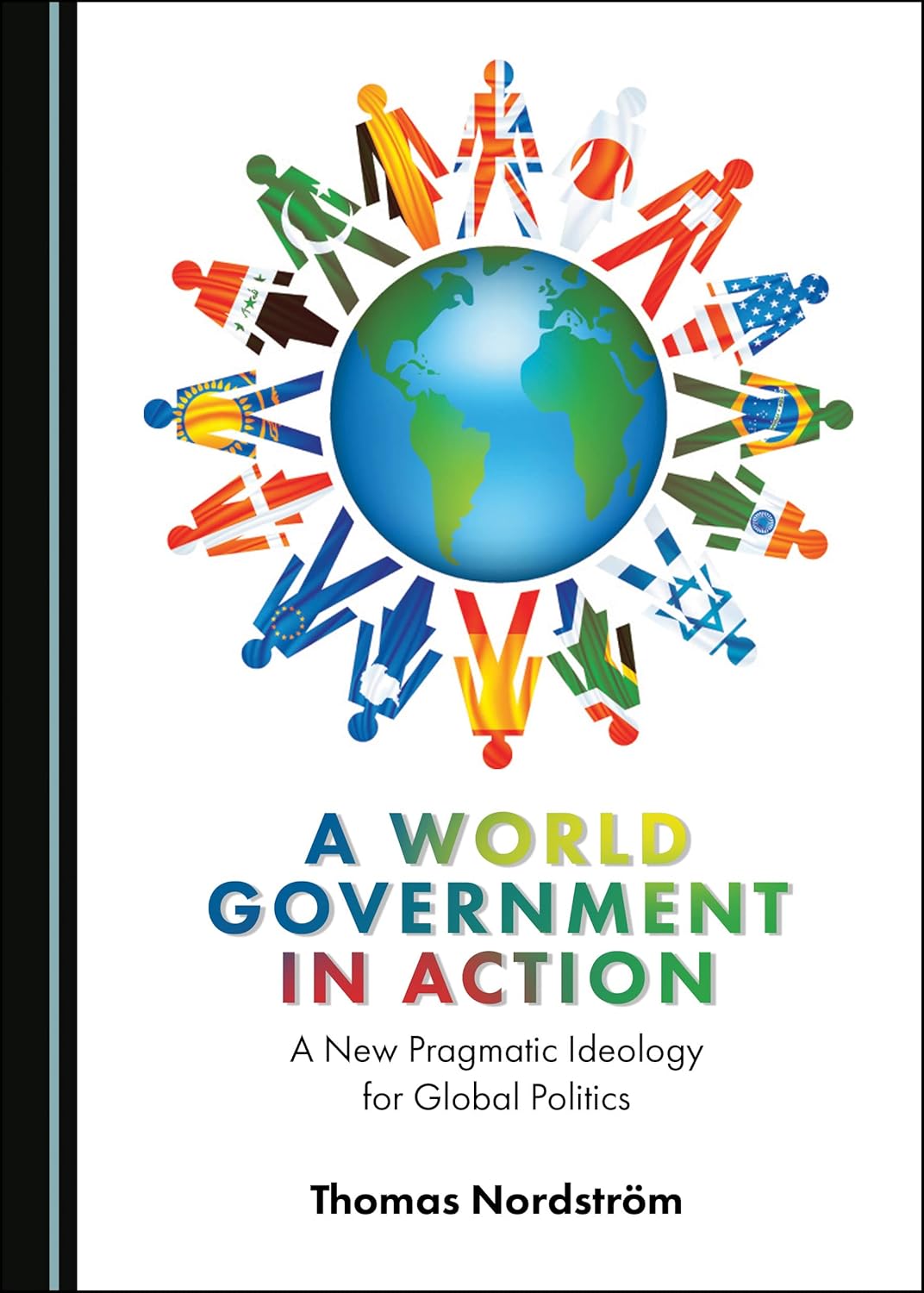
Newcastle upon Tyne: Cambridge Scholars Publishing, 2020, 147pp.
Thomas Nordström has written a useful book which more accurately should have been called “The Need for a World Government in Action”. He outlines many of the challenges facing the world society and stresses that the United Nations (UN) does not have the authority or the power to deal with these challenges adequately. The challenges are interrelated and thus must be faced in an interrelated way. Thus, climate change has an impact on land use which has an impact on food production. To improve food production, there must be better education on food issues as well as greater equality among women and men, as, in many countries, women play a major role in food production, food preparation, and food conservation.
As governments and UN Secretariat members become aware of an issue, the issue is taken up in one or another of the UN Specialized Agencies – FAO, WHO, ILO, UNESCO, or a new program is created: the Environment Program, or different programs on the issue of women. Today, within the halls of the UN there are negotiations for a Global Pact on the Environment and for the creation of a World Environment Organization which would be stronger than the existing UN Environment Program. Such a Global Pact for the Environment would clarify important environmental principles and relations between the existing treaties on the environment which have been negotiated separately.
In the UN, the international agenda reflects the growing influence of nongovernmental organizations (NGOs) and the scientific community in shaping policy. We see this vividly in the discussions on the impact of climate change. The distinction that used to be made between national and international questions has almost entirely vanished. NGOs must be able to provide possible avenues of action based on an effective theoretical analysis that acknowledges the complexity of the international environment.
Governments cannot at the same time boost expenditure on armaments and deal effectively with ecological deterioration and the consequences of climate change. Militarization has contributed to the neglect of other pressing issues, such as shrinking forests, erosion of soils and falling water tables. Militarization draws energy and efforts away from constructive action to deal with common problems. Militarization creates rigidity at the center of world politics as well as brittleness which leads to regional conflicts and civil wars. This political paralysis is both a cause and a result of the rigidity and the brittleness of current international politics. Opportunities are missed for building upon the more positive elements of a particular situation.
What is often called “complex emergencies” – a combination of political and social disintegration that includes armed conflicts, ethnic violence, state collapse, warlordism, refugee flows and famine – have become one of the most pressing humanitarian issues of our time. Today’s violent conflicts are often rooted in a mix of exclusion, inequality, mismanagement of natural resources, corruption, and the frustrations that accompany a lack of jobs and opportunities. Lack of opportunities sows the seeds of instability and violence.
As Nordström points out, behind all the current armed conflicts, there is the presence in a small number of countries of nuclear weapons. If they were used, the level of destruction would be great. Although nuclear disarmament was on the agenda of the UN General Assembly from its start, there has been little progress on nuclear disarmament issues.
As World Citizen and former President of India S. Radhakrishnan has written, “To survive we need a revolution in our thoughts and outlook. From the alter of the past we should take the living fire and not the dead ashes. Let us remember the past, be alive to the present and create the future with courage in our hearts and faith in ourselves.” The great challenge which humanity faces today is to leave behind the culture of violence in which we find ourselves and move rapidly to a culture of peace and solidarity. We can achieve this historic task by casting aside our ancient nationalistic and social prejudices and begin to think and act as responsible Citizens of the World. Nordström sets out some of the guideposts.
Prof. René Wadlow is President of the Association of World Citizens.
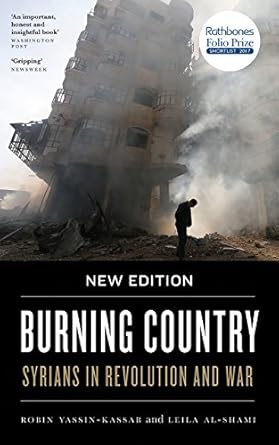
Robin Yassin-Kassab and Leila Al-Shami, Burning Country – Syrians in Revolution and War.
London, Pluto Press, 2016, 262pp.
Although this overview of Syrian society was written before the January 2025 flight of Bashar al-Assad to Moscow and the coming to power of Ahmed al-Sharaa as “interim” President, the book is a useful guide to many of the current issues in Syria today.
As Khalil Gibran wrote in The Garden of the Prophet, thinking of his home country, Lebanon, but it can also be said of the neighboring Syria, “Pity the nation divided into fragments, each fragment deeming itself a nation.” The fragments, ethnic and religious to which are added deep social divisions, make common action difficult. The Druze, the Alaouites, the Kurds, all play an important role but are often fearful of each other. Some of the Alaouites have fled to Lebanon. At the same time, there is a slow return of Syrians who have been in exile in Turkey and western Europe – especially Germany.
The divisions were made deeper by the years of violent conflict against the government of Bashar al-Assad which began in March 2011 with youth-led demonstrations appealing for a Syrian republic based on equality of citizenship, the rule of law, respect for human rights, and political pluralism.
After some months of non-violent protests, members of the military deserted, taking their weapons with them. The Syrian conflict became militarized. A host of armed militias were formed, often hostile to each other.
From late 2013 to February 2014, there were negotiations for a ceasefire held at the United Nations (UN), Geneva. Representatives of the Association of World Citizens (AWC) met with the Ambassador to the UN of Syria, as well as with the representatives of different Syrian factions who had come to Geneva. Unfortunately, Syrian politics has been that of “winner takes all” with little spirit of compromise or agreed-upon steps for the public good. The AWC called for a broad coming together of individuals who believe in non-violence, equality of women and men, ecologically-sound development, and cooperative action for the common good. The need to work together for an orderly creation of the government and the development of a just and pluralistic Syrian society is still with us.
Robin Yassin-Kassab’s book is a useful guide to the forces that must come together and cooperate today.
Prof. René Wadlow is President of the Association of World Citizens.
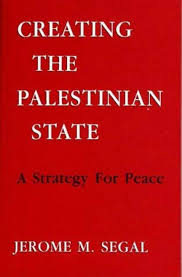
Jerome M. Segal, Creating The Palestinian State: A Strategy for Peace.
Chicago,IL: Laurence Hill Books, 1989, 177pp.
At this time when clashes among Israelis and Palestinians have been growing in intensity with an impact on neighboring countries, new attitudes and approaches are needed. Several Western European countries have announced that they will recognize a Palestinian state during the 2025 United Nations General Assembly in New York. Thus, it is useful to review an early presentation of the need for a Palestinian state.
Jerome Segal was a research scholar at the Institute for Philosophy and Public Policy at the University of Maryland in the USA. He writes, “My efforts have been directed towards the creation of a Palestinian state, not primarily as an end in itself, but as a component part of the two-state solution. The two-state solution is, in my estimation, the only basis for a stable peace in the Middle East… It cannot be done by the Palestinians alone… It can only occur if there is broad support from all who seek peace along the lines of the two-state solution.”
For Segal, a Palestinian state would be a state without an army, on the model of Costa Rica. A Palestinian state would work effectively to prevent terrorism and attacks against Israeli structures. It would declare that the State of Palestine offers peace to all its neighboring states and looks forward to mutual cooperation for the common good of all.
The Association of World Citizens (AWC) has been concerned with the development of appropriate constitutional structures as a vital aspect of peacebuilding. The AWC emphasis has been placed on the possibilities of con-federalism, autonomy within a decentralized state, and trans-frontier cooperation. We will continue to follow Israeli-Palestinian events closely.
Prof. René Wadlow is President of the Association of World Citizens.
 Association of World Citizens