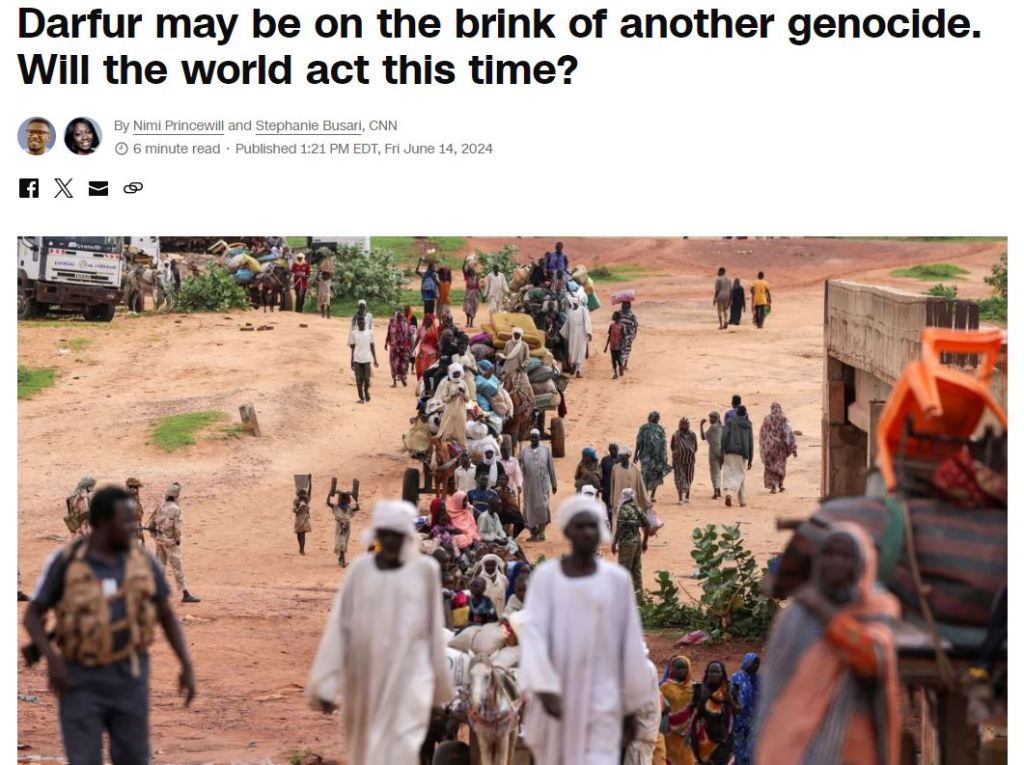
On June 13, 2024, the United Nations (UN) Security Council called for an end to the siege on El Fasher, the capital of the North Darfur Province of Sudan. The Council requested all parties to enable lifesaving aid to enter the city of El Fasher, the center of the most vicious fighting. The brutality of the fighting makes it impossible for aid workers to enter the city.
The civil war has gone on since April 2023 between the Rapid Support Forces led by General Mohamed Hamdan, known by his battle name of Hemedti, and the Sudanese Armed Forces led by General Abdul Fattah al-Burham. The fighting has led to some 15,000 persons being killed and 8 million displaced. The agriculture in the country is disorganized, and many people face acute hunger and, in some areas, famine.
Each of the two generals has created local militias which rob, torture, rape, and create conditions of disorder. Many of the militias use child soldiers in violation of UN treaties on the protection of children. Each of the two generals has opened the door to foreign fighters. There are Russian mercenaries which had been under the control of the Russian Wagner Group who had been fighting in Mali, Chad, Niger, and the Central African Republic. There are Ukrainian mercenaries who have come to fight the Russians.
It is difficult to understand the intensity of the current divisions represented by the two generals who had once been allies. The current divisions do not follow earlier fault lines in Sudan.
(C) Cable News Network
On behalf of the Association of World Citizens (AWC), I had been the first to raise in the UN Commission on Human Rights in 2004 the violent conditions in Darfur, Sudan, having been informed by a member of the UN Secretariat who was leaving the country and who could not speak out for himself. The violent conditions in Darfur were largely based on ethnic divisions linked to lifestyle differences between settled agriculturalists and cattle herders. There were also aspects of political divisions at the national level.
We kept in close contact with the Sudanese Mission to the UN in Geneva. Thus, the AWC was invited to be observers in the referendum which led to the creation of the State of South Sudan. The World Citizens had sent a team of observers.
Today, the suffering is real. Enlightened action is necessary. The conflictual situation requires close cooperation among humanitarian and peace nongovernmental organizations to see what is possible.
Prof. René Wadlow is President of the Association of World Citizens.
For a historic background on Darfur, see Julie Flint and Alex de Wall, Darfur: A Short History of a Long War (London: Zed Books, 2005).
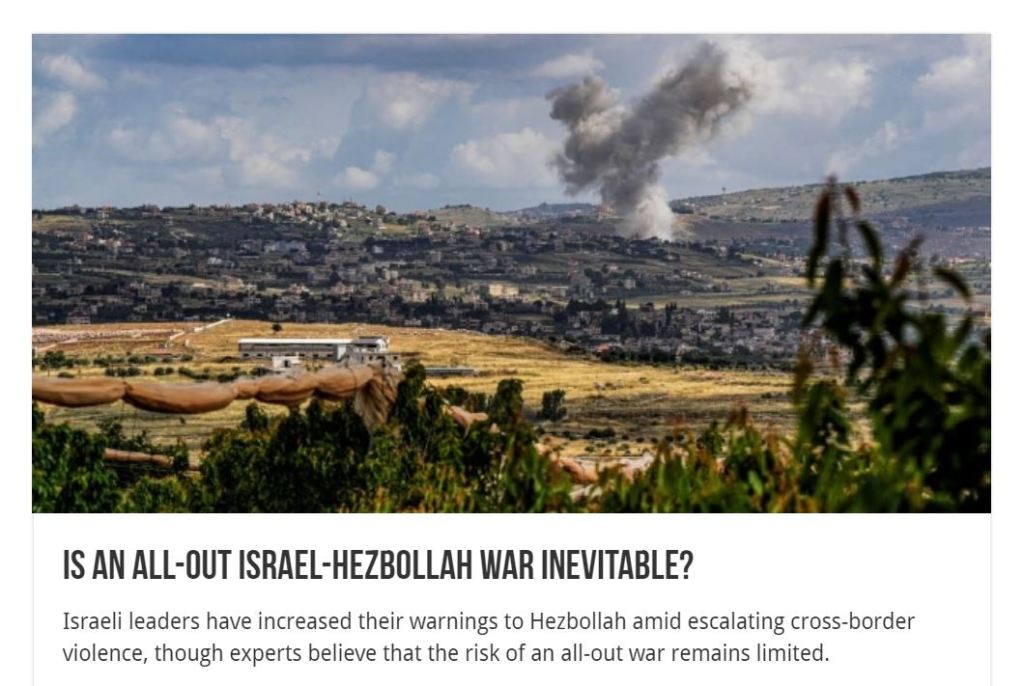
On June 6, 2024, United Nations (U.N.) Secretary-General Antonio Guterres called for an urgent ceasefire in the armed conflict on the Lebanese frontier between the armed forces of Israel and the armed militia within Lebanon of Hezbollah. Clashes between Hezbollah and the Israeli military along the Israel-Lebanon border have recently increased in scope in terms of both the territory under fire and the weapons used. Already 100,000 Israelis and an equal number of Lebanese have been forced to flee their home. UNIFIL – the U.N. peacekeeping forces in southern Lebanon – has not been able to prevent this escalation.
The Nongovernmental Organization (NGO) Human Rights Watch, in a new report called Lebanon: Israel’s White Phosphorous Use Risks Civilian Harm, stated that white phosphorous, which poses a high risk of burns and long suffering, was used by Israeli forces in at least 17 towns in southern Lebanon since October 2023. Amnesty International has also documented the use of white phosphorous in southern Lebanon. In addition, Lebanon’s Ministry of Public Health says that the white phosphorous attacks have caused hundreds of forest fires in Lebanon.
An end to the armed conflict in the Gaza Strip remains the key to ending the hostilities between Hezbollah and the Israeli military. Hezbollah has stated that a ceasefire in the Gaza Strip is a precondition for stopping its attacks. Currently, there are discussions among Egyptian, Qatari, and U.S. mediators on a ceasefire with phases. The U.S. proposals were set out by U.S. President Biden on May 31, 2024, but progress is very uncertain.
(C) Daily Star Lebanon
A Gaza Strip ceasefire, while necessary, is only a first step in the process needed of negotiations in good faith among Israelis and Palestinians. On October 8, 2023, in light of the October 7, 2023 Hamas attacks on Israeli settlements, the Association of World Citizens (AWC) had stated,
“As Citizens of the World, we call for a ceasefire in the Israeli-Palestinian armed conflict:
– for the release of all hostages held by Hamas and other Palestinian groups;
– for the release of Palestinian prisoners held in Israeli jails, often under administrative detention without trial;
– for preventing the extension of the conflict to the frontier of Lebanon through negotiations with Hezbollah;
– for preventing an increase in violence on the West Bank among Israeli settlers and Palestinian villages;
– for the start of negotiations in good faith for a political solution that ensures freedom and the collective safety of Israelis and Palestinians.”
The AWC believes that these proposals can build on a pool of shared values, create a climate of dialogue and trust, and set the stage for a new political reality.
Prof. René Wadlow is President of the Association of World Citizens.
The founder of the Baha’i faith Baha’u’llah wrote,
“The world of humanity is possessed of two wings, the male and the female. So long as these two wings are not equivalent in strength, the bird will not fly.”
It is likely that the Taliban leaders of Afghanistan have not read Baha’i texts. In fact, when the Taliban were first in power from 1996-2001 and again now from August 2021, they have arrested, tortured and summarily executed members of minority religions such as the Hazara population who are Shia and members of Sufi orders.
However, it is against women and girls in general that the Taliban have systematically implemented restrictive policies and practices that deny women and girls their human rights. Over 50 repressive edicts and decrees address women and girls to limit employment possibilities and access to education and health care. Protests have been suppressed. Women’s rights activists have faced targeted killings, enforced disappearances, incommunicado detention, and other forms of harassment. In March 2024 the Taliban authorities announced that they will revive public stoning and flogging women to death on charges of adultery.
It is not clear what outside pressure can be brought on the Afghan government to modify its policies toward women and girls. The governments of China and Russia seem to have developed closer relations with the Taliban authorities. However, it is unlikely that the Chinese or Russian government will raise human rights violations. Thus, we must see what influence nongovernmental organizations can have. It is clear that economic and social development is clearly hindered by current Taliban policies and practices. Without equality, the birds will not fly.
Prof. René Wadlow is the President of the Association of World Citizens.
Karim Khan, chief prosecutor for the International Criminal Court (ICC), on May 20, 2024 announced that he had formally applied for arrest warrants for leaders of the Israeli government and the political and military leaders of the Islamic Resistance Movement (Hamas) for war crimes and crimes against humanity as set out in the Rome Statute which created the ICC. The Israeli leaders are Prime Minister Benjamin Netanyahu, Defense Minister Yoav Gallant, and the Israeli Defense Force (IDF) Chief of Staff, General Herzi Halevi. The Hamas leaders are Yahya Sinwar, head of Hamas since 2017, Mohammed Diab Ibrahim Al-Masri, the Commander-in-Chief of the Al-Assam Brigades – the military arm of Hamas, and Ismail Haniyeh, head of Hamas’s Political Bureau based in Doha, Qatar.
The Israelis are accused of violations of international humanitarian law including starvation as a method of war including the denial of humanitarian relief supplies and deliberately targeting civilians. The Hamas leaders are said to be individually criminally responsible for the killing of Israeli civilians on October 7, 2023 and the taking of hostages.
(C) International Criminal Court
Karim Khan stated in an interview at the time of the announcement of the arrest warrants, “We must collectively demonstrate that international humanitarian law, the foundational baseline for human conduct during conflict, applies to all individuals and applies equally across the situations addressed by my Office and the Court. This is how we will prove, tangibly, that the lives of all human beings have equal value.”
The application for arrest warrants is the first step. The warrants must be approved by a panel of ICC judges which oversee such decisions. Israel is not a party to the Rome Statute of the ICC, but Palestine accepted its jurisdiction in 2015. The legal aspect of the next steps is complicated and need to be followed closely.
The Association of World Citizens has stressed that all elements of international humanitarian law must be safeguarded and charges of war crimes investigated.
Prof. René Wadlow is President of the Association of World Citizens.
Despite strong protests from Georgian Nongovernmental Organizations (NGOs) and street protests for three weeks in the capital Tbilisi, the Georgian Parliament adopted on May 14, 2024 the controversial law on “foreign influence”. The vote was 84 in favor and 30 opposed. The law is likely to be vetoed by the Georgian President, Salomé Zourabichvili, a former French diplomat, but there are probably enough favorable votes in the Parliament to override the veto.
The law is very close to a similar law of 2012 in the Russian Federation used to hinder NGOs often considered to be “enemy agents” voicing opposition to the government. The law obliges NGOs and media to publish all financing from foreign governments, foundations, and individuals if it amounts to 20 or more percent of the funds of the organization. The law has been strongly opposed by officials of the European Union and the United States. Georgia has a candidate status for joining the European Union.
(C) Euronews
The former Prime Minister and leader of the Georgian Dream Party in power for the last 12 years, Bidzina Ivanichvili, has attacked those opposed to the law as “people without a country” – a term used in the Soviet Union in the 1930s. He has been playing with a fear among some in power in Georgia that NGOs with foreign funding could create a “color revolution” to overthrow the government as was done elsewhere.
In the days prior to the vote, there was strong government pressure against journalists and NGO representatives, some being beaten and many threatened by telephone calls. As Citizens of the World concerned with the role of NGOs and freedom of the press, we need to watch developments in Georgia closely.
Prof. René Wadlow is President of the Association of World Citizens.
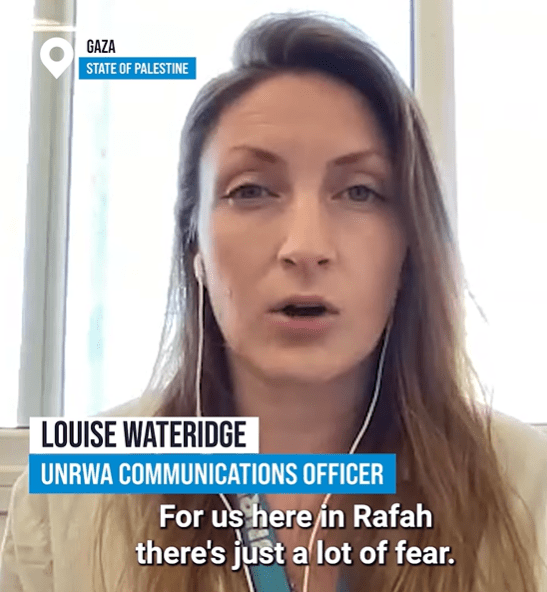
“I am disturbed and distressed by the renewed military activity in Rafah by the Israeli Defense Forces. Make no mistake – a full-scale assault on Rafah would be a human catastrophe,”
United Nations (UN) Secretary-General Antonio Guterres told reporters on May 7, 2024. The UN Office for the Coordination of Humanitarian Affairs reported that more than 35,000 Palestinians have been killed in the Gaza Strip, some 78,000 have suffered injuries, and nearly 2 million have been internally displaced. The number is rising as the ground invasion of Rafah begins.
(C) UN Geneva on Instagram
The UN Human Rights Council Special Rapporteurs have painted a grim picture of the disproportionate level of suffering experienced by girls and especially pregnant women in Gaza. “The treatment of pregnant and lactating women continues to be appalling with the direct bombardment of hospitals and the deliberate denial of access to health care facilities by Israeli snipers, combined with the lack of beds and medical resources placing an estimated 50,000 pregnant Palestinian women and 20,000 newborn babies at unimaginable risk.”
Many of these military actions are in direct violation of International Humanitarian Law as set out in the Geneva Conventions of August 12, 1949 and the Protocol Additional adopted in 1977. In order to meet new situations, International Humanitarian Law (IHL) has evolved to cover not only international armed conflicts but also internal armed conflicts. IHL prohibits the indiscriminate killing of civilians, the holding of hostages, and the destruction of medical and educational infrastructure.
The Association of World Citizens stresses the importance of IHL as a vital part of world law that will replace unilateral actions by States based on narrow domestic political considerations. The standards of IHL require political will if they are to function effectively. Thus, nongovernmental action on the Gaza Strip armed conflict is urgently needed.
Prof. René Wadlow is President of the Association of World Citizens.
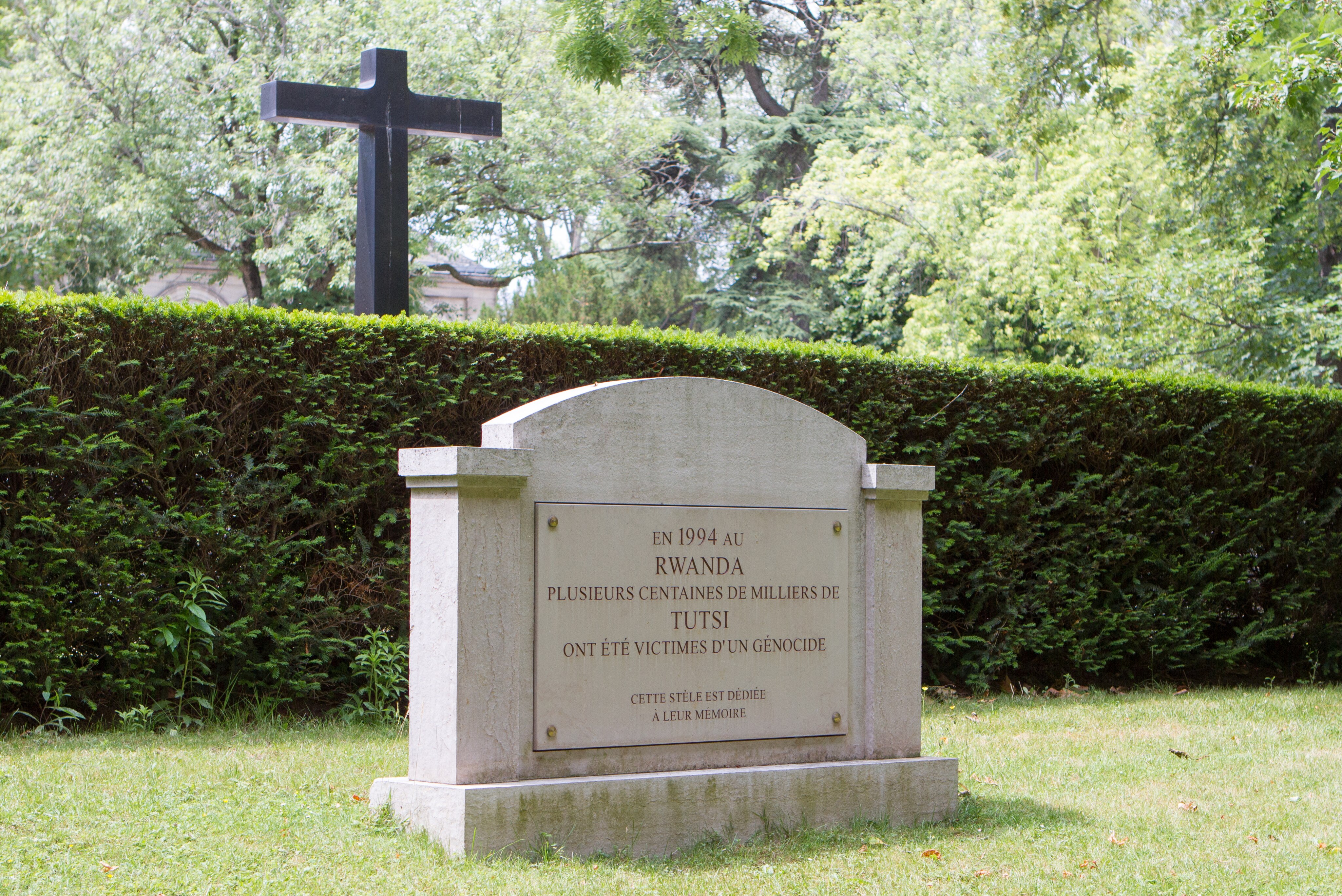
On April 7, 2024, Paul Kagame, President of Rwanda, lit the memorial flame of the monument to the victims of the 1994 genocide during which some 800,000 persons, mostly ethnic Tutsi, were killed. In 1994, Paul Kagame was the head of a Tutsi-led militia, the Rwanda Patriotic Front, which put an end to the massacres in Rwanda. Many of the Hutu-led governmental forces of 1994 fled to what is today the Democratic Republic of Congo, where there were already established Hutu communities. Ethnic-tribal frontiers do not follow the same frontiers as those created by the colonial powers.
During the colonial period and also since independence, when speaking of Rwandan politics, politics was described as a struggle between Tutsi and Hutu. However, the conflictual cleavages were more complicated. There were a good number of “mixed marriages” between Tutsi and Hutu. Nevertheless, in times of tension, political leaders played upon the Hutu-Tutsi divide.
In 1994, as soon as Kagame’s forces took control of the capital, Kigali, he declared himself president and has held power since. His emphasis has been on economic stability, the development of tourism and the creation of an effective civil service. Because of the 1994 genocide, Rwanda has received a good deal of foreign aid and support. However, some 70 percent of the population are still in the rural areas and farm small plots of land.
A symbolic tombstone in memory of the Tutsi victims of the Rwandan genocide at the Père Lachaise cemetery in Paris, France (C) Pierre-Yves Beaudouin / Wikimedia Commons / CC BY-SA 4.0
The entry of Hutu militias into the Democratic Republic of Congo when defeated in Rwanda added to an already complicated situation in the administrative provinces of North and South Kivu. In mid-1994, more than one million Rwandan Hutu refugees poured into the Kivus. Many of these Hutu were still armed; among them were the “génocidaires” who, a couple of months earlier, were killing Tutsi and moderate Hutu. The “génocidaires” continued to kill Tutsi living in the Congo, many of whom had migrated there in the eighteenth century.
The people in eastern Congo have lived together for several centuries and had developed techniques of conflict resolution especially between the two chief agricultural lifestyles – that of agriculture and that of cattle herding. The Hutu were farmers and the Tutsi cattle raisers. However, a desire of others to control the wealth of the area – rich in gold, tin, and tropical timber – overburdened the local techniques of conflict resolution and opened the door to new negative forces interested only in making money and gaining political power. The inability to deal with land tenure and land use issues, the lack of social services and socio-economic development created the conditions which led to multiple forms of violence.
Land tenure issues have always been complex. Land is often thought of as belonging to the ethnic community and is given to clans or to individuals for their use, sometimes for a given period, sometimes for several lifetimes if the land is cultivated. The rules of land tenure often differ from one ethnic group to another even a small distance apart. Traditionally clan chiefs would be called upon to settle land disputes. However, with the large displacement of people, land disputes have become more frequent, and clan chiefs have often disappeared or lost their function as judges.
Into this disorder, in 1999, the United Nations (UN) sent peacekeepers but there was no peace to keep. The UN Stabilization Mission in the Democratic Republic of Congo (MONUSCO) was the largest of the UN peacekeeping forces, currently some 2,000 military, 180 police, and 400 civilian administrators.
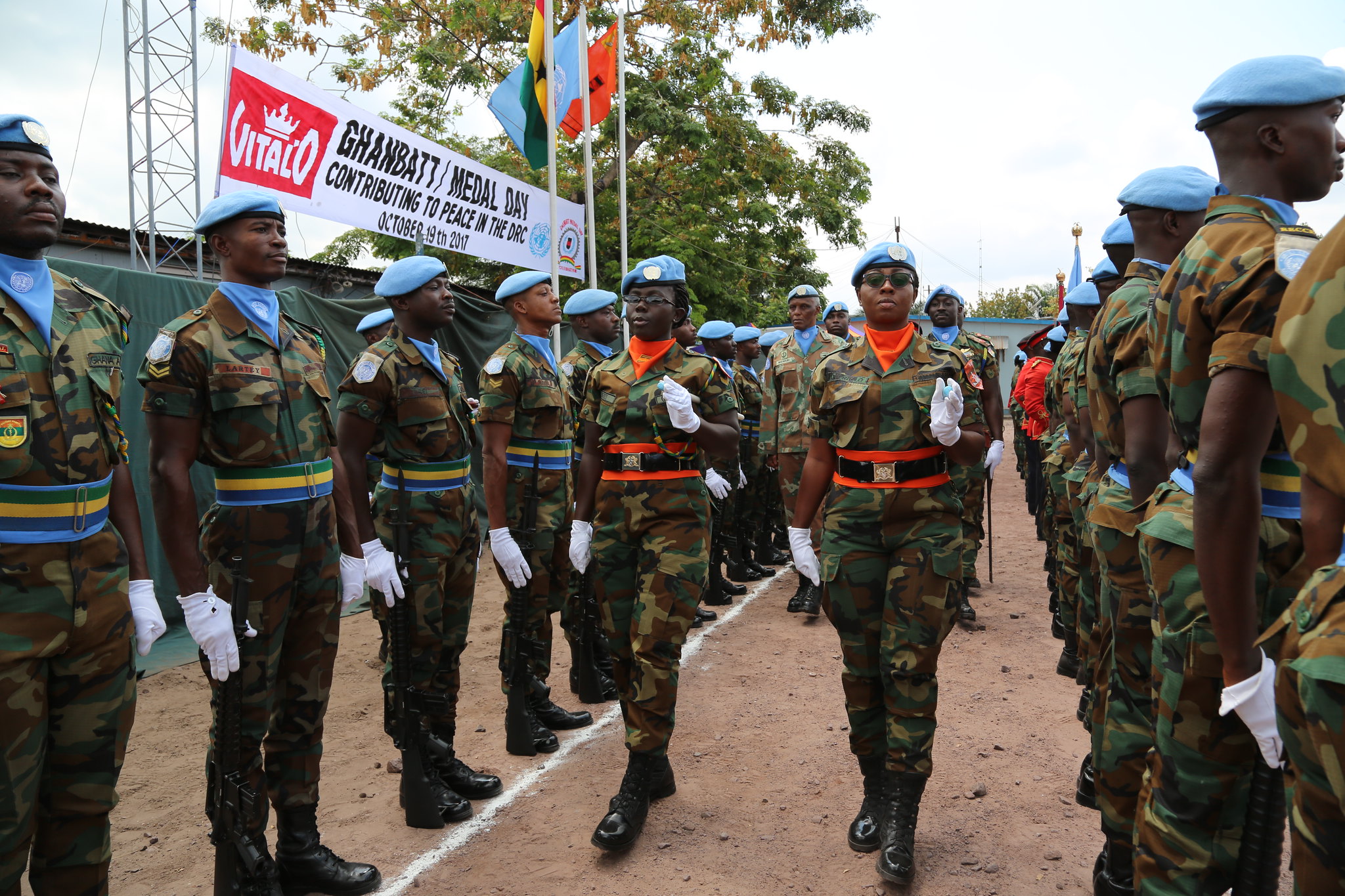
Troops with the Ghanaian Battalion of MONUSCO marking their medal presentation day in Kinshasa on October 19, 2017 (C) MONUSCO Photos
The States which have provided the bulk of the UN forces in the Congo – India, Pakistan, Bangladesh, and Nepal – have other worries and few cultural affinities. Thus, these States have made no large effort to call world attention to the eastern Congo and to the very difficult situation the soldiers face. UN troops are not trained to deal with complex cultural issues – especially land tenure and land use issues which are the chief causes of the conflicts.
Thus, there is a popular frustration at the ineffectiveness. The troops are popularly called “tourists” who only watch what is going on. Despite the UN troops, there have been large-scale occurrences of violation of human rights and humanitarian law by all the many parties in the conflict with massive displacement of population, plundering of villages, systematic rape of women, summary executions and the use of child soldiers. Thus, the newly elected President, Felix Tshisekedi, has asked the UN to remove all its troops by the end of 2024. Troops are currently being removed.
One of some 200 armed groups in eastern Congo, the M23, is said to be backed by Rwanda, although the Rwanda government denies this. Today, there is a security vacuum, and the military of the Democratic Republic of Congo will have difficulty to create stable socioeconomic structures. Thus, the 1994 genocide is a stark reminder that violence has long range consequences.
Prof. René Wadlow is President of the Association of World Citizens.
The United Nations (UN) has recently drawn attention to situations of acute hunger in areas where there is armed conflict. Stephane Dujarric, the UN Spokesperson, stated that, in Sudan, there were 18 million people facing acute food insecurity with alarming reports of child deaths related to malnutrition. Sudan has been the victim of a year-long armed conflict between the leaders of the regular army and its rival, the Rapid Support Force. This conflict has been particularly acute in the Darfur Province which has been the scene of violence and massive displacement of population since 2004.
In Ethiopia, where there has been fighting, especially in the Tigray Province between the forces of the government and Tigray militias, there is widespread hunger. Many people have been displaced by the fighting, and thus food crops have not been planted. International relief efforts have been hindered by the disorganization of all governmental services and corruption. The hunger situation is also acute in Gezira Province, usually a “breadbasket” area of food crops.
The situation in the Gaza Strip has been front page news since October 8, 2023, when the bombing of the Strip began in the armed conflict between Israelis and Palestinians. The delivery of food aid has been a central issue of international concern. However, hunger persists and its consequences deepen. The economic and social infrastructure of the Gaza Strip has been largely destroyed and will take a long time to rebuild even when, and if, a political administration is reestablished. Beth Bechdol, Associate Director of the UN Food and Agriculture Organization (FAO) has said that the speed and degree of the food crisis in the Gaza Strip is unprecedented.
These examples, to which others could be added such as the eastern zones of the Democratic Republic of Congo, are an indication of the need to combine conflict resolution efforts with food support and other forms of relief. As long as violence continues, relief can only be uneven and temporary. Too often, as within the UN system, conflict resolution efforts and food relief are separated and not sufficiently coordinated. A holistic vision is necessary and combined efforts undertaken.
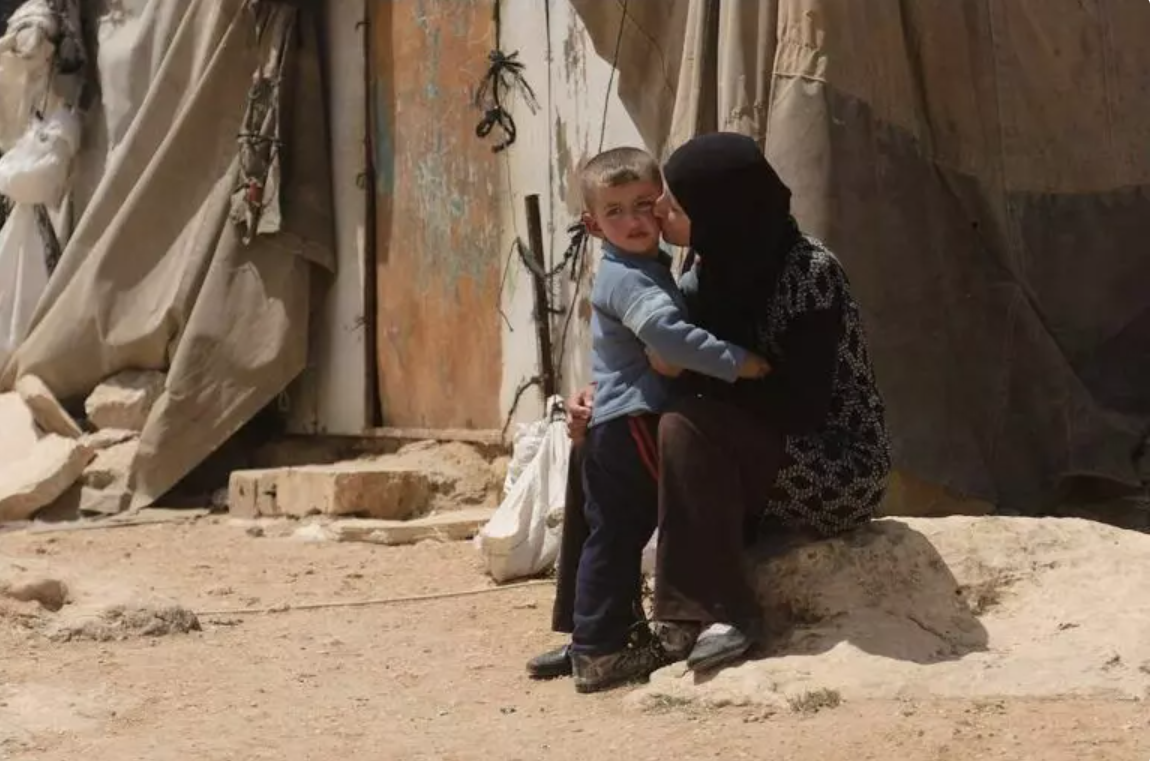
A Palestinian woman and her child facing starvation in northern Gaza (C) Libertinus
Prof. René Wadlow is President of the Association of World Citizens.
February 1 marks the anniversary of the military coup which overthrew the government of Aung San Suu Kyi in 2021. She was in practice the leader of the government but could not take the title of “President”. An earlier military junta had passed a law with her in mind saying that a person married to a foreigner could not become president. Aung San Suu Kyi had married a British anthropologist, Michael Aris, a specialist on Tibet who died in 1989 of cancer. Aung San Suu Kyi represented a new spirit – partly because she had lived most of her life outside Burma and was not linked to existing political compromises.
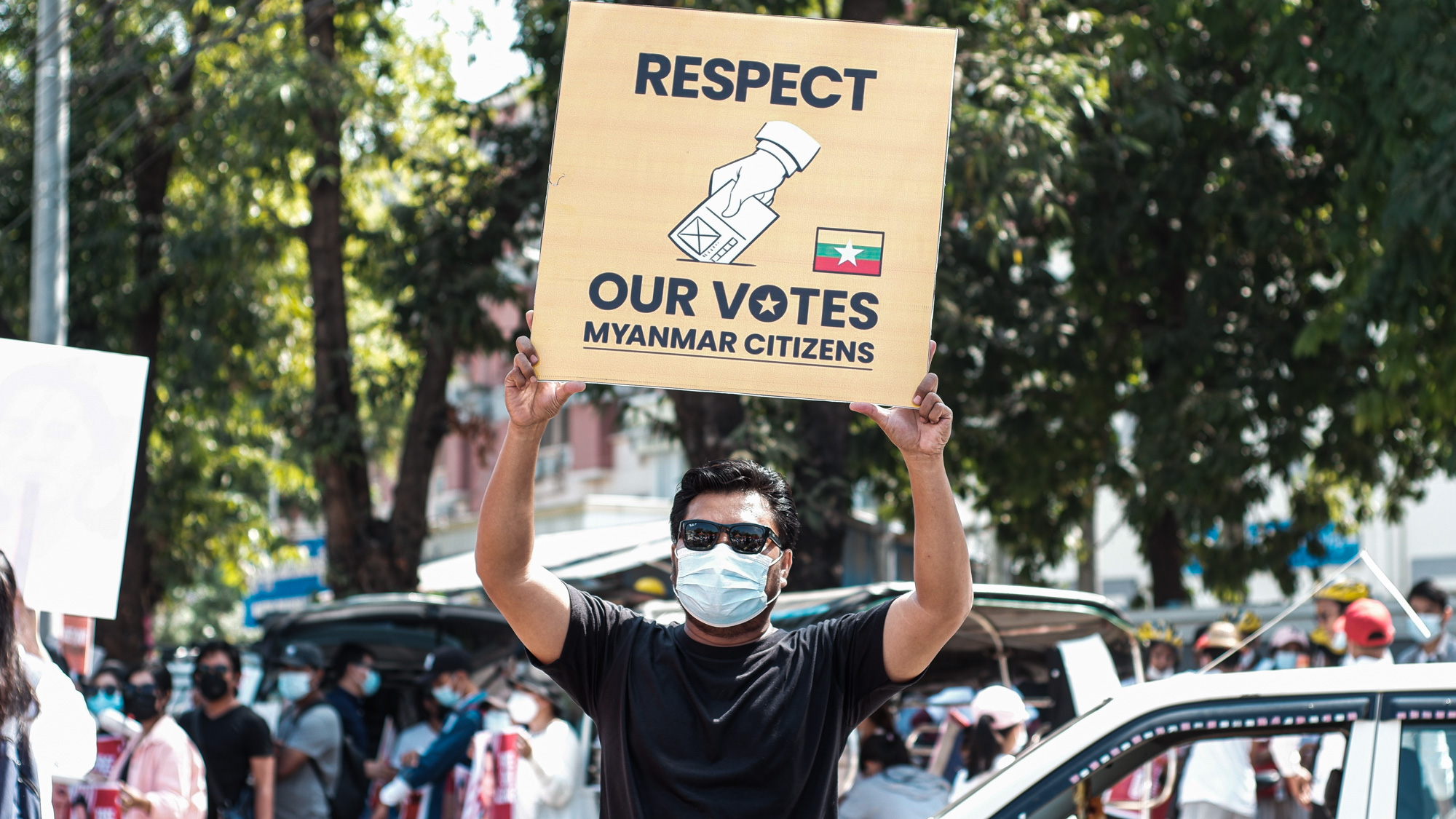
On February 14, 2021, a protest in Myanmar against the military coup (C) MgHla
Her father, Aung San, who died when Aung San Suu Kyi was two years old, was one of the original “Thirty Comrades” – student nationalists who were inspired by Second World War Japanese propaganda which appealed for a common Asian struggle against Western imperialism. Aung San went to Tokyo to assist the Japanese conquest of Burma. However, by 1944, the “Thirty Comrades” had decided that the Japanese were not liberators, that the occupation of Burma was carried out for Japanese rather than Burmese aims, and that the Japanese might lose the war. In the last year of the war, the “Thirty Comrades” cooperated with Lord Mountbatten.
Thus, on January 27, 1947, British Prime Minister Clement Attlee and Aung San signed an agreement for full independence of Burma within a year. On July 19, 1947, Aung San was assassinated by a political rival. He became a legend of Burmese independence.
Aung San Suu Kyi was educated in India (where her mother served as ambassador of Burma) and at Oxford University. She only returned to Burma in 1988 to take care of her dying mother. Her dynamism, combined with the legend of her father, led her to being named secretary of the National League for Democracy.
On June 14, 2012, Aung San Suu Kyi welcomed at the International Labor Organization’s premises in Geneva (C) Violaine Martin/UN Geneva
Since the military junta has taken power, it has intensified the struggle against the ethnic minorities – the Mon, Kachen, Karen, Shan, Wa, the Arakan Muslims, and others. The ethnic minorities represent some 40 percent of the population, the Burmese, some 60 percent. However, population statistics are not based on real population surveys. Decades of self-imposed isolation, fabricated statistics and an absence of social and economic research have left even the authorities without an accurate appreciation of the distribution of the population. The military have destroyed villages along the frontiers with China, India, Thailand, and Bangladesh.
While we are critical of the military government and their repressive policies, we must not idealize the forces of the ethnic insurgencies. In 1992-1993, I was involved in getting the National Council of the Union of Burma created by the insurgencies and democratic Burmese who had taken refuge in the ethnic minority zones to sign the Geneva Conventions of August 12, 1947 and the protocols additional which provide the basic rules of international humanitarian law in armed conflict. The Union President, General Saw Bo Myn of the Karen National Union, and the three Vice Presidents signed in January 1993. While the signature is symbolic – only governments may sign the Geneva conventions – the signature was widely noted and led the Myanmar government to sign the conventions which they had always refused to do until then. The signature led to a mutual release of war prisoners – but not to a formal exchange as the two sides in the conflict refused direct contact at the time.
Burma, now renamed Myanmar after 1988, faces two basic and related issues: the installation of democratic government and a constitutional system which allows autonomy to the minority peoples. Both tasks are difficult. There is little democratic tradition or ethos upon which to structure a democratic government. While a federal or con-federal system would be the most suited for a multi-ethnic state, what leadership exists both in the junta and the insurgencies is motivated by personal and clan-centered interests. The leaders recruit allies similarly motivated. Only peace will allow new leadership to emerge with broader motivations and allow all citizens to participate in a renewed political process.
Prof. René Wadlow is President of the Association of World Citizens.
With the armed conflict in the Gaza Strip continuing to increase the number of dead, wounded, and displaced and the danger of the conflict spreading to other areas of the Middle East, renewed efforts of conflict resolution need to be made. The United Nations (UN) has been active especially in relief efforts, and many Nongovernmental Organizations (NGOs) have expressed their concern. NGOs have also been active in relief efforts. However, the inadequate amount of relief supplies that enter the Gaza Strip limits the impact of nongovernmental activity.
From the start of the Gaza conflict more than 100 days ago, NGOs such as the Association of World Citizens have been highlighting positive steps on the path to negotiations. They have stressed four major steps:
1) An immediate ceasefire;
2) Release of hostages held by Hamas and other Palestinian armed groups, release of Palestinian prisoners held in Israeli jails – often under administrative detention without trial;
3) Preventing the extension of the conflict to Lebanon’s frontier through negotiations with Hezbollah;
4) Preventing an increase in violence in the West Bank between Israeli settlers and Palestinian villages.
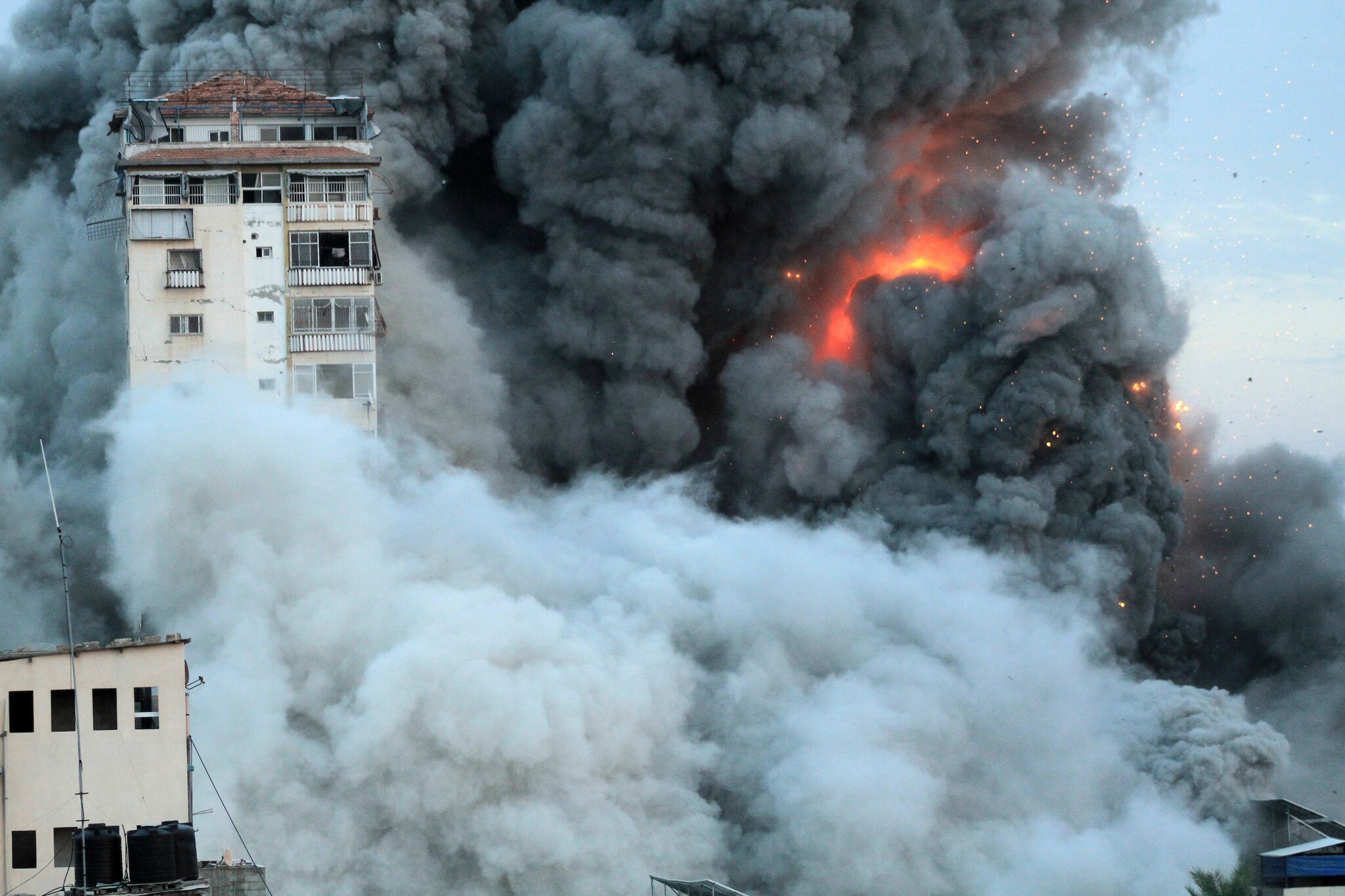
In October 2023, a building destroyed in Gaza (C) Ali Hamad/APAimages
The start of hearings on the charge of genocide at the International Court of Justice has added international attention to the Gaza Strip situation and more broadly to the Israel-Palestine drama.
The need for conflict resolution action is great. The proposals of NGOs hold a light of hope.
Prof. René Wadlow is President of the Association of World Citizens.



 Association of World Citizens