The Official Blog of the

Archive for the ‘Conflict Resolution’ Category

August 19 – World Humanitarian Day: A Need for Common Actions

In Being a World Citizen, Conflict Resolution, Current Events, Human Rights, International Justice, Middle East & North Africa, Solidarity, The Search for Peace, Uncategorized, United Nations, World Law on August 18, 2016 at 11:32 PM

AUGUST 19 – WORLD HUMANITARIAN DAY:
A NEED FOR COMMON ACTIONS
By René Wadlow

In memory of Sergio Vieira de Mello (1948-2003)

The United Nations (UN) General Assembly has designated August 19 as “World Humanitarian Day” to pay tribute to aid workers in humanitarian service in difficult and often dangerous conditions. August 19 was designated in memory of the bombing on August 19, 2003 of the UN office building in Baghdad, Iraq in which Sergio Vieira de Mello, UN High Commissioner for Human Rights and at the time Special Representative of the UN Secretary General, was killed along with 21 UN staff members. Over 200 UN employees were injured. The exact circumstances of the attack are not known, and why United States (U. S.) and UN security around the building was not tighter is still not clear. A truck with explosives was able to dive next to the building and then blew itself up.

Sergio Vieira de Mello had spent his UN career in humanitarian efforts, often with the Office of the High Commissioner for Refugees and at other times as Special Representative of the UN Secretary General. As a Nongovernmental Organization (NGO) representative to the UN in Geneva and active on human rights issues, I knew him during his short 2002-2003 tenure as High Commissioner for Human Rights. Many of us had high hopes that his dynamism, relative youth (he was 54) and wide experience in conflict resolution efforts would provide new possibilities for human rights efforts. His death along with the death of others who had been Geneva-based was a stark reminder of the risks that exist for all engaged in humanitarian and conflict resolution work.

Sergio_Vieira_de_Mello_1-1

Sergio Vieira de Mello (1948-2003) (C) Wilson Dias

This year the risks and dangers are not just memories but are daily news. On May 3, 2016, the UN Security Council unanimously adopted Resolution 2286 calling for greater protection for health care institutions and personnel in light of recent attacks against hospitals and clinics in Syria, Iraq, Yemen, South Sudan, Democratic Republic of Congo, and Afghanistan. These attacks on medical facilities are too frequent to be considered “collateral damage.” The attacks indicate a dangerous trend of non-compliance with world law by both State and non-State agents. The protection of medical personnel and the treatment of all the wounded − both allies and enemies − goes back to the start of humanitarian law.

The Association of World Citizens (AWC) has stressed the need for accountability, including by investigation of alleged violations of the laws of war. The grave violations by the Islamic State (ISIS) must be protested by as wide a coalition of concerned voices as possible. There is a real danger that as ISIS disintegrates and no longer controls as much territory, it will increase terrorist actions.

The laws of war, now more often called humanitarian law, have two wings, one dealing with the treatment of medical personnel in armed conflict situations, the military wounded, prisoners of war, and the protection of civilians. This wing is represented by the Geneva (Red Cross) Conventions. The second wing, often called The Hague Conventions limit or ban outright the use of certain categories of weapons. These efforts began at The Hague with the 1900 peace conferences and have continued even if the more recent limitations on land mines, cluster weapons and chemical weapons have been negotiated elsewhere.

The ban on the use of weapons are binding only on States which have ratified the convention. Thus the current use of USA-made cluster weapons in Yemen by the Saudi Arabia-led coalition is, in a narrow sense, legal as the USA, Saudi Arabia and Yemen have not signed the cluster weapon ban. The AWC was one of the NGOs leading the campaign against cluster weapons. My position is that when a large number of States ratify a convention (which is the case for the cluster-weapons ban) then the convention becomes world law and so must be followed by all States and non-State actors even if they have not signed or ratified the convention. The same holds true for the use of land mines currently being widely used by ISIS in Syria and Iraq.

B1-B_Lancer_and_cluster_bombs

A B-1B Lancer unleashes cluster munitions. (C) U. S. Air Force

The current situation concerning refugees and internally-displaced persons can also be considered as part of humanitarian law. Thus those working with refugees and the displaced within their country are also to be honored by the World Humanitarian Day. To prevent and alleviate human suffering, to protect life and health and to ensure respect for the human person − these are the core values of humanitarian law.

There needs to be a wide public outcry in the defense of humanitarian law so that violations can be reduced. The time for action is now.

20151030_Syrians_and_Iraq_refugees_arrive_at_Skala_Sykamias_Lesvos_Greece_2

Syrian and Iraqi immigrants getting off a boat from Turkey on the Greek island of Lesbos. (C) Ggia

Prof. René Wadlow is President of the Association of World Citizens.
Yemen Negotiations Move Ahead Slowly – Postwar Planning Needed

In Being a World Citizen, Children's Rights, Conflict Resolution, Current Events, Human Development, Human Rights, Middle East & North Africa, Solidarity, The Search for Peace, United Nations, Women's Rights, World Law on July 19, 2016 at 4:50 PM

YEMEN NEGOTIATIONS MOVE AHEAD SLOWLY – POSTWAR PLANNING NEEDED

As a result of Saudi bombing raids, Yemen’s underdeveloped socio-economic infrastructure has been largely destroyed. Post-war planning will need to be followed by international aid for development, with post-war socio-economic construction developed on a basic needs approach.

By René Wadlow

Guard sits on the rubble of the house of Brigadier Fouad al-Emad, an army commander loyal to the Houthis, after air strikes destroyed it in Sanaa, Yemen

A guard sits on the rubble of the house of Brigadier Fouad al-Emad, an army commander loyal to the Houthis, after air strikes destroyed it in Sanaa, Yemen June 15, 2015. Warplanes from a Saudi-led coalition bombarded Yemen’s Houthi-controlled capital Sanaa overnight as the country’s warring factions prepared for talks expected to start in Geneva on Monday. REUTERS/Khaled Abdullah

The United Nations (UN)-mediated peace negotiations for Yemen led by Ismail Ould Cheikh in Kuwait move ahead slowly. The 13-month war was at first between Houthis tribal forces loyal to former President Ali Abdallah Saleh and those supporting the current president, Abd-Rabbu Mansour Hadi, who had been Saleh’s vice-president for many years. The war is a struggle for power but is not an ideological-religious-tribal conflict.

Into this conflict has come a Saudi Arabian-led military coalition using bombs and sophisticated weapons. As a result, some 2.5 million people have been displaced within the country. Yemen was already a poor country which needed to import much of its agricultural and food supplies. As a result of the Saudi bombing raids, the underdeveloped socio-economic infrastructure has been largely destroyed.

Sanaa

A shopping center destroyed by an airstrike in Sana’a, the capital of Yemen, on April 20, 2015. (C) Ibrahem Qasim

Thus, there is a serious need first for postwar planning to be followed by international aid for development. “Reconstruction” would be the wrong term since there was little that had been “constructed”. Rather, we need to look to a postwar socio-economic construction developed on a basic needs approach.

The Basic Needs Approach to Development with its emphasis on people as central to the development process is embodied in the June 1976 World Employment Conference Declaration of Principles and Program of Action.[i] The Declaration underlines the importance of the individual and the central role of the family and household as the basic unit around which to work for development.

Although the Basic Needs Approach builds on the development thinking of the UN and national governments of the 1950s and 1960s such as rural development, urban poverty alleviation, employment creation through small-scale industries, the Declaration of Principles is a major shift in development strategies with its focus on the family with the objective of providing the opportunities for the full physical, mental, and social development of the human personality. The Program of Action defines a two-part approach: “First, Basic Needs includes certain minimum requirements of a family for private consumption: adequate food, shelter and clothing, as well as certain household equipment and furniture. Second, Basic Needs includes essential services provided by and for the community at large, such as safe drinking water, sanitation, public transport, health, education and cultural facilities.”

Airstrike

Widespread destruction in a residential neighborhood near Mount Attan after an airstrike carried out by the Saudi Arabian-led “coalition” in Yemen. (C) Ibrahem Qasim

The Program added a basic element to the actions: “A Basic Needs-oriented policy implies the participation of the people in making the decisions which affect them through organizations of their own choice.”

The Basic Needs Approach concentrates on the nature of what is provided rather than on income − income having often been used as the criteria for drawing a ‘poverty line’. The Basic Needs Approach is concerned not only with the underemployed but also with the unemployable: the aged, the sick, the disabled, orphaned children and others. Such groups have often been neglected by the incomes and productivity approach to poverty alleviation and employment creation.

For Yemen which is largely structured on the basis of clan – extended family institutions, the Basic Needs Approach is most appropriate. In practice, there are few institutions or associations beyond the clan level, although tribal and religious identities are often mentioned. Tribes and religious identity are “shorthand” terms as it is impossible to mention the multitude of clans. However, a family welfare – meeting basic needs is the most appropriate strategy on which to base postwar planning. Although the fighting continues sporadically and agreement on a possible “unity government” seems far away, Basic Needs Planning must start now.

Prof. René Wadlow is President and a Representative to the United Nations Office at Geneva of the Association of World Citizens.
[i] See the Director General’s Report and the Declaration in the International Labor Office. Employment, Growth and Basic Needs: A One World Problem (New York: Praeger Publishers, 1977, 224 pp.)

World Humanitarian Summit: On the Front Lines for Action

In Being a World Citizen, Conflict Resolution, Current Events, Human Rights, Solidarity, The Search for Peace, United Nations, World Law on May 21, 2016 at 10:22 PM

WORLD HUMANITARIAN SUMMIT: ON THE FRONT LINES FOR ACTION

By René Wadlow

The World Humanitarian Summit organized by the United Nations (UN) will open on May 23, 2016 in Istanbul, Turkey. The aim of the conference in the words of UN Secretary-General Ban Ki-moon is to see what should be done “to end conflict, alleviate suffering and reduce risk and vulnerability.” Turkey is on the front lines of the consequences of armed conflict with nearly three million refugees from Syria and Iraq as well as its own attacks against Kurds. Turkey has entered into agreements with the States of the European Union concerning the flow of refugees through Turkey to Europe − agreements that have raised controversy and concern from human rights organizations.

Given the policies of the Turkish Government, some nongovernmental organizations (NGOs) have refused to participate in protest. Doctors Without Borders − one of the best-known of the relief organizations − has pulled out. However, the Association of World Citizens will participate while working for a settlement of Kurdish issues at the same time.

P31_L.É._Eithne_Operations_28_June_2015.jpg

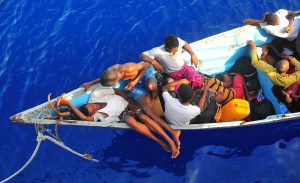
On June 28, 2015, rescued migrants being brought to southern Italian ports (C) Irish Defense Forces

As with all UN conferences, there has been a good deal of earlier discussion. These discussions within UN agencies, national governments, and NGOs have led to a synthesis document which sets out the agenda and the main lines for discussion in Istanbul. It is the Secretary-General’s report for the World Humanitarian Summit One humanity: shared responsibility. (A70/709). There is a useful overview of the current world situation of refugees, internally-displaced people and of people on the move to escape persistent poverty. There are also warnings about future displacement of people due to the consequences of climate change.

As the report highlights “The effort necessary to prevent and resolve conflict will be massive but can be broken down into sets of core actions. They include demonstrating courageous leadership, acting early, investing in stability and ensuring broad participation by affected people and other stakeholders.”

As with so many UN reports, there is a call for courageous political leadership and a mobilization of political will. If there were more courageous political leadership, we might not have the scope and intensity of the problems we now face. There is a limited amount that we can do to provide courageous political leadership at the national level. Rather we have to ask what can we do within NGOs in which we are active to resolve conflicts and deal with some of the consequences of the conflicts such as refugee flows.

I see three areas, outlined in the UN report as agenda items, that we can develop on a nongovernmental level. The UN report sets out the values that also guide our NGO actions. “To prevent and alleviate human suffering, to protect life and health and to ensure respect for the human person − these are the most important humanitarian principles”.

15925352712_1d6b10596f_k.jpg

Doctors Without Borders staff distribute take-home kits for Ebola survivors in Liberia (C) Morgana Wingard

The first issue for NGO action is to strengthen respect for the laws of war − now more commonly called Humanitarian Law. The recent and wide-spread attacks against medical facilities and medical personnel indicate an erosion of the laws of war. There is an urgent need to strengthen respect for the laws of war. This is an issue on which NGOs and the media can focus. Much humanitarian law has already been codified into the Geneva Conventions and other treaties. States which have not ratified should be encouraged to do so, but States must also be encouraged to live up to their word.

The second area is risk analysis and the publication of findings. All governments do a certain amount of risk analysis and contingency planning, especially the military. However, they make their findings public only when it serves their interests and States give little information as to how the analysis was made. NGOs along with academic institutions can provide analysis from open sources and indicate growing tension areas − what I have called “storm warnings”. For storm warnings to be effective, they need to reach as many people as possible and especially those in the path of the storm. International support for conflict resolution efforts must be made early and in a continuing way. If a storm does not break out quickly, it does not mean that the “storm-creating factors” have gone away and that attention can be put on other possible conflict areas. There need to be constant awareness of the way that tensions may form.

The third issue is training and preparation. There are a relatively large number of people working for (or having worked for) relief operations. They are able to set up tents, field kitchens, field clinics and water supplies. There may be need for more but there is not much room for innovation. However, teaching in refugee camps, dealing with longer-range psychological damage are areas where there is less experience and also less agreement as to what is to be done.

We can wish creative energies for the participants in the World Humanitarian Summit. Hopefully, the broad outline of actions necessary will be set, but the real work of all international conferences comes in the follow-up.

Prof. René Wadlow is President of the Association of World Citizens.
Tair, 19: Israel, “Will you put me in jail for a murder I will not commit?”

In Being a World Citizen, Conflict Resolution, Current Events, Human Rights, Middle East & North Africa, Solidarity, The Search for Peace, Uncategorized, War Crimes, World Law on April 27, 2016 at 9:30 AM

TAIR, 19: ISRAEL, “WILL YOU PUT ME IN JAIL FOR A MURDER I WILL NOT COMMIT?”
By Bernard Henry

In 1987 a British new wave group called Johnny Hates Jazz topped the charts with a song called I Don’t Want to Be a Hero, whose standardized, rather soulless music hid lyrics that were anything but common in the pop song industry of that era. No phony story of an impossible love romance – the song was really a fierce anti-war statement.

Among the lyrics, a question asked by the young man stating his refusal of conscription stands out:

“And what if I fail?
Will you put me in jail
For a murder I will not commit?”

By the time the song was released, the United Kingdom had long renounced conscription, as had the United States, Canada, and Australia. In the Western world, only in Europe could a draft be found, although the practice had gradually disappeared from the continent when the twentieth century ended. Except for Norway, Finland, Austria and Greece – plus neutral Switzerland – the then NATO allies of Britain against the Warsaw Pact are now all draft-free.

In what is generally called “the West”, only one non-European country retains a strong draft – Israel.

Ever since the Jewish State was created in 1948, its armed forces regrouped under the Hebrew acronym Tsahal, literally Tsva Haganah Lé-Yisrael, “Israeli Defense Force” (IDF), have taken in young people of both genders, male and female. Having been often at war with its Arab neighbors, being constantly in need of military personnel to maintain its occupation of the West Bank and the Golan Heights, Israel has traditionally had all of its sons and daughters wear the uniform for a few years – three for the boys, two for the girls. Exemptions are given, though, to observant religious Jews and, on quite different grounds, to non-Druze Arab Israeli citizens.

Then comes the problem when you “don’t want to be a hero”, in short, when you declare yourself a conscientious objector (CO), thus joining the number of the country’s shministim, “twelfth-graders”, students who refuse to comply with the law and enter the IDF once they have completed their high school studies as the law requires. You must appear before an IDF board, and if you fail to obtain exemption from military service, you will be ordered to enlist at once – or go to jail.

That is what happened this year to Tair Kaminer, 19. A member of Mesarvot – Jews for Justice for Palestinians, the young woman filed for conscientious objection but was turned down by the board. Sent to jail a first time, she was released and jailed again, and then jailed and released three more times. “The last military officer who sent me to jail told me that he was a member of the conscientious objection board,” says Kaminer. “He added that I had no chance of obtaining CO status and he would send me back to jail ‘for the rest of my life’ if I continued to resist.”

While serving her current sentence, Kaminer was given two weeks’ leave for the Jewish Passover, a national holiday in Israel. But upon leaving the military prison, she was told to return the next day. She chose to fully observe the two weeks’ leave and, instead of reporting to the prison as ordered, she stayed at home. “I am not ending my protest”, she insists. “I will return to the prison.” But she will have the IDF keep their word.

Tair-Kaminer.jpg

Tair Kaminer

Kaminer is by no means the first Israeli conscript to refuse enlistment. The issue has been with the IDF since 1970, when a first Shministim movement was created, followed in 1982 by the Yesh Gvul “There is a Limit/Frontier” organization of reservists who refused to serve in the Lebanon War, and a surge of CO initiatives under the premiership of the hawkish former IDF general and Defense Minister, Ariel Sharon, in the early 2000s. The latest two IDF military campaigns against Gaza, “Cast Lead” in 2009 and “Protective Edge” in 2014, also resulted in more CO applications from young Israelis, as has the announced expansion of Israeli settlements on Palestinian land. As for today’s Shministim movement, it is comprised by an estimated 3,000 high school students.

This only makes it harder to understand why the IDF has proved so adamant about punishing Kaminer specifically, putting her in jail, as Johnny Hates Jazz sang, for “a murder (she) will not commit”.

In a country like Israel where such people as former Prime Ministers Ariel Sharon and Ehud Olmert died without being prosecuted for the gross human rights abuses committed under their command by, respectively, IDF proxies in Lebanon and the IDF proper in Gaza – and to date, the incumbent, Benyamin Netanyahu, remains immune from domestic or international prosecution over the IDF’s campaign on Gaza’s civilian population in 2014, there must be room for the honest refusal of war stated with courage by young people whose love for their country will not be turned into hatred of their neighbors.

Hopefully, Tair’s sacrifice of her own freedom will let the Israeli government see that, in the very words of Johnny Hates Jazz, “It’s time to forget and forgive” its COs at last.

Johnny Hates Jazz, “I Don’t Want to Be a Hero”

Bernard Henry is the External Relations Officer of the Association of World Citizens.
The Yemen Conflict: Solutions to an Unnecessary War

In Conflict Resolution, Current Events, Human Rights, International Justice, Middle East & North Africa, Solidarity, The Search for Peace, United Nations, War Crimes, World Law on April 23, 2016 at 2:58 PM

THE YEMEN CONFLICT: SOLUTIONS TO AN UNNECESSARY WAR

By René Wadlow


During the Second World War, in the United States (U. S.) there was a government-sponsored publicity campaign to save automobile gas with the slogan “Is this trip necessary?” The aim was to show that if one really asked the question, many trips were not really necessary. We can ask the same question about wars today. In Yemen, is the Saudi-led war really necessary?

A new round of conflict-resolution meetings has started on April 20 in Kuwait, facilitated by the United Nations (UN) and led by Ould Cheikh Ahmed of Mauritania who had earlier been the UN humanitarian coordinator for Yemen and so knows the country and its many factions well. There was an exchange of prisoners at the start as a goodwill measure.

A four-step conflict resolution outline has been proposed by a number of governments and nongovernmental organizations (NGO), including the Association of World Citizens (AWC):

1) an immediate ceasefire ending all foreign military attacks;

2) humanitarian assistance, especially important for hard-to-reach zones;

3) a broad national dialogue;

4) through this dialogue, the establishment of an inclusive unity government.

_82462823_yemen_sanaa_bombing_r.jpg

Smoke rises from a weapons dump outside Sanaa, the capital city of Yemen, after being hit in an airstrike. (C) Reuters

The title of the aggression of Saudi Arabia against Yemen changed its name from “Operation Decisive Storm” to “Operation Restoring Hope” probably on the advice of the public relations firm which advises the U. S. Pentagon on the names of its operations. Saudi bombing from the air of cities, hospitals and refugee camps, created a storm, but the results were in no way “decisive.” It is not likely that Saudi bombing will “Restore Hope.”

There is wide agreement in UN circles and among conflict-resolution NGOs that Yemen is a quagmire, with a free-fall of its economic and social infrastructure and with constant violations of the laws of war. The country is on the eve of a new division between the north and the south. Yemen’s present form dates from 1990 when south Yemen (Aden) was more or less integrated into the north, but the country remains highly fractured on tribal, sectarian, and ideological lines, with the tribal structures being the most important.

Yemen.jpg

(C) CTV News, Canada

Negotiations among the multitude of factions in Yemen will be difficult. The most likely pattern will be for the country to split into two again with each half having a number of relatively autonomous regions. In the best of worlds, one could envisage a federal Yemen with the rule of law. More realistically, we can hope that these autonomous tribal areas do not fight each other actively. On a short term basis, we can hope that there will be minimum cooperation among the factions to allow necessary food imports and medical supplies.

Poverty and the lack of a peaceful political horizon seem to be the continuing fate of Yemen, but violent internal conflict and Saudi aggression may not be permanent. With the start of negotiations, there is a role for NGOs to encourage the efforts in contacting organizations and individuals that might have a positive impact on events. There are many geopolitical and economic interests who want “peace” on their terms. Thus, our role as World Citizens seeking a relatively just compromise solution is ever more important.

Prof. René Wadlow is President and a representative to the United Nations, Geneva, of the Association of World Citizens.

A report on the UN Commission on the Status of Women, New York City, March 14-24, 2016

In Being a World Citizen, Conflict Resolution, Democracy, Environmental protection, Human Development, Human Rights, International Justice, Social Rights, Solidarity, The Search for Peace, Uncategorized, United Nations, Women's Rights, World Law on March 26, 2016 at 9:27 AM

Received from Sue Zipp, Vice-President of the Association of World Citizens:

*  *  *

UN COMMISSION ON THE STATUS OF WOMEN URGES GENDER-RESPONSIVE IMPLEMENTATION OF AGENDA 2030

Meeting concludes with agreement on foundations to accelerate action for all women and girls.

Date: 24 March 2016
Media Contacts:
Oisika Chakrabarti, +1 646 781-4522, oisika.chakrabarti@unwomen.org
Sharon Grobeisen, +1 646 781-4753, sharon.grobeisen@unwomen.org

* * *

New York — The 60th session of the UN Commission on the Status of Women concluded today with UN Member States committing to the gender-responsive implementation of Agenda 2030. A set of agreed conclusions called for enhancing the basis for rapid progress, including stronger laws, policies and institutions, better data and scaled-up financing.

The Commission recognized women’s vital role as agents of development. It acknowledged that progress on the Sustainable Development Goals at the heart of Agenda 2030 will not be possible without gender equality and the empowerment of all women and girls.

UN Women Executive Director Phumzile Mlambo-Ngcuka welcomed the agreement and the commitment of UN Member States to make the 2030 Agenda, adopted last September, a reality in countries around the world. She said: “Countries gave gender inequality an expiry date: 2030. Now it is time to get to work. These agreed conclusions entrench and start the implementation of a gender-responsive agenda 2030 with which we have the best possibility to leave no one behind.”

UN Women 1

Photo: UN Women/Ryan Brown

UN Women Executive Director Phumzile Mlambo-Ngcuka high-fives UN Women Deputy Executive Director Lakshmi Puri as the CSW Chair Antonio de Aguilar Patriota of Brazil announces the adoption of the agreement. Photo: UN Women/Ryan Brown.

Growing global commitment was already in evidence with a record number of more than 80 government ministers from around the world attending the Commission. Around 4,100 non-governmental representatives from more than 540 organizations participated as well, the highest number ever for one of the Commission’s regular annual meetings.

The agreed conclusions urge a comprehensive approach to implementing all 17 Sustainable Development Goals through thorough integration of gender perspectives across all government policies and programmes. Eliminating all forms of gender-based discrimination depends on effective laws and policies and the removal of any statutes still permitting discrimination. Temporary special measures may be required to guarantee that women and girls can obtain justice for human rights violations.

The Commission endorsed significantly increased investment to close resource gaps for achieving gender equality and the empowerment of all women and girls. Funds should be mobilized from all sources, domestic and international, ranging from fulfilling official development assistance commitments to combatting illicit financial flows that shortchange public resources for gender equality.

With humanitarian crises and other emergencies disproportionately affecting women and girls, the Commission underlined the imperative of empowering women in leadership and decision-making in all aspects of responding to and recovering from crisis. On the eve of the World Humanitarian Summit, it stressed prioritizing women’s and girls’ needs in humanitarian action and upholding their rights in all emergency situations. Every humanitarian response should take measures to address sexual and gender-based violence.

UN Women 2

Photo: UN Women/Ryan Brown

CSW60 delgates applaud as an agreement is announced during the closing plenary. Photo: UN Women/Ryan Brown.

Members of the Commission united behind ensuring women’s equal participation in leadership at all levels of decision-making in the public and private spheres, encompassing governments, businesses and other institutions, and across all areas of sustainable development. Depending on different circumstances, this may involve establishing temporary special measures, setting and achieving concrete benchmarks and removing barriers to women’s participation.

Given the major contributions to Agenda 2030 of civil society, including women’s and community-based organizations, feminist groups, human rights defenders and girls’ and youth-led organizations, the Commission welcomed open engagement and cooperation with them in gender-responsive implementation. It emphasized fully engaging with men and boys as agents of change and allies in the elimination of all forms of discrimination and violence against women and girls.

To guide systematic progress towards gender equality and women’s empowerment throughout the 2030 Agenda, the Commission stressed enhanced national statistical capacity and the systematic design, collection and sharing of high-quality, reliable and timely data disaggregated by sex, age and income. Members also agreed to bolster the role of national mechanisms for women and girls in championing their equality and empowerment.

UN Women 3

Photo: UN Women/Ryan Brown

A wide view of the room during the closing plenary meeting of the 60th Session of the UN Commission on the Status of Women. Photo: UN Women/Ryan Brown.

– See more at: http://www.unwomen.org/en/news/stories/2016/3/press-release-csw60-urges-gender-responsive-implementation-of-agenda-2030#sthash.ci0a4sJ9.dpuf

World Interfaith Harmony Week: Steps Toward A Harmony Renaissance

In Being a World Citizen, Conflict Resolution, Cultural Bridges, Human Rights, Religious Freedom, Solidarity, The Search for Peace, United Nations, World Law on February 1, 2016 at 10:44 PM

WORLD INTERFAITH HARMONY WEEK: STEPS TOWARD A HARMONY RENAISSANCE

By René Wadlow


February 1, 2016


The Association of World Citizens, a nongovernmental organization in consultative status with the United Nations (UN), cooperates fully with the World Interfaith Harmony Week, which takes place February 1-7. The UN General Assembly designates the first week of every February as a time for cooperation for a common purpose among all religions, faiths and beliefs.

The General Assembly, building on its efforts for a culture of peace and non-violence in which World Citizens have played an active part, wishes to highlight the importance of mutual understanding and inter-religious dialogue in developing a creative culture of peace and non-violence. The General Assembly recognizes “the imperative need for dialogue among different faiths and religions in enhancing mutual understanding, harmony and cooperation among people.” The week has a potential to promote the healing of religion-based tensions in the world.

As Secretary-General Ban Ki-moon wrote,

At a time when the world is faced with many simultaneous problems—security, environmental, humanitarian, and economic—enhanced tolerance and understanding are fundamental for a resilient and vibrant international society. There is an imperative need, therefore, to further reaffirm and develop harmonious cooperation between the world’s different faiths and religions.

interfaith.jpg

Global citizens have stressed that peace comes from cooperation beyond the boundaries of ethnicity, religion and nationality, and have called for a cultural renaissance based on the concept of harmony. Rather than concentrating primarily on conflicts, struggles, and suffering, they have suggested focusing on cooperation, coexistence, and visions of a better future. Harmony includes tolerance, acceptance, equality, and forgiveness of past pains and conflicts. Harmony leads to gentleness, patience, kindness, and thus to inner peace and outward relations based on respect.

World Citizens maintain that harmony is a universal common value. In harmony, we can find true values that transcend all cultures and religions. The meaning of life is to seek harmony within our inner self. Humans are born with a spiritual soul that develops to seek self-fulfillment. Our soul has a conscience that elevates us. As our soul grows to maturity, we achieve our own harmony.

However, harmony is not only a personal goal of inner peace, but a guideline for political, social and world affairs. Citizens of the World believe that our actions should enhance peace, reduce conflict, and activate a culture of harmony. The 21st century is the beginning of a Harmony Renaissance. Our world mission is to be ready for humanity’s next creative wave to lead us to a higher level of common accomplishment. The World Harmony Renaissance will bring the whole world into action for this new millennium of peace and prosperity with unfettered collective energy.

“Religion without joy – It is no religion.”

Theodore Parker.

World Citizens have underlined the strong contribution that Chinese culture could play in the creation of this harmonious culture. In an earlier period of Chinese thought during the Song Dynasty, there was an important conscious effort to create a Harmony Renaissance.  This was a period of interest in science — “the extension of knowledge through the investigation of things.” It was a time when there was a conscious effort to bring together into a harmonious framework what often existed as separate and sometimes hostile schools of thought: Confucianism, Buddhism, philosophical Daoism and religious Daoism. These efforts were called Tao hsuch, the Study of the Tao, an effort Western scholars later termed “Neo-Confucianism.”

Zhou Dunyi, often better known as the Master of Lien-his, was a leading figure in this effort. He developed a philosophy based on the alternation of the Yin and Yang, each becoming the source of the other.

Today, after decades of conflict when the emphasis of nations both in policy and practice was upon competition, conflict, and individual enrichment, we need to emphasize harmony, cooperation, mutual respect, and working for the welfare of the community with a respect for nature.  When one aspect, either Yin or Yang, becomes too dominant, equilibrium needs to be restored.

zhou dunyi.jpg

Zhou Dunyi

Obviously it takes time to put into place a harmonious society at home and a harmonious world abroad. The cultivation of harmony must become the operational goal for many. As Mencius, a follower of Confucius said,

A trail through the mountains, if used, becomes a path in a short time, but, if unused, becomes blocked by grass in an equally short time.

mencius.jpg

Mencius

The World Interfaith Harmony Week is an opportunity to open new paths. As global citizens, we must find a new guiding image for our culture, one that unifies the aspirations of humanity with the needs of the planet and the individual. We hold that peace can be achieved through opening our hearts and minds to a broader perspective. We are one human race, and we inhabit one world. Therefore, we must see the world with global eyes, understand the world with a global mind, and love the world with a global heart.

Prof. René Wadlow is President of the Association of World Citizens.
Robert M. Hutchins: Building on Earlier Foundations

In Being a World Citizen, Conflict Resolution, Democracy, Human Development, Human Rights, Social Rights, The Search for Peace, United Nations, World Law on January 17, 2016 at 5:16 PM

ROBERT M. HUTCHINS: BUILDING ON EARLIER FOUNDATIONS
By René Wadlow

Much of our current work for a more just and peaceful world builds on the thinking and efforts of earlier foundations. An important foundation is the leading role of Robert M. Hutchins, long-time President of the University of Chicago (1929-1951) whose birth anniversary we mark on January 17.

Hutchins’ father, William, was President of Berea, a small but important liberal arts college, so Robert Hutchins (1899-1977) was set to follow the family pattern. He went to Yale Law School and stayed on to teach. He quickly became the Dean of the Law School and was spotted as a rising star of United States (US) education. When he was 30 years old, he was asked to become President of the University of Chicago, a leading institution. Hutchins was then the youngest president of a US university.

In the first decade of his tenure, the 1930s, his ideas concerning undergraduate education − compulsory survey courses, early admission after two years of secondary school for bright and motivated students, a concentration on “Great Books” – an examination of seminal works of philosophy in particular Plato and Aristotle − divided the University of Chicago faculty. There were strong and outspoken pro- and anti-Hutchins faculty groups. Moreover, Hutchins’ abolition of varsity football and ending the University’s participation in the “Big Ten” university football league distressed some alumni whose link to the university was largely limited to attending football games. For Hutchins, a university was for learning and discussion, not for playing sports. As he famously said, “When I feel like exercising, I sit down until the feeling goes away.”

It is Hutchins’ creation and leadership of the Committee to Frame a World Constitution in 1945 which makes him one of the intellectual founders of the movement for world federation and world citizenship. After the coming to power of Hitler in Germany in 1933 and his quick decision to ban Jewish professors from teaching in German universities, many Jewish scientists and professors left Germany and came to the USA. Some of the leading natural scientists joined the University of Chicago. Thus began the “Metallurgy Project” as the work on atomic research was officially called. The University of Chicago team did much of the theoretical research which led to the Atom Bomb. While Hutchins was not directly involved in the atomic project, he understood quickly the nature of atomic energy and its military uses. He saw that the world would never return to a “pre-atomic” condition and that new forms of world organization were needed.


hutchins_0.jpg

Robert M. Hutchins

“The death of democracy is not likely to be an assassination from ambush. It will be a slow extinction from apathy, indifference, and undernourishment.”

-Robert Maynard Hutchins.


On August 12, 1945, a few days after the use of the atom bombs, Hutchins made a radio address “Atomic Force: Its Meaning for Mankind” in which he outlined the need for strong world institutions, stronger than the United Nations (UN) Charter, whose drafters earlier in the year did not know of the destructive power of atomic energy.

Several professors of the University of Chicago were already active in peace work such as Mortimer Adler, G. A. Borgese, and Richard McKeon, Dean of the undergraduate college. The three approached Hutchins saying that as the University of Chicago had taken a lead in the development of atomic research, so likewise, the university should take the lead in research on adequate world institutions. By November 1945, a 12-person Committee to Frame a World Constitution was created under Hutchins’ chairmanship. The Committee drew largely on existing faculty of the University of Chicago − Wilber Katz, Dean of the Law School and Rexford Tugwell who taught political science but who had been a leading administrator of the Roosevelt New Deal and Governor of Puerto Rico. Two retired professors from outside Chicago were added − Charles McIlwain of Harvard, a specialist on constitutions, and Albert Guerard of Stanford, a French refugee who was concerned about the structure of post-war Europe.

From 1947 to 1951, the Committee published a monthly journal Common Cause many of whose articles still merit reading today as fundamental questions concerning the philosophical basis of government, human rights, distribution of power, and the role of regions are discussed. The Preliminary Draft of a World Constitution was published in 1948 and reprinted in the Saturday Review of Literature edited by Norman Cousins and in the Bulletin of the Atomic Scientists some of whom were in the original “Metallurgy Project”. The Preliminary Draft raised a good deal of discussion, reflected in the issues of Common Cause. There was no second draft. The Preliminary Draft was as G.A. Borgese said, quoting Dante “…of the True City at least the Tower.”


WorldConstposter-e1401485123703


In 1951, Hutchins retired from the presidency of the University of Chicago for the Ford Foundation and then created the Ford Foundation-funded Center for the Study of Democratic Institutions where he gathered together some of his co-workers from the University of Chicago.

Two ideas from The Preliminary Draft are still part of intellectual and political life for those concerned with a stronger UN. The first is the strong role of regional organizations. When The Preliminary Draft was written the European Union was still just an idea and most of the States now part of the African Union were European colonies. The Preliminary Draft saw that regional groups were institutions of the future and should be integrated as such in the world institution. Today, the representatives of States belonging to regional groupings meet together at the UN to try to reach a common position, but regional groups are not part of the official UN structure. However, they may be in the future.

The other lasting aspect of The Preliminary Draft is the crucial role that nongovernmental organizations (NGOs) should play. The then recently drafted UN Charter had created a “consultative status” for NGOs, but few of the UN Charter drafters foresaw the important role that NGOs would play as the UN developed. The Preliminary Draft had envisaged a Syndical Senate to represent occupational associations on the lines of the International Labor Organization where trade unions and employer associations have equal standing with government delegates. In 1946, few people saw the important role that the NGOs would later play in UN activities. While there is no “Syndical Senate”, today NGOs represent an important part of the UN process.

Hutchins, however, was also a reflection of his time. There were no women as members of the Committee to Frame a World Constitution, and when he created the Center for the Study of Democratic Institutions with a large number of “fellows”, consultants, and staff, women were also largely absent.

The effort to envisage the structures and processes among the different structures was an innovative contribution to global institution building at the time, and many of the debates and reflections are still crucial for today.

For an understanding of the thinking of those involved in writing The Preliminary Draft see:
Mortimor Adler, How to think about War and Peace (New York: Simon and Schuster, 1944)
Rexford Tugwell, Chronicle of Jeopardy (Chicago: University of Chicago Press, 1955)
G. A. Borgese, Foundations of the World Republic (Chicago: University of Chicago Press,1953)
Scott Buchanan, Essay in Politics (New York: Philosophical Library, 1953)
For a life of Hutchins written by a co-worker in the Center for the Study of Democratic Institutions:
Harry Ashmore, Unreasonable Truths: The Life of Robert Maynard Hutchins (Boston: Little, Brown and Co, 1989)

Prof. René Wadlow is President of the Association of World Citizens.

The World, Its Protection, Its Citizens

In Being a World Citizen, Conflict Resolution, Cultural Bridges, Democracy, Environmental protection, Human Development, Human Rights, International Justice, Solidarity, The Search for Peace, United Nations, World Law on December 30, 2015 at 12:13 PM

THE WORLD, ITS PROTECTION, ITS CITIZENS

By René Wadlow

-- AWC-UN Geneva Logo --
On behalf of the Association of World Citizens, I would like to send you our best wishes for 2016.

May it be a year that brings peace and harmony closer to our world. Progress in the world is based on the emergence of ideas, their acceptance, their transformation into ideals, and then into programs of action.

2015 has seen within the United Nations (UN) system two major frameworks of ideas and suggested plans of action. The first was the post-2015 Sustainable Development Goals, and the second was the Paris COP 21 goals and treaty to deal with climate change.  These guidelines require close cooperation among national governments, the UN and other multilateral government institutions such as the European Union, and the wide range of non-governmental organizations including business and agriculture associations.  We need to move from fragmented efforts to strong partnerships.

However, these positive goals need to be seen against the background of current armed conflicts and violent extremism often rooted in a deadly mix of exclusion and marginalization, mismanagement of natural resources, oppression and the alienation arising from a lack of jobs and opportunities. The World is in need of protection, both of people and Nature.  As Citizens of the World, we have a sense of responsibility to participate fully in the emerging world society where disputes among States are settled within the framework of world law and through negotiations in good faith so that common interests may be found and developed.

As Citizens of the World, we have a sense of compassion for Nature, and thus we unite to safeguard the delicate balance of the natural environment and to develop the world’s resources for the common good.

Today, we all face a choice between those forces that would drive us apart, forces and attitudes such as racism, narrow nationalism and the aggressive pursuit of self-interest on the one hand, and on the other hand, those forces which promote an emerging world society that is equitable and harmonious. I am sure that you also will choose to work for wholeness, harmony and creativity.

Prof. René Wadlow is President of the Association of World Citizens.
International Day of Migrants: Need for a UN-led World Conference on Migration and Refugee Flows

In Being a World Citizen, Conflict Resolution, Current Events, Europe, Fighting Racism, Human Rights, Solidarity, The Search for Peace, United Nations, World Law on December 18, 2015 at 9:52 AM

INTERNATIONAL DAY OF MIGRANTS: NEED FOR A UN-LED WORLD CONFERENCE ON MIGRATION AND REFUGEE FLOWS

By René Wadlow

I am a migrant.jpg

December 18 was set by the United Nations (UN) General Assembly to call attention to the role of migrants in the world society. The date was chosen to mark the creation of the UN-negotiated International Convention on the Rights of All Migrant Workers and Members of their Families. The aim of the Convention was to insure that migrants and their families would continue to be covered by the human rights standards set out in the Universal Declaration of Human Rights, the Covenants, and other human rights treaties. In practice, migrants are often “between two chairs” − no longer of concern to the State they have left and not yet covered by the human rights laws of the State to which they have gone.

Ratifications of the Convention have been slow with a good number of governments making reservations that generally weaken the impact of the Convention. In 2004, a commission of independent experts was set up to study the reports to the UN of governments on the application of the Convention − a commission that is part of the Human Rights Treaty Body System. Reports from each government party to the Convention are to be filed once every four years. However, the discussions within the Migration Treaty Body and its subsequent report attract the attention of only a small number of people. However, the discussion deals with the report of only one government at a time while migration is always a multi-State issue and can have worldwide implications.

Moreover, many States consider that earlier International Labor Organization conventions deal adequately with migrant rights and see no need to sign a new convention.

Citizens of the world have stressed that the global aspects of migration flows have an impact on all countries. The changing nature of the world’s economies modify migration patterns, and there is a need to plan for migration as the result of possible environmental-climate changes.

The refugees.jpeg

The current flow of migrants and refugees to Europe has become a high profile political issue. Many migrants come from areas caught up in armed conflict: Syria, Iraq, Yemen, Afghanistan, Somalia. The leaders of the European Union (EU) have been divided and unsure in their responses. Local solidarity networks that offer food, shelter, and medical care are overwhelmed. Political debates over how to deal with the refugees have become heated, usually with more heat than light. The immediacy of the refugee exodus requires our attention, our compassion, and our sense of organization.

EU officials have met frequently to discuss how to deal with the migrant-refugee flow, but a common policy has so far been impossible to establish. At a popular level, there have been expressions of fear of migrants, of possible terrorists among them, and a rejection of their cultures. These popular currents, often increased by right-wing political parties make decisions all the more difficult to take. An exaggerated sense of threat fuels anti-immigration sentiments and creases a climate of intolerance and xenophobia.

Je suis un migrant.jpg

Therefore, the Association of World Citizens, which is in consultative status with the UN, is calling for a UN-led world conference on migration and refugee issues, following earlier UN world conferences on the environment, food, housing, women, population, youth, human rights and other world issues. The pattern of such UN-led world conferences usually follows a common pattern: encouragement of research and data collection by UN agencies, national governments, nongovernmental organizations (NGOs), and academic institutions. Then regional meetings are held to study the regional dimensions of the issue. The regional conferences are followed by the world conference of government representatives with the participation of NGO delegates of organizations which hold consultative status. Usually there is also a parallel NGO conference with a wider range of NGOs present, especially those active at the local or national level. From such a world conference a plan of action is set to influence action by UN agencies, national governments, and NGOs.

Only a UN-led conference with adequate research and prior discussions can meet the challenges of worldwide migration and continuing refugee flows. There is a need to look at both short-term emergency humanitarian measures and at longer-range migration patterns, especially at potential climate modification impact. A UN-led world conference on migration can highlight possible trends and especially start to build networks of cooperation to meet this world challenge.

Prof. René Wadlow is President and a representative to the United Nations Office at Geneva of the Association of World Citizens.