The Official Blog of the

Archive for the ‘Syria’ Category

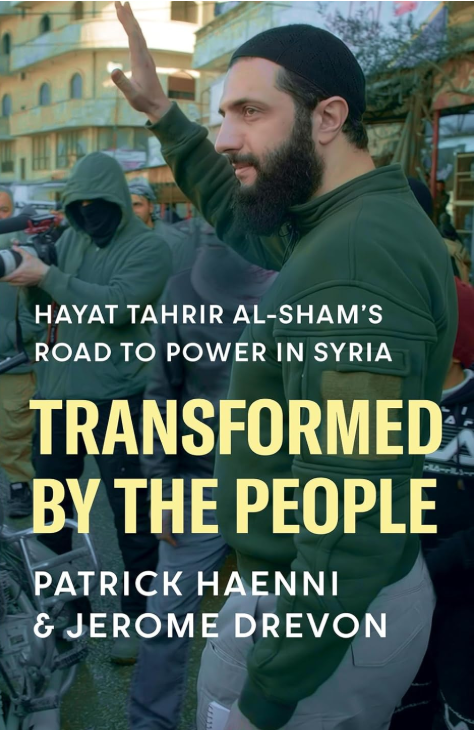
BOOK REVIEW: Patrick Haenni and Jerome Drevon, “Transformed by the People: Hayat Tahrir Al-Sham’s Road to Power in Syria”

In Book Review, Conflict Resolution, Current Events, Middle East & North Africa, Peacebuilding, Solidarity, Syria, The Search for Peace on November 24, 2025 at 8:00 AM

By René Wadlow

Patrick Haenni and Jerome Drevon,

Transformed by the People: Hayat Tahrir Al-Sham’s Road to Power in Syria.

London: C.Hurst and Co, 2025, 331pp.

In December 2024, Ahmad al-Sharaa (formerly known by his battle name of Abu Muhammad al-Jolani) and his armed militia, Hayat Tahrir Al-Sham (HTS), took control of most of Syria. Bashar al-Assad and his close circle left for Moscow on December 8, 2024 after nearly fourteen years of destructive civil war. A convergence of disorganization, low morale in the al-Assad forces, and international disengagement as Russia was focused on Ukraine ultimately facilitated the takeover of Damascus by Ahmad al-Sharaa.

Earlier, between 2016 and 2024, al-Sharaa and the HTS had been in control of Idlib, a rural province in northwest Syria. There, the HTS clamped down on its more radical commanders, severed ties with global jihad movements, and created the Salvation Government to administer the province. Important local figures and Islamist actors unconnected to HTS continued to pursue their own agendas.

In Idlib, the HTS was faced with many aspects of governance as there were many different factions, ideological, religious and professional present. This response to the local social and religious environment – what can be called a process of localization – modified deeply the HTS, “transformed by the people”, the title of the book. Now the process of localization must be applied to the whole of Syria – a more complex challenge than in Idlib. The authors deal in detail with the policies put in place in Idlib and the difficulties faced.

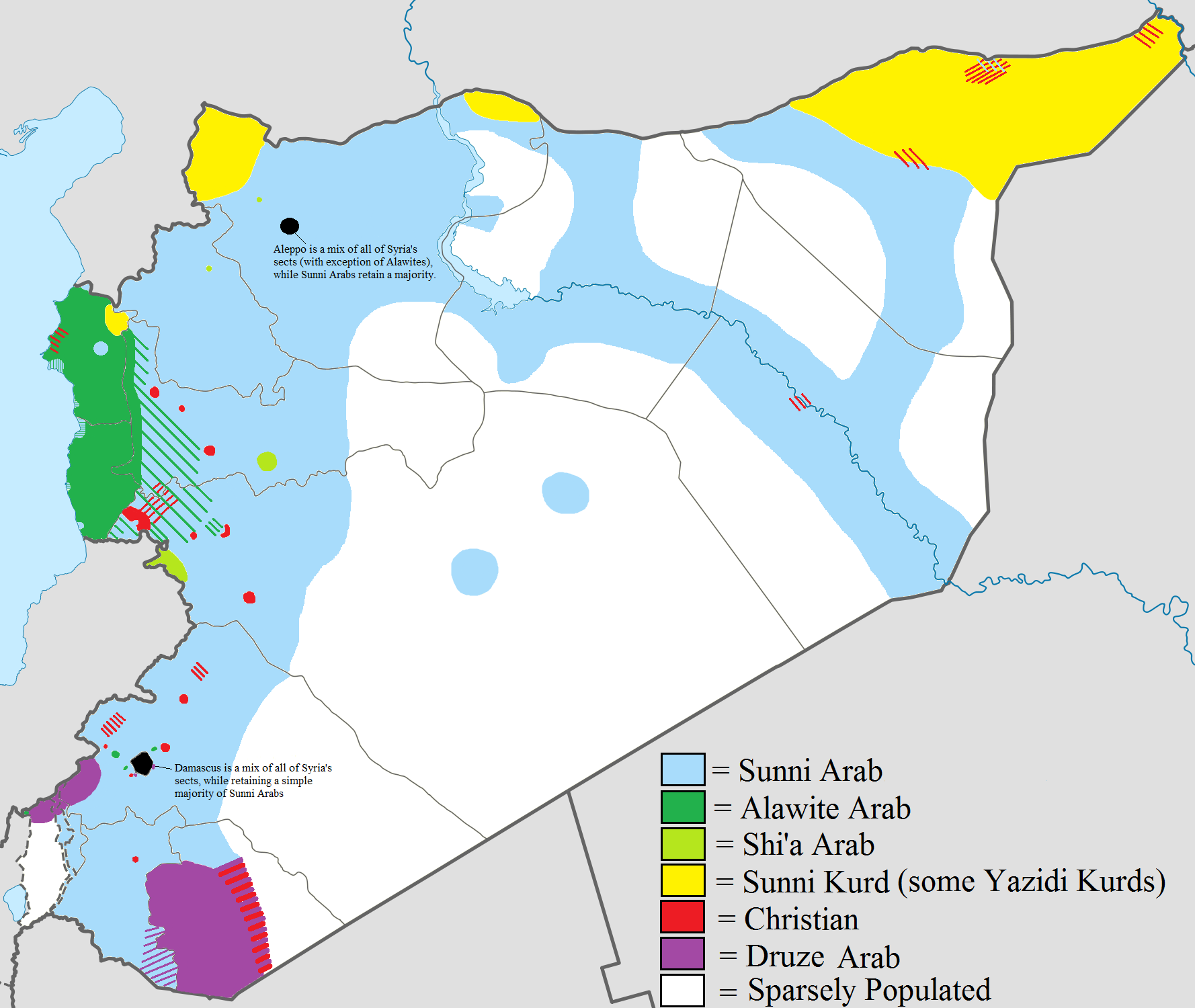
Now, al-Sharaa faces the strong presence of the Alawites – some 15 percent of the population – a religious-ethnic group of which the al-Assad family were members. There have been revenge killings against the Alawites, some of whom have fled to Lebanon and Turkey. In addition to the Alawites, there is an active Druze community – some three percent of the population – also a religious-ethnic movement. There is also a Christian community. Christians make up about ten percent of the population with significant communities in Damascus, Aleppo, Homs and Latakia.

In addition to the strong ethnic-religious communities which must be integrated into a new Syrian society, there are women who represent at least half of the population. Over the past decade, Syrian women sought to integrate into the new power structures as they emerged in different parts of the country. There was also a distinct feminist mobilization aimed at the empowerment of individuals in all aspects of life. Western Nongovernmental Organizations provided training sessions and workshops for women. Women still play a minor role in public life. They hold few positions within administrative and policy circles. The role of women is an issue to be watched closely.

The authors have highlighted the crucial issues in this period of transition. Their book is a useful guide to fast-moving events and will be of real use to all who wish to influence events in Syria in a positive direction.

Prof. René Wadlow is President of the Association of World Citizens.

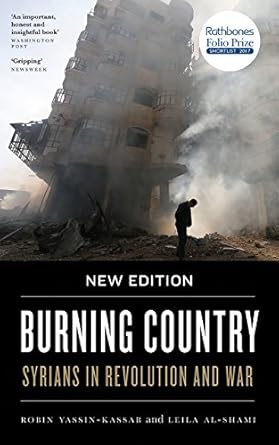
BOOK REVIEW: Robin Yassin-Kassab and Leila Al-Shami, “Burning Country – Syrians in Revolution and War”

In Being a World Citizen, Book Review, Conflict Resolution, Cultural Bridges, Current Events, Democracy, Human Rights, International Justice, Middle East & North Africa, NGOs, Peacebuilding, Solidarity, Syria, The Search for Peace, Track II, United Nations, War Crimes, World Law on September 1, 2025 at 6:00 AM

Robin Yassin-Kassab and Leila Al-Shami, Burning Country – Syrians in Revolution and War.

London, Pluto Press, 2016, 262pp.

Although this overview of Syrian society was written before the January 2025 flight of Bashar al-Assad to Moscow and the coming to power of Ahmed al-Sharaa as “interim” President, the book is a useful guide to many of the current issues in Syria today.

As Khalil Gibran wrote in The Garden of the Prophet, thinking of his home country, Lebanon, but it can also be said of the neighboring Syria, “Pity the nation divided into fragments, each fragment deeming itself a nation.” The fragments, ethnic and religious to which are added deep social divisions, make common action difficult. The Druze, the Alaouites, the Kurds, all play an important role but are often fearful of each other. Some of the Alaouites have fled to Lebanon. At the same time, there is a slow return of Syrians who have been in exile in Turkey and western Europe – especially Germany.

The divisions were made deeper by the years of violent conflict against the government of Bashar al-Assad which began in March 2011 with youth-led demonstrations appealing for a Syrian republic based on equality of citizenship, the rule of law, respect for human rights, and political pluralism.

After some months of non-violent protests, members of the military deserted, taking their weapons with them. The Syrian conflict became militarized. A host of armed militias were formed, often hostile to each other.

From late 2013 to February 2014, there were negotiations for a ceasefire held at the United Nations (UN), Geneva. Representatives of the Association of World Citizens (AWC) met with the Ambassador to the UN of Syria, as well as with the representatives of different Syrian factions who had come to Geneva. Unfortunately, Syrian politics has been that of “winner takes all” with little spirit of compromise or agreed-upon steps for the public good. The AWC called for a broad coming together of individuals who believe in non-violence, equality of women and men, ecologically-sound development, and cooperative action for the common good. The need to work together for an orderly creation of the government and the development of a just and pluralistic Syrian society is still with us.

Robin Yassin-Kassab’s book is a useful guide to the forces that must come together and cooperate today.

Prof. René Wadlow is President of the Association of World Citizens.

BOOK REVIEW: Peter L. Wilson, “Peacock Angel: The Esoteric Tradition of the Yezidis”

In Being a World Citizen, Book Review, Conflict Resolution, Cultural Bridges, Human Rights, Humanitarian Law, International Justice, Middle East & North Africa, Modern slavery, Peacebuilding, Refugees, Religious Freedom, Solidarity, Spirituality, Syria, The Search for Peace, United Nations, War Crimes, Women's Rights, World Law on August 4, 2025 at 5:55 PM

By René Wadlow

Peter L. Wilson, Peacock Angel: The Esoteric Tradition of the Yezidis.

Rochester, VT, Inner Traditions, 2022, 272pp.

Peter Wilson, a specialist on the Middle East, has written a useful book on the religious framework of the Yezidis as seen by someone outside the Yezidi faith. A Yezidi website has been established by Yezidis living in Nebraska, USA: https://yeziditruth.org.

The yearly Sakharov Prize for Freedom of Thought awarded by the European Parliament was given on October 27, 2016 to Nadia Murad who is also the co-laureate of the 2018 Nobel Peace Prize. She had been taken captive by the forces of the Islamic State in Iraq and Syria (ISIS) in August 2014 and then sold into sexual slavery and forced marriage. She was able to escape with the help of a compassionate Muslim family and went to Germany as a refugee. She has become a spokesperson for the Yezidi, especially Yezidi women.

There are some 500,000 Yezidis, a Kurdish-speaking religious community living in northern Iraq. There were also some 200,000 Yezidis among the Kurds of Türkiye, but nearly all have migrated to Western Europe, primarily Germany as well as to Australia, Canada, and the USA.

There are also some Yezidi among Kurds living in Syria, Iran and Armenia. The Yezidis do not convert people. Thus, the religion continues only through birth into the community.

The structure of the Yezidi religious system is Zoroastrian, a faith born in Persia proclaiming that two great cosmic forces, that of light and good and that of darkness and evil are in constant battle. Humans are called upon to help light overcome darkness.

However, the strict dualistic thinking of Zoroastrianism was modified by another Persian prophet, Mani of Ctesiphon in the third century of the Common Era. Mani tried to create a synthesis of religious teachings that were increasingly coming into contact through travel and trade: Buddhism and Hinduism from India, Jewish and Christian thought, Hellenistic Gnostic philosophy from Egypt and Greece as well as many small belief systems.

Mani kept the Zoroastrian dualism as the most easily understood intellectual framework, though giving it a somewhat more Taoist (yin/yang) flexibility, Mani having traveled to China. He developed the idea of the progression of the soul by individual effort through reincarnation. Unfortunately, only the dualistic Zoroastrian framework is still attached to Mani’s name – Manichaeism. This is somewhat ironic as it was the Zoroastrian Magi who had him put to death as a dangerous rival.

Within the Mani-Zoroastrian framework, the Yezidi added the presence of angels who are to help humans in the constant battle for light and good, in particular Melek Tawsi, the peacock angel. Although there are angels in Islam, angels that one does not know could well be demons. Thus, the Yezidis are regularly accused of being “demon worshipers”.

The Yezidis have always been looked down upon by both their Muslim and Christian neighbors as “pagans”. The government of Saddam Hussein was opposed to the Yezidis not so much for their religious beliefs but rather because some Yezidis played important roles in the Kurdish community, seen as largely opposed to the government. The Yezidi community is still in socio-economic difficulty given the instability of the situation in Iraq.

Peter Wilson has written a useful introduction to this little-known faith.

Prof. René Wadlow is President of the Association of World Citizens.

Syria: Creating a Framework for Cooperative Action

In Being a World Citizen, Conflict Resolution, Cultural Bridges, Current Events, Democracy, Human Rights, Middle East & North Africa, NGOs, Nonviolence, Peacebuilding, Solidarity, Syria, The Search for Peace, Track II, United Nations, War Crimes, World Law on March 26, 2025 at 7:00 AM

By René Wadlow

Recent violence and growing tensions along religious, ethnic and social class lines in Syria have highlighted the need to create a framework for cooperation among civil society groups. The Peacebuilding Section of the United Nations (UN) Secretariat was created because of the difficulties of creating a peaceful and just society after a period of armed conflict. It has been noted that violence often starts up again if strong measures of reconciliation and cooperative action are not undertaken as soon as the armed conflict ends. A spirit of revenge is often present, especially among those who consider themselves as victims. Thus, there needs to an interweaving of economic improvement with social reconciliation and the creation of trust among factions.

The long, multi-layered conflict in Syria from 2011 to the departure of Bashar al-Assad in December 2024 had increased tensions among groups, but the tensions were already there, clashing over values and interests. “Pity the nation divided into fragments, each fragment deeming itself a nation” wrote Khalil Gibran in The Garden of the Prophet thinking about his home country Lebanon, but it can also be said of neighboring Syria.

External countries had quickly stepped into the armed conflict after 2011 projecting their rivalries onto Syria and jockeying for regional preeminence. Syrian civil society members had cooperated during the efforts of mediation during the early years of the conflict. The first mediator was Mr. Kofi Annan as the joint envoy of the UN and the League of Arab States in February 2012.

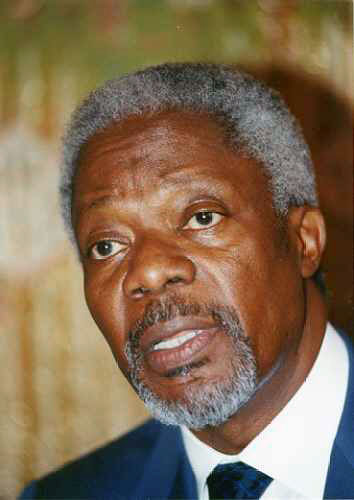
Kofi Annan (C) Magyar ENSZ Társaság

Kofi Annan, a former UN Secretary General, had spent his entire career in the UN system and was a seasoned mediator. From his discussions and observations, he proposed first steps based on a ceasefire with effective UN supervision, a release of arbitrarily detained persons, increased humanitarian aid, and freedom of association within Syria. The implementation of his proposals did not follow, and he resigned his mandate on August 2, 2012.

I knew somewhat Kofi Annan and knew better some members of his staff. I also knew fairly well the Secretary General of the League of Arab States Nabil al-Araby, a longtime Ambassador of Egypt to the UN in Geneva. Thus, on behalf of the Association of World Citizens (AWC), I became involved with the armed conflict in Syria.

I had discussions with Dr. Faysal Khabbaz Hamouri, the Ambassador of Syria to the UN in Geneva, to see what issues might be negotiable and if an agenda could be fixed. I also had discussions with Syrian Nongovernmental Organization (NGO) members who had come to Geneva because of the negotiations. NGO representatives, such as I for the AWC, have no standing as official mediators but can play some role through their contacts with diplomats and UN Secretariat members. From these discussions, I came to realize how deeply divided was the Syrian community involved in the political aspects of the armed conflict. There were no public negotiations in Geneva after 2015. In September 2015, Russian military troops started their heavy support of the al-Assad government.

Today, it is difficult to know what those of us who are not Syrians and who are outside of Syria can do to help build a society of social cohesion in Syria. The wider Middle East is filled with violence and tensions among Israelis and Palestinians, in Lebanon, Yemen and Iran. We have to keep our spirits open for new possibilities of positive action.


(C) Khaled Fozan

Prof. René Wadlow is President of the Association of World Citizens.

Syria: What New Structures of the State Are Needed?

In Being a World Citizen, Conflict Resolution, Cultural Bridges, Current Events, Democracy, Human Rights, Middle East & North Africa, Solidarity, Syria, The Search for Peace on February 17, 2025 at 8:00 AM

By René Wadlow

With the end of the long dictatorship of Bachar al-Assad and the naming of Ahmed al-Sharaa, leader of the militia Hayat Tahrir al-Sham (HTS), as President, there is a need for the Syrians to consider the structures of the state. Like its neighbor Lebanon, Syria is home to a number of religious and ethnic groups, sometimes mixed, especially in the major cities. In other places, one group is dominant and usually controls both the economic and political life of the area. Thus, there have been suggestions that Syria should be re-structured as a federal or confederal state.

On March 17, 2016, the “federal democratic system of Rojava” (a Kurdish term for northern Syria) was proclaimed officially. Some 150 representatives of Kurdish, Arab, and Assyrian (largely Christian) groups met in the city of Rmeilan in northeast Syria and voted in favor of the union of three ‘cantons’ largely populated by Kurds − the cantons of Afrin, Kobani, and Jezireh.

The government as well as a major opposition group stated their refusal of a federalist system which they saw as a first step to the breakup of Syria.

While the Kurdish issues in Turkey have attracted international attention, and the largely autonomous Kurdish region of Iraq is a major player in Iraqi politics, the Kurds in Syria have been less discussed.

The Kurds of Syria had not been as visible a factor as other ethnic or sectarian groups. As Michael Gunter, a specialist on the Kurdish world, writes,

On July 19, 2012, the previously almost unheard Syrian Kurds suddenly emerged as a potential game changer in the Syrian civil war and what its aftermath might hold for the future in the Middle East when in an attempt to consolidate their increasingly desperate position, government troops were abruptly pulled out of the major Kurdish areas. The Kurds in Syria had suddenly become autonomous, a situation that also gravely affected neighboring Turkey and the virtually independent Kurdistan Regional Government in Iraq. Indeed, the precipitous rise of the Kurds in Syria bid to become a tipping point that might help change the artificial borders of the Middle East established after the First World War following the notorious Sykes-Picot Agreement. (1)

In a hope of keeping the Kurds out of the growing armed conflict, shortly after the March 15, 2011 start of the Syrian armed conflict, in April 2011, Bashar al-Assad had granted Syrian citizenship to some 220,000 Kurds that had been long waiting to be considered as citizens or who had been stripped of their citizenship in a 1962 census.

However, armed conflict spread, and the Islamic State started to control territory near Kurdish majority areas. Some observers saw the Kurds as “objective allies” of Bashar as they had many of the same enemies.

Working with the regime had largely saved the Kurdish areas from government bombardment and allowed Kurdish leadership to build alternative forms of government. Gunter discusses in some detail the influence among some Kurdish leaders in Turkey and Syria of the writings of Murray Bookchin (1921-2006) and his views of ecologically-sound autonomous governance – “democratic autonomy”.

In the first years of the French mandate of Syria after the First World War, the French had created a form of ‘federal’ administration.

It is very unlikely that the Kurdish propositions will be on the agenda for new governmental structures in Syria now in 2025. The current Syrian leadership is heavily influenced by the government of Turkey, strongly opposed to anything Kurdish. The future development of the Syrian state is an issue to watch closely.

Prof. René Wadlow is President of the Association of World Citizens.

Notes

(1) Michael M. Gunter, Out of Nowhere: The Kurds of Syria in Peace and War (London: Hurst and Co, 2014, p.1)

(2) Damian White, Bookchin: A Critical Appraisal (London: Pluto Press, 2008)

Women’s Peacebuilding for the New Syria

In Being a World Citizen, Conflict Resolution, Current Events, Human Rights, Middle East & North Africa, NGOs, Peacebuilding, Solidarity, Syria, The Search for Peace, United Nations, Women's Rights on December 16, 2024 at 7:00 AM

By René Wadlow

The flight of the Syrian dictator Bashar al-Assad on December 7, 2024 from Damascus to Moscow has opened a radically new period for Syrian politics. There are many different armed militias, ethnic and religious factions working to gain influence in the post-Assad situation. There are also outside powers – Iran, Russia, Turkey, and the USA which have been playing a role for some time and are not likely to fade from the scene overnight.

Women played only a minor direct role in the al-Assad administration and only minor roles in the groups opposing the Assad government, especially once the opposition became militarized mid-2011. Now, we must strive so that women can play a positive and active role in developing the new structures for a new Syria. Excluding women from peacebuilding neglects a rich source of skills, insights and energy. It is important to recognize that women are not a homogeneous group: education, class, ethnic group identity condition how individuals are affected by conflict.

We have seen with the Taliban administration in Afghanistan what can happen when women are not actively structured to play a role before there is a change in government. While not as vocal as the Afghan Taliban, there are most likely men in Syria in Jihadist factions who wish to keep women secluded and powerless.

Thus, women activists need to promote a vision that goes beyond the negotiation table. Negotiations to structure the new government are likely to begin in the next few days. There had been earlier negotiations among Syrian factions held at the United Nations in Geneva in 2014 with few or no women involved. Women face major challenges to engage in formal peace negotiations. Exclusion is often the norm. Therefore, women need to organize quickly now to spearhead Syrian civil society and reconciliation activities.

Read here (C) Uplifting Syrian Women

In the period after mid-2011 when opposition to the al-Assad government became an armed uprising, many Syrians left Syria for neighboring countries such as Lebanon and Turkey but also more widely to other countries in Western Europe. Some of these refugees were whole families with men present. In many cases, it was women with their children. Women had to learn skills in order to earn a living. They also started to get organized in mutual help organizations. These skills can be used today as the refugees return to Syria.

With the departure of al-Assad, the prisons have been opened. Men, often activists and intellectuals, have been liberated. They will want to play a role in helping develop new structures. However, they are related to different opposition factions and may have different view of what should be a future Syria.

We, on the outside and who are not Syrians, can try to support Syrian women involved in peacebuilding initiatives that are inclusive of both women and men. There is a need for relevant and timely support. We must see what avenues are open and how local conditions evolve.

Prof. René Wadlow is the Association of World Citizens.

The Association of World Citizens Urges Immediate Assistance in Computer Technology to Help Free Syria’s Inmates Buried Alive By the Assad Regime

In Being a World Citizen, Current Events, Human Rights, International Justice, Middle East & North Africa, NGOs, Solidarity, Syria, United Nations, World Law on December 10, 2024 at 7:00 AM

THE ASSOCIATION OF WORLD CITIZENS URGES
IMMEDIATE ASSISTANCE IN COMPUTER TECHNOLOGY
TO HELP FREE SYRIA’S INMATES BURIED ALIVE BY THE ASSAD REGIME

Paris, France
December 10, 2024
International Human Rights Day

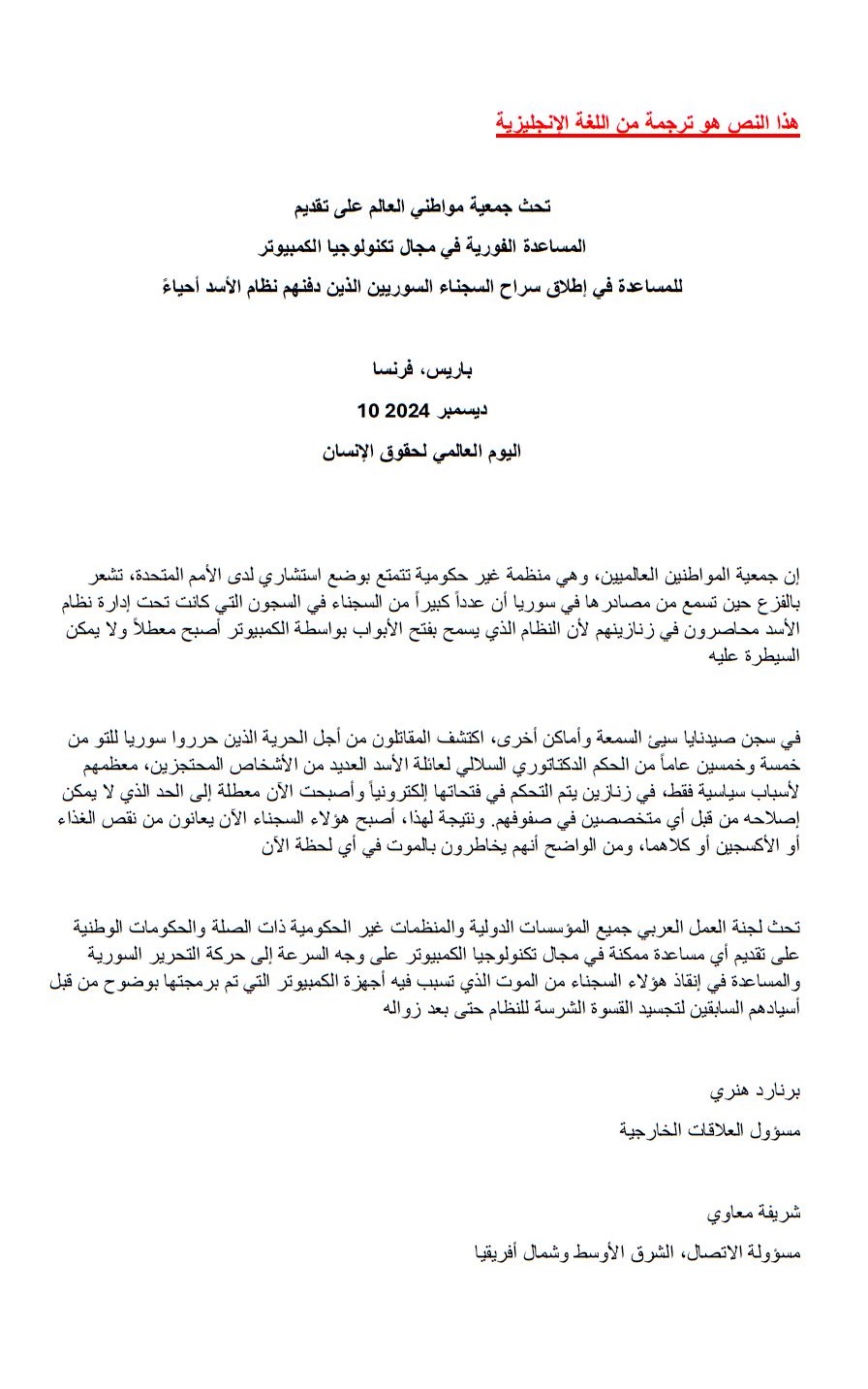
The Association of World Citizens (AWC), a Nongovernmental Organization (NGO) in Consultative Status with the United Nations (UN) is alarmed to hear from its sources in Syria that a considerable number of inmates in the prisons once run by the Assad regime are trapped in their cells because the computer-based system allowing the opening of the doors has been jammed and cannot be brought under control.

In the infamous prison of Sednaya and other places, the freedom fighters who just liberated Syria from fifty-five years of dictatorial, dynastic rule by the Assad family have discovered many people held, most of them merely on political grounds, in cells whose opening is electronically managed and is now jammed beyond any possible repair by any specialists in their ranks. As a result, those inmates are now running out of food or oxygen when not both, obviously risking death any moment now.

The AWC urges all international institutions, relevant NGOs and national governments to urgently bring whatever computer technology assistance possible to the Syrian liberation movement and help save those inmates from death caused by computers evidently programmed by their former masters to embody the vicious cruelty of the regime even after its demise.

Bernard Henry
External Relations Officer

Cherifa Maaoui
Liaison Officer, Middle East & North Africa

L’Association of World Citizens Appelle à une Assistance Informatique Immédiate pour Libérer les Prisonniers de Syrie Enterrés Vivants par le Régime Assad

In Being a World Citizen, Current Events, Human Rights, International Justice, Middle East & North Africa, NGOs, Solidarity, Syria, Track II, United Nations, World Law on December 10, 2024 at 7:00 AM

L’ASSOCIATION OF WORLD CITIZENS APPELLE
A UNE ASSISTANCE INFORMATIQUE IMMEDIATE
POUR LIBERER LES PRISONNIERS DE SYRIE
ENTERRES VIVANTS PAR LE REGIME ASSAD

Paris, France
10 décembre 2024
Journée internationale des Droits Humains

L’Association of World Citizens (AWC), Organisation Non-Gouvernementale dotée du Statut Consultatif auprès de l’ONU et active à ce titre au sein du Conseil des Droits de l’Homme, s’alarme d’apprendre de ses sources en Syrie qu’un nombre considérable de détenus dans les prisons jadis dirigées par le régime sont pris au piège dans leurs cellules car le système informatique permettant l’ouverture des portes est bloqué et ne peut être ramené sous contrôle.

A la prison de sinistre mémoire de Sednaya et en d’autres endroits, les combattants de la liberté qui viennent de libérer la Syrie de cinquante-cinq ans de règne dictatorial et dynastique de la famille Assad ont découvert de nombreuses personnes détenues, la plupart pour de pures raisons politiques, dans des cellules dont l’ouverture est gérée électroniquement et se trouve aujourd’hui bloquée au-delà de toute réparation possible par des spécialistes combattant dans leurs rangs. Le résultat en est que ces détenus arrivent à court de nourriture ou d’oxygène, quand ce n’est pas des deux, chaque instant les rapprochant plus encore, bien entendu, de la mort.

L’AWC appelle toutes les institutions internationales, toutes les ONG compétentes et tous les gouvernements nationaux à apporter en urgence toute assistance informatique possible au mouvement de libération syrien et d’aider à sauver ces détenus d’une mort que leur causeraient des ordinateurs programmés, à l’évidence, par leurs anciens maîtres pour incarner la vicieuse cruauté du régime même après sa chute.

Bernard Henry
Officier des Relations Extérieures

Cherifa Maaoui
Officier de Liaison, Afrique du Nord & Moyen-Orient

جمعية مواطني العالم تدعو إلى تقديم مساعدة فورية في مجال تكنولوجيا الكمبيوتر للمساعدة في تحرير المعتقلين السوريين الذين دفنهم نظام الأسد أحياءً

In Being a World Citizen, Current Events, Human Rights, International Justice, Middle East & North Africa, NGOs, Solidarity, Syria, Track II, United Nations, World Law on December 10, 2024 at 7:00 AM

Qu’on le veuille ou non, un seul monde et le droit à la migration

In Africa, Anticolonialism, Asia, Being a World Citizen, Conflict Resolution, Current Events, Democracy, Europe, Fighting Racism, Human Rights, Latin America, Middle East & North Africa, Migration, NGOs, Refugees, Solidarity, Syria, The former Soviet Union, The Search for Peace, Track II, United Nations, World Law on December 28, 2021 at 5:00 PM

Par Bernard J. Henry

Deux ans déjà, deux ans d’une guerre mondiale qui semble interminable, une Troisième Guerre Mondiale non entre deux ou plusieurs alliances d’Etats souverains, ou contre un envahisseur extraterrestre comme dans certains films ou séries de science-fiction, mais contre un virus – un coronavirus, le SARS-CoV-2 responsable de la COronaVIrus Disease of 2019 ou Covid-19. Après la souche originelle dite de Wuhan, le monde a découvert les variants, d’abord affublés de gentilés (anglais, sud-africain, indien) puis renommés selon l’alphabet grec : Alpha, Beta, Delta …  Et maintenant Omicron.

La lutte progresse mais la pandémie sait contre-attaquer, comme avec Omicron. Hélas, l’inégalité vaccinale entre pays et régions du monde, couplée aux décisions scientifiquement absurdes de certains gouvernements, se fait pour le virus une alliée inespérée.

L’histoire nous l’enseigne, lorsqu’une crise mondiale éclate et se prolonge, ce n’est pas après qu’elle a pris fin qu’il faut envisager l’avenir, mais pendant même qu’elle se produit, et faire de ses projets son but réel de guerre. L’histoire nous l’enseigne, oui, et l’an prochain verra le quatre-vingtième anniversaire des Nations Unies, non pas de l’organisation internationale créée en 1945 à San Francisco – également berceau de l’Association of World Citizens (AWC) – mais de l’alliance militaire des pays combattant l’Allemagne nazie, l’Italie fasciste et le Japon. Une alliance militaire qui avait retenu les leçons de l’échec de la Société des Nations et compris, à l’avenant, qu’un combat armé ne vaut rien s’il n’est porteur d’un projet politique pour un monde en paix, donc, un monde plus uni.

Un monde plus uni …  Que certains partis politiques ici ou là le veuillent ou non, c’est ce que produira inéluctablement cette pandémie, après une épreuve dont aucun continent sur terre n’aura été épargné. Et même si cela dérange ces partis xénophobes de divers pays et continents, là encore, ce monde ne pourra plus regarder de la même manière le sujet dont ils ont fait leur fonds de commerce pendant le demi-siècle écoulé – la migration.

La forteresse WENA

Si c’est littéralement le monde entier qui est touché, tout comme par la Covid-19, par le virus de la xénophobie qu’aucun vaccin ne vient enrayer, le centre mondial de l’épidémie est bien la WENA (Western Europe and North America, Europe occidentale et Amérique du Nord). Depuis le début du siècle, avec des entrées au gouvernement en Autriche et en Italie notamment, ainsi qu’une présence au second tour de l’élection présidentielle en France et un résultat électoral sans précédent aux Pays-Bas, l’extrême droite xénophobe n’a cessé de croître en WENA, jusqu’à fusionner au Canada avec la droite traditionnelle incarnée par le Parti conservateur. Mais, après des reflux ici et là, l’année 2015 est venue lui ouvrir grand les portes jusqu’alors closes du pouvoir.

Après ce que d’aucuns appelaient la «crise migratoire» de l’été, lorsque migrants et réfugiés avaient eu l’impudence de venir déranger la baignade et la bronzette des Européens en accostant sur la rive sud de la Méditerranée, un exode vite réduit par certains à une attaque envers l’Occident de Daesh, le soi-disant «État islamique en Irak et en Syrie» qui avait déjà en janvier fait couler le sang à Paris, la Grande-Bretagne suivit sans mal l’année suivante un UKIP déchaîné contre des hordes d’envahisseurs vers le vote du Brexit. A des milliers de kilomètres de là, loin des rivages du désespoir, un Donald Trump donné perdant d’avance remporta contre toute attente la Maison Blanche en évoquant, entre autres, un mur géant le long de la frontière mexicaine censé bloquer toute immigration clandestine. En 2017, bien que largement vaincue en fin de compte, l’extrême droite française atteignit une nouvelle fois les marches de l’Élysée. En 2018, les électeurs italiens consacrèrent Matteo Salvini. Il ne suffisait plus d’une «forteresse Europe», le temps était venu d’une «forteresse WENA», à bâtir du plus ironiquement sur des plans fournis par Moscou, où le pouvoir inspire et parfois finance les partis d’extrême droite comme de gauche radicale, antagonistes mais unanimes pour saper la démocratie libérale.

Ile de Lesbos (Grèce), 11 octobre 2015 (C) Antonio Masiello

Ils savent ce qui leur fait peur, les tenants de la forteresse WENA. Ils le désignent par deux mots – le grand remplacement, celui d’une population européenne blanche et chrétienne qui n’existe que dans leur imaginaire par des hordes d’Arabes et d’Africains musulmans. Leur imaginaire où trône Le Camp des Saints, roman publié en 1973 par Jean Raspail et qui, en écho à l’antisémitisme délirant des Turner Diaries adulés par les suprémacistes blancs des Etats-Unis, décrit la chute de l’Occident blanc devant une invasion venue des pays du Sud. Loin d’avoir été oublié avec le temps, Le Camp des Saints inspire encore aujourd’hui l’extrême droite française ainsi que des proches de Donald Trump.

Personne au sud ne prône un «grand remplacement», concept qui n’existe donc qu’en WENA. Et pour cause, il ne pouvait venir d’ailleurs. S’il est une région au monde dont les pays ont, dans le passé, débarqué de force sur des rivages lointains, usé de la force pour imposer leur présence puis, in fine, leurs institutions, leur religion et leur culture, ce sont bien ceux de la WENA à travers le colonialisme, imités plus tard, tragique ironie, par l’URSS «anticolonialiste» sous couvert de soutien idéologique et pour les pires effets, dont deux en Afghanistan ayant pour noms les Talibans et Al-Qaïda.

Il n’y a qu’eux qui y pensent, eux pour qui la relation avec l’autre n’est que haine ou mépris, et pour certains, violence et guerre où l’on ne peut être que vainqueur ou vaincu. Dans leur immense majorité, celles et ceux qui, au sud, veulent gagner la WENA y recherchent tout au contraire son mode de vie, ses opportunités de travail et de construction d’une vie nouvelle, ses libertés que leur refusent les gouvernements de leurs pays d’origine, se servant la plupart du temps de la culture traditionnelle locale comme d’un alibi et nourrissant ainsi les fantasmes des xénophobes en WENA, trop contents de prendre en tenaille des migrants et réfugiés déjà pourchassés par leurs propres gouvernants.

Nigel Farage, chef du parti UKIP, agitant le spectre de la migration pour amener les Britanniques à voter pour le Brexit en 2016 (C) @epkaufm (Twitter), licensed under Public Domain

La WENA a peur. Elle a peur de tous ces gens qui voient en elle un exemple pour leurs propres dirigeants, peur de toutes ces victimes qui l’appellent à agir pour leur permettre de vivre en paix chez eux ou, si elle s’y refuse, à les admettre au moins sur son territoire. Elle a peur aussi de ses propres enfants, ceux dont les parents sont eux-mêmes venus d’ailleurs ou dont les ancêtres plus lointains y ont été amenés de force, notamment comme esclaves. Elle a peur des Black Lives Matter et autres mouvements exigeant la justice pour qui, né ou élevé dans la WENA, s’y voit rejeté car porteur de cet ailleurs qui la tétanise.

Ses dirigeants ont peur, et ceux qui voudraient l’être aussi. Délogé de la présidence américaine, Donald Trump ne désarme pas. En France, terre de l’adoption de la Déclaration universelle des Droits de l’Homme en 1948, l’extrême droite se dédouble en deux partis rivalisant de peur et de haine d’autrui, tandis que le parti héritier de celui du Général de Gaulle parle arrêt de l’immigration et sortie de la Cour européenne des Droits de l’Homme, même la gauche se laissant tenter par la facilité xénophobe en s’en prenant par exemple aux transferts d’argent de travailleurs migrants vers leurs familles au pays.

Mise à mal par l’exemple russe de la démocratie illibérale de pure façade et celui de l’autoritarisme de marché donné par la Chine, la WENA n’est plus, elle le sait, maîtresse du monde. Devenir la forteresse WENA ne résoudra pourtant, pour elle, aucun problème. Fantasmer n’est pas empêcher les difficultés, encore moins les surmonter mais bien les rendre hors de contrôle. A travers le monde entier, migration et recherche d’asile génèrent des drames sans lien avec les peurs irraisonnées des opinions occidentales. La WENA peut bien rêver d’isolement, mais tout comme ceux que crée la Covid-19, les drames de la migration ont aboli les frontières et uni le monde – pour le pire.

Le monde uni en fait refuse de l’être en droit

Déjà tourmentée par ses cauchemars de « grand remplacement » et les capitulations de ses démocrates supposés devant les vrais populistes, la WENA tente l’impossible en s’obstinant à séparer strictement les migrants, en quête d’une vie meilleure, et les réfugiés, qui fuient une persécution potentiellement mortelle. Il est pourtant de moins en moins possible de chercher une vie meilleure sans fuir aussi une certaine forme d’oppression, même en filigrane, là où un réfugié peut certes avoir dû laisser derrière lui une vie confortable mais à laquelle a mis fin une soudaine et brutale menace. Et le mouvement des demandeurs d’asile s’exerce toujours bien davantage vers la WENA qu’à partir d’elle …   Mais qui érige la peur en système s’en soucie bien peu. Tant pis pour les tragédies qui en sortent et tant pis pour le mauvais exemple ainsi envoyé au reste du monde, qui ne le reçoit que trop clairement.

Toute cette année, l’AWC n’a pu que le constater en intervenant sur des situations où les frontières des Etats ne s’ouvrent que pour laisser entrer l’oppression venue d’ailleurs. Entre la Pologne, Etat membre de l’Union européenne (UE), et le Belarus sous la tyrannie d’Aleksandr Loukachenko, des migrants et réfugiés venus du Moyen-Orient sont bloqués hors du monde, utilisés par Minsk tels des pions contre l’UE et refoulés par Varsovie qui craint un afflux si elle laisse entrer un petit groupe de personnes. A l’intérieur de l’UE même, le Danemark où l’extrême droite inquiète un gouvernement social-démocrate restreint encore ses lois sur l’asile et ordonne aux réfugiés de Syrie de rentrer chez eux, comme si la fin des combats actifs dans certaines régions du pays rendait plus sûr, et meilleur, le régime tyrannique de Bachar el-Assad. Et c’est à toute l’UE que se pose, comme au monde entier, la question de l’accueil des réfugiés d’Afghanistan depuis le retour au pouvoir le 15 août dernier de la milice islamiste des Talibans, dont la première cible est depuis un quart de siècle toujours la même – les femmes, premières à devoir fuir et premières à chercher asile.

Manifestation de soutien aux réfugiés à Berlin le 31 août 2014 (C) Montecruz Foto

Cherchant toujours plus à fermer ses frontières à qui veut y entrer, la WENA n’a en revanche aucun état d’âme à les ouvrir grand pour en faire sortir l’inspiration du refus de l’autre. Et ça marche.

En Amérique latine où se produit la deuxième plus grave crise de demandeurs d’asile au monde, celle du Venezuela où quiconque le peut fuit la dictature de Nicolas Maduro soutenue par Moscou, le Pérou qui accueille le plus grand nombre d’exilés vénézuéliens refuse aux enfants son statut de «Migration Humanitaire», plongeant donc des mineurs déjà déracinés dans une invivable inexistence officielle. En Égypte, où déjà sévit une répression intense, des réfugiés de conflits africains comme celui de l’Érythrée se voient, en dépit de l’évidence même, déboutés de leurs demandes d’asile et placés dans l’expectative d’un rapatriement forcé à tout moment. En Russie, une réfugiée d’Ouzbékistan privée d’un jour à l’autre de son statut après avoir dénoncé les manquements de Moscou à ses obligations en la matière a fini sa course en détention dans un aéroport, «hors du monde», comme emmurée «dans la prison des frontières», selon la Complainte du Partisan, l’autre chant de la Résistance française pendant la Seconde Guerre Mondiale.

Qu’attendre d’autre d’un monde qui s’entête à ne pas comprendre que, bien que composé d’États souverains, il est désormais uni dans l’épreuve et doit donc le devenir aussi pour la vaincre ? Un monde uni de fait qui refuse de l’être de droit, ce n’est pas nouveau dans l’histoire et on en sait les conséquences. En 1914, c’est un monde où l’Europe faisait la loi mais où une forme de mondialisation, économique et technologique, existait déjà qui est entré en guerre, car sa politique était restée peu ou prou celle du Congrès de Vienne, là où les nations ayant vaincu l’Empire français de Napoléon Ier avaient décidé entre elles du sort des autres. Pour certains la Grande Guerre, pour d’autres «la der des der», le conflit mondial sorti d’un ordre international périmé allait certes engendrer la première organisation politique internationale de l’histoire, la Société des Nations, mais cette dernière allait s’avérer elle aussi en retard sur son temps, incapable d’arrêter les ambitions italiennes en Éthiopie puis celles plus dévastatrices et meurtrières encore d’Adolf Hitler et du Troisième Reich allemand. Ce n’est qu’en combattant le fléau d’un temps en son temps, en créant contre Hitler une alliance militaire prenant le nom de Nations Unies, que le monde libre allait réussir à vaincre le Reich génocidaire et créer une nouvelle organisation, celle que nous connaissons encore aujourd’hui – l’Organisation des Nations Unies.

Voir le passé avec l’œil du présent, l’historien le dira, il faut se l’interdire. Mais l’inverse n’est pas plus souhaitable, et de 1914, l’historien pourra le dire encore. Que conclure alors d’un monde qui, en proie à une pandémie qui a déchiré les frontières, s’y enferme comme en des murailles et se le voit enseigner par la région même qui, depuis la fin de la Seconde Guerre Mondiale, symbolisait la liberté ?

(C) U.S. National Archives & DVDs

Qu’on le veuille ou non

Un monde sans frontières est aussi peu probable qu’un «grand remplacement» en WENA, peu probable et, pour nous, une fausse bonne idée. L’AWC défend depuis le départ une Citoyenneté Mondiale accessible à toutes et tous, acceptable par toutes et tous, fondée sur un principe simple mais qui semble si difficile à accepter : étant toutes et tous natifs et habitants de la planète Terre, il est du devoir de chacun(e) de la protéger ainsi que son peuple, notre peuple, l’humanité, et accepter cet état d’esprit est entrer dans une Citoyenneté Mondiale qui s’exerce en supplément de la citoyenneté nationale, non à la place, d’autant qu’il n’existe au niveau planétaire aucune structure reconnue par les États qui permette une telle substitution. Même la citoyenneté de l’UE n’est acquise que par la citoyenneté nationale de l’un de ses États membres, se vouloir citoyen(ne) de l’Union de manière directe et exclusive étant impossible.

Pour autant, et l’histoire ne va pas dans une direction autre, qu’est-ce qui oblige les frontières à s’ériger en remparts, a fortiori contre un ennemi inexistant et chimérique ? Au nom de quoi les États souverains devraient-ils être des citadelles ? Et surtout, comment exercer dans de telles conditions la moindre Citoyenneté Mondiale alors que le sort de toute la planète et toute l’humanité nous le commande ? C’est ce que l’AWC a toujours défendu et, aujourd’hui, ce que l’on pouvait refuser comme n’étant qu’un simple axiome de notre part est devenu, plus que jamais, un fait prouvé. Même si un autre enseignement de la Covid-19 est, hélas, que les faits prouvés peuvent n’être plus probants.

Négateurs du virus, promoteurs de thérapies inefficaces, d’aucuns auront rejeté l’évidence nue face au SARS-CoV-2. Chefs d’État ou de gouvernement, qu’ils se nomment Trump, Johnson ou Bolsonaro, ils auront tous fini par rencontrer ce virus qu’ils niaient ou minimisaient, finissant ainsi par prouver au contraire son existence et le besoin absolu de s’en protéger. D’autres poursuivent aujourd’hui le travail de sape de ces derniers, parfois en y laissant leur vie. Les faits prouvés peuvent n’être plus probants, mais Lénine le savait, «les faits sont têtus».

Ces politiques migratoires et ces injustices qui nous ont amenés à intervenir, nous ne les avons pas inventées. L’AWC n’a pas le temps, encore moins le goût, de fabriquer des problèmes, trop occupée qu’elle est à tenter de résoudre ceux dont elle vient à avoir connaissance. Une vision des frontières, de l’étranger et de la migration qui n’est plus adaptée à son temps, c’est un problème, majeur, que nous ne résoudrons jamais seuls et qui demande une implication littéralement universelle. D’autant qu’il n’est pas sans rencontrer l’autre problème majeur du moment, le coronavirus. Si ce n’est par la coupable méfiance vis-à-vis de traitements venus de l’extérieur et/ou par la tout aussi coupable négligence alimentant l’inégalité vaccinale entre nations, plusieurs fois dénoncée de concert par l’Organisation mondiale de la Santé et le Fonds monétaire international, comment expliquer l’apparition des variants Delta puis Omicron respectivement en Inde puis en Afrique du Sud ? On empêchera des êtres humains de quitter leur pays, on les empêchera d’entrer dans celui qu’ils espèrent atteindre, mais des gardes-frontières n’arrêtent pas un virus. Les frontières non plus, et voir en elles une solution soit à la migration tant redoutée soit à la Covid-19, c’est rendre impossible tant une migration ordonnée et humaine que la fin de la pandémie.

Un seul monde, ce n’est plus un slogan, c’est maintenant un fait. Que la WENA vous nomme un migrant si vous y venez ou si vous allez et venez en dehors d’elle (le terme «réfugié» n’ayant plus rien d’automatique, même devant un danger avéré), ou un expatrié si vous en venez et la quittez, vous serez toujours soumis aux lois nationales sur la migration et c’est là, partout, un domaine régalien, privilège absolu de l’État. Mais si ces lois sont adoptées et/ou appliquées les yeux grands fermés à la marche du monde, votre sort ne regardera bientôt plus seulement votre État de provenance et/ou d’arrivée. Pas plus que votre nationalité ne fera quelque différence si vous êtes positif à la Covid-19, où que vous soyez. Les deux questions seront mondiales.

Le droit absolu à la migration, sans demander l’avis de l’État d’arrivée, n’existera probablement jamais. Pour autant, le droit à la migration, celui d’être accueilli dignement, d’être ainsi traité même si l’on doit ensuite repartir et, certes, de n’être en aucun cas traité en migrant lorsque l’on est demandeur d’asile, peut et doit être un droit absolu, pour d’élémentaires raisons d’humanité dont même une catastrophe planétaire claire et présente n’autorise pas l’oubli.

Qu’on le veuille ou non, il n’existe plus qu’un seul monde. S’il prend au sérieux les malades de la Covid-19, alors il n’a pas d’excuse pour ne pas prendre au sérieux les migrants. Au moment où la deuxième année de la pandémie s’achève, s’il est déjà temps de prendre une bonne résolution, alors, que ce soit celle d’y parvenir enfin. Et immuniser les consciences contre nos coupables indifférences.

Bernard J. Henry est Officier des Relations Extérieures de l’Association of World Citizens.