The Official Blog of the

Archive for the ‘Human Rights’ Category

Ratko Mladić: Arrest and Coming Trial – A Step Forward for World Law

In Current Events, Human Rights, International Justice, The Balkan Wars, The Search for Peace, United Nations on May 27, 2011 at 7:23 PM

RATKO MLADIĆ: ARREST AND COMING TRIAL – A STEP FORWARD FOR WORLD LAW

By René Wadlow

On May 26, 2011, President Boris Tadić of Serbia announced the arrest of General Ratko Mladić, the Yugoslav general become head of the Bosnian Serb forces of Republika Srpska. General Mladić had been charged by the War Crimes Tribunal for ex-Yugoslavia in the Hague for genocide, crimes against humanity and war crimes and thus should be sent from Belgrade to the Hague to stand trial shortly. General Mladić is particularly charged with commending the 1992-1995 siege of Sarajevo during which much of the city was destroyed and some 10,000 persons killed, often shot by snipers. The genocide charge arises mainly from the killing in July 1995 of some 8,000 Muslim men at Srebrenica which had been declared a neutral safe haven guarded by UN troops.

Mladić had been forced from his position in Republika Srpska after the 1995 Dayton Agreement, largely facilitated by the US envoy Richard Holbrooke. Mladić moved to Serbia and lived mostly in Belgrade, having changed his name. He was arrested at the farm of a cousin some 50 miles north of Belgrade in the Vojvodina area. His arrest and trial was one of the conditions set by the European Union for advancing with negotiations on Serbia joining the EU. Negotiations are now at a serious stage, and the arrest of Mladić was necessary to open the door further. Mladić kept out of sight, but he was not hiding. He had supporters in the Serbian army, police and in certain nationalist political circles. Thus an arrest earlier would not have been worth the political outcries and tensions an arrest might have provoked. Now, when EU membership and the economic future of the country are at stake, his arrest is not a very high price to pay.

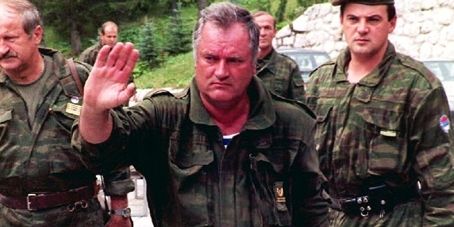
Ratko Mladić, here as the Bosnian Serb forces' top general during the civil war in Bosnia-Herzegovina (1922-1995).

It is not really satisfaction when one sees those who have betrayed one’s proposals are finally taken down. However, there is a sense of “closure” – a recognition that karma is finally at work. I did not know Ratko Mladić but saw him a number of times in the halls of the Palais des Nations — the European Headquarters of the United Nations (UN). I was in contact with Radovan Karadžić, the political head of the Bosnian Serbs — officially Prime Minister of Republika Srpska. I had been asked to be an advisor to Karadžić on UN procedures when negotiations began in Geneva in 1992. After discussions, I turned down the offer although it would have been a possibility to be a direct participant in the negotiations.

Whatever credibility I had in the Yugoslav conflict came from being a neutral and not linked to one side, although I was generally seen as pro-Serb. My first efforts had been to help Milan Babić, the leader of the Serb enclave in Croatia called Krajina. I had Babić address the UN Commission on Human Rights in February 1991 to warn of the consequences if Yugoslavia broke up. His presentation was filmed and widely shown on Yugoslav TV. I am still convinced that had his warning been taken seriously, things might have been different. However, the Commission on Human Rights was not really equipped to deal with “early warning”, and nothing was done until fighting broke out in June 1991.

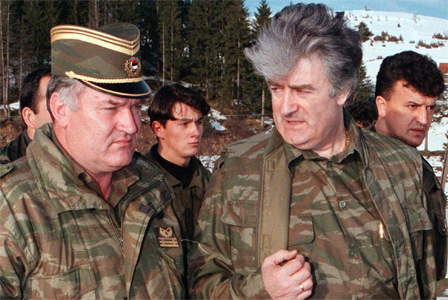
Here with then General Ratko Mladić, former Bosnian Serb political leader Radovan Karadžić.

In June, Krajina declared its independence from Croatia, calling itself the Republic of Serbian Krajina. Babić was named Prime Minister. From August to December 1991, Serbs from Krajina killed hundreds of Croats and drove some 80,000 from their homes. Ratko Mladić was the head of the Krajina forces at the time and a close co-worker with Babić.

In 1992, Babić was eased out of power by behind-the-scenes pressures by Prime Minister of Serbia, Slobodan Milosevic, who wanted someone with a less independent character, at which time Mladić left Krajina and went to Bosnia where he had been born.

In 2004 Babić was sentenced to 13 years in prison for war crimes by the Yugoslav War Crimes Tribunal in The Hague and shortly afterwards committed suicide.

On July 11, 1995, General Ratko Mladić and his troops stormed the Bosnian Safe Haven of Srebrenica. With the most unwelcome participation of UN peacekeepers there, they secured the place for the Bosnian Serb army and took some 7,000 unarmed Bosnian civilians to their death.

In March 1992, Bosnia-Herzegovina declared its independence from Yugoslavia, and at the same time, Republika Srpska declared itself independent under the leadership of Radovan Karadžić. Many at the time questioned the wisdom of a unilateral splitting of Bosnia, but Mladić said “The existence of the Republika Srpska may be contested internationally, but the existence of its army cannot be contested. The Republika Srpska exists because we have our territory, our nation, our government and all the attributes of a state. Whether they acknowledge it or not — that’s their problem. The army is the fact.”

A month later, in April 1992, the siege of Sarajevo began with Ratko Mladić in charge of the Serb forces. The siege was to illustrate that a multi-ethnic society could not exist, Sarajevo being the Yugoslav city with the most ethnically-mixed population.

I had been in Belgrade in 1991 at the start of the Yugoslav fighting, just at the time of the fall of Vukovar, the first major battle, to see if NGOs could play any role in conflict reduction. But once the fighting had broken out there was really nothing that NGOs could do to prevent the spread of the conflict. The International Committee of the Red Cross tried, with great difficulty, to maintain some humanitarian efforts, but NGO conflict mediation was not really possible.

In September 1992, with fighting still going on, the Geneva Peace Conference on Bosnia began at the UN headquarters under the co-leadership of Lord David Owen on behalf of the EC and Mr. Cyrus Vance, former U. S. Secretary of State for the UN. Vance later withdrew, discouraged by the lack of progress and was replaced by Thorvald Stoltenberg, a former Minister of Foreign Affairs of Norway.

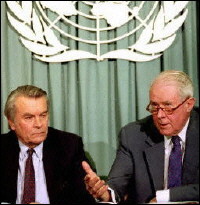
Lord David Owen, Special Representative of the European Community for Bosnia-Herzegovina, and the UN Special Envoy, former U. S. Secretary of State Cyrus Vance.

Late in 1992, as fighting was increasing and political proposals for the future of Bosnia were bogged down, David Arnott, an English Buddhist who had been working with me on Burma issues and I were the first to propose in the UN Commission on Human Rights and in a text sent to the members of the UN Security Council the creation of a number of security zones or “safe areas” within Bosnia-Herzegovina. I had been working closely with Tadeusz Mazowiecki, a former Prime Minister of Poland, who was the Special Rapporteur of the Commission on Human Rights on ex-Yugoslavia. In his November 1992 Report to the Commission, he had proposed the establishment of a security zone encompassing Sarajevo and its airport in order to facilitate the delivery of humanitarian supplies.

Building on this proposal, in an oral statement of December 1, 1992 to the “Special Session of the Commission on Human Rights devoted to Human Rights in Former Yugoslavia”, I stressed the need to create a larger number of safe havens and emphasized “that the declaration of protected Safe Haven Zones is an interim arrangement with a humanitarian purpose and in no way reduces the urgent and imperative need to find negotiated political solutions.”

Safe havens, called neutralized zones, are provided for in article 15 of the 4th Geneva Convention of August 12, 1949. On October 30, 1992, the International Committee of the Red Cross had proposed that “protected zones be set up for the civilian population at risk, away from combat areas. They would not be intended for the inhabitants of besieged towns for whose protection other solutions should be found, such as a cessation of hostilities.” This was basically a call for protected refugee camps while ours was for “protected cities” since ‘cessation of hostilities’ were not in the cards.

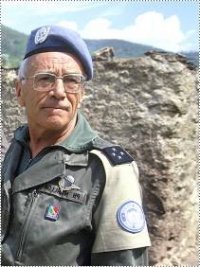
General Sir Michael Rose, the British senior military man who in 1994 served as Commander of the Bosnian segment of the United Nations Protection Force (UNPROFOR Bosnia). When the Bosnian Serb army attacked a UN-declared Safe Haven for the first time (that was Goražde in April 1994), General Rose and his UNPROFOR troops stood idle and let the Bosnian Serbs invade the city.

Thus our proposal was not original but rather what was needed for the hour. On April 16, 1993, the UN Security Council proclaimed Srebrenica a safety zone and on May 6 added Sarajevo, Žepa, Goražde, Bihać and Tuzla to the list. Our proposal was quoted by the then Ambassador of Afghanistan, Mr. Farhadi, during the debate on safe havens.

Thus I followed with interest how the safe havens were put into place. Srebrenica had been a middle-sized town of 6,000 prior to the fighting. It had grown to over 70,000 as families left the countryside for the relative safety of the town; infrastructure, however, could not keep up.

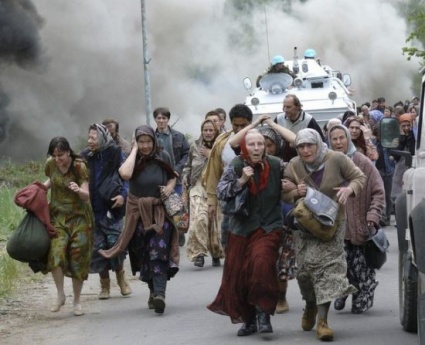
In July 1995, the “safe havens” of Žepa and Srebrenica were taken over by the forces led by Ratko Mladić. The UN forces led by soldiers from the Netherlands did not try to resist. A month earlier in June, UN forces had been taken hostage for two weeks but finally were released. Although NATO planes were dropping bombs on Serb positions at the time, it is not clear that any NATO forces would have come to the defense of the Dutch. The UN troops stood by as Mladić separated the women and children from the men. He had his soldiers kill some 8,000 male prisoners and had their bodies put into mass graves.

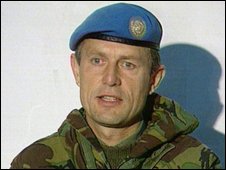
General Philippe Morillon, the French peacekeeper whose efforts to protect the UN-designated Safe Havens quickly made him a living legend in Bosnia-Herzegovina.

There had been so many violations of the laws of war and human rights in the Yugoslav conflicts, that there was not much public outcry at the time, although Tadeusz Mazowiecki resigned his UN position as Special Rapporteur writing to the UN Secretary-General Boutros Boutros-Ghali and making his letter public that his resignation was forced by the “horrendous tragedy which has beset the population of those ‘safe havens’ guaranteed by international agreement…I believe we have a certain hypocrisy as far as Bosnia is concerned when we are claiming to defend it but in fact we are abandoning it. The same goes for hypocrisy about the protection of human rights. I hope that my decision will also be understood as a protest against this hypocrisy.”

The wheels of karma turn slowly. As there is no longer anything at stake, more people today will agree that killing people who thought that they were protected in UN-proclaimed safe havens is not a good thing. There have been no new proposals for safe havens since and thus none has been created. I still think that it was a good idea at the time. Yet I share the observation of Michèle Mercier who had been for a long time part of the International Committee of the Red Cross team in former Yugoslavia “The word most frequently heard in the ranks of humanitarian workers is frustration. Their leaders are powerless to settle by themselves the problems involved with security and they have worn themselves out negotiating and renegotiating with opposite numbers of the most unlikely kind agreements that lose all their meaning before they are reached.” (1)

René Wadlow is Senior Vice-President and Chief Representative to the United Nations Office at Geneva of the Association of World Citizens.

(1)  Michèle Mercier Crimes Without Punishment: Humanitarian Action in Former Yugoslavia (London: Pluto Press, 1995, p. 165)

Bahrain and the Defense of Spiritual Liberty

In Current Events, Human Rights, Middle East & North Africa, Religious Freedom on May 24, 2011 at 11:33 AM

BAHRAIN AND THE DEFENSE OF SPIRITUAL LIBERTY

By René Wadlow


In a recent May 14, 2011 Appeal to the Kingdom of Bahrain concerning the systematic destruction of mosques used by the Shi’a citizens who are currently demonstrating for greater liberty and democracy, the Appeal pointed out that the destructions of places of worship is a direct violation of the spirit but also the letter of the UN Declaration on the Elimination of All Forms of Intolerance and of Discrimination Based on Religion or Belief.  The Declaration was proclaimed on November 25, 1981 and began “Considering that one of the principles of the Charter of the United Nations is that of the dignity and equality inherent in all human beings, and that all Member States have pledged themselves to take joint and separate action in co-operation with the Organization to promote and encourage universal respect for and observance of human rights and fundamental freedoms for all, without distinction as to race, sex, language or religion.”

The Declaration took nearly 20 years of difficult negotiations to draft.  Preparation of the declaration began in 1962, and the Declaration was proclaimed in November 1981.  Originally, UN negotiators had thought of drafting a single text which would have included the elimination of discrimination based on race, sex and religion.  However, there was too great a diversity of views.  It was easier to deal with the elements separately, all the more so that in the 1960s and 1970s in UN circles “race” was only the Apartheid policy of South Africa which everyone was, at least verbally, against.

Religion and belief were more difficult questions.  The defense of spiritual liberty has been one of the most persistent of struggles, and there is no area of the world that does not have its martyrs to the cause.  The struggle has often been against religious authorities who have wanted to maintain their faith within narrow limits claiming that they alone held the truth.  It is significant that the words “dogmatic”, “sectarian”, and “inquisition” — all arise from the religious vocabulary.  The stoning of the prophets and the auto-da-fe have been the answers of religious authorities — and often ordinary believers as well — to new ideas.  Today, in most parts of the world, religious organizations can no longer put heretics to death.  Now, religious organizations can only try to marginalize those who hold new ideas or to excommunicate them; the inquisition has lost its secular arm.

The Amir Mohammed Braighi mosque before destruction.

If religious organizations are no longer able to put to death heretics, the State has taken over the task of establishing orthodoxy and putting heretics to death.  Although today, governments are the prime agents of repression against the spiritual life, governments are also timidly building the defenses of spiritual liberty.

The Declaration of November 25, 1981 builds upon Article 18 of the Universal Declaration of Human Rights which states that “Everyone has the right to freedom of thought, conscience and religion; this right includes freedom to change his religion or belief, and freedom, either alone or in community with others and in public or private, to manifest his religion or belief in teaching, practice, worship and observance.”

One of the most difficult areas in drafting the Declaration concerned the rights of the child to have “access to education in the matter of religion or belief in accordance with the wishes of his parents and shall not be compelled to receive teaching on religion or belief against the wishes of his parents or legal guardians, the best interests of the child being the guiding principle.”  The Declaration went on to state that “The child shall be brought up in a spirit of understanding, tolerance, friendship among peoples, peace and universal brotherhood, respect for freedom of religion or belief of others, and in full consciousness that his energy and talents should be devoted to the services of his fellow men.”

The Amir Mohammed Braighi mosque now stands in ruins.

Despite the rather nondramatic title of the Declaration, it is a milestone on the path of spiritual liberty.  Thanks to the Declaration on the Elimination of All Forms of Intolerance and of Discrimination Based on Religion or Belief, we who work for a world of understanding and solidarity have a UN text on which to base our efforts to defend spiritual liberty.

The Kingdom of Bahrain which has received support from the Kingdom of Saudi Arabia in the form of tanks and soldiers and from other Gulf States in the form of police, has not yet relied to the AWC Appeal.  It seems that they are preoccupied with arresting people rather than reading UN documents by which to set their standards. However the AWC will continue to remind them of the foundations of world law.

René Wadlow is Senior Vice-President and Chief Representative to the United Nations Office at Geneva of the Association of World Citizens.

Syria: The Downward Spiral

In Current Events, Democracy, Human Rights, Middle East & North Africa on April 30, 2011 at 10:45 PM

SYRIA: THE DOWNWARD SPIRAL

By René Wadlow


The United Nations (UN) has tried to stop the downward spiral of Syria into repression and potential chaos. It has been five weeks that what began as peaceful protests and demands for limited reforms have been increasingly met by government violence. Discussions on what the UN could do to help the Syrian people and to speed up necessary reforms started in both New York and Geneva. Governments and UN Secretariat members discussed different possibilities against the backdrop of the UN Security Council resolutions on Libya and the continued fighting there.

The representatives of China and Russia who had not blocked the resolution to use “all necessary force” to protect the civilian population in Libya but who have grown increasingly ill-at-ease with the NATO-led attacks did not want to open the door to a possible repeat over Syria. Thus all possibility of action within the Security Council was blocked with the insistence on the part of China and Russia that the situation was an internal affair of Syria and did not pose a danger to regional peace.

Thus the UN focus moved to Geneva and the UN Human Rights Council, for if events in Syria did not pose a danger to peace in the area, events were an open violation of the UN human rights standards. Syria is a party to all the major UN human rights conventions. Thus, on Friday, 29 April 2011 — when the eyes of much of the world were turned to London and a Royal wedding — in Geneva a path-making Special Session of the UN Human Rights Council was being held. A Special Session is the “highest profile” which the Council can give to a situation. It can be called on short notice, but before a Special Session is held, there are usually intense negotiations among governments. The representatives of non-governmental organizations (NGOs) also have a short time to prepare common positions and statements for a Special Session. Since NGOs speak after the governments, there is usually time for only a few statements prior to voting on the outcome resolution. However, for this Special Session, government representatives stuck to their time limits, and 16 NGOs were able to speak even if few said anything which had not already been said by governments.

Syria's President, Bashar al-Assad, posing before the Syrian flag.

The human rights situation in Syria was well set out at the start by the Deputy High Commissioner for Human Rights Ms Kyung-Wha Kang from Korea:

Information gathered since mid-March points a disturbing picture: the widespread use of live fire against protesters; the arrest, detention, and disappearance of demonstrators, human rights defenders, and journalists; the torture and ill-treatment of detainees; the sharp repression of press freedoms and other means of communication; and the attacks against medical personnel, facilities and patients.

“Yet even these deplorable practices have been exceeded over the past week. According to reports, entire towns have been besieged. Tanks have been deployed and shelled densely-populated areas. The delivery of food has been impeded. Access to electricity has been cut. And transportation systems have been shut down. There have been reports of snipers firing on persons attempting to assist the injured or remove dead bodies from public areas.

“We have noted with concern that military and security officers have been among those killed. Still, the preponderance of information emerging from Syria depicts a widespread, persistent and gross disregard for basic human rights by the Syrian military and security forces. Syrian and international human rights organizations have already documented more than 450 killings and around four times that number of injuries…

“Let me conclude by emphasizing the importance of holding perpetrators of serious human rights violations accountable, and in this regard, the urgent need for an independent, impartial, effective and prompt investigation into recent events in Syria. The convening of this Special Session should not only convey to the people of Syria that the international community is aware of their plight and supports their struggle for fundamental rights and freedoms. It should affirm to people everywhere that the Human Rights Council will be resolute in ensuring justice for victims of human rights worldwide.”

As with all serious UN meetings, the decisions have been negotiated before the meeting starts. There was broad agreement that the Human Rights Council would vote the creation of a working group for an independent, impartial investigation to be named by the President of the Council after consultation. The consultations have started, but the names of the members have not yet been announced. It is unclear at this stage if Syria will allow the group to enter to carry out interviews and other investigations. The working group on the situation in Darfur was not able to enter Sudan, and Israel did not allow the working group chaired by Justice Goldstone to enter Israel. However, some countries have allowed Special Rapporteurs on country situations named by the Human Rights Council or the earlier Commission on Human Rights to visit the country in question.

Much of the debate during the Special Session concerned basic attitudes on general human rights matters over which negotiations would not lead to any compromise. There are States which do not want country-specific discussions, basically by fear that they might one day be discussed. This is the long-standing position of China and Cuba and can be taken up by others depending on the specific case. With the situation in Syria, there was a newer and more interesting balance to be found between those States who, in addition to the creation of an investigation body, wanted a condemnation of the current violations in Syria on the basis of information now available and those States which wanted “constructive dialog”. Those for constructive dialog stressed that while not opposing an investigation, felt that there was an opportunity to “engage in constructive dialog with the Syrian government”. They maintained that condemnation measures would hinder finding peaceful solutions. This group of States, largely led by Pakistan and the Russian Federation, put an emphasis on the reforms which had already taken place after the start of the demonstrations, in particular the lifting of the state of emergency, abolishing the State Security Court, the granting of citizenship to 250,000 Kurds who had been registered until then as “aliens” and the replacement of the Cabinet and some governors of provinces.

The Syrian Ambassador, Mr. Faysal Khabbas Hamoui, could have played on these calls for engagement and dialog, and he may have done so in private. In his public statements prior to the start of the debate and again just prior to the vote, his position was so “hard line” as to destroy any idea that “constructive dialog” was possible at all. He attacked the idea of having a Special Session at all and then went on to attack the protesters as agents of a foreign-led conspiracy and as extremists wanting violence. His presentation left no visible door open for dialog, and there was no call for a possible national reconciliation.

The United Nations Human Rights Council in session.

The vote on the only resolution, A/HRC/S-16/1 came with few surprises:

Votes in favor: 26.

Against 9: Bangladesh, China, Cuba, Ecuador, Gabon, Malaysia, Mauritania, Pakistan, Russian Federation.

Abstentions 7: Cameroon, Djbouti, Nigeria, Saudi Arabia, Thailand, Uganda, Ukraine

Left the room so they could not be counted in any category: 4: Angola, Bahrain, Jordan, Qatar

The motivations of Angola are unclear. However, given the solid structuring of power in Syria, the inter-twinning of power and wealth, the mosaic of security services, quick reforms are unlikely. As President Bashar al-Assad has said “haste comes at the expense of the quality of reforms”. There may be a possibility for external NGOs, civil society organizations in Syria and the Syrian government to discuss peaceful advances toward a more just and inclusive society. We need to keep looking for possible doors even as people are being killed on the ground.

René Wadlow is Senior Vice President and Chief Representative to  the United Nations Office in Geneva of the Association of World Citizens.

Aimé Césaire (1913 – 2008): A Black Orpheus

In Anticolonialism, Human Rights, Literature on April 7, 2011 at 10:29 PM

AIME CESAIRE (1913 – 2008): A BLACK ORPHEUS

By René Wadlow


My negritude is not a stone,

nor deafness flung out against the clamor

of the day

my negritude is not a white speck of dead water

on the dead eye of the earth

my negritude is neither tower nor cathedral.


Return to My Native Land


On April 6, 2011, Aimé Césaire was honored by the President of the French Republic, Nicolas Sarkozy, at the Pantheon, a monument in Paris where persons who have contributed to French political culture are honored. Aimé Césaire, the Martinique poet and political figure, was a cultural bridge builder between the West Indies, Europe and Africa. A poet, teacher, and political figure, he had been mayor of the capital city, Fort-de-France for 56 years from 1945 to 2001, and a member of the French Parliament without a break from 1945 to 1993 — the French political system allowing a person to be a member of the national parliament and an elected local official at the same time. First elected to Parliament as a member of the Communist Party, he had left the Party in 1956 when he felt that the Communist Party did not put anti-colonialism at the center of its efforts.

The Communist Party’s position was that colonialism would end by itself once the workers had come to power. Césaire went on to form a local political party which existed only in Martinique and was largely his political machine for creating municipal jobs. Césaire faced a massive rural to urban migration on the 400,000 person West Indian department of France. One answer to unemployment was to create municipal posts largely paid for from the central government budget — a ready pool of steady political supporters. Césaire also did much to develop cultural activities from his mayor’s office— encouraging theater, music and handicrafts.

Aimé Césaire’s wider fame was due to his poetry and his plays — all with political implications, but heavily influenced by images from the subconscious. Thus it was that André Breton (1896-1966) writer and ideologue of the Surrealists saw in Césaire a kindred soul and became a champion of Césaire’s writing. Breton had been interested in African art and culture, by its sense of motion, color and myth. Breton often projected his own ideas onto African culture seeing it as spontaneous and mystical when much African art is, in fact, conventional and material. Nevertheless, Breton, who spent some of the Second World War years in Martinique, was able to interest many French writers and painters in African culture. It was Breton who encouraged Jean Paul Sartre to do an early anthology of African and West Indian poetry – Black Orpheus and to write an important introduction stressing the revolutionary character of the poems.

Aimé Césaire’s parents placed high value on education — his father was a civil servant who encouraged his children to read and to take school seriously. Thus Césaire ranked first in his secondary school class and received a scholarship in 1931 to go to France to study at l’Ecole Normale Supérieure — a university-level institution which trains university professors and elite secondary school teachers. He was in the same class with Léopold Sédar Senghor of Senegal and Leon Damas. They, along with Birago Diop also from Senegal, started a publication in Paris L’étudiant noir (The Black Student) as an expression of African culture. One of Césaire’s styles in poetry was to string together every cliché that the French used when speaking about Africa and turning these largely negative views into complements. Thus he and Senghor took the most commonly used term for Blacks, Nègre, which was not an insult but which incorporated all the clichés about Africans and West Indians and put a positive light upon the term. Thus negritude became the term for a large group of French-speaking Africans and French-speaking West Indians – including Haiti – writers. They stressed the positive aspects of African society but also the pain and agony in the experience of Black people, especially slavery and colonialism.

In 1938, just as he finished his university studies, Césaire took a few weeks’ vacation on the coast of Yugoslavia. There he wrote in a burst of energy his Cahier d’un retour au pays natal (Notebook of the Return to My Native Land), his best known series of poems. In 1939, he returned to Martinique having married another teacher from Martinique who was also trained in Paris. Both started teaching at the major secondary school of Martinique and started being politically active. However, by 1940, Martinique was under the control of the Vichy government of France and political activity was firmly discouraged. Thus Césaire concentrated on his writing. He met André Breton who spent the war years in the USA. Breton encouraged an interest in the history and culture of Haiti. While Haiti is physically close to Martinique, Haitian history and culture is often overlooked — if not looked down upon — in Martinique. Césaire wrote on the Haitian independence leader Toussaint Louverture as a hero, and later a play in 1963 La Tragédie du roi Christophe largely influenced by the early years of the dictatorship of Francois Duvalier.

Aimé Césaire (1913-2008)

With the end of the Second World War, the French Communist Party had one third of the seats in the Parliament of the newly created Fourth Republic. The French Communists were looking for potential candidates from Martinique where the Party was not particularly well structured. They turned to young, educated persons who had a local base. Césaire, with his Paris education and as a popular teacher at the major secondary school fitted that bill. He was elected the same year both to Parliament and to the town hall. When in Paris, he took an active part in cultural life, especially with African students and young intellectuals. In 1947, along with the Senegalese Alioune Diop and Senghor, he founded the journal Présence africaine which later became also a publisher of books and the leading voice of the negritude movement.

As the French Communist Party had a rule of tight party discipline, Césaire played no independent role in the French Parliament until he left the Party in 1956. However, his 1950 Discours sur le Colonialisme, at the same time violent and satiric became the most widely read anti-colonial tract of the times, calling attention to the deep cultural roots of colonial attitudes. After 1956, most of his efforts in Parliament were devoted to socio-economic development for Martinique. His strong anti-colonial efforts were made outside Parliament, especially in the cultural sphere. Nevertheless, as a member of Parliament he could open doors that poets do not usually enter.

Césaire, who read English well, was interested in the writings of Langston Hughes whose poems were close in spirit and style. He translated into French some of the poems of the Negro poet Sterling A. Brown.

In the 1960s, Césaire turned increasingly to writing plays, especially on the history of Haiti, as the earliest independent State of the West Indies. These were verse plays as the actors’ dialogues were nearly poems. As the French African colonies became independent in the 1960s, he stressed that the end of colonialism was not enough but that colonial culture had to be replaced by a new culture, a culture of the universal, a culture of renewal. “It is a universal, rich with all that is particular, rich with all the particulars that are, the deepening of each particular, the coexistence of them all.”


René Wadlow is Senior Vice President and Chief Representative to  the United Nations Office in Geneva of the Association of World  Citizens.

LES CITOYENS DU MONDE APPELLENT A UN CESSEZ-LE-FEU EN LIBYE ET A L’OUVERTURE DE NÉGOCIATIONS POUR UNE NOUVELLE RÉPUBLIQUE LIBYENNE

In Current Events, Democracy, Human Rights, Middle East & North Africa on March 20, 2011 at 4:29 PM

LES CITOYENS DU MONDE APPELLENT A UN CESSEZ-LE-FEU EN LIBYE ET A L’OUVERTURE DE NÉGOCIATIONS POUR UNE NOUVELLE RÉPUBLIQUE LIBYENNE

(Mis à jour le 20 mars 2011)

Par René Wadlow


Le 15 mars 2011, alors que les combats concernaient encore les seuls pro- et anti-Kadhafi, dans un message au Secrétaire Général de l’ONU, Ban Ki-moon, le Professeur René Wadlow, Représentant en Chef auprès de l’Office des Nations Unies à Genève de l’Association of World Citizens (AWC), a exhorté le Secrétaire Général à prendre l’ascendant en appelant à un cessez-le-feu en Libye qui mît fin aux hostilités en cours et à l’hémorragie de réfugiés. En se prolongeant et s’intensifiant, le conflit ne fait que placer un insupportable fardeau sur des lieux de soins médicaux déjà débordés et sur l’approvisionnement visant à répondre aux besoins élémentaires de la population.

Un cessez-le-feu constituerait aussi un premier pas en direction de négociations menant à un nouvel ordre constitutionnel et à une nouvelle République libyenne dont le fondement démocratique serait des plus larges.

Depuis les Ides de Mars, la situation s’est envenimée et a pris un caractère international, avec l’adoption d’une résolution du Conseil de Sécurité de l’ONU, un Sommet consécutif à celle-ci qui s’est tenu à Paris le 19 mars et le déclenchement des frappes aériennes et maritimes françaises, britanniques et américaines en Libye.

Pendant ce temps, les combats entre Libyens se poursuivent au sol. A ce stade, il paraît impossible de dire combien de temps durera le conflit armé et quels résultats sur le court terme il produira. La véritable question est de savoir comment aboutir à une fin des combats qui ait fait l’objet d’un accord préalable, puis d’ouvrir la porte à la nécessaire restructuration constitutionnelle du pays et à la création d’une République libyenne de large fondement démocratique.

Selon l’exemple des révolutions non-violentes de Tunisie et d’Egypte, des protestations contre le fonctionnement politique et économique de la Libye ont éclaté. Plutôt que d’entamer le dialogue, les autorités libyennes ont entrepris une politique de répression, laquelle a conduit à la violence à grande échelle que nous voyons aujourd’hui, provoquant par là même un flot massif de départs de travailleurs immigrés du pays ainsi qu’un important déplacement interne de Libyens.

Un manifestant libyen exigeant le départ de Muammar Kadhafi.

Seul un cessez-le-feu permettra le début d’un traitement en profondeur des questions constitutionnelles fondamentales que le pays a affrontées depuis l’Indépendance. Lorsque celle-ci est survenue en 1951, l’autorité reposait sur le Roi Sayyid Idriss as-Sanoussi (1890-1983), dirigeant d’une importante fraternité islamique qui se montrait de longue date plus soucieuse de réformes religieuses que de la structure du gouvernement ou de la qualité de l’administration. Son gouvernement possédait quelques attributs de décentralisation et de fédéralisme, mais reposait pour beaucoup sur des confédérations tribales qui existaient depuis bien plus longtemps. (1)

Quand les officiers de l’armée menés par le Colonel Muammar Kadhafi prirent le pouvoir à l’occasion d’un coup d’Etat en septembre 1969, la discussion s’engagea pendant un cours laps de temps quant à la forme de gouvernement qu’il convenait de développer. L’idée d’un pouvoir plus centralisé faisait l’unanimité, de même que la conservation des politiques de l’ancien roi et de la Fraternité Sanoussi en matière de religion – ce qui prit le nom de néo-salafisme. Cependant, afin de ne pas mettre d’obstacles à la future unité arabe, aucune structure étatique basée sur un accord constitutionnel ne fut officiellement créée.

Sayyid Idriss as-Sanoussi, également appelé Idriss 1er, Roi de Libye de 1951 à 1969.

Le colonel Kadhafi voulait se débarrasser du gouvernement de type parlementaire et des élections visant à élire une représentation, ce au profit de comités populaires, d’un congrès du peuple et de comités révolutionnaires, tous tenus ensemble par les présomptions idéologiques de la Troisième Théorie Universelle de Kadhafi – un concept qui englobe l’anti-impérialisme, l’unité arabe, le socialisme islamique et la démocratie populaire directe. (2)

Des désaccords sur la nature de l’Etat menèrent à d’importantes divisions au sein du cercle dirigeant, notamment en 1975. Cependant, toute discussion ouverte sur la nature de l’Etat, sur la relation entre l’Etat et la société, ou encore sur la place des tribus et des fraternités religieuses, était considérée subversive, revenant à une trahison. En pratique, bien que non en théorie, le processus de décision demeurait entre les mains du colonel Kadhafi, de sa famille, de ses amis et de ses alliés tribaux. (3)

Sur le court terme, les négociations suivant un cessez-le-feu pourraient conduire à la prorogation de la structure libyenne du pouvoir concentrant celui-ci en le seul colonel Kadhafi, ainsi que ses fils et leurs alliés. Toutefois, le degré de violence constitue une indication claire de ce que la structure de l’Etat ne fonctionne pas, et que, quoi que l’on puisse lui reprocher par ailleurs, un parlement permet à certaines des exigences du peuple d’être entendues et crée des garde-fous à l’exercice du pouvoir.

Historiquement, en Libye, il existait seize tribus marabtin renommées pour leur sagesse religieuse, lesquelles servaient de médiatrices et d’arbitres au sein des structures politiques de la Libye tribale d’avant la colonisation. Cette tradition de médiation réconciliatrice existe peut-être encore, ce qui signifie que recourir aux voies traditionnelles de médiation devrait être envisagé de manière sérieuse.

Un cessez-le-feu doit être un premier pas, et l’ONU, l’institution la plus appropriée pour maintenir ensuite le cessez-le-feu tandis que les négociations constitutionnelles commenceront.


René Wadlow est le Premier Vice-Président et le Représentant en Chef auprès de l’Office des Nations Unies à Genève de l’Association of World Citizens.


1)      Pour une analyse utile des structures de gouvernement libyennes, voir J. Davis, Libyan Politics, Tribes and Revolution (Londres: I.B. Tauris, 1987)

2)      Voir M.M. Ayoub Islam and the Third Universal Theory: The religious thought of Muamar al Qadhafi (Londres: Kegan Paul, 1987)

3)      Voir René Lemarchand (Ed). The Green and the Black: Qadhafi’s Politics in Africa (Bloomington: Indiana University Press, 1988).

WORLD CITIZENS CALL FOR A CEASEFIRE IN LIBYA AND THE START OF NEGOTIATIONS ON A BROADLY-BASED NEW LIBYAN REPUBLIC

In Current Events, Democracy, Human Rights, Middle East & North Africa on March 17, 2011 at 10:29 PM

WORLD CITIZENS CALL FOR  A CEASEFIRE IN LIBYA AND THE START OF NEGOTIATIONS ON A BROADLY-BASED NEW LIBYAN REPUBLIC

(Updated March 20, 2011)

By René Wadlow


On March 15, 2011, when the fighting was still between pro- and anti-Qaddafi forces, in a message to United Nations Secretary-General Ban Ki-moon, Prof. René Wadlow, Chief Representative to the United Nations Office at Geneva of the Association of World Citizens (AWC), urged the Secretary-General to take a lead in advocating a ceasefire in Libya that would halt the current fighting and the flight of refugees. Increased fighting provokes an intolerable burden upon the already-strained medical facilities as well as supplies to meet the basic needs of the population.

A ceasefire would be a first step toward negotiations that would lead to a new constitutional order and a broadly-based new Libyan Republic.

Since the ides of March, the situation has heated up and has been internationalized with a United Nations Security Council Resolution, a follow-up Summit in Paris on March 19 and the start of French, British and U. S. air and sea strikes in Libya.

Fighting among Libyans continues on the ground. How long the armed conflict will go on and with what short-term results is too early to say. The real issue is to move to an agreed-upon end to the fighting and to open the door to the necessary constitutional restructuring of the country and creation of a broadly-based new Libyan Republic.

Following the nonviolent people’s revolution in Tunisia and Egypt, protests against the political and economic functioning of Libya began. Rather than starting a dialogue, the Libyan authorities undertook a policy of repression, leading to the large-scale armed violence we see today, provoking a massive flow of foreign workers to leave the country and to the internal displacement of many Libyans.

A Libyan demonstrator demanding an end to the rule of Colonel Moammar Qaddafi.

Only a ceasefire will allow the start of dealing with the fundamental constitutional issues which have faced the country since its Independence.  At Independence in 1951, authority rested with King Sayyid Idris as Sanoussi (1890-1983), the leader of an important Islamic brotherhood who remained more concerned with religious reforms than with the structure of the government and the quality of the administration. His government had some decentralized, federalist aspects but was largely based on pre-existing tribal confederations. (1)

When the military officers led by Colonel Moammar Qaddafi took power in a coup in September 1969, there was for a short time some discussion as to the forms of government that they would develop. There was agreement on a greater centralization of power, as well as keeping to the religious policies of the former King and the Sanoussi Brotherhood — what has been called neo-salafyisme. However, in order not to put obstacles in the way of future Arab unity, no constitutionally-agreed upon State structures were officially created.

King Sayyid Idris as Sanoussi, aka Idriss the First, of Libya (reigned 1951-1969).

Colonel Qaddafi wanted to do away with parliamentary government and representational elections in favour of people’s committees, a people’s congress, and revolutionary committees, all held together by the ideological assumptions of his Third Universal Theory — a concept that embodies anti-imperialism, Arab unity, Islamic socialism and direct popular democracy. (2)

Disagreements on the nature of the State had led to important divisions among the ruling circle, especially in 1975.  However, all open discussions on the nature of the State, of the relation between State and society, of the place of the tribes and of religious brotherhoods were considered subversive — in fact treason.  In practice, but not in theory, decision-making was in the hands of Colonel Qaddafi, his family, friends and tribal allies. (3)

In the short term, negotiations after a ceasefire may lead to a continued role in the Libyan power structure of Colonel Qaddafi, his sons and allies.  However, the degree of violence is clear evidence that the  structure of the State does not function, that whatever its faults, a parliament allows some of the demands of the people to be heard and creates limits on the exercise of power.

Historically in Libya, there were sixteen marabtin tribes renowned for their religious wisdom who served as mediators and arbiters within the political structures of tribal, pre-colonial Libya. The tradition of reconciliatory mediation may still exist, and traditional avenues of mediation should be explored.

A ceasefire must be a first step, and the United Nations the most appropriate institution for maintaining a ceasefire while constitutional discussions start.

René Wadlow is Senior Vice President and Chief Representative to  the United Nations Office in Geneva of the Association of World  Citizens.


1)      For a useful analysis of Libyan governmental structures see: J. Davis Libyan Politics, Tribes and Revolution (London: I.B. Tauris, 1987)

2)      See M.M. Ayoub Islam and the Third Universal Theory: the religious thought of Muamar al Qadhafi (London: Kegan Paul, 1987)

3)      See Rene Lemarchand (Ed). The Green and the Black: Qadhafi’s Politics in Africa (Bloomington: Indiana University Press, 1988).

March 8: Women and the People’s Revolution

In Human Rights, Middle East & North Africa, Women's Rights on March 7, 2011 at 11:12 PM

MARCH 8: WOMEN AND THE PEOPLE’S REVOLUTION
By René Wadlow

It is only when women start to organize in large numbers that we become a political force, and begin to move towards the possibility of a truly democratic society in which every human being can be brave, responsible, thinking and diligent in the struggle to live at once freely and unselfishly.”

March 8 is the International Day of Women and thus a time to analyse the specific role of women in local, national and the world society.  2011 is the 100th anniversary of the creation of International Women’s Day first proposed by Clara Zetkin (1857-1933) at the Second International Conference of Socialist Women in Copenhagen in 1911.  Later she served as a socialist-communist member of the German Parliament during the Weimar Republic which existed from 1920 to 1933 when Hitler came to power.

Zetkin who had lived some years in Paris and was active in women’s movements there was building on the 1889 International Congress for Feminine Works and Institutions held in Paris under the leadership of Ana de Walska. De Walska was part of the circle of young Russian and Polish intellectuals in Paris around Gerard Encausse, a spiritual writer who wrote under the pen name of Papus. For this turn-of-the-century spiritual milieu influenced by Indian and Chinese thought, ‘feminine’ and ‘masculine’ were related to the Chinese terms of Yin and Yang.  Men and women alike have these psychological characteristics. ‘Feminine’ characteristics or values include intuitive, nurturing, caring, sensitive, relational traits, while ‘masculine’ are rational, dominant, assertive, analytical and hierarchical.

Clara Zetkin.

As individual persons, men and women alike can achieve a state of wholeness, of balance between the Yin and Yang.  However, in practice ‘masculine’ refers to men and ‘feminine’ to women.  Thus, some feminists identify the male psyche as the prime cause of the subordination of women around the world.  Men are seen as having nearly a genetic coding that leads them to ‘seize’ power, to institutionalize that power through patriarchal societal structures and to buttress the power with masculine values and culture.

However, when women take positions of political power, they have tended to rule according to the same ‘masculine’ values used by their male predecessors, as we saw with Golda Meir in Israel, Indira Gandhi in India and Margaret Thatcher in the United Kingdom. Thus people have asked what effects the increased entry of women into the political arena would have on public policies and priorities.  Would women assure greater equality of opportunity for all people, including their own gender, a greater emphasis in international affairs on cooperation? It may be that confronted with urgent security threats and economic instability, any prime-minister – of either gender- would govern within a ‘masculine’ framework rather than with ‘feminine’ tools of intuition, compassion, consensus-building and peacemaking.

Can the world be made safe for the ‘subversive’ feminine values?  The Italian sociologist Eleonora Masini, with whom I worked in 1977 in Hiroshima on the life histories of those who survived the atomic bombing, has  an optimistic view of the  capacity of women to be agents of change toward a more just and humane world.  “Women are capable of sensing the seeds of change which need not only rational capacities but intuitive capacities.  This intuition has not been developed by centuries of searching for better productivity, more profit, hence more consumption, which is what men do. Women instead have capacities that are of help in capturing seeds of change that are still alive such as:

a)      Capacity to grasp the wholeness of a situation other than the details, such as the feeling ill or well of a family:
b)      Capacity to act rapidly after rapidly grasping whole situations, such as stopping a child from falling out of a window;
c)      Capacity to change from one interest to others almost at the same time, ironing, reading, watching the child at play;
d)      Capacity to sacrifice herself for the good of others.  This capacity has very often been ill used.

All such capacities make a better audience for the seeds of change and better creators of vision. In the long term, the future is one of more solidarity among people, rather than hunger; one of love and understanding rather than one where the atomic bomb is present; one of peaceful living in big towns, rather than one of violence which the children experience every day.”

A test for women as agents of change toward a more just and humane world is presenting itself in the Arab-Islamic world.  The People’s Revolution which began in Tunisia followed by Egypt has now spread throughout North Africa, the Middle East and Iran.  The waves of the People’s Revolution are having an impact throughout the world.  It is being watched with hope by many and with fear by those who have interests in the status quo.

On this International Day of Women, we must ask a crucial question: How does political conflict degenerate into mass violence, generating new crises and new forms of violent conflict in the future?  How does a community pull itself out from a cycle of violence and set up sustainable ways of living in which different categories of people may be encouraged to contribute to the process?

Women, individually and in groups, have played a critical role in the struggle for justice and peace in all societies.  However, when real negotiations on the future of a society begin, women are often relegated to the sidelines. Therefore, there is a need to organize so that women are at the negotiating table to present their ingenuity, patience and determination. Solidarity and organization are crucial elements. March 8, 2011 is a reminder of the steps taken over a 100 years and the distance yet to be covered.

René Wadlow is Senior Vice President and Chief Representative to  the United Nations Office in Geneva of the Association of World  Citizens.

Libya: The People’s Revolution on the March

In Current Events, Human Rights, Middle East & North Africa on February 28, 2011 at 7:45 PM

LIBYA: THE PEOPLE’S REVOLUTION ON THE MARCH

By René Wadlow


Along with Tunisia and Egypt, the People’s Revolution is on the march in Libya. In the words of Henry A. Wallace, then Vice-President of the USA in 1942 “The people’s revolution is on the march.  When the freedom-loving people march — when the farmers have an opportunity to buy land at reasonable prices and to sell the produce of their land through their own organizations, when workers have the opportunity to form unions and bargain through them collectively, and when the children of all the people have an opportunity to attend schools which teach them truths of the real world in which they live — when these opportunities are open to everyone, then the world moves straight ahead…The people are on the march toward ever fuller freedom, toward manifesting here on earth the dignity that is in every human soul.

While the People’s Revolution in Tunisia and Egypt was largely non-violent, the revolution if Libya may turn more violent as the last of the palace guard circle around Colonel Qaddafi, his family and a small number of people with tribal ties to him.

Somewhat too late in the day, the U.N. Security Council demanded an embargo on arms sales to Libya.  However, the country has more arms than it can use.  The Security Council also requested the International Criminal Court to investigate if there have been war crimes and crimes against humanity committed in Libya as well as freezing the foreign bank holdings of the Qaddafi family.

The U.N. Human Rights Council, like the Commission on Human Rights, had been silent on human rights violations in Libya for years. In fact, the then Libyan Ambassador, Najat al-Hajjaji, a former wife of one of the Qaddafi sons had chaired the Commission on Human Rights in 2003. There is now discussion of expelling Libya from the Human Rights Council, however the Libyan representatives in both New York and Geneva have resigned in order to join the opposition. At this stage, Colonel Qaddafi is not interested in diplomatic symbols.

The representatives of the European Union are worried, especially of a possible migration of Africans through Libya towards Europe.  Colonel Qaddafi had signed an agreement that he would try to control migration through Libya toward Europe, and he had been given speed boats from Europe to help him in his task.  The Europeans are also worried about energy supplies from Libya, although Libya represents a very small – some 2 per cent – of energy to Europe, easily replaced from other sources.  However, revolution in Libya and unrest in other parts of the Arab world has moved oil prices upward, and they are not likely to go down soon. NATO planners are meeting, reflecting the same worries as those of the EU officials.

The EU and US officials remind one of the aristocrats watching the French Revolution from safety in London or Belgium.  They had not seen that the people were getting tired of the contempt in which they were held, nor that there was a rise of an educated middle class that could take care of itself without the nobles and the clergy.  Likewise many in the Arab world can do without the kings and tribal chiefs, without the higher military officers who played a role of nobles and without the preaching of the Islamic clergy.

Today’s People’s Revolution, like that of France in 1789, is the victory of  an educated middle class bringing  along with it in its current a mass of the unemployed, small merchants, regular soldiers often from the rural farming milieu which has little prospered from modernization.

The question now is how will the young and educated middle class in the Arab world be able to structure a new society based on relative equality and justice.  In each country, there are remains of the old society with some power, some skills, and a continuing sense of their own importance.  We have seen in Tunisia how some of the old structure wanted to continue in power though this was met with continuing street protests.

Creation of new structures in a society is never easy.  Both Tunisia and Egypt face an influx of workers fleeing Libya.  Just as the French Revolution did not have only friends abroad, the People’s Revolution of the Arab world has more sceptical observers saying “what next?” than friends.

The governments, such as those of Algeria, Morocco and Jordan where only the first shocks have been felt are promising “reforms” or “bread and circuses” but probably too little and too late.

The People’s Revolution is just that, the rise of a new people, not yet structured into a real social class.  It has some leaders but rarely on a national level, and interest groups are only partly structured.  This is not chaos except in the sense described by the classical Greek thinker Hesiod who saw chaos, creativity, and transformation working together.  For Hesiod, chaos was not confusion but a richly creative space which flowed from the dual cosmic forces of heaven and earth or as in Chinese philosophy, from Yin and Yang. From this chaos comes new and more mature organization, one with more complexity and greater adequacy for dealing with the challenges of life.

Thus we need to find ways to support the People’s Revolution, to keep an eye open for counter-revolutionary activities and to watch closely as the next structures are put into place.


René Wadlow is Senior Vice President and Chief Representative to the United Nations Office in Geneva of the Association of World Citizens.

Blood in the Sand: A World Citizen Protest to Repression in Libya

In Current Events, Human Rights, Middle East & North Africa on February 23, 2011 at 7:42 PM

BLOOD IN THE SAND: A WORLD CITIZEN PROTEST TO REPRESSION IN LIBYA

By René Wadlow


Surely, I said

Now will the poets sing

But they have raised no cry

I wonder why

Scottsboro, Too, Is Worth Its Song


Countree Cullen


We, citizens of the world, determined to safeguard future generations from war, poverty, injustice, and environmental degradation, have always stood for a simple yet powerful idea: that humanity on this planet, must think of itself as one society and must unite in developing the basic policies that advance peace with justice.

The Right to Life — a reverence for life — is the core value upon which our efforts for human rights, for the resolution of conflicts, and for ecologically-sound development is based.

Thus, we are encouraged by the waves of efforts for democracy and social justice that are sweeping over North Africa and the Middle East. We salute the courage of those who have brought change and an opportunity for justice in Tunisia and Egypt. The people’s revolution for dignity and social justice is on the march.  The march will not be broken, although the old structures of repression try to hold back the future with force.

We are sad when we note a loss of life in different countries throughout North Africa and the Middle East, nearly always the life of a protester at the hands of the military, the police or militia forces.

We are particularly concerned with the repression and loss of life due to the forces of Colonel Muammar Gaddafi in Libya. Although foreign journalists have been refused entry and Internet and phone lines have been disrupted, we have received reports made in good faith of widespread repression and killings by special commandos and government-sponsored snipers.  These actions seem to constitute a widespread and systematic practice.

Therefore, we first call upon the Government of the Libyan Arab Jamahiriya to uphold universally-recognized human rights and to prevent the disproportionate use of force by its agents.

Secondly, we call upon the Member States of the U.N. Human Rights Council, which has the duty to address situations of the systematic violation of human rights, to organize an Emergency Special Session to mandate a fact-finding team of independent experts to collect information on possible violations of international human rights law.

Thirdly, we call upon the representatives of Non-Governmental Organizations and other representatives of civil society to raise their voices so that all will hear their determination to protect the Right to Life and Human Dignity.

When in 1931 in the USA, the Scottsboro Boys — a group of nine Blacks — were tried for rape in Alabama under conditions which  prevented a fair trial, the poet Countree Cullen was listening for the voices of protest, for the calls for justice, but he heard no such cries and wondered why.

Let it not be said of us that when the blood of protesters in Libya flowed int the sand, no cries were heard.


René Wadlow is Senior Vice President and Chief Representative to the United Nations Office in Geneva of the Association of World Citizens.