THE ASSOCIATION OF WORLD CITIZENS URGES
IMMEDIATE ASSISTANCE IN COMPUTER TECHNOLOGY
TO HELP FREE SYRIA’S INMATES BURIED ALIVE BY THE ASSAD REGIME
Paris, France
December 10, 2024
International Human Rights Day
The Association of World Citizens (AWC), a Nongovernmental Organization (NGO) in Consultative Status with the United Nations (UN) is alarmed to hear from its sources in Syria that a considerable number of inmates in the prisons once run by the Assad regime are trapped in their cells because the computer-based system allowing the opening of the doors has been jammed and cannot be brought under control.
In the infamous prison of Sednaya and other places, the freedom fighters who just liberated Syria from fifty-five years of dictatorial, dynastic rule by the Assad family have discovered many people held, most of them merely on political grounds, in cells whose opening is electronically managed and is now jammed beyond any possible repair by any specialists in their ranks. As a result, those inmates are now running out of food or oxygen when not both, obviously risking death any moment now.
The AWC urges all international institutions, relevant NGOs and national governments to urgently bring whatever computer technology assistance possible to the Syrian liberation movement and help save those inmates from death caused by computers evidently programmed by their former masters to embody the vicious cruelty of the regime even after its demise.
Bernard Henry
External Relations Officer
Cherifa Maaoui
Liaison Officer, Middle East & North Africa
L’ASSOCIATION OF WORLD CITIZENS APPELLE
A UNE ASSISTANCE INFORMATIQUE IMMEDIATE
POUR LIBERER LES PRISONNIERS DE SYRIE
ENTERRES VIVANTS PAR LE REGIME ASSAD
Paris, France
10 décembre 2024
Journée internationale des Droits Humains
L’Association of World Citizens (AWC), Organisation Non-Gouvernementale dotée du Statut Consultatif auprès de l’ONU et active à ce titre au sein du Conseil des Droits de l’Homme, s’alarme d’apprendre de ses sources en Syrie qu’un nombre considérable de détenus dans les prisons jadis dirigées par le régime sont pris au piège dans leurs cellules car le système informatique permettant l’ouverture des portes est bloqué et ne peut être ramené sous contrôle.
A la prison de sinistre mémoire de Sednaya et en d’autres endroits, les combattants de la liberté qui viennent de libérer la Syrie de cinquante-cinq ans de règne dictatorial et dynastique de la famille Assad ont découvert de nombreuses personnes détenues, la plupart pour de pures raisons politiques, dans des cellules dont l’ouverture est gérée électroniquement et se trouve aujourd’hui bloquée au-delà de toute réparation possible par des spécialistes combattant dans leurs rangs. Le résultat en est que ces détenus arrivent à court de nourriture ou d’oxygène, quand ce n’est pas des deux, chaque instant les rapprochant plus encore, bien entendu, de la mort.
L’AWC appelle toutes les institutions internationales, toutes les ONG compétentes et tous les gouvernements nationaux à apporter en urgence toute assistance informatique possible au mouvement de libération syrien et d’aider à sauver ces détenus d’une mort que leur causeraient des ordinateurs programmés, à l’évidence, par leurs anciens maîtres pour incarner la vicieuse cruauté du régime même après sa chute.
Bernard Henry
Officier des Relations Extérieures
Cherifa Maaoui
Officier de Liaison, Afrique du Nord & Moyen-Orient
By René Wadlow
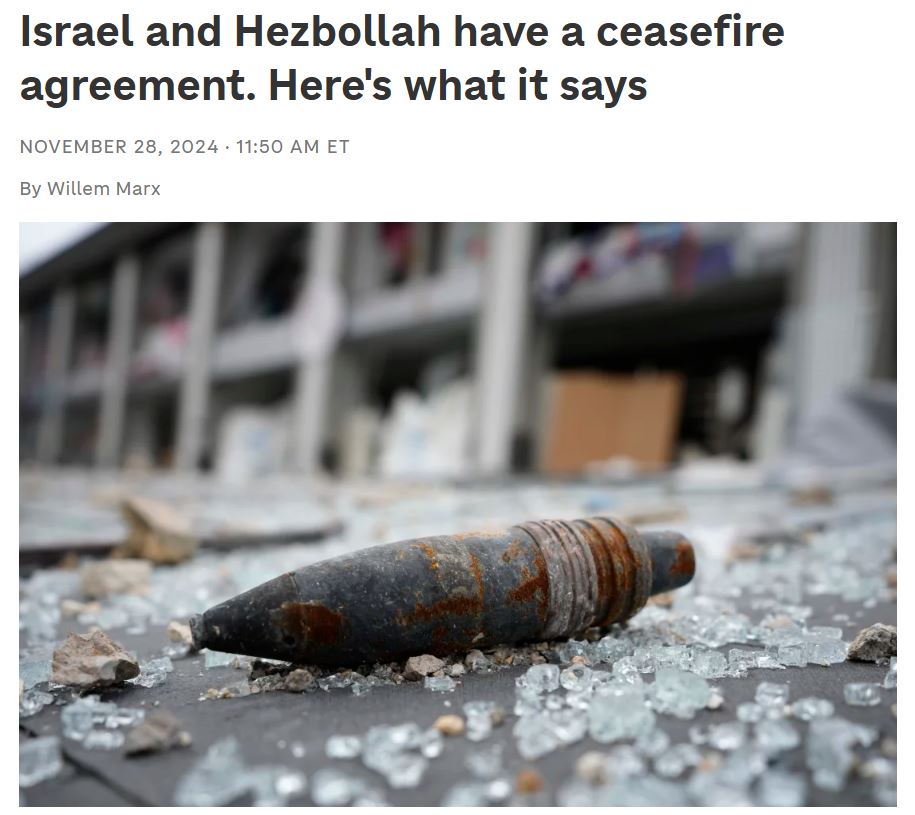
The ceasefire between Israeli troops and the Hezbollah militia is good news in an area deep in armed conflicts. After a year-long period of hostilities, we must strive so that the ceasefire holds, becomes permanent, and that the United Nations (UN) forces are able to carry out their mandate.
The ceasefire between Israeli forces and those of Hezbollah started at 4 AM on November 27, 2024, a conflict that has killed some 4,000 people, displaced more than one million in Lebanon and some 60,000 in Israel. As the ceasefire started, some Lebanese were already starting to return to their homes at day light although many houses in villages near the frontier have been destroyed.
The “Cessation of Hostilities” text which sets out the terms of the ceasefire calls for the ability of civilians on both sides of the Blue Line (the de facto border between Lebanon and Israel) to return safely to their lands and homes.
The ceasefire was negotiated by diplomats from the USA and France. Amos Hochstein was the lead United States (U.S.) negotiator. The U.S. and France will continue to have diplomats to follow the ceasefire process and to deal with any violations or unsolved tensions. There have already been accusations of violations of the ceasefire by both sides. The UN Interim Force in Lebanon (UNIFIL) – some 10,000 soldiers, will again be able to control the Blue Line frontier. There is currently discussion on adding members to the UN force.
The ceasefire was able to be developed as there was a convergence of interests among leaders in Israel, Lebanon, Hezbollah and Iran which is a strong supporter of Hezbollah. Many in Israel, including in the active military, are exhausted by the armed conflicts and must continue operations in the Gaza Strip and the West Bank. Lebanon faces economic and political difficulties provoking a growth of the already strong sectarian tensions. Hezbollah’s military and leadership has been seriously weakened by Israeli actions. However, the movement continues, and new leaders are coming to the fore such as Hassan Fadlallah, a Hezbollah deputy in the Lebanese Parliament. With a new Iranian President and a new U.S. administration, Iran’s leaders may want to see what policies President Trump will develop toward Iran.
Turning the 60-day ceasefire into a permanent peace accord will not be an easy task. There are territorial disputes along the Blue Line which have not been solved in the past, a consequence of the 2006 war. Today, all the parties lack peace-oriented leaders. As noted, the ceasefire is in the current interest of all the leaders, but such situations can change due to internal political factors.
Thus, there is an opportunity for Nongovernmental Organizations to continue promotion of a permanent ceasefire and to advance stability for the region. It is an opportunity for which we must organize with others.
Prof. René Wadlow is President of the Association of World Citizens.
By René Wadlow
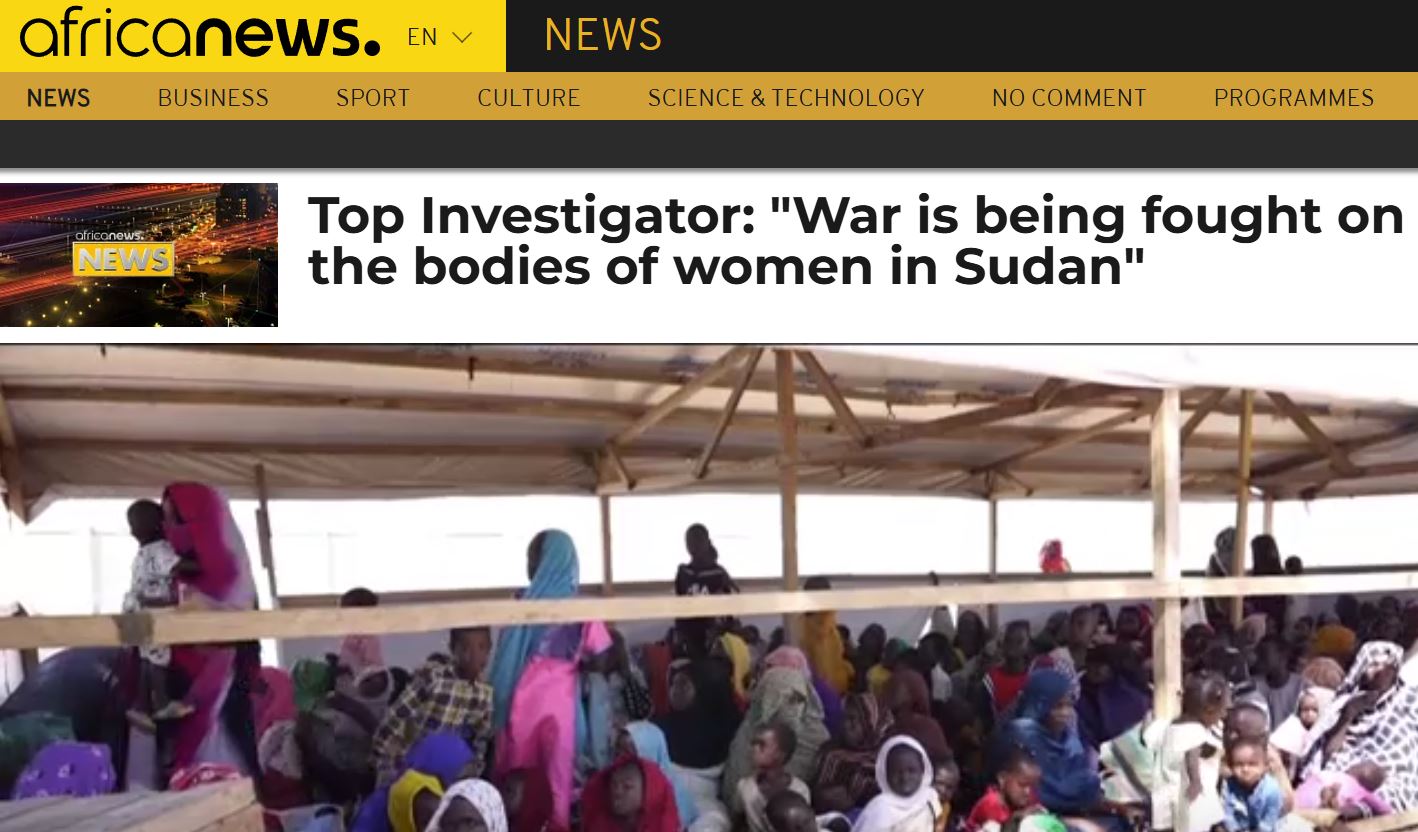
Sudan’s armed conflict which began on April 15, 2023 is between two former allies. On one side is General Abdel Fattah Al Burham of the Sudanese Armed Forces; on the other side is General Mohamed Hamdan Dagulo, known by his battle name of Hemedhi of the Rapid Support Forces. The conflict, which has spread to 14 of the 18 provinces of Sudan, has killed and wounded tens of thousands of civilians, displaced nearly 8 million people, and forced over two million to flee to neighboring countries. The agriculture of the country is disorganized, and many people face acute hunger.
There has been an appalling range of human rights and international humanitarian law violations including indiscriminate airstrikes and shelling against civilians, hospitals, and vital water services. The warring parties and their respective militia allies have made rape a weapon of war and have organized markets where women are sold for sexual slavery.
Rape harms not only the woman raped but also the whole family system. Often, the husband repudiates his wife. The whole family may scorn her. In a country where “the family” is a wide circle of people, the repudiated woman has few people to whom to turn for support. As was done by the “Islamic State” (IS, or Da’esh) in Iraq and Syria, sexual slave markets have been created where women are bought or exchanged.
So far, efforts by the United Nations (UN) and regional governments for a ceasefire and negotiations have not led to constructive action. Thus, the conflictual situation requires close cooperation among UN agencies, humanitarian and peace Nongovernmental Organizations.
Prof. René Wadlow is President of the Association of World Citizens.
By René Wadlow
War and armed violence are highly destructive of the lives of persons, but also of works of art and elements of cultural heritage. Knowledge and understanding of people’s past can help current inhabitants to develop their identity and to appreciate the value of their culture and heritage. Such knowledge and understanding enriches their lives and enables them to manage contemporary problems more successfully.
Since September 23, 2024, the armed conflict between the Israeli armed forces and the Hezbollah militia in Lebanon has led to increased air attacks by Israeli forces on different parts of Lebanon, resulting in deaths and the uprooting of a large number of people. Hezbollah had begun hostilities on October 8, 2023 by shelling Israeli positions in support of Hamas.
The Association of World Citizens (AWC) had called for a reduction of Israeli-Hezbollah tensions and has since called for a ceasefire and for the return of persons displaced in the areas on both sides of the Israel-Lebanon frontier. (See our Appeal of September 2024).
This AWC Appeal concerns the protection of cultural heritage as Israeli attacks have already harmed cultural heritage sites in Baalbek and Tyr as well as other culutral sites. Lebanon has a rich past going back to Biblical and Roman times.
After the Second World War, UNESCO had developed international conventions on the protection of cultural and educational bodies in time of armed conflict. The most important of these is the 1954 Hague Convention for the Protection of Cultural Property in the Event of Armed Conflict. The Hague Convention has been signed by a large number of States.
The 1954 Hague Convention builds on the Roerich Peace Pact first proposed by the Russian painter and champion of Asian culture, Nicholas Roerich. The Roerich Peace Pact was signed on April 15, 1935 by 21 States in a Pan American Union ceremony at the White House in Washington, D.C.

At the signing, Henry A. Wallace, then United States (U.S.) Secretary of Agriculture and later Vice-President, said, “At no time has such an ideal been more needed. It is high time for the idealists who make the reality of tomorrow, to rally around such a symbol of international cultural unity. It is time that we appeal to that appreciation of beauty, science, education which runs across all national boundaries to strengthen all that we hold dear in our particular governments and customs. Its acceptance signifies the approach of a time when those who truly love their own nation will appreciate in addition the unique contributions of other nations and also do reverence to that common spiritual enterprise which draws together in one fellowship all artists, scientists, educators and truly religious of whatever faith. Thus we build a world civilization which places that which is fine in humanity above that which is low, sordid and mean, that which is hateful and grabbing.”
We still have efforts to make so that what is fine in humanity is above what is hateful and grabbing. The AWC strives so that a start will begin in Lebanon and spread to the wider Middle East.
Prof. René Wadlow is President of the Association of World Citizens.
By René Wadlow
On October 21, 2024, prior to the meeting of the Indian leader, Narendra Modi, and the Chinese leader, Xi Jinping, the Indian Minister of Foreign Affairs, Subrahmanyam Juishankar, announced that an accord had been reached between Indian and Chinese authorities for a reduction of tensions along the 3,500-kilometer frontier between the two countries.
In 2020, there had been exchanges of fire between Indian and Chinese forces in the Tibet-Ladakh frontier area. There then seemed to be real possibilities that the violence would escalate. Thus, the Association of World Citizens (AWC) had made an Urgent Appeal, posted in July 2020 on its website and sent widely to contacts that might be helpful in reducing tensions. Today, the AWC is pleased with the new agreement and re-publishes its original 2020 Appeal.
* * *
July 3, 2020 at 7:52 AM
In a June 24, 2020 message to the Secretary General of the Shanghai Cooperation Organization, Mr. Vladimir Novov, the Association of World Citizens (AWC) expressed its active concern with the June 15 death of Indian and Chinese military in the Galwan River Valley in Ladakh on the India-China frontier and the possibility that the tensions will increase. While there have been brief discussions among Indian and Chinese authorities to prevent escalation, there have been no real negotiations. Negotiation is a basic political decision-making process, to facilitate compromise without loss of essential objectives.

The Indian Ministry of External Affairs said on June 25 that since early May, the Chinese have been amassing a large contingent of troops and arms along the Line of Actual Control (LAC). Also, within India, there has been a good deal of media attention, highly critical of China, given to the events. In addition, there have been calls for a boycott of Chinese goods, and some Chinese products have been removed from Indian shops. Both Indian and Chinese spokespersons have made references to the 1962 war during which some 2,000 persons were killed.
The AWC believes that there is a need for prompt measures as the India-China tensions add to existing tensions between the USA and China as well as boundary issues with Asian States in the South China Sea.
There may be a role for “Track II” nongovernmental efforts and exchanges. Track I is official government to government diplomacy among instructed representative of States, usually diplomats from the Foreign Ministry. However, governments have a range of officials on whom to call: intelligence agencies, the military, and “friends of the President” – trusted individuals within the executive entourage.

Track II efforts are organized through nongovernmental organizations and sometimes by academic institutions. Such efforts can entail informal, behind the scene communications that take place in the absence of formal communication channels. The term “Track II” was coined by the U. S. diplomat Joseph Montville in The Arrow and the Olive Branch: A Case for Track II Diplomacy.
Track II efforts have grown as there is increasing recognition that there is a tragic disjunction between the United Nations tension-reduction mandate and its ability to intervene in conflicts when called upon. As Adam Curle, experienced in Quaker mediation efforts has written “In general governments achieve their results because they have power to influence events, including the ability to reward or to punish. Paradoxically, the strength of civilian peacemakers resides specifically in their lack of power. They are neither feared nor courted for what they can do. Instead, they are trusted and so may sometimes be enabled to play a part in peacemaking denied to most official diplomats.”
Those involved in Track II efforts must, nevertheless, have ready access to governmental decision-makers and Track I diplomats. As the World Citizen and Quaker economist Kenneth Boulding in a little verse writes,
“When Track One will not do,
We have to travel on Track Two
But for results to be abiding,
The Tracks must meet upon some siding”.
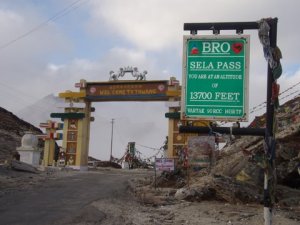
In the China-India frontier tensions, both sides must be convinced that there is a considerable sentiment for peace among their own supporters. In this conflict, which could slip into greater violence, there is an understandable tendency to look for short term answers. Yet there is also a need for some involved in Track II efforts to have an over-all integrated perspective for both short as well as long-term transformation. Thus, there needs to be a “pool” of people with experience, skills and the ability to move fast when the need or the opportunity is there?
We are sure that there are groups in India and China which can rise to meet this challenge.
Prof. René Wadlow is President of the Association of World Citizens.
By René Wadlow
There is increasing discussion concerning the Gaza Strip, its relation to the West Bank, and “the day after” when there is a ceasefire, people return to their home area, and reconstruction begins. The Association of World Citizens (AWC) had proposed in a written text to the United Nations (UN) Human Rights Council (A/HRC/5-12/NGO /1, October 14, 2009) the creation of a Gaza Development Corporation, a strong, future-oriented positive vision influenced by the Tennessee Valley Authority (TVA) of the “New Deal” of the USA and a Jordan Valley Authority proposed in the early 1950s.
The AWC proposal had been first submitted to the representatives of governments and the UN Secretariat for an international funding conference for the Palestinian Authority held in Paris in December 2007. At the funding conference, the World Bank representative, much in the spirit of the AWC proposal, stressed the need to integrate an economically vigorous Palestine into the wider geographic context. Such a wider economic zone would include Israel, Palestine, Lebanon, Syria, and Jordan. The World Bank representative highlighted that prosperity depends on liberating the economic potential of the Palestinian refugees and their descendants.
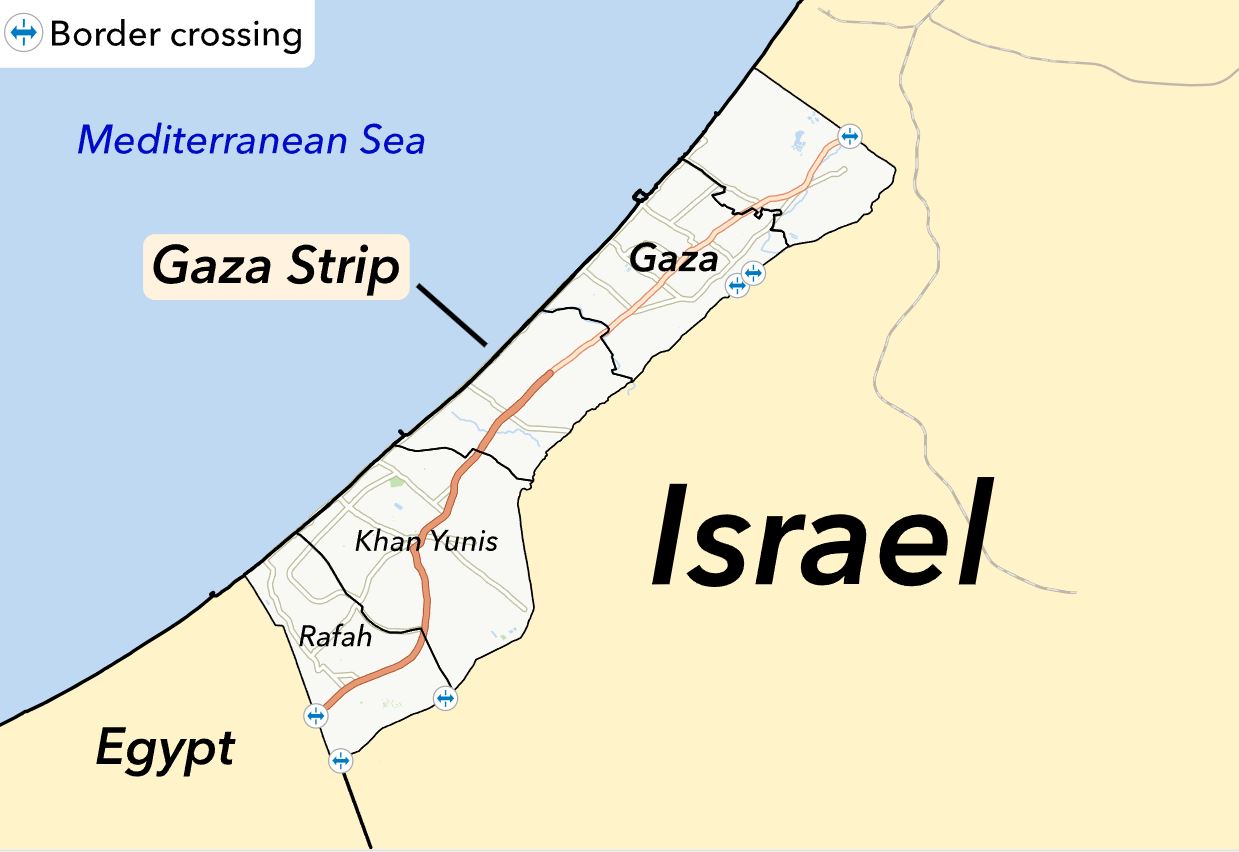
Unfortunately, the Gaza Development Corporation was not acted upon at the Paris funding meeting, nor in its follow up phase. Creating a framework and institutions to help the people of the Gaza Strip and the wider region will not be easy. However, difficult times call for political creativity. Thus, the AWC re-proposes for consideration the creation of a Gaza Development Corporation.
The TVA was created in May 1933 to help overcome the deep economic depression in the USA. President Franklin Roosevelt, in his message to Congress, suggested that the Authority should be a “corporation clothed with the power of Government but possessed of the flexibility and initiative of a private enterprise. It should be charged with the broadest duty of planning for the proper use, conservation and development of the natural resources of the Tennessee River drainage basin and its adjoining territory for the general social and economic welfare of the Nation… This in a true sense is a return to the spirit and vision of the pioneer. If we are successful here, we can march on, step by step, in the development of other great natural territorial units.”
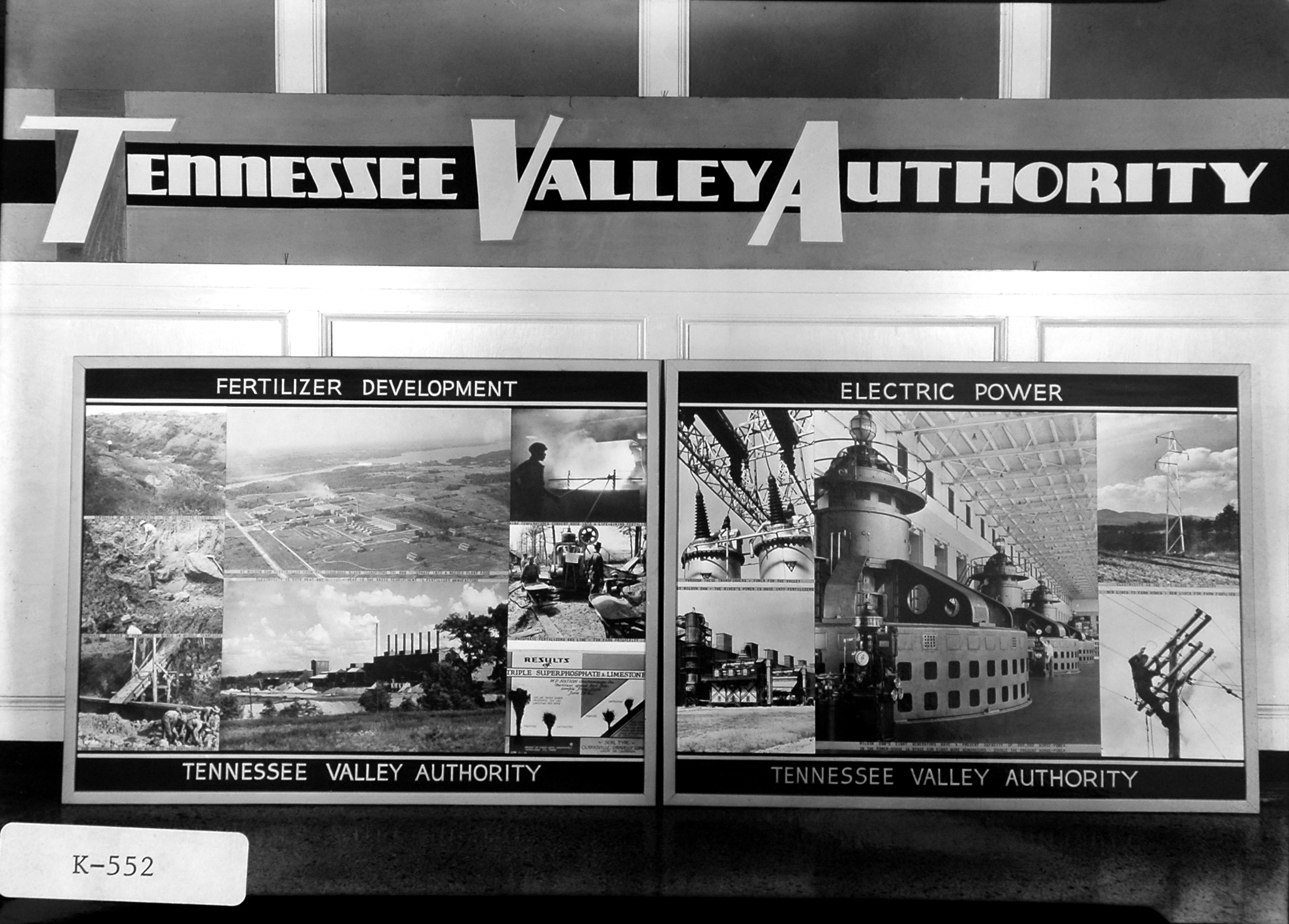
The central idea of the TVA was that it should do many things, all connected with each other. To do all these activities well, it had to be a public corporation, public because it served the public interest, a corporation rather than a government department, so that it could initiate the flexible, responsive management of a well-run private business. As Stringfellow Barr wrote in his book Citizens of the World (New York: Doubleday and Co, 1952, 285 pp), “The great triumph of the TVA was not the building of dams. Great dams had been built before. The greatest triumph was that it not only taught the Valley people but insisted on learning from them too. It respected persons.”
Strong socioeconomic structures are needed which can be maintained during periods of inevitable future tensions. As Jean Monnet, one of the fathers of the European Common Market has said, “Men take great decisions only when crisis stares them in the face.” Just as the first steps of the European Common Market had to overcome the deep wounds of the Second World War, so the situation in the Gaza Strip and the wider area needs to break the strong psychological barriers with cooperative economic measures from which many can benefit and negotiations in good faith”.
Prof. René Wadlow is President of the Association of World Citizens.
By René Wadlow
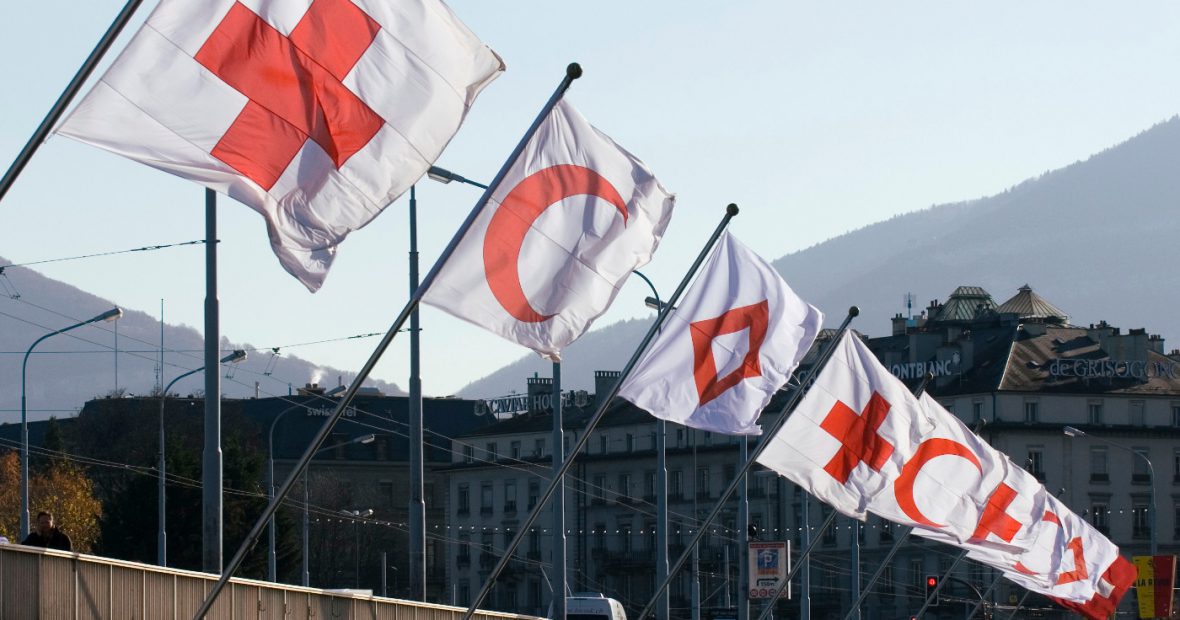
The armed conflicts in the Middle East: Israel-Palestine, Lebanon, Syria, Iraq, Iran, Yemen have led to increased violations of International Humanitarian Law. Medical facilities and medical personnel have been attacked; civilians have been targeted, educational facilities destroyed. Therefore, the Association of World Citizens (AWC) makes an urgent call for the respect of International Humanitarian Law. This must be a joint effort of governments and Nongovernmental Organizations.
Regular military personnel of all countries are theoretically informed of the rules of the Geneva Conventions of August 12, 1949, and the Protocol Additional adopted in 1977.
When the 1949 Geneva Conventions were drafted and adopted, it was possible to spell out in considerable detail rules regarding prisoners of war and the protection of civilians, in particular Common Article 3 (so called because it is found in all four Conventions) provides that “each Party to the conflict shall be bound to apply, as a minimum, the following provisions: Persons taking no active part in the hostilities … shall in all circumstances be treated humanely without any adverse distinction founded on race, color, religion or faith, sex, birth or wealth, or any other similar criteria.”
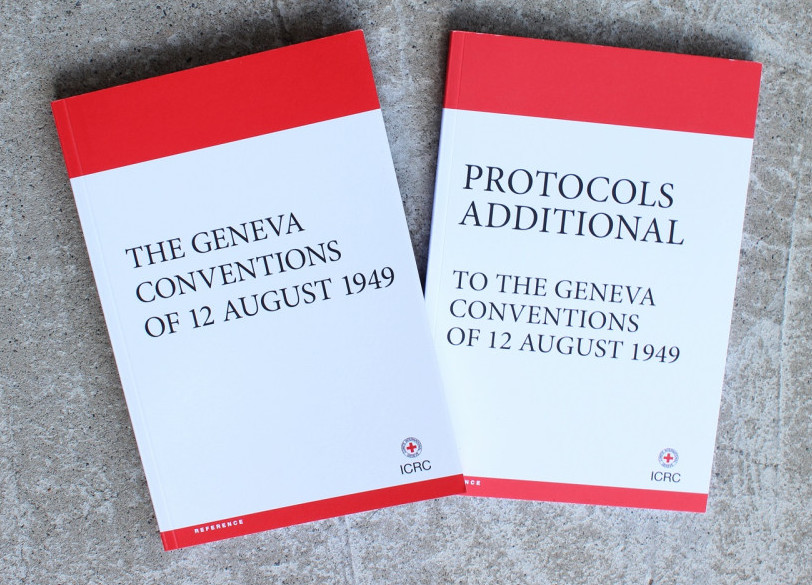
The importance of Common Article 3 should not be underestimated. It sets out in straightforward terms important protections that all parties to a conflict must respect. In order to meet the need for additional protection, international humanitarian law has evolved to cover not only international armed conflict but also internal armed conflict. Today, international human rights standards are also considered part of international humanitarian law, thus providing additional protection for vulnerable population groups such as women, children, and minorities.
As situations of internal violence and strife proliferate, abuses committed by non-State actors, such as armed militias, are increasing concerns. Fundamental standards of international humanitarian law are intended to ensure the effective protection of human beings in all situations. The standards are clear. (1)
There are two major weaknesses in the effectiveness of international humanitarian law. The first is that many people do not know that it exists and that they are bound by its norms. Thus, there is an important role for greater promotional activities, the dissemination of information through general education, specific training of the military, outreach to armed militias, and cooperation with a wide range of nongovernmental organizations.
The second weakness is that violations of international humanitarian law are rarely punished. Governments too often tolerate these violations. Few soldiers are tried, or courtmartialed, for the violations of international humanitarian law. This weakness is even more true of nongovernmental militias and armed groups.
In fact, most violations of international humanitarian law are not actions of individual soldiers or militia members carried away by a sudden rush of anger, fear, a desire of revenge or a sudden sexual urge to rape a woman. Soldiers and militia members violating the norms of international humanitarian law are acting on orders of their commanders.
Thus, the only sold response is an act of conscience to refuse an order of a military or militia higher up and refuse to torture, to bomb a medical facility, to shoot a prisoner, to harm a child, and to rape a woman. Conscience, that inner voice which discerns what is right from wrong and encourages right action is the value on which we can build the defense of international humanitarian law. The defense of conscience to refuse unjust orders is a large task but a crucial action for moving toward a law-based world society.
Notes
(1) For useful guides to international humanitarian law see:
D. Schindler and J. Toman, The Laws of Armed Conflicts (Martinus Nihjoff Publishers, 1988)
H. McCoubrey and N.D. White, International Law and Armed Conflicts (Dartmouth Publishing Co., 1992)
Prof. René Wadlow is President of the Association of World Citizens.
By René Wadlow
October 7-8, 2024 will mark one year of armed conflict between Israeli forces and the Hamas militia – an armed conflict which grinds on and has spread.
On October 8, 2023, in light of the October 7 Hamas attack and the start of the Israeli response in the Gaza Strip, the Association of World Citizens called for five immediate steps that it hoped would create a climate of dialogue and the start of negotiations in good faith. The proposals were posted on the World Citizens’ website, sent to the Israeli Missions to the United Nations (UN) and to groups that might have avenues of communication with Hamas.
“As Citizens of the World, we call for a ceasefire in the Israeli-Palestinian armed conflict;
For the release of all hostages held by Hamas and other Palestinian groups;
For the release of all Palestinian prisoners held in Israeli jails, often under administrative detention without trial;
For preventing the extension of the conflict to the Lebanon frontier through negotiations with Hezbollah;
For preventing an increase in violence on the West Bank among Israeli settlers and Palestinian villages;
For the start of negotiations in good faith for a political solution that ensures freedom and the collective safety of Israelis and Palestinians.”
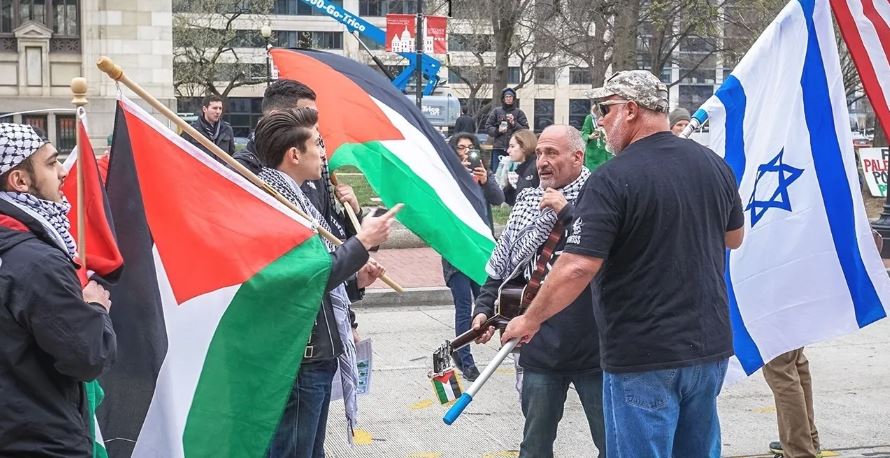
A year later, the armed violence has increased: in Gaza with a high number of persons killed, wounded and displaced, on the West Bank, in Lebanon, has expanded to Iran and brought in elements of the conflict in Yemen.
There have been relevant resolutions of the UN General Assembly, of the International Court of Justice, and appeals for a ceasefire and negotiations from many Nongovernmental Organizations (NGOs).
Due to the spiraling growth of destruction, as NGOs we must continue and increase our efforts.
Prof. René Wadlow is President of the Association of World Citizens.
 Association of World Citizens