The Official Blog of the

Archive for the ‘Middle East & North Africa’ Category

Sergio Vieira de Mello, un héros des Droits de l’Homme

In Being a World Citizen, Human Rights, Middle East & North Africa, The Search for Peace, United Nations, World Law on August 18, 2013 at 10:01 PM

SERGIO VIEIRA DE MELLO, UN HEROS DES DROITS DE L’HOMME

Par Bernard Henry

Il y a dix ans jour pour jour, le 19 août 2003, Sergio Vieira de Mello trouvait la mort dans l’attentat contre l’Hôtel Canal à Bagdad.

Citoyen brésilien, francophone de culture, Sergio Vieira de Mello s’était imposé au plus haut du système de l’ONU comme un incontournable des missions de maintien de la paix et de nation-building, dans ces années 1990 qui avaient vu la redistribution des cartes au niveau mondial et l’émergence de nouvelles urgences dans des pays où les conflits gelés par la Guerre Froide avaient repris leurs droits.

Après s’être illustré aux côtés de Bernard Kouchner au Kosovo, Sergio Vieira de Mello avait pris la suite de l’ancienne Présidente irlandaise Mary Robinson au poste de Haut Commissaire des Nations Unies pour les Droits de l’Homme, couronnement d’une carrière consacrée exclusivement à ce domaine dans diverses instances onusiennes, en particulier au sein du Haut Commissariat des Nations Unies pour les Réfugiés.

Devenu Haut Commissaire, Sergio Vieira de Mello n’a pas ménagé ses efforts pour renforcer un Haut Commissariat encore jeune et mal armé pour réagir rapidement aux atteintes aux Droits de l’Homme qui lui étaient signalées. Il aimait le contact et la coopération étroite avec les représentants d’organisations non-gouvernementales, dont l’AWC.

Après que la « coalition » menée par les Etats-Unis a envahi l’Irak en mars 2003, court-circuitant le Conseil de Sécurité de l’ONU et prétendant rechercher des armes de destruction massives qu’aurait détenu le régime de Saddam Hussein, il a bien fallu que Washington et ses alliés admettent deux évidences. D’une part, les fameuses armes de destruction massive qu’une entrée en force en Irak permettrait à coup sûr de trouver, là où les experts internationaux affirmaient pourtant dès 2002 qu’elles n’existaient pas, n’avaient plus été fabriquées en Irak depuis au moins dix ans et n’existaient effectivement pas. D’autre part, malgré sa victoire militaire, la « coalition » sans existence légale qui occupait l’Irak avait balayé l’ONU d’un revers de main un peu rapide et avait maintenant besoin, comble de l’ironie, de l’assistance de l’Organisation mondiale pour rétablir une légitimité de droit dans le pays.

C’est Sergio Vieira de Mello, lauréat de fraîche date du Prix des Droits de l’Homme des Nations Unies, qui fut choisi comme Représentant spécial du Secrétaire Général – à l’époque Kofi Annan – en Irak, tout en conservant, fait exceptionnel, sa charge de Haut Commissaire aux Droits de l’Homme.

Le mardi 19 août 2003, en début d’après-midi, un camion chargé d’explosifs détruit l’Hôtel Canal à Bagdad, devenu siège de la mission des Nations Unies dans le pays. Sergio Vieira de Mello est grièvement touché, et faute par les secours de pouvoir le sortir à temps des débris, il succombe à ses blessures. L’attaque est revendiquée par Abou Moussab al-Zarqaoui, chef d’Al-Qaïda en Irak, dont l’un des lieutenants, Abou Omar al-Kurdi, directement impliqué dans l’attentat, sera arrêté en 2005.

Inhumé le 28 août 2003, Sergio Vieira de Mello repose au Cimetière des Rois à Genève, ville abritant les Hauts Commissariats de l’ONU pour les Réfugiés et aux Droits de l’Homme.

Aucun Défenseur des Droits de l’Homme ne cherche à être un héros, et s’il le fait, il a tort. Certains le deviennent, contre leur gré, sans s’y attendre. Et le premier héros des Droits de l’Homme de ce siècle encore jeune, c’est Sergio Vieira de Mello.

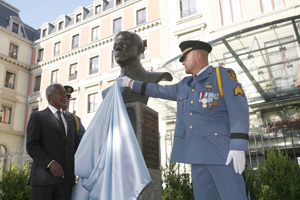
Après la mort de Sergio Vieira de Mello, l'ONU lui a dédié un mémorial, en l'occurrence un buste qui orne l'entrée du siège du Haut Commissariat des Nations Unies pour les Droits de l'Homme.

Après la mort de Sergio Vieira de Mello, l’ONU lui a dédié un mémorial, en l’occurrence un buste qui orne l’entrée du siège du Haut Commissariat des Nations Unies pour les Droits de l’Homme à Genève. Un hommage mérité à ce grand serviteur des Droits de l’Homme et de la paix.

Bernard Henry est Officier des Relations Extérieures du Bureau de Représentation auprès de l’Office des Nations Unies à Genève de l’Association of World Citizens.

World Citizens Call for the Unconditional Respect of the Right to Life, Liberty and Security of Person in Egypt

In Conflict Resolution, Current Events, Democracy, Human Rights, Middle East & North Africa, United Nations, World Law on August 16, 2013 at 1:58 PM

-- AWC-UN Geneva Logo --

WORLD CITIZENS CALL FOR THE UNCONDITIONAL RESPECT OF THE RIGHT TO LIFE, LIBERTY AND SECURITY OF PERSON IN EGYPT

Paris & Geneva, August 16, 2013


The Association of World Citizens (AWC) is gravely concerned at the serious human rights violations which have been committed in recent weeks by both the security and armed forces and the Muslim Brotherhood movement in Egypt.

Thus, the AWC welcomes the August 15 Appeal of the United Nations Security Council urging both the Egyptian Government and the Muslim Brotherhood to exercise “maximum restraint” with a view to ending the violence which has spread across the country.  The military-police-security forces confronted the predictable resistance of pro-Morsi forces with a brutal show of force designed to instill fear and submission but gave rise instead to a collective display of resolve-until-death and a readiness for martyrdom.

However, the AWC stresses that more than “maximum restraint” is needed. The majority of Egyptians desire a more representative government based on respect for human rights which will provide the basis for a much-needed economic recovery.

The AWC underlines the need for strong civil society institutions and Nongovernmental Organizations (NGOs). Both domestic and international NGOs working for freedom of expression, religious freedom and women’s rights have been under unwarranted pressure.

The AWC has protested the recurrent violent attacks carried out by Muslim Brotherhood supporters against the Coptic Christians of Egypt, a community that has been for two and a half years the target of outrageous sectarian violence, including the August 14-15 burning of some 14 Coptic churches in reprisal attacks to the police violence against pro-Morsi sit-in protesters.

Article 3 of the Universal Declaration of Human Rights clearly provides that “Everyone has the right to life, liberty and security of person ». This right belongs to everyone, not just to people who think as we do. Democracy and the rule of law should never be a one-way flow.

The AWC therefore calls on the Egyptian Government, including the police and armed forces, to ensure at all times full respect for human rights in the maintenance of public order, and on the Muslim Brotherhood party to refrain from any actions that are not strictly related to the right to peaceful demonstration, and unequivocally condemn any such actions committed by its members.

The AWC further urges that immediate, special protection be given to the Coptic Christian community and any other national, religious or other minorities that may find themselves in harm’s way due to the current unrest in Egypt.

Finally, the AWC is concerned with the consequences of the proclamation of the one-month State of Emergency across the country.  Past States-of-Emergency periods have always opened the door to human rights abuses and to military authoritarianism. Therefore, the AWC calls for a speedy return to civilian rule, new democratic elections, and a new constitution which places human rights as a core value.

Orages d’été sur le printemps arabe

In Current Events, Democracy, Human Rights, Middle East & North Africa on August 14, 2013 at 11:28 PM

ORAGES D’ETE SUR LE PRINTEMPS ARABE

Par Bernard Henry

La lutte pour la liberté n’est pas une suite logique. Elle ne l’a jamais été.

Au début de l’année 2011, le monde entier a été pris de cours par le « printemps arabe », quand les révoltes populaires ont chassé les dictateurs en place de longue date en Tunisie puis en Egypte, celle de Libye ayant en revanche été déviée de sa trajectoire et celle de Syrie s’étant perdue depuis dans les méandres de l’islamisme.

Puis ce fut, quelques mois plus tard, l’ « automne islamiste », avec la victoire de l’Islam politique lors des scrutins démocratiques tunisien et égyptien. Lentement mais sûrement, les anciens persécutés ont pris à leur tour le chemin de l’autoritarisme en y injectant leur idéologie réactionnaire.

Deux ans plus tard, le mois d’août apporte ses « orages d’été » aux révolutions arabes, lorsqu’une violence largement absente des soulèvements populaires du départ s’invite à l’ultime stade de l’exaspération pour venir réclamer son tribut.

L’Egypte, premier pays du printemps arabe à avoir destitué son gouvernement islamiste post-révolutionnaire, entre aujourd’hui dans un état d’urgence né d’affrontements entre forces armées et Frères musulmans, non sans que les partisans du Président déchu Mohamed Morsi se soient livrés entre temps à des actes de barbarie contre les Coptes du pays.

En Tunisie, une population poussée à bout par un pouvoir provisoire entièrement rendu à la volonté d’Ennahda, le parti islamiste qui dirige le gouvernement, et dont les assassinats successifs des dirigeants politiques d’opposition Chokri Belaïd et Mohamed Brahmi ont eu raison de ce qu’il pouvait encore lui rester de patience, paie le prix fort pour son choix de la protestation non-violente, sous les coups des milices islamistes tolérées voire encouragées par les pouvoirs publics.

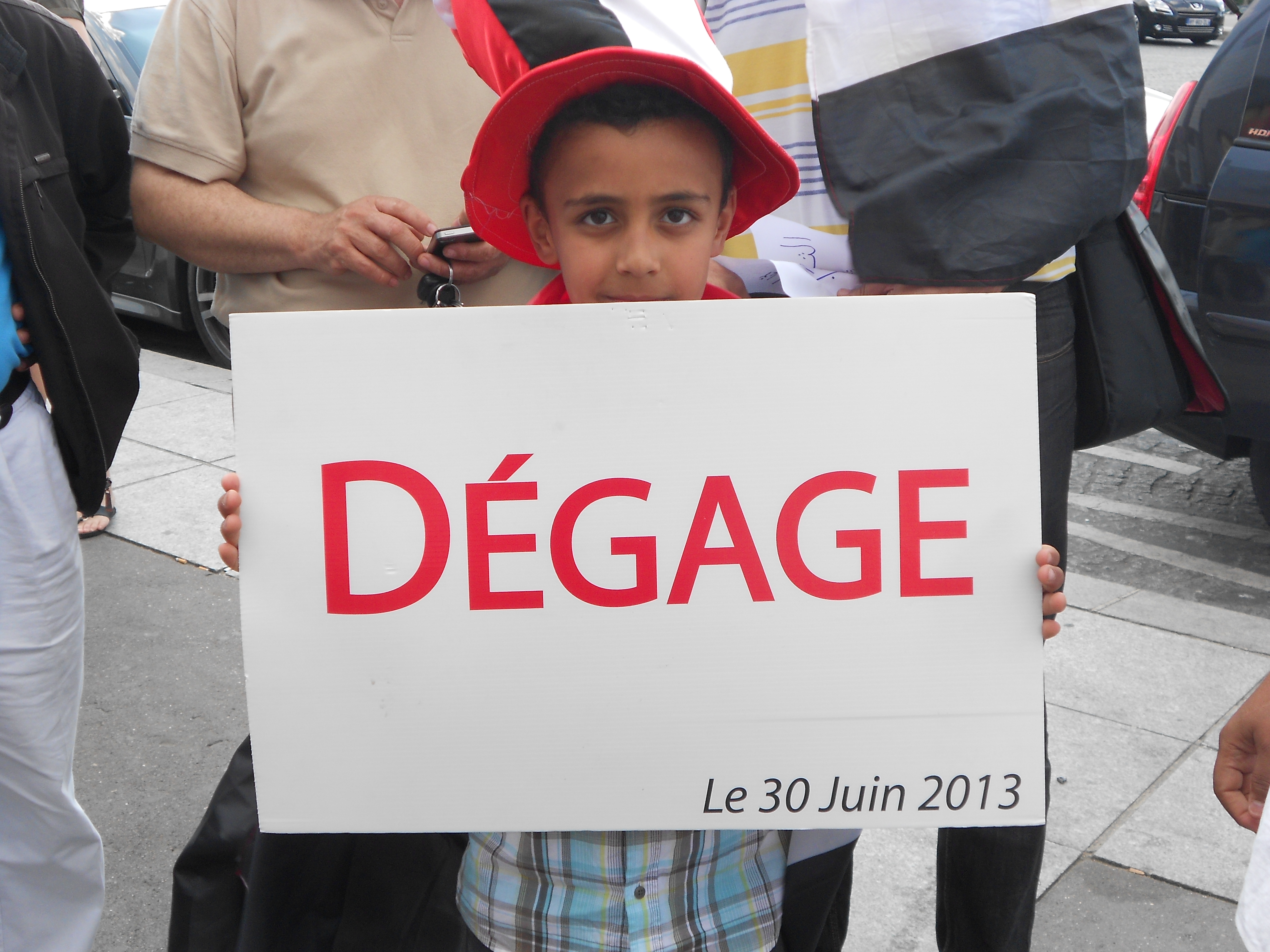
En Tunisie comme en Egypte, le peuple n'avait qu'un seul mot à dire à ses dictateurs respectifs : "Dégage". Aujourd'hui, tant les islamistes vainqueurs des élections libres ont trahi les espoirs des révolutions dans les deux pays, c'est à eux que ce court et simple slogan révolutionnaire est désormais destiné.

En Tunisie comme en Egypte, le peuple n’avait qu’un seul mot à dire à ses dictateurs respectifs : “Dégage”. Aujourd’hui, tant les islamistes vainqueurs des élections libres ont trahi les espoirs des révolutions dans les deux pays, c’est à eux que ce court et simple slogan révolutionnaire est désormais destiné.

L’iconographie de la lutte victorieuse d’un peuple armé de sa seule détermination pour faire chuter la dictature, contre toute attente et contre les certitudes de politologues vouant le monde arabe à la tyrannie ou à l’islamisme, a vécu. Mais le mythe de l’ « islamo-démocratie », vantée par Moncef Marzouki lors d’une visite à l’Assemblée nationale française et symbolisée aux yeux de certains par l’AKP au pouvoir en Turquie, a vécu lui aussi.

Les partis islamistes ne doivent jamais oublier que, même pris pour cibles sous les régimes Ben Ali et Moubarak, ils ne sont en rien, comme ils le prétendent, les auteurs des révolutions arabes. Ils n’ont fait que récolter a posteriori les fruits des luttes menées par d’autres. Quant aux gouvernants, aujourd’hui égyptiens et peut-être demain tunisiens, issus du rejet de l’islamisme, leur volonté de condamner les atteintes aux Droits de l’Homme même commises à l’encontre de leurs adversaires islamistes montrera (ou non) leur aptitude à se réclamer de cet Etat de droit qu’ils invoquaient hier contre l’islamisme au pouvoir.

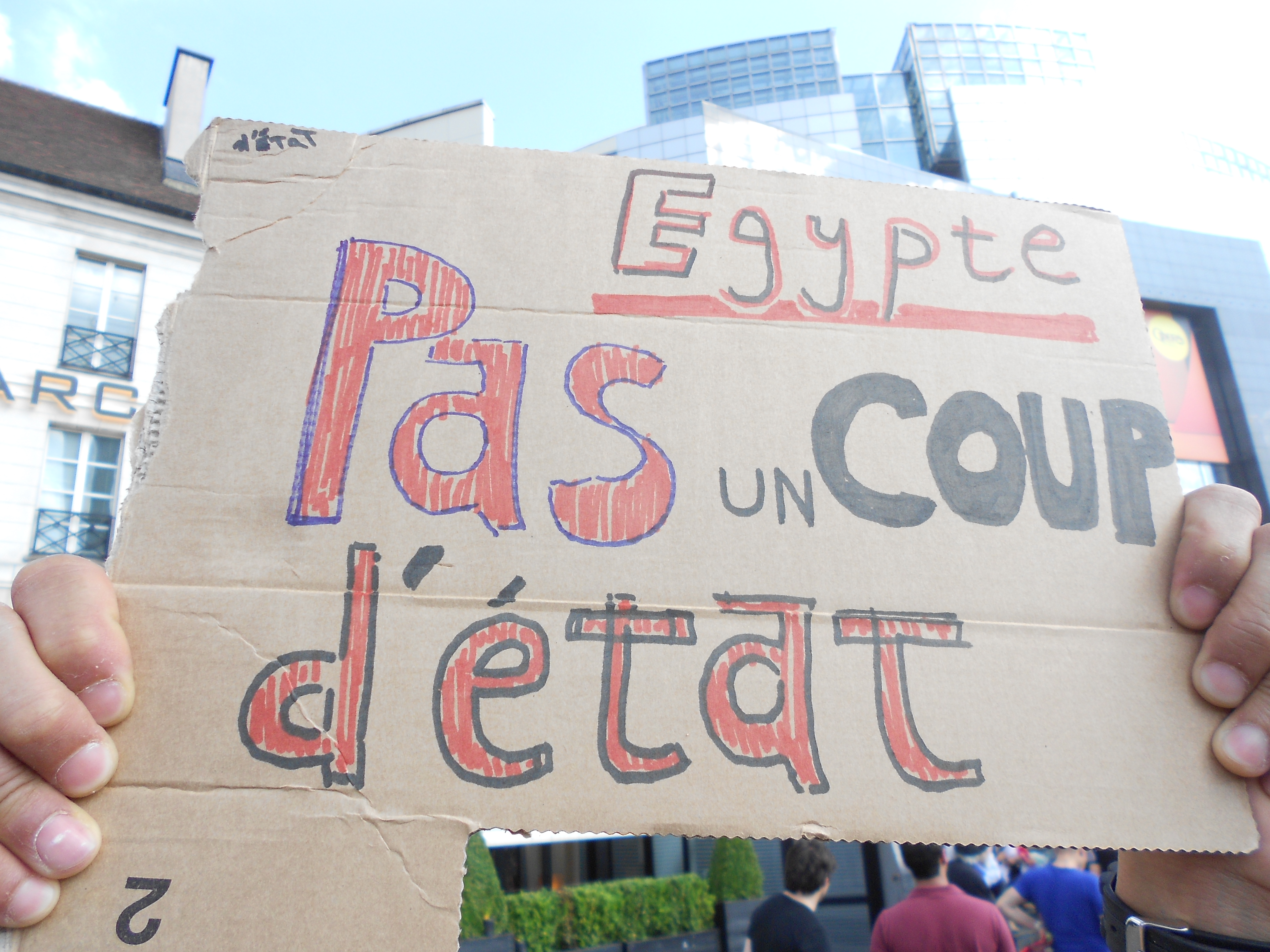
Une pétition nationale avait recueilli plus de 22 millions de signatures d’Égyptiens pour le départ du Président élu islamiste Mohamed Morsi, d'où le refus du terme "coup d'Etat" par les militants démocrates égyptiens. Mais aujourd'hui, les forces armées du pays qui avaient dans un premier temps soutenu le mouvement semblent voir les choses tout autrement ...

Une pétition nationale avait recueilli plus de 22 millions de signatures d’Égyptiens pour le départ du Président élu islamiste Mohamed Morsi, d’où le refus du terme “coup d’Etat” par les démocrates égyptiens. Mais aujourd’hui, hélas, les forces armées du pays qui avaient dans un premier temps soutenu le mouvement semblent voir les choses tout autrement …

Etre élu ne donne pas tous les droits et renverser une dictature n’autorise pas à en créer une autre. Quand les uns et les autres accepteront chacun de ces deux principes, et seulement à ce moment-là, cesseront les « orages d’été » du printemps arabe.

Bernard Henry est Officier des Relations Extérieures du Bureau de Représentation auprès de l’Office des Nations Unies à Genève de l’Association of World Citizens.

Les Citoyens du Monde en appellent au Gouvernement de la Turquie pour le respect du droit des citoyens à manifester pacifiquement

In Conflict Resolution, Current Events, Democracy, Human Rights, Middle East & North Africa on June 4, 2013 at 11:12 PM

awc-un-geneva-logo

LES CITOYENS DU MONDE EN APPELLENT

AU GOUVERNEMENT DE LA TURQUIE

POUR LE RESPECT DU DROIT DES CITOYENS

A MANIFESTER PACIFIQUEMENT

Paris & Genève, le 4 juin 2013

L’Association of World Citizens (AWC) est gravement préoccupée par les très sérieuses atteintes aux Droits de l’Homme commises ces derniers jours par les forces de sécurité contre les manifestants pacifiques rassemblés au Parc de Taksim Gezi à Istanbul (Turquie), dans un mouvement de protestation dont l’impact s’est entre temps étendu à d’autres parties du pays.

L’AWC est dévouée aux valeurs de respect, de reconnaissance et d’inclusion de toutes les composantes de la société. C’est pourquoi l’AWC appelle le Gouvernement de la Turquie à se montrer attentif aux inquiétudes de celles et ceux qui s’expriment aujourd’hui ainsi qu’à rechercher des solutions permettant d’ouvrir des négociations de bonne foi.

Le droit international des Droits de l’Homme interdit formellement l’utilisation du gaz lacrymogène contre des protestataires pacifiques ainsi que dans des espaces clos où il peut s’avérer extrêmement dangereux, de même que l’usage excessif de la force contre des manifestations non-violentes, l’un et l’autre ayant pourtant été présents dans l’intégralité de la réaction de la police turque aux dernières protestations en date.

Même si le maintien de l’ordre public est une fonction naturelle de tout gouvernement dans une société démocratique, toute décision de disperser un rassemblement doit être prise seulement en ultime recours et toujours en conformité avec les principes de nécessité et de proportionnalité.

Le Code de Conduite des Nations Unies pour les Responsables de l’Application des Lois adopté par l’Assemblée générale de l’ONU en sa Résolution 34/169 du 17 décembre 1979 stipule clairement que « Les responsables de l’application des lois peuvent recourir à la force seulement lorsque cela est strictement nécessaire et dans la mesure exigée par l’accomplissement de leurs fonctions ».

L’AWC appelle donc le Premier Ministre Reçep Tayyip Erdogan à ordonner promptement une enquête indépendante et impartiale sur tout signalement d’utilisation excessive et non nécessaire de la force, à s’assurer que tout responsable de l’application des lois reconnu responsable d’usage arbitraire ou abusif de la force soit promptement traduit en justice et, bien sûr, à garantir pleinement les légitimes droits à la réunion pacifique et à la liberté d’expression pour tous les citoyens de la Turquie.

World Citizens Call on the Government of Turkey to Respect the Right of Citizens to Peaceful Demonstration

In Conflict Resolution, Current Events, Democracy, Human Rights, Middle East & North Africa on June 4, 2013 at 3:36 PM

awc-un-geneva-logo

WORLD CITIZENS CALL

ON THE GOVERNMENT OF TURKEY

TO RESPECT THE RIGHT OF CITIZENS

TO PEACEFUL DEMONSTRATION

Paris & Geneva, June 4, 2013

The Association of World Citizens (AWC) is gravely concerned at the serious human rights violations which have been committed in recent days by the security forces against peaceful demonstrators gathered at Taksim Gezi Park in Istanbul, Turkey, in a movement of protest which has had impact on other parts of the country.

The AWC is devoted to the values of respect, recognition and inclusion of all segments of societies. Thus, the AWC calls upon the Government of Turkey to be attentive to the concerns of those now expressing themselves and to find ways of starting good faith negotiations.

International human rights law strictly prohibits the use of tear gas against peaceful protestors and in confined spaces where it may constitute a serious danger, as well as excessive force against nonviolent demonstrations, as has been seen in both cases throughout the Turkish police’s response to the latest protests.

Even though maintaining public order is a natural function of government in a democratic society, any decision to disperse an assembly should be taken only as a last resort and in line with the principles of necessity and proportionality.

The United Nations Code of Conduct for Law Enforcement Officials adopted by the UN General Assembly in its Resolution 34/169 of December 17, 1979 clearly provides that “Law enforcement officials may use force only when strictly necessary and to the extent required for the performance of their duty.”

The AWC thus calls upon Prime Minister Reçep Tayyip Erdogan to order a prompt, independent and impartial investigation into all reports of excessive and unnecessary use of force, ensure that any law enforcement officials responsible for arbitrary or abusive use of force are promptly prosecuted and, of course, fully guarantee the legitimate rights to peaceful assembly and freedom of expression of all citizens of Turkey.

L’AWC DEMANDE VÉRITÉ ET JUSTICE POUR CHOKRI BELAÏD

In Conflict Resolution, Current Events, Democracy, Human Rights, Middle East & North Africa, The Search for Peace, World Law on February 6, 2013 at 3:39 PM

awc-un-geneva-logo

COMMUNIQUE


Genève, Mercredi 6 Février 2013


L’AWC DEMANDE VERITE ET JUSTICE APRES L’ASSASSINAT

DU DIRIGEANT POLITIQUE CHOKRI BELAÏD EN TUNISIE

L’Association of World Citizens (AWC), organisation non-gouvernementale internationale œuvrant pour le respect de l’Etat de droit et le dialogue politique dans les Etats en crise ou en conflit armé, s’indigne de l’assassinat de Maître Chokri Belaïd, avocat tunisien, Secrétaire général du Mouvement des Patriotes démocrates et ancien membre de la Haute instance pour la Réalisation des Objectifs de la Révolution, de la Réforme politique et de la Transition démocratique en Tunisie.

Qui que l’on prenne pour cible, l’assassinat n’est jamais admissible dans une démocratie. Négation ultime de l’état de droit en politique, il est l’arme exclusive de ceux qui voudraient faire prévaloir l’ordre de la terreur et la loi du plus fort.

L’AWC appelle instamment les autorités tunisiennes à diligenter une enquête indépendante, impartiale et exhaustive sur le meurtre de Maître Chokri Belaïd, enquête dont les résultats devront être sans faute rendus publics et qui devra aboutir sans faiblesse à la comparution des responsables devant la justice, selon toutes les normes de droit international en la matière.

La violence vient de frapper en Tunisie. Il faut maintenant l’empêcher de triompher.

* * *

Does the Non-Aligned Movement Still Matter?

In Africa, Anticolonialism, Asia, Cultural Bridges, Current Events, Middle East & North Africa, United Nations, World Law on August 27, 2012 at 11:36 AM

DOES THE NON-ALIGNED MOVEMENT STILL MATTER?

by René Wadlow

With Iran taking over the three-year term of the presidency of the Non-Aligned Movement (N.A.M.) at the end of August 2012, the question arises: Does the Non-Aligned Movement still matters in world politics and how will Iran use the presidency?

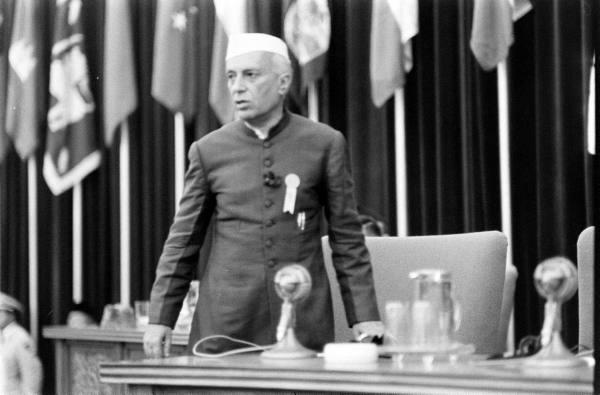
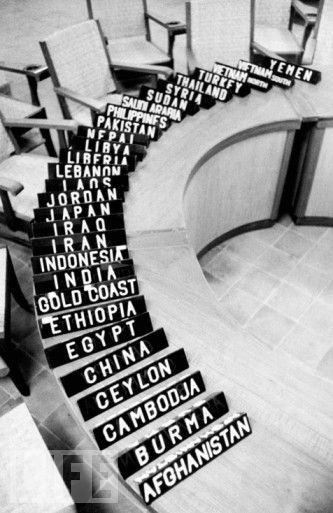
At the time of its founding at the Bandung Conference in April 1955, the major world powers were aligned in Soviet- and United States-led blocs. The war in Korea had recently ended in an armistice with the same frontiers as at the start but could have been the forerunner of a world war. The French war in Indochina had ended with independence of the three Indochina states, but a new independence conflict had just started in Algeria. Basically Bandung marked the end of formal colonialism. As Sir John Kotelawala, Premier of Ceylon (now Sri Lanka), said at the end of the conference “Bandung will be a name to reverberate in history and earn the gratitude and blessings of ages to come.”

Prime Minister Jawaharlal Nehru of India delivering the closing speech at the Bandung Conference that created the Non-Aligned Movement.

For fear that the new Non-Aligned movement might supplement or weaken the United Nations (UN), no implementary organization was set up. Later, the pattern of three-year rotating presidency was developed, but without a permanent secretariat. The country holding the presidency offers its own diplomats and civil servants to carry on Non-Aligned tasks. The outgoing presidency — Egypt — was so taken up with its own political changes that it virtually played no role on behalf of the N.A.M. Will Iran be able to do more than use the prestige of the Movement to defend its own interests?

In time, the Non-Aligned Movement grew up to become a major player in international relations, providing the Third World with a voice of its own on the world stage.

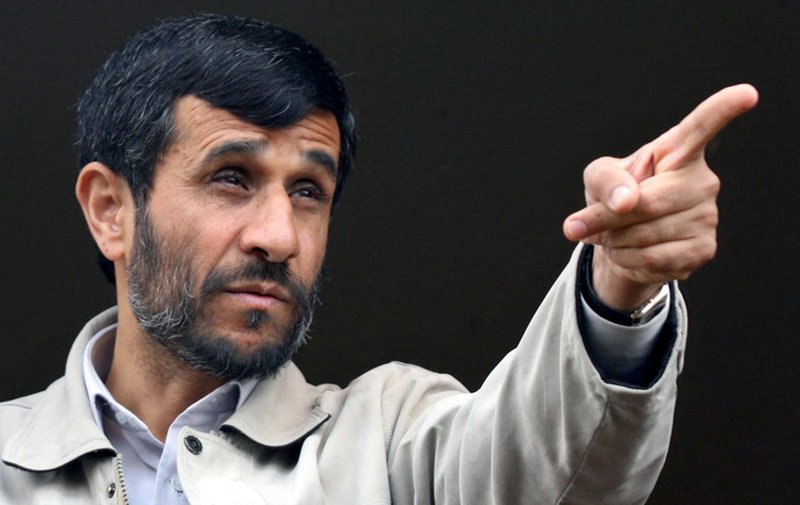
President Mahmoud Ahmadinejad will become the N.A.M. representative for its 118 members. His first presentation will be to the UN General Assembly in September. His talk should be analyzed closely to see if his presentation goes beyond the usual Iranian positions to be more inclusive of the interests of the N.A.M. members. A large conference at the end of August in Tehran will be the formal start of Iran’s presidency. Some Iranian leaders have called for the creation of a permanent secretariat. Thus it will be important to note what structural reforms are made within the N.A.M.

While in 1955, the idea of a “third camp” was a possibility — a wedge of sanity and restraint between the two atomic giants —, now there are real conflicts of interest among the N.A.M. members — the conflict in Syria being a prime example, along with differing territorial claims within the South China Sea among China and its neighbors.

The direct threats issued against the State of Israel by Iran’s President, Mahmoud Ahmadinejad, albeit in response to Israeli Prime Minister Benjamin Netanyahu’s own warmongering rhetoric against Iran, raises serious questions as to what Ahmadinejad can be expected to make of his presidency of the Non-Aligned Movement.

Iran itself is at the center of an international storm, and it is not clear if its diplomats and political leaders will have the energy to deal with the host of current conflicts among N.A.M. states as well as making proposition concerning the important economic, financial and ecological issues that the world faces. Moreover, the N.A.M. states are members of regional, intergovernmental organizations and therefore look less to N.A.M. leadership to structure economic and cultural cooperation.

Yet the N.A.M. does provide a structure for states and a large percentage of the people of the world. N.A.M. leadership has had an erratic relation with non-governmental organizations (NGOs) — sometimes encouraging their participation in meetings and programs and at other times ignoring them completely. Without a permanent secretariat, the N.A.M. has not developed the sort of consultative status that the UN has with NGOs. The Indian government at one stage had encouraged NGO-related activities within the N.A.M. Given the challenges facing the Iranian presidency of the N.A.M. it would be useful for NGOs to propose a more structured and formal relation with the N.A.M. especially if a permanent secretariat is created.

René Wadlow is President and Chief Representative to the United Nations, Geneva, of the Association of World Citizens.

Supporting Young Syrians who Say “Stop the Killing!”

In Conflict Resolution, Current Events, Human Rights, Middle East & North Africa, Solidarity, The Search for Peace, United Nations, World Law on May 26, 2012 at 3:07 PM

SUPPORTING YOUNG SYRIANS WHO SAY “STOP THE KILLING!”

By René Wadlow

 Image

In early May 2012, there were particularly deadly explosions in Damascus, the capital of Syria, an escalation of a conflict which began over a year ago with nonviolent protests but which spilled over into violence, refugee displacements, and ever deeper division among the people of Syria.

For the moment, the efforts of the League of Arab States and the United Nations have not been able to establish good-faith negotiations or even a permanent ceasefire. Therefore a group of young nonviolent Syrians have created a movement “Stop the Killing,” not related to a political party or a confessional religious group, but which wishes to unite those of good will to stop the violence and to develop a society in which all can contribute.

Therefore, we who are outside Syria, send our support and willingness to cooperate.

I believe in you, and I believe in your destiny.

I believe that you have inherited from your forefathers an ancient dream, a song, a prophecy which you can proudly lay as a gift of gratitude to  those working for a just resolution of the current conflicts.

I believe that it is in you to be good citizens.

And what is it to be a good citizen?

It is to acknowledge the other person’s rights before asserting your own, but always to be conscious of your own.

It is to be free in word and deed but it is to know that your freedom is subject to the other person’s freedom.

It is to know that killing will never bring a society of justice and harmony. A just and nonviolent society is the fruit of wisdom and love. Therefore let love, human and frail, command the coming day.


Rene Wadlow, a member of the Fellowship of Reconciliation and of its Task Force on the Middle East, is President and Chief Representative to the United Nations Office at Geneva of the Association of World Citizens.

Syria: Reforms and Mediation

In Current Events, Democracy, Human Rights, Middle East & North Africa, World Law on July 3, 2011 at 6:49 PM

SYRIA: REFORMS AND MEDIATION

By René Wadlow

Hope has never trickled down. It has always sprung up.

Studs Terkel

The situation in Syria seems to have reached a critical turning point. There is a possibility that popular protests continue as they have since mid-March and that they continue to be met by military and police violence in violation of the spirit and letter of humanitarian international law. The Syrian army and militias have responded to unarmed nonviolent demonstrations with disproportionate force. Humanitarian international law has as its base the Martens Clause named after the legal advisor of the Russian Czar at the time of the Hague Peace Conferences. The clause is included in the Preamble to the 1899 Hague Convention. It is taken up again in Article 3, common to the four Geneva Conventions of August 12, 1949. The Martens Clause states that “the means that can be used to injure an enemy are not unlimited” but must meet the test of ‘proportionality’ meaning that every resort to armed force be limited to what is necessary for meeting military objectives. The shooting of unarmed demonstrators does not meet the test of proportionality.

For several months, the Syrian people have been sending a clear message to President Bashar al-Assad: The time has come for him to step aside.

However, there seems to be a real possibility of negotiations between the government led by President Bashar al-Assad and members of different opposition groups. President Assad, after two months of silence during which time demonstrations spread and repression increased on June 20 has called for a “national dialog” that could usher in changes. However, there were few specifics as to what topics such a national dialog would cover.

Many opposition leaders consider the proposal as a bid for more time during which arrests continue and over 1,000 persons have been killed in response to non-violent demonstrations. Moreover, it is not clear that the leaders of the longstanding but divided leadership of opposition groups are in control of the demonstrators. As in Tunisia and Egypt, Syrian demonstrators are young, come from an increasingly educated middle class and are influenced by the spirit of the ‘Arab Spring’ rather than by the ideology of the historic opposition groups.

As a sign that the proposal for a national dialog was real, the government allowed a meeting on June 27 in Damascus of some opposition figures. Those who met stressed that they did not claim to speak for all the demonstrators, and not all open opposition figures attended. In addition there are opposition figures in exile, and those in hiding fearful of arrest. There are also, no doubt, those who are waiting to see which way the wind blows. President Assad has spoken of starting the national dialog on July 12, but it is not clear who will attend and how representative they will be.

The savagery of the Damascus regime in suppressing dissent knows no boundaries. President Assad will resort even to heavy military force to silence his own people.

Civil society participation — religious, education, labor, women, cultural and media — is crucial to build public support for a real national dialog and to broaden constituencies for peace. A national dialog is merely the beginning of a deep reordering of the political and economic structures and relationships among elements of the society. There is a need for continual adjustments to adapt to new developments. There also needs to be quick post-agreement benefits to give people a stake in the readjustment process and to reduce the capacity of spoilers.

In some conflict situations, external mediators from the United Nations, national governments or nongovernmental organizations have played a useful role. Currently, the situation seems to have reached a stalemate when neither the government nor the protesters can resolve the crisis on their own terms. There are few signs that the government is open to external mediators, but with refugees from Syria going to Turkey, there is a real danger that the conflict will take on trans-frontier dimensions. A real national dialog could set out a framework for reforms which have been promised in the past but which never came to birth. As a result, sentiments have hardened, and trust has been lost. As external but concerned parties, we should encourage a broadly-based national dialog as a first important step on the road to reform.

René Wadlow is Senior Vice President and Chief Representative to the United Nations Office at Geneva of the Association of World Citizens.

Palestinian Status at the UN: Breaking the Logjam

In Conflict Resolution, Current Events, Middle East & North Africa, The Search for Peace, United Nations on June 30, 2011 at 7:44 PM

PALESTINIAN STATUS AT THE UN: BREAKING THE LOGJAM

By René Wadlow

There is a good deal of discussion in the halls of the United Nations (UN), both in New York and Geneva, concerning a possible application of full membership in the UN by the Palestinian Authority. The discussions reflect similar discussions within Foreign Ministries in the hope that there can be an agreed-upon program of action (or non-action) by September when the new General Assembly meets. Currently Palestine has observer status at the UN from a time when liberation movements were given observer status — two organizations for South Africa, one for South West Africa as Namibia was then, and for the PLO. With the changes in South Africa and Namibia, the liberation movement observer status was dropped for the three, and only the PLO remained.

In practice, there is little effective difference between observer status and full membership. Observers cannot vote, but voting in the UN has been largely replaced by ‘consensus making’. Effectiveness for all countries except for a small number of Great Powers depends on the skills of the diplomats which represent them. The Vatican has only observer status but a good deal of influence due to an effective diplomatic team. The Palestinian diplomats in Geneva have been weak, in New York somewhat stronger. The Palestinian diplomats have always been in the shadows of the representatives of the Arab States who want to play ‘Big Brother’, but with the exception of Egypt which has always had a strong core of diplomats, the Arab diplomats have rarely been more competent than the Palestinians.

Being overshadowed by the larger Arab States would probably not change even if full membership is granted, but full membership would be a symbolic victory of legitimacy and open the door to the independent use of the World Court. As Mahmoud Abbas has written “Palestine’s admission to the United Nations would pave the way for the internationalization of the conflict as a legal matter, not only a political one. It would also pave the way for us to pursue claims against Israel at the United Nations, human rights treaty bodies and the International Court of Justice.”
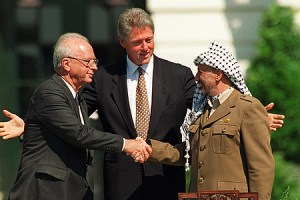
The Middle East came this close to peace when Israeli Prime Minister Yitzhak Rabin and PLO Chairman Yasser Arafat shook hands on the White House lawn on September 13, 1993.

As of now, there are a number of variations being discussed around three possible approaches:

1)      The first approach favored by the USA, some of the Western European members of the European Union, in particular Germany, and a few others including Israel is that the issue should go away. It is felt that there are enough problems in the world, especially in the Middle East not to have a complicated procedural battle in September. This has been the ‘advice’ given to the Palestinians by the US, Canada, and some Western European States. It may be also what some of the Arab States are saying more privately. To reinforce their arguments, the US and the Western European governments have a strong card — they can cut off funding to the Palestinian Authority. The pretext would be the Hamas support or participation in a ‘unity government’ even if such a government is made of ‘non-political technocrats’. Hamas is still listed by the USA and the European Union as a ‘terrorist organization’ and so cannot receive funds from the US or EU governments. The Palestinian Authority depends largely on external financing; thus cutting off financing is an argument that carries weight — even if it is called ‘blackmail’ in other settings.

In exchange for dropping the full membership application, there would be some sort of short Israel-Palestine meeting where each side would speak of a ‘peace process’ through September when the membership issue has gone by. Such a sleight of hand will not advance real negotiations but may ‘buy time’ which is what many governments now want.

2)      There is, however, a real possibility that the Palestinian Authority will ask for full membership in September. This will depend in part on discussions among the Palestinian leadership and the views of the three key States concerning the Middle East: Egypt, Turkey, and Iran. Iran which is one of the Vice Presidents of the upcoming General Assembly will be particularly influential in procedural matters. The UN Charter states that the admission of new members “will be effected by a decision of the General Assembly upon the recommendation of the Security Council”. The Council makes its membership recommendation through a resolution; thus it must be approved by at least nine of the Council’s 15 members and not be vetoed by the one of the five permanent members. If the USA abstains — abstentions are not considered a veto — it is likely that there would be at least nine positive votes for Palestinian membership in the Security Council. Then it is most likely that the General Assembly would follow the Security Council recommendation as it has always done in the past. Thus current discussions turn around what could convince the US to abstain rather than veto. We will return to this key issue after a consideration of a third possibility.

3)      The third possibility in the case of a US veto is to move the issue to the General Assembly under what is known now as the “Uniting for Peace” mechanism. UN General Assembly resolution 377(V) of November 3, 1950, first known as ‘the Acheson Plan’ from the name of the US Secretary of State who proposed it and later renamed Uniting for Peace states that in cases where the UN Security Council fails to act to maintain international peace and security, owing to disagreement among the five permanent members, the matter shall be discussed immediately by the General Assembly. If the General Assembly is not in session, an Emergency Special Session can be called. This procedure has been used 10 times since its 1950 start. (1) As from September to December, the General Assembly will be in session, a Special Session will not have to be called. For a resolution to pass under the Uniting for Peace mechanism, there must be a 2/3 majority, meaning now 135 States if all are present and voting. However, not being present is a ‘diplomatic’ way of not having to be seen making a choice. Currently, 112 UN members recognize a Palestinian State within the pre-1967 frontiers. What cannot be analyzed is how hard the USA and some of its allies would work to prevent the 135 positive voters.

To turn back to the Security Council procedure, we can ask could there be a ‘deal’ that would satisfy no one completely but not dissatisfy any of the five permanent powers to the extent of their casting a veto. Here we can turn to precedent because at the UN everything functions by precedent. If something has been done once, one can argue that it can be done again. If it has never been done, it takes an exceptional situation and a few highly skilled diplomats to get any innovation.
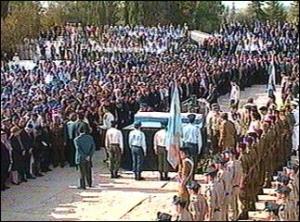
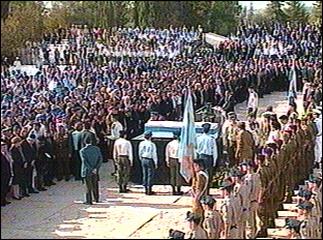
A picture of the funeral of Yitzhak Rabin after he was shot dead on November 4, 1995 by an Israeli nationalist named Yigal Amir.

Thus we can turn to the 1954 period and the breaking of the ‘logjam’ on membership. During the first ‘hot round’ of the Cold War — the June 1950 to July 1953 Korean War — the Soviet Union and the USA blocked each other’s potential allies from UN membership. At the end of the Korean War, there was a host of pending membership applications on which no progress had been made. There seemed to be little possibility of moving things forward.

The 1954 membership issue was my start at looking closely at diplomatic negotiations around procedural issues at the UN. At a time when I should have spent my time chasing girls, I was a university student representative on the Executive Committee of what was then the United World Federalists in the USA. In 1955, the issue of a review conference on the UN Charter was to be placed automatically on the agenda of the General Assembly. During the 1945 negotiations that led to the creation of the UN Charter, a review conference on the Charter after 10 years was to be placed on the agenda. This was a demand of some of the smaller States at San Francisco, in particular Australia. It was expected in 1945 that such a review conference would be held and that was still the expectation in the period 1953-1954. There was a good deal of reflection on how to improve and strengthen the Charter during such a Review Conference. Universal membership was one of the demands of UN reformers, both some diplomats and activists such as those in the United World Federalists who had taken a lead on the Charter Review issue.

However, both the USA and the USSR opposed holding a Charter Review conference and brought most of their allies along with them. The result was that when the Charter Review conference came upon on the agenda, it was swept under the rug, and there has never been a review. Nevertheless, the diplomats of the USA and the USSR felt that some of the ‘steam’ for a Review Conference had to be lowered and this could be done by getting rid of ‘universal membership’ as an issue. Negotiations to break the logjam on pending applications started with the aim of making as close-to-possible balance between pro-USA, pro-USSR and neutral States entering the UN. The negotiations were carried out in 1954 and in 1955, before the debate on Charter Review, the membership logjam broke and Albania, Austria, Bulgaria, Cambodia, Finland, Hungary, Ireland, Italy, Jordan, Laos, Libya, Nepal, Portugal, Romania, Spain and Sri Lanka entered the UN. Japan should have been part of the group, but there was still the “enemy states” clause in the Charter which took more negotiations concerning Japan. Japan only came in the next year, 1956.
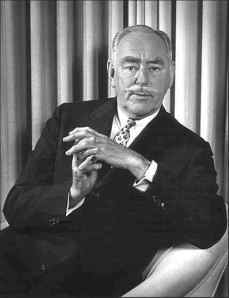
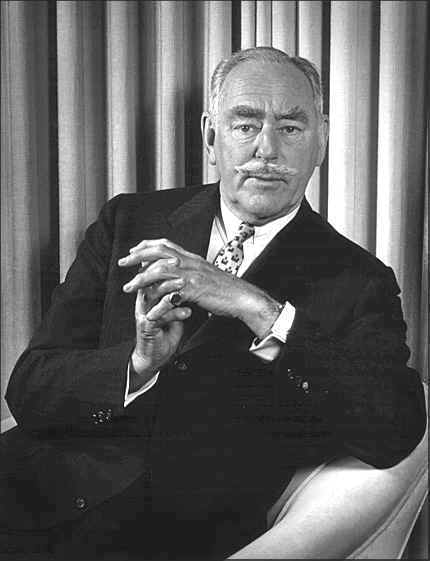
Dean Acheson, the U. S. Secretary of State who fathered the Uniting for Peace procedure at the United Nations.

Can there be something comparable in September? In an article “Coming in from the Cold: UN Membership Needed for the Phantom Republics”, I suggested at the time of the Georgia-Abkhazia-South Ossetia conflict that Abkhazia, Chechnya, Kosovo, Nagorno-Karabakh, South Ossetia and Transnistra be given UN membership as a necessary first step for security and a lessening of tensions. I had stressed that “to find mutually acceptable forms of government in these conflicts will require political creativity (breaking out of thinking in fixed patterns) and then new forms of constitutional order such as renewed forms of federal-confederal types of government, greater popular participation in decision-making and new forms of protection of minorities. Flexibility, compromise and cooperation are the hallmarks of success when it comes to resolving such conflicts concerning independence and autonomy. There is a need for a healing of past animosities and a growth of wider loyalties and cooperation.”

Both diplomats and members of the UN secretariat as well as secretariat of the Organization for Security and Cooperation in Europe where I had also floated the idea explained in detail why such a joint membership procedure would not happen. None the less, if we added upgrading the status of Palestine in the UN, another membership logjam might be broken. The point I have repeatedly made is that membership does not solve difficulties; it just provides a framework where serious negotiations might be carried out. The 1955 access to membership of Cambodia and Laos did not ‘solve’ the Indochina conflict. The French-led war in Vietnam was still going on, to be followed a decade later by the US-led war.

Thus, I think that a world citizen position is that full Palestinian membership in the UN will not ‘solve’ all the Israel-Palestine issues, and certainly not the issues of the wider Middle East. However UN membership will allow the Palestinians to come out from the shadows of the Arab States and to negotiate with the Israelis as equals. Such is a very modest step forward but it is worth taking.

(1)   For a useful discussion of the background to the Uniting for Peace procedure see Dean Acheson Present at the Creation: My Years in the State Department (New York: W. W. Norton, 1969, chapters 47-51)


René Wadlow is Senior Vice President and Chief Representative to the United Nations Office at Geneva of the Association of World Citizens.