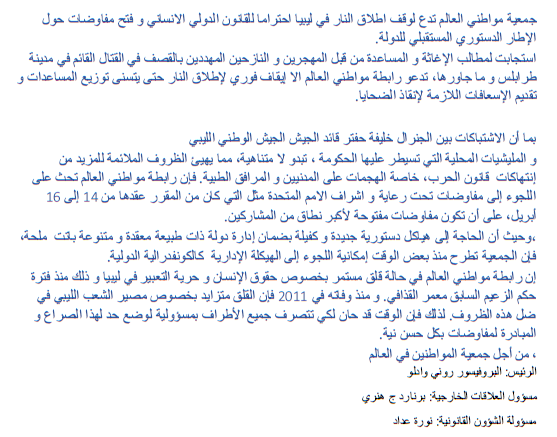
THE ASSOCIATION OF WORLD CITIZENS CALLS FOR A CEASEFIRE IN LIBYA, THE RESPECT OF INTERNATIONAL HUMANITARIAN LAW AND THE START OF NEGOTIATIONS IN GOOD FAITH ON THE FUTURE CONSTITUTIONAL STRUCTURE OF THE STATE
The Association of World Citizens, responding to calls for assistance
from persons displaced and in danger of bomb attacks by the fighting in and
around Tripoli, calls for an immediate ceasefire so that humanitarian aid can
be provided, and lives saved.
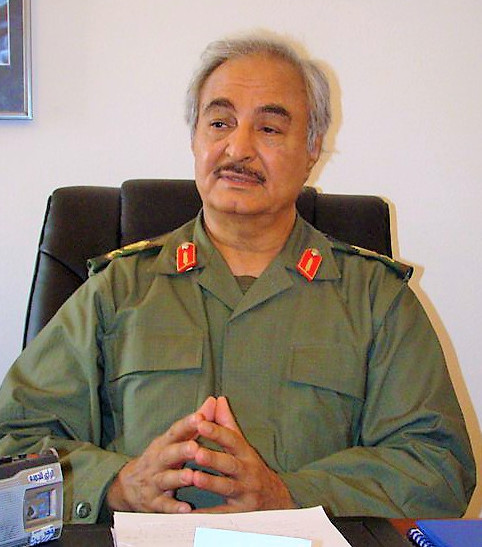
Continued fighting by the forces of General Khalifa Haftar and his Libyan
National Army opposed by local militias under the control of the Government is
likely to lead to increased violations of the laws of war, especially attacks
upon civilians and medical facilities.
The Association of World Citizens urges that negotiations under the
leadership of United Nations mediators, originally to be held April 14-16, be
undertaken with a range of participants as wide as possible. New and
appropriate constitutional structures are needed for the administration of a
complex and diversified State. This association has proposed the possibility of
con-federal administrative structures for the State.
The Association of World Citizens had been concerned with human rights
and freedom of expression in Libya during the time of the leadership of Mu’ammar
Gaddafi and has continued to be concerned with the fate of the people of Libya
since his death in 2011. Now is the time for responsible action by all parties
for an end to the fighting and the start of negotiations in good faith.
April 28, 1919 can be
considered as the birth of the League of Nations. The creation of the League
had been on the agenda of the Peace Conference at Versailles, just outside of
Paris, from its start in January 1919. The United States (U. S.) President, Woodrow
Wilson, was the chief champion of the League. The creation of such an
organization was discussed from the start in January, along with discussions as
to where the headquarters of the League would be set. On April 28, there was a
unanimous decision to create a League of Nations and at the same time Geneva
was chosen for its headquarters.
Woodrow Wilson
Some of the later
failings of the League were visible from the start. Defeated Germany and
revolutionary USSR were not invited to join, and the U. S. Senate turned down
the invitation. Nevertheless, the first decade of the League’s life saw a good
deal in international cooperation, especially in the fields of labor
conditions, health, social welfare, intellectual cooperation, and agriculture –
all areas that would later be continued and developed within the United Nations
(UN) system.
The first decade saw
the settlement of a number of conflicts that could have led to war. There was a
wide-spread feeling that a new era in international relations had been born.
However, the 1930s began with the conflicts which led to the end of the League.
On September 18, 1931,
Japan accused China of blowing up a Manchurian railway line over which Japan
had treaty rights. This “Mukden Incident” as it became known was
followed by the Japanese seizure of the city of Mukden and the invasion of
Manchuria. Military occupation of the region followed, and on February 18, 1932,
Japan established the puppet “State of Manchuria” (Manchukuo).
Further hostilities
between Japan and China were a real possibility. The League tried to mediate the
conflict under the leadership of Salvador De Madariaga, the Ambassador of
Republican Spain to the League. In practice, none of the Western governments
wanted to get involved in Asian conflicts, especially not at a time when they
were facing an economic depression.
Salvador De Madariaga
Nongovernmental
organization cooperation with the League of Nations was not as structured as it
would be by the UN Charter. There were a few peace groups in Geneva which did interact
informally with the League delegations – the Women’s International League for
Peace and Freedom, the International Peace Bureau, and the British Quakers were
active but were unable to speak directly in League meetings. They could only
send written appeals to the League secretariat and contact informally certain
delegations.
In reaction to the Japan-China tensions, Dr. Maude Revden, a former suffragist, one of England’s first women pastors, influenced by Mahatma Gandhi whom she had visited in India proposed “shock troops of peace” who would volunteer to place themselves between the Japanese and Chinese combatants. The proposal for the interposition of an unarmed body of civilians of both sexes between the opposing armies was brought to the Secretary General of the League of Nations, Sir Eric Drummond. Drummond replied that it was not in his constitutional power to bring the proposal before the League’s Assembly. Only governments could bring agenda items to the Assembly. Nevertheless, he released the letter to the many journalists then in Geneva as the Assembly was in session. The letter was widely reported.
An unarmed shock troop
of the League never developed, and China and much of Asia became the scene of a
Japanese-led war.
Sir Eric Drummond
The idea of an unarmed interposition force was again presented this time to the UN by world citizens shortly after the UN’s creation at the time of the 1947-48 creation of the State of Israel and the resulting armed conflict. The proposal was presented by Henry Usborne, a British MP, active in the world federalist and world citizen movement. Usborne was influenced by Mahatma Gandhi’s concept of satyagraha (a soul force) and proposed that a volunteer corps of some 10,000 unarmed people hold a two-kilometer-wide demilitarized zone between Israel and its Arab neighbors.
Jayaprakash Narayan
Somewhat later, in 1960, Salvador De Madariaga, who had ceased being the Spanish Ambassador to the League when General Franco came to power, created in 1938 the World Citizens Association from his exile in England. He developed a proposal with the Gandhian Indian Socialist Party leader Jayaprakash Narayan for UN Peace Guards, an unarmed international peace force that would be an alternative to the armed UN forces. (1) De Madariaga and Narayan held that a body of regular Peace Guards intervening with no weapons whatever, between two forces in combat or about to fight might have considerable effect.
The Peace Guards would
be authorized by the UN Member States to intervene in any conflict of any
nature when asked by one of the parties or by the Secretary-General.
Dag Hammarskjold who
was having enough problems with armed UN troops in the former Belgium Congo and
understanding the realpolitik of the UN did not act on the proposal. Thus, for
the moment, there are only armed UN troops drawn from national armies and able
to act only on a resolution of the Security Council.
Note
1) A good portrait of
Jayaprakash Narayan, a world citizen, is set out in Bimal Prasad, Gandhi, Nehru and J.P. Studies in Leadership
(Delhi, Chamakya Publications, 1985)
Narayan was also one
of the Indian leaders met by the student world federalist leaders in their 1949
stay in India. See Clare and Harris Wofford, Jr., India Afire (New York: John Day Company, 1951)
Prof. René Wadlow is President of the Association of World Citizens.
On
Tuesday, April 23, 2019, the United Nations (UN) Security Council voted Resolution
2467 concerning the use of rape as a weapon in times of armed conflict. This
resolution builds on an earlier resolution of June 24, 2013 which called for
the complete and immediate cessation of all acts of sexual violation by all
parties in armed conflicts. The new resolution introduced by Germany contained
two new elements, both of which were eliminated in the intense negotiations in
the four days prior to the vote of 13 in favor and two abstentions, those of
Russia and China.
The
first new element in the German proposed text concerned help to the victims of
rape. The proposed paragraph was “urges United Nations entities and donors to
provide non-discriminatory and comprehensive health services including sexual
and reproductive health, psychosocial, legal and livelihood support and other
multi-sectoral services for survivors of sexual violence, taking into account
the special needs of persons with disabilities.”
French Ambassador François Delattre
The United States (U. S). delegation objected to this paragraph claiming that “sexual and reproductive health” were code words that opened a door to abortion. Since a U. S. veto would prevent the resolution as a whole, the paragraph was eliminated. There had been four days of intense discussions among the Security Council members concerning this paragraph, with only the U. S. opposed to any form of planned parenthood action. After the resolution was passed with the health paragraph eliminated, the Permanent Representative of France, Ambassador François Delattre, spoke for many of the members saying “It is intolerable and incomprehensible that the Security Council is incapable of acknowledging that women and girls who suffered from sexual violence in conflict and who obviously didn’t choose to become pregnant should have the right to terminate their pregnancy.”
Russian Ambassador Vassily Nebenzya
The second concept of the German draft that was eliminated was the proposal to create a working group to monitor and to review progress on ending sexual violence in armed conflict. Such a working group was opposed by the diplomats of Russia and China, both of which have the veto power. Thus, for the same reason as with the U. S. opposition, the idea of a monitoring working group was dropped. Both China and Russia are opposed to any form of UN monitoring, fearing that their actions on one topic or another would be noted by a monitoring group. The Russian diplomat had to add that he was against the added administrative burden that a monitoring group would present but that Russia was against sexual violence in conflict situations.
Thus,
the new UN Security Council Resolution 2467 is weaker than it should have been
but is nevertheless a step forward in building awareness. The Association of
World Citizens (AWC) first raised the issue in the UN Commission on Human
Rights in March 2001, citing the judgment of the International Criminal
Tribunal for Former Yugoslavia which maintained that there can be no time
limitations on bringing an accused to trial. The Tribunal also reinforced the
possibility of universal jurisdiction that a person can be tried not only by
his national court but by any court claiming universal jurisdiction and where
the accused is present.
Nadia Murad, the Iraqi women’s rights activist who was raped as an ISIS/Daesh slave
The AWC again stressed the use of rape as a weapon of war in the Special Session of the Commission on Human Rights Violations in the Democratic Republic of Congo citing the findings of Meredeth Turshen and Clotilde Twagiramariya in their book What Women Do in Wartime: Gender and Conflict in Africa (London: Zed Press, 1998). They write “There are numerous types of rape. Rape is committed to boast the soldiers’ morale, to feed soldiers’ hatred of the enemy, their sense of superiority, and to keep them fighting: rape is one kind of war booty; women are raped because war intensifies men’s sense of entitlement, superiority, avidity, and social license to rape: rape is a weapon of war used to spread political terror; rape can destabilize a society and break its resistance; rape is a form of torture; gang rapes in public terrorize and silence women because they keep the civilian population functioning and are essential to its social and physical continuity; rape is used in ethnic cleansing; it is designed to drive women from their homes or destroy their possibility of reproduction within or “for” their community; genocidal rape treats women as “reproductive vessels”; to make them bear babies of the rapists’ nationality, ethnicity, race or religion, and genocidal rape aggravates women’s terror and future stigma, producing a class of outcast mothers and children – this is rape committed with consciousness of how unacceptable a raped woman is to the patriarchal community and to herself. This list combines individual and group motives with obedience to military command; in doing so, it gives a political context to violence against women, and it is this political context that needs to be incorporated in the social response to rape.”
The
Security Council resolution opens the door to civil society organizations to
build on the concepts eliminated from the governmental resolution itself. Nongovernmental
organizations (NGOs) must play an ever-more active role in providing services
to rape victims with medical, psychological and socio-cultural services. In
addition, if the UN is unable to create a monitoring and review of information
working group, then such a monitoring group will have to be the task of
cooperative efforts among NGOs. It is always to be hoped that government acting
together would provide the institutions necessary to promote human dignity. But
with the failure of governments to act, our task as nongovernmental
representatives is set out for us.
Prof. René Wadlow is President of
the Association of World Citizens.
The United Nations
(UN) Global Compact for Safe, Orderly and Regular Migration has drawn attention
to the positive aspects of migration. However, there are also negative aspects
so that we are also concerned with migration that is not safe such as
trafficking in persons. A UN report presented to the Commission on the Status
of Women at the start of its current two-week session in New York highlighted
that human trafficking is one of the fastest growing criminal industries and
one of the biggest human rights crises today. The vast majority of victims
trafficked are for sexual exploitation, while others are exploited for forced
labor and forced marriage.
One aspect of
migration issues is the issue of the trans-frontier trafficking in persons.
Awareness has been growing, but effective remedies are slow and uncoordinated. Effective
remedies are often not accessible to victims of trafficking owing to gaps between
setting international standards, enacting national laws and then implementation
in a humane way.
The international
standards have been set out in the “United Nations Convention against
Transnational Organized Crime” and its “Protocol to Prevent, Suppress and
Punish Trafficking in Persons, Especially Women and Children.” The Convention
and the Protocol standards are strengthened by the “International Convention on
the Protection of the Rights of All Migrant Workers and Members of their Families.”
The worldwide standards have been reaffirmed by regional legal frameworks such
as the “Council of Europe Convention on Action against Trafficking in Human
Beings.”
Despite clear
international and regional standards, there is poor implementation, limited
government resources and infrastructure dedicated to the issue, a tendency to
criminalize victims and restrictive immigration policies in many countries.
Trafficking in
persons is often linked to networks trafficking in drugs and arms. Some gangs
are involved in all three; in other cases, agreements are made to specialize
and not expand into the specialty of other criminal networks.
Basically, there
are three sources of trafficking in persons. The first are refugees from armed
conflicts. Refugees are covered by the Refugee Conventions supervised by the UN
High Commissioner for Refugees (UNHCR) in the country of first asylum. Thus,
Syrian refugees are protected and helped by the UNHCR in Lebanon, but not if
they leave Lebanon. As ¼ of the population of Lebanon are now refugees from the
conflicts in Syria, the Lebanese government is increasingly placing
restrictions on Syrian’s possibility to work in Lebanon, to receive schooling,
medical services, proper housing etc. Therefore, many Syrians try to leave Lebanon
or Turkey to find a better life in Western Europe. Refugees from Iraq,
Afghanistan, Sudan follow the same pattern.
The second
category are people leaving their country for economic reasons − sometimes
called “economic refugees.” Migration for better jobs and a higher standard of
living has a long history. Poverty, ethnic and racial discrimination, and
gender-based discrimination are all factors in people seeking to change
countries. With ever-tighter immigration policies in many countries and with a
popular “backlash” against migrants in some countries, would-be migrants turn
to “passers” − individuals or groups that try to take migrants into a country,
avoiding legal controls.
A third category − or a subcategory of economic migration − is the sex trade, usually of women but also children. As a Human Rights Watch study of the Japanese “sex-entertainment” businesses notes, “There are an estimated 150,000 non-Japanese women employed in the Japanese sex industry, primarily from other Asian countries such as Thailand and the Philippines. These women are typically employed in the lower rungs of the industry either in ‘dating’ snack bars or in low-end brothels, in which customers pay for short periods of eight or fifteen minutes. Abuses are common as job brokers and employers take advantage of foreign women’s vulnerability as undocumented migrants: they cannot seek recourse from the police or other law enforcement authorities without risking deportation and potential prosecution, and they are isolated by language barriers, a lack of community, and a lack of familiarity with their surroundings.” We find similar patterns in many countries.
The scourge of
trafficking in persons will continue to grow unless strong counter measures are
taken. Basically, police and governments worldwide do not place a high priority
on the fight against trafficking unless illegal migration becomes a media
issue. Thus, real progress needs to be made through nongovernmental
organizations (NGOs) such as the Association of World Citizens. There are four
aspects to this anti-trafficking effort. The first is to help build political
will by giving accurate information to political leaders and the press. The
other three aspects depend on the efforts of the NGOs themselves. Such efforts
call for increased cooperation among NGOs and capacity building.
The second aspect
is research into the areas from which children and women are trafficked. These
are usually the poorest parts of the country and among marginalized
populations. Socio-economic and educational development projects must be
directed to these areas so that there are realistic avenues for advancement.
The third aspect
is the development of housing and of women’s shelters to ensure that persons
who have been able to leave exploitive situations have temporary housing and
other necessary services.
The fourth aspect
is psychological healing. Very often women and children who have been
trafficked into the sex trades have a disrupted or violent family and have a
poor idea of their self-worth. This is also often true of refugees from armed
conflict. Thus, it is important to create opportunities for individual and
group healing, to give a spiritual dimension to the person through teaching
meditation and yoga. There are needs for creating adult education facilities so
that people may continue a broken education cycle.
There are NGOs who are already working along these lines. Their efforts need to be encouraged and expanded.
Prof. René Wadlow is President of the Association of World Citizens.
World law, as World Citizens use the term, is more
than current international law. World law has, as its base, universally-recognized
international law but also the human rights declarations and standards, the
oft-repeated declarations of the United Nations (UN) General Assembly as well
as the international legal bodies such as the World Court and the International
Criminal Court (ICC). The International Criminal Court is the most recent of
the world courts, and its Rome Status has not been ratified by all UN Member
States, the United States (U. S.) being a significant holdout.
ICC Prosecutor Fatou Bensouda
Some States have withdrawn from the ICC and other
States do not cooperate with it, such as the Sudan. The ICC can act only after
the relevant national courts have acted or when national courts are unable to
act (the case of some ‘failed States’) or when there is an unjustified
unwillingness of national courts to act when crimes against humanity have been
committed.
The Association of World Citizens (AWC) has repeatedly
stressed that humanitarian law (international law in times of war, primarily
the Geneva Conventions) are being systematically violated and that there should
be a UN-led World Conference for the Re-affirmation of Humanitarian Law.
In the armed conflicts in Afghanistan, there have been
repeated violations of humanitarian law by all sides: violations in the
treatment of prisoners of war, violation of the prohibition of torture,
prohibition of attacking medical facilities and medical personnel. The ICC has
undertaken preliminary investigations to collect evidence. Among those who have
violated humanitarian law are U. S. troops, and thus evidence should be
collected.
Although most evidence could be collected within
Afghanistan itself, it would be useful to interview persons who had served in
Afghanistan but now have returned to the U. S. and to see written reports no
longer stored in Afghanistan. Thus, the ICC plans to send investigators to the
U. S. to interview and collect documentation.
However, Secretary of State Mike Pompeo announced on
March 15, 2019 that the U. S. will revoke or deny visas to ICC personnel
investigating allegations of torture or other war crimes committed in the
conflicts in Afghanistan. Pompeo also announced that the U. S. will consider
imposing financial sanctions and restrictions on “persons who take or have
taken action to request or further such ICC investigation”. He could have
added imprisonment if we recall those who provided evidence of war crimes in
Iraq.
Unfortunately, Pompeo sends the wrong message to all
other parties that torture, rape, attacks on medical facilities will not be
tried. Pompeo helps to undermine further international humanitarian law.
We have to think back to 1947-1948 and the leadership
of Mrs. Eleanor Roosevelt as chair of the UN Commission on Human Rights to
recall any U.S. leadership on world law. Unfortunately, law has never been part
of U. S. culture. The lone cowboy taking the law into his own hands by shooting
it out on a dusty street seen in many films remains the U. S. ideal.
As mentioned, most of the necessary evidence can be
found in Afghanistan itself. Bringing anyone from any party to trial for crimes
in Afghanistan seems to me unlikely. Nevertheless, as world citizens, we need
to keep the standards of world law in mind. These standards should be clear. Thus,
our repeated call for a UN-led conference on the re-affirmation of
international humanitarian law.
Prof. René Wadlow is
President of the Association of World Citizens.
March 15 is widely used as the date on which the conflict in Syria began. March 15, 2011 was the first “Day of Rage” held in a good number of localities to mark opposition to the repression of youth in the southern city of Daraa, where a month earlier young people had painted anti-government graffiti on some of the walls, followed by massive arrests.
I think that it is important for us to look at why organizations that promote nonviolent action and conflict resolution in the US and Western Europe were not able to do more to aid those in Syria who tried to use nonviolence during the first months of 2011. By June 2011, the conflict had largely become one of armed groups against the government forces, but there were at least four months when there were nonviolent efforts before many started to think that a military “solution” was the only way forward. There were some parts of the country where nonviolent actions continued for a longer period.
There had been early on an effort on the part of some Syrians to develop support among nonviolent and conflict resolution groups. As one Syrian activist wrote concerning the ‘Left’ in the US and Europe but would also be true for nonviolent activists “I am afraid that it is too late for the leftists in the West to express any solidarity with the Syrians in their extremely hard struggle. What I always found astonishing in this regard is that mainstream Western leftists know almost nothing about Syria, its society, its regime, its people, its political economy, its contemporary history. Rarely have I found a useful piece of information or a genuinely creative idea in their analyses “(1)
A Syrian opposition rally in Paris (C) Bernard J. Henry/AWC
In December 2011, there was the start of a short-lived Observer Mission of the League of Arab States. In a February 9, 2012 message to the Secretary General of the League of Arab States, Ambassador Nabil el-Araby, the Association of World Citizens (AWC) proposed a renewal of the Arab League Observer Mission with the inclusion of a greater number of non-governmental organization observers and a broadened mandate to go beyond fact-finding and thus to play an active conflict resolution role at the local level in the hope to halt the downward spiral of violence and killing. In response, members from two Arab human rights nongovernmental organizations (NGO) were added for the first time. However, opposition to the conditions of the Arab League Observers from Saudi Arabia let to the end of the Observer Mission.
On many occasions since, the AWC has indicated to the United Nations (UN), the Government of Syria and opposition movements the potentially important role of NGOs, both Syrian and international, in facilitating armed conflict resolution measures.
In these years of war, the AWC, along with others, has highlighted six concerns:
1) The widespread violation of humanitarian law (international law in time of war) and thus the need for a UN-led conference for the re-affirmation of humanitarian law.
2) The widespread violations of human rights standards.
3) The deliberate destruction of monuments and sites on the UNESCO World Heritage list.
4) The use of chemical weapons in violation of the 1925 Geneva Protocol signed by Syria at the time, as well as in violation of the more recent treaty banning chemical weapons.
5) The situation of the large number of persons displaced within the country as well as the large number of refugees and their conditions in Turkey, Lebanon, and Jordan. In addition, there is the dramatic fate of those trying to reach Europe.
6) The specific conditions of the Kurds and the possibility of the creation of a trans-frontier Kurdistan without dividing the current States of Syria, Iraq, Turkey and Iran.
These issues have been raised with diplomats and others participating in negotiations in Geneva as well as with the UN-appointed mediators. In addition, there have been articles published and then distributed to NGOs and others of potential influence.
The Syrian situation has grown increasingly complex since 2011 with more death and destruction as well as more actors involved and with a larger number of refugees and displaced persons. Efforts have been made to create an atmosphere in which negotiations in good faith could be carried out. Good faith is, alas, in short supply. Efforts must continue. An anniversary is a reminder of the long road still ahead.
Notes:
(1) Yassin al-Haj Saleh in Robin Yassin-Kassal and Leila Al-Shami, Burning Country, Syrians in Revolution and War (London: Pluto Press, 2015, p. 210)
Prof. René Wadlow is President of the Association of World Citizens.
March
8 is the International Day of Women and thus a time to highlight the specific
role of women in local, national and world society. International Women’s Day
was first proposed by Clara Zetlin (1857-1933) at the Second International
Conference of Socialist Women in Copenhagen in 1911. Later, she served as a
socialist-communist member of the German Parliament during the Weimar Republic
which existed from 1920 to 1933 when Hitler came to power. Zetlin went into
exile in the Soviet Union shortly after Hitler came to power. She died there
several months later in 1933.
Zetkin had lived some years in Paris and was active in women’s movements there. The women were building on the 1889 International Congress for Feminine Works and Institutions held in Paris under the leadership of Ana de Walska. De Walska was part of the circle of young Russian and Polish intellectuals in Paris around Gerard Encausse (1865-1916), a spiritual writer who wrote under the pen name of Papus and edited a journal, L’Initiation (1). Papus stressed the need for world peace. In 1901 Papus spent time in Russia as a spiritual adviser to Tsar Nicholas II. Papus had warned the Tsar against the growing influence of Rasputin.
Clara Zetkin
This
turn-of-the-century spiritual milieu was influenced by Indian and Chinese
thought. Translations of fundamental Asian philosophical texts were
increasingly known in an educated public. ‘Feminine’ and ‘masculine’ were
related to the Chinese terms of Yin and Yang − not opposed but in a harmonic
balance. Men and women alike have within
themselves the Yin and Yang psychological characteristics. ‘Feminine’
characteristics or values include intuitive, nurturing, caring, sensitive and
relational traits. ‘Masculine’ traits
are rational, assertive and analytical.
Yin and Yang
As
individual persons, men and women alike can achieve a state of wholeness, of
balance between the Yin and Yang.
However, in practice, ‘masculine’ refers to men and ‘feminine’ to
women. Thus, some feminists identify the
male psyche as the prime cause of the subordination of women around the
world. Men are seen as having nearly a
genetic coding that leads them to ‘seize’ power, to institutionalize that power
through patriarchal societal structures and to buttress that power with masculine
values and culture.
Thus,
Clara Zetkin saw the need to call attention in a forceful way to the role that
women as women play in society and the many blocks which men place in their
way. She made her proposal in 1911 and the
idea of the Day was taken up within the Socialist movements.
The
harmonious balance of Yin and Yang, present in the early discussions around Ana
de Walska and Papus, largely dropped out of the Socialist version of
International Women’s Day. However, with
greater attention being given to Chinese philosophical thought, we may see a
revival of the theme.
The emerging world society has been slow to address the problem of injustice to women, because it has lacked a consensus on sex-based inequality as an urgent issue of political justice. The outrages suffered every day by millions of women − domestic violence, child sexual abuse, child marriage, inequality before the law, poverty and lack of dignity require concerted action. Leadership on these issues comes more often from nongovernmental organizations rather than legislative action. Solidarity and organization are crucial elements to create sustainable ways of living in which all categories of people are encouraged to contribute. March 8, 2019 is a reminder of the positive steps taken but also the distance yet to be covered.
Note
1.
See the biography by Marie-Sophie André and Christophe Beaufils, Papus (Paris: Berg International, 1995,
354pp.)
Prof. René Wadlow is President of
the Association of World Citizens.
When the drums of war start beating, can cooler heads prevail and negotiations in good faith start? Vijay Mehta has written a useful overview of efforts to create a Department of Peace within governments so that there would be an institutionalized official voice proposing other avenues than war. (1)
Such proposals are not new. In 1943, Alexander Wiley, a liberal Republican senator had proposed to President Franklin Roosevelt that he establish a cabinet-level post of Secretary of Peace as there was already a Secretary of War. The Secretary of War has now been renamed Secretary of Defense, but the function has not radically changed.
A Secretary of Peace in Wiley’s vision would be charged with preempting conflicts before they exploded into violence and proposing peaceful resolutions. In the USA after the end of the Second World War, in a “never again” atmosphere, other members of Congress suggested the creation of such a Department of Peace. However, such a vision was never transformed into a reality.
As the Cold War took up ever more energy and funds, a compromise was reached in 1984 at the time that Ronald Reagan was President. The United States (U. S.) Institute of Peace was created and has produced some useful publications and does some conflict resolution training for diplomats and mediators. However, the leadership of the Institute of Peace has not played a visible role in foreign policy formation. One must look elsewhere for cooler voices to cover the beat of the war drums.
The headquarters of the United States Institute of Peace in Washington, D. C.
There is currently a test in real time as the situation in Venezuela grows more complex. There are real possibilities of armed violence, ranging from armed violence within the country to the creation of armed militias operating from Colombia and Brazil as the Contras had in the Nicaragua case, to an old-fashioned intervention by U. S. troops. All these “cards are on the table”. There is no Secretary of Peace officially in the U. S. Government (nor in that of Venezuela either) The influence of national security advisors to the U. S. President has grown, and they have the advantage of frequent personal contact.
Latin America has often been considered as a U. S. “zone of influence”. Unlike current situations in the Middle East which are of direct concern to European States, Latin America has never been a priority of European countries with the exception of Soviet-Cuban relations. Spain has a cultural and economic interest in Latin America but does not try to influence U. S. policy toward individual States. The current U. S. administration seems largely indifferent to the views of the United Nations (U. N.). On the Venezuela crisis the U. N. Secretary-General has called for calm and restraint but has made no specific proposals.
In the U. S. there are a good number of “Think Tanks” devoted to policy making as well as university departments and programs with a geographic – area studies – orientation. As I am not a specialist on Latin America (most of my academic focus has been Africa and the Middle East), I do not know which have strong policy impact. I have seen relatively few public statements coming from academic Latin American specialists, though there is probably outreach to representatives in Congress.
Thus, we must watch the policy-making process closely. Obviously, my hope is that the cooler minds will win out and compromises made, such as holding new elections with international election monitors. This is a test in real time of Vijay Mehta’s aim How Not to Go to War.
Note: (1) Vijay Mehta. How Not to Go to War: Establishing Departments for Peace and Peace Centres Worldwide (Oxford: New Internationalist Publications, 2019)
Prof. René Wadlow is President of the Association of World Citizens.
On January 23, 2019, the Secretary-General of the United Nations (UN), Antonio Guterres, in a statement listed States which had carried out reprisals or intimidation including killings, torture, and arbitrary arrests against individuals cooperating with the UN on human rights issues. He said,
“The world owes it to these brave people standing up for human rights, who have responded to requests to provide information and to engage with the United Nations to ensure their rights to participate is respected. Punishing individuals for cooperating with the United Nations is a shameful practice that everyone must do more to stamp out.” He went on to add “Governments frequently charged human rights activists with terrorism or blamed them for cooperating with foreign entities or damaging the state’s reputation of security.”
The UN human rights bodies and the Office of the High Commissioner for Human Rights have established a number of mechanisms for gathering information on the status of human rights in certain countries or about certain issues. In practice, most of this information is complaints on the violation of human rights. In some cases, the information comes from the local branch of an international nongovernmental organization and also from a national human rights organization. In other cases, it comes from a victim or the family of a victim. Information may also come from journalists, religious groups, or visitors to a country who are willing to carry a message out of the country.
Many human rights defenders are people working in isolated, remote areas far from the international networks of protection. These unsung defenders become a vulnerable target in areas where impunity prevails, and assailants operate with virtual no fear of having to account for their crimes. Nevertheless, international appeals with accuracy of information and speed of reaction can be helpful which the Association of World Citizens (AWC) knows from direct experience.
With the often cited “War on Terrorism”, there is a disturbing trend to use national security reasons and counterterrorism strategies by States as a justification for blocking access by communities and civil society groups to UN human rights staff. Women cooperating with the UN have reported threats of rape and being subject to on-line smear campaigns.
The information is collected at the UN High Commissioner’s Office in Geneva and is evaluated to see if the information fits into a pattern of continuing human rights violations or if it is an individual event. In some cases, the same information is also given to well-known human rights NGOs such as Amnesty International and Human Rights Watch. The AWC receives a certain amount of information which is usually passed on orally to the UN Secretariat in Geneva without the names of the contacts. Like journalists, one must protest one’s sources. On the other hand, the AWC cannot prove the information. Thus, in its public statements, this association only raises broad country situations such as the national minorities and the Rohingya in Myanmar (Burma). However, in private letters to the UN Ambassadors in Geneva and New York, we raise specific cases, often of what is increasingly called “human rights defenders”.
I present the States listed by broad geographic region rather than all together in alphabetical order as they are in the UN statement as other States in each region may also have human rights violation issues, often inter-related to the State named. Thus, the list of States is only those which the UN is aware that there have been reprisals against individuals who have given information to the UN units. We will close with some observations on what NGOs can do to limit such reprisals.
Middle East & North Africa
Bahrain Egypt Israel Saudi Arabia Morocco
Africa
Cameroon Democratic Republic of Congo Djibouti Mali Rwanda South Sudan
Asia
China India Maldives Myanmar Philippines Thailand Turkey
Latin America
Colombia Cuba Guatemala Guyana Honduras Trinidad and Tobago Venezuela
Europe
Hungary Russian Federation
Central Asia
Kyrgyzstan Turkmenistan
The impact and increasingly higher profile of human rights informants has left them more and more exposed to a high risk of harassment, repression, arbitrary detention and extra-judicial executions. Governments are not the only actors. Depending on the country, there can be gangs, militias, paramilitary and other nongovernmental groups who also menace people thought to be giving information to the UN or to international human rights organizations.
The publication by the UN of its list is done with the hope that governments themselves will take positive action to protect. In some countries, internal security services or police-related “death squads” may act without the knowledge of the highest authorities of the State. In other States, there is little repression that does not come on orders of the higher authorities. There is a need for representatives of NGOs and also the media to be alert, especially for violations in States which are not otherwise in the news. Active networking remains crucial.
Prof. René Wadlow is President of the Association of World Citizens.
The present era of globalization of the economy is not new, but as a term and also as an organizing concept for policy making, it dates from 1991 and the formal end of the Soviet zone of influence which had some of the structures of an alternative trading system.
Earlier, dating from the 1970s the term used was “interdependence”. The emphasis was on economic relations but there was also some emphasis on cultural and political factors. In a July 1975 speech, United States Secretary of State Henry Kissinger who had an academic background and kept himself informed of theoretical trends said “All of us – allies and rivals, new nations and old nations, the rich and the poor – constitute one world community. The interdependence on our planet is becoming the central fact of our diplomacy… The reality is that the world economy is a single global system of trade and monetary relations on which hinges the development of all our economies. An economic system thrives if all who take part in it thrive.”
Interdependence was to help build a world society based on equality, justice, and mutual benefit. As Secretary Kissinger said the need was “to transform the concept of world community from a slogan into an attitude.”
Interdependence was to be articulated into policies leading to disarmament, peaceful change, improved welfare especially for the poorest and respect for human rights. However, in practice the continuing USA-USSR tensions, questions of access to oil especially in the Middle East and the difficulties of establishing rules and controls for the world trade system kept “interdependence” as a slogan and not as a framework for policies and decisions of major governments.
The term “globalization” has progressively replaced that of “interdependence” The concept of globalization continues the interdependence focus on global economic linkages but adds an emphasis on the organization of social life on a global scale and the growth of a global consciousness. Global consciousness is the essential starting point of world citizenship. Globalization is a socio-economic process in which the constraints of geography on social and cultural patterns recede and in which people become increasingly away that these geographic constraints are receding.
The rapid pace of globalization requires that research and practice keep up with the speed of changes in order to reduce unnecessary risks and to provide legitimacy and confidence in the world system. However, within the world society – as within national societies – there are many different interests. At the world level, there are not yet the web of consensus-building techniques found in public and private institutions at the national level.
There were recently two intergovernmental conferences being held at the same time which indicated the possibilities and the difficulties of reaching agreement among most of the States of th World: COP 24 held in Katowice, Poland devoted to issues of climate change and the conference on the Global Compact for Safe, Orderly and Regular Migration, held in Marrakech, Morocco.
The COP 24 had the advantage of building on the 2015 Paris Climate Accord and on the serious scientific research carried out by the Intergovernmental Panel on Climate Change (IPCC). The Katowice conference was to develop a common system of rules, reporting and measurement for the Paris Climate Accord. This “rule book” was largely accomplished. A sub-theme was to show that the international spirit which had led to the Paris Agreement was still alive and well despite criticism and a lack of visible progress.
The Global Compact for Safe, Orderly and Regular Migration is the first of its kind, although there are earlier agreements on the status of refugees. In many countries, there has been sharp debates on immigration policy – often with more heat than light. Some States have already indicated that they will not sign the Compact even though it has been repeatedly pointed out that the Compact is not a treaty and thus not legally binding. The Compact sets out aspirations and strengthens some of the processes already in practice. The representatives of some States which signed indicated that they will be “selective” in the processes which they will put into practice.
Blue: Will adopt the Compact, Red: Will not adopt the Compact, Yellow: Considering not adopting, Gray: Undetermined
There was an agreement to hold a review conference in 2022. There is a growing tendency in inter-governmental treaties to set a review conference every four or five years to analyze implementation and the changing political and economic situation.
The Association of World Citizens (AWC) has been stressing for some years the importance of migration issues. Migration is likely to increase as climate changes have their impact. Thus, the AWC calls upon Nongovernmental Organizations to focus cooperatively and strongly on migration and the standards of the Global Compact.
Prof. René Wadlow is President of the Association of World Citizens.