The Imburi are spirits that are said to inhabit the forests of Gabon, in Equatorial Africa, and who cry out for those who can hear them at times of impending violence and danger. The Imburi are now crying out loudly on the increasing dangers and forced migration in Goma, capital of the North Kivu province of the Democratic Republic of Congo – democratic in name only.
The July 31, 2024 ceasefire agreement – never fully effective – has now been broken. Troops of the Tutsi-led militia known as M23 along with regular military of Rwanda are advancing toward Goma, the capital of North Kivu. The Association of World Citizens has members in Goma who keep us informed of the critical situation there – getting worse each day.
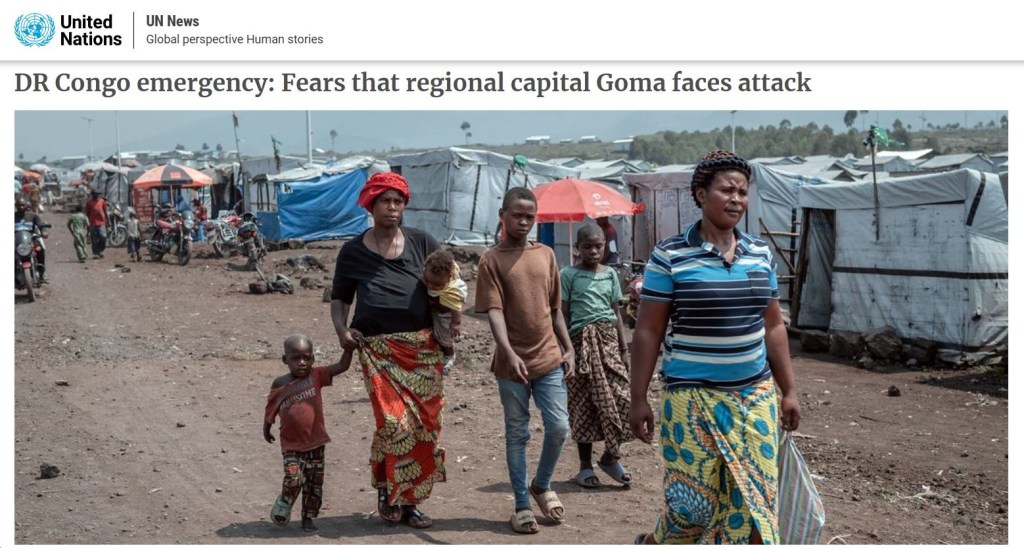
(C) UN News
People in the neighboring province of South Kivu are frightened and have started to flee. There are a large number of displaced persons in both North and South Kivu, and some have fled across the frontier into Burundi. Many people are living in displaced persons camps in difficult situations despite the efforts of the United Nations (UN), the International Committee of the Red Cross, and humanitarian aid organizations.
This eastern area of the Congo has been the scene of fighting at least since 1998 – in part as a result of the genocide in neighboring Rwanda in 1994. In mid-1994, more than one million Rwandan Hutu refugees poured into the Kivus, fleeing the advance of the Tutsi-led Rwandan Patriotic Front, which now comprises the government of Rwanda. Many of these Hutu were still armed, among them the “génocidaires” who, a couple of months before, had participated in the killing of some 800,000 Tutsi and moderate Hutu in Rwanda.
Today, there is still large-scale occurrence of serious violations of human rights and international humanitarian law by all parties with massive displacement of populations, plundering of villages, systematic rape of women, summary executions and the use of child soldiers. There is a report from the UN Group of Experts on the Democratic Republic of Congo of December 27, 2024 which outlines clearly the disintegrating situation.
Thus, there is a need to create an enabling political environment which would help develop the rule of law and a vital civil society – a vast task that the Imburi are not sure will be carried quickly enough.
Prof. René Wadlow is President of the Association of World Citizens.
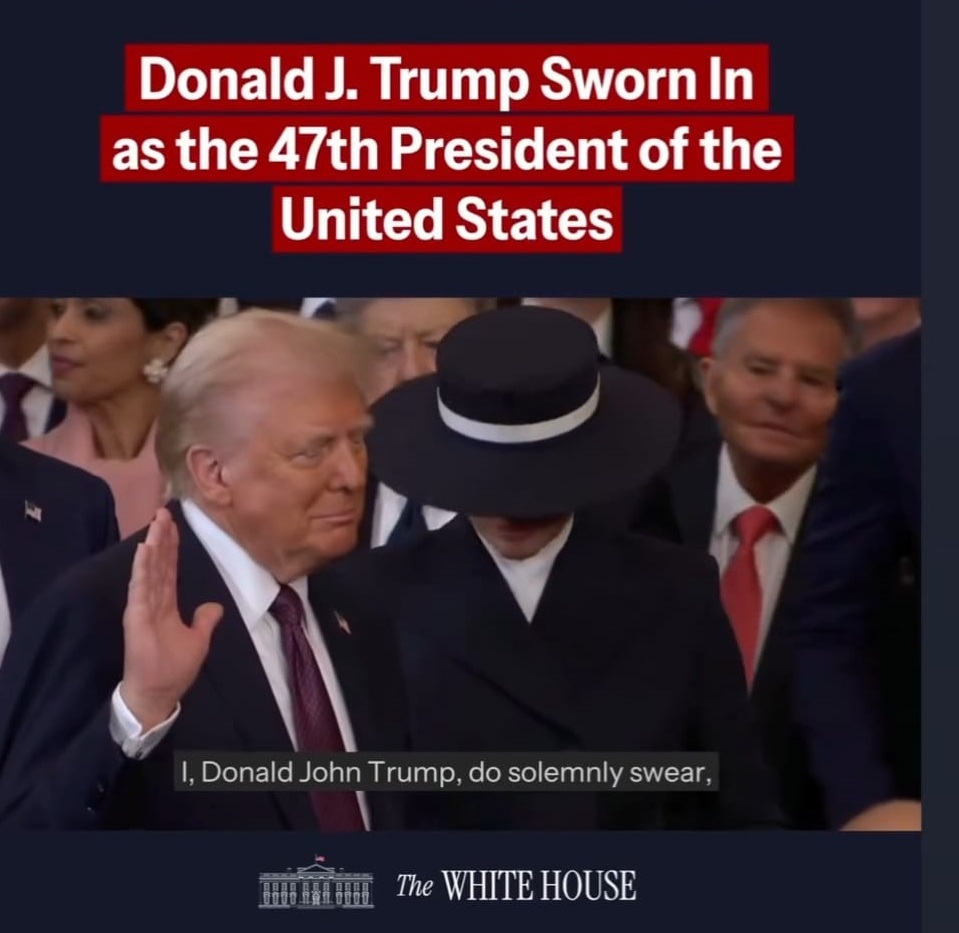
The January 20, 2025 inauguration of President Donald Trump has brought into sharp focus the turbulent and complex world society in which we live. As peacebuilders and citizens of the world, we face the same challenges as President Trump but with a different style and with far fewer resources at our command. We make plans but then are called to work for conflict resolution in unanticipated ways.
There are four policy challenges which face both President Trump and World Citizens: armed conflicts, currently ongoing and potential, persistent poverty in many areas, the erosion of international law and faith in multinational institutions, particularly the United Nations (UN), and the consequences of climate change.
The ongoing and potential armed conflicts are neither new nor unexpected. The Israeli-Palestinian tensions exist at least since 1936 and increased after the creation of the State of Israel. There may be some possibilities for negotiations in good faith. We must keep an eye open for possible actions.
Tensions with Iran are not new. The Soviet forces in part of Iran was the first conflict with which the UN had to deal in its early days. However, the rule by the Ayatollahs has made matters more complex.
The Russian-Ukrainian war grinds on with a large number of persons killed, wounded, and uprooted. Again, we must look to see if a ceasefire and negotiations are possible.
In Asia, the armed conflict in Myanmar between the military in power and the ethnic militias dates from the creation of the Burmese State at the end of the Second World War. A potential armed conflict between Mainland China and Taiwan dates from 1949 and the Nationalist government’s retreat to Taiwan. The potential armed conflict between the two Korean States dates from 1950 and the start of the Korean War.
The armed conflicts in Africa are no longer in the headlines, but they date from the early 1960s and the breakup of the European Empires: the Democratic Republic of Congo, Sudan, the States of the Sahel.
Thus, we all have a poor record of armed conflict prevention and mediation. Armed conflicts should remain at the top of both the governmental and nongovernmental agenda for action.
(C) U.S. Embassy France on Instagram
Persistent Poverty: Despite the UN Decades for Development, the Sustainable Development Goals, and Article 22 of the Universal Declaration of Human Rights which states that everyone is entitled to the economic, social, and cultural rights indispensable for his dignity and free development of his personality, persistent poverty exists in many parts of the world. One consequence of persistent poverty is migration from poorer to richer areas, both within countries and from poorer to richer States. Migration is a hotly debated issue in many countries, as right-wing nationalist groups make anti-migration their battle cry. Migration is likely to become an even more heated topic of debate as President Trump tries to carry out his proposal for a mass deportation of immigrants from the USA.
Linked to persistent poverty are trade issues and the protectionist trends in many countries. President Trump has proposed higher tariffs for good coming into the USA. This policy may set off tariff wars. Obviously to counter persistent poverty, world development policies must be improved – easier said than done!
The Erosion of International Law and Faith in Multinational Institutions: Armed conflicts and persistent poverty are closely related to the third issue: the receding United States (U.S.) involvement with the UN, the World Bank, the IMF, the World Court and other multinational organizations. Some of the foreign policy authorities appointed by President Trump are overtly critical of the UN and the International Criminal Court. There has already been an Executive Order to halt U.S. funding of the World Health Organization. However, there is no unifying vision of what a new world society would involve. The battle cry of “Make America Great Again”, if repeated by each State for itself, “Make Panama Great Again”, could be a loud concert but not conducive to positive decision making.
The Consequences of Climate Change: The fourth major group of issues concerns the consequences of climate change and the ways to lessen its impact. During the campaign for the presidency, Trump threatened to pull the USA out of the Paris Climate Agreement, and he has now signed an Executive Order doing so. The issue of climate change has been brought to the world agenda by scientists on the one hand, and by Nongovernmental Organizations and popular, often youth-led efforts, on the other hand. It is likely that these vital efforts related to climate change will continue despite climate policy resistance by some in the Trump administration.
President Trump said during his inaugural ceremony that “The Golden Age of America begins now… We stand on the verge of the four greatest years in American history.” We will have to watch closely and judge in four years. What is sure for peacebuilders and citizens of the world is that we stand on the verge of four more years of serious challenges. Thus, there is a need for cooperative and courageous action.
Prof. René Wadlow is President of the Association of World Citizens.
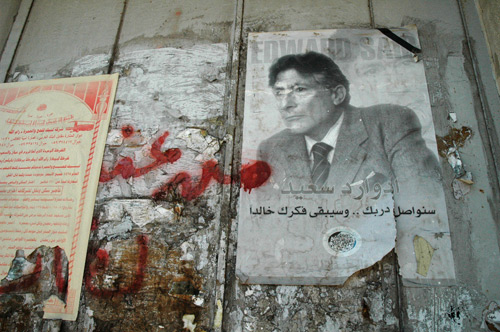
Edward Said, the late Palestinian-American scholar (and my Princeton University classmate), said, “Writing is the final resistance that we have against the inhuman practices and injustices that disfigure human history.”
Today, we see inhumanity, injustice, and armed violence in the wider Middle East: the Gaza Strip, the West Bank, the Golan Heights, Lebanon, Syria, Yemen with an impact in Iraq, Iran, and Turkey.
In many of these Middle East conflicts, there were no contacts to be cut. The process of creating contacts must start from point zero. Thus, peacebuilders must develop political legitimacy by trying to develop contacts with politically active groups and by bringing in new voices such as feminist constituencies. There is a need to engage conflicting parties – governments, armed groups and militias – so that there can be negotiations in good faith and an end to armed conflicts. The increasingly complex nature of conflicts requires diverse forms and levels of peacebuilding. This complexity makes the remaking of communications difficult. There needs to be flexibility, innovation, and cooperation.
A poster of Edward Said on the West Bank separation wall in Ramallah, Palestine (C) Justin McIntosh
Both formal and informal efforts are needed to create a web of alternative approaches with the ability to seize the initiative when there is an opportunity for action. Our focus here is on informal approaches which can be carried out by Nongovernmental Organizations (NGOs) such as the Association of World Citizens (AWC).
Social media is a recent form of contact beyond the older face-to-face approach. Social media has become an important mobilizing force. It can drive debates and political change, but it can also be used to divide societies, incite violence and xenophobia. For peacebuilders, social media allows direct access to the general public. Thus, for peacebuilders, they need to learn to use social media creatively.
For NGOs such as the AWC, the first step is an analysis of the nature and the parties in the conflict. Information can be gathered from people already active on the issue such as academics and members of other NGOs. For the wider Middle East conflicts, there are citizens from these countries living in Europe and the U.S.A. as well as persons who visit Middle East countries regularly. It is important to get a wide range of views. For organizations such as the AWC, with consultative status at the United Nations (UN), it is possible to discuss with UN Secretariat members and with diplomats.
Resolving armed conflicts and lowering persistent tensions involves a change in the attitudes that are at the core of the conflict. We work to create possibilities for dialogue and confidence-building so as to increase mutual trust. Remaking contacts is a way of facilitating better communications between leaders holding antagonistic views, thus promoting cross-cultural communications. As we begin 2025 with tensions in the Middle East at a high level, creative action is needed. Join in this vital process.
Prof. René Wadlow is President of the Association of World Citizens.
 Association of World Citizens