CROSSING CULTURAL AND LINGUISTIC BOUNDARIES: INTERNATIONAL VOLUNTEER DAY By René Wadlow
Founded on the values of solidarity and mutual trust, volunteerism transcends all cultural, linguistic and geographic boundaries. By giving their time and skills without expectations of material reward, volunteers themselves are uplifted by a singular sense of purpose.
-Ban Ki-moon, Secretary-General of the United Nations.
December 5 was selected as the International Volunteer Day by a 1985 UN General Assembly resolution. This year, December 5 comes as government representatives and volunteers of nongovernmental organizations (NGOs) are meeting in Paris to develop a new international climate agreement, COP 21. The NGO representatives are fewer in number than originally planned due to the November 13 shootings in Paris and thus tightened security conditions. However, those that are present are doubly active as world media attention is focused on the conference and its outcome.
In practice, as with all major UN conferences, negotiations among governments have been going on for two years with a good deal of input from NGO representatives. At the Paris stage, there is a preliminary “Final Document and Action Plan” of some 30 pages with a good number of square brackets around words or sentences on which there is no agreement. Negotiations concern making the document shorter so that the main ideas will stand out better and to remove square brackets. If a suitable word is not found, often the whole sentence will be dropped.
Both government representatives and NGOs are discussing post-Paris action and coalition building. There is also a concerted effort to bring the business community, especially transnational corporations into the action. While the UN system has a structure of consultative status for NGOs through the Economic and Social Council, the world of business is largely not represented. Only the International Labor Organization with its headquarters in Geneva has a three-party membership: governments, trade unions and business associations from each of the member States. The business world is not really a “voluntary association” in the sense of NGOs. Material reward is an important element in business.
COP 21 is a prime example of the need for cooperative action at the local, national and world level. As has been often said, the climate does not recognize national frontiers. The relations among ecologically-sound development, security, conflict resolution and respect for human rights have now assumed a more dynamic form than at any other time since the creation of the United Nations in 1945. To meet these strong challenges, NGOs, academic institutions, business and professional associations and the media must work together cooperatively. International Volunteer Day can serve as a time of reflection on capacity building and improved networking.
Prof. René Wadlow is President and a representative to the United Nations Office at Geneva of the Association of World Citizens.
“Whom the gods would destroy, they first make mad” was an insight of the classic Greek period.
There is obviously a form of madness in the Turks destroying a Russian fighter-bomber which may have entered Turkish air space along the frontier with Syria. The Turkish authorities knew that the Russians were going to bomb in Syria and not attack Turkey. “Air space” is a relative concept in a frontier area. When the Russian plane crashed, it crashed in Syria.
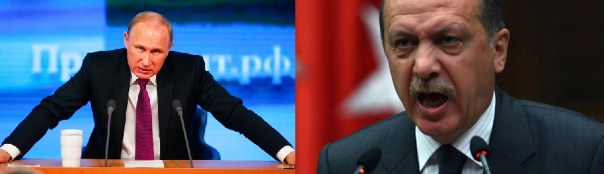
Russian President Vladimir Putin (left) said the downing of a Russian plane by the Turkish military felt like “a stab in the back” to him, while his Turkish counterpart Reçep Tayyip Erdogan (right) claimed the plane ignored a formal warning from Turkey. Who’s right or wrong doesn’t really matter; the real question is whether the leaders of the two countries concerned really think that kind of conduct can possibly help resolve the dispute and not fuel it instead.
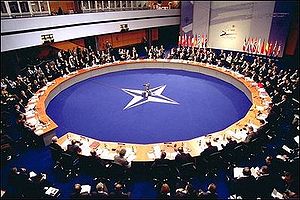
During the First World War, the French Prime Minister, George Clemenceau, said “War is too important to be left only to Generals”. Today, for the moment, the generals at the North Atlantic Treaty Organization (NATO) are meeting and the Russian generals are meeting on their own side. The political leaders are in contact. However, peacemaking is too important to be left only to political leaders who created the violence in the first place.
Under Article 5 of the North Atlantic Treaty, an attack on one Ally (NATO Member State) shall be considered an attack on all Allies. But in this very case, can Turkey prove beyond reasonable doubt that it was actually attacked by Russia?
There needs to be movements and efforts beyond and outside the governments in conflict to help bring about negotiations and a climate in which peace measures are possible.
As citizens of the world, we are particularly called to help create such a climate for negotiations in good faith. We know that violence can spread, and that mutual escalation can slip out of control. We need to use our worldwide links in a creative way to reduce tensions in the wider Middle East so that peace measures are possible.
Prof. René Wadlow is President of the Association of World Citizens.
“Seeing with eyes that are gender aware, women tend to make connections between the oppression that is the ostensible cause of conflict (ethnic or national oppression) in the light of another crosscutting one: that of gender regime. Feminist work tends to represent war as a continuum of violence from the bedroom to the battlefield, traversing our bodies and our sense of self. We glimpse this more readily because as women we have seen that ‘the home’ itself is not the haven it is cracked up to be. Why, if it is a refuge, do so many women have to escape it to ‘refuges’? And we recognize, with Virginia Woolf, that ‘the public and private worlds are inseparably connected: that the tyrannies and servilities of one are the tyrannies and servilities of the other.”
Cynthia Cockburn, Negotiating Gender and National Identities.
October 31 is the anniversary of the United Nations (UN) Security Council Resolution 1325 which callsfor full and equal participation of women in conflict prevention, peace processes, and peace-building, thus creating opportunities for women to become fully involved in governance and leadership.This historic Security Council Resolution 1325 of October 31, 2000 provides a mandate to incorporate gender perspectives in all areas of peace support. Its adoption is part of a process within the UN system through its World Conferences on Women in Mexico City (1975), in Copenhagen (1980), in Nairobi (1985), in Beijing (1995), and at a special session of the U.N. General Assembly to study progress five years after Beijing (2000).
Since 2000, there have been no radical changes as a result of Resolution 1325, but the goal has been articulated and accepted. Now women must learn to take hold of and generate political power if they are to gain an equal role in peace-making. They must be willing to try new avenues and new approaches as symbolized by the actions of Lysistrata.
Lysistrata, immortalized by Aristophanes, mobilized women on both sides of the Athenian-Spartan War for a sexual strike in order to force men to end hostilities and avert mutual annihilation. In this, Lysistrata and her co-strikers were forerunners of the American humanistic psychologist Abraham Maslow who proposed a hierarchy of needs: water, food, shelter, and sexual relations being the foundation. (See Abraham Maslow, The Farther Reaches of Human Nature) Maslow is important for conflict resolution work because he stresses dealing directly with identifiable needs in ways that are clearly understood by all parties and with which they are willing to deal at the same time.
Addressing each person’s underlying needs means you move toward solutions that acknowledge and value those needs rather than denying them. To probe below the surface requires redirecting the energy towards asking ‘what are your real needs here? What interests need to be serviced in this situation?’ The answers to such questions significantly alter the agenda and provide a real point of entry into the negotiation process.
It is always difficult to find a point of entry into a conflict, that is, a subject on which people are willing to discuss because they sense the importance of the subject and all sides feel that ‘the time is ripe’ to deal with the issue. The art of conflict resolution is highly dependent on the ability to get to the right depth of understanding and intervention into the conflict. All conflicts have many layers. If one starts off too deeply, one can get bogged down in philosophical discussions about the meaning of life.
However, one can also get thrown off track by focusing on too superficial an issue on which there is relatively quick agreement. When such relatively quick agreement is followed by blockage on more essential questions, there can be a feeling of betrayal.
Since Lysistrata, women, individually and in groups, have played a critical role in the struggle for justice and peace in all societies. However, when real negotiations begin, women are often relegated to the sidelines. However, a gender perspective on peace, disarmament, and conflict resolution entails a conscious and open process of examining how women and men participate in and are affected by conflict differently. It requires ensuring that the perspectives, experiences and needs of both women and men are addressed and met in peace-building activities. Today, conflicts reach everywhere. How do these conflicts affect people in the society — women and men, girls and boys, the elderly and the young, the rich and poor, the urban and the rural?
In the 1990s a young French singer, Olivier Villa, son of the famous French comic impersonator and TV show host Patrick Sébastien, released a first single entitled “Debout les Femmes” (Stand Up Women) in which, along the lines of Aristophanes’ Lysistrata, he called on women worldwide to deny any sexual intercourse until men have renounced war and violence for good.
“Only you, mothers, only you, women, can stop war.
Close your hearts until all men have laid down their weapons.”
There has been a growing awareness that women and children are not just victims of violent conflict and wars −’collateral damage’ − but they are chosen targets. Conflicts such as those in Rwanda and the former Yugoslavia have served to bring the issue of rape and other sexual atrocities as deliberate tools of war to the forefront of international attention. Such violations must be properly documented, the perpetrators brought to justice, and victims provided with criminal and civil redress.
I would stress three elements which seem to me to be the ‘gender’ contribution to conflict transformation efforts:
The first is in the domain of analysis, the contribution of the knowledge of gender relations as indicators of power. Uncovering gender differences in a given society will lead to an understanding of power relations in general in that society, and to the illumination of contradictions and injustices inherent in those relations.
The second contribution is to make us more fully aware of the role of women in specific conflict situations. Women should not only be seen as victims of war: they are often significantly involved in taking initiatives to promote peace. Some writers have stressed that there is an essential link between women, motherhood and non-violence, arguing that those engaged in mothering work have distinct motives for rejecting war which run in tandem with their ability to resolve conflicts non-violently. Others reject this position of a gender bias toward peace and stress rather that the same continuum of non-violence to violence is found among women as among men. In practice, it is never all women nor all men who are involved in peace-making efforts. Sometimes, it is only a few, especially at the start of peace-making efforts. The basic question is how best to use the talents, energies, and networks of both women and men for efforts at conflict resolution.
The third contribution of a gender approach with its emphasis on the social construction of roles is to draw our attention to a detailed analysis of the socialization process in a given society. Transforming gender relations requires an understanding of the socialization process of boys and girls, of the constraints and motivations which create gender relations. Thus, there is a need to look at patterns of socialization, potential incitements to violence in childhood training patterns, and socially-approved ways of dealing with violence.
There is growing recognition that it is important to have women in politics, in decision-making processes and in leadership positions. The strategies women have adapted to get to the negotiating table are testimony to their ingenuity, patience and determination. Solidarity and organization are crucial elements. The path may yet be long but the direction is set.
Prof. René Wadlow is President of the Association of World Citizens.
As the professor of economics Milton Friedman wrote “Only a crisis – actual or perceived – produces real change. When the crisis occurs, the actions that are taken depend on the ideas that are lying around. That, I believe, is our basic function: to develop alternatives to existing policies, and to keep them alive and available until the politically impossible becomes the politically inevitable.”
The current tension around the two Korean States, the Democratic People’s Republic of Korea (DPRK) and the Republic of Korea (ROK), is such a crisis. For the moment, it is not clear that Governments are willing to take the diplomatic measures necessary to reverse the tensions on the Korean Peninsula. Thus it is important that non-governmental voices be raised and that their proposals are taken seriously. Nongovernmental organizations can present policy choices that can help to resolve the multidimensional Korean security challenge.
Therefore, the Association of World Citizens (AWC) has proposed a two-track approach to the current Korean tensions. In a message to the United Nations (UN) Secretary-General Ban Ki-moon, AWC President René Wadlow stressed that a crisis can also be an opportunity for strong initiatives and action. The UN with historic responsibility for Korea should take the lead in organizing an UN-sponsored Korean Peace Settlement Conference, now that all the States which participated in the 1950-1953 Korean War are members of the UN. The UN-led Korean Peace Settlement Conference should be organized to lead to a North-east Asia Security and Nuclear-weapon Free Zone.
Such a Peace Settlement Conference is of concern not only to Governments but is one in which the voices of civil society are legitimate and should be heard.
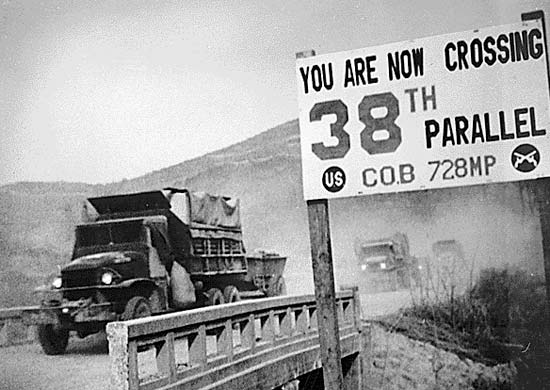
From 1950 to 1953 the first major international conflict to have taken place after the end of World War II saw the United Nations join the pro-Western South Korean military in its fight against the Communist North Korea. Neither side really won the war but since the 1953 armistice the Korean Peninsula has been divided in two along the horizontal border represented by the 38th Parallel.
In the past, there have been a series of dangerous but ultimately resolvable crises concerning the two Korean States. However, there are always dangers of miscalculations and unnecessary escalations of threats. Past crises have led to partial measures of threat reduction.
Partial measures of cooperation between the two Korean States, the Six-Party talks on nuclear issues and a number of Track II-civil society diplomatic efforts have shown the possibilities but also the limits of partial measures.
In the past decade, world attention has been focused on two Korean issues:
1) how to resolve the nuclear weapons-ballistic missiles issues;
2) how to help the DPRK to become food secure and to overcome a sharp inadequacy in food production. The food deficit points to broader structural obstacles, production and supply bottlenecks, and a generalized vulnerability of the economy.
Northeast Asia’s highly sensitive interlocking security issues are of great significance to the future of the region which includes China, Russia, Japan, the two Korean States and by extension the USA.
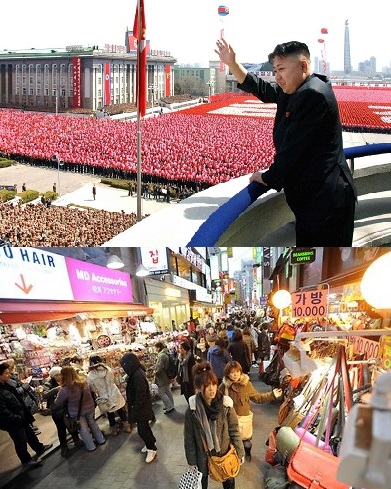
During the Cold War, Korea was to Asia what Germany was to Europe and Yemen to the Middle East – once a single people now divided along the ideological border of the rival blocs. Unlike Germany and Yemen, though, a quarter of the century after the Cold War has ended, Korea remains firmly divided. In the North, the world’s last Stalinist regime ruled by the Kim family continues to pose a serious threat to the pro-Western, democratic South Korea. (C) AP Photo/Korean Central News Agency via Korea News Service & Park Ji-Hwan/Agence France-Presse — Getty Images
Changing security perceptions and policies, unresolved conflicts and grievances, and concerns about nuclear and missiles proliferation are all elements that affect the stability of the region as a whole — and which also have global impacts.
In addition to the broadly based UN-led Korean Peace Settlement Conference, the AWC has stressed the need for regional cooperation and confidence-building measures which would improve the daily life of individuals and create the framework for greater future cooperation.
The AWC has highlighted that the Tumen River Development Project (TRADP), now often called the Greater Tuman Initiative (GTI), is probably the best framework for rapid cooperative development. The planning for a Tuman River economic zone at the mouth of the river had been drawn up in the early 1990s by the UN Development Program (UNDP – a vast free – economic zone which would involve parts of Mongolia, China, Russia and the two Korean States as well as Japan as a logical regional development partner. However, development has fallen far short of initial expectations for reasons both internal and external to the participating States.
As Milton Friedman pointed out, ideas can be dormant until a crisis occurs and then new steps must be taken. The AWC believes that the Tuman River economic zone is a real opportunity for cooperation among the States for the benefit of the people of the area.
Citizens of the World call for speedy and creative action to meet the challenge of Korean tensions with a response of cooperation and reconciliation.
Prof. René Wadlow is President of the Association of World Citizens.
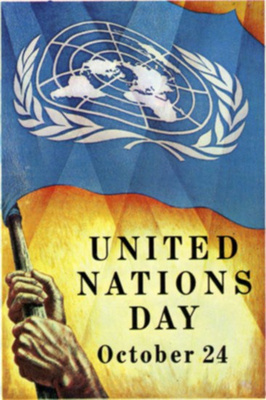
As we mark United Nations (UN) Day this October 24, we are reminded that the UN remains the only universally representative and comprehensively empowered body the world has to deal with threats to international peace and security. As Brian Urquhart, one of the early UN civil servants said, “In the great uncertainties and disorders that lie ahead, the UN, for all its shortcomings, will be called on again and again because there is no other global institution, because there is a severe limit to what even the strongest powers wish to take on themselves, and because inaction and apathy toward human misery or about the future of the human race are unacceptable.” However, the nature of the threats to international security is ever changing. The UN, just as the national governments which make it up, have difficulties meeting new challenges.
“From the outset of my mandate”, said in 1993 then Secretary General of the UN Boutros Boutros-Ghali, “I have been convinced that the structure of the Organization must mirror, as closely as possible, the tasks it is assigned to undertake. An institution must reflect the objectives it pursues … The UN therefore faces the difficult task of relating our aims to our means, of updating and reforming institutions set up at different times and with different imperatives.” Boutros-Ghali proposed measures to promote coordination and decentralization within the UN system, greater cooperation with non-governmental organizations and regional bodies, and creating more effective UN financing and budget-making mechanisms.
He went on to stress the vast challenges of famine, drought, AIDS, civil wars, uprooted and displaced populations and deepening human misery in many parts of the world. These situations make dramatic demands on the UN system and require a better field presence and operational capabilities. The UN system is called upon to respond to much diversified requirements, often involving the provisions of crucial and direct aid to peoples in deep distress and involving sensitive new fields of social, economic and political transformations. However, the crisis we face is not about the administration of UN bodies, but about a tragically broken world where poverty and violence are ever more visible and where there is an ever-diminishing willingness to help those in need.
Over a decade later, Kofi Annan made many of the same observations as he set out his own proposals for structural reforms “In Larger Freedom”. However, the current structures of the UN for government representatives work “just well enough” that they do not want to take the risk of making changes. Increasingly, it is the representatives of nongovernmental organizations who are pushing for change and are organizing to undertake tasks which some governments are unwilling to do. We see this with the current flow of migrants-refugees to Europe where some non-governmental groups have stepped in to help refugees even when their governments have an unwelcoming and negative policy.
One potentially important innovation is the creation within the UN of the Peacebuilding Commission. Hopefully this Commission will be more than a name change for the same functional relief efforts in post-conflict situations. The Peacebuilding Commission was created as a response to the observation that conflicts are rarely settled, and they often take on new forms of violence as we saw in the Afghanistan case after the end of the Soviet intervention, in Kosovo after the other ex-Yugoslav conflicts had died down, in Somalia despite repeated ceasefires and the creation of “unity governments”.
We all have limited attention spans for crisis situations in which we are not directly involved or do not have strong emotional links. We are constantly asked to pay attention to a new crisis, to new tensions, to new difficulties. Political leaders have even shorter attention spans unless there are strong domestic reasons for remaining involved. Therefore, there is a need both within the UN system and within national governments for a group of persons will a long-range holistic vision, who are able to see trends and the links between situations. Such a body needs to be able to organize long-term cooperation drawing upon the knowledge and resources of universities, religious groups, NGOs and government services at all levels. There needs to be greater public awareness and the ability to organize to articulate values and the implementation of goals.
Just as ecological concerns require actions by a multitude of actors who do not always see the relationship between their actions, so peacebuilding has material, intellectual and spiritual dimensions. Finding the way these fit together in a manner understandable to policy makers is not easy. However, this is the challenge before us. The process will take time and vision. Peacebuilding can be a major focus as we mark UN Day on October 24.
Prof. René Wadlow is President of the Association of World Citizens.
“[…] determined to promote the common welfare by furthering separate and collective action for the purpose of raising levels of nutrition and standards of living […]”
-Preamble of the Food and Agriculture Organization Constitution.
October 16 is the UN-designated World Food Day, the date chosen being the anniversary of the creation of the FAO in 1945 with the aim, as stated in its Constitution of “contributing towards an expanding world economy and ensuring humanity’s freedom from hunger.” Freedom from hunger is not simply a technical matter to be solved with better seeds, fertilizers, cultivation practices and marketing. To achieve freedom from hunger for mankind, there is a need to eliminate poverty. The elimination of poverty must draw upon the ideas, skills and energies of whole societies and requires the cooperation of all countries.
World Citizens have played an important role in efforts to improve agricultural production worldwide and especially to better the conditions of life of rural workers. Lord Boyd-Orr was the first director of the FAO; Josue de Castro was the independent President of the FAO Council in the 1950s when the FAO had an independent Council President. (The independent presidents have now been replaced by a national diplomat, rotating each year. Governments are never happy with independent experts who are often too independent.) The World Citizen, René Dumont, an agricultural specialist, is largely the “father” of political ecology in France, having been the first Green Party candidate for the French Presidency in 1974.
As Lester Brown, the American agricultural specialist says “We are cutting trees faster than they can be regenerated, overgrazing rangelands and converting them into deserts, overpumping aquifers, and draining rivers dry. On our croplands, soil erosion exceeds new soil formation, slowly depriving the soil of its inherent fertility. We are taking fish from the ocean faster than they can reproduce.”
To counter these trends, we need awareness and vision, an ethical standard which has the preservation of nature at its heart, and the political leadership to bring about the socio-economic changes needed. For the moment, awareness and vision are unequally spread. In some countries, ecological awareness has led to beneficial changes and innovative technologies. In others, the governmental and social structures are disintegrating due to disease, population pressure upon limited resources, and a lack of social leadership. Worldwide, military spending, led by the USA, dwarfs spending on ecologically-sound development and the necessary expansion of education and health services.
Some 795 million people in the world do not have enough food to lead a healthy active life. That’s about one in nine people on earth. (World Food Program)
As Lester Brown has written “The sector of the economy that seems likely to unravel first is food. Eroding soils, deteriorating rangelands, collapsing fisheries, falling water tables, and rising temperatures are converging to make it more difficult to expand food production fast enough to keep up with demand…food is fast becoming a national security issue as growth in the world harvest slows and falling water tables and rising temperatures hint at future shortages.”
Yet there are agricultural techniques which can raise protein efficiency, raise land productivity, improve livestock use and produce second harvests on the same land. However, unless we quickly reverse the damaging trends that we have set in motion, we will see vast numbers of environmental refugees — people abandoning depleted aquifers and exhausted soils and those fleeing advancing deserts and rising seas.
David Seckler of the International Water Management Institute writes “Many of the most populous countries of the world — China, India, Pakistan, Mexico, and nearly all the countries of the Middle East and North Africa — have literally been having a free ride over the past two or three decades by depleting their groundwater resources. The penalty of mismanagement of this valuable resource is now coming due, and it is no exaggeration to say that the results could be catastrophic for these countries, and given their importance, for the world as a whole.” Unfortunately, the International Water Management Institute does not manage the world’s use of water but can only study water use. While there are some planners who would like to be able to tax or make people pay for water, most water use is uncontrolled. Payment for water is a way that governments or private companies have to get more revenue, but the welfare of farmers is usually not a very high priority for them.
Yet as Citizens of the World have stressed, ecologically-sound development cannot be the result only of a plan, but rather of millions of individual actions to protect soil, conserve water, plant trees, use locally grown crops, reduce meat from our diets, protect biological diversity in forest areas, cut down the use of cars by increasing public transportation and living closer to one’s work. We need to stabilize and then reduce world population and to encourage better distribution of the world’s population through planned migration and the creation of secondary cities to reduce the current growth of megacities. We need to encourage wise use of rural areas by diversifying employment in rural areas. We also need to develop ecological awareness through education so that these millions of wise individual decisions can be taken.
In 1989 The Christians sang, “When will there be a harvest for the world?” Well … We wish we knew.
Lester Brown underlines the necessary link between knowledge and action. “Environmentally responsible behaviour also depends to a great extent on a capacity to understand basic scientific issues, such as the greenhouse effect or the ecological role of forests. Lacking this, it is harder to grasp the link between fossil fuel burning and climate change or between tree cutting and the incidence of flooding or the loss of biological diversity…The deteriorating relationship between the global economy and the earth’s ecosystem requires an all-out effort to bring literacy to all adults in order to break the poverty cycle and stabilize population.”
Education and vision require leadership, and it is ecologically-sound political leadership that is badly lacking today. Thus Citizens of the World and all of good will are called upon to provide wise leadership to work for a redirection of financial resources to protect the planet, and to encourage ecologically-sound individual and collective action.
Prof. René Wadlow is President of the Association of World Citizens.
October 10 is the International Day against the Death Penalty. Since the end of World War II, there has been a gradual abolition of the death penalty due to the rather obvious recognition that putting a person to death is not justice. Moreover, on practical grounds, the death penalty has little impact on the rate of crime in a country. A number of States have a death penalty for those involved in the drug trade. To the extent that the drug trade can be estimated statistically, the death penalty has no measurable impact on the trade − a trade usually linked to economic or geopolitical factors.
October 10 can also be a day to oppose all organized killings by State agents. In addition to State-sponsored official executions, usually carried out publicly or at least with official observers, a good number of countries have State-sponsored “death squads” − persons affiliated to the police or to intelligence agencies who kill “in the dark of the night” − unofficially. These deaths avoid a trial which might attract attention or even a “not guilty” decision. A shot in the back of the head is faster. The number of “targeted killings” has grown. In many cases, the bodies of those killed are destroyed and so death is supposed but not proved, as has been the case of students protesting in Mexico. United States assassinations with drones has also been highlighted both in the United Nations human rights bodies and domestically. However, the drone “strikes” continue, and there is very little legislative opposition.
The United States is the one and only Western country which retains the death penalty in its national legislation – and, ironically, the most violent one too. So much for the so-called “deterrent effect” of the death penalty.
A good deal of recent concern has been expressed on the death sentence in Saudi Arabia pronounced against Ali al-Nimr found guilty “of going out to a number of marches, demonstrations, and gatherings against the state and repeating some chants against the state” when he was 15 years old. He is to die by crucifixion. There is perhaps some chance of a change of penalty due to more historically-minded Saudis. The most widely known person crucified is Jesus. As the Roman count records have been lost, we have only the account written by his friends who stressed that he was innocent of the crimes for which he was condemned. His crucifixion has taken on cosmic dimensions. “Are you washed in the blood of the Lamb?” The Saudis try to avoid some of the Jesus parallel by beheading the person before putting the rest of the body on the cross, but the image of the crucified as innocent is wide spread.
In the 1970s French singer Julien Clerc sang “L’assassin assassiné”, “The Assassinated Assassin”, a resounding plea for the abolition of the death penalty. When France did abolish capital punishment in 1981, then Justice Minister Robert Badinter said the song had done even more for the removal of the death penalty than his own speech before the French National Assembly.
October 10 is an occasion for us to stress the importance of human dignity. Our efforts against executions need to be addressed both to governments and to those state-like nongovernmental armed groups such as ISIS/Daesh in Syria and Iraq. The abolition of executions and the corresponding valuation of human life are necessary steps in developing a just world society.
Prof. René Wadlow is President of a Representative to the United Nations Office at Geneva of the Association of World Citizens.
SYRIA: ISIS ICONOCLASTS LEAVE A BLOODY TRAIL OF DESTRUCTION
By René Wadlow
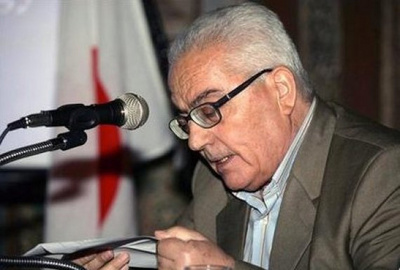
On August 18, 2015 Dr Khaled al-Assad, retired director of the Palmyra museum and an officer of the Directorate General of Antiquities and Museums, had his neck cut and his body hung from a traffic light pole. The 83 year-old archaeologist had been held in seclusion (and probably tortured) for three weeks. In the public square of Palmyra an accusation was read out that he was “the director of pagan idols”. Khaled al-Assad had been born in Palmyra and had spent most of his career there, writing numerous articles as well as directing archaeological sites. He had few rivals in his knowledge of the ancient crossroad city of Palmyra, an important link on the trade routes between Asia, North Africa, and Europe.
The public killing of Khaled al-Assad renewed concern for the historic sites. It was widely believed that many of the sites had had explosives placed in them to provoke their destruction. Sites in Palmyra had already been damaged during the fighting in the spring as the soldiers of the Islamic State in Iraq and Syria (ISIS or Daesh in Arabic) took control of the city and the surrounding area. Then on August 23, some of the explosives were set off, damaging the important Temple of Baal, one of the most visited sites in Palmyra. Baal – the Lord of the Heavens – was represented by an eagle. He was also a storm god shown holding a lightning bolt in his hand.
From a distance, it is hard to know what elements within ISIS are responsible for the destruction and what are the motivations. ISIS has attracted fighters from a good number of countries, and it is impossible to know the chains of command or the motivations. Many Syrians are proud of the vestiges of pre−Islamic civilizations, proof that the area was an important actor and in some ways a rival of Rome. The Directorate General of Antiquities has some 2,500 employees with a record of preserving Syria’s cultural heritage. In addition, some Syrian citizens, risking their lives, have tried to defend heritage sites or to hide away cultural objects. Moreover, ISIS agents as well as persons belonging to other armed factions have been looting objects to sell outside the country, either for personal gain or to finance their political faction, rather than destroying them.
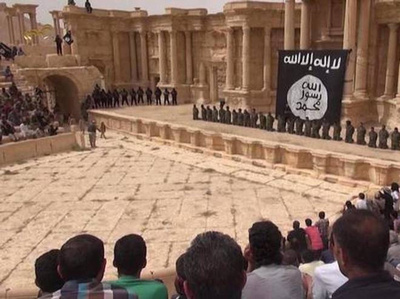
When ISIS/Daesh took Palmyra last May, many people feared they might blow up the ancient city at once. They didn’t, but now the vestiges of the ancient civilization most inappropriately serve as a stage for ISIS/Daesh to use toward propaganda purposes.
Thus, it is not clear who wants to destroy works of art and cultural heritage. Are there sincere iconoclasts for whom any object that recalls pre-Islamic worship is an insult to the Islamic faith? Are there people who just want to destroy and will blow up most anything? Are there people who believe that public killings and destruction of heritage will facilitate military expansion and control of the population? Is there any possibility of rational discussion and good-faith negotiations with ISIS authorities to preserve cultural sites in Syria and Iraq?
Conserving a cultural heritage even in times of peace is always difficult. Weak institutional capabilities, lack of appropriate resources and isolation of many culturally essential sites are compounded by a lack of awareness of the value of cultural heritage conservation. On the other hand, the dynamism of local initiatives and community solidarity are impressive assets. These forces should be enlisted, enlarged and empowered to preserve and protect a heritage.
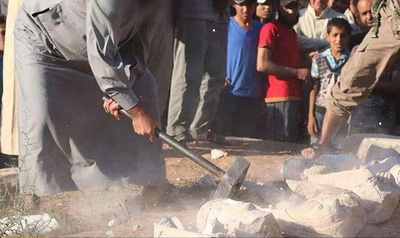
ISIS/Daesh members enthusiastically destroying a historical ancient site. They may bring down every reminder of the past they come by, but try as they might, they cannot change history.
Are there ways that those of us on the “outside” can reach those in Syria and Iraq who wish to preserve cultural heritage and to defend the lives of those who work to preserve protect and inform?
My belief is that the current military action against ISIS, either with ground troops or bombing from the air, will have little positive impact. Armed force may lead some of the ISIS forces to a “burned earth” policy, destroying as much as they can before retreating. I think that there needs to be initiatives taken by those currently living under ISIS rule but who do not share ISIS values. They need to take actions to show ISIS leaders that their policies are an error and will lead to greater divisions within the population.
There is always a certain irony for someone in a safe area to encourage others to take actions which can put their lives in danger. Therefore, the least that we can do is to have a loud outcry from cultural workers throughout the world so that those in Syria and Iraq who will act positively know that they are not alone.
Prof. René Wadlow is President and Chief Representative to the United Nations Office at Geneva of the Association of World Citizens.
THE CONTINUING HUMANITARIAN CRISIS AND VIOLATIONS OF HUMAN RIGHTS IN ISIS-HELD AREAS IN IRAQ AND SYRIA
By René Wadlow
In an August 25, 2014 statement, the United Nations (UN) High Commissioner for Human Rights condemned the “appalling, widespread, and systematic violations of human rights” by the Islamic State in Iraq and Syria (ISIS). The violations mentioned included targeted killings, forced conversions, abductions, trafficking of women, slavery, sexual abuse, destruction of religious and cultural sites of significance and the besieging of entire communities because of ethnic, religious and sectarian affiliation.
Among those directly targeted have been the religious communities of Christians, Yezidi (also written Yazidi) and Sabeans (also called Sabean-Mandaeans). In addition to the violation of human rights, the High Commissioner cited other UN reports stressing the humanitarian crisis and the severe shortages of food, water and the lack of medical services.
This sign, here painted in red on a wall with a circle around it, is the letter N in Arabic. When ISIS started seizing predominantly Christian-inhabited areas of Iraq by force, its militiamen immediately painted this on houses they knew or thought were owned by Christians, N being for “Nasrani” which is itself the Arabic for “Christian”. A long echo of the Nazis’ practices in pre-World War II Germany, when Hitler’s own militiamen would paint a Star of David on the front door of each Jewish-owned business. That was just before the “Final Solution” which claimed over 6 million lives.
One year later, the situation remains much the same, but with an increased number of people uprooted as internally displaced persons and refugees. The political situation has grown more complex, with Turkey playing an increasing if unclear role. Efforts at mediation by the UN of the Syrian aspects of the conflict have not given visible results. Russian diplomats have been meeting with some Syrian factions as well as with the Syrian government, but there seem to be no advances toward broader negotiations. The political and military actions of ISIS have effectively linked Iraq and Syria so that each conflict is linked to the other. A global approach for conflict resolution is needed.
The conflict has increased religious sectarian attitudes. It is hard for an outsider to know to what extent religious differences are deeply felt or if religion is used as a “cover” for ethnic, tribal, and economic interests. It is certain that ISIS has tried to give a religious coloring to its policies, with forced conversions and destruction of non-Islamic communities which refused conversion. Therefore, there needs to be an emphasis on freedom of religion or belief as set out by the United Nations.
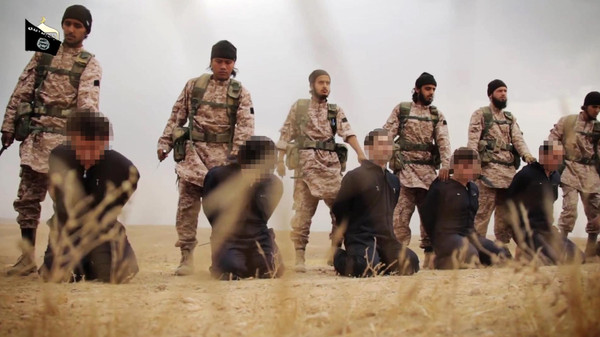
An image grab taken from a propaganda video released on November 16, 2014 by al-Furqan Media allegedly shows members of the Islamic State jihadist group preparing the simultaneous beheadings of at least 15 men described as Syrian military personnel. In the highly choreographed sequence, jihadists march the prisoners by a wooden box of long military knives, each taking one as they pass, before forcing their victims to kneel in a line and decapitating them. (C) AFP PHOTO
One of the major UN declarations confirming a deep sense of inherent dignity is the Declaration on the Elimination of All Forms of Intolerance and of Discrimination Based on Religion or Belief, adopted by the General Assembly on November 25, 1981 after a number of years of study and discussion in which the Association of World Citizens (AWC) took an active part. The Declaration states “that it is essential to promote understanding, tolerance and respect in matters relating to freedom of religion and belief and to ensure that the use of religion or belief for ends inconsistent with the Charter, other relevant instruments of the United Nations and the purposes and principles of the present Declaration is inadmissible.”
Article One states clearly that “No one shall be subject to coercion which would impair his freedom to have a religion or belief of his choice.”
World law as developed by the UN applies not only to the governments of Member States but also to individuals and non-governmental organizations. The ISIS has not been recognized as a State and is not a member of the UN. Nevertheless, the AWC is convinced that the terms of the Declaration on the Elimination of All Forms of Intolerance and Discrimination Based on Religion or Belief applies to the ISIS and that the actions of the ISIS are, in the terms of the Declaration, “inadmissible”.
Syrian demonstrators in Paris, France, vowing for “a democratic future” in Syria “without [Syrian President] Bashar [al-Assad] and without Daesh [ISIS]”. (C) AWC/Bernard J. Henry
Life in the emerging world society requires world law and certain common values among all the States and peoples of the world. The challenges which face us all require inclusive ethical values based on a sense of responsibility for both present and future generations. Such values are, I am sure, in the heart of many individuals who are now living in areas under the control of ISIS in Iraq and Syria. We must find ways to reach such people with the message that the policies of the ISIS leaders are deliberate violations of world law and ethical standards. The majority of the world society is not hostile to the people living under ISIS rule and we look forward to the time when human rights standards will be the law of the land. In the meantime, they need to work as best they can for a tolerant and open society.
Prof. René Wadlow is President and Chief Representative to the United Nations, Geneva, of the Association of World Citizens.
OSCE: STRAINS AND RENEWAL IN THE SECURITY COMMUNITY
By René Wadlow
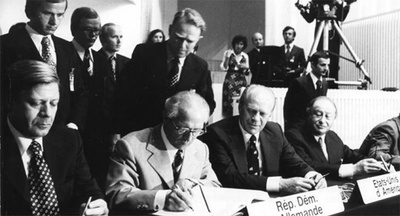
On August 1, 2015, the Helsinki Final Act, the birth certificate of the Organization for Security and Cooperation in Europe (OSCE) turned 40. The Final Act signed in Helsinki’s Finlandia Hall was the result of three years of nearly continuous negotiations among government representatives meeting for the most part in Geneva, Switzerland as well as years of promotion of better East-West relations by non-governmental peace builders.
Basically, one can date the planting of the seeds that grew into the OSCE as 1968 in two cities: Paris and Prague. The student-led demonstrations in Paris which sent shock waves to other university centers from California to Berlin showed that under a cover of calm, there was a river of demands and desires for a new life, a more cooperative and creative way of life.
In Prague, the Prague Spring of internal reforms and demands for a freer European society was met by the tanks of the Soviet Union and the Warsaw Pact in August. Yet some far-sighted individuals saw that 1968 was a turning point in European history and that there could be no return to the 1945 divisions of two Europes with the Berlin Wall as the symbol of that division. Thus, in small circles, there were those who started asking “Where do we go from here?”
A Security Community: A Halfway House
In 1957, Karl W. Deutsch (1912-1992) published an important study, Political Community and the North Atlantic Area (Princeton University Press). Karl Deutsch was born to a German-speaking family in Prague in what was then the Austro-Hungarian Empire. His family was active in socialist party politics and became strongly anti-Nazi. Seeing what might happen, Deutsch and his wife left Prague in 1939 for the USA where he became a leading political science-international relations professor. I knew Karl Deutsch in the mid-1950s when I was a university student at Princeton, and he was associated with a Center on International Organization at Princeton. It was there that he was developing his ideas on types of integration among peoples and States and that he coined the term “security community” to mean a group of people “believing that they had come to agreement on at least one point that common social problems must and can be resolved by processes of peaceful change.” For Deutsch, the concept of a security community could be applied to people coming together to form a State: His approach was much used in the 1960s in the study of “nation building” especially of post-colonial African States. A “security community” could also be a stage in relations among States as the term has become common in OSCE thinking. For Deutsch, a security community was a necessary halfway house before the creation of a State or a multi-State federation. Deutsch stressed the need for certain core values which created a sense of mutual identity and loyalty leading to self-restraint and good-faith negotiations to settle disputes.
Core values established and quickly disappeared
During the negotiations leading to the Helsinki Final Act, a set of 10 core values or commitments were set out, sometimes called the OSCE Decalogue after the “Ten Commandments”. “Sovereign equality, respect for the rights inherent in sovereignty and non-intervention in internal affairs” set the framework as well as the limitations of any efforts toward a supranational institution. The two other related core values were “the territorial integrity of States and the inviolability of frontiers.”
The core values were not so much “values” as a reflection of the status quo of the Cold War years. By the time that the Charter of Paris for a New Europe was signed in November 1990, marking the formal end of the Cold War, “territorial integrity and the inviolability of frontiers” as values had disappeared.
The 1990s saw the breakup of two major European federations − that of Yugoslavia and the USSR. Most of the work of the OSCE has been devoted to the consequences of these two breakups. Yugoslavia broke into nearly all the pieces that it could with a few exceptions. I had been asked to help support the independence of Sandzak, a largely Muslim area in Serbia and part of Montenegro. I declined, having thought at the time that with a few modifications the Yugoslav federation could be kept together. I was wrong, and the OSCE is still confronted by tensions in Kosovo, renewed tensions in Macedonia, an unlikely form of government in Bosnia and Herzegovina as well as social issues of trafficking in persons, arms, drugs and uncontrolled migration.
The breakup of the Soviet Union has led to a full agenda of OSCE activities. The republics of the Soviet Union had been designed by Joseph Stalin, then Commissioner for Nationalities so that each republic could not become an independent State but would have to look to the central government for security and socio-economic development. Each Soviet republic had minority populations though each was given the name of the majority or dominant ethnic group called a “nationality”.
With the breakup of the Soviet Union, there have been recurrent issues involving the degree of autonomy of geographic space and the role of minorities. The conflict in Nagorno-Karabakh had already started before the breakup, but continues to this day with its load of refugees, displaced persons and the calmer but unlikely twin, the Nakhchivan Autonomous Republic. Moldova and Transdniestria remain a “frozen conflict” with a 1992 ceasefire agreement. The armed conflicts in Chechnya and violence in Dagestan highlighted conflicts within the Russian Federation. The 2008 “Guns of August” conflict over South Ossetia between Russia and Georgia showed that autonomy issues could slip out of control and have Europe-wide consequences.
(C) Sadankomitea
A Cloudy Cristal Ball
Predictions, especially about the future, are always difficult. In 2013, the OSCE Chairperson-in-Office, the then Minister for Foreign Affairs of Ukraine, Leonid Kazhara, said “We wish to contribute to the establishment of the Euro-Atlantic and Eurasian security community free of dividing lines, conflicts, spheres of influence and zones with different levels of security … There is a pressing need to, first of all, change our mindsets from confrontational thinking to a cooperative approach. I am confident that Ukraine, with its rich history, huge cultural heritage and clear European aspirations is well placed for carrying out this mission.”
Today, Ukraine’s rich history has a new chapter, recreating old dividing lines and spheres of influence. The shift in “ownership” of Crimea indicates that “territorial integrity of States” is a relative commitment. The large number of persons going to Russia as refugees and to west Ukraine as internally-displaced persons recalls the bad days of displacement of the Second World War. NATO has dangerously over-reacted to events in Ukraine.
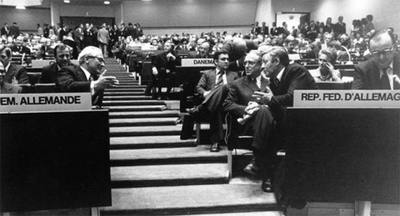
It is not clear that the current leaders of the 57 governments of the OSCE have the wisdom or skills to lead to a renewal of the Security Community. Yet when one looks at the photos of the government leaders who did sign the Helsinki Final Act 40 years ago, there are few faces indicating wisdom or diplomatic skills so perhaps all is not lost today. Very likely, as in the period between the events of 1968 and the start of government negotiations in 1972, there will need to be nongovernmental voices setting out new ideas and creating bridges between people.
Prof. René Wadlow is President and Chief Representative to the United Nations Office at Geneva of the Association of World Citizens.






![Syrian demonstrators in Paris, France, vowing for "a democratic future" in Syria "without [Syrian President] Bashar [al-Assad] and without Daesh [ISIS]". (C) AWC/Bernard J. Henry](https://awcungeneva.com/wp-content/uploads/2015/08/without_daesh.jpg)