The Official Blog of the

Archive for the ‘Middle East & North Africa’ Category

Syria: From a ceasefire to comprehensive negotiations?

In Conflict Resolution, Current Events, Middle East & North Africa, NGOs, Refugees, Solidarity, Syria, The Search for Peace, Track II, United Nations on February 27, 2018 at 9:16 PM

By René Wadlow

After multiple delays to reach agreement with the Russian ambassador, on February 24 the United Nations (UN) Security Council adopted a resolution for a 30-day ceasefire “without delay” in Syria. The truce would allow for the delivery of emergency aid and the evacuation of the wounded, including the beleaguered Eastern Ghouta, home to some 350,000 people near Damascus. Now, we need to work to have the ceasefire honored.

Eastern Ghouta is near Damascus and has been a contested zone since early in the 2011 uprising. Ghouta is close enough to Damascus so that opposition mortars can be fired on districts in Damascus – close enough also so that rockets and barrel bombs from government helicopters can increasingly fall on the zone. Hospitals have been hit in Ghouta, probably deliberately.

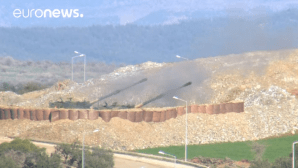
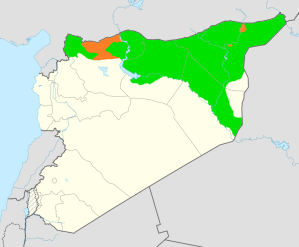
Afrin, the scene of new fighting, is in the Aleppo Governorate. It has a large Kurdish population. The Turkish government suspects all organized Kurdish groups to be “terrorists” or potential terrorists. Moreover, the demands for independence of the Kurdish Autonomous Administration in Iraq being linked to a possible similar Kurdish zone in Syria is considered by the Turkish government as an active threat to be countered by force. Thus, for the past 10 days, Turkish troops in the misnamed “Operation Olive Branch” have been attacking Afrin and its surrounding area. As an element in complicated Kurdish politics and alliances, a pro-Syrian government Kurdish militia has joined the battle to defend Afrin.
Capture d'écran 2018-02-27 21.37.00

The fighting between Turkey and the YPG in and around Afrin has made the headlines lately. (Screenshot)

It is too early to know if the ceasefire will be respected. There have been ceasefires in the past which did not hold. However, a ceasefire is not an end in itself. It is a time which may create a “breathing space” during which there are potentially increased possibilities for negotiations on the end to the armed conflict which began in the Spring of 2011.

Currently, there are two sets of inter-related but separate official negotiations undertaken. The most comprehensive is that of the UN carried out largely in Geneva but also at times in Vienna. The second is sponsored largely by the Russian Federation with some support at different times from Iran and Turkey. There may be less public discussions carried out in the shadows of the official mediations about which little is made public and which probably involves only a number of the actors in the conflict.

Mediation is the action taken by a third party to facilitate two (occasionally more) hostile parties coming together to negotiate. Mediation is not negotiation. Negotiation is the process of bargaining and compromise by which those directly in conflict can reach an agreement. The function of the mediator is to remove the obstacles to negotiation, in part by bringing the conflicting parties together for direct discussions.

The impartial mediator sees no enemies but only the mental and physical suffering of war, as much among “the aggressors” as among the victims. The hatred and suspicions that nourish the conflict makes the conflict increasingly complicated. Part of the mediators’ task is psychological, to lessen the negative emotions so that a slight change of understanding can occur. But this psychological task must be carried on as though one is discussing political and military issues. Mediators must present their efforts in such a way that they will be listened to, avoiding words or ideas that evoke automatically a hostile response.
luncheon

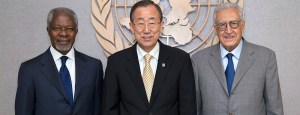
Left to right: Kofi Annan, Ban ki-moon and Lakhdar Brahimi. Under Ban as Secretary-General of the United Nations, Annan and Brahimi successively served as UN mediators for Syria, both unsuccessfully. (International Peace Institute)

Mediation is an on-going process with many steps both forward and backward. If skillfully carried out, psychological advances may be made; some tensions may be eased, some misconceptions dispelled, some fixed ideas diminished. For parties in a conflict to seek compromise, there needs to be a certain “atmosphere” – an informed public opinion that will accept the compromise and build better future relations based on an agreement.

The official mediator’s role is not to suggest the constitutional or political nature of the settlement to which the protagonists should arrive. The official mediator can only suggest how constitutional structures might be discussed.

It is chiefly on the issue of constitutional structures that there is a difference between efforts carried out by the UN and the Russian Federation and what can be done by a nongovernmental organization such as the Association of World Citizens (AWC). Non-official mediators must be able to speak to the wide range of protagonists in the Syrian-Iraq conflicts without being seen as supporting one faction or another.

The AWC has been concerned with possible con-federal structures for both Syria and Iraq. The AWC has a long-standing interest in helping to develop appropriate constitutional structures for States facing the possibility of prolonged or intensified armed conflicts. An emphasis is placed on the possibilities of con-federation, autonomy, renewal, and trans-frontier cooperation. The AWC continues the con-federal, trans-frontier tradition of the world citizens Denis de Rougemont (1906-1985) and Alexandre Marc (1904-2000) (1). In the recent past, the Association has proposed con-federal structures to deal with conflicts situations in Mali, Ukraine, Myanmar, Sri Lanka, Libya, Sudan and Cyprus.

The AWC has been actively concerned with Kurdistan issues which involves structures of both Iraq and Syria as well as positive cooperation among Kurds living in Iraq, Syria, Turkey, and Iran. While the AWC does not sponsor Kurdish demands as such, we believe that the Kurdish issues in Syria, Iraq and Turkey merit close attention. Con-federation and autonomy are broad concepts, capable of covering a multitude of visions extending from very limited local initiatives to complete control over everything other than foreign policy. The ways in which the elements and patterns of autonomy are put together require political imagination, far-sighted political leadership, a willingness to compromise, and constant dialogue.
Kurdistan_Referendum_and_Independence_Rally_at_Franso_Hariri_Stadium_in_Erbil,_Kurdistan_Region_of_Iraq_03

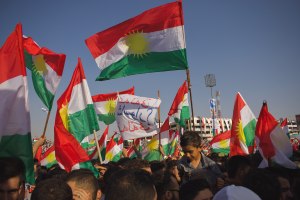
In September 2017 a majority of Iraqi Kurds voted for independence. Who knows what lies ahead for a historically stateless Kurdish people now? (C) Levi Clancy

There are legitimate fears among some in Syria and also in Iraq that consideration of con-federal structures opens the door to having Syria and Iraq broken into separate zones of influence, dependent on outside powers – the USA, Russia, Iran, Turkey. Thus, we need to stress that autonomy does not mean division. There is also a need to stress trans-frontier cooperation among groups.

Some sectors demanding greater recognition are not primarily geographically based. The Sunni-Shi’a divisions cut across zones though there are zones which have a majority of one particular religious tradition. Religion is not the only dividing factor: Kurd, Turkmen can be considered ethnic factors.

Comprehensive negotiations on the future of Syria and Iraq within the context of the wider Middle East are difficult to organize. It is not sure that the ceasefire in Syria will hold long enough to create an atmosphere leading to serious official negotiations. For those of us in the nongovernmental field, we must use every opportunity to promote a broader, more cooperative framework to consider the challenges and to facilitate serious discussions.

Note:

1) See Christian Roy, Alexandre Marc et la Jeune Europe (Presse de l’Europe, 1998); J. Laubert de Boyle, Les non-conformistes des années 30 (Seuil, 1969); Michel Winock, Esprit. Des intellectuels dans la cité. 1930-1950 (Seuil 1996)

Prof. René Wadlow is President of the Association of World Citizens.
Syria Conflicts Highlight Violations of Humanitarian International Law

In Conflict Resolution, Current Events, Human Rights, Humanitarian Law, International Justice, Middle East & North Africa, NGOs, Refugees, Solidarity, The Search for Peace, Track II, United Nations, War Crimes, World Law on February 23, 2018 at 9:58 PM

By René Wadlow

A recent wave of fighting in Syria, especially in the Eastern Ghouta zone near Damascus and in Afrin, a largely Kurdish area near the frontier with Turkey has highlighted the violations of humanitarian international law. Calls from United Nations (UN) officials for at least a month-long truce so that food and medical supplies could reach the civilian population have not been honored. The scale of the violations is such that they can be considered as a deliberate policy and not as events of “collateral damage” in the fog of war. These violations of long-established humanitarian international law are evidence that the laws of war are increasingly being undermined with few governmental reactions.

The Association of World Citizens (AWC) again calls for respect of humanitarian international law and for a world-wide effort for the re-affirmation of humanitarian international law. (1)

TOPSHOT-SYRIA-CONFLICT-KURDS-TURKEY

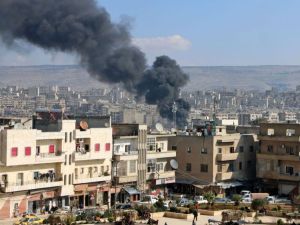
The Kurdish city of Afrin, in the north of Syria, under heavy shelling by the Turkish army

Eastern Ghouta is near Damascus and has been a contested zone since early in the 2011 uprising. Ghouta is close enough to Damascus so that opposition mortars can be fired on districts in Damascus – close enough also so that rockets and barrel bombs from government helicopters can increasingly fall on the zone. Hospitals have been hit, probably deliberately. Eastern Ghouta is one of the deescalation zones agreed to by Russia, Iran and Turkey. However not all the opposition groups are party to the deescalation agreement which opens the door to ever-escalating violence.

Afrin is in the Aleppo Governorate and in an area with a large Kurdish population. The Turkish government suspects all organized Kurdish groups to be “terrorists” or potential terrorists. Moreover, the demands for independence of the Kurdish Autonomous Administration in Iraq linking to a possible similar Kurdish zone in Syria is considered by the Turkish government as an active threat to be countered by force. Thus, for the past month, Turkish troops in the mis-named “Operation Olive Branch” have been attacking Afrin and its surrounding area. As an element in complicated Kurdish politics and alliances, a pro-Syrian government Kurdish militia has joined the battle to defend Afrin. The dangers of escalation and greater loss of civilian life are very real. For the moment, negotiations on a resolution of the armed conflict within all of Syria seems to be at a dead point, at least in terms of public negotiations.

With the current impossibility to reach an overall resolution to the conflict, the best we can hope for is an honest application of humanitarian international law and a broader, worldwide re-affirmation of humanitarian international law.

1024px-Ghouta_massacre4

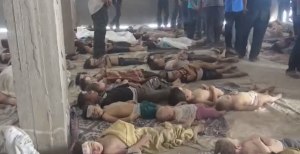
Syrian civilians, including children, killed in the first chemical attack on the Ghouta, back in August 2013

Current armed conflicts in Afghanistan, Yemen, Syria-Iraq-ISIS-Turkey, Libya, Somalia and elsewhere have led to repeated and conscious violations of humanitarian international law such as attacks on medical facilities and personnel, killing of prisoners-of-war, the taking and killing of hostages, the use of civilians as “human shields” and the use of weapons which have been banned by treaties.

Thus, there is a pressing need for actions to be taken to implement humanitarian international law in response to increased challenges. Citizens of the World stress the need for a UN-led conference on the re-affirmation of humanitarian international law including its application by non-State parties. Non-State actors such as ISIS or the Afghan Taliban, are increasingly involved in armed conflicts but were largely not envisaged when humanitarian international law was being drawn up by governments Thus, the conference would highlight the need to apply humanitarian international law both to States and to non-State actors. (2)

Such a conference would bring together into a coherent synthesis the four avenues of humanitarian international law: (3)

1) The Geneva Conventions – Red Cross-mandated treaties;

2) The Hague Convention traditions dealing with prohibited weapons, highlighting recent treaties such as those on land mines and cluster munitions;

3) Human rights conventions and standards, valid at all time but especially violated in times of armed conflicts;

4) The protection of sites and monuments which have been designated by UNESCO as part of the cultural heritage of humanity, highlighting the August 2016 decision of the International Criminal Court on the destruction of Sufi shrines in northern Mali. (4)

Such a re-affirmation of humanitarian international law should be followed by efforts to influence public consciousness of the provisions and spirit of humanitarian international law. This can be done, in part, by the creation of teaching manuals for different audiences and action guides. (5)

22805364530_76de57d168_k

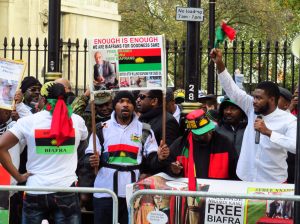
A protest by Biafran activists in London on November 13, 2015 (C) David Holt

I would cite a precedent for this re-affirmation of humanitarian international law from personal experience. During the Nigeria-Biafra civil war, I was part of a working group created by the International Committee of the Red Cross to respond adequately to the challenges of this conflict which was the first African armed conflict that did not involve a colonial power. The blocking of food flows to Biafra and thus starvation as a tool of war was stressed in our work. (6)


One conclusion of the working group was the need to re-affirm the Geneva Conventions and especially to have them more widely known in Africa by writing Africa-focused teaching manuals. Thus, as at the time I was professor and Director of Research of the Graduate Institute of Development Studies, Geneva, I collaborated with Professor Jiri Toman, Director of the Institut Henri Dunant on the creation of such a manual to be used in Africa. Today, such culturally-sensitive manuals could be developed to explain humanitarian international law.

Such a re-affirmation conference would be welcomed by civil society organizations related to relief, refugees, human rights and conflict resolution. A certain number of these organizations have already called attention to violations and the need for international action. There is a need for some governmental leadership for the re-affirmation of humanitarian international law as a basis of world law dealing with the protection and dignity of each person.

** Notes **

1) Hilaire McCoubrey and Nigel D. White. International Law and Armed Conflict (Aldershot: Dartmouth, 1992)

2) see Andrew Clapham. Human Rights Obligations of Non-State Actors (Oxford: Oxford University Press, 2006)

3) see Sydney D. Bailey. Prohibitions and Restraints in War (Oxford: Oxford University Press, 1972)

4) see Rene Wadlow “Guilty Plea in Cultural Destruction Case” Peace Magazine (Canada) Oct-Dec 2016

5) see Jacques Freymond. Guerres, Révolutions, Croix-Rouge (Geneva: Institut Universitaire de Hautes Etudes Internationales, 1976) and Thierry Hentsch. Face au blocus. La Croix Rouge internationale dans le Nigéria en guerre (Geneva: Institut Universitaire de Hautes Etudes Internationales, 1973)

6) see as a good example of an action guide Paul Bonard. Les Modes d’Action des Acteurs Humanitaires. Critères d’une Complémentarité Opérationnelle (Geneva, CICR, no date given)

Prof. René Wadlow is President of the Association of World Citizens.
Con-federation, Constitutional Reforms, Renewal and Trans-frontier Cooperation

In Conflict Resolution, Current Events, Democracy, Middle East & North Africa, NGOs, The Search for Peace, Track II, United Nations on January 5, 2018 at 8:58 PM

By René Wadlow

The Association of World Citizens (AWC) has a longstanding interest in developing appropriate constitutional structures for States facing the possibilities of prolonged or intensified armed conflicts. An emphasis is placed on the possibilities of con-federation, autonomy, renewal, and trans-frontier cooperation. The AWC continues the con-federal, de-centralist, trans-frontier cooperation tradition of World Citizens Denis de Rougemont (1906-1985) and Alexandre Marc (1904-2000). (1)

In the recent past, this association has proposed con-federal structures to deal with conflict situations in Mali, Ukraine, Myanmar, Libya and Cyprus as well as Kurdistan, which involves both the structure of Iraq as well as positive cooperation among Kurds living in Iraq, Syria, Turkey and Iran. While the AWC does not sponsor the Kurdish demands as such, we believe that the Kurdish issues in Syria, Iraq and Turkey merit attention.

The current AWC emphasis is on the wider Middle East as this is an area where current armed conflicts may slip out of the control of conflict management techniques and institutions. The wider Middle East is an area of unrest, often without avenues for dialogue and compromise among the parties. Even in those States where there is no armed fighting such as Iran, Lebanon, Egypt, Israel-Palestine, there are strong tensions which can get worse and also spread. For the parties in these conflicts to seek a compromise, there needs to be a certain “atmosphere” – an informed public opinion that will accept the compromise and build better future relations based on an agreement. It is in the creation of such an atmosphere that citizens of the world have an important role to play. We see the dangers of calling into question of the nuclear agreement with Iran, especially by the United States (U. S.) administration.

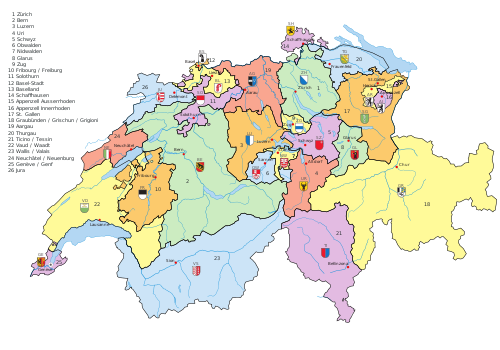
Kantone_der_Schweiz.svg

In today’s world, only one nation-state claims to be a con-federation – Switzerland, officially the Swiss Confederation, a country of high political stability, harmonious ethnic and linguistic diversity, and a long-running tradition of informal diplomacy toward conflict resolution too.

As a nongovernmental organization (NGO), we can have little influence on who will be the “leaders” of these States, but we can play a role in proposing new con-federal constitutional structures linked to new attitudes, what I call ‘renewal’ within the existing social-ethnic-religious groups involved. New constitutional forms by themselves will not reduce the current antagonisms. However, if people now caught up in the ‘fog of conflict’ see that there may be possibilities for changes in the structures of government that will recognize their identity and views, doors may open for compromise.

Proclamation_Canadian_Confederation

Canada, the world’s second largest country, is organized as a confederation. The northernmost nation in the Americas stands out as a model of democracy, decentralized government, and coexistence between various ethnic and linguistic groups.

Con-federation and autonomy are broad concepts, capable of covering a multitude of visions extending from very limited local initiatives to complete control over everything other than foreign policy. Autonomy can therefore incorporate all situations between nearly total subordination to the center to nearly total independence. The ways in which the elements and patterns of autonomy are put together require political imagination, far-sighted political leadership, a willingness to compromise, and constant dialogue.

In none of the wider Middle East situations: Yemen, Syria, Iraq, Libya, on which we have made proposals have we found much of a climate for meaningful negotiations . Our “track record” outside the Middle East has not been much better: Sri Lanka, Burma, Mali, Sudan, and Ukraine. I think that from our contacts with diplomats at the United Nations (UN) in Geneva and New York, our proposals for new constitutional structures are not brushed off lightly, but they are not acted upon either. National political leaders often have a short attention span for issues unless there are strong domestic reasons for remaining involved. Diplomats often share this short-term point of view. “We are concerned with a ceasefire, with stopping the flow of Middle East refugees to Europe. After that, it is up to the people in each State to work out their constitutional structures. We thank you for sharing your ideas on the future of the Middle East. When the smoke clears, please come back to see us, but, of course, I may have retired by then.”

1024px-Claimed_and_de_facto_territory_of_Rojava

Rojava, a state-like entity formed by the Kurds of Syria, claims in its Constitution to be based on “democratic confederalism” and vows to be a part of a future “federal Syria”. Can that claim ever be realized, or is it bound to remain only wishful thinking?

Negotiations means a joint undertaking by disputants with the aim of settling their disputes on the basis of mutual compromise. Negotiation is a basic political decision-making process, a way of finding common interests, to facilitate compromise without loss of what each considers to be essential objectives.

The challenges posed by the conflicts in Mali, Ukraine, Myanmar, Libya, and Kurdistan need to be measured against the broad concept of security. Barry Buzan of the University of Copenhagen sets out four types of security:
1. Political security concerns the organizational stability of states, systems of government, and the ideologies that give them legitimacy.
2. Economic security concerns access to the resources, finances and markets necessary to sustain acceptable levels of welfare.
3. Societal security concerns the sustainability within acceptable conditions of the evolution of traditional patterns of language, culture, religions and customs.
4. Environmental security concerns the maintenance of the local and the planetary biosphere as the essential support system on which all other human enterprises depend.

One of the difficulties in each situation is what I would call “the frozen image of the other”. In each case, the group or groups demanding new State structures are seen in the minds of the current government authorities as being the same people with the same aspirations as when the demands were first made: the Karen of Myanmar today are the same as the Karen of the Union of Burma in 1947; the Tuareg of north Mali today are the same as those calling for the creation of an independent State in 1940 when the withdrawal of French troops to Dakar had left a political vacuum.

However, there have been evolutions in policy proposals and in the level of education and experience of new leadership of those demanding autonomy. Yet “frozen images” exist and need to be overcome within all decision-makers involved. The modification of “frozen images” is one of the tasks of non-governmental organizations and Track II diplomatic efforts. This is what I call “renewal”, the ability to think in new terms, so see things in a different way, to see the “Other” as part of the same humanity.

Notes

(1) See: Christian Roy, Alexandre Marc et la Jeune Europe : L’Ordre nouveau aux origines du personnalisme (Presse de l’Europe, 1998)
Jean-Louis Loubet del Bayle, Les non-conformistes des années 30 : Une tentative de renouvellement de la pensée politique francaise (Seuil, 1969)
Michel Winock, Esprit: Des intellectuels dans la cité, 1930-1950 (Seuil, 1996)
Denis de Rougemont, The Future Is Within Us (Pegamon Press, 1983)

Prof. René Wadlow is President of the Association of World Citizens.
Strangled by Saudi-led War, Famine and Internal Divisions, Yemen Faces a Possible Turning Point

In Conflict Resolution, Current Events, Democracy, Human Rights, International Justice, Middle East & North Africa, NGOs, Solidarity, The Search for Peace, Track II, United Nations, War Crimes, World Law, Yemen on December 6, 2017 at 11:13 PM

By René Wadlow

The assassination on December 4, 2017 of former Yemen President Ali Abdullah Saleh has potentially opened a new chapter in the ongoing struggle for power in Yemen. There might be a possibility that with a major actor pushed off the stage, the lesser actors might accept the good offices of the United Nations (UN) mediator Ismail Ould Cheikh Ahmed and form an inclusive central government. There is also a real possibility that the armed conflict becomes even more protracted as factions see increased opportunities to advance their interests.

The Saudi Arabian leadership had expected a quick victory when in March 2015 they launched their operation at the time called “Decisive Storm”. Despite limitless weapons from the USA and Great Britain, including the use of U. S.-made cluster weapons now banned by world law, the Saudi-led coalition made relatively few territorial gains beyond those tribal areas within Yemen that were already favorable to the Saudis, tribes that often existed on both sides of the frontier.

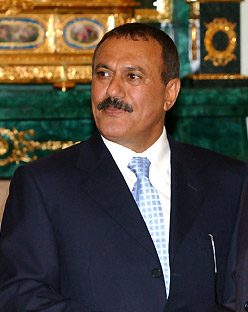
President_Ali_Abdullah_Saleh.jpg

Ali Abdullah Saleh

Both Saudi Arabia and Iran have been backing separate and opposing factions. The lack of progress as well as the costs of the military operations may create a climate favorable to stopping the fighting. However, Saudi Arabia and its coalition are directly involved in the fighting while Iran only supplies some weapons and political support to its allies. Thus, of the outside actors, most responsibility for a change lies with the Saudi decision-makers.

There are two major issues that shape the future. The first is the possibility or not of forming a decentralized but relatively inclusive central government. Yemen remains largely a tribal society with political decisions made by the tribal head. Tribes usually have a specific geographic base. Thus, a central government requires participation by members from the major tribal groups. However, through economic development, people from different tribes now live in the cities and larger towns. These more urbanized populations do not depend as much on the decisions or views of tribal chiefs.

The relative strength of the central government has been based on patronage strategies, offering major tribal leaders some economic advantages. Until March 2011, most people had little say as to government policy. In March 2011, in the spirit of the “Arab Spring”, there were popular demonstrations throughout the country demanding jobs, the end of corruption and some respect for all citizens. By the end of 2011 Ali Abdullah Saleh, who had been in power for 33 years, was pushed out and replaced by his Vice-president Abdu Rabbu Mansur Hadi who has the same governing style but who was considered as a change without upsetting too much the governing pattern.

Saleh, however, never really accepted the idea of giving up power and its material benefits. He formed an alliance with a religious movement that drew its members from the same geographic region. Saleh had combated this Huthi movement, including by force of arms, when he was president. But for a time, the alliance seemed to be mutually beneficial. The alliance broke sharply this November. Fighting among the Huthi forces and those loyal to Saleh broke out in the capital Sana’a in November and on December 4, Huthi troops shot Saleh in his auto as he was trying to leave the city.

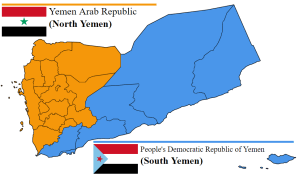
Capture d'écran 2017-12-07 00.04.38

The second major issue concerns the ability of Yemen to remain as one State or again to split into two with Sana’a as the capital of one State in the north and Aden as the capital of another State in the south. The two States were the political structure until 1990 when the People’s Democratic Republic of Yemen, with its center in Aden, combined with the Yemen Arab Republic in the north to become the Republic of Yemen. Leading up to 1990, there was wide hope that the union of the two States would lead to increased economic well-being. In practice, there has been little improvement. If there has been an improvement, it is because of external economic factors and not directly linked to the union. The lack of improvement in the south has led to resentment in the south and on the part of some persons, a desire for southern separation. Now, some in the south have formed militias. It is difficult to know how far they will push for separation and the creation of an independent State. Already in 1994, there had been armed attacks to push for a return to an Aden-based State.

The Association of World Citizens (AWC) has been concerned with three issues in the Yemen conflict:

         1) The violation of international humanitarian law, involving attacks on medical facilities, medical personnel and the use of weapons banned by international treaties, especially cluster munitions. The AWC had been particularly active in promoting a treaty on the prohibition of cluster munitions.

         2) Humanitarian relief, especially food aid. With the Saudi-led blockage of ports and air fields, it has been difficult for the UN or relief organizations to bring in food supplies. It is estimated that some eight million people suffer from famine-like conditions and that some 17 million others are in conditions of food insecurity. The fighting makes certain roads unsafe, preventing the delivery of food and other relief supplies.

         3) The creation of a Yemen confederation. While the form of State structures depends on the will of the people of Yemen (if they were able to express themselves freely), the AWC proposes con-federal forms of government which maintain cooperation within a decentralized framework as an alternative to the creation of new independent States. In 2014, a committee appointed by then president Abu Hadi proposed a six-region federation as the political structure for Yemen. The AWC believes that this proposal merits close attention and could serve as a base of a renewal for an inclusive Yemen government.

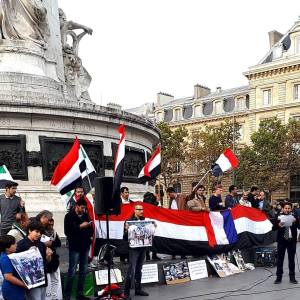
22792442_10212777529168066_8045826512212193364_o

A Yemeni rally in Paris on October 28 (C) Bernard J. Henry/AWC

Today, the choice between an end to the armed conflict with negotiations for a renewal of a Yemeni State on the basis of the con-federal system proposed and continued fighting in the hope that one faction become a “winner-take-all” is relatively clear. The AWC is resolutely for an end to the armed conflict with serious negotiations on the structure of a future State. We encourage others to support such a policy.

Prof. René Wadlow is President of the Association of World Citizens.
To Snap Every Yoke: World Law to End Slavery in Libya

In Africa, Being a World Citizen, Conflict Resolution, Current Events, Human Development, Human Rights, International Justice, Middle East & North Africa, Migration, Modern slavery, NGOs, Refugees, Solidarity, The Search for Peace, United Nations, World Law on November 29, 2017 at 4:25 PM

By René Wadlow

“Is not this what I require of you… to snap every yoke and set free those who have been crushed?” Isaiah, 58 v 6

There are many ways that an individual can be held in chains through his desires and emotions. These chains need to be broken by the development of the will and strong efforts of self-realization through mediation and therapy.

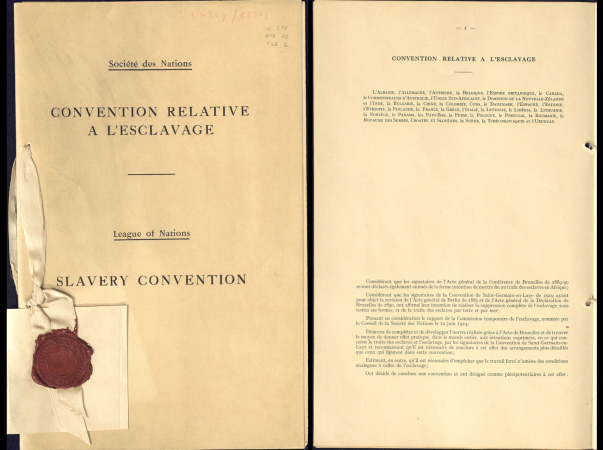
However, it is contemporary forms of slavery in its literal and not symbolic sense that must concern us today. The League of Nations on September 25, 1926 facilitated a Convention on Slavery which was a high-water mark in the world-wide consensus on the need to abolish slavery begun some 100 years before by small groups of anti-slavery activists in England, France and the USA. However as with many League of Nations conventions, there were no mechanisms written into the convention for monitoring, investigation and enforcement. Although the Slavery Convention outlawed slavery and associated practices, it not only failed to establish procedures for reviewing the incidences of slavery in States parties, but also neglected to create an international body which could evaluate and pursue allegations of violations.

1926ConventionContreEsclavageBNM11573.png

Within the United Nations (UN) system, there have been advances made, especially in investigation both making public through official UN documents the investigations of nongovernmental organizations (NGOs) and through the work of Special Rapporteurs of UN human rights bodies.

Thus, in a UN report on “Trafficking of Children and Prostitution in India” the authors write “Nepal appears to be the most significant, identifiable source of child prostitution for Indian brothels. Thousands of Nepalese females under the age of 20 have been identified in India by various studies. The average age of the Nepalese girl entering an Indian brothel is said to be 10-14 years, some 5,000-7,000 of them being trafficked between Nepal and India annually.”

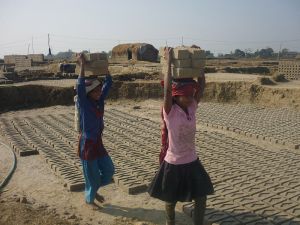
Child_Labour_in_Brick_Kilns_of_Nepal

As Professor Vitit Muntarbhorn, a former UN Special Rapporteur on the Sale of Children, has written, “Gender discrimination victimizes the girl child. Precisely because the girl child in seen in some communities as having lower priority, she is often denied access to such basic necessities as education which could ultimately protect her from exploitation. Another disquieting form of discrimination is based upon race and social origin, interwoven with issues of class and caste. It has become increasingly obvious that many children used in labor and sexual exploitation are lured from particular racial or social groups such as hill tribes, rather than the well-endowed groups in power.”

Today, it is the fate of migrants blocked in Libya, forced into forms of slavery one thought had disappeared, which rightly has focused UN and NGO concern. The UN High Commissioner for Human Rights, Prince Zeid Raad Al Hussein, has said that “the suffering of migrants detained in Libya is an outrage to the conscience of humanity.” His evaluation is based in part on the in-depth field investigation of UN teams which have highlighted that the majority of the 34 detention centers in Libya are concentration camps in which abuse, torture, forced work and all sorts of violence are everyday occurrences. Smugglers of people are often free to do as they please with the complicity of police officials at all levels. The risk of women being captured and raped is so high that some women and girls who are often fleeing from conflict conditions in their home countries take massage doses of birth control pills before entering Libya so that they can avoid getting pregnant. However, this can often cause irreversible injuries.

Capture d'écran 2017-11-29 17.20.08.png

There have been reports and filming of “slave auctions” especially in Sabba, the capital of the Fezzan province where routes from Sudan, Chad, and Niger meet and where roads leading north to the Mediterranean start. The UN also has reports from NGOs, especially humanitarian organizations, and from investigators of the International Criminal Court.

The issue which faces us now is what can be done. The League of Nations and the UN anti-slavery conventions are based on the idea that a State has a government. Unfortunately, Libya is a “failed State”. It has two rival governments, a host of armed groups, and more-or-less independent tribes.

The Association of World Citizens has proposed that there could be created a Libyan confederation with a good deal of regional autonomy but with a central government which would be responsible for living up to international treaties and UN standards. For the moment, there has been no progress in that direction or in the direction of any other constitutional system.

Slavery is a consequence of disorder. Without a minimum of legal structure, there will always be those who arise to make short-term gains including by the selling of people. The conscience of humanity of which the High Commissioner for Human Rights spoke must now speak out boldly to break the yoke of slavery. NGOs need to take a lead. Governments are likely to follow.

Prof. René Wadlow is President of the Association of World Citizens.

COMMUNIQUE DE PRESSE – 2017-11-17-21-30-FRA

In Being a World Citizen, Conflict Resolution, Current Events, Human Rights, Humanitarian Law, International Justice, Middle East & North Africa, Press release, Solidarity, The Search for Peace, United Nations, War Crimes, World Law on November 17, 2017 at 8:24 PM

-- Logo 2017 --

COMMUNIQUE DE PRESSE


Paris, le 17 novembre 2017


LES CITOYENS DU MONDE APPELLENT LA FEDERATION DE RUSSIE

A CESSER DE FERMER LES YEUX

SUR L’UTILISATION D’ARMES CHIMIQUES EN SYRIE


L’Association of World Citizens (AWC) est profondément déçue du veto opposé par la Fédération de Russie au renouvellement par le Conseil de Sécurité de l’ONU du mandat du Mécanisme Commun d’Enquête sur les armes chimiques en Syrie.

L’AWC soutient fortement depuis le départ la nécessité d’enquêtes internationales sur l’utilisation d’armes interdites par le droit mondial.

Un rapport de l’ONU publié en octobre établit la responsabilité des forces armées de la République arabe syrienne, notoirement soutenues par la force militaire russe, dans l’attaque au gaz sarin contre Khan Cheikhoun en avril dernier.

Les armes chimiques sont prohibées en vertu du droit humanitaire international et leur utilisation par quelque partie que ce soit dans le conflit syrien constitue donc un crime de guerre, susceptible d’être jugé comme tel par la Cour pénale internationale, les tribunaux nationaux ou toute institution ad hoc qui viendrait à être créée à cette fin.

L’AWC appelle la Fédération de Russie, le Conseil de Sécurité de l’ONU, et tous les Etats membres de l’ONU à apporter leur plein soutien aux enquêtes existantes et à mener sur l’utilisation d’armes illégales en Syrie, au premier rang desquelles les armes chimiques.

PRESS RELEASE – 2017-11-17-21-30-ENG

In Being a World Citizen, Conflict Resolution, Current Events, Human Rights, Humanitarian Law, International Justice, Middle East & North Africa, Press release, Solidarity, The Search for Peace, United Nations, War Crimes, World Law on November 17, 2017 at 8:24 PM

-- Logo 2017 --

PRESS RELEASE


Paris, November 17, 2017


WORLD CITIZENS CALL ON THE RUSSIAN FEDERATION

TO STOP CONDONING THE USE OF CHEMICAL WEAPONS IN SYRIA


The Association of World Citizens (AWC) is deeply disappointed by the veto opposed by the Russian Federation to a renewal by the United Nations (UN) Security Council of the mandate of the Joint Investigative Mechanism on chemical weapons in Syria.

The AWC has strongly supported the need for international investigations on the use of weapons prohibited by world law.

A UN report released in October established the responsibility of the armed forces of the Syrian Arab Republic, known to be backed by the Russian military, in the sarin gas attack on Khan Sheikhoun last April.

Chemical weapons are prohibited under international humanitarian law and their use by whichever party to the Syrian conflict is thus a war crime, liable to be tried as such by the International Criminal Court, national courts, or whatever ad hoc institution may be created to that end in the future.

The AWC calls on the Russian Federation, the UN Security Council, and all UN Member States to bring their full support to investigations on the use of illegal weapons in Syria, starting with chemical weapons.

– 30 –

The Hidden Stakes of the Independence Vote in Iraqi Kurdistan

In Conflict Resolution, Current Events, Democracy, Middle East & North Africa, The Search for Peace on September 19, 2017 at 10:06 PM

By Bernard J. Henry

A new nation may soon emerge in the Middle East. A nation that has been in the hearts and minds of its people for centuries, but nowhere to be found in geography textbooks or diplomatic directories. A nation named Kurdistan, carved out of what is currently the autonomous northernmost part of Iraq.

On September 25, all native Kurdistanis – people born in Iraqi Kurdistan, whether they are Kurds or from the area’s solid ethnic minorities – will have to answer a question asked by the President of the Kurdish Regional Government, Massoud Barzani: “Do you want the Kurdistan region and the Kurdistani areas outside the region’s administration to become an independent state?”.

Yet behind the possibility of a “Kurdexit” driving the region away from the federal government in Baghdad, there may be more to the vote than meets the eye.

Capture d'écran 2017-09-19 23.15.13

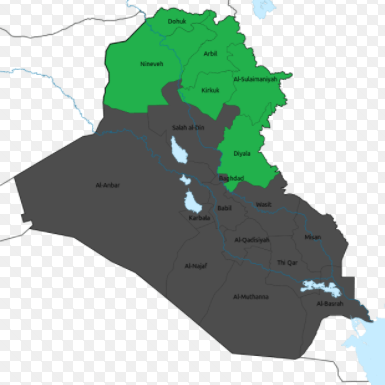
In green on this map, Iraqi Kurdistan

1280px-Flag_of_Kurdistan.svg

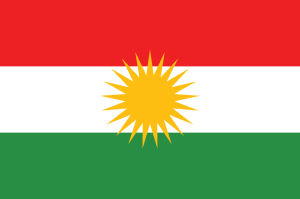
The Kurdish flag

Seeking independence – from dissent at home?

Since 2014, the ruling Kurdish Democratic Party (KDP) of President Massoud Barzani and its archrival, the leftist Patriotic Union of Kurdistan (PUK) once led by former Iraqi President Jalal Talabani, have been at odds with a third contender for leadership – Gorran, “Change” in Kurdish, a center-left movement that spawned from rejection of the two main parties’ policies.

Barzani

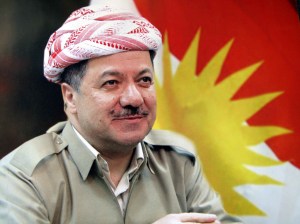
Massoud Barzani

Barzani, who had reneged on leaving his post and reluctantly agreed in the end, cited the rise of Da’esh, the “Islamic State”, to maintain himself in power. Created in 2009, Gorran quickly secured a blocking majority in parliament, forcing the election of one of its members as speaker as well as many concessions from Barzani, who appeared too eager to push back the PUK and along with it any attempt to remove him from power.

When the referendum was announced, Gorran immediately voiced opposition, not out of heartfelt rejection of independence and die-hard loyalty to Iraq but because Barzani was felt as using the issue to stifle any debate on domestic issues, whether with Gorran or the PUK.

“Most of those voters who will say no will not be rejecting independence, but really telling Barzani they want a fair presidential election first,” comments Emran Mensour, a Kurdish lawyer from Syria living in exile in Paris. “The political feud between Barzani and Talabani stops where independence is at stake. But domestically, rivalry never stops.” Even though breaches have since appeared within Gorran and some members have started voicing support for the referendum, the party apparatus continues to stand up to Barzani.

With an estimated 80% of likely voters supporting independence, Gorran appears unlikely to block Barzani’s plans. But the party has made its point and the President of a future independent Kurdistan will know that (s)he must reckon with the third force.

Minding the “big brothers”

Already struggling with dissent at home, alienating others beyond borders is the last thing Barzani needs. In a September 10 official message, the Kurdistani leader called on referendum campaigners to observe the “spirit of brotherhood that binds the people of Kurdistan with the Iraqi people”. He had no choice as the debate on independence is spilling over to neighboring countries, especially Iran and Turkey, the “big brothers” the Shi’a majority in Iraq and the Turkmen minority in Kurdistan look to, respectively.

The Iraqi government and most Iraqi political parties have spoken out against the referendum, as have the governments of Iran, Syria, and Turkey, Ankara’s opposition being echoed in Kurdistan proper by a Turkmen party, the Iraqi Turkmen Front. Understandably, the three countries besides Iraq on whose national territory historic Kurdistan spreads cannot live with the thought that “their” own Kurds may choose independence someday, if only by joining a former Iraqi Kurdistan turned independent. Even then, the main issue will not be with either of the “big brothers”.

Emran_Mensour

Emran Mensour

“Kurds in all four countries are not bound together with the same strength,” Emran Mensour comments. “There is a strong bond between the Kurds of Iraq and Syria”, the former being now organized in a self-declared autonomous entity, Rojava – the Kurdish for “west” –, led by the Syrian branch of Turkey’s Marxist-Leninist Kurdish Workers Party (PKK).

Like its Iraqi counterpart, Rojava has been at the forefront of the military struggle against Da’esh, while also antagonizing the Syrian opposition forces and thus becoming an objective ally of the Damascus regime. Yet Barzani’s paternalistic style of leadership hardly matches the democratic confederal structure of Rojava, at least on paper, and an alliance or a merger between the two looks the least probable outcome of a successful independence vote.

Short-circuiting a “Shi’a crescent”

If not the creation of a greater, mightier Kurdistan, another stake of the referendum is the influence of Shi’a Muslims in an area whose politics have been dictated predominantly by Sunni leaders. “If Assad should remain in power in Syria,” Mensour adds, “he and his counterparts in Iran and Iraq would be able to form a ‘Shi’a crescent’ in the Middle East, obviously a scary thought for every Sunni country in the region”.

No wonder both King Abdullah of Jordan and Israeli Prime Minister Benyamin Netanyahu – none the keener about an independence referendum in Palestine – have expressed support for the vote.

King_Abdullah_portrait

King Abdullah of Jordan

As for Turkey, the main Sunni power west of Iraq, though its President turned autocrat, Reçep Tayyip Erdogan, recently tried to sway King Abdullah, the monarch held firm. Now it is uncertain that Ankara, in business with Iraqi Kurdistan through an oil deal struck outside of Baghdad’s authority, will have the leverage, let alone the will, to resist an independent Kurdistan on the long run. Especially if Erdogan should decide to durably play (the former) Iraqi Kurdistan against the PKK at the helm in Rojava.

More than independence

If any region in the world knows that independence does not guarantee freedom, let alone stability, the Middle East does.

On September 25, Kurdistanis will have to decide on a lot more than independence or not. Should the vote be positive, the ball will be in the court of a world that has shunned peace and human dignity in the Middle East for much too long.

Bernard J. Henry is the External Relations Officer of the Association of World Citizens.
A letter to the President to the Turkish Republic

In Being a World Citizen, Current Events, Democracy, Europe, Human Rights, Middle East & North Africa, NGOs, Solidarity, United Nations, World Law on July 19, 2017 at 8:58 AM

-- AWC-UN Geneva Logo --

TRANSMITTED BY FAX AND EMAIL

July 18, 2017

Hon. Recep Tayyip Erdogan
President of the Turkish Republic
Ankara
Turkey

Honorable President Erdogan:

As a Nongovernmental Organization in Consultative Status with the United Nations (UN) and accredited with the UN Human Rights Council, the Association of World Citizens (AWC) wrote on June 12 expressing concern over the arrest by police of Mr. Taner Kiliç, Attorney at Law, Chair of Amnesty International Turkey.

A month has passed and Attorney Kiliç remains in detention. More preoccupying still, we hear a court in Turkey has just sent six Human Rights Defenders (HRDs) to prison, including Amnesty International’s Turkey Director, Ms. Idil Eser, less than a month after jailing Attorney Kiliç.

It appears that other HRDs have also been arrested, namely Günal Kursun and Veli Acu (Human Rights Agenda Association), Özlem Dalkiran (Citizens’ Assembly), Ali Gharavi, an IT strategy consultant, and Peter Steudtner, a nonviolence and well-being trainer. They are being held pending trial on the suspicion of “assisting an armed terrorist organization”.

Four HRDs were charged but released on bail – Nalan Erkem (Citizens Assembly), Ilknur Üstün (Women’s Coalition), Nejat Tastan (Equal Rights Watch Association) and Seyhmus Özbekli (Rights Initiative).

The AWC is sorry to hear that the Turkish authorities have arrested and jailed these HRDs just when they are needed most. As your country is still trying to make sense of the major constitutional crisis that took place with the failed coup d’état against the democratically-elected government of Turkey last year, there is a need for all positive, useful energies to get involved in the search for a more inclusive, participatory form of governance in Turkey.

We understand that the charges brought against the abovementioned people are related to the Fethullah Gülen Terrorist Organization. While the AWC certainly understands Turkey has been under pressure from terrorist groups for a number of years, especially in connection with the ongoing conflict in Syria where your country supports the people’s democratic revolution, like we do, we believe that charges related to terrorism must not be brought too lightly or quickly against an individual or an association – also bearing in mind the many existing cases throughout the world of HRDs who were branded “supporters of terrorism” only because they had denounced human rights violations by state agents, while they were also being targeted by those very terrorist groups they were being accused of supporting.

A year and a day ago, our President, Prof. René Wadlow, highlighted precisely this phenomenon and the risks induced thereby in an article published in Foreign Policy News. We are attaching a copy thereof for your reference and you can access it online here:
http://foreignpolicynews.org/2016/07/17/prepare-defend-human-rights-turkey/

The AWC believes that Turkey has reached a turning point in its history and a country with as great a culture and past as yours cannot afford to put its future in jeopardy by shutting out – or locking up – people who are so precious to its present and future.

Therefore, we are sure that your Government will make all efforts to immediately and unconditionally release Attorney Taner Kiliç, Ms. Idil Eser, as well as HRDs Günal Kursun, Veli Acu, Özlem Dalkiran, Ali Gharavi and Peter Steudtner.

The AWC further urges you to have all existing restrictions imposed on HRDs Nalan Erkem, Ilknur Üstün, Nejat Tastan and Seyhmus Özbekli lifted.

We thank you very much in advance for bringing Turkey back in line with UN standards.

Please accept, Honorable President Erdogan, the assurances of our highest consideration.

Prof. René Wadlow
President

Bernard Henry
External Relations Officer

Cherifa Maaoui
Liaison Officer,
Middle East & North Africa

Noura Addad, Attorney at Law
Legal Officer

June 20: World Refugee Day

In Being a World Citizen, Conflict Resolution, Current Events, Democracy, Europe, Human Rights, Humanitarian Law, International Justice, Middle East & North Africa, Migration, NGOs, Refugees, Solidarity, The Search for Peace, United Nations, War Crimes, World Law on June 20, 2017 at 8:19 AM

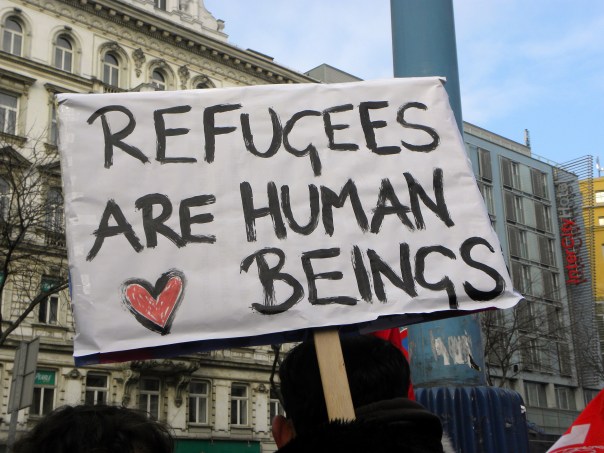
Refugees_are_human_beings.jpg

JUNE 20: WORLD REFUGEE DAY
By René Wadlow

June 20 is the United Nations (UN)-designated World Refugee Day marking the signing in 1951 of the Convention on Refugees. The condition of refugees and migrants has become a “hot” political issue in many countries, and the policies of many governments have been very inadequate to meet the challenges. The UN-led World Humanitarian Summit held in Istanbul, Turkey on May 23-24, 2016 called for efforts to prevent and resolve conflicts by “courageous leadership, acting early, investing in stability, and ensuring broad participation by affected people and other stakeholders.”

If there were more courageous political leadership, we might not have the scope and intensity of the problems that we now face. Care for refugees is the area in which there is the closest cooperation between nongovernmental organizations (NGOs) and the UN system. As one historian of the work of the UN High Commissioner for Refugees (UNHCR) has written “No element has been more vital to the successful conduct of the programs of the UNHCR than the close partnership between UNHCR and the non-governmental organizations.”

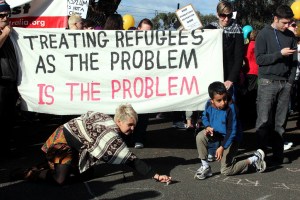
Refugee Rights Protest at Broadmeadows, Melbourne

The 1956 flow of refugees from Hungary was the first emergency operation of the UNHCR. The UNHCR turned to the International Committee of the Red Cross and the League of Red Cross Societies which had experience and the finances to deal with such a large and unexpected refugee departure and resettlement. Since 1956, the UNHCR has increased the number of NGOs, both international and national, with which it works given the growing needs of refugees and the increasing work with internally displaced persons who were not originally part of the UNHCR mandate.

Along with emergency responses − tents, water, medical facilities − there are longer-range refugee needs, especially facilitating integration into host societies. It is the integration of refugees and migrants which has become a contentious political issue. Less attention has been given to the concept of “investing in stability”. One example:

The European Union (EU), despite having pursued in words the design of a Euro-Mediterranean Community, in fact did not create the conditions to approach its achievement. The Euro-Mediterranean partnership, launched in 1995 in order to create a free trade zone and promote cooperation in various fields, has failed in its purpose. The EU did not promote a plan for the development of the countries of North Africa and the Middle East and did nothing to support the democratic currents of the Arab Spring. Today, the immigration crisis from the Middle East and North Africa has been dealt with almost exclusively as a security problem.

An_Aerial_View_of_the_Za'atri_Refugee_Camp

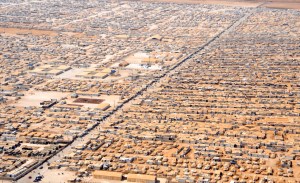
Za’atari, Jordan. The biggest refugee camp in the world.

The difficulties encountered in the reception of refugees do not lie primarily in the number of refugees but in the speed with which they have arrived in Western Europe. These difficulties are the result of the lack of serious reception planning and weak migration policies. The war in Syria has gone on for six years. Turkey, Lebanon and Jordan, not countries known for their planning skills, have given shelter to nearly four million persons, mostly from the Syrian armed conflicts. That refugees would want to move further is hardly a surprise. That the refugees from war would be joined by “economic” and “climate” refugees is also not a surprise. The lack of adequate planning has led to short-term “conflict management” approaches. Fortunately, NGOs and often spontaneous help have facilitated integration, but the number of refugees and the lack of planning also impacts NGOs.

Thus, there is a need on the part of both governments and NGOs to look at short-term emergency humanitarian measures and at longer-range migration patterns, especially at potential climate modification impact. World Refugee Day can be a time to consider how best to create a humanist, cosmopolitan society.

Prof. René Wadlow is President of the Association of World Citizens.