The Official Blog of the

Archive for the ‘Conflict Resolution’ Category

The Law of the Seize

In Being a World Citizen, Conflict Resolution, Environmental protection, International Justice, The Search for Peace, United Nations, World Law on June 15, 2014 at 10:03 PM

THE LAW OF THE SEIZE

By René Wadlow


June 8 of each year has been proclaimed by the UN General Assembly as the Day of the Law of the Sea. However, according to my friend John Logue, who had participated with me as non-governmental organization representative in the long negotiations in New York and Geneva, it should be called “the Law of the Seize.”

What started out in November 1967 with a General Assembly presentation by Ambassador Arivid Pardo of Malta as a call to establish a new political and legal regime for the ocean space ended in August 1980 with a draft convention. It was a mixed bag of successes and disappointments, but that convention has now been ratified by 162 States.

For world citizens, the quality of the Law of the Sea Convention was of particular significance. The greater part of the oceans has been considered res communis, a global common beyond national ownership. Furthermore, the physical nature of the oceans suggests world rather than national solutions to the increasing need for management of marine resources and the marine environment.

World Citizen Thor Heyerdahl was one of those who called attention to the dangers of ocean pollution coming to Geneva to speak for world citizens during the Law of the Sea negotiations. The oceans and the seas remind us that the planet and not the State should be our focus. A holistic view of life arises from our interdependence as a species and our dependence on the life system of nature. World citizens have stressed that a balanced, sustainable eco-system will only emerge if our political, economic and ethical policies coincide in building a more stable and more peaceful—in short, a more human—planet.

(C) The Economist

(C) The Economist

Establishing rules for the management of the oceans was a real possibility in bringing about an increase in the awareness of the earth as our common home. However, the UN Law of the Sea Conference was first and foremost a political conference with over 160 States participating. From the outset of the conference, it was agreed that the convention had to be drafted by consensus in order to create a political and legal system for the oceans accepted to all — to manage what Arivid Pardo had called “the common heritage of mankind.”

During the negotiations, there were groupings that cut across the Cold War divisions of the times, especially within a group called “the landlocked and geographically disadvantaged countries.” There were also informal groups of persons who acted in a private capacity, a mixture of nongovernmental organization (NGO) representatives, legal scholars, and diplomats who prepared suggestions on many of the issues of the conference. These issues included the economic zones, the continental shelf, scientific research, marine pollution, and dispute settlement. Such propositions were taken seriously by the government negotiators, in part because few diplomats had the technical knowledge needed for making decisions as well as the creation of a new international organization, the Seabed Authority.

However, in practice, government negotiators are more used to working for the “national interest” and in defending the idea of “territory,” both on land and on the sea. Boundary-making is a primordial activity. Various theories have been advanced to explain why, many of them derived from our animal ancestors. However, ocean boundary problems are more difficult than building a wall on land. As Douglas Johnston and Mark Valencia write,

The forces of nationalism were too strong to be swayed by Pardo’s appeals to international cooperation and technocratic rationality. Instead the coastal states, developed and developing alike, saw in the newly available ocean areas an unexpected windfall, offering the prospect of a previously unimagined extension of their natural resource base. The economic goal of national autonomy had prevailed over the interest in global cooperation, setting in motion the processes of establishing vast national enclosures of offshore areas, especially those enclosures consonant with the new exclusive economic zone (EEZ) regime. International cooperation had yielded to national autonomy.1

An outstanding first attempt at codification of the law of the sea was the work of Hugo Grotius, the Dutch jurist widely regarded as the forefather of international law as we know it today. In 1609 Grotius published Mare Liberum (A Free Sea), a book in which claimed that the sea was international territory and thus free for all nations to use in their usual conduct of trade with one another.

An outstanding first attempt at codification of the law of the sea was the work of Hugo Grotius, the Dutch jurist widely regarded as the forefather of international law as we know it today. In 1609 Grotius published Mare Liberum (A Free Sea), a book in which claimed that the sea was international territory and thus free for all nations to use in their usual conduct of trade with one another.

Conflicts over national sea boundaries are particularly strong in the Pacific Ocean among China, Vietnam, the Philippines, Japan, Taiwan, and Cambodia, with India and Indonesia watching closely. The disputes arise largely because of the claims of waters around small islands as national territory. Most of these islands are not inhabited, but are claimed as the starting point of “territorial waters.”

Originally, the disputes concerned exclusive fishing rights within national territorial zones. Now the issues have become stronger, as it is believed that there are oil and natural gas reserves in these areas.

Concerning China’s dispute with Japan (which is also largely true of China’s policy with other Asian countries), Krista Wiegand writes,

China’s current strategy to negotiate with Japan over joint development of natural gas and oil resources outside the disputed zone seems to be the most rational strategy it can take in the disputes. Rather than dropping its territorial claim, China continues to maintain its claim for sovereignty, while at the same time benefiting from joint development of natural gas resources. By maintaining the territorial claim, China also sustains its ability to confront Japan through diplomatic and militarized conflict when other disputed issues arise.2

Territorial sea disputes can be heated up or cooled off at will or when other political issues require attention. We are currently in a “heating up” stage. Thus for June 8, in honor of the Law of the Sea, we can consider how best to resolve territorial disputes by having a broader view of the common heritage of humanity.


Prof. René Wadlow is President of the Association of World Citizens.


Notes

1)   Douglas M. Johnston and Mark J. Valencia. Pacific Ocean Boundary Problems (Dordrecht: Martinus Nighoff Publishers, 1991, 214pp.)

2)   Krista E. Wiegand. Enduring Territorial Disputes (Athens, GA: University of Georgia Press, 2011, 340pp.)

Ukraine: The Dogs of the Cold War are Awakened

In Being a World Citizen, Conflict Resolution, Current Events, Democracy, Europe, Human Rights, International Justice, The former Soviet Union, The Search for Peace, United Nations, World Law on June 12, 2014 at 9:11 PM

UKRAINE: THE DOGS OF THE COLD WAR ARE AWAKENED

By René Wadlow


“Cry Havoc! And let slip the dogs of war!”

William Shakespeare, Julius Caesar


The dogs of the Cold War (1945-1990) had largely fallen asleep after the 1990 Summit Conference of the Organization for Security and Cooperation in Europe (OSCE) in Paris had put a formal end to the European aspects of the Cold War. A New Europe was the slogan of both governments and non-governmental currents that had been working for a Europe without its East-West divisions symbolized by the Berlin Wall.

Many of us had been involved in the April 1980 European Nuclear Disarmament Appeal, often shortened to END, of which the English historian E.P. Thompson was a leading spokesman. Mient Jan Faber of the Dutch Inter-Church Peace Council was the link to those working within church/religious groups on the same lines. Obviously, the level of arms − and thus disarmament − was not the only aspect of the moves necessary to move beyond the Cold War embodied in bureaucratic, and military-industrial forms.

There was a necessary ‘healing process’ − a need to remove the barbed wire in people’s minds and hearts.

The hope was that moving beyond the Cold War would become a citizens’ search for common projects, bringing together widening constituencies in a direct discourse beyond Cold War agendas and the media’s framing of the debates.

Many of us met in Prague in what was still Czechoslovakia in October 1990 for the creation of the Helsinki Citizens’ Assembly with an aim of a democratic integration of Europe. Vaclav Havel who had become Head of State spoke to the opening session on the power of acting from principle guided by our consciences to build a thoroughly new Europe undivided into blocs.

Vaclav Havel (1936-2011), the Czechoslovakian dissident playwright who in 1989 led the country's 'Velvet Revolution', eventually becoming President of Czechoslovakia. From 1992 to 2003 Havel was President of the Czech Republic after Czechoslovakia was eventually dissolved.

Vaclav Havel (1936-2011), the Czechoslovakian dissident playwright who in 1989 led the country’s ‘Velvet Revolution’, eventually becoming President of Czechoslovakia. From 1992 to 2003 Havel was President of the Czech Republic after Czechoslovakia was dissolved. (C) John Macdougall/AFP/Getty Images

“Helsinki Citizens” had been chosen by the organizers as the name because Helsinki had been the city which saw the formal start of the governmental process in 1975 leading first to a certain stabilization of the European Cold War structure and progressively to tension-reduction under the title of “détente”. Since much of the governmental detente seemed to be aimed only at making a more stable status quo, citizen activists spoke of “detente from below”, as going beyond the current structures.

The visions of a better world differed among peace, green, and human rights groups. However all agreed that the future forms of Europe was beyond the current status quo.

I had gone to Prague already concerned with ethnic-nationalities tensions. These tensions were colored by the Cold War but also had non-Cold War roots as seen in the Nagorno-Karabakh conflict within the then USSR. Through contacts in Geneva, I had become concerned by Nagorno-Karabakh and thought that good faith negotiations could lead to a resolution of the conflict. I was also concerned with the growing tensions in Yugoslavia. My paper read at the Prague conference “Future of Europe” was published in the Belgrade Review of International Affairs in December 1990.

Since 1990, the conflicts linked to the breakup of Yugoslavia, and the conflicts of Abkhazia-South Ossetia-Georgia, and Transnistra-Moldova all confirm my analysis that the key problem of our time is the manifestation of narrow nationalism. This narrow nationalist ideology must be countered by a strong cosmopolitan-world citizen ideology and practice.

The hope at Prague in 1990 was to build a pan-European movement participating in public debates, offering opinions and discussing alternatives in each country but also able to come together and act in a conflict resolution way in times of strong tensions and armed conflicts. There were a few efforts of the Helsinki groups during the Yugoslav conflicts, but they were not coordinated nor of massive size. I had participated in some of these undertakings at the UN in Geneva when the conference on Yugoslavia was in session there.

The Hofburg Palace in Vienna, Austria, which houses the Headquarters of the Organization for Security and Cooperation in Europe. (C) Bernard Henry

The Hofburg Palace in Vienna, Austria, which houses the Headquarters of the Organization for Security and Cooperation in Europe. (C) Bernard Henry/AWC

Since 1990, we have seen the rise in some European countries of hard line nationalist groups − often Right wing and some with Neo-Fascist aspects. This rise was illustrated by the May 25, 2014 elections to the European Parliament. The entry of an additional number of narrow nationalists will not have much impact on the way the European Parliament operates, but it will give the nationalists a media platform and a degree of legitimacy in their home country. There has not been a significant rise in cosmopolitan-world citizen movements, although cosmopolitanism as an intellectual framework has become increasingly common.

Without a well-organized movement of pan-European peace-green-human rights movements, “Europe from Below” has been unable to act in the Ukraine crisis. Individual governments, in particular Russia and the USA, have taken a highly visible role. The media in both countries dusted off the Cold War vocabulary and political analysis.

Talk of a “New Cold War” has been common. The OSCE − with Switzerland as President for 2014 − has called for restraint and negotiations. There has been no equivalent “high profile” efforts on the part of non-governmental groups. Today, there is no Vaclav Havel to serve as a bridge of respect among both governments and non-governmental movements. Certainly, the dogs of the Cold War have awakened to remind us that they are still there. In addition, new nationalist, and authoritarian tendencies are emerging. Although these nationalist movements are sometimes led by comic figures, they need to be taken seriously.

Counter voices also need to awaken, and the ability for nongovernmental conflict resolution groups to act must be strengthened.


Prof. René Wadlow is President of the Association of World Citizens.

Hugh Joseph Schonfield, the World Citizen Pioneer who Tried to Unite the Holy Land

In Being a World Citizen, Conflict Resolution, Cultural Bridges, Current Events, Middle East & North Africa, Solidarity, The Search for Peace, United Nations, World Law on May 24, 2014 at 8:50 PM

HUGH JOSEPH SCHONFIELD, THE WORLD CITIZEN PIONEER WHO TRIED TO UNITE THE HOLY LAND

By René Wadlow


Hugh Joseph Schonfield (1901-1988) was the first to incorporate the term “world citizen” into the name of a nongovernmental organization: the Commonwealth of World Citizens in 1938. The Commonwealth of World Citizens was to have an emphasis on service to humanity and a potential role as impartial mediator in international disputes. The founding was what he called a “revolt into sanity” from a mentally-deranged world in which Fascism, Nazism, Communism and militarized Shintoism flourished. From 1941 to 1948, Schonfield published a magazine called The World Citizen. As he said in a speech to the Constructive World Peace Conference in April 1940 “External forces, the agents of God, have caused the emergence in the world itself of ideas of World Community and World Citizenship. It is seen by serious political thinkers that if peace and justice are to reign here there must be a loyalty above that which is due from subjects to their own nation state. Much is being done, and rightly, to encourage such ideas. What we have to concern ourselves with is the bridge that will bring us safely to that farther shore. The bridge must be one that will carry us eventually to the New Jerusalem, not to a new Babylon.”

He wrote, “So many of the grave problems of our time are due to the fact that we are living in a radical transition, having to relate to the rapid advances of science which are requiring us to move forward into a wholeness and interdependence for which we are not sufficiently prepared. There are inevitable consequences, which chiefly affect our self-consciousness. The problems of the transition period affect individuals just as much as nations. Multitudes find themselves incapable of adjusting to the new demands and fear loss of identity.”

In his Mondcivitan Writings ('mondcivitan" coming from "mondcivitano" which is the Esperanto for "World Citizen"), Schonfield developed a comprehensive World Citizen thought, long before the Association of World Citizen was created.

In his Mondcivitan Writings (‘mondcivitan” coming from “mondcivitano” which is the Esperanto for “World Citizen”), Schonfield developed a comprehensive World Citizen thought and ideology, long before the Association of World Citizens itself was created.

Hugh Schonfield drew parallels between the current period of transition with the Jewish society at the time of Jesus, a period which was the focus of most of his writings. He wrote in 1936 History of Jewish Christianity and in 1939 Jesus: A Biography. During the Second World War while working on Middle East issues for the British government, he published in 1943 Judaism and World Order. Shortly afterwards he published Jesus: Man and Messiah, Readings from the Aprocryphal Gospels. A major work was published in 1955, a translation of the New Testament with notes relating the work to the thoughts of the period in which it was written and linking it to Jewish writings of the same period. As a Jew, he did not want his translation to become known as the “Schonfield New Testament” so it was published in 1955 as The Authentic New Testament. He continued his research on Jesus and messianic expectations and in 1965 published The Passover Plot which became a ‘best seller’ selling over two million copies. He became very interested in the Dead Sea scrolls and one of his last books in 1984 was The Essene Odyssey.

With his interest in the Holy Land, he was particularly concerned with Arab-Jewish relations and became an active champion for the idea of an Israel-Palestine Confederation, setting out proposals in 1944 which also concerned what is now Jordan, the pre-Independence Mandate area.

As Dr. Schonfield wrote in Transnational Perspectives in 1982, “What is clearly called for is a Confederation, possibly on the Swiss model, composed of the states of Palestine and Israel, with Jerusalem as the federal capital. The city would not have to be divided or fought over as to who should possess it. Palestine could have a state capital in the eastern part and Israel in the western sector, if they so desired, but the city as a whole would represent the Confederation.

Jerusalem is the cradle of the world's two major religions, Islam and Christianity, as well as of Judaism. Therefore, why should it have to be a place of hatred and division, and not a place of brotherhood and unity?

Jerusalem is the cradle of the world’s two major religions, Islam and Christianity, as well as of Judaism. Therefore, why should it have to be a place of hatred and division, and not a place of brotherhood and unity instead?

“The advantage of this plan should be obvious. The frontiers between the two states would be internal and unfortified, and would therefore not create a risk of future war. As citizens of the Confederation, both Palestinians and Israelis would enjoy rights of access to all parts for purposes of travel and commerce, and questions of settlement would be covered by federal laws. There should be freedom of conscience for all citizens of the Confederation, but if so desired the religious laws of Islam and Judaism could be operative in the respective component states. The important thing would be that the Confederation would be the common homeland of both Palestinians and Israelis, who would yet have their own states.

“This is not a dream and could readily become a practical reality. What has been provided here is no more than a plan in outline, but it does keep the Holy Land as a unity, a common homeland for both Israelis and Palestinians, and satisfies their aspirations for self-governing statehood. With imagination and goodwill, it would inaugurate a new era in the Near East, and become an inspiration to mankind.” He saw that forms of regional integration are increasingly considered as the principal methodology for general security, development and the safeguard of human rights. Individual, national and regional security should be accompanied by a spirit of mutual acceptance – with economic cooperation and development as a by-product for a future Israel-Jordan-Palestine grouping.

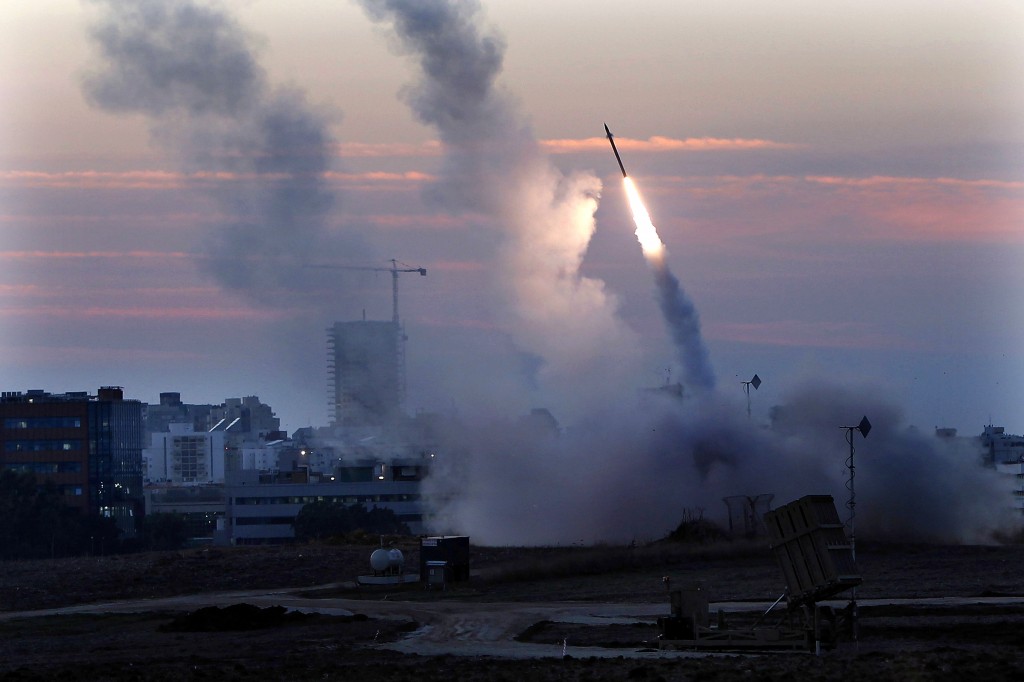
A rocket being fired by the Israeli Defense Force (IDF) to counter an incoming rocket attack from Gaza. (AP Photo/Tsafrir Abayov)

As the Middle East remains hopelessly plagued by violence, a rocket is being fired by the Israeli Defense Force (IDF) to counter an incoming rocket attack on Israel coming from Gaza. (AP Photo/Tsafrir Abayov)

However, the World Citizen proposals have not been followed by the strong national political leadership needed to bring them to the fore of real political negotiations. The quality of government leadership in the Middle East has been uneven at best. But even the Israeli-Palestinian problems are more complex than the quality of leadership. A new spirit of mutual acceptance will only flourish in the region when individual security and dignity for all will become rooted in law – everywhere in the region. This can happen with a general process of democratization and respect for human rights, with safeguards for ethnic and religious minorities. Such democratic values and practices must become the natural bedrock of society in all the countries of the Middle East.

World Citizens can take inspiration from Hugh Schonfield and in their Middle East efforts put an emphasis on unity rather than division.


Prof. René Wadlow is President and Chief Representative to the United Nations in Geneva of the Association of World Citizens.

Ukraine: What Future for ‘Self-Rule’?

In Conflict Resolution, Current Events, Europe, The former Soviet Union, The Search for Peace on May 24, 2014 at 7:59 PM

UKRAINE: WHAT FUTURE FOR “SELF-RULE”?

By René Wadlow


On the eve of the election for President in Ukraine, the heated tensions among factions within the country and between the Russian Federation, the European Union (EU) and the USA seem to be cooling. Talk of a new ‘Cold War’, of economic sanctions, of Russian or NATO imperialism is lessening. More rational discussion on the structures of the Ukrainian State and its relations with other countries now seems possible.

Ukraine faces real internal problems: political, economic and social. There is a need for dialogue, trust-building, and reconciliation within the country − all stepping stones to stable internal peace. The earlier situation in Ukraine did not lend itself to calm considerations of basic orientations or for compromises.

In an April 15 report, the Office of the United Nations (UN) High Commissioner for Human Rights had warned that “Misinformation, propaganda and incitement to hatred need be urgently countered in Ukraine to avoid further escalation of tensions in the country… It is critical for the Government to prioritize respect for diversity, inclusiveness and equal participation of all − including minorities in Ukraine.”

One possibility of lowering tensions on a longer-term basis is to start serious discussions on a federal-decentralized government structure that would not divide the country but would foster local and regional autonomy. World Citizens who have a long history of reflection on federalist approaches as elements of conflict resolution have warned against simplified concepts in the Ukraine discussions. Federalism is not a first step to the disintegration of the Ukraine. But it is not a “magic solution” either.

When Ukraine declared independence from the Soviet Union in late 1991 the country's Russian community did not have any objections. However, since the eviction of President Viktor Yanukovych in February 2014, oddly enough, many of Ukraine's Russians have risen up against Kiev and demanded reunification with Russia. (C) (AFP / Genya Savilov)

When Ukraine declared independence from the Soviet Union in late 1991 the country’s Russian community did not express any objections. However, since the eviction of President Viktor Yanukovych in February 2014, oddly enough, many of Ukraine’s Russians have risen up against Kiev and demanded reunification with Russia. (C) (AFP / Genya Savilov)

Factions in eastern Ukraine decided to hold a referendum on Sunday 11 May in a hastily organized way, with little if any public debate on the consequences of the referendum and strong pressure to vote “yes” on the only option presented. The central government, the EU and the USA have all indicated that they considered the referendum and its results as not valid − in fact, illegal. President Vladimir Putin of the Russian Federation had suggested on the eve of the referendum that it be postponed or not held. However, after the referendum, the Russian government indicated that the referendum showed the “will of the people” and that Russia would abide by the results.

The referendum was organized in only part of eastern Ukraine, in what is newly proclaimed as the Donetsk People’s Republic and the Luhansk People’s Republic. The question posed concerned “yes” or “no” on the Russian word samostoyatelnost which can be translated as “self rule”. Since there had been no real public discussion, the term could mean − and did mean − different things to different people − everything from greater autonomy within the existing constitution of Ukraine but with a greater recognition of Russian language and culture, autonomy within a to-be-created new Ukrainian federation, an independent state along the lines of Abkhazia, formerly part of neighboring Georgia, or a willingness to join the Russian Federation on the model of Crimea. People were discouraged from voting “no” and few did.

Since Russia invaded Georgia in 2008, leading to the declaration of independence of the two Georgian provinces of Abkhazia and South Ossetia as separate republics, Moscow has made all efforts to assert regional leadership and pressure all neighboring countries into recognizing local Russians as its own nationals. (AP Photo/Mikhail Metzel)

Since Russia’s invasion of Georgia in 2008, leading to the declaration of independence of the two Georgian provinces of Abkhazia and South Ossetia as separate republics, Moscow has exerted substantial political and military pressure to assert regional leadership over Russians both at home and abroad and have all neighboring countries recognize local Russians as Moscow’s own nationals. (AP Photo/Mikhail Metzel)

Thus one possible model for the Donetsk and Luthansk People’s Republics are the states created earlier in Republics at the time of the breakup of the Soviet Union: Abkhazia and South Ossetia in Georgia, Transnistra in Moldova, Nagorno-Karabagh still torn between Armenia and Azerbaijan, and the ill-fated Chechen Republic. One reason that President Putin suggested not having a referendum in Ukraine may have been his fears that the pattern of holding an unauthorized referendum would spread. There are a good number of peoples in Russia who are unhappy with the current constitutional status of their area and could look to creating a referendum to express their wishes. “You know where things start but not where they end.”[i]

With the lowering of tensions, the options of creating an independent State on the model of Transnistra or of integration into Russia on the Crimea pattern seems to be ever less likely. Thus the option of greater autonomy under the existing constitution by Parliamentary action seems the more likely, though there may be demands for a constitutional convention and the institutionalizing of autonomy in a new constitution.

The Ukraine crisis showed how easily the dogs of Cold War can be awakened from their sleep. The military, intelligence services and ad hoc armed groups are never far away. While many of us who had worked for better relations between the USA-USSR, NATO-Warsaw Pact during the 1960-1990 period have often gone on to other conflict resolution issues such as the conflicts in the wider Middle East and Africa, the Ukraine events point out dramatically that there is still work to do in Europe.


Prof. René Wadlow is President and Chief Representative to the United Nations in Geneva of the Association of World Citizens.


[i] For a useful and detailed history of the creation and current status of Abkhazia and South Ossetia see: George Hewitt Discordant Neighbors: A Reassessment of the Georgian-Abkhazian and Georgian-South Ossetian Conflicts (Leiden-Boston: Brill, 2013, 389pp.)

Liberating the Young Women Kidnapped by Boko Haram

In Africa, Being a World Citizen, Children's Rights, Conflict Resolution, Current Events, Foundations for the New Humanism, Human Rights, Solidarity, War Crimes, Women's Rights, World Law on May 12, 2014 at 1:53 PM

LIBERATING THE YOUNG WOMEN KIDNAPPED BY BOKO HARAM

By René Wadlow


Citizens of the World, motivated by the spirit of compassion symbolized by Kuan Yin appeal to the members of Boko Haram to return the young women taken from the girls’ school in Chibok, northeastern Nigeria.

The actions of Boko Haram undermine the efforts of local and national educational services in Nigeria to overcome the persistent poverty and lack of development in northern Nigeria.

Although the name of the armed group which carried out the kidnapping can be roughly translated as “Western Education is Unlawful” of forbidden, its members know full well that education is neither “Western” or “Southern” but is an effort to train individuals to meet the challenges of life and to develop their full potential as persons. The members of Boko Haram know that education is a crucial need for the development of northern Nigeria and that the education of women is necessary for progress.

Kuan Yin is the bodhisattva (the "compassionate one") associated with compassion as venerated by East Asian Buddhists, usually as a female. The name Guanyin is short for Guanshiyin, which means "Observing the Sounds (or Cries) of the World." (Source: Wikipedia)

Kuan Yin (or Guanyin) is the bodhisattva (the “compassionate one”) associated with compassion as venerated by East Asian Buddhists, usually as a female. The name Guanyin is short for Guanshiyin, which means “Observing the Sounds (or Cries) of the World.” ((c) Wikipedia)

We are sure that many members of the Boko Haram group understand that their actions are morally wrong as well as unlawful under Nigerian law and in violation of the universally-recognized standards of human rights. Thus they will act to return the young women to their home area.

Armed violence will destroy the efforts being made to meet basic needs and to improve the standard of living of all in northern Nigeria. A spirit of compassion should motivate members of Boko Haram to return the young women to their families and to find nonviolent ways to better the lives of all in northern Nigeria.


Prof. René Wadlow is President of the Association of World Citizens.

World Citizens Welcome Serious Considerations of Federalist Government Structures for Ukraine, but Warn Against Simplified Concepts

In Conflict Resolution, Cultural Bridges, Current Events, Europe, The former Soviet Union, The Search for Peace on April 16, 2014 at 2:22 PM

WORLD CITIZENS WELCOME SERIOUS CONSIDERATIONS OF FEDERALIST GOVERNMENT STRUCTURES FOR UKRAINE, BUT WARN AGAINST SIMPLIFIED CONCEPTS

-- AWC-UN Geneva Logo --

The Association of World Citizens (AWC), in an April 14, 2014 message to the Secretary-General of the Organization for Security and Cooperation in Europe (OSCE), welcomed the serious consideration of federalist government structures for Ukraine being proposed both by the current President of Ukraine in an April 13 statement and by the authorities of the Russian Federation.

As Professor René Wadlow, President of the AWC, pointed out in the message, such proposals can have a positive impact to lessen the growing tensions both within Ukraine and among the Russian Federation, Ukraine, and the European Union. The President recalled that World Citizens have always stressed that government structures should be as close as possible to the people so that their views can have a direct impact on government decisions. Federalist forms of government can facilitate the balance between the need for larger government units for policy making and units close to local communities so that those impacted are able to influence policy.

The current tensions, first within the Ukraine, followed by the change of status of Crimea and its integration into the Russian Federation, the massing of Russian troops on the Ukraine frontier with Russia, and the violent demonstrations within parts of Ukraine have created the most serious European tensions since the conflicts related to the breakup of the Yugoslav federation.

Efforts of both governments and nongovernmental organizations (NGOs) must be undertaken to lessen tensions and to create opportunities for creative dialogue. Proposals for new governmental forms within Ukraine offer a possibility for such creative dialogue.

The current tensions in Ukraine highlight two crucial political and economic orientations possible for Ukraine. On one side, there is a growing but not clearly defined revival of an economic and strategic zone with the Russian Federation as the main motor. This possible “Eurasian Customs Union” could include Russia, Belarus, Kazakhstan, Armenia, Azerbaijan and perhaps Moldova and Ukraine. Such a Eurasian association would probably develop into more than a common market. However, the full structure and tasks of such a Eurasian association have not been fully discussed publicly.

On the other side is the European Union (EU) with which Ukraine has already some treaty agreements. The refusal by the then President of Ukraine, Viktor Yanukovich, to sign a more detailed plan of action with the EU was the reason or a pretext for the start of the massive demonstrations in Kiev.

The current situation in Ukraine does not lead itself to calm considerations of basic orientations or for compromises. Both the EU and Russian diplomacy will weigh in the Ukraine decisions, and the USA and Chinese diplomacy is not likely to be absent.

World Citizens who have a long history of reflection on federalist approaches, warn against simplified concepts in the Ukraine discussions. Federalism is not a first-step to the disintegration of the Ukraine. But it is not a “magic solution” either. Government structures are closely related to the aims which people wish to achieve. The aims of the Ukrainians are multiple. Dialogue and open discussion is needed so that these aims are seen more clearly and then structures created to facilitate these aims. Those outside Ukraine, both governments and NGOs must facilitate discussions of aims and structures so that common interests may be found and current tensions reduced.

M.K. Gandhi: “The Free Spirit: One and manifold”

In Anticolonialism, Asia, Being a World Citizen, Conflict Resolution, Cultural Bridges, The Search for Peace on January 30, 2014 at 1:41 PM

M. K. GANDHI: “THE FREE SPIRIT: ONE AND MANIFOLD”

By René Wadlow

I do daily perceive that while every thing around me is ever changing, ever dying, there is underlying all that change, a living power that is changeless, that holds all together, that creates, dissolves, and re-creates.  That informing power or spirit is God. I see it as purely benevolent, for I can see in the midst of death, life persists.  In the midst of untruth, truth persists.  In the midst of darkness, light persists.  Hence I gather that God is life, God is light, God is love. God is the supreme good.”

Mahatma Gandhi

On the anniversary of the assassination of Mahatma Gandhi, January 30, we still try to find peaceful ways to resolve conflicts.  Mahatma Gandhi was a man of dialogue and compromise.  A British-trained lawyer, he always knew the limits of the law and when not to push too far or ask for more than what could be seen as reasonable to the authorities in South Africa or British-controlled India even if the authorities were not willing to accept the demands at the time.

Yet what does one do when opponents refuse dialogue and when events move so fast that no compromise seems possible?  These questions are crucial as difficult negotiations on the armed conflict in Syria have started in Switzerland — first one day in the calm of the resort Montreux on Lake Geneva with some 40 states present, some directly involved, others to give moral support to the UN-led negotiations. The negotiations then moved to the UN’s Palais des Nations in Geneva and, no doubt, to restaurants for small groups.

To make matters more complex, some key actors are not officially there, though they are not very hidden in the shadows: Iran has a large mission to the UN in Geneva; the Kurds from Syria-Iraq-Turkey- and Iran have a permanently strong presence in Geneva and gather from outside when events merit; there is a large community of people from Lebanon — some bankers but also, no doubt, representative from Hezbollah as well.  The foothills of the Alps above Montreux have long been the home of international arms merchants — though the arms are stocked elsewhere. If they were unable to make sales on the sideline of the Montreux meeting, they can afford to drive to Geneva to see what factions may want to buy arms which they cannot receive supplied by governments.

Among the dangerous aspects of the armed conflict in Syria is the extent to which all factions use images of the “eternal enemy” — Arabs and Iranians, Kurds and Arab, Christian, Alawit and Muslim, Sunni and Shia.  These enemy images make compromise all the more difficult.  It is sad to see the writing of history deformed, intellectual short cuts taken, the media used to strengthen prejudice rather than to inform.

Thus for the anniversary of Gandhi’s assassination, carried out by a narrow Hindu to cut short Gandhi’s efforts at Hindu-Muslim reconciliation in the middle of the Partition Riots, it is useful to recall the appeal of Romain Rolland, biographer of Tolstoy, Gandhi, Ramakrishna and Vivekananda, who Gandhi visited on his journey to Europe.  In 1919, shortly after the end of the First World War which had divided the intellectual community, Romain Rolland wrote to a wide range of intellectuals to raise the Arch of the Free Spirit.

When asked once by his fellow Hindus to allow retaliatory action against India's Muslims after sectarian violence struck the Hindu community, Mohandas Karamchand Gandhi, the Mahatma, had this to say about revenge: "An eye for an eye only ends up making the whole world blind."

When asked once by his fellow Hindus to allow retaliatory action against India’s Muslims after sectarian violence had struck the Hindu community, Mohandas Karamchand Gandhi, the Mahatma, had this to say about revenge: “An eye for an eye only ends up making the whole world blind.”

“To the pestilence which is corroding in body and spirit, thinkers and artists have added an incalculable amount of poisoned hate; they have searched in the arsenal of their knowledge, their memory and their imagination for old and new reasons, historical, scientific, logical and poetic reasons, for hating; they have laboured to destroy love and understanding. And in so doing they have disfigured, dishonoured, debased and degraded Thought, whose ambassadors they were. They have made it an instrument of passions and (perhaps without knowing it) of the egotistic interests of a social or political clan, of a state, of a country or a class…

“Let us extricate the spirit from these humiliating alliances, this secret slavery!… We serve Truth alone, which is free, with no frontiers, with no limits, with no prejudices of race or caste.  Of course, we shall not dissociate ourselves from the interests of Humanity!  We shall work for it, but for it as a whole. We do not recognise nations.  We recognise the People — one and universal — the People who suffer, who struggle, who fall and rise again and who ever march forward on the rough road, drenched with their sweat and their blood — the People comprising all men, all equally our brothers.  And it is in order to make them, like ourselves, aware of this fraternity, that we raise above their blind battles the Arch of Alliance, of the Free Spirit, one and manifold, eternal.”[i]

* * *

Prof. René Wadlow is President and Chief Representative to the United Nations in Geneva of the Association of World Citizens.


[i] Quoted from Rolland and Tagore (Calcutta: Visva-Bharati, 1945, pp 20-24)

The UN and the Disappearing State of the Central African Republic

In Africa, Anticolonialism, Conflict Resolution, Current Events, Democracy, Human Rights, International Justice, The Search for Peace, United Nations, War Crimes, World Law on November 22, 2013 at 10:36 AM

THE UN AND THE DISAPPEARING STATE OF THE CENTRAL AFRICAN REPUBLIC

By René Wadlow

In a November 19, 2013 statement to the United Nations (UN) Security Council, the Secretary General, Mr. Ban Ki-moon, warned that communal violence in the Central African Republic (CAR) was spiraling out of control and backed the possibility of an armed UN peacekeeping force to complement the civilian UN staff, the Integrated Peacebuilding Office in the Central African Republic (BINUCA).

The UN faces a double task in the CAR. There is the immediate problem of violence among tribal-based militias in the absence of a national army or central government security forces. The militias basically pit the north of the country against the south. In addition, there are other militias from the Democratic Republic of the Congo which use the CAR as a “safe haven” and live off the land by looting villages. There are also segments of the Lord’s Resistance Army, largely from the Acholi tribes of northern Uganda who also use the CAR as a safe area looting as they move about.

In the absence of a standing UN peacekeeping force, UN peacekeepers would have to be redeployed from the eastern areas of the Democratic Republic of Congo, an area also torn apart by fighting among different militias and an incompetent Congolese national army. Although the UN forces have been in the Congo for a number of years, it is only in the last couple of months that they have had a mandate to be active in a military way and have started to make an impact on the security situation. By deploying UN troops away from the Congo, there is a danger that the security progress made will fade away.

The longer range task of the UN, the peacebuilding effort, is to create a national administration which provides services beyond the capital city, Bangui. This is the aim of the BINUCA, but its work is largely impossible in the light of the ongoing violence. The challenge is “State-building” which was not done during the colonial period by France.

The area covered by the current State had no pre-colonial common history, but was incorporated into French Equatorial Africa when it could have been as easily part of the Belgium Congo or added to Uganda as part of British East Africa.

Oubangui-Chari as it was then known was the poor cousin of French Equatorial Africa (AEF) whose administrative center was Brazzaville, Congo, with Gabon as the natural resource base. The Cameroon, although legally a League of Nations Mandate, was basically part of AEF. Oubangui-Chari was used as an “exile post” for African civil servants considered “trouble makers”. French colonial administrators also considered Oubangui-Chari as a posting in exile, a place to get away from as soon as possible. Schools were few, and secondary school students were sent away to Brazzaville.

There was only one political figure of standing who emerged from Oubangui-Chari, Barthelemy Boganda (1910-1959). He was the first Roman Catholic priest ordained in 1938. After the Second World War, he was elected to serve in the French Parliament as a member of the Catholic-influenced MRP Party, although he was stripped of his priesthood for going into politics and also for marrying his legislative assistant.

Boganda advocated keeping the AEF together as a federation of independent States knowing that Oubangui-Chari was the poorest of the AEF States and most in need of help from its neighbours. Unfortunately, he was killed in a plane crash on the eve of independence, and with him disappeared all enlightened leadership.

However, his stature in the political life of Oubangui-Chari was such that political power passed on to two cousins, David Dacko, first President of the independent Central African Republic and then Jean-Bedel Bokassa in 1965 who changed the name of the country to Central African Empire and ruled (or misruled) as Bokassa 1er. His dreams of being a new Napoleon was ended in 1979 by a French military intervention after Bokassa had too visibly killed young school children who were protesting.

Jean-Bedel Bokassa aka Bokassa the First, the man who would be emperor – even if it meant reigning over scorched earth.

Jean-Bedel Bokassa aka Bokassa the First, the man who would be emperor – even if it meant reigning over scorched earth.

Since Bokassa, all pretext of a unified administration has disappeared. General Kolingba, Ange-Felix Patassé, followed by Francois Bozizé were considered “Head of State”, but the State had no visible administration. Bozizé was overthrown in March 2013 by Michel Djotodia and his Seleka (alliance in the Sango language) militia. The Alliance has now been dissolved by Djotodia but replaced by nothing. A fact-finding mission sent by the UN Human Rights Council concluded that “both the forces of the former government of President Bozizé and the non-State armed group Seleka committed serious violations of international humanitarian law and international human rights law during the conflict”.

Creating order from disorder is a difficult task, especially as the pre-colonial tribal structures no longer function. There were very few inter-tribal mechanisms to settle disputes in any case. The State-building process merits close attention. Somalia remains a good example of the difficulties. The UN faces real challenges in the Central African Republic and requires help from national governments and NGOs.

Politically, Africa has always been a continent of many dramas. Hopefully, if the international community finally decides to take quick, decisive action at last, the Central African Republic will not be just another name on the list.

Politically, Africa has always been a continent of many dramas. Hopefully, if the international community finally decides to take quick, decisive action, the Central African Republic will not be just another name on the list.

René Wadlow is the President and Chief Representative to the United Nations Office at Geneva of the Association of World Citizens.
November 15, 1920 : First Meeting of the Assembly of the League of Nations in Geneva

In Conflict Resolution, The Search for Peace, World Law on November 15, 2013 at 1:38 PM

NOVEMBER 15, 1920: FIRST MEETING OF THE ASSEMBLY OF THE LEAGUE OF NATIONS IN GENEVA
By René Wadlow

The real contributions made by the League of Nations to the development of a sense of world community have been widely disregarded. The League is too often disparaged because of the failure of its Members to carry out their obligations, especially in the face of armed aggression.

Yet it has been said that when a star breaks, it gives birth to a thousand suns. That is just what happened with the League, for the League prepared the way for the United Nations and the further development of world law. Let us look at some of its achievements.

The official emblem of the League of Nations.

The official emblem of the League of Nations.

1)An essential precondition to any solid world organization is an impartial civil service responsible only to the head of the organization, under obligation not to accept instructions from any government or outside authority, and committed to the promotion of the aims and principles of the Organization. This the League of Nations provided for the first time under the leadership of the first Secretary-General, Sir Eric Drummond. He took bold, if discrete, initiatives in drawing the attention of the League Council to conflicts and suggested conflict resolution measures.

2)The League also dealt with the economic and monetary reconstruction of Austria, Hungary and some other countries, with the issues of minorities, with the administration of former German and Ottoman territories under the mandates system. The League provided the starting point for future work on refugees and drug control. The International Labor Organization was created alongside the League, its budget being voted by the League Assembly.

3)With the League, for the first time, it became possible to develop a world review of production, trade, health and other economic and social data. No doubt, the studies produced by the League were embryonic — the basic information in the hands of governments being nowhere near what it is today. However, without this start, the kind of world economic planning — or at least overview — which we have today would not have been conceivable.

The League of Nations, inspired by Immanuel Kant and created by Woodrow Wilson, was supposed to put an end to all wars. Due to its lack of resolve, it allowed the opposite to happen as World War II put a brutal end to its existence.

The League of Nations, inspired by Immanuel Kant and created by Woodrow Wilson, was supposed to put an end to all wars. Unfortunately, though, it allowed the exact opposite to happen, as World War II eventually put a brutal end to its existence.

Unfortunately, the League of Nations ran into difficulties from the start. The United States refused to join; too long a time elapsed before Germany and the Soviet Union were admitted. The legacy of the First World War — not primarily a matter for the League — upset both the political and economic climate: huge reparations due by Germany, the payment of large debts by the Allies to the United States, monetary collapse in several countries with general economic protectionism rampant. All this contributed to the Great Depression of the 1930s, and in turn accentuated the structural weaknesses of the world economy.

Then came the aggression committed by Japan, Italy and Germany, which found the resolve of the Western European countries and the USA weakened. The national foreign offices and the war offices were still thinking in terms of balance of power and could not bring themselves to think outside a narrow nationalistic framework.

Fortunately, today, a sense of global citizenship, of world loyalty, has been growing. By looking back to the first meeting of the League Assembly, we can mark the progress not only of institutions but also in the spirit of the women and men who shape them. Today, we see more and more people whose chosen vocation is to make this earth a true home for humanity. They have dedicated themselves to the same tasks that the League began but left unfinished.

René Wadlow is President and Chief Representative to the United Nations in Geneva of the Association of World Citizens.

World Citizens Call for a Ceasefire and Renewed Good-faith Negotiations by All Parties in Syria

In Conflict Resolution, Current Events, Middle East & North Africa, The Search for Peace, United Nations, World Law on September 9, 2013 at 10:55 PM

WORLD CITIZENS CALL FOR A CEASEFIRE AND RENEWED GOOD-FAITH NEGOTIATIONS BY ALL PARTIES IN SYRIA

By René Wadlow

World Citizens have called for good-faith negotiations among all the parties from the start of the demonstrations in March 2011 which had begun in a spirit of non-violence. Neither the Government nor the oppositions were willing to set an agenda or a timetable for such good-faith negotiations. The Government held out vague promises for reform but without details and without open discussion among those concerned. As the fighting has escalated, the possibility of good-faith negotiations has increasingly faded, despite efforts by the United Nations (UN) mediators to facilitate such negotiations.

Discussion of specific issues for reform or setting an overall agenda seems impossible for the moment.  However, there is a growing awareness that there is a dangerous stalemate and that there is no military “solution”. It is often at this “stalemate” stage of a conflict that the parties turn to a negotiated compromise.[i]  The dangers of a wider conflict with more States involved are real. Thus the situation requires careful concerted action.

The use of chemical weapons in violation of the 1925 Geneva Protocol (by government forces or by the armed opposition) has added an additional element of danger but not modified the stalemated structure of the conflict.

awc-un-geneva-logo

Therefore, the Association of World Citizens (AWC) calls upon the Syrian Government, armed opposition, and representative associations of Syrians to initiate a ceasefire followed quickly by good-faith negotiations.

The AWC calls upon all other States to refrain from arming or in other ways strengthening the military capacities of the Government’s armed forces and the armed forces of the armed oppositions.  Other States should, through the UN and through other institutions, encourage good-faith negotiations.

The AWC calls upon Nongovernmental Organizations, both Syrian and international, to facilitate the transition from the ongoing violence to a situation conducive to creative dialogue.

René Wadlow is President and Chief Representative to the United Nations Office at Geneva of the Association of World Citizens.


[i] See: Louis Kriesberg and Stuart Thorson (Eds), Timing the De-Escalation of International Conflicts (Syracuse University Press, 1991)