The Official Blog of the

Archive for November, 2024|Monthly archive page

Sixty-Day Ceasefire Starts in Israeli-Hezbollah Conflict: Urgent Measures Needed to Make It Permanent

In Being a World Citizen, Conflict Resolution, Current Events, Middle East & North Africa, NGOs, Refugees, Solidarity, The Search for Peace, Track II, United Nations on November 29, 2024 at 7:00 AM

By René Wadlow

The ceasefire between Israeli troops and the Hezbollah militia is good news in an area deep in armed conflicts. After a year-long period of hostilities, we must strive so that the ceasefire holds, becomes permanent, and that the United Nations (UN) forces are able to carry out their mandate.

The ceasefire between Israeli forces and those of Hezbollah started at 4 AM on November 27, 2024, a conflict that has killed some 4,000 people, displaced more than one million in Lebanon and some 60,000 in Israel. As the ceasefire started, some Lebanese were already starting to return to their homes at day light although many houses in villages near the frontier have been destroyed.

The “Cessation of Hostilities” text which sets out the terms of the ceasefire calls for the ability of civilians on both sides of the Blue Line (the de facto border between Lebanon and Israel) to return safely to their lands and homes.
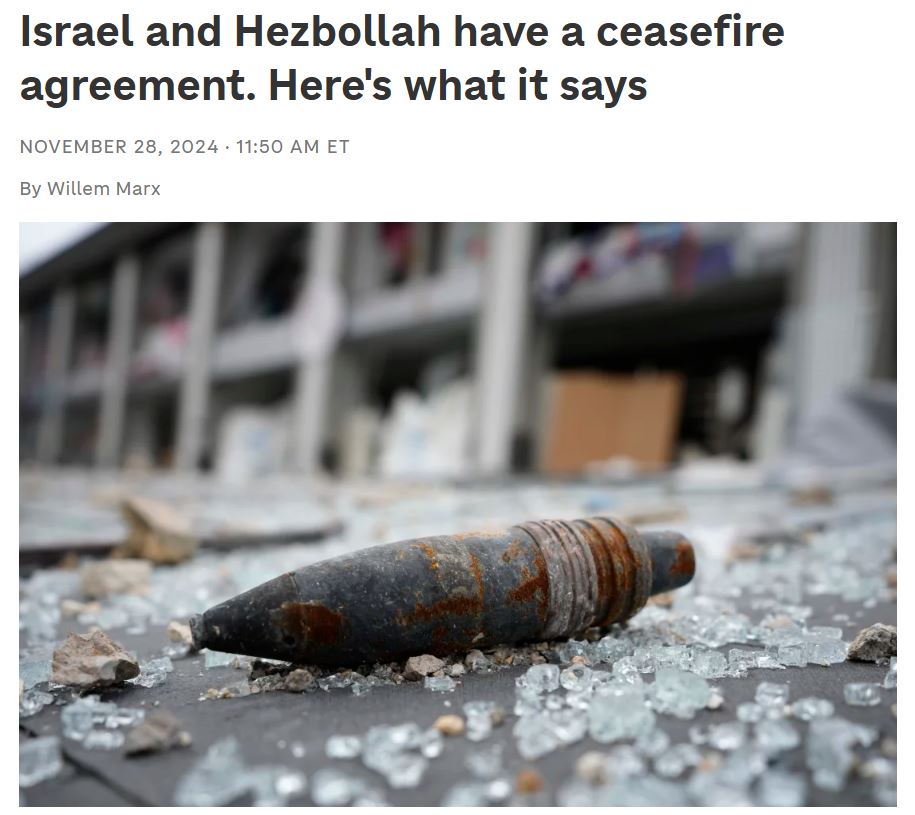
The ceasefire was negotiated by diplomats from the USA and France. Amos Hochstein was the lead United States (U.S.) negotiator. The U.S. and France will continue to have diplomats to follow the ceasefire process and to deal with any violations or unsolved tensions. There have already been accusations of violations of the ceasefire by both sides. The UN Interim Force in Lebanon (UNIFIL) – some 10,000 soldiers, will again be able to control the Blue Line frontier. There is currently discussion on adding members to the UN force.

The ceasefire was able to be developed as there was a convergence of interests among leaders in Israel, Lebanon, Hezbollah and Iran which is a strong supporter of Hezbollah. Many in Israel, including in the active military, are exhausted by the armed conflicts and must continue operations in the Gaza Strip and the West Bank. Lebanon faces economic and political difficulties provoking a growth of the already strong sectarian tensions. Hezbollah’s military and leadership has been seriously weakened by Israeli actions. However, the movement continues, and new leaders are coming to the fore such as Hassan Fadlallah, a Hezbollah deputy in the Lebanese Parliament. With a new Iranian President and a new U.S. administration, Iran’s leaders may want to see what policies President Trump will develop toward Iran.

Turning the 60-day ceasefire into a permanent peace accord will not be an easy task. There are territorial disputes along the Blue Line which have not been solved in the past, a consequence of the 2006 war. Today, all the parties lack peace-oriented leaders. As noted, the ceasefire is in the current interest of all the leaders, but such situations can change due to internal political factors. 

Thus, there is an opportunity for Nongovernmental Organizations to continue promotion of a permanent ceasefire and to advance stability for the region. It is an opportunity for which we must organize with others.

Prof. René Wadlow is President of the Association of World Citizens.
Rape as a Weapon of War in Sudan: Counter Measures Needed

In Africa, Being a World Citizen, Conflict Resolution, Current Events, Human Rights, Humanitarian Law, International Justice, Modern slavery, NGOs, Refugees, Solidarity, Sudan, The Search for Peace, Track II, United Nations, War Crimes, World Law on November 25, 2024 at 8:00 AM

By René Wadlow

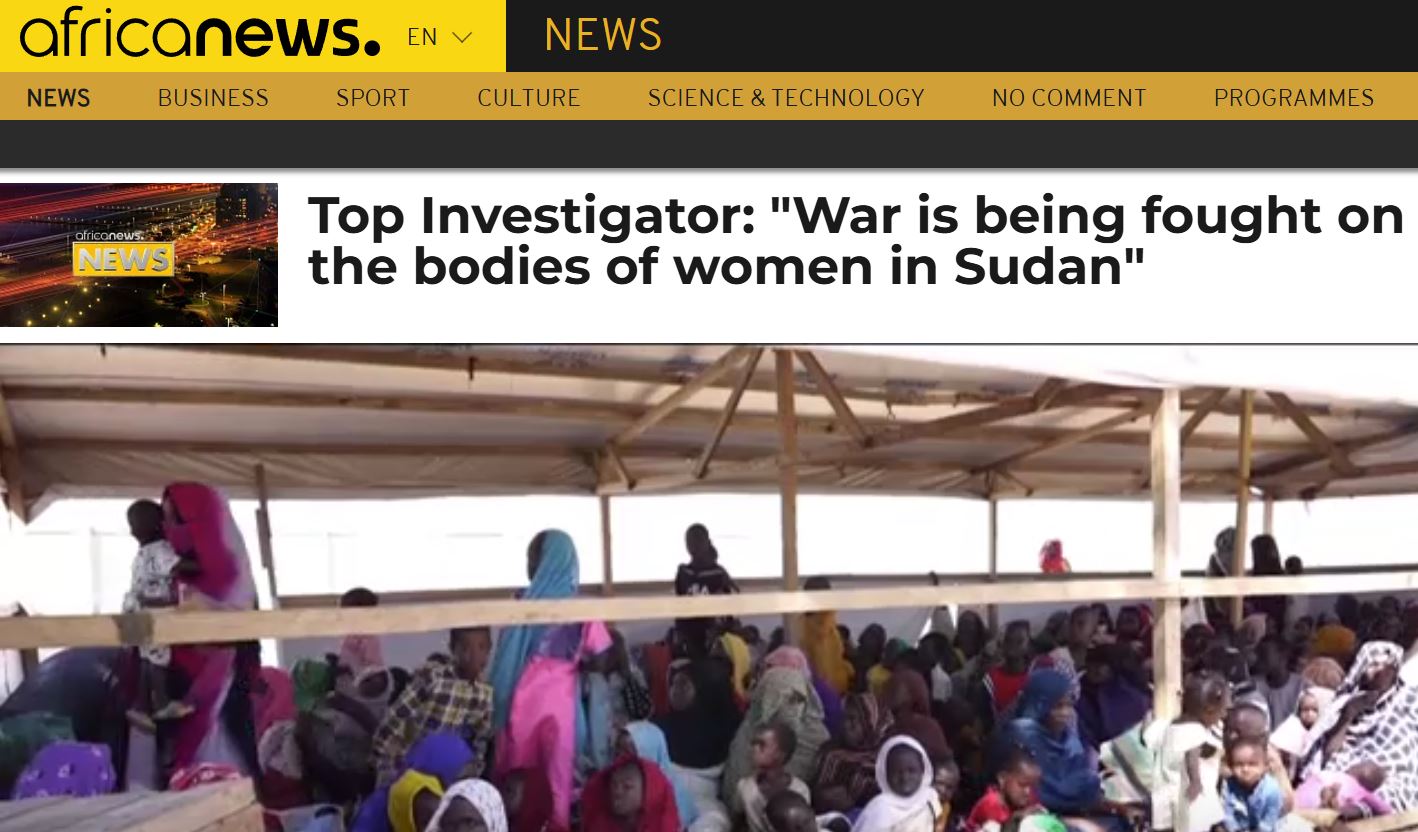
Sudan’s armed conflict which began on April 15, 2023 is between two former allies. On one side is General Abdel Fattah Al Burham of the Sudanese Armed Forces; on the other side is General Mohamed Hamdan Dagulo, known by his battle name of Hemedhi of the Rapid Support Forces. The conflict, which has spread to 14 of the 18 provinces of Sudan, has killed and wounded tens of thousands of civilians, displaced nearly 8 million people, and forced over two million to flee to neighboring countries. The agriculture of the country is disorganized, and many people face acute hunger.

There has been an appalling range of human rights and international humanitarian law violations including indiscriminate airstrikes and shelling against civilians, hospitals, and vital water services. The warring parties and their respective militia allies have made rape a weapon of war and have organized markets where women are sold for sexual slavery.

Rape harms not only the woman raped but also the whole family system. Often, the husband repudiates his wife. The whole family may scorn her. In a country where “the family” is a wide circle of people, the repudiated woman has few people to whom to turn for support. As was done by the “Islamic State” (IS, or Da’esh) in Iraq and Syria, sexual slave markets have been created where women are bought or exchanged.

So far, efforts by the United Nations (UN) and regional governments for a ceasefire and negotiations have not led to constructive action. Thus, the conflictual situation requires close cooperation among UN agencies, humanitarian and peace Nongovernmental Organizations.

Prof. René Wadlow is President of the Association of World Citizens.

Roar Aloud

In Being a World Citizen, Cultural Bridges, Human Rights, Poetry, Solidarity, Spirituality, The Search for Peace on November 18, 2024 at 8:00 AM

By Prosperina Sarkar

Roar aloud, all of you
The oppressed and exploited of the world
Be you women or men, white or black,
Hindus, Muslims, Christians, or Buddhists,
Shatter the unequal systems of society.

Roar aloud, all of you
The persecuted and downtrodden of the world,
The deprived and helpless, both women and men,
Know that without protest,
Justice will never be yours.

Roar aloud, all of you
The free-thinking, the youth of open minds,
Establish humanity as the supreme virtue,
Destroy all superstitions and the barriers
of false religion.

Roar aloud, all of you
The wise, the virtuous, the principled and idealistic,
Break down the mountains of social divisions,
Crush the arrogance of society,
Ensure equal rights for all people.

Prosperina Sarkar, a native of Bangladesh, is a social worker, poet, and writer of books for children.

AWC Lebanon Appeal: Protecting Cultural Heritage in Time of War

In Arts, Being a World Citizen, Conflict Resolution, Cultural Bridges, Current Events, International Justice, Middle East & North Africa, Nonviolence, Solidarity, The Search for Peace, War Crimes, World Law on November 18, 2024 at 8:00 AM

By René Wadlow

War and armed violence are highly destructive of the lives of persons, but also of works of art and elements of cultural heritage. Knowledge and understanding of people’s past can help current inhabitants to develop their identity and to appreciate the value of their culture and heritage. Such knowledge and understanding enriches their lives and enables them to manage contemporary problems more successfully.

Since September 23, 2024, the armed conflict between the Israeli armed forces and the Hezbollah militia in Lebanon has led to increased air attacks by Israeli forces on different parts of Lebanon, resulting in deaths and the uprooting of a large number of people. Hezbollah had begun hostilities on October 8, 2023 by shelling Israeli positions in support of Hamas.

The Association of World Citizens (AWC) had called for a reduction of Israeli-Hezbollah tensions and has since called for a ceasefire and for the return of persons displaced in the areas on both sides of the Israel-Lebanon frontier. (See our Appeal of September 2024).

This AWC Appeal concerns the protection of cultural heritage as Israeli attacks have already harmed cultural heritage sites in Baalbek and Tyr as well as other culutral sites. Lebanon has a rich past going back to Biblical and Roman times.

After the Second World War, UNESCO had developed international conventions on the protection of cultural and educational bodies in time of armed conflict. The most important of these is the 1954 Hague Convention for the Protection of Cultural Property in the Event of Armed Conflict. The Hague Convention has been signed by a large number of States.

The 1954 Hague Convention builds on the Roerich Peace Pact first proposed by the Russian painter and champion of Asian culture, Nicholas Roerich. The Roerich Peace Pact was signed on April 15, 1935 by 21 States in a Pan American Union ceremony at the White House in Washington, D.C.

The Banner of Peace (Pax Cultura), as defined by the Roerich Pact of 1935
(C) Kwamikagami

At the signing, Henry A. Wallace, then United States (U.S.) Secretary of Agriculture and later Vice-President, said, “At no time has such an ideal been more needed. It is high time for the idealists who make the reality of tomorrow, to rally around such a symbol of international cultural unity. It is time that we appeal to that appreciation of beauty, science, education which runs across all national boundaries to strengthen all that we hold dear in our particular governments and customs. Its acceptance signifies the approach of a time when those who truly love their own nation will appreciate in addition the unique contributions of other nations and also do reverence to that common spiritual enterprise which draws together in one fellowship all artists, scientists, educators and truly religious of whatever faith. Thus we build a world civilization which places that which is fine in humanity above that which is low, sordid and mean, that which is hateful and grabbing.”

We still have efforts to make so that what is fine in humanity is above what is hateful and grabbing. The AWC strives so that a start will begin in Lebanon and spread to the wider Middle East.

Prof. René Wadlow is President of the Association of World Citizens.