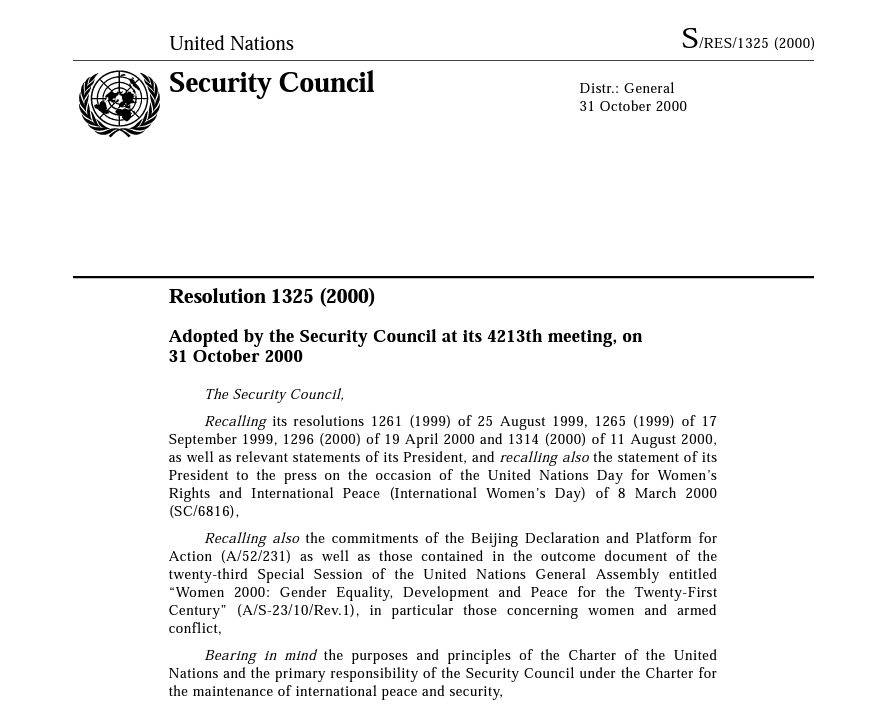
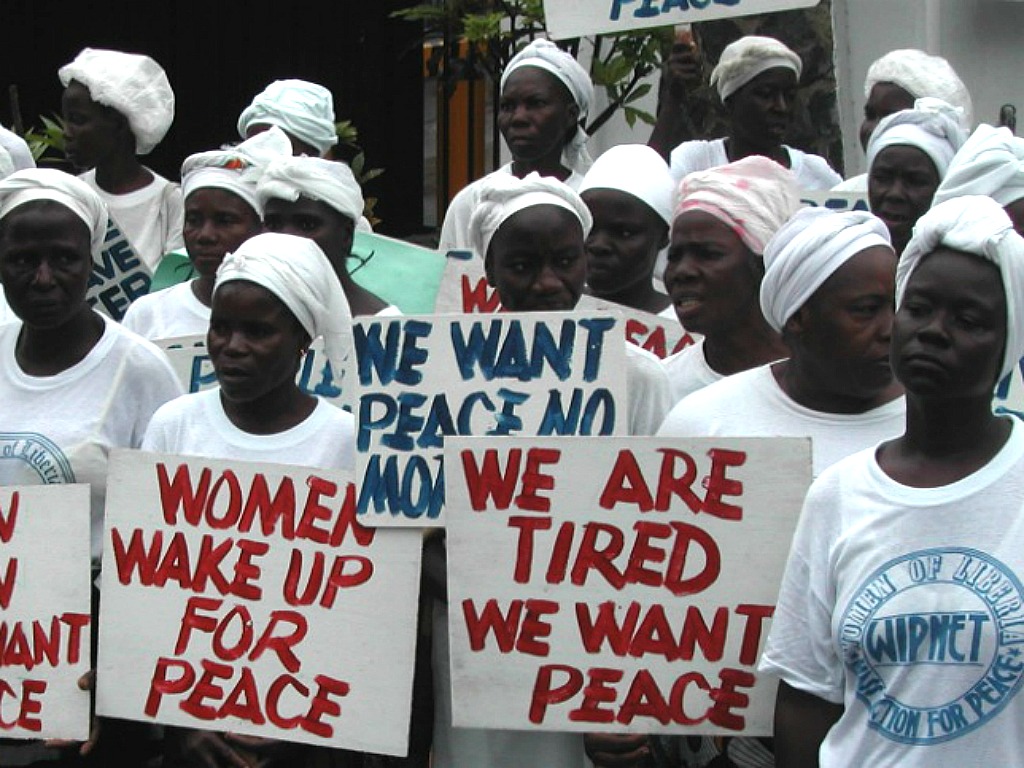
October 31 is the anniversary of the United Nations (UN) Security Council Resolution 1325 which calls for “the full and equal participation of women in conflict prevention, peace processes, and peacebuilding, thus creating opportunities for women to become fully involved in governance and leadership.” This historic Security Council Resolution 1325 of October 31, 2000 provides a mandate to incorporate gender perspectives in all areas of peace support.
Since 2000, there have been no radical changes in UN or governmental practices as a result of Resolution 1325, but the goal has been articulated and accepted.
As UN Secretary-General Antonio Guterres wrote in his 2023 Report on Women, Peace, and Security, “Despite our best efforts, women represented just sixteen percent of negotiators or delegates in the peace processes led, or co-led, by the United Nations.” Women were almost completely missing from peace processes in situations monitored by the UN Security Council such as Ethiopia, Sudan, Libya, and Myanmar.
There has been a growing awareness that women are not just victims in violent armed conflicts and wars – “collateral damage” – but are chosen targets. Recent conflicts have served to bring rape and other sexual atrocities as deliberate tools of war to the forefront of international attention. Such violations must be properly documented; the perpetrators brought to justice; and victims provided with redress.
However, women should not only be seen as victims of war. They are often significantly involved in taking initiatives to promote peace. Some writers have stressed the essential link between women, motherhood, and nonviolence, arguing that those in mothering work have distinct motives for rejecting war which run in tandem with their ability to resolve conflicts nonviolently. Others reject this position of a gender bias toward peace and stress rather that the same continuum of nonviolence to violence is found among women as among men.
In practice, it is never all women nor all men who are involved in peacemaking efforts. Sometimes, it is only a few persons, especially at the start of peacemaking efforts. The basic question is how best to use the talents, energies, and networks of both women and men for efforts at conflict resolution.
October 31 can serve as a day of rededication to inclusive processes for peacebuilding.
Prof. René Wadlow is the Association of World Citizens.
Calls from both governments and nongovernmental organizations (NGOs) for a ceasefire in the Hamas-Israel armed conflict having not been acted upon. Attention is now centered on a potential Israeli military land invasion of the Gaza Strip. Attacks from the air have already been very destructive of civilian institutions. Many persons have had their homes destroyed and have taken shelter in schools and other public buildings. There are signs that the situation will grow more violent. There are no negotiations in sight.
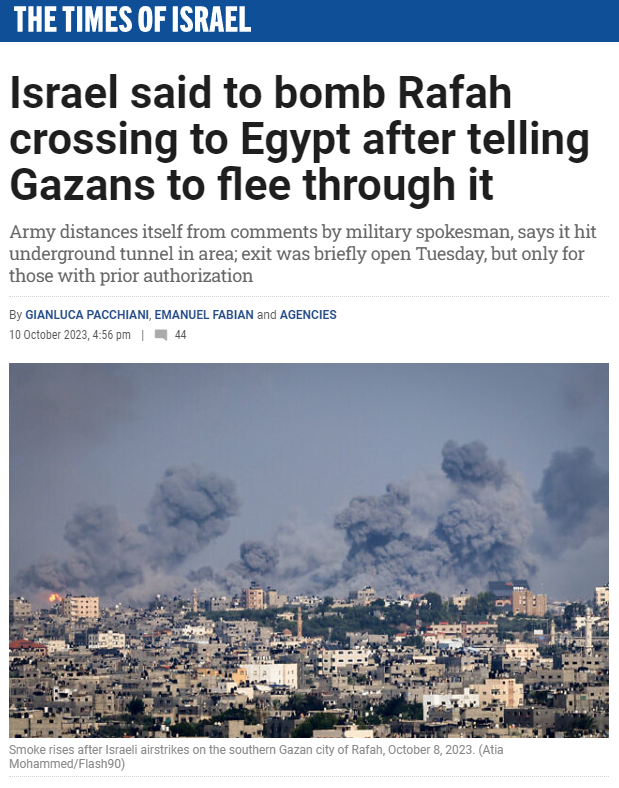
Thus, many people living in Gaza would want to leave and find safety. Passage to Israel is impossible; the frontier is now blocked, and the Israeli government considers all those living in Gaza as potential enemies. Thus, the only frontier post open is that of Rafah, leading to the Egyptian territory of Sinai. However, for the moment, the Egyptian government, fearing a mass exodus, refuses to open the Rafah post to a large number of people.
Some Palestinians fear that if there is a mass migration to Sinai, that would be a form of “ethnic cleansing” of Gaza. The population would then be replaced by Israelis. On a more positive note, potentially, the Rafah crossing could be used to bring in humanitarian supplies for Gaza collected in Egypt and elsewhere.
At this point, there should be governmental and NGO appeals to the Egyptian government to open the Rafah post to a large number of people. Facilities to meet the needs of refugees should be prepared. It is unlikely that people will spend 40 years in Sinai waiting to enter the promised land. However, current security is vital, and negotiations for longer-range conflict settlements need to start.
Prof. René Wadlow is President of the Association of World Citizens.
The Association of World Citizens (AWC), devoted to the resolution of armed conflicts through negotiations in good faith, is deeply concerned with the October 7 outbreak of violence between Hamas and Israel and the possible extension of the conflict to Hezbollah and Lebanon. The AWC stresses the need in the world society for systems of world law such as those standards expressed in International Humanitarian Law. Thus, we call for resolute action on the violations of humanitarian law in the Hamas-Israel conflict with the indiscriminate killing of civilians, the holding of hostages, and the destruction of medical and educational infrastructure.
Regular military personnel of all countries are theoretically informed of the rules of the Geneva Conventions of August 12, 1949, and the Protocol Additional adopted in 1977.
When the 1949 Geneva Conventions were drafted and adopted, it was possible to spell out in considerable detail rules regarding prisoners of war and the protection of civilians, in particular Common Article 3 (so called because it is found in all four Conventions) provides that “each Party to the conflict shall be bound to apply, as a minimum, the following provisions: Persons taking no active part in the hostilities…shall in all circumstances be treated humanely without any adverse distinction founded on race, color, religion or faith, sex, birth or wealth, or any other similar criteria.”
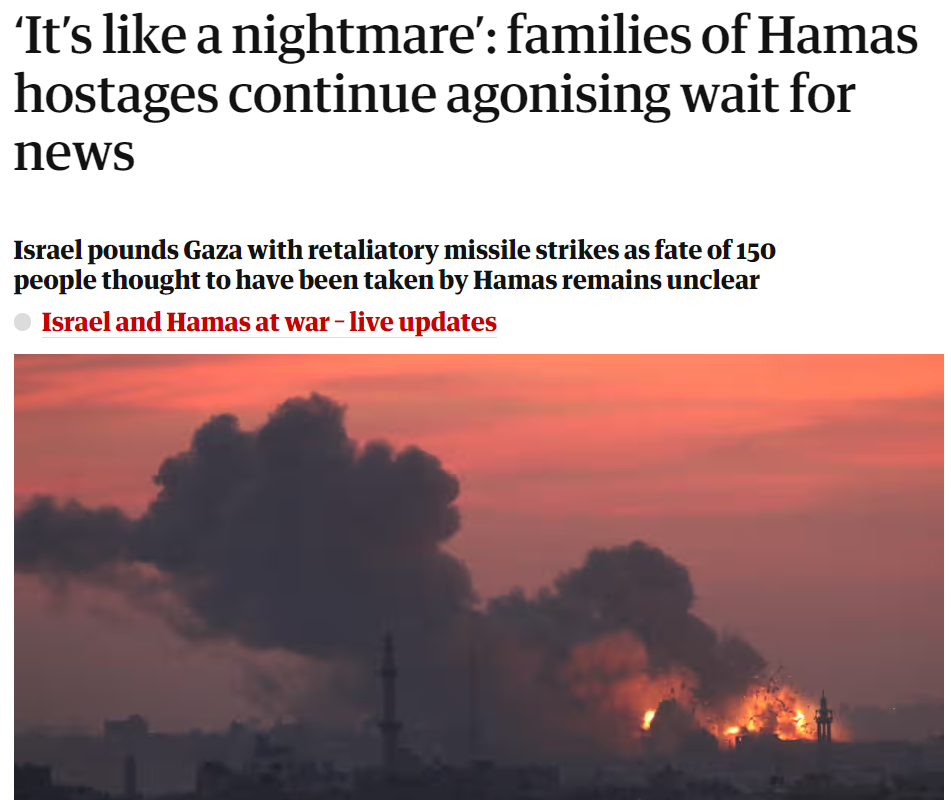
(C) The Guardian (UK)
The importance of Common Article 3 should not be underestimated. It sets out in straightforward terms important protections that all parties to a conflict must respect. In order to meet the need for additional protection, international humanitarian law has evolved to cover not only international armed conflict but also internal armed conflict. Today, international human rights standards are also considered part of international humanitarian law, thus providing additional protection for vulnerable population groups such as women, children, and minorities.
As situations of internal violence and strife proliferate, abuses committed by non-State actors, such as armed militias, are increasing concerns. Fundamental standards of international humanitarian law are intended to ensure the effective protection of human beings in all situations. The standards are clear. (1)
There are two major weaknesses in the effectiveness of international humanitarian law. The first is that many people do not know that it exists and that they are bound by its norms. Thus, there is an important role for greater promotional activities, the dissemination of information through general education, specific training of the military, outreach to armed militias, and cooperation with a wide range of nongovernmental organizations.
The second weakness is that violations of international humanitarian law are rarely punished. Governments too often tolerate these violations. Few soldiers are tried, or courtmartialed, for the violations of international humanitarian law. This weakness is even more true of nongovernmental militias and armed groups.
(C) World Health Organization
In fact, most violations of international humanitarian law are not actions of individual soldiers or militia members carried away by a sudden rush of anger, fear, a desire of revenge or a sudden sexual urge to rape a woman. Soldiers and militia members violating the norms of international humanitarian law are acting on orders of their commanders.
Thus, the only sold response is an act of conscience to refuse an order of a military or militia higher up and refuse to torture, to bomb a medical facility, to shoot a prisoner, to harm a child, and to rape a woman. Conscience, that inner voice which discerns what is right from wrong and encourages right action is the value on which we can build the defense of international humanitarian law. The defense of conscience to refuse unjust orders is a large task but a crucial action for moving toward a law-based world society.
Notes
(1) For useful guides to international humanitarian law see:
D. Schindler and J. Toman, The Laws of Armed Conflicts (Martinus Nihjoff Publishers, 1988)
H. McCoubrey and N.D. White, International Law and Armed Conflicts (Dartmouth Publishing Co., 1992)
Prof. René Wadlow is President of the Association of World Citizens.
LES CITOYENS DU MONDE APPELLENT A UNE FIN IMMEDIATE
DES HOSTILITES ENTRE ISRAEL ET LE HAMAS
ET A UN EFFORT VERITABLE DE CONSTRUCTION DE LA PAIX
POUR LE MOYEN-ORIENT
L’AWC, Organisation Non-Gouvernementale dotée du Statut Consultatif auprès de l’ONU et active à ce titre au sein du Conseil des Droits de l’Homme, est profondément alarmée de la dernière flambée de violence entre les milices armées du Mouvement de la Résistance islamique palestinien (Hamas) et les Forces de Défense israéliennes (Tsahal). Plus encore, nous sommes consternés des conséquences des attaques délibérées, perpétrées par les deux côtés, contre les droits des civils en Israël et dans la Bande de Gaza.
Depuis les attaques lancées par ses forces au petit matin du 7 octobre, le Hamas prend pour cible des civils en Israël, étant allé jusqu’à capturer des citoyens israéliens, tant civils que soldats de Tsahal, pour les garder en otage. La cause légitime d’un peuple privé de longue date de sa propre terre, cause que même l’ONU reconnaît comme légitime sur le plan international, ne saurait être servie dans la dignité par de telles méthodes qui s’inscrivent en faux contre le droit international.
Le gouvernement actuel d’Israël n’a fait que repousser les limites du mépris pour ce même droit international, à travers des déclarations et mesures répétées et insistantes visant à la discrimination systématique contre le peuple palestinien dans les Territoires palestiniens occupés (TPO). A l’intérieur même des frontières internationalement reconnues d’Israël, le gouvernement israélien actuel a également semé les graines de la discorde et de l’affrontement politique en tentant d’amoindrir les prérogatives du pouvoir judiciaire et, ce faisant, de mettre fin à la tradition de démocratie épaulée de contrepouvoirs qui est celle d’Israël.
Cette conduite mal inspirée s’avère nuisible tant au peuple palestinien qu’aux citoyens d’Israël. Elle crée à présent un chaos nouveau dans la région qui revient, selon les termes du Chapitre VII de la Charte des Nations Unies, à une menace contre la paix et la sécurité internationales. La situation risque de s’aggraver encore maintenant que le Hezbollah, notoirement soutenu par l’Iran, vient en dépit de toute sagesse de rejoindre le combat depuis le sud du Liban.
Une fois de plus, les droits des civils en Israël et dans la Bande de Gaza sont réduits à l’état de victimes de la haine et de la violence qu’ont déchaîné les deux côtés en l’absence d’un effort international, faisant cruellement défaut mais se voyant constamment refusé, pour résoudre le conflit du Moyen-Orient en s’attaquant à ses causes premières mêmes, au nombre desquelles l’exigence de justice qui est celle du peuple palestinien et le besoin de sécurité qui est celui de l’Etat d’Israël.
En conséquence, l’AWC réitère son appel à la fin immédiate des hostilités en Israël et dans la Bande de Gaza. Nous appelons également à la libération de toute personne, qu’il s’agisse d’un civil ou d’un militaire, prise en otage par le Hamas.
Nous en appelons de surcroît à la communauté internationale pour enfin entreprendre un effort authentique de construction de la paix en Israël et dans les TPO, ce en prenant pleinement en compte les causes premières du conflit et en faisant droit comme il convient à la légitime revendication du peuple palestinien pour la justice ainsi qu’à la revendication tout aussi légitime du peuple israélien pour la sécurité.
AND FOR A GENUINE PEACEBUILDING EFFORT IN THE MIDDLE EAST
The AWC, a Nongovernmental Organization in Consultative Status with the United Nations (UN) and accredited with the UN Human Rights Council, is deeply alarmed at the latest flare of violence between the armed militias of the Palestinian Islamic Resistance Movement (Hamas) and the Israeli Defense Force (IDF). Most importantly, we are appalled at the consequences of the deliberate attacks from both sides on the rights of civilians in Israel and the Gaza Strip.
Since the attacks launched by its forces in the early morning of October 7, Hamas has been targeting civilians in Israel, even capturing Israeli citizens, both civilians and IDF soldiers, to keep them as hostages. The legitimate cause of a people long deprived of their own land, a cause that even the UN recognizes as internationally legitimate, cannot be served in dignity by such methods that run counter to international law.
The current government of Israel has been constantly pushing the limits of disregard for the same international law, through repeated and insistent statements and practices aiming at systematic discrimination against the Palestinian people in the Occupied Palestinian Territory (OPT). Within the internationally recognized borders of the State of Israel, the current Israeli Government has also sowed the seeds of discord and political strife by trying to lessen the powers of the judicial branch and, in so doing, to end Israel’s tradition of democracy with checks and balances.
This misguided conduct has proved harmful to both the Palestinian people and the citizenry of Israel. It is now creating new chaos in the region amounting to, in the very words of Chapter VII of the UN Charter, a threat to international peace and security. The situation could get even worse as Hezbollah, notoriously backed by Iran, has now unwisely joined the fight from South Lebanon.
Once more, the rights of civilians in Israel and the Gaza Strip are falling victim to the hatred and violence unleashed by both sides in the absence of a badly needed but constantly denied international effort to tackle the Middle East conflict right from its root causes, including the Palestinian people’s demand for justice and the State of Israel’s need for security.
Consequently, the AWC reiterates its call for an immediate end to hostilities in Israel and the Gaza Strip. We also call for the release of every person, civilian or military, taken hostage by Hamas.
We further urge the international community to finally undertake a genuine peacebuilding effort in Israel and the OPT by addressing the root causes of the conflict and duly acting on the legitimate claim of the Palestinian people for justice and the equally legitimate claim of the Israeli people for security.
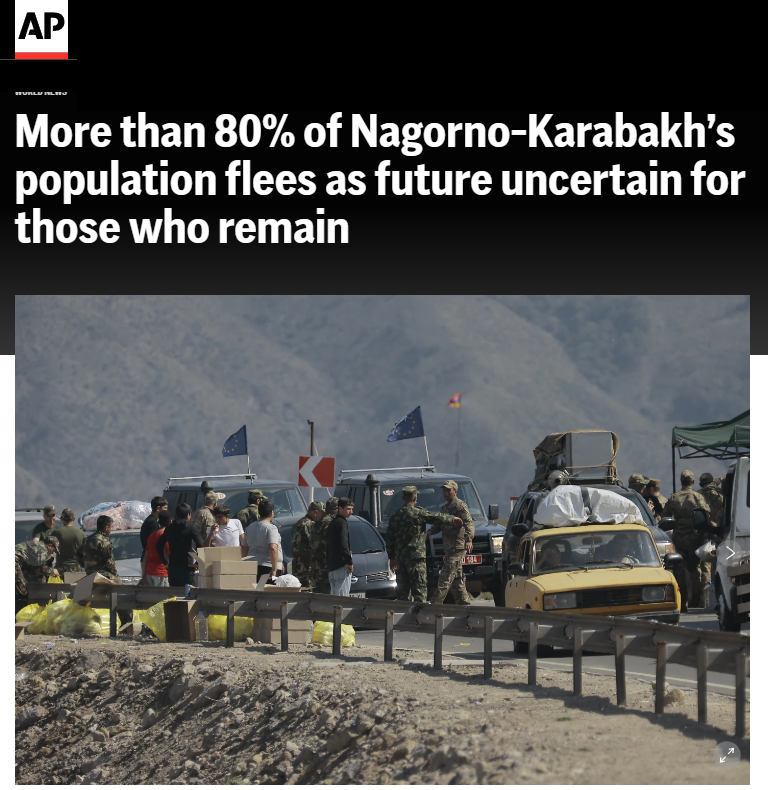
Recent events in Nagorno-Karabakh in the conflict between Azerbaijan and Armenia have raised the issue of possible genocide and the role that the 1948 Convention on Genocide may play.
Genocide is the most extreme consequence of racial discrimination and ethnic hatred. Genocide has as its aim the destruction, wholly or in part, of a national, ethnic, racial, or religious group as such. The term was proposed by the legal scholar Raphael Lemkin, drawing on the Greek genos (people or tribe) and the Latin –cide (to kill) (1). The policies and war crimes of the Nazi German government were foremost on the minds of those who drafted the Genocide Convention, but the policy was not limited to the Nazis (2).
The Genocide Convention is a landmark in the efforts to develop a system of universally accepted standards which promote an equitable world order for all members of the human family to live in dignity. Four articles are at the heart of this Convention and are here quoted in full to understand the process of implementation proposed by the Association of World Citizens (AWC), especially of the need for an improved early warning system.
Article I
In the present Convention, genocide means any of the following acts committed with intent to destroy, in whole or in part, a national, ethnical, racial or religious group, as such:
(a) Killing members of the group; (b) Causing serious bodily or mental harm to members of the group; (c) Deliberately inflicting on the group conditions of life calculated to bring about its physical destruction in whole or in part; (d) Imposing measures intended to prevent births within the group; (e) Forcibly transferring children of the group to another group.
Unlike most humanitarian international law which sets out standards but does not establish punishment, Article III sets out that the following acts shall be punishable:
(a) Genocide; (b) Conspiracy to commit genocide; (c) Direct and public incitement to commit genocide; (d) Attempt to commit genocide; (e) Complicity in genocide
Article IV
Persons committing genocide or any of the other acts enumerated in article III shall be punished, whether they are constitutionally responsible rulers, public officials or private individuals.
Article VIII
Any Contracting Party may call upon the competent organs of the United Nations to take such action under the Charter of the United Nations as they consider appropriate for the prevention and suppression of acts of genocide or any of the other acts enumerated in article III.
Numerous reports have reached the Secretariat of the United Nations (UN) of actual, or potential, situations of genocide: mass killings; cases of slavery and slavery-like practices, in many instances with a strong racial, ethnic, and religious connotation — with children as the main victims, in the sense of article II (b) and (c). Despite factual evidence of these genocides and mass killings as in Sudan, the former Yugoslavia, Rwanda, Burundi, the Democratic Republic of Congo, Sierra Leone and in other places, no Contracting Party to the Genocide Convention has called for any action under article VIII of the Convention.
As Mr. Nicodème Ruhashyankiko of the Sub-Commission on Prevention of Discrimination and Protection of Minorities wrote in his study of proposed mechanisms for the study of information on genocide and genocidal practices “A number of allegations of genocide have been made since the adoption of the 1948 Convention. In the absence of a prompt investigation of these allegations by an impartial body, it has not been possible to determine whether they were well-founded. Either they have given rise to sterile controversy or, because of the political circumstances, nothing further has been heard about them.”
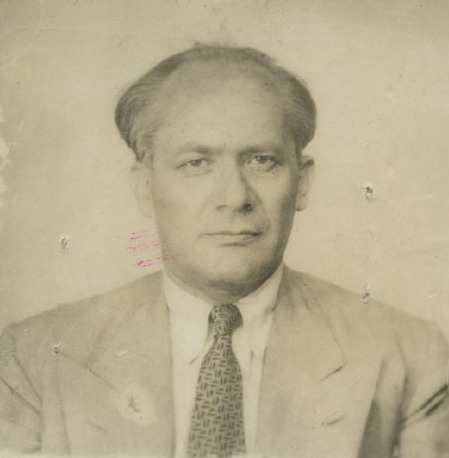
Raphael Lemkin
Yet the need for speedy preventive measures has been repeatedly underlined by UN Officials. On December 8, 1998, in his address at UNESCO, UN Secretary-General Kofi Annan said “Many thought, no doubt, that the horrors of the Second World War — the camps, the cruelty, the exterminations, the Holocaust — could not happen again. And yet they have, in Cambodia, in Bosnia and Herzegovina, In Rwanda. Our time — this decade even — has shown us that man’s capacity for evil knows no limits. Genocide — the destruction of an entire people on the basis of ethnic or national origins — is now a word of our time, too, a stark and haunting reminder of why our vigilance must be eternal.”
In her address Translating words into action to the UN General Assembly on December 10, 1998, the then High Commissioner for Human Rights, Ms. Mary Robinson, declared “The international community’s record in responding to, let alone preventing, gross human rights abuses does not give grounds for encouragement. Genocide is the most flagrant abuse of human rights imaginable. Genocide was vivid in the minds of those who framed the Universal Declaration, working as they did in the aftermath of the Second World War. The slogan then was ‘never again’. Yet genocide and mass killing have happened again — and have happened before the eyes of us all — in Rwanda, Cambodia, the former Yugoslavia and other parts of the globe.”
We need to heed the early warning signs of genocide. Officially directed massacres of civilians of whatever numbers cannot be tolerated, for the organizers of genocide must not believe that more widespread killing will be ignored. Yet killing is not the only warning sign. The Convention drafters, recalling the radio addresses of Hitler and the constant flow of words and images, set out as punishable acts “direct and public incitement to commit genocide”. The Genocide Convention, in its provisions concerning public incitement, sets the limits of political discourse. It is well documented that public incitement — whether by Governments or certain non-governmental actors, including political movements — to discriminate against, to separate forcibly, to deport or physically eliminate large categories of the population of a given State, or the population of a State in its entirety, just because they belong to certain racial, ethnic, or religious groups, sooner or later leads to war. It is also evident that, at the present time, in a globalized world, even local conflicts have a direct impact on international peace and security in general. Therefore, the Genocide Convention is also a constant reminder of the need to moderate political discourse, especially constant and repeated accusations against a religious, ethnic, and social category of persons. Had this been done in Rwanda, with regard to the Radio Mille Collines, perhaps that premeditated and announced genocide could have been avoided or mitigated.
For the UN to be effective in the prevention of genocide, there needs to be an authoritative body which can investigate and monitor a situation well in advance of the outbreak of violence. As has been noted, any Party to the Genocide Convention (and most States are Parties) can bring evidence to the UN Security Council, but none has. In the light of repeated failures and due to pressure from nongovernmental organizations, the Secretary-General has named an individual advisor on genocide to the UN Secretariat. However, he is one advisor among many, and there is no public access to the information that he may receive.
Therefore, a relevant existing body must be strengthened to be able to deal with the first signs of tensions, especially ‘direct and public incitement to commit genocide.” The Committee for the Elimination of Racial Discrimination (CERD) created to monitor the 1965 International Convention on the Elimination of All Forms of Racial Discrimination would be the appropriate body to strengthen, especially by increasing its resources and the number of UN Secretariat members which service the CERD. Through its urgent procedure mechanisms, CERD has the possibility of taking early-warning measures aimed at preventing existing strife from escalating into conflicts, and to respond to problems requiring immediate attention. A stronger CERD more able to investigate fully situations should mark the world’s commitment to the high standards of world law set out in the Genocide Convention.
Notes
1) Raphael Lemkin. Axis Rule in Occupied Europe (Washington: Carnegie Endowment for World Peace, 1944).
2) For a good overview, see: Samantha Power. A Problem from Hell: America and the Age of Genocide (New York: Basic Books, 2002)
3) William Schabas, Genocide in International Law (Cambridge: Cambridge University Press, 2000)
4) E/CN.4/Sub.2/1778/416, Para 614
Prof. René Wadlow is President of the Association of World Citizens.
 Association of World Citizens
