The Official Blog of the

Archive for the ‘The Search for Peace’ Category

Day of Mother Earth – April 22

In Being a World Citizen, Environmental protection, Human Development, Human Rights, Poetry, The Search for Peace, United Nations, World Law on April 22, 2017 at 9:25 AM

DAY OF MOTHER EARTH – APRIL 22

By René Wadlow

The United Nations (UN) General Assembly in 2009 through resolution A/RES/63/278, under the leadership of the Plurinational State of Bolivia, designated April 22 as the International Mother Earth Day. The Day recognizes a collective responsibility, set out in the 1992 Rio Declaration, to promote harmony with Nature so as to achieve a just balance among economic, social and ecological needs of the present and future generations.

In traditional Indian culture, according to texts as early as the Vedas, the Earth is home to all living species that inhabit it and must not be excluded as they all contribute to the planet’s welfare and preservation. Therefore, human beings must contribute to the web of life of which they are a part and find ways of using the elements to produce food without damaging other life forms as far as possible.

World Citizens stress that Earth is our common home and that we must protect it together. Loss of biodiversity, desertification, and soil loss – all are signs that there must be renewed efforts to develop socio-economic patterns that are in harmony with Nature.

World Citizens highlight that the protection of Mother Earth is a task in which each of us must participate. However, there have always been traditions that stressed that a more enlightened group of humans would come to show the way. One tradition was among the Natives of North America. The more enlightened were thought of as “The Rainbow Warriors” – the warrior being one who protects rather than one who goes abroad to attack others. Nicola Beechsquirrel recalls this tradition in her poem, a tribute to Mother Earth.


The Rainbow Warriors

Nicola Beechsquirrel

Come, all who ever loved our Earth

Who lived in peace amongst her creatures

Gentle, loving, caring folk

With healing hands, and wisdom in your souls.

Come, incarnate once more

Come to Earth in her greatest need.

Help us rid her of her burdens

Cleanse her of all poisons

Close up the deep sores on her sacred body

And cover it once more in soft green.

Walk amongst us again

That we may relearn ancient skills

And long-forgotten wisdom

And tread lightly upon our Mother Earth

Taking from her only what we need

Living her ways in love and joy

Treating her creatures as equals.

Teach us how to reach those who exploit her

How to open their souls to the beauty of Life

That they may destroy no longer.

Come to us, Rainbow Warriors

Share with us your wisdom

For we have great need of it.

hands-864037_1920

Prof. René Wadlow is President of the Association of World Citizens.

Syria: Chemical Weapon Use, Destruction of Children, The Ethical Vacuum

In Being a World Citizen, Conflict Resolution, Current Events, Human Rights, Humanitarian Law, International Justice, Middle East & North Africa, NGOs, Refugees, The Search for Peace, United Nations, War Crimes, World Law on April 12, 2017 at 12:22 PM

SYRIA: CHEMICAL WEAPON USE, DESTRUCTION OF CHILDREN, THE ETHICAL VACUUM

By René Wadlow

The defense of those using their conscience to uphold humanitarian international law.

The Association of World Citizens (AWC) calls for the re-affirmation of humanitarian international law. It is a call to the soldiers and militia members in armed conflicts to refuse orders to violate humanitarian international law by refusing to use weapons outlawed by international treaties such as chemical weapons, landmines, cluster munitions or any weapon to attack civilians, especially children and women. We must defend all who use their individual conscience to refuse to follow orders to violate humanitarian international law.

“At the heart of this growing phenomenon of mass violence and social disintegration is a crisis of values. Perhaps the most fundamental loss a society can suffer is the collapse of its own value system. Many societies exposed to protracted conflicts have seen their community values radically undermined if not shattered altogether. This has given rise to an ethical vacuum, a setting in which international standards are ignored with impunity and where local value systems have lost their sway.”

-Olara Otunnu, then Special Representative of the United Nations (UN) Secretary-General for Children and Armed Conflict, Report to UN General Assembly, 1998.

The attack on Khan Sheikhoon in Idlib Province of Syria on April 4, 2017 raises at least two essential issues concerning humanitarian international law and the protection of children in times of armed conflict.

B9711633296Z.1_20170405122424_000+G1I8R2IML.2-0

A major issue is the use of chemical weapons, probably sarin or a sarin-like substance in violation of the 1925 Geneva Protocol for the Prohibition of the Use in War of Asphyxiating, Poisonous or other Gases, and of Bacteriological Methods of Warfare of which Syria was a party, among the 135 governments which have signed. The attack was also a violation of the Convention on the Prohibition of the Development, Production, Stockpiling and Use of Chemical Weapons and on their Destruction which came into force in 1997. The Convention created The Hague-based Organization for the Prohibition of Chemical Weapons (OPCW). Syria signed the Convention in 2013 as part of a compromise decision to have its chemical-weapon stock destroyed.

The use of poison gas strikes deep, partly subconscious, reactions not provoked in the same way as seeing someone shot by a machine gun. The classic Greeks and Romans had a prohibition against the use of poison in war, especially poisoning water well because everyone needs to drink. Likewise poison gas is abhorred because everyone needs to breath to live.

There is a real danger that the Geneva Protocol of 1925, one of the oldest norms of humanitarian international law will be undermined and the use of chemical weapons “normalized”. The Organization for the Prohibition of Chemical Weapons is already investigating the use of chemical weapons in seven other locations in Syria.

Chemical weapons have been used in armed conflicts in the Middle East before. Although Egypt had signed the 1925 Geneva Protocol, Egyptian forces used chemical weapons widely in their support of the republican forces in the Yemen Civil War (1962-1967) with very few international outcries. As a result of the lack of any sanctions against Egypt, Syria requested Egyptian technical assistance in developing its own chemical weapons capabilities shortly after 1967 – well before the al-Assad dynasty came to power.

17834033_10211018305268568_50252574586113453_o

Humanitarian international law is largely based on self-imposed restraints. Although the International Criminal Court has a mandate to try crimes of war and crimes against humanity, its impact on the way armed conflicts are currently carried out is small. Thus, restraints need to rest on the refusal of soldiers and militia members to carry out actions that they know to be against both humanitarian international law and the local value system. This is especially true of the non-harming of children in times of armed conflict.

Humanitarian international law creates an obligation to maintain the protection of all non-combatants caught in the midst of violent conflicts as set out in the Geneva Conventions of 1949 and their Additional Protocols of 1977. Moreover, there is an urgent need to focus special attention on the plight of children. They are the least responsible for the conflict and yet are most vulnerable. They need special protection. The norms to protect children in armed conflicts are set out clearly in the Additional Protocols which has 25 articles specifically pertaining to children. The norms are also clearly stated in the Convention on the Rights of the Child, the most universally ratified international treaty. The Convention calls for the protection of the child’s right to life, education, health, and other fundamental needs. These provisions apply equally in times of armed conflict and in times of peace.

As with the use of weapons prohibited by international treaty: chemical weapons, land mines, cluster munitions, the protection of children must be embodied in local values and practice. The classic Chinese philosopher Mencius, in maintaining that human were basically good, used the example of a child about to fall into a well who would be saved by anyone regardless of status or education.

The AWC has called for a UN-led conference on the re-affirmation of humanitarian, international law. There needs to be a world-wide effort on the part of governments and non-governmental organizations to re-affirm humanitarian values and the international treaties which make them governmental obligations. Such a conference would bring together into a coherent synthesis the four avenues of humanitarian international law:

1) The Geneva Conventions – Red Cross-mandated treaties;

2) The Hague Convention tradition dealing with prohibited weapons, highlighting recent treaties such as those on land mines and cluster munitions;

3) Human rights conventions and standards, valid at all time but especially violated in times of armed conflicts;

4) The protection of sites and monuments which have been designated by UNESCO as part of the cultural heritage of humanity, highlighting the August 2016 decision of the International Criminal Court on the destruction of Sufi shrines in northern Mali.

There is also a need to use whatever avenues of communication we have to stress to those living in Syria-Iraq-ISIS-Kurd-majority areas-and Turkey that they have a moral duty to disobey orders that violate humanitarian international law. We on the outside must do all we can to protect those who so act humanely in accord with their conscience.

-- AWC-UN Geneva Logo --

Prof. René Wadlow is President of the Association of World Citizens.

Saudi Arabia: Still Lost in the Sands of War

In Children's Rights, Conflict Resolution, Current Events, Human Rights, Humanitarian Law, International Justice, Middle East & North Africa, NGOs, Refugees, Solidarity, The Search for Peace, United Nations, War Crimes, World Law on April 5, 2017 at 9:38 PM

SAUDI ARABIA: STILL LOST IN THE SANDS OF WAR

By René Wadlow

The aggression of the Saudi Arabia-led coalition (Bahrain, Egypt, Jordan, Kuwait, Morocco, Qatar, Sudan, and the United Arab Emirates) against Yemen began on March 24, 2015 so that we can now mark its second anniversary. However, there has been little progress toward a resolution of the armed conflict. Rather, there has been an increase in suffering, displacement of people, and destruction of the society. Saudi Arabia has changed the name from “Operation Decisive Storm” to “Operation Restoring Hope”, probably on the advice of the public relations firm which advises the United States (U. S.) Pentagon on the name of its operations. The first 28 days in 2015 of bombing from the air of cities and camps, killing women and children, created a sand storm, but the results were in no way decisive. Since that start on March 24, at least a 4,600 people have been killed, many more wounded and many displaced within the country. Nevertheless, the aggression has had little impact on the power configuration within the country.

The Association of World Citizens (AWC) has constantly called attention to the violations of the minimum standards of the laws of war. There are international agreements which set humanitarian law and human rights standards in times of armed conflicts, mainly the Red Cross Geneva Conventions of 1949 written in the light of experience during the Second World War and the two Protocols to the Conventions written in 1977 in the light of experiences of the Vietnam War. Not all States have ratified Protocols I and II, and a number of States have made reservations, especially refusing to forgo reprisals against civilians. Protocol I requires that attacks against military objectives be planned and executed so that “incidental” civilian injuries are not “excessive in relation to the specific military advantages anticipated”. The decision-making is subjective on the part of the military, and military officers rarely see any action as “excessive” (1)

Air_strike_in_Sana'a_11-5-2015

Another consequence of the bombing in Yemen is the starvation of the civilian population due to lack of food and water. As a result of the widespread use of defoliants in the Vietnam War, there was written as Article 54 (2) of the 1977 Additional Protocol I, a prohibition to destroy foodstuffs, crops, drinking water installations and irrigation works. Yemen is, at the best of times, short of food and drinking water installations. The bombing has deliberately increased the hardship as well as increasing the number of displaced people with resulting lack of access to food and water.

The members of the United Nations (UN) Security Council looked at the situation, and then decided to look away, although the Council appointed a UN mediator to try to find a “political solution”. The UN envoys to Yemen have had little influence on the promotion of a “political solution” or even any meaningful negotiations. The first UN envoy, Jamal Benomar, resigned in frustration. He has been replaced by Ismail Ould Cheikh Ahmed of Mauritania, who had been earlier the UN humanitarian coordinator for Yemen and so knows the country and its many factions well.

There is wide agreement in UN circles that Yemen is in a quagmire, with a free-fall of its economy, a collapse of its health services, its food imports blocked, and the country on the eve of division between north and south. The country’s present form dates from 1990 when south Yemen (Aden) was more or less integrated into the north, but the country remains highly fractured on tribal, sectarian, and ideological lines, with tribal structures being the most important. In the best of worlds, one could envisage a federal Yemen with a rule of law. More realistically, we can hope that autonomous tribal areas can be created that do not fight each other actively and allow necessary food imports and medical supplies into their areas.

3_Kids_in_San'a

Salman_bin_Abdull_aziz_December_9,_2013

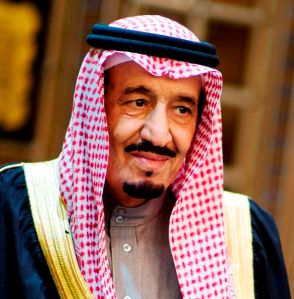
King Salman of Saudi Arabia

Saudi Arabia, which should have known better, thought that it could expand its influence in Yemen. The new King Salman with his son Mohammed as Defense Minister hoped for a quick victory, having an endless supply of modern military equipment from the USA, England and cooperation from the Gulf States. The memories of the Egyptian intervention with its heavy use of chemical weapons in the Yemen civil war of the 1960s was overlooked, both by Saudi Arabia and its close partner Egypt, although Egypt had lost some 20,000 soldiers at the time.

One generation rarely learns from the experiences of earlier generations, and both Saudi’s and Egyptians had hoped to advance their interests in Yemen’s political confusion. Instead, Saudi Arabian leaders have been lost, blinded by the sands of war. It is likely that the King and his son will never be trusted again. The aggression in Yemen was the first foreign policy effort of Saudi Arabia which had not been designed and directed by the USA − their first effort to walk alone. The King and his son were lost in the sands of war and will never be heard of again on the international scene, but oil revenues will continue to assure the royal court of a comfortable life style.

The AWC has proposed a four-step approach to the resolution of the armed conflict:

1) an immediate ceasefire ending all foreign military attacks;

2) humanitarian assistance, especially for hard-to-reach zones;

3) a broad national dialogue;

4) through this dialogue, the establishment of a highly decentralized federal government.

In an April 17, 2015 letter to the then UN Secretary-General Ban Ki-moon, the President of the Association of World Citizens wrote “It is imperative for the United Nations to be more effectively involved in ending the senseless aerial attacks and to establish a ceasefire, ensuring humanitarian and medical assistance to the people of Yemen. The critical situation is escalating and the humanitarian crisis in Yemen is approaching catastrophic dimensions”

We can, alas, only repeat ourselves today.

*********************************************

Note:

D. Schindler and J. Toman, The Laws of Armed Conflicts (Martinus Nihjoff Publishers, 1988)

*********************************************

Prof. René Wadlow is President of the Association of World Citizens.

Syrie : Résoudre le Conflit Armé et Reconstruire une Société Qui Soit Inclusive et Juste

In Being a World Citizen, Conflict Resolution, Current Events, Human Rights, Humanitarian Law, International Justice, Middle East & North Africa, NGOs, Refugees, Solidarity, The Search for Peace, United Nations, War Crimes, World Law on April 3, 2017 at 10:56 PM

SYRIE : RÉSOUDRE LE CONFLIT ARME ET RECONSTRUIRE UNE SOCIÉTÉ QUI SOIT INCLUSIVE ET JUSTE

Par René Wadlow et Bernard J. Henry

Le 5 avril 2017, l’Union européenne (UE) et l’ONU tiendront une conférence commune sur l’avenir de la Syrie et de sa région. La « société civile » est invitée à y participer, mais il est impossible de savoir par avance si la rencontre de Bruxelles sera un événement de « récolte de fonds », auquel cas les Organisations Non-Gouvernementales (ONG) dotées du statut consultatif auprès de l’ONU ne pourront apporter qu’une contribution limitée, ou si les buts fixés seront plus ambitieux.

La rencontre organisée par l’UE et l’ONU est la troisième sur la Syrie en un laps de temps très court, démontrant l’ampleur des inquiétudes quant au flot des réfugiés ainsi que devant la violence et la souffrance qui ne semblent pas connaître de fin en Syrie et en Irak. Le texte suivant a été écrit au nom de l’Association of World Citizens (AWC) qui le transmet en amont aux gouvernements concernés par la conférence du 5 avril.

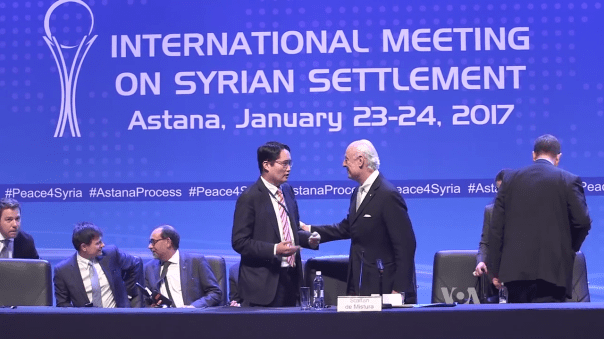
A la suite des pourparlers qui se sont tenus du 23 au 25 janvier 2017 à Astana (Kazakhstan) sous le parrainage de la Fédération de Russie, de la Turquie et de la République islamique d’Iran, un nouveau tour de pourparlers parrainé par l’ONU a eu lieu du 23 au 31 mars à Genève, sous l’appellation non-officielle de « Genève IV ». L’Émissaire spécial de l’ONU pour la Syrie, M. Staffan de Mistura, a dirigé ces pourparlers conviés par l’ONU à Genève et Lausanne.

Toutes les parties en présence au conflit en Syrie et en Irak n’y ont pas participé. Ni Daesh ni les Kurdes n’y étaient présents et toutes les composantes de l’opposition au Gouvernement du Président syrien Bachar al-Assad n’y ont pas été représentées. S’il existe des pourparlers non-officiels dans des hôtels ou des restaurants de Genève parallèlement aux négociations, en tout cas, personne n’en parle. Il existe une vaste et active communauté kurde à Genève et dans sa région, où certains agissent peut-être comme porte-paroles des efforts actuels de création du Rojava, zone autonome kurde au nord de la Syrie dont il est envisageable qu’elle s’associe un jour avec la région autonome kurde d’Irak.
International_Meeting_on_Syrian_Settlement_in_Astana.png

Les pourparlers de Genève ont porté sur des questions à court terme, parmi lesquelles un cessez-le-feu, la sécurité des civils syriens et l’accès aux humanitaires des zones en besoin d’aide. D’autres questions ont été abordées sur un plus long terme, s’agissant de processus politiques tels une administration transitoire, des changements constitutionnels, et des élections en vue d’un nouveau gouvernement dont les fondements soient plus larges.

En parallèle aux pourparlers intra-syriens lors desquels M. de Mistura a officié en tant que médiateur, l’ONU s’est saisie des préoccupations liées aux Droits Humains en Syrie, ayant créé une Commission d’enquête internationale indépendante sur la République arabe syrienne ainsi qu’un mécanisme commun d’enquête ONU-Organisation pour l’Interdiction des Armes Chimiques.
Saadallah_after_the_explosion

L’Association of World Citizens (AWC), Organisation Non-Gouvernementale (ONG) dotée du statut consultatif auprès de l’ONU, active dans la résolution des conflits armés et la promotion des Droits Humains, avait salué l’appel lancé le 20 juillet 2011 par le Secrétaire Général de l’ONU de l’époque, Ban Ki-moon, pour un dialogue inclusif sur les griefs du peuple syrien et ses préoccupations pour l’avenir. A travers un message au Secrétaire Général, l’AWC avait encouragé une participation aussi large que possible de la société civile syrienne à un tel dialogue, ajoutant que l’AWC, consciente de l’utilité qui peut être celle des ONG internationales dans la résolution des conflits, aiderait à faciliter de telles discussions de toute manière jugée appropriée.

En décembre 2011 commença une Mission d’Observation de la Ligue des Etats Arabes qui allait s’avérer de courte durée. Dans un message du 9 février 2012 au Secrétaire Général de la Ligue des Etats Arabes, l’Ambassadeur Nabil el-Araby, l’AWC a proposé un renouvellement de la Mission d’Observation de la Ligue Arabe, avec l’inclusion d’un nombre plus important d’observateurs issus d’ONG et un mandat élargi dépassant la simple mission d’exploration, et ainsi jouer un rôle actif de résolution des conflits au niveau local dans l’espoir d’arrêter la spirale qui engloutit le peuple syrien dans la violence et le carnage.

A bien des reprises depuis lors, l’AWC a rappelé à l’ONU, au Gouvernement syrien et aux mouvements d’opposition le rôle important que peuvent remplir les ONG, tant syriennes qu’internationales, pour faciliter la résolution des conflits.
Syrian_refugees_having_rest_at_the_floor_of_Keleti_railway_station._Refugee_crisis._Budapest,_Hungary,_Central_Europe,_5_September_2015

Les combats en Syrie, en Irak et dans certaines régions de la Turquie ont généré un grand nombre de personnes déplacées et de réfugiés. La réaction des gouvernements au flot de réfugiés s’est montrée pour le moins inégale, quelques-uns s’étant montrés accueillants et d’autres ayant ouvertement fermé leur porte. Très tôt, l’AWC avait appelé de ses vœux une conférence de l’ONU sur les réfugiés et personnes déplacées. L’AWC a salué la convocation par l’ONU de conférences sur les réfugiés et l’aide humanitaire, au sein desquelles elle a pris toute sa part.

Les conflits armés en Syrie, en Irak, au Yémen et en Afghanistan ont causé des violations graves du droit humanitaire international : attaques contre des installations médicales et du personnel de santé, exécutions de prisonniers de guerre, tortures, destructions délibérées du patrimoine culturel, attaques délibérées contre des populations civiles, usage d’armes que les traités internationaux interdisent. En conséquence, l’AWC a souligné la nécessité d’une conférence de l’ONU pour la réaffirmation du droit humanitaire international. S’il ne se manifeste pas maintenant un soutien fort au droit humanitaire international, il existera un danger réel de voir les violations désormais considérées comme « normales », ce qui les rendra hors de contrôle. Des mesures fortes de soutien au droit humanitaire international doivent être prises sans délai.

8211986588_54c6f4f542_b

Les structures de gouvernement, l’autorité, les limites géographiques des régions administratives et les droits des minorités de prendre part à la vie de la nation posent problème en Irak, en Syrie au Liban depuis l’époque de la désintégration de l’Empire ottoman après la fin de la Première Guerre Mondiale. Il est essentiel de développer des formes de gouvernement adaptées rendant possibles à la fois l’autonomie locale et la coopération régionale.

La recherche d’une structure adaptée à ceux qui s’identifient comme Kurdes s’est avérée être une question particulièrement difficile qui a donné lieu à des violences. L’AWC, fidèle à la tradition de décentralisation et de fédéralisme d’Alexandre Marc et de Denis de Rougemont, tient que le fédéralisme et la décentralisation ne sont pas des chemins vers la désintégration d’un Etat, mais tendent au contraire à créer des structures plus justes d’organisation de l’Etat et de coopération régionale.

L’AWC salue la conférence organisée le 5 avril par l’UE et l’ONU sur la Syrie et la région du monde à laquelle elle appartient.

L’AWC affirme une nouvelle fois son souhait de coopérer pleinement à la vaste et indispensable tâche de mettre fin au conflit armé et de développer une société qui soit inclusive et juste.

Le Professeur René Wadlow est Président de l’Association of World Citizens.

Bernard J. Henry est Officier des Relations Extérieures de l’Association of World Citizens.

Syria: Armed Conflict Resolution and the Reconstruction of an Inclusive and Just Society

In Being a World Citizen, Conflict Resolution, Current Events, Human Rights, Humanitarian Law, International Justice, Middle East & North Africa, NGOs, Refugees, Solidarity, The Search for Peace, United Nations, War Crimes, World Law on April 3, 2017 at 10:45 PM

SYRIA: ARMED CONFLICT RESOLUTION AND THE RECONSTRUCTION OF AN INCLUSIVE AND JUST SOCIETY

By René Wadlow

On April 5, 2017, the European Union (EU) and the United Nations (UN) will hold a joint conference on the future of Syria and its region. “Civil Society” is invited to participate, but it is not clear in advance if the Brussels meeting will be a “fundraising” one, in which case most Nongovernmental Organizations (NGO) in consultative status with the UN will have little to contribute or if there will be wider aims.

The EU-UN meeting is the third in a short space of time concerning Syria, a reflection of concern with the refugee flow and the continued violence and suffering in Syria and Iraq. The following is a text written on behalf of the Association of World Citizens (AWC) that is being sent to governments in advance of the April 5 conference. The text notes earlier appeals and efforts of the AWC in the Syria-Iraq-Turkey conflicts.

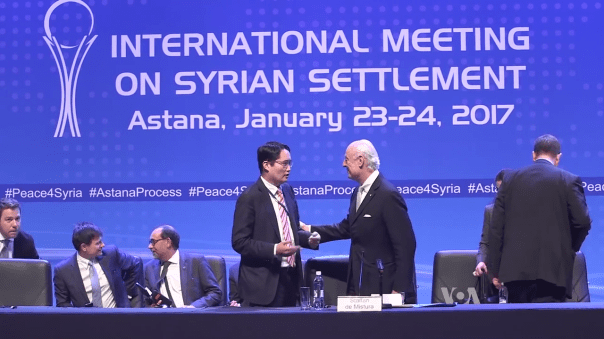
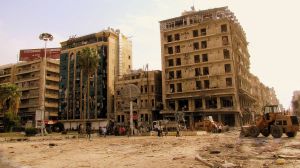
Following the January 23-25, 2017 talks in Astana, Kazakhstan sponsored by the Russian Federation, Turkey, and the Islamic Republic of Iran, a new round of United Nations (UN)-sponsored talks, March 23-31 was held in Geneva (informally called Geneva 4). The UN Special Envoy for Syria, Mr. Staffan de Mistura, has led the UN, Geneva and Lausanne-based talks. Not all the parties involved in the Syria-Iraq conflicts are participants in the talks. ISIS and the Kurds were not present, nor have all segments of the opposition to the Government of President Bashar al-Assad been formally present. What informal talks are held in Geneva hotels and restaurants during the negotiations are not officially reported. There is a large and active Kurdish community in the Geneva area and some may be spokespersons for the effort to create Rojava, a Kurdish autonomous zone in Northern Syria that might form some sort of association with the Kurdish autonomous area of Iraq.

International_Meeting_on_Syrian_Settlement_in_Astana.png

The Geneva-based talks have concerned short-term issues such as a ceasefire, safety of Syrian civilians and humanitarian access. There have also been longer-range issues concerning political processes such as a transition administration, constitutional changes, and elections for a new, more broadly based government.

Parallel to the intra-Syrian talks mediated by Mr. de Mistura, the UN has been concerned with the human rights issues having created an Independent International Commission of Inquiry on the Syrian Arab Republic as well as a joint UN-Organization for the Prohibition of Chemical Weapons investigative mechanism.

Saadallah_after_the_explosion

The Association of World Citizens (AWC), a Nongovernmental Organization in consultative status with the UN, active on issues of the resolution of armed conflicts and the promotion of human rights, had welcome a July 20, 2011 call of then UN Secretary-General Ban Ki-moon for an inclusive dialogue to respond to pressing grievances and longer-term concerns of the Syrian people. The AWC, in a message to the Secretary-General, encouraged broad participation of Syrian civil society in such a dialogue and indicated that the AWC, knowing the possible usefulness of international NGOs in conflict resolution, would help facilitate such discussions in any way considered appropriate.

In December 2011, there was the start of a short-lived Observer Mission of the League of Arab States. In a February 9, 2012 message to the Secretary General of the League of Arab States, Ambassador Nabil el-Araby, the AWC proposed a renewal of the Arab League Observer Mission with the inclusion of a greater number of NGO observers and a broadened mandate to go beyond fact-finding and thus to play an active conflict resolution role at the local level in the hope to halt the downward spiral of violence and killing.

On many occasions since, the AWC has indicated to the UN, the Government of Syria, and opposition movements the potentially important role of NGOs, both Syrian and international, in facilitating armed conflict resolution measures.

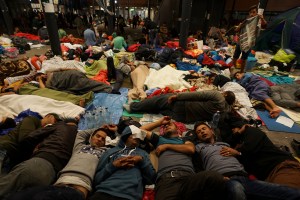
Syrian_refugees_having_rest_at_the_floor_of_Keleti_railway_station._Refugee_crisis._Budapest,_Hungary,_Central_Europe,_5_September_2015

The fighting in Syria, Iraq and parts of Turkey has led to a large number of displaced persons and refugees. The response of governments to the refugee flow has been very uneven, welcoming in a few cases, outright rejection in other cases. The AWC early on called for a UN-led conference on refugees and internally displaced persons. The AWC welcomed and participated in the UN conferences on refugees and humanitarian aid.

The armed conflicts in Syria, Iraq, Yemen and Afghanistan have led to serious violations of humanitarian international law: attacks of medical facilities and personnel, the execution of prisoners of war, the use of torture, the deliberate destruction of cultural heritage, the deliberate attacks on civilian populations, the use of weapons banned by international treaties. Therefore, the AWC has stressed the need for a UN-led conference to reaffirm humanitarian international law. If strong support for international law is not manifested now, there is a danger that violations will become considered as “normal”, and thus will increase. Strong measures of support for humanitarian international law are needed to be undertaken now.

8211986588_54c6f4f542_b

The structures of government, the authority, and the geographic limits of administrative regions, the rights and participation in national life of minorities have been issues in Iraq, Syria and Lebanon since the disintegration of the Ottoman Empire at the end of the First World War. Appropriate forms of government which allow both for local autonomy and regional cooperation need to be developed. The search for an appropriate structure for those considering themselves to be Kurds has been a particularly difficult issue often leading to violence. The AWC which has a decentralization, federalist tradition in the spirit of Alexandre Marc and Denis de Rougemont, has highlighted that federalism and decentralization are not steps toward the disintegration of a State but rather are efforts to find a more just structure of State organization and regional cooperation.

The AWC welcomes the April 5, 2017 EU-UN conference on Syria and the region. The AWC reconfirms its willingness to cooperate fully in the vast and critical effort for an end to the armed conflict and a development of an inclusive and just society.

Prof. René Wadlow is President of the Association of World Citizens.

Erich Fromm: Meeting the Challenges of the Century

In Being a World Citizen, Human Development, The Search for Peace on March 25, 2017 at 8:24 AM

ERICH FROMM: MEETING THE CHALLENGES OF THE CENTURY

By René Wadlow

I believe that the One World which is emerging can come into existence only if a New Man comes into being – a man who has emerged from the archaic ties of blood and soil, and who feels himself to be a citizen of the world whose loyalty is to the human race and to life, rather than to any exclusive part of it, a man who loves his country because he loves mankind, and whose views are not warped by tribal loyalties.

Erich Fromm, Beyond the Chains of Illusion

Erich Fromm (1900-1980), the psychoanalyst concerned with the relation between personality and society, whose birth anniversary we mark on March 23, was born in 1900. Thus, his life was marked by the socio-political events of the century he faced, especially those of Germany, his birth place.

eric01_400_01.jpg

Erich Fromm was born into an orthodox Jewish family in Frankfurt am Main. The families of both his mother and father had rabbis and Talmudic scholars, and so he grew up in a household where the significance of religious texts was an important part of life. While Fromm later took a great distance from Orthodox Jewish thought, he continued a critical appreciation of Judaism.

He was interested in the prophets of the Old Testament but especially by the hope of the coming of a Messianic Age – a powerful theme in popular Judaism. The coming of the Messiah would establish a better world in which there would be higher spiritual standards but also a new organization of society. The Messianic ideal is one in which the spiritual and the political cannot be separated from one another. (1)

He was 14 when the First World War started and 18 when the German State disintegrated – too young to fight but old enough to know what was going on and to be impressed by mass behavior. Thus, he was concerned from the start of his university studies with the link between sociology and psychology as related ways of understanding how people act in a collective way.

As was true for German university students of his day, he was able to spend a year or a bit more in different German universities: in Frankfurt where he studied with the Frankfurt School of Critical Theory whose members he would see again in New York when they were all in exile, at the University of Munich, at the Berlin Psychoanalytic Institute, and at the University of Heidelberg from where he received a doctorate.

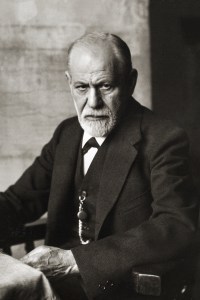
Sigmund_Freud_1926

Sigmund Freud

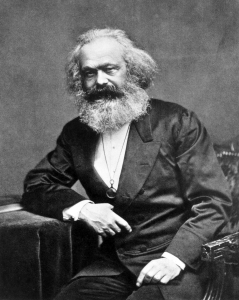
He had two intellectual influences in his studies: Sigmund Freud whose approach was the basis of the Berlin Psychoanalytic Institute and Karl Marx, a strong influence in the Frankfurt School. Fromm chose a psychoanalyst path as a profession, learning and, as was required in the Freudian tradition, spending five years in analysis. Fromm, however, increasingly took his distance from Freudian orthodoxy believing that society beyond family relations had an impact on the personality. He also broke one of the fundamental rules of Freudian analysis in not overcoming the transfer of identification with his analyst. He married the woman who was his analyst. The marriage broke after four years perhaps proving the validity of Freud’s theories on transfers and counter-transfers.

Karl_Marx

Karl Marx

Erich Fromm’s reputation and his main books rest on his concern with the relation of individual psychology and social forces – the relation between Freud and Marx. However, probably the most fundamental thinker who structured his approach was the Buddha whom he discovered around the age of 26. It is not Buddhism as a faith which interested him – Buddhism being the tradition built on some of the insights of the Buddha. Rather it was the basic quest of the Buddha which interested him: what is suffering? Can suffering be reduced or overcome? If so, how?

Fromm saw suffering in the lives of the Germans among whom he worked in the late 1920s, individual suffering as well as socio-economic suffering. For Fromm there must be a link between the condition of the individual and the social milieu, a link not fully explained by either Freud or Marx.

Fromm had enough political awareness to leave Germany for the United States just as Hitler was coming to power in 1933. From 1934, he was teaching in leading United States (U. S.) universities. In 1949 he took up a post as professor at the National Autonomous University in Mexico, but often lectured at U. S. universities as well.

41EePD3kEoL._UY250_.jpg

Fromm’s work is largely structured around the theme of suffering and how it can be reduced. There is individual suffering. It can be reduced by compassion and love. One of his best-known books is The Art of Loving. Love is an art, a “discipline”, and he sets out exercises largely drawn from the Zen tradition to develop compassion toward oneself and all living beings.

There is also social suffering which can be reduced by placing an emphasis not on greater production and greater consumption but on being more, an idea that he develops in To Have or To Be. Fromm was also aware of social suffering and violence on a large scale and the difficulties of creating a society of compassionate and loving persons. His late reflections on the difficulties of creating The Sane Society (the title of a mid-1950s book) is The Anatomy of Human Destructiveness. We still face the same issues of individual and social suffering and the relation between the two. Erich Fromm’s thinking makes a real contribution as we continue to search.

Note

(1) See his You Shall Be As Gods for a vision of the Jewish scriptures as being a history of liberation.

Prof. René Wadlow is President of the Association of World Citizens.
A Time of Renewal: The Day of World Citizens

In Being a World Citizen, Human Development, The Search for Peace, World Law on March 20, 2017 at 8:00 AM

A TIME OF RENEWAL: THE DAY OF WORLD CITIZENS
By René Wadlow

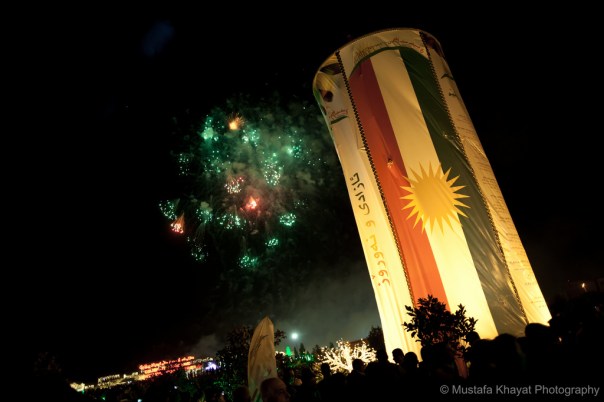
A moment to celebrate our sense of being a World Citizen is the midnight passage between March 20, now designated by the United Nations (UN) as the International Day of Happiness, and March 21 which is now a UN holiday marking the start of Nowroz, the New Year in Iran, Afghanistan and Central Asia. March 21 is also the start of the New Year for the worldwide faith of the Baha’i.

Newroz

A Nowroz celebration in Erbil, capital city of Iraqi Kurdistan, in 2012. (C) Mustafa Khayat

As the scholar of religion Mircea Eliade has pointed out, there are moments “out of time” when all is considered possible. The laws of the previous time are suspended and the new time has not yet started. This is a widely-shared belief, even if largely separated from any religious significance, as we see in the moment just before the start of one January when people chant the number of seconds prior to midnight: Ten, nine, eight… Happy New Year!

The midnight passage between March 20 and 21 is linked to the Spring Equinox, a time of equal balance between day and night. However, at midnight it is yet too early to see any signs of dawn. We know only by faith and hope that light will come. In the same way we know that we are at a crucial moment in world history when there is a passage of consciousness focused on the individual State to a consciousness focused on the unity of humanity. Not all persons are moving at the same speed to a universal consciousness. There are those who are still at an “America First” level, but there are an increasing number of people who realize that harmony and balance are the key to our ascent to the next higher level: Harmony between intellect and heart, mind and body, female and male, being and doing. We are moving toward the full development of each person in a cosmopolitan, humanist world society.

Outer Earth Globe Rise Sunrise Sun Space World

Today, after decades of conflict when the emphasis of State leaders, both in policy and practice, was upon competition, conflict and individual enrichment, World Citizens place an emphasis on harmony, cooperation, mutual respect and working for the welfare of the community with a love of Nature of which we are a part.

Earth is our Common Home. Let us protect it together.

Prof. René Wadlow is President of the Association of World Citizens.
Robert Muller (March 11, 1923 – September 20, 2010): Crossing Frontiers for Reconciliation

In Being a World Citizen, Conflict Resolution, Human Development, Human Rights, NGOs, Solidarity, The Search for Peace, United Nations, World Law on March 11, 2017 at 9:47 AM

ROBERT MULLER (MARCH 11, 1923 – SEPTEMBER 20, 2010): CROSSING FRONTIERS FOR RECONCILIATION

By René Wadlow

“The time has come for the implementation of a spiritual vision of the world’s affairs. The entire planet must elevate itself into the spiritual, cosmic throbbing of the universe.”

— Robert Muller

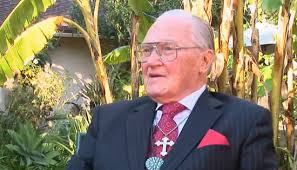
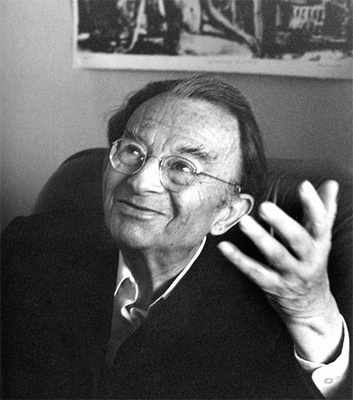
Robert-Muller

Robert Muller, whose birth anniversary we mark on March 11, was the former Assistant Secretary-General for Economic and Social Service of the United Nations (UN), and, after his retirement, he served as Honorary President of the Association of World Citizens (AWC).

He was brought up in Alsace-Lorraine still marked by the results of the First World War. As a young man, he joined the French Resistance movement during the Second World War when Alsace-Lorraine had been re-annexed by Germany. At the end of the War, he earned a Doctorate in Law and Economics at the University of Strasbourg. Strasbourg was to become the city symbolic of French-German reconciliation and is today home of the European Parliament.

Determined to work for peace having seen the destructive impact of war, he joined the UN Secretariat in 1948 where he worked primarily on economic and social issues. For many years, he was the Secretary of the UN Economic and Social Council (ECOSOC). His work with ECOSOC brought him into close contact with Nongovernmental Organizations (NGOs) whose work he always encouraged.

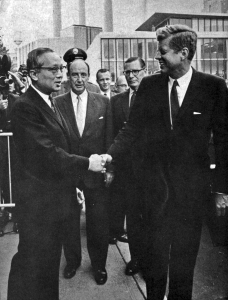
In 1970, he joined the cabinet of the then Secretary-General U Thant, who was Secretary-General from 1961 to 1971. U Thant had a deep impact on the thinking of Robert Muller. U Thant’s inner motivations were inspired by a holistic philosophy drawn from his understanding of Buddhism, by an intensive personal discipline and by a sense of compassions for humans. U Thant had been promoted to his UN post by the military leaders of Burma who feared that had he stayed in the country, he would have opposed their repressive measures and economic incompetence. Although U Thant was reserved in expressing his spiritual views in public speeches, he was much more willing to discuss ideas and values with his inner circle of colleagues. U Thant held that “the trouble of our times is that scientific and technological progress has been so rapid that moral and spiritual development has not been able to keep up with it.”

U_Thant_and_John_F._Kennedy

U Thant (left) shaking hands with then U. S. President John F. Kennedy (right).

Muller agreed with U Thant’s analysis. As Muller was a good public speaker, he often expressed these views both in UN meetings and in addresses to NGOs and other public meetings. Muller became increasingly interested in the views of the French Jesuit philosopher Pierre Teilhard de Chardin who had lived his last years of his life in New York City. For Teilhard, as he wrote in Phenomenon of Man, “No longer will man be able to see himself unrelated to mankind neither will he be able to see mankind unrelated to life, nor life unrelated to the universe.”

Muller saw the UN as a prime instrument for developing a sense of humanity as all members of one human family and for relating humans to the broader community of life and Nature. As Muller wrote, “We are entering one of the most fascinating and challenging areas of human evolution. In order to win this new battle for civilization, we must be able to rely upon a vastly increased number of people with a world view. We need world managers and servers in many fields.”

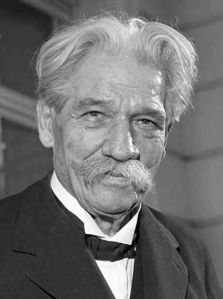
I had the pleasure of knowing Robert Muller well as he was often in Geneva for his UN economic and social work and, at that time, had a home in France near Geneva, where he did much of his writing. Muller was also deeply influenced by the thinking of another Alsatian, Albert Schweitzer, who had also spent most of his life outside France.

Albert_Schweitzer_1955

Albert Schweitzer, the legendary humanitarian who coined the concept of “reverence for life” (Ehrfurcht vor dem Leben).

I had known Albert Schweitzer when I was working for the Ministry of Education of Gabon in the early 1960s. Both Schweitzer and I, influenced by Norman Cousins, had been active against A-Bomb tests in the atmosphere, and so I had been welcomed for discussions at the hospital in Lambaréné. For Muller, Schweitzer with his philosophy of reverence for life and the need for a spiritual – cultural renewal was a fellow world citizen and a model of linking thought and action.

For Muller, the UN was the bridge that helped to cross frontiers and hopefully to develop reconciliation through a common vision of needs and potential for action.

hqdefault

Robert Muller, an example for all of us at the Association of World Citizens.
Notes:

For two autobiographic books, see Robert Muller. What War Taught Me About Peace (New York: Doubleday) and Robert Muller, Most of All, They Taught Me Happiness (New York: Doubleday, 1978).


Prof. René Wadlow is President of the Association of World Citizens.
Xi Jinping, Citizen of the World, and the Making of a Global Policy

In Anticolonialism, Being a World Citizen, Cultural Bridges, Current Events, Environmental protection, Human Development, Solidarity, The Search for Peace, World Law on March 5, 2017 at 12:09 PM

XI JINPING, CITIZEN OF THE WORLD, AND THE MAKING OF A GLOBAL POLICY

By René Wadlow

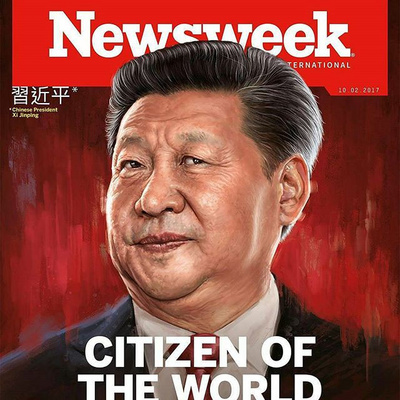
A recent issue of Newsweek hailed the President of China, Xi Jinping, as a citizen of the world and highlighted his January 17, 2017 speech to the World Economic Forum in Davos, Switzerland as setting forth a new global policy. At a time when the President of the United States is putting his “America First” policy into practice, and the President of the Russian Federation is striving to make Russia and the Russian Orthodox Church “great again”, it is China that is providing great power leadership toward a cosmopolitan, humanistic, world society.

At Davos, Xi Jinping stressed that globalization had produced “powerful global growth and facilitated movement of goods and capital, advances in science, technology and civilization and interaction among people.” He noted the China-led creation of the Asian Infrastructure Investment Bank and the Regional Comprehensive Economic Partnership. He ended by saying that “the people of all countries expect nothing less (than to make globalization work) and this is our unshrinkable responsibility as leaders of our times.”

citi01_400

It is true that globalization – the world as an open market – has worked well for China’s export-led economy and for its foreign infrastructure development efforts – the One Belt-One Road project of rail, roads and sea ports. However, Xi Jinping also mentioned civilization and interaction among people as one of the outcomes of globalization, perhaps thinking of the large number of student exchanges and the impact of Chinese culture through the increasing number of Confucius Institutes throughout the world.

Xi Jinping stressed the need for ecologically-sound development and meeting the goals of the Paris Climate Conference – the protection of Nature being high on the list of world citizen priorities.

2009_protest_at_un_against_chinas_re-election_in_the_human_rights_council_%e8%81%af%e5%90%88%e5%9c%8b%e5%a4%96%e6%8a%97%e8%ad%b0%e4%b8%ad%e5%9c%8b%e5%9c%a8%e4%ba%ba%e6%ac%8a%e5%a7%94%e5%93%a1

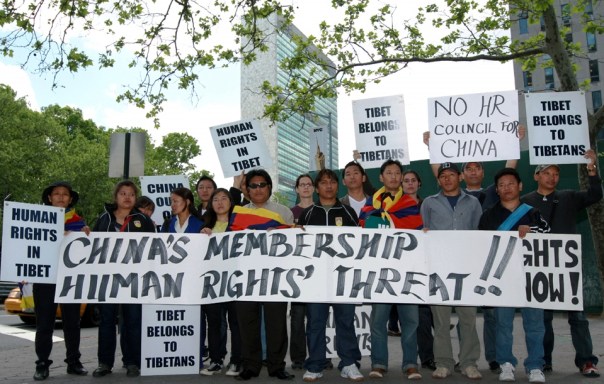
China retains a preoccupying record of human rights violations, as does its northeastern neighbor Russia. Now that extreme right populism has prevailed at the polls in Britain and the United States, and as France is entering a dangerous electoral period with a genuine extreme right risk too, human rights are set to become an ever greater matter of concern in terms of global leadership, regardless of the proven merits in other fields of any given individual country. President Xi Jinping should implement immediate, significant policy changes and bring his country in line with United Nations standards at last.

It is certain that in addition to setting a broadly positive global policy, there are real internal challenges to meeting the world citizen values of equality and respect for the dignity of each person.

As fellow citizens of the world, we are heartened by the advances of the rule of world law, of equality between women and men, by efforts of solidarity to overcome poverty and hunger. We look to Chinese leadership to strengthen the forces which advance a cosmopolitan, humanist world society based on wholeness, harmony and creativity.

Prof. René Wadlow is President of the Association of World Citizens.

Kuan Yin: Goddess of Compassion and Harmony

In Asia, Being a World Citizen, Conflict Resolution, Cultural Bridges, Solidarity, The Search for Peace on February 19, 2017 at 9:15 AM

KUAN YIN: GODDESS OF COMPASSION AND HARMONY
By René Wadlow

Wise in using skillful means, in every corner of the world, she manifests her countless forms

February 19, in countries influenced by Chinese culture, is a day devoted to honoring Kuan Yin, goddess of compassion, “She who hears the cries of the world and restores harmony.” She is a goddess for the Taoists and a bodhisattva for the Buddhists but she represents the same values of compassion for both faiths. There has been mutual borrowing of symbols and myths between the two groups, as well as an identification with Mary in countries with a Roman Catholic minority such as Vietnam and with Tara among the Tibetans.

From the Taoist tradition, she is associated with running water and lotus pools. Many of her virtues come from Buddhist teachings:
“Wrathful, banish thought of self
Sad, let fall the causes of woe,
Lustful, shed lust’s mental object,
Win all, by simply letting go.”

As in this Chinese verse reflecting her advice, many Buddhist values are phrased negatively: abobha (non-greed), adosa (non-hatred), amoka (non-delusion), less frequently in positive values metta (loving kindness), karuma (compassion), mudita (happiness in the good fortune of others).

543px-guan_yin_100

Yet Kuan Yin is associated with active compassion as a driving force of action, where all, including the least of living things are treated with fairness and consideration and where the broader currents of life move toward harmony and equilibrium.

While most of the myths and ex voto paintings found in temples show Kuan Yin helping individuals in times of stress or danger, there is also a broader, more political-social aspect to her efforts to restore harmony and balance. Today, at a time when humanity is increasingly working together to meet ecological challenges and to overcome ideologically-led strife, the spirit of Kuan Yin presents to us an important call for a cultural renaissance based on the concept of harmony. Rather than concentrating primarily on conflicts, struggles and suffering, the spirit of Kuan Yin suggests that the focus should be on cooperation, and visions of a better future. Harmony includes tolerance, acceptance, equality, and forgiveness of past pains and conflicts. The spirit of Kuan Yin leads to gentleness, patience, kindness, and to inner peace.

We are fortunate to be able to participate in a crucial moment in world history when the law of harmony, that is the law of equilibrium, is being increasingly recognized and understood. Harmony is the key to our ascent to the next higher level of human consciousness: harmony between the intellect and the heart, the mind and the body, male and female, being and doing.

3580833211_ca9e9598fb_b

For the conscious restoration of equilibrium, we must understand the lack of harmony particular to each society and to each segment of the society. It may be a lack of balance in the goals to be reached and the means to reach these goals. It may be a lack of balance between thought and action, or it may be a lack of balance between the role of women and men.

The efforts to restore harmony can often be long for there are structures and institutions which, though lifeless, take a long time to crumble. One needs patience. Yet, there are, at times, unexpected breakthrough and shifts. Thus, one must always be sensitive to the flow of energy currents.

Thus, as we mark February 19 to honor Kuan Yin, we also develop a new spirit of cooperation for the creation of a cosmopolitan, humanist world society. Social harmony is inseparable from the values of respect and understanding, of goodwill, and of gratitude toward one another.

Prof. René Wadlow is President of the Association of World Citizens.