The Official Blog of the

Archive for the ‘Solidarity’ Category

Many Forms of Violence against Women

In Being a World Citizen, Democracy, Human Development, Human Rights, International Justice, Social Rights, Solidarity, United Nations, Women's Rights, World Law on November 25, 2016 at 11:47 AM

MANY FORMS OF VIOLENCE AGAINST WOMEN

By René Wadlow

November 25 is the day designated by the United Nations (UN) General Assembly as the “International Day for the Elimination of Violence against Women.” Violence against women is a year-round occurrence and continues at an alarming rate. Violence against women can take many different forms. There can be an attack upon their bodily integrity and their dignity. As citizens of the world, we need to place an emphasis on the universality of violence against women but also on the multiplicity of the forms of violence. We need to look at the broader system of domination based on subordination and inequality. The value of a special Day for the Elimination of Violence against Women is that the day serves as a time of analysis of the issues and a time for a re-dedication to take both short-term measures – such as the creation of a larger number of homes for battered women – and longer range programs.

Both at the international UN level and at the national and local level, there have been programs devoted to the equality of women and to the promotion of women in all fields. Thus, it is important to stress that women are not only victims in need of special protection but also that women should participate fully and effectively in all aspects of society.

Nevertheless, women have largely remained invisible and inaudible by being allowed to have a key role in the “informal sector” – those sectors of the economy that are the least organized and are often left out of the statistics of the formal economy as if the informal sector did not count. Women have turned to the informal sector – or have been pushed into it – as a way of sustaining a livelihood for their families.

8214743009_edc61758d5_b

(C) Anna Sapphire

In the informal sector, women survive and often have a major responsibility for the economy of the whole family. Fathers are often absent by need or by choice. Some women do well in the informal sector and serve as a model – or a hope – as to what others can accomplish. Self-employed women are increasingly helped by micro-credit programs. Micro-credit loans are useful but rarely do such loans allow a person to move outside the informal economy.

Women’s work in the informal sector accounts for a large proportion of total female employment in most developing countries of Africa, Latin America and Asia. Women work as food producers, traders, home-based workers, domestic workers, prostitutes and increasingly are engaged in drug trafficking – anything to earn an income to feed their children. The informal sector is their last hope for economic and social survival for themselves and their families.

Violence against women

“Violence against women”, by Gaetano Salerno, 80x60cm, 2013.

Gender inequality and the walls built around the informal sector are the marks of the “silent violence” against women. Amartya Sen defined the major challenge of human development as “broadening the limited lives into which the majority of human beings are willy-nilly imprisoned by the forces of circumstances”.  On November 25, this day for the elimination of violence against women, we need to look closely at the many social, cultural and economic wall which imprison.

Prof. René Wadlow is President of the Association of World Citizens.
World Citizens Demand an End to All Hostile Maneuvers Toward Amnesty International in Russia

In Being a World Citizen, Current Events, Democracy, Europe, Human Rights, International Justice, Solidarity, The former Soviet Union, United Nations, World Law on November 4, 2016 at 9:20 AM

-- AWC-UN Geneva Logo --

WORLD CITIZENS DEMAND AN END TO ALL HOSTILE MANEUVERS
TOWARD AMNESTY INTERNATIONAL IN RUSSIA

The Association of World Citizens (AWC) is concerned that the headquarters of the Russian Section of Amnesty International, based in Moscow, have been sealed off by the local authorities and the staff have been barred from accessing the premises.

Although the Russian authorities have contended that the rent for the Amnesty headquarters was overdue, the organization has proved that this contention was unfounded, thus demonstrating that the sealing is an unwarranted move and a violation of Amnesty International’s rights as an organization of Human Rights Defenders in line with the provisions of Resolution 53/144 of the United Nations (UN) General Assembly.

Compliance with international human rights standards can never harm the stability – political, administrative or other, of a given society, only improve it by establishing firm legal, political, and moral norms that every citizen can both claim in defense of their own rights and use to defend the rights of others when necessary.

The AWC calls on the authorities of the Russian Federation and the City of Moscow to restore free access to the headquarters of Amnesty International Russia for its staff, volunteers, members and anyone else who may wish to visit with the consent of the Amnesty leadership there.

Battle for Mosul: Can There Be Respect for the Laws of War?

In Conflict Resolution, Current Events, Human Rights, International Justice, Middle East & North Africa, Solidarity, The Search for Peace, United Nations, War Crimes, World Law on October 18, 2016 at 7:43 PM

BATTLE FOR MOSUL: CAN THERE BE RESPECT FOR THE LAWS OF WAR?
By René Wadlow

On Monday, October 17, 2016, the battle of Mosul began as the troops of the Iraqi army started moving toward the northern Iraq city of Mosul. The Iraqi Prime Minister, Haider al-Abadi, announced the effort to take Mosul, a city of over one million people which has been held by the forces of the Islamic State (ISIS or Daesh in its Arabic initials) since July 2014. The Iraqi troops are assisted by Turkish troops and tanks, by United States (U. S.) Special Forces who have also been training the Iraqi troops, and by the Kurdish peshmerga militias who have attacked surrounding villages but who, for political reasons, are not likely to enter Mosul.

There are estimates that there are some 4,500 ISIS troops facing some 50,000 on the Iraqi government side. ISIS has been aware that an attack on Mosul was in preparation for a long time and has responded by mining buildings and roads as well as building tunnels. It is likely that some ISIS fighters have slipped away, but it is also likely that the remaining majority of ISIS will fight to the bitter end, preferring death to surrender. In a situation that is confused by the number and nationalities of the groups in combat as well as the very ethnically and religiously mixed population of Mosul, what possibilities exist for respect of the laws of war?

15015691860_2c3dd3f2e1_b.jpg

Two Kurdish peshmerga fighters at Mosul Dam in 2014.

The laws of war, now often called humanitarian law, have two wings, one dealing with the treatment of medical personnel in armed conflict situations, the treatment of the military wounded and prisoners of war as well as the protection of civilians. This wing is represented by the Geneva (Red Cross) Conventions. The second wing, often called the Hague Conventions limit or ban outright the use of certain categories of weapons. These efforts began at The Hague with the 1900 peace conferences and have continued since even if the more recent limitations on land mines, cluster weapons and chemical weapons have been negotiated elsewhere than in The Hague.

For the Hague Conventions such as the ban on land mines, the ban is binding only on States which have ratified the convention. Although the Islamic State had some of the markings of a proto-State, it was not recognized as a State by any other State. Basically ISIS can be considered as an armed militia.

ISIS_YouTube.jpg

ISIS, or Daesh, the self-styled “Islamic State”, only believes in violence. It has always displayed an unmitigated hatred of everything that international law and human rights stand for. It is neither “Islamic” nor a “State” and never will be.

The status of the Geneva Conventions for non-State militias can be debated. When I was involved at the United Nations (UN) with the national minorities of Burma in the 1990s, I encouraged the Burmese militias to study, discuss and then sign the Geneva Conventions, of which the Swiss government is the depositary power. When the Burmese government learned of our efforts, they quickly signed the Geneva Conventions. Once the national minorities had signed, and I sent the document to the Swiss government and to the International Committee of the Red Cross, both the Burmese military and the national minorities released a number of prisoners of war as a mark of good faith which had never been done before. The status of world law for non-State entities and individuals is a crucial question, and there are discussions at the International Criminal Court on this issue.

The current situation concerning refugees and internally-displaced persons can also be considered as part of humanitarian law. The status of refugees is more widely respected than that of the internally-displaced.

ISIS has shown no interest or respect for humanitarian law nor for universally-recognized human rights. ISIS has carried out many summary executions of perceived opponents. There is a real danger that as ISIS disintegrates and no longer controls as much territory, it will increase terrorist actions having “nothing left to lose”.

The violations of the laws of war are not limited to ISIS. On May 3, 2016, the UN Security Council unanimously adopted Resolution 2286 calling for greater protection for health care institutions and personnel in light of recent attacks against hospitals and clinics in Syria, Iraq, Yemen, South Sudan, Democratic Republic of Congo and Afghanistan. These attacks indicate a dangerous trend of non-compliance with the laws of war by both State and non-State agents.

To prevent and alleviate human suffering, to protect life and health, and to ensure respect for the human person – these are the core values of humanitarian law. These values may get lost in the “fog of war” of the battle for Mosul. Therefore, there needs to be a wide public outcry in the defense of humanitarian law so that violations can be reduced. As the tanks move ahead, the time for the defense of humanitarian values is now.

Prof. René Wadlow is President of the Association of World Citizens.
Ending Marginalization and Exclusion

In Asia, Being a World Citizen, Children's Rights, Human Development, Human Rights, International Justice, Social Rights, Solidarity, The Search for Peace, United Nations, World Law on October 17, 2016 at 9:31 AM

ENDING MARGINALIZATION AND EXCLUSION
By René Wadlow

October 17 was set by the United Nations (UN) General Assembly in Resolution 47/196 as the International Day for the Eradication of Poverty. October 17 was chosen as the anniversary of a October 17, 1987 meeting in front of the Trocadéro in Paris near where the Universal Declaration of Human Rights was signed in 1948. The 1987 meeting was called as a reminder that the victims of extreme poverty, hunger and violence do not enjoy the rights that are set out in the Universal Declaration.

In some ways the 1987 meeting is an indication of how long ideas and values take to be institutionalized in the world society. It took nearly 40 years for awareness to grow that there were people who fell outside the development and welfare provisions of governments. It took another four years for that awareness to be enshrined in a General Assembly resolution. Nevertheless, we must be thankful for resolutions which highlight the obvious. We can build upon that awareness and the resolution.

poverty-509601_960_720.jpg

Somewhere along the line of the growing awareness that poverty exists came the realization that the eradication of poverty was not only the concern of governments but also of the poor and marginalized themselves. To use the most commonly-used image: poverty reduction is not only a “top-down” effort (governments toward citizens) but also a “bottom-up” process (of the poor toward the holders of wealth and the governmental decision-makers.) Thus today, there is an awareness that the marginalized sections of society should be involved in the decision-making process which determines the socio-cultural, economic, and political life of the State. This awareness is often termed “popular participation”, “community organizing” and “grass-roots organizations.”

2014_Poverty_rate_chart_Chad_Haiti_Nigeria_Bangladesh_Kenya_Indonesia_India_China_Brazil_based_on_World_Bank_new_2011_PPP_benchmarks.png

As an Asian Committee for People’s Organization states in its manual for organizers Organizing People for Power, “It is the oppressors who, after all, control corporate decision-making, the government apparatus, the media, and the police. Although the people vastly outnumber the oppressors, in their disorganized conditions they lack the power to oppose their enemy. By themselves, the poor farmers, workers or slum dwellers are no match for the oppressors in terms of money or resources … The transfer of power from the hands of the oppressors to those of the oppressed is not easily accomplished at one fell swoop. Part of the difficulty lies in the ‘culture of silence’ that has been inculcated into the people’s consciousness by centuries of domination. By slow degrees, the oppressed have internalized a subservient mentality that is reinforced by their daily experience. They find it difficult to see their liberation in terms of their own strength, and look instead outside themselves to an external force to come and save them. The oppressed cannot imagine that the power they await lies within them, and therefore, they lapse into a state of passivity awaiting liberation from heaven or a messianic leader.”

11019578316_026bae1ae5_b.jpg

However, there are growing efforts by which people are released from their culture of silence and demand a meaningful participation in society through socio-economic projects which enhance their bargaining power. Such approaches involve tensions and conflicts, but conflicts can have a potential for creativity. As a set of notes for workers engaged in rural development and adult education written by the Xavier Institute of Social Service in Ranchi, India states, “Projects should be the result of a process where people have perceived the need for them. This will require a clear-cut vision and manifestation of a just society. Projects can be undertaken as instruments for social transformation, and development programmes must make the conscious effort to translate these projects into useful tools to hasten the establishment of a just society.”

Today, different social conditions, identities, religious beliefs shape our one humanity. We share the responsibility to ensure the dignity of each individual. We need to find creative ways of ending marginalization and exclusion of groups and individuals. October 17 should stand as a time of re-dedication to finding creative paths to this goal.

Prof. René Wadlow is President of the Association of World Citizens.
World Policy for Migrants and Refugees

In Africa, Being a World Citizen, Conflict Resolution, Current Events, Democracy, Europe, Fighting Racism, Human Rights, Middle East & North Africa, Solidarity, The Search for Peace, United Nations, World Law on October 4, 2016 at 7:26 PM

WORLD POLICY FOR MIGRANTS AND REFUGEES
By René Wadlow

«There is no doubt that Mankind is once more on the move. The very foundations have been shaken and loosened, and things are again fluid. The tents have been struck, and the great caravan of Humanity is once more on the march.»

Jan Christian Smuts at the end of the 1914-1918 World War.

On September 19, 2016, the United Nations (UN) General Assembly held a one-day Summit on “Addressing Large Movements of Refugees and Migrants”, a complex of issues which have become important and emotional issues in many countries. The UN Department of Economic and Social Affairs (DESA) published a report on international migration indicating that there are some 244 million migrants, some 76 million live in Europe, 75 million in Asia, 54 million in North America and others in the Middle East, Latin America and the Pacific, especially Australia and New Zealand. In addition, there are some 24 million refugees – people who have crossed State frontiers fleeing armed conflict and repression as well as some 40 million internally-displaced persons within their own country. Acute poverty, armed conflicts, population growth and high unemployment levels provide the incentives for people to move, while easier communications and transport are the means.

However, as we have seen with the many who have died in the Mediterranean Sea, people will take great risks to migrate. Thus, there is an urgent need to take away the monopoly of the life and death of refugees from the hands of mafias and traffickers and to create an effective world policy for migrants and refugees.

UNGA

This is the third time that the major governments of the world have tried to deal in an organized way with migration and refugees. The first was within the League of Nations in the 1920s. The 1914-1918 World War and the 1917 Russian Revolution had created a large number of refugees and “stateless” persons – citizens of the former Russian, Ottoman, and Austro-Hungarian Empires. These people had no passports or valid identity documents. The League of Nations created a League identity document – the Nansen Passport – which gave some relief to the “stateless” and brought international attention to their conditions. The Nansen Passport, however, became overshadowed in the mid-1930 when people – in particular Jews – fled from Germany-Austria and were refused resettlement.

nansenpassport

The second international effort was as a result of the experiences of the 1939-1945 Second World War and the large number of refugees and displaced. Under UN leadership was created the 1951 Geneva Convention on the Status of Refugees. In addition, the UN Office of the High Commissioner for Refugees, originally created as a temporary body, was made a permanent UN agency in recognition of the continuing nature of refugee issues.

The current third international effort is largely a result of the flow of refugees and migrants toward Europe during 2015-2016. The disorganized and very uneven response of European governments and the European Union to this flow has indicated that governments are unprepared to deal with such massive movements of people. Nongovernmental organizations (NGOs) have not been able to deal adequately with this large number of persons despite many good-will efforts. Moreover, certain European political movements and political parties have used the refugee issue to promote narrow nationalist and sometimes racist policies. Even a much smaller flow of refugees to the USA has provoked very mixed reactions – few of them welcoming.

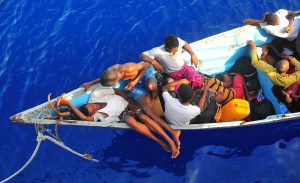
Distressed persons wave after being transferred to a Maltese patrol vessel.

The September 19 Summit is a first step toward creating a functioning world policy for migrants and refugees. The Summit is not an end in itself but follows a pattern of UN awareness-building conferences on the environment, population, food, urbanization and other world issues. The impact of UN conferences has been greatest when there are preexisting popular movements led by NGOs which have in part sensitized people to the issue. The two UN conferences which have had the most lasting consequences were the 1972 Stockholm conference on the environment and the 1975 International Year of Women and its Mexico conference. The environment conference was held at a time of growing popular concern with the harm to the environment symbolized by the widely-read book of Rachel Carson Silent Spring. The 1975 women’s conference came at a time when in Western Europe and the USA there was a strong “women’s lib” movement and active discussion on questions of equality and gender.

Migration and refugee issues do not have a well-organized NGO structure highlighting these issues. However human rights NGOs have stressed the fate of refugees and migrants as well as human rights violations in the countries from which they fled. There is also some cooperation among relief NGOs which provide direct help to refugees and migrants such as those from Syria and Iraq living in Turkey, Jordan, Lebanon and those going to Greece and Italy.

The Summit’s Declaration is very general, and some observers have been disappointed with the lack of specific measures. However, we can welcome the spirit of the Summit Declaration with its emphasis on cooperative action, a humane sense of sharing the responsibilities for refugees and migrants and on seeking root causes of migration and refugee flows. What is needed now are strong NGO efforts to remind constantly government authorities of the seriousness of the issues and the need for collective action. Refugees and migrants are not a temporary “emergency” but part of a continuing aspect of the emerging world society. Thus there is a need to develop a world policy and strong institutions for migrants and refugees.

Prof. René Wadlow is President of the Association of World Citizens.
Building on the UN Summit to Address Large Movements of Refugees and Migrants

In Being a World Citizen, Children's Rights, Conflict Resolution, Current Events, Democracy, Europe, Fighting Racism, Human Rights, Social Rights, Solidarity, The Search for Peace, United Nations, Women's Rights, World Law on September 20, 2016 at 6:58 PM

BUILDING ON THE UN SUMMIT TO ADDRESS LARGE MOVEMENTS OF REFUGEES AND MIGRANTS

By René Wadlow

awc-un-geneva-logo

On September 19, 2016, the United Nations (UN) General Assembly held a one-day Summit on “Addressing Large Movements of Refugees and Migrants”, a complex of issues which have become important and emotional issues in many countries. Restrictive migration policies deny many migrants the possibility of acquiring a regular migrant status, and as a result, the migrants end up being in an irregular or undocumented situation in the receiving country and can be exposed to exploitation and serious violations of human rights.

Citizens of the world have been actively concerned with the issues of migrants, refugees, the “stateless” and those displaced by armed conflicts within their own country. Thus we welcome the spirit of the Summit Declaration with its emphasis on cooperative action, a humane sense of sharing the responsibilities for refugees and migrants and on seeking root causes of migration and refugee flows. There are three issues mentioned in the Summit Declaration which merit follow up action among the UN Secretariat, world citizens and other non-governmental organizations:

1) The migration of youth;

2) The strong link between migration, refugee flows, and improving the structures for the resolution of armed conflicts;

3) Developing further cooperation among non-governmental organizations for the protection and integration of refugees and migrants.

The Migration of Youth

Youth leave their country of birth to seek a better life and also to escape war, poverty, and misfortune. We should add to an analysis of trans-frontier youth migration a very large number of youth who leave their home villages to migrate toward cities within their own country. Without accurate information and analysis of both internal and trans-frontier migration of youth, it is difficult to develop appropriate policies for employment, housing, education and health care of young migrants and refugees. It is estimated that there are some 10 million refugee children, and most are not in school.

Studies have noted an increasing feminization of trans-frontier migration in which the female migrant moves abroad as a wage earner, especially as a domestic worker rather than as an accompanying family member. Migrant domestic workers are often exposed to abuse, exploitation and discrimination based on gender, ethnicity and occupation. Domestic workers are often underpaid, their working conditions poor and sometimes dangerous. Their bargaining power is severely limited. Thus, there is a need to develop legally enforceable contracts of employment, setting out minimum wages, maximum hours of work and responsibilities.

The Association of World Citizens recommends that there be in the follow ups to the Summit, a special focus on youth, their needs as well as possibilities for positive actions by youth.

The strong link between migration, refugee flows, and improving the structures for the resolution of armed conflicts

The UN General Assembly which follows immediately the Migration-Refugee Summit is facing the need for action on a large number of armed conflicts in which Member States are involved. In some of these conflicts the UN has provided mediators; in others, UN peacekeepers are present. In nearly all these armed conflicts, there have been internally-displaced persons as well as trans-frontier refugees. Therefore, there is an urgent need to review the linkages between armed conflict and refugee flows. There needs to be a realistic examination as to why some of these armed conflicts have lasted as long as they have and why negotiations in good faith have not been undertaken or have not led to the resolution of these armed conflicts. Such reflections must aim at improvements of structures and procedures.

Developing further cooperation among nongovernmental organizations for the protection and integration of refugees and migrants

We welcome the emphasis in the Summit Declaration on the important role that nongovernmental organizations (NGOs) play in providing direct services to refugees and migrants. NGOs also lobby government authorities on migration legislation and develop public awareness campaigns. The Summit has stressed the need to focus on future policies taking into account climate change and the growing globalization of trade, finance, and economic activities. Thus, there needs to be strong cooperation among the UN and its Agencies, national governments, and NGOs to deal more adequately with current challenges and to plan for the future. Inclusive structures for such cooperation are needed.

Prof. René Wadlow is President of the Association of World Citizens.
August 19 – World Humanitarian Day: A Need for Common Actions

In Being a World Citizen, Conflict Resolution, Current Events, Human Rights, International Justice, Middle East & North Africa, Solidarity, The Search for Peace, Uncategorized, United Nations, World Law on August 18, 2016 at 11:32 PM

AUGUST 19 – WORLD HUMANITARIAN DAY:
A NEED FOR COMMON ACTIONS
By René Wadlow

In memory of Sergio Vieira de Mello (1948-2003)

The United Nations (UN) General Assembly has designated August 19 as “World Humanitarian Day” to pay tribute to aid workers in humanitarian service in difficult and often dangerous conditions. August 19 was designated in memory of the bombing on August 19, 2003 of the UN office building in Baghdad, Iraq in which Sergio Vieira de Mello, UN High Commissioner for Human Rights and at the time Special Representative of the UN Secretary General, was killed along with 21 UN staff members. Over 200 UN employees were injured. The exact circumstances of the attack are not known, and why United States (U. S.) and UN security around the building was not tighter is still not clear. A truck with explosives was able to dive next to the building and then blew itself up.

Sergio Vieira de Mello had spent his UN career in humanitarian efforts, often with the Office of the High Commissioner for Refugees and at other times as Special Representative of the UN Secretary General. As a Nongovernmental Organization (NGO) representative to the UN in Geneva and active on human rights issues, I knew him during his short 2002-2003 tenure as High Commissioner for Human Rights. Many of us had high hopes that his dynamism, relative youth (he was 54) and wide experience in conflict resolution efforts would provide new possibilities for human rights efforts. His death along with the death of others who had been Geneva-based was a stark reminder of the risks that exist for all engaged in humanitarian and conflict resolution work.

Sergio_Vieira_de_Mello_1-1

Sergio Vieira de Mello (1948-2003) (C) Wilson Dias

This year the risks and dangers are not just memories but are daily news. On May 3, 2016, the UN Security Council unanimously adopted Resolution 2286 calling for greater protection for health care institutions and personnel in light of recent attacks against hospitals and clinics in Syria, Iraq, Yemen, South Sudan, Democratic Republic of Congo, and Afghanistan. These attacks on medical facilities are too frequent to be considered “collateral damage.” The attacks indicate a dangerous trend of non-compliance with world law by both State and non-State agents. The protection of medical personnel and the treatment of all the wounded − both allies and enemies − goes back to the start of humanitarian law.

The Association of World Citizens (AWC) has stressed the need for accountability, including by investigation of alleged violations of the laws of war. The grave violations by the Islamic State (ISIS) must be protested by as wide a coalition of concerned voices as possible. There is a real danger that as ISIS disintegrates and no longer controls as much territory, it will increase terrorist actions.

The laws of war, now more often called humanitarian law, have two wings, one dealing with the treatment of medical personnel in armed conflict situations, the military wounded, prisoners of war, and the protection of civilians. This wing is represented by the Geneva (Red Cross) Conventions. The second wing, often called The Hague Conventions limit or ban outright the use of certain categories of weapons. These efforts began at The Hague with the 1900 peace conferences and have continued even if the more recent limitations on land mines, cluster weapons and chemical weapons have been negotiated elsewhere.

The ban on the use of weapons are binding only on States which have ratified the convention. Thus the current use of USA-made cluster weapons in Yemen by the Saudi Arabia-led coalition is, in a narrow sense, legal as the USA, Saudi Arabia and Yemen have not signed the cluster weapon ban. The AWC was one of the NGOs leading the campaign against cluster weapons. My position is that when a large number of States ratify a convention (which is the case for the cluster-weapons ban) then the convention becomes world law and so must be followed by all States and non-State actors even if they have not signed or ratified the convention. The same holds true for the use of land mines currently being widely used by ISIS in Syria and Iraq.

B1-B_Lancer_and_cluster_bombs

A B-1B Lancer unleashes cluster munitions. (C) U. S. Air Force

The current situation concerning refugees and internally-displaced persons can also be considered as part of humanitarian law. Thus those working with refugees and the displaced within their country are also to be honored by the World Humanitarian Day. To prevent and alleviate human suffering, to protect life and health and to ensure respect for the human person − these are the core values of humanitarian law.

There needs to be a wide public outcry in the defense of humanitarian law so that violations can be reduced. The time for action is now.

20151030_Syrians_and_Iraq_refugees_arrive_at_Skala_Sykamias_Lesvos_Greece_2

Syrian and Iraqi immigrants getting off a boat from Turkey on the Greek island of Lesbos. (C) Ggia

Prof. René Wadlow is President of the Association of World Citizens.
Yemen Negotiations Move Ahead Slowly – Postwar Planning Needed

In Being a World Citizen, Children's Rights, Conflict Resolution, Current Events, Human Development, Human Rights, Middle East & North Africa, Solidarity, The Search for Peace, United Nations, Women's Rights, World Law on July 19, 2016 at 4:50 PM

YEMEN NEGOTIATIONS MOVE AHEAD SLOWLY – POSTWAR PLANNING NEEDED

As a result of Saudi bombing raids, Yemen’s underdeveloped socio-economic infrastructure has been largely destroyed. Post-war planning will need to be followed by international aid for development, with post-war socio-economic construction developed on a basic needs approach.

By René Wadlow

Guard sits on the rubble of the house of Brigadier Fouad al-Emad, an army commander loyal to the Houthis, after air strikes destroyed it in Sanaa, Yemen

A guard sits on the rubble of the house of Brigadier Fouad al-Emad, an army commander loyal to the Houthis, after air strikes destroyed it in Sanaa, Yemen June 15, 2015. Warplanes from a Saudi-led coalition bombarded Yemen’s Houthi-controlled capital Sanaa overnight as the country’s warring factions prepared for talks expected to start in Geneva on Monday. REUTERS/Khaled Abdullah

The United Nations (UN)-mediated peace negotiations for Yemen led by Ismail Ould Cheikh in Kuwait move ahead slowly. The 13-month war was at first between Houthis tribal forces loyal to former President Ali Abdallah Saleh and those supporting the current president, Abd-Rabbu Mansour Hadi, who had been Saleh’s vice-president for many years. The war is a struggle for power but is not an ideological-religious-tribal conflict.

Into this conflict has come a Saudi Arabian-led military coalition using bombs and sophisticated weapons. As a result, some 2.5 million people have been displaced within the country. Yemen was already a poor country which needed to import much of its agricultural and food supplies. As a result of the Saudi bombing raids, the underdeveloped socio-economic infrastructure has been largely destroyed.

Sanaa

A shopping center destroyed by an airstrike in Sana’a, the capital of Yemen, on April 20, 2015. (C) Ibrahem Qasim

Thus, there is a serious need first for postwar planning to be followed by international aid for development. “Reconstruction” would be the wrong term since there was little that had been “constructed”. Rather, we need to look to a postwar socio-economic construction developed on a basic needs approach.

The Basic Needs Approach to Development with its emphasis on people as central to the development process is embodied in the June 1976 World Employment Conference Declaration of Principles and Program of Action.[i] The Declaration underlines the importance of the individual and the central role of the family and household as the basic unit around which to work for development.

Although the Basic Needs Approach builds on the development thinking of the UN and national governments of the 1950s and 1960s such as rural development, urban poverty alleviation, employment creation through small-scale industries, the Declaration of Principles is a major shift in development strategies with its focus on the family with the objective of providing the opportunities for the full physical, mental, and social development of the human personality. The Program of Action defines a two-part approach: “First, Basic Needs includes certain minimum requirements of a family for private consumption: adequate food, shelter and clothing, as well as certain household equipment and furniture. Second, Basic Needs includes essential services provided by and for the community at large, such as safe drinking water, sanitation, public transport, health, education and cultural facilities.”

Airstrike

Widespread destruction in a residential neighborhood near Mount Attan after an airstrike carried out by the Saudi Arabian-led “coalition” in Yemen. (C) Ibrahem Qasim

The Program added a basic element to the actions: “A Basic Needs-oriented policy implies the participation of the people in making the decisions which affect them through organizations of their own choice.”

The Basic Needs Approach concentrates on the nature of what is provided rather than on income − income having often been used as the criteria for drawing a ‘poverty line’. The Basic Needs Approach is concerned not only with the underemployed but also with the unemployable: the aged, the sick, the disabled, orphaned children and others. Such groups have often been neglected by the incomes and productivity approach to poverty alleviation and employment creation.

For Yemen which is largely structured on the basis of clan – extended family institutions, the Basic Needs Approach is most appropriate. In practice, there are few institutions or associations beyond the clan level, although tribal and religious identities are often mentioned. Tribes and religious identity are “shorthand” terms as it is impossible to mention the multitude of clans. However, a family welfare – meeting basic needs is the most appropriate strategy on which to base postwar planning. Although the fighting continues sporadically and agreement on a possible “unity government” seems far away, Basic Needs Planning must start now.

Prof. René Wadlow is President and a Representative to the United Nations Office at Geneva of the Association of World Citizens.
[i] See the Director General’s Report and the Declaration in the International Labor Office. Employment, Growth and Basic Needs: A One World Problem (New York: Praeger Publishers, 1977, 224 pp.)

Turkey, the Death Penalty, and Human Dignity

In Being a World Citizen, Current Events, Democracy, Europe, Human Rights, International Justice, Middle East & North Africa, Solidarity, United Nations, World Law on July 19, 2016 at 4:07 PM

TURKEY, THE DEATH PENALTY, AND HUMAN DIGNITY

By René Wadlow

In the aftermath of the failed military coup of July 15-16, 2016 in Turkey, there have been calls at the highest levels of political authority to restore the death penalty.

The Association of World Citizens (AWC) has a consistent policy of opposition to the death penalty, in statements to the United Nations (UN) human rights bodies as well as in direct appeals to governments.

Turkey

Since the end of World War II, there has been a gradual abolition of the death penalty due to the rather obvious recognition that putting a person to death is not justice. Moreover, on practical grounds, the death penalty has little impact on the rate of crime in a country. A number of States have a death penalty for those involved in the drug trade. To the extent that the drug trade can be estimated statistically, the death penalty has no measurable impact on the trade − a trade usually linked to economic or geopolitical factors.

Horse_thief_hanging

The AWC is opposed to all organized killings by State agents. In addition to State-sponsored official executions, usually carried out publicly or at least with official observers, a good number of countries have State-sponsored “death squads” − persons affiliated to the police or to intelligence agencies who kill “in the dark of the night” − unofficially. These deaths avoid a trial which might attract attention or even a “not guilty” decision. A shot in the back of the head is faster. The number of “targeted killings” has grown. In many cases, the bodies of those killed are destroyed and so death is supposed but not proved, as has been the case of students protesting in Mexico. USA assassinations with drones has also been highlighted both in the UN human rights bodies and domestically. However, the drone “strikes” continue, and there is very little legislative opposition.

Death_Penalty_World_Map

A good deal of recent concern had been expressed on the death sentence in Saudi Arabia pronounced against Ali al−Nimr found guilty “of going out to a number of marches, demonstrations, and gatherings against the state and repeating some chants against the state” when he was 15 years old. He was to die by crucifixion. There is perhaps some chance of a change of penalty due to more historically-minded Saudis. The most widely known person crucified is Jesus. As the Roman count records have been lost, we have only the account written by his friends who stressed that he was innocent of the crimes for which he was condemned. His crucifixion has taken on cosmic dimensions. “Are you washed in the blood of the Lamb?” The Saudis try to avoid some of the Jesus parallel by beheading the person before putting the rest of the body on the cross, but the image of the crucified as innocent is wide spread.

Taliban_execute_Zarmeena_in_Kabul_in1999_RAWA

Thus, the AWC stresses the importance of human dignity. Our efforts against executions need to be addressed both to governments and to those state-like non-governmental armed groups such as ISIS in Syria and Iraq. The abolition of executions and the corresponding valuation of human life are necessary steps in developing a just world society.

Prof. René Wadlow is President of the Association of World Citizens.
World Humanitarian Summit: On the Front Lines for Action

In Being a World Citizen, Conflict Resolution, Current Events, Human Rights, Solidarity, The Search for Peace, United Nations, World Law on May 21, 2016 at 10:22 PM

WORLD HUMANITARIAN SUMMIT: ON THE FRONT LINES FOR ACTION

By René Wadlow

The World Humanitarian Summit organized by the United Nations (UN) will open on May 23, 2016 in Istanbul, Turkey. The aim of the conference in the words of UN Secretary-General Ban Ki-moon is to see what should be done “to end conflict, alleviate suffering and reduce risk and vulnerability.” Turkey is on the front lines of the consequences of armed conflict with nearly three million refugees from Syria and Iraq as well as its own attacks against Kurds. Turkey has entered into agreements with the States of the European Union concerning the flow of refugees through Turkey to Europe − agreements that have raised controversy and concern from human rights organizations.

Given the policies of the Turkish Government, some nongovernmental organizations (NGOs) have refused to participate in protest. Doctors Without Borders − one of the best-known of the relief organizations − has pulled out. However, the Association of World Citizens will participate while working for a settlement of Kurdish issues at the same time.

P31_L.É._Eithne_Operations_28_June_2015.jpg

On June 28, 2015, rescued migrants being brought to southern Italian ports (C) Irish Defense Forces

As with all UN conferences, there has been a good deal of earlier discussion. These discussions within UN agencies, national governments, and NGOs have led to a synthesis document which sets out the agenda and the main lines for discussion in Istanbul. It is the Secretary-General’s report for the World Humanitarian Summit One humanity: shared responsibility. (A70/709). There is a useful overview of the current world situation of refugees, internally-displaced people and of people on the move to escape persistent poverty. There are also warnings about future displacement of people due to the consequences of climate change.

As the report highlights “The effort necessary to prevent and resolve conflict will be massive but can be broken down into sets of core actions. They include demonstrating courageous leadership, acting early, investing in stability and ensuring broad participation by affected people and other stakeholders.”

As with so many UN reports, there is a call for courageous political leadership and a mobilization of political will. If there were more courageous political leadership, we might not have the scope and intensity of the problems we now face. There is a limited amount that we can do to provide courageous political leadership at the national level. Rather we have to ask what can we do within NGOs in which we are active to resolve conflicts and deal with some of the consequences of the conflicts such as refugee flows.

I see three areas, outlined in the UN report as agenda items, that we can develop on a nongovernmental level. The UN report sets out the values that also guide our NGO actions. “To prevent and alleviate human suffering, to protect life and health and to ensure respect for the human person − these are the most important humanitarian principles”.

15925352712_1d6b10596f_k.jpg

Doctors Without Borders staff distribute take-home kits for Ebola survivors in Liberia (C) Morgana Wingard

The first issue for NGO action is to strengthen respect for the laws of war − now more commonly called Humanitarian Law. The recent and wide-spread attacks against medical facilities and medical personnel indicate an erosion of the laws of war. There is an urgent need to strengthen respect for the laws of war. This is an issue on which NGOs and the media can focus. Much humanitarian law has already been codified into the Geneva Conventions and other treaties. States which have not ratified should be encouraged to do so, but States must also be encouraged to live up to their word.

The second area is risk analysis and the publication of findings. All governments do a certain amount of risk analysis and contingency planning, especially the military. However, they make their findings public only when it serves their interests and States give little information as to how the analysis was made. NGOs along with academic institutions can provide analysis from open sources and indicate growing tension areas − what I have called “storm warnings”. For storm warnings to be effective, they need to reach as many people as possible and especially those in the path of the storm. International support for conflict resolution efforts must be made early and in a continuing way. If a storm does not break out quickly, it does not mean that the “storm-creating factors” have gone away and that attention can be put on other possible conflict areas. There need to be constant awareness of the way that tensions may form.

The third issue is training and preparation. There are a relatively large number of people working for (or having worked for) relief operations. They are able to set up tents, field kitchens, field clinics and water supplies. There may be need for more but there is not much room for innovation. However, teaching in refugee camps, dealing with longer-range psychological damage are areas where there is less experience and also less agreement as to what is to be done.

We can wish creative energies for the participants in the World Humanitarian Summit. Hopefully, the broad outline of actions necessary will be set, but the real work of all international conferences comes in the follow-up.

Prof. René Wadlow is President of the Association of World Citizens.