The Official Blog of the

Archive for the ‘Nuclear weapons’ Category

Albert Einstein and the Problem of War

In Being a World Citizen, Conflict Resolution, Nuclear weapons, Peacebuilding, The Search for Peace on October 13, 2025 at 7:00 AM

By Laurence Wittner

(An earlier version of this piece was published on Peace & Health Blog.)

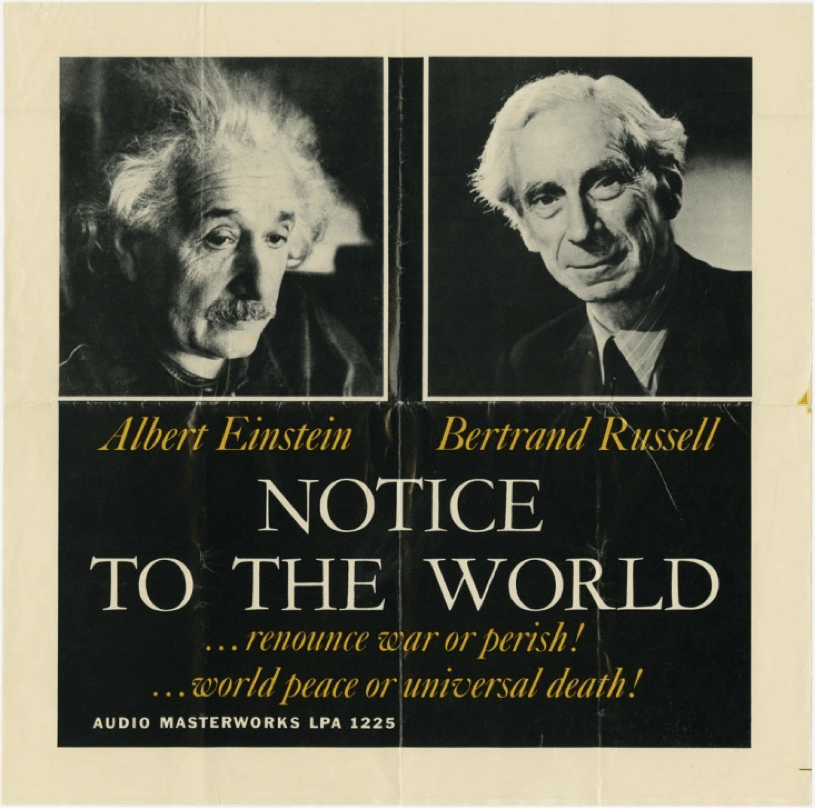
The Russell-Einstein Manifesto, issued in 1955, called on world leaders to renounce war. Einstein died shortly after the release of the manifesto, but its salience continues to this day.

Although Albert Einstein is best-known as a theoretical physicist, he also spent much of his life grappling with the problem of war.

In 1914, shortly after he moved to Berlin to serve as director of the Kaiser Wilhelm Institute of Physics, Einstein was horrified by the onset of World War I. “Europe, in her insanity, has started something unbelievable,” he told a friend. “In such times one realizes to what a sad species of animal one belongs.” Writing to the French author Romain Rolland, he wondered whether “centuries of painstaking cultural effort” have “carried us no further than . . . the insanity of nationalism.”

As militarist propaganda swept through Germany, accompanied that fall by a heated patriotic “Manifesto” from 93 prominent German intellectuals, Einstein teamed up with the German pacifist Georg Friedrich Nicolai to draft an antiwar response, the “Manifesto to Europeans.” Condemning “this barbarous war” and the “hostile spirit” of its intellectual apologists, the Einstein-Nicolai statement maintained that “nationalist passions cannot excuse this attitude which is unworthy of what the world has heretofore called culture.”

In the context of the war’s growing destructiveness, Einstein also helped launch and promote a new German antiwar organization, the New Fatherland League, which called for a prompt peace without annexations and the formation of a world government to make future wars impossible. It engaged in petitioning the Reichstag, challenging proposals for territorial gain, and distributing statements by British pacifists. In response, the German government harassed the League and, in 1916, formally suppressed it.

After the World War came to an end, Einstein became one of the Weimar Republic’s most influential pacifists and internationalists. Despite venomous attacks by Germany’s rightwing nationalists, he grew increasingly outspoken. “I believe the world has had enough of war,” he told an American journalist. “Some sort of international agreement must be reached among nations.” Meanwhile, he promoted organized war resistance, denounced military conscription, and, in 1932, drew Sigmund Freud into a famous exchange of letters, later published as Why War.

Although technically a Zionist, Einstein had a rather relaxed view of that term, contending that it meant a respect for Jewish rights around the world. Appalled by Palestinian-Jewish violence in British-ruled Palestine, he pleaded for cooperation between the two constituencies. In 1938, he declared that he would “much rather see reasonable agreement with the Arabs on the basis of living together in peace than the creation of a Jewish state.” He disliked “the idea of a Jewish state with borders, an army, and a measure of temporal power,” plus “the development of a narrow nationalism within our own ranks.”

The most serious challenge to Einstein’s pacifism came with the Nazi takeover of Germany in 1933 and the advent of that nation’s imperialist juggernaut. “My views have not changed,” he told a French pacifist, “but the European situation has.” As long as “Germany persists in rearming and systematically indoctrinating its citizens in preparation for a war of revenge, the nations of Western Europe depend, unfortunately, on military defense.” In his heart, he said, he continued to “loathe violence and militarism as much as ever; but I cannot shut my eyes to realities.” Consequently, Einstein became a proponent of collective security against fascism.

Fleeing from Nazi Germany, Einstein took refuge in the United States, which became his new home. Thanks to his renown, he was approached in 1939 by one of his former physics students, Leo Szilard, a Hungarian refugee who brought ominous news about advances in nuclear fission research in Nazi Germany. At Szilard’s urging, Einstein sent a warning letter to President Franklin Roosevelt about German nuclear progress. In response, the U.S. government launched the Manhattan Project, a secret program to build an atomic bomb.

Einstein, like Szilard, considered the Manhattan Project necessary solely to prevent Nazi Germany’s employment of nuclear weapons to conquer the world. Therefore, when Germany’s war effort neared collapse and the U.S. bomb project neared completion, Einstein helped facilitate a mission by Szilard to Roosevelt with the goal of preventing the use of atomic bombs by the United States. He also fired off an impassioned appeal to the prominent Danish physicist, Niels Bohr, urging scientists to take the lead in heading off a dangerous postwar nuclear arms race.

Neither venture proved successful, and the U.S. government, under the direction of the new president, Harry Truman, launched the nuclear age with the atomic bombing of Japan. Einstein later remarked that his 1939 letter to Roosevelt had been the worst mistake of his life.

Convinced that humanity now faced the prospect of utter annihilation, Einstein resurrected one of his earlier ideas and organized a new campaign against war. “The only salvation for civilization and the human race,” he told an interviewer in September 1945, “lies in the creation of a world government, with security of nations founded upon law.” Again and again, he reiterated this message. In January 1946, he declared: “As long as there exist sovereign states, each with its own, independent armaments, the prevention of war becomes a virtual impossibility.” Consequently, humanity’s “desire for peace can be realized only by the creation of a world government.”

In 1946, he and other prominent scientists, fearful of the world’s future, established the Emergency Committee of Atomic Scientists. As chair of the new venture, Einstein repeatedly assailed militarism, nuclear weapons, and runaway nationalism. “We shall require a substantially new manner of thinking,” he said, “if mankind is to survive.”

Until his death in 1955, Einstein continued his quest for peace, criticizing the Cold War and the nuclear arms race and calling for strengthened global governance as the only “way out of the impasse.”

Today, as we face a violent, nuclear-armed world, Einstein’s warnings about unrestrained nationalism and his proposals to control it are increasingly relevant.

Lawrence S. Wittner is Professor of History Emeritus at SUNY/Albany and the author of Confronting the Bomb (Stanford University Press).

Albert Schweitzer: Respect for Life Against Nuclear Death

In Africa, Being a World Citizen, Conflict Resolution, Human Rights, Nonviolence, Nuclear weapons, Peacebuilding, The Search for Peace, World Law on September 8, 2025 at 7:00 PM

By René Wadlow

Civilization is made up of four ideals: the ideal of the individual; the ideal of social and political organization; the ideal of spiritual and religious organization; the ideal of humanity as a whole. On the basis of these four ideals, thought tries conclusions with progress.

Albert Schweitzer, The Philosophy of Civilization

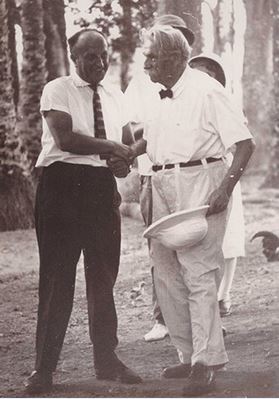
Albert Schweitzer was concerned with the ways that these four ideals of civilization are developed into a harmonious whole. Late in his life, when I knew him in the early 1960s, he was most concerned with the ideal of humanity as a whole.

He had come out strongly against nuclear weapons, weapons which were the opposite of respect for life which was the foundation of his ethical values. (1) “Man can hardly recognize the devils of his creation. Let me give you a definition of ethics. It is good to maintain and further life. It is bad to damage and destroy life. By having reverence for life, we enter into a spiritual relation with the world. By practicing respect for life, we become of the human family and our good, deep and alive.”

For Schweitzer, our sense of unity of the human family and our obligation to future generations was threatened as never before in the two World Wars that he had seen. I had been active since the mid-1950s in efforts to ban testing of nuclear weapons in the atmosphere – a focus of anti-nuclear efforts at the time. I had also worked with the world citizen Norman Cousins who had visited Lambaréné and had written a lively book on his exchanges with Schweitzer. (2) Thus I was well received by Schweitzer at his hospital in Lambaréné; and we had useful discussions. I was working for the Ministry of Education at the time and was at the Protestant Secondary School which was a mile down the Ogowe River from the hospital.

René Wadlow and Albert Schweitzer (C) René Wadlow (personal archives)

It was Norman Cousins, active in disarmament efforts in the USA, who urged Schweitzer to speak out against nuclear weapons. Schweitzer had been awarded the Nobel Peace Prize for his humanitarian efforts in Africa. Thus, he came into ever greater contact with people working for peace. However, he was reluctant to make statements on issues on which he was not expert. As he said to Cousins, “All my life, I have carefully stayed away from making pronouncements on public matters. Groups would come to me for statements or I would be asked to sign joint letters or the press would ask me for my views on certain political questions. And always I would feel forced to say no.” However, he went on “The world needs a system of enforceable law to prevent aggression and deal with the threats to the peace, but the important thing to do is to make a start somewhere…I think maybe the place to take hold is with the matter of nuclear testing…If a ban on nuclear testing can be put into effect then perhaps the stage can be set for other and broader measures related to peace.

Schweitzer’s 1958 appeal Peace or Atomic War was an important contribution to the growing protests against nuclear testing and their fallout of radiation. On October 16, 1963, the Treaty Banning Nuclear Weapons Tests in the Atmosphere, in Outer Space and Under Water (more commonly called the Partial Test Ban) came into force.

Today, we still need those other and broader measures related to peace and for a constant affirmation of respect for life.

Prof. René Wadlow is President of the Association of World Citizens.

Notes

1) See Albert Schweitzer, Peace or Atomic War (New York: Henry Holt, 1958)

2) See Norman Cousins, Dr Schweitzer of Lambaréné (New York: Harper and Brothers, 1960)

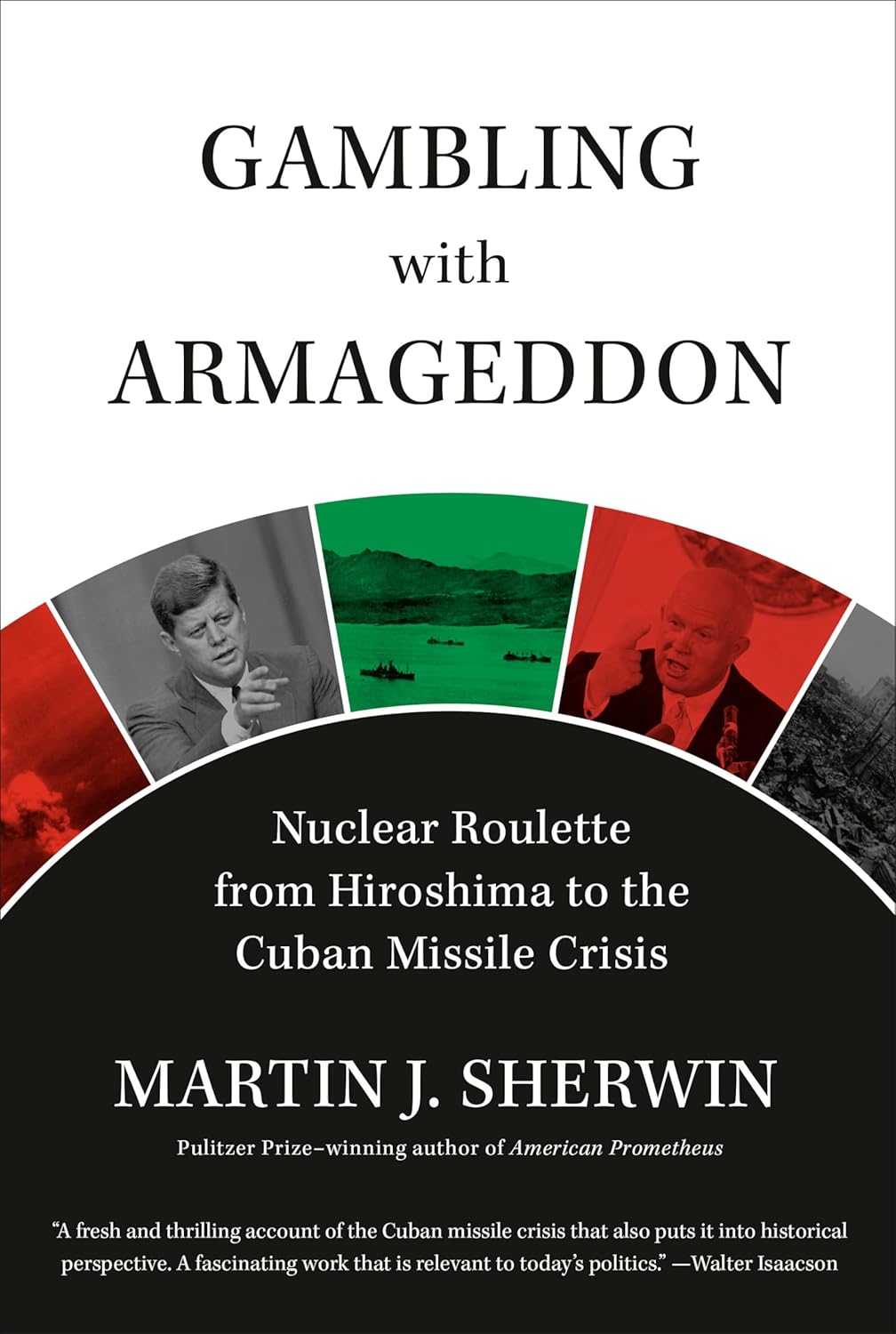
BOOK REVIEW: Martin J. Sherwin, “Gambling with Armageddon: Nuclear Roulette from Hiroshima to the Cuban Missile Crisis”

In Being a World Citizen, Book Review, Conflict Resolution, Nuclear weapons, Peacebuilding, Solidarity, The Search for Peace on August 5, 2025 at 7:00 AM

By Lawrence Wittner

Martin J. Sherwin, Gambling with Armageddon: Nuclear Roulette from Hiroshima to the Cuban Missile Crisis.

New York: Vintage Books, 2020.

The development and the deployment of nuclear weapons are usually based on the assumption that they enhance national security. But, in fact, as this powerful study of nuclear policy convincingly demonstrates, nuclear weapons move nations toward the brink of destruction.

The basis for this conclusion is the post-World War II nuclear arms race and, especially, the Cuban missile crisis of October 1962. At the height of the crisis, top officials from the governments of the United States and the Soviet Union narrowly avoided annihilating a substantial portion of the human race by what former U.S. Secretary of State Dean Acheson, an important participant in the events, called “plain dumb luck.”

The author of this cautionary account, Martin Sherwin, who died shortly after its publication, was certainly well-qualified to tell this chilling story. A professor of history at George Mason University, Sherwin was the author of the influential A World Destroyed: Hiroshima and Its Legacies and the co-author, with Kai Bird, of American Prometheus: The Triumph and Tragedy of J. Robert Oppenheimer, which, in 2006, won the Pulitzer Prize for biography. Perhaps the key factor in generating these three scholarly works was Sherwin’s service as a U.S. Navy junior intelligence officer who was ordered to present top secret war plans to his commander during the Cuban missile crisis.

In Gambling with Armageddon, Sherwin shows deftly how nuclear weapons gradually became a key part of international relations. Although Harry Truman favored some limitations on the integration of these weapons into U.S. national security strategy, his successor, Dwight Eisenhower, significantly expanded their role. According to the Eisenhower administration’s NSC 162/2, the U.S. government would henceforth “consider nuclear weapons as available for use as other munitions.” At Eisenhower’s direction, Sherwin notes, “nuclear weapons were no longer an element of American military power; they were its primary instrument.”

Sherwin adds that, although the major purpose of the new U.S. “massive retaliation” strategy “was to frighten Soviet leaders and stymie their ambitions,” its “principal result . . . was to establish a blueprint for Nikita Khrushchev to create his own ‘nuclear brinkmanship.’” John F. Kennedy’s early approach to U.S. national security policy – supplementing U.S. nuclear superiority with additional conventional military forces and sponsoring a CIA-directed invasion of Cuba – merely bolstered Khrushchev’s determination to contest U.S. power in world affairs. Consequently, resumption of Soviet nuclear weapons testing and a Soviet-American crisis over Berlin followed.

Indeed, dismayed by U.S. nuclear superiority and feeling disrespected by the U.S. government, Khrushchev decided to secretly deploy medium- and intermediate-range ballistic nuclear missiles in Cuba. As Sherwin observes, the Soviet leader sought thereby “to protect Cuba, to even the balance of nuclear weapons and nuclear fear, and to reinforce his leverage to resolve the West Berlin problem.” Assuming that the missiles would not be noticed until their deployment was completed, Khrushchev thought that the Kennedy administration, faced with a fait accompli, would have no choice but to accept them. Khrushchev was certainly not expecting a nuclear war.

But that is what nearly occurred. In the aftermath of the U.S. government’s discovery of the missile deployment in Cuba, the Joint Chiefs of Staff demanded the bombing and invasion of the island and were supported by most members of ExComm, an ad hoc group of Kennedy’s top advisors during the crisis. At the time, they did not realize that the Soviet government had already succeeded in delivering 164 nuclear warheads to Cuba and, therefore, that a substantial number of the ballistic missiles on the island were already operational. Also, the 42,000 Soviet troops in Cuba were armed with tactical nuclear weapons and had been given authorization to use them to repel an invasion. As Fidel Castro later remarked: “It goes without saying that in the event of an invasion, we would have had nuclear war.”

Initially, among all of Kennedy’s advisors, only Adlai Stevenson, the U.S. ambassador to the United Nations, suggested employing a political means – rather than a military one – to secure the removal of the missiles. Although Kennedy personally disliked Stevenson, he recognized the wisdom of his UN ambassador’s approach and gradually began to adopt his ideas. “The question really is,” the president told his hawkish advisors, “what action we take which lessens the chance of a nuclear exchange, which obviously is the final failure.” Therefore, Kennedy tempered his initial impulse to order rapid military action and, instead, adopted a plan for a naval blockade (“quarantine”) of Cuba, thereby halting the arrival of additional Soviet missiles and creating time for negotiations with Khrushchev for removal of the missiles already deployed.

U.S. military leaders, among other ostensible “wise men,” were appalled by what they considered the weakness of the blockade plan, though partially appeased by Kennedy’s assurances that, if it failed to secure the desired results within a seven-day period, a massive U.S. military attack on the island would follow. Indeed, as Sherwin reveals, at the beginning of October, before the discovery of the missiles, the U.S. Joint Chiefs of Staff were already planning for an invasion of Cuba and looking for an excuse to justify it.

Even though Khrushchev, like Kennedy, regarded the blockade as a useful opportunity to negotiate key issues, they quickly lost control of the volatile situation.

For example, U.S. military officers took the U.S.-Soviet confrontation to new heights. Acting on his own initiative, General Thomas Power, the head of the U.S. Strategic Air Command, advanced its nuclear forces to DEFCON 2, just one step short of nuclear war – the only occasion when that level of nuclear alert was ever instituted. He also broadcast the U.S. alert level “in the clear,” ensuring that the Russians would intercept it. They did, and promptly raised their nuclear alert level to the same status.

In addition, few participants in the crisis seemed to know exactly what should be done if a Soviet ship did not respect the U.S. blockade of Cuba. Should the U.S. Navy demand to board it? Fire upon it? Furthermore, at Castro’s orders, a Soviet surface-to-air battery in Cuba shot down an American U-2 surveillance flight, killing the pilot. Khrushchev was apoplectic at the provocative action, while the Kennedy administration faced the quandary of how to respond to it.

A particularly dangerous incident occurred in the Sargasso Sea, near Cuba. To bolster the Soviet defense of Cuba, four Soviet submarines, each armed with a torpedo housing a 15-kiloton nuclear warhead, had been dispatched to the island. After a long, harrowing trip through unusually stormy seas, these vessels were badly battered when they arrived off Cuba. Cut off from communication with Moscow, their crews had no idea whether the United States and the Soviet Union were already at war.

All they did know was that a fleet of U.S. naval warships and warplanes was apparently attacking one of the stricken Soviet submarines, using the unorthodox (and unauthorized) tactic of forcing it to surface by flinging hand grenades into its vicinity. One of the Soviet crew members recalled that “it felt like you were sitting in a metal barrel while somebody is constantly blasting with a sledgehammer.” Given the depletion of the submarine’s batteries and the tropical waters, temperatures ranged in the submarine between 113 and 149 degrees Fahrenheit. The air was foul, fresh water was in short supply, and crew members were reportedly “dropping like dominoes.” Unhinged by the insufferable conditions below deck and convinced that his submarine was under attack, the vessel’s captain ordered his weapons officer to assemble the nuclear torpedo for action. “We’re gonna blast them now!” he screamed. We will die, but we will sink them all―we will not become the shame of the fleet.”

At this point, though, Captain Vasily Arkhipov, a young Soviet brigade chief of staff who had been randomly assigned to the submarine, intervened. Calming the distraught captain, he eventually convinced him that the apparent military attack, plus subsequent machine gun fire from U.S. Navy aircraft, probably constituted no more than a demand to surface. And so they did. Arkhipov’s action, Sherwin notes, saved not only the lives of the submarine crew, “but also the lives of thousands of U.S. sailors and millions of innocent civilians who would have been killed in the nuclear exchanges that certainly would have followed from the destruction” that the “nuclear torpedo would have wreaked upon those U.S. Navy vessels.”

Meanwhile, recognizing that the situation was fast slipping out of their hands, Kennedy and Khrushchev did some tense but serious bargaining. Ultimately, they agreed that Khrushchev would remove the missiles, while Kennedy would issue a public pledge not to invade Cuba. Moreover, Kennedy would remove U.S. nuclear missiles from Turkey – reciprocal action that made sense to both men, although, for political reasons, Kennedy insisted on keeping the missile swap a secret. Thus, the missile crisis ended with a diplomatic solution.

Ironically, continued secrecy about the Cuba-Turkey missile swap, combined with illusions of smooth Kennedy administration calibrations of power spun by ExComm participants and the mass communications media, led to a long-term, comforting, and triumphalist picture of the missile crisis. Consequently, most Americans ended up with the impression that Kennedy stood firm in his demands, while Khrushchev “blinked.” It was a hawkish “lesson” – and a false one. As Sherwin points out, “the real lesson of the Cuban missile crisis . . . is that nuclear armaments create the perils they are deployed to prevent, but are of little use in resolving them.”

Although numerous books have been written about the Cuban missile crisis, Gambling with Armageddon ranks as the best of them. Factually detailed, clearly and dramatically written, and grounded in massive research, it is a work of enormous power and erudition. As such, it represents an outstanding achievement by one of the pre-eminent U.S. historians.

Like Sherwin’s other works, Gambling with Armageddon also grapples with one of the world’s major problems: the prospect of nuclear annihilation. At the least, it reveals that, while nuclear weapons exist, the world remains in peril. On a deeper level, it suggests the need to move beyond considerations of national security to international security, including the abolition of nuclear weapons and the peaceful resolution of conflict among nations.

Securing these goals might necessitate a long journey, but Sherwin’s writings remind us that, to safeguard human survival, there’s really no alternative to pressing forward with it.

Lawrence Wittner (http://lawrenceswittner.com) is Professor of History Emeritus at SUNY/Albany.

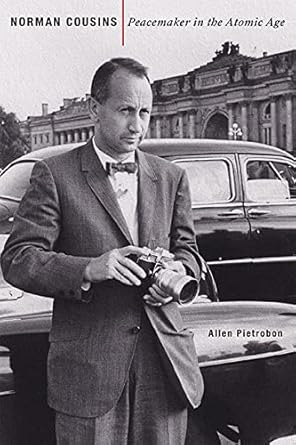
BOOK REVIEW: Allen Pietrobon, “Norman Cousins: Peacemaker in the Atomic Age”

In Being a World Citizen, Book Review, Conflict Resolution, Nuclear weapons, Peacebuilding, Solidarity, The Search for Peace, World Law on July 31, 2025 at 7:00 AM

By Lawrence Wittner

Allen Pietrobon, Norman Cousins: Peacemaker in the Atomic Age.

Baltimore: Johns Hopkins University Press, 2022

Although Norman Cousins was a major figure in U.S. and world affairs during his lifetime (1915-1990), this is the first book-length biography of that extraordinary individual.

The book, written by Allen Pietrobon, an Assistant Professor of Global Affairs at Trinity Washington University, argues that, unlike many peace activists during the Cold War, Cousins had “an enormous impact on domestic politics and international relations.” The key to this impact, Pietrobon observes, was Cousins’s role, for 35 years, as editor of the Saturday Review, which he built into the third most popular public affairs magazine in the United States, with a circulation of 650,000. This role enabled him to have a significant impact upon public opinion and, also, to build up a network of connections with prominent individuals, including Adlai Stevenson, Nikita Khrushchev, Pope John XXIII, Albert Schweitzer, Norman Thomas, Jawaharlal Nehru, John F. Kennedy, Martin Luther King, Jr., and many more.

According to Pietrobon, the atomic bombing of Japan set the course for Cousins’s peace advocacy. That bombing, Cousins wrote in Modern Man Is Obsolete, “marked the violent death of one stage in man’s history and the beginning of another.” It meant that war, which had persisted throughout human history, finally had to be ended, for, given the advent of nuclear weapons, the alternative was global suicide. And war could only be ended, Cousins maintained, by establishing a world government.

Naturally, then, Cousins, gravitated toward aiding victims of the atomic bombing, promoting world federalism (for example, leading United World Federalists and, later, the World Federalist Association), founding and co-chairing the National Committee for a Sane Nuclear Policy (SANE), brokering the Partial Test Ban Treaty of 1963, and improving East-West relations. In addition, he sought to end the wars in Vietnam and Biafra and, from 1948 to 1964, gave an estimated 2,100 speeches for peace. He also worked to assist victims of Nazi “medical experiments,” prepared speeches for U.S. presidential candidates and presidents, and from 1940 to 1964 alone, published just under 600 editorials and wrote or edited ten books.

In compiling this excellent account of Cousins’ busy and productive life, Pietrobon has drawn upon Cousins’s lengthy correspondence (located at UCLA), his extensive published writings, interviews with his daughters, and relevant manuscript materials at U.S. presidential libraries, the German Federal Archives, and Princeton University.

Although Pietrobon has done an outstanding job of pulling together many facets of Cousins’s extraordinary career and grounding them in the relevant sources, some areas would have benefited from further exploration. For example, Cousins was probably the most important figure in the history of SANE and of the U.S. branch of the world federalist movement. And yet his role in many of SANE’s internal operations―including its ordeal over the role of Communists in its ranks―is not examined. Nor, for that matter, is his presidency of the World Federalist Association from 1976 to 1990.

Overall, though, readers will learn much from this fine study of one of the most prominent figures in the 20th century peace movement.

Lawrence Wittner (http://lawrenceswittner.com) is Professor of History Emeritus at SUNY/Albany.

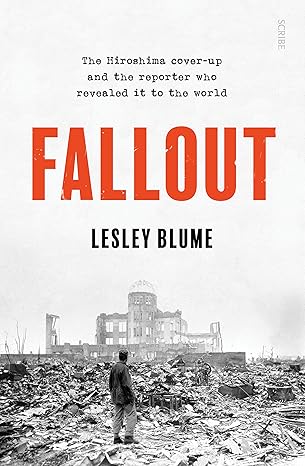
BOOK REVIEW: Lesley M. M. Blume, “Fallout: The Hiroshima Cover-up and the Reporter Who Revealed It to the World”

In Being a World Citizen, Book Review, Conflict Resolution, Nonviolence, Nuclear weapons, Peacebuilding, Solidarity, The Search for Peace, World Law on July 29, 2025 at 4:00 PM

By Lawrence Wittner

Lesley M. M. Blume, Fallout: The Hiroshima Cover-up and the Reporter Who Revealed It to the World.

New York: Simon & Schuster, 2020

In this crisply-written, well-researched book, Lesley Blume, a journalist and biographer, tells the fascinating story of the background to John Hersey’s pathbreaking article, “Hiroshima,” and of its extraordinary impact upon the world.

In 1945, although only 30 years of age, Hersey was a very prominent war correspondent for Time magazine—a key part of publisher Henry Luce’s magazine empire—and living in the fast lane. That year, he won the Pulitzer Prize for his novel, A Bell for Adano, which had already been adapted into a movie and a Broadway play. Born the son of missionaries in China, Hersey had been educated at upper class, elite institutions, including the Hotchkiss School, Yale, and Cambridge. During the war, Hersey’s wife, Frances Ann, a former lover of young Lieutenant John F. Kennedy, arranged for the three of them to get together over dinner. Kennedy impressed Hersey with the story of how he saved his surviving crew members after a Japanese destroyer rammed his boat, PT-109. This led to a dramatic article by Hersey on the subject—one rejected by the Luce publications but published by the New Yorker. The article launched Kennedy on his political career and, as it turned out, provided Hersey with the bridge to a new employer – the one that sent him on his historic mission to Japan.

Blume reveals that, at the time of the U.S. atomic bombing of Hiroshima, Hersey felt a sense of despair—not for the bombing’s victims, but for the future of the world. He was even more disturbed by the atomic bombing of Nagasaki only three days later, which he considered a “totally criminal” action that led to tens of thousands of unnecessary deaths.

Most Americans at the time did not share Hersey’s misgivings about the atomic bombings. A Gallup poll taken on August 8, 1945 found that 85 percent of American respondents expressed their support for “using the new atomic bomb on Japanese cities.”

Blume shows very well how this approval of the atomic bombing was enhanced by U.S. government officials and the very compliant mass communications media. Working together, they celebrated the power of the new American weapon that, supposedly, had brought the war to an end, by producing articles lauding the bombing mission and pictures of destroyed buildings. What was omitted was the human devastation, the horror of what the atomic bombing had done physically and psychologically to an almost entirely civilian population—the flesh roasted off bodies, the eyeballs melting, the terrible desperation of mothers digging with their hands through the charred rubble for their dying children.

The strange new radiation sickness produced by the bombing was either denied or explained away as of no consequence. “Japanese reports of death from radioactive effects of atomic bombing are pure propaganda,” General Leslie Groves, the head of the Manhattan Project, told the New York Times. Later, when, it was no longer possible to deny the existence of radiation sickness, Groves told a Congressional committee that it was actually “a very pleasant way to die.”

When it came to handling the communications media, U.S. government officials had some powerful tools at their disposal. In Japan, General Douglas MacArthur, the supreme commander of the U.S. occupation regime, saw to it that strict U.S. military censorship was imposed on the Japanese press and other forms of publication, which were banned from discussing the atomic bombing. As for foreign newspaper correspondents (including Americans), they needed permission from the occupation authorities to enter Japan, to travel within Japan, to remain in Japan, and even to obtain food in Japan. American journalists were taken on carefully controlled junkets to Hiroshima, after which they were told to downplay any unpleasant details of what they had seen there.

In September 1945, U.S. newspaper and magazine editors received a letter from the U.S. War Department, on behalf of President Harry Truman, asking them to restrict information in their publications about the atomic bomb. If they planned to do any publishing in this area of concern, they were to submit the articles to the War Department for review.

Among the recipients of this warning were Harold Ross, the founder and editor of the New Yorker, and William Shawn, the deputy editor of that publication. The New Yorker, originally founded as a humor magazine, was designed by Ross to cater to urban sophisticates and covered the world of nightclubs and chorus girls. But, with the advent of the Second World War, Ross decided to scrap the hijinks flavor of the magazine and begin to publish some serious journalism.

As a result, Hersey began to gravitate into the New Yorker’s orbit. Hersey was frustrated with his job at Time magazine, which either rarely printed his articles or rewrote them atrociously. At one point, he angrily told publisher Henry Luce that there was as much truthful reporting in Time magazine as in Pravda. In July 1945, Hersey finally quit his job with Time. Then, late that fall, he sat down with William Shawn of the New Yorker to discuss some ideas he had for articles, one of them about Hiroshima.

Hersey had concluded that the mass media had missed the real story of the Hiroshima bombing. And the result was that the American people were becoming accustomed to the idea of a nuclear future, with the atomic bomb as an acceptable weapon of war. Appalled by what he had seen in the Second World War—from the firebombing of cities to the Nazi concentration camps—Hersey was horrified by what he called “the depravity of man,” which, he felt, rested upon the dehumanization of others. Against this backdrop, Hersey and Shawn concluded that he should try to enter Japan and report on what had really happened there.

Getting into Japan would not be easy. The U.S. Occupation authorities exercised near-total control over who could enter the stricken nation, keeping close tabs on all journalists who applied to do so, including records on their whereabouts, their political views, and their attitudes toward the occupation. Nearly every day, General MacArthur received briefings about the current press corps, with summaries of their articles. Furthermore, once admitted, journalists needed permission to travel anywhere within the country, and were allotted only limited time for these forays.

Even so, Hersey had a number of things going for him. During the war, he was a very patriotic reporter. He had written glowing profiles about rank-and-file U.S. soldiers, as well as a book (Men on Bataan) that provided a flattering portrait of General MacArthur. This fact certainly served Hersey well, for the general was a consummate egotist. Apparently as a consequence, Hersey received authorization to visit Japan.

En route there in the spring of 1946, Hersey spent some time in China, where, on board a U.S. warship, he came down with the flu. While convalescing, he read Thornton Wilder’s Pulitzer Prize-winning novel, The Bridge of San Luis Rey, which tracked the different lives of five people in Peru who were killed when a bridge upon which they stood collapsed. Hersey and Shawn had already decided that he should tell the story of the Hiroshima bombing from the victims’ point of view. But Hersey now realized that Wilder’s book had given him a particularly poignant, engrossing way of telling a complicated story. Practically everyone could identify with a group of regular people going about their daily routines as catastrophe suddenly struck them.

Hersey arrived in Tokyo on May 24, 1946, and two days later, received permission to travel to Hiroshima, with his time in that city limited to 14 days.

Entering Hiroshima, Hersey was stunned by the damage he saw. In Blume’s words, there were “miles of jagged misery and three-dimensional evidence that humans—after centuries of contriving increasingly efficient ways to exterminate masses of other humans—had finally invented the means with which to decimate their entire civilization.” Now there existed what one reporter called “teeming jungles of dwelling places . . . in a welter of ashes and rubble.” As residents attempted to clear the ground to build new homes, they uncovered masses of bodies and severed limbs. A cleanup campaign in one district of the city alone at about that time unearthed a thousand corpses. Meanwhile, the city’s surviving population was starving, with constant new deaths from burns, other dreadful wounds, and radiation poisoning.

Given the time limitations of his permit, Hersey had to work fast. And he did, interviewing dozens of survivors, although he eventually narrowed down his cast of characters to six of them.

Departing from Hiroshima’s nightmare of destruction, Hersey returned to the United States to prepare the story that was to run in the New Yorker to commemorate the atomic bombing. He decided that the article would have to read like a novel. “Journalism allows its readers to witness history,” he later remarked. “Fiction gives readers the opportunity to live it.” His goal was “to have the reader enter into the characters, become the characters, and suffer with them.”

When Hersey produced a sprawling 30,000 word draft, the New Yorker’s editors at first planned to publish it in serialized form. But Shawn decided that running it this way wouldn’t do, for the story would lose its pace and impact. Rather than have Hersey reduce the article to a short report, Shawn had a daring idea. Why not run the entire article in one issue of the magazine, with everything else—the “Talk of the Town” pieces, the fiction, the other articles and profiles, and the urbane cartoons—banished from the issue?

Ross, Shawn, and Hersey now sequestered themselves in a small room at the New Yorker’s headquarters, furiously editing Hersey’s massive article. Ross and Shawn decided to keep the explosive forthcoming issue a top secret from the magazine’s staff. Indeed, the staff were kept busy working on a “dummy” issue that they thought would be going to press. Contributors to that issue were baffled when they didn’t receive proofs for their articles and accompanying artwork. Nor were the New Yorker’s advertisers told what was about to happen. As Blume remarks: “The makers of Chesterfield cigarettes, Perma-Lift brassieres, Lux toilet soap, and Old Overholt rye whiskey would just have to find out along with everyone else in the world that their ads would be run alongside Hersey’s grisly story of nuclear apocalypse.”

However, things don’t always proceed as smoothly as planned. On August 1, 1946, President Truman signed into law the Atomic Energy Act, which established a “restricted” standard for “all data concerning the manufacture or utilization of atomic weapons.” Anyone who disseminated that data “with any reason to believe that such data” could be used to harm the United States could face substantial fines and imprisonment. Furthermore, if it could be proved that the individual was attempting to “injure the United States,” he or she could “be punished by death or imprisonment for life.”

In these new circumstances, what should Ross, Shawn, and Hersey do? They could kill the story, water it down, or run it and risk severe legal action against them. After agonizing over their options, they decided to submit Hersey’s article to the War Department—and, specifically, to General Groves—for clearance.

Why did they take that approach? Blume speculates that the New Yorker team thought that Groves might insist upon removing any technical information from the article while leaving the account of the sufferings of the Japanese intact. After all, Groves believed that the Japanese deserved what had happened to them, and could not imagine that other Americans might disagree. Furthermore, the article, by underscoring the effectiveness of the atomic bombing of Japan, bolstered his case that the war had come to an end because of his weapon. Finally, Groves was keenly committed to maintaining U.S. nuclear supremacy in the world, and he believed that an article that led Americans to fear nuclear attacks by other nations would foster support for a U.S. nuclear buildup.

The gamble paid off. Although Groves did demand changes, these were minor and did not affect the accounts by the survivors.

On August 29, 1946, copies of the “Hiroshima” edition of the New Yorker arrived on newsstands and in mailboxes across the United States, and it quickly created an enormous sensation, particularly in the mass media. Editors from more than thirty states applied to excerpt portions of the article, and newspapers from across the nation ran front-page banner stories and urgent editorials about its revelations. Correspondence from every region of the United States poured into the New Yorker’s office. A large number of readers expressed pity for the victims of the bombing. But an even greater number expressed deep fear about what the advent of nuclear war meant for the survival of the human race.

Of course, not all readers approved of Hersey’s report on the atomic bombing. Some reacted by canceling their subscriptions to the New Yorker. Others assailed the article as antipatriotic, Communist propaganda, designed to undermine the United States. Still others dismissed it as pro-Japanese propaganda or, as one reader remarked, written “in very bad taste.”

Some newspapers denounced it. The New York Daily News derided it as a stunt and “propaganda aimed at persuading us to stop making atom bombs . . . and to give our technical bomb secrets away . . . to Russia.” Not surprisingly, Henry Luce was infuriated that his former star journalist had achieved such an enormous success writing for a rival publication, and had Hersey’s portrait removed from Time Inc.’s gallery of honor.

Despite the criticism, “Hiroshima” continued to attract enormous attention in the mass media. The ABC Radio Network did a reading of the lengthy article over four nights, with no acting, no music, no special effects, and no commercials. “This chronicle of suffering and destruction,” it announced, was being “broadcast as a warning that what happened to the people of Hiroshima could next happen anywhere.” After the broadcasts, the network’s telephone switchboards were swamped by callers, and the program was judged to have received the highest rating of any public interest broadcast that had ever occurred. The BBC also broadcast an adaptation of “Hiroshima,” while some 500 U.S. radio stations reported on the article in the days following its release.

In the United States, the Alfred Knopf publishing house came out with the article in book form, which was quickly promoted by the Book-of-the-Month Club as “destined to be the most widely read book of our generation.” Ultimately, Hiroshima sold millions of copies in nations around the world. By the late fall of 1946, the rather modest and retiring Hersey, who had gone into hiding after the article’s publication to avoid interviews, was rated as one of the “Ten Outstanding Celebrities of 1946,” along with General Dwight Eisenhower and singer Bing Crosby.

For U.S. government officials, reasonably content with past public support for the atomic bombing and a nuclear-armed future, Hersey’s success in reaching the public with his disturbing account of nuclear war confronted them with a genuine challenge. For the most part, U.S. officials recognized that they had what Blume calls “a serious post-`Hiroshima’ image problem.”

Behind the scenes, James B. Conant, the top scientist in the Manhattan Project, joined President Truman in badgering Henry Stimson, the former U.S. Secretary of War, to produce a defense of the atomic bombing. Provided with an advance copy of the article, to be published in Harper’s, Conant told Stimson that it was just what was needed, for they could not have allowed “the propaganda against the use of the atomic bomb . . . to go unchecked.”

Although the New Yorker’s editors sought to arrange for publication of the book version of “Hiroshima” in the Soviet Union, this proved impossible. Instead, Soviet authorities banned the book in their nation. Pravda fiercely assailed Hersey, claiming that “Hiroshima” was nothing more than an American scare tactic, a fiction that “relishes the torments of six people after the explosion of the atomic bomb.” Another Soviet publication called Hersey an American spy who embodied his country’s militarism and had helped to inflict upon the world a “propaganda of aggression, strongly reminiscent of similar manifestations in Nazi Germany.”

Ironically, the Soviet attack upon Hersey didn’t make him any more acceptable to the U.S. government. In 1950, FBI director J. Edgar Hoover assigned FBI field agents to research, monitor, and interview Hersey, on whom the Bureau had already opened a file. During the FBI interview with Hersey, agents questioned him closely about his trip to Hiroshima.

Not surprisingly, U.S. occupation authorities did their best to ban the appearance of “Hiroshima” in Japan. Hersey’s six protagonists had to wait months before they could finally read the article, which was smuggled to them. In fact, some of Hersey’s characters were not aware that they had been included in the story or that the article had even been written until they received the contraband copies. MacArthur managed to block publication of the book in Japan for years until, after intervention by the Authors’ League of America, he finally relented. It appeared in April 1949, and immediately became a best-seller.

Hersey, still a young man at the time, lived on for decades thereafter, writing numerous books, mostly works of fiction, and teaching at Yale. He continued to be deeply concerned about the fate of a nuclear-armed world—proud of his part in stirring up resistance to nuclear war and, thereby, helping to prevent it.

The conclusion drawn by Blume in this book is much like Hersey’s. As she writes, “Graphically showing what nuclear warfare does to humans, `Hiroshima’ has played a major role in preventing nuclear war since the end of World War II.”

A secondary theme in the book is the role of a free press. Blume observes that “Hersey and his New Yorker editors created `Hiroshima’ in the belief that journalists must hold accountable those in power. They saw a free press as essential to the survival of democracy.” She does, too.

Overall, Blume’s book would provide the basis for a very inspiring movie, for at its core is something many Americans admire: action taken by a few people who triumph against all odds.

But the actual history is somewhat more complicated. Even before the publication of “Hiroshima,” a significant number of people were deeply disturbed by the atomic bombing of Japan. For some, especially pacifists, the bombing was a moral atrocity. An even larger group feared that the advent of nuclear weapons portended the destruction of the world. Traditional pacifist organizations, newly-formed atomic scientist groups, and a rapidly-growing world government movement launched a dramatic antinuclear campaign in the late 1940s around the slogan, “One World or None.” Curiously, this uprising against nuclear weapons is almost entirely absent from Blume’s book.

Even so, Blume has written a very illuminating, interesting, and important work—one that reminds us that daring, committed individuals can help to create a better world.

Lawrence Wittner (http://lawrenceswittner.com) is Professor of History Emeritus at SUNY/Albany.
BOOK REVIEW: Lawrence S. Wittner, “Working for Peace and Justice”

In Being a World Citizen, Book Review, Conflict Resolution, Nonviolence, Nuclear weapons, Peacebuilding, Solidarity, The Search for Peace, United Nations, World Law on July 28, 2025 at 8:15 PM

By René Wadlow

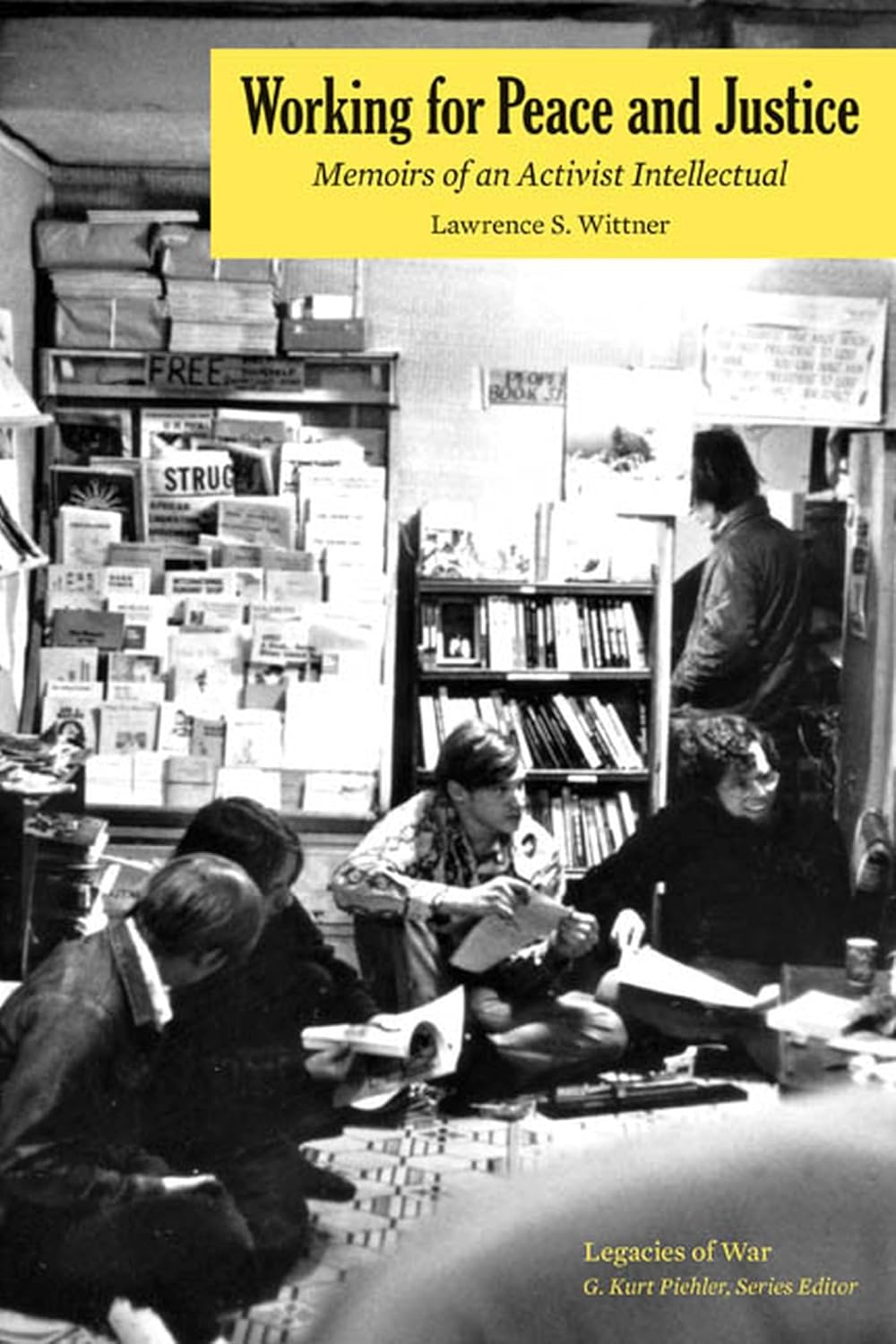
Lawrence S. Wittner, Working for Peace and Justice

Knoxville, TN/University of Tennessee Press, 2012, 268pp.

Laurence Wittner has written a very moving account of his efforts as an activist for peace and social justice. At this present time, when such efforts are very necessary, the memoir is a guideline for concerted efforts, both the joys and the difficulties.

Wittner was largely based at the State University of New York at Albany, which is the administrative capital of New York, home of the governor, although New York City has a much larger population and is a center of economic, cultural, and political power.

In the fall of 2005, his long-time activity in the peace movement combined with his books on anti-nuclear weapons such as Struggle Against the Bomb and Toward Nuclear Abolition, both published by Stanford University Press) led to his election to the national board of Peace Action, the largest, broadly based United States (U.S.) peace organization with some 100,000 members. Thus, he writes on activities at the local level, mostly Albany, as well as at the national level with the factionalism and sectarianism that have often characterized Left movements such as democratic socialism in which Wittner was active.

Yet, as he writes, “Over the course of history, there are heartening indications that people of goodwill and determination have made headway in pulling humanity out of the nightmare of ignorance, superstition, slavery, tyranny, exploitation and militarism that has characterized the past. In my own lifetime I have seen courageous people topple dictatorships, shatter systems of racial oppression, roll back corporate domination, bring an end to unjust wars and avert a nuclear holocaust. And I am confident that efforts to extend human progress will continue.”

Progress requires organizing, persistence, and a sense of community with those with whom one is working. For Wittner, music was an important activist tool; he played the guitar and often performed songs at political meetings.

There is much to be done to create a harmonious world society, and Working for Peace and Justice sets out important paths of action.

Prof. René Wadlow is President of the Association of World Citizens.

India-Pakistan Ceasefire: Negotiations Now Needed

In Asia, Being a World Citizen, Conflict Resolution, Current Events, NGOs, Nonviolence, Nuclear weapons, Peacebuilding, Solidarity, The Search for Peace, Track II, United Nations, World Law on May 13, 2025 at 7:30 AM

By René Wadlow

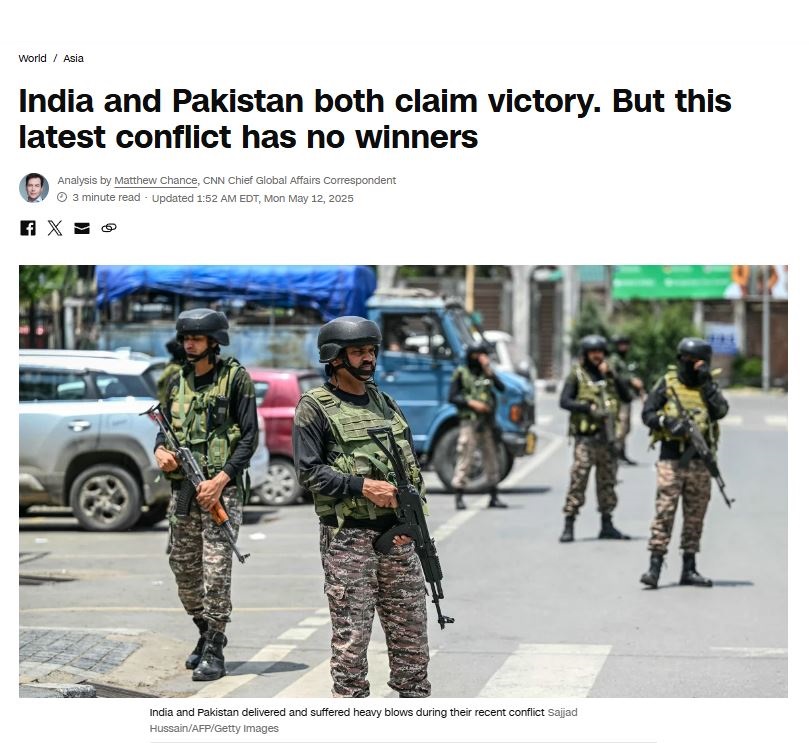
After the April 22 attack and death of 26 Indian tourists at Pahalgam in the Indian-administered area of Kashmir, tensions between India and Pakistan grew quickly. Pakistan was accused by India of backing the terrorists who had carried out the attack – a charge which Pakistan denied. Prime Minister Narendra Modi gave the Indian military “complete operational freedom”. A combination of bellicose rhetoric, domestic pressures, and political agitation led to daily exchanges of armed fire, and the shooting down of Indian jet fighters. The frontiers between the two countries were closed and diplomats withdrawn. The dangers of escalation between the two nuclear-armed countries were obvious to many.

Fortunately, outside voices called for an immediate ceasefire: U.S. President Donald Trump and his Secretary of State Marco Rubio, Antonio Guterres, Secretary-General of the United Nations (UN), and some member governments of the UN Security Council which met in closed session, as well as a good number of Nongovernmental Organizations (NGOs) involved in conflict resolution efforts such as the International Peace Bureau and the Association of World Citizens (AWC). One must now strive so that the ceasefire will hold.

The next step is to facilitate negotiations between the Indian and Pakistani governments. A first step is to create a number of confidence-building measures so that the ceasefire holds. Then there is a need to develop longer-range negotiations. There are a good number of outstanding issues, such as Kashmir, which go back to the founding of the two countries.

It may be that the current steps back from the nuclear brink will drive home the need for serious negotiations. NGOs in both India and Pakistan may help to see on what issues progress may be made. Those of us on the outside must do all we can to facilitate creative dialogue between Indians and Pakistanis.

Prof. René Wadlow is President of the Association of World Citizens.

Nonproliferation of Nuclear Weapons: Need for New Common Security Approaches

In Being a World Citizen, Current Events, Latin America, Middle East & North Africa, NGOs, Nuclear weapons, Spirituality, The former Soviet Union, The Search for Peace, Track II, United Nations, World Law on July 23, 2024 at 6:00 AM

By René Wadlow

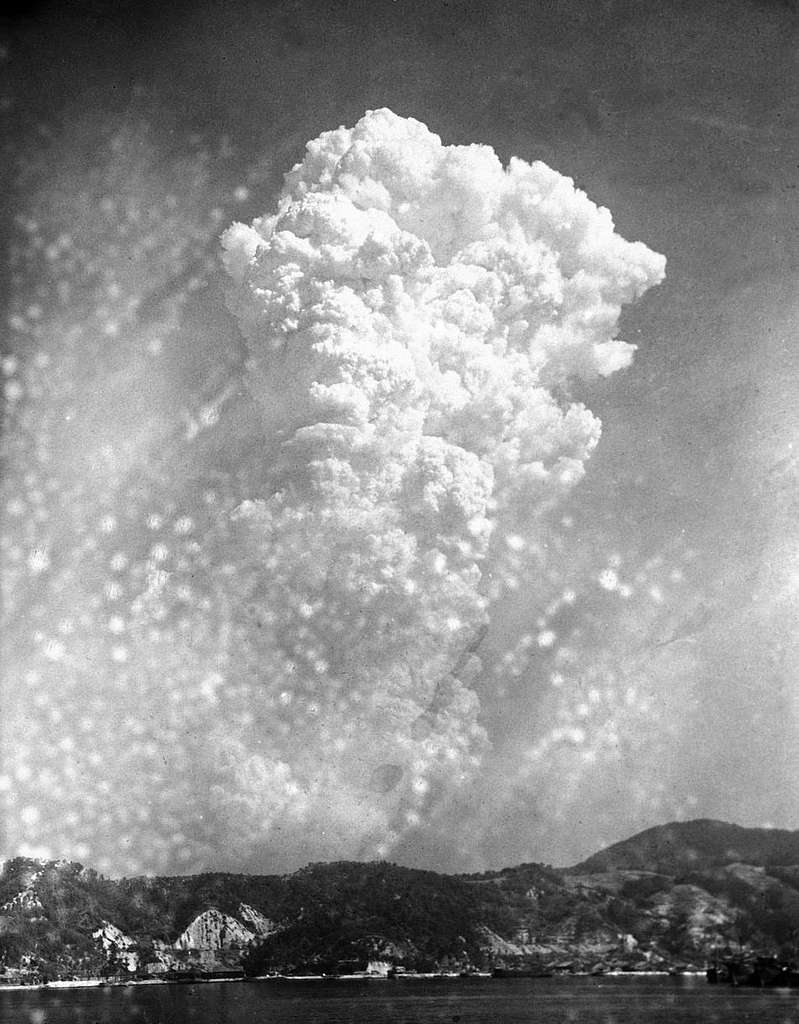
Hiroshima, Japan, August 6, 1945.

Government representatives and some Nongovernmental Organizations (NGOs) are participating from July 22 to August 2, 2024 in Geneva, Switzerland in the Preparatory Session for the Review Conference on the Treaty on the Nonproliferation of Nuclear Weapons. As the political and strategic situation in the world can evolve over time, the Treaty on the Nonproliferation of Nuclear Weapons (NPT) had as one of its provisions (Article VIII) that a review conference be held every five years to judge the situation and to see if new elements should be added. At the end of each Review a “Chairman’s Statement” must be agreed upon by all the States present.

The NPT, which had taken 10 years to negotiate, was proclaimed in 1970, and the first Review Conference was held in Geneva in 1975. As the Review Conference was a meeting of the States Party to the Treaty and not a regular United Nations (UN) disarmament negotiation, NGO representatives had more opportunity for interaction with governments. NGO texts were considered as “official documents” and were printed and distributed by the conference secretariat. I was asked to chair the group of NGO participants, which I did both in 1975 and 1980. As a result of my chairing the NGOs at the 1975 Review, I was invited to Moscow to discuss with Soviet military and arms control specialists. I have remained concerned with the issues ever since.

Each Review Conference has been concerned with the three fundamental aspects of the Treaty: non-proliferation, promotion of the peaceful uses of nuclear energy, and the disarmament initiatives of the five nuclear-weapon States when the Treaty was signed: the USA, USSR, the United Kingdom, France, and China as set out in Article VI.

To make matters more complicated but politically realistic, the policies of nuclear-weapon States which have not signed the NPT – India, Pakistan, Israel, North Korea – color the discussions of each Review. Iran is a State Party to the NPT, but questions have been raised about the effectiveness of the control of the International Atomic Energy Agency (IAEA) on Iran’s peaceful nuclear activities and if nuclear material is being enriched to weapon-production levels.

The nuclear weapons of Israel and their meaning for Middle East policies have long been “an elephant in the room” – too large not to notice but too dangerous to deal with if anything else in the Review process is to be done. In 1995, there was an annex to the final Chairman’s Statement of the Review proposing that a conference on a potential nuclear-weapon-free Middle East should be called. In practice, “the time was never ripe”, but the concept is still there.

The concept of nuclear-weapon-free zones has been an important concept in disarmament and regional conflict-reduction efforts. A nuclear-weapon-free zone was first suggested by the Polish Foreign Minister, Adam Rapacki, at the UN General Assembly in October 1957 – just a year after the crushing of the uprising in Hungary. The crushing of the Hungarian revolt by Soviet troops and the unrest among Polish workers at the same time showed that the East-West equilibrium in Central Europe was unstable with both the Soviet Union and the USA in possession of nuclear weapons, and perhaps a willingness to use them if the political situation became radically unstable. The Rapacki Plan, as it became known, called for the denuclearization of East and West Germany, Czechoslovakia and Poland.

The Plan went through several variants which included its extension to cover reduction of armed forces and armaments, and as a preliminary step, a freeze on nuclear weapons in the area. The Rapacki Plan was opposed by the NATO powers, in part because it recognized the legitimacy of the East German State. It was not until 1970 and the start of what became the 1975 Helsinki Conference on Security and Cooperation in Europe (CSCE) that serious negotiations on troop levels and weapons in Europe began. While the Rapacki Plan never led to negotiations on nuclear-weapon policies in Europe, it had the merit of restarting East-West discussions which were then at a dead point after the Hungarian uprising.

Adam Rapacki

The first nuclear-weapon-free zone to be negotiated – the Treaty of Tlatelolco – was a direct aftermath of the Cuban missile crisis of October 1962. It is hard to know how close to a nuclear exchange between the USA and the USSR the Cuban missile crisis was. It was close enough so that Latin American leaders were moved to action. While Latin America was not an area in which military confrontation was as stark as in Europe, the Cuban missile crisis was a warning that you did not need to have standing armies facing each other for there to be danger.

Mexico, under the leadership of Ambassador Alfonso Garcia-Robles at the UN, began immediately to call for a denuclearization of Latin America. There were a series of conferences, and in February 1067 the Treaty for the Prohibition of Nuclear Weapons in Latin America was signed at Tlatelolco, Mexico. For a major arms control treaty, the Tlatelolco was negotiated in a short time, due partly to the fear inspired by the Cuban missile crisis but especially to the energy and persistence of Garcia-Robles and the expert advice of William Epstein, the UN’s Director of Disarmament Affairs. The Treaty established a permanent and effective system of control which contains a number of novel and pioneering elements as well as a body to supervise the Treaty.

Alfonso Garcia Robles (C) Marcel Antonisse

On September 8, 2006, the five States of Central Asia – Kazakhstan, Kyrgyzstan, Uzbekistan, Tajikistan, and Turkmenistan – signed a treaty establishing a nuclear-weapon-free zone. The treaty aims at reducing the risk of nuclear proliferation and nuclear-armed terrorism. The treaty bans the production, acquisition, deployment of nuclear weapons and their components as well as nuclear explosives. Importantly, the treaty bans the transportation of nuclear weapons as both Russia and the USA have established military airbases in Central Asia where nuclear weapons could have been placed in times of crisis in Asia.

Superman is not coming to rid the world of nuclear weapons. World Citizens need to take the problem to UN delegates by themselves. Or own Quest for Peace deserves a happy ending too.

It is an unfortunate aspect of world politics that constructive, institution-building action is usually undertaken only because of a crisis. Perhaps the growing pressures in the Middle East could lead to concerted leadership for a Middle East nuclear-weapon-free zone. The IAEA has the technical knowledge for putting such a zone in place. Now there needs to be leadership from within the Middle East as well as from the broader international community. There are urgent needs for new common security approaches.

Prof. René Wadlow is President of the Association of World Citizens.