The Official Blog of the

Archive for the ‘Human Development’ Category

World Food Day: A Renewal of Collective Action

In Being a World Citizen, Foundations for the New Humanism, Human Development, Human Rights, International Justice, Social Rights, Solidarity, The Search for Peace, Uncategorized, United Nations, World Law on October 16, 2015 at 8:30 AM

WORLD FOOD DAY: A RENEWAL OF COLLECTIVE ACTION

By René Wadlow


[…] determined to promote the common welfare by furthering separate and collective action for the purpose of raising levels of nutrition and standards of living […]” 

-Preamble of the Food and Agriculture Organization Constitution.


October 16 is the UN-designated World Food Day, the date chosen being the anniversary of the creation of the FAO in 1945 with the aim, as stated in its Constitution of “contributing towards an expanding world economy and ensuring humanity’s freedom from hunger.” Freedom from hunger is not simply a technical matter to be solved with better seeds, fertilizers, cultivation practices and marketing. To achieve freedom from hunger for mankind, there is a need to eliminate poverty. The elimination of poverty must draw upon the ideas, skills and energies of whole societies and requires the cooperation of all countries. 

World Citizens have played an important role in efforts to improve agricultural production worldwide and especially to better the conditions of life of rural workers. Lord Boyd-Orr was the first director of the FAO; Josue de Castro was the independent President of the FAO Council in the 1950s when the FAO had an independent Council President. (The independent presidents have now been replaced by a national diplomat, rotating each year. Governments are never happy with independent experts who are often too independent.) The World Citizen, René Dumont, an agricultural specialist, is largely the “father” of political ecology in France, having been the first Green Party candidate for the French Presidency in 1974.

As Lester Brown, the American agricultural specialist says “We are cutting trees faster than they can be regenerated, overgrazing rangelands and converting them into deserts, overpumping aquifers, and draining rivers dry. On our croplands, soil erosion exceeds new soil formation, slowly depriving the soil of its inherent fertility. We are taking fish from the ocean faster than they can reproduce.”

To counter these trends, we need awareness and vision, an ethical standard which has the preservation of nature at its heart, and the political leadership to bring about the socio-economic changes needed. For the moment, awareness and vision are unequally spread. In some countries, ecological awareness has led to beneficial changes and innovative technologies. In others, the governmental and social structures are disintegrating due to disease, population pressure upon limited resources, and a lack of social leadership. Worldwide, military spending, led by the USA, dwarfs spending on ecologically-sound development and the necessary expansion of education and health services.

World Food Day

Some 795 million people in the world do not have enough food to lead a healthy active life. That’s about one in nine people on earth. (World Food Program)

As Lester Brown has written “The sector of the economy that seems likely to unravel first is food. Eroding soils, deteriorating rangelands, collapsing fisheries, falling water tables, and rising temperatures are converging to make it more difficult to expand food production fast enough to keep up with demand…food is fast becoming a national security issue as growth in the world harvest slows and falling water tables and rising temperatures hint at future shortages.”

Yet there are agricultural techniques which can raise protein efficiency, raise land productivity, improve livestock use and produce second harvests on the same land. However, unless we quickly reverse the damaging trends that we have set in motion, we will see vast numbers of environmental refugees — people abandoning depleted aquifers and exhausted soils and those fleeing advancing deserts and rising seas.

David Seckler of the International Water Management Institute writes “Many of the most populous countries of the world — China, India, Pakistan, Mexico, and nearly all the countries of the Middle East and North Africa — have literally been having a free ride over the past two or three decades by depleting their groundwater resources. The penalty of mismanagement of this valuable resource is now coming due, and it is no exaggeration to say that the results could be catastrophic for these countries, and given their importance, for the world as a whole.” Unfortunately, the International Water Management Institute does not manage the world’s use of water but can only study water use. While there are some planners who would like to be able to tax or make people pay for water, most water use is uncontrolled. Payment for water is a way that governments or private companies have to get more revenue, but the welfare of farmers is usually not a very high priority for them.

Yet as Citizens of the World have stressed, ecologically-sound development cannot be the result only of a plan, but rather of millions of individual actions to protect soil, conserve water, plant trees, use locally grown crops, reduce meat from our diets, protect biological diversity in forest areas, cut down the use of cars by increasing public transportation and living closer to one’s work. We need to stabilize and then reduce world population and to encourage better distribution of the world’s population through planned migration and the creation of secondary cities to reduce the current growth of megacities. We need to encourage wise use of rural areas by diversifying employment in rural areas. We also need to develop ecological awareness through education so that these millions of wise individual decisions can be taken.

In 1989 The Christians sang, “When will there be a harvest for the world?” Well … We wish we knew.

Lester Brown underlines the necessary link between knowledge and action. “Environmentally responsible behaviour also depends to a great extent on a capacity to understand basic scientific issues, such as the greenhouse effect or the ecological role of forests. Lacking this, it is harder to grasp the link between fossil fuel burning and climate change or between tree cutting and the incidence of flooding or the loss of biological diversity…The deteriorating relationship between the global economy and the earth’s ecosystem requires an all-out effort to bring literacy to all adults in order to break the poverty cycle and stabilize population.”

Education and vision require leadership, and it is ecologically-sound political leadership that is badly lacking today. Thus Citizens of the World and all of good will are called upon to provide wise leadership to work for a redirection of financial resources to protect the planet, and to encourage ecologically-sound individual and collective action. 

Prof. René Wadlow is President of the Association of World Citizens.

OSCE: Strains and Renewal in the Security Community

In Being a World Citizen, Conflict Resolution, Current Events, Democracy, Europe, Human Development, Human Rights, The Balkan Wars, The former Soviet Union, The Search for Peace, World Law on August 2, 2015 at 9:29 AM

OSCE: STRAINS AND RENEWAL IN THE SECURITY COMMUNITY

By René Wadlow

On August 1, 2015, the Helsinki Final Act, the birth certificate of the Organization for Security and Cooperation in Europe (OSCE) turned 40. The Final Act signed in Helsinki’s Finlandia Hall was the result of three years of nearly continuous negotiations among government representatives meeting for the most part in Geneva, Switzerland as well as years of promotion of better East-West relations by non-governmental peace builders.

Basically, one can date the planting of the seeds that grew into the OSCE as 1968 in two cities: Paris and Prague. The student-led demonstrations in Paris which sent shock waves to other university centers from California to Berlin showed that under a cover of calm, there was a river of demands and desires for a new life, a more cooperative and creative way of life.

In Prague, the Prague Spring of internal reforms and demands for a freer European society was met by the tanks of the Soviet Union and the Warsaw Pact in August. Yet some far-sighted individuals saw that 1968 was a turning point in European history and that there could be no return to the 1945 divisions of two Europes with the Berlin Wall as the symbol of that division. Thus, in small circles, there were those who started asking “Where do we go from here?”

A Security Community: A Halfway House

In 1957, Karl W. Deutsch (1912-1992) published an important study, Political Community and the North Atlantic Area (Princeton University Press). Karl Deutsch was born to a German-speaking family in Prague in what was then the Austro-Hungarian Empire. His family was active in socialist party politics and became strongly anti-Nazi. Seeing what might happen, Deutsch and his wife left Prague in 1939 for the USA where he became a leading political science-international relations professor. I knew Karl Deutsch in the mid-1950s when I was a university student at Princeton, and he was associated with a Center on International Organization at Princeton. It was there that he was developing his ideas on types of integration among peoples and States and that he coined the term “security community” to mean a group of people “believing that they had come to agreement on at least one point that common social problems must and can be resolved by processes of peaceful change.” For Deutsch, the concept of a security community could be applied to people coming together to form a State: His approach was much used in the 1960s in the study of “nation building” especially of post-colonial African States. A “security community” could also be a stage in relations among States as the term has become common in OSCE thinking. For Deutsch, a security community was a necessary halfway house before the creation of a State or a multi-State federation. Deutsch stressed the need for certain core values which created a sense of mutual identity and loyalty leading to self-restraint and good-faith negotiations to settle disputes.

Core values established and quickly disappeared

During the negotiations leading to the Helsinki Final Act, a set of 10 core values or commitments were set out, sometimes called the OSCE Decalogue after the “Ten Commandments”. “Sovereign equality, respect for the rights inherent in sovereignty and non-intervention in internal affairs” set the framework as well as the limitations of any efforts toward a supranational institution. The two other related core values were “the territorial integrity of States and the inviolability of frontiers.”

The core values were not so much “values” as a reflection of the status quo of the Cold War years. By the time that the Charter of Paris for a New Europe was signed in November 1990, marking the formal end of the Cold War, “territorial integrity and the inviolability of frontiers” as values had disappeared.

The 1990s saw the breakup of two major European federations − that of Yugoslavia and the USSR. Most of the work of the OSCE has been devoted to the consequences of these two breakups. Yugoslavia broke into nearly all the pieces that it could with a few exceptions. I had been asked to help support the independence of Sandzak, a largely Muslim area in Serbia and part of Montenegro. I declined, having thought at the time that with a few modifications the Yugoslav federation could be kept together. I was wrong, and the OSCE is still confronted by tensions in Kosovo, renewed tensions in Macedonia, an unlikely form of government in Bosnia and Herzegovina as well as social issues of trafficking in persons, arms, drugs and uncontrolled migration.

The breakup of the Soviet Union has led to a full agenda of OSCE activities. The republics of the Soviet Union had been designed by Joseph Stalin, then Commissioner for Nationalities so that each republic could not become an independent State but would have to look to the central government for security and socio-economic development. Each Soviet republic had minority populations though each was given the name of the majority or dominant ethnic group called a “nationality”.

With the breakup of the Soviet Union, there have been recurrent issues involving the degree of autonomy of geographic space and the role of minorities. The conflict in Nagorno-Karabakh had already started before the breakup, but continues to this day with its load of refugees, displaced persons and the calmer but unlikely twin, the Nakhchivan Autonomous Republic. Moldova and Transdniestria remain a “frozen conflict” with a 1992 ceasefire agreement. The armed conflicts in Chechnya and violence in Dagestan highlighted conflicts within the Russian Federation. The 2008 “Guns of August” conflict over South Ossetia between Russia and Georgia showed that autonomy issues could slip out of control and have Europe-wide consequences.

(C) Sadankomitea

(C) Sadankomitea

A Cloudy Cristal Ball

Predictions, especially about the future, are always difficult. In 2013, the OSCE Chairperson-in-Office, the then Minister for Foreign Affairs of Ukraine, Leonid Kazhara, said “We wish to contribute to the establishment of the Euro-Atlantic and Eurasian security community free of dividing lines, conflicts, spheres of influence and zones with different levels of security … There is a pressing need to, first of all, change our mindsets from confrontational thinking to a cooperative approach. I am confident that Ukraine, with its rich history, huge cultural heritage and clear European aspirations is well placed for carrying out this mission.”

Today, Ukraine’s rich history has a new chapter, recreating old dividing lines and spheres of influence. The shift in “ownership” of Crimea indicates that “territorial integrity of States” is a relative commitment. The large number of persons going to Russia as refugees and to west Ukraine as internally-displaced persons recalls the bad days of displacement of the Second World War. NATO has dangerously over-reacted to events in Ukraine.

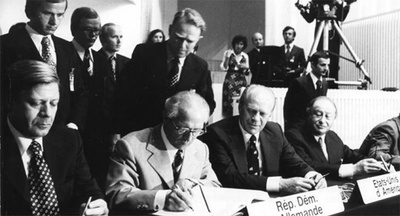
It is not clear that the current leaders of the 57 governments of the OSCE have the wisdom or skills to lead to a renewal of the Security Community. Yet when one looks at the photos of the government leaders who did sign the Helsinki Final Act 40 years ago, there are few faces indicating wisdom or diplomatic skills so perhaps all is not lost today. Very likely, as in the period between the events of 1968 and the start of government negotiations in 1972, there will need to be nongovernmental voices setting out new ideas and creating bridges between people.

Prof. René Wadlow is President and Chief Representative to the United Nations Office at Geneva of the Association of World Citizens.
International Day of Friendship

In Being a World Citizen, Children's Rights, Foundations for the New Humanism, Human Development, Human Rights, United Nations on July 30, 2015 at 7:23 PM

INTERNATIONAL DAY OF FRIENDSHIP

By Rene Wadlow

The United Nations (UN) General Assembly established in 2011 July 30 as the International Day of Friendship. The Day was to be a continuation of the themes of dialogue and mutual understanding proposed in the International Decade for a Culture of Peace and Nonviolence for the Children of the World (2001-2010). I had been active in getting the General Assembly resolution voted, building on the earlier Year of the Culture of Peace. My effort, backed by UNESCO which had been at the start of the concept of a “culture of peace”, was to add the word “nonviolence” to make the concept still clearer. Then, some of us wanted a focus on children because who can be against doing things for the benefit of children. It turned out during the negotiations prior to the introduction of the resolution that the UK and the USA were against the whole concept but were pushing the idea that “we are already doing enough for children by supporting UNICEF”.

Finally, in light of wide support for having such a Decade, the UK and the USA backed off although they had made a strong try to get “nonviolence” out of the title. There was still some debate as to the wording of the Decade. A colleague in New York called me in Geneva about the debate over the title. I replied that “the title was too long for public relations reasons, but it was not up to NGO representatives to suggest cuts. Let the governments do as they want for the title as long as they vote the resolution by consensus.” The governments kept all the words, voted the resolution by consensus and then did very little else. Both peace and nonviolence did not standout strongly during the 2001-2010 decade.

At the end of the Decade, there was a need to continue the spirit, and “friendship” could be seen to combine peace and nonviolence. Thus we now have a yearly International Day of Friendship.

The idea of an International Day of Friendship had been first developed in the 1930s in the USA by the president of a well-known company which made Christmas cards, Birthday cards, and cards to send on Mother’s Day. He suggested that everyone send cards to their friends and even people they did not know indicating the joys of friendship and the need to keep ties active and strong.

For a few years, there was a certain active interest, but then it looked too much like a commercial venture for his company to sell cards. In the middle of the summer, there were no other Days to celebrate, so a Day of Friendship could be a form of sales promotion. By the end of the 1930s and the start of the Second World War, the idea of an International Day of Friendship celebrated by sending cards had disappeared.

Now, however, we live in a different period of time than in the 1930s. Although there are still many world tensions and local wars as in the Middle East, the idea of friendship among all the peoples of the world could become a real force for cooperation.

Emails and the Internet can spread the idea that friendship is the basis of freedom in the world as it elevates the spirit. Friendship is as a ray of light coming from the burning core of the soul. Friendship can be a kind of love, a happy feeling when sharing a secret.

Paper still has its uses, and one can write a short text on the importance of friendship within the family, the school, neighborhood, nation and the world and send it to friends known and not yet known. 30 July, a day to renew and deepen friendships.

Prof. René Wadlow is President and Chief Representative to the United Nations Office at Geneva of the Association of World Citizens.
July 4, 2015: World Citizen Declaration of Inter-Dependence

In Being a World Citizen, Foundations for the New Humanism, Human Development, Solidarity, The Search for Peace, World Law on July 4, 2015 at 8:20 PM

JULY 4, 2015: WORLD CITIZEN DECLARATION OF INTER-DEPENDENCE

By René Wadlow

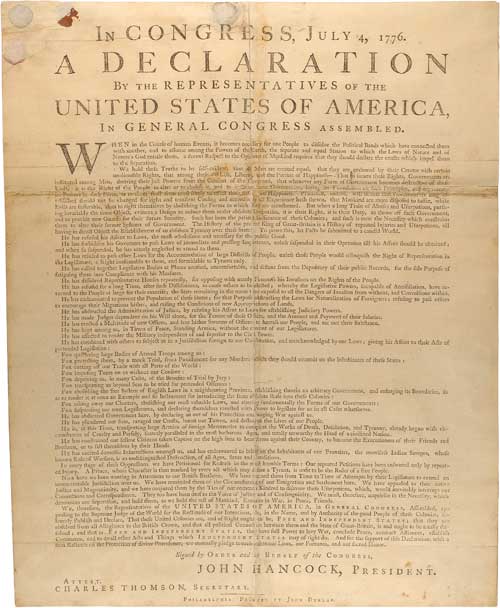
In 1776, progress for humanity required the first act of decolonization as leaders in the English colonies of North America consciously broke the bonds with the colonial English government. In 1776, the Declaration of Independence was a positive act to affirm human dignity in opposition to an English government dominated by a small aristocratic class and a King who represented these narrow economic and class interests.

In 2015, as Citizens of the World, we affirm the unity of humanity, the impossibility of cutting bonds with others.  Thus we re-affirm the inter-dependence of humanity.

Today, world progress moves from affirming U. S. citizenship as separate from England in 1776 to affirming world citizenship in 2015.

Next stop: Inter-dependence!

A milestone in world history. Next stop: Inter-dependence!

Prof. René Wadlow is President of the Association of World Citizens.

March 8, 2015: International Women’s Day – Balance of Yin and Yang

In Being a World Citizen, Current Events, Democracy, Human Development, Human Rights, International Justice, Social Rights, Solidarity on March 7, 2015 at 9:48 AM

MARCH 8, 2015: INTERNATIONAL WOMEN’S DAY – BALANCE OF YIN AND YANG

By René Wadlow

It is only when women start to organize in large numbers that women become a political force, and begin to move towards the possibility of a truly democratic society in which every human being can be brave, responsible, thinking and diligent in the struggle to live at once freely and unselfishly.

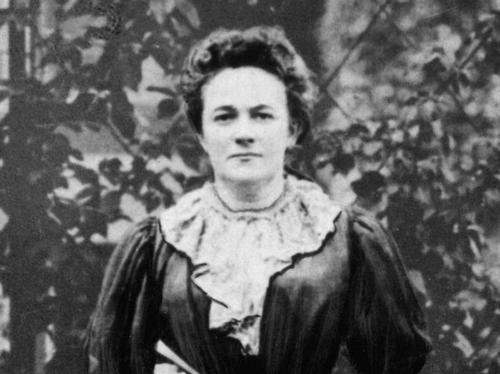
March 8 is the International Day of Women and thus a time to analyze the specific role of women in local, national and world society. International Women’s Day was first proposed by Clara Zetlin (1857-1933) at the Second International Conference of Socialist Women in Copenhagen in 1911. Later, she served as a socialist-communist member of the German Parliament during the Weimar Republic which existed from 1920 to 1933 when Hitler came to power.

Zetkin had lived some years in Paris and was active in women’s movements there who were building on the 1889 International Congress for Feminine Works and Institutions held in Paris under the leadership of Ana de Walska. De Walska was part of the circle of young Russian and Polish intellectuals in Paris around Gerard Encausse (1865-1916), a spiritual writer who wrote under the pen name of Papus and edited a journal L’Initiation (1). Papus stressed the need for world peace and was particularly active on the human rights of Armenians.

Clara Zetkin (1857-1933), the initiator of International Women's Day.

Clara Zetkin (1857-1933), the initiator of International Women’s Day.

This turn-of-the-century spiritual milieu was influenced by Indian and Chinese thought. Translations of fundamental Asian philosophical texts were increasingly known in an educated public. ‘Feminine’ and ‘masculine’ were related to the Chinese terms of Yin and Yang − not opposed but in a harmonic balance. Men and women alike have the Yin and Yang psychological characteristics. ‘Feminine’ characteristics or values include intuitive, nurturing, caring, sensitive and relational traits. ‘Masculine’ traits are rational, assertive and analytical.

As individual persons, men and women alike can achieve a state of wholeness, of balance between the Yin and Yang. However, in practice, ‘masculine’ refers to men and ‘feminine’ to women. Thus, some feminists identify the male psyche as the prime cause of the subordination of women around the world. Men are seen as having nearly a genetic coding that leads them to ‘seize’ power, to institutionalize that power through patriarchal societal structures and to buttress that power with masculine values and culture.

Thus Clara Zetkin saw the need to call attention in a forceful way to the role that women as women play in society and the many obstacles which men place in their way. She made her proposal in 1911 and today March 8 is widely observed.

Women, individually and in groups, have played a critical role in the struggle for justice and peace in all societies. However, when real negotiations start to pull a community out from a cycle of violence, women are often relegated to the sidelines. There is a need to organize so that women are at the negotiating table to present their ingenuity, patience and determination.

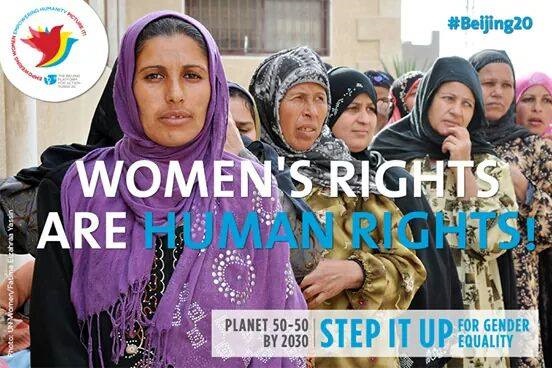
The emerging world society has been slow to address the problem of injustice to women, because it has lacked a consensus on sex-based inequality as an urgent issue of political justice. The outrages suffered every day by millions of women − domestic violence, child sexual abuse, child marriage, inequality before the law, poverty and lack of dignity − are not uniformly regarded as ignominious and seen as human rights abuses.

Solidarity and organization are crucial elements to create sustainable ways of living in which all categories of people are encouraged to contribute. March 8, 2015 is a reminder of the positive steps taken but also the distance yet to be covered.

Prof. René Wadlow is President and Chief Representative to the United Nations Office at Geneva of the Association of World Citizens.
(1) See the biography by Marie-Sophie André and Christophe Beaufils, Papus.

Celebrating Social Justice: The People’s Revolution is On the March

In Being a World Citizen, Democracy, Human Development, Human Rights, Middle East & North Africa, Social Rights, Solidarity on February 22, 2015 at 4:45 PM

CELEBRATING SOCIAL JUSTICE: THE PEOPLE’S REVOLUTION IS ON THE MARCH

By René Wadlow

Social Justice

The United Nations (UN) General Assembly, on the initiative of Nurbch Jeenbrev, the Ambassador of Kyrgyzstan to the UN in New York, has proclaimed February as the “World Day of Social Justice”.

The World Day of Social Justice gives us an opportunity to take stock of how we can work together – the whole year round – at the local, national and global level on policy and action to achieve the goals set out in the resolution of “solidarity, harmony and equality within and among states.”

As the resolution states, “Social development and social justice are indispensable for the achievement and maintenance of peace and security within and among nations, and that in turn, social development and social justice cannot be attained in the absence of peace and security or in the absence of respect for all human rights and fundamental freedoms.”

The Preamble to the UN Charter makes social justice one of the chief aims of the organization using the more common expression of that time “social progress”. The Preamble calls for efforts to “promote social progress and better standards of life in larger freedom.”

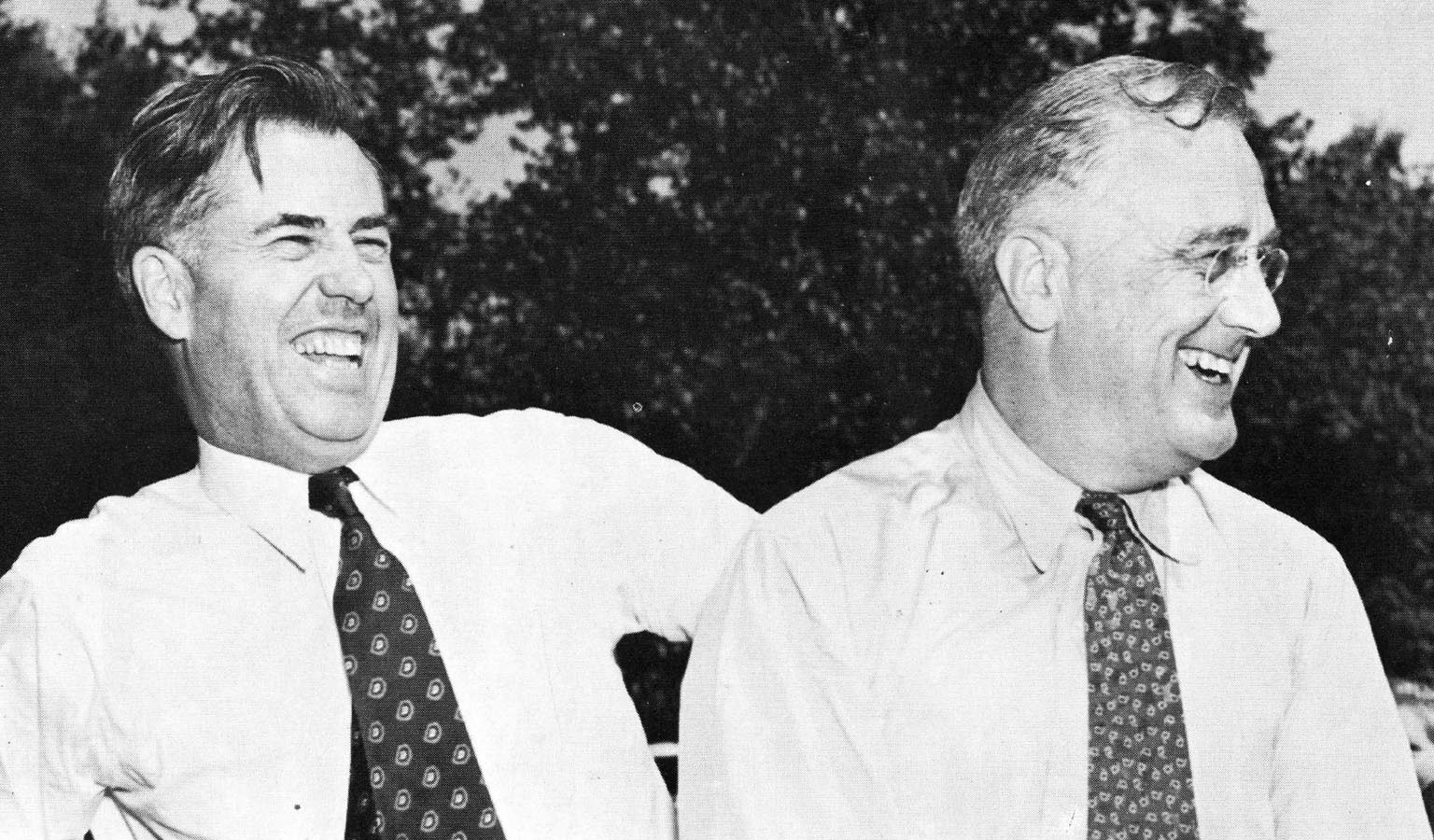
The United States (U. S.) representatives who worked on the draft of the UN Charter were strongly influenced in their views of social progress by the “New Deal” legislation of President Roosevelt and its philosophy as it had been set out by his Vice-President Henry A. Wallace in 1942 when he set out the U. S. war aims. Wallace’s speech was the first time that the war aims of a country were not stated in terms of “national interest” and limited to the demands that had produced the start of the war.

Wallace, who had first been the Secretary of Agriculture and who had to deal with the severe depression facing U. S. agriculture, was proposing a world-wide New Deal based on the cooperative action of all of humanity. Wallace said “The people’s revolution is on the march. When the freedom-loving people march — when the farmers have an opportunity to buy land at reasonable prices and to see the produce of their land through their own organizations, when workers have the opportunity to form unions and bargain through them collectively, and when the children of all the people have an opportunity to attend schools which teach them truths of the real world in which they live — when these opportunities are open to everyone, then the world moves straight ahead…The people are on the march toward ever fuller freedom, toward manifesting here on earth the dignity that is in every human soul.”

Henry A. Wallace (left), Vice-President of the United States from 1941 to 1945. After the third and final reelection of Franklin Delano Roosevelt (right) to the presidency in 1944, Wallace was succeeded by Harry S. Truman, who himself succeeded Roosevelt as President of the United States after Roosevelt died on April 12, 1945.

Henry A. Wallace (left), Vice-President of the United States from 1941 to 1945. After the third and final reelection of Franklin Delano Roosevelt (right) to the presidency in 1944, Wallace was succeeded by Harry S. Truman, who himself succeeded Roosevelt as President of the United States after Roosevelt died on April 12, 1945.

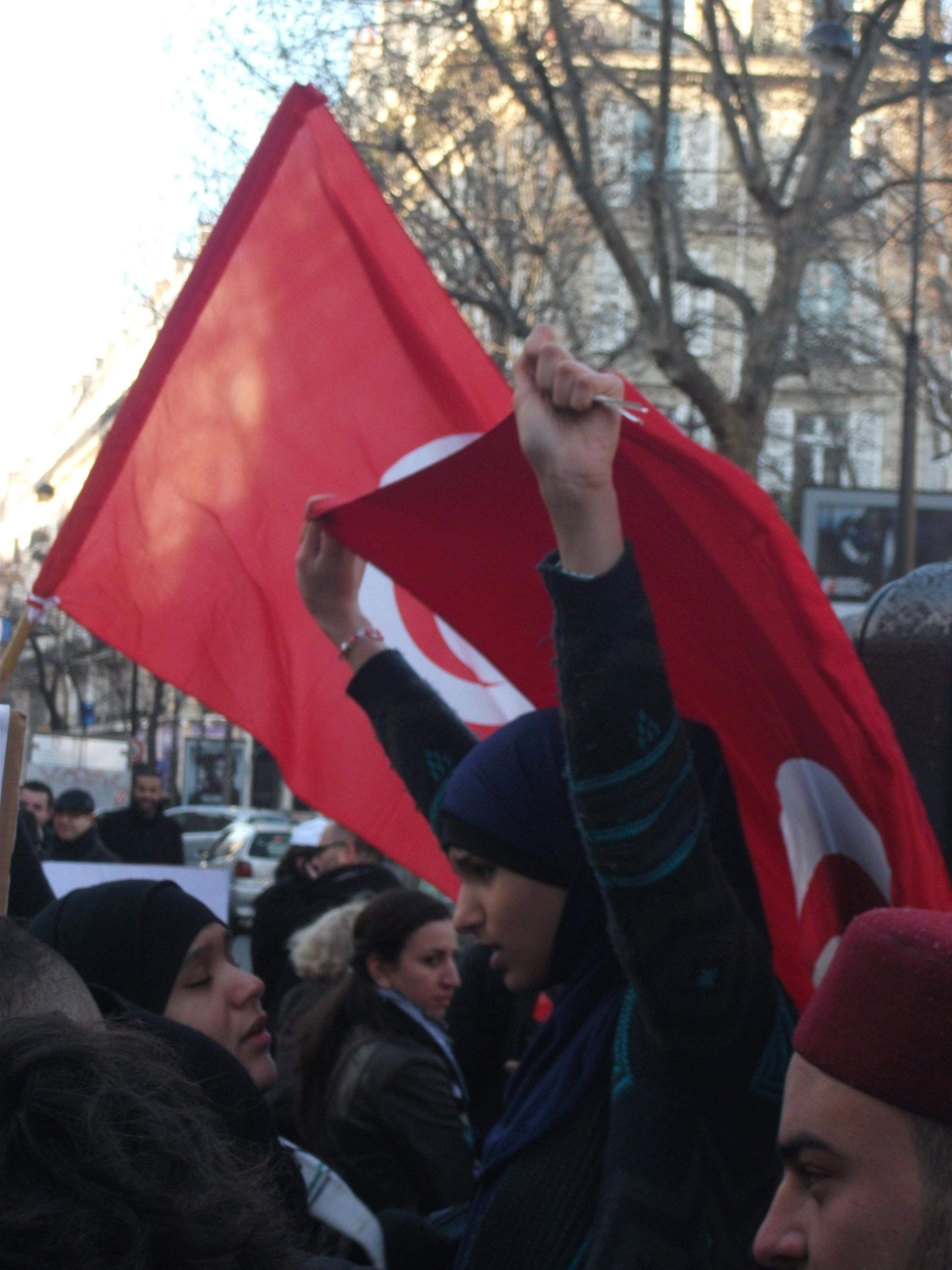
The People’s Revolution found its expression in the cry of the Tunisian uprising — Work-Liberty-Dignity. Today in the demands of “Work-Liberty-Dignity” we hear the demands of farmers to own land under sure conditions, to receive a fair price for their crops as well as the right to organize to protect their interests. We hear the crises of industrial and urban workers to be able to organize and to have their work appreciated for its full value. We hear the demands of students and the young for an education that opens minds and prepares for meaningful work.

A Tunisian demonstrator in Paris, France, as the Tunisian community there celebrated the first anniversary of the revolution on January 14, 2012. (C) Bernard J. Henry/AWC

A Tunisian demonstrator in Paris, France as Tunisians living there were celebrating the first anniversary of their revolution on January 14, 2012. (C) Bernard J. Henry/AWC

The people’s revolution is on the march. While the forces of the status quo are still strong and often heavily armed, the energy has shifted from the rulers to the people. The concept of Social Justice has articulated and focused deep demands for liberty, jobs, and dignity. The people’s revolution is not that of an elite willing to replace the existing ruling elite. The people’s revolution is a wave of all moving together, with deep currents below the surface. The tide moves with only a few visible waves but the collective demands for social justice and dignity is what makes the difference between the people’s revolution and a military coup. This is the true meaning of the World Day of Social Justice.

“For the wretched of the earth,
There is a flame that never dies,
Even the darkest night will end
And the sun will rise.”

Les Miserables, “Do You Hear the People Sing – Epilogue”.

In 2011, as the Tunisian and Egyptian revolutions were underway, the AWC adopted this song as its unofficial anthem.

* * *

Prof. René Wadlow is President and Chief Representative to the United Nations in Geneva of the Association of World Citizens.
December 18: International Migrants Day

In Africa, Asia, Being a World Citizen, Current Events, Environmental protection, Europe, Fighting Racism, Human Development, Human Rights, Middle East & North Africa, Solidarity, United Nations, World Law on December 17, 2014 at 11:33 PM

DECEMBER 18: INTERNATIONAL MIGRANTS DAY
By René Wadlow


“Let us make migration work for the benefit of migrants and countries alike. We owe this to the millions of migrants who, through their courage, vitality and dreams, help make our societies more prosperous, resilient and diverse.”

Ban Ki-moon, Secretary-General of the United Nations.


In December 2000, the United Nations (UN) General Assembly proclaimed December 18 as the International Migrants Day. The day was chosen to highlight that on a December 18, the UN had adopted the International Convention on the Protection of the Rights of All Migrants Workers and Members of Their Families. Although migration to and from countries is a worldwide flow of people, only 42 countries, basically Latin American, North and West African, Indonesia and the Philippines, have ratified the Convention. The Convention created a Committee on Migrant Workers which meets in Geneva to review once every four years a report of the Convention members on their application of the Convention. The Convention also created a mechanism by which the Committee could receive individual complaints. Only three States have ratified this individual complaints mechanism: Mexico, Guatemala and Uruguay.

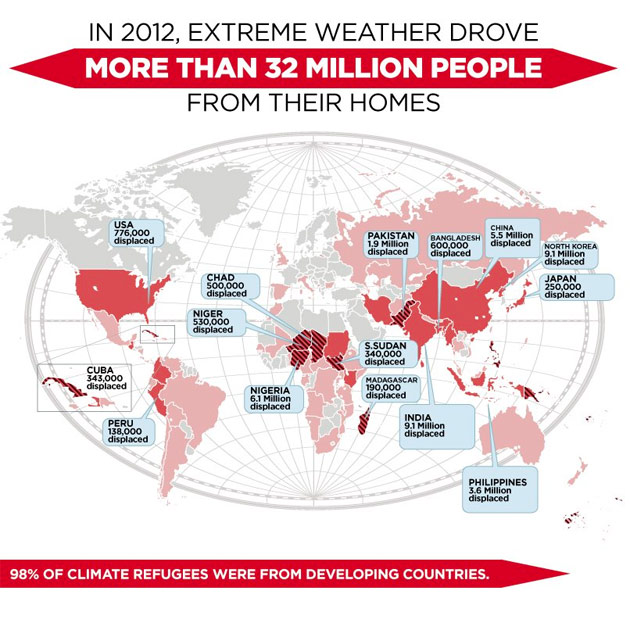
Today, there are some 232 million persons who reside and work outside their country of birth. The reasons for migration are diverse − most often economic, but also refugees from armed conflicts and oppression, and increasingly what are called “ecological refugees” − persons who leave their home area due to changing environmental conditions: drought, floods, rising sea levels etc. Global warming may increase the number of these ecological refugees.

After war, persecution, and poverty, a new danger is now driving people away from their homes in their millions – climate change. (C) Tck Tck Tck

After war, persecution, and poverty, a new danger is now driving people away from their homes in their millions – climate change. (C) Tck Tck Tck

Although migration is an important issue with a multitude of consequences in both countries of origin and destination, the Committee on Migrant Workers, a group of experts who function in their individual capacity and not as representatives of the State of which they are citizens, has a low profile among what are called “UN Treaty Bodies” – the committees which review the reports of States which have ratified UN human rights conventions such as the International Covenant on Civil and Political Rights or the International Covenant on Economic, Social and Cultural Rights.

Since the great majority of States receiving migrants − Western Europe and North America – have not ratified the Convention on Migrant Workers, other ways have to be found within the UN system to look at migration issues. Thus has been created outside the UN system but in close cooperation with the UN, the Global Forum on Migration and Development and the Global Migration Group to address the opportunities and challenges of international migration. Within the UN, there was the recent, October 2013 “High-level Dialogue on International Migration and Development”.

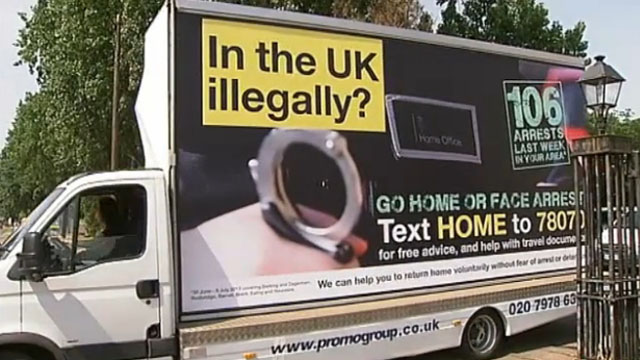
In 2013 the Conservative-led Government of the United Kingdom publicly called on undocumented migrants to “go home or face arrest”, a move that was basically inhumane and completely out of place. ( (C) Socialist Party of Great Britain)

In 2013 the Conservative-led Government of the United Kingdom publicly called on undocumented migrants to “go home or face arrest”, a move that was basically inhumane and completely out of place. (C) Socialist Party of Great Britain)

The Governments at the Dialogue unanimously adopted a Declaration (A/68/L.5) calling for greater cooperation to address the challenges of irregular migration and to facilitate safe, orderly and regular migration. The Declaration also emphasized the need to respect the human rights of migrants and to promote international labor standards. The Declaration strongly condemns manifestations of racism and intolerance and stresses the need to improve public perceptions of migrants.

UN conferences and such dialogues or forums serve as a magnet, pulling Governments to agree to higher ideals and standards collectively than they would proclaim individually. This is not only hypocrisy − though there is certainly an element of hypocrisy as Governments have no plans to put these aims into practice. Rather it is a sort of “collective unconscious” of Government representatives who have a vision of an emerging world society based on justice and peace.


In 2010 two French singers, Stanislas and Mike Ibrahim, released a song entitled “Tu verras en France” (“You’ll see in France”). In this song, the two young men call for attention to the situation of migrants who leave their home countries hoping to find a better life in France but end up undocumented and living in extreme poverty, constantly having to run from the police if they don’t want to end up in jail or sent back to their country of origin.


The role of nongovernmental organizations is to remind constantly Government representatives that it is they who have written the text and voted for it without voicing reservations. Numerous States which ratified the International Convention on Migrant Workers made reservations limiting the application of the Convention on their territory. Thus, the Declaration of the High-level Dialogue was not written by the Association of World Citizens but by Government diplomats.

The Declaration is a strong text and covers most of the important issues, including human mobility as a key factor for sustainable development, the role of women and girls who represent nearly half of all migrants, the need to protect the rights of migrant children and the role of remittances to families.

The Declaration merits to be better known and widely quoted in the on-going discussions and debates on migration policies and practices.

Prof. René Wadlow is President of the Association of World Citizens.
“A Living Thing is Born”

In Being a World Citizen, Conflict Resolution, Human Development, International Justice, The Search for Peace, United Nations, World Law on November 15, 2014 at 4:18 PM

“A LIVING THING IS BORN”
by René Wadlow


November 15, 1920 – The First Assembly of the League of Nations, Geneva


“A general association of nations must be formed under specific covenants for the purpose of affording mutual guarantees of political independence and territorial integrity to great and small States alike.” President Woodrow Wilson. The last of the fourteen points in which he set out in January 1918 the Allied war aims.

November 15 marks the anniversary of the first session of the Assembly of the League of Nations. Representatives of 44 States entered La Salle de la Réformation in central Geneva. The Salle had been built originally as a meeting place for Protestant refugees from France and Italy who needed a place of worship and a place for discussions and welfare. In the large hall, there was Léon Bourgeois, the oldest delegate and a long-time French worker for peace. Ignace Paderewski headed the Polish delegation in a room where he had given piano concerts. There was Lord Robert Cecil, who with Jan Christian Smuts of South Africa was a principle author of the League Covenant. There were delegates from South Africa and India which had “dominion status” but were not yet fully independent.

Significant were the countries not represented: the USA, the USSR, Germany, Austria and Hungary − all of whom had participated in parts of the First World War. Woodrow Wilson had welcomed the birth of the League of Nations: “A living thing is born.” Unfortunately, the League ran into difficulties from the start. The United States refused to join; too long a time elapsed before Germany was admitted or the USSR asked to join. The legacy of the First World War, codified in the Versailles Treaty, upset both the political and economic climate: huge reparations due by Germany, the payment of large debts by the Allies to the US, monetary collapse in several countries and economic protectionism rampant. All this contributed to the Great Depression of the 1930s.

The greatest trouble, however, was the mentality of the officials in national foreign ministries and war offices who were thinking in terms of the balance of power and who could not bring themselves to face new challenges. Nor was there among the general public a sense of global citizenship, of world loyalty which might have influenced government leaders in a more positive direction. Even today, as Brian Urquhart has said of the United Nations (UN), “There has yet to emerge, on the international scene, a great combined popular constituency to insist on the necessity of a respected central order and an orderly process of law and the keeping of peace.” However, there were real contributions of the League to the development of world institutions. The UN’s structure is that of the League − only the names have been changed: The League Assembly became the General Assembly, the League Council became the Security Council, the Mandates Commission became the Trusteeship Council.

A crucial contribution was the creation of an impartial civil service responsible only to the head of the organization under the obligation not to accept instructions from any government or outside authority. The League created a high quality staff under the direction of the first Secretary-General, Sir Eric Drummond, who served from the start until 1933.

The League also provided the starting point for future work on refugees, drug control, health and agriculture through its close cooperation with the International Institute of Agriculture set up in Rome. The International Labor Organization functioned alongside the League, its budget being voted by the League Assembly.

Looking back, we can mark the progress not only of the institutions but also the persons who shape them. A new breed of international civil servants are evolving within world organizations and non-governmental organizations active within the UN system to make this earth a true home for humanity. They have dedicated themselves to the same tasks that the League began but left unfinished.

Prof. René Wadlow is President of the Association of World Citizens.

The Open Conspiracy for Peace

In Being a World Citizen, Conflict Resolution, Human Development, Introductory, The Search for Peace on September 21, 2014 at 2:26 AM

THE OPEN CONSPIRACY FOR PEACE

By René Wadlow

Behind the short-sighted governments that divide and mismanage human affairs, a real force for world unity and order exists and grows.”

H. G. Wells, A Short History of the World, 1943.

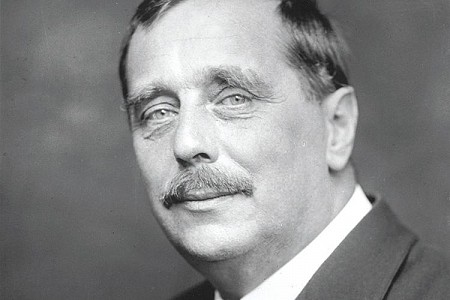
September 21 is the United Nations (UN)-designated World Day of Peace. It is also the anniversary of the birth of Herbert George Wells, usually known as just H. G. Wells.[i]

From the publication of The Time Machine in 1895 to his death in 1946, Wells ‘bestrode his world like a colossus’. He was a creator of modern science fiction, a pioneer of women’s rights (though he treated some badly in his many love affairs), a journalist, historian and novelist. Above all, he was a social thinker devoted to peace and a stable world order. It is this last aspect of his writing that makes his birth anniversary and the World Day of Peace appropriate.[ii]

Wells first studied biology under Thomas H. Huxley, the leading Darwinian of Victorian times, and came to see the ethical principles underlying humanity’s social systems as being rooted in the evolutionary process and therefore having the potential for onward development. Just as there was one major factor in biological progress − natural selection − so in social progress, there was one major factor − the quality of enlightened thought.

As he wrote, “However urgent things may seem, a great mental renascence must precede any effectual reorganization of the world. A systematic development and a systematic application of the sciences of human relationship, of personal and group psychology, of financial and economic sciences, and of education − sciences still in their infancy − is required. Narrow and obsolete, dead and dying moral and political ideas have to be replaced by a clearer and simpler conception of the common origins and destinies of our kind.”

"If we don't end war, war will end us." H. G. Wells.

“If we don’t end war, war will end us.”
H. G. Wells.

Wells was critical of democracy as being too slow and always tending toward the middle of the road on important issues. In 1928, he tried to alert to new dangers and possibilities by proposing an “open conspiracy” − an elite group of pioneer world citizens who would organize to move humanity forward[iii]The Open Conspiracy was his organizing manual for the diverse constituencies of globally-minded citizens to bring sanity to the organizing of human affairs.

Wells clearly foresaw the need for a re-organization of the economic affairs of humanity. “Certain things, the ocean, the air, rare wild animals must be the collective property of all humankind and cannot be altogether safe until they are so regarded and until some concrete body exists to exercise these proprietary rights … the raw material of the earth should be for all.”

Some progress has been made in the identification of endangered species, and a variety of international conventions have at least slowed the despoliation of an amount of our natural heritage. Yet the ongoing destruction of forests, over-exploitation of the oceans as well as other signs of the environmental crisis are constant reminders of how much distance is left to travel.

Wells was harshly critical of Marxist theory and of the Communist rule of Stalin in the USSR. Thus he contrasts his “open conspiracy” with the closed conspiracies and vanguard approach of Lenin whom he had met in 1920. He was also highly opposed to Fascism and its closed conspiracies. The “open conspiracy” is a project for every manner of person once an individual has developed a ‘world consciousness’, though Wells was himself very Eurocentric in his world outlook.

He summed up his views as a race between education for world citizenship and catastrophe − a task or bold and creative minds.

Prof. René Wadlow is President of the Association of World Citizens.
[i] For a detailed biography see: David Lodge, A Man of Parts (New York, Viking, 436pp.)

[ii] For an overview of his political thinking see: John S. Partington. Building Cosmopolis: The Political thought of H.G. Wells Aldershot: Ashgate, 2003)

[iii] The Open Conspiracy was first published in 1928 and slightly revised published in 1933. The 1933 edition is republished much more recently with a strong introduction and notes in W. Warren Wagar. The Open Conspiracy/H.G. Wells on World Revolution (Westport, CT: Praeger Publishers, 151pp.).

Tribal Societies: Survival and Transformations

In Being a World Citizen, Cultural Bridges, Current Events, Environmental protection, Foundations for the New Humanism, Human Development, Human Rights, International Justice, Solidarity, The Search for Peace, United Nations, World Law on August 9, 2014 at 10:46 AM

TRIBAL SOCIETIES: SURVIVAL AND TRANSFORMATIONS

by René Wadlow


August 9 has been chosen by the UN General Assembly as the International Day of the World’s Indigenous Peoples.

As Paulo Freire has written, “While both humanization and dehumanization are real alternatives, only the first is man’s vocation. This vocation is constantly negated. It is hindered by injustice, exploitation, oppression, and the violence of the oppressors; it is affirmed by the yearning of the oppressed for freedom and justice, and by their struggle to recover their lost humanity.

The world society is filled with many different types of collective actors: clans, tribes, castes, ethnic groups, cities, races, social classes, religious organizations, nation-states, multi-state alliances for military or economic goals, transnational corporations and associations. Each is the creation of individuals who have grouped together − or have been grouped together − to achieve goals considered common to the group’s members. All such collective groups have techniques to socialize new members to share the common values, to accept the ideology and beliefs of the tribe, the nation-state or the association. This socialization process goes so deeply that a person’s sense of identity becomes associated with these collective identity, the school, the army, the church, the political process and institutions − each propose a sense of group purpose.

Yet none of these groups is static and unchanging. Even clans and tribes whose members often consider that they have a common ancestor do, in fact, change. Tribes merge and divide; new identities are formed; new ancestors are created to justify the new groupings.

Some types of collective belonging are more easily left than others. One can move relatively easily from a city and take on the character, the values and the goals of a new city. Social mobility can produce changes in social class, and even caste lines become blurred. Persons change nationality or acquire new nationalities as frontiers are modified. Race is less easily changed but definitions of what constitutes a race do change. Ethnic identity is often associated with birth, but parents can belong to different ethnic communities, although the child is usually raised as belonging to the more dominant group. However the socialization process of group identity goes to the level of sub-conscious behavior and is not easily set aside.

In Peru, some tribes remain uncontacted. Some live no more than 100 kms from the legendary mountain site of Machu Picchu. Today, however, the future of these tribes who live in the heartland of the ancient Inca Empire is threatened by a gas project. (C) Survival International

In Peru, some tribes remain uncontacted. Some live no more than 100 kms from the legendary mountain site of Machu Picchu. Today, however, the future of these tribes who live in the heartland of the ancient Inca Empire is threatened by a gas project. (C) Survival International

Today the nation-state claims to be the dominant collective association − setting the boundaries of loyalty and identity. The State claims the right to set out the major collective goals and values. Through laws, the State claims the right to set out the rules by which other collective entities may pursue their goals; through taxation the State draws the resources to further the goals it has set, and the State claims to have the only legitimate use of violence to punish those who break the laws and rules it has set.

There have always been tensions between these collective groups for their spheres of goal-setting and value-setting have overlapped. Thus there have been tensions between religious organizations and the State as to who should set what goals and the means to achieve these goals. There have also been tensions between economic classes and the State when it was felt that the State was dominated by another economic class who used its power within State institutions not for the good of all but only to advance class interests. The same is true of other collective units − races or ethnic groups − excluded from power within State institutions.

Today in many parts of the world those most excluded from power within State institutions are people living in alternative structures of authority, goal-setting and rule-making: persons living in tribal societies.

Tribal societies predated most of today’s nation-state. A tribal society usually has all the same functions as the nation-state: it sets out membership, loyalties, common goals and rules of behavior. It has sanctions against those breaking the laws of the tribe and has − or had − the monopoly of the legitimacy of using violence against those breaking the laws. Tribes are, in fact, more realistically “nation-states” if one defines nation as a common language, a common history and a common will to act together.

Thus because the tribal society is the closest in function to that of the nation-state, it is also the most feared. Tribes are institutions with whom it is difficult to compromise because they have the same pretensions as the State. It is relatively easy for a government to offer higher wages to the industrial worker or higher prices to the farmer as these social classes do not claim to carry out an alternative way the functions of the State. It is more of a challenge to the State’s image of its role to allow tribal societies to set out a land policy or fishing rights or trans-frontier trading rights because these activities conflict directly with the functions that the government has set for itself.

Thus there has been a long history of the State destroying alternative institutions of governance on its territory. The nation-states of Europe were built upon the ruins of feudal institutions; much of Asia on the destruction of local rulers. We see the pattern today as we watch traditional chiefs in Africa lose their authority to the heads of State and the military. In the Americas, many of the indigenous tribal societies were destroyed. Others were pushed into areas that those who controlled the government did not want − the “reservations” of the USA and Canada.

In Latin America and Asia, there is still active struggle going on between those trying to preserve their tribal institutions and homelands and the State which claims complete authority over all its territory and who often wished to put new settlers on tribal lands.

A Koma tribe woman at her farm. Alantika Mountain, Cameroon. (C) Middle Africa The Koma people are indigenous hill-dwelling people occupying the Alantika Mountains in northern Adamawa State, Nigeria and in Northern Cameroon (Faro National Park), near the border with Adamawa State.

A Koma tribe woman at her farm. Alantika Mountain, Cameroon. (C) Middle Africa
The Koma people are indigenous hill-dwelling people living in the Alantika Mountains in northern Adamawa State, Nigeria and in Northern Cameroon (Faro National Park), near the border with Adamawa State.

The amount of violence and suffering is considerable. Slowly, the fate of tribal societies has come to the attention of the United Nations (UN). The UN was set up to facilitate relations among nation-states. However, because wide-spread violations of individual rights had been one of the consequences of the Second World War, a Universal Declaration of Human Rights was drafted and proclaimed by the UN General Assembly in December 1948. The aim of the Declaration is to stress the rights of the individual − a natural consequence of the philosophy of the drafters. The rights of collective bodies which the drafters knew were also protected: trade unions, churches, professional associations. However tribal societies were not particularly thought of as one sees by reading the drafting negotiations. Thus, the Universal Declaration protects the rights of all individuals − including, of course, individuals living in tribal societies − but there is no direct recognition of the functions of tribal societies.

Thus for many years, indigenous and tribal peoples were the forgotten stepchildren of the UN system dealing with human rights. Yet they needed protection at least as much as those on whom the political limelight had focused. The situation began to change with the publication by the International Labor Organization’s study Indigenous Peoples: Living and working conditions of aboriginal populations in independent countries (1953). This was followed by the study by Jose Martinez Cobo Study of the Problem of Discrimination Against Indigenous Populations of the UN Commission on Human Rights (1986). While the Cobo study was being written, a Working Group on Indigenous Populations was set up under the then-existing Sub-Commission on Prevention of Discrimination and Protection of Minorities under the dynamic leadership of Erica-Irene Daes.

The United Nations Declaration on the Rights of Indigenous Peoples, a document that was long awaited by indigenous peoples and their defenders throughout the world.

The United Nations Declaration on the Rights of Indigenous Peoples, a document that was long awaited by indigenous peoples and their defenders throughout the world.

From the Working Group, with a good deal of interaction with the representatives of Nongovernmental Organizations and tribal groups came a United Nations Declaration on the Rights of Indigenous Peoples (A61/295) in 2007 after some 20 years of efforts. The Declaration sets out a useful framework for action. A UN Permanent Forum on Indigenous Issues has been created and meets once a year in New York. Conditions “on the ground” change slowly but there is now a UN institutions where issues can be raised. It is still the task of non-government organizations and tribal groups to continue to draw attention and to seek cooperation with governments.

See the useful Making the Declaration Work published by the International Work Group for Indigenous Affairs (Copenhagen) available on their website: www.iwgia.org.


********************************************************************


Prof. René Wadlow is President of the Association of World Citizens.