The Official Blog of the

Archive for the ‘Current Events’ Category

Xi Jinping, Citizen of the World, and the Making of a Global Policy

In Anticolonialism, Being a World Citizen, Cultural Bridges, Current Events, Environmental protection, Human Development, Solidarity, The Search for Peace, World Law on March 5, 2017 at 12:09 PM

XI JINPING, CITIZEN OF THE WORLD, AND THE MAKING OF A GLOBAL POLICY

By René Wadlow

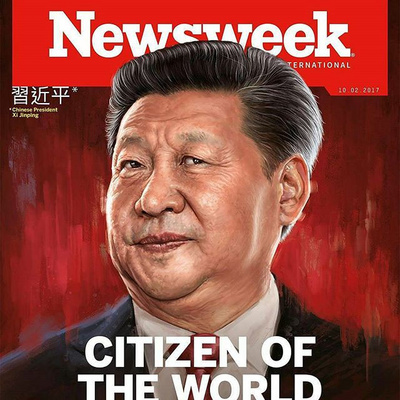
A recent issue of Newsweek hailed the President of China, Xi Jinping, as a citizen of the world and highlighted his January 17, 2017 speech to the World Economic Forum in Davos, Switzerland as setting forth a new global policy. At a time when the President of the United States is putting his “America First” policy into practice, and the President of the Russian Federation is striving to make Russia and the Russian Orthodox Church “great again”, it is China that is providing great power leadership toward a cosmopolitan, humanistic, world society.

At Davos, Xi Jinping stressed that globalization had produced “powerful global growth and facilitated movement of goods and capital, advances in science, technology and civilization and interaction among people.” He noted the China-led creation of the Asian Infrastructure Investment Bank and the Regional Comprehensive Economic Partnership. He ended by saying that “the people of all countries expect nothing less (than to make globalization work) and this is our unshrinkable responsibility as leaders of our times.”

citi01_400

It is true that globalization – the world as an open market – has worked well for China’s export-led economy and for its foreign infrastructure development efforts – the One Belt-One Road project of rail, roads and sea ports. However, Xi Jinping also mentioned civilization and interaction among people as one of the outcomes of globalization, perhaps thinking of the large number of student exchanges and the impact of Chinese culture through the increasing number of Confucius Institutes throughout the world.

Xi Jinping stressed the need for ecologically-sound development and meeting the goals of the Paris Climate Conference – the protection of Nature being high on the list of world citizen priorities.

2009_protest_at_un_against_chinas_re-election_in_the_human_rights_council_%e8%81%af%e5%90%88%e5%9c%8b%e5%a4%96%e6%8a%97%e8%ad%b0%e4%b8%ad%e5%9c%8b%e5%9c%a8%e4%ba%ba%e6%ac%8a%e5%a7%94%e5%93%a1

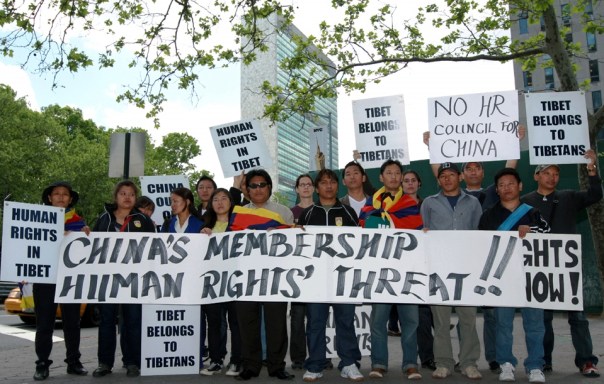
China retains a preoccupying record of human rights violations, as does its northeastern neighbor Russia. Now that extreme right populism has prevailed at the polls in Britain and the United States, and as France is entering a dangerous electoral period with a genuine extreme right risk too, human rights are set to become an ever greater matter of concern in terms of global leadership, regardless of the proven merits in other fields of any given individual country. President Xi Jinping should implement immediate, significant policy changes and bring his country in line with United Nations standards at last.

It is certain that in addition to setting a broadly positive global policy, there are real internal challenges to meeting the world citizen values of equality and respect for the dignity of each person.

As fellow citizens of the world, we are heartened by the advances of the rule of world law, of equality between women and men, by efforts of solidarity to overcome poverty and hunger. We look to Chinese leadership to strengthen the forces which advance a cosmopolitan, humanist world society based on wholeness, harmony and creativity.

Prof. René Wadlow is President of the Association of World Citizens.

President Trump’s UN and a Good Time Had by All

In Being a World Citizen, Conflict Resolution, Current Events, Human Development, Human Rights, International Justice, NGOs, Solidarity, The Search for Peace, United Nations, United States, World Law on January 23, 2017 at 11:02 PM

PRESIDENT TRUMP’S UN AND A GOOD TIME HAD BY ALL

By René Wadlow

President Donald Trump has tweeted that “The UN has such great potential but right now it is just a club for people to get together, talk, and have a good time.”

It takes less to have good time for some people than for others. Having sat through many long sessions in human rights bodies at the United Nations (UN) in Geneva, I could hardly wait to get out and have a good time elsewhere. I recall one year in particular when the UN Commission on Human Rights went on repeatedly till three in the morning. The “coffee bar” which was just outside the meeting room would close around 8 PM, but they would leave a couple of buckets of ice cubes on the bar so we could serve ourselves.

d-trump

Donald J. Trump, the new President of the United States, sounded in his campaign speeches less than enthusiastic about the United Nations.

I had a woman friend from New York, a leading human rights lawyer, who would come each year. She was blind so I would take care of her “seeing eye” dog in the Palais des Nations and take the dog out for a run in the UN park. In compensation, she would bring a couple of bottles of “duty-free” whisky which I would put in a flask and around 10PM we would have a couple of drinks in the coffee bar to keep us going to the end.

There was only one year that the meetings went till 3AM. The other years the sessions would stop at midnight because UN staff – interpreters etc. – had to be paid for a full day even if they had worked only from midnight until 3AM. But the 3AM year, I had with me the “Man Friday” of the Dalai Lama, a monk who is usually with him to get things, meet people etc. The monk had not had a vacation in a long time, and the Dalai Lama thought that he might have a good time by staying in Geneva for a week. It was a week of the Commission on Human Rights so I always had him with me and would try to explain what was going on, the meaning behind the speeches.

At 10PM he would come with me for our nightly whisky, but as a monk he did not drink alcohol, though I always offered him the possibility. He must have said some mantras for strength because he always held out till 3AM as well.
800px-conference_on_disarmament_at_the_united_nations_palais_des_nations_in_geneva_2

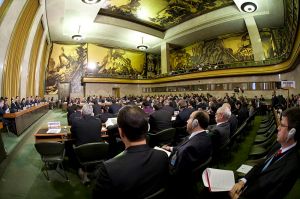
A session on disarmament in the Council Chamber at the United Nations in Geneva. (C) U. S. Mission/Eric Bridiers

When not listening to talks and having a good time, what is the role of nongovernmental representatives at the UN – people probably not at the front of President Trump’s vision of the UN? However, there is growing interest in the role of Nongovernmental Organizations (NGOs) within the United Nations system in the making and the implementation of policies at the international level. NGOs are more involved than ever before in global policy making and project implementation in such areas as conflict resolution, human rights, humanitarian relief, and environmental protection.

NGOs at the UN have a variety of roles — they bring citizens’ concerns to governments, advocate particular policies, present alternative avenues for political participation, provide analysis, serve as an early warning mechanism of potential violence and help implement peace agreements.
ecosoc

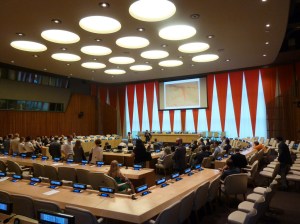
A session in the ECOSOC Council Chamber, New York. (C) Swedish Mission/Jenny Zhao

The role of consultative-status NGOs was written into the UN Charter at its founding in San Francisco in June, 1945. As one of the failings of the League of Nations had been the lack of public support and understanding of the functioning of the League, some of the UN Charter drafters felt that a role should be given to NGOs. At the start, both governments and UN Secretariat saw NGOs as an information avenue — telling NGO members what the governments and the UN was doing and building support for their actions. However, once NGOs had a foot in the door, the NGOs worked to have a two-way avenue — also telling governments and the Secretariat what NGO members thought and what policies should be carried out at the UN. Governments were none too happy with this two-way avenue idea and tried to limit the UN bodies with which NGOs could ‘consult’. There was no direct relationship with the General Assembly or the Security Council. The Economic and Social Council (ECOSOC) in Article 71 of the Charter was the body to which “consultative-status NGOs” were related.

What in practice gives NGOs their influence is not what an individual NGO can do alone but what they can do collectively. ‘Networking’ and especially trans-national networking is the key method of progress. NGOs make networks which facilitate the trans-national movement of norms, resources, political responsibility, and information. NGO networks tend to be informal, non-binding, temporary, and highly personalized. NGOs are diverse, heterogeneous and independent. They are diverse in mission, level of resources, methods of operating and effectiveness. However, at the UN they are bound together in a common desire to protect the planet and advance the welfare of humanity.

Samantha Power (left), the Irish-born writer and journalist whom Barack Obama had appointed U. S. Ambassador to the United Nations. Like all other sitting U. S. Ambassadors worldwide, she had to leave her post by January 20 as ordered by then President-elect Donald Trump. If confirmed by the U. S. Senate, what is her chosen successor, South Carolina Governor Nimrata “Nikki” Haley (right), going to do? How UN-friendly or “NGO-friendly” is she going to be?

The role of NGO representatives is to influence policies through participation in the entire policy-making process. What distinguishes the NGO representative’s role at the UN from lobbying at the national level is that the representative may appeal to and discuss with the diplomats of many different governments. While some diplomats may be unwilling to consider ideas from anyone other than the mandate they receive from their Foreign Ministry, others are more open to ideas coming from NGO representatives. Out of the 193 Member States, the NGO representative will always find some diplomats who are ‘on the same wave length’ or who are looking for additional information on which to take a decision, especially on issues on which a government position is not yet set. Therefore, an NGO representative must be trusted by government diplomats and the UN Secretariat.

As with all diplomacy in multilateral forums such as the UN, much depends upon the skill and knowledge of the NGO representative and on the close working relations which they are able to develop with some government representatives and some members of the UN Secretariat. Many Secretariat members share the values of the NGO representatives but cannot try to influence government delegates directly. The Secretariat members can, however, give to the NGO representatives some information, indicate countries that may be open to acting on an issue and help with the style of presentation of a document.
11008525_10205118706062275_1200146605456811975_n

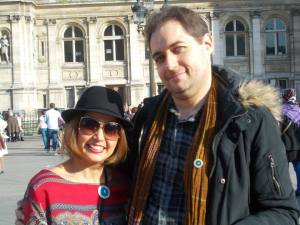
Among the people representing the Association of World Citizens in international forums or, as featured here, public demonstrations are Legal Officer Noura Addad (left) and External Relations Officer Bernard Henry (right). (C) Nadia Leïla Aïssaoui

It is probably in the environmental field — sustainable development — that there has been the most impact. Each environmental convention or treaty such as those on biological diversity or drought was negotiated separately, but with many of the same NGO representatives present. It is more difficult to measure the NGO role in disarmament and security questions. It is certain that NGO mobilization for an end to nuclear testing and for a ban on land mines and cluster weapons played a role in the conventions which were steps forward for humanity. However, on other arms issues, NGO input is more difficult to analyze.

‘Transnational advocacy networks’ which work across frontiers are of increasing importance as seen in the efforts against land mines, for the International Criminal Court and for increased protection from violence toward women and children. The groups working on these issues are found in many different countries but have learned to work trans-nationally both through face-to-face meetings and through the internet web. The groups in any particular campaign share certain values and ideas in common but may differ on other issues. Thus, they come together on an ad hoc basis around a project or a small number of related issues. Yet their effectiveness is based on their being able to function over a relatively long period of time in rather complex networks even when direct success is limited.

These campaigns are based on networks which combine different actors at various levels of government: local, regional, national, and UN (or European Parliament, OSCE etc.). The campaigns are waged by alliances among different types of organizations — membership groups, academic institutions, religious bodies, and ad hoc local groupings. Some groups may be well known, though most are not.

There is a need to work at the local, the national, and the UN levels at the same time. Advocacy movements need to be able to contact key decision-makers in national parliaments, government administrations and intergovernmental secretariats. Such mobilization is difficult, and for each ‘success story’ there are many failed efforts. The rise of UN consultative-status NGOs has been continual since the early 1970s. NGOs and government diplomats at the UN are working ever more closely together to deal with the world challenges which face us all.

______________________________________

NOTES:

(1) This interest is reflected in a number of path-making studies such as P. Willets (Ed.) The Consciences of the World: The Influence of Non-Governmental Organizations in the UN System (London: Hurst, 1996), T. Princen and M. Finger (Eds), Environmental NGOs in World Politics: Linking the Global and the Local (London: Routledge, 1994), M. Rech and K. Sikkink, Activists Without Borders: Advocacy Networks in International Politics (Ithaca, NY: Cornell University Press, 1998), Bas Arts, Math Noortmann and Rob Reinalda (Eds), Non-State Actors in International Relations (Aldershot: Ashgate, 2001) and William De Mars, NGOs and Transnational Networks (London: Pluto Press, 2005).
______________________________________

Prof. René Wadlow is President of the Association of World Citizens.
Jammeh: Here’s Your Hat, The Plane is Waiting

In Africa, Conflict Resolution, Current Events, Democracy, Human Rights, The Search for Peace, World Law on January 23, 2017 at 10:59 AM

JAMMEH: HERE’S YOUR HAT, THE PLANE IS WAITING

By René Wadlow

An update to the article “Gambia: The Cry of the Imburi” by René Wadlow, published on January 21, 2017.

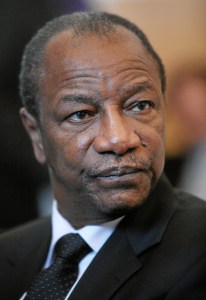
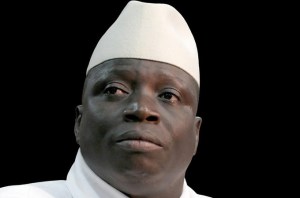
Yahya Jammeh, the former President of Gambia, chose the wiser course of action and left Gambia on Saturday, on January 20, 2017 at 9.15 PM local time with his wife Zineb and the President of Guinea, Alpha Condé, who had been negotiating the departure on behalf of the Economic Community of West African States (ECOWAS). He was wearing his trademark white cap and said that only God would judge him.

Senegal troops, mandated by ECOWAS, had already crossed the frontier of Gambia, although they said that their aim was to protect the people and not to bring about political change. There was, nevertheless, a potential for violence either in opposition to the Senegalese troops or among supporters and opponents to Jammeh.

Managing Resource Wealth: Alpha Conde

Alpha Condé, President of Guinea, who helped broker a peaceful solution to the political crisis in Gambia.

It is likely that the situation will remain relatively calm as people await the return to Gambia of Adama Barrow, who had taken the oath of office of President in the Gambian Embassy in Dakar on Friday, January 19, 2017. Barrow had left Gambia fearing for his life as Jammeh has a reputation of “disappearing” his opponents during his 22 years of rule. With Barrow’s return, the real work of socio-economic development can start.

As noted in my earlier article, Gambia is a creation of colonial history, the English came up the Gambia River first for the slave trade. After 1807 when the slave trade was banned north of the equator, there was a shift to other forms of trade. In the late 1860s the English started to set up an administration while the French were doing the same thing in what is now Senegal. Thus Gambia is bounded on both sides by Senegal and the Gambian population of about one and a half million have ethnic links with groups in Senegal.

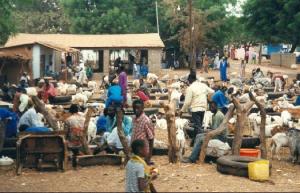
Gambia is heavily dependent on the Senegal, and a good number of Gambians work in Senegal. As Gambia has few resources beyond a subsistence agriculture and some export of peanuts, the country has become a transit area for drugs coming from Latin America destined for Europe. Gangs involved in the drug trade have also been involved in the arms trade. Since nothing in the small country escaped the eyes of Jammeh, it is most likely that he took his cut of the drug profits and placed his money outside of Gambia.

Press reports indicate that Jammeh and his wife quickly left Guinea for Equatorial Guinea, set between Cameroon and Gabon, also ruled by long-time and brutal dictator Obiang Nguema. Jammeh is in no danger of a trial.

1014050-market_in_abuko-the_gambia

In looking at the statistical tables of the UN Conference on Trade and Development’s Least Developed Countries Reports, the Gambian economy has been flat since Jammeh took power – the drug and arms trade are not part of the figures. In addition, the education and health sectors have been “weak” at best.

There have been since the independence of Senegal in 1960 proposals for the integration perhaps in the form of a confederation. For lack of a political will, such a con-federation has never been created. Rather we have a week integration of the Gambian economy into that of Senegal with no corresponding government structures.

It is too early to know what the future will hold. Armed violence is most probably avoided. But we must still keep an eye open to see if the new government is able to meet the new economic challenges.

Prof. René Wadlow is President of the Association of World Citizens.
Gambia: The Cry of the Imburi

In Africa, Being a World Citizen, Conflict Resolution, Current Events, Democracy, Human Rights, International Justice, The Search for Peace, World Law on January 22, 2017 at 10:25 AM

GAMBIA: THE CRY OF THE IMBURI
By René Wadlow

The Imburi are spirits that are said to inhabit the forests of Gabon in Equatorial Africa and who cry out for those who can hear them at times of impending violence or danger. Today, the Imburi are crying so that we will focus on the Gambia. The United Nations (UN) Security Council has heard the cry and has called for a transfer of authority to a new president, duly elected, Adama Barrow.

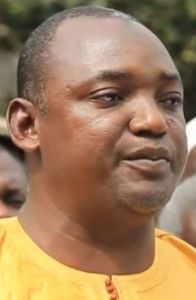
Adama Barrow took the oath of office of President on January 19, 2017 at the Embassy of Gambia in Dakar, Senegal as he is in exile for his safety in neighboring Senegal. The long-time President, Yahya Jammeh, who took power in 1994 in a military coup has been in office so long that he refuses to leave.

adama_barrow_2016

Adama Barrow, the new, democratically-elected President of Gambia.

Many have suggested that Jammeh could leave, especially to avoid local violence or foreign intervention. In his 22 years of service in a country where the trade of arms and drugs is the chief economic activity, he must have put his share of profits in foreign banks. There are suggestions that with funds collected to offer him a “golden parachute” he could leave peacefully. Nigeria has offered him a nice retirement home. But Jammeh insists that he will stay on and that the one December vote was somehow fixed against him and his alliance for Patriotic Reorientation and Construction Party.

The 15-nation Economic Community of West African States (ECOWAS) has strongly suggested that Jammeh leave power and has sent a number of high-level missions to the capital Banjul to urge a departure. To drive home their point, ECOWAS has stationed troops in Senegal on the frontier with Gambia. Some Senegalese troops, members of ECOWAS, have crossed the frontier into Gambia to prevent violence but said that they did not have a political mission. The current chair of ECOWAS is the Liberian President, Ellen Johnson Sirleaf, who knows first-hand what armed conflict and civil war can bring to a country.

There are those in Gambia who expect the worst. Some 45,000 have left the country for Senegal in the last few days. Many shops have closed, and food prices have climbed. There are real possibilities for violence. President Jammeh had a long-term policy of hate speech against minorities, especially the Mandinka whose traditional home is Senegal and against gays. Jammeh’s current supporters are stressing that “gays and their foreign supporters” are those who are creating instability.

yaya_jammeh

Yahya Jammeh, the former President of Gambia.

There is real danger that violence based on ethnicity, sexual orientation, and political allegiance will break out.

Ministers in Jammeh’s government have resigned including the key ministries of Foreign Affairs, Finance and Trade. Some ministers have left the country for Senegal fearing revenge violence. Certainly a quiet retirement in Nigeria would be a welcome end to Jammeh’s brutal and corrupt years of service. But the situation merits watching closely. The Imburi are worried.

Prof. René Wadlow is President of the Association of World Citizens.

Aleppo: Short-term action followed by reaffirmation of humanitarian law

In Being a World Citizen, Conflict Resolution, Current Events, Human Rights, Humanitarian Law, International Justice, Middle East & North Africa, Refugees, Solidarity, The Search for Peace, United Nations, War Crimes, World Law on December 20, 2016 at 10:34 PM

ALEPPO: SHORT-TERM ACTION FOLLOWED BY REAFFIRMATION OF HUMANITARIAN LAW

By René Wadlow


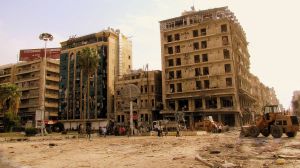
Stephen O’Brien, the United Nations (UN) Under Secretary-General for Humanitarian Affairs describing the ever-more destructive situation in and around Aleppo, Syria, said, “The parties to the conflict have shown time and again they are willing to take any action to secure military advantage even if it means killing, maiming or starving children into submission in the process.”

aleppo-1

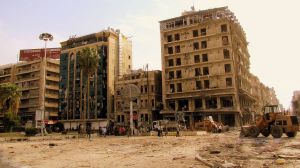
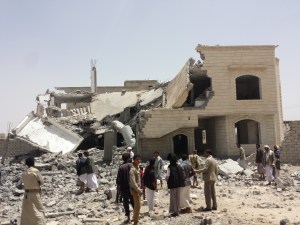
A large number of persons are trapped within the city, victims of blind bombardments, shelling, landmines and gunfire. Some persons are used as “human shields” and are unable to protect themselves. Medical facilities have been destroyed, and medical supplies are lacking. Food is unable to reach much of the population, and relief efforts are unable to reach persons in real need.

For the moment, there seems to be no willingness to negotiate a broad ceasefire. The UN Security Council is blocked. Thus, the only short-term action possible is to create “safe routes” so that those who wish to leave the besieged areas can do so. Mr. Brita Hagi Hasan, an elected official of a committee administering parts of Aleppo, has made a moving appeal for such humanitarian corridors. Some persons, an estimated 16,000 as of the first of December, have already been able to leave the city, but many more would do so if true safe routes were put into place.

Brita_Hagi_Hasan.jpg

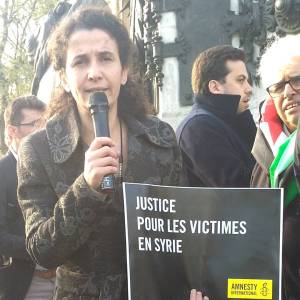
Brita Hagi Hasan (left), Chairman of the Local Council of the City of Aleppo, the (now defunct) local administration committee created by the leaders of the Syrian revolution there, addressing supporters in Paris, France on December 1, 2016. (C) Bernard J. Henry/AWC

However, there are two immediate obstacles. Many persons feel that such “safe routes” would, in fact, not be safe. There is a fear that they would be trapped, and once outside of their houses in the open, they would be shot at or bombed. The second fear is that they would not be safe when they reach government-held areas but could become victims of government-led repression.

aleppo-2

Thus, there is a double, short-term need: the first is accompaniment of citizens leaving the area either by UN or other international troops or by unarmed nongovernmental observers. With such accompaniment, there would be some reluctance to attack persons on foot or in buses. The second need is for credible guarantees by the government that there would be no reprisals against civilians, most of whom have been living in opposition-administered parts of the city, often for several years. There needs to be some sort of international follow-up to make sure that such government guarantees are honored.

Beyond these short-term but vital efforts, there is a longer-term need for the reaffirmation of the validity of humanitarian law and especially a reaffirmation of respect for humanitarian law.

The current armed conflicts in Afghanistan, Yemen, Libya, and the Syria-Iraq-ISIS-Kurds-Turkey conflict have seen a dangerous erosion of respect for the laws of war concerning medical facilities and personnel, concerning prisoners of war, of hostages, and of civilians, in particular women and children. There have been repeated cries of alarm from leaders of the International Committee of the Red Cross, of the UN, and nongovernmental organizations such as the Association of World Citizens (AWC). However, violations of these fundamental prohibitions of the laws of war continue. There have been relatively few calls for creative responses in the face of these continuing violations.

Thus, the AWC stresses the need to create immediately internationally-guaranteed safe routes for the evacuation of civilians from the besieged areas of Aleppo. Such guaranteed safe routes can also serve as a model for civilians in other besieged cities.

The AWC also calls for a serious investigation of the reasons for the erosion of the respect for humanitarian law to be followed by a UN-led conference on the reaffirmation of humanitarian law.

Prof. René Wadlow is President of the Association of World Citizens.
Immigration, Detention, Control

In Being a World Citizen, Conflict Resolution, Current Events, Europe, Human Rights, Middle East & North Africa, Migration, Refugees, Solidarity, The Search for Peace, United Nations, World Law on December 18, 2016 at 9:56 AM

IMMIGRATION, DETENTION, CONTROL

By René Wadlow

Migrants_1.jpg

If I were another on the road, I wouldn’t have looked back. I’d have said what one traveler says to another: Hello stranger, wake up your guitar! Let’s postpone our tomorrow to lengthen our road and widen our space, so that we may be rescued from our story together.


– Mahmoud Darwish, Palestinian poet.


By creating special observance days, the United Nations (UN) tries to promote international awareness and action on specific issues. Thus February 6 is International Day of Zero Tolerance to Female Genital Mutilation and March 20 is International Day of Happiness. May 2 highlights an issue we do not think about often: World Tuna Day. December 18 has been designated as the International Migrants Day, but even without a special day, migrants and refugees have become worldwide issues leading to political debate, especially in Europe and the USA.

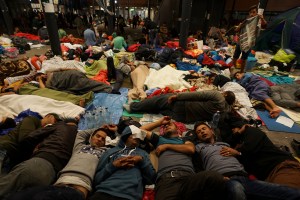
Asylum seekers and immigrants with low level of education are often seen as a “burden”, not only for “Fortress Europe” but also for first reception countries. Thus, today’s borders function as a filter, separating the “wanted” – that is, migrants who can be used – from the “unwanted”. The filter serves to separate those that get in from those who are pushed back.

migrants_3

The filter serves to distort refugee flows. Because unaccompanied minors are more protected by law or policy and are often not deported, there are an increasing number of unaccompanied minors separated from the rest of the family and facing very uncertain futures, especially as concerns education.

There have been some efforts to provide for educational facilities, but most often for students already at the university level. In September 2014, the German Foreign Minister, Frank-Walter Steinmeier, announced the establishment of a special scholarship program for refugees from Syria saying “We cannot allow the Syrian conflict to engender a lost generation. It is particularly young Syrians who will play a crucial role in rebuilding their country and deciding the future as soon as this terrible conflict is over. We want to help give this young generation a future perspective.” Since then there are many signs of a lost Syrian generation, especially for those in the neighboring countries of Jordan, Turkey and Lebanon.

The filter also increases the trafficking of people by organized bands who quickly learn the ways of going around a filter. The trafficking of women and children for the sexual industries occurs in all parts of the world, but increases in areas with armed conflicts. Women in war zones are forced into sex slavery by combatant forces or sold to international gangs. Even without commercial trafficking, there has been a sharp increase in early marriage among Syrian refugee girls in Jordan, marriage being one of the few ways to cope economically and socially.

Migrants_2.jpg

The systemic failures and bureaucratic delays that characterize government reception systems have left many migrants and refugees in a legal “limbo” in which migrants remain trapped, contributing to processes of alienation. There is obviously a need for cooperation and some coordination among States of origin, transit and destination – more easily said than done.

Fortunately, nongovernmental organizations (NGOs) have tried to meet the challenges of migrant and refugee flows, often being able to draw upon the spontaneous goodwill of people. However, there are real limits to what NGOs can do, especially on longer-term issues. There is an obvious need to resolve the different armed conflicts through negotiations in good faith. There is also an obvious need to increase development efforts in those countries from which economic migration is a strong motivation. There is also a need to reverse environmental damage with ecologically-sound development programs.

090525-N-4774B-032

December 18 should serve as a time when we look with compassion at the fate of migrants, refugees and the internally displaced. It is especially a time when we must plan and increase resources for creative action.

Prof. René Wadlow is the President of the Association of World Citizens.

Yazidi Freedom of Thought Honored

In Being a World Citizen, Conflict Resolution, Cultural Bridges, Current Events, Human Rights, International Justice, Middle East & North Africa, Religious Freedom, Solidarity, The Search for Peace, United Nations, War Crimes, World Law on December 3, 2016 at 11:07 PM

YAZIDI FREEDOM OF THOUGHT HONORED

By René Wadlow

The Yearly Sakharov Prize for Freedom of Thought awarded by the European Parliament was given on October 27, 2016 to Nadia Mourad Bassi Taka and Lamiya Aji Bachar, both Iraqi Yazidis. Both had been taken captive by Islamic State (IS) forces in August 2014 and then sold into sexual slavery and forced marriage. Both were recently able to escape from bondage and went to Germany as refugees. Both have become spokespersons for the Yazidis, especially those Yazidi women who are still being held in sexual slavery. The United Nations (UN) has appointed Nadia Taka as Goodwill Ambassador for the Dignity of Survivors of Human Trafficking.

art_13949

There were probably some 500,000 Yazidis, a Kurdish-speaking religious community living in northern Iraq, many in the Mosul area. Iraqi demographic statistics are not very reliable, and Yazidi leaders may give larger estimates by counting Kurds who had been Yazidis but who had converted to Islam. There were also some 200,000 Yazidis among the Kurds of Turkey but now nearly all have migrated to Western Europe, primarily Germany, to Australia, Canada, and the USA. There are also some Yazidis among Kurds living in Syria, Iran and Armenia. The Yazidi do not convert people, and so the religion continues only through birth into the community.

The structure of the Yazidi world view is Zoroastrian, a faith born in Persia proclaiming that two great cosmic forces, that of light and good, and that of darkness and evil are in constant battle. Man is called upon to help light overcome evil.

However, the strict dualistic thinking of Zoroastrianism was modified by another Persian prophet, Mani of Ctesiphon in the third century CE who had to deal with a situation very close to that of ours today. Mani tried to create a synthesis of religious teachings that were increasingly coming into contact through travel and trade: Buddhism and Hinduism from India, Jewish and Christian thought, Hellenistic Gnostic philosophy from Egypt and Greece as well as many smaller, traditional and “animist” beliefs. Mani kept the Zoroastrian dualism as the most easily understood intellectual framework, though giving it a somewhat more Taoist (yin/yang) flexibility, Mani having traveled to China, he developed the idea of the progression of the soul by individual effort through reincarnation – a main feature of Indian thought combined with the ethical insights of Gnostic and Christian thought. Unfortunately, only the dualistic Zoroastrian framework is still attached to Mani’s name – Manichaeism. This is somewhat ironic as it was the Zoroastrian Magi who had him put to death as a dangerous rival.

rene02_400_02

Within the Mani-Zoroastrian framework, the Yazidis added the presence of angels who are to help man in his constant battle for light and good, in particular Melek Tawis, the peacock angel. Although there are angels in Islam, angels that one does not know could well be demons, and so the Yazidis are regularly accused of being “demon worshipers” (1).

If one is to take seriously the statements of the IS leadership, genocide – the destruction in whole or in part of a group – is a stated aim concerning the Yazidis. The killing of the Yazidis is a policy and not “collateral damage” from fighting. The 1948 Convention for the Prevention and Punishment of the Crime of Genocide allows any State party to the Convention to “call upon the competent organs of the United Nations to take such action under the Charter of the United Nations as they consider appropriate for the prevention and suppression of acts of genocide.” Thus far, no State has done so by making a formal proposal to deal with the Convention.

rene01_400_06

The Yazidis have always been looked down upon by both their Muslim and Christian neighbors as “pagans”. The government of Saddam Hussein was opposed to them not so much for their religious beliefs but rather because some Yazidi played important roles in the Kurdish community, seen as largely opposed to the government. The Yazidis also had some old ownership claims on land on which oil reserves are found in northern Iraq which makes them suspect in the eyes of the current leadership of the Kurdish Autonomous Region of Iraq. The government of the Kurdish Region has accepted the Yazidi refugees but has done little to help their socio-economic development perhaps fearing competition with the Kurdish families now in control of the government. In all fairness, the government and the civil society of the Kurdish Region are stretched well beyond their means to deal with the refugees and displaced.

The current fighting in both Iraq and Syria overshadows concerns for the freedom of thought as the ability to live is in question. However, the Sakharov Prize may serve as a reminder that the quality of life is also measured by the ability to think and to hold on to one’s convictions.

(1) A Yazidi website has been set up by Iraqis living in Lincoln, Nebraska, USA. The website is uneven but of interest as a self-presentation: yeziditruth.org.

Prof. René Wadlow is President of the Association of World Citizens.
Les Citoyens du Monde appellent à des couloirs humanitaires à Alep (Syrie) pour laisser entrer l’aide et sortir les civils

In Being a World Citizen, Conflict Resolution, Current Events, Human Rights, International Justice, Middle East & North Africa, Solidarity, The Search for Peace, United Nations, War Crimes, World Law on December 2, 2016 at 1:04 AM

LES CITOYENS DU MONDE APPELLENT A DES COULOIRS HUMANITAIRES A ALEP (SYRIE) POUR LAISSER ENTRER L’AIDE ET SORTIR LES CIVILS

-- AWC-UN Geneva Logo --

L’Association of World Citizens (AWC) est choquée et révoltée par les attaques délibérées perpétrées par l’armée du Gouvernement syrien et les alliés étrangers de celui-ci contre les quartiers est de la ville d’Alep, sous le contrôle des forces révolutionnaires.

Nous condamnons fermement le refus persistant du gouvernement russe d’accepter aucune des résolutions proposées par la France au Conseil de Sécurité des Nations Unies pour une fin des bombardements menés par les troupes russes sur les secteurs d’Alep tenus par les rebelles.

Nous condamnons avec la même vigueur le refus constant des gouvernements syrien et russe de laisser ouvrir des couloirs humanitaires à l’intérieur d’Alep et depuis la ville, tant pour y laisser entrer l’aide d’urgence que pour permettre aux civils qui souhaitent quitter la zone de combat de le faire sans que leurs vies en soient mises en danger.

Nous en appelons aux gouvernements syrien et russe en vue de cesser leur obstruction à l’ouverture de tels couloirs et de créer enfin les conditions permettant, d’une part, à l’aide d’être acheminée aux zones qui en ont besoin, d’autre part, aux civils souhaitant fuir les secteurs subissant des attaques de chercher un abri en dehors d’Alep sans que ce soit à leurs risques et périls.

Enfin, l’AWC appelle à une solution politique en Syrie qui n’avalisât aucun fait accompli généré par des violations du droit international.

World Citizens Call for Humanitarian Corridors in Aleppo, Syria to Let Aid In and Civilians Out

In Conflict Resolution, Current Events, Human Rights, International Justice, Middle East & North Africa, Solidarity, The Search for Peace, United Nations, War Crimes, World Law on December 1, 2016 at 1:15 PM

WORLD CITIZENS CALL FOR HUMANITARIAN CORRIDORS IN ALEPPO, SYRIA TO LET AID IN AND CIVILIANS OUT

-- AWC-UN Geneva Logo --

The Association of World Citizens (AWC) is shocked and outraged by the relentless attacks carried out by the Syrian Government’s army and its foreign allies on the eastern districts of the city of Aleppo controlled by revolutionary forces.

We strongly condemn the persistent refusal of the Russian Government to accept any of the resolutions proposed by France to the United Nations Security Council for an end to the Russian forces’ bombardments on Aleppo’s rebel-held sectors.

We condemn with equal strength the Syrian and Russian Governments’ constant refusal to have humanitarian corridors opened into and from Aleppo, both to let emergency aid in and allow those civilians who wish to leave the combat zones to do so without endangering their lives.

We hereby call on the Syrian and Russian Governments to stop blocking the opening of such corridors and make it possible at last for aid to be delivered to those areas in need and for civilians wishing to flee those sectors under attack to seek shelter outside of Aleppo without putting themselves at risk in so doing.

Finally, the AWC calls for a political solution in Syria that does not endorse any fait accompli generated by violations of international law.

World Citizens Demand an End to All Hostile Maneuvers Toward Amnesty International in Russia

In Being a World Citizen, Current Events, Democracy, Europe, Human Rights, International Justice, Solidarity, The former Soviet Union, United Nations, World Law on November 4, 2016 at 9:20 AM

-- AWC-UN Geneva Logo --

WORLD CITIZENS DEMAND AN END TO ALL HOSTILE MANEUVERS
TOWARD AMNESTY INTERNATIONAL IN RUSSIA

The Association of World Citizens (AWC) is concerned that the headquarters of the Russian Section of Amnesty International, based in Moscow, have been sealed off by the local authorities and the staff have been barred from accessing the premises.

Although the Russian authorities have contended that the rent for the Amnesty headquarters was overdue, the organization has proved that this contention was unfounded, thus demonstrating that the sealing is an unwarranted move and a violation of Amnesty International’s rights as an organization of Human Rights Defenders in line with the provisions of Resolution 53/144 of the United Nations (UN) General Assembly.

Compliance with international human rights standards can never harm the stability – political, administrative or other, of a given society, only improve it by establishing firm legal, political, and moral norms that every citizen can both claim in defense of their own rights and use to defend the rights of others when necessary.

The AWC calls on the authorities of the Russian Federation and the City of Moscow to restore free access to the headquarters of Amnesty International Russia for its staff, volunteers, members and anyone else who may wish to visit with the consent of the Amnesty leadership there.