The Official Blog of the

Archive for the ‘Women’s Rights’ Category

Building on the UN Summit to Address Large Movements of Refugees and Migrants

In Being a World Citizen, Children's Rights, Conflict Resolution, Current Events, Democracy, Europe, Fighting Racism, Human Rights, Social Rights, Solidarity, The Search for Peace, United Nations, Women's Rights, World Law on September 20, 2016 at 6:58 PM

BUILDING ON THE UN SUMMIT TO ADDRESS LARGE MOVEMENTS OF REFUGEES AND MIGRANTS

By René Wadlow

awc-un-geneva-logo

On September 19, 2016, the United Nations (UN) General Assembly held a one-day Summit on “Addressing Large Movements of Refugees and Migrants”, a complex of issues which have become important and emotional issues in many countries. Restrictive migration policies deny many migrants the possibility of acquiring a regular migrant status, and as a result, the migrants end up being in an irregular or undocumented situation in the receiving country and can be exposed to exploitation and serious violations of human rights.

Citizens of the world have been actively concerned with the issues of migrants, refugees, the “stateless” and those displaced by armed conflicts within their own country. Thus we welcome the spirit of the Summit Declaration with its emphasis on cooperative action, a humane sense of sharing the responsibilities for refugees and migrants and on seeking root causes of migration and refugee flows. There are three issues mentioned in the Summit Declaration which merit follow up action among the UN Secretariat, world citizens and other non-governmental organizations:

1) The migration of youth;

2) The strong link between migration, refugee flows, and improving the structures for the resolution of armed conflicts;

3) Developing further cooperation among non-governmental organizations for the protection and integration of refugees and migrants.

The Migration of Youth

Youth leave their country of birth to seek a better life and also to escape war, poverty, and misfortune. We should add to an analysis of trans-frontier youth migration a very large number of youth who leave their home villages to migrate toward cities within their own country. Without accurate information and analysis of both internal and trans-frontier migration of youth, it is difficult to develop appropriate policies for employment, housing, education and health care of young migrants and refugees. It is estimated that there are some 10 million refugee children, and most are not in school.

Studies have noted an increasing feminization of trans-frontier migration in which the female migrant moves abroad as a wage earner, especially as a domestic worker rather than as an accompanying family member. Migrant domestic workers are often exposed to abuse, exploitation and discrimination based on gender, ethnicity and occupation. Domestic workers are often underpaid, their working conditions poor and sometimes dangerous. Their bargaining power is severely limited. Thus, there is a need to develop legally enforceable contracts of employment, setting out minimum wages, maximum hours of work and responsibilities.

The Association of World Citizens recommends that there be in the follow ups to the Summit, a special focus on youth, their needs as well as possibilities for positive actions by youth.

The strong link between migration, refugee flows, and improving the structures for the resolution of armed conflicts

The UN General Assembly which follows immediately the Migration-Refugee Summit is facing the need for action on a large number of armed conflicts in which Member States are involved. In some of these conflicts the UN has provided mediators; in others, UN peacekeepers are present. In nearly all these armed conflicts, there have been internally-displaced persons as well as trans-frontier refugees. Therefore, there is an urgent need to review the linkages between armed conflict and refugee flows. There needs to be a realistic examination as to why some of these armed conflicts have lasted as long as they have and why negotiations in good faith have not been undertaken or have not led to the resolution of these armed conflicts. Such reflections must aim at improvements of structures and procedures.

Developing further cooperation among nongovernmental organizations for the protection and integration of refugees and migrants

We welcome the emphasis in the Summit Declaration on the important role that nongovernmental organizations (NGOs) play in providing direct services to refugees and migrants. NGOs also lobby government authorities on migration legislation and develop public awareness campaigns. The Summit has stressed the need to focus on future policies taking into account climate change and the growing globalization of trade, finance, and economic activities. Thus, there needs to be strong cooperation among the UN and its Agencies, national governments, and NGOs to deal more adequately with current challenges and to plan for the future. Inclusive structures for such cooperation are needed.

Prof. René Wadlow is President of the Association of World Citizens.
Yemen Negotiations Move Ahead Slowly – Postwar Planning Needed

In Being a World Citizen, Children's Rights, Conflict Resolution, Current Events, Human Development, Human Rights, Middle East & North Africa, Solidarity, The Search for Peace, United Nations, Women's Rights, World Law on July 19, 2016 at 4:50 PM

YEMEN NEGOTIATIONS MOVE AHEAD SLOWLY – POSTWAR PLANNING NEEDED

As a result of Saudi bombing raids, Yemen’s underdeveloped socio-economic infrastructure has been largely destroyed. Post-war planning will need to be followed by international aid for development, with post-war socio-economic construction developed on a basic needs approach.

By René Wadlow

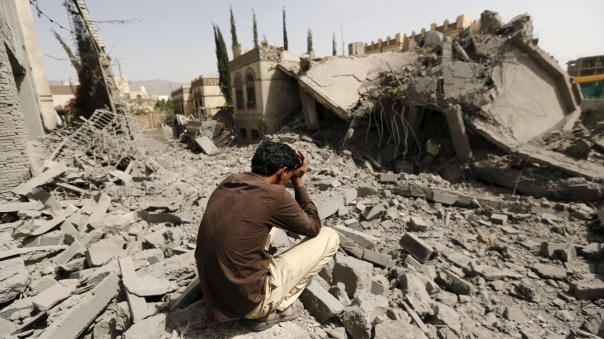
Guard sits on the rubble of the house of Brigadier Fouad al-Emad, an army commander loyal to the Houthis, after air strikes destroyed it in Sanaa, Yemen

A guard sits on the rubble of the house of Brigadier Fouad al-Emad, an army commander loyal to the Houthis, after air strikes destroyed it in Sanaa, Yemen June 15, 2015. Warplanes from a Saudi-led coalition bombarded Yemen’s Houthi-controlled capital Sanaa overnight as the country’s warring factions prepared for talks expected to start in Geneva on Monday. REUTERS/Khaled Abdullah

The United Nations (UN)-mediated peace negotiations for Yemen led by Ismail Ould Cheikh in Kuwait move ahead slowly. The 13-month war was at first between Houthis tribal forces loyal to former President Ali Abdallah Saleh and those supporting the current president, Abd-Rabbu Mansour Hadi, who had been Saleh’s vice-president for many years. The war is a struggle for power but is not an ideological-religious-tribal conflict.

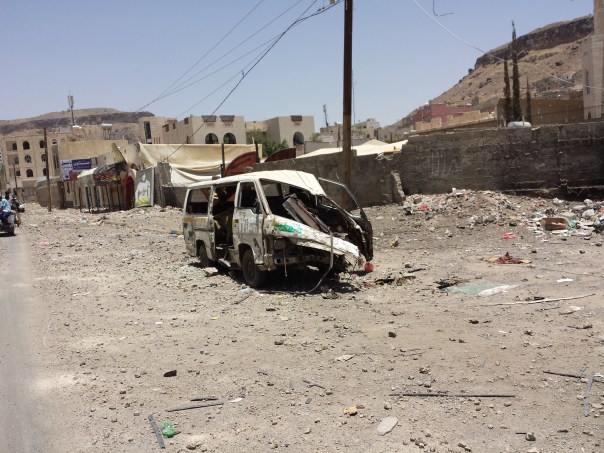
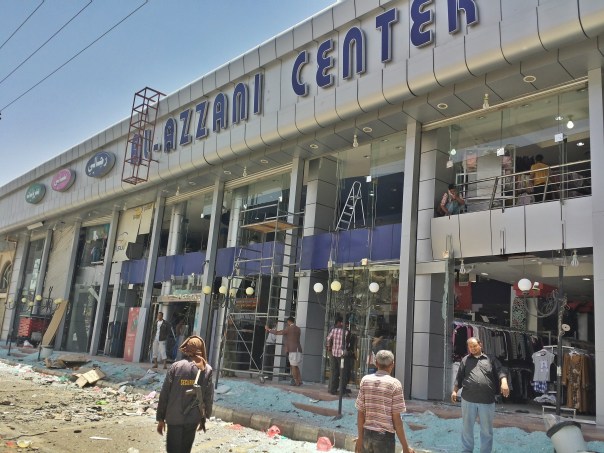
Into this conflict has come a Saudi Arabian-led military coalition using bombs and sophisticated weapons. As a result, some 2.5 million people have been displaced within the country. Yemen was already a poor country which needed to import much of its agricultural and food supplies. As a result of the Saudi bombing raids, the underdeveloped socio-economic infrastructure has been largely destroyed.

Sanaa

A shopping center destroyed by an airstrike in Sana’a, the capital of Yemen, on April 20, 2015. (C) Ibrahem Qasim

Thus, there is a serious need first for postwar planning to be followed by international aid for development. “Reconstruction” would be the wrong term since there was little that had been “constructed”. Rather, we need to look to a postwar socio-economic construction developed on a basic needs approach.

The Basic Needs Approach to Development with its emphasis on people as central to the development process is embodied in the June 1976 World Employment Conference Declaration of Principles and Program of Action.[i] The Declaration underlines the importance of the individual and the central role of the family and household as the basic unit around which to work for development.

Although the Basic Needs Approach builds on the development thinking of the UN and national governments of the 1950s and 1960s such as rural development, urban poverty alleviation, employment creation through small-scale industries, the Declaration of Principles is a major shift in development strategies with its focus on the family with the objective of providing the opportunities for the full physical, mental, and social development of the human personality. The Program of Action defines a two-part approach: “First, Basic Needs includes certain minimum requirements of a family for private consumption: adequate food, shelter and clothing, as well as certain household equipment and furniture. Second, Basic Needs includes essential services provided by and for the community at large, such as safe drinking water, sanitation, public transport, health, education and cultural facilities.”

Airstrike

Widespread destruction in a residential neighborhood near Mount Attan after an airstrike carried out by the Saudi Arabian-led “coalition” in Yemen. (C) Ibrahem Qasim

The Program added a basic element to the actions: “A Basic Needs-oriented policy implies the participation of the people in making the decisions which affect them through organizations of their own choice.”

The Basic Needs Approach concentrates on the nature of what is provided rather than on income − income having often been used as the criteria for drawing a ‘poverty line’. The Basic Needs Approach is concerned not only with the underemployed but also with the unemployable: the aged, the sick, the disabled, orphaned children and others. Such groups have often been neglected by the incomes and productivity approach to poverty alleviation and employment creation.

For Yemen which is largely structured on the basis of clan – extended family institutions, the Basic Needs Approach is most appropriate. In practice, there are few institutions or associations beyond the clan level, although tribal and religious identities are often mentioned. Tribes and religious identity are “shorthand” terms as it is impossible to mention the multitude of clans. However, a family welfare – meeting basic needs is the most appropriate strategy on which to base postwar planning. Although the fighting continues sporadically and agreement on a possible “unity government” seems far away, Basic Needs Planning must start now.

Prof. René Wadlow is President and a Representative to the United Nations Office at Geneva of the Association of World Citizens.

[i] See the Director General’s Report and the Declaration in the International Labor Office. Employment, Growth and Basic Needs: A One World Problem (New York: Praeger Publishers, 1977, 224 pp.)

Frank Baum: The Father of the Wizard of Oz

In Being a World Citizen, Human Development, Women's Rights on May 15, 2016 at 3:38 PM

FRANK BAUM: THE FATHER OF THE WIZARD OF OZ

By René Wadlow

dorothy-toto

“Toto, we are not in Kansas any more …”

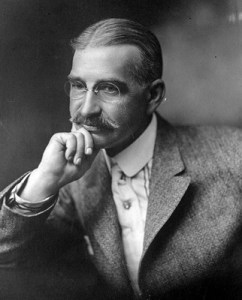
Frank Baum (1856-1916) whose birth anniversary we mark on May 15 is largely forgotten as a writer while his 1899 book The Wonderful Wizard of Oz lives on through the 1939 film with Judy Garland as Dorothy and references in essays to the Tin Woodman without a heart or Toto, Dorothy’s faithful dog.

The story begins as Dorothy and Toto are picked up from their farm in Kansas by a cyclone and carried into another world − the land of Oz. Dorothy wants to return to Kansas and is advised to consult the Wizard who lives in the Emerald City at the center of the Land of Oz. Dorothy and Toto set out on the Yellow Brick Road for the Emerald City. On the way they meet three companions, each of whom joins her in the hope that the Wizard of Oz will be able to give him what he lacks. The first is the Scarecrow whose head is of straw and wants some brains so he can think. The second is the Tin Woodman who wants a heart so he can love. The third is the Cowardly Lion, who should be the king of the forest, but this lion is afraid of everything. He wants courage so that he can act.

When they finally meet the Wizard of Oz, he turns out to be a human like Dorothy. He was a balloonist in Nebraska who worked in a circus, going up in the balloon to attract a crowd. One day a strong wind blew him all the way to Oz where the inhabitants took him to be a great wizard.

Frank Baum

Frank Baum

The Wizard of Oz has all the essentials of a myth. It is set in a perilous, enchanted land where the human protagonist is engaged in a quest. She faces great difficulties but is helped by extraordinary friends who are also on a quest. The three friendly helpers represent what they think they lack: intelligence, love, courage.

At the end, each finds within himself the qualities they are seeking. We each have within ourselves the qualities we seek. The myth is a metaphor for balancing energies at all levels. Just as the spiritual transformation of a person must be initiated from within, so too collective bodies such as the Emerald City must discover the inner power to balance their energies and transform themselves into more humane systems.

Both individuals and organizations can become whole only if they can balance intellect, emotions, and courage. Through this balance, individuals and organizations develop a sense of purpose, a direction for their quest. Many spiritual traditions emphasize the importance of balancing one’s energies as a means for spiritual growth, such as the Taoist Yin and Yang, thought of as ‘masculine’ and ‘feminine’ energies. The balance must occur within each person who has both masculine and feminine qualities within. The balance must be initiated from within the person, but this inner response comes from contact with external forces − thus the adventures and crises of the Oz myth.

The Wizard of Oz.jpg

Frank Baum as a newspaper editor was a strong advocate of the rights of women, and his wife was very active in efforts for the right of women to vote. Thus, it is not surprising to find Dorothy as the central character of the story. She symbolizes all the various energies and forces of the story. She finds her personal balance resulting in her spiritual transformation and her ability to achieve her quest − to return ‘home’.

As with all myths, the story can be read at different levels. However, Frank Baum had a strong interest in Asian thought, and a spiritual reading of the myth is not adding something that was not consciously there.

The MGM film with its songs sung by Judy Garland is out as a CD and merits seeing or re-seeing.

“Somewhere, over the rainbow, way up high …”

For a biography see: Katharine M. Rogers, L. Frank Baum. Creator of Oz. A Biography (New York: St Martin’s Press, 2002)
To place Oz in the broader context of U. S. myth-making, see Brian Attebery, The Fantasy Tradition in American Literature (Bloomington, IN: Indiana University Press, 1980)

Prof. René Wadlow is President of the Association of World Citizens.
A report on the UN Commission on the Status of Women, New York City, March 14-24, 2016

In Being a World Citizen, Conflict Resolution, Democracy, Environmental protection, Human Development, Human Rights, International Justice, Social Rights, Solidarity, The Search for Peace, Uncategorized, United Nations, Women's Rights, World Law on March 26, 2016 at 9:27 AM

Received from Sue Zipp, Vice-President of the Association of World Citizens:

*  *  *

UN COMMISSION ON THE STATUS OF WOMEN URGES GENDER-RESPONSIVE IMPLEMENTATION OF AGENDA 2030

Meeting concludes with agreement on foundations to accelerate action for all women and girls.

Date: 24 March 2016
Media Contacts:
Oisika Chakrabarti, +1 646 781-4522, oisika.chakrabarti@unwomen.org
Sharon Grobeisen, +1 646 781-4753, sharon.grobeisen@unwomen.org

* * *

New York — The 60th session of the UN Commission on the Status of Women concluded today with UN Member States committing to the gender-responsive implementation of Agenda 2030. A set of agreed conclusions called for enhancing the basis for rapid progress, including stronger laws, policies and institutions, better data and scaled-up financing.

The Commission recognized women’s vital role as agents of development. It acknowledged that progress on the Sustainable Development Goals at the heart of Agenda 2030 will not be possible without gender equality and the empowerment of all women and girls.

UN Women Executive Director Phumzile Mlambo-Ngcuka welcomed the agreement and the commitment of UN Member States to make the 2030 Agenda, adopted last September, a reality in countries around the world. She said: “Countries gave gender inequality an expiry date: 2030. Now it is time to get to work. These agreed conclusions entrench and start the implementation of a gender-responsive agenda 2030 with which we have the best possibility to leave no one behind.”

UN Women 1

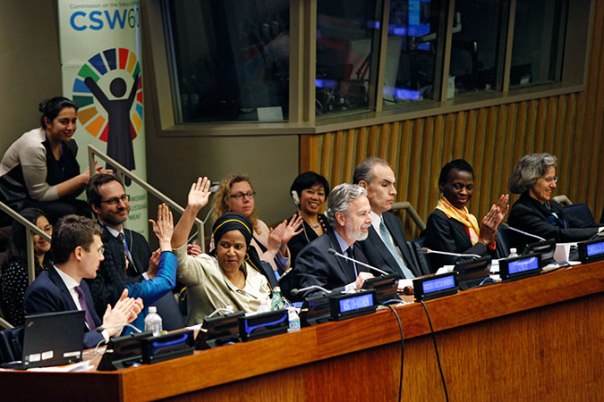
Photo: UN Women/Ryan Brown

UN Women Executive Director Phumzile Mlambo-Ngcuka high-fives UN Women Deputy Executive Director Lakshmi Puri as the CSW Chair Antonio de Aguilar Patriota of Brazil announces the adoption of the agreement. Photo: UN Women/Ryan Brown.

Growing global commitment was already in evidence with a record number of more than 80 government ministers from around the world attending the Commission. Around 4,100 non-governmental representatives from more than 540 organizations participated as well, the highest number ever for one of the Commission’s regular annual meetings.

The agreed conclusions urge a comprehensive approach to implementing all 17 Sustainable Development Goals through thorough integration of gender perspectives across all government policies and programmes. Eliminating all forms of gender-based discrimination depends on effective laws and policies and the removal of any statutes still permitting discrimination. Temporary special measures may be required to guarantee that women and girls can obtain justice for human rights violations.

The Commission endorsed significantly increased investment to close resource gaps for achieving gender equality and the empowerment of all women and girls. Funds should be mobilized from all sources, domestic and international, ranging from fulfilling official development assistance commitments to combatting illicit financial flows that shortchange public resources for gender equality.

With humanitarian crises and other emergencies disproportionately affecting women and girls, the Commission underlined the imperative of empowering women in leadership and decision-making in all aspects of responding to and recovering from crisis. On the eve of the World Humanitarian Summit, it stressed prioritizing women’s and girls’ needs in humanitarian action and upholding their rights in all emergency situations. Every humanitarian response should take measures to address sexual and gender-based violence.

UN Women 2

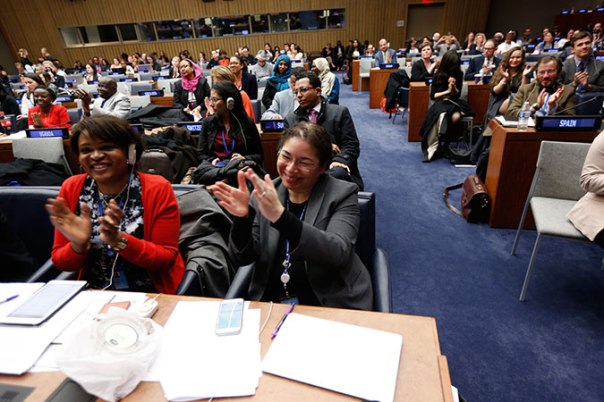
Photo: UN Women/Ryan Brown

CSW60 delgates applaud as an agreement is announced during the closing plenary. Photo: UN Women/Ryan Brown.

Members of the Commission united behind ensuring women’s equal participation in leadership at all levels of decision-making in the public and private spheres, encompassing governments, businesses and other institutions, and across all areas of sustainable development. Depending on different circumstances, this may involve establishing temporary special measures, setting and achieving concrete benchmarks and removing barriers to women’s participation.

Given the major contributions to Agenda 2030 of civil society, including women’s and community-based organizations, feminist groups, human rights defenders and girls’ and youth-led organizations, the Commission welcomed open engagement and cooperation with them in gender-responsive implementation. It emphasized fully engaging with men and boys as agents of change and allies in the elimination of all forms of discrimination and violence against women and girls.

To guide systematic progress towards gender equality and women’s empowerment throughout the 2030 Agenda, the Commission stressed enhanced national statistical capacity and the systematic design, collection and sharing of high-quality, reliable and timely data disaggregated by sex, age and income. Members also agreed to bolster the role of national mechanisms for women and girls in championing their equality and empowerment.

UN Women 3

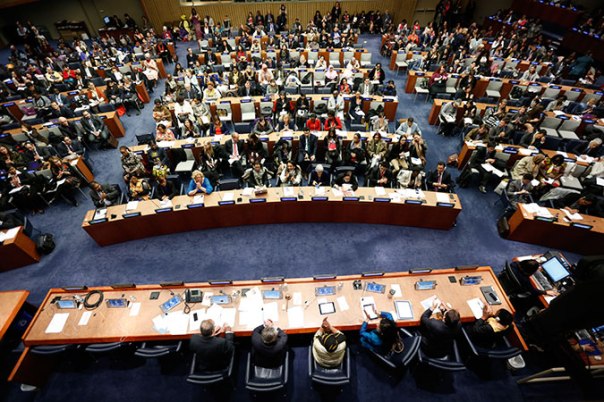
Photo: UN Women/Ryan Brown

A wide view of the room during the closing plenary meeting of the 60th Session of the UN Commission on the Status of Women. Photo: UN Women/Ryan Brown.

– See more at: http://www.unwomen.org/en/news/stories/2016/3/press-release-csw60-urges-gender-responsive-implementation-of-agenda-2030#sthash.ci0a4sJ9.dpuf

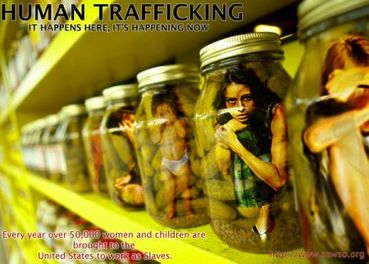
UN-Designated Day for Developing Awareness of Human Trafficking

In Being a World Citizen, Children's Rights, Current Events, Human Development, Human Rights, International Justice, Social Rights, Solidarity, United Nations, Women's Rights, World Law on January 11, 2016 at 11:23 PM

POUR UN NOUVEL ANTI-ESCLAVAGISME

In Africa, Being a World Citizen, Children's Rights, Current Events, Human Rights, International Justice, Middle East & North Africa, Religious Freedom, United Nations, War Crimes, Women's Rights on February 10, 2015 at 12:10 AM

-- AWC-UN Geneva Logo --

L’Association of World Citizens

dit

L’ESCLAVAGE,

PLUS JAMAIS CA !

  1. L’esclavage est IMMORAL,
  2. L’esclavage est CONTRAIRE AU DROIT MONDIAL,
  3. L’esclavage doit être VAINCU SANS RECOURIR A LA GUERRE.

L’asservissement, la vente tel du bétail, et le mariage forcé de femmes et de jeunes filles par l’ « Etat islamique » (Daesh) dans les zones de l’Irak et de la Syrie qu’il a soumises par la barbarie, ainsi que par Boko Haram dans le nord-est du Nigéria, appellent une réaction concertée, notamment dans la mesure où cette pratique risque de s’étendre à d’autres zones telles que le nord du Cameroun et du Niger si l’influence de Boko Haram continue de croître.

C’est pourquoi l’Association of World Citizens appelle à un effort aussi vaste que possible en direction d’un Nouveau Mouvement Anti-Esclavagiste, rappelant à cette fin la devise du Libérateur (1831-1865) de William Lloyd Garrison, «Notre pays, c’est le Monde, et tous les êtres humains sont nos compatriotes».

Aux Etats-Unis, l’abolition de l’esclavage ne fut qu’un aspect de la sanglante Guerre de Sécession qui n’a produit que de l’amertume et n’a eu d’influence sur les relations interraciales que négative. En France, une première abolition de l’esclavage dans la fureur guerrière de la Révolution n’a abouti qu’à son rétablissement sous un Premier Empire qui s’est montré tout aussi guerrier, l’abolition définitive n’étant venue, avec Victor Schoelcher, que lorsque les canons se furent enfin tus. C’est pourquoi nous croyons fermement que l’esclavage tel que le pratiquent Daesh et Boko Haram doit être vaincu sans qu’il y ait pour cela recours à une guerre.

A travers les frappes aériennes en cours contre Daesh et l’action militaire kurde pour enrayer les atrocités de ce dernier, les tambours de la guerre se font pourtant d’ores et déjà entendre. Les troupes tchadiennes et camerounaises se sont jointes aux forces armées nigérianes pour empêcher Boko Haram de nuire plus avant, ce qui ne fera toutefois qu’ajouter encore au conflit armé déjà violent dans la région. Des armées peuvent vaincre d’autres armées, mais comme le rappelle l’Acte constitutif de l’UNESCO, «Les guerres prenant naissance dans l’esprit des hommes, c’est dans l’esprit des hommes que doivent être élevées les défenses de la paix».

Nous croyons donc que la réponse au problème doit venir d’un mouvement social et populaire issu des sociétés irakienne, syrienne et nigériane, qui reconnaissent toutes que l’esclavage est immoral et constitue une violation du droit mondial. La prohibition de l’esclavage est un élément crucial du droit mondial, au sein duquel elle s’est manifestée historiquement tant par les interdictions du trafic d’esclaves au dix-neuvième siècle, obtenues grâce au combat du Mouvement Anti-Esclavagiste de l’époque, que par celles édictées plus tard par la Société des Nations et enfin par l’action des Nations Unies depuis leur création en 1945.

Aujourd’hui, c’est d’un Nouveau Mouvement Anti-Esclavagiste que nous avons besoin, afin d’en appeler à toutes celles et tous ceux qui, au Moyen-Orient et en Afrique, peuvent et veulent nous rejoindre pour réaffirmer et renforcer le respect de la dignité humaine, en particulier des femmes et des jeunes filles, ainsi que le respect des droits des minorités religieuses quelles qu’elles soient.

REJOIGNEZ-NOUS DANS CE COMBAT!

THE NEW ABOLITIONISTS

In Africa, Being a World Citizen, Children's Rights, Current Events, Human Rights, International Justice, Middle East & North Africa, Religious Freedom, United Nations, War Crimes, Women's Rights, World Law on February 9, 2015 at 11:19 PM

-- AWC-UN Geneva Logo --

The Association of World Citizens

says

 NO TO SLAVERY!

  1. Slavery is IMMORAL,
  2. Slavery is BANNED BY WORLD LAW,
  3. Slavery must be OVERCOME WITHOUT RESORT TO WAR.

The enslavement, sale, and forced marriage of women and girls by the Islamic State (ISIS) in parts of Iraq-Syria and by Boko Haram in northeast Nigeria calls for concerted action, especially as the practice may spread to other areas such as northern Cameroon and Niger if the influence of Boko Haram grows.

Therefore, the Association of World Citizens calls for a broad effort of a New Abolitionist Movement, recalling the motto of The Liberator (1831-1865) of William Lloyd Garrison “Our country is the world; our countrymen are all mankind.”

As slavery was abolished in the United States only as an aspect of a bloody civil war which left long bitterness and influenced race relations negatively, we believe that slavery in ISIS and Boko Haram-held areas must be overcome without recourse to a war. The signs of war are already present in air strikes on ISIS positions and Kurdish military action. The joining of troops from Chad and Cameroon to Nigerian forces to combat Boko Haram can also lead to increased armed conflict.

Rather, we believe that reform must come from within Iraqi, Syrian and Nigerian society which recognizes that slavery is immoral and a violation of world law. The banning of slavery is a core element of world law: the unilateral bans on the slave trade of the nineteenth century in response to the efforts of the Abolitionist Movements, the League of Nations bans, and the continuing efforts of the United Nations.

Today, a New Abolitionist Movement is needed to reach out to those in the wider Middle East and Africa to join in strengthening respect for human dignity, respect of women and girls and respect of religious minorities.

JOIN US IN THIS COMMON CAUSE!

Liberating the Young Women Kidnapped by Boko Haram

In Africa, Being a World Citizen, Children's Rights, Conflict Resolution, Current Events, Foundations for the New Humanism, Human Rights, Solidarity, War Crimes, Women's Rights, World Law on May 12, 2014 at 1:53 PM

LIBERATING THE YOUNG WOMEN KIDNAPPED BY BOKO HARAM

By René Wadlow


Citizens of the World, motivated by the spirit of compassion symbolized by Kuan Yin appeal to the members of Boko Haram to return the young women taken from the girls’ school in Chibok, northeastern Nigeria.

The actions of Boko Haram undermine the efforts of local and national educational services in Nigeria to overcome the persistent poverty and lack of development in northern Nigeria.

Although the name of the armed group which carried out the kidnapping can be roughly translated as “Western Education is Unlawful” of forbidden, its members know full well that education is neither “Western” or “Southern” but is an effort to train individuals to meet the challenges of life and to develop their full potential as persons. The members of Boko Haram know that education is a crucial need for the development of northern Nigeria and that the education of women is necessary for progress.

Kuan Yin is the bodhisattva (the "compassionate one") associated with compassion as venerated by East Asian Buddhists, usually as a female. The name Guanyin is short for Guanshiyin, which means "Observing the Sounds (or Cries) of the World." (Source: Wikipedia)

Kuan Yin (or Guanyin) is the bodhisattva (the “compassionate one”) associated with compassion as venerated by East Asian Buddhists, usually as a female. The name Guanyin is short for Guanshiyin, which means “Observing the Sounds (or Cries) of the World.” ((c) Wikipedia)

We are sure that many members of the Boko Haram group understand that their actions are morally wrong as well as unlawful under Nigerian law and in violation of the universally-recognized standards of human rights. Thus they will act to return the young women to their home area.

Armed violence will destroy the efforts being made to meet basic needs and to improve the standard of living of all in northern Nigeria. A spirit of compassion should motivate members of Boko Haram to return the young women to their families and to find nonviolent ways to better the lives of all in northern Nigeria.


Prof. René Wadlow is President of the Association of World Citizens.
Can Persistent Racism be a Prelude to Genocide?

In Being a World Citizen, Fighting Racism, Human Rights, International Justice, The Search for Peace, United Nations, War Crimes, Women's Rights, World Law on December 9, 2013 at 1:31 PM

CAN PERSISTENT RACISM BE A PRELUDE TO GENOCIDE?

An Interrogation to Mark the Anniversary of the Genocide Convention

By René Wadlow

December 9 is the anniversary of the 1948 Convention on Genocide, signed at the UN General Assembly held in 1948 in Paris. The Genocide Convention was signed the day before the proclamation on December 10, 1948 of the Universal Declaration of Human Rights. The two texts were much influenced by the Second World War. The crimes of Nazi Germany were uppermost in the minds of those who drafted the Convention in order to deal with a new aspect of international law and the laws of war.

The protection of civilians from deliberate mass murder was already in The Hague and Geneva Conventions of international humanitarian law. However, genocide is different from mass murder. Genocide is the most extreme consequences of racial discrimination and ethnic hatred. Genocide has as its aim the destruction, wholly or in part, of national, ethnic, racial or religious group as such. The term was proposed by the legal scholar Raphael Lemkin, drawing on the Greek genos (people or tribe) and the Latin cide (to kill)[i].

Mass deaths are not genocide. The largest number of deaths since the end of the Second World War was the failure of Chinese agricultural policies between 1958 and 1962 with over 20 million deaths, but the aim was not to destroy the Chinese as a people. Likewise, the destructive famine in Ukraine 1932-1933 with its seven million dead had a political motivation to reduce opposition but not to destroy the Ukrainians as a people. The United States-led war in Vietnam killed some two million Vietnamese, but the aim was not to destroy the Vietnamese as a people.

Genocide in the sense of a desire to eliminate a people has nearly always a metaphysical aspect as well as deep-seated racism. This was clear in the Nazi desire to eliminate Jews, first by forced emigration from Europe and, when emigration was not possible, by physical destruction.

With the horrendous Jewish Holocaust committed by Nazi Germany in mind, on December 9, 1948 the UN General Assembly made genocide the subject matter of the very first human rights instrument created by the World organization, one day before even the Universal Declaration of Human Rights was adopted by the Assembly in Paris.

With the horrendous Jewish Holocaust committed by Nazi Germany during World War II in mind, on December 9, 1948 the UN General Assembly made genocide the subject matter of the very first human rights instrument created by the World organization, one day before even the Universal Declaration of Human Rights was adopted by the Assembly in Paris.

We see a desire to destroy totally certain tribes in the Darfur conflict in Sudan that did not exist in the much longer and more deadly North-South Sudan Civil War (1956-1972, 1982-2005). Darfur tribes are usually defined by “blood lines” — marriage and thus procreation is limited to a certain population, either within the tribe or with certain other groups with which marriage relations have been created over a period of time. Thus children born of rape — considered ‘Janjaweed babies ‘— after the government-sponsored Janjaweed militias— are left to die or are abandoned. The raped women are often banished or ostracized. By attacking both the aged, holders of traditional knowledge, and the young of child-bearing age, the aim of the destruction of the continuity of a tribal group is clear.

We find the same pattern in some of the fighting in the eastern provinces of the Democratic Republic of Congo where not only are women raped but their sexual organs are destroyed so that they will not be able to reproduce.

Thanks to the efforts of Raphael Lemkin, the international community does have a legal instrument to deal with genocide and punish perpetrators whenever necessary. The only trouble is that in this day and age, "genocide" has still not become an anachronism in global affairs.

Thanks to the efforts of Raphael Lemkin, the international community does have a legal instrument to deal with genocide and punish the perpetrators thereof. It is a shame, though, that in this day and age, “genocide” has still not become an anachronism in global affairs.

Article VIII of the Genocide Conventions provides that “Any Contracting Party may call upon the Competent Organs of the United Nations to take such action under the Charter of the UN as they consider appropriate for the prevention and suppression of acts of genocide or any of the other acts enumerated in article III”. Unfortunately no State has ever done so.

Thus we need to look more closely at the ways in which deep-set racism and constant and repeated accusations against a religious, ethnic or social category can be a prelude to genocide.


Prof. René Wadlow is President and Chief Representative to the United Nations Office at Geneva of the Association of World Citizens.


[i] Raphael Lemkin, Axis Rule in Occupied Europe (Washington: Carnegie Endowment for World Peace, 1944)

For good overviews see:

Walliman and Dobkowski (Eds), Genocide and the Modern Age (New York: Greenwood Press, 1987)

F. Chalk, K. Jonassohn, The History and Sociology of Genocide (New Haven: Yale University Press, 1990)

G.J. Andreopoulos (Ed), Genocide Conceptual and Historical Dimensions Philadelphia (University of Pennsylvania Press, 1994)

Samantha Power, A Problem from Hell: America and the Age of Genocide (New York: Basic Books, 2002)

John Tirman, The Death of Others (New York: Oxford University Press, 2011)

Violences contre les femmes : Des murs qui emprisonnent

In Human Rights, International Justice, Solidarity, United Nations, Women's Rights, World Law on November 25, 2013 at 10:57 PM

VIOLENCES CONTRE LES FEMMES : DES MURS QUI EMPRISONNENT

Par René Wadlow


Lorsque, dans son discours de lauréat du Prix Nobel de la Paix (1974), Sean McBride (1904-1988) a cité, aux côtés du développement et de l’acceptation des armes nucléaires sans discernement, l’utilisation d’armes chimiques et d’assassinats politiques comme les signes d’un « écroulement presque total de la moralité publique et privée dans pratiquement tous les secteurs des relations entre les êtres humains », il a mis l’accent sur le thème qui lui était le plus cher : la nécessité d’actions non-gouvernementales visant à assurer la survie.

Même si McBride avait servi en qualité de Ministre irlandais des Affaires Etrangères entre 1948 et 1951 et joué en cela un rôle important dans la création du Conseil de l’Europe, c’est bien en tant que dirigeant d’une organisation non-gouvernementale (ONG) qu’il a apposé sa marque dans l’histoire – en tant que premier président du Comité Exécutif d’Amnesty International (1961-1974), Secrétaire Général de la Commission international des Juristes (1963-1970) et Président du Bureau international de la Paix. C’est dans le cadre de ses efforts pour mettre en lumière l’usage répandu de la torture que nous avions commencé à travailler ensemble à Genève. Il dénonçait des techniques de torture « qui faisaient passer la poucette et le rack du Moyen Age pour des jouets d’enfants ».

Sean McBride, un authentique héros de la défense des Droits de l'Homme.

Sean McBride, un authentique héros de la défense des Droits de l’Homme.

Il critiquait particulièrement la torture et la violence à l’encontre des femmes. Il avait été élevé en grande partie par sa mère, l’actrice et militante nationaliste irlandaise Maud Gonne. Son père, John McBride, avait été pendu par les Britanniques pour sa participation à l’insurrection de Pâques en 1916, quand Sean avait douze ans. La violence contre les femmes était donc doublement injuste – parce qu’il s’agissait de violence et parce que les femmes devaient être respectées.

Quand Sean McBride, au travers d’Amnesty International, a soulevé pour la première fois la question de la torture à la Commission des Droits de l’Homme de l’ONU, les représentants des divers gouvernements ont répondu que la torture pouvait arriver occasionnellement – il y a toujours bien des policiers ou des gardiens de prison à la main lourde – mais que la torture était rare et jamais employée en tout cas au titre de politique gouvernementale officielle. Cependant, une fois que la question a été soulevée et reprise par les représentants d’autres ONG, il est devenu clair que la torture était généralisée, à travers les différentes cultures et les différents systèmes politiques eux-mêmes. En fin de compte, la Commission des Droits de l’Homme des Nations Unies a nommé un Rapporteur spécial pour la Torture et mis en place un moyen systématique d’examiner les plaintes de torture.

Pareillement, c’est pour beaucoup cette façon de faire qui a été utilisée pour faire naître une prise une conscience au sujet des violences contre les femmes. Quand la question a été soulevée pour la première fois par les représentants d’ONG, les gouvernements ont répondu là encore que la violence contre les femmes existait en effet, mais qu’elle était rare ou n’était en tout et pour tout qu’une « violence conjugale », ce qui faisait que les gouvernements ne pouvaient intervenir si la police n’agissait pas la première.

Toutefois, des preuves émanant du monde entier furent présentées par les ONG qui établissaient que la violence contre les femmes atteignait un niveau alarmant. La violence contre les femmes est une agression contre leur intégrité physique, et aussi contre leur dignité. Comme l’ont souligné les représentants des ONG, nous devons mettre l’accent sur l’universalité de la violence contre les femmes, sur la multiplicité des formes qu’elle prend et sur les façons dont la violence, ainsi que la discrimination, que subissent les femmes, et de manière plus large le système de domination basé sur l’asservissement et l’inégalité, fonctionnent en lien direct les uns avec les autres.

‘La violence contre les femmes’, de Gaetano Salerno, 80x60cm, 2013.

‘La violence contre les femmes’, de Gaetano Salerno, 80x60cm, 2013.

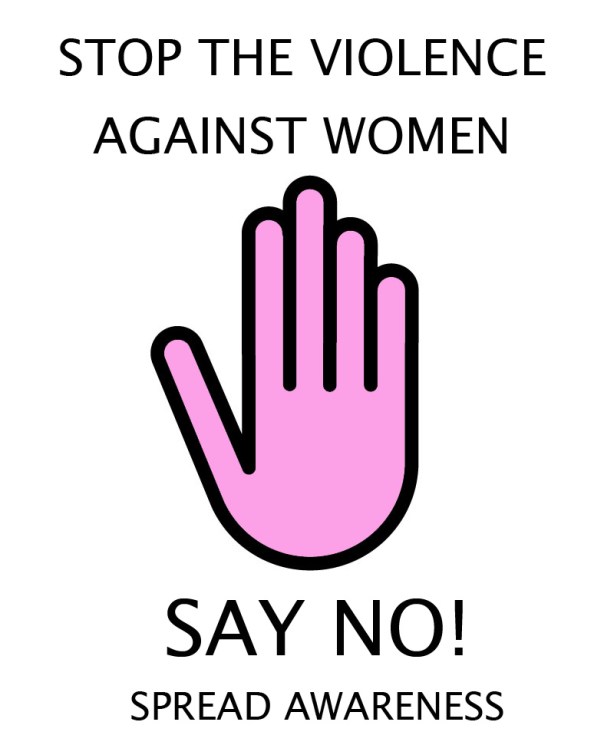
En réponse à cette abondance de preuves, l’Assemblée générale de l’ONU a proclamé le 25 novembre Journée internationale pour l’Elimination de la Violence contre les Femmes. La valeur d’une telle « Journée » spéciale est qu’elle offre un moment pour analyser une question donnée puis de remobilisation pour prendre des mesures tout à la fois à court terme et sur une durée plus longue.

Tout à la fois au niveau international de l’ONU et au niveau national, des programmes ont été créés en vue d’assurer l’égalité pour les femmes et la promotion des femmes dans tous les domaines. La violence physique envers les femmes a fait l’objet d’une attention de plus en plus importante, des centres pour les femmes battues ont été créés et l’on s’est aussi penché sur la question de trafic de femmes. Il a été souvent redit qu’il était nécessaire d’assurer l’éducation, la formation, la santé, la promotion de l’emploi, et l’insertion des femmes afin que celles-ci puissent participer de manière pleine et effective au processus du développement dans la société.

Les violences envers les femmes, encore et toujours un fléau mondial.  (c) Wikipédia

Les violences envers les femmes, encore et toujours un fléau mondial. (c) Wikipédia

Mais l’inégalité perdure, et les murs qui emprisonnent les femmes sont toujours debout. En ce 25 novembre, cette journée pour l’élimination de la violence contre les femmes, il nous faut regarder de près les différentes formes de violences qui font que de telles murailles, à travers le temps, demeurent en place.

Le Professeur René Wadlow est Président et Représentant en Chef  auprès de l’Office des Nations Unies à Genève de l’Association of World Citizens.