The Official Blog of the

Archive for the ‘Middle East & North Africa’ Category

Attack on Gaza: Letter to the President of the UN Security Council

In Anticolonialism, Conflict Resolution, Cultural Bridges, Current Events, Human Development, Human Rights, International Justice, Middle East & North Africa, Solidarity, The Search for Peace, United Nations, War Crimes, World Law on July 15, 2014 at 7:24 PM

-- AWC-UN Geneva Logo --

ASSOCIATION OF WORLD CITIZENS

THE EXTERNAL RELATIONS DESK


July 14, 2014


H. E. Mr. Eugène-Richard Gasana

Ambassador, Permanent Representative

of the Republic of Rwanda

to the United Nations

President of the United Nations Security Council


Excellency:

The Association of World Citizens (AWC), a Nongovernmental Organization in Consultative Status with the United Nations Economic and Social Council (ECOSOC), has been concerned with the status of Gaza as well as the broader Israel-Palestine context.

The current manifestations of violence are part of a recurrent cycle of violence and counter-violence with which You are familiar.

The AWC believes that there must be a sharp break in this pattern of violence by creating institutions of security, development, and cooperation. Such a break requires more than the ceasefire proposed by the Security Council. The Association believes that longer-lasting measures must be undertaken that will allow new patterns of understanding and cooperation to be established.

In an earlier United Nations (UN) discussion of Gaza tensions, the AWC had proposed in a written statement to the Human Rights Council, “Human Rights in Gaza: Need for a Special Focus and Specific Policy Recommendations” (A/HRC/S-12/NGO-1, October 14, 2009; see attached copy) that a Gaza Development Authority be created – a transnational economic effort that would bring together the skills, knowledge and finance from Gaza, Israel, the Palestinian Authority on the West Bank, and Egypt to create conditions which would facilitate the entry of other partners.

Our proposal was obviously inspired by the Tennessee Valley Authority (TVA) of the “New Deal” in the USA. The TVA was a path-making measure to overcome the deep economic depression of the 1930s in the USA and the difficulties of cooperative action across state frontiers in the federal structure of the USA.

Today, the deep divisions in the Israel-Palestine area require more than economic measures – although economy and raising the standards of living remain important elements. Today, there should be a structure that provides security as well as economic advancement.

Therefore, the AWC would like to propose the creation of an International Temporary Transition Administration for Gaza that would promote security, stabilization, economic development, and institution building. Such a Transitional Administration would be limited in time from the start, perhaps five years.

Unlike the earlier UN Trusteeship agreements which followed upon the League of Nations mandate pattern, the Gaza Transitional Authority would welcome civil society cooperation from outside the area.

Such a Transitional Administration cannot be imposed. We believe that the Members of the Security Council can raise the possibility publicly, request a UN Secretariat study on what such a Transitional Administration would require, and encourage’ discussion among those most directly involved.

As Jean Monnet, one of the fathers of the European Common Market, had said, “Men take great decisions only when crisis stares them in the face.” We believe that the current violence is such a time of crisis. Our hope is that the Members of the Security Council are prepared to take great decisions.

Please accept, Excellency, the assurance of our highest consideration.


Prof. René Wadlow

President


Bernard Henry

External Relations Officer


Iraq: What does one do with the broken pieces?

In Anticolonialism, Conflict Resolution, Cultural Bridges, Current Events, Democracy, Human Rights, Middle East & North Africa, The Search for Peace, United Nations, War Crimes, World Law on June 23, 2014 at 9:31 PM

IRAQ: WHAT DOES ONE DO WITH THE BROKEN PIECES?

By René Wadlow


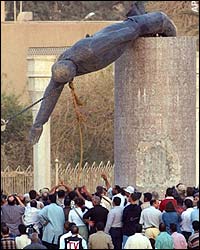
There is the legendary sign in shops selling china and porcelain “Do not touch; If you break it, you buy it”. The same sign should have been hung at the entry to Baghdad rather than portraits of Saddam Hussein. With Iraq in armed confusion as sectors of the country change side, and the Iraqi government seems incapable of an adequate response other than to call for military help, as concerned world citizens we must ask ourselves “What can we do?”

The forces of the Islamic State of Iraq and Syria (ISIS) have broken down a wall on the frontier between Iraq and Syria as a symbol of abolishing national frontiers to be replaced by a community of the Islamic faithful − the umma. In some ways, we are back to the early days of the post-World War One period when France and England tried to re-structure that part of the Ottoman Empire that is now Iraq, Syria, Lebanon, Israel-Palestine, Jordan, Turkey and an ill-defined Kurdistan.


In March 2003 an international "coalition" led by the United States attacked Iraq in violation of international law and overthrew the country's dictator, Saddam Hussein. The problem is that, having acted without prior permission from the Security Council, the "coalition" was never able to garner support from the international community and build a real, stable democracy in Iraq. As a result, a significant part of the country is now in the hands of radical Islamist fighters.

In March 2003 an international “coalition” led by the United States attacked Iraq in violation of international law and overthrew the country’s dictator, Saddam Hussein. The problem is that, having acted without prior permission from the Security Council, the “coalition” was never able to garner support from the international community and build a real, stable democracy in Iraq. As a result, a significant part of the country is now in the hands of radical Islamist fighters.


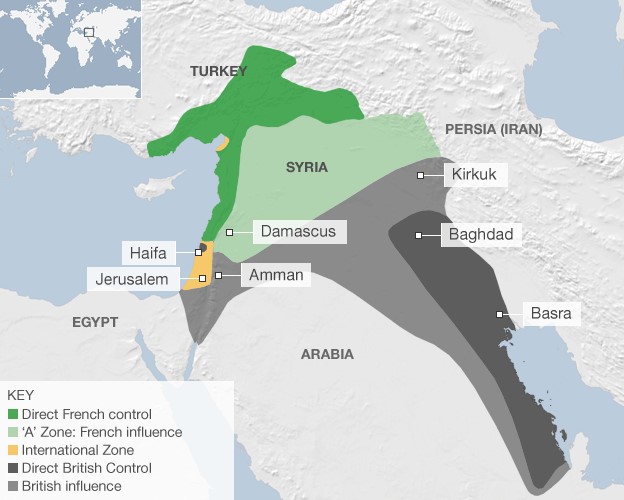
During 1915, Sir Mark Sykes, a Tory Member of Parliament and a specialist on  Turkish affairs and Francois Georges-Picot, a French political figure with strong links to colonial factions in the French Senate negotiated how to re-structure the Ottoman Empire to the benefit of England and France. Although these were considered “secret negotiations” Sykes reported to Lord Kitchener, the War Minister, and Picot had joined the French Foreign Ministry as war service. However, both operated largely as “free agents”. Today Sykes and Picot are recalled for no other achievement than their talent in dividing. The agreement between them was signed in January 1916 but kept in a draw until the war was over. In April 1920 at San Remo, France and England made the divisions official.

History has moved on, but dividing and re-structuring remains the order of the day. The political structures of Israel-Palestine as one state, two states, or one state and occupied territories have confronted the best of mediators − and less talented mediators as well. With the war in Syria continuing, there have been suggestions to divide − or federate − the state into three parts: an Alawite-Shi’ite area, a Sunni area, and a Kurdish area. The same divisions had been suggested for Iraq earlier and are again being discussed in the light of the ISIS advances: a Shi’ite area in the south, Kurds in the north − already largely independent − and Sunnis in the Middle. Lebanon, although not a federal state, is largely structured on sectarian-geographic divisions.


In 1916 the Sykes-Picot agreement carved the Middle East into two "spheres of influence", one British, the other French, plus two zones of direct control by either of the colonial powers.

In 1916 the Sykes-Picot agreement carved the Middle East into two “spheres of influence”, one British, the other French, plus two zones of direct control by either of the colonial powers.


Constitution-making under duress is not the best way of doing things. Forced federalism presents even more difficulties than creating a federal state when people are not fighting each other. We have seen the difficulties of proposing federal structures for Ukraine, federalism seen by some as a prelude to the disintegration of the state. The difficulties in the wider Middle East are even greater, as we have three states directly involved: Iraq, Syria, Turkey with a well-organized and armed Kurdish community in Iraq and parts of Syria.

The Kurds had expected that a Kurdistan would be recognized after World War One. The issue was raised at a conference to set Middle East frontiers held in June 1923 in Lausanne. The failure of the Kurds to achieve their goal for independence and the forced inclusion of their mountainous homeland within the then newly created states of Iraq, Syria and Turkey caused resentment and unrest. All the Kurds received in 1923 was a pledge to respect minority rights. By 1924, the Turkish government had banned all Kurdish schools, organizations, publications, and religious Sufi brotherhoods. In 1925, there was the first of the Kurdish revolts in Turkey, which, on-and-off, continue to today.


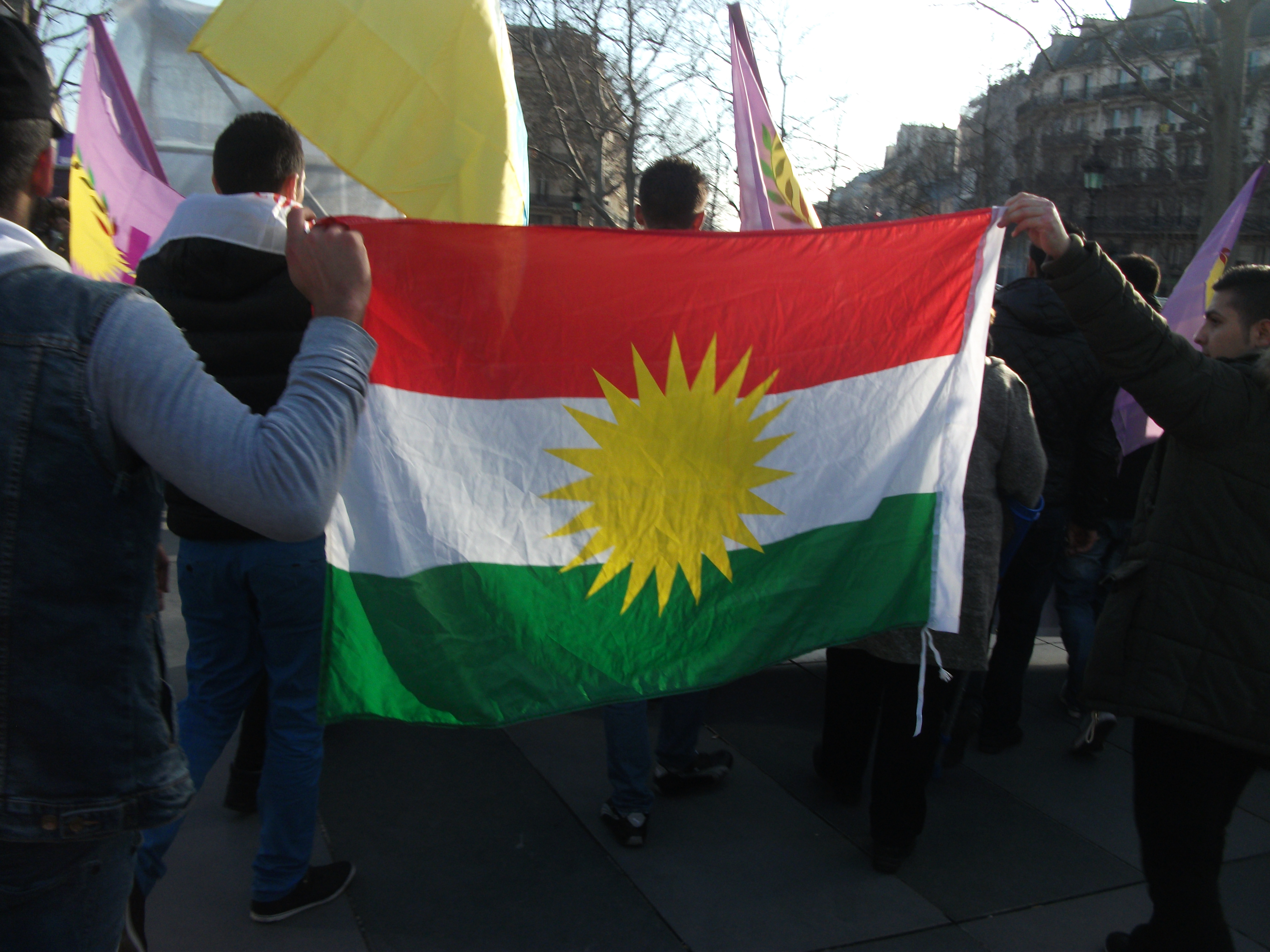
The flag of the Kurdish people, a people without a nation, a people without a land, to whom the promises of history ring hollow today more than they ever have. (C) Bernard J. Henry/AWC

The flag of the Kurdish people, a people without a nation, a people without a land, to whom the promises of history ring hollow today more than they ever have. (C) Bernard J. Henry/AWC


As outsiders but as specialists in federal forms of government, is there anything which we can do to be helpful? Maps are deceptive, and what is drawn as Shi’ite, Sunni and Kurdish area in Iraq and Syria have, in fact, mixed populations. Nor are religious-sectarian divisions the only lines of fracture.

Nevertheless, discussions among Syrians, Iraqis, Turks, Iranians and outside specialists on forms of government may be of greater use than sending Special Forces as ‘intelligence’ specialists. Such discussions will not be easy to organize or to facilitate but in a period of constitutional disorder and flux, such efforts are necessary.


Prof. René Wadlow is President of the Association of World Citizens.

Hugh Joseph Schonfield, the World Citizen Pioneer who Tried to Unite the Holy Land

In Being a World Citizen, Conflict Resolution, Cultural Bridges, Current Events, Middle East & North Africa, Solidarity, The Search for Peace, United Nations, World Law on May 24, 2014 at 8:50 PM

HUGH JOSEPH SCHONFIELD, THE WORLD CITIZEN PIONEER WHO TRIED TO UNITE THE HOLY LAND

By René Wadlow


Hugh Joseph Schonfield (1901-1988) was the first to incorporate the term “world citizen” into the name of a nongovernmental organization: the Commonwealth of World Citizens in 1938. The Commonwealth of World Citizens was to have an emphasis on service to humanity and a potential role as impartial mediator in international disputes. The founding was what he called a “revolt into sanity” from a mentally-deranged world in which Fascism, Nazism, Communism and militarized Shintoism flourished. From 1941 to 1948, Schonfield published a magazine called The World Citizen. As he said in a speech to the Constructive World Peace Conference in April 1940 “External forces, the agents of God, have caused the emergence in the world itself of ideas of World Community and World Citizenship. It is seen by serious political thinkers that if peace and justice are to reign here there must be a loyalty above that which is due from subjects to their own nation state. Much is being done, and rightly, to encourage such ideas. What we have to concern ourselves with is the bridge that will bring us safely to that farther shore. The bridge must be one that will carry us eventually to the New Jerusalem, not to a new Babylon.”

He wrote, “So many of the grave problems of our time are due to the fact that we are living in a radical transition, having to relate to the rapid advances of science which are requiring us to move forward into a wholeness and interdependence for which we are not sufficiently prepared. There are inevitable consequences, which chiefly affect our self-consciousness. The problems of the transition period affect individuals just as much as nations. Multitudes find themselves incapable of adjusting to the new demands and fear loss of identity.”

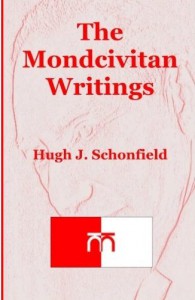
In his Mondcivitan Writings ('mondcivitan" coming from "mondcivitano" which is the Esperanto for "World Citizen"), Schonfield developed a comprehensive World Citizen thought, long before the Association of World Citizen was created.

In his Mondcivitan Writings (‘mondcivitan” coming from “mondcivitano” which is the Esperanto for “World Citizen”), Schonfield developed a comprehensive World Citizen thought and ideology, long before the Association of World Citizens itself was created.

Hugh Schonfield drew parallels between the current period of transition with the Jewish society at the time of Jesus, a period which was the focus of most of his writings. He wrote in 1936 History of Jewish Christianity and in 1939 Jesus: A Biography. During the Second World War while working on Middle East issues for the British government, he published in 1943 Judaism and World Order. Shortly afterwards he published Jesus: Man and Messiah, Readings from the Aprocryphal Gospels. A major work was published in 1955, a translation of the New Testament with notes relating the work to the thoughts of the period in which it was written and linking it to Jewish writings of the same period. As a Jew, he did not want his translation to become known as the “Schonfield New Testament” so it was published in 1955 as The Authentic New Testament. He continued his research on Jesus and messianic expectations and in 1965 published The Passover Plot which became a ‘best seller’ selling over two million copies. He became very interested in the Dead Sea scrolls and one of his last books in 1984 was The Essene Odyssey.

With his interest in the Holy Land, he was particularly concerned with Arab-Jewish relations and became an active champion for the idea of an Israel-Palestine Confederation, setting out proposals in 1944 which also concerned what is now Jordan, the pre-Independence Mandate area.

As Dr. Schonfield wrote in Transnational Perspectives in 1982, “What is clearly called for is a Confederation, possibly on the Swiss model, composed of the states of Palestine and Israel, with Jerusalem as the federal capital. The city would not have to be divided or fought over as to who should possess it. Palestine could have a state capital in the eastern part and Israel in the western sector, if they so desired, but the city as a whole would represent the Confederation.

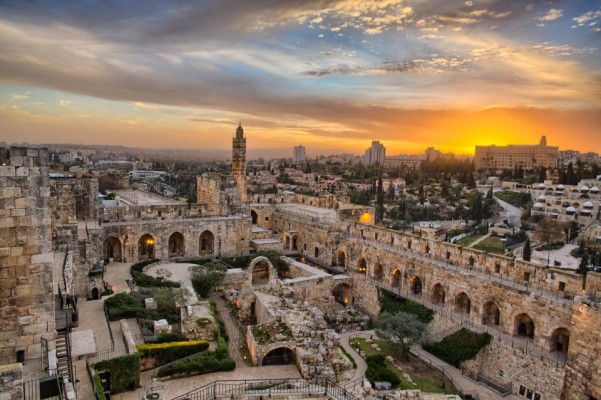
Jerusalem is the cradle of the world's two major religions, Islam and Christianity, as well as of Judaism. Therefore, why should it have to be a place of hatred and division, and not a place of brotherhood and unity?

Jerusalem is the cradle of the world’s two major religions, Islam and Christianity, as well as of Judaism. Therefore, why should it have to be a place of hatred and division, and not a place of brotherhood and unity instead?

“The advantage of this plan should be obvious. The frontiers between the two states would be internal and unfortified, and would therefore not create a risk of future war. As citizens of the Confederation, both Palestinians and Israelis would enjoy rights of access to all parts for purposes of travel and commerce, and questions of settlement would be covered by federal laws. There should be freedom of conscience for all citizens of the Confederation, but if so desired the religious laws of Islam and Judaism could be operative in the respective component states. The important thing would be that the Confederation would be the common homeland of both Palestinians and Israelis, who would yet have their own states.

“This is not a dream and could readily become a practical reality. What has been provided here is no more than a plan in outline, but it does keep the Holy Land as a unity, a common homeland for both Israelis and Palestinians, and satisfies their aspirations for self-governing statehood. With imagination and goodwill, it would inaugurate a new era in the Near East, and become an inspiration to mankind.” He saw that forms of regional integration are increasingly considered as the principal methodology for general security, development and the safeguard of human rights. Individual, national and regional security should be accompanied by a spirit of mutual acceptance – with economic cooperation and development as a by-product for a future Israel-Jordan-Palestine grouping.

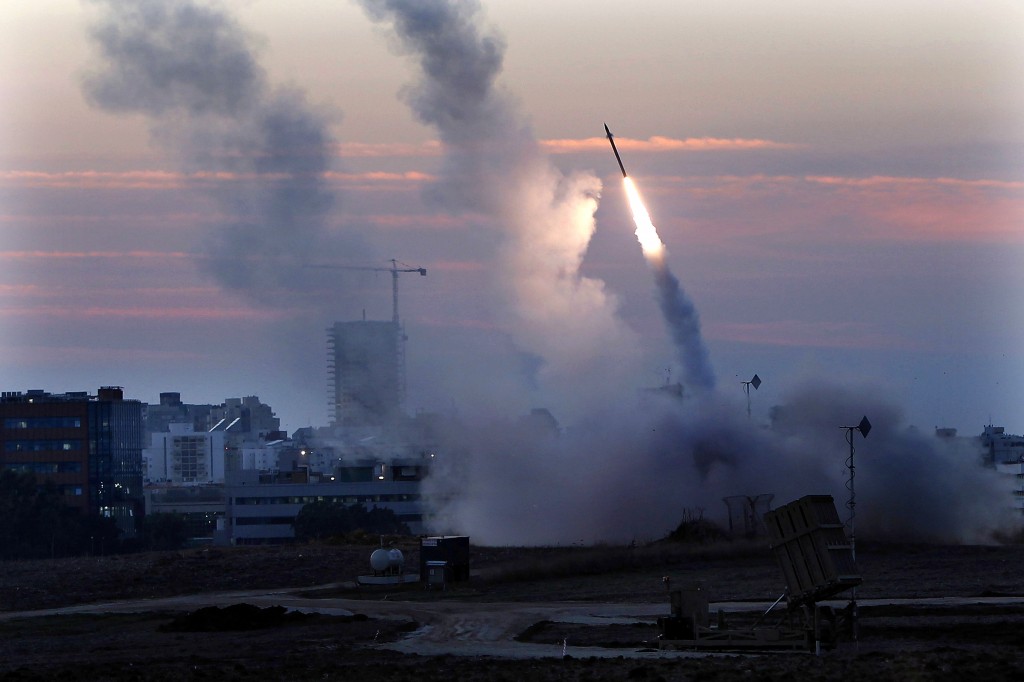
A rocket being fired by the Israeli Defense Force (IDF) to counter an incoming rocket attack from Gaza. (AP Photo/Tsafrir Abayov)

As the Middle East remains hopelessly plagued by violence, a rocket is being fired by the Israeli Defense Force (IDF) to counter an incoming rocket attack on Israel coming from Gaza. (AP Photo/Tsafrir Abayov)

However, the World Citizen proposals have not been followed by the strong national political leadership needed to bring them to the fore of real political negotiations. The quality of government leadership in the Middle East has been uneven at best. But even the Israeli-Palestinian problems are more complex than the quality of leadership. A new spirit of mutual acceptance will only flourish in the region when individual security and dignity for all will become rooted in law – everywhere in the region. This can happen with a general process of democratization and respect for human rights, with safeguards for ethnic and religious minorities. Such democratic values and practices must become the natural bedrock of society in all the countries of the Middle East.

World Citizens can take inspiration from Hugh Schonfield and in their Middle East efforts put an emphasis on unity rather than division.


Prof. René Wadlow is President and Chief Representative to the United Nations in Geneva of the Association of World Citizens.

Rencontre avec Ali ETMAN, jeune révolutionnaire égyptien que la France veut expulser

In Being a World Citizen, Current Events, Democracy, Human Rights, Middle East & North Africa, Solidarity on April 29, 2014 at 5:30 PM

Sur la chaîne Dailymotion de l’AWC :

Bernard HENRY, Officier des Relations extérieures du Bureau de Représentation auprès de l’Office des Nations Unies à Genève de l’AWC, donne la parole à Ali ETMAN, jeune militant de la révolution égyptienne en France que les autorités françaises veulent expulser parce qu’il a pris part à une protestation publique devant l’Ambassade d’Egypte en France.

Rencontre avec Ali ETMAN, jeune révolutionnaire égyptien que la France veut expulser

Les Citoyens du Monde Refusent l’Expulsion de Jeunes Militants Égyptiens par la France

In Being a World Citizen, Current Events, Democracy, Human Rights, Middle East & North Africa, Solidarity, World Law on March 28, 2014 at 7:25 PM

-- AWC-UN Geneva Logo --

LES CITOYENS DU MONDE REFUSENT L’EXPULSION DE JEUNES MILITANTS ÉGYPTIENS PAR LA FRANCE

L’Association of World Citizens, Organisation Non-Gouvernementale dotée du Statut Consultatif aux Nations Unies et accréditée auprès du Conseil des Droits de l’Homme, appelle le Gouvernement de la République française à honorer la tradition historique et constitutionnelle de la France en renonçant à toute poursuite, pénale ou administrative, contre les jeunes Egyptiens qui ont été arrêtés le 25 janvier dernier après avoir protesté pacifiquement devant l’Ambassade d’Egypte à Paris.

Depuis 1948 et les débuts de notre mouvement, nous, Citoyens du Monde, avons toujours œuvré pour le respect des Droits de l’Homme pour toutes et tous, au-delà de toutes les frontières, qu’elles soient nationales, politiques, religieuses ou autres.

Avant les révolutions arabes, le mot « frontière » était un symbole des régimes en place en Tunisie, en Egypte et ailleurs. Assumant un rôle de gardes-frontières pour des pays occidentaux qui n’étaient pas pressés d’accueillir des migrants en provenance d’Afrique du Nord, les régimes répressifs obligeaient souvent celles et ceux qui n’avaient d’autre choix que de fuir la misère, ou la persécution, souvent les deux, à « brûler » les frontières, à devenir ce que la langue arabe appelle « harraga », une personne qui « brûle » la frontière de son pays, et avec, toute sa vie passée.

Aujourd’hui, la décision des autorités françaises de renvoyer en Egypte des jeunes gens qui, ici en France, ne cherchaient qu’à faire usage de la liberté d’expression que consacrent tant la Constitution française que les engagements internationaux de la France en matière de Droits de l’Homme est incompréhensible. Nous voulons que les frontières ne soient pas des murs pour les migrants, mais pour ce qui est du respect des Droits de l’Homme, nous refusons que les frontières nationales ne s’ouvrent, comme c’est apparemment le cas ici, que pour laisser entrer la répression.

En voyant nos différentes structures – associations, syndicats, partis politiques et autres, unir ainsi leurs forces aujourd’hui, nous sommes certains que le Gouvernement de la France finira par nous entendre et par se montrer digne des valeurs de respect des normes universelles de Droits de l’Homme qui sont celles de ce pays, ces normes universelles qui, avec l’adoption de la Déclaration universelle des Droits de l’Homme au Palais de Chaillot, ont pris naissance en 1948 ici même, à Paris.

Professeur René WADLOW, Président

Bernard HENRY, Officier des Relations Extérieures du Bureau de Représentation auprès de l’ONU à Genève

http://www.worldcitizensunited.orghttp://www.awcungeneva.comawcungeneva@yahoo.fr

World Citizens, Opposed to the Death Penalty, Question the Egyptian Government’s Sentencing to Death 528 People in a Mass Trial

In Current Events, Human Rights, International Justice, Middle East & North Africa, Uncategorized, World Law on March 25, 2014 at 5:51 PM

-- AWC-UN Geneva Logo --

WORLD CITIZENS, STRONGLY OPPOSED TO THE DEATH PENALTY, QUESTION THE EGYPTIAN GOVERNMENT’S SENTENCING TO DEATH 528 PEOPLE IN A SHORT MASS TRIAL

In a March 26, 2014 message to the Acting President of Egypt and to the United Nations High Commissioner for Human Rights, Prof. René Wadlow, President of the Association of World Citizens (AWC), stated that the mass trial of Muslim Brotherhood members accused of the murder of a police officer and terrorist acts during the August 2013 protests was an insult to the Spirit of Justice and a violation of the rule of law.

The AWC has repeatedly called upon governments to declare a moratorium on executions with a view to abolishing the death penalty – a penalty that extensive research has shown has little or no impact on the level of violent crime and too often opens the door to judicial errors and injustice.

The speed of the two-day trial during which defense lawyers were not able to develop their arguments is unprecedented and points to the political motivations of the current military-influenced Government.

There is a possibility to appeal the verdict, but the timing and modalities are unclear. There are some 1,200 Muslim Brotherhood supporters awaiting trial, and this trial in the Minya Criminal Count does not indicate a rule of law but rather of revenge and a desire to inspire fear of possible Government action.

The verdict now goes to Egypt’s Grand Mufti, a religious authority, for approval or rejection. It is not clear on what basis religious authorities review and make decisions on what are essentially secular trials. In practice, death sentences in Egypt are often handed down, but few have been carried out in recent years. The aims of the trials and the sentences are political: to show that death is a real possibility if one “steps out of line”.

Such a misuse of the court system undermines trust in the legal order and is in violation of the spirit and provisions of human rights law.

The AWC is devoted to the universal application of human rights law which includes fair trials and the right to adequate defense. Therefore, the AWC calls upon the Government of Egypt to revise this court case by a speedy appeal procedure and to see that the subsequent trials concerning Muslim Brotherhood members or supporters of former President Mohammed Morsi are carried out in conformity with established international norms.

Libérez Razan Zaïtouneh !

In Current Events, Human Rights, International Justice, Middle East & North Africa, United Nations, War Crimes, World Law on December 19, 2013 at 1:44 PM

-- AWC-UN Geneva Logo --

LES CITOYENS DU MONDE APPELLENT A LA LIBÉRATION IMMÉDIATE DE MAÎTRE RAZAN ZAITOUNEH ET TROIS AUTRES DÉFENSEURS DES DROITS DE L’HOMME CAPTURÉS AVEC ELLE DANS LA SYRIE EN GUERRE

Paris & Genève, le 19 décembre 2013

L’Association of World Citizens (AWC) appelle à la libération immédiate de Madame Razan Zaïtouneh, avocate syrienne des Droits de l’Homme, et de trois autres Défenseurs des Droits de l’Homme (DDH) – Monsieur Wael Hamada, Monsieur Nazem Hamadi et Madame Samira Khalil – qui ont été enlevés avec elle par des inconnus voici dix jours.

Le 9 décembre 2013, ces quatre DDH ont été capturés par des hommes masqués et armés puis conduits en un endroit inconnu, depuis les locaux du Centre pour la Documentation des Violations des Droits de l’Homme en Syrie situé à Douma.

Madame Razan Zaïtouneh défend sans relâche les droits des prisonniers politiques en Syrie. Quand la révolution, qui était au départ non-violente, a éclaté en 2011, elle a fondé les « comités locaux de coordination ». Cette même année, elle a été la lauréate du Prix Anna Politkovskaïa « RAW (Reach of Women) in WAR ».

Active également en tant que journaliste, Madame Razan Zaitouneh observe et informe sur les crimes de guerre et les atteintes aux Droits de l’Homme en Syrie. Dans le courant de cette année, le Prix « International Women of Courage » lui a été décerné pour son travail et ses efforts remarquables.

Depuis le 9 décembre, personne n’a revendiqué l’enlèvement, qui a eu lieu dans une zone où toutes les parties au conflit sont représentées et il est donc impossible de savoir avec certitude pour le compte de qui œuvraient les ravisseurs.

La seule certitude en la matière est que, qui qu’ils soient, les kidnappeurs ont commis un crime de guerre par l’enlèvement délibéré de civils dans un contexte de conflit armé, particulièrement s’agissant de DDH qui sont protégés de manière spéciale par le droit international des Droits de l’Homme.

En conséquence, l’AWC exige la libération immédiate de ces quatre DDH syriens.

Release Razan Zaitouneh!

In Current Events, Human Rights, International Justice, Middle East & North Africa, Uncategorized, United Nations, War Crimes, World Law on December 19, 2013 at 1:37 PM

-- AWC-UN Geneva Logo --

CITIZENS OF THE WORLD CALL FOR THE RELEASE OF ATTORNEY RAZAN ZAITOUNEH AND OTHER HUMAN RIGHTS DEFENDERS CAPTURED IN WAR-TORN SYRIA

Paris & Geneva, December 19, 2013

The Association of World Citizens (AWC) calls for the immediate release of Ms. Razan Zaitouneh, a Syrian human rights lawyer, and three other Human Rights Defenders (HRDs) – Mr. Wael Hamada, Mr. Nazem Hamadi, and Ms. Samira Khalil, who were kidnapped by unknown assailants ten days ago.

On December 9, 2013, the four HRDs were abducted by masked armed men and taken to unknown whereabouts from the premises of the Center for Documenting Human Rights Violations in Syria, located in Douma.

Ms. Razan Zaitouneh has tirelessly defended the rights of political prisoners in Syria. When the revolution, initially a nonviolent one, started in 2011 she founded the “local coordination committees”. That year she received the Anna Politkovskaya award “RAW (Reach All Women) in WAR”.

Also active as a journalist, Ms. Razan Zaitouneh has been monitoring and reporting war crimes and human rights violations in Syria. Earlier this year she received the International Women of Courage Award for her outstanding work and efforts.

Since December 9 no one has claimed responsibility for the abduction, which took place in a zone where all parties to the conflict are represented, making it impossible to know for sure who the kidnappers were working for.

The one thing we know for sure is that, whoever they are, the kidnappers committed a war crime by deliberately abducting civilians in a context of armed conflict, especially HRDs who are specially protected under international human rights law.

Consequently, the AWC demands the immediate release of the four Syrian HRDs.

World Citizens Call for a Ceasefire and Renewed Good-faith Negotiations by All Parties in Syria

In Conflict Resolution, Current Events, Middle East & North Africa, The Search for Peace, United Nations, World Law on September 9, 2013 at 10:55 PM

WORLD CITIZENS CALL FOR A CEASEFIRE AND RENEWED GOOD-FAITH NEGOTIATIONS BY ALL PARTIES IN SYRIA

By René Wadlow

World Citizens have called for good-faith negotiations among all the parties from the start of the demonstrations in March 2011 which had begun in a spirit of non-violence. Neither the Government nor the oppositions were willing to set an agenda or a timetable for such good-faith negotiations. The Government held out vague promises for reform but without details and without open discussion among those concerned. As the fighting has escalated, the possibility of good-faith negotiations has increasingly faded, despite efforts by the United Nations (UN) mediators to facilitate such negotiations.

Discussion of specific issues for reform or setting an overall agenda seems impossible for the moment.  However, there is a growing awareness that there is a dangerous stalemate and that there is no military “solution”. It is often at this “stalemate” stage of a conflict that the parties turn to a negotiated compromise.[i]  The dangers of a wider conflict with more States involved are real. Thus the situation requires careful concerted action.

The use of chemical weapons in violation of the 1925 Geneva Protocol (by government forces or by the armed opposition) has added an additional element of danger but not modified the stalemated structure of the conflict.

awc-un-geneva-logo

Therefore, the Association of World Citizens (AWC) calls upon the Syrian Government, armed opposition, and representative associations of Syrians to initiate a ceasefire followed quickly by good-faith negotiations.

The AWC calls upon all other States to refrain from arming or in other ways strengthening the military capacities of the Government’s armed forces and the armed forces of the armed oppositions.  Other States should, through the UN and through other institutions, encourage good-faith negotiations.

The AWC calls upon Nongovernmental Organizations, both Syrian and international, to facilitate the transition from the ongoing violence to a situation conducive to creative dialogue.

René Wadlow is President and Chief Representative to the United Nations Office at Geneva of the Association of World Citizens.


[i] See: Louis Kriesberg and Stuart Thorson (Eds), Timing the De-Escalation of International Conflicts (Syracuse University Press, 1991)

Syria: Chemical Weapons and Restraints in War

In Current Events, International Justice, Middle East & North Africa, United Nations, War Crimes, World Law on August 31, 2013 at 3:21 PM

SYRIA: CHEMICAL WEAPONS AND RESTRAINTS IN WAR

By René Wadlow

There was a recent political drawing in the International Herald Tribune which showed high piles of skulls with signs on them which said “Killed by Assad’s Machine Guns”, “Killed by Assad’s Tanks” and two men with the two letters “UN” on their coats saying “If they really were killed by chemical weapons we’ll have to stop Assad.”

The accusations of the recent use of chemical weapons (CWs) in the Syrian conflict has led to a United Nations (UN) investigation as well as discussions at the UN and in national capitals as to the appropriate response to what has been called “a clear violation of international norms.” Yet there has been little discussion of why chemical weapons are prohibited and not tanks, and machine guns which in practice have killed many more people in Syria. To be more accurate, the drawing should have also shown piles of skulls with signs saying “Killed by armed opposition machine guns, snipers etc”.

A short review of the prohibitions on the use of chemical weapons, the UN response, and the use of chemical weapons in conflicts in the Middle East may be useful as background to a discussion of appropriate responses.

I had been active in 1975 with some other Geneva-based representatives of Nongovernmental Organizations (NGOs) in highlighting the fiftieth anniversary of the 1925 Geneva Protocol for the Prohibition of the Use in War of Asphyxiating, Poisonous or other Gases, and of Bacteriological Methods of Warfare which is the core treaty on the prohibition on the use of chemical weapons. We were encouraging states to ratify the Protocol, in particular the French-speaking African states which were not covered by the original signature of the Protocol by France even though France was the Depository Power for the treaty. The Protocol is, in fact, an international treaty. It is called a protocol because it was to have been a protocol — an attachment — to a disarmament treaty never completed within the League of Nations. We were also proposing that there be some sort of investigation – dispute settlement mechanism integrated into the Protocol along the lines then being discussed in Geneva concerning what was to become the Convention on the Prohibition of Military or any Other Hostile Use of Environmental Modification Techniques (Enmod Convention) which came into force in 1978 and has an innovative mechanism for a Committee of Experts to investigate complaints.

However, in 1968, governments had begun discussing a more comprehensive ban on chemical weapons in what was then the main UN arms control body — the Eighteen-Nation Disarmament Conference. In the UN, when negotiations are not fruitful, the practice is to add more states to the body and to change the name. Thus the Eighteen-Nation Conference became the Conference of the Committee on Disarmament (1969-1979), the Committee on Disarmament (1979-1984) and the Conference on Disarmament from 1984 until today. After nearly 30 years of negotiations a far-reaching Convention on the Prohibition of the Development, Production, Stockpiling and Use of Chemical Weapons and on their Destruction (Chemical Weapons Convention) came into force in 1997, and an Organization for the Prohibition on Chemical Weapons with a sizeable Secretariat was created in The Hague. Syria is not a party to the Convention, but it is to the 1925 Geneva Protocol.

Thus, in 1975, few governments were interested in strengthening the 1925 Geneva Protocol, hoping for a speedy conclusion of the broader CW treaty. However when in the late 1970s there were serious accusations of the use of chemical agents in the on-going conflict against the Hmong in Laos — the Yellow Rain accusations — I presented a paper distributed to the members of the Commission on Disarmament (the only ways NGOs could participate directly in the disarmament discussions) “The Strengthening of the 1925 Geneva Protocol Against Poison Gas as an Interim Step Toward a Broader Chemical Weapons Ban” (April 22, 1980). The text led to a number of private discussions with the diplomats but to no specific action.

My text did, however, build a “profile” for my concern with investigating chemical weapon use and thus for my early efforts for a UN investigation of chemical weapon use in the 1980-1988 Iraq-Iran War.

CWs had been used by the Egyptian forces in their support of the republican forces in the Yemen Civil War (1962-1967). Although Egypt had signed the 1925 Geneva Protocol in 1928, its forces used them widely in Yemen. Investigations were carried out by the International Committee of the Red Cross (ICRC) who said that it was “extremely disturbed and concerned by these methods of warfare which are absolutely forbidden by codified international and customary law.” However, the ICRC is extremely cautious in commenting publicly on abuses in conflict situations fearing that publicity would hinder its main task of care of the wounded and visits to war prisoners. Government responses to the report of Egyptian CW use were weak. The US response was muted, presumably because of its own use at the time of chemical agents in the form of herbicides and harassing agents in Vietnam. On the Geneva front, it was not until the early 1970s that NGO representatives became visibly active in UN disarmament negotiations. So there was little NGO activity over the conflict in Yemen — not a high priority area in any case.

However, the Egyptian experience was not lost on everyone. Soon after the 1967 end of fighting in Yemen, Syria requested Egyptian technical assistance in developing its own chemical weapons capabilities. Iraq was also interested in the Egyptian experience; it began its own CW program in the late 1960s turning to the US for help. In 1967, Saddam Hussein and some 15 Iraqi officials participated in a fact-finding trip to the USA to familiarize themselves with chemical warfare and defensive techniques including observation of CW tests at US proving grounds.
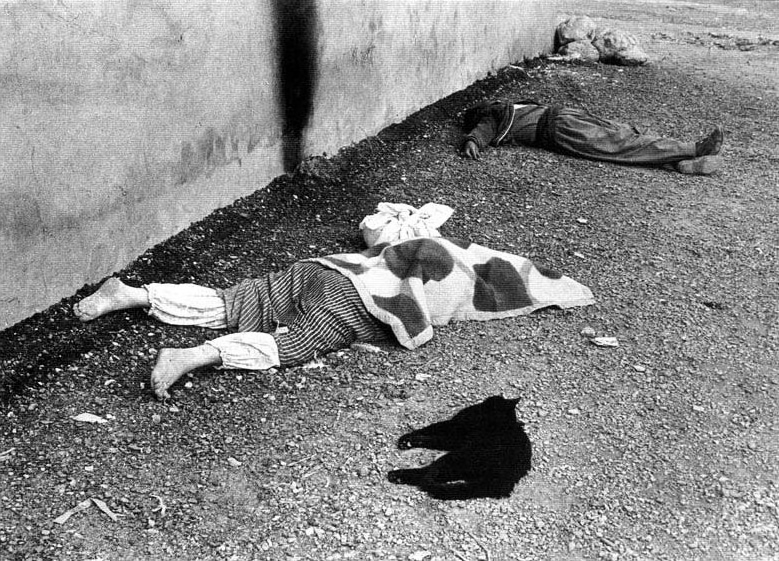
On March 16, 1988, the Iraqi regime, then led by Saddam Hussein, used chemical weapons in a genocidal attack on the town of Halabja, in Iraqi Kurdistan. The attack on Iraq’s own Kurdish population killed 5,000 civilians and injured at least 10,000 more. Generally dubbed “Bloody Friday”, the Halabja attack also remains in the memory of the Kurdish people of Iraq and beyond as the "Kurdish Hiroshima”. (Photo by Sayeed Janbozorgi)

On March 16, 1988, the Iraqi regime, then led by Saddam Hussein, used chemical weapons in a genocidal attack on the town of Halabja, in Iraqi Kurdistan. The attack on Iraq’s own Kurdish population killed 5,000 civilians and injured at least 10,000 more. Generally dubbed “Bloody Friday”, the Halabja attack also remains in the memory of the Kurdish people of Iraq and beyond as the “Kurdish Hiroshima”. (Photo by Sayeed Janbozorgi)

I had thought from the start that an Iraq-Iran war was not a good thing and that if frontier delimitation issues were the real reason for the war as Iraq claimed, then there were better ways of dealing with the conflicting claims. I had started seeing if mediation were possible. Saddam Hussein’s half-brother was the Iraqi Ambassador to the UN in Geneva, and I think that my proposals were sent on. The formal UN-led mediation efforts had to wait until late 1985 to be carried out in Geneva and leading to the UN-brokered ceasefire of August 1988.

The first official Iranian complaint on CW use to the UN was in November 1983. The complaint ran into the same structural difficulties I had set out in my text: the 1925 Geneva Protocol has no investigative measures and no dispute settlement provisions. Thus there was a long discussion among governments about what steps to take. Finally, there was a UN Security Council resolution authorizing an investigation. The UN investigations were largely based on examination of victims in medical facilities but which took place some days after the occurrence. The highly-regarded Stockholm International Peace Research Institute (SIPRI) carried out independently interviews with victims as part of its extensive work on chemical weapons arms control possibilities.

The UN investigations led to the conclusion that the Iraq military had used CWs in violation of the 1925 Geneva Protocol, but no further action was taken. The military effectiveness of chemical weapons in the Iraq-Iran War is a matter of debate among military specialists. According to figures released by the Iranian authorities, CWs accounted for only three per cent of their one million war casualties. However, CW impact on military morale and creating fears in the civilian population is difficult to measure. In March 1988, when Iraq publicly threatened to use CWs against Iranian cities, many persons momentarily left Teheran. In the same month, the Iraq army used chemical weapons against unprotected civilians in the Iraqi-Kurdish city of Halabja.

There is also a Red Cross convention that was invoked at the time of the mass killing at Halabja and is relevant to the Syrian case as well. In the light of the experiences of the war in Vietnam which was not an “international war” in the sense that the original Red Cross conventions cover, there was a conference in Geneva so that protection could be provided in cases of “civil” or internal conflicts. The conference led to the Geneva Additional Protocols of 1977 which states in article 51.2 “The civilian population as such, as well as individual civilians, shall not be the object of attack. Acts or threats of violence, the primary purpose of which is to spread terror among the civilian population are prohibited” Further article 51.6 stipulates that “Attacks against the civilian population or civilians by way of reprisals are prohibited.”
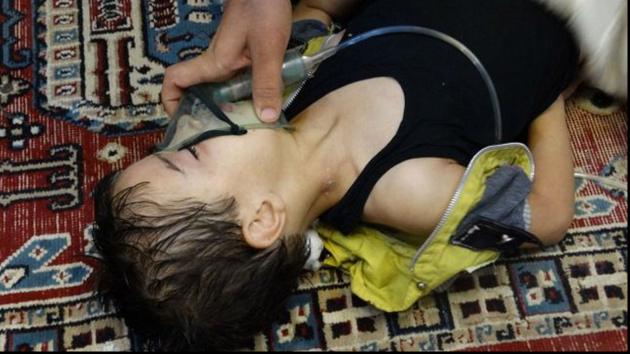
It is now an established fact that chemical weapons have been used this month in the Syrian conflict; but just who used them? It is the Assad regime, or did armed groups with the Free Syrian Army do it? Hopefully, the report of the UN investigation mission that was sent in to investigate will yield the much-awaited answer to this question. (C) UPI

It is now an established fact that chemical weapons have been used this month in the Syrian conflict; but just who used them? It is the Assad regime, or did armed groups with the Free Syrian Army do it? Hopefully, the report of the UN mission that was sent in to investigate will yield the much-awaited answer to this question. (C) UPI

There is as yet no agreed upon international sanctions concerning the violation of humanitarian (Red Cross) law. Humanitarian law can be cited in national court trials as was the use of CWs against the Kurds in some of the Iraq trials but not the use against the Iranians. Moreover, the post-Saddam trials resemble too much “victors’ justice” to be used as a basis of world law. The International Criminal Court can also use humanitarian law as a basis for judgments, but its justice grinds slowly.

The use of poison gas strikes a deep, partly subconscious, reaction not provoked in the same way as being shot by a machine gun. The classic Greeks and Romans had a prohibition against the use of poison in war, especially poisoning water wells because everyone needs to drink. Likewise poison gas is abhorred because everyone needs to breath to live.

The UN investigations and the appropriate responses are yet to be made. More shelling of military installations in Syria is unlikely to bring about the negotiations in good faith needed in the Syrian conflict. Thus there is a short-term need to stop beating the drums of war while at the same time stressing the condemnation of the use of chemical weapons. There is a need for longer-term efforts to start serious negotiations with as many factions of the opposition as possible and the Syrian government to create government structures more fully representative of the multi-cultural Syrian society.

René Wadlow is President and Chief Representative to the United Nations Office at Geneva of the Association of World Citizens.