The Official Blog of the

Archive for the ‘International Justice’ Category

A l’ombre du Pays des Cèdres, pas de refuge pour les Syriens

In Current Events, Human Rights, International Justice, Middle East & North Africa, Solidarity, The Search for Peace, War Crimes, World Law on September 29, 2014 at 11:51 AM

A L’OMBRE DU PAYS DES CEDRES, PAS DE REFUGE POUR LES SYRIENS

Par Bernard Henry


Lorsque l’on pense au Liban et à la Syrie, l’on ne peut oublier la longue guerre civile libanaise, l’ingérence permanente de Damas et la fin du conflit en 1990 qui laissa Hafez el-Assad, le Président syrien, seul maître du Liban. L’on se souvient de l’assassinat, le 14 février 2005 à Beyrouth, de l’ancien Premier Ministre libanais Rafic Hariri, élément déclencheur du retrait précipité du Liban de cette Syrie qui s’y croyait pour toujours en terrain conquis.

Rares sont ceux qui pensent, aujourd’hui, aux 1 200 000 Syriens réfugiés au Liban voisin, fuyant le conflit qui ravage leur pays depuis trois ans et la répression sanglante de toute résistance à la dictature de Bachar el-Assad, le fils d’Hafez. Ayant succédé en 2000 à son père décédé, le jeune Bachar avait tôt fait de décevoir les espoirs de réforme placés en lui, ayant tout au contraire accru l’écrasement de la dissidence à partir de 2004 et n’ayant laissé d’autre choix à son peuple, au printemps 2011, que de prendre les armes.

Ce n’est pas une actualité dominée par les conquêtes militaires de Daesh, le fameux « Etat islamique en Irak et au Levant », qui se veut même « Etat islamique » tout court maintenant qu’il a soumis une portion conséquente de l’Irak, qui va y changer quelque chose. Persécutant les minorités dans les zones tombées sous sa coupe, Chrétiens et Yazidis notamment, Daesh a réalisé l’exploit de concentrer sur ses méfaits l’attention d’une Session spéciale du Conseil des Droits de l’Homme de l’ONU le 1er septembre dernier.

Il n’en fallait guère plus à de bonnes consciences occidentales déjà enclines à soutenir Bachar al-Assad, certes jugé désagréable parce que dictateur, contre une révolution syrienne condamnée par contumace parce que contenant des éléments islamistes, pour parler aujourd’hui, en dépit même de faits accablant le régime de Damas, de blanchir Assad en tant qu’allié de circonstance contre l’islamisme barbare de Daesh, quitte à lui faire ainsi crédit de la création du groupe islamiste dont son régime est pourtant le premier fautif, à la manière d’un Frankenstein.

Mais que diraient ceux-là du sort des réfugiés syriens d’Ersal, ce village de trente mille âmes de la Beqaa à quelques cent vingt kilomètres au nord-est de Beyrouth ?

Un village libanais au cœur de la guerre en Syrie

Depuis le début de la guerre, bien que protégé en théorie par la frontière libanaise, Ersal est littéralement partie prenante au conflit syrien. La population locale ayant pris fait et cause depuis le départ pour l’Armée syrienne libre, Ersal accueille aujourd’hui non moins de cent dix mille réfugiés syriens, répartis dans plusieurs camps de la ville, dont par exemple celui d’Alsanabel.

L’été dernier, c’est la guerre proprement dite qui a fini par s’inviter à Ersal, avec l’incursion dans le village de combattants du groupe armé syrien Jahbat al-Nosra, avatar syrien d’Al-Qaïda, après l’arrestation de l’un de ses dirigeants, Imad Ahmad Joumaa.

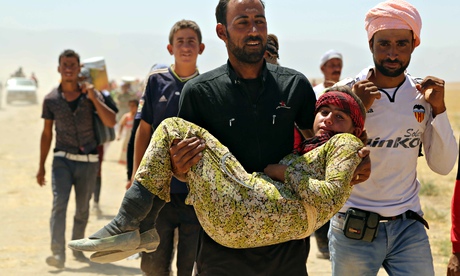
D’interminables et violents combats ont ensuite opposé Jahbat al-Nosra et l’armée libanaise, avec, sous leurs feux croisés, des réfugiés syriens pris dans des affrontements par trop semblables à ceux auxquels, chez eux, ils avaient échappé. Même le retrait d’Ersal de Jahbat al-Nosra le 6 août dernier ne ramena pas la paix, l’armée libanaise se livrant depuis lors à une répression féroce à travers la ville et dans les camps de réfugiés – les réfugiés, dont treize mille sur les cent vingt-trois mille que comptait Ersal ont regagné la Syrie, leur lieu d’asile espéré étant devenu pire encore que l’enfer qu’ils avaient fui.

L’armée libanaise n’est pas celle d’Assad. Mais dans un Liban se cherchant désespérément un Président depuis mai dernier, elle est ce qui s’approche le plus d’une colonne vertébrale de l’Etat. Et bien sûr, sa mission première demeure la défense du territoire, mission dans laquelle un passé d’humiliation, non dans une moindre mesure pendant la guerre civile, lui interdit la moindre faiblesse.

Septembre porte le noir souvenir d’un épisode de cette guerre des plus humiliants pour l’armée libanaise – Sabra et Chatila, en 1982, lorsque plus de mille civils palestiniens et sud-libanais furent exécutés dans les deux camps de réfugiés beyrouthins par les Kataeb, les Phalanges chrétiennes d’extrême droite du Président Bechir Gemayel, sous le regard complice de l’armée d’invasion israélienne.

Cet été, Tsahal s’est à nouveau distinguée de manière macabre en se livrant à Gaza à son opération la plus meurtrière depuis la création de l’Etat d’Israël, rendant plus vivace et brûlante encore la mémoire de Sabra et Chatila.

Tant le présent que le passé privent l’armée libanaise de tout droit à l’indulgence face à une force armée étrangère sur son sol. Il n’en faut pas plus pour céder aux traumatismes du passé, quitte à voir Jahbat al-Nosra là où il n’est plus, à la manière des Kataeb obsédées par la présence de fedayin de l’OLP tapis dans l’ombre de Sabra et Chatila. Et Alsanabel en a fait les frais.

Des réfugiés bombardés délibérément, l’un d’entre eux torturé à mort

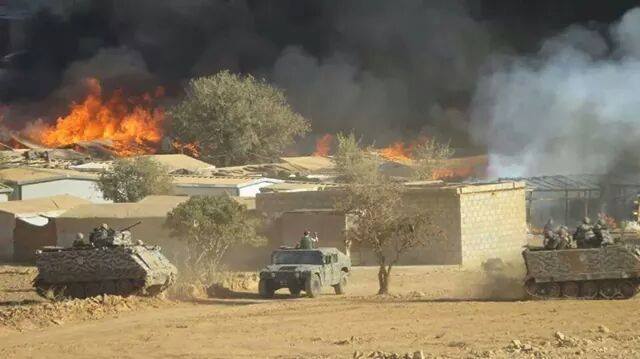
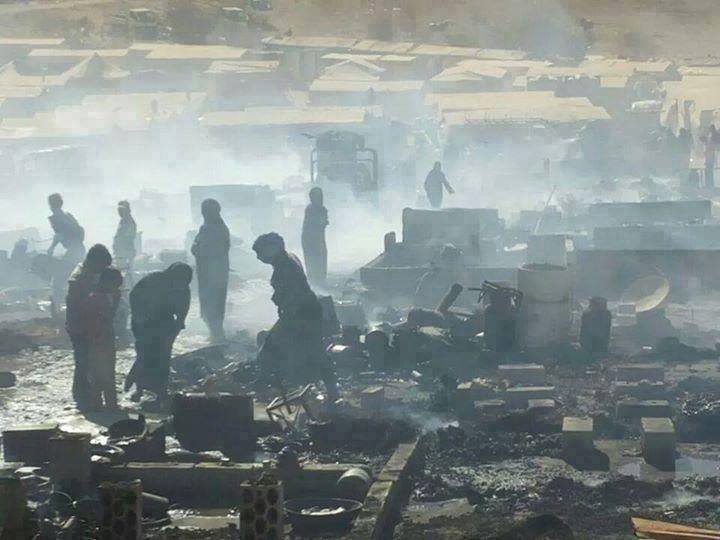
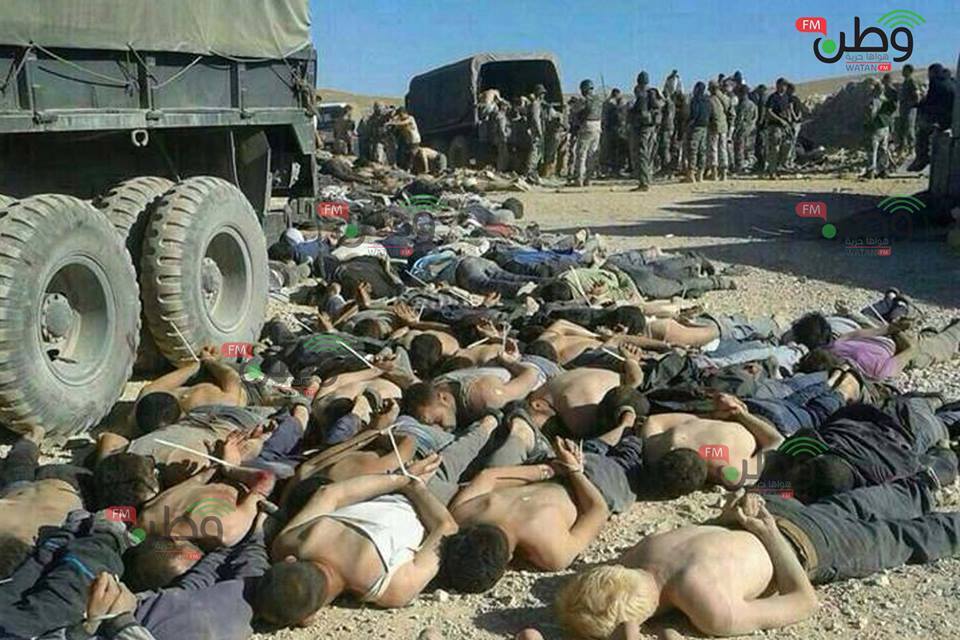
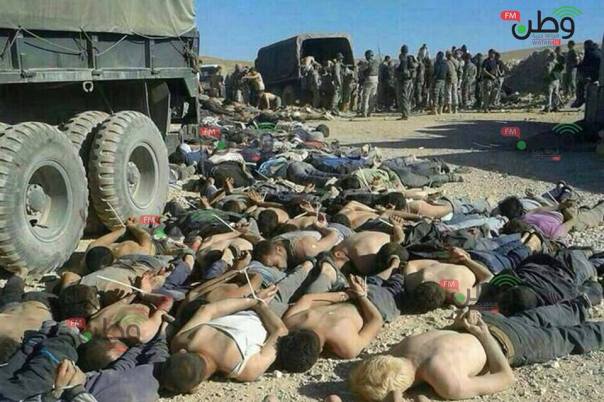
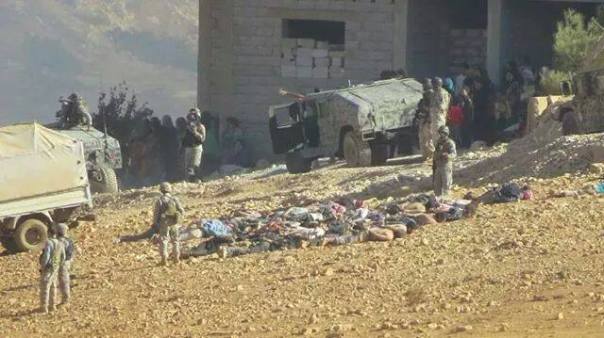
Le 25 septembre, sous le commandement du Général Chamel Roukoz, des blindés font feu sans sommation sur le camp de réfugiés, dont s’emparent aussitôt les flammes. Tout se consume, et bientôt, le camp entier n’est plus que ruines. Les militaires pénètrent dans un Alsanabel livré à la panique et arrêtent quatre cent cinquante réfugiés, les plaquant face contre terre aux pieds des soldats.
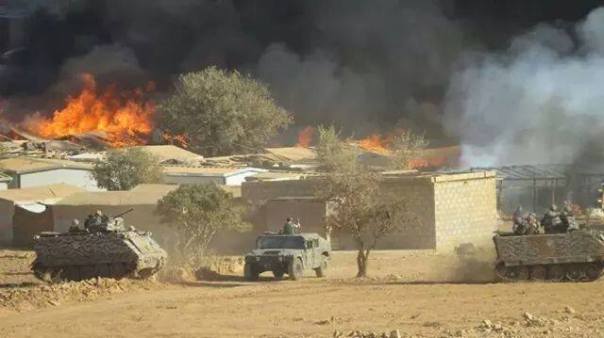
Le 25 septembre dernier, les blindés libanais attaquent le camp d’Alsanabel.
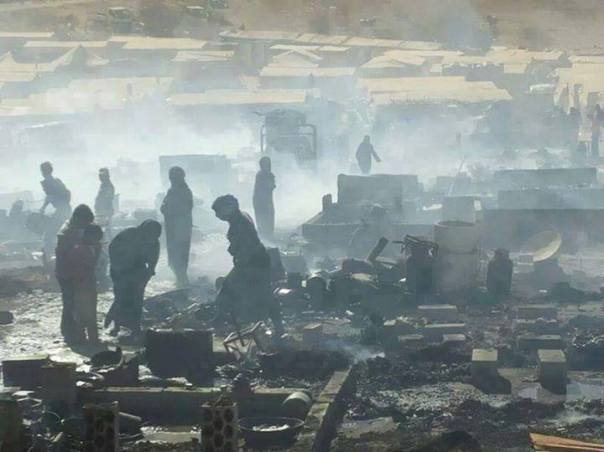
Le 25 septembre dernier, les blindés libanais attaquent le camp d’Alsanabel.

Les flammes ravagent le camp, réduisant les maigres biens des réfugiés syriens en cendres.
Les flammes ravagent le camp, réduisant les maigres biens des réfugiés syriens en cendres.

Les forces armées libanaises forcent les réfugiés d’Alsanabel à se coucher à leurs pieds, les dépouillant de la moindre dignité humaine.
Les forces armées libanaises forcent les réfugiés d’Alsanabel à se coucher à leurs pieds, les dépouillant de la moindre dignité humaine.

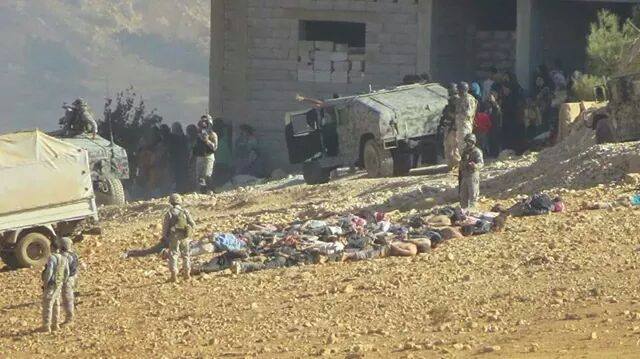
Non, ce ne sont pas des sacs poubelle que l’on voit aux pieds des soldats libanais ; ce sont des réfugiés syriens, dont la vie et la dignité ne semble pourtant pas, aux yeux des militaires, valoir plus que cela.

Non, ce ne sont pas des sacs poubelle que l’on voit aux pieds des soldats libanais ; ce sont des réfugiés syriens, dont la vie et la dignité ne semble pourtant pas, aux yeux des militaires, valoir plus que cela.

Ce même jour à Alsanabel, les parents d’un jeune Syrien, Ahmad Mohammad Abdalla Aldorra, originaire de Qara, voient les soldats libanais leur apporter la dépouille mutilée de leur fils, arrêté le 20 septembre et qui a succombé à la torture.
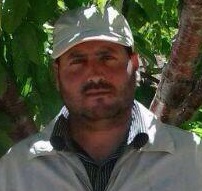
Ahmad Mohammad Abdalla Aldorra, arrêté le 20 septembre par des soldats libanais.
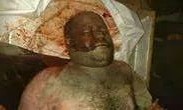
Ahmad Mohammad Abdalla Aldorra, arrêté le 20 septembre par des soldats libanais.

Ses parents devaient ne le revoir que mort, son corps couvert de blessures reçues sous la torture.

Ses parents devaient ne le revoir que mort, son corps couvert de blessures reçues sous la torture.

Le sort des quatre cent cinquante personnes arrêtées demeure indéterminé.

D’aucuns peuvent bien s’obstiner à dire que, face au danger islamiste de Daesh, la dictature réputée « laïque » de Bachar el-Assad, même récusée par les capitales occidentales comme moindre mal face à une révolution syrienne jugée dévoyée par le djihadisme, peut constituer un rempart, pas idéal certes, mais un rempart.

Ce n’en est pas moins faire la scandaleuse économie, d’une part, de l’amnistie générale de cette année qui a ouvert grand les portes des prisons du régime pour en faire sortir, on ne peut plus sciemment venant de Damas, ceux qui sont allés aussitôt grossir les rangs de Daesh, et d’autre part, du verrouillage total de la société syrienne par le régime Assad depuis 2004, notamment au détriment des Kurdes qui, au sein de leur propre pays, sont devenus, plus encore que des étrangers, des invisibles.

Quant à la persécution de réfugiés syriens par une armée étrangère, en l’occurrence l’armée libanaise, contre quoi celle-ci peut-elle bien constituer un « rempart » ?

Une armée libanaise aux atours plus « laïcs » que Daesh est-elle plus fondée à harceler des civils, qui plus est des réfugiés ? Est-ce différent, a fortiori meilleur, que les attaques d’installations civiles et de lieux protégés, tels que des hôpitaux ou des écoles de l’ONU, reprochées à l’Etat d’Israël lors de sa campagne à Gaza l’été dernier ?

Un crime de guerre

Sabra et Chatila était un crime de guerre, Gaza cet été était un crime de guerre, et de la même façon, Alsanabel est un crime de guerre. Soit les autorités libanaises, cette fois seules en cause puisque c’est leur armée qui est intervenue et non une quelconque armée étrangère ou milice partisane, s’expliquent et/ou enquêtent de manière réelle et sérieuse, soit l’on saura quel parti elles ont désormais choisi – celui d’Assad et de Daesh, « les deux têtes du serpent » comme l’écrivaient le 18 septembre dernier dans Libération les Syriens Bassma Kodmani et Bicher Haj Ibrahim[i].

Ce serait dommage, et pour tout dire inexplicable, de la part d’un pays qui a tant souffert, dans son histoire récente, du fanatisme religieux et de la volonté de conquête militaire au mépris de l’intégrité territoriale d’un Etat et de l’unité de son peuple.

Ce que l’on reproche à Damas et Daesh tout à la fois, l’on ne peut l’admettre des soldats d’un pays qui accueille en connaissance de cause des réfugiés de Syrie. Le Liban a beau n’avoir pas ratifié la Convention des Nations Unies relative au Statut des Réfugiés de 1951, s’il accepte la présence de réfugiés étrangers sur son sol, il sait ce qu’il fait et, précisément, il le fait sous les auspices du Haut Commissariat des Nations Unies pour les Réfugiés, qui œuvre pour faire respecter cette convention.

Si en 1982, les Libanais, des Kataeb jusqu’aux communistes, avaient su mettre de côté leurs divisions partisanes après Sabra et Chatila au profit de l’intérêt national, alors l’on s’attendrait à ce qu’ils en tirent aujourd’hui l’enseignement au profit des réfugiés syriens présents sur leur sol, en commençant par ceux d’Alsanabel. A moins qu’ils ne le fassent, jamais le Liban, le « Pays des Cèdres », ne pourra offrir le moindre refuge digne de ce nom à ceux qui sont venus, dans un dernier espoir, l’y chercher de Syrie.


Bernard Henry est Officier des Relations Extérieures de l’Association of World Citizens.


[i] « L’Etat islamique et Assad, les deux têtes du serpent », Libération, 18 septembre 2013, www.liberation.fr/monde/2014/09/15/l-etat-islamique-et-assad-les-deux-tetes-du-serpent_1100773.
UN Progress on Sexual Orientation Issues: A Long Road Still Ahead

In Being a World Citizen, Current Events, Democracy, Human Rights, International Justice, Solidarity, World Law on September 28, 2014 at 12:35 AM

UN PROGRESS ON SEXUAL ORIENTATION ISSUES: A LONG ROAD STILL AHEAD

By René Wadlow


On the last day of the current session of the United Nations (UN) Human Rights Council in Geneva, September 26, 2014, the Council approved a resolution condemning discrimination based on sexual orientation and gender identity stating:

Expressing grave concern at acts of violence and discrimination, in all regions of the world, committed against individuals because of their sexual orientation and gender identity.

Welcoming positive developments at the international, regional and national levels in the fight against violence and discrimination based on sexual orientation and gender equality.”

This is, for the Human Rights Council, a strong resolution on which to build a wave of support for respect of gender equality and the rights of lesbian, gay, bisexual and transgender (LGBT) in the current UN terminology. There had been an earlier resolution of the Council in June 2011, but it was weaker and with fewer countries voting in favor.

The resolution was hotly discussed by the government representatives in private − the reason why the vote came up only on the last day. The opponents made great efforts, offering complicated procedural moves and proposing seven meaningless amendments each of which required a vote, in the hope that time would run out and the session would close on time so the members could have a last drink together in the restaurant on the top floor of the Palais des Nations. However, the resolution moved forward.

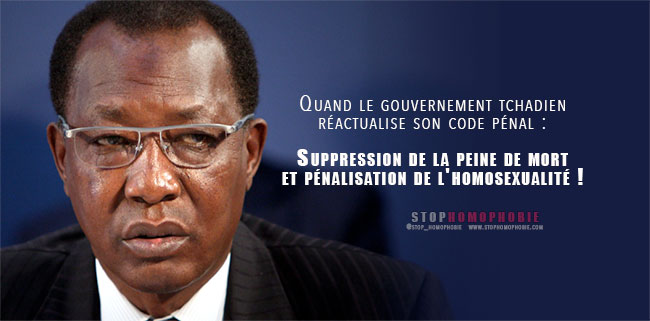
In a most welcome move to amend its penal code, the African nation of Chad announced but it was abolishing the death penalty. Unfortunately, the same move to amend the penal code also includes a disappointing penalization of homosexuality. (C) Stop Homophobie

In a most welcome move to amend its penal code, the African nation of Chad recently announced that it was abolishing the death penalty.
Unfortunately, the same move to amend the penal code also includes a disappointing penalization of homosexuality.
(C) Stop Homophobie

There are 47 Member States in the Council elected within regional groups. Many more States attend the session as Observer States, with the right to speak but not vote. Some Observer States are there because they are interested in human rights; most are there to reply, if they are attacked, especially by representatives of nongovernmental organizations in consultative status, such as the Association of World Citizens.

The vote was 25 in favor, 14 against, 7 abstentions, and the representative of the African State of Benin left the room so he would not have to vote at all. It is important to analyze the composition of the vote to see allies to strengthen, opponents to change, and abstentions to act.

Interestingly, the lead on the resolution was taken by South American countries which have a large Roman Catholic population. In the past Latin American countries were hostile or uninterested, a reflection of Catholic sexual policy. Now with a new Pope from Latin America and his less condemning attitude, Latin American countries could play an active, positive role. Brazil, Chile, Colombia and Uruguay took the lead, and the other Latin American members voted for: Argentina, Costa Rica, Cuba, Mexico, Peru and Venezuela. Western Europe voted for, and more surprisingly, four Asian States: Japan, Philippines, South Korea, and Vietnam.

Opposition came from African States: Botswana, Cote d’Ivoire, Ethiopia, Gabon, Kenya, joined by North African and Middle East States: Algeria, Kuwait, Morocco, Saudi Arabia, United Arab Emirates, and Asian States with a large Muslim population: Indonesia, Maldives, and Pakistan. The Russian Federation also voted no, a reflection of the current policy there, especially voiced by its President.

Among the States which abstained are two key Asian States where efforts must be made systematically for change: China and India. Four African States also abstained, not giving into strong pressure to have a unified African bloc: Burkina Faso, Congo, Namibia, and Sierra Leone, and as mentioned, Benin left the room so as not to vote at all. Since individual African States have little influence, they try to vote together as a bloc which gives them some power. That four African States were willing to leave the negative bloc is an important sign of progress, but they are hardly in the “yes” group as yet.

The resolution also calls for an update on a 2012 study on discrimination based on sexual orientation. The updated study means that the issue will be automatically on the 2015 Human Rights Council agenda.

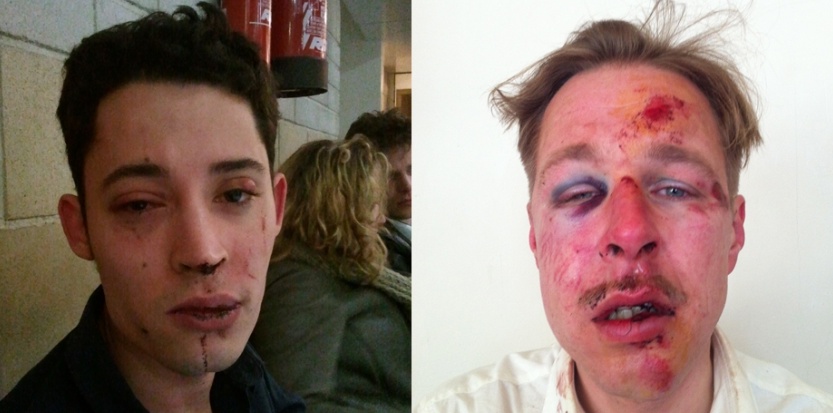
On April 7, 2013 Wilfred de Bruijn and Olivier Couderc, a young homosexual couple living in Paris, were savagely attacked on the street on homophobic grounds as they were going home late at night. Since the newly-elected Socialist Party parliamentary majority had begun examining a bill on same-sex marriage in late 2012, French President François Hollande and his government had faced demonstrations, sometimes violent, by opponents to gay rights who wanted them to drop the bill. The attack on Wilfred and Olivier resulted in national outrage and the opponents to the government-proposed bill were widely blamed for it.  Eventually, on May 17, 2013 the French Parliament went ahead and did pass the law extending the right to marriage to same-sex couples.

On April 7, 2013 Wilfred de Bruijn and Olivier Couderc, a young homosexual couple living in Paris, were savagely attacked on the street on homophobic grounds as they were going home late at night.
Since the newly-elected Socialist Party parliamentary majority had begun examining a bill on same-sex marriage in late 2012, French President François Hollande and his government had faced demonstrations, sometimes violent, by opponents to gay rights who wanted them to drop the bill.
The attack on Wilfred and Olivier resulted in national outrage and the opponents to the government-proposed bill were widely blamed for it.
Eventually, on May 17, 2013 the French Parliament went ahead and did pass the law extending the right to marriage to same-sex couples.

Nongovernmental work must start now to influence governments for the 2015 sessions. To the extent possible, articles in the press in India and China would be useful. China, India and Russia have influence in the Human Rights Council, both because of the size of the States but also the good quality of their representatives who are often very skillful in tactical techniques to delay action. The African States have prejudices but no real ideological position, and so some progress may be made there. The Islamic States will be the most difficult to swing given the power of conservative religious leaders in many Muslim countries. Latin American governments should be thanked or their efforts, especially as there could be a conservative Catholic backlash in some countries once people learn of their governments’ initiatives. It must be said that the media in most countries do not focus on the resolutions of the UN Human Rights Council. Thus when a conservative, activist minority learns about the resolution, they may mobilize to change the policy of the Latin American States.

There is still a long road ahead for real respect for sexual orientation efforts. As most UN human rights resolutions, the emphasis is put on non-discrimination and anti-violence. I think that the policy of the Association of World Citizens must stress a positive approach of respect for each individual and creating a society in which each person can fulfill potentials.


Prof. René Wadlow is President of the Association of World Citizens.

UN Human Rights Protection: Small Steps, But No Turning Back

In Anticolonialism, Asia, Being a World Citizen, Conflict Resolution, Cultural Bridges, Current Events, Human Rights, International Justice, Middle East & North Africa, Solidarity, The Search for Peace, United Nations, War Crimes, World Law on September 7, 2014 at 10:11 PM

UN HUMAN RIGHTS PROTECTION: SMALL STEPS, BUT NO TURNING BACK

By René Wadlow


The effectiveness of United Nations (UN) action to promote human rights and prevent massive violations grows by small steps. However, the steps, once taken, serve as precedents and can be cited in future cases. Once the steps taken, it is difficult to refuse such action later.

Such small steps can be seen in the contrasting response to two situations:

1) The current situation in Iraq and Syria, in particular the areas held by the Islamic State (IS) and

2) The massacres and refugee flow from East Pakistan, now Bangladesh, in 1971.

I will contrast briefly the Special Session on Iraq held on September 1, 2014 in Geneva of the Human Rights Council with efforts at the Sub-Commission on Prevention of Discrimination and Protection of Minorities in August 1971 when I was among the representatives of nongovernmental organizations (NGOs) which had signed a joint appeal to the Sub-Commission for action in East Pakistan.

The September 1 Special Session stands out for two precedents which can be important:

1) The affirmation that non-State actors are bound to respect UN human rights standards;

2) The speedy creation of a UN Committee of Inquiry by using members of the UN human rights secretariat.

The massive violations of human rights in those parts of Iraq and Syria held by the IS is the first time that a major UN human rights body, the Human Rights Council or the earlier Commission on Human Rights, deals with an area not under the control of a State.

The diplomats working on a Special Session decided to focus only on Iraq. If Syria had been included, the actions of the Syrian government would have had to be considered as well.

Holding non-State actors responsible for violations of UN human rights norms is an important precedent and can have wide implications. The Declaration of the Eliminations of All Forms of Intolerance and Discrimination Based on Religion or Belief, adopted by the UN General Assembly on November 25, 1981 sets the standard − a standard repeatedly being violated by the forces of the IS.

Likewise, the speedy creation of a Committee of Inquiry is a major advance. The Human Rights Council in the past, following a practice of the earlier Commission on Human Rights, has created “Commissions of Inquiry” also called “Fact-finding Missions.” Currently there are four such Commissions at work:

1) Commission of Inquiry on Human Rights in the Democratic People’s Republic of Korea,

2) The Independent International Commission of Inquiry on the Syrian Arab Republic,

3) The OHCHR Investigation on Sri Lanka,

4) The Commission of Inquiry on Gaza.

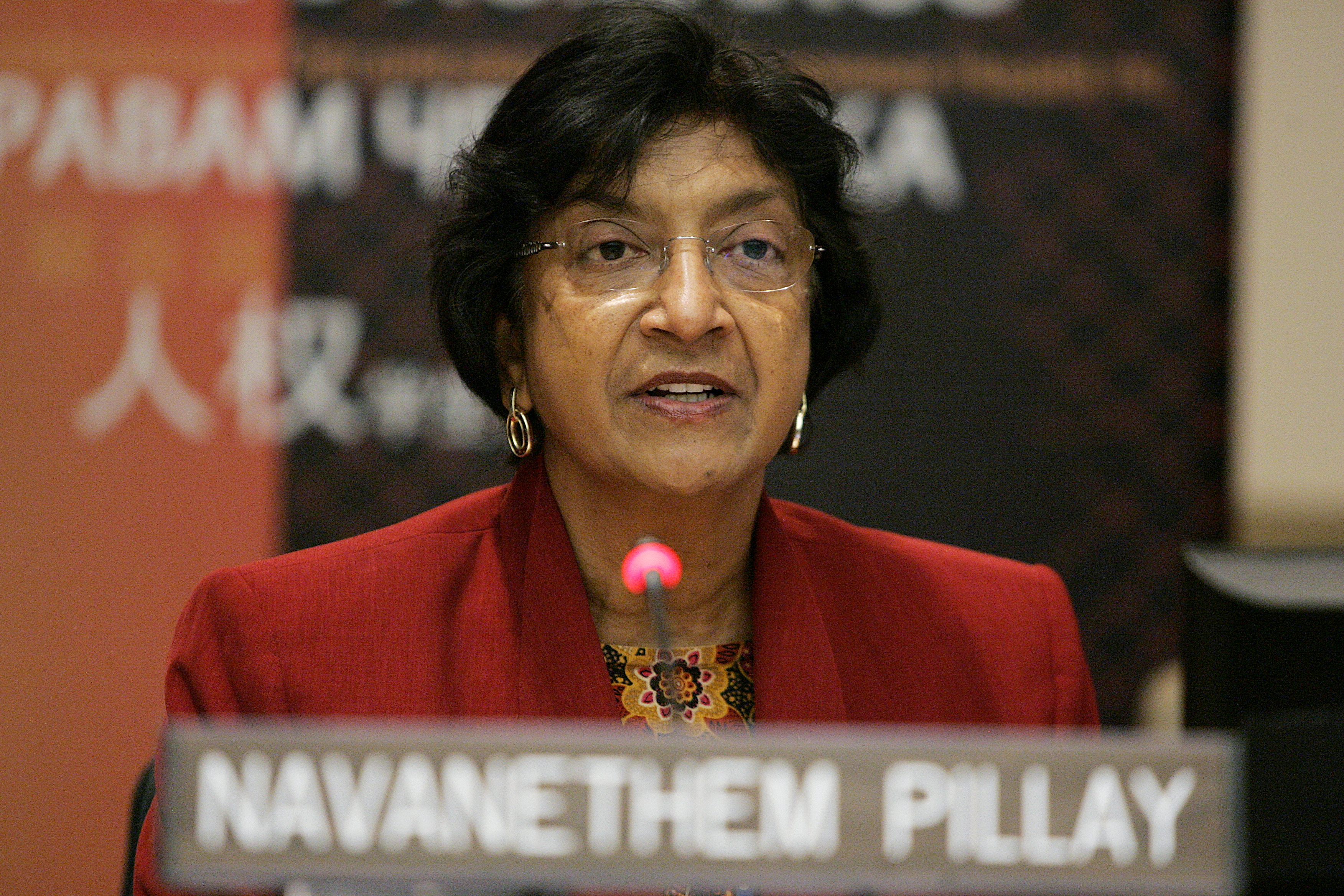
It was under Navanethem Pillay, who was the United Nations High Commissioner for Human Rights from 2008 to September 2014, that all of the existing four UN Commissions of Inquiry were created. The world has the former High Commissioner to thank for such valuable efforts in defense of human rights.

It was under Navanethem Pillay, who was the United Nations High Commissioner for Human Rights from 2008 to September 2014, that all of the existing four UN Commissions of Inquiry were created. The world has the former High Commissioner to thank for such valuable efforts in defense of human rights.

Each commission has three, sometimes four, members each from a different geographic zone. The members have usually had experience in UN activities, and the chair is usually someone who has a reputation beyond his UN efforts.

Since the commissions are usually not welcomed by the government of the country to be studies, the fact-finding is done by interviewing exiles and refugees. NGOs, scholars as well as governments can also provide information in writing. The commission reports rarely contain information that is not already available from specialized NGOs, journalists, and increasingly the Internet. However, the commission reports give an official coloring to the information, and some UN follow up action can be based on the reports.

It takes a good deal of time to put these commissions together as there must be regional balance, increasingly gender balance, as well as a balance of expertise. Moreover, the people approached to be a commission member are often busy and have other professional duties. It can sometimes take a month or more to put together a commission. In light of the pressing need presented by the situation in Iraq, it was decided that the members of the fact-finding group for Iraq would be members of the Secretariat of the Office of the High Commissioner for Human Rights so that they can get to work immediately.

For the UN, this is a major step forward and must have led to a good deal of discussion before the proposal was presented in the resolution. As it is, India and China objected publicly in official statements just before the final resolution was accepted. Both States maintained that using Secretariat members went beyond the mandate of the Office of the High Commissioner. They were worried by the increasing investigative role of the Office which should be limited only to helping develop national capacity building. Iraq today, Kashmir and Tibet tomorrow. The Indians and the Chinese are probably not the only governments worried, but they were the only States which spoke on the issue, Objecting strongly but saying they would not block consensus on the resolution.

In contrast to these steps: I had followed as closely as possible, from Geneva, the events in East Pakistan, having at one stage helped a representative of the Bangladesh opposition to speak to relevant diplomats in Geneva. Later, he became the Ambassador of Bangladesh to the UN in Geneva, and for a year was president of the Commission on Human Rights.

In December 1970, the Awami League led by Sheik Mujib Rahman won a majority of seats in the national assembly. The government of Pakistan refused to convene the national assembly, since it would result in shifting political power from West to East Pakistan. For three months, the government and the Awami League tried to negotiate a political settlement. On March 25, 1971, the government discontinued negotiations and unleashed the Pakistan army against the civilian population of East Pakistan. Hindus, members and sympathizers of the Awami League, students and faculty of the universities and women were especially singled out.

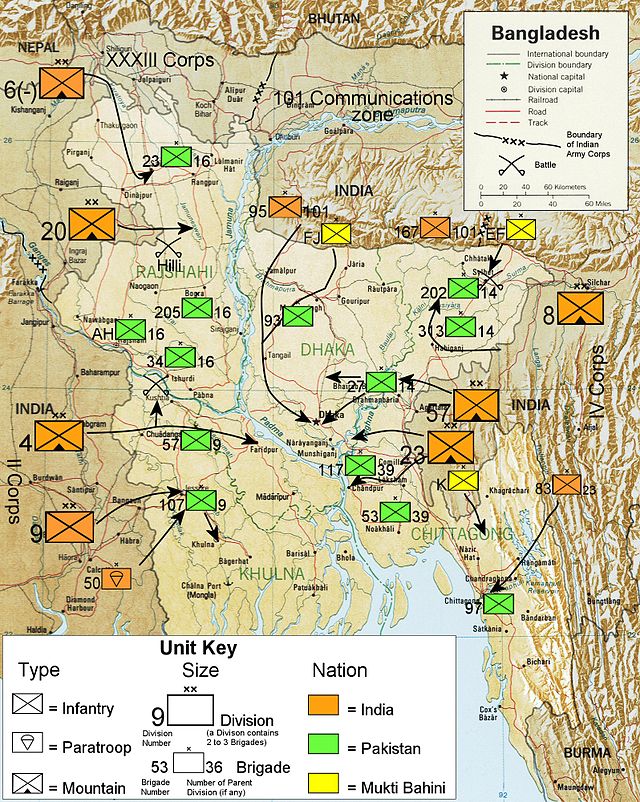
These atrocities continued until the Indian army which had been drawn into the conflict, in part by the large number of refugees that had fled to India, took control of Dacca on December 1, 1971.

When India gained independence from Britain in 1947, the predominantly Muslim-inhabited parts of the former colony became a separate country called Pakistan. Originally a Dominion within the British Empire, Pakistan eventually established a republic of its own in 1956. In March 1971 the province of East Pakistan launched a war of independence, waged by an armed force called the Mukti Bahini, also called the Bengali Liberation Army, and the Indian military which came to the aid of the rebels. Eventually, in December 1971 Pakistani troops were defeated and East Pakistan became a sovereign nation with the name of Bangladesh.

When India gained independence from Britain in 1947, the predominantly Muslim-inhabited parts of the former colony became a separate country called Pakistan. Originally a Dominion within the British Empire, Pakistan eventually established a republic of its own in 1956.
In March 1971 the province of East Pakistan launched a war of independence, waged by an armed force called the Mukti Bahini, also called the Bengali Liberation Army, and the Indian military which came to the aid of the rebels. Eventually, in December 1971 Pakistani troops were defeated and East Pakistan became a sovereign nation with the name of Bangladesh.

The UN Security Council was unwilling or unable to deal with the human rights situations in East Pakistan. The U. S. government strongly supported the Pakistan army while the Soviet Union supported India. For NGO representatives our hopes rested on the Sub-Commission on the Prevention of Discrimination and Protection of Minorities which was to meet in Geneva from August 2 to 20, 1971. At the time, the Commission on Human Rights and the bulk of the human rights secretariat was still in New York. However, the Sub-Commission would meet in Geneva once a year, usually in July or August.

The Sub-Commission members were not diplomatic representatives of governments as was the Commission on Human Rights. Rather they were “independent experts”. The saying among NGOs was that some were more independent than others, and some were more expert than others. Most were professors of law in their countries − thus the August dates when universities were on vacation. It was easier to have informal relations with Sub-Commission members than with diplomats, and NGO representatives could get advice on the best avenues of action.

NGOs had two formal avenues of action. We could present written statements that were distributed as official documents, and we could make oral statements, usually 10 minutes in which to develop ideas and to call attention to additional elements in the written statement. Written statements could be that of a single NGO or, often to give more weight, there could be a “joint statement”. On the East Pakistan situation, with the violence being covered by the world media, it was decided to have a joint statement. The statement called upon the Sub-Commission “to examine all available information regarding allegations of the violation of human rights and fundamental freedoms in East Pakistan and to recommend measures which might be taken to protect the human rights and fundamental freedoms of the people of East Pakistan”. Twenty-two NGOs with representatives in Geneva signed the joint statement, and John Salzberg, a representative of the International Commission of Jurists, made an oral statement presenting the written joint statement.

Government representatives were always present in the room and had the right to make statements (and also to try to influence the independent experts behind the scene). Najmul Saguib Khan, the independent expert from Pakistan contended that the Sub-Commission could not consider East Pakistan since the UN role in human rights “did not extend to questions arising out of situations affecting the sovereignty and territorial integrity of Member States and that attention to such situations would encourage those seeking the dismemberment of Member States.” The Indian diplomat, N.P. Jain, replied highlighting the influx of eight million refugees into India.

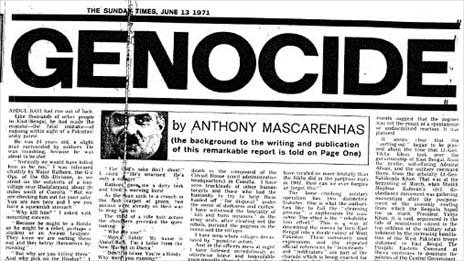
"On 13 June 1971, an article in the UK's Sunday Times exposed the brutality of Pakistan's suppression of the Bangladeshi uprising. It forced the reporter's family into hiding and changed history. (...) Written by Anthony Mascarenhas, a Pakistani reporter, and printed in the UK's Sunday Times, it exposed for the first time the scale of the Pakistan army's brutal campaign to suppress its breakaway eastern province in 1971. (...) There is little doubt that Mascarenhas' reportage played its part in ending the war. It helped turn world opinion against Pakistan and encouraged India to play a decisive role." (C) BBC News

“On 13 June 1971, an article in the UK’s Sunday Times exposed the brutality of Pakistan’s suppression of the Bangladeshi uprising. It forced the reporter’s family into hiding and changed history. (…)
Written by Anthony Mascarenhas, a Pakistani reporter, and printed in the UK’s Sunday Times, it exposed for the first time the scale of the Pakistan army’s brutal campaign to suppress its breakaway eastern province in 1971. (…)
There is little doubt that Mascarenhas’ reportage played its part in ending the war. It helped turn world opinion against Pakistan and encouraged India to play a decisive role.”
(C) BBC News

The Sub-Commission members took the “diplomatic way out” and said nothing. In drafting the report of the session, one member, Adamu Mohammed from Nigeria proposed deleting any reference to the discussion on East Pakistan. He held that the Sub-Commission had listened to, but had not considered the statements made by the representative of the International Commission of Jurists, the Sub-Commission member from Pakistan and the observer of India.

The NGO representatives were saddened by the lack of action but not totally surprised. No other UN human rights body took action, and the massacres stopped only after the ‘lightning war’ of India defeated the Pakistan army and occupied the country until a Bangladesh government could be set up.

There remains real danger that the situation in Iraq and Syria will continue through military means, but at least progress has been made within the UN in calling attention to conflicts within a State and holding all parties responsible for maintaining the standards of human rights.

Prof. René Wadlow is President of the Association of World Citizens.

World Law Advanced by the UN Special Session of the Human Rights Council on Human Rights Violations in Iraq

In Being a World Citizen, Current Events, Human Rights, International Justice, Middle East & North Africa, Religious Freedom, Solidarity, United Nations, War Crimes, World Law on September 3, 2014 at 12:21 AM

WORLD LAW ADVANCED BY THE UN SPECIAL SESSION OF THE HUMAN RIGHTS COUNCIL ON HUMAN RIGHTS VIOLATIONS IN IRAQ

By René Wadlow


Two major advancements in the universal application of world law were made by the United Nations (UN) Human Rights Council Special Session in Geneva on September 1, 2014. The Council met in response to widespread and converging accusations of human rights violations in territory in Iraq and Syria under the control of the Islamic State (IS) also called the Islamic State in Iraq and the Levant (ISIL) and the Islamic State in Iraq and Syria (ISIS). I will use the term “Islamic State” which is the title that the movement most often uses now for itself.

For the past several years, the IS was one of a good number of shifting insurgency groups active in Syria in opposition to the government, and it did not receive more attention than any of the other insurgencies. It had no clear political program, and its ideology was not particularly different from that of other Islamist groups. Then suddenly in June 2014, under the leadership of the young Abu Bakr al-Baghdadi, the group shifted its focus from Syria to Iraq. It was able to build on the growing resentment and sentiment of marginalization of the Iraqi Sunnis and the disorganization of the Iraq army to sweep through large parts of western Iraq and eastern Syria. IS’s ideology does not recognize existing nation-states but rather a potentially unified Islamic world. One of its first symbolic moves was to destroy frontier wall and frontier posts on the Iraq-Syria frontier. Thus the name of Islamic State and the title of Caliphate for the area under its control.

In the areas under IS control, IS armed groups have killed prisoners of the Iraqi army and members of religious and ethnic minorities leading to larger scale displacement of people, often to the Kurdish Autonomous Area − some 800,000 during August. The Office of the High Commissioner for Refugees has stated that this is a “humanitarian crisis” and appealed for support from governments and civil society to meet the urgent needs of the displaced. On August 12, 2014, Heiner Beilefeldt, the Special Rapporteur of the Council on Discrimination due to Religion or Belief, warned of the destruction of religious minorities and the UN Committee on the Elimination of Racial Discrimination activated its early warning and urgent action procedures.

During August, IS forces took areas close to the Kurdish Autonomous Area, areas in which there is a large Kurdish-speaking population but is outside the Kurdish Autonomous Area’s boundaries. The Kurdish forces fought back, helped by US bombing missions aimed at IS military equipment and posts. The danger of a military escalation and a spreading of the conflict was (and still is) a real possibility.

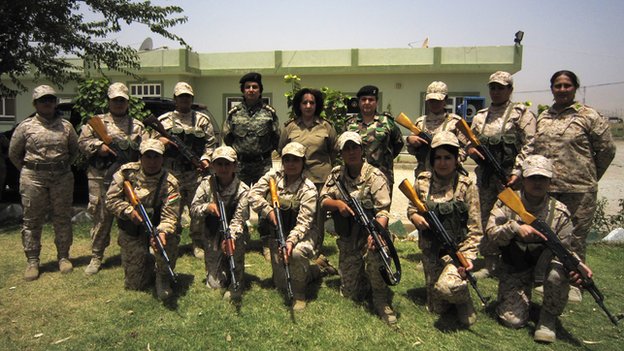
Kurdish women fighters in Suleymaniyeh, Iraq. Many people in Kurdistan believe the region owes much of its safety to the efforts of the Peshmerga. (C) BBC News

Kurdish women fighters in Suleymaniyeh, Iraq.
Many people in Kurdistan believe the region owes much of its safety to the efforts of the Peshmerga.
(C) BBC News

Many looked toward the UN Human Rights Council to speak out. Both some governments and nongovernmental organizations (NGOs) urged a Special Session of the Council, the highest profile action which the Council can take. It seems that France took the lead in the effort to get a Special Session. Although a minority of 16 States among the 47 Members of the Council is needed to call a Special Session, diplomatic sense requires that as many States as possible participate in the call and that they would vote positively on the resolution at the end of the Special Session.

In the case of this session, it was agreed by government negotiators to limit the discussion to IS actions in Iraq and not bring up violations in Syria on which governments hold differing views. The negotiators organizing the effort had to have the agreement of Iraq, the concerned State, of Iran which holds the presidency of the Non-Aligned Movement and its 120 members. Iran is also heavily involved in the conflicts of Syria and Iraq. Pakistan needed to agree as Pakistan is the usual spokesperson for the Organization of the Islamic Cooperation. Italy, as current president of the EU had to play a key role.

The President of the Council, Ambassador Baudelaire Ndong Ella, had to be kept informed as the Special Session would be under his leadership.

It is difficult for someone not party to the government private negotiations to know how they are carried out and how the resolution is written, well in advance of the Session itself. In this case, the Ambassador of South Africa felt that he had been left out of the discussions and complained bitterly that the resolution had not been negotiated inclusively and transparently and had appealed to the President of the Council to defer until more time was given to delegates to negotiate the text. His request was turned down, and so South Africa was the only State to say after the resolution was passed by consensus without a vote that had there been a vote, he would have abstained.

As the final resolution is written and agreed upon prior to the start of the Session, all the statements of the Member States of the Council, the Observer States and NGOs are “for the record”. Each State wishes to have been seen as saying something in the very short time that each State is allocated. The factual information was presented at the start of the Session by Ms. Flavia Pansieri, Deputy High Commissioner for Human Rights, and Ms. Leila Zerrougui, Special Representative of the Secretary-General for Children in Armed Conflict. There is therefore a good deal of repetition in what government representatives have to say. There is a story in the United States (U. S.) about a mythical conference of comedians who have heard all the jokes before, so rather than tell a joke, they would just say a number, “Number 10” and everyone would laugh. Along these lines, I have suggested that at the UN a good deal of time could be saved by having all ideas given a number, so the Ambassador could just say, “We believe, 7 9 15, Thank you” and a skilled technician would flash a red light if ever a new idea was mentioned. My suggestion has not yet been acted upon, and so one must listen carefully to “hear between the lines” and see who is saying something different or occasionally saying it very well.

Thus, it was impossible for the Ambassador of Syria not to mention that the IS was also in Syria, which the Canadian Ambassador did as well. Germany mentioned that there were Syrian refugees in Iraqi Kurdistan but did not go into more detail. Cuba and Venezuela mentioned that the problems of Iraq were due to the U. S. invasion of 2003 “responsible or sowing the seeds of death and the social breakdown among the Iraqi people”. Ireland was the one State to mention “open and possibly genocidal attacks on minority communities” but did not mention the 1948 Genocide Convention. Austria spoke of the “total annihilation of minorities” but did not use the term “genocide”. Morocco called or Iraq to become a “cohesive State in which all citizens were equal and enjoyed their human rights.” Malaysia called upon “the voices of moderation to drown out the destructive and divisive voices of extremism and terrorism”. Lebanon called for action by the International Criminal Court (ICC), especially against those bearing passports of States which were party to the Rome Statute setting up the ICC. The Holy See (the Vatican) made a moving call or tolerance and understanding among all religions.

After the speeches “for the record”, what was the action proposal which was an advancement for world law? The action proposal followed a Council pattern but with a significant difference. The Council in the past, following a practice of the earlier Commission on Human Rights, has created “Commissions of Inquiry” also called “Fact-finding Missions”. Currently there are four such Commissions at work: Commission of Inquiry on Human Rights in the Democratic People’s Republic of Korea, the Independent International Commission of Inquiry on the Syrian Arab Republic, the OHCHR Investigation on Sri Lanka, and the Commission of Inquiry on Gaza. Each commission has three, sometimes four people, each from a different geographic zone. The members have usually had experience in UN activities, and the chair is usually someone who has a reputation beyond his UN efforts, such as Mr. Marti Ahtisaari, the former President of Finland who heads the Sri Lanka study.

This sign, here painted in red on a wall with a circle around it, is the letter N in Arabic. When the IS started seizing predominantly Christian-inhabited areas of Iraq by force, its militiamen immediately painted this on houses they knew or thought were owned by Christians, N being for “Nasrani” which is itself the Arabic for “Christian”. A long echo of the Nazis’ practices in pre-World War II Germany, when Hitler’s own militiamen would paint a Star of David on the front door of each Jewish-owned business. That was just before the “Final Solution” which claimed over 6 million lives.

This sign, here painted in red on a wall with a circle around it, is the letter N in Arabic.
When the IS started seizing predominantly Christian-inhabited areas of Iraq by force, its militiamen immediately painted this on houses they knew or thought were owned by Christians, N being for “Nasrani” which is itself the Arabic for “Christian”.
A long echo of the Nazis’ practices in pre-World War II Germany, when Hitler’s own militiamen would paint a Star of David on the front door of each Jewish-owned business. That was just before the “Final Solution” which claimed over 6 million lives.

Since the commissions are usually not welcomed by the government of the country to be studied, the fact-finding is done by interviewing exiles and refugees. NGOs, scholars as well as governments can also provide information in writing. The Commission reports rarely contain information that is not already available from specialized NGOs, journalists and increasingly the Internet. However, the commission reports give an official coloring to the information, and some UN follow up action can be based on the reports.

It takes a good deal of time to put these commissions together as there must be regional balance, increasingly gender balance, and a balance of expertise. Moreover, the people approached to be commission members are often busy and have other professional duties. It can sometimes take a month or more to put together a commission. In light of the pressing need presented by the situation in Iraq, it was decided that the members of the fact-finding group would be members of the Secretariat of the Office of the High Commissioner for Human Rights so that they can get to work immediately.

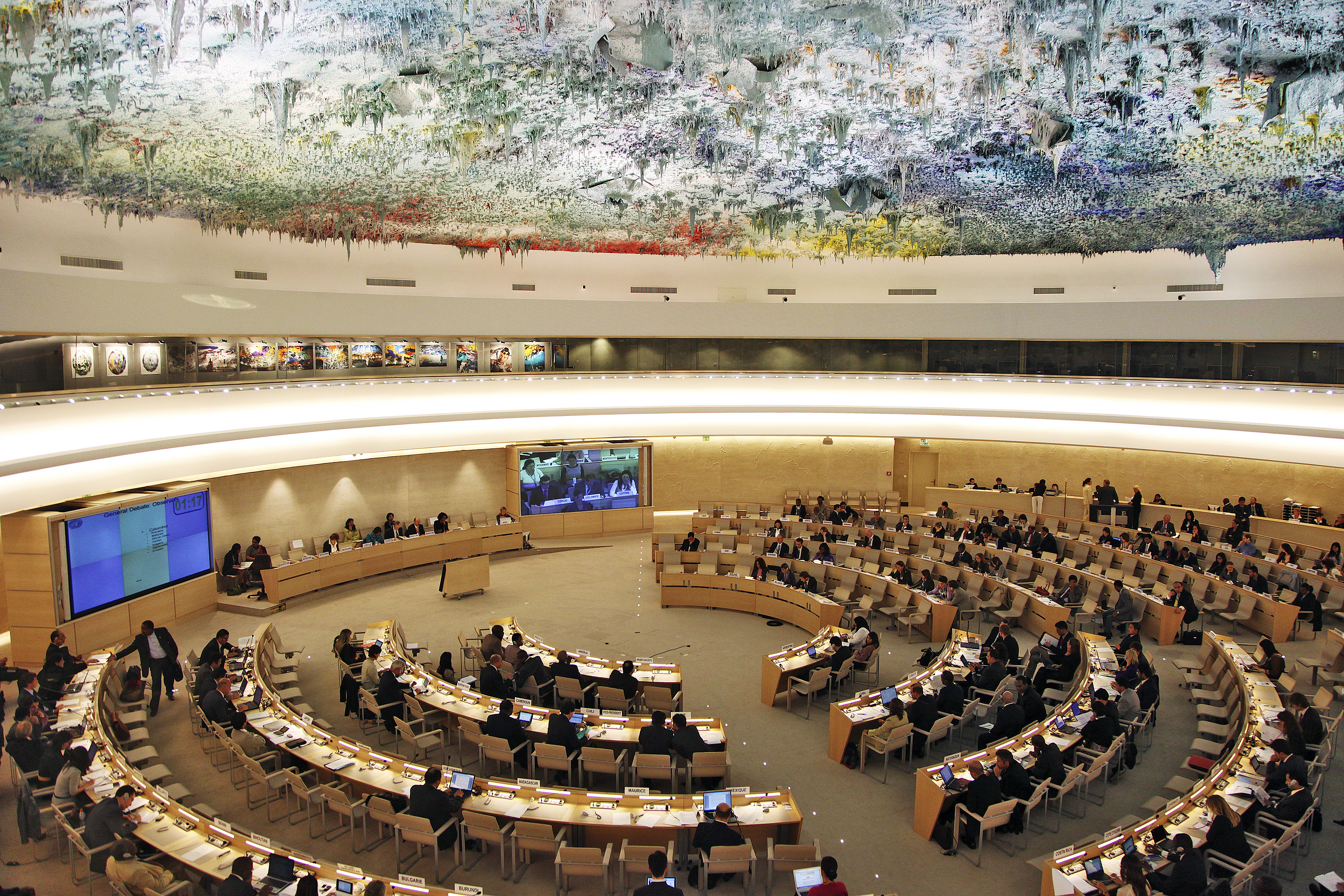
Inside the Human Rights and Alliance of Civilizations Room of the Palais des Nations in Geneva. Inaugurated in 2008, the room accommodates different United Nations bodies, including ECOSOC and the Human Rights Council. (C) United Nations

Inside the Human Rights and Alliance of Civilizations Room of the Palais des Nations in Geneva.
Inaugurated in 2008, the room accommodates different United Nations bodies, including ECOSOC and the Human Rights Council.
(C) United Nations

For the UN, this is a major step forward and must have led to a good deal of discussion before being presented in the resolution. As it is, India and China objected publicly in official statements just before the final resolution was accepted. Both States maintained that using Secretariat members went beyond the mandate of the Office of the High Commissioner. They were worried by the increasing investigative role of the Office which should be limited only to helping develop national capacity building: Iraq today, Kashmir and Tibet tomorrow. The Indians and the Chinese are probably not the only governments worried, but they were the only States which spoke up on the issue, objecting strongly but saying they would not block consensus on the resolution.

The other advance or world law arising from the Special Session is the principle of the universality of concern and thus of investigation. In no previous case, has the UN looked at the violations within an area not under the control of a Member State. In this case, the investigation concerns actions of a non-state actor who nevertheless controls territory and to some extent administers the territory trying to impose its vision of strict Islamic law. This is a major step forward and has implications or other state entities but which are not members of the UN or recognized by the majority of UN Member States such as Abkhazia, South Ossetia, Transnistra, Nagorno-Karabakh, and if a state were set up in eastern Ukraine.

This principle was stated in a widely distributed text for the Special Session and which will come out as a written NGO statement at the regular session of the Council starting 8 September. With due modesty, I quote from myself:

“The Association of World Citizens believes that world law as developed by the United Nations applies not only to the governments of Member States but also to individuals and non-governmental organizations. The ISIS has not been recognized as a State and is not a member of the UN. Nevertheless the Association of World Citizens is convinced that the terms of the Declaration on the Elimination of All Forms of Intolerance and Discrimination Based on Religion or Belief applies to the ISIS and that the actions of the ISIS are, in the terms of the Declaration adopted by the General Assembly on November 25, 1981 ‘inadmissible’.

Citizens of the World stress the need for world law and certain common values among all the States and peoples of the world. We are one humanity with a shared destiny. The challenge before us requires inclusive ethical values. Such values must be based on a sense of common responsibility for both present and future generations.”

Prof. René Wadlow is President of the Association of World Citizens.

Iraq: Yazidis’ Genocide?

In Cultural Bridges, Current Events, Human Rights, International Justice, Middle East & North Africa, Religious Freedom, Uncategorized, United Nations, War Crimes, World Law on August 11, 2014 at 7:05 PM

IRAQ: YAZIDIS’ GENOCIDE?

By René Wadlow


A mix of United States (U. S.) humanitarian airdrops of food and water to the stranded displaced people on Mount Sinjar as well as U. S. military air strikes against some of the positions of the Islamic State in Iraq and Syria (ISIS) has focused international attention on the area. The Christian Peacemaker Teams have had a group working toward human rights protection and reconciliation in the Iraq Kurdistan for some years and are now posting daily updates on their website and Facebook [i].

I will not deal here with the broader issues of the impact of the ISIS on the possible geographic fragmentation and re-structuring of Iraq and Syria.

As a Nongovernmental Organization (NGO) representative to the United Nations, Geneva, and active on human rights issues, I had already raised the issues of two major religious minorities in Iraq at the UN Commission on Human Rights: the Yazidis and the Mandaeans. Here I ask if their fate can be identified as genocide under the 1948 Convention for the Prevention and Punishment of the Crime of Genocide. My concern with the Yazidi (also written as Yezidi) dates from the early 1990s and the creation of the Kurdish Autonomous Region. Many of the Yazidis are ethnic Kurds, and the government of Saddam Hussein was opposed to them not so much for their religious beliefs but rather that some Yazidis played important roles in the Kurdish community seen as largely opposed to the government. The Yazidis also had some old ownership claims on land on which oil reserves are found in northern Iraq.

My concern with the Mandaeans (also written as Sabean-Mandeans) came in the early 2000s after the U. S. invasion when the Mandaeans were persecuted as being supporters of Saddam Hussein and most fled to Syria. A word about the faiths of the two groups which helps to explain their special status. Although both are called “sects” and are closed religious communities which one can only enter by birth, they are faiths even if the number of the faithful is small.

The Mandaeans are a religious group formed in the first centuries of the Common Era in what is now Israel-Palestine-Jordan. Over time, they migrated to southern Iraq in the area of Basra as well as to what is now the Islamic Republic of Iran. One of their distinctive signs is the frequent purification by running water − baptism. They honor John the Baptist, described in the Christian Gospel of Luke, but are probably not direct descendents of his followers. At the time of John and Jesus, there were a good number of movements which had purification by water as one of their rituals. The Mandaean scripture The Book of John is probably a third-century collection. The Book of John was used in Mandaean rituals and services but was never published to be read by others. Given intellectual and historic interest in the Mandaeans, the Mandaean leadership authorized the publication of their scriptures. As a sign of respect, the first printed copy was given to Saddam Hussein as President of the country. In the confused situation after the U. S. occupation of Iraq, the book presentation was enough to have some accuse the Mandaeans of being Saddam Hussein supporters. Under increasing pressure, the vast majority of Mandaeans left Iraq for Syria (the frying pan into the fire image). Now they are caught in the Syrian civil war, unable or unwilling to return to Iraq. A small number of Mandaeans have been granted refugee status in the US and Western Europe.

There has been some intellectual mutual interplay among the Mandaeans and the Yazidis, but they are separate faiths and located in different parts of Iraq. The structure of the Yazidi worldview is Zoroastrian, a faith born in Persia proclaiming that two great cosmic forces, that of light and good, and that of darkness and evil are in constant battle. Man is called upon to help light overcome evil.

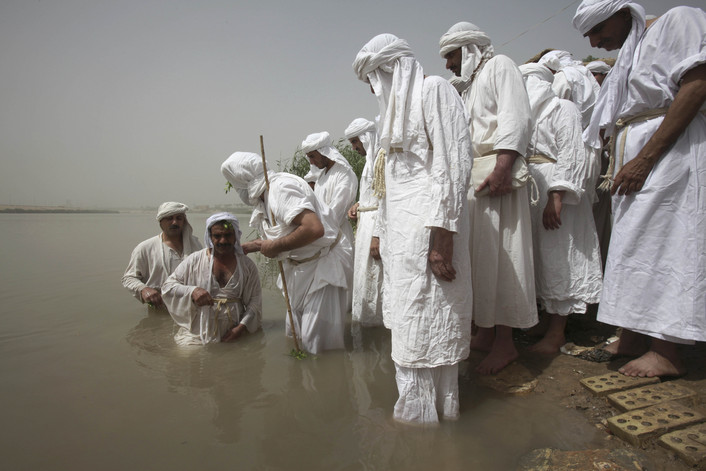
Sabean Mandeans perform baptisms for the faithful, in Iraq's Tigris River. (C) The Washington Post

Sabean Mandeans perform baptisms for the faithful, in Iraq’s Tigris River.
(C) The Washington Post

However, the strict dualistic thinking of Zoroastrianism was modified by another Persian prophet, Mani of Ctesiphon in the third century CE who had to deal with a situation very close of that of ours today. Mani tried to create a synthesis of religious teachings that were increasingly coming into contact through travcl and trade: Buddhism and Hinduism from India, Jewish and Christian thought, Helenistic Gnostic philosophy from Egypt and Greece as well as many smaller, traditional and “animist” beliefs. He kept the Zoroastrian dualism as the most easily understood intellectual framework, though giving it a somewhat more Taoist (yin-yang) flexibility, Mani having traveled in China. He developed the idea of the progression of the soul by individual effort through reincarnation − a main feature of Indian thought combined with the ethical insights of Gnostic and Christian thought. Unfortunately, only the dualistic Zoroastrian framework is still attached to Mani’s name − Manichaeism. This is somewhat ironic as it was the Zoroastrian Magi who had him put to death as a dangerous rival.

Within the Mani-Zoroastrian framework, the Yazidi added the presence of angels who are to help man in his constant battle for light and good, in particular Melek Tawis, the peacock angel. Although there are angels in Islam, angels that one does not know could well be demons, and so the Yazidis are regularly accused of being “demon worshipers” [ii].

The faravahar is one of the best-known symbols of Zoroastrianism, the state religion of ancient Iran.

The faravahar is one of the best-known symbols of Zoroastrianism, the state religion of ancient Iran.

With the smaller Mandaean faith, originally some 60,000 people, now virtually destroyed in Iraq and unable to function effectively in Syria, the idea of ridding a country of the near totality of a faith is not for the ISIS an “impossible dream”. There are probably some 500,000 Yazidis in Iraq. Iraq demographic statistics are not fully reliable, and Yazidi leaders may give larger estimates by counting Kurds who had been Yazidis but had been converted to Islam. There had been some 200,000 Yazidis among the Kurds of Turkey but now nearly all have migrated to Western Europe, Australia and Canada.

Already in the last days, some 150,000 Yazidis have been uprooted and have fled to Iraqi Kurdistan. Thus most Yazidis could be pushed into an ever-smaller Kurdish-controlled zone of Iraq and Syria. The rest could be converted to Islam or killed. The government of the autonomous Kurdish region of Iraq has done little (if anything) to help the socio-economic development of the Yazidis, probably fearing competition for the Kurdish families now in control of the autonomous Kurdish government and society. Now the Kurdistan government and civil society groups are stretched well beyond capacity with displaced persons from Iraq and Syria.

Thousands of Yazidis previously trapped by Isis have been rescued by Kurdish peshmerga forces. (C) Anadolu Agency/Getty Images

Thousands of Yazidis previously trapped by Isis have been rescued by Kurdish peshmerga forces.
(C) Anadolu Agency/Getty Images

If one is to take seriously the statements of the ISIS leadership, genocide − the destruction in whole or in part of a group − is a stated aim. The killing of the Yazidis is a policy and not “collateral damage” from fighting. The 1948 Convention for the Prevention and Punishment of the Crime of Genocide allows any State party to the Convention to “call upon the competent organs of the United Nations to take such action under the Charter of the United Nations as they consider appropriate for the prevention and suppression of acts of genocide.” Thus far no State has done so by making a formal proposal to deal with the Convention.

With the incomplete evidence at hand, I would maintain that the ISIS policy is genocide and not just a control of territory. Although the UN “track record” of dealing with genocide is very mixed, the first immediate step is for a State to raise the issue within the UN in order to set a legal approach in motion [iii].

Prof. René Wadlow is President of the Association of World Citizens.


[i] See the website of the Christian Peacemaker Teams: www.cpt.org.

[ii] A Yazidi website has been set up by Iraqis living in Lincoln, Nebraska. The website is uneven but of interest as a self presentation: www.yeziditruth.org.

[iii] See the very complete study: William A. Schabas, Genocide in International Law (Cambridge Univesity Press, 2000).

Tribal Societies: Survival and Transformations

In Being a World Citizen, Cultural Bridges, Current Events, Environmental protection, Foundations for the New Humanism, Human Development, Human Rights, International Justice, Solidarity, The Search for Peace, United Nations, World Law on August 9, 2014 at 10:46 AM

TRIBAL SOCIETIES: SURVIVAL AND TRANSFORMATIONS

by René Wadlow


August 9 has been chosen by the UN General Assembly as the International Day of the World’s Indigenous Peoples.

As Paulo Freire has written, “While both humanization and dehumanization are real alternatives, only the first is man’s vocation. This vocation is constantly negated. It is hindered by injustice, exploitation, oppression, and the violence of the oppressors; it is affirmed by the yearning of the oppressed for freedom and justice, and by their struggle to recover their lost humanity.

The world society is filled with many different types of collective actors: clans, tribes, castes, ethnic groups, cities, races, social classes, religious organizations, nation-states, multi-state alliances for military or economic goals, transnational corporations and associations. Each is the creation of individuals who have grouped together − or have been grouped together − to achieve goals considered common to the group’s members. All such collective groups have techniques to socialize new members to share the common values, to accept the ideology and beliefs of the tribe, the nation-state or the association. This socialization process goes so deeply that a person’s sense of identity becomes associated with these collective identity, the school, the army, the church, the political process and institutions − each propose a sense of group purpose.

Yet none of these groups is static and unchanging. Even clans and tribes whose members often consider that they have a common ancestor do, in fact, change. Tribes merge and divide; new identities are formed; new ancestors are created to justify the new groupings.

Some types of collective belonging are more easily left than others. One can move relatively easily from a city and take on the character, the values and the goals of a new city. Social mobility can produce changes in social class, and even caste lines become blurred. Persons change nationality or acquire new nationalities as frontiers are modified. Race is less easily changed but definitions of what constitutes a race do change. Ethnic identity is often associated with birth, but parents can belong to different ethnic communities, although the child is usually raised as belonging to the more dominant group. However the socialization process of group identity goes to the level of sub-conscious behavior and is not easily set aside.

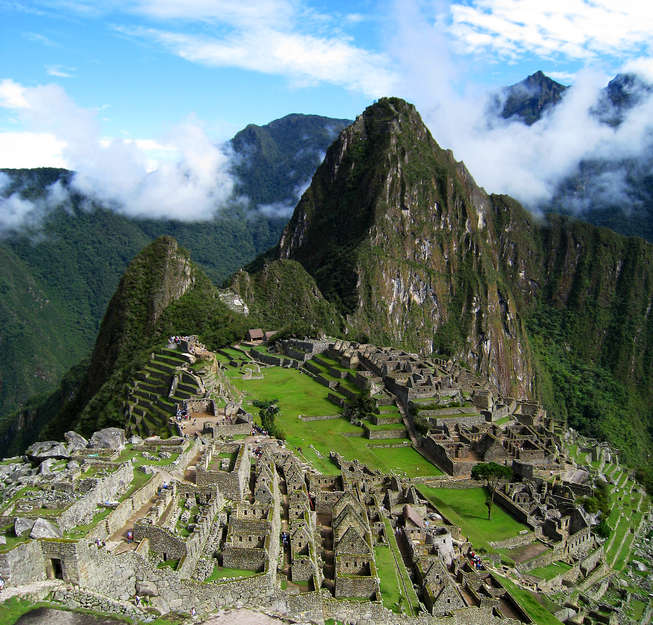
In Peru, some tribes remain uncontacted. Some live no more than 100 kms from the legendary mountain site of Machu Picchu. Today, however, the future of these tribes who live in the heartland of the ancient Inca Empire is threatened by a gas project. (C) Survival International

In Peru, some tribes remain uncontacted. Some live no more than 100 kms from the legendary mountain site of Machu Picchu. Today, however, the future of these tribes who live in the heartland of the ancient Inca Empire is threatened by a gas project. (C) Survival International

Today the nation-state claims to be the dominant collective association − setting the boundaries of loyalty and identity. The State claims the right to set out the major collective goals and values. Through laws, the State claims the right to set out the rules by which other collective entities may pursue their goals; through taxation the State draws the resources to further the goals it has set, and the State claims to have the only legitimate use of violence to punish those who break the laws and rules it has set.

There have always been tensions between these collective groups for their spheres of goal-setting and value-setting have overlapped. Thus there have been tensions between religious organizations and the State as to who should set what goals and the means to achieve these goals. There have also been tensions between economic classes and the State when it was felt that the State was dominated by another economic class who used its power within State institutions not for the good of all but only to advance class interests. The same is true of other collective units − races or ethnic groups − excluded from power within State institutions.

Today in many parts of the world those most excluded from power within State institutions are people living in alternative structures of authority, goal-setting and rule-making: persons living in tribal societies.

Tribal societies predated most of today’s nation-state. A tribal society usually has all the same functions as the nation-state: it sets out membership, loyalties, common goals and rules of behavior. It has sanctions against those breaking the laws of the tribe and has − or had − the monopoly of the legitimacy of using violence against those breaking the laws. Tribes are, in fact, more realistically “nation-states” if one defines nation as a common language, a common history and a common will to act together.

Thus because the tribal society is the closest in function to that of the nation-state, it is also the most feared. Tribes are institutions with whom it is difficult to compromise because they have the same pretensions as the State. It is relatively easy for a government to offer higher wages to the industrial worker or higher prices to the farmer as these social classes do not claim to carry out an alternative way the functions of the State. It is more of a challenge to the State’s image of its role to allow tribal societies to set out a land policy or fishing rights or trans-frontier trading rights because these activities conflict directly with the functions that the government has set for itself.

Thus there has been a long history of the State destroying alternative institutions of governance on its territory. The nation-states of Europe were built upon the ruins of feudal institutions; much of Asia on the destruction of local rulers. We see the pattern today as we watch traditional chiefs in Africa lose their authority to the heads of State and the military. In the Americas, many of the indigenous tribal societies were destroyed. Others were pushed into areas that those who controlled the government did not want − the “reservations” of the USA and Canada.

In Latin America and Asia, there is still active struggle going on between those trying to preserve their tribal institutions and homelands and the State which claims complete authority over all its territory and who often wished to put new settlers on tribal lands.

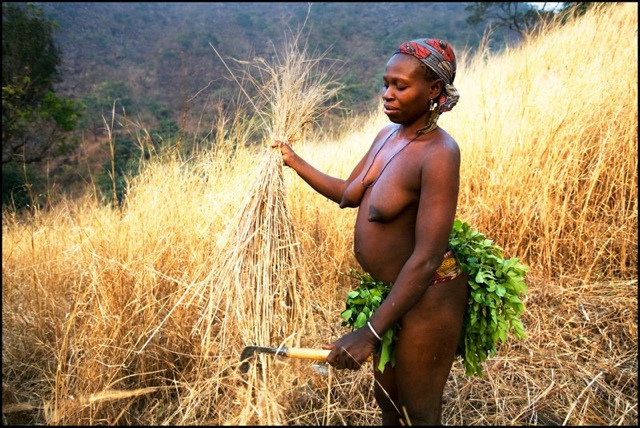
A Koma tribe woman at her farm. Alantika Mountain, Cameroon. (C) Middle Africa The Koma people are indigenous hill-dwelling people occupying the Alantika Mountains in northern Adamawa State, Nigeria and in Northern Cameroon (Faro National Park), near the border with Adamawa State.

A Koma tribe woman at her farm. Alantika Mountain, Cameroon. (C) Middle Africa
The Koma people are indigenous hill-dwelling people living in the Alantika Mountains in northern Adamawa State, Nigeria and in Northern Cameroon (Faro National Park), near the border with Adamawa State.

The amount of violence and suffering is considerable. Slowly, the fate of tribal societies has come to the attention of the United Nations (UN). The UN was set up to facilitate relations among nation-states. However, because wide-spread violations of individual rights had been one of the consequences of the Second World War, a Universal Declaration of Human Rights was drafted and proclaimed by the UN General Assembly in December 1948. The aim of the Declaration is to stress the rights of the individual − a natural consequence of the philosophy of the drafters. The rights of collective bodies which the drafters knew were also protected: trade unions, churches, professional associations. However tribal societies were not particularly thought of as one sees by reading the drafting negotiations. Thus, the Universal Declaration protects the rights of all individuals − including, of course, individuals living in tribal societies − but there is no direct recognition of the functions of tribal societies.

Thus for many years, indigenous and tribal peoples were the forgotten stepchildren of the UN system dealing with human rights. Yet they needed protection at least as much as those on whom the political limelight had focused. The situation began to change with the publication by the International Labor Organization’s study Indigenous Peoples: Living and working conditions of aboriginal populations in independent countries (1953). This was followed by the study by Jose Martinez Cobo Study of the Problem of Discrimination Against Indigenous Populations of the UN Commission on Human Rights (1986). While the Cobo study was being written, a Working Group on Indigenous Populations was set up under the then-existing Sub-Commission on Prevention of Discrimination and Protection of Minorities under the dynamic leadership of Erica-Irene Daes.

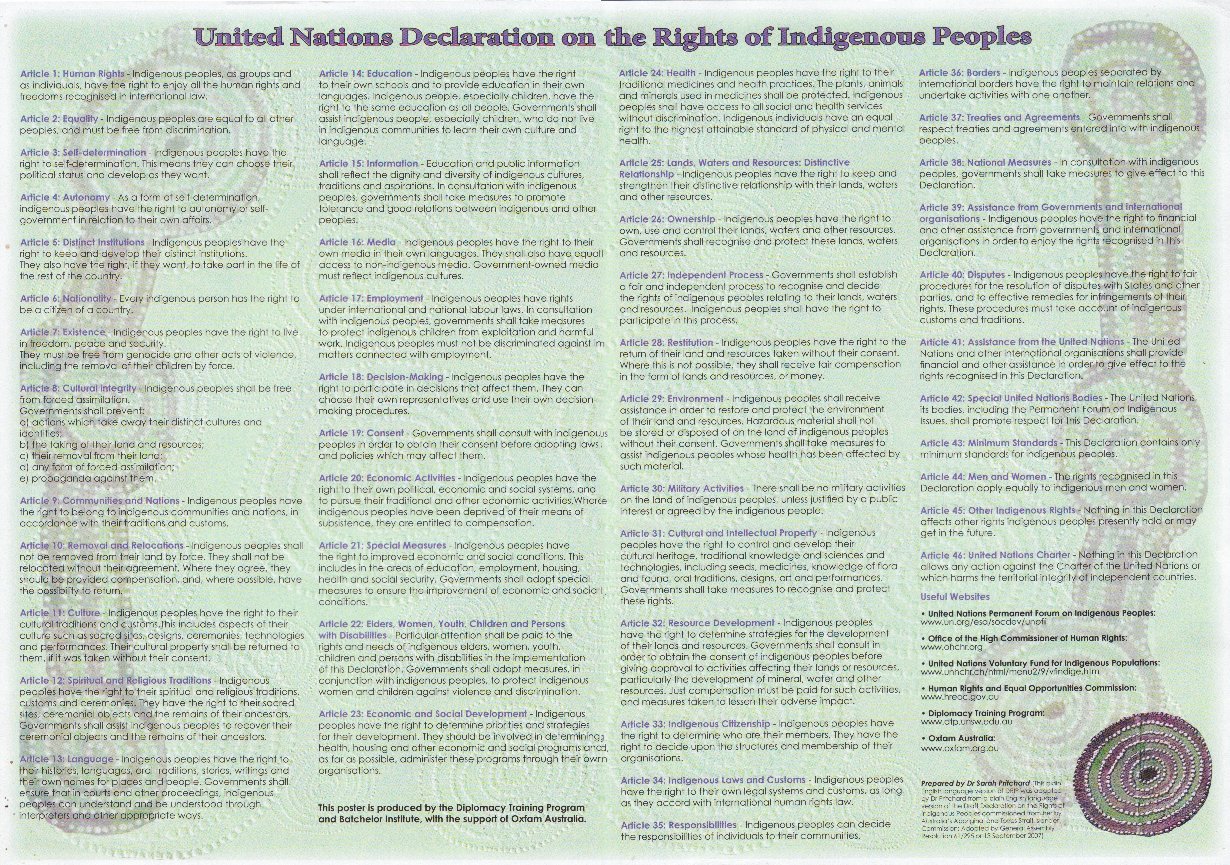
The United Nations Declaration on the Rights of Indigenous Peoples, a document that was long awaited by indigenous peoples and their defenders throughout the world.

The United Nations Declaration on the Rights of Indigenous Peoples, a document that was long awaited by indigenous peoples and their defenders throughout the world.

From the Working Group, with a good deal of interaction with the representatives of Nongovernmental Organizations and tribal groups came a United Nations Declaration on the Rights of Indigenous Peoples (A61/295) in 2007 after some 20 years of efforts. The Declaration sets out a useful framework for action. A UN Permanent Forum on Indigenous Issues has been created and meets once a year in New York. Conditions “on the ground” change slowly but there is now a UN institutions where issues can be raised. It is still the task of non-government organizations and tribal groups to continue to draw attention and to seek cooperation with governments.

See the useful Making the Declaration Work published by the International Work Group for Indigenous Affairs (Copenhagen) available on their website: www.iwgia.org.


********************************************************************


Prof. René Wadlow is President of the Association of World Citizens.

Lettre au Ministre des Affaires Etrangères de la République française

In Anticolonialism, Being a World Citizen, Children's Rights, Conflict Resolution, Cultural Bridges, Current Events, Human Rights, International Justice, Middle East & North Africa, Solidarity, The Search for Peace, United Nations, War Crimes, World Law on July 30, 2014 at 9:07 PM

awc-un-geneva-logo

ASSOCIATION OF WORLD CITIZENS

ASSOCIATION DES CITOYENS DU MONDE


The External Relations Desk


Monsieur Laurent FABIUS

Ministre des Affaires Etrangères de la République française

Ministère des Affaires Etrangères

37 Quai d’Orsay

75700 PARIS


Le 25 juillet 2014


Monsieur le Ministre,

En tant qu’Organisation Non-Gouvernementale dotée du Statut Consultatif auprès de l’ONU et active à ce titre au sein du Conseil des Droits de l’Homme, l’Association of World Citizens (ci-après, AWC) tient à vous exprimer sa plus vive préoccupation quant aux positions adoptées par la République française au sujet des actuels événements violents et tragiques au Proche-Orient.

Depuis que l’Etat d’Israël a lancé, à travers la Force de Défense israélienne (ci-après, Tsahal), une opération dénommée « Gardiens de nos Frères », en réaction à l’enlèvement et l’assassinat, non élucidés à ce jour, de trois jeunes Israéliens originaires des colonies le 12 juin dernier, complétée par une autre opération de Tsahal portant pour sa part le nom de « Bordure de protection », celle-ci en réponse aux tirs de roquettes depuis la Bande de Gaza, votre pays exprime des positions favorables au seul Etat d’Israël, cependant que la population civile palestinienne de Gaza en semble oubliée.

Autant l’AWC ne peut que partager la méfiance des autorités françaises quant aux manières de faire avérées et intentions probables du Mouvement de la Résistance islamique (ci-après, Hamas), lequel contrôle la Bande de Gaza depuis sept ans, autant, pour une organisation telle que la nôtre qui a toujours dénoncé les atteintes aux Droits de l’Homme et appelé au respect de la dignité humaine sans considération de frontières, pas même de celles séparant l’Etat hébreu du Hamas ou de l’Autorité palestinienne, cette position de la part de la France est purement et simplement incompréhensible.

En particulier, nous ne pouvons pas nous expliquer que la France ait choisi, lors du vote du 22 écoulé au Conseil des Droits de l’Homme d’une résolution sur le respect du droit international dans les Territoires palestiniens occupés, de s’abstenir. Sachant quelle est l’histoire de la France au Proche-Orient, notamment à quel point votre pays s’est souvent distingué comme un interlocuteur hors pair entre les uns et les autres des belligérants, nous y voyons une occasion manquée d’aider à affirmer le principe de justice internationale et de favoriser un retour à la recherche de la paix.

Ensuite, l’AWC ne peut qu’attirer votre attention sur le rôle que joue inéluctablement la France dans le bombardement de zones civiles dans la Bande de Gaza, de par son statut de cinquième exportateur mondial d’armement à l’Etat d’Israël.

Selon le Quinzième Rapport de l’Union européenne sur les Autorisations d’Exportation d’Armes, pour la seule année 2012, votre pays a délivré des autorisations d’exportations à Tel Aviv pour plus de 200 millions d’euros.

A ce jour, plus de cinq cents Palestiniens ont été tués dans des attaques par les forces israéliennes, la grande majorité d’entre eux étant des civils, dont des femmes et des enfants. Du côté de l’Etat d’Israël, deux civils ont été tués ainsi que dix-huit membres de Tsahal.

L’AWC entend vous rappeler, à cet égard, la déclaration de Madame Navi PILLAY, Haute Commissaire des Nations Unies pour les Droits de l’Homme, rappelant aux parties en conflit à Gaza l’obligation qui leur est faite de se conformer aux principes de distinction, de proportionnalité et de précaution des attaques afin d’éviter les dommages civils, les exhortant au surabondant à mener des enquêtes promptes, indépendantes et sérieuses sur les allégations de violation du droit international.

A cette fin, il incombe à chaque pays du monde, plus particulièrement encore aux Membres Permanents du Conseil de Sécurité de l’ONU, de prendre en compte toutes les souffrances causées par ce conflit et de manière juste, non l’une plutôt que l’autre, ainsi que de tarir à la source la possibilité pour l’une ou l’autre des deux parties de faire perdurer le conflit, bien entendu en termes d’armement.

Seul l’avènement d’un système viable de droit mondial peut fournir le cadre travail propre à la création d’une société mondiale qui soit tout à la fois juste et pacifique. En tant que Citoyens du Monde, nous travaillons au renforcement du droit mondial ainsi que de son acceptation, de son fonctionnement ainsi que d’un système d’observation et de sanctions ô combien nécessaire en pareil cas.

C’est pourquoi nous sommes certains que votre Gouvernement ne manquera pas d’entreprendre tous les efforts afin,

D’une part,

– de condamner publiquement et fermement les attaques menées par Israël à l’encontre des Palestiniens tout autant qu’il condamne, à juste titre, les tirs de roquettes sur Israël en provenance de la Bande de Gaza,

– de soutenir dans les faits, malgré le vote français au Conseil des Droits de l’Homme, la création par les Nations Unies d’une mission d’enquête internationale qui soit chargée de faire la lumière sur les violations du droit international humanitaire et du droit international des Droits de l’Homme commises par les différentes parties depuis le 12 juin 2014,

D’autre part,

– de suspendre immédiatement toutes les livraisons de matériel militaire à l’Etat d’Israël et toute autorisation d’exportation délivrée en ce sens,

– d’œuvrer au Conseil de Sécurité pour un embargo général sur les armes à destination d’Israël, du Hamas et des groupes armés palestiniens, avec obligation préalable à toute fin à celui-ci de voir éliminé tout risque substantiel de voir ces armes utilisées pour commettre ou faciliter des violations graves du droit international humanitaire et du droit international des Droits de l’Homme.

Nous vous remercions par avance de mettre ainsi la France en conformité avec les normes internationales de Droits de l’Homme telles que définies par l’ONU, et ce faisant de rendre à votre pays le statut particulier que lui a depuis toujours conféré l’histoire dans la défense de ces droits au Proche et Moyen-Orient.

Nous vous prions de croire, Monsieur le Ministre, en l’assurance de notre haute considération.


Prof. René Wadlow

Président


Bernard Henry

Officier des Relations Extérieures


Cherifa Maaoui

Officier de Liaison

Afrique du Nord & Moyen-Orient


Noura Addad, Avocat

Officier juridique

Attack on Gaza: Letter to the President of the UN Security Council

In Anticolonialism, Conflict Resolution, Cultural Bridges, Current Events, Human Development, Human Rights, International Justice, Middle East & North Africa, Solidarity, The Search for Peace, United Nations, War Crimes, World Law on July 15, 2014 at 7:24 PM

-- AWC-UN Geneva Logo --

ASSOCIATION OF WORLD CITIZENS

THE EXTERNAL RELATIONS DESK


July 14, 2014


H. E. Mr. Eugène-Richard Gasana

Ambassador, Permanent Representative

of the Republic of Rwanda

to the United Nations

President of the United Nations Security Council


Excellency:

The Association of World Citizens (AWC), a Nongovernmental Organization in Consultative Status with the United Nations Economic and Social Council (ECOSOC), has been concerned with the status of Gaza as well as the broader Israel-Palestine context.

The current manifestations of violence are part of a recurrent cycle of violence and counter-violence with which You are familiar.

The AWC believes that there must be a sharp break in this pattern of violence by creating institutions of security, development, and cooperation. Such a break requires more than the ceasefire proposed by the Security Council. The Association believes that longer-lasting measures must be undertaken that will allow new patterns of understanding and cooperation to be established.

In an earlier United Nations (UN) discussion of Gaza tensions, the AWC had proposed in a written statement to the Human Rights Council, “Human Rights in Gaza: Need for a Special Focus and Specific Policy Recommendations” (A/HRC/S-12/NGO-1, October 14, 2009; see attached copy) that a Gaza Development Authority be created – a transnational economic effort that would bring together the skills, knowledge and finance from Gaza, Israel, the Palestinian Authority on the West Bank, and Egypt to create conditions which would facilitate the entry of other partners.

Our proposal was obviously inspired by the Tennessee Valley Authority (TVA) of the “New Deal” in the USA. The TVA was a path-making measure to overcome the deep economic depression of the 1930s in the USA and the difficulties of cooperative action across state frontiers in the federal structure of the USA.

Today, the deep divisions in the Israel-Palestine area require more than economic measures – although economy and raising the standards of living remain important elements. Today, there should be a structure that provides security as well as economic advancement.

Therefore, the AWC would like to propose the creation of an International Temporary Transition Administration for Gaza that would promote security, stabilization, economic development, and institution building. Such a Transitional Administration would be limited in time from the start, perhaps five years.

Unlike the earlier UN Trusteeship agreements which followed upon the League of Nations mandate pattern, the Gaza Transitional Authority would welcome civil society cooperation from outside the area.

Such a Transitional Administration cannot be imposed. We believe that the Members of the Security Council can raise the possibility publicly, request a UN Secretariat study on what such a Transitional Administration would require, and encourage’ discussion among those most directly involved.

As Jean Monnet, one of the fathers of the European Common Market, had said, “Men take great decisions only when crisis stares them in the face.” We believe that the current violence is such a time of crisis. Our hope is that the Members of the Security Council are prepared to take great decisions.

Please accept, Excellency, the assurance of our highest consideration.


Prof. René Wadlow

President


Bernard Henry

External Relations Officer


The Law of the Seize

In Being a World Citizen, Conflict Resolution, Environmental protection, International Justice, The Search for Peace, United Nations, World Law on June 15, 2014 at 10:03 PM

THE LAW OF THE SEIZE

By René Wadlow


June 8 of each year has been proclaimed by the UN General Assembly as the Day of the Law of the Sea. However, according to my friend John Logue, who had participated with me as non-governmental organization representative in the long negotiations in New York and Geneva, it should be called “the Law of the Seize.”

What started out in November 1967 with a General Assembly presentation by Ambassador Arivid Pardo of Malta as a call to establish a new political and legal regime for the ocean space ended in August 1980 with a draft convention. It was a mixed bag of successes and disappointments, but that convention has now been ratified by 162 States.

For world citizens, the quality of the Law of the Sea Convention was of particular significance. The greater part of the oceans has been considered res communis, a global common beyond national ownership. Furthermore, the physical nature of the oceans suggests world rather than national solutions to the increasing need for management of marine resources and the marine environment.

World Citizen Thor Heyerdahl was one of those who called attention to the dangers of ocean pollution coming to Geneva to speak for world citizens during the Law of the Sea negotiations. The oceans and the seas remind us that the planet and not the State should be our focus. A holistic view of life arises from our interdependence as a species and our dependence on the life system of nature. World citizens have stressed that a balanced, sustainable eco-system will only emerge if our political, economic and ethical policies coincide in building a more stable and more peaceful—in short, a more human—planet.

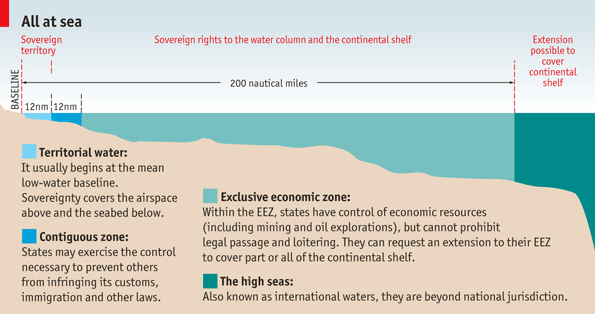
(C) The Economist

(C) The Economist

Establishing rules for the management of the oceans was a real possibility in bringing about an increase in the awareness of the earth as our common home. However, the UN Law of the Sea Conference was first and foremost a political conference with over 160 States participating. From the outset of the conference, it was agreed that the convention had to be drafted by consensus in order to create a political and legal system for the oceans accepted to all — to manage what Arivid Pardo had called “the common heritage of mankind.”

During the negotiations, there were groupings that cut across the Cold War divisions of the times, especially within a group called “the landlocked and geographically disadvantaged countries.” There were also informal groups of persons who acted in a private capacity, a mixture of nongovernmental organization (NGO) representatives, legal scholars, and diplomats who prepared suggestions on many of the issues of the conference. These issues included the economic zones, the continental shelf, scientific research, marine pollution, and dispute settlement. Such propositions were taken seriously by the government negotiators, in part because few diplomats had the technical knowledge needed for making decisions as well as the creation of a new international organization, the Seabed Authority.

However, in practice, government negotiators are more used to working for the “national interest” and in defending the idea of “territory,” both on land and on the sea. Boundary-making is a primordial activity. Various theories have been advanced to explain why, many of them derived from our animal ancestors. However, ocean boundary problems are more difficult than building a wall on land. As Douglas Johnston and Mark Valencia write,

The forces of nationalism were too strong to be swayed by Pardo’s appeals to international cooperation and technocratic rationality. Instead the coastal states, developed and developing alike, saw in the newly available ocean areas an unexpected windfall, offering the prospect of a previously unimagined extension of their natural resource base. The economic goal of national autonomy had prevailed over the interest in global cooperation, setting in motion the processes of establishing vast national enclosures of offshore areas, especially those enclosures consonant with the new exclusive economic zone (EEZ) regime. International cooperation had yielded to national autonomy.1

An outstanding first attempt at codification of the law of the sea was the work of Hugo Grotius, the Dutch jurist widely regarded as the forefather of international law as we know it today. In 1609 Grotius published Mare Liberum (A Free Sea), a book in which claimed that the sea was international territory and thus free for all nations to use in their usual conduct of trade with one another.

An outstanding first attempt at codification of the law of the sea was the work of Hugo Grotius, the Dutch jurist widely regarded as the forefather of international law as we know it today. In 1609 Grotius published Mare Liberum (A Free Sea), a book in which claimed that the sea was international territory and thus free for all nations to use in their usual conduct of trade with one another.

Conflicts over national sea boundaries are particularly strong in the Pacific Ocean among China, Vietnam, the Philippines, Japan, Taiwan, and Cambodia, with India and Indonesia watching closely. The disputes arise largely because of the claims of waters around small islands as national territory. Most of these islands are not inhabited, but are claimed as the starting point of “territorial waters.”

Originally, the disputes concerned exclusive fishing rights within national territorial zones. Now the issues have become stronger, as it is believed that there are oil and natural gas reserves in these areas.

Concerning China’s dispute with Japan (which is also largely true of China’s policy with other Asian countries), Krista Wiegand writes,

China’s current strategy to negotiate with Japan over joint development of natural gas and oil resources outside the disputed zone seems to be the most rational strategy it can take in the disputes. Rather than dropping its territorial claim, China continues to maintain its claim for sovereignty, while at the same time benefiting from joint development of natural gas resources. By maintaining the territorial claim, China also sustains its ability to confront Japan through diplomatic and militarized conflict when other disputed issues arise.2

Territorial sea disputes can be heated up or cooled off at will or when other political issues require attention. We are currently in a “heating up” stage. Thus for June 8, in honor of the Law of the Sea, we can consider how best to resolve territorial disputes by having a broader view of the common heritage of humanity.


Prof. René Wadlow is President of the Association of World Citizens.


Notes

1)   Douglas M. Johnston and Mark J. Valencia. Pacific Ocean Boundary Problems (Dordrecht: Martinus Nighoff Publishers, 1991, 214pp.)

2)   Krista E. Wiegand. Enduring Territorial Disputes (Athens, GA: University of Georgia Press, 2011, 340pp.)

Ukraine: The Dogs of the Cold War are Awakened

In Being a World Citizen, Conflict Resolution, Current Events, Democracy, Europe, Human Rights, International Justice, The former Soviet Union, The Search for Peace, United Nations, World Law on June 12, 2014 at 9:11 PM

UKRAINE: THE DOGS OF THE COLD WAR ARE AWAKENED

By René Wadlow


“Cry Havoc! And let slip the dogs of war!”

William Shakespeare, Julius Caesar


The dogs of the Cold War (1945-1990) had largely fallen asleep after the 1990 Summit Conference of the Organization for Security and Cooperation in Europe (OSCE) in Paris had put a formal end to the European aspects of the Cold War. A New Europe was the slogan of both governments and non-governmental currents that had been working for a Europe without its East-West divisions symbolized by the Berlin Wall.

Many of us had been involved in the April 1980 European Nuclear Disarmament Appeal, often shortened to END, of which the English historian E.P. Thompson was a leading spokesman. Mient Jan Faber of the Dutch Inter-Church Peace Council was the link to those working within church/religious groups on the same lines. Obviously, the level of arms − and thus disarmament − was not the only aspect of the moves necessary to move beyond the Cold War embodied in bureaucratic, and military-industrial forms.

There was a necessary ‘healing process’ − a need to remove the barbed wire in people’s minds and hearts.

The hope was that moving beyond the Cold War would become a citizens’ search for common projects, bringing together widening constituencies in a direct discourse beyond Cold War agendas and the media’s framing of the debates.

Many of us met in Prague in what was still Czechoslovakia in October 1990 for the creation of the Helsinki Citizens’ Assembly with an aim of a democratic integration of Europe. Vaclav Havel who had become Head of State spoke to the opening session on the power of acting from principle guided by our consciences to build a thoroughly new Europe undivided into blocs.

Vaclav Havel (1936-2011), the Czechoslovakian dissident playwright who in 1989 led the country's 'Velvet Revolution', eventually becoming President of Czechoslovakia. From 1992 to 2003 Havel was President of the Czech Republic after Czechoslovakia was eventually dissolved.

Vaclav Havel (1936-2011), the Czechoslovakian dissident playwright who in 1989 led the country’s ‘Velvet Revolution’, eventually becoming President of Czechoslovakia. From 1992 to 2003 Havel was President of the Czech Republic after Czechoslovakia was dissolved. (C) John Macdougall/AFP/Getty Images

“Helsinki Citizens” had been chosen by the organizers as the name because Helsinki had been the city which saw the formal start of the governmental process in 1975 leading first to a certain stabilization of the European Cold War structure and progressively to tension-reduction under the title of “détente”. Since much of the governmental detente seemed to be aimed only at making a more stable status quo, citizen activists spoke of “detente from below”, as going beyond the current structures.

The visions of a better world differed among peace, green, and human rights groups. However all agreed that the future forms of Europe was beyond the current status quo.

I had gone to Prague already concerned with ethnic-nationalities tensions. These tensions were colored by the Cold War but also had non-Cold War roots as seen in the Nagorno-Karabakh conflict within the then USSR. Through contacts in Geneva, I had become concerned by Nagorno-Karabakh and thought that good faith negotiations could lead to a resolution of the conflict. I was also concerned with the growing tensions in Yugoslavia. My paper read at the Prague conference “Future of Europe” was published in the Belgrade Review of International Affairs in December 1990.

Since 1990, the conflicts linked to the breakup of Yugoslavia, and the conflicts of Abkhazia-South Ossetia-Georgia, and Transnistra-Moldova all confirm my analysis that the key problem of our time is the manifestation of narrow nationalism. This narrow nationalist ideology must be countered by a strong cosmopolitan-world citizen ideology and practice.

The hope at Prague in 1990 was to build a pan-European movement participating in public debates, offering opinions and discussing alternatives in each country but also able to come together and act in a conflict resolution way in times of strong tensions and armed conflicts. There were a few efforts of the Helsinki groups during the Yugoslav conflicts, but they were not coordinated nor of massive size. I had participated in some of these undertakings at the UN in Geneva when the conference on Yugoslavia was in session there.

The Hofburg Palace in Vienna, Austria, which houses the Headquarters of the Organization for Security and Cooperation in Europe. (C) Bernard Henry

The Hofburg Palace in Vienna, Austria, which houses the Headquarters of the Organization for Security and Cooperation in Europe. (C) Bernard Henry/AWC

Since 1990, we have seen the rise in some European countries of hard line nationalist groups − often Right wing and some with Neo-Fascist aspects. This rise was illustrated by the May 25, 2014 elections to the European Parliament. The entry of an additional number of narrow nationalists will not have much impact on the way the European Parliament operates, but it will give the nationalists a media platform and a degree of legitimacy in their home country. There has not been a significant rise in cosmopolitan-world citizen movements, although cosmopolitanism as an intellectual framework has become increasingly common.

Without a well-organized movement of pan-European peace-green-human rights movements, “Europe from Below” has been unable to act in the Ukraine crisis. Individual governments, in particular Russia and the USA, have taken a highly visible role. The media in both countries dusted off the Cold War vocabulary and political analysis.

Talk of a “New Cold War” has been common. The OSCE − with Switzerland as President for 2014 − has called for restraint and negotiations. There has been no equivalent “high profile” efforts on the part of non-governmental groups. Today, there is no Vaclav Havel to serve as a bridge of respect among both governments and non-governmental movements. Certainly, the dogs of the Cold War have awakened to remind us that they are still there. In addition, new nationalist, and authoritarian tendencies are emerging. Although these nationalist movements are sometimes led by comic figures, they need to be taken seriously.

Counter voices also need to awaken, and the ability for nongovernmental conflict resolution groups to act must be strengthened.


Prof. René Wadlow is President of the Association of World Citizens.