Archive for the ‘Current Events’ Category
World Citizens Condemn Terrorism and Intolerance Based on Religion
In Cultural Bridges, Current Events, Human Rights, International Justice, World Law on May 30, 2013 at 12:56 PMN’abandonnez pas la lutte pour les Droits de l’Homme !
In Being a World Citizen, Current Events, Democracy, Human Rights, International Justice, The Search for Peace, United Nations, World Law on May 3, 2013 at 11:06 PMN’ABANDONNEZ PAS LA LUTTE POUR LES DROITS DE L’HOMME !
Par Bernard Henry
(D’après « Don’t Give Up the Fight for Human Rights! », du même auteur :
https://awcungeneva.com/2013/05/03/dont-give-up-fight-human-rights/)
Le début du mois de mai est un bon moment pour fêter les Droits de l’Homme. En dehors du 1er mai, Fête internationale du Travail, il y a aussi le 3 mai, Journée internationale de la Liberté de la Presse, instaurée par l’Assemblée générale de l’ONU en 1993 et célébrée chaque année sous l’égide de l’institution spécialisée de l’ONU en charge de la communication, l’UNESCO[1].
Alors faisons la fête. Mais le restant de l’année, les Droits de l’Homme ne nous donnent guère d’occasions de le faire. Depuis l’année 2000, en dépit même de développements historiques à l’ONU et dans d’autres organisations intergouvernementales, ainsi que dans un certain nombre d’Etats-nations pris isolément, les Droits de l’Homme au niveau international, indiscutablement le plus noble héritage politique du vingtième siècle, semblent avoir largement perdu leur place prioritaire dans la vie politique mondiale.
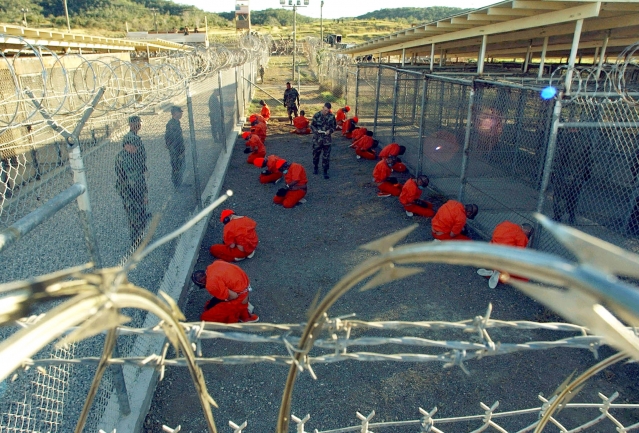
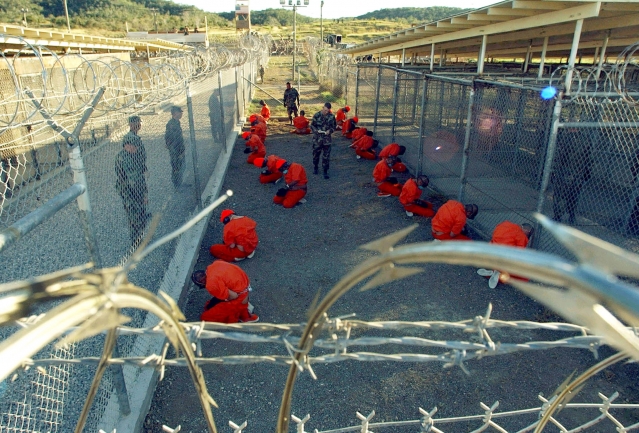
Rien d’étonnant. Après l’élection présidentielle de 2000 aux Etats-Unis et le coup ainsi porté au modèle occidental de démocratie protégeant les libertés, les attaques terroristes contre le World Trade Center et le Pentagone l’année suivante ont entièrement tourné l’attention du monde vers une menace terroriste capable de frapper quiconque, où que ce soit, à tout instant, semant la peur et entraînant un appel aux armes. Il s’en est suivi une « guerre contre le terrorisme » menée par les Etats-Unis, dont l’horreur est symbolisée par la zone de non-droit sous direction gouvernementale de Guantanamo Bay et les « restitutions secrètes » de personnes soupçonnées d’actes de terrorisme et convoyées par avion de pays en pays. Dans les premières années, brandir les Droits de l’Homme en protestation, c’était être vu tout simplement comme un partisan d’Al Qaïda.
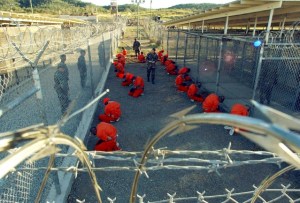
Après les attaques terroristes du 11 septembre 2001 à New York et Washington, de nombreux Américains se sont dits prêts à accepter des restrictions des libertés civiles pour combattre le terrorisme. C’est ce qui a permis à l’Administration Bush de réagir à la menace terroriste par de nombreuses et graves atteintes aux Droits de l’Homme, plus particulièrement à l’établissement pénitentiaire américain de Guantanamo Bay à Cuba. (C) Reuters
Puis ce furent les émeutes de la faim de 2008 – les premiers symptômes de la crise du système mondial de finance et d’économie de marché qui se poursuit aujourd’hui. Après que la spéculation financière sur les denrées alimentaires de base a produit des effets dévastateurs dans la plupart des pays en développement, la crise des subprimes aux Etats-Unis a mis à genoux même le pays le plus fortuné au monde, conduisant une corporation de premier plan comme Lehman Brothers à la faillite pure et simple et mettant au jour le système de fraude à long terme du courtier-vedette Bernard Madoff. Autant dire que des droits fondamentaux comme l’alimentation ou le logement, on pouvait les oublier. Dans de nombreux pays, riches comme pauvres, le sentiment général était que la mondialisation économique était coupable et que les frontières nationales étaient désormais les (seuls) remparts des peuples contre la violation de leurs droits économiques et sociaux, comme ce fut le cas au Venezuela de Hugo Chavez. Le populisme est également monté en Occident, restreignant les limites du questionnement politique au fait de savoir à quel point exactement les immigrés faisaient du tort à l’emploi et au pouvoir d’achat. Considérés à présent comme élitistes en Occident et comme « occidentaux » dans le reste du monde, les Droits de l’Homme furent forcés de plier sous le poids de l’écroulement de l’économie.
Le résultat en fut que, lorsque la première décennie du siècle nouveau toucha à sa fin, les Droits de l’Homme tels qu’ils avaient été codifiés à Paris et New York à l’issue de la Seconde Guerre Mondiale apparaissaient comme morts et enterrés. Dans son édition du 18 février 2010, Newsweek alla jusqu’à proclamer la « Mort des Droits de l’Homme »[2], expliquant en détail comment les Etats occidentaux en étaient venus à ne plus prêter aucune attention aux bilans désastreux en matière de Droits de l’Homme de leurs partenaires économiques, politiques et militaires en Asie, en Afrique et au Moyen-Orient. Alors que la crise économique s’éternise et que l’islamisme armé essaime aujourd’hui jusque dans une Afrique subsaharienne relativement épargnée, l’homme de la rue désabusé et des grands de ce monde qui le sont tout autant ont appris à s’en remettre au jeu cynique de la géopolitique et à ne plus guère aimer les Droits de l’Homme que comme une philosophie bienveillante qui serait politiquement irréalisable.
Serait-ce vrai ? Mais pourquoi alors quiconque, où que ce soit, devrait-il continuer à se battre pour les Droits de l’Homme ?
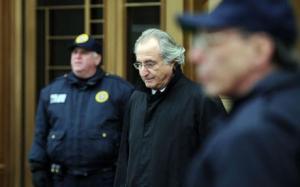
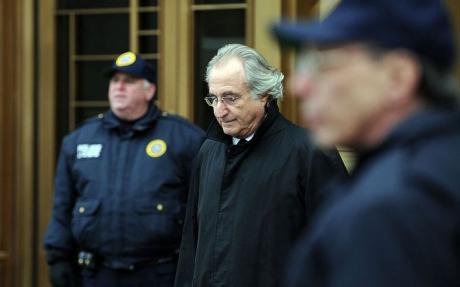
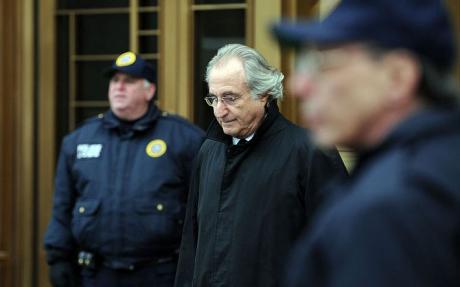
Le 11 décembre 2008, le courtier-vedette Bernard Madoff fut arrêté aux Etats-Unis pour avoir commis une présumée fraude d’un montant de 50 milliards de dollars. ( C ) The Telegraph – Derek Blair
Pas si vite. Dire que les décennies actuelle et précédente n’ont rien apporté de bon aux Droits de l’Homme, en ce qu’elles auraient été au mieux infructueuses et au pire dangereuses, serait des plus naïfs – ou des plus malhonnêtes.
Tout d’abord, même si elle a fait aux Droits de l’Homme un mal indiscutable, la crise économique n’offre pas matière à s’inquiéter, du moins en ce qui concerne les pays occidentaux. Comme l’ont expliqué les politologues américains Christian Welzel et Ronald Inglehart dans leur livre de 2005 Modernization, Cultural Change and Democracy (Modernisation, changement culturel et démocratie)[3], cité par Larry Diamond, professeur à l’Université de Stanford, dans The Spirit of Democracy (L’esprit de la démocratie)[4], les difficultés économiques rendent la population plus encline à affirmer des valeurs de survie, à savoir des valeurs conservatrices, sectaires et casanières, plutôt que des valeurs d’expression de soi qui permettent la liberté, l’autonomie et la tolérance.
Nous ne traversons donc pas un moment de rejet des Droits de l’Homme en eux-mêmes, mais en fait un moment d’angoisse et de doute alimentés par l’incertitude quant au présent et à l’avenir de l’emploi, de la sécurité sociale et de la fiscalité. Les politiques d’austérité, toutefois, jouent bel et bien un rôle en faisant naître chez les citoyens un sentiment que l’on en fait plus pour sauver leurs banques que pour venir en aide à leurs comptes bancaires en souffrance.
Alors que le mécontentement social monte dans les pays en faillite ou risquant de l’être, de plus en plus d’électeurs frustrés en arrivent à traduire leur adhésion aux valeurs de survie en votant pour la première fois de leur vie pour l’extrême droite, laquelle va du Front National qui, en France, s’escrime à se donner bon genre, au parti ouvertement néo-nazi Aube Dorée en Grèce. L’attitude parfois ambiguë des partis au pouvoir envers les migrants, particulièrement envers les Roms, vient fournir un encouragement malvenu à l’intolérance en faisant penser aux citoyens que leur haine de tout ce qui vient d’ailleurs est justifiée.
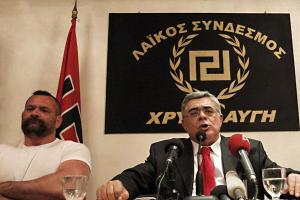
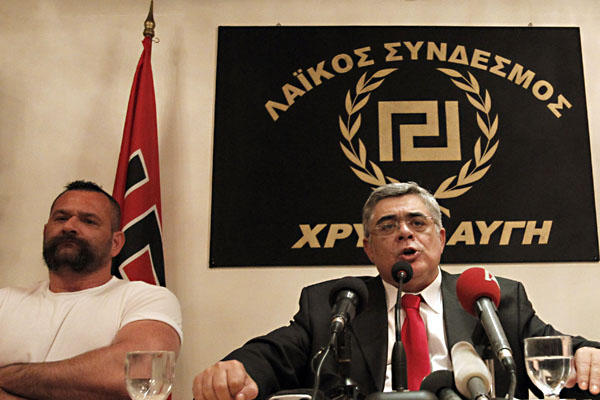
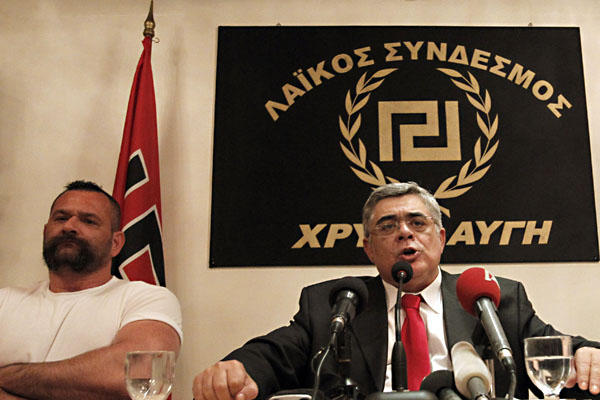
En Grèce, Nikólaos Michaloliákos dirige le parti Aube Dorée, dont l’emblème rappelle le svastika des Nazis et dont la rhétorique violente et haineuse fait resurgir des souvenirs des heures les plus noires de l’histoire européenne moderne.
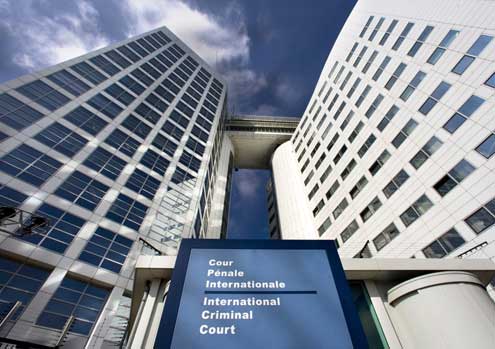
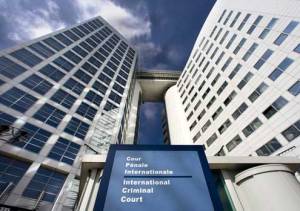
Ensuite, bien que les années 2000 aient été en effet largement perturbées tout à la fois par le terrorisme et par la réaction agressive de l’Amérique à celui-ci, elles furent indéniablement des années de progrès authentiques et importants pour les Droits de l’Homme dans le monde, dans la parfaite continuité de l’année 1998 qui avait vu l’adoption tout à la fois du Statut de Rome créant la Cour pénale internationale (CPI) et, le 9 décembre, de la Déclaration sur les Défenseurs des Droits de l’Homme, « née » Résolution 53/144 de l’Assemblée générale de l’ONU.
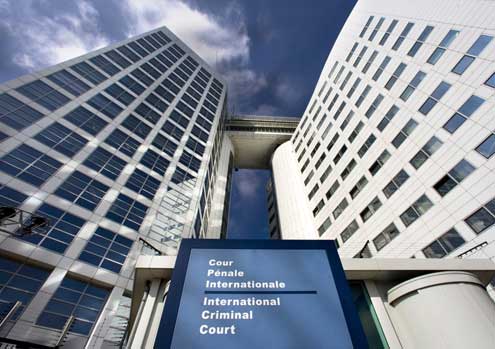
La CPI, justement, a vu le jour en 2002, le seuil de la ratification du Statut de Rome par soixante Etats ayant été atteint cette année-là.
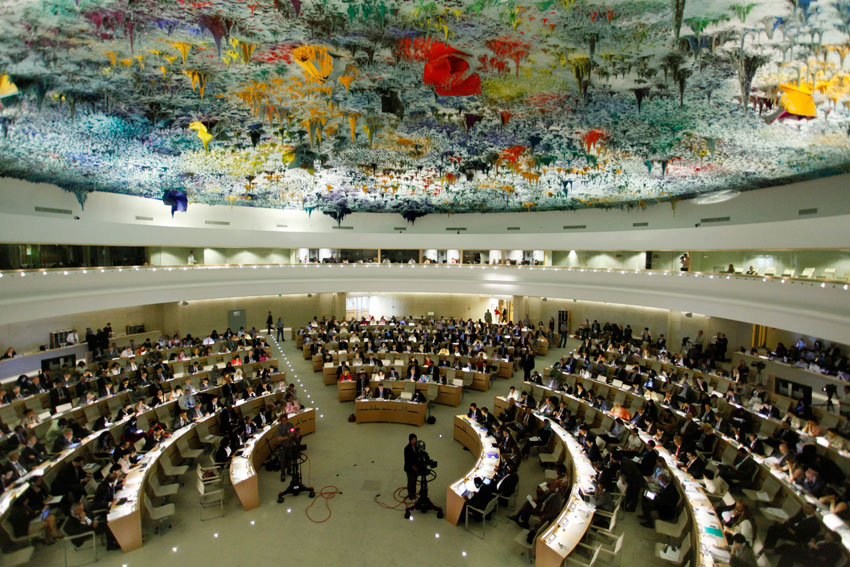
Quatre ans plus tard, c’est encore un autre organe de l’ONU qui était créé, cette fois à partir d’un qui existait déjà – le Conseil des Droits de l’Homme, conçu pour remplacer la Commission des Droits de l’Homme qui se trouvait depuis déjà longtemps sous le feu des critiques en raison de ses mécanismes archaïques et inefficaces de surveillance et de sanctions, ainsi que pour avoir permis à des régimes autoritaires et répressifs de prendre part à ses activités.
En septembre 2007, l’Assemblée générale de l’ONU a adopté la Déclaration sur les Droits des Peuples indigènes, premier instrument international de Droits de l’Homme de tous les temps à définir de manière universelle les droits spécifiques des populations indigènes dans chaque pays, qu’ils soient civils, politiques, économiques, sociaux ou culturels. Sans surprise, quatre gouvernements connus pour être encore aux prises avec des revendications autochtones chez eux ont voté contre – les Etats-Unis, le Canada, la Nouvelle-Zélande et l’Australie.
L’année suivante vit l’entrée en vigueur de la Convention sur les Droits des Personnes handicapées, enfin rédigée en 2006 après des années d’opposition farouche de la part de l’Administration Bush qui soutenait que les Etats-Unis et tous les autres pays du monde devraient avoir des lois nationales propres quant aux droits des handicapés plutôt qu’un traité mondial. En fait, la réticence américaine s’avéra être la meilleure justification possible pour la création d’un traité de l’ONU sur les droits liés au handicap, en ce qu’elle rappelait à une communauté internationale oublieuse que le handicap était, depuis les années 1970, une question pleine et entière de Droits de l’Homme au sein de l’Organisation mondiale[5]. Même si les Etats-Unis ont fini par rejoindre la Convention en qualité de signataires, l’Administration Obama ne l’a toujours pas ratifiée.
Avec la création de la Convention vint celle d’une agence de l’ONU chargée d’encourager et de surveiller le respect par les Etats membres des dispositions de celle-ci, UN Enable. Une autre nouvelle agence de l’ONU de premier plan créée pendant les années 2000 fut ONU Femmes, officiellement dénommée l’Entité des Nations Unies pour l’Egalité de Genre et l’Autonomisation des Femmes. Sa Directrice exécutive fondatrice fut l’emblématique ancienne Présidente socialiste du Chili Michelle Bachelet.
Un monde qui serait devenu totalement obsédé par l’idée d’arrêter le terrorisme n’aurait jamais pu aller si loin pour faire progresser les Droits de l’Homme et les enraciner sans conteste, au bout du compte, dans le vingt-et-unième siècle.
CQFD. Les Droits de l’Homme ont beau être moins populaires de nos jours, l’on en a pourtant toujours autant besoin qu’avant, besoin mais aussi envie, même si l’on sera moins prompt que dans le passé à l’avouer.
Le problème est que la « guerre contre le terrorisme » et les valeurs de survie inspirées par la crise qui se sont répandues à travers le monde depuis le début du siècle font qu’il est beaucoup plus difficile pour les Défenseurs des Droits de l’Homme, qu’ils soient isolés ou membres d’organisations non-gouvernementales (ONG), d’exercer leurs fonctions et activités habituelles sans craindre d’être réprimés ou à tout le moins intimidés. Certains gouvernements ont même commencé à les fustiger comme « ennemis de l’Etat », ainsi de la Russie qui impose aujourd’hui un label « agent de l’étranger » aux ONG recevant un soutien financier depuis l’extérieur du pays.
Le 15 mars, en réaction à de tels développements catastrophiques, quinze ans après que l’Assemblée générale de l’ONU a adopté la Déclaration sur les Défenseurs des Droits de l’Homme, le Conseil des Droits de l’Homme a adopté une résolution au titre éloquent – « Protéger les Défenseurs des Droits de l’Homme ».
Dans son Préambule, la résolution, proposée à l’origine par la Norvège, rappelle que « toutes les dispositions de la [déclaration de 1998] restent fondées et applicables », rappelant aussi les résolutions précédentes du Conseil et de l’Assemblée générale ainsi que le Programme d’Action de la Conférence de Vienne de 1993 sur les Droits de l’Homme, qui fut le premier événement international d’envergure consacré aux Droits de l’Homme après la fin de la guerre froide. La résolution réaffirme que « les États sont tenus de protéger tous les droits de l’homme et libertés fondamentales de tous », reconnaît que « les défenseurs des droits de l’homme apportent une contribution importante, aux niveaux local, national, régional et international, à la promotion et à la protection des droits de l’homme », et souligne en conséquence que « le respect et le soutien manifestés pour les activités des défenseurs des droits de l’homme, y compris les femmes qui défendent ces droits, sont déterminants pour la jouissance globale des droits de l’homme ».
La résolution appelle tous les Etats membres de l’ONU à éviter ou cesser de recourir au droit interne et aux dispositions administratives, en ce comprises « les lois et autres mesures relatives à la sécurité nationale et à la lutte antiterroriste, telles que les lois régissant les organisations de la société civile », pour entraver le travail des Défenseurs des Droits de l’Homme, a fortiori pour les stigmatiser ainsi que leur dévouement sans relâche. Elle met également l’accent sur le rôle important que jouent « les nouvelles formes de communication, y compris la diffusion d’informations en ligne et hors ligne, peuvent constituer pour les défenseurs des droits de l’homme », car elles sont des « outils importants leur permettant de promouvoir et favoriser la protection des droits de l’homme ».
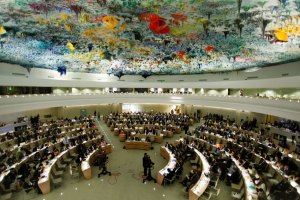
Prenant la mesure de la « discrimination et la violence systémiques et structurelles subies par les femmes qui défendent les droits de l’homme », la résolution « engage les États à prendre en compte les considérations liées au genre » dans leurs entreprises de sécurisation et de garantie de la liberté d’action des Défenseurs des Droits de l’Homme au sein de leurs frontières.
Dans l’une des déclarations les plus fortes de toute la résolution, le Conseil, s’appuyant directement sur des instruments de Droits de l’Homme de l’ONU aussi primordiaux que la Déclaration universelle des Droits de l’Homme, le Pacte international relatif aux Droits civils et politiques et le Pacte international relatif aux Droits économiques, sociaux et culturels, appelle tous les pays à « instaurer un climat sûr et porteur qui permette aux défenseurs des droits de l’homme d’agir sans entrave et en toute sécurité, dans l’ensemble du pays et dans tous les secteurs de la société, et notamment à apporter leur appui aux défenseurs des droits de l’homme au niveau local ».
Adoptée avec le soutien de nombreux Etats non-membres du Conseil, tels que la France, le Costa Rica, le Portugal, la Suède et l’Uruguay, mais aussi, de manière plus surprenante lorsqu’il s’agit de Droits de l’Homme, de la Côte d’Ivoire, de la Géorgie et de la Turquie, la résolution survient tel un vibrant rappel à l’ordre, réaffirmant la pertinence et l’importance du travail des Défenseurs des Droits de l’Homme dans le monde d’aujourd’hui et confirmant que celui-ci n’est ni un luxe suranné, ni une croisade d’arrière-garde coupée de la réalité, mais une nécessité claire et immédiate.
Dans l’un de ses plus grands succès, parfois utilisé comme un « hymne de la maison » par Amnesty International, Bob Marley chantait :
“Get up, stand up,
Stand up for your right,
Get up, stand up,
Don’t give up the fight”,
« Allez, debout,
Luttez pour vos droits,
Allez, debout,
N’abandonnez pas. »
Marley a disparu depuis trente-deux ans, mais ses mots n’ont jamais cessé de résonner comme un appel au courage et à l’action pour les Défenseurs des Droits de l’Homme en tous lieux.
Plus que jamais, nous, Défenseurs des Droits de l’Homme, devons faire briller la flamme, cette même flamme qui symbolise les Droits de l’Homme au sein de l’ONU, et poursuivre notre combat, sans nous laisser dissuader, sans nous laisser décourager, sans nous laisser impressionner. A présent, la dernière ligne de défense de l’humanité contre la peur et le désespoir, c’est nous.
A l’ONU, les Droits de l’Homme sont représentés par un flambeau, le flambeau pour une vie de plein épanouissement. Le flambeau représente également ceux qui le portent à travers le monde – les Défenseurs des Droits de l’Homme.
Bernard Henry est l’Officier des Relations Extérieures du Bureau de Représentation auprès de l’Office des Nations Unies à Genève de l’Association of World Citizens.
[1] http://www.unesco.org/new/fr/communication-and-information/resources/news-and-in-focus-articles/all-news/news/unesco_launches_pressing_for_freedom_20_years_of_world_press_freedom_day/
[3] New York and Cambridge, Cambridge University Press, 2005
[4] The Spirit of Democracy – The Struggle to Build Free Societies Throughout the World, by Larry Diamond, 448 pp. Times Books/Henry Holt & Company.
Don’t Give Up the Fight for Human Rights!
In Being a World Citizen, Current Events, Democracy, Human Rights, International Justice, The Search for Peace, United Nations, Women's Rights, World Law on May 3, 2013 at 1:34 PMDON’T GIVE UP THE FIGHT FOR HUMAN RIGHTS!
By Bernard Henry
Early May is a good time to celebrate human rights. Besides May 1, International Labor Day, there is also May 3, World Press Freedom Day, first established by the United Nations (UN) General Assembly in 1993 and celebrated yearly under the auspices of the UN’s specialized institution in charge of communication, UNESCO[1].
So let’s celebrate. But during the rest of the year, human rights actually give cause to little celebration. Since the year 2000, in spite of milestone developments at the UN and other intergovernmental organizations as well as in a number of individual nation-states, international human rights, arguably the noblest part of the political inheritance of the twentieth century, seem to have lost much of their prominence in global political life.
No wonder. After the 2000 presidential election in the United States dealt a severe blow to the until then sacrosanct, universally-revered Western pattern of liberal democracy, the terror attacks on the World Trade Center and the Pentagon of the following year definitely shifted the world’s attention to the reality of a terrorist threat that could strike anyone, anywhere, anytime, creating calamity and leading to a call to arms. A “war on terror” led by the United States ensued, infamously symbolized by the government-operated lawless zone of Guantanamo Bay and the “secret renditions” of terror suspects by plane from one country to another. In the early years, holding out human rights in protest was viewed as merely being an Al Qaeda supporter.

After the terror attacks of September 11, 2001 in New York and Washington, many Americans said they were willing to accept restrictions on civil liberties to fight terrorism. This allowed the Bush Administration to respond to the terrorist threat with numerous, serious human rights abuses, most notably at the U. S. detention facility of Guantanamo Bay, Cuba. (C) Reuters
Then came the hunger riots of 2008—the first symptoms of the crisis of the global trade and free-market system we are still in today. After financial speculation on basic food items had devastating effects in most developing countries, the subprime mortgage crisis in the United States brought even the world’s wealthiest country to its knees, leading a major corporation like Lehman Brothers to plain, simple bankruptcy and exposing the long-running fraud schemes of star trader Bernard Madoff. So much for basic rights such as food and housing. In many countries rich and poor, it was felt that economic globalization was at fault and national borders were now the (only) safeguards of peoples against abuse of their economic and social rights, as was seen in Hugo Chavez’s Venezuela. Populism also rose in the West, limiting the scope of political questioning to how much damage immigrants were causing to employment and purchasing power. Now perceived as elitist in the West and “Western” in the rest of the world, human rights were forced to yield under the weight of economic collapse.
As a result, by the end of the first decade of the new century, human rights as codified in Paris and New York in the wake of World War II appeared to be dead in space. In its edition of February 18, 2010, Newsweek went so far as to declare the “Death of Human Rights”[2], detailing how Western states were now disregarding the poor human rights records of their economic, political and military partners in Asia, Africa and the Middle East. As the economic crisis lingers on and armed Islamism now spawns also in the relatively spared Sub-Saharan Africa, jaded everyday citizens and world leaders have learned to leave it to a cynical game of geopolitics and like human rights as little more than a benevolent philosophy which would be politically unrealizable.
Could this be true? If so, why should anyone, anywhere in the world, continue to fight for human rights?

On December 11, 2008, star trader Bernard Madoff was arrested in the United States for an alleged $50 billion fraud.
(C) The Telegraph – Derek Blair
Not so fast. Dismissing the previous and current decades as having been at best fruitless, at worst damaging in terms of human rights development would be quite foolish—or quite dishonest.
First, harmful as it may have been to human rights, the economic crisis is nothing to worry about, at least as far as Western countries are concerned. As the American political scientists Christian Welzel and Ronald Inglehart explained in their 2005 book Modernization, Cultural Change and Democracy[3], quoted by Stanford professor Larry Diamond in The Spirit of Democracy[4], economic hardship makes it more natural for people to affirm survival values, i. e. conservative, sectarian, inward-looking values, rather than self-expression values allowing for freedom, autonomy and tolerance.
This is thus hardly a time of rejection of human rights per se, actually a time of anguish and doubt fueled by uncertainty about the present and future of employment, health care and taxation. Austerity policies, however, do play a role in alienating constituents who feel more is being done to save their banks than to support their ailing bank accounts.
As social discontent grows in those bankrupt or economically-fledgling countries, an increasing number of disgruntled voters come to translate their adhesion to survival values into a first-time vote for the extreme right, ranging from the would-be nice-looking National Front in France to Greece’s openly neo-Nazi Golden Dawn party. The sometimes ambiguous attitude of ruling parties toward migrants, especially the Roma, in some European countries further provides an unwelcome encouragement of intolerance, making people feel justified in their hatred of outsiders.

In Greece, Nikólaos Michaloliákos leads the Golden Dawn party, whose emblem resembles the Nazi swastika and whose violent, hateful rhetoric brings back memories of the darkest hours of modern European history.
Second, although the 2000s were largely marred by both terrorism and America’s pushy response to it, these were years of genuine, significant progress for human rights in the world, very much in continuity with the year 1998 which saw the adoption of both the Rome Statute of the International Criminal Court (ICC) and, on December 9, the Declaration on Human Rights Defenders née Resolution 53/144 of the UN General Assembly.
Precisely, the ICC came to existence in 2002 after the threshold of ratification of the Rome Statute by 60 UN Member States was reached that year.
Four years later, another new UN body was created out of an existing one—the Human Rights Council, designed to replace the Human Rights Commission which had been for some time under heavy fire for its outdated, unassertive monitoring and sanctioning mechanisms and for allowing authoritarian, repressive regimes to participate in its activities.
In September 2007 the UN General Assembly adopted the Declaration on the Rights of Indigenous Peoples, the first ever international human rights instrument to universally define the specific rights of indigenous groups in every country, whether civil, political, economic, social or cultural. Unsurprisingly, four governments notoriously still scrambling with indigenous rights claims at home voted against—the USA, Canada, New Zealand and Australia.
The following year saw the entry into force of the Convention on the Rights of People with Disabilities, finally drafted in 2006 after years of fierce opposition from the Bush Administration which claimed the USA and all other countries should have national laws of their own about disability rights instead of a world treaty. Actually, the American reluctance turned out to be the best possible justification for the creation of a UN treaty on disability rights, as it reminded an oblivious international community that since the 1970s, disability has been a full-fledged human rights issue within the World organization[5]. Although the USA eventually joined the Convention as a signatory, the Obama Administration still hasn’t ratified it.
Along with the creation of the Convention came that of a UN agency tasked to encourage and monitor compliance by Member States with its provisions, UN Enable. Another paramount new UN agency created in the 2000s was UN Women, officially named the UN Entity for Gender Equality and the Empowerment of Women. Its founding Executive Director was the emblematic former Socialist Chilean President Michelle Bachelet.
A world gone completely obsessed with stopping terrorism could never have gone that far in making human rights progress and definitely take root after all in the twenty-first century.
Q.E.D. Human rights may be less popular nowadays but they are still just as needed as ever, needed and wanted too, although the latter will not be said publicly as easily as before.
The problem is that the “war on terror” and crisis-inspired survival values that have spread throughout the world since the beginning of the century have made it a lot more difficult for Human Rights Defenders, whether on their own or as members of nongovernmental organizations (NGOs), to carry out their usual work and activities without fear of repression or at the very least intimidation. Some governments have even begun to lash out at them as “enemies of the state”, such as Russia which is now imposing a “foreign agent” label on NGOs receiving financial support from outside the country.
On March 15, in response to such alarming developments, fifteen years after the UN General Assembly adopted the Declaration of Human Rights Defenders, the Human Rights Council adopted a resolution whose title says it all – “Protecting Human Rights Defenders”.
In its Preamble, the resolution, originally proposed by Norway, recalls “the continued validity and application of all the provisions” of the 1998 declaration, as well as other Council and General Assembly resolutions and the Program of Action of the Vienna Conference on Human Rights of 1993 which was the first post-Cold War main event dedicated to human rights on the international stage. It reaffirms that “States are under the obligation to protect all human rights and fundamental freedoms of all persons” and acknowledges that “human rights defenders play an important role at the local, national, regional and international levels in the promotion and protection of human rights”, accordingly “[s]tressing that respect and support for the activities of human rights defenders, including women human rights defenders, is essential to the overall enjoyment of human rights.”
The resolutions calls on UN Member States to avoid or stop using domestic law and administrative provisions, including “national security and counter-terrorism legislation and other measures, such as laws regulating civil society organizations”, to hinder the work of Human Rights Defenders, let alone to stigmatize them and their tireless campaigning. It also highlights the important role played by “new forms of communication, including the dissemination of information online and offline” as “tools for human rights defenders to promote and strive for the protection of human rights”.
Taking stock of the “systemic and structural discrimination and violence faced by women human rights defenders”, the resolution “calls upon States to integrate a gender perspective” in their work to ensure the freedom and safety of Human Rights Defenders within their borders.
In one of the most powerful statements in the entire resolution, the Council, referring directly to such major UN human rights instruments as the Universal Declaration of Human Rights, the International Covenant on Civil and Political Rights and the International Covenant on Economic, Social and Cultural Rights, urges all countries to “create a safe and enabling environment in which human rights defenders can operate free from hindrance and insecurity, in the whole country and in all sectors of society, including by extending support to local human rights defenders”.
Adopted with the support of many non-Member States of the Council, such as France, Costa Rica, Portugal, Sweden and Uruguay but also, more surprisingly when it comes to human rights, Ivory Coast, Georgia and Turkey, the resolution came as a powerful reminder that the work of Human Rights Defenders is still relevant and important to today’s world and that it is neither an old-fashioned luxury nor a rear-guard crusade out of touch with reality but a clear and present necessity.
In one of his greatest hits, sometimes used as a “house anthem” by Amnesty International, the late Bob Marley sang,
“Get up, stand up,
Stand up for your right,
Get up, stand up,
Don’t give up the fight.”
Marley has been gone for thirty-two years but his words never ceased to resonate as a call to courage and action for Human Rights Defenders everywhere.
More than ever, we Human Rights Defenders must keep the flame alive, that very flame which symbolizes human rights at the UN, and carry on with our fight, undeterred, unabated, uncompromising. We are now humanity’s last line of defense against fear and despair.

At the United Nations, human rights are represented by a flame, the flame for a life of full self-fulfillment. The flame also symbolizes those who carry it throughout the world – Human Rights Defenders.
Bernard Henry is the External Relations Officer of the Office to the United Nations—Geneva of the Association of World Citizens.
[1] http://www.unesco.org/new/en/communication-and-information/resources/news-and-in-focus-articles/all-news/news/unesco_launches_pressing_for_freedom_20_years_of_world_press_freedom_day/
[3] New York and Cambridge, Cambridge University Press, 2005
[4] The Spirit of Democracy – The Struggle to Build Free Societies Throughout the World, by Larry Diamond,
448 pp. Times Books/Henry Holt & Company.
L’AWC DEMANDE VÉRITÉ ET JUSTICE POUR CHOKRI BELAÏD
In Conflict Resolution, Current Events, Democracy, Human Rights, Middle East & North Africa, The Search for Peace, World Law on February 6, 2013 at 3:39 PM
COMMUNIQUE
Genève, Mercredi 6 Février 2013
L’AWC DEMANDE VERITE ET JUSTICE APRES L’ASSASSINAT
DU DIRIGEANT POLITIQUE CHOKRI BELAÏD EN TUNISIE
L’Association of World Citizens (AWC), organisation non-gouvernementale internationale œuvrant pour le respect de l’Etat de droit et le dialogue politique dans les Etats en crise ou en conflit armé, s’indigne de l’assassinat de Maître Chokri Belaïd, avocat tunisien, Secrétaire général du Mouvement des Patriotes démocrates et ancien membre de la Haute instance pour la Réalisation des Objectifs de la Révolution, de la Réforme politique et de la Transition démocratique en Tunisie.
Qui que l’on prenne pour cible, l’assassinat n’est jamais admissible dans une démocratie. Négation ultime de l’état de droit en politique, il est l’arme exclusive de ceux qui voudraient faire prévaloir l’ordre de la terreur et la loi du plus fort.
L’AWC appelle instamment les autorités tunisiennes à diligenter une enquête indépendante, impartiale et exhaustive sur le meurtre de Maître Chokri Belaïd, enquête dont les résultats devront être sans faute rendus publics et qui devra aboutir sans faiblesse à la comparution des responsables devant la justice, selon toutes les normes de droit international en la matière.
La violence vient de frapper en Tunisie. Il faut maintenant l’empêcher de triompher.
* * *
Does the Non-Aligned Movement Still Matter?
In Africa, Anticolonialism, Asia, Cultural Bridges, Current Events, Middle East & North Africa, United Nations, World Law on August 27, 2012 at 11:36 AMDOES THE NON-ALIGNED MOVEMENT STILL MATTER?
by René Wadlow
With Iran taking over the three-year term of the presidency of the Non-Aligned Movement (N.A.M.) at the end of August 2012, the question arises: Does the Non-Aligned Movement still matters in world politics and how will Iran use the presidency?
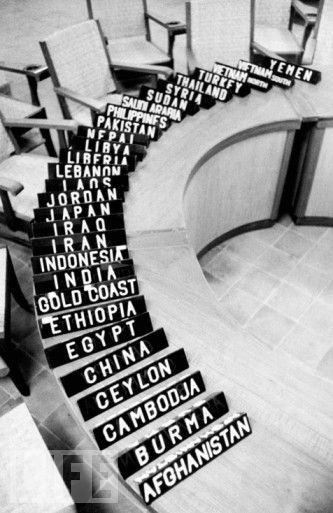
At the time of its founding at the Bandung Conference in April 1955, the major world powers were aligned in Soviet- and United States-led blocs. The war in Korea had recently ended in an armistice with the same frontiers as at the start but could have been the forerunner of a world war. The French war in Indochina had ended with independence of the three Indochina states, but a new independence conflict had just started in Algeria. Basically Bandung marked the end of formal colonialism. As Sir John Kotelawala, Premier of Ceylon (now Sri Lanka), said at the end of the conference “Bandung will be a name to reverberate in history and earn the gratitude and blessings of ages to come.”

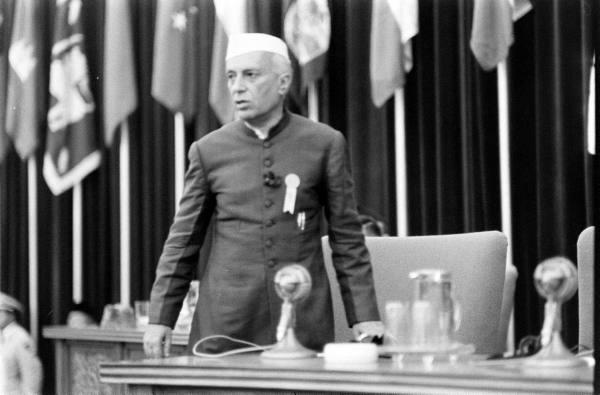
Prime Minister Jawaharlal Nehru of India delivering the closing speech at the Bandung Conference that created the Non-Aligned Movement.
For fear that the new Non-Aligned movement might supplement or weaken the United Nations (UN), no implementary organization was set up. Later, the pattern of three-year rotating presidency was developed, but without a permanent secretariat. The country holding the presidency offers its own diplomats and civil servants to carry on Non-Aligned tasks. The outgoing presidency — Egypt — was so taken up with its own political changes that it virtually played no role on behalf of the N.A.M. Will Iran be able to do more than use the prestige of the Movement to defend its own interests?

In time, the Non-Aligned Movement grew up to become a major player in international relations, providing the Third World with a voice of its own on the world stage.
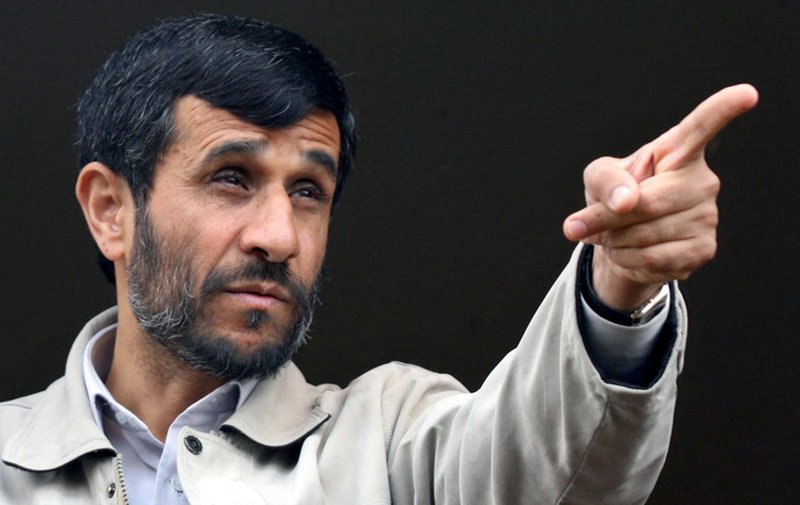
President Mahmoud Ahmadinejad will become the N.A.M. representative for its 118 members. His first presentation will be to the UN General Assembly in September. His talk should be analyzed closely to see if his presentation goes beyond the usual Iranian positions to be more inclusive of the interests of the N.A.M. members. A large conference at the end of August in Tehran will be the formal start of Iran’s presidency. Some Iranian leaders have called for the creation of a permanent secretariat. Thus it will be important to note what structural reforms are made within the N.A.M.
While in 1955, the idea of a “third camp” was a possibility — a wedge of sanity and restraint between the two atomic giants —, now there are real conflicts of interest among the N.A.M. members — the conflict in Syria being a prime example, along with differing territorial claims within the South China Sea among China and its neighbors.

The direct threats issued against the State of Israel by Iran’s President, Mahmoud Ahmadinejad, albeit in response to Israeli Prime Minister Benjamin Netanyahu’s own warmongering rhetoric against Iran, raises serious questions as to what Ahmadinejad can be expected to make of his presidency of the Non-Aligned Movement.
Iran itself is at the center of an international storm, and it is not clear if its diplomats and political leaders will have the energy to deal with the host of current conflicts among N.A.M. states as well as making proposition concerning the important economic, financial and ecological issues that the world faces. Moreover, the N.A.M. states are members of regional, intergovernmental organizations and therefore look less to N.A.M. leadership to structure economic and cultural cooperation.
Yet the N.A.M. does provide a structure for states and a large percentage of the people of the world. N.A.M. leadership has had an erratic relation with non-governmental organizations (NGOs) — sometimes encouraging their participation in meetings and programs and at other times ignoring them completely. Without a permanent secretariat, the N.A.M. has not developed the sort of consultative status that the UN has with NGOs. The Indian government at one stage had encouraged NGO-related activities within the N.A.M. Given the challenges facing the Iranian presidency of the N.A.M. it would be useful for NGOs to propose a more structured and formal relation with the N.A.M. especially if a permanent secretariat is created.
René Wadlow is President and Chief Representative to the United Nations, Geneva, of the Association of World Citizens.
Supporting Young Syrians who Say “Stop the Killing!”
In Conflict Resolution, Current Events, Human Rights, Middle East & North Africa, Solidarity, The Search for Peace, United Nations, World Law on May 26, 2012 at 3:07 PMSUPPORTING YOUNG SYRIANS WHO SAY “STOP THE KILLING!”
By René Wadlow
In early May 2012, there were particularly deadly explosions in Damascus, the capital of Syria, an escalation of a conflict which began over a year ago with nonviolent protests but which spilled over into violence, refugee displacements, and ever deeper division among the people of Syria.
For the moment, the efforts of the League of Arab States and the United Nations have not been able to establish good-faith negotiations or even a permanent ceasefire. Therefore a group of young nonviolent Syrians have created a movement “Stop the Killing,” not related to a political party or a confessional religious group, but which wishes to unite those of good will to stop the violence and to develop a society in which all can contribute.
Therefore, we who are outside Syria, send our support and willingness to cooperate.
I believe in you, and I believe in your destiny.
I believe that you have inherited from your forefathers an ancient dream, a song, a prophecy which you can proudly lay as a gift of gratitude to those working for a just resolution of the current conflicts.
I believe that it is in you to be good citizens.
And what is it to be a good citizen?
It is to acknowledge the other person’s rights before asserting your own, but always to be conscious of your own.
It is to be free in word and deed but it is to know that your freedom is subject to the other person’s freedom.
It is to know that killing will never bring a society of justice and harmony. A just and nonviolent society is the fruit of wisdom and love. Therefore let love, human and frail, command the coming day.
Rene Wadlow, a member of the Fellowship of Reconciliation and of its Task Force on the Middle East, is President and Chief Representative to the United Nations Office at Geneva of the Association of World Citizens.
World Citizens Call for Renewed Efforts for a Mali Federation
In Africa, Conflict Resolution, Current Events, The Search for Peace, United Nations, World Law on April 29, 2012 at 10:10 PMSTATEMENT BY THE REPRESENTATIVE OFFICE
TO THE UNITED NATIONS OFFICE AT GENEVA
OF THE ASSOCIATION OF WORLD CITIZENS
WORLD CITIZENS CALL FOR RENEWED EFFORTS
FOR A MALI FEDERATION
In an April 29, 2012 message to H. E. Mr. Ramtane Lamamra, Commissioner for Peace and Security of the African Union, Prof. René Wadlow, President of the Association of World Citizens, called upon the African Union to facilitate the creation of a federation of north and south Mali rather than having the country split into two independent states with unresolved frontier issues.
President Wadlow highlighted the recent meeting of representatives of the 15-member Economic Organization of West African States (ECOWAS) on April 26-27 in Abidjan which set a 12-month deadline for a transition period in Mali after the March 22coup of military officers led by Captain Amadou Sanogo. In response to strong, negative reactions by the international community, on April 7 there was a return to a civilian transitional government. However, the northern half of the country is now controlled by two rival Tuareg groups, the Mouvement national de libération de l’Azawad (MNLA) and the Ansar Dine. The MNLA has declared the northern half to be the independent state of Azawad.
“12 months should be long enough to work out a new constitution which maintains the unity of the country while at the same time providing the needed autonomy to the north and a preservation of the Tuareg way of life.” World Citizens believe in cooperation and in finding solutions based on respect for the positions and values of all the parties in the conflict.
“The Association of World Citizens believes that the Commission for Peace and Security of the African Union is well placed to help in drafting such a new federal constitution, especially as the Commissioner is a former Ambassador of Algeria to the United Nations. In the past, Algeria has played a mediation role between the Tuareg who also inhabit south Algeria and the governments of Mali and Niger where there are larger Tuareg communities.”
The declaration of the independence of north Mali by the MNLA is the first time such a formal proclamation has been made, although the independence of Azawad has always been among the Tuareg demands. Thus, it may be difficult for the Tuareg leadership, now in a position of force, to return simply to promises of greater autonomy within a unified Mali. A federation with clear divisions of authority could be a measure acceptable to both the MNLA and the government in Bamako.
“A crisis is a time for creative efforts. The Association of World Citizens is prepared to be of help with expertise in federal-confederal forms of government in this process.
“A transition period of 12 months may seem like a long time, but given the deep divisions of attitudes among leaders of north and south Mali, the sooner such efforts get underway the better. Support for the goal of a Mali federation on the part of the African Union’s Commission for Peace and Security could be an important part of creating a positive atmosphere in which such constitution drafting could be carried out.”
– 30 –
A New Mali Federation?
In Africa, Anticolonialism, Conflict Resolution, Current Events, The Search for Peace, United Nations, World Law on April 21, 2012 at 9:55 PMA NEW MALI FEDERATION?
By René Wadlow
Since the fall of northern Mali to the forces of the Tuareg at the end of March 2012, the situation has grown in complexity. The group of young officers, more or less led by Captain Amadou Sanogo, had taken control of the government buildings of the Central Government in Bamako on March 23, but they had little idea of what else to do.
There was an immediate counter-reaction on the part of Western States such as France and the USA who provide most of the financial and technical assistance to Mali. Both France and the USA cut their aid to Mali—a country currently facing a severe drought and food shortages. Likewise, the 15 states of the Economic Organization of West African States (ECOWAS) called for a speedy return to the civilian government. Captain Sanogo saw the “handwriting on the wall” and agreed to turn over the government to the President of the National Assembly who is the constitutional replacement when the President is absent.
In the meantime, the country is divided into two roughly equal areas—a north with the Tuareg holding the two major cities of Timbuktu and Gao, and the more populated south whose population provides most of the civil service, the army and the agricultural wealth of the country.
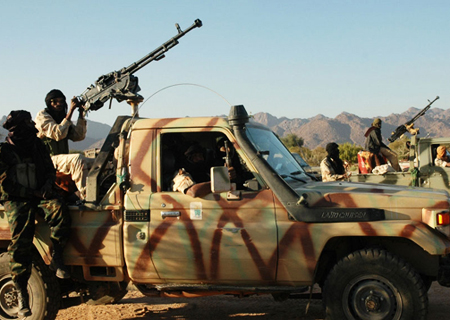
The Tuareg along with various armed groups probably from Mauritania, south Algeria and fighters who had been recruited for Libya are divided on what strategy to follow. There are two broad options. The largest group, Mouvement national de libération de l’Azawad (MNLA) wants an independent state of northern Mali (and probably part of the Tuareg-inhabited Niger) to be called Azawad. The second faction, called Ansar Dine, is smaller but is more heavily armed and contains the bulk of armed foreigners. Their stated aim is to take control of all of Mali and to install Islamic law.
Both options have difficulties. Northern Mali as an independent state of Azawad has no natural resources, a small population and few educated people to administer a state or to develop any economy beyond that of camel nomadism. In addition, most African states are opposed to carving up existing states or changing frontiers—a Pandora’s box as many states could be redrawn on ethnic lines and frontiers changed. Thus “territorial integrity” is an article of faith.
Ansar Dine’s option of an Islamist Mali is also difficult to realize. The Bambara and the Malinké are the largest groups in the country and hold economic, military, and political power. Ideologically, they are opposed to the Islamic vision of Ansar Dine, being more Sufi-influenced with a large measure of traditional African beliefs and practices mixed in.(1) Thus the possibility of Ansar Dine gaining support in the south of Mali is slight. However, they may be able with force of arms to impose their views on Timbuktu and Gao but not on the northern countryside. The Tuareg are not Islamist by tradition. Yet in the two cities, the Ansar Dine may be able to force women to cover their hair, prevent the sale of wine and cut the hands of robbers—these three practices being the extent of their knowledge of Islamic law.
Faced with the difficulties of having a northern Malian state—Azawad—accepted by the power-holders of Mali and the neighboring states, there have been some discussions among Tuareg leaders and a former Malian government leader in Nouahchott, Mauritania. There have been no official statements coming from these talks, in part because both north and south Mali are in administrative disorder. No one knows how much authority the persons involved have. For the moment, it is probably at best “Track II” diplomacy, trying to see what are the aspirations, the limits of the acceptable, and the degree of the willingness to compromise. In the past France and Algeria have mediated disputes between the Tuareg and the central government of Mali. There have been past agreements on autonomy for the Tuareg. However, these agreements have rarely held and more centralized government was slowly restored. I believe that this is due more to the incapacity of the Tuareg to provide trained people to run a decentralized administration than ill will or a desire of control on the part of the central government.
Yet, in the past, a “declaration of independence” for northern Mali was never proclaimed. Now that a powerful segment has declared the independence of Azawad, can they go “backward” and accept greater autonomy within a unified Mali?
Echoes from the current Nouachott talks have spoken of a “Federation of Mali”. The name has already been used. The Mali Federation with Senegal was achieved briefly on the eve of independence and lasted for 506 days from April 1, 1959 until August 19, 1960 when it fell apart during the conflict between the President of Senegal, L. S. Senghor and his Prime Minister Mamadou Dia, largely over the division of authority between the two posts.
Because of the way these events occurred, Mali was deprived of its principle outlet to the sea —Dakar, for three years. Attempts to revive federalism between Mali, Guinea, and Ghana, two other states which had also chosen an anti-colonial “socialist” policy, proved futile.(2) Mali, which had been known as Soudan during the French colonial period, took the name Mali on the suggestion of President Senghor of Senegal from the 14th century empire which covered much of what is today Senegal, Mali and part of Niger.(3)
Can a new Mali Federation of the two sections of the current Mali work better than the earlier Federation of Mali? With good will and imagination, federalist structures should be able to be worked out. Yet there are times when good will and imagination are in short supply.
Rene Wadlow is the President and Chief Representative to the United Nations, Geneva of the Association of World Citizens.
Notes:
1) See the classic study: Germaine Dieterlen, Essai sur le religion Bambara (Paris,:Presses Universitaires de France,1951)
2) See: Ruth Schachter Morgenthau, Political Parties in French-speaking West Africa (Oxford: Clarendon Press, 1964)
William J. Foltz, From French West Africa to the Mali Federation (New Haven: Yale University Press, 1965)
3) Raymond Mauny, Tableau géographique de l’Ouest africain au Moyen Age (Dakar: IFAN, 1961)
World Citizens Call for Protection of Timbuktu, UNESCO Cultural Heritage Site and Center of Trans-Saharan Cultural History
In Africa, Conflict Resolution, Current Events, Human Development, The Search for Peace, World Law on April 8, 2012 at 8:47 PMWORLD CITIZENS CALL FOR PROTECTION OF TIMBUKTU,
UNESCO CULTURAL HERITAGE SITE
AND CENTER OF TRANS-SAHARAN CULTURAL HISTORY
By René Wadlow
In an April 8, 2012 Appeal to Irina Bokova, Director-General of the United Nations Educational, Scientific and Cultural Organization (UNESCO), René Wadlow, President of the Association of World Citizens (AWC), welcomed UNESCO’s speedy effort to prevent damage to Timbuktu and called for negotiations between the Mouvement national de libération de l’Azawad (MNLA) and the Ansar Dine, a rival Tuareg group currently holding separate parts of the historic city. The MNLA, led by its Secretary-General Bilal Ag Cherif, is the larger group and focuses on the creation of an independent state, Azawad, comprising northern Mali and possibly part of the Tuareg-inhabited area of northern Niger.
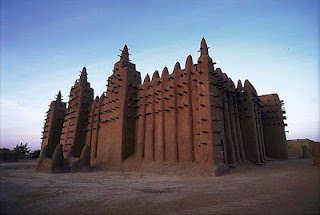
Ansar Dine, a smaller faction, is led by Ag Ghaley. It claims to want to create an Islamic state within all of Mali. Within or alongside Ansar Dine are Islamists from Algeria and Mauritania and probably other countries. Some had been fighting in Libya and are heavily armed. The aim of moving south toward non-Tuareg areas is, no doubt, unrealistic as Ansar Dine has no support in the more densely-populated south, inhabited by Bambara and Malenke ethnic groups. However, there could be an armed struggle for power between the MNLA and Ansar Dine in which the fragile, backed mud building of Timbuktu could be destroyed or badly damaged.

Timbuktu, a jewel of African culture and history, stands proud and tall in the desert sands of Mali.
While Timbuktu was once a metaphor for the middle of nowhere, it was an important city for the trans-Sahara trade from about 800 until 1591 when Moroccan troops destroyed the then Songhai Empire of Mali and Portugal and others developed a sea-going trade that largely replaced the trans-Sahara trade. (1). During the time that trade flourished, scholars and religious preachers were attracted to Timbuktu and Gao, the other trans-Sahara “port” and learning was highly developed.
The protection of Timbuktu’s cultural wealth may depend a good deal on the role of non-governmental organizations to facilitate negotiations between the MNLA the Ansar Dine and possible other armed groups. For the moment, the political situation in Mali is confused, and the protection of cultural sites in Timbuktu must not rank very high on the list of priorities.
From March 22 until April 6, 2012, a military group of young officers had taken control of government buildings in Bamako claiming that the government of President Amadou Touré was incompetent in the struggle against the Tuareg. The coup was more or less led by Captain Amadou Sanogo, who had been trained by the United States (U. S.) Marine Corps, but Sanogo was probably acting on his own and not on behalf of the U. S. Marines. The negative reaction to the coup was speedy. Led by France, the former colonial power, the United Nations Security Council decided on April 4 to issue a President’s Statement (less strong than a resolution but on which all states must be in agreement) calling for a restoration of the civilian government. It is not likely that the civilian-led government of President Touré will be restored. Touré was himself a former general who had come to power in a coup, then governed in a fairly democratic way but without making many socio-economic advances. The country now faces a food crisis due in part to drought and in part to the lack of improvements in the agricultural production and distribution system.
While the UN Security Council was meeting, the 15-member Economic Organization of West African States (ECOWAS) also met, calling for a return to a civilian government and closing the frontiers. During the ECOWAS meeting, it was decided to activate the Anti-Terrorism Centre which is located at Tamanarasset in south Algeria and to place some 2000 soldiers on alert. Captain Amadou Sanogo saw the “handwriting on the wall” and agreed to turn over the government to the President of the National Assembly who is the constitutional replacement when the President is absent.

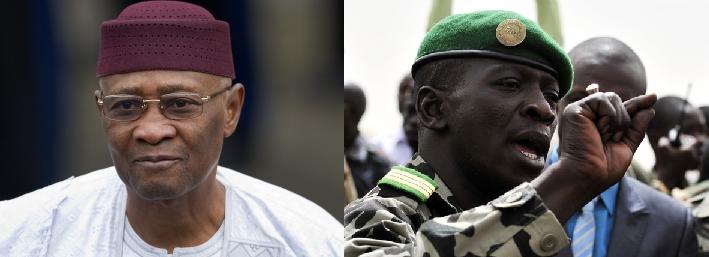
President Amadou Touré of Mali (left) and his rival, Captain Amadou Sanogo of the Mali military (right).
The states in the UN Security Council and in ECOWAS refused to recognize the creation of the Tuareg state of Azawad, so it is unlikely that they will provide any mediators to negotiate between MNLA and Ansar Dime or to facilitate the protection of historic sites. There is on the part of many governments a dislike of carving up existing countries in order to create new states. It took fighting from 1982 to 2005 for there to be an agreement to create the new state of South Sudan and for other African states to agree to the division.
The military in Bamako do not seem organized or willing to die to retake northern Mali, especially since most of the Mali military are from the Bambara ethnic group with little attachment to northern Mali in any case.
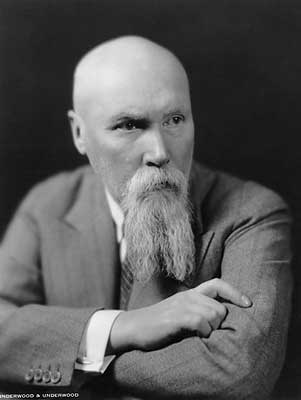
Much of the initiative for the protection of educational and cultural institutions has come from the NGO world and world-mined artists. Early efforts were undertaken by Nicholas Roerich (1874-1947) a Russian and world citizen. Nicholas Roerich had lived through the First World War and the Russian Revolution and saw how armed conflict can destroy works of art and cultural institutions. For Roerich, such institutions were irreplaceable and their destruction was a loss for all humanity. Thus, he worked for the protection of works of art and institutions of culture in times of armed conflict. He envisaged a universally-accepted symbol that could be placed on educational institutions in the way that a red cross had become a widely-recognized symbol to protect medical institutions and medical workers. Roerich proposed a “Banner of Peace” — three red circles representing the past, present, and future — that could be placed upon institutions and sites of culture and education to protect them in times of conflict.
Roerich mobilized artists and intellectuals in the 1920s for the establishment of this Banner of Peace. Henry A. Wallace, the US Secretary of Agriculture and later Vice-President was an admirer of Roerich and helped to have an official treaty introducing the Banner of Peace — the Roerich Peace Pact — signed at the White House on April 15, 1935 by 21 States in a Pan-American Union ceremony. At the signing, Henry Wallace on behalf of the USA said “At no time has such an ideal been more needed. It is high time for the idealists who make the reality of tomorrow, to rally around such a symbol of beauty, science, education which runs across all national boundaries to strengthen all that we hold dear in our particular governments and customs. Its acceptance signifies the approach of a time when those who truly love their own nation will appreciate in addition the unique contribution of other nations and also do reverence to that common spiritual enterprise which draws together in one fellowship all artists, scientists, educators and truly religious of whatever faith.”

Nicolas Roerich (1874-1947), the man who opened the drive to make protection of works of art a full-fledged part of the law of armed conflict.
After the Second World War, UNESCO has continued the effort, and there have been additional conventions on the protection of cultural and educational bodies in times of conflict. The most important is the 1954 Hague Convention for the Protection of Cultural Property in the Event of Armed Conflict. The spirit of the Hague Convention is clear and the protection of cultural and educational institutions should be a priority in conflicts among States or in civil wars even if no State recognizes Azawad.
Therefore we, as World Citizens, all have a duty to articulate more clearly the crucial link among human rights standards, humanitarian law, and world law to protect educational and cultural institutions in times of conflict. As Nicholas Roerich said in a presentation of his Pact “The world is striving toward peace in many ways, and everyone realizes in his heart that this constructive work is a true prophesy of the New Era. We deplore the loss of libraries of Louvain and Oviedo and the irreplaceable beauty of the Cathedral of Rheims. We remember the beautiful treasures of private collections which were lost during world calamities. But we do not want to inscribe on these deeds any words of hatred. Let us simply say: Destroyed by human ignorance — rebuilt by human hope.

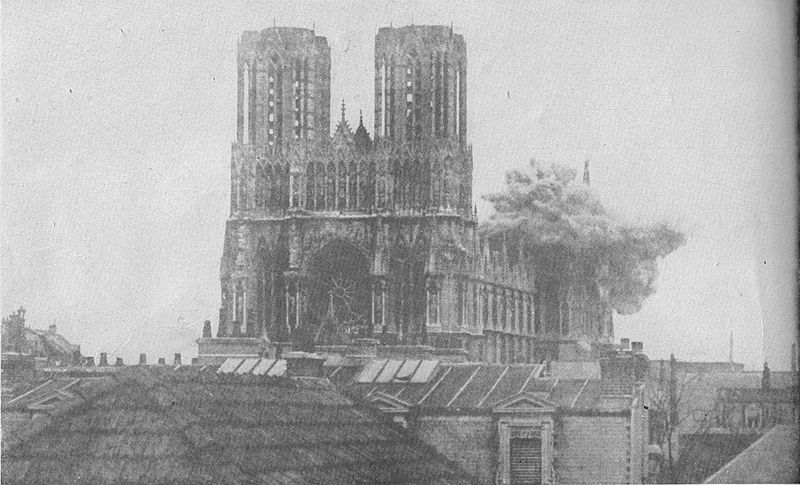
In 1914, a shell explosion at the Cathedral of Rheims in the early times of World War I.
Almost a century later, can the world possibly let Timbuktu become a "casualty of war" too?
René Wadlow is President and Chief Representative to the United Nations Office at Geneva of the Association of World Citizens.
(1) See Raymond Mauny Tableau géographique de l’Ouest africain au Moyen Age (Dakar, IFAN, 1961, 587 pp.)
In English : Horace Miner, The primitive city of Timbuctoo (Princeton: Princeton University Press, 1953, 297pp.)
The Horn of Africa: Refugees, Famine, Conflicts
In Africa, Conflict Resolution, Current Events, Solidarity, The Search for Peace, United Nations, World Law on July 31, 2011 at 11:24 PMTHE HORN OF AFRICA: REFUGEES, FAMINE, CONFLICTS
By René Wadlow
Only a crisis — actual or perceived — produces real change. When the crisis occurs, the actions that are taken depend on the ideas that are lying around. That, I believe, is our basic function: to develop alternatives to existing policies, and to keep them alive and available until the politically impossible becomes politically inevitable.
– Milton Friedman
Heavy fighting started again on July 28, 2011 in Mogadishu, the capital of what was once Somalia, in a battle between the African Union peacekeeping force (Amisom) and the Islamic insurgency al-Shahab. The fighting prevents aid from reaching the tens of thousands of refugees who have arrived in Mogadishu fleeing famine. The United Nations (UN) World Food Program says it cannot reach some two million people in need in areas controlled by al-Shahab which had expelled Western nongovernmental organizations (NGOs) who were providing relief.
The Horn of Africa, in particular Ethiopia, Somalia and Kenya, faces a deep crisis, a combination of refugee flows, famine in part linked to drought, and persistent conflicts. There is a broad consensus in the UN system that radical measures are needed to deal with the Horn of Africa crisis and that these measures will have to be taken in a holistic way with actions going from the local level of the individual farmer to the national level with new government policies, to measures to be undertaken by the African Union and the UN system, in particular the Food and Agriculture Organization (FAO) in Rome.
Today, cooperation is needed among the UN family of agencies, national governments, NGOs, and the millions of food producers. There is a need for swift, short-term measures to help people now suffering from lack of food, inadequate distribution and situations of violence. Such short-term action requires additional funding for the UN World Food Program and the release of national food stocks. However, it is the longer-range and structural issues on which world citizens have focused their attention. The world requires a World Food Policy and a clear Plan of Action.
While constant improvements in technology, mechanization, plant breeding and farm chemicals have steadily increased food production per acre in much of the world, African food production per acre has stagnated, and in some areas has gone down. Likewise, the portion of development assistance in Africa dedicated to agriculture has declined from 15 per cent in the 1980s to 4 per cent in 2006.
As a July 11, 2011 UNCTAD study Economic Development in Africa stresses “One of the major challenges which African countries currently face is to generate productive jobs and livelihoods for the 7-10 million young people entering the labor force each year. This is difficult to achieve simply through commodity exports but rather requires a complementary process of agricultural productivity growth and development of non-agricultural employment opportunities in both industry and services.”
Thus, the first need in Africa is to develop the local economies: currently, poverty, lack of adapted technology, population pressure on ecologically fragile areas, a growth of urban slums due to rapid rural to urban migration is the lot of many Sub-Saharan African countries.
Increased action to improve rural life needs to be taken quickly. As the recent UN-sponsored Millennium Ecosystem Assessment warns “Human activity is putting such strains on the natural function of Earth that the ability of the planet’s ecosystem to sustain future generations can no longer be taken for granted. It is becoming ever more apparent that human society has a rapidly shrinking window of opportunity to alter its path.”
The Horn of Africa is an extreme case. The Horn possesses all the resources needed to make it one of Africa’s major economic centers, and yet there seems to be no halting the environmental decay and political insecurity it engenders. In fact, when one looks at the Horn’s problems, one must conclude that urgent and well-directed international action is needed to prevent a mega-disaster. Due to an often unenlightened management of the environment, its willful mismanagement to extract short-term economic gain, and confrontational rather than conciliatory policies, the squandering of the region’s resources has gathered speed.
Environmental degradation is part of a cycle that upsets the traditional balance between people, their habitat and the socio-economic systems by which they live. Insecurity leads to strife; strife results in inter-clan feuding, civil war, cross-border raiding and military confrontation. Environmental degradation and insecurity continue to interact, swinging back and forth like a pendulum of destruction. A shrinking resource base breeds insecurity; insecurity spreads conflict, and conflict causes environmental destruction.
It is hard to know how to improve the situation. There is a long-term need for people to modify their living patterns to bring about a better quality of life, with increased security. There is a need to break the cycle of chaos so that people can transform insecurity into confidence. Yet social change is slow, and the necessary limiting of the birth rate can take generations. Agricultural patterns also change slowly. There is no political leadership within the area, and there is no cooperation among the states of the Horn. The African Union’s conflict management structures do not function, and the UN has hoped that the African Union could take the lead in the area’s conflict resolution. This was a hope based on an unwillingness to get involved rather than a realistic evaluation of the situation.
The cycle of chaos is likely to speed up, and more refugees will be on the move. However, as Milton Friedman noted only a crisis produces real change. Just as the “Arab Spring” brought a new generation of leadership into action — though not yet into power — the Horn of Africa might see a new generation of non-governmental leadership coming to the fore. The older political and clanic leadership has failed and is discredited. However, they have guns and plan to stay in control. Yet what is politically impossible today in the Horn may become politically inevitable.
René Wadlow is Senior Vice President and Chief Representative to the United Nations Office at Geneva of the Association of World Citizens.
See also Somalia: Signs of Danger (https://awcungeneva.wordpress.com/2011/05/17/somalia-signs-of-danger/)