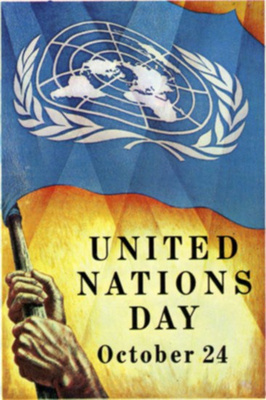
The Official Blog of the

Archive for the ‘Conflict Resolution’ Category

Korea: Challenge and Response

In Asia, Being a World Citizen, Conflict Resolution, Human Rights, The Search for Peace, United Nations, World Law on October 28, 2015 at 10:39 AM

KOREA: CHALLENGE AND RESPONSE

By René Wadlow

As the professor of economics Milton Friedman wrote “Only a crisis – actual or perceived – produces real change. When the crisis occurs, the actions that are taken depend on the ideas that are lying around. That, I believe, is our basic function: to develop alternatives to existing policies, and to keep them alive and available until the politically impossible becomes the politically inevitable.”

The current tension around the two Korean States, the Democratic People’s Republic of Korea (DPRK) and the Republic of Korea (ROK), is such a crisis. For the moment, it is not clear that Governments are willing to take the diplomatic measures necessary to reverse the tensions on the Korean Peninsula. Thus it is important that non-governmental voices be raised and that their proposals are taken seriously. Nongovernmental organizations can present policy choices that can help to resolve the multidimensional Korean security challenge.

Therefore, the Association of World Citizens (AWC) has proposed a two-track approach to the current Korean tensions. In a message to the United Nations (UN) Secretary-General Ban Ki-moon, AWC President René Wadlow stressed that a crisis can also be an opportunity for strong initiatives and action. The UN with historic responsibility for Korea should take the lead in organizing an UN-sponsored Korean Peace Settlement Conference, now that all the States which participated in the 1950-1953 Korean War are members of the UN. The UN-led Korean Peace Settlement Conference should be organized to lead to a North-east Asia Security and Nuclear-weapon Free Zone.

Such a Peace Settlement Conference is of concern not only to Governments but is one in which the voices of civil society are legitimate and should be heard.

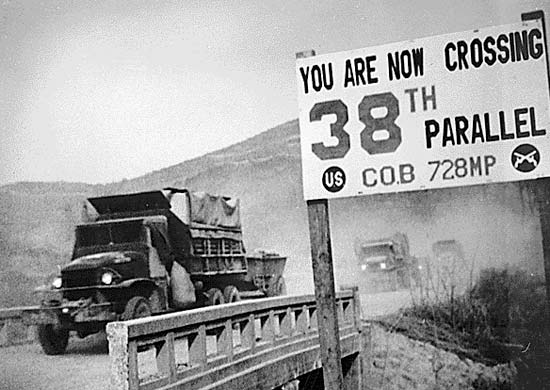
From 1950 to 1953 the first major international conflict to have taken place after the end of World War II saw the United Nations join the pro-Western South Korean military in its fight against the Communist North Korea. Neither side really won the war but since the 1953 armistice the Korean Peninsula has been divided in two along the horizontal border represented by the 38th Parallel.

From 1950 to 1953 the first major international conflict to have taken place after the end of World War II saw the United Nations join the pro-Western South Korean military in its fight against the Communist North Korea. Neither side really won the war but since the 1953 armistice the Korean Peninsula has been divided in two along the horizontal border represented by the 38th Parallel.

In the past, there have been a series of dangerous but ultimately resolvable crises concerning the two Korean States. However, there are always dangers of miscalculations and unnecessary escalations of threats. Past crises have led to partial measures of threat reduction.

Partial measures of cooperation between the two Korean States, the Six-Party talks on nuclear issues and a number of Track II-civil society diplomatic efforts have shown the possibilities but also the limits of partial measures.

In the past decade, world attention has been focused on two Korean issues:

1) how to resolve the nuclear weapons-ballistic missiles issues;
2) how to help the DPRK to become food secure and to overcome a sharp inadequacy in food production. The food deficit points to broader structural obstacles, production and supply bottlenecks, and a generalized vulnerability of the economy.

Northeast Asia’s highly sensitive interlocking security issues are of great significance to the future of the region which includes China, Russia, Japan, the two Korean States and by extension the USA.

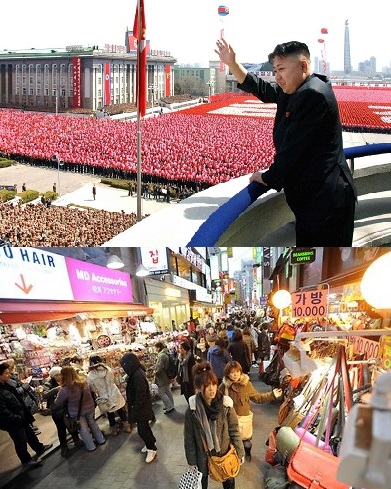
During the Cold War, Korea was to Asia what Germany was to Europe and Yemen to the Middle East – once a single people now divided along the ideological border of the rival blocs. Unlike Germany and Yemen, though, a quarter of the century after the Cold War has ended, Korea remains firmly divided. In the North, the world’s last Stalinist regime ruled by the Kim family continues to pose a serious threat to the pro-Western, democratic South Korea. (C) AP Photo/Korean Central News Agency via Korea News Service & Park Ji-Hwan/Agence France-Presse — Getty Images

During the Cold War, Korea was to Asia what Germany was to Europe and Yemen to the Middle East – once a single people now divided along the ideological border of the rival blocs. Unlike Germany and Yemen, though, a quarter of the century after the Cold War has ended, Korea remains firmly divided. In the North, the world’s last Stalinist regime ruled by the Kim family continues to pose a serious threat to the pro-Western, democratic South Korea. (C) AP Photo/Korean Central News Agency via Korea News Service & Park Ji-Hwan/Agence France-Presse — Getty Images

Changing security perceptions and policies, unresolved conflicts and grievances, and concerns about nuclear and missiles proliferation are all elements that affect the stability of the region as a whole — and which also have global impacts.

In addition to the broadly based UN-led Korean Peace Settlement Conference, the AWC has stressed the need for regional cooperation and confidence-building measures which would improve the daily life of individuals and create the framework for greater future cooperation.

The AWC has highlighted that the Tumen River Development Project (TRADP), now often called the Greater Tuman Initiative (GTI), is probably the best framework for rapid cooperative development. The planning for a Tuman River economic zone at the mouth of the river had been drawn up in the early 1990s by the UN Development Program (UNDP – a vast free – economic zone which would involve parts of Mongolia, China, Russia and the two Korean States as well as Japan as a logical regional development partner. However, development has fallen far short of initial expectations for reasons both internal and external to the participating States.

As Milton Friedman pointed out, ideas can be dormant until a crisis occurs and then new steps must be taken. The AWC believes that the Tuman River economic zone is a real opportunity for cooperation among the States for the benefit of the people of the area.

Citizens of the World call for speedy and creative action to meet the challenge of Korean tensions with a response of cooperation and reconciliation.

Prof. René Wadlow is President of the Association of World Citizens.
Peacebuilding: A Focus for UN Day

In Being a World Citizen, Conflict Resolution, Human Development, United Nations, World Law on October 24, 2015 at 11:37 AM

PEACEBUILDING: A FOCUS FOR UN DAY

By René Wadlow

UN Flags 

As we mark United Nations (UN) Day this October 24, we are reminded that the UN remains the only universally representative and comprehensively empowered body the world has to deal with threats to international peace and security. As Brian Urquhart, one of the early UN civil servants said, “In the great uncertainties and disorders that lie ahead, the UN, for all its shortcomings, will be called on again and again because there is no other global institution, because there is a severe limit to what even the strongest powers wish to take on themselves, and because inaction and apathy toward human misery or about the future of the human race are unacceptable.” However, the nature of the threats to international security is ever changing. The UN, just as the national governments which make it up, have difficulties meeting new challenges.

“From the outset of my mandate”, said in 1993 then Secretary General of the UN Boutros Boutros-Ghali, “I have been convinced that the structure of the Organization must mirror, as closely as possible, the tasks it is assigned to undertake. An institution must reflect the objectives it pursues … The UN therefore faces the difficult task of relating our aims to our means, of updating and reforming institutions set up at different times and with different imperatives.” Boutros-Ghali proposed measures to promote coordination and decentralization within the UN system, greater cooperation with non-governmental organizations and regional bodies, and creating more effective UN financing and budget-making mechanisms.

He went on to stress the vast challenges of famine, drought, AIDS, civil wars, uprooted and displaced populations and deepening human misery in many parts of the world. These situations make dramatic demands on the UN system and require a better field presence and operational capabilities. The UN system is called upon to respond to much diversified requirements, often involving the provisions of crucial and direct aid to peoples in deep distress and involving sensitive new fields of social, economic and political transformations. However, the crisis we face is not about the administration of UN bodies, but about a tragically broken world where poverty and violence are ever more visible and where there is an ever-diminishing willingness to help those in need.

Over a decade later, Kofi Annan made many of the same observations as he set out his own proposals for structural reforms “In Larger Freedom”. However, the current structures of the UN for government representatives work “just well enough” that they do not want to take the risk of making changes. Increasingly, it is the representatives of nongovernmental organizations who are pushing for change and are organizing to undertake tasks which some governments are unwilling to do.  We see this with the current flow of migrants-refugees to Europe where some non-governmental groups have stepped in to help refugees even when their governments have an unwelcoming and negative policy.

UN Day

One potentially important innovation is the creation within the UN of the Peacebuilding Commission. Hopefully this Commission will be more than a name change for the same functional relief efforts in post-conflict situations. The Peacebuilding Commission was created as a response to the observation that conflicts are rarely settled, and they often take on new forms of violence as we saw in the Afghanistan case after the end of the Soviet intervention, in Kosovo after the other ex-Yugoslav conflicts had died down, in Somalia despite repeated ceasefires and the creation of “unity governments”.

We all have limited attention spans for crisis situations in which we are not directly involved or do not have strong emotional links. We are constantly asked to pay attention to a new crisis, to new tensions, to new difficulties. Political leaders have even shorter attention spans unless there are strong domestic reasons for remaining involved. Therefore, there is a need both within the UN system and within national governments for a group of persons will a long-range holistic vision, who are able to see trends and the links between situations. Such a body needs to be able to organize long-term cooperation drawing upon the knowledge and resources of universities, religious groups, NGOs and government services at all levels. There needs to be greater public awareness and the ability to organize to articulate values and the implementation of goals.

Just as ecological concerns require actions by a multitude of actors who do not always see the relationship between their actions, so peacebuilding has material, intellectual and spiritual dimensions. Finding the way these fit together in a manner understandable to policy makers is not easy. However, this is the challenge before us. The process will take time and vision. Peacebuilding can be a major focus as we mark UN Day on October 24.

Prof. René Wadlow is President of the Association of World Citizens.
OSCE: Strains and Renewal in the Security Community

In Being a World Citizen, Conflict Resolution, Current Events, Democracy, Europe, Human Development, Human Rights, The Balkan Wars, The former Soviet Union, The Search for Peace, World Law on August 2, 2015 at 9:29 AM

OSCE: STRAINS AND RENEWAL IN THE SECURITY COMMUNITY

By René Wadlow

On August 1, 2015, the Helsinki Final Act, the birth certificate of the Organization for Security and Cooperation in Europe (OSCE) turned 40. The Final Act signed in Helsinki’s Finlandia Hall was the result of three years of nearly continuous negotiations among government representatives meeting for the most part in Geneva, Switzerland as well as years of promotion of better East-West relations by non-governmental peace builders.

Basically, one can date the planting of the seeds that grew into the OSCE as 1968 in two cities: Paris and Prague. The student-led demonstrations in Paris which sent shock waves to other university centers from California to Berlin showed that under a cover of calm, there was a river of demands and desires for a new life, a more cooperative and creative way of life.

In Prague, the Prague Spring of internal reforms and demands for a freer European society was met by the tanks of the Soviet Union and the Warsaw Pact in August. Yet some far-sighted individuals saw that 1968 was a turning point in European history and that there could be no return to the 1945 divisions of two Europes with the Berlin Wall as the symbol of that division. Thus, in small circles, there were those who started asking “Where do we go from here?”

A Security Community: A Halfway House

In 1957, Karl W. Deutsch (1912-1992) published an important study, Political Community and the North Atlantic Area (Princeton University Press). Karl Deutsch was born to a German-speaking family in Prague in what was then the Austro-Hungarian Empire. His family was active in socialist party politics and became strongly anti-Nazi. Seeing what might happen, Deutsch and his wife left Prague in 1939 for the USA where he became a leading political science-international relations professor. I knew Karl Deutsch in the mid-1950s when I was a university student at Princeton, and he was associated with a Center on International Organization at Princeton. It was there that he was developing his ideas on types of integration among peoples and States and that he coined the term “security community” to mean a group of people “believing that they had come to agreement on at least one point that common social problems must and can be resolved by processes of peaceful change.” For Deutsch, the concept of a security community could be applied to people coming together to form a State: His approach was much used in the 1960s in the study of “nation building” especially of post-colonial African States. A “security community” could also be a stage in relations among States as the term has become common in OSCE thinking. For Deutsch, a security community was a necessary halfway house before the creation of a State or a multi-State federation. Deutsch stressed the need for certain core values which created a sense of mutual identity and loyalty leading to self-restraint and good-faith negotiations to settle disputes.

Core values established and quickly disappeared

During the negotiations leading to the Helsinki Final Act, a set of 10 core values or commitments were set out, sometimes called the OSCE Decalogue after the “Ten Commandments”. “Sovereign equality, respect for the rights inherent in sovereignty and non-intervention in internal affairs” set the framework as well as the limitations of any efforts toward a supranational institution. The two other related core values were “the territorial integrity of States and the inviolability of frontiers.”

The core values were not so much “values” as a reflection of the status quo of the Cold War years. By the time that the Charter of Paris for a New Europe was signed in November 1990, marking the formal end of the Cold War, “territorial integrity and the inviolability of frontiers” as values had disappeared.

The 1990s saw the breakup of two major European federations − that of Yugoslavia and the USSR. Most of the work of the OSCE has been devoted to the consequences of these two breakups. Yugoslavia broke into nearly all the pieces that it could with a few exceptions. I had been asked to help support the independence of Sandzak, a largely Muslim area in Serbia and part of Montenegro. I declined, having thought at the time that with a few modifications the Yugoslav federation could be kept together. I was wrong, and the OSCE is still confronted by tensions in Kosovo, renewed tensions in Macedonia, an unlikely form of government in Bosnia and Herzegovina as well as social issues of trafficking in persons, arms, drugs and uncontrolled migration.

The breakup of the Soviet Union has led to a full agenda of OSCE activities. The republics of the Soviet Union had been designed by Joseph Stalin, then Commissioner for Nationalities so that each republic could not become an independent State but would have to look to the central government for security and socio-economic development. Each Soviet republic had minority populations though each was given the name of the majority or dominant ethnic group called a “nationality”.

With the breakup of the Soviet Union, there have been recurrent issues involving the degree of autonomy of geographic space and the role of minorities. The conflict in Nagorno-Karabakh had already started before the breakup, but continues to this day with its load of refugees, displaced persons and the calmer but unlikely twin, the Nakhchivan Autonomous Republic. Moldova and Transdniestria remain a “frozen conflict” with a 1992 ceasefire agreement. The armed conflicts in Chechnya and violence in Dagestan highlighted conflicts within the Russian Federation. The 2008 “Guns of August” conflict over South Ossetia between Russia and Georgia showed that autonomy issues could slip out of control and have Europe-wide consequences.

(C) Sadankomitea

(C) Sadankomitea

A Cloudy Cristal Ball

Predictions, especially about the future, are always difficult. In 2013, the OSCE Chairperson-in-Office, the then Minister for Foreign Affairs of Ukraine, Leonid Kazhara, said “We wish to contribute to the establishment of the Euro-Atlantic and Eurasian security community free of dividing lines, conflicts, spheres of influence and zones with different levels of security … There is a pressing need to, first of all, change our mindsets from confrontational thinking to a cooperative approach. I am confident that Ukraine, with its rich history, huge cultural heritage and clear European aspirations is well placed for carrying out this mission.”

Today, Ukraine’s rich history has a new chapter, recreating old dividing lines and spheres of influence. The shift in “ownership” of Crimea indicates that “territorial integrity of States” is a relative commitment. The large number of persons going to Russia as refugees and to west Ukraine as internally-displaced persons recalls the bad days of displacement of the Second World War. NATO has dangerously over-reacted to events in Ukraine.

It is not clear that the current leaders of the 57 governments of the OSCE have the wisdom or skills to lead to a renewal of the Security Community. Yet when one looks at the photos of the government leaders who did sign the Helsinki Final Act 40 years ago, there are few faces indicating wisdom or diplomatic skills so perhaps all is not lost today. Very likely, as in the period between the events of 1968 and the start of government negotiations in 1972, there will need to be nongovernmental voices setting out new ideas and creating bridges between people.

Prof. René Wadlow is President and Chief Representative to the United Nations Office at Geneva of the Association of World Citizens.
UN Human Rights Council Reaffirms the Safeguards for Civilians in Times of War

In Being a World Citizen, Conflict Resolution, Current Events, Human Rights, International Justice, Middle East & North Africa, The Search for Peace, United Nations, War Crimes, World Law on July 5, 2015 at 7:33 PM

UN HUMAN RIGHTS COUNCIL REAFFIRMS THE SAFEGUARDS FOR CIVILIANS IN TIMES OF WAR

By René Wadlow

“Accountability for breaches of international humanitarian law and for human rights violations, as well as respect for human rights, are not obstacles to peace, but rather the preconditions on which trust and, ultimately, a durable peace can be built.”

– Navanethem Pillay, then UN High Commissioner for Human Rights, 2009.

On July 3, 2015, the concluding day of its summer session, the United Nations (UN) Human Rights Council welcomed the report of the “Gaza Conflict Commission of Inquiry” which indicated that the Israeli military and Palestinian armed groups may have committed war crimes during the Israeli “Operation Protective Edge” campaign. 47 member States of the Human Rights Council voted in favor of the resolution, 5 States abstained: Kenya, Ethiopia, Macedonia, India and Paraguay; the USA was the only Member State to vote against the resolution.

The Gaza Conflict Commission of Inquiry was led by the New York Judge Mary McGowan Davis with Doudou Diène of Senegal, the UN Special Rapporteur on Contemporary Forms of Racism (2002-2008), as the other ranking member. The Commission was to study the legal implications of an earlier UN Fact-Finding Mission on the Gaza Conflict. The Commission was not established to evaluate the results of the Fact-Finding Mission which had largely confirmed the death tolls provided by the Gaza Hamas administration, some 2,250 Palestinians killed of which 1,462 civilians. Rather the Commission had the task of setting out the world law applications of the facts collected earlier.

Judge Mary McGowan Davis (left) and Doudou Diène (right).

Judge Mary McGowan Davis (left) and Doudou Diène (right).

Thus the focus of the Commission was the “Geneva Convention relative to the Protection of Civilian Persons in Time of War” of August 12, 1949. The Geneva Conventions, for which the International Committee of the Red Cross is responsible, grew out of deliberations started in 1947 in the shadow of the abuses of the Second World War. By 1949, the negotiations among governments led to the 1949 Red Cross Conventions. The emphasis was on the principles of protection and not on the punishment of wrong doers. The International Committee of the Red Cross is not an international court. It bases its protection efforts on the belief that all sides in a conflict have an interest to follow the laws of war as its soldiers or civilians could meet the same fate. If there is to be any action on trials and punishment, such trials should be done in national courts.

From 1974 to 1977, as a result of the war in Vietnam, there were subsequent laws of war negotiated to cover “civil wars” − wars within a State where the parties involved may not be States. (1)

Today, however, there is the International Criminal Court which can investigate as well as having the mandate to hold court trials and pass judgment. Investigations and trials can also be carried out at the national level. The Israeli argument has always been that the Israeli Defense Force (IDF) can and does carry out investigations and that there is a functioning national court system. The Hamas-led administration of Gaza makes the same argument.

Unfortunately, both Israel and Hamas have dismal records of investigating their own forces. I am unaware of any case where a Hamas fighter was punished for deliberately shooting a rocket into a civilian area of Israel − on the contrary, some Hamas leaders repeatedly praise such acts. While Israel has carried out investigations into alleged violations by its forces, the emphasis has been on the unauthorized actions of individual soldiers, not on policy makers. Yet the Gaza Conflict Commission stressed that “military tactics are reflective of a broader policy approved at least tacitly by decision-makers at the highest levels of the Israeli government.”

A demonstrator raises the Palestinian flag during a July 2014 rally in Paris against the Israeli attack on Gaza. (C) AWC/Bernard J. Henry

A demonstrator raises the Palestinian flag during a July 2014 rally in Paris against the Israeli attack on Gaza. (C) AWC/Bernard J. Henry

Nongovernmental organizations (NGOs) active in UN human rights bodies, including the Association of World Citizens, have long stressed the importance of fact-finding carried out by the UN, intergovernmental bodies such as the Organization for Security and Cooperation in Europe, and NGOs themselves. (2)

There are now two follow-up steps set out by the Human Rights Council resolution:

1) A request is made that the UN High Commissioner for Human Rights (and thus the Secretariat) prepare a report on implementation measures;

2) A recommendation that the UN General Assembly take up the matter “until it is satisfied that appropriate action is taken to implement its recommendations.”

The Israeli government has replied angrily to the resolution, the Israeli Ambassador to the UN in Geneva calling it an “anti-Israeli manifesto” and Prime Minister Benjamin Netanyahu saying “the UN Human Rights Council cares little about the facts and less still about human rights.”

Rather, I would say that the resolution is an important procedural advancement in the respect of world law in times of conflict. In the past, there have been UN-authorized fact-finding missions with the reports going directly to discussion in the UN Commission on Human Rights (as it was then) and then to the UN General Assembly. With the Gaza Conflict Commission of Inquiry we have a useful intermediary step. First there is a fact-finding effort as close in time to the events as possible to interview victims, to see the physical damage and to interview the military and other combatants. Such fact-finding is done, as it were “in the heat of the action”.

In late July 2014 Gazan doctors saved the life of little Shaima, an unborn child, by extracting her from the womb of her mother who was killed in an Israeli airstrike. Two days later, the Israeli Air Force destroyed the sole existing power plant in Gaza, thus stopping Shaima’s life support system and eventually killing the baby too.

In late July 2014 Gazan doctors saved the life of little Shaima, an unborn child, by extracting her from the womb of her mother who was killed in an Israeli airstrike. Two days later, the Israeli Air Force destroyed the sole existing power plant in Gaza, thus stopping Shaima’s life support system and eventually killing the baby too.

Then there is a calm, legal review of the fact-finding reports. In the past when I have been present at debates on fact-finding reports in the Commission on Human Rights, the debates were anything except calm and legal. They were political exchanges which reflected the evaluations of the original conflict. In this case of the Gaza Commission, we have an orderly presentation of facts, avenues to strengthen protection, and suggestions on the role of the International Criminal Court. There is no guarantee that the discussions in the next UN General Assembly will be calm and focused on legal procedures, but at least there will have been this useful intermediary step.

As things now stand, world law is not created by the decisions of a world parliament. World law is basically the “common law of mankind”’ based on small advances. Usually the first step is to set out the basic values in widely agreed-upon texts such as the Red Cross Geneva Conventions. This is followed by a recognition that there are repeated violations of these values in the practice of war, the torture of individuals, massive aggression against minorities. After repeated violations, there is the very slow realization that such violations are not acceptable and if nothing is done, the values themselves will be permanently undermined.

We are now at this last stage as concerns Gaza. The repeated bombings of the Gaza Strip do not bring peace, security or socioeconomic development. In fact, each bombing campaign creates a more difficult situation. It is not a function of world law to say what socioeconomic-political measures should be taken, though as NGO representatives we can and have made suggestions. The function of world law is to set out clearly the value basis of the law, to set out fair procedures to deal with possible violations and ultimately to see if there can be sanctions or punishment for wrong doers.

I believe that we still have many miles to go on the path for the respect of world law, but I believe that the direction is now set.

Prof. René Wadlow is President of the Association of World Citizens.
Notes

1)      See Hilaire McCoubrey and Nigel White, International Law and Armed Conflict (1992)

2)      See B. G. Ramcharan (ed), International Law and Fact-Finding in the Field of Human Rights (1983)

For NGO Fact-finding, see Hans Tholen and B. Verstappen, Fact-Finding Practice of Non-Governmental Organizations (1986)

June 26: Anniversary of the Signing of the UN Charter

In Being a World Citizen, Conflict Resolution, Current Events, The Search for Peace, United Nations, World Law on June 26, 2015 at 6:24 PM

JUNE 26: ANNIVERSARY OF THE SIGNING OF THE UN CHARTER

By René Wadlow

June 26 is the anniversary date of the signing of the Charter of the United Nations (UN) in San Francisco in 1945. While “UN Day” is usually celebrated on October 24, when the UN Charter came into force after the ratification by States and especially the needed ratification by the five permanent members of the proposed Security Council, it was June 26 that the UN Charter was presented to the world.

As a friend noted, “I prefer to celebrate the birth and not the baptism”. Thus for this June 26, we will look at two reports which outline challenges facing the emerging world society, and the role that the UN should play.

Dumbarton Oaks: A New Beginning – With Old Recipes

The UN Charter was largely written by a small number of persons − largely Americans and Englishmen − meeting during September 1944 at Dumbarton Oaks in Washington, DC. For readers not living in Washington, Dumbarton Oaks is a large house and estate in a then calm part of Washington where those drafting the Charter could meet quietly, leading to the little poem written at the time:

“A plan for peace, in war, evokes

Few Yeas, and perfect floods of Buts

Yet the original Dumbarton Oaks

Were also, at the start, just nuts.”

The Dumbarton Oaks proposals were largely based on the structure of the League of Nations but with a larger role of the “Great Powers” such as the “veto” power in the Security Council to guarantee USA participation and that of the USSR which had been expelled from the League. Since the presentation of the Charter in 1945, there have been criticisms and proposals for reforms and revisions. In August 1945, Milton Mayer, an active member of the Campaign for World Government and a journalist working closely with the University of Chicago-based Committee to Frame a World Constitution wrote “If San Francisco, embodying, as it does, all that is wrong with the world, not only embodying it, but sanctifying it, if San Francisco is the best we can get, are we so old, and sad and hopeless, that we have to accept it as the best we can get?”

In response to criticisms, the UN Charter provided that a Review conference on the Charter would be put on the Agenda 10 years after the Charter’s coming into force − that is in 1955. With the end of the Korean War in 1953, there began an intense discussion of UN Charter revision during 1954 and the first half of 1955. In practice, neither the US nor the Soviet Union wanted a discussion of the Charter so the issue was “swept under the rug” in exchange for a USA-USSR agreement to allow a number of States whose entry to UN membership had been blocked by Cold War rivalries to gain membership. However, the issue of Charter revision was still a hot topic in 1955-1956.

Let the Voice of NGOs Be Heard At Last

My first efforts as a Nongovernmental Organization (NGO) representative at the UN were in 1955, when there was a tenth anniversary session in San Francisco. Many of the 1945 “founding fathers” returned, some like the Soviet Foreign Minister V. Molotov still in power. We NGOs had a rich documentation of possible reforms for the UN system, thought possible as the end of the Korean War had produced a short-lived “Cold War calm”. The Fall of 1956 with the revolts in Hungary and the English-French-Israeli attack on Egypt and the Suez canal put an end to the brief “era of good feelings”, and academic research shifted from UN reform to the nature of “limited war.”

However, for the 70th anniversary this June, two useful reports have been issued: the Commission on Global Security, Justice and Governance led by Madeleine Albright, former United States (U. S.) Secretary of State and Ibrahim Gambari, former Foreign Minister of Nigeria and former UN Under-Secretary General for Political Affairs, issued their report Confronting the Crisis of Global Governance (1) At the same time, the UN-created High-Level Independent Panel on Peace Operations, led by Jose Ramos Horta, former President of Timor-Leste, issued its recommendations stressing that “Primacy of politics means that lasting peace is achieved through political solutions and not through military and technical engagements alone. Political solutions must guide all UN peace operations.”

Left to right: Madeleine Albright, Ibrahim Gambari, and Jose Ramos Horta.

Both reports are worth reading as a reflection of current thinking. Personally, I was glad to find no new ideas. If there had been ideas and proposals that I had not heard before, I would have had the impression of getting old and being “out of things”. Rather, what is striking in both reports is the emphasis given to the crucial role of NGOs, now usually called by the larger but less clear term of “civil society”.

Both reports highlight the trend toward greater openness to the participation of NGOs in world policy processes and in the implementation of programs. Both governments and the UN increasingly recognize the importance of having more diverse voices at the table and especially “on the ground”. The Commission on Global Security report is structured around what it sees as the three crucial challenges facing the emerging world society: State fragility, climate governance and the stewardship of the world economy. As the report states “Global governance is a mix of bilateral informal multilateral, and treaty-based relations among states increasingly influenced by non-state actors’ interests and activities.”

The report recognizes that any reforms of UN structures is difficult − basically impossible − because the system works “well enough” to suit most governments and that most governments are not willing to risk major changes in the world society because of unknown consequences. Therefore change and improvements will come only through forceful and coordinated efforts from the non-state sector. In the “non-state sector” the report places NGOs in consultative status with the UN, currently some 4,000 NGOs, the 2,000 largest business firms, most of which are active in more than one State, and the 750 largest cities which increasingly have trans-frontier impacts.

Both the Commission and the High-Level Independent Panel consulted NGOs, but the NGO views are not presented as such. For the moment, it is difficult to speak of a common NGO view, especially if we need to integrate the views of transnational corporations and city administrations. NGOs come in all shapes and sizes, and some seek UN accreditation for domestic reasons and do not really participate in UN activities. The reports set out the challenges well. The next step is to develop a broad understanding among NGOs of these challenges and of the steps which they can undertake collectively − an appropriate birthday present.

Prof. René Wadlow is President and Chief Representative to the United Nations Office at Geneva of the Association of World Citizens.
Omar al-Bashir: As a Thief in the Night

In Africa, Being a World Citizen, Conflict Resolution, Current Events, Human Rights, International Justice, Middle East & North Africa, The Search for Peace, United Nations, War Crimes, World Law on June 19, 2015 at 9:39 PM

OMAR AL-BASHIR: AS A THIEF IN THE NIGHT

By René Wadlow

In what was almost a “Pinochet moment” in South Africa, a South African nongovernmental organization (NGO), Southern African Litigation Centre, requested a South African court to serve two International Criminal Court (ICC) arrest warrants against President Omar al-Bashir of Sudan. The South African Supreme Court issued an order that al-Bashir not leave South Africa until the Supreme Court had been able to decide on the validity of the request. Al-Bashir had been in Johannesburg, South Africa, to participate in the yearly Summit of the African Union (AU). Al-Bashir left by his governmental jet on June 13 before the Supreme Court was able to meet.

The ICC arrest warrants of 2009 issued by a panel of three judges contains seven charges including crimes against humanity, murder, extermination, forcible transfer, torture, rape, attacks against civilian populations and pillaging. The through examinations of the evidence presented by the then Chief Prosecutor of the ICC confirmed the statements which NGOs, including the Association of World Citizens (AWC), had been making to the United Nations (UN) human rights bodies in Geneva since early 2004.

The charges against al-Bashir concern the conflict in Darfur which began in 2003 and not the 1982-2005 civil war between north and south Sudan which led to the creation of a separate State of South Sudan in 2011. The 1982-2005 civil war was the second half of a civil war which had started in 1954 on the eve of the independence of Sudan which was granted in 1956. The 1954-1972 war was stopped when a ceasefire largely organized by the World Council of Churches came into force. Unfortunately, the ten years of “non-war” were not used to deal with the basic issues of the structure of the State and the need for regional autonomy in light of the cultural-ethnic differences within the State. Thus in 1982 the civil war started again during which there were many violations of the laws of war (now usually called humanitarian law). The north-south civil war violations are not part of the ICC charges which concern only the Darfur conflict.

It was Baltasar Garzon, a Spanish judge, who in 1998 urged the United Kingdom to arrest Chile’s former military ruler Augusto Pinochet while he was on British soil, hoping to make him accountable for his deeds as leader of the country’s brutal military dictatorship from 1973 to 1989. Although the British government eventually allowed Pinochet to return to Chile without being prosecuted, the case did set a precedent in international law against enduring impunity for human rights violators. (C) AFP

Darfur (the home of the Fur) was always marginal to the politics of modern Sudan. In the 19th century, Darfur, about the size of France, was an independent Sultanate loosely related to the Ottoman Empire. Darfur was on a major trade route from West Africa to Egypt and so populations from what is now northern Nigeria, Niger, Mali and Chad joined the older ethnic groups of the area: the Fur, Massalits, Zaghawa, and the Birgit.

France and England left Darfur as a buffer zone between the French colonial holdings − what is now Chad − and the Anglo-Egyptian controlled Sudan. French-English rivalry in West Africa had nearly led earlier in the 1880s to a war. Thus a desert buffer area was of more use than the low agricultural and livestock production would provide to either colonial power. It was only in 1916 during the First World War when French-English colonial rivalry in Africa paled in front of the common German enemy that the English annexed Darfur to the Sudan without asking anyone in Darfur or in the Sudan if such a ‘marriage’ was desirable.

Darfur continued its existence as an environmentally fragile area of Sudan. It was marginal in economics but largely self-sufficient. Once Sudan was granted its independence in 1956, Darfur became politically as well as economically marginal. Darfur’s people have received less education, less health care, less development assistance and fewer government posts than any other region.

In 2000, Darfur’s political leadership and intellectuals met to draw up a ‘Black Book’ which detailed the region’s systematic under-representation in the national government since independence. The ‘Black Book’ marked the start of a rapprochement between the Islamists and the secular radicals of Darfur which took form three years later with the rise of the more secular Sudan Liberation Army (SLA) and the Islamist-leaning Justice and Equality Movement (JEM). However, at the level of the central government, the ‘Black Book’ led to no steps to increase the political and economic position of Darfur. This lack of reaction convinced some in Darfur that only violent action would bring about recognition and compromise as the war with the South had done.

Members of the Sudanese Liberation Army in Susuwa, north Darfur. (C) Candace Feit/Reuters

Members of the Sudanese Liberation Army in Susuwa, north Darfur. (C) Candace Feit/Reuters

The two Darfur groups, SLA and JEM, in 2002 started to structure themselves and to gather weapons and men. Their idea was to strike in a spectacular way which they hoped would lead the government to take notice and to start wealth-sharing negotiations. Not having read the ‘Little Red Book’ of Mao, they did not envisage a long drawn-out conflict of the countryside against the towns of Darfur. By February 2003, the two groups were prepared to act, and in one night attacked and destroyed many of Sudan’s military planes based at El Fasher. The Sudan military lost in one night more planes than it has lost in 20 years of war against the South.

However, the central government’s ‘security elite’ − battle hardened from the fight against the South but knowing that the regular army was over-extended and tired of fighting − decided to use against Darfur techniques that had been used with some success against the South: to arm and to give free reign to militias and other irregular forces.

Thus the government armed and directed existing popular defense forces and tribal militias. Especially the government also started pulling together a fluid and shadowy group, now called the Janjaweed (“the evildoers on horseback”). To the extent that the make-up of the Janjaweed is known, it seems to be a collection of bandits, of Chadians who had used Darfur as a safe haven for the long-lasting insurgencies in Chad and the remains of Libya’s Islamic Forces which had once been under the control of the Libyan government but left wandering when Libyan policy changed.

A member of the murderous, death-sowing Janjaweed militia of Sudan. (C) Sudan Tribune

A member of the murderous, death-sowing Janjaweed militia of Sudan. (C) Sudan Tribune

The Sudanese central government gave these groups guns, uniforms, equipment and indications where to attack by first bombing villages but no regular pay. Thus the Janjaweed militias had to pay themselves by looting houses, crops, livestock, by taking slaves and raping women and girls. Village after village was destroyed on the pretext that some of the villagers supported either the SLA or the JEM; crops were burned, water wells filled with sand. As many people as possible fled to Chad or to areas thought safer in Darfur. The current situation in 2015 in Darfur remains complex and will be described in a later article.

The crimes which the ICC investigated and issued the arrest warrants concern the earlier 2004-2005 period. Although the SLA and the JEM have now divided into numerous armed groups, the type of violations of the laws of war continue and are about the same. There is a certain irony that the crimes cited by the ICC were less the work of the Sudanese Army which is more or less under the command of al-Bashir than of the Janjaweed. However, al-Bashir as President is responsible for all activities in Sudan.

President al-Bashir of Sudan may have escaped arrest and prosecution in South Africa, but now he is warned: Whatever country he may visit in the near future, he is no longer guaranteed to freely fly back to Sudan afterward and avoid answering for his crimes back home.

President al-Bashir of Sudan may have escaped arrest and prosecution in South Africa, but now he is warned: Whatever country he may visit in the near future, he is no longer guaranteed to freely fly back to Sudan and avoid answering for his crimes back home.

For the moment, the ICC has dropped active involvement in the al-Bashir case due to the impossibility of an arrest and a trial. Al-Bashir proclaimed that the recent dropping of the case was the same as being declared “innocent” but it is not. He had no doubt checked with the South African government what its policy would be in practice if he went there for the AU Summit. He must have been told that all the police in South Africa have a blind eye and would not see him coming or going. The government did not expect an NGO action or the Supreme Court order. But the South African police all do have a blind eye, and as a thief in the night, al-Bashir returned to Sudan.

Prof. René Wadlow is President and Chief Representative to the United Nations Office at Geneva of the Association of World Citizens.
Palmyra: Protection of the Cultural Heritage of Humanity in Periods of Armed Conflict

In Being a World Citizen, Conflict Resolution, Cultural Bridges, Current Events, International Justice, Middle East & North Africa, The Search for Peace, United Nations, World Law on May 22, 2015 at 9:16 PM

PALMYRA: PROTECTION OF THE CULTURAL HERITAGE OF HUMANITY IN PERIODS OF ARMED CONFLICT

By René Wadlow

In a May 15, 2015 message to Madame Irina Bokova, UNESCO Director-General, the Association of World Citizens (AWC) highlighted its Appeal for a Humanitarian Ceasefire in and around Palmyra, Syria, a UNESCO Heritage of Humanity site.

On May 15, there was an intensification of fighting around Palmyra between the forces of ISIS/Daesh and the Syrian Government. A humanitarian ceasefire was an appropriate measure at that time. Now, it seems that the ISIS/Daesh forces have taken control of the city and some of the area around it. Thus, the AWC Appeal must be addressed to the leadership of the ISIS/Daesh, although the AWC has no direct communication avenues to the ISIS/Daesh leadership.

Palmyra is a rich contribution to the cultural heritage of all the Syrian people, no matter to what political faction they may now belong. Moreover, Palmyra is for all of humanity a moving example of trade routes such as the Silk Road and cultural exchanges through the centuries. For some 400 years, Palmyra was an important outpost of the Roman Empire, a link between the Gulf and the Mediterranean.

The ruins of the ancient city of Palmyra were designated a UNESCO World Heritage site in 1980. Is ISIS/Daesh going to destroy such a place which stands out as a jewel of history in the Middle East?

The ruins of the ancient city of Palmyra were designated a UNESCO World Heritage site in 1980. Is ISIS/Daesh going to destroy this site which stands out as a jewel of history in the Middle East? (C) Encyclopaedia Britannica

We believe that if ISIS/Daesh wishes to be seen as a valid participant in future negotiations concerning the future of Syria and Iraq, it must show its willingness to respect world law.  The protection of the cultural heritage of humanity is an important element of world law binding on States, nongovernmental organizations (NGOs) and individuals.

The AWC works in the tradition of the Roerich Peace Pact and its Banner of Peace for the protection of cultural institutions.

Early efforts for the protection of educational and cultural institutions were undertaken by Nicholas Roerich (1874-1947) a Russian and world citizen. Nicholas Roerich had lived through the First World War and the Russian Revolution and saw how armed conflicts can destroy works of art and cultural and educational institutions. For Roerich, such institutions were irreplaceable and their destruction was a permanent loss for all humanity. Thus, he worked for the protection of works of art and institutions of culture in times of armed conflict.  Thus, he envisaged a universally-accepted symbol that could be placed on educational institutions in the way that a red cross had become a widely-recognized symbol to protect medical institutions and medical workers.

Roerich proposed a “Banner of Peace” − three red circles representing the past, present and future − that could be placed upon institutions and sites of culture and education to protect them in times of conflict.

The Banner of Peace once proposed by World Citizen Nicholas Roerich.

The Banner of Peace once proposed by World Citizen Nicholas Roerich.

Roerich mobilized artists and intellectuals in the 1920s for the establishment of this Banner of Peace.  Henry A. Wallace, then the United States Secretary of Agriculture and later Vice-President, was an admirer of Roerich and helped to have an official treaty introducing the Banner of Peace − the Roerich Peace Pact − signed at the White House on April 15, 1935 by 21 States in a Pan-American Union ceremony.  At the signing, Henry Wallace on behalf of the USA said “At no time has such an ideal been more needed.  It is high time for the idealists who make the reality of tomorrow, to rally around such a symbol of international cultural unity.  It is time that we appeal to that appreciation of beauty, science, education which runs across all national boundaries to strengthen all that we hold dear in our particular governments and customs. Its acceptance signifies the approach of a time when those who truly love their own nation will appreciate in additions the unique contributions of other nations and also do reverence to that common spiritual enterprise which draws together in one fellowship all artists, scientists, educators and truly religious of whatever faith.”

As Nicholas Roerich said in a presentation of his Pact “The world is striving toward peace in many ways, and everyone realizes in his heart that this constructive work is a true prophesy of the New Era.  We deplore the loss of libraries of Lou vain and Overdo and the irreplaceable beauty of the Cathedral of Reims.  We remember the beautiful treasures of private collections which were lost during world calamities.  But we do not want to inscribe on these deeps any worlds of hatred.  Let us simply say: Destroyed by human ignorance − rebuilt by human hope.”


Prof. René Wadlow is President and Chief Representative to the United Nations Office at Geneva of the Association of World Citizens.
Navroz: The Recurrent Renewal

In Being a World Citizen, Conflict Resolution, Cultural Bridges, Current Events, Human Rights, Middle East & North Africa on March 21, 2015 at 10:21 PM

NAVROZ: THE RECURRENT RENEWAL

By René Wadlow

“May the soul flourish;

May youth be as the new-grown grain.”

Navroz, usually celebrated on March 21 in Iran and Central Asia, is the “New Day”, the end of the old year with its hardships and deceptions and the start of the New Year to be filled with hope and optimism.

It is a day for spiritual renewal and physical rejuvenation and is usually a time for reciting devotional poetry, presenting food with symbolic meaning to guests, and visits among family and close friends, which coincides with the Spring Equinox, is related to myths focused on the sun and thus symbolizes the connections of humans to nature. In some of the myths, Navroz is considered as symbolizing the first day of creation − thus a time when all can be newly created. It is a day between times − old time has died; new time will start the day after Navroz. In this one-day period without time, all is possible. The seeds are planted for a new birth. Among some who celebrate Navroz, real seeds are planted, usually in seven pots with symbolic meanings of virtues. Their growth is an indication of how these virtues will manifest themselves in the coming year. Among those influenced by Islam and Christianity, Navroz is the day when God will raise the dead for the final judgment and the start of eternal life.

Navroz has an ancient Persian origin, related to Abura Mazda, the high god who was symbolized by the sun and manifested by fire. Navroz is also related to the opposite of fire, that is, water. However water can also be considered not as opposite but as complementary, and thus fire-water can become symbols of harmony. Fire – as light, as an agent of purification, as a manifestation of the basic energy of life − played a large role in Zoroastrian thought and in the teachings of Zarathoustra. Thus we find fire as a central symbol and incorporated into rituals among the Parsis in India, originally of Iranian origin.

From what is today Iran, Zoroastrian beliefs and ritual spread along the “Silk Road” through Central Asia to China, and in the other direction to the Arab world. As much of this area later came under the influence of Islam, elements of Navroz were given Islamic meanings to the extent that some today consider Navroz an “Islamic holiday”. Navroz is also celebrated among the Alawites in Syria, the Baha’i, the Yezidis, and the Kurds, each group adapting Navroz to its spiritual framework.

In Turkey, for many years, Navroz was officially banned as being too related to the Kurds and thus to Kurdish demands for autonomy or an independent Kurdistan. I recall a number of years ago being invited to participate in a non-violent Kurdish protest in Turkey on Navroz to protest the ban. I declined as the idea of going from Geneva to be put in a Turkish jail was not on top of my list of priorities. Fortunately, for the last few years, the ban has been lifted, and Kurds in Turkey can now celebrate openly Navroz.

The celebration of Navroz in the Cental Asian Republics has had an uneven history during the Soviet period and since − ranging from a ban because it was too Islamic, to being promoted as of Zoroastrian origin and thus anti-Islamic, to being “nationalized” as a holiday of national unity. As armed conflicts in Syria, Iraq, “Kurdistan” and Afghanistan and strong tensions in Iran and Central Asia continue, we must hope that 2015 Navroz will purify the old and plant the seeds of a new harmonious regional society.

Prof. René Wadlow is President and Chief Representative to the United Nations Office at Geneva of the Association of World Citizens.
UN Fact-finding Report: The Yazidis of Iraq

In Children's Rights, Conflict Resolution, Current Events, Democracy, Human Rights, International Justice, Middle East & North Africa, Religious Freedom, Solidarity on March 21, 2015 at 9:17 PM

UN FACT-FINDING REPORT: THE YAZIDIS OF IRAQ

By René Wadlow

On Thursday, March 19, 2015, the United Nations (UN) investigative team on human rights violations in Iraq led by Ms. Suki Nagra raised accusations of genocide and war crimes against the Islamic State (ISIS) citing evidence that ISIS sought to “destroy the Yazidi as a group” − the definition of genocide in the 1948 Genocide Convention which has become a core element of World Law. The fact-finding group of members of the Secretariat of the Office of the UN High Commissioner for Human Rights had been established by a Special Session of the Human Rights Council in September 2014. (See article ‘World Law Advanced by UN Special Session of the Human Rights Council on Human Rights Violations in Iraq’)

The report to the current session of the Human Rights Council included testimony from Yazidi men who had survived massacres by shielding themselves behind the bodies of men who had already been killed. “It was quite clear that attacks against them were not just spontaneous or happened out of the blue; they were clearly orchestrated. Witnesses consistently reported that orders were coming through, by telephone in many cases, about what to do with them. There was a clear chain of command”.  Ms. Nagra reported to the Human Rights Council. (On the Yazidis as a religious community, see the article ‘Iraq: Yazidis’ Genocide?’)

The report also detailed evidence that Yazidi women and girls were abducted and sold into slavery as spoils of war in violation of some of the oldest standards of world law against slavery developed by the League of Nations and continued by the UN. There were also repeated cases of rape. The use of rape as a weapon of war has become of increasing concern to both the UN human rights bodies and to NGOs.

As the Association of World Citizens’ (AWC) written Statement to the Iraq Special Session stressed, “The Association of World Citizens believes that world law as developed by the United Nations applies not only to the governments of Member States but also to individuals and non-governmental organizations. The ISIS has not been recognized as a State and is not a member of the UN. Nevertheless, the Association of World Citizens is convinced that the terms of the Declaration on the Elimination of All Forms of Intolerance and Discrimination Based on Religion or Belief adopted by the General Assembly on 25 November 1981 applies to the ISIS.”

Citizens of the World stress the need for world law and certain common values among all the States and peoples of the world. We are one humanity with a shared destiny. The challenge before us requires inclusive ethical values. Such values must be based on a sense of common responsibility for both present and future generations.

Prof. René Wadlow is President and Chief Representative to the United Nations Office at Geneva of the Association of World Citizens.
Religious Liberty: Challenges and Tasks Ahead for Nongovernmental Organization Action

In Being a World Citizen, Conflict Resolution, Cultural Bridges, Current Events, Human Rights, International Justice, Religious Freedom, Solidarity, The Search for Peace, United Nations on February 2, 2015 at 4:21 PM

RELIGIOUS LIBERTY:

CHALLENGES AND TASKS AHEAD FOR NONGOVERNMENTAL ORGANIZATION ACTION

By René Wadlow

Every year, January 30 is a most appropriate day on which to reflect on issues of religious liberty and to the challenges facing us as members of nongovernmental organizations (NGOs) such as the Association of World Citizens (AWC). January 30 is the anniversary of the assassination of Mahatma Gandhi by Nathuram Godse, an agent of the semi-military militant Hindu organization RSS (Rashtriya Swayam-sevah Sangh). In the eyes of Godse, Gandhi was too tolerant of Muslims in the riots then going on at the time of independence and partition between India and Pakistan. Currently, the RSS is still very active trying to force with its militias Indian Christians to become Hindus. The RSS is backed by some factions within the Indian government. The RSS is a good example of the fact that efforts to destroy or limit strongly freedom of thought and religious liberty come from both governments and from religious organizations.

As the AWC has been very active on religious liberty issues within the United Nations (UN) human rights committees in Geneva, I will list briefly the types of challenges which we face and then mention UN standards which we can use in our efforts to promote religious liberty.

  • The first situation is when a State has a State Religion and persecutes minority religions within the country. An example is the Islamic Republic of Iran which has banned the Baha’i religion (which began in Iran) and persecutes its members.
  • The second situation is when a State has a State Religion and persecutes branches of that religion with which it disagrees: the Pakistan government persecution of the Ahmadi branch of Islam (which began in what is now Pakistan) is an example.
  • The third situation is when a State has a State Religion and persecutes those who wish to bring about reforms within that religion. A recent example is in Saudi Arabia where a young man posted on his Internet blog a plea to limit the powers of the “moral police” who try to enforce what the government considers “moral behavior” such as women not driving an auto. For his blog statement, Ralf Badawi was sentenced to 10 years in prison and 1,000 lashes of a whip (50 lashes in public each week during 20 weeks). The AWC’s External Relations Officer, Bernard Henry, was among those protesting this decision in front of the Saudi Embassy in Paris a few days ago in a demonstration led by Amnesty International.
  • The fourth situation is when a State has not State Religion and is against all religious movements and institutions in general. The Soviet Union from 1922 to 1942. In 1942, Stalin changed his policy to encourage religious people to fight the German invaders. Mainland China during the Cultural Revolution years and the Pol Pot government of Cambodia are examples of governments hostile to all religious movements.
  • The fifth situation: Armed movements which control some territory and who wish to create a State with a State Religion and who are hostile to religious minorities. The Islamic State in Iraq and Syria (ISIS) is a dramatic example of an armed movement which controls an area as large as France, partly in Iraq, partly in Syria. There are forced conversions to Islam and girls and women from minority religions are sold as slaves. The Boko Haram movement, active in nearly as large an area as France in northeast Nigeria, northern Cameroon, and part of Niger acts in the same way. Boko Haram and ISIS follow the same policy and ideology and cooperate when possible. We have very similar patterns, but on a smaller scale, in the Central African Republic where Christian militias have attacked Muslim communities so that the majority of Muslims have fled to neighboring countries. However, the Christian militias have not said that they wish to set up a State with Christianity as a State religion.
  • The sixth situation are States which have no State Religion but where there are popular, nongovernmental currents or movements against specific religions. France, Germany and Myanmar can be good examples. France, most recently after attacks against journalists of a satiric journal by two brothers of Muslim religion, has seen a relatively large number of people attacking Islamic institutions largely at night. In Germany, there is a movement which is holding large demonstrations against Muslims. The German government has been against these demonstrations but is limited in what sort of police actions it can take to prevent them. In Myanmar (Burma) although Buddhism was never officially proclaimed a State Religion, the military-led government favored Buddhist groups to such an extent that Buddhism could nearly be considered a State Religion. Currently there are Buddhist monk-led attacks against the Rohingyas − a Muslim minority − and the government has done nothing to prevent such attacks.
On January 23 Amnesty International France and Reporters Without Borders held a protest before the Saudi Arabian Embassy in Paris in support of blogger Raif Badawi. (C) Bernard J. Henry/AWC

On January 23 Amnesty International France and Reporters Without Borders held a protest before the Saudi Arabian Embassy in Paris in support of blogger Raif Badawi. (C) Bernard J. Henry/AWC

These six situations highlight violent situations in which religions are banned, followers killed, imprisoned, sold into slavery and living in fear of being attacked.

There are, of course, many examples of more subtle forms of discrimination, the use of tax policies, the non-recognition of a group as a religion, the banning of healing practices, images making fun of a religion etc. It is important to be aware of these more subtle forms. They need to be prevented, but they are less visible than the imprisonment of a person so they lead to fewer protests.

The front door of a mosque in France in 2009, covered by racist and neo-Nazi graffiti. Over the last five years anti-Islam acts have soared in the country, hitting an all-time high in the wake of the terror attack against the weekly satirical newspaper Charlie Hebdo of January 7, 2015. (C) Thierry Antoine/AFP

The front door of a mosque in France in 2009, covered by racist and neo-Nazi graffiti. Over the last five years anti-Islam acts have soared in the country, hitting an all-time high in the wake of the terror attack against the weekly satirical newspaper Charlie Hebdo of January 7, 2015. (C) Thierry Antoine/AFP

Universal Standards for Religious Liberty

The universal standard is set out in the Universal Declaration of Human Rights (Article 18) “Everyone has the right to freedom of thought, conscience and religion; this right includes freedom to change his religion or belief and freedom, either alone or in community with others and in public or private to manifest his religion or belief in teaching, practice, worship and observance.” Article 18 of the Universal Declaration is reaffirmed in Article 18 of the International Covenant on Civil and Political Rights but made stronger by adding “no one shall be subject to coercion which would impair his freedom to have or to adopt a religion or belief of his choice.” The Covenant was followed, after many years of discussion and debate in which the Association of World Citizens played an important role, with a UN General Assembly “Declaration on the Elimination of All Forms of Intolerance and of Discrimination Based on Religion or Belief” of November 25, 1981. This is a strong Declaration. I believe that such a strong and comprehensive statement would not be possible today given the coordinated strength of the Islamic States in opposition to the idea in the Declaration of being able to change one’s religion. Unlike the Covenant, the Declaration is not a treaty and so there is no institution to study the action of governments in the light of the Declaration. Nevertheless, the Declaration, relatively little known, should be widely quoted by NGOs working on religious liberty issues.

What Can Be Done Today?

Governments are relatively inactive − or not active at all − when it comes to States restricting religious liberty. We have seen these recent days government leaders going to Saudi Arabia to wish the new king well, as Saudi Arabia sells oil and buys arms from Western governments. Saudi Arabia is one of the most violent oppressors of religious liberty. Thus I would expect no action on the part of governments toward other governments.

However, we do see governmental action against nongovernmental militias who violate religious liberty. There is a coalition of States, led by the United States, England and France to bomb from the air positions of the ISIS in Iraq-Syria. That such bombing will transform the ISIS into liberal advocates of human rights seems to me unlikely.

Likewise the army of Chad has joined the army of Nigeria to fight Boko Haram. As the Nigerian and Chadian armies are best known for their practice of burning villages and raping women, their contribution to a society of respect and tolerance is to be doubted.

Thus, to sum up: the possibilities for the defense of religious liberty are few. There are norms and standards set by the United Nations: Article 18 of the Universal Declaration and the Covenant, and especially the Declaration on the Elimination of All Forms of Intolerance and Discrimination Based on Religion or Belief. Governments are basically unwilling to do anything in the UN even against the worst offenders. On the one hand governments need resources from the country − oil from Saudi Arabia − or they are more concerned with security issues of the country than with religious liberty issues − the case with Iran and North Korea.

If, as I believe, governmental action is useless and will make situations worse, what can NGOs do? One must not be discouraged. The challenges are great; the resources of NGOs are few. A worldwide erosion of religious freedom is causing large-scale human suffering, grave injustice and serious threats to world peace and security. Yet I believe that NGOs have through UN standards a clear set of international principles and standards to maintain. We must find ways for common action today.

Prof. René Wadlow is President of the Association of World Citizens.