The Official Blog of the

Archive for May, 2024|Monthly archive page

International Criminal Court: Upholding International Humanitarian Law

In Being a World Citizen, Conflict Resolution, Current Events, Human Rights, Humanitarian Law, International Justice, Middle East & North Africa, NGOs, Solidarity, The Search for Peace, Track II, War Crimes, World Law on May 21, 2024 at 6:00 AM

By René Wadlow

Karim Khan, chief prosecutor for the International Criminal Court (ICC), on May 20, 2024 announced that he had formally applied for arrest warrants for leaders of the Israeli government and the political and military leaders of the Islamic Resistance Movement (Hamas) for war crimes and crimes against humanity as set out in the Rome Statute which created the ICC. The Israeli leaders are Prime Minister Benjamin Netanyahu, Defense Minister Yoav Gallant, and the Israeli Defense Force (IDF) Chief of Staff, General Herzi Halevi. The Hamas leaders are Yahya Sinwar, head of Hamas since 2017, Mohammed Diab Ibrahim Al-Masri, the Commander-in-Chief of the Al-Assam Brigades – the military arm of Hamas, and Ismail Haniyeh, head of Hamas’s Political Bureau based in Doha, Qatar.

The Israelis are accused of violations of international humanitarian law including starvation as a method of war including the denial of humanitarian relief supplies and deliberately targeting civilians. The Hamas leaders are said to be individually criminally responsible for the killing of Israeli civilians on October 7, 2023 and the taking of hostages.

(C) International Criminal Court

Karim Khan stated in an interview at the time of the announcement of the arrest warrants, “We must collectively demonstrate that international humanitarian law, the foundational baseline for human conduct during conflict, applies to all individuals and applies equally across the situations addressed by my Office and the Court. This is how we will prove, tangibly, that the lives of all human beings have equal value.”

The application for arrest warrants is the first step. The warrants must be approved by a panel of ICC judges which oversee such decisions. Israel is not a party to the Rome Statute of the ICC, but Palestine accepted its jurisdiction in 2015. The legal aspect of the next steps is complicated and need to be followed closely.

The Association of World Citizens has stressed that all elements of international humanitarian law must be safeguarded and charges of war crimes investigated.

Prof. René Wadlow is President of the Association of World Citizens.

Start to Dangerous Regression of Liberty in Georgia: A Situation to Watch Closely

In Being a World Citizen, Conflict Resolution, Current Events, Democracy, Europe, Human Rights, NGOs, Solidarity, The former Soviet Union, Track II, World Law on May 16, 2024 at 7:00 PM

By René Wadlow

Despite strong protests from Georgian Nongovernmental Organizations (NGOs) and street protests for three weeks in the capital Tbilisi, the Georgian Parliament adopted on May 14, 2024 the controversial law on “foreign influence”. The vote was 84 in favor and 30 opposed. The law is likely to be vetoed by the Georgian President, Salomé Zourabichvili, a former French diplomat, but there are probably enough favorable votes in the Parliament to override the veto.

The law is very close to a similar law of 2012 in the Russian Federation used to hinder NGOs often considered to be “enemy agents” voicing opposition to the government. The law obliges NGOs and media to publish all financing from foreign governments, foundations, and individuals if it amounts to 20 or more percent of the funds of the organization. The law has been strongly opposed by officials of the European Union and the United States. Georgia has a candidate status for joining the European Union.

(C) Euronews

The former Prime Minister and leader of the Georgian Dream Party in power for the last 12 years, Bidzina Ivanichvili, has attacked those opposed to the law as “people without a country” – a term used in the Soviet Union in the 1930s. He has been playing with a fear among some in power in Georgia that NGOs with foreign funding could create a “color revolution” to overthrow the government as was done elsewhere.

In the days prior to the vote, there was strong government pressure against journalists and NGO representatives, some being beaten and many threatened by telephone calls. As Citizens of the World concerned with the role of NGOs and freedom of the press, we need to watch developments in Georgia closely.

Prof. René Wadlow is President of the Association of World Citizens.
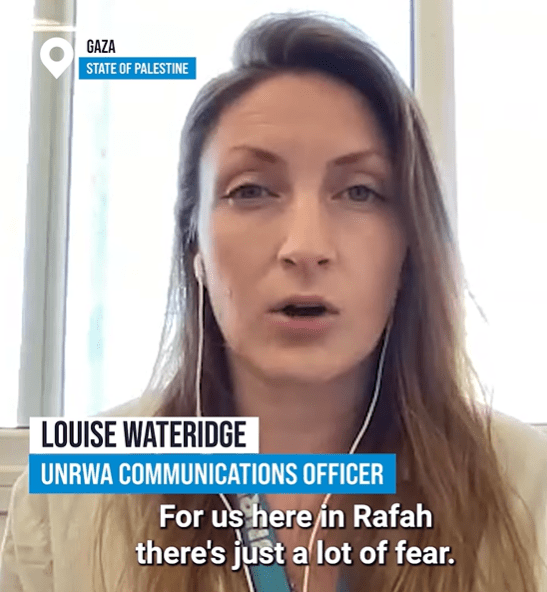
Rafah, Gaza Strip: A Human Catastrophe in the Making

In Being a World Citizen, Conflict Resolution, Current Events, Human Rights, Humanitarian Law, Middle East & North Africa, NGOs, Solidarity, The Search for Peace, Track II, United Nations, World Law on May 9, 2024 at 5:00 PM

By René Wadlow

“I am disturbed and distressed by the renewed military activity in Rafah by the Israeli Defense Forces. Make no mistake – a full-scale assault on Rafah would be a human catastrophe,”

United Nations (UN) Secretary-General Antonio Guterres told reporters on May 7, 2024. The UN Office for the Coordination of Humanitarian Affairs reported that more than 35,000 Palestinians have been killed in the Gaza Strip, some 78,000 have suffered injuries, and nearly 2 million have been internally displaced. The number is rising as the ground invasion of Rafah begins.

(C) UN Geneva on Instagram

The UN Human Rights Council Special Rapporteurs have painted a grim picture of the disproportionate level of suffering experienced by girls and especially pregnant women in Gaza. “The treatment of pregnant and lactating women continues to be appalling with the direct bombardment of hospitals and the deliberate denial of access to health care facilities by Israeli snipers, combined with the lack of beds and medical resources placing an estimated 50,000 pregnant Palestinian women and 20,000 newborn babies at unimaginable risk.”

Many of these military actions are in direct violation of International Humanitarian Law as set out in the Geneva Conventions of August 12, 1949 and the Protocol Additional adopted in 1977. In order to meet new situations, International Humanitarian Law (IHL) has evolved to cover not only international armed conflicts but also internal armed conflicts. IHL prohibits the indiscriminate killing of civilians, the holding of hostages, and the destruction of medical and educational infrastructure.

The Association of World Citizens stresses the importance of IHL as a vital part of world law that will replace unilateral actions by States based on narrow domestic political considerations. The standards of IHL require political will if they are to function effectively. Thus, nongovernmental action on the Gaza Strip armed conflict is urgently needed.

Prof. René Wadlow is President of the Association of World Citizens.