The Official Blog of the

Archive for the ‘The Search for Peace’ Category

A report on the UN Commission on the Status of Women, New York City, March 14-24, 2016

In Being a World Citizen, Conflict Resolution, Democracy, Environmental protection, Human Development, Human Rights, International Justice, Social Rights, Solidarity, The Search for Peace, Uncategorized, United Nations, Women's Rights, World Law on March 26, 2016 at 9:27 AM

Received from Sue Zipp, Vice-President of the Association of World Citizens:

*  *  *

UN COMMISSION ON THE STATUS OF WOMEN URGES GENDER-RESPONSIVE IMPLEMENTATION OF AGENDA 2030

Meeting concludes with agreement on foundations to accelerate action for all women and girls.

Date: 24 March 2016
Media Contacts:
Oisika Chakrabarti, +1 646 781-4522, oisika.chakrabarti@unwomen.org
Sharon Grobeisen, +1 646 781-4753, sharon.grobeisen@unwomen.org

* * *

New York — The 60th session of the UN Commission on the Status of Women concluded today with UN Member States committing to the gender-responsive implementation of Agenda 2030. A set of agreed conclusions called for enhancing the basis for rapid progress, including stronger laws, policies and institutions, better data and scaled-up financing.

The Commission recognized women’s vital role as agents of development. It acknowledged that progress on the Sustainable Development Goals at the heart of Agenda 2030 will not be possible without gender equality and the empowerment of all women and girls.

UN Women Executive Director Phumzile Mlambo-Ngcuka welcomed the agreement and the commitment of UN Member States to make the 2030 Agenda, adopted last September, a reality in countries around the world. She said: “Countries gave gender inequality an expiry date: 2030. Now it is time to get to work. These agreed conclusions entrench and start the implementation of a gender-responsive agenda 2030 with which we have the best possibility to leave no one behind.”

UN Women 1

Photo: UN Women/Ryan Brown

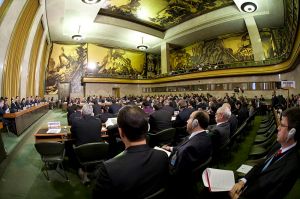
UN Women Executive Director Phumzile Mlambo-Ngcuka high-fives UN Women Deputy Executive Director Lakshmi Puri as the CSW Chair Antonio de Aguilar Patriota of Brazil announces the adoption of the agreement. Photo: UN Women/Ryan Brown.

Growing global commitment was already in evidence with a record number of more than 80 government ministers from around the world attending the Commission. Around 4,100 non-governmental representatives from more than 540 organizations participated as well, the highest number ever for one of the Commission’s regular annual meetings.

The agreed conclusions urge a comprehensive approach to implementing all 17 Sustainable Development Goals through thorough integration of gender perspectives across all government policies and programmes. Eliminating all forms of gender-based discrimination depends on effective laws and policies and the removal of any statutes still permitting discrimination. Temporary special measures may be required to guarantee that women and girls can obtain justice for human rights violations.

The Commission endorsed significantly increased investment to close resource gaps for achieving gender equality and the empowerment of all women and girls. Funds should be mobilized from all sources, domestic and international, ranging from fulfilling official development assistance commitments to combatting illicit financial flows that shortchange public resources for gender equality.

With humanitarian crises and other emergencies disproportionately affecting women and girls, the Commission underlined the imperative of empowering women in leadership and decision-making in all aspects of responding to and recovering from crisis. On the eve of the World Humanitarian Summit, it stressed prioritizing women’s and girls’ needs in humanitarian action and upholding their rights in all emergency situations. Every humanitarian response should take measures to address sexual and gender-based violence.

UN Women 2

Photo: UN Women/Ryan Brown

CSW60 delgates applaud as an agreement is announced during the closing plenary. Photo: UN Women/Ryan Brown.

Members of the Commission united behind ensuring women’s equal participation in leadership at all levels of decision-making in the public and private spheres, encompassing governments, businesses and other institutions, and across all areas of sustainable development. Depending on different circumstances, this may involve establishing temporary special measures, setting and achieving concrete benchmarks and removing barriers to women’s participation.

Given the major contributions to Agenda 2030 of civil society, including women’s and community-based organizations, feminist groups, human rights defenders and girls’ and youth-led organizations, the Commission welcomed open engagement and cooperation with them in gender-responsive implementation. It emphasized fully engaging with men and boys as agents of change and allies in the elimination of all forms of discrimination and violence against women and girls.

To guide systematic progress towards gender equality and women’s empowerment throughout the 2030 Agenda, the Commission stressed enhanced national statistical capacity and the systematic design, collection and sharing of high-quality, reliable and timely data disaggregated by sex, age and income. Members also agreed to bolster the role of national mechanisms for women and girls in championing their equality and empowerment.

UN Women 3

Photo: UN Women/Ryan Brown

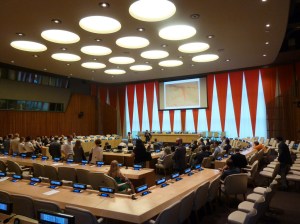
A wide view of the room during the closing plenary meeting of the 60th Session of the UN Commission on the Status of Women. Photo: UN Women/Ryan Brown.

– See more at: http://www.unwomen.org/en/news/stories/2016/3/press-release-csw60-urges-gender-responsive-implementation-of-agenda-2030#sthash.ci0a4sJ9.dpuf

World Interfaith Harmony Week: Steps Toward A Harmony Renaissance

In Being a World Citizen, Conflict Resolution, Cultural Bridges, Human Rights, Religious Freedom, Solidarity, The Search for Peace, United Nations, World Law on February 1, 2016 at 10:44 PM

WORLD INTERFAITH HARMONY WEEK: STEPS TOWARD A HARMONY RENAISSANCE

By René Wadlow


February 1, 2016


The Association of World Citizens, a nongovernmental organization in consultative status with the United Nations (UN), cooperates fully with the World Interfaith Harmony Week, which takes place February 1-7. The UN General Assembly designates the first week of every February as a time for cooperation for a common purpose among all religions, faiths and beliefs.

The General Assembly, building on its efforts for a culture of peace and non-violence in which World Citizens have played an active part, wishes to highlight the importance of mutual understanding and inter-religious dialogue in developing a creative culture of peace and non-violence. The General Assembly recognizes “the imperative need for dialogue among different faiths and religions in enhancing mutual understanding, harmony and cooperation among people.” The week has a potential to promote the healing of religion-based tensions in the world.

As Secretary-General Ban Ki-moon wrote,

At a time when the world is faced with many simultaneous problems—security, environmental, humanitarian, and economic—enhanced tolerance and understanding are fundamental for a resilient and vibrant international society. There is an imperative need, therefore, to further reaffirm and develop harmonious cooperation between the world’s different faiths and religions.

interfaith.jpg

Global citizens have stressed that peace comes from cooperation beyond the boundaries of ethnicity, religion and nationality, and have called for a cultural renaissance based on the concept of harmony. Rather than concentrating primarily on conflicts, struggles, and suffering, they have suggested focusing on cooperation, coexistence, and visions of a better future. Harmony includes tolerance, acceptance, equality, and forgiveness of past pains and conflicts. Harmony leads to gentleness, patience, kindness, and thus to inner peace and outward relations based on respect.

World Citizens maintain that harmony is a universal common value. In harmony, we can find true values that transcend all cultures and religions. The meaning of life is to seek harmony within our inner self. Humans are born with a spiritual soul that develops to seek self-fulfillment. Our soul has a conscience that elevates us. As our soul grows to maturity, we achieve our own harmony.

However, harmony is not only a personal goal of inner peace, but a guideline for political, social and world affairs. Citizens of the World believe that our actions should enhance peace, reduce conflict, and activate a culture of harmony. The 21st century is the beginning of a Harmony Renaissance. Our world mission is to be ready for humanity’s next creative wave to lead us to a higher level of common accomplishment. The World Harmony Renaissance will bring the whole world into action for this new millennium of peace and prosperity with unfettered collective energy.

“Religion without joy – It is no religion.”

Theodore Parker.

World Citizens have underlined the strong contribution that Chinese culture could play in the creation of this harmonious culture. In an earlier period of Chinese thought during the Song Dynasty, there was an important conscious effort to create a Harmony Renaissance.  This was a period of interest in science — “the extension of knowledge through the investigation of things.” It was a time when there was a conscious effort to bring together into a harmonious framework what often existed as separate and sometimes hostile schools of thought: Confucianism, Buddhism, philosophical Daoism and religious Daoism. These efforts were called Tao hsuch, the Study of the Tao, an effort Western scholars later termed “Neo-Confucianism.”

Zhou Dunyi, often better known as the Master of Lien-his, was a leading figure in this effort. He developed a philosophy based on the alternation of the Yin and Yang, each becoming the source of the other.

Today, after decades of conflict when the emphasis of nations both in policy and practice was upon competition, conflict, and individual enrichment, we need to emphasize harmony, cooperation, mutual respect, and working for the welfare of the community with a respect for nature.  When one aspect, either Yin or Yang, becomes too dominant, equilibrium needs to be restored.

zhou dunyi.jpg

Zhou Dunyi

Obviously it takes time to put into place a harmonious society at home and a harmonious world abroad. The cultivation of harmony must become the operational goal for many. As Mencius, a follower of Confucius said,

A trail through the mountains, if used, becomes a path in a short time, but, if unused, becomes blocked by grass in an equally short time.

mencius.jpg

Mencius

The World Interfaith Harmony Week is an opportunity to open new paths. As global citizens, we must find a new guiding image for our culture, one that unifies the aspirations of humanity with the needs of the planet and the individual. We hold that peace can be achieved through opening our hearts and minds to a broader perspective. We are one human race, and we inhabit one world. Therefore, we must see the world with global eyes, understand the world with a global mind, and love the world with a global heart.

Prof. René Wadlow is President of the Association of World Citizens.
Robert M. Hutchins: Building on Earlier Foundations

In Being a World Citizen, Conflict Resolution, Democracy, Human Development, Human Rights, Social Rights, The Search for Peace, United Nations, World Law on January 17, 2016 at 5:16 PM

ROBERT M. HUTCHINS: BUILDING ON EARLIER FOUNDATIONS
By René Wadlow

Much of our current work for a more just and peaceful world builds on the thinking and efforts of earlier foundations. An important foundation is the leading role of Robert M. Hutchins, long-time President of the University of Chicago (1929-1951) whose birth anniversary we mark on January 17.

Hutchins’ father, William, was President of Berea, a small but important liberal arts college, so Robert Hutchins (1899-1977) was set to follow the family pattern. He went to Yale Law School and stayed on to teach. He quickly became the Dean of the Law School and was spotted as a rising star of United States (US) education. When he was 30 years old, he was asked to become President of the University of Chicago, a leading institution. Hutchins was then the youngest president of a US university.

In the first decade of his tenure, the 1930s, his ideas concerning undergraduate education − compulsory survey courses, early admission after two years of secondary school for bright and motivated students, a concentration on “Great Books” – an examination of seminal works of philosophy in particular Plato and Aristotle − divided the University of Chicago faculty. There were strong and outspoken pro- and anti-Hutchins faculty groups. Moreover, Hutchins’ abolition of varsity football and ending the University’s participation in the “Big Ten” university football league distressed some alumni whose link to the university was largely limited to attending football games. For Hutchins, a university was for learning and discussion, not for playing sports. As he famously said, “When I feel like exercising, I sit down until the feeling goes away.”

It is Hutchins’ creation and leadership of the Committee to Frame a World Constitution in 1945 which makes him one of the intellectual founders of the movement for world federation and world citizenship. After the coming to power of Hitler in Germany in 1933 and his quick decision to ban Jewish professors from teaching in German universities, many Jewish scientists and professors left Germany and came to the USA. Some of the leading natural scientists joined the University of Chicago. Thus began the “Metallurgy Project” as the work on atomic research was officially called. The University of Chicago team did much of the theoretical research which led to the Atom Bomb. While Hutchins was not directly involved in the atomic project, he understood quickly the nature of atomic energy and its military uses. He saw that the world would never return to a “pre-atomic” condition and that new forms of world organization were needed.


hutchins_0.jpg

Robert M. Hutchins

“The death of democracy is not likely to be an assassination from ambush. It will be a slow extinction from apathy, indifference, and undernourishment.”

-Robert Maynard Hutchins.


On August 12, 1945, a few days after the use of the atom bombs, Hutchins made a radio address “Atomic Force: Its Meaning for Mankind” in which he outlined the need for strong world institutions, stronger than the United Nations (UN) Charter, whose drafters earlier in the year did not know of the destructive power of atomic energy.

Several professors of the University of Chicago were already active in peace work such as Mortimer Adler, G. A. Borgese, and Richard McKeon, Dean of the undergraduate college. The three approached Hutchins saying that as the University of Chicago had taken a lead in the development of atomic research, so likewise, the university should take the lead in research on adequate world institutions. By November 1945, a 12-person Committee to Frame a World Constitution was created under Hutchins’ chairmanship. The Committee drew largely on existing faculty of the University of Chicago − Wilber Katz, Dean of the Law School and Rexford Tugwell who taught political science but who had been a leading administrator of the Roosevelt New Deal and Governor of Puerto Rico. Two retired professors from outside Chicago were added − Charles McIlwain of Harvard, a specialist on constitutions, and Albert Guerard of Stanford, a French refugee who was concerned about the structure of post-war Europe.

From 1947 to 1951, the Committee published a monthly journal Common Cause many of whose articles still merit reading today as fundamental questions concerning the philosophical basis of government, human rights, distribution of power, and the role of regions are discussed. The Preliminary Draft of a World Constitution was published in 1948 and reprinted in the Saturday Review of Literature edited by Norman Cousins and in the Bulletin of the Atomic Scientists some of whom were in the original “Metallurgy Project”. The Preliminary Draft raised a good deal of discussion, reflected in the issues of Common Cause. There was no second draft. The Preliminary Draft was as G.A. Borgese said, quoting Dante “…of the True City at least the Tower.”


WorldConstposter-e1401485123703


In 1951, Hutchins retired from the presidency of the University of Chicago for the Ford Foundation and then created the Ford Foundation-funded Center for the Study of Democratic Institutions where he gathered together some of his co-workers from the University of Chicago.

Two ideas from The Preliminary Draft are still part of intellectual and political life for those concerned with a stronger UN. The first is the strong role of regional organizations. When The Preliminary Draft was written the European Union was still just an idea and most of the States now part of the African Union were European colonies. The Preliminary Draft saw that regional groups were institutions of the future and should be integrated as such in the world institution. Today, the representatives of States belonging to regional groupings meet together at the UN to try to reach a common position, but regional groups are not part of the official UN structure. However, they may be in the future.

The other lasting aspect of The Preliminary Draft is the crucial role that nongovernmental organizations (NGOs) should play. The then recently drafted UN Charter had created a “consultative status” for NGOs, but few of the UN Charter drafters foresaw the important role that NGOs would play as the UN developed. The Preliminary Draft had envisaged a Syndical Senate to represent occupational associations on the lines of the International Labor Organization where trade unions and employer associations have equal standing with government delegates. In 1946, few people saw the important role that the NGOs would later play in UN activities. While there is no “Syndical Senate”, today NGOs represent an important part of the UN process.

Hutchins, however, was also a reflection of his time. There were no women as members of the Committee to Frame a World Constitution, and when he created the Center for the Study of Democratic Institutions with a large number of “fellows”, consultants, and staff, women were also largely absent.

The effort to envisage the structures and processes among the different structures was an innovative contribution to global institution building at the time, and many of the debates and reflections are still crucial for today.

For an understanding of the thinking of those involved in writing The Preliminary Draft see:
Mortimor Adler, How to think about War and Peace (New York: Simon and Schuster, 1944)
Rexford Tugwell, Chronicle of Jeopardy (Chicago: University of Chicago Press, 1955)
G. A. Borgese, Foundations of the World Republic (Chicago: University of Chicago Press,1953)
Scott Buchanan, Essay in Politics (New York: Philosophical Library, 1953)
For a life of Hutchins written by a co-worker in the Center for the Study of Democratic Institutions:
Harry Ashmore, Unreasonable Truths: The Life of Robert Maynard Hutchins (Boston: Little, Brown and Co, 1989)

Prof. René Wadlow is President of the Association of World Citizens.
The World, Its Protection, Its Citizens

In Being a World Citizen, Conflict Resolution, Cultural Bridges, Democracy, Environmental protection, Human Development, Human Rights, International Justice, Solidarity, The Search for Peace, United Nations, World Law on December 30, 2015 at 12:13 PM

THE WORLD, ITS PROTECTION, ITS CITIZENS

By René Wadlow

-- AWC-UN Geneva Logo --
On behalf of the Association of World Citizens, I would like to send you our best wishes for 2016.

May it be a year that brings peace and harmony closer to our world. Progress in the world is based on the emergence of ideas, their acceptance, their transformation into ideals, and then into programs of action.

2015 has seen within the United Nations (UN) system two major frameworks of ideas and suggested plans of action. The first was the post-2015 Sustainable Development Goals, and the second was the Paris COP 21 goals and treaty to deal with climate change.  These guidelines require close cooperation among national governments, the UN and other multilateral government institutions such as the European Union, and the wide range of non-governmental organizations including business and agriculture associations.  We need to move from fragmented efforts to strong partnerships.

However, these positive goals need to be seen against the background of current armed conflicts and violent extremism often rooted in a deadly mix of exclusion and marginalization, mismanagement of natural resources, oppression and the alienation arising from a lack of jobs and opportunities. The World is in need of protection, both of people and Nature.  As Citizens of the World, we have a sense of responsibility to participate fully in the emerging world society where disputes among States are settled within the framework of world law and through negotiations in good faith so that common interests may be found and developed.

As Citizens of the World, we have a sense of compassion for Nature, and thus we unite to safeguard the delicate balance of the natural environment and to develop the world’s resources for the common good.

Today, we all face a choice between those forces that would drive us apart, forces and attitudes such as racism, narrow nationalism and the aggressive pursuit of self-interest on the one hand, and on the other hand, those forces which promote an emerging world society that is equitable and harmonious. I am sure that you also will choose to work for wholeness, harmony and creativity.

Prof. René Wadlow is President of the Association of World Citizens.
International Day of Migrants: Need for a UN-led World Conference on Migration and Refugee Flows

In Being a World Citizen, Conflict Resolution, Current Events, Europe, Fighting Racism, Human Rights, Solidarity, The Search for Peace, United Nations, World Law on December 18, 2015 at 9:52 AM

INTERNATIONAL DAY OF MIGRANTS: NEED FOR A UN-LED WORLD CONFERENCE ON MIGRATION AND REFUGEE FLOWS

By René Wadlow

I am a migrant.jpg

December 18 was set by the United Nations (UN) General Assembly to call attention to the role of migrants in the world society. The date was chosen to mark the creation of the UN-negotiated International Convention on the Rights of All Migrant Workers and Members of their Families. The aim of the Convention was to insure that migrants and their families would continue to be covered by the human rights standards set out in the Universal Declaration of Human Rights, the Covenants, and other human rights treaties. In practice, migrants are often “between two chairs” − no longer of concern to the State they have left and not yet covered by the human rights laws of the State to which they have gone.

Ratifications of the Convention have been slow with a good number of governments making reservations that generally weaken the impact of the Convention. In 2004, a commission of independent experts was set up to study the reports to the UN of governments on the application of the Convention − a commission that is part of the Human Rights Treaty Body System. Reports from each government party to the Convention are to be filed once every four years. However, the discussions within the Migration Treaty Body and its subsequent report attract the attention of only a small number of people. However, the discussion deals with the report of only one government at a time while migration is always a multi-State issue and can have worldwide implications.

Moreover, many States consider that earlier International Labor Organization conventions deal adequately with migrant rights and see no need to sign a new convention.

Citizens of the world have stressed that the global aspects of migration flows have an impact on all countries. The changing nature of the world’s economies modify migration patterns, and there is a need to plan for migration as the result of possible environmental-climate changes.

The refugees.jpeg

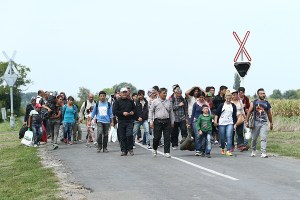
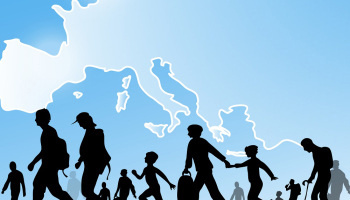
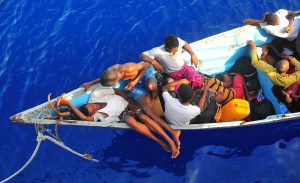
The current flow of migrants and refugees to Europe has become a high profile political issue. Many migrants come from areas caught up in armed conflict: Syria, Iraq, Yemen, Afghanistan, Somalia. The leaders of the European Union (EU) have been divided and unsure in their responses. Local solidarity networks that offer food, shelter, and medical care are overwhelmed. Political debates over how to deal with the refugees have become heated, usually with more heat than light. The immediacy of the refugee exodus requires our attention, our compassion, and our sense of organization.

EU officials have met frequently to discuss how to deal with the migrant-refugee flow, but a common policy has so far been impossible to establish. At a popular level, there have been expressions of fear of migrants, of possible terrorists among them, and a rejection of their cultures. These popular currents, often increased by right-wing political parties make decisions all the more difficult to take. An exaggerated sense of threat fuels anti-immigration sentiments and creases a climate of intolerance and xenophobia.

Je suis un migrant.jpg

Therefore, the Association of World Citizens, which is in consultative status with the UN, is calling for a UN-led world conference on migration and refugee issues, following earlier UN world conferences on the environment, food, housing, women, population, youth, human rights and other world issues. The pattern of such UN-led world conferences usually follows a common pattern: encouragement of research and data collection by UN agencies, national governments, nongovernmental organizations (NGOs), and academic institutions. Then regional meetings are held to study the regional dimensions of the issue. The regional conferences are followed by the world conference of government representatives with the participation of NGO delegates of organizations which hold consultative status. Usually there is also a parallel NGO conference with a wider range of NGOs present, especially those active at the local or national level. From such a world conference a plan of action is set to influence action by UN agencies, national governments, and NGOs.

Only a UN-led conference with adequate research and prior discussions can meet the challenges of worldwide migration and continuing refugee flows. There is a need to look at both short-term emergency humanitarian measures and at longer-range migration patterns, especially at potential climate modification impact. A UN-led world conference on migration can highlight possible trends and especially start to build networks of cooperation to meet this world challenge.

Prof. René Wadlow is President and a representative to the United Nations Office at Geneva of the Association of World Citizens.
Crossing Cultural and Linguistic Boundaries: International Volunteer Day

In Being a World Citizen, Current Events, Environmental protection, Human Development, Solidarity, The Search for Peace, United Nations, World Law on December 5, 2015 at 5:45 PM

CROSSING CULTURAL AND LINGUISTIC BOUNDARIES: INTERNATIONAL VOLUNTEER DAY
By René Wadlow

Founded on the values of solidarity and mutual trust, volunteerism transcends all cultural, linguistic and geographic boundaries. By giving their time and skills without expectations of material reward, volunteers themselves are uplifted by a singular sense of purpose.
-Ban Ki-moon, Secretary-General of the United Nations.

Volunteer Day 1.jpg

December 5 was selected as the International Volunteer Day by a 1985 UN General Assembly resolution. This year, December 5 comes as government representatives and volunteers of nongovernmental organizations (NGOs) are meeting in Paris to develop a new international climate agreement, COP 21. The NGO representatives are fewer in number than originally planned due to the November 13 shootings in Paris and thus tightened security conditions. However, those that are present are doubly active as world media attention is focused on the conference and its outcome.

In practice, as with all major UN conferences, negotiations among governments have been going on for two years with a good deal of input from NGO representatives. At the Paris stage, there is a preliminary “Final Document and Action Plan” of some 30 pages with a good number of square brackets around words or sentences on which there is no agreement. Negotiations concern making the document shorter so that the main ideas will stand out better and to remove square brackets. If a suitable word is not found, often the whole sentence will be dropped.

Both government representatives and NGOs are discussing post-Paris action and coalition building. There is also a concerted effort to bring the business community, especially transnational corporations into the action. While the UN system has a structure of consultative status for NGOs through the Economic and Social Council, the world of business is largely not represented. Only the International Labor Organization with its headquarters in Geneva has a three-party membership: governments, trade unions and business associations from each of the member States. The business world is not really a “voluntary association” in the sense of NGOs. Material reward is an important element in business.

Volunteer Day 2.jpg

COP 21 is a prime example of the need for cooperative action at the local, national and world level. As has been often said, the climate does not recognize national frontiers. The relations among ecologically-sound development, security, conflict resolution and respect for human rights have now assumed a more dynamic form than at any other time since the creation of the United Nations in 1945. To meet these strong challenges, NGOs, academic institutions, business and professional associations and the media must work together cooperatively. International Volunteer Day can serve as a time of reflection on capacity building and improved networking.

Prof. René Wadlow is President and a representative to the United Nations Office at Geneva of the Association of World Citizens.
Turkey & Russia: First Negotiate in Good Faith

In Conflict Resolution, Current Events, Middle East & North Africa, The Search for Peace, World Law on November 25, 2015 at 12:15 AM

TURKEY & RUSSIA: FIRST NEGOTIATE IN GOOD FAITH

By René Wadlow

“Whom the gods would destroy, they first make mad” was an insight of the classic Greek period.

There is obviously a form of madness in the Turks destroying a Russian fighter-bomber which may have entered Turkish air space along the frontier with Syria.  The Turkish authorities knew that the Russians were going to bomb in Syria and not attack Turkey. “Air space” is a relative concept in a frontier area. When the Russian plane crashed, it crashed in Syria.

Tyrants.jpg

Russian President Vladimir Putin (left) said the downing of a Russian plane by the Turkish military felt like “a stab in the back” to him, while his Turkish counterpart Reçep Tayyip Erdogan (right) claimed the plane ignored a formal warning from Turkey. Who’s right or wrong doesn’t really matter; the real question is whether the leaders of the two countries concerned really think that kind of conduct can possibly help resolve the dispute and not fuel it instead.

During the First World War, the French Prime Minister, George Clemenceau, said “War is too important to be left only to Generals”. Today, for the moment, the generals at the North Atlantic Treaty Organization (NATO) are meeting and the Russian generals are meeting on their own side. The political leaders are in contact. However, peacemaking is too important to be left only to political leaders who created the violence in the first place.

NATO.jpg

Under Article 5 of the North Atlantic Treaty, an attack on one Ally (NATO Member State) shall be considered an attack on all Allies. But in this very case, can Turkey prove beyond reasonable doubt that it was actually attacked by Russia?

There needs to be movements and efforts beyond and outside the governments in conflict to help bring about negotiations and a climate in which peace measures are possible.

As citizens of the world, we are particularly called to help create such a climate for negotiations in good faith. We know that violence can spread, and that mutual escalation can slip out of control. We need to use our worldwide links in a creative way to reduce tensions in the wider Middle East so that peace measures are possible.

Prof. René Wadlow is President of the Association of World Citizens.
Korea: Challenge and Response

In Asia, Being a World Citizen, Conflict Resolution, Human Rights, The Search for Peace, United Nations, World Law on October 28, 2015 at 10:39 AM

KOREA: CHALLENGE AND RESPONSE

By René Wadlow

As the professor of economics Milton Friedman wrote “Only a crisis – actual or perceived – produces real change. When the crisis occurs, the actions that are taken depend on the ideas that are lying around. That, I believe, is our basic function: to develop alternatives to existing policies, and to keep them alive and available until the politically impossible becomes the politically inevitable.”

The current tension around the two Korean States, the Democratic People’s Republic of Korea (DPRK) and the Republic of Korea (ROK), is such a crisis. For the moment, it is not clear that Governments are willing to take the diplomatic measures necessary to reverse the tensions on the Korean Peninsula. Thus it is important that non-governmental voices be raised and that their proposals are taken seriously. Nongovernmental organizations can present policy choices that can help to resolve the multidimensional Korean security challenge.

Therefore, the Association of World Citizens (AWC) has proposed a two-track approach to the current Korean tensions. In a message to the United Nations (UN) Secretary-General Ban Ki-moon, AWC President René Wadlow stressed that a crisis can also be an opportunity for strong initiatives and action. The UN with historic responsibility for Korea should take the lead in organizing an UN-sponsored Korean Peace Settlement Conference, now that all the States which participated in the 1950-1953 Korean War are members of the UN. The UN-led Korean Peace Settlement Conference should be organized to lead to a North-east Asia Security and Nuclear-weapon Free Zone.

Such a Peace Settlement Conference is of concern not only to Governments but is one in which the voices of civil society are legitimate and should be heard.

From 1950 to 1953 the first major international conflict to have taken place after the end of World War II saw the United Nations join the pro-Western South Korean military in its fight against the Communist North Korea. Neither side really won the war but since the 1953 armistice the Korean Peninsula has been divided in two along the horizontal border represented by the 38th Parallel.

From 1950 to 1953 the first major international conflict to have taken place after the end of World War II saw the United Nations join the pro-Western South Korean military in its fight against the Communist North Korea. Neither side really won the war but since the 1953 armistice the Korean Peninsula has been divided in two along the horizontal border represented by the 38th Parallel.

In the past, there have been a series of dangerous but ultimately resolvable crises concerning the two Korean States. However, there are always dangers of miscalculations and unnecessary escalations of threats. Past crises have led to partial measures of threat reduction.

Partial measures of cooperation between the two Korean States, the Six-Party talks on nuclear issues and a number of Track II-civil society diplomatic efforts have shown the possibilities but also the limits of partial measures.

In the past decade, world attention has been focused on two Korean issues:

1) how to resolve the nuclear weapons-ballistic missiles issues;
2) how to help the DPRK to become food secure and to overcome a sharp inadequacy in food production. The food deficit points to broader structural obstacles, production and supply bottlenecks, and a generalized vulnerability of the economy.

Northeast Asia’s highly sensitive interlocking security issues are of great significance to the future of the region which includes China, Russia, Japan, the two Korean States and by extension the USA.

During the Cold War, Korea was to Asia what Germany was to Europe and Yemen to the Middle East – once a single people now divided along the ideological border of the rival blocs. Unlike Germany and Yemen, though, a quarter of the century after the Cold War has ended, Korea remains firmly divided. In the North, the world’s last Stalinist regime ruled by the Kim family continues to pose a serious threat to the pro-Western, democratic South Korea. (C) AP Photo/Korean Central News Agency via Korea News Service & Park Ji-Hwan/Agence France-Presse — Getty Images

During the Cold War, Korea was to Asia what Germany was to Europe and Yemen to the Middle East – once a single people now divided along the ideological border of the rival blocs. Unlike Germany and Yemen, though, a quarter of the century after the Cold War has ended, Korea remains firmly divided. In the North, the world’s last Stalinist regime ruled by the Kim family continues to pose a serious threat to the pro-Western, democratic South Korea. (C) AP Photo/Korean Central News Agency via Korea News Service & Park Ji-Hwan/Agence France-Presse — Getty Images

Changing security perceptions and policies, unresolved conflicts and grievances, and concerns about nuclear and missiles proliferation are all elements that affect the stability of the region as a whole — and which also have global impacts.

In addition to the broadly based UN-led Korean Peace Settlement Conference, the AWC has stressed the need for regional cooperation and confidence-building measures which would improve the daily life of individuals and create the framework for greater future cooperation.

The AWC has highlighted that the Tumen River Development Project (TRADP), now often called the Greater Tuman Initiative (GTI), is probably the best framework for rapid cooperative development. The planning for a Tuman River economic zone at the mouth of the river had been drawn up in the early 1990s by the UN Development Program (UNDP – a vast free – economic zone which would involve parts of Mongolia, China, Russia and the two Korean States as well as Japan as a logical regional development partner. However, development has fallen far short of initial expectations for reasons both internal and external to the participating States.

As Milton Friedman pointed out, ideas can be dormant until a crisis occurs and then new steps must be taken. The AWC believes that the Tuman River economic zone is a real opportunity for cooperation among the States for the benefit of the people of the area.

Citizens of the World call for speedy and creative action to meet the challenge of Korean tensions with a response of cooperation and reconciliation.

Prof. René Wadlow is President of the Association of World Citizens.
World Food Day: A Renewal of Collective Action

In Being a World Citizen, Foundations for the New Humanism, Human Development, Human Rights, International Justice, Social Rights, Solidarity, The Search for Peace, Uncategorized, United Nations, World Law on October 16, 2015 at 8:30 AM

WORLD FOOD DAY: A RENEWAL OF COLLECTIVE ACTION

By René Wadlow


[…] determined to promote the common welfare by furthering separate and collective action for the purpose of raising levels of nutrition and standards of living […]” 

-Preamble of the Food and Agriculture Organization Constitution.


October 16 is the UN-designated World Food Day, the date chosen being the anniversary of the creation of the FAO in 1945 with the aim, as stated in its Constitution of “contributing towards an expanding world economy and ensuring humanity’s freedom from hunger.” Freedom from hunger is not simply a technical matter to be solved with better seeds, fertilizers, cultivation practices and marketing. To achieve freedom from hunger for mankind, there is a need to eliminate poverty. The elimination of poverty must draw upon the ideas, skills and energies of whole societies and requires the cooperation of all countries. 

World Citizens have played an important role in efforts to improve agricultural production worldwide and especially to better the conditions of life of rural workers. Lord Boyd-Orr was the first director of the FAO; Josue de Castro was the independent President of the FAO Council in the 1950s when the FAO had an independent Council President. (The independent presidents have now been replaced by a national diplomat, rotating each year. Governments are never happy with independent experts who are often too independent.) The World Citizen, René Dumont, an agricultural specialist, is largely the “father” of political ecology in France, having been the first Green Party candidate for the French Presidency in 1974.

As Lester Brown, the American agricultural specialist says “We are cutting trees faster than they can be regenerated, overgrazing rangelands and converting them into deserts, overpumping aquifers, and draining rivers dry. On our croplands, soil erosion exceeds new soil formation, slowly depriving the soil of its inherent fertility. We are taking fish from the ocean faster than they can reproduce.”

To counter these trends, we need awareness and vision, an ethical standard which has the preservation of nature at its heart, and the political leadership to bring about the socio-economic changes needed. For the moment, awareness and vision are unequally spread. In some countries, ecological awareness has led to beneficial changes and innovative technologies. In others, the governmental and social structures are disintegrating due to disease, population pressure upon limited resources, and a lack of social leadership. Worldwide, military spending, led by the USA, dwarfs spending on ecologically-sound development and the necessary expansion of education and health services.

World Food Day

Some 795 million people in the world do not have enough food to lead a healthy active life. That’s about one in nine people on earth. (World Food Program)

As Lester Brown has written “The sector of the economy that seems likely to unravel first is food. Eroding soils, deteriorating rangelands, collapsing fisheries, falling water tables, and rising temperatures are converging to make it more difficult to expand food production fast enough to keep up with demand…food is fast becoming a national security issue as growth in the world harvest slows and falling water tables and rising temperatures hint at future shortages.”

Yet there are agricultural techniques which can raise protein efficiency, raise land productivity, improve livestock use and produce second harvests on the same land. However, unless we quickly reverse the damaging trends that we have set in motion, we will see vast numbers of environmental refugees — people abandoning depleted aquifers and exhausted soils and those fleeing advancing deserts and rising seas.

David Seckler of the International Water Management Institute writes “Many of the most populous countries of the world — China, India, Pakistan, Mexico, and nearly all the countries of the Middle East and North Africa — have literally been having a free ride over the past two or three decades by depleting their groundwater resources. The penalty of mismanagement of this valuable resource is now coming due, and it is no exaggeration to say that the results could be catastrophic for these countries, and given their importance, for the world as a whole.” Unfortunately, the International Water Management Institute does not manage the world’s use of water but can only study water use. While there are some planners who would like to be able to tax or make people pay for water, most water use is uncontrolled. Payment for water is a way that governments or private companies have to get more revenue, but the welfare of farmers is usually not a very high priority for them.

Yet as Citizens of the World have stressed, ecologically-sound development cannot be the result only of a plan, but rather of millions of individual actions to protect soil, conserve water, plant trees, use locally grown crops, reduce meat from our diets, protect biological diversity in forest areas, cut down the use of cars by increasing public transportation and living closer to one’s work. We need to stabilize and then reduce world population and to encourage better distribution of the world’s population through planned migration and the creation of secondary cities to reduce the current growth of megacities. We need to encourage wise use of rural areas by diversifying employment in rural areas. We also need to develop ecological awareness through education so that these millions of wise individual decisions can be taken.

In 1989 The Christians sang, “When will there be a harvest for the world?” Well … We wish we knew.

Lester Brown underlines the necessary link between knowledge and action. “Environmentally responsible behaviour also depends to a great extent on a capacity to understand basic scientific issues, such as the greenhouse effect or the ecological role of forests. Lacking this, it is harder to grasp the link between fossil fuel burning and climate change or between tree cutting and the incidence of flooding or the loss of biological diversity…The deteriorating relationship between the global economy and the earth’s ecosystem requires an all-out effort to bring literacy to all adults in order to break the poverty cycle and stabilize population.”

Education and vision require leadership, and it is ecologically-sound political leadership that is badly lacking today. Thus Citizens of the World and all of good will are called upon to provide wise leadership to work for a redirection of financial resources to protect the planet, and to encourage ecologically-sound individual and collective action. 

Prof. René Wadlow is President of the Association of World Citizens.
Syria: ISIS Iconoclasts Leave a Bloody Trail of Destruction

In Cultural Bridges, Current Events, International Justice, Middle East & North Africa, Religious Freedom, Solidarity, The Search for Peace, United Nations, War Crimes, World Law on August 25, 2015 at 11:31 AM

SYRIA: ISIS ICONOCLASTS LEAVE A BLOODY TRAIL OF DESTRUCTION

By René Wadlow

On August 18, 2015 Dr Khaled al-Assad, retired director of the Palmyra museum and an officer of the Directorate General of Antiquities and Museums, had his neck cut and his body hung from a traffic light pole. The 83 year-old archaeologist had been held in seclusion (and probably tortured) for three weeks. In the public square of Palmyra an accusation was read out that he was “the director of pagan idols”. Khaled al-Assad had been born in Palmyra and had spent most of his career there, writing numerous articles as well as directing archaeological sites. He had few rivals in his knowledge of the ancient crossroad city of Palmyra, an important link on the trade routes between Asia, North Africa, and Europe.

The public killing of Khaled al-Assad renewed concern for the historic sites. It was widely believed that many of the sites had had explosives placed in them to provoke their destruction. Sites in Palmyra had already been damaged during the fighting in the spring as the soldiers of the Islamic State in Iraq and Syria (ISIS or Daesh in Arabic) took control of the city and the surrounding area. Then on August 23, some of the explosives were set off, damaging the important Temple of Baal, one of the most visited sites in Palmyra. Baal – the Lord of the Heavens – was represented by an eagle. He was also a storm god shown holding a lightning bolt in his hand.

From a distance, it is hard to know what elements within ISIS are responsible for the destruction and what are the motivations. ISIS has attracted fighters from a good number of countries, and it is impossible to know the chains of command or the motivations. Many Syrians are proud of the vestiges of pre−Islamic civilizations, proof that the area was an important actor and in some ways a rival of Rome. The Directorate General of Antiquities has some 2,500 employees with a record of preserving Syria’s cultural heritage. In addition, some Syrian citizens, risking their lives, have tried to defend heritage sites or to hide away cultural objects. Moreover, ISIS agents as well as persons belonging to other armed factions have been looting objects to sell outside the country, either for personal gain or to finance their political faction, rather than destroying them.

When ISIS/Daesh took Palmyra last May, many people feared they might blow up the ancient city at once. They didn't, but now the vestiges of the ancient civilization there were soon turned into a stage for ISIS/Daesh to use toward propaganda purposes.

When ISIS/Daesh took Palmyra last May, many people feared they might blow up the ancient city at once. They didn’t, but now the vestiges of the ancient civilization most inappropriately serve as a stage for ISIS/Daesh to use toward propaganda purposes.

Thus, it is not clear who wants to destroy works of art and cultural heritage. Are there sincere iconoclasts for whom any object that recalls pre-Islamic worship is an insult to the Islamic faith? Are there people who just want to destroy and will blow up most anything? Are there people who believe that public killings and destruction of heritage will facilitate military expansion and control of the population? Is there any possibility of rational discussion and good-faith negotiations with ISIS authorities to preserve cultural sites in Syria and Iraq?

Conserving a cultural heritage even in times of peace is always difficult. Weak institutional capabilities, lack of appropriate resources and isolation of many culturally essential sites are compounded by a lack of awareness of the value of cultural heritage conservation. On the other hand, the dynamism of local initiatives and community solidarity are impressive assets. These forces should be enlisted, enlarged and empowered to preserve and protect a heritage.

ISIS/Daesh members enthusiastically destroying a historical ancient site. They may bring down every reminder of the past they come by, but try as they might, they cannot change history.

Are there ways that those of us on the “outside” can reach those in Syria and Iraq who wish to preserve cultural heritage and to defend the lives of those who work to preserve protect and inform?

My belief is that the current military action against ISIS, either with ground troops or bombing from the air, will have little positive impact. Armed force may lead some of the ISIS forces to a “burned earth” policy, destroying as much as they can before retreating. I think that there needs to be initiatives taken by those currently living under ISIS rule but who do not share ISIS values. They need to take actions to show ISIS leaders that their policies are an error and will lead to greater divisions within the population.

There is always a certain irony for someone in a safe area to encourage others to take actions which can put their lives in danger. Therefore, the least that we can do is to have a loud outcry from cultural workers throughout the world so that those in Syria and Iraq who will act positively know that they are not alone.


Prof. René Wadlow is President and Chief Representative to the United Nations Office at Geneva of the Association of World Citizens.