The Official Blog of the

Archive for the ‘International Justice’ Category

UN-Designated Day for Developing Awareness of Human Trafficking

In Being a World Citizen, Children's Rights, Current Events, Human Development, Human Rights, International Justice, Social Rights, Solidarity, United Nations, Women's Rights, World Law on January 11, 2016 at 11:23 PM

The World, Its Protection, Its Citizens

In Being a World Citizen, Conflict Resolution, Cultural Bridges, Democracy, Environmental protection, Human Development, Human Rights, International Justice, Solidarity, The Search for Peace, United Nations, World Law on December 30, 2015 at 12:13 PM

THE WORLD, ITS PROTECTION, ITS CITIZENS

By René Wadlow

-- AWC-UN Geneva Logo --
On behalf of the Association of World Citizens, I would like to send you our best wishes for 2016.

May it be a year that brings peace and harmony closer to our world. Progress in the world is based on the emergence of ideas, their acceptance, their transformation into ideals, and then into programs of action.

2015 has seen within the United Nations (UN) system two major frameworks of ideas and suggested plans of action. The first was the post-2015 Sustainable Development Goals, and the second was the Paris COP 21 goals and treaty to deal with climate change.  These guidelines require close cooperation among national governments, the UN and other multilateral government institutions such as the European Union, and the wide range of non-governmental organizations including business and agriculture associations.  We need to move from fragmented efforts to strong partnerships.

However, these positive goals need to be seen against the background of current armed conflicts and violent extremism often rooted in a deadly mix of exclusion and marginalization, mismanagement of natural resources, oppression and the alienation arising from a lack of jobs and opportunities. The World is in need of protection, both of people and Nature.  As Citizens of the World, we have a sense of responsibility to participate fully in the emerging world society where disputes among States are settled within the framework of world law and through negotiations in good faith so that common interests may be found and developed.

As Citizens of the World, we have a sense of compassion for Nature, and thus we unite to safeguard the delicate balance of the natural environment and to develop the world’s resources for the common good.

Today, we all face a choice between those forces that would drive us apart, forces and attitudes such as racism, narrow nationalism and the aggressive pursuit of self-interest on the one hand, and on the other hand, those forces which promote an emerging world society that is equitable and harmonious. I am sure that you also will choose to work for wholeness, harmony and creativity.

Prof. René Wadlow is President of the Association of World Citizens.

The Genocide Convention: An Unused But Not Forgotten Standard of World Law

In Being a World Citizen, Current Events, Fighting Racism, Human Rights, International Justice, United Nations, War Crimes, World Law on December 9, 2015 at 7:58 PM

THE GENOCIDE CONVENTION: AN UNUSED BUT NOT FORGOTTEN STANDARD OF WORLD LAW

By René Wadlow

On the anniversary of the 1948 Convention on Genocide, it is imperative to identify a relevant existing body – such as the Committee for the Elimination of Racial Discrimination (CERD) – to strengthen in order to be able to deal with the first signs of tensions, especially “direct and public incitement to commit genocide.”

December 9 is the anniversary of the 1948 Convention on Genocide, signed at the UN General Assembly held in 1948 in Paris. The Genocide Convention was signed the day before the proclamation on December 10, 1948 of the Universal Declaration of Human Rights. The two texts were much influenced by the Second World War. The crimes of Nazi Germany were uppermost in the minds of those who drafted the Genocide Convention in order to deal with a new aspect of international law and the laws of war. The cry was “Never again!”

The protection of civilians from deliberate mass murder was already in The Hague and Geneva Conventions of international humanitarian law. However, genocide is different from mass murder. Genocide is the most extreme consequences of racial discrimination and ethnic hatred. Genocide has as its aim the destruction, wholly or in part, of national, ethnic, racial or religious group as such. The term was proposed by the legal scholar Raphael Lemkin, drawing on the Greek genos (people or tribe) and the Latin cide (to kill) [1].

Genocide in the sense of a desire to eliminate a people has nearly always a metaphysical aspect as well as deep-seated racism. This was clear in the Nazi desire to eliminate Jews, first by forced emigration from Europe and, when emigration was not possible, by physical destruction.

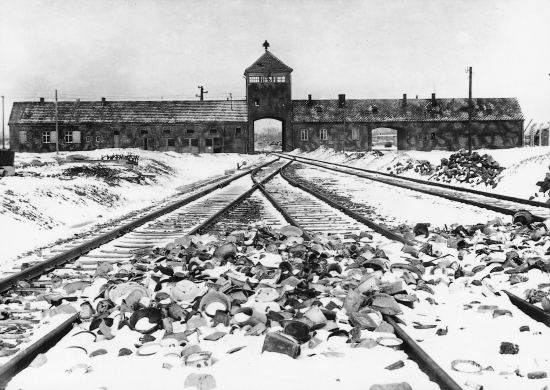
The genocide of the Jewish people in Europe during World War II, carried out in such infamous places as the Auschwitz concentration camp pictured above, was the leading cause for the drafting and adoption of the UN Genocide Convention. The following day, the UN General Assembly also adopted the Universal Declaration of Human Rights.

The genocide of the Jewish people in Europe during World War II, carried out in such infamous places as the Auschwitz concentration camp pictured above, was the leading cause for the drafting and adoption of the UN Genocide Convention. The following day, the UN General Assembly also adopted the Universal Declaration of Human Rights.

We see a desire to destroy totally certain tribes in the Darfur conflict in Sudan that did not exist in the much longer and more deadly North-South Sudan Civil War (1956-1972, 1982-2005). Darfur tribes are usually defined by “blood lines” — marriage and thus procreation is limited to a certain population, either within the tribe or with certain other groups with which marriage relations have been created over a period of time. Thus children born of rape — considered ‘Janjaweed babies ‘— after the government-sponsored Janjaweed militias— are left to die or are abandoned. The raped women are often banished or ostracized. By attacking both the aged, holders of traditional knowledge, and the young of child-bearing age, the aim of the destruction of the continuity of a tribal group is clear.

We find the same pattern in some of the fighting in the eastern provinces of the Democratic Republic of Congo where not only are women raped but their sexual organs are destroyed so that they will not be able to reproduce.

As then UN Secretary-General Kofi Annan said at UNESCO in 1998,

“Many thought, no doubt, that the horrors of the Second World War − the camps, the cruelty, the exterminations, the Holocaust – could not happen again. And yet they have, in Cambodia, in Bosnia and Herzegovina, in Rwanda. Our time − this decade even − has shown us that man’s capacity for evil knows no limits. Genocide − the destruction of an entire people on the basis of ethnic or national origins − is now a word of our time too, a stark and haunting reminder of why our vigilance must be eternal.”

Mr. Nicodène Ruhashyankiko of the Sub-Commission on Prevention of Discrimination of Minorities wrote in his study of proposed mechanisms for the study of information on genocide and genocidal practices “A number of allegations of genocide have been made since the adoption of the 1948 Convention. In the absence of a prompt investigation of these allegations by an impartial body, it has not been possible to determine whether they were well founded. Either they have given rise to sterile controversy or, because of the political circumstances, nothing further has been heard about them.”

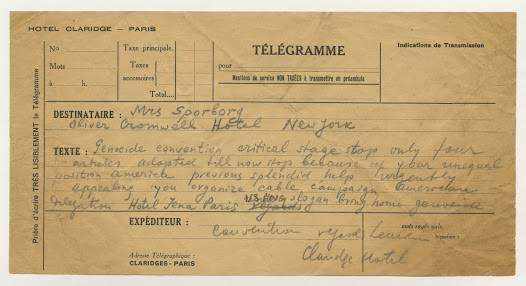
In a telegram sent from Paris in December 1948, Raphael Lemkin asked Ms. William Dick Sporberg, a member of the United States Committee for a United Nations (UN) Genocide Convention, to organize a cable campaign to persuade the United States Mission to the UN to support the adoption of the convention. Until the very last minute, no efforts were to be spared if the Genocide Convention was to come to existence and make the hopes of a whole generation traumatized by wide-scale extermination come true. (C) Google Cultural Institute/Center for Jewish History

In a telegram sent from Paris in December 1948, Raphael Lemkin asked Ms. William Dick Sporberg, a member of the United States Committee for a United Nations (UN) Genocide Convention, to organize a cable campaign to persuade the United States Mission to the UN to support the adoption of the convention. Until the very last minute, no efforts were to be spared if the Genocide Convention was to come to existence and make the hopes of a whole generation traumatized by wide-scale extermination come true. (C) Google Cultural Institute/Center for Jewish History

Article VIII of the Genocide Conventions provides that “Any Contracting Party may call upon the Competent Organs of the United Nations to take such action under the Charter of the UN as they consider appropriate for the prevention and suppression of acts of genocide or any of the other acts enumerated in article III”. Unfortunately no State has ever done so.

Thus we need to heed the early warning signs of genocide. Officially-directed massacres of civilians of whatever number cannot be tolerated, for the organizers of genocide must not believe that more widespread killing will be ignored. Yet killing is not the only warning sign. The Convention drafters, recalling the radio addresses of Hitler and the constant flow of words and images, set out as punishable acts “direct and public incitement to commit genocide.” The Genocide Convention, in its provisions concerning public incitement, sets the limits of political discourse. It is well documented that public incitement − whether by Governments or certain non-governmental actors − including political movements − to discriminate against, to separate forcibly, to deport or physically eliminate large categories of the population of a given State because they belong to certain racial, ethnic or religious groups, sooner or later leads to war. Therefore, the Genocide Convention is also a constant reminder of the need to moderate political discourse, especially constant and repeated accusations against a religion, ethnic and social category of persons. Had this been done in Rwanda, with regard to the radio Mille Collines perhaps the premeditated and announced genocide could have been avoided or mitigated.

For the UN to be effective in the prevention of genocide, there needs to be an authoritative body which can investigate and monitor a situation well in advance of the outbreak of violence. As has been noted, any Party to the Genocide Convention (and most States are Parties) can bring evidence to the UN Security Council, but none has. In the light of repeated failures and due to pressure from non-governmental organizations, the UN Secretary-General has named an individual adviser on genocide to the UN Secretariat. However, he is one adviser among many, and there is no public access to the information that he may receive.

Therefore, a relevant existing body must be strengthened to be able to deal with the first signs of tensions, especially “direct and public incitement to commit genocide.” The CERD created to monitor the 1965 International Convention on the Elimination of All Forms of Racial Discrimination would be the appropriate body to strengthen, especially by increasing its resources and the number of UN Secretariat members which service CERD. Through its urgent procedures mechanisms, CERD has the possibility of taking early-warning measures aimed at preventing existing strife from escalating into conflicts, and to respond to problems requiring immediate attention. A stronger CERD more able to investigate fully situations should mark the world’s commitment to the high standards of world law set out in the Genocide Convention.

Prof. René Wadlow is President and a representative to the United Nations Office at Geneva of the Association of World Citizens (AWC) and editor of Transnational Perspectives.

Notes

  1. Raphael Lemkin. Axis Rule in Occupied Europe (Washington: Carnegie Endowment for World Peace, 1944)
  2. For good overviews see: Walliman and Dobkowski (Eds) Genocide and the Modern Age (New York: Greenwood Press, 1987), F. Chalk, K. Jonassohn. The History and Sociology of Genocide (New Haven: Yale University Press, 1990), G. J. Andreopoulos (Ed) Genocide: Conceptual and Historical Dimensions (Philadelphia: University of Pennsylvania Press, 1994), Samantha Power A Problem from Hell: America and the Age of Genocide (New York: Basic Books, 2002), John Tirman, The Death of Others (New York: Oxford University Press, 2011), William Schabas, Genocide in International Law (Cambridge: Cambridge University Press, 2000)

World Food Day: A Renewal of Collective Action

In Being a World Citizen, Foundations for the New Humanism, Human Development, Human Rights, International Justice, Social Rights, Solidarity, The Search for Peace, Uncategorized, United Nations, World Law on October 16, 2015 at 8:30 AM

WORLD FOOD DAY: A RENEWAL OF COLLECTIVE ACTION

By René Wadlow


[…] determined to promote the common welfare by furthering separate and collective action for the purpose of raising levels of nutrition and standards of living […]” 

-Preamble of the Food and Agriculture Organization Constitution.


October 16 is the UN-designated World Food Day, the date chosen being the anniversary of the creation of the FAO in 1945 with the aim, as stated in its Constitution of “contributing towards an expanding world economy and ensuring humanity’s freedom from hunger.” Freedom from hunger is not simply a technical matter to be solved with better seeds, fertilizers, cultivation practices and marketing. To achieve freedom from hunger for mankind, there is a need to eliminate poverty. The elimination of poverty must draw upon the ideas, skills and energies of whole societies and requires the cooperation of all countries. 

World Citizens have played an important role in efforts to improve agricultural production worldwide and especially to better the conditions of life of rural workers. Lord Boyd-Orr was the first director of the FAO; Josue de Castro was the independent President of the FAO Council in the 1950s when the FAO had an independent Council President. (The independent presidents have now been replaced by a national diplomat, rotating each year. Governments are never happy with independent experts who are often too independent.) The World Citizen, René Dumont, an agricultural specialist, is largely the “father” of political ecology in France, having been the first Green Party candidate for the French Presidency in 1974.

As Lester Brown, the American agricultural specialist says “We are cutting trees faster than they can be regenerated, overgrazing rangelands and converting them into deserts, overpumping aquifers, and draining rivers dry. On our croplands, soil erosion exceeds new soil formation, slowly depriving the soil of its inherent fertility. We are taking fish from the ocean faster than they can reproduce.”

To counter these trends, we need awareness and vision, an ethical standard which has the preservation of nature at its heart, and the political leadership to bring about the socio-economic changes needed. For the moment, awareness and vision are unequally spread. In some countries, ecological awareness has led to beneficial changes and innovative technologies. In others, the governmental and social structures are disintegrating due to disease, population pressure upon limited resources, and a lack of social leadership. Worldwide, military spending, led by the USA, dwarfs spending on ecologically-sound development and the necessary expansion of education and health services.

World Food Day

Some 795 million people in the world do not have enough food to lead a healthy active life. That’s about one in nine people on earth. (World Food Program)

As Lester Brown has written “The sector of the economy that seems likely to unravel first is food. Eroding soils, deteriorating rangelands, collapsing fisheries, falling water tables, and rising temperatures are converging to make it more difficult to expand food production fast enough to keep up with demand…food is fast becoming a national security issue as growth in the world harvest slows and falling water tables and rising temperatures hint at future shortages.”

Yet there are agricultural techniques which can raise protein efficiency, raise land productivity, improve livestock use and produce second harvests on the same land. However, unless we quickly reverse the damaging trends that we have set in motion, we will see vast numbers of environmental refugees — people abandoning depleted aquifers and exhausted soils and those fleeing advancing deserts and rising seas.

David Seckler of the International Water Management Institute writes “Many of the most populous countries of the world — China, India, Pakistan, Mexico, and nearly all the countries of the Middle East and North Africa — have literally been having a free ride over the past two or three decades by depleting their groundwater resources. The penalty of mismanagement of this valuable resource is now coming due, and it is no exaggeration to say that the results could be catastrophic for these countries, and given their importance, for the world as a whole.” Unfortunately, the International Water Management Institute does not manage the world’s use of water but can only study water use. While there are some planners who would like to be able to tax or make people pay for water, most water use is uncontrolled. Payment for water is a way that governments or private companies have to get more revenue, but the welfare of farmers is usually not a very high priority for them.

Yet as Citizens of the World have stressed, ecologically-sound development cannot be the result only of a plan, but rather of millions of individual actions to protect soil, conserve water, plant trees, use locally grown crops, reduce meat from our diets, protect biological diversity in forest areas, cut down the use of cars by increasing public transportation and living closer to one’s work. We need to stabilize and then reduce world population and to encourage better distribution of the world’s population through planned migration and the creation of secondary cities to reduce the current growth of megacities. We need to encourage wise use of rural areas by diversifying employment in rural areas. We also need to develop ecological awareness through education so that these millions of wise individual decisions can be taken.

In 1989 The Christians sang, “When will there be a harvest for the world?” Well … We wish we knew.

Lester Brown underlines the necessary link between knowledge and action. “Environmentally responsible behaviour also depends to a great extent on a capacity to understand basic scientific issues, such as the greenhouse effect or the ecological role of forests. Lacking this, it is harder to grasp the link between fossil fuel burning and climate change or between tree cutting and the incidence of flooding or the loss of biological diversity…The deteriorating relationship between the global economy and the earth’s ecosystem requires an all-out effort to bring literacy to all adults in order to break the poverty cycle and stabilize population.”

Education and vision require leadership, and it is ecologically-sound political leadership that is badly lacking today. Thus Citizens of the World and all of good will are called upon to provide wise leadership to work for a redirection of financial resources to protect the planet, and to encourage ecologically-sound individual and collective action. 

Prof. René Wadlow is President of the Association of World Citizens.

The Death Penalty and Human Dignity

In Being a World Citizen, Human Rights, International Justice, United Nations, World Law on October 10, 2015 at 11:59 AM

THE DEATH PENALTY AND HUMAN DIGNITY

By René Wadlow


October 10 is the International Day against the Death Penalty. Since the end of World War II, there has been a gradual abolition of the death penalty due to the rather obvious recognition that putting a person to death is not justice. Moreover, on practical grounds, the death penalty has little impact on the rate of crime in a country. A number of States have a death penalty for those involved in the drug trade. To the extent that the drug trade can be estimated statistically, the death penalty has no measurable impact on the trade − a trade usually linked to economic or geopolitical factors.

October 10 can also be a day to oppose all organized killings by State agents. In addition to State-sponsored official executions, usually carried out publicly or at least with official observers, a good number of countries have State-sponsored “death squads” − persons affiliated to the police or to intelligence agencies who kill “in the dark of the night” − unofficially. These deaths avoid a trial which might attract attention or even a “not guilty” decision. A shot in the back of the head is faster. The number of “targeted killings” has grown. In many cases, the bodies of those killed are destroyed and so death is supposed but not proved, as has been the case of students protesting in Mexico. United States assassinations with drones has also been highlighted both in the United Nations human rights bodies and domestically. However, the drone “strikes” continue, and there is very little legislative opposition.

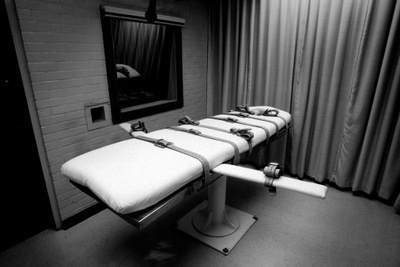
The United States is the one and only Western country which retains the death penalty in its national legislation – and, ironically, the most violent one too. So much for the so-called “deterrent effect” of the death penalty.

The United States is the one and only Western country which retains the death penalty in its national legislation – and, ironically, the most violent one too. So much for the so-called “deterrent effect” of the death penalty.

A good deal of recent concern has been expressed on the death sentence in Saudi Arabia pronounced against Ali al-Nimr found guilty “of going out to a number of marches, demonstrations, and gatherings against the state and repeating some chants against the state” when he was 15 years old. He is to die by crucifixion. There is perhaps some chance of a change of penalty due to more historically-minded Saudis. The most widely known person crucified is Jesus. As the Roman count records have been lost, we have only the account written by his friends who stressed that he was innocent of the crimes for which he was condemned. His crucifixion has taken on cosmic dimensions. “Are you washed in the blood of the Lamb?” The Saudis try to avoid some of the Jesus parallel by beheading the person before putting the rest of the body on the cross, but the image of the crucified as innocent is wide spread.

In the 1970s French singer Julien Clerc sang “L’assassin assassiné”, “The Assassinated Assassin”, a resounding plea for the abolition of the death penalty. When France did abolish capital punishment in 1981, then Justice Minister Robert Badinter said the song had done even more for the removal of the death penalty than his own speech before the French National Assembly.

October 10 is an occasion for us to stress the importance of human dignity. Our efforts against executions need to be addressed both to governments and to those state-like nongovernmental armed groups such as ISIS/Daesh in Syria and Iraq. The abolition of executions and the corresponding valuation of human life are necessary steps in developing a just world society.

Prof. René Wadlow is President of a Representative to the United Nations Office at Geneva of the Association of World Citizens.

Syria: ISIS Iconoclasts Leave a Bloody Trail of Destruction

In Cultural Bridges, Current Events, International Justice, Middle East & North Africa, Religious Freedom, Solidarity, The Search for Peace, United Nations, War Crimes, World Law on August 25, 2015 at 11:31 AM

SYRIA: ISIS ICONOCLASTS LEAVE A BLOODY TRAIL OF DESTRUCTION

By René Wadlow

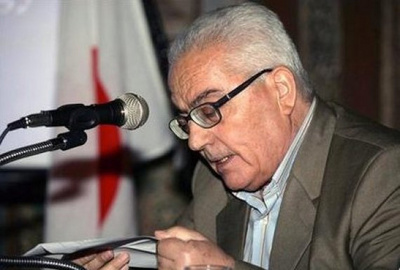
On August 18, 2015 Dr Khaled al-Assad, retired director of the Palmyra museum and an officer of the Directorate General of Antiquities and Museums, had his neck cut and his body hung from a traffic light pole. The 83 year-old archaeologist had been held in seclusion (and probably tortured) for three weeks. In the public square of Palmyra an accusation was read out that he was “the director of pagan idols”. Khaled al-Assad had been born in Palmyra and had spent most of his career there, writing numerous articles as well as directing archaeological sites. He had few rivals in his knowledge of the ancient crossroad city of Palmyra, an important link on the trade routes between Asia, North Africa, and Europe.

The public killing of Khaled al-Assad renewed concern for the historic sites. It was widely believed that many of the sites had had explosives placed in them to provoke their destruction. Sites in Palmyra had already been damaged during the fighting in the spring as the soldiers of the Islamic State in Iraq and Syria (ISIS or Daesh in Arabic) took control of the city and the surrounding area. Then on August 23, some of the explosives were set off, damaging the important Temple of Baal, one of the most visited sites in Palmyra. Baal – the Lord of the Heavens – was represented by an eagle. He was also a storm god shown holding a lightning bolt in his hand.

From a distance, it is hard to know what elements within ISIS are responsible for the destruction and what are the motivations. ISIS has attracted fighters from a good number of countries, and it is impossible to know the chains of command or the motivations. Many Syrians are proud of the vestiges of pre−Islamic civilizations, proof that the area was an important actor and in some ways a rival of Rome. The Directorate General of Antiquities has some 2,500 employees with a record of preserving Syria’s cultural heritage. In addition, some Syrian citizens, risking their lives, have tried to defend heritage sites or to hide away cultural objects. Moreover, ISIS agents as well as persons belonging to other armed factions have been looting objects to sell outside the country, either for personal gain or to finance their political faction, rather than destroying them.

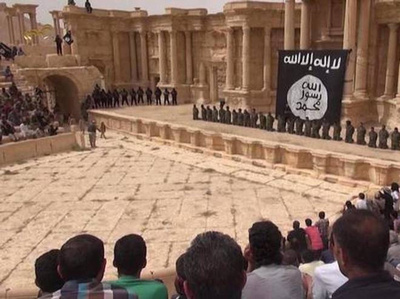
When ISIS/Daesh took Palmyra last May, many people feared they might blow up the ancient city at once. They didn't, but now the vestiges of the ancient civilization there were soon turned into a stage for ISIS/Daesh to use toward propaganda purposes.

When ISIS/Daesh took Palmyra last May, many people feared they might blow up the ancient city at once. They didn’t, but now the vestiges of the ancient civilization most inappropriately serve as a stage for ISIS/Daesh to use toward propaganda purposes.

Thus, it is not clear who wants to destroy works of art and cultural heritage. Are there sincere iconoclasts for whom any object that recalls pre-Islamic worship is an insult to the Islamic faith? Are there people who just want to destroy and will blow up most anything? Are there people who believe that public killings and destruction of heritage will facilitate military expansion and control of the population? Is there any possibility of rational discussion and good-faith negotiations with ISIS authorities to preserve cultural sites in Syria and Iraq?

Conserving a cultural heritage even in times of peace is always difficult. Weak institutional capabilities, lack of appropriate resources and isolation of many culturally essential sites are compounded by a lack of awareness of the value of cultural heritage conservation. On the other hand, the dynamism of local initiatives and community solidarity are impressive assets. These forces should be enlisted, enlarged and empowered to preserve and protect a heritage.

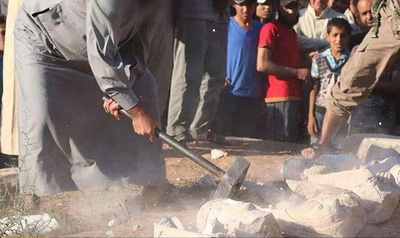
ISIS/Daesh members enthusiastically destroying a historical ancient site. They may bring down every reminder of the past they come by, but try as they might, they cannot change history.

Are there ways that those of us on the “outside” can reach those in Syria and Iraq who wish to preserve cultural heritage and to defend the lives of those who work to preserve protect and inform?

My belief is that the current military action against ISIS, either with ground troops or bombing from the air, will have little positive impact. Armed force may lead some of the ISIS forces to a “burned earth” policy, destroying as much as they can before retreating. I think that there needs to be initiatives taken by those currently living under ISIS rule but who do not share ISIS values. They need to take actions to show ISIS leaders that their policies are an error and will lead to greater divisions within the population.

There is always a certain irony for someone in a safe area to encourage others to take actions which can put their lives in danger. Therefore, the least that we can do is to have a loud outcry from cultural workers throughout the world so that those in Syria and Iraq who will act positively know that they are not alone.


Prof. René Wadlow is President and Chief Representative to the United Nations Office at Geneva of the Association of World Citizens.

The Continuing Humanitarian Crisis and Violations of Human Rights in ISIS-held Areas in Iraq and Syria

In Current Events, Human Rights, International Justice, Middle East & North Africa, Solidarity, The Search for Peace, United Nations, War Crimes, World Law on August 25, 2015 at 9:00 AM

THE CONTINUING HUMANITARIAN CRISIS AND VIOLATIONS OF HUMAN RIGHTS IN ISIS-HELD AREAS IN IRAQ AND SYRIA

By René Wadlow

In an August 25, 2014 statement, the United Nations (UN) High Commissioner for Human Rights condemned the “appalling, widespread, and systematic violations of human rights” by the Islamic State in Iraq and Syria (ISIS). The violations mentioned included targeted killings, forced conversions, abductions, trafficking of women, slavery, sexual abuse, destruction of religious and cultural sites of significance and the besieging of entire communities because of ethnic, religious and sectarian affiliation.

Among those directly targeted have been the religious communities of Christians, Yezidi (also written Yazidi) and Sabeans (also called Sabean-Mandaeans). In addition to the violation of human rights, the High Commissioner cited other UN reports stressing the humanitarian crisis and the severe shortages of food, water and the lack of medical services.

This sign, here painted in red on a wall with a circle around it, is the letter N in Arabic. When the IS started seizing predominantly Christian-inhabited areas of Iraq by force, its militiamen immediately painted this on houses they knew or thought were owned by Christians, N being for “Nasrani” which is itself the Arabic for “Christian”. A long echo of the Nazis’ practices in pre-World War II Germany, when Hitler’s own militiamen would paint a Star of David on the front door of each Jewish-owned business. That was just before the “Final Solution” which claimed over 6 million lives.

This sign, here painted in red on a wall with a circle around it, is the letter N in Arabic.
When ISIS started seizing predominantly Christian-inhabited areas of Iraq by force, its militiamen immediately painted this on houses they knew or thought were owned by Christians, N being for “Nasrani” which is itself the Arabic for “Christian”.
A long echo of the Nazis’ practices in pre-World War II Germany, when Hitler’s own militiamen would paint a Star of David on the front door of each Jewish-owned business. That was just before the “Final Solution” which claimed over 6 million lives.

One year later, the situation remains much the same, but with an increased number of people uprooted as internally displaced persons and refugees. The political situation has grown more complex, with Turkey playing an increasing if unclear role. Efforts at mediation by the UN of the Syrian aspects of the conflict have not given visible results. Russian diplomats have been meeting with some Syrian factions as well as with the Syrian government, but there seem to be no advances toward broader negotiations. The political and military actions of ISIS have effectively linked Iraq and Syria so that each conflict is linked to the other. A global approach for conflict resolution is needed.

The conflict has increased religious sectarian attitudes. It is hard for an outsider to know to what extent religious differences are deeply felt or if religion is used as a “cover” for ethnic, tribal, and economic interests. It is certain that ISIS has tried to give a religious coloring to its policies, with forced conversions and destruction of non-Islamic communities which refused conversion. Therefore, there needs to be an emphasis on freedom of religion or belief as set out by the United Nations.

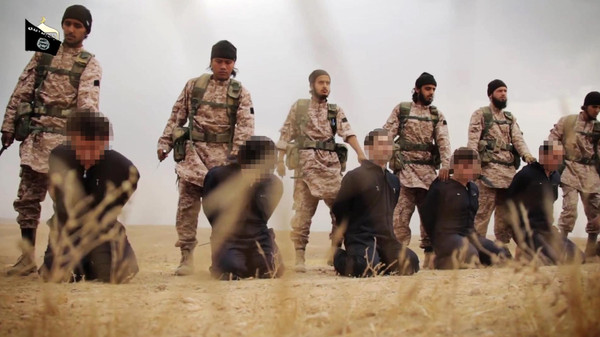
An image grab taken from a propaganda video released on November 16, 2014 by al-Furqan Media allegedly shows members of the Islamic State jihadist group preparing the simultaneous beheadings of at least 15 men described as Syrian military personnel. In the highly choreographed sequence, jihadists march the prisoners by a wooden box of long military knives, each taking one as they pass, before forcing their victims to kneel in a line and decapitating them. (C) AFP PHOTO

An image grab taken from a propaganda video released on November 16, 2014 by al-Furqan Media allegedly shows members of the Islamic State jihadist group preparing the simultaneous beheadings of at least 15 men described as Syrian military personnel. In the highly choreographed sequence, jihadists march the prisoners by a wooden box of long military knives, each taking one as they pass, before forcing their victims to kneel in a line and decapitating them. (C) AFP PHOTO

One of the major UN declarations confirming a deep sense of inherent dignity is the Declaration on the Elimination of All Forms of Intolerance and of Discrimination Based on Religion or Belief, adopted by the General Assembly on November 25, 1981 after a number of years of study and discussion in which the Association of World Citizens (AWC) took an active part. The Declaration states “that it is essential to promote understanding, tolerance and respect in matters relating to freedom of religion and belief and to ensure that the use of religion or belief for ends inconsistent with the Charter, other relevant instruments of the United Nations and the purposes and principles of the present Declaration is inadmissible.”

Article One states clearly that “No one shall be subject to coercion which would impair his freedom to have a religion or belief of his choice.”

World law as developed by the UN applies not only to the governments of Member States but also to individuals and non-governmental organizations. The ISIS has not been recognized as a State and is not a member of the UN. Nevertheless, the AWC is convinced that the terms of the Declaration on the Elimination of All Forms of Intolerance and Discrimination Based on Religion or Belief applies to the ISIS and that the actions of the ISIS are, in the terms of the Declaration, “inadmissible”.

Syrian demonstrators in Paris, France, vowing for "a democratic future" in Syria "without [Syrian President] Bashar [al-Assad] and without Daesh [ISIS]". (C) AWC/Bernard J. Henry

Syrian demonstrators in Paris, France, vowing for “a democratic future” in Syria “without [Syrian President] Bashar [al-Assad] and without Daesh [ISIS]”. (C) AWC/Bernard J. Henry

Life in the emerging world society requires world law and certain common values among all the States and peoples of the world.  The challenges which face us all require inclusive ethical values based on a sense of responsibility for both present and future generations.  Such values are, I am sure, in the heart of many individuals who are now living in areas under the control of ISIS in Iraq and Syria. We must find ways to reach such people with the message that the policies of the ISIS leaders are deliberate violations of world law and ethical standards.  The majority of the world society is not hostile to the people living under ISIS rule and we look forward to the time when human rights standards will be the law of the land. In the meantime, they need to work as best they can for a tolerant and open society.

Prof. René Wadlow is President and Chief Representative to the United Nations, Geneva, of the Association of World Citizens.

The Trial of Hissène Habré: An Advance for World Law

In Africa, Being a World Citizen, Current Events, Human Rights, International Justice, The Search for Peace, United Nations, World Law on July 21, 2015 at 10:18 PM

THE TRIAL OF HISSENE HABRE: AN ADVANCE FOR WORLD LAW

By René Wadlow

The trial of Hissène Habré, former President of Chad, which opened in Dakar, Senegal, on July 20 marks a new step in transnational law. Habré will be tried in a specially constituted court created by a treaty between the African Union and the State of Senegal. The court is modeled on the statutes of the International Criminal Court (ICC) in The Hague, but is to deal only with cases concerning Africans. It will be important to see if this new African court will be a one-time-only institution for the Habré trial or if it becomes a permanent institution of world law.

The ICC has been criticized by some African leaders as being overly focused on Africans. Arrests and arrest warrants have been issued nearly exclusively against Africans. What is not mentioned in polite company is that Africa is the only continent where state institutions have totally disappeared − Somalia, Central African Republic, Libya − or where vast areas of a State are not under the control of the central government: the eastern provinces of the Democratic Republic of Congo and the northeast areas of Nigeria. In addition, there are a good number of African States where the court system is so under the control of the executive that “fair trials” are out of question.

Thus, if African leaders were reluctant to see the ICC take on new African cases, an “all-African” alternative had to be created, even if it is nearly identical in the types of crimes to be judged and the way that evidence is to be collected. The judges in Dakar have already interviewed some 2,500 persons even before the trial started.

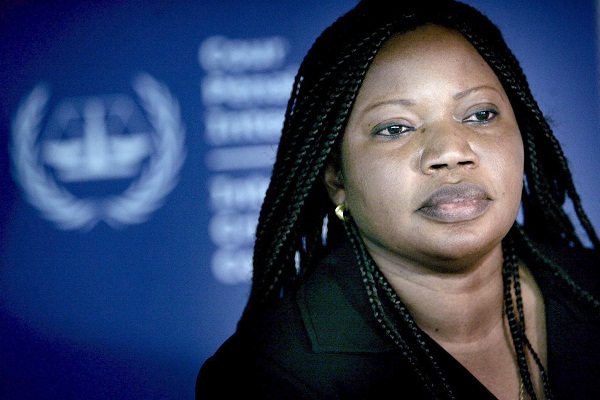
Not even the fact that the current Prosecutor of the International Criminal Court, Fatou Bensouda, is an African from the nation of Guinea could silence critics who claim the ICC has been exerting racial bias against suspects from Africa, a most unfounded charge in our view. (C) EPA/Evert-Jan Daniels dpa  +++(c) dpa - Bildfunk+++

Not even the fact that the current Prosecutor of the International Criminal Court, Fatou Bensouda, is an African from the nation of Guinea could silence critics who claim the ICC has been exerting racial bias against suspects from Africa, a most unfounded charge in our view. (C) EPA/Evert-Jan Daniels – Bildfunk

Hissène Habré is a sad case of an intelligent man blinded by his quest for power and then for holding on to power. In this process he destroyed large segments of ethnic groups who he suspected of wanting power. He also had killed any potential rivals, even those who had shown no opposition. It is estimated that in his eight years of power, some 40,000 persons were killed, some in the military campaigns against ethnic groups, but also some 4,000 political figures killed individually in jails and specially-designed torture centers. In his very last days in power in December 1990 as the forces of his general Idriss Deby were moving to overthrow him, he had 300 persons in jail killed as a last gesture. His very last gesture, however, was to take all the money available in the Treasury with him into exile in Senegal − money which has allowed him to live well and to contribute to the well-being of Senegal political figures.

Hissène Habré is a member of the Toubou ethnic group in northwest Chad. His intelligence was spotted by his teachers, and at the independence of Chad in 1960, he was given an important post in the provincial government at age 18. After two years of administration, he was selected to go to France for university studies in law and development economics. He even has a diploma in federalist-decentralization studies so he had heard that there were ways of dealing with ethnic minorities other than by killing them. Habré spent 9 years in France, mostly in Paris, and has the equivalent of two Master’s degrees in law and development economics.

In 1972, he returned to Chad but rather than becoming a government administrator, he joined a militia band that was trying to overthrow the government, and then formed his own militia group. Habré had been deeply influenced by the example and writings of Che Guevara and saw power as coming from “the people in arms.” He first attracted international, especially French, attention by taking hostages. The most famous − if unclear case − is taking the woman anthropologist Francoise Claustre hostage from 1974 to 1977. What makes the case unclear is the Habré and Claustre knew each other as students in Paris, and there was some talk that the hostage-taking was a common plot to get money out of the French government. The French military officer sent to negotiate her release was murdered by Chadian government officials, but Claustre was later released.

By 1978, Habré and his troops had become powerful enough that he was named Prime Minister. He learned his way around the administration, and in June 1982 he overthrew the then President Goukouni Oueddei and became President. Habré abolished the post of Prime Minister. He wanted no rivals in sight and until December 1990 ruled ruthlessly, helped by his security organization: Direction de la Documentation et de la Sécurité (DDS). His repressive administrative practices were hardly secret. However his administration was heavily supported by the governments of France and the USA as a barrier to the expansion of Colonel Qaddafi’s Libya.

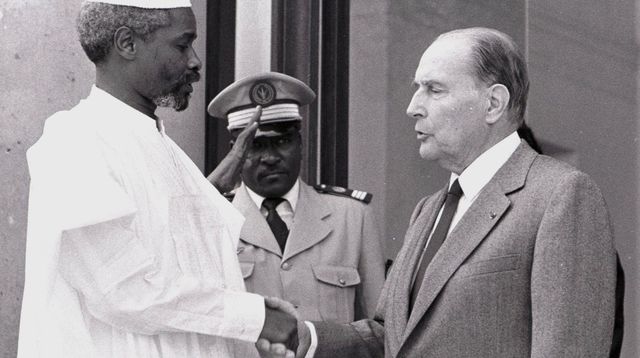
Hissène Habré, then President of Chad, and his French counterpart François Mitterrand on the doorsteps of the Elysée Palace in Paris, France on October 21, 1989. Habré was then an African head of state to be reckoned with; now he is a suspect in the dock of an African court and can no longer run away from his deeds. (C) Reuters/Christine Grunnet

Hissène Habré, then President of Chad, and his French counterpart François Mitterrand on the doorsteps of the Elysée Palace in Paris, France on October 21, 1989. Habré was then an African head of state to be reckoned with; now he is a suspect in the dock of an African court and can no longer run away from his crimes. (C) Reuters/Christine Grunnet

In 1973, Libya had claimed and then occupied a strip of land − the Aouzou Strip − on the frontier between the two countries. Modern State frontiers have little meaning to the nomadic tribes of that area and so the frontier had never been well delimited. However, there were fears that Qaddafi wanted to annex all of Chad and had expansionist aims toward other countries of the Sahel. Hissène Habré was willing to give a free hand to the CIA which tried to create an anti-Qaddafi military force from captured Libyan soldiers. Since the CIA was willing to pay large amounts of money to set up its training bases, Habré had no objection, especially as the area occupied by Libya was of no particular interest or support to him.

French aid was more obvious. French soldiers were sent as a mark of support to the Habré government. Each time that French troops were sent as security for the capital, Habré could use his own troops to attack minority areas. Thus in 1983 French troops, code named “Manta” landed, and in 1984 Habré’s troops attacked the Sara population of south Chad. In 1986, French troops, code named “Epervier” (“Sharp-shinned Hawk”) landed and in 1987 Habré’s troops attacked the Hadjarai tribes: this pattern went on through 1989 and the attacks against the Zaghawa tribes.

By 1990, one of Habré’s generals, Idriss Deby said “Why not me?” and with some troops loyal to him overthrew Hissène Habré. Deby is still President of Chad and his troops are the most battle-tested of African armies, now busy helping the Nigerian army against Boko Haram on the Nigeria-Chad frontier.

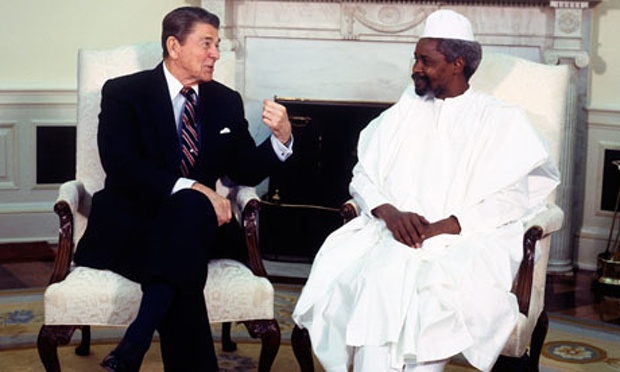
In 1987 Ronald Reagan, the then President of the United States, welcomed Hissène Habré to the White House during his official visit to America. (C) Jean-Louis Atlan/Sygma/Corbis

In 1987 Ronald Reagan, the then President of the United States, welcomed Hissène Habré to the White House during his official visit to America. As President of Chad, Habré was never short of powerful allies in the West; today, as he faces punishment for his deeds, he stands alone. (C) Jean-Louis Atlan/Sygma/Corbis

Since 1990, Habré has lived a comfortable but low profile life in Dakar. However victims and their families from his years of rule have cried for revenge (or at least justice). Different avenues to bring Habré to trial have been used, especially a universal jurisdiction law of Belgium which held that persons accused of certain crimes such as crimes against humanity, war crimes, systematic torture, no matter where committed, could be tried in a Belgium court. This Belgium law has since been revoked but not before evidence on the Chadian case could be presented to the Belgium judges.

Evidence concerning torture and the killing of potential opponents by Habré’s security forces was carefully collected under the driving energy of Reed Brody of Human Rights Watch. Habré had friends among the governing elite of then President of Senegal, Abdoulaye Wade, who protected him so that no trial could take place. However, with the new President of Senegal, Macky Sall, in power and the accumulation of evidence, the African Union and Senegal felt that something had to be done. Thus, the creation of the special court and the start of the trial. It is unlikely that new facts will be uncovered. Habré’s government was fairly open in its repression. The degree of active support of France and the USA will probably be pushed under the rug. Yet the trial merits watching closely. There are still other African dictators, some retired, others still in power. What impact will the trial and the court have on the rule of world law?

Prof. René Wadlow is President of the Association of World Citizens.

UN Human Rights Council Reaffirms the Safeguards for Civilians in Times of War

In Being a World Citizen, Conflict Resolution, Current Events, Human Rights, International Justice, Middle East & North Africa, The Search for Peace, United Nations, War Crimes, World Law on July 5, 2015 at 7:33 PM

UN HUMAN RIGHTS COUNCIL REAFFIRMS THE SAFEGUARDS FOR CIVILIANS IN TIMES OF WAR

By René Wadlow

“Accountability for breaches of international humanitarian law and for human rights violations, as well as respect for human rights, are not obstacles to peace, but rather the preconditions on which trust and, ultimately, a durable peace can be built.”

– Navanethem Pillay, then UN High Commissioner for Human Rights, 2009.

On July 3, 2015, the concluding day of its summer session, the United Nations (UN) Human Rights Council welcomed the report of the “Gaza Conflict Commission of Inquiry” which indicated that the Israeli military and Palestinian armed groups may have committed war crimes during the Israeli “Operation Protective Edge” campaign. 47 member States of the Human Rights Council voted in favor of the resolution, 5 States abstained: Kenya, Ethiopia, Macedonia, India and Paraguay; the USA was the only Member State to vote against the resolution.

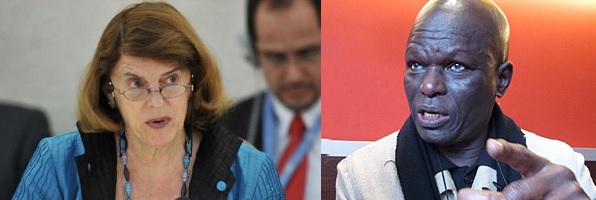
The Gaza Conflict Commission of Inquiry was led by the New York Judge Mary McGowan Davis with Doudou Diène of Senegal, the UN Special Rapporteur on Contemporary Forms of Racism (2002-2008), as the other ranking member. The Commission was to study the legal implications of an earlier UN Fact-Finding Mission on the Gaza Conflict. The Commission was not established to evaluate the results of the Fact-Finding Mission which had largely confirmed the death tolls provided by the Gaza Hamas administration, some 2,250 Palestinians killed of which 1,462 civilians. Rather the Commission had the task of setting out the world law applications of the facts collected earlier.

Judge Mary McGowan Davis (left) and Doudou Diène (right).

Judge Mary McGowan Davis (left) and Doudou Diène (right).

Thus the focus of the Commission was the “Geneva Convention relative to the Protection of Civilian Persons in Time of War” of August 12, 1949. The Geneva Conventions, for which the International Committee of the Red Cross is responsible, grew out of deliberations started in 1947 in the shadow of the abuses of the Second World War. By 1949, the negotiations among governments led to the 1949 Red Cross Conventions. The emphasis was on the principles of protection and not on the punishment of wrong doers. The International Committee of the Red Cross is not an international court. It bases its protection efforts on the belief that all sides in a conflict have an interest to follow the laws of war as its soldiers or civilians could meet the same fate. If there is to be any action on trials and punishment, such trials should be done in national courts.

From 1974 to 1977, as a result of the war in Vietnam, there were subsequent laws of war negotiated to cover “civil wars” − wars within a State where the parties involved may not be States. (1)

Today, however, there is the International Criminal Court which can investigate as well as having the mandate to hold court trials and pass judgment. Investigations and trials can also be carried out at the national level. The Israeli argument has always been that the Israeli Defense Force (IDF) can and does carry out investigations and that there is a functioning national court system. The Hamas-led administration of Gaza makes the same argument.

Unfortunately, both Israel and Hamas have dismal records of investigating their own forces. I am unaware of any case where a Hamas fighter was punished for deliberately shooting a rocket into a civilian area of Israel − on the contrary, some Hamas leaders repeatedly praise such acts. While Israel has carried out investigations into alleged violations by its forces, the emphasis has been on the unauthorized actions of individual soldiers, not on policy makers. Yet the Gaza Conflict Commission stressed that “military tactics are reflective of a broader policy approved at least tacitly by decision-makers at the highest levels of the Israeli government.”

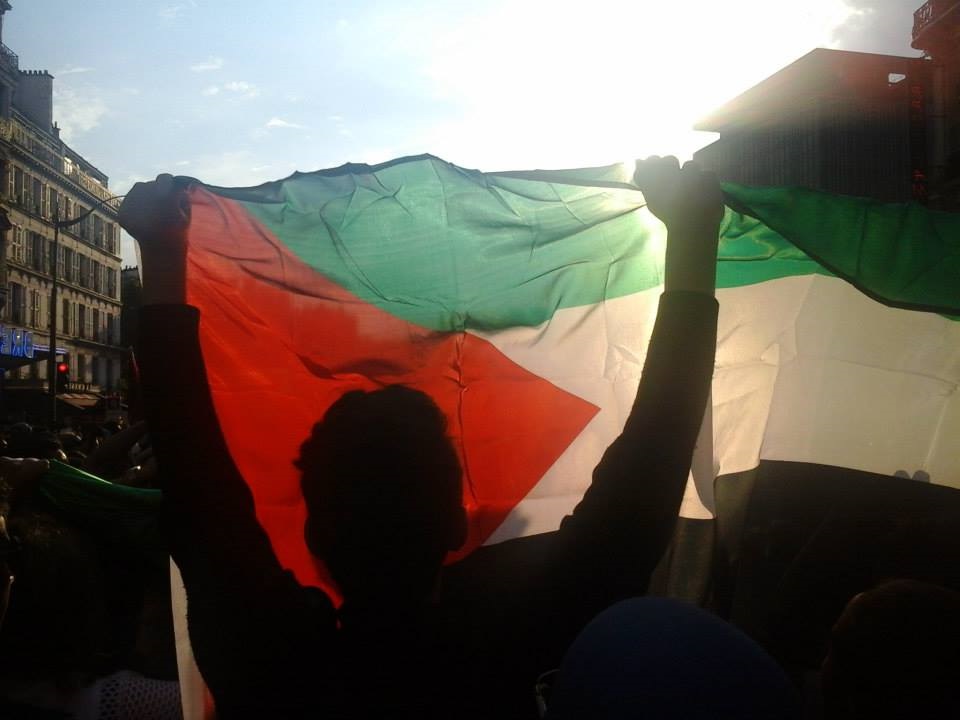
A demonstrator raises the Palestinian flag during a July 2014 rally in Paris against the Israeli attack on Gaza. (C) AWC/Bernard J. Henry

A demonstrator raises the Palestinian flag during a July 2014 rally in Paris against the Israeli attack on Gaza. (C) AWC/Bernard J. Henry

Nongovernmental organizations (NGOs) active in UN human rights bodies, including the Association of World Citizens, have long stressed the importance of fact-finding carried out by the UN, intergovernmental bodies such as the Organization for Security and Cooperation in Europe, and NGOs themselves. (2)

There are now two follow-up steps set out by the Human Rights Council resolution:

1) A request is made that the UN High Commissioner for Human Rights (and thus the Secretariat) prepare a report on implementation measures;

2) A recommendation that the UN General Assembly take up the matter “until it is satisfied that appropriate action is taken to implement its recommendations.”

The Israeli government has replied angrily to the resolution, the Israeli Ambassador to the UN in Geneva calling it an “anti-Israeli manifesto” and Prime Minister Benjamin Netanyahu saying “the UN Human Rights Council cares little about the facts and less still about human rights.”

Rather, I would say that the resolution is an important procedural advancement in the respect of world law in times of conflict. In the past, there have been UN-authorized fact-finding missions with the reports going directly to discussion in the UN Commission on Human Rights (as it was then) and then to the UN General Assembly. With the Gaza Conflict Commission of Inquiry we have a useful intermediary step. First there is a fact-finding effort as close in time to the events as possible to interview victims, to see the physical damage and to interview the military and other combatants. Such fact-finding is done, as it were “in the heat of the action”.

In late July 2014 Gazan doctors saved the life of little Shaima, an unborn child, by extracting her from the womb of her mother who was killed in an Israeli airstrike. Two days later, the Israeli Air Force destroyed the sole existing power plant in Gaza, thus stopping Shaima’s life support system and eventually killing the baby too.

In late July 2014 Gazan doctors saved the life of little Shaima, an unborn child, by extracting her from the womb of her mother who was killed in an Israeli airstrike. Two days later, the Israeli Air Force destroyed the sole existing power plant in Gaza, thus stopping Shaima’s life support system and eventually killing the baby too.

Then there is a calm, legal review of the fact-finding reports. In the past when I have been present at debates on fact-finding reports in the Commission on Human Rights, the debates were anything except calm and legal. They were political exchanges which reflected the evaluations of the original conflict. In this case of the Gaza Commission, we have an orderly presentation of facts, avenues to strengthen protection, and suggestions on the role of the International Criminal Court. There is no guarantee that the discussions in the next UN General Assembly will be calm and focused on legal procedures, but at least there will have been this useful intermediary step.

As things now stand, world law is not created by the decisions of a world parliament. World law is basically the “common law of mankind”’ based on small advances. Usually the first step is to set out the basic values in widely agreed-upon texts such as the Red Cross Geneva Conventions. This is followed by a recognition that there are repeated violations of these values in the practice of war, the torture of individuals, massive aggression against minorities. After repeated violations, there is the very slow realization that such violations are not acceptable and if nothing is done, the values themselves will be permanently undermined.

We are now at this last stage as concerns Gaza. The repeated bombings of the Gaza Strip do not bring peace, security or socioeconomic development. In fact, each bombing campaign creates a more difficult situation. It is not a function of world law to say what socioeconomic-political measures should be taken, though as NGO representatives we can and have made suggestions. The function of world law is to set out clearly the value basis of the law, to set out fair procedures to deal with possible violations and ultimately to see if there can be sanctions or punishment for wrong doers.

I believe that we still have many miles to go on the path for the respect of world law, but I believe that the direction is now set.

Prof. René Wadlow is President of the Association of World Citizens.

Notes

1)      See Hilaire McCoubrey and Nigel White, International Law and Armed Conflict (1992)

2)      See B. G. Ramcharan (ed), International Law and Fact-Finding in the Field of Human Rights (1983)

For NGO Fact-finding, see Hans Tholen and B. Verstappen, Fact-Finding Practice of Non-Governmental Organizations (1986)

Le 20 juin, Journée Mondiale des Réfugiés

In Being a World Citizen, Current Events, Human Rights, International Justice, Solidarity on June 19, 2015 at 10:07 PM

LE 20 JUIN, JOURNEE MONDIALE DES REFUGIES

Par René Wadlow

Dans un rapport en date du 18 juin 2015 du Haut Commissariat des Nations Unies pour les Réfugiés (HCNUR), il est écrit qu’il existe aujourd’hui dans le monde quelques soixante millions de personnes déplacées par la guerre, la violence et la persécution. Un réfugié est forcé de le devenir, il ne l’est pas à la naissance. Ce sont les régimes politiques répressifs et les conflits qui fabriquent des réfugiés.

Le rapport de l’HCNUR cite la Syrie, l’Afghanistan et la Somalie comme des situations de première importance, ainsi que les réfugiés du Myanmar. Cependant que les événements qui déclenchent des fuites massives de réfugiés sont spécifiques à chaque contexte particulier où ils se produisent, certaines caractéristiques communes à tous n’en demeurent pas moins apparentes. La cause la plus immédiate de la fuite des réfugiés est dans la majorité des cas une menace imminente sur leur vie, leur liberté et leur sécurité. L’expulsion délibérée d’un groupe ethnique peut également être en soi l’objet du conflit qui les amène à fuir.

Des déplacés syriens marchent dans le camp d'Atme, le long de la frontière turque dans la province d'Idib, au nord-ouest de la Syrie, le 19 mars 2013. (C) BULENT KILIC/AFP/Getty Images

Des déplacés syriens marchant dans le camp d’Atme, le long de la frontière turque dans la province d’Idib, au nord-ouest de la Syrie, le 19 mars 2013. (C) BULENT KILIC/AFP/Getty Images

Le nombre ahurissant des personnes déplacées de chez elles représente un défi majeur pour la société mondiale émergente. Les Nations Unies et leurs Etats membres ne sont pas en mesure de faire face de manière appropriée à ce flux sans cesse croissant et se tournent donc de plus en plus vers les organisations non-gouvernementales en demandant leur implication pleine et entière.

En tant que Citoyens du Monde, nous savons que nous devons travailler sur les causes premières des déplacements forcés, ainsi que sur l’intégration des réfugiés dans les sociétés qui les accueillent. Personne ne peut faire comme s’il s’agissait là d’une tâche facile. Celle-ci appelle la bonne volonté et l’engagement sur tous les plans de toutes et tous.

Le Professeur René Wadlow est Président et Représentant en Chef auprès de l’Office des Nations Unies à Genève de l’Association of World Citizens.