The Official Blog of the

Archive for the ‘Africa’ Category

The UN and the Disappearing State of the Central African Republic

In Africa, Anticolonialism, Conflict Resolution, Current Events, Democracy, Human Rights, International Justice, The Search for Peace, United Nations, War Crimes, World Law on November 22, 2013 at 10:36 AM

THE UN AND THE DISAPPEARING STATE OF THE CENTRAL AFRICAN REPUBLIC

By René Wadlow

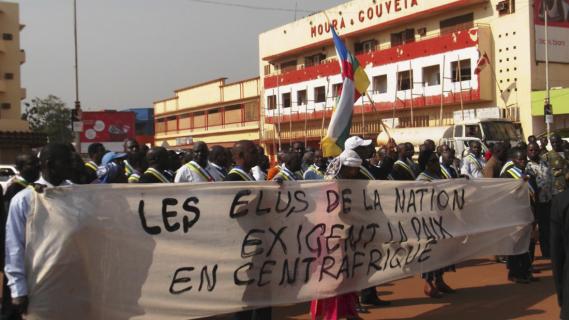
In a November 19, 2013 statement to the United Nations (UN) Security Council, the Secretary General, Mr. Ban Ki-moon, warned that communal violence in the Central African Republic (CAR) was spiraling out of control and backed the possibility of an armed UN peacekeeping force to complement the civilian UN staff, the Integrated Peacebuilding Office in the Central African Republic (BINUCA).

The UN faces a double task in the CAR. There is the immediate problem of violence among tribal-based militias in the absence of a national army or central government security forces. The militias basically pit the north of the country against the south. In addition, there are other militias from the Democratic Republic of the Congo which use the CAR as a “safe haven” and live off the land by looting villages. There are also segments of the Lord’s Resistance Army, largely from the Acholi tribes of northern Uganda who also use the CAR as a safe area looting as they move about.

In the absence of a standing UN peacekeeping force, UN peacekeepers would have to be redeployed from the eastern areas of the Democratic Republic of Congo, an area also torn apart by fighting among different militias and an incompetent Congolese national army. Although the UN forces have been in the Congo for a number of years, it is only in the last couple of months that they have had a mandate to be active in a military way and have started to make an impact on the security situation. By deploying UN troops away from the Congo, there is a danger that the security progress made will fade away.

The longer range task of the UN, the peacebuilding effort, is to create a national administration which provides services beyond the capital city, Bangui. This is the aim of the BINUCA, but its work is largely impossible in the light of the ongoing violence. The challenge is “State-building” which was not done during the colonial period by France.

The area covered by the current State had no pre-colonial common history, but was incorporated into French Equatorial Africa when it could have been as easily part of the Belgium Congo or added to Uganda as part of British East Africa.

Oubangui-Chari as it was then known was the poor cousin of French Equatorial Africa (AEF) whose administrative center was Brazzaville, Congo, with Gabon as the natural resource base. The Cameroon, although legally a League of Nations Mandate, was basically part of AEF. Oubangui-Chari was used as an “exile post” for African civil servants considered “trouble makers”. French colonial administrators also considered Oubangui-Chari as a posting in exile, a place to get away from as soon as possible. Schools were few, and secondary school students were sent away to Brazzaville.

There was only one political figure of standing who emerged from Oubangui-Chari, Barthelemy Boganda (1910-1959). He was the first Roman Catholic priest ordained in 1938. After the Second World War, he was elected to serve in the French Parliament as a member of the Catholic-influenced MRP Party, although he was stripped of his priesthood for going into politics and also for marrying his legislative assistant.

Boganda advocated keeping the AEF together as a federation of independent States knowing that Oubangui-Chari was the poorest of the AEF States and most in need of help from its neighbours. Unfortunately, he was killed in a plane crash on the eve of independence, and with him disappeared all enlightened leadership.

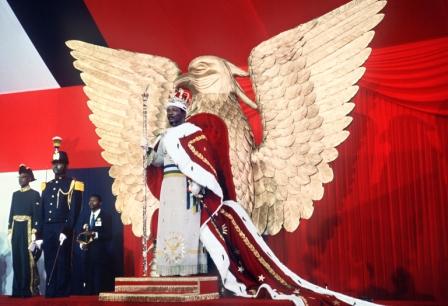
However, his stature in the political life of Oubangui-Chari was such that political power passed on to two cousins, David Dacko, first President of the independent Central African Republic and then Jean-Bedel Bokassa in 1965 who changed the name of the country to Central African Empire and ruled (or misruled) as Bokassa 1er. His dreams of being a new Napoleon was ended in 1979 by a French military intervention after Bokassa had too visibly killed young school children who were protesting.

Jean-Bedel Bokassa aka Bokassa the First, the man who would be emperor – even if it meant reigning over scorched earth.

Jean-Bedel Bokassa aka Bokassa the First, the man who would be emperor – even if it meant reigning over scorched earth.

Since Bokassa, all pretext of a unified administration has disappeared. General Kolingba, Ange-Felix Patassé, followed by Francois Bozizé were considered “Head of State”, but the State had no visible administration. Bozizé was overthrown in March 2013 by Michel Djotodia and his Seleka (alliance in the Sango language) militia. The Alliance has now been dissolved by Djotodia but replaced by nothing. A fact-finding mission sent by the UN Human Rights Council concluded that “both the forces of the former government of President Bozizé and the non-State armed group Seleka committed serious violations of international humanitarian law and international human rights law during the conflict”.

Creating order from disorder is a difficult task, especially as the pre-colonial tribal structures no longer function. There were very few inter-tribal mechanisms to settle disputes in any case. The State-building process merits close attention. Somalia remains a good example of the difficulties. The UN faces real challenges in the Central African Republic and requires help from national governments and NGOs.

Politically, Africa has always been a continent of many dramas. Hopefully, if the international community finally decides to take quick, decisive action at last, the Central African Republic will not be just another name on the list.

Politically, Africa has always been a continent of many dramas. Hopefully, if the international community finally decides to take quick, decisive action, the Central African Republic will not be just another name on the list.

René Wadlow is the President and Chief Representative to the United Nations Office at Geneva of the Association of World Citizens.

New Fires Relight in Eastern Congo

In Africa, Conflict Resolution, Current Events, Human Rights, International Justice, The Search for Peace, United Nations, World Law on August 25, 2013 at 4:25 PM

NEW FIRES RELIGHT IN EASTERN CONGO

By René Wadlow

In a message of August 24, 2013 addressed to United Nations (UN) Secretary-General Ban Ki-moon, the Association of World Citizens (AWC) highlighted that the Democratic Republic of Congo’s eastern capital of North Kivu Province, Goma, had been shelled for the past three days, including Saturday 24.

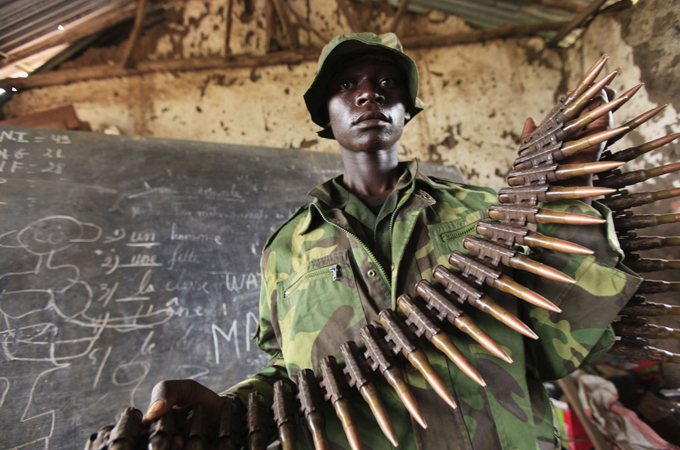
The shelling seems to be a continuation of the struggle for power and wealth between heavily-armed rebels, called the March 23 Movement (M23) and the Congolese central government’s army – the Democratic Republic of Congo Armed Forces (FARDC).

This struggle with ever-changing groups began in 1996, two years after the genocide in Rwanda which led to a refugee influx into eastern Congo.  From 1998 to 2003, the area was the scene of fighting between forces of at least six countries – Congo, Rwanda, Burundi, Uganda, Kenya, and Tanzania.

A fighter with the M23 Movement.

A fighter with the M23 Movement.

Since the end of the international fighting, the area has been divided into what can be called “mafia clans” running protection rackets and trying to make a profit from minerals, timber, food supplies for the UN forces and humanitarian nongovernmental organizations present. A deep and deadly struggle for influence is being played out in the shadows with an ever-changing cast of characters.

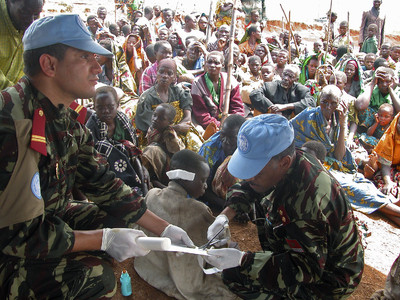
The UN has a large and expensive peacekeeping group in the area, the MONUC, but with uneven results.  UN forces are seen by the local population as favorable to the far-away incompetent central government.  The M23 is widely considered to be favored by the government of Rwanda.

UN peacekeeping troops are generally effective when there is peace to keep. However what is required today in eastern Congo is not so much more soldiers under UN command as reconciliation bridge-builders, persons who are able to restore relations among the ethnic groups of the area.  The UN, national governments, and non-governmental organizations need to develop bridge-building teams who can help to strengthen local efforts at conflict resolution and re-establishing community relations.

World Citizens were among those in the early 1950s who stressed the need to create UN peacekeeping forces with soldiers especially trained for such a task.  Today a new type of world civil servant is needed – those who in areas of tension and conflict can undertake the slow but important task of restoring confidence among peoples in conflict, establishing contacts and looking for ways to build upon common interests.

There is only so much the MONUC mission can do to keep the peace and assist the civilian population in the Democratic Republic of Congo.

There is only so much the MONUC mission can do to keep the peace and assist the civilian population in the Democratic Republic of Congo.

As the militias and “mafia clans” have proliferated, rivalries, particularly over land tenure and use have become a key source of conflict.  With the breakdown of society, there was a parallel breakdown of local, traditional conflict reduction mechanisms.  The precolonial tribal society had been too weakened during the colonial period to return to precolonial forms of governance.  Post-colonial administration had never been put into place, and so the result was a void of social rules and mechanisms for dispute settlement.

In particular, disputes over land became critical.  Land tenure issues have always been complex.  Land is often thought of as belonging to the ethnic community and is given to clans or to individuals for their use, sometimes for a given period, sometimes for several lifetimes if the land is continually cultivated.  The rules of land tenure often differ from one ethnic group to another, even a small distance apart. Traditionally, clan chiefs would be called upon to settle land disputes, often by compromises, so win-win solutions were often found. With the large displacement of people, land disputes have become frequent, and clan chiefs have often disappeared or lost their function as judges.

Many people have left villages near main roads to live in relative safety far from roads. They have had to move several times and to re-clear land for planting.  Local markets have been destroyed.  Social organizations such as churches have been disbanded, and family links, which provide the African “safety net” have been destroyed by death and displacement.  What trust existed between groups has been largely replaced by fear.  A few people are making money from the disorder by plundering natural resources, but economic injustice and deprivation remain the order of the day.

There is a short-term need to bring the current fighting to a negotiated end, but future security is closely linked to the ways in which land tenure and land use issues are settled.

René Wadlow is President and Chief Representative to the United Nations Office at Geneva of the Association of World Citizens.

Does the Non-Aligned Movement Still Matter?

In Africa, Anticolonialism, Asia, Cultural Bridges, Current Events, Middle East & North Africa, United Nations, World Law on August 27, 2012 at 11:36 AM

DOES THE NON-ALIGNED MOVEMENT STILL MATTER?

by René Wadlow

With Iran taking over the three-year term of the presidency of the Non-Aligned Movement (N.A.M.) at the end of August 2012, the question arises: Does the Non-Aligned Movement still matters in world politics and how will Iran use the presidency?

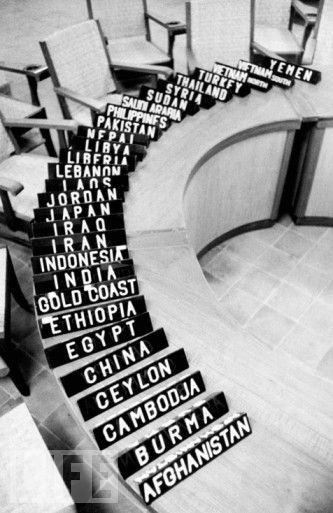
At the time of its founding at the Bandung Conference in April 1955, the major world powers were aligned in Soviet- and United States-led blocs. The war in Korea had recently ended in an armistice with the same frontiers as at the start but could have been the forerunner of a world war. The French war in Indochina had ended with independence of the three Indochina states, but a new independence conflict had just started in Algeria. Basically Bandung marked the end of formal colonialism. As Sir John Kotelawala, Premier of Ceylon (now Sri Lanka), said at the end of the conference “Bandung will be a name to reverberate in history and earn the gratitude and blessings of ages to come.”

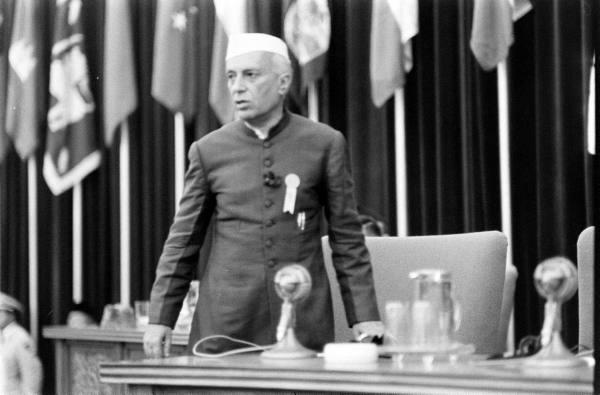
Prime Minister Jawaharlal Nehru of India delivering the closing speech at the Bandung Conference that created the Non-Aligned Movement.

For fear that the new Non-Aligned movement might supplement or weaken the United Nations (UN), no implementary organization was set up. Later, the pattern of three-year rotating presidency was developed, but without a permanent secretariat. The country holding the presidency offers its own diplomats and civil servants to carry on Non-Aligned tasks. The outgoing presidency — Egypt — was so taken up with its own political changes that it virtually played no role on behalf of the N.A.M. Will Iran be able to do more than use the prestige of the Movement to defend its own interests?

In time, the Non-Aligned Movement grew up to become a major player in international relations, providing the Third World with a voice of its own on the world stage.

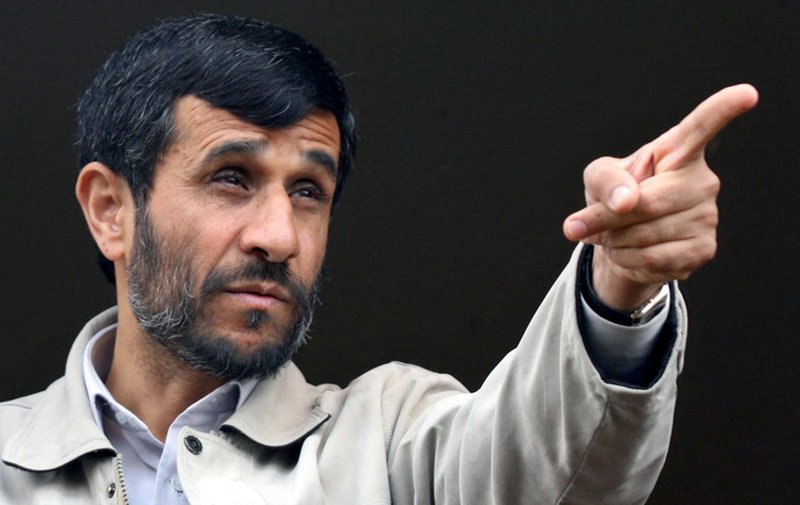
President Mahmoud Ahmadinejad will become the N.A.M. representative for its 118 members. His first presentation will be to the UN General Assembly in September. His talk should be analyzed closely to see if his presentation goes beyond the usual Iranian positions to be more inclusive of the interests of the N.A.M. members. A large conference at the end of August in Tehran will be the formal start of Iran’s presidency. Some Iranian leaders have called for the creation of a permanent secretariat. Thus it will be important to note what structural reforms are made within the N.A.M.

While in 1955, the idea of a “third camp” was a possibility — a wedge of sanity and restraint between the two atomic giants —, now there are real conflicts of interest among the N.A.M. members — the conflict in Syria being a prime example, along with differing territorial claims within the South China Sea among China and its neighbors.

The direct threats issued against the State of Israel by Iran’s President, Mahmoud Ahmadinejad, albeit in response to Israeli Prime Minister Benjamin Netanyahu’s own warmongering rhetoric against Iran, raises serious questions as to what Ahmadinejad can be expected to make of his presidency of the Non-Aligned Movement.

Iran itself is at the center of an international storm, and it is not clear if its diplomats and political leaders will have the energy to deal with the host of current conflicts among N.A.M. states as well as making proposition concerning the important economic, financial and ecological issues that the world faces. Moreover, the N.A.M. states are members of regional, intergovernmental organizations and therefore look less to N.A.M. leadership to structure economic and cultural cooperation.

Yet the N.A.M. does provide a structure for states and a large percentage of the people of the world. N.A.M. leadership has had an erratic relation with non-governmental organizations (NGOs) — sometimes encouraging their participation in meetings and programs and at other times ignoring them completely. Without a permanent secretariat, the N.A.M. has not developed the sort of consultative status that the UN has with NGOs. The Indian government at one stage had encouraged NGO-related activities within the N.A.M. Given the challenges facing the Iranian presidency of the N.A.M. it would be useful for NGOs to propose a more structured and formal relation with the N.A.M. especially if a permanent secretariat is created.

René Wadlow is President and Chief Representative to the United Nations, Geneva, of the Association of World Citizens.

World Citizens Call for Renewed Efforts for a Mali Federation

In Africa, Conflict Resolution, Current Events, The Search for Peace, United Nations, World Law on April 29, 2012 at 10:10 PM

STATEMENT BY THE REPRESENTATIVE OFFICE

TO THE UNITED NATIONS OFFICE AT GENEVA

OF THE ASSOCIATION OF WORLD CITIZENS

WORLD CITIZENS CALL FOR RENEWED EFFORTS

FOR A MALI FEDERATION


In an April 29, 2012 message to H. E. Mr. Ramtane Lamamra, Commissioner for Peace and Security of the African Union, Prof. René Wadlow, President of the Association of World Citizens, called upon the African Union to facilitate the creation of a federation of north and south Mali rather than having the country split into two independent states with unresolved frontier issues.

President Wadlow highlighted the recent meeting of representatives of the 15-member Economic Organization of West African States (ECOWAS) on April 26-27 in Abidjan which set a 12-month deadline for a transition period in Mali after the March 22coup of military officers led by Captain Amadou Sanogo. In response to strong, negative reactions by the international community, on April 7 there was a return to a civilian transitional government. However, the northern half of the country is now controlled by two rival Tuareg groups, the Mouvement national de libération de l’Azawad (MNLA) and the Ansar Dine. The MNLA has declared the northern half to be the independent state of Azawad.

“12 months should be long enough to work out a new constitution which maintains the unity of the country while at the same time providing the needed autonomy to the north and a preservation of the Tuareg way of life.” World Citizens believe in cooperation and in finding solutions based on respect for the positions and values of all the parties in the conflict.

“The Association of World Citizens believes that the Commission for Peace and Security of the African Union is well placed to help in drafting such a new federal constitution, especially as the Commissioner is a former Ambassador of Algeria to the United Nations. In the past, Algeria has played a mediation role between the Tuareg who also inhabit south Algeria and the governments of Mali and Niger where there are larger Tuareg communities.”

The declaration of the independence of north Mali by the MNLA is the first time such a formal proclamation has been made, although the independence of Azawad has always been among the Tuareg demands. Thus, it may be difficult for the Tuareg leadership, now in a position of force, to return simply to promises of greater autonomy within a unified Mali. A federation with clear divisions of authority could be a measure acceptable to both the MNLA and the government in Bamako.

“A crisis is a time for creative efforts. The Association of World Citizens is prepared to be of help with expertise in federal-confederal forms of government in this process.

“A transition period of 12 months may seem like a long time, but given the deep divisions of attitudes among leaders of north and south Mali, the sooner such efforts get underway the better. Support for the goal of a Mali federation on the part of the African Union’s Commission for Peace and Security could be an important part of creating a positive atmosphere in which such constitution drafting could be carried out.”

–   30   –

A New Mali Federation?

In Africa, Anticolonialism, Conflict Resolution, Current Events, The Search for Peace, United Nations, World Law on April 21, 2012 at 9:55 PM

A NEW MALI FEDERATION?

By René Wadlow


Since the fall of northern Mali to the forces of the Tuareg at the end of March 2012, the situation has grown in complexity. The group of young officers, more or less led by Captain Amadou Sanogo, had taken control of the government buildings of the Central Government in Bamako on March 23, but they had little idea of what else to do.

There was an immediate counter-reaction on the part of Western States such as France and the USA who provide most of the financial and technical assistance to Mali. Both France and the USA cut their aid to Mali—a country currently facing a severe drought and food shortages.  Likewise, the 15 states of the Economic Organization of West African States (ECOWAS) called for a speedy return to the civilian government. Captain Sanogo saw the “handwriting on the wall” and agreed to turn over the government to the President of the National Assembly who is the constitutional replacement when the President is absent.

In the meantime, the country is divided into two roughly equal areas—a north with the Tuareg holding the two major cities of Timbuktu and Gao, and the more populated south whose population provides most of the civil service, the army and the agricultural wealth of the country.

The Tuareg along with various armed groups probably from Mauritania, south Algeria and fighters who had been recruited for Libya are divided on what strategy to follow. There are two broad options. The largest group, Mouvement national de libération de l’Azawad (MNLA) wants an independent state of northern Mali (and probably part of the Tuareg-inhabited Niger) to be called Azawad. The second faction, called Ansar Dine, is smaller but is more heavily armed and contains the bulk of armed foreigners. Their stated aim is to take control of all of Mali and to install Islamic law.

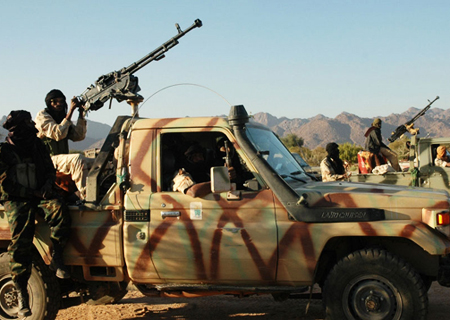
Tuareg rebels near the Sahara desert

Both options have difficulties. Northern Mali as an independent state of Azawad has no natural resources, a small population and few educated people to administer a state or to develop any economy beyond that of camel nomadism. In addition, most African states are opposed to carving up existing states or changing frontiers—a Pandora’s box as many states could be redrawn on ethnic lines and frontiers changed. Thus “territorial integrity” is an article of faith.

Ansar Dine’s option of an Islamist Mali is also difficult to realize. The Bambara and the Malinké are the largest groups in the country and hold economic, military, and political power. Ideologically, they are opposed to the Islamic vision of Ansar Dine, being more Sufi-influenced with a large measure of traditional African beliefs and practices mixed in.(1) Thus the possibility of Ansar Dine gaining support in the south of Mali is slight.  However, they may be able with force of arms to impose their views on Timbuktu and Gao but not on the northern countryside.  The Tuareg are not Islamist by tradition.  Yet in the two cities, the Ansar Dine may be able to force women to cover their hair, prevent the sale of wine and cut the hands of robbers—these three practices being the extent of their knowledge of Islamic law.

Faced with the difficulties of having a northern Malian state—Azawad—accepted by the power-holders of Mali and the neighboring states, there have been some discussions among Tuareg leaders and a former Malian government leader in Nouahchott, Mauritania. There have been no official statements coming from these talks, in part because both north and south Mali are in administrative disorder.  No one knows how much authority the persons involved have.  For the moment, it is probably at best “Track II” diplomacy, trying to see what are the aspirations, the limits of the acceptable, and the degree of the willingness to compromise. In the past France and Algeria have mediated disputes between the Tuareg and the central government of Mali. There have been past agreements on autonomy for the Tuareg.  However, these agreements have rarely held and more centralized government was slowly restored. I believe that this is due more to the incapacity of the Tuareg to provide trained people to run a decentralized administration than ill will or a desire of control on the part of the central government.

Yet, in the past, a “declaration of independence” for northern Mali was never proclaimed. Now that a powerful segment has declared the independence of Azawad, can they go “backward” and accept greater autonomy within a unified Mali?

Echoes from the current Nouachott talks have spoken of a “Federation of Mali”. The name has already been used. The Mali Federation with Senegal was achieved briefly on the eve of independence and lasted for 506 days from April 1, 1959 until August 19, 1960 when it fell apart during the conflict between the President of Senegal, L. S. Senghor and his Prime Minister Mamadou Dia, largely over the division of authority between the two posts.

Because of the way these events occurred, Mali was deprived of its principle outlet to the sea —Dakar, for three years.  Attempts to revive federalism between Mali, Guinea, and Ghana, two other states which had also chosen an anti-colonial “socialist” policy, proved futile.(2) Mali, which had been known as Soudan during the French colonial period, took the name Mali on the suggestion of President Senghor of Senegal from the 14th century empire which covered much of what is today Senegal, Mali and part of Niger.(3)

Can a new Mali Federation of the two sections of the current Mali work better than the earlier Federation of Mali?  With good will and imagination, federalist structures should be able to be worked out. Yet there are times when good will and imagination are in short supply.


Rene Wadlow is the President and Chief Representative to the United Nations, Geneva of the Association of World Citizens.

Notes:

1) See the classic study: Germaine Dieterlen, Essai sur le religion Bambara (Paris,:Presses Universitaires de France,1951)

2) See: Ruth Schachter Morgenthau, Political Parties in French-speaking West Africa (Oxford: Clarendon Press, 1964)

William J. Foltz, From French West Africa to the Mali Federation (New Haven: Yale University Press, 1965)

3) Raymond Mauny, Tableau géographique de l’Ouest africain au Moyen Age (Dakar: IFAN, 1961)

World Citizens Call for Protection of Timbuktu, UNESCO Cultural Heritage Site and Center of Trans-Saharan Cultural History

In Africa, Conflict Resolution, Current Events, Human Development, The Search for Peace, World Law on April 8, 2012 at 8:47 PM

WORLD CITIZENS CALL FOR PROTECTION OF TIMBUKTU,

UNESCO CULTURAL HERITAGE SITE

AND CENTER OF TRANS-SAHARAN CULTURAL HISTORY


By René Wadlow


In an April 8, 2012 Appeal to Irina Bokova, Director-General of the United Nations Educational, Scientific and Cultural Organization (UNESCO), René Wadlow, President of the Association of World Citizens (AWC), welcomed UNESCO’s speedy effort to prevent damage to Timbuktu and called for negotiations between the Mouvement national de libération de l’Azawad (MNLA) and the Ansar Dine, a rival Tuareg group currently holding separate parts of the historic city.  The MNLA, led by its Secretary-General Bilal Ag Cherif, is the larger group and focuses on the creation of an independent state, Azawad, comprising northern Mali and possibly part of the Tuareg-inhabited area of northern Niger.

Ansar Dine, a smaller faction, is led by Ag Ghaley. It claims to want to create an Islamic state within all of Mali. Within or alongside Ansar Dine are Islamists from Algeria and Mauritania and probably other countries.  Some had been fighting in Libya and are heavily armed.  The aim of moving south toward non-Tuareg areas is, no doubt, unrealistic as Ansar Dine has no support in the more densely-populated south, inhabited by Bambara and Malenke ethnic groups. However, there could be an armed struggle for power between the MNLA and Ansar Dine in which the fragile, backed mud building of Timbuktu could be destroyed or badly damaged.

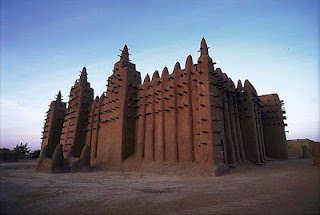
Timbuktu, a jewel of African culture and history, stands proud and tall in the desert sands of Mali.

While Timbuktu was once a metaphor for the middle of nowhere, it was an important city for the trans-Sahara trade from about 800 until 1591 when Moroccan troops destroyed the then Songhai Empire of Mali and Portugal and others developed a sea-going trade that largely replaced the trans-Sahara trade. (1). During the time that trade flourished, scholars and religious preachers were attracted to Timbuktu and Gao, the other trans-Sahara “port” and learning was highly developed.

The protection of Timbuktu’s cultural wealth may depend a good deal on the role of non-governmental organizations to facilitate negotiations between the MNLA the Ansar Dine and possible other armed groups. For the moment, the political situation in Mali is confused, and the protection of cultural sites in Timbuktu must not rank very high on the list of priorities.

From March 22 until April 6, 2012, a military group of young officers had taken control of government buildings in Bamako claiming that the government of President Amadou Touré was incompetent in the struggle against the Tuareg.  The coup was more or less led by Captain Amadou Sanogo, who had been trained by the United States (U. S.) Marine Corps, but Sanogo was probably acting on his own and not on behalf of the U. S. Marines.  The negative reaction to the coup was speedy.  Led by France, the former colonial power, the United Nations Security Council decided on April 4 to issue a President’s Statement (less strong than a resolution but on which all states must be in agreement) calling for a restoration of the civilian government.  It is not likely that the civilian-led government of President Touré will be restored.  Touré was himself a former general who had come to power in a coup, then governed in a fairly democratic way but without making many socio-economic advances.  The country now faces a food crisis due in part to drought and in part to the lack of improvements in the agricultural production and distribution system.

While the UN Security Council was meeting, the 15-member Economic Organization of West African States (ECOWAS) also met, calling for a return to a civilian government and closing the frontiers.  During the ECOWAS meeting, it was decided to activate the Anti-Terrorism Centre which is located at Tamanarasset in south Algeria and to place some 2000 soldiers on alert. Captain Amadou Sanogo saw the “handwriting on the wall” and agreed to turn over the government to the President of the National Assembly who is the constitutional replacement when the President is absent.

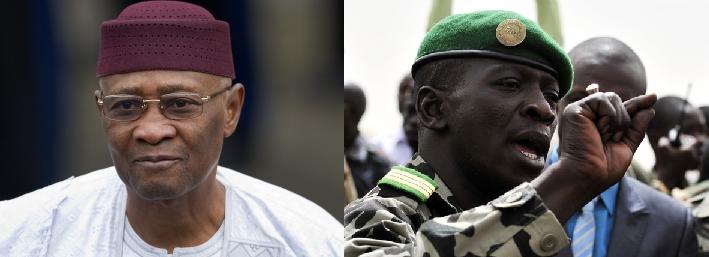
President Amadou Touré of Mali (left) and his rival, Captain Amadou Sanogo of the Mali military (right).

The states in the UN Security Council and in ECOWAS refused to recognize the creation of the Tuareg state of Azawad, so it is unlikely that they will provide any mediators to negotiate between MNLA and Ansar Dime or to facilitate the protection of historic sites. There is on the part of many governments a dislike of carving up existing countries in order to create new states. It took fighting from 1982 to 2005 for there to be an agreement to create the new state of South Sudan and for other African states to agree to the division.

The military in Bamako do not seem organized or willing to die to retake northern Mali, especially since most of the Mali military are from the Bambara ethnic group with little attachment to northern Mali in any case.

Much of the initiative for the protection of educational and cultural institutions has come from the NGO world and world-mined artists. Early efforts were undertaken by Nicholas Roerich (1874-1947) a Russian and world citizen.  Nicholas Roerich had lived through the First World War and the Russian Revolution and saw how armed conflict can destroy works of art and cultural institutions.  For Roerich, such institutions were irreplaceable and their destruction was a loss for all humanity.  Thus, he worked for the protection of works of art and institutions of culture in times of armed conflict. He envisaged a universally-accepted symbol that could be placed on educational institutions in the way that a red cross had become a widely-recognized symbol to protect medical institutions and medical workers.  Roerich proposed a “Banner of Peace” — three red circles representing the past, present, and future — that could be placed upon institutions and sites of culture and education to protect them in times of conflict.

Roerich mobilized artists and intellectuals in the 1920s for the establishment of this Banner of Peace.  Henry A. Wallace, the US Secretary of Agriculture and later Vice-President was an admirer of Roerich and helped to have an official treaty introducing the Banner of Peace — the Roerich Peace Pact — signed at the White House on April 15, 1935 by 21 States in a Pan-American Union ceremony. At the signing, Henry Wallace on behalf of the USA said “At no time has such an ideal been more needed. It is high time for the idealists who make the reality of tomorrow, to rally around such a symbol of beauty, science, education which runs across all national boundaries to strengthen all that we hold dear in our particular governments and customs. Its acceptance signifies the approach of a time when those who truly love their own nation will appreciate in addition the unique contribution of other nations and also do reverence to that common spiritual enterprise which draws together in one fellowship all artists, scientists, educators and truly religious of whatever faith.”

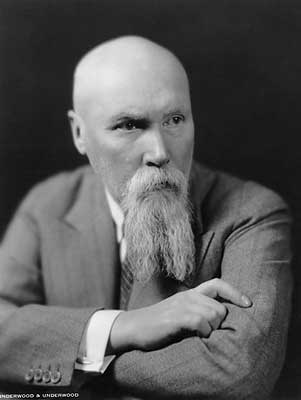
Nicolas Roerich (1874-1947), the man who opened the drive to make protection of works of art a full-fledged part of the law of armed conflict.

After the Second World War, UNESCO has continued the effort, and there have been additional conventions on the protection of cultural and educational bodies in times of conflict.  The most important is the 1954 Hague Convention for the Protection of Cultural Property in the Event of Armed Conflict. The spirit of the Hague Convention is clear and the protection of cultural and educational institutions should be a priority in conflicts among States or in civil wars even if no State recognizes Azawad.

Therefore we, as World Citizens, all have a duty to articulate more clearly the crucial link among human rights standards, humanitarian law, and world law to protect educational and cultural institutions in times of conflict.  As Nicholas Roerich said in a presentation of his Pact “The world is striving toward peace in many ways, and everyone realizes in his heart that this constructive work is a true prophesy of the New Era.  We deplore the loss of libraries of Louvain and Oviedo and the irreplaceable beauty of the Cathedral of Rheims.  We remember the beautiful treasures of private collections which were lost during world calamities.  But we do not want to inscribe on these deeds any words of hatred. Let us simply say: Destroyed by human ignorance — rebuilt by human hope.

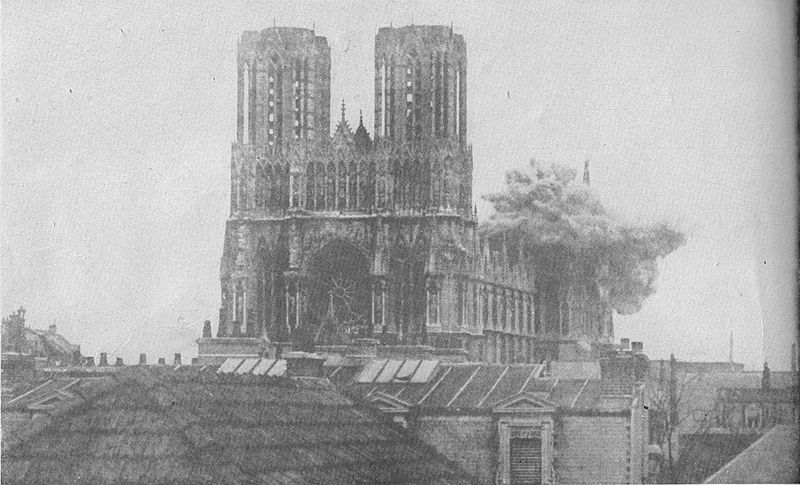
In 1914, a shell explosion at the Cathedral of Rheims in the early times of World War I.
Almost a century later, can the world possibly let Timbuktu become a "casualty of war" too?


René Wadlow is President and Chief Representative to the United Nations Office at Geneva of the Association of World Citizens.


(1)   See  Raymond Mauny Tableau géographique de l’Ouest africain au Moyen Age (Dakar, IFAN, 1961, 587 pp.)

In English : Horace Miner, The primitive city of Timbuctoo (Princeton: Princeton University Press, 1953, 297pp.)

The Horn of Africa: Refugees, Famine, Conflicts

In Africa, Conflict Resolution, Current Events, Solidarity, The Search for Peace, United Nations, World Law on July 31, 2011 at 11:24 PM

THE HORN OF AFRICA: REFUGEES, FAMINE, CONFLICTS

By René Wadlow


Only a crisis — actual or perceived — produces real change.  When the crisis occurs, the actions that are taken depend on the ideas that are lying around.  That, I believe, is our basic function: to develop alternatives to existing policies, and to keep them alive and available until the politically impossible becomes politically inevitable.

– Milton Friedman


Heavy fighting started again on July 28, 2011 in Mogadishu, the capital of what was once Somalia, in a battle between the African Union peacekeeping force (Amisom) and the Islamic insurgency al-Shahab. The fighting prevents aid from reaching the tens of thousands of refugees who have arrived in Mogadishu fleeing famine. The United Nations (UN) World Food Program says it cannot reach some two million people in need in areas controlled by al-Shahab which had expelled Western nongovernmental organizations (NGOs) who were providing relief.

The Horn of Africa, in particular Ethiopia, Somalia and Kenya, faces a deep crisis, a combination of refugee flows, famine in part linked to drought, and persistent conflicts.  There is a broad consensus in the UN system that radical measures are needed to deal with the Horn of Africa crisis and that these measures will have to be taken in a holistic way with actions going from the local level of the individual farmer to the national level with new government policies, to measures to be undertaken by the African Union and the UN system, in particular the Food and Agriculture Organization (FAO) in Rome.

Combatants with Somalia's al-Shabab Islamist militia.

Today, cooperation is needed among the UN family of agencies, national governments, NGOs, and the millions of food producers. There is a need for swift, short-term measures to help people now suffering from lack of food, inadequate distribution and situations of violence. Such short-term action requires additional funding for the UN World Food Program and the release of national food stocks. However, it is the longer-range and structural issues on which world citizens have focused their attention. The world requires a World Food Policy and a clear Plan of Action.

While constant improvements in technology, mechanization, plant breeding and farm chemicals have steadily increased food production per acre in much of the world, African food production per acre has stagnated, and in some areas has gone down. Likewise, the portion of development assistance in Africa dedicated to agriculture has declined from 15 per cent in the 1980s to 4 per cent in 2006.

As a July 11, 2011 UNCTAD study Economic Development in Africa stresses “One of the major challenges which African countries currently face is to generate productive jobs and livelihoods for the 7-10 million young people entering the labor force each year. This is difficult to achieve simply through commodity exports but rather requires a complementary process of agricultural productivity growth and development of non-agricultural employment opportunities in both industry and services.”

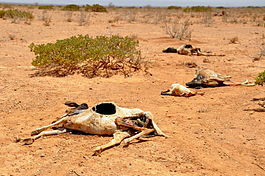
Carcasses of dead sheep and goats in the drought-stricken region of Waridaad, Somaliland.

Thus, the first need in Africa is to develop the local economies: currently, poverty, lack of adapted technology, population pressure on ecologically fragile areas, a growth of urban slums due to rapid rural to urban migration is the lot of many Sub-Saharan African countries.

Increased action to improve rural life needs to be taken quickly.  As the recent UN-sponsored Millennium Ecosystem Assessment warns “Human activity is putting such strains on the natural function of Earth that the ability of the planet’s ecosystem to sustain future generations can no longer be taken for granted. It is becoming ever more apparent that human society has a rapidly shrinking window of opportunity to alter its path.”

The Horn of Africa is an extreme case. The Horn possesses all the resources needed to make it one of Africa’s major economic centers, and yet there seems to be no halting the environmental decay and political insecurity it engenders. In fact, when one looks at the Horn’s problems, one must conclude that urgent and well-directed international action is needed to prevent a mega-disaster. Due to an often unenlightened management of the environment, its willful mismanagement to extract short-term economic gain, and confrontational rather than conciliatory policies, the squandering of the region’s resources has gathered speed.

A map of the ongoing famine in the Horn of Africa. The facts speak for themselves.

Environmental degradation is part of a cycle that upsets the traditional balance between people, their habitat and the socio-economic systems by which they live. Insecurity leads to strife; strife results in inter-clan feuding, civil war, cross-border raiding and military confrontation. Environmental degradation and insecurity continue to interact, swinging back and forth like a pendulum of destruction. A shrinking resource base breeds insecurity; insecurity spreads conflict, and conflict causes environmental destruction.

It is hard to know how to improve the situation. There is a long-term need for people to modify their living patterns to bring about a better quality of life, with increased security.  There is a need to break the cycle of chaos so that people can transform insecurity into confidence. Yet social change is slow, and the necessary limiting of the birth rate can take generations. Agricultural patterns also change slowly. There is no political leadership within the area, and there is no cooperation among the states of the Horn. The African Union’s conflict management structures do not function, and the UN has hoped that the African Union could take the lead in the area’s conflict resolution. This was a hope based on an unwillingness to get involved rather than a realistic evaluation of the situation.

The cycle of chaos is likely to speed up, and more refugees will be on the move.  However, as Milton Friedman noted only a crisis produces real change. Just as the “Arab Spring” brought a new generation of leadership into action — though not yet into power — the Horn of Africa might see a new generation of non-governmental leadership coming to the fore. The older political and clanic leadership has failed and is discredited. However, they have guns and plan to stay in control. Yet what is politically impossible today in the Horn may become politically inevitable.


René Wadlow is Senior Vice President and Chief Representative to the United Nations Office at Geneva of the Association of World Citizens.

See also Somalia: Signs of Danger (https://awcungeneva.wordpress.com/2011/05/17/somalia-signs-of-danger/)

Will the UN be a Fairy Godmother for the Birth of South Sudan?

In Africa, Current Events, United Nations, World Law on July 9, 2011 at 9:46 PM

WILL THE UN BE A FAIRY GODMOTHER FOR THE BIRTH OF SOUTH SUDAN?

By René Wadlow

On July 9, 2011, South Sudan became an independent State, six months after the January referendum in which the south Sudan population voted overwhelmingly for independence. However, Sudan is not really structured to be divided in two. There are no natural dividing lines, neither physical nor social. During much of the English colonial period, southern Sudan was administered from Uganda as road communications were easier than from Khartoum, the capital in the north of the country. In fact, ‘administered’ is too strong a term. South Sudan had no real crops for export or minerals to mine, and so there was very little administration. In place of any government development activities, the Colonial Office encouraged Christian missionaries, mostly Church of England and Roman Catholic to set up schools and clinics. Thus south Sudan was ‘Christianized’ in that the educated had gone to church schools and been treated in Christian clinics. However, most people continued also to practice traditional rituals as these were considered as part of tribal life and not as the rituals of a particular religion. Thus when considering Sudan, the often-used terms of ‘Muslim’, ‘Christian’, and ‘Animist’ cover a more complex reality.

In December 2010, no less than 98.83% of South Sudanese voters chose independence at the polls.

Complexity is a term which is true for all Sudanese life — political, economic, and geographic. The failure to deal creatively with complexity has led to fighting for nearly all of its history as an independent State since 1956. On the eve of Independence, with the makeup of a new national army being the spark which set the fire, civil war broke out, basically on a North-South basis. There have been two phases to the Sudan Civil War. The first phase (1954-1972) had ended with negotiations facilitated by the All-African Conference of Churches with back up help from the World Council of Churches in Geneva.

The 1972-1982 decade was one of relative peace, but it was not used to heal the divisions or to work out forms of government, administration, and legal systems that would be acceptable to all segments of Sudanese society. International attention on Sudan had diminished once the 1972 peace agreement was signed. The warning signals that all was not well were ignored internationally. Thus in 1982, southern soldiers who had been integrated into the national army revolted, and the second phase of the civil war continued from 1983 until the end of 2004.

As a North-South peace agreement was nearly set, groups in Darfur, western Sudan, who had not been part of the North-South conflict decided that violence was the only way to get attention and to get a ‘piece of the pie’ of the natural resources, especially the oil revenue. They hoped for a short war after which they would be invited to participate in the North-South negotiations. In practice, the Darfur conflict has not been short — starting in 2003 and continuing still today, and the Darfur factions have not been invited to the North-South negotiations.

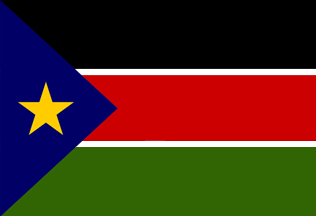
The flag of the Republic of South Sudan, originally the flag of the Sudanese People's Army/Movement (SPLAM).

Darfur (the home of the Fur) was always marginal to the politics of modern Sudan. In the 19th century, Darfur, about the size of France, was an independent Sultanate loosely related to the Ottoman Empire. It was on a major trade route from West Africa to Egypt and so populations from what is now northern Nigeria, Niger, Mali and Chad joined the older ethnic groups of the area: the Fur, Masalit, Zaghawa and the Birgit. Nomads from Libya also moved south into Darfur. As the population density was low, a style of life with mutual interaction between pastoral herdsmen and settled agriculturalists with some livestock developed. Increasingly, however, there was ever-greater competition for water and forage made scarce by environmental degradation and the spread of the desert.

France and England left Darfur as a buffer zone between the French colonial holdings — what is now Chad — and the Anglo-Egyptian controlled Sudan. French-English rivalry in West Africa had nearly led earlier to a war — the Fashoda crisis of 1898. Thus a desert buffer was of more use than its low agricultural and livestock production would provide to either European colonial power. It was only in 1916 during the First World War when French-English colonial rivalry in Africa paled in front of the common German enemy that the English annexed Darfur to the Sudan without asking anyone in Darfur or the Sudan if such a ‘marriage’ was desirable.

Darfur continued its existence as an environmentally fragile area of Sudan. It was marginal in economics but largely self-sufficient. Once Sudan was granted its independence in 1956, Darfur became politically as well as economically marginal. Darfur’s people have received less education, less health care, less development assistance and fewer government posts than any other region.

The seal of the government of the new sovereign nation.

In 2000, Darfur’s political leadership had met and wrote the Black Book which detailed the region’s systematic under-representation in national government since independence. However, at the level of the central government, the Black Book led to no steps to increase the political and economic position of Darfur. This lack of reaction convinced some in Darfur that only violent action would bring recognition and compromise as the war with the South had done.

An armed insurgency began in 2003 led by the more secular but tribal Sudan Liberation Army (SLA) and the Islamist-leaning Justice and Equality Movement (JEM). Since then, there have been splits in the JEM and the SLA largely along tribal lines. These splits make negotiations with the government of Sudan all the more difficult. The interests of many people in Darfur are not represented by either the government or the insurgencies, but it is nearly impossible for other voices to be heard.

In Darfur, there is a joint African Union-UN peacekeeping mission (UNAMID), but there is no peace to keep. Although the peacekeeping force has a mission to protect populations, it is unable to do so. As Mohammed Otham noted in his UN report (A/HRC/14/41) “In Darfur, notwithstanding the general improvement in the security situation, banditry, criminal activities and intermittent military activities by the parties to the conflict have continued. In some areas, aerial bombardment and troop mobilization by the Sudanese Armed Forces have been reported. In the context of this ongoing violence, United Nations and humanitarian personnel face significant risks to their lives. A significant number of UNAMID and humanitarian staff were deliberately attacked; some were abducted and held in captivity for long periods.” The level of suffering in Darfur — people killed and displaced, the agricultural infrastructure destroyed — has been very high. The reconciliation and reconstruction of Darfur will be difficult. We must be on the lookout for possibilities to help.

This is what the new country will look like in political and administrative terms. The AWC wishes South Sudan well and looks forward to working with its government toward the protection and promotion of world law.

The UN has had Special Representatives in Darfur responsible for facilitating negotiations, but they have made little progress. Darfur will continue as part of North Sudan and should be a priority of concern.

As there are no sharp natural or cultural dividing lines between North and South Sudan, there will be non-Muslim populations left in the North and Muslim populations in the South. We must hope that there will not be the massive transfer of populations as at the independence of India and Pakistan. There are possibilities of continued conflict in the northern non-Muslim areas such as the Blue Nile and Southern Kordofan provinces. There is also a mixed population on the frontier between North and South in Abyei. It is less the fact that the population is mixed than that the area is oil-rich that has attracted international attention. The UN Security Council in resolution 1990 of 29 June 2011 decided to establish the UN Interim Security Force for Abyei (UNISFA).

Thus, the United Nations is present as the Fairy Godmother at the birth of South Sudan. As in the folk tales, the Fairy Godmother has some presents for the newly born as well as certain conditions and demands. The UN brings few material goods, and peacekeeping forces have been largely unable to bring peace. However, the UN has brought the present of world attention, a willingness to help and high international standards to meet. We will have to watch closely as the newborn grows.

René Wadlow is Senior Vice President and Chief Representative to the United Nations Office at Geneva of the Association of World Citizens.

June 17: A UN Emphasis on the Wise Use of Dry Lands

In Africa, Environmental protection, Human Development, Solidarity on June 17, 2011 at 7:30 PM

JUNE 17 : A UN EMPHASIS ON THE WISE USE OF DRY LANDS

By René Wadlow

 
The World Day to Combat Desertification, June 17 each year, was proclaimed by the United Nations (UN) General Assembly in resolution A/RES/49/1995. The day has been observed since 1995. However United Nations efforts on Desertification began in 1977 with the UN Conference on Desertification held in Nairobi. The desertification conference was convened by the UN General Assembly in the midst of a series of catastrophic droughts in the Sudano-Sahelian region of Africa. The conference was designed to be the centerpiece of a massive worldwide attack to arrest the spread of deserts or desert-like conditions not only in Africa south of the Sahara but wherever such conditions encroached on the livelihood of those who lived in the desert or in their destructive path. The history of the conference is vividly recalled by James Walls in his book Land, Men and Sand (New York: Macmillan, 1980).

At the conference, there was a call for the mobilization of human and financial resources to hold and then push back the advancing desert. “Attack” may have been the wrong word and “mobilization” too military a metaphor for the very inadequate measures taken later in the Sudano-Sahelian area. Today, in 2011, there are real possibilities of famine in West and East Africa on the edges of the desert. Niger and Mali and parts of Senegal and Chad in the Sahel belt are facing the consequences of serious drought as are parts of northern Kenya and Somalia.

The most dramatic case is that of Darfur, Sudan which partakes of the Sahel drought but which also faces a war in which the conflicts between pastoralists and settled agriculturalists have become politicized. It is estimated that 300,000 have been killed since the start of the war late in 2003. Some two and a half million people have been uprooted. The agricultural infrastructure of homes, barns and wells has been deliberately destroyed. It will be difficult and costly to repair this destruction. The Darfur conflict highlights the need for a broader approach to the analysis and interpretation of active and potential armed conflicts in the Sahel region. This analysis needs to take into consideration the impact of environmental scarcity and climate variation in complex situations.

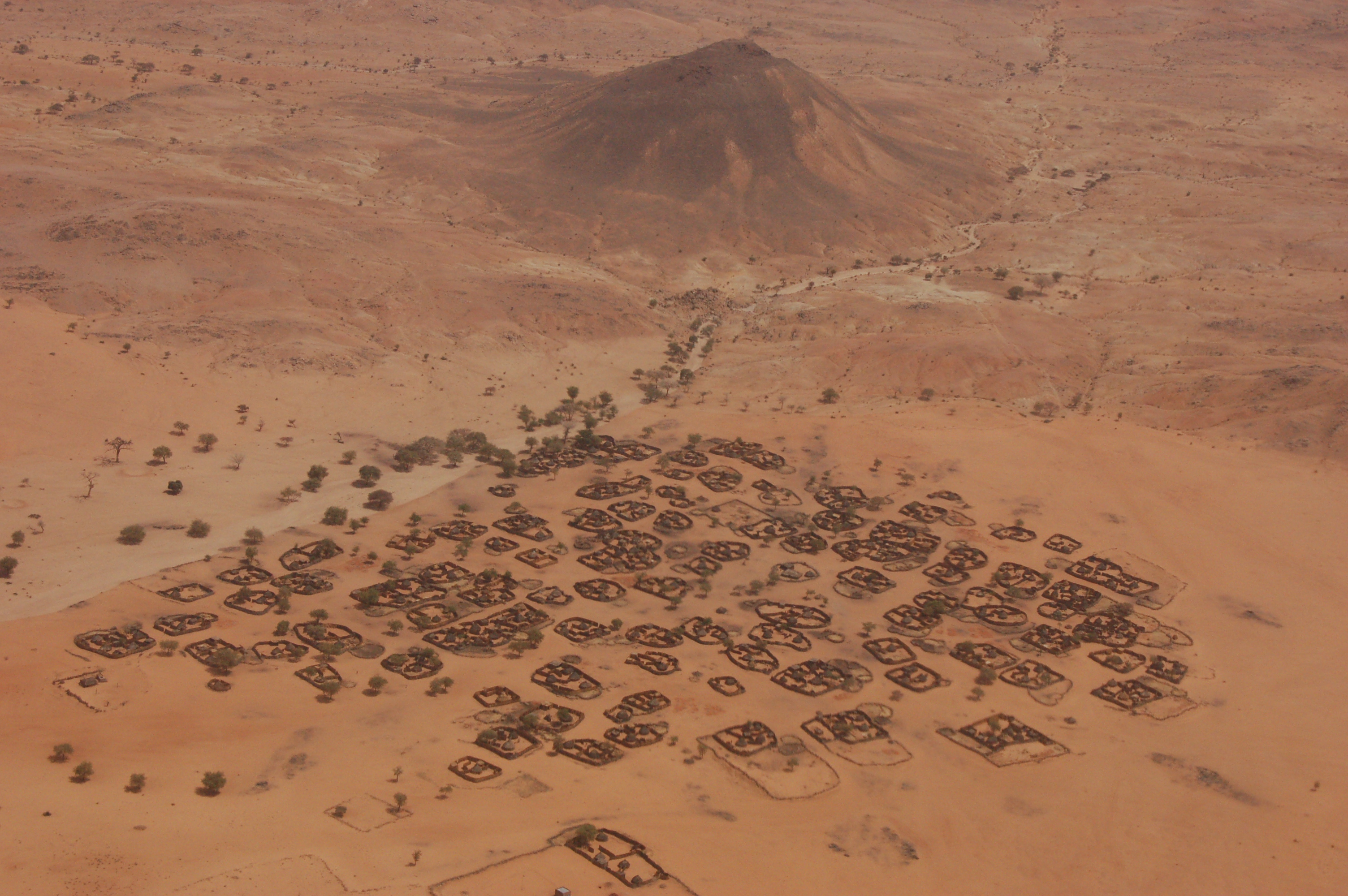
A settlement in the semi-desert north of El Fasher, Northern Darfur.

Earth is our common home, and therefore all, as world citizens, must organize to protect it. It is up to all of us concerned with ecologically-sound development to draw awareness to both the dangers and the promises of deserts. What is the core of the desertification process? The destruction of land that was once productive does not stem from mysterious and remorseless forces of nature but from the actions of humans. Desertification is a social phenomenon. The causes of dry land degradation include overgrazing, deforestation, agricultural mismanagement, fuel wood over-consumption, and industry and urbanization. Thus, by preventing land degradation and improving agricultural practices, action to combat desertification can lead to increased agricultural productivity and alleviate poverty. Humans are both the despoiler and the victim of the process. Increasingly, populations are eking out a livelihood on a dwindling resource, hemmed in by encroaching plantations and sedentary agriculturalists, by towns and roads. Pressure of population upon resources leads to tensions which can burst into violence as we see in Darfur and which spilled over into eastern Chad.

Desertification needs to be seen in a holistic way. If we see desertification only as aridity, we may miss areas of impact such as the humid tropics. We need to consider the special problems of water-logging, salinity or alkalinity of irrigation systems that destroy land each year. The value of UN-designated Days is the creation of a process of identifying major clusters of problems, bringing the best minds to bear on them so as to have a scientific and social substratum on which common political will can be found and from which action will follow.

Desertification is a plague that upsets the traditional balance between people, their habitat, and the socio-economic systems by which they live. Because desertification disturbs a region’s natural resource base, it promotes insecurity. Insecurity leads to strife. If allowed to degenerate, strife results in inter-clan feuding, civil war, cross-border raiding and military confrontation. Yet dry land communities have great resources that can be put to fighting poverty and desertification, provided they are properly empowered and supported.

In China, desertification spreads 1,300 square miles per year.

Only with a lessening of insecurity can cultivators and pastoralists living in or near deserts turn their attention to adapting traditional systems. There can be no reversion to purely traditional systems. But for insecurity to abate, a lengthy process of conciliation must begin and forms of conflict resolution strengthened. People must be encouraged to understand that diversity is a crucial element of ecologically-sound development. Judicious resource management breeds security and an improved quality of life for everyone. We can see what efforts can be made to encourage reforestation and to slow the unwanted advances of deserts.

The contrast between widespread rural poverty and environmental degradation, on the one land, and the opportunities which can be created on a small scale through community empowerment, access to groundwater and sustainable land management, defines the ideals of the Day. The Day is not about fighting deserts, it is about reversing land degradation trends, improving living conditions and alleviating poverty in rural dry lands. Thus, the World Day to Combat Desertification can be a Day during which we can learn more of the lives of the people in and on the edge of the deserts.

Even trees can grow in the desert ... A sign of hope indeed. Now let's act on it.

Deserts can also have a positive image. There is a significant role in the literature and mythology of spirituality — the 40 years in the desert before entering the “Promised Land” of Israel, the 40 days in the desert before starting his mission for Jesus, the life in the desert of the early Christian church fathers. Today, there are an increasing number of spiritual retreats in the desert chosen for its silence and for the essential nature of the landscape. Thus, during this Day our emphasis must not be on “combat” but on wise and ecologically-sound use of dry lands.

René Wadlow is Senior Vice President and Chief Representative to the United Nations Office at Geneva of the Association of World Citizens.

Somalia: Signs of Danger

In Africa, Conflict Resolution, The Search for Peace on May 17, 2011 at 10:44 PM

SOMALIA: SIGNS OF DANGER

By René Wadlow


            Although Somalia is in a crucial geo-strategic position on the Horn of Africa facing the Arabian peninsula, the country had largely slipped from world attention except for African specialists. The government had disappeared in 1991, proving that people can live without a State if there are sub-State institutions of order and dispute settlement. Thus what order existed was the result of local warlords and clanic chiefs who provided order in very small areas, often only one town and a small area around it. In July 2006, a revitalized Islamic movement — the Union of Shari’a Courts — took control of the capital Mogadishu and in the months following extended its control to much of the country. There was a fear in other countries that Somalia could serve as a base for terrorist activities on the pattern of Afghanistan. On December 6, 2006, the UN Security Council passed Resolution 1725 which authorized the creation of a regional African peacekeeping force to enter Somalia. The creation of such a multi-state force under the authority of the African Union seemed unlikely in the near term. The African Union forces are tied up in the Darfur, Sudan conflict. Therefore, Ethiopian troops moved in at the request, it is said, of the Transitional Federal Government. Ethiopia has the best trained and equipped army in the Horn of Africa. The Ethiopian forces quickly defeated the loose coalition of clanic militias which were supporting the Union of Shari’a Courts. On December 28, 2006, Ethiopian troops and representatives of the Transitional Federal Government moved into the capital Mogadishu. Thus an analysis of the background of the conflict in Somalia is merited as the conflict has potentially wider implications.

            As William Zartman points out in his recent book  Cowardly Lions  “In a world scarred by State collapse and deadly conflict, external actors can no longer sit by and watch, mesmerized by the blood on their television screens. Nor can they hide behind the fear of their own casualties or long-term involvement as an excuse for inaction. External engagement is required when it is necessary to protect populations from their rulers and from each other. Such protective engagement is justified for its own sake, for humanitarian reasons, and for preventive security purposes, because these conflicts will continue to destabilize their regions and impose costlier involvement later on… The terrible fact is that in the major cases of state collapse in the post Cold-War era, specific actions identified and discussed at the time could have been taken that would have gone far to prevent the enormously costly catastrophes that eventually occurred… The reason why no action was taken also varies, ranging from loss of nerve to preoccupation elsewhere.” (1)

            The UN General Assembly resolution on Somalia is an indication of a growing consciousness that international action must be taken early in a conflict before positions harden. The longer a conflict lasts, the more likely the parties will harden their positions to justify the costs in lives and money that has gone on before. With the entry of Ethiopian troops into Somalia in support of the Transitional Federal Government (TFG), the Somalia crisis seems to observers to be at a critical stage when the intensity of the conflict could escalate.  Thus the need for action, although there is no clear view on what action should be taken. The first step to analyze the possibilities of action is to place the Somalia conflict into a historical and sociological framework so that alternative international actions stand out clearly.
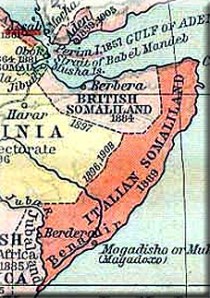
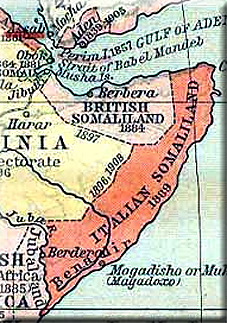
An old map of Somalia as a colony of Britain and Italy.

            In 1960, the Somali Republic was created by the union of a British colony and an Italian trusteeship area. The start of European involvement in Somali affairs began in 1902 when Italy, France, and Britain signed a Tripartite Convention that saw the Somalis divided between France taking Djibouti — a potentially important port and the terminal of the railroad to Ethiopia, the British which created Somaliland and also attached a separate area of Somali-speaking people to its Kenya colony, and Italy which created a separate colony of Italian Somaliland. The European powers recognized the expansion of the Ethiopian Empire under the leadership of Emperor Menelik which had taken control of the Ogaden area, inhabited largely by Somalis.

            The British and Italian Somali colonies existed from 1902 until 1945. At the end of the Second World War, the Italian colony was placed under a UN administration as was all of Italy’s former African holdings. From 1945 to 1950, Somalia was governed by UN administrators. By 1950 Italy had regained international respectability and so Italian Somaliland was returned to Italy under a UN Trusteeship Council mandate.

            1960 was a turning point for African independence. Although there was not among the Somalis a strong anti-colonial movement as there had been in North and West Africa, by 1960 both the French and the English believed that the colonial system as it had existed in Africa since the 1880s could no longer continue. There was a systematic granting of independence of the French colonies in 1960 and a drawn out granting of independence to the British colonies. Italy went along with the tide. Thus in 1960, both the UK and Italy granted independence to its Somali holdings and combined the two into the new state of the Somali Republic. However, there was a five day gap between the granting of independence to the UK colony and its integration into a united Somalia. This five-day status of independence now serves as the basis for the independence of the former British colony called again Somaliland, declared in 1991.
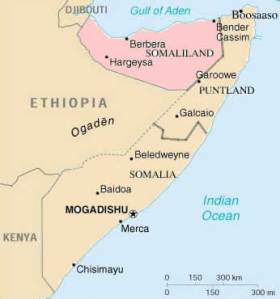
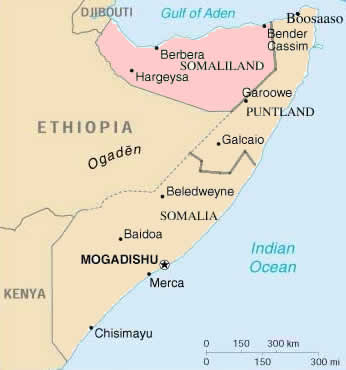
The once-united nation of Somalia now stands divided in three separate entities: Somalia proper, Puntland, and Somaliland.

           By and large, the different colonial administrations had little impact on the lives of the Somali populations. The Somalis speak the same language and practice the same forms of Sunni Islam.  The divisions among the Somalis are not tribal but clanic, with clans being followed by sub-clans, lineages, and extended families. Lineage is the most important identity. Thus one has frequent intra-clan tensions as well as inter-clan disputes. The sub-clan and lineage are the core social institutions providing personal identity, mutual support, access to local resources, and the framework of customary law, called xeer in Somali. It has been said that Somalis live in societies with rules but without rulers.

           The pastoral clan organization in Somalia is a fragile system characterized at all levels by shifting allegiances, temporary coalitions and ephemeral alliances. Lineages usually exist for three generations at which time they split and form new lineages. In such a clanic, largely pastoral society, one does not need state institutions to function. Clans are not all equal; some are severely disadvantaged due to their social status and therefore had less access to water and grazing land. There are, however, some people who lived outside the Somali clanic system. There is a small minority on the frontier with Kenya who are agriculturalists and not Somalis.  There are also a small number of urbanized Somalis, especially those living in the coastal cities who no longer followed clanic authority, as well as a small but growing educated bourgeoisie. (2)

            The great majority of Somalis are Muslim. Somali Islam is largely Sufi based with three major Sufi orders: Qaadariya, Saalihiya and Ahmadiya with other smaller groups or followers of particular saintly figures. By and large, the Sufi orders have been non-political, but the best known of the anti-colonial Somali leaders was a member of the S aalihiya order. Sayed Mohammed Abdille Hasan, called by the English “the Mad Mullah” led a 20 year struggle against Ethiopia, Italy and England starting in 1899 against Ethiopia and ending with his death in 1920.  He had been influenced by the earlier Madhi movement in Sudan.

            Sufi Islam is largely non-legalistic, placing a large emphasis on the teachings and lives of local saintly persons. Somali Sufi orders have integrated into the customary law (xeer) certain elements of Shari’a law especially as concerns family law – divorce and inheritance.

            During the last 25 years, and especially since 1991 with the end of state institutions, three other currents of Islam have been present and which are important in the analysis of the current political situation. Somalia is in the orbit of Wahhabist preaching sponsored by Saudi Arabia. This is a conservative, legalistic Islam, part of a wider Salafist movement. The Wahhabist school of thought has a good deal of Saudi money to open schools and medical clinics at a time when state facilities have largely disappeared.  There is a reformist Islamic movement, Al Islah, which is heavily influenced by the Egyptian Muslim Brotherhood and has some contacts within Pakistan. More important politically, there is a more radical At Itihad al Islamiya movement which is willing to use violence to further its aims. These non-Sufi movements are largely limited to larger towns and the few cities, but they have support from outside Somalia. (3)

            The first 10 years of independent Somali political life was largely a reflection of clan and sub-clan reality. The Parliament and the higher administration was structured on clanic reality. Government posts, seats in Parliament and government favors were distributed along clanic lines. The army was the only institution of the state that was not originally structured along clanic lines. Then in 1969, General Mohamed Siad Barre took control of the government.  His ideology was an anti-clanic “scientific socialism” drawn from his limited reading of Soviet philosophy. However, he received support from the USSR, thus bringing Somalia into the Cold War. The Cold War helped to partition Africa into ideological spheres of influence. In order to counter Soviet influence in Somalia, the USA increased its support for conservative Emperor Haile Selassie of Ethiopia.
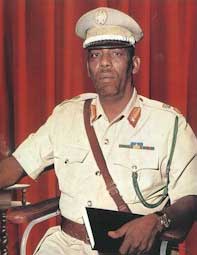
General Mohamed Siad Barre, President of Somalia from 1969 to 1991 and the country's very last head of state.

            Siad Barre, with the help of Soviet advisors, increased the size of the Army and the paramilitary forces. By 1982 there were some 120,000 men in the army with political commissars to develop ideological purity. Unlike the colonial period and the first years of independence during which the rural areas were left alone, Siad Barre extended government control to the rural areas, weakening clanic chiefs. Siad Barre also largely destroyed the independent bourgeoisies; some were jailed, more left the country to work elsewhere.

           Siad Barre, followed by probably the majority of Somali leaders, had a pan-Somali ideology which maintained that those areas of Kenya and Ethiopia where Somalis live should be joined to Somalia. The ideology had already led in the mid-1960s to attacks on Kenya which were quickly pushed back and then a much bloodier 1977-1978 war with Ethiopia in an effort to annex the Ogaden area where most of Ethiopia’s Somalis live. The fighting in Ogaden brought heavy losses to both armies. While Ethiopia pushed back Somali troops, the losses have left deep scars in Ethiopia and a persistent fear of Somali policies.

           At the time of the 1977-1978 Ogaden War with Ethiopia, there was a classic Cold War switch of alliances. A Marxist, Mengistu Haile Mariam, overthrew the emperor of Ethiopia and looked to the Soviet Union for help. In 1978, Siad Barre abrogated the USSR/Somali Treaty of Friendship and turned to the USA for help with weapons and training of the military. As Barre was uninterested in U. S. liberal-democratic ideology, he returned to governing on a clanic basis with members of his lineage, that of his mother and that of his principal son-in-law. His style of government under U. S. influence from 1978 until the end of 1991 ranged from autocratic to tyrannical.

            With the end of the Cold War, neither the USA nor the USSR had much interest in supporting difficult and unpredictable allies. Thus by 1991 both Siad Barre and Mengistu had been forced from power by rebel movements. While Ethiopia, having a long history of a weak but centralized government, was able to re-establish a state structure, Somalia returned to a precolonial structure but with few of the conflict-resolution techniques of precolonial times. Thus, in addition to traditional clanic conflicts over water and livestock, there was a clash between traditional clanic leaders and army officers who had gotten a taste of power under Siad Barre and who now wanted to set up little militarized kingdoms over which to rule.

            The 1960 merger of the Italian and British colonies had been more based on a desire of the Europeans to withdraw than any Somali urge to merge. The former British area reorganized itself after 1992 and took back the name of Somaliland. The Somaliland area is about the size of England with some 3,5 million people. In 1993, Somaliland reintroduced the structures of government: tax, customs, and banking. Somaliland has trade to Arabia and beyond through the busy port of Berbera and is helped by the remittances from the Somaliland disaspora of about one million in Saudi Arabia and the Gulf States, in East Africa and some in Europe. Somaliland, the former British colony is calm and its administration largely unchanged in Hargeisa, its capital which has become a magnet for displaced middle-class Somalis. However, there is a deep fear among many African governments that if one African state breaks up, many could follow the same pattern. Thus no African government wants to recognize the independent existence of Somaliland, and Europeans and others will not go against the African consensus by recognizing Somaliland.
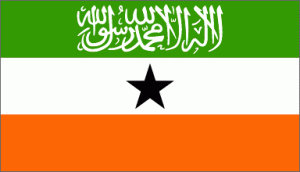
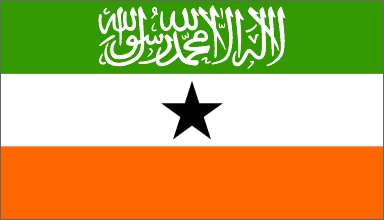
The flag of Somaliland as a would-be independent state.

            Thus, it is in the former Italian area and its capital Mogadishu where fighting is taking place and where the dangers of increased conflict exists. The following analysis concerns only this former Italian Somali colony.

            Siad Barre was in power from his coup in 1969 until January 1991. When he was forced from Mogadishu, he tried briefly to re-establish control but was finally forced into Kenya.  He died in exile in Nigeria in 1995. Those who had forced Siad Barre from power were never able to reorganize central control of the country, nor even of the former Italian area. The country was divided into small fiefdoms headed sometimes by clan leaders but more often by military officers who had served in the government of General Siad Barre and had gotten a taste for power and the wealth which came within. These “warlords” as they were called carved out fiefdoms which served as a base for the exploitation of confiscated properties; plantations for banana export, the arms trade, and drug trafficking.  Around the warlords are their business allies who run the plantations, make contacts with foreign companies  for banana exports, and especially organize the arms and drug traffics.

            The warlords used the clan and sub-clan organizations among ethnic Somalis to create alliances and build support. However, the warlords are not traditional clan leaders. There have always been conflicts among clans. However the violence in Somalia after 1991 was not caused by clan and sub-clan divisions but was a struggle for power among individuals. Once violence broke out, the clan and especially sub-clans provided a ready-made solidarity group, and old inter-clan disputes were reignited. (4)

            Fighting continued over the control of areas between two fiefs. The result was economic and political chaos, with most people living a day-to-day existence. Many of the youth have been taken into the forces of the warlords but receive no education  and even little military training. There are also independent bandit  bands interested in looting.

            Since governments do not like anarchy, there have been numerous efforts on the part of neighboring countries, in particular Kenya, to help the Somalis create a government. (5) After many failed efforts, there now exists a Transitional Federal Government (TFG) which is recognized by the African Union. The TFG is made up of some clan leaders, some warlords and some persons chosen from urban civil society. However, while people do not have much enthusiasm for a continuation of armed conflicts, there is little enthusiasm for the return of government either. Attitudes of animosity, suspicion, and hostility are dominant. It will have to be seen if the TFG is able to establish control over the country if the Ethiopian troops are withdrawn.

            The Transitional Federal Government is, no doubt, more transitional than federal. Most international mediators have preferred to focus on trying to stabilise Somalia before addressing the Somaliland issue. The TFG has as president Abdullahi Yussuf — a war lord turned president — but its authority was limited to one large town, Baidoa, 200 miles from Mogadishu. Into the political void, Islamic groups that have always been around tried starting in June 2006 to take the high ground. The al-Ittihad al Islaami (Islamic Unity, often called just al-Ittihad) is a loosely structured group which has taken in a few floating Islamic fighters, many of whom had been been in Afghanistan or Pakistan. They see the similarities between the chaos in Somalia and the time after the departure of the Soviets from Afghanistan when the resistance forces were fighting for control among themselves. They hope that with a Taliban-like ideology of “Order and Islam will solve all your problems”, the people would help them come to power to put an end to the divisions among the warlords.

           Most of these Islamist groups have created a loose structure called the Union of Shari’a Courts, sometimes called the Union of Islamic Courts. The current leader Sheikh Hassan Dahir Aweys is a former Army colonel as well as a former leader of the al-Ittihad though he claims that the Shari’a Courts have a broader base al-Ittihad. The Union of Shari’a Courts received funds but no troops from Saudi Arabian sources. The line between public and private funds in Saudi Arabia is never clear.

            Ethiopia was the regional state most concerned by the rise of the Shari’a Courts and their potential control of the country.  Ethiopia feared that the Shari’a Courts could revive the pan-Somali ideology as a way of rebuilding national unity and so might again try to join the Somali-populated Ogaden to Somalia. Since the 1977-1978 war, the Ogaden has taken on increased importance to Ethiopia. The area could have large quantities of gas but further exploration is needed to verify the amount and the possibilities to develop the field.

           As Ethiopia is helping the TFG, the Eritrean government angry with Ethiopia for unresolved frontier issues and resentments from the long struggle for independence from Ethiopia has sent some troops to aid the Union of Shari’a courts. Thus the TFG, in the spirit of “the enemy of my enemy is my friend” is trying to build links with the Eritrean Liberation Front, an armed insurgency against the Eritrean government.

            Kenya also has direct interests in Somalia — Kenya’s northeast province is populated by ethnic Somalis. From 1963 to 1967 there was on-and-off fighting between Somalia and Kenya as part of the then “Greater Somalia” policy. There are also some 135,000 Somali refugees living in Kenya, some of them involved in an active arms trade.

            Into these lands of intrigue, few want to adventure. Some countries, in particular the U. S. government, see the possibility of Somalia turning into a safe haven for al-Qaada networks. Sheikh Aweys of the Union of Shari’a Courts has already been designated as a terrorist by the USA for suspected links to al-Qaada. The USA has some 1,800 troops based nearby in Djibouti specializing in intelligence gathering and counter-terrorism. These U. S. troops are especially active since the 1998 attacks on U. S. embassies in Nairobi and Dar es Salaam which had been prepared in Somalia. The USA is unlikely to get directly involved, but they sponsored the 6 December 2006 UN Security Council resolution which opens the door to African peacekeeping troops.   

            Once Ethiopian troops moved massively into Somalia in mid-December 2006, the fighting in Somalia was brought to the attention of the UN Security Council. The USA and the UK prevented a resolution calling on all foreign troops to leave the country from being presented. The delay in passing any resolution gave time to the Ethiopian troops to fight the forces of the Union of Shari’a Courts. In fact, the Courts had few foreign forces helping them. In a tightly structured clanic society as Somalia, foreigners, even Muslims, stand out and are not welcome. There is a real risk of betrayal of foreigners who can not be integrated into the protective network of a sub-clan. The Shari’a Courts were able to draw on the militias of some sub-clans, drawing upon clanic loyalties rather than on ideological conviction. The support of these sub-clans melted away once they saw the superior fighting force of the Ethiopian army.  On December 28, Ethiopian troops and representatives of the TFG including Prime Minister Ali Muhamad Gedi and Vice Prime Minister Mohamed Hussein Aidid moved into Mogadishu with the top Shari’a Courts leaders going into exile in Yemen.

            It is too early to know if the TFG will be able to consolidate its authority since it is a coalition of clans, warlords and former administrators who have little in common. It is also too soon to know what policy Ethiopia will follow. Ethiopian Prime Minister Meles Zenawi has said that the troops will be withdrawn as soon as order is established. But who is to define “order”? It is important that those working for peace from outside Somalia follow developments closely. Somalia requires our constant concern.     


References

1)      I. William Zartman.Cowardly Lions: Missed Opportunities to Prevent Deadly Conflict and State Collapse (Boulder, CO: Lynne Rienner, 2005)

2)      I. Lewis. A Pastoral Democracy (Oxford: Oxford University Press, 1991)

3)      I. Lewis. Saints and Somalis: popular Islam in a clan-based society (London: Haan, 1998)

4)      I. Lewis. A Modern History of Somalia (Oxford: James Currey, 2002)

5)      International Crisis Group. Negotiating a Blueprint for Peace in Somalia (Brussels: ICG, 2003)


Rene Wadlow is the editor of the online journal of world politics www.transnational-perspectives.org. He is also the Senior Vice President and Chief Representative to the United Nations Office at Geneva of the Association of World Citizens. Formerly, he was professor and Director of Research of the Graduate Institute of Development Studies, University of Geneva.