By René Wadlow
Patrick Haenni and Jerome Drevon,
Transformed by the People: Hayat Tahrir Al-Sham’s Road to Power in Syria.
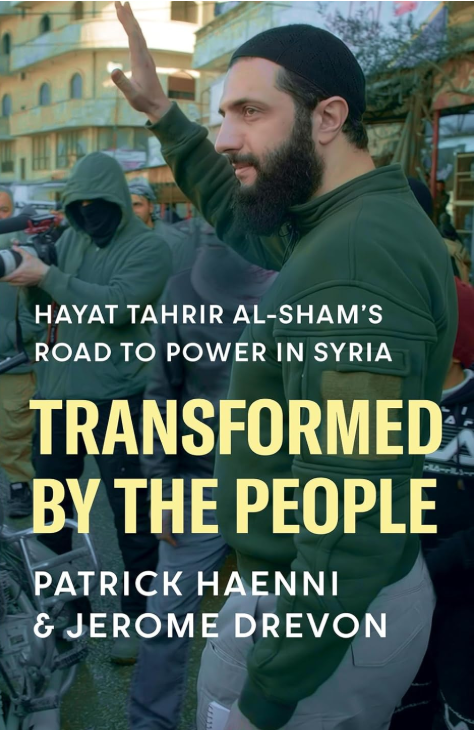
London: C.Hurst and Co, 2025, 331pp.
In December 2024, Ahmad al-Sharaa (formerly known by his battle name of Abu Muhammad al-Jolani) and his armed militia, Hayat Tahrir Al-Sham (HTS), took control of most of Syria. Bashar al-Assad and his close circle left for Moscow on December 8, 2024 after nearly fourteen years of destructive civil war. A convergence of disorganization, low morale in the al-Assad forces, and international disengagement as Russia was focused on Ukraine ultimately facilitated the takeover of Damascus by Ahmad al-Sharaa.
Earlier, between 2016 and 2024, al-Sharaa and the HTS had been in control of Idlib, a rural province in northwest Syria. There, the HTS clamped down on its more radical commanders, severed ties with global jihad movements, and created the Salvation Government to administer the province. Important local figures and Islamist actors unconnected to HTS continued to pursue their own agendas.
In Idlib, the HTS was faced with many aspects of governance as there were many different factions, ideological, religious and professional present. This response to the local social and religious environment – what can be called a process of localization – modified deeply the HTS, “transformed by the people”, the title of the book. Now the process of localization must be applied to the whole of Syria – a more complex challenge than in Idlib. The authors deal in detail with the policies put in place in Idlib and the difficulties faced.
Now, al-Sharaa faces the strong presence of the Alawites – some 15 percent of the population – a religious-ethnic group of which the al-Assad family were members. There have been revenge killings against the Alawites, some of whom have fled to Lebanon and Turkey. In addition to the Alawites, there is an active Druze community – some three percent of the population – also a religious-ethnic movement. There is also a Christian community. Christians make up about ten percent of the population with significant communities in Damascus, Aleppo, Homs and Latakia.
In addition to the strong ethnic-religious communities which must be integrated into a new Syrian society, there are women who represent at least half of the population. Over the past decade, Syrian women sought to integrate into the new power structures as they emerged in different parts of the country. There was also a distinct feminist mobilization aimed at the empowerment of individuals in all aspects of life. Western Nongovernmental Organizations provided training sessions and workshops for women. Women still play a minor role in public life. They hold few positions within administrative and policy circles. The role of women is an issue to be watched closely.
The authors have highlighted the crucial issues in this period of transition. Their book is a useful guide to fast-moving events and will be of real use to all who wish to influence events in Syria in a positive direction.
Prof. René Wadlow is President of the Association of World Citizens.
 Association of World Citizens