The Official Blog of the

Archive for the ‘War Crimes’ Category

Yazidi Freedom of Thought Honored

In Being a World Citizen, Conflict Resolution, Cultural Bridges, Current Events, Human Rights, International Justice, Middle East & North Africa, Religious Freedom, Solidarity, The Search for Peace, United Nations, War Crimes, World Law on December 3, 2016 at 11:07 PM

YAZIDI FREEDOM OF THOUGHT HONORED

By René Wadlow

The Yearly Sakharov Prize for Freedom of Thought awarded by the European Parliament was given on October 27, 2016 to Nadia Mourad Bassi Taka and Lamiya Aji Bachar, both Iraqi Yazidis. Both had been taken captive by Islamic State (IS) forces in August 2014 and then sold into sexual slavery and forced marriage. Both were recently able to escape from bondage and went to Germany as refugees. Both have become spokespersons for the Yazidis, especially those Yazidi women who are still being held in sexual slavery. The United Nations (UN) has appointed Nadia Taka as Goodwill Ambassador for the Dignity of Survivors of Human Trafficking.

art_13949

There were probably some 500,000 Yazidis, a Kurdish-speaking religious community living in northern Iraq, many in the Mosul area. Iraqi demographic statistics are not very reliable, and Yazidi leaders may give larger estimates by counting Kurds who had been Yazidis but who had converted to Islam. There were also some 200,000 Yazidis among the Kurds of Turkey but now nearly all have migrated to Western Europe, primarily Germany, to Australia, Canada, and the USA. There are also some Yazidis among Kurds living in Syria, Iran and Armenia. The Yazidi do not convert people, and so the religion continues only through birth into the community.

The structure of the Yazidi world view is Zoroastrian, a faith born in Persia proclaiming that two great cosmic forces, that of light and good, and that of darkness and evil are in constant battle. Man is called upon to help light overcome evil.

However, the strict dualistic thinking of Zoroastrianism was modified by another Persian prophet, Mani of Ctesiphon in the third century CE who had to deal with a situation very close to that of ours today. Mani tried to create a synthesis of religious teachings that were increasingly coming into contact through travel and trade: Buddhism and Hinduism from India, Jewish and Christian thought, Hellenistic Gnostic philosophy from Egypt and Greece as well as many smaller, traditional and “animist” beliefs. Mani kept the Zoroastrian dualism as the most easily understood intellectual framework, though giving it a somewhat more Taoist (yin/yang) flexibility, Mani having traveled to China, he developed the idea of the progression of the soul by individual effort through reincarnation – a main feature of Indian thought combined with the ethical insights of Gnostic and Christian thought. Unfortunately, only the dualistic Zoroastrian framework is still attached to Mani’s name – Manichaeism. This is somewhat ironic as it was the Zoroastrian Magi who had him put to death as a dangerous rival.
rene02_400_02

Within the Mani-Zoroastrian framework, the Yazidis added the presence of angels who are to help man in his constant battle for light and good, in particular Melek Tawis, the peacock angel. Although there are angels in Islam, angels that one does not know could well be demons, and so the Yazidis are regularly accused of being “demon worshipers” (1).

If one is to take seriously the statements of the IS leadership, genocide – the destruction in whole or in part of a group – is a stated aim concerning the Yazidis. The killing of the Yazidis is a policy and not “collateral damage” from fighting. The 1948 Convention for the Prevention and Punishment of the Crime of Genocide allows any State party to the Convention to “call upon the competent organs of the United Nations to take such action under the Charter of the United Nations as they consider appropriate for the prevention and suppression of acts of genocide.” Thus far, no State has done so by making a formal proposal to deal with the Convention.
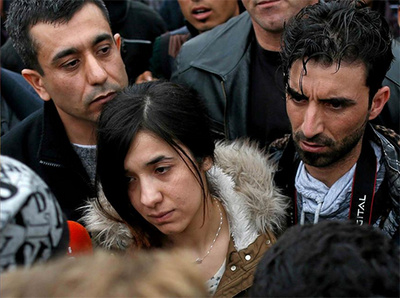
rene01_400_06

The Yazidis have always been looked down upon by both their Muslim and Christian neighbors as “pagans”. The government of Saddam Hussein was opposed to them not so much for their religious beliefs but rather because some Yazidi played important roles in the Kurdish community, seen as largely opposed to the government. The Yazidis also had some old ownership claims on land on which oil reserves are found in northern Iraq which makes them suspect in the eyes of the current leadership of the Kurdish Autonomous Region of Iraq. The government of the Kurdish Region has accepted the Yazidi refugees but has done little to help their socio-economic development perhaps fearing competition with the Kurdish families now in control of the government. In all fairness, the government and the civil society of the Kurdish Region are stretched well beyond their means to deal with the refugees and displaced.

The current fighting in both Iraq and Syria overshadows concerns for the freedom of thought as the ability to live is in question. However, the Sakharov Prize may serve as a reminder that the quality of life is also measured by the ability to think and to hold on to one’s convictions.

(1) A Yazidi website has been set up by Iraqis living in Lincoln, Nebraska, USA. The website is uneven but of interest as a self-presentation: yeziditruth.org.

Prof. René Wadlow is President of the Association of World Citizens.

Les Citoyens du Monde appellent à des couloirs humanitaires à Alep (Syrie) pour laisser entrer l’aide et sortir les civils

In Being a World Citizen, Conflict Resolution, Current Events, Human Rights, International Justice, Middle East & North Africa, Solidarity, The Search for Peace, United Nations, War Crimes, World Law on December 2, 2016 at 1:04 AM

LES CITOYENS DU MONDE APPELLENT A DES COULOIRS HUMANITAIRES A ALEP (SYRIE) POUR LAISSER ENTRER L’AIDE ET SORTIR LES CIVILS

-- AWC-UN Geneva Logo --

L’Association of World Citizens (AWC) est choquée et révoltée par les attaques délibérées perpétrées par l’armée du Gouvernement syrien et les alliés étrangers de celui-ci contre les quartiers est de la ville d’Alep, sous le contrôle des forces révolutionnaires.

Nous condamnons fermement le refus persistant du gouvernement russe d’accepter aucune des résolutions proposées par la France au Conseil de Sécurité des Nations Unies pour une fin des bombardements menés par les troupes russes sur les secteurs d’Alep tenus par les rebelles.

Nous condamnons avec la même vigueur le refus constant des gouvernements syrien et russe de laisser ouvrir des couloirs humanitaires à l’intérieur d’Alep et depuis la ville, tant pour y laisser entrer l’aide d’urgence que pour permettre aux civils qui souhaitent quitter la zone de combat de le faire sans que leurs vies en soient mises en danger.

Nous en appelons aux gouvernements syrien et russe en vue de cesser leur obstruction à l’ouverture de tels couloirs et de créer enfin les conditions permettant, d’une part, à l’aide d’être acheminée aux zones qui en ont besoin, d’autre part, aux civils souhaitant fuir les secteurs subissant des attaques de chercher un abri en dehors d’Alep sans que ce soit à leurs risques et périls.

Enfin, l’AWC appelle à une solution politique en Syrie qui n’avalisât aucun fait accompli généré par des violations du droit international.

World Citizens Call for Humanitarian Corridors in Aleppo, Syria to Let Aid In and Civilians Out

In Conflict Resolution, Current Events, Human Rights, International Justice, Middle East & North Africa, Solidarity, The Search for Peace, United Nations, War Crimes, World Law on December 1, 2016 at 1:15 PM

WORLD CITIZENS CALL FOR HUMANITARIAN CORRIDORS IN ALEPPO, SYRIA TO LET AID IN AND CIVILIANS OUT

-- AWC-UN Geneva Logo --

The Association of World Citizens (AWC) is shocked and outraged by the relentless attacks carried out by the Syrian Government’s army and its foreign allies on the eastern districts of the city of Aleppo controlled by revolutionary forces.

We strongly condemn the persistent refusal of the Russian Government to accept any of the resolutions proposed by France to the United Nations Security Council for an end to the Russian forces’ bombardments on Aleppo’s rebel-held sectors.

We condemn with equal strength the Syrian and Russian Governments’ constant refusal to have humanitarian corridors opened into and from Aleppo, both to let emergency aid in and allow those civilians who wish to leave the combat zones to do so without endangering their lives.

We hereby call on the Syrian and Russian Governments to stop blocking the opening of such corridors and make it possible at last for aid to be delivered to those areas in need and for civilians wishing to flee those sectors under attack to seek shelter outside of Aleppo without putting themselves at risk in so doing.

Finally, the AWC calls for a political solution in Syria that does not endorse any fait accompli generated by violations of international law.

Battle for Mosul: Can There Be Respect for the Laws of War?

In Conflict Resolution, Current Events, Human Rights, International Justice, Middle East & North Africa, Solidarity, The Search for Peace, United Nations, War Crimes, World Law on October 18, 2016 at 7:43 PM

BATTLE FOR MOSUL: CAN THERE BE RESPECT FOR THE LAWS OF WAR?
By René Wadlow

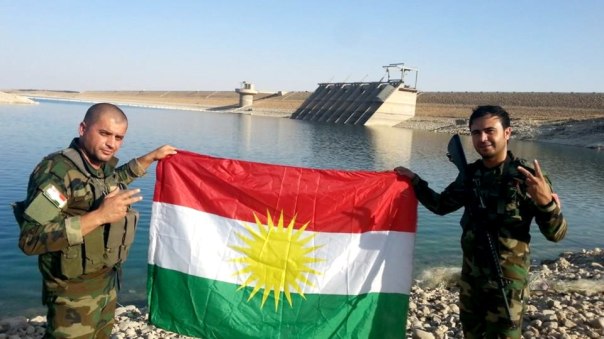
On Monday, October 17, 2016, the battle of Mosul began as the troops of the Iraqi army started moving toward the northern Iraq city of Mosul. The Iraqi Prime Minister, Haider al-Abadi, announced the effort to take Mosul, a city of over one million people which has been held by the forces of the Islamic State (ISIS or Daesh in its Arabic initials) since July 2014. The Iraqi troops are assisted by Turkish troops and tanks, by United States (U. S.) Special Forces who have also been training the Iraqi troops, and by the Kurdish peshmerga militias who have attacked surrounding villages but who, for political reasons, are not likely to enter Mosul.

There are estimates that there are some 4,500 ISIS troops facing some 50,000 on the Iraqi government side. ISIS has been aware that an attack on Mosul was in preparation for a long time and has responded by mining buildings and roads as well as building tunnels. It is likely that some ISIS fighters have slipped away, but it is also likely that the remaining majority of ISIS will fight to the bitter end, preferring death to surrender. In a situation that is confused by the number and nationalities of the groups in combat as well as the very ethnically and religiously mixed population of Mosul, what possibilities exist for respect of the laws of war?

15015691860_2c3dd3f2e1_b.jpg

Two Kurdish peshmerga fighters at Mosul Dam in 2014.

The laws of war, now often called humanitarian law, have two wings, one dealing with the treatment of medical personnel in armed conflict situations, the treatment of the military wounded and prisoners of war as well as the protection of civilians. This wing is represented by the Geneva (Red Cross) Conventions. The second wing, often called the Hague Conventions limit or ban outright the use of certain categories of weapons. These efforts began at The Hague with the 1900 peace conferences and have continued since even if the more recent limitations on land mines, cluster weapons and chemical weapons have been negotiated elsewhere than in The Hague.

For the Hague Conventions such as the ban on land mines, the ban is binding only on States which have ratified the convention. Although the Islamic State had some of the markings of a proto-State, it was not recognized as a State by any other State. Basically ISIS can be considered as an armed militia.

ISIS_YouTube.jpg

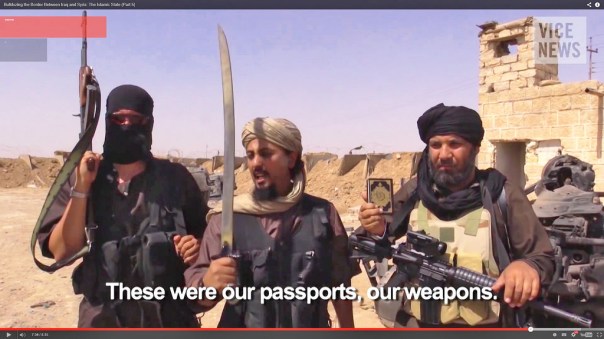
ISIS, or Daesh, the self-styled “Islamic State”, only believes in violence. It has always displayed an unmitigated hatred of everything that international law and human rights stand for. It is neither “Islamic” nor a “State” and never will be.

The status of the Geneva Conventions for non-State militias can be debated. When I was involved at the United Nations (UN) with the national minorities of Burma in the 1990s, I encouraged the Burmese militias to study, discuss and then sign the Geneva Conventions, of which the Swiss government is the depositary power. When the Burmese government learned of our efforts, they quickly signed the Geneva Conventions. Once the national minorities had signed, and I sent the document to the Swiss government and to the International Committee of the Red Cross, both the Burmese military and the national minorities released a number of prisoners of war as a mark of good faith which had never been done before. The status of world law for non-State entities and individuals is a crucial question, and there are discussions at the International Criminal Court on this issue.

The current situation concerning refugees and internally-displaced persons can also be considered as part of humanitarian law. The status of refugees is more widely respected than that of the internally-displaced.

ISIS has shown no interest or respect for humanitarian law nor for universally-recognized human rights. ISIS has carried out many summary executions of perceived opponents. There is a real danger that as ISIS disintegrates and no longer controls as much territory, it will increase terrorist actions having “nothing left to lose”.

The violations of the laws of war are not limited to ISIS. On May 3, 2016, the UN Security Council unanimously adopted Resolution 2286 calling for greater protection for health care institutions and personnel in light of recent attacks against hospitals and clinics in Syria, Iraq, Yemen, South Sudan, Democratic Republic of Congo and Afghanistan. These attacks indicate a dangerous trend of non-compliance with the laws of war by both State and non-State agents.

To prevent and alleviate human suffering, to protect life and health, and to ensure respect for the human person – these are the core values of humanitarian law. These values may get lost in the “fog of war” of the battle for Mosul. Therefore, there needs to be a wide public outcry in the defense of humanitarian law so that violations can be reduced. As the tanks move ahead, the time for the defense of humanitarian values is now.

Prof. René Wadlow is President of the Association of World Citizens.
Tair, 19: Israel, “Will you put me in jail for a murder I will not commit?”

In Being a World Citizen, Conflict Resolution, Current Events, Human Rights, Middle East & North Africa, Solidarity, The Search for Peace, Uncategorized, War Crimes, World Law on April 27, 2016 at 9:30 AM

TAIR, 19: ISRAEL, “WILL YOU PUT ME IN JAIL FOR A MURDER I WILL NOT COMMIT?”
By Bernard Henry

In 1987 a British new wave group called Johnny Hates Jazz topped the charts with a song called I Don’t Want to Be a Hero, whose standardized, rather soulless music hid lyrics that were anything but common in the pop song industry of that era. No phony story of an impossible love romance – the song was really a fierce anti-war statement.

Among the lyrics, a question asked by the young man stating his refusal of conscription stands out:

“And what if I fail?
Will you put me in jail
For a murder I will not commit?”

By the time the song was released, the United Kingdom had long renounced conscription, as had the United States, Canada, and Australia. In the Western world, only in Europe could a draft be found, although the practice had gradually disappeared from the continent when the twentieth century ended. Except for Norway, Finland, Austria and Greece – plus neutral Switzerland – the then NATO allies of Britain against the Warsaw Pact are now all draft-free.

In what is generally called “the West”, only one non-European country retains a strong draft – Israel.

Ever since the Jewish State was created in 1948, its armed forces regrouped under the Hebrew acronym Tsahal, literally Tsva Haganah Lé-Yisrael, “Israeli Defense Force” (IDF), have taken in young people of both genders, male and female. Having been often at war with its Arab neighbors, being constantly in need of military personnel to maintain its occupation of the West Bank and the Golan Heights, Israel has traditionally had all of its sons and daughters wear the uniform for a few years – three for the boys, two for the girls. Exemptions are given, though, to observant religious Jews and, on quite different grounds, to non-Druze Arab Israeli citizens.

Then comes the problem when you “don’t want to be a hero”, in short, when you declare yourself a conscientious objector (CO), thus joining the number of the country’s shministim, “twelfth-graders”, students who refuse to comply with the law and enter the IDF once they have completed their high school studies as the law requires. You must appear before an IDF board, and if you fail to obtain exemption from military service, you will be ordered to enlist at once – or go to jail.

That is what happened this year to Tair Kaminer, 19. A member of Mesarvot – Jews for Justice for Palestinians, the young woman filed for conscientious objection but was turned down by the board. Sent to jail a first time, she was released and jailed again, and then jailed and released three more times. “The last military officer who sent me to jail told me that he was a member of the conscientious objection board,” says Kaminer. “He added that I had no chance of obtaining CO status and he would send me back to jail ‘for the rest of my life’ if I continued to resist.”

While serving her current sentence, Kaminer was given two weeks’ leave for the Jewish Passover, a national holiday in Israel. But upon leaving the military prison, she was told to return the next day. She chose to fully observe the two weeks’ leave and, instead of reporting to the prison as ordered, she stayed at home. “I am not ending my protest”, she insists. “I will return to the prison.” But she will have the IDF keep their word.

Tair-Kaminer.jpg

Tair Kaminer

Kaminer is by no means the first Israeli conscript to refuse enlistment. The issue has been with the IDF since 1970, when a first Shministim movement was created, followed in 1982 by the Yesh Gvul “There is a Limit/Frontier” organization of reservists who refused to serve in the Lebanon War, and a surge of CO initiatives under the premiership of the hawkish former IDF general and Defense Minister, Ariel Sharon, in the early 2000s. The latest two IDF military campaigns against Gaza, “Cast Lead” in 2009 and “Protective Edge” in 2014, also resulted in more CO applications from young Israelis, as has the announced expansion of Israeli settlements on Palestinian land. As for today’s Shministim movement, it is comprised by an estimated 3,000 high school students.

This only makes it harder to understand why the IDF has proved so adamant about punishing Kaminer specifically, putting her in jail, as Johnny Hates Jazz sang, for “a murder (she) will not commit”.

In a country like Israel where such people as former Prime Ministers Ariel Sharon and Ehud Olmert died without being prosecuted for the gross human rights abuses committed under their command by, respectively, IDF proxies in Lebanon and the IDF proper in Gaza – and to date, the incumbent, Benyamin Netanyahu, remains immune from domestic or international prosecution over the IDF’s campaign on Gaza’s civilian population in 2014, there must be room for the honest refusal of war stated with courage by young people whose love for their country will not be turned into hatred of their neighbors.

Hopefully, Tair’s sacrifice of her own freedom will let the Israeli government see that, in the very words of Johnny Hates Jazz, “It’s time to forget and forgive” its COs at last.

Johnny Hates Jazz, “I Don’t Want to Be a Hero”

Bernard Henry is the External Relations Officer of the Association of World Citizens.
The Yemen Conflict: Solutions to an Unnecessary War

In Conflict Resolution, Current Events, Human Rights, International Justice, Middle East & North Africa, Solidarity, The Search for Peace, United Nations, War Crimes, World Law on April 23, 2016 at 2:58 PM

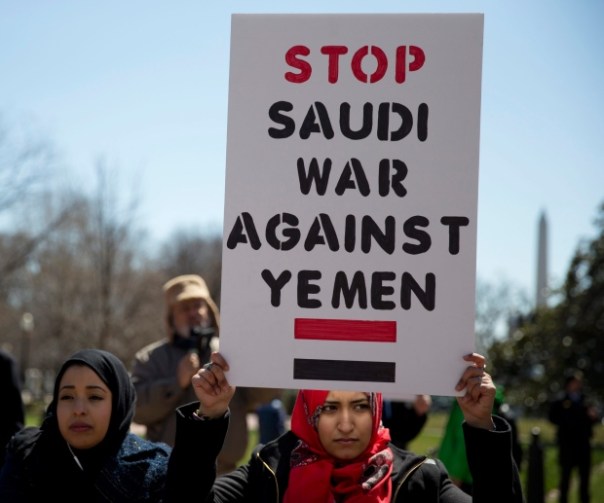
THE YEMEN CONFLICT: SOLUTIONS TO AN UNNECESSARY WAR

By René Wadlow


During the Second World War, in the United States (U. S.) there was a government-sponsored publicity campaign to save automobile gas with the slogan “Is this trip necessary?” The aim was to show that if one really asked the question, many trips were not really necessary. We can ask the same question about wars today. In Yemen, is the Saudi-led war really necessary?

A new round of conflict-resolution meetings has started on April 20 in Kuwait, facilitated by the United Nations (UN) and led by Ould Cheikh Ahmed of Mauritania who had earlier been the UN humanitarian coordinator for Yemen and so knows the country and its many factions well. There was an exchange of prisoners at the start as a goodwill measure.

A four-step conflict resolution outline has been proposed by a number of governments and nongovernmental organizations (NGO), including the Association of World Citizens (AWC):

1) an immediate ceasefire ending all foreign military attacks;

2) humanitarian assistance, especially important for hard-to-reach zones;

3) a broad national dialogue;

4) through this dialogue, the establishment of an inclusive unity government.

_82462823_yemen_sanaa_bombing_r.jpg

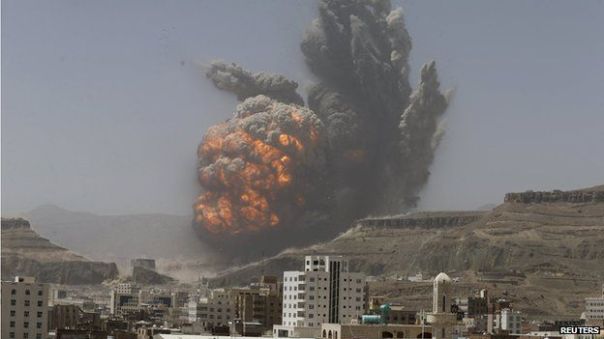
Smoke rises from a weapons dump outside Sanaa, the capital city of Yemen, after being hit in an airstrike. (C) Reuters

The title of the aggression of Saudi Arabia against Yemen changed its name from “Operation Decisive Storm” to “Operation Restoring Hope” probably on the advice of the public relations firm which advises the U. S. Pentagon on the names of its operations. Saudi bombing from the air of cities, hospitals and refugee camps, created a storm, but the results were in no way “decisive.” It is not likely that Saudi bombing will “Restore Hope.”

There is wide agreement in UN circles and among conflict-resolution NGOs that Yemen is a quagmire, with a free-fall of its economic and social infrastructure and with constant violations of the laws of war. The country is on the eve of a new division between the north and the south. Yemen’s present form dates from 1990 when south Yemen (Aden) was more or less integrated into the north, but the country remains highly fractured on tribal, sectarian, and ideological lines, with the tribal structures being the most important.

Yemen.jpg

(C) CTV News, Canada

Negotiations among the multitude of factions in Yemen will be difficult. The most likely pattern will be for the country to split into two again with each half having a number of relatively autonomous regions. In the best of worlds, one could envisage a federal Yemen with the rule of law. More realistically, we can hope that these autonomous tribal areas do not fight each other actively. On a short term basis, we can hope that there will be minimum cooperation among the factions to allow necessary food imports and medical supplies.

Poverty and the lack of a peaceful political horizon seem to be the continuing fate of Yemen, but violent internal conflict and Saudi aggression may not be permanent. With the start of negotiations, there is a role for NGOs to encourage the efforts in contacting organizations and individuals that might have a positive impact on events. There are many geopolitical and economic interests who want “peace” on their terms. Thus, our role as World Citizens seeking a relatively just compromise solution is ever more important.

Prof. René Wadlow is President and a representative to the United Nations, Geneva, of the Association of World Citizens.

The Genocide Convention: An Unused But Not Forgotten Standard of World Law

In Being a World Citizen, Current Events, Fighting Racism, Human Rights, International Justice, United Nations, War Crimes, World Law on December 9, 2015 at 7:58 PM

THE GENOCIDE CONVENTION: AN UNUSED BUT NOT FORGOTTEN STANDARD OF WORLD LAW

By René Wadlow

On the anniversary of the 1948 Convention on Genocide, it is imperative to identify a relevant existing body – such as the Committee for the Elimination of Racial Discrimination (CERD) – to strengthen in order to be able to deal with the first signs of tensions, especially “direct and public incitement to commit genocide.”

December 9 is the anniversary of the 1948 Convention on Genocide, signed at the UN General Assembly held in 1948 in Paris. The Genocide Convention was signed the day before the proclamation on December 10, 1948 of the Universal Declaration of Human Rights. The two texts were much influenced by the Second World War. The crimes of Nazi Germany were uppermost in the minds of those who drafted the Genocide Convention in order to deal with a new aspect of international law and the laws of war. The cry was “Never again!”

The protection of civilians from deliberate mass murder was already in The Hague and Geneva Conventions of international humanitarian law. However, genocide is different from mass murder. Genocide is the most extreme consequences of racial discrimination and ethnic hatred. Genocide has as its aim the destruction, wholly or in part, of national, ethnic, racial or religious group as such. The term was proposed by the legal scholar Raphael Lemkin, drawing on the Greek genos (people or tribe) and the Latin cide (to kill) [1].

Genocide in the sense of a desire to eliminate a people has nearly always a metaphysical aspect as well as deep-seated racism. This was clear in the Nazi desire to eliminate Jews, first by forced emigration from Europe and, when emigration was not possible, by physical destruction.

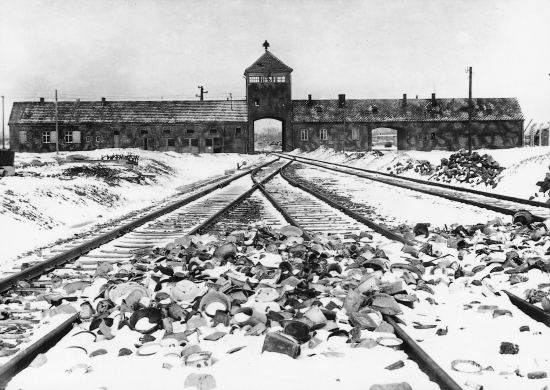
The genocide of the Jewish people in Europe during World War II, carried out in such infamous places as the Auschwitz concentration camp pictured above, was the leading cause for the drafting and adoption of the UN Genocide Convention. The following day, the UN General Assembly also adopted the Universal Declaration of Human Rights.

The genocide of the Jewish people in Europe during World War II, carried out in such infamous places as the Auschwitz concentration camp pictured above, was the leading cause for the drafting and adoption of the UN Genocide Convention. The following day, the UN General Assembly also adopted the Universal Declaration of Human Rights.

We see a desire to destroy totally certain tribes in the Darfur conflict in Sudan that did not exist in the much longer and more deadly North-South Sudan Civil War (1956-1972, 1982-2005). Darfur tribes are usually defined by “blood lines” — marriage and thus procreation is limited to a certain population, either within the tribe or with certain other groups with which marriage relations have been created over a period of time. Thus children born of rape — considered ‘Janjaweed babies ‘— after the government-sponsored Janjaweed militias— are left to die or are abandoned. The raped women are often banished or ostracized. By attacking both the aged, holders of traditional knowledge, and the young of child-bearing age, the aim of the destruction of the continuity of a tribal group is clear.

We find the same pattern in some of the fighting in the eastern provinces of the Democratic Republic of Congo where not only are women raped but their sexual organs are destroyed so that they will not be able to reproduce.

As then UN Secretary-General Kofi Annan said at UNESCO in 1998,

“Many thought, no doubt, that the horrors of the Second World War − the camps, the cruelty, the exterminations, the Holocaust – could not happen again. And yet they have, in Cambodia, in Bosnia and Herzegovina, in Rwanda. Our time − this decade even − has shown us that man’s capacity for evil knows no limits. Genocide − the destruction of an entire people on the basis of ethnic or national origins − is now a word of our time too, a stark and haunting reminder of why our vigilance must be eternal.”

Mr. Nicodène Ruhashyankiko of the Sub-Commission on Prevention of Discrimination of Minorities wrote in his study of proposed mechanisms for the study of information on genocide and genocidal practices “A number of allegations of genocide have been made since the adoption of the 1948 Convention. In the absence of a prompt investigation of these allegations by an impartial body, it has not been possible to determine whether they were well founded. Either they have given rise to sterile controversy or, because of the political circumstances, nothing further has been heard about them.”

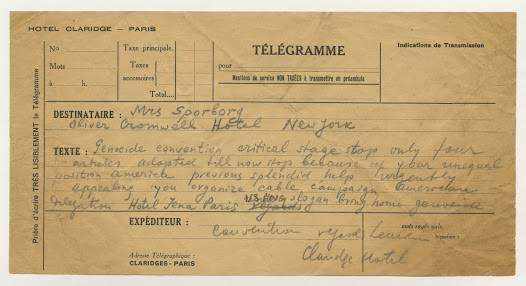
In a telegram sent from Paris in December 1948, Raphael Lemkin asked Ms. William Dick Sporberg, a member of the United States Committee for a United Nations (UN) Genocide Convention, to organize a cable campaign to persuade the United States Mission to the UN to support the adoption of the convention. Until the very last minute, no efforts were to be spared if the Genocide Convention was to come to existence and make the hopes of a whole generation traumatized by wide-scale extermination come true. (C) Google Cultural Institute/Center for Jewish History

In a telegram sent from Paris in December 1948, Raphael Lemkin asked Ms. William Dick Sporberg, a member of the United States Committee for a United Nations (UN) Genocide Convention, to organize a cable campaign to persuade the United States Mission to the UN to support the adoption of the convention. Until the very last minute, no efforts were to be spared if the Genocide Convention was to come to existence and make the hopes of a whole generation traumatized by wide-scale extermination come true. (C) Google Cultural Institute/Center for Jewish History

Article VIII of the Genocide Conventions provides that “Any Contracting Party may call upon the Competent Organs of the United Nations to take such action under the Charter of the UN as they consider appropriate for the prevention and suppression of acts of genocide or any of the other acts enumerated in article III”. Unfortunately no State has ever done so.

Thus we need to heed the early warning signs of genocide. Officially-directed massacres of civilians of whatever number cannot be tolerated, for the organizers of genocide must not believe that more widespread killing will be ignored. Yet killing is not the only warning sign. The Convention drafters, recalling the radio addresses of Hitler and the constant flow of words and images, set out as punishable acts “direct and public incitement to commit genocide.” The Genocide Convention, in its provisions concerning public incitement, sets the limits of political discourse. It is well documented that public incitement − whether by Governments or certain non-governmental actors − including political movements − to discriminate against, to separate forcibly, to deport or physically eliminate large categories of the population of a given State because they belong to certain racial, ethnic or religious groups, sooner or later leads to war. Therefore, the Genocide Convention is also a constant reminder of the need to moderate political discourse, especially constant and repeated accusations against a religion, ethnic and social category of persons. Had this been done in Rwanda, with regard to the radio Mille Collines perhaps the premeditated and announced genocide could have been avoided or mitigated.

For the UN to be effective in the prevention of genocide, there needs to be an authoritative body which can investigate and monitor a situation well in advance of the outbreak of violence. As has been noted, any Party to the Genocide Convention (and most States are Parties) can bring evidence to the UN Security Council, but none has. In the light of repeated failures and due to pressure from non-governmental organizations, the UN Secretary-General has named an individual adviser on genocide to the UN Secretariat. However, he is one adviser among many, and there is no public access to the information that he may receive.

Therefore, a relevant existing body must be strengthened to be able to deal with the first signs of tensions, especially “direct and public incitement to commit genocide.” The CERD created to monitor the 1965 International Convention on the Elimination of All Forms of Racial Discrimination would be the appropriate body to strengthen, especially by increasing its resources and the number of UN Secretariat members which service CERD. Through its urgent procedures mechanisms, CERD has the possibility of taking early-warning measures aimed at preventing existing strife from escalating into conflicts, and to respond to problems requiring immediate attention. A stronger CERD more able to investigate fully situations should mark the world’s commitment to the high standards of world law set out in the Genocide Convention.

Prof. René Wadlow is President and a representative to the United Nations Office at Geneva of the Association of World Citizens (AWC) and editor of Transnational Perspectives.

Notes

  1. Raphael Lemkin. Axis Rule in Occupied Europe (Washington: Carnegie Endowment for World Peace, 1944)
  2. For good overviews see: Walliman and Dobkowski (Eds) Genocide and the Modern Age (New York: Greenwood Press, 1987), F. Chalk, K. Jonassohn. The History and Sociology of Genocide (New Haven: Yale University Press, 1990), G. J. Andreopoulos (Ed) Genocide: Conceptual and Historical Dimensions (Philadelphia: University of Pennsylvania Press, 1994), Samantha Power A Problem from Hell: America and the Age of Genocide (New York: Basic Books, 2002), John Tirman, The Death of Others (New York: Oxford University Press, 2011), William Schabas, Genocide in International Law (Cambridge: Cambridge University Press, 2000)

Syria: ISIS Iconoclasts Leave a Bloody Trail of Destruction

In Cultural Bridges, Current Events, International Justice, Middle East & North Africa, Religious Freedom, Solidarity, The Search for Peace, United Nations, War Crimes, World Law on August 25, 2015 at 11:31 AM

SYRIA: ISIS ICONOCLASTS LEAVE A BLOODY TRAIL OF DESTRUCTION

By René Wadlow

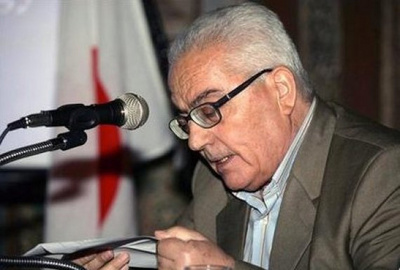
On August 18, 2015 Dr Khaled al-Assad, retired director of the Palmyra museum and an officer of the Directorate General of Antiquities and Museums, had his neck cut and his body hung from a traffic light pole. The 83 year-old archaeologist had been held in seclusion (and probably tortured) for three weeks. In the public square of Palmyra an accusation was read out that he was “the director of pagan idols”. Khaled al-Assad had been born in Palmyra and had spent most of his career there, writing numerous articles as well as directing archaeological sites. He had few rivals in his knowledge of the ancient crossroad city of Palmyra, an important link on the trade routes between Asia, North Africa, and Europe.

The public killing of Khaled al-Assad renewed concern for the historic sites. It was widely believed that many of the sites had had explosives placed in them to provoke their destruction. Sites in Palmyra had already been damaged during the fighting in the spring as the soldiers of the Islamic State in Iraq and Syria (ISIS or Daesh in Arabic) took control of the city and the surrounding area. Then on August 23, some of the explosives were set off, damaging the important Temple of Baal, one of the most visited sites in Palmyra. Baal – the Lord of the Heavens – was represented by an eagle. He was also a storm god shown holding a lightning bolt in his hand.

From a distance, it is hard to know what elements within ISIS are responsible for the destruction and what are the motivations. ISIS has attracted fighters from a good number of countries, and it is impossible to know the chains of command or the motivations. Many Syrians are proud of the vestiges of pre−Islamic civilizations, proof that the area was an important actor and in some ways a rival of Rome. The Directorate General of Antiquities has some 2,500 employees with a record of preserving Syria’s cultural heritage. In addition, some Syrian citizens, risking their lives, have tried to defend heritage sites or to hide away cultural objects. Moreover, ISIS agents as well as persons belonging to other armed factions have been looting objects to sell outside the country, either for personal gain or to finance their political faction, rather than destroying them.

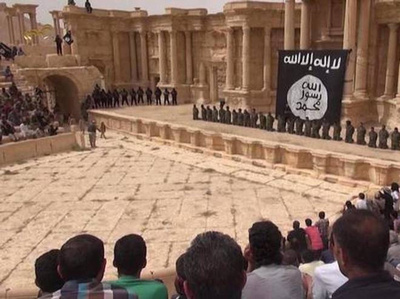
When ISIS/Daesh took Palmyra last May, many people feared they might blow up the ancient city at once. They didn't, but now the vestiges of the ancient civilization there were soon turned into a stage for ISIS/Daesh to use toward propaganda purposes.

When ISIS/Daesh took Palmyra last May, many people feared they might blow up the ancient city at once. They didn’t, but now the vestiges of the ancient civilization most inappropriately serve as a stage for ISIS/Daesh to use toward propaganda purposes.

Thus, it is not clear who wants to destroy works of art and cultural heritage. Are there sincere iconoclasts for whom any object that recalls pre-Islamic worship is an insult to the Islamic faith? Are there people who just want to destroy and will blow up most anything? Are there people who believe that public killings and destruction of heritage will facilitate military expansion and control of the population? Is there any possibility of rational discussion and good-faith negotiations with ISIS authorities to preserve cultural sites in Syria and Iraq?

Conserving a cultural heritage even in times of peace is always difficult. Weak institutional capabilities, lack of appropriate resources and isolation of many culturally essential sites are compounded by a lack of awareness of the value of cultural heritage conservation. On the other hand, the dynamism of local initiatives and community solidarity are impressive assets. These forces should be enlisted, enlarged and empowered to preserve and protect a heritage.

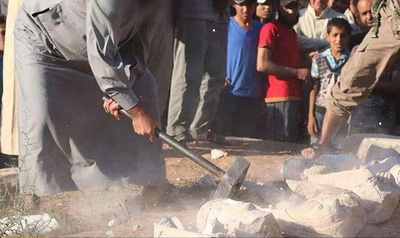
ISIS/Daesh members enthusiastically destroying a historical ancient site. They may bring down every reminder of the past they come by, but try as they might, they cannot change history.

Are there ways that those of us on the “outside” can reach those in Syria and Iraq who wish to preserve cultural heritage and to defend the lives of those who work to preserve protect and inform?

My belief is that the current military action against ISIS, either with ground troops or bombing from the air, will have little positive impact. Armed force may lead some of the ISIS forces to a “burned earth” policy, destroying as much as they can before retreating. I think that there needs to be initiatives taken by those currently living under ISIS rule but who do not share ISIS values. They need to take actions to show ISIS leaders that their policies are an error and will lead to greater divisions within the population.

There is always a certain irony for someone in a safe area to encourage others to take actions which can put their lives in danger. Therefore, the least that we can do is to have a loud outcry from cultural workers throughout the world so that those in Syria and Iraq who will act positively know that they are not alone.


Prof. René Wadlow is President and Chief Representative to the United Nations Office at Geneva of the Association of World Citizens.
The Continuing Humanitarian Crisis and Violations of Human Rights in ISIS-held Areas in Iraq and Syria

In Current Events, Human Rights, International Justice, Middle East & North Africa, Solidarity, The Search for Peace, United Nations, War Crimes, World Law on August 25, 2015 at 9:00 AM

THE CONTINUING HUMANITARIAN CRISIS AND VIOLATIONS OF HUMAN RIGHTS IN ISIS-HELD AREAS IN IRAQ AND SYRIA

By René Wadlow

In an August 25, 2014 statement, the United Nations (UN) High Commissioner for Human Rights condemned the “appalling, widespread, and systematic violations of human rights” by the Islamic State in Iraq and Syria (ISIS). The violations mentioned included targeted killings, forced conversions, abductions, trafficking of women, slavery, sexual abuse, destruction of religious and cultural sites of significance and the besieging of entire communities because of ethnic, religious and sectarian affiliation.

Among those directly targeted have been the religious communities of Christians, Yezidi (also written Yazidi) and Sabeans (also called Sabean-Mandaeans). In addition to the violation of human rights, the High Commissioner cited other UN reports stressing the humanitarian crisis and the severe shortages of food, water and the lack of medical services.

This sign, here painted in red on a wall with a circle around it, is the letter N in Arabic. When the IS started seizing predominantly Christian-inhabited areas of Iraq by force, its militiamen immediately painted this on houses they knew or thought were owned by Christians, N being for “Nasrani” which is itself the Arabic for “Christian”. A long echo of the Nazis’ practices in pre-World War II Germany, when Hitler’s own militiamen would paint a Star of David on the front door of each Jewish-owned business. That was just before the “Final Solution” which claimed over 6 million lives.

This sign, here painted in red on a wall with a circle around it, is the letter N in Arabic.
When ISIS started seizing predominantly Christian-inhabited areas of Iraq by force, its militiamen immediately painted this on houses they knew or thought were owned by Christians, N being for “Nasrani” which is itself the Arabic for “Christian”.
A long echo of the Nazis’ practices in pre-World War II Germany, when Hitler’s own militiamen would paint a Star of David on the front door of each Jewish-owned business. That was just before the “Final Solution” which claimed over 6 million lives.

One year later, the situation remains much the same, but with an increased number of people uprooted as internally displaced persons and refugees. The political situation has grown more complex, with Turkey playing an increasing if unclear role. Efforts at mediation by the UN of the Syrian aspects of the conflict have not given visible results. Russian diplomats have been meeting with some Syrian factions as well as with the Syrian government, but there seem to be no advances toward broader negotiations. The political and military actions of ISIS have effectively linked Iraq and Syria so that each conflict is linked to the other. A global approach for conflict resolution is needed.

The conflict has increased religious sectarian attitudes. It is hard for an outsider to know to what extent religious differences are deeply felt or if religion is used as a “cover” for ethnic, tribal, and economic interests. It is certain that ISIS has tried to give a religious coloring to its policies, with forced conversions and destruction of non-Islamic communities which refused conversion. Therefore, there needs to be an emphasis on freedom of religion or belief as set out by the United Nations.

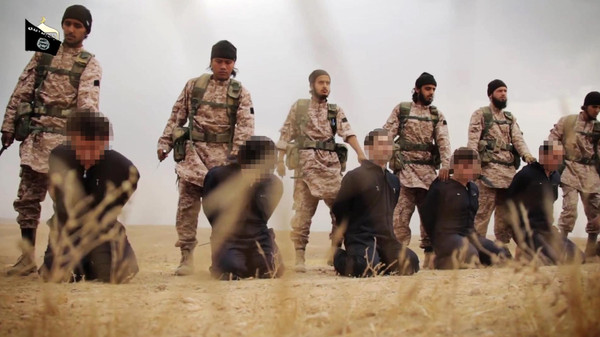
An image grab taken from a propaganda video released on November 16, 2014 by al-Furqan Media allegedly shows members of the Islamic State jihadist group preparing the simultaneous beheadings of at least 15 men described as Syrian military personnel. In the highly choreographed sequence, jihadists march the prisoners by a wooden box of long military knives, each taking one as they pass, before forcing their victims to kneel in a line and decapitating them. (C) AFP PHOTO

An image grab taken from a propaganda video released on November 16, 2014 by al-Furqan Media allegedly shows members of the Islamic State jihadist group preparing the simultaneous beheadings of at least 15 men described as Syrian military personnel. In the highly choreographed sequence, jihadists march the prisoners by a wooden box of long military knives, each taking one as they pass, before forcing their victims to kneel in a line and decapitating them. (C) AFP PHOTO

One of the major UN declarations confirming a deep sense of inherent dignity is the Declaration on the Elimination of All Forms of Intolerance and of Discrimination Based on Religion or Belief, adopted by the General Assembly on November 25, 1981 after a number of years of study and discussion in which the Association of World Citizens (AWC) took an active part. The Declaration states “that it is essential to promote understanding, tolerance and respect in matters relating to freedom of religion and belief and to ensure that the use of religion or belief for ends inconsistent with the Charter, other relevant instruments of the United Nations and the purposes and principles of the present Declaration is inadmissible.”

Article One states clearly that “No one shall be subject to coercion which would impair his freedom to have a religion or belief of his choice.”

World law as developed by the UN applies not only to the governments of Member States but also to individuals and non-governmental organizations. The ISIS has not been recognized as a State and is not a member of the UN. Nevertheless, the AWC is convinced that the terms of the Declaration on the Elimination of All Forms of Intolerance and Discrimination Based on Religion or Belief applies to the ISIS and that the actions of the ISIS are, in the terms of the Declaration, “inadmissible”.

Syrian demonstrators in Paris, France, vowing for "a democratic future" in Syria "without [Syrian President] Bashar [al-Assad] and without Daesh [ISIS]". (C) AWC/Bernard J. Henry

Syrian demonstrators in Paris, France, vowing for “a democratic future” in Syria “without [Syrian President] Bashar [al-Assad] and without Daesh [ISIS]”. (C) AWC/Bernard J. Henry

Life in the emerging world society requires world law and certain common values among all the States and peoples of the world.  The challenges which face us all require inclusive ethical values based on a sense of responsibility for both present and future generations.  Such values are, I am sure, in the heart of many individuals who are now living in areas under the control of ISIS in Iraq and Syria. We must find ways to reach such people with the message that the policies of the ISIS leaders are deliberate violations of world law and ethical standards.  The majority of the world society is not hostile to the people living under ISIS rule and we look forward to the time when human rights standards will be the law of the land. In the meantime, they need to work as best they can for a tolerant and open society.

Prof. René Wadlow is President and Chief Representative to the United Nations, Geneva, of the Association of World Citizens.
UN Human Rights Council Reaffirms the Safeguards for Civilians in Times of War

In Being a World Citizen, Conflict Resolution, Current Events, Human Rights, International Justice, Middle East & North Africa, The Search for Peace, United Nations, War Crimes, World Law on July 5, 2015 at 7:33 PM

UN HUMAN RIGHTS COUNCIL REAFFIRMS THE SAFEGUARDS FOR CIVILIANS IN TIMES OF WAR

By René Wadlow

“Accountability for breaches of international humanitarian law and for human rights violations, as well as respect for human rights, are not obstacles to peace, but rather the preconditions on which trust and, ultimately, a durable peace can be built.”

– Navanethem Pillay, then UN High Commissioner for Human Rights, 2009.

On July 3, 2015, the concluding day of its summer session, the United Nations (UN) Human Rights Council welcomed the report of the “Gaza Conflict Commission of Inquiry” which indicated that the Israeli military and Palestinian armed groups may have committed war crimes during the Israeli “Operation Protective Edge” campaign. 47 member States of the Human Rights Council voted in favor of the resolution, 5 States abstained: Kenya, Ethiopia, Macedonia, India and Paraguay; the USA was the only Member State to vote against the resolution.

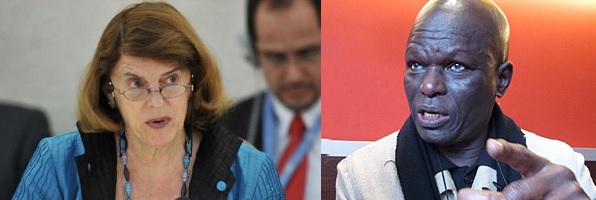
The Gaza Conflict Commission of Inquiry was led by the New York Judge Mary McGowan Davis with Doudou Diène of Senegal, the UN Special Rapporteur on Contemporary Forms of Racism (2002-2008), as the other ranking member. The Commission was to study the legal implications of an earlier UN Fact-Finding Mission on the Gaza Conflict. The Commission was not established to evaluate the results of the Fact-Finding Mission which had largely confirmed the death tolls provided by the Gaza Hamas administration, some 2,250 Palestinians killed of which 1,462 civilians. Rather the Commission had the task of setting out the world law applications of the facts collected earlier.

Judge Mary McGowan Davis (left) and Doudou Diène (right).

Judge Mary McGowan Davis (left) and Doudou Diène (right).

Thus the focus of the Commission was the “Geneva Convention relative to the Protection of Civilian Persons in Time of War” of August 12, 1949. The Geneva Conventions, for which the International Committee of the Red Cross is responsible, grew out of deliberations started in 1947 in the shadow of the abuses of the Second World War. By 1949, the negotiations among governments led to the 1949 Red Cross Conventions. The emphasis was on the principles of protection and not on the punishment of wrong doers. The International Committee of the Red Cross is not an international court. It bases its protection efforts on the belief that all sides in a conflict have an interest to follow the laws of war as its soldiers or civilians could meet the same fate. If there is to be any action on trials and punishment, such trials should be done in national courts.

From 1974 to 1977, as a result of the war in Vietnam, there were subsequent laws of war negotiated to cover “civil wars” − wars within a State where the parties involved may not be States. (1)

Today, however, there is the International Criminal Court which can investigate as well as having the mandate to hold court trials and pass judgment. Investigations and trials can also be carried out at the national level. The Israeli argument has always been that the Israeli Defense Force (IDF) can and does carry out investigations and that there is a functioning national court system. The Hamas-led administration of Gaza makes the same argument.

Unfortunately, both Israel and Hamas have dismal records of investigating their own forces. I am unaware of any case where a Hamas fighter was punished for deliberately shooting a rocket into a civilian area of Israel − on the contrary, some Hamas leaders repeatedly praise such acts. While Israel has carried out investigations into alleged violations by its forces, the emphasis has been on the unauthorized actions of individual soldiers, not on policy makers. Yet the Gaza Conflict Commission stressed that “military tactics are reflective of a broader policy approved at least tacitly by decision-makers at the highest levels of the Israeli government.”

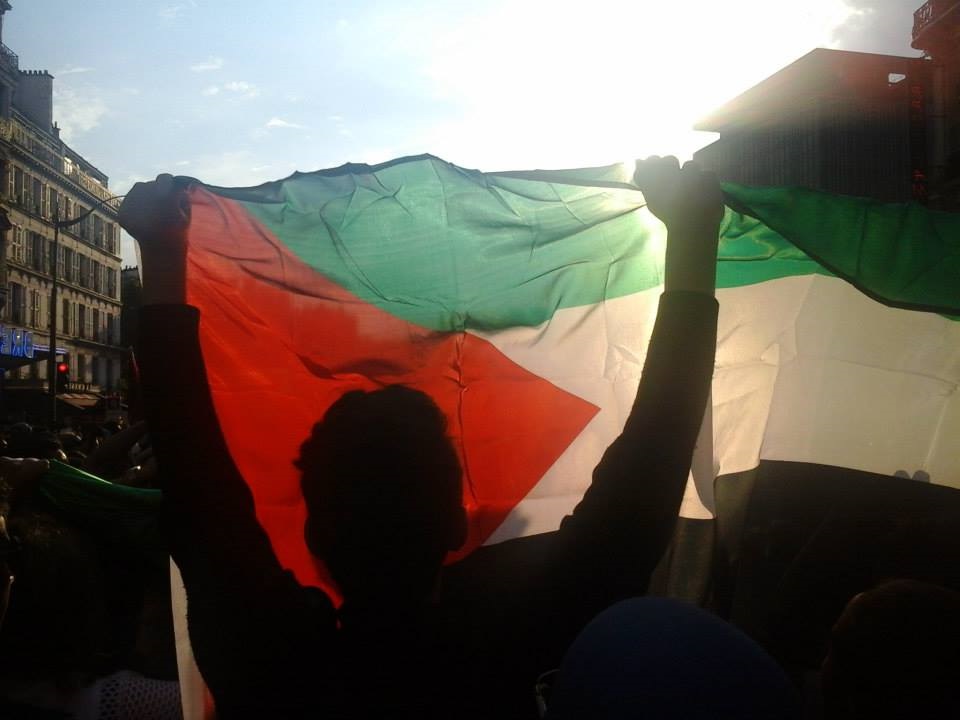
A demonstrator raises the Palestinian flag during a July 2014 rally in Paris against the Israeli attack on Gaza. (C) AWC/Bernard J. Henry

A demonstrator raises the Palestinian flag during a July 2014 rally in Paris against the Israeli attack on Gaza. (C) AWC/Bernard J. Henry

Nongovernmental organizations (NGOs) active in UN human rights bodies, including the Association of World Citizens, have long stressed the importance of fact-finding carried out by the UN, intergovernmental bodies such as the Organization for Security and Cooperation in Europe, and NGOs themselves. (2)

There are now two follow-up steps set out by the Human Rights Council resolution:

1) A request is made that the UN High Commissioner for Human Rights (and thus the Secretariat) prepare a report on implementation measures;

2) A recommendation that the UN General Assembly take up the matter “until it is satisfied that appropriate action is taken to implement its recommendations.”

The Israeli government has replied angrily to the resolution, the Israeli Ambassador to the UN in Geneva calling it an “anti-Israeli manifesto” and Prime Minister Benjamin Netanyahu saying “the UN Human Rights Council cares little about the facts and less still about human rights.”

Rather, I would say that the resolution is an important procedural advancement in the respect of world law in times of conflict. In the past, there have been UN-authorized fact-finding missions with the reports going directly to discussion in the UN Commission on Human Rights (as it was then) and then to the UN General Assembly. With the Gaza Conflict Commission of Inquiry we have a useful intermediary step. First there is a fact-finding effort as close in time to the events as possible to interview victims, to see the physical damage and to interview the military and other combatants. Such fact-finding is done, as it were “in the heat of the action”.

In late July 2014 Gazan doctors saved the life of little Shaima, an unborn child, by extracting her from the womb of her mother who was killed in an Israeli airstrike. Two days later, the Israeli Air Force destroyed the sole existing power plant in Gaza, thus stopping Shaima’s life support system and eventually killing the baby too.

In late July 2014 Gazan doctors saved the life of little Shaima, an unborn child, by extracting her from the womb of her mother who was killed in an Israeli airstrike. Two days later, the Israeli Air Force destroyed the sole existing power plant in Gaza, thus stopping Shaima’s life support system and eventually killing the baby too.

Then there is a calm, legal review of the fact-finding reports. In the past when I have been present at debates on fact-finding reports in the Commission on Human Rights, the debates were anything except calm and legal. They were political exchanges which reflected the evaluations of the original conflict. In this case of the Gaza Commission, we have an orderly presentation of facts, avenues to strengthen protection, and suggestions on the role of the International Criminal Court. There is no guarantee that the discussions in the next UN General Assembly will be calm and focused on legal procedures, but at least there will have been this useful intermediary step.

As things now stand, world law is not created by the decisions of a world parliament. World law is basically the “common law of mankind”’ based on small advances. Usually the first step is to set out the basic values in widely agreed-upon texts such as the Red Cross Geneva Conventions. This is followed by a recognition that there are repeated violations of these values in the practice of war, the torture of individuals, massive aggression against minorities. After repeated violations, there is the very slow realization that such violations are not acceptable and if nothing is done, the values themselves will be permanently undermined.

We are now at this last stage as concerns Gaza. The repeated bombings of the Gaza Strip do not bring peace, security or socioeconomic development. In fact, each bombing campaign creates a more difficult situation. It is not a function of world law to say what socioeconomic-political measures should be taken, though as NGO representatives we can and have made suggestions. The function of world law is to set out clearly the value basis of the law, to set out fair procedures to deal with possible violations and ultimately to see if there can be sanctions or punishment for wrong doers.

I believe that we still have many miles to go on the path for the respect of world law, but I believe that the direction is now set.

Prof. René Wadlow is President of the Association of World Citizens.
Notes

1)      See Hilaire McCoubrey and Nigel White, International Law and Armed Conflict (1992)

2)      See B. G. Ramcharan (ed), International Law and Fact-Finding in the Field of Human Rights (1983)

For NGO Fact-finding, see Hans Tholen and B. Verstappen, Fact-Finding Practice of Non-Governmental Organizations (1986)