The Official Blog of the

Archive for the ‘Migration’ Category

June 20: World Refugee Day

In Being a World Citizen, Conflict Resolution, Current Events, Democracy, Europe, Human Rights, Humanitarian Law, International Justice, Middle East & North Africa, Migration, NGOs, Refugees, Solidarity, The Search for Peace, United Nations, War Crimes, World Law on June 20, 2017 at 8:19 AM

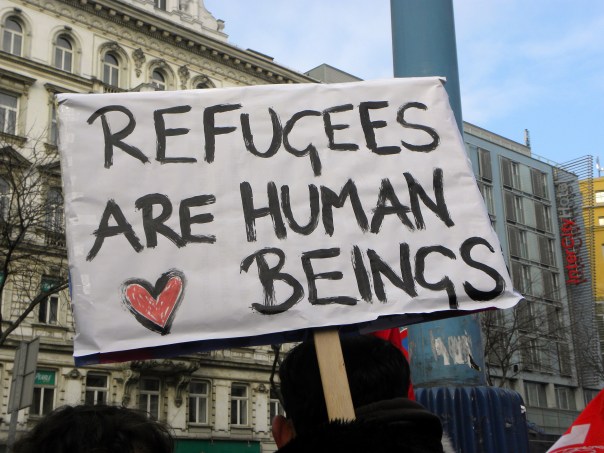
Refugees_are_human_beings.jpg

JUNE 20: WORLD REFUGEE DAY
By René Wadlow

June 20 is the United Nations (UN)-designated World Refugee Day marking the signing in 1951 of the Convention on Refugees. The condition of refugees and migrants has become a “hot” political issue in many countries, and the policies of many governments have been very inadequate to meet the challenges. The UN-led World Humanitarian Summit held in Istanbul, Turkey on May 23-24, 2016 called for efforts to prevent and resolve conflicts by “courageous leadership, acting early, investing in stability, and ensuring broad participation by affected people and other stakeholders.”

If there were more courageous political leadership, we might not have the scope and intensity of the problems that we now face. Care for refugees is the area in which there is the closest cooperation between nongovernmental organizations (NGOs) and the UN system. As one historian of the work of the UN High Commissioner for Refugees (UNHCR) has written “No element has been more vital to the successful conduct of the programs of the UNHCR than the close partnership between UNHCR and the non-governmental organizations.”
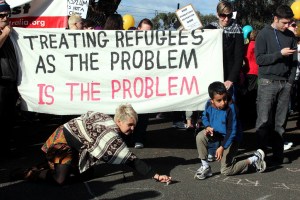
Refugee Rights Protest at Broadmeadows, Melbourne

The 1956 flow of refugees from Hungary was the first emergency operation of the UNHCR. The UNHCR turned to the International Committee of the Red Cross and the League of Red Cross Societies which had experience and the finances to deal with such a large and unexpected refugee departure and resettlement. Since 1956, the UNHCR has increased the number of NGOs, both international and national, with which it works given the growing needs of refugees and the increasing work with internally displaced persons who were not originally part of the UNHCR mandate.

Along with emergency responses − tents, water, medical facilities − there are longer-range refugee needs, especially facilitating integration into host societies. It is the integration of refugees and migrants which has become a contentious political issue. Less attention has been given to the concept of “investing in stability”. One example:

The European Union (EU), despite having pursued in words the design of a Euro-Mediterranean Community, in fact did not create the conditions to approach its achievement. The Euro-Mediterranean partnership, launched in 1995 in order to create a free trade zone and promote cooperation in various fields, has failed in its purpose. The EU did not promote a plan for the development of the countries of North Africa and the Middle East and did nothing to support the democratic currents of the Arab Spring. Today, the immigration crisis from the Middle East and North Africa has been dealt with almost exclusively as a security problem.
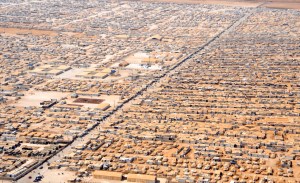
An_Aerial_View_of_the_Za'atri_Refugee_Camp

Za’atari, Jordan. The biggest refugee camp in the world.

The difficulties encountered in the reception of refugees do not lie primarily in the number of refugees but in the speed with which they have arrived in Western Europe. These difficulties are the result of the lack of serious reception planning and weak migration policies. The war in Syria has gone on for six years. Turkey, Lebanon and Jordan, not countries known for their planning skills, have given shelter to nearly four million persons, mostly from the Syrian armed conflicts. That refugees would want to move further is hardly a surprise. That the refugees from war would be joined by “economic” and “climate” refugees is also not a surprise. The lack of adequate planning has led to short-term “conflict management” approaches. Fortunately, NGOs and often spontaneous help have facilitated integration, but the number of refugees and the lack of planning also impacts NGOs.

Thus, there is a need on the part of both governments and NGOs to look at short-term emergency humanitarian measures and at longer-range migration patterns, especially at potential climate modification impact. World Refugee Day can be a time to consider how best to create a humanist, cosmopolitan society.

Prof. René Wadlow is President of the Association of World Citizens.
Immigration, Detention, Control

In Being a World Citizen, Conflict Resolution, Current Events, Europe, Human Rights, Middle East & North Africa, Migration, Refugees, Solidarity, The Search for Peace, United Nations, World Law on December 18, 2016 at 9:56 AM

IMMIGRATION, DETENTION, CONTROL

By René Wadlow

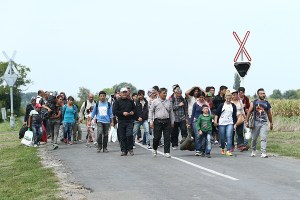
Migrants_1.jpg

If I were another on the road, I wouldn’t have looked back. I’d have said what one traveler says to another: Hello stranger, wake up your guitar! Let’s postpone our tomorrow to lengthen our road and widen our space, so that we may be rescued from our story together.


– Mahmoud Darwish, Palestinian poet.


By creating special observance days, the United Nations (UN) tries to promote international awareness and action on specific issues. Thus February 6 is International Day of Zero Tolerance to Female Genital Mutilation and March 20 is International Day of Happiness. May 2 highlights an issue we do not think about often: World Tuna Day. December 18 has been designated as the International Migrants Day, but even without a special day, migrants and refugees have become worldwide issues leading to political debate, especially in Europe and the USA.

Asylum seekers and immigrants with low level of education are often seen as a “burden”, not only for “Fortress Europe” but also for first reception countries. Thus, today’s borders function as a filter, separating the “wanted” – that is, migrants who can be used – from the “unwanted”. The filter serves to separate those that get in from those who are pushed back.

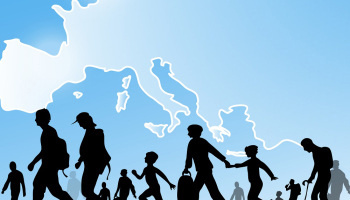
migrants_3

The filter serves to distort refugee flows. Because unaccompanied minors are more protected by law or policy and are often not deported, there are an increasing number of unaccompanied minors separated from the rest of the family and facing very uncertain futures, especially as concerns education.

There have been some efforts to provide for educational facilities, but most often for students already at the university level. In September 2014, the German Foreign Minister, Frank-Walter Steinmeier, announced the establishment of a special scholarship program for refugees from Syria saying “We cannot allow the Syrian conflict to engender a lost generation. It is particularly young Syrians who will play a crucial role in rebuilding their country and deciding the future as soon as this terrible conflict is over. We want to help give this young generation a future perspective.” Since then there are many signs of a lost Syrian generation, especially for those in the neighboring countries of Jordan, Turkey and Lebanon.

The filter also increases the trafficking of people by organized bands who quickly learn the ways of going around a filter. The trafficking of women and children for the sexual industries occurs in all parts of the world, but increases in areas with armed conflicts. Women in war zones are forced into sex slavery by combatant forces or sold to international gangs. Even without commercial trafficking, there has been a sharp increase in early marriage among Syrian refugee girls in Jordan, marriage being one of the few ways to cope economically and socially.

Migrants_2.jpg

The systemic failures and bureaucratic delays that characterize government reception systems have left many migrants and refugees in a legal “limbo” in which migrants remain trapped, contributing to processes of alienation. There is obviously a need for cooperation and some coordination among States of origin, transit and destination – more easily said than done.

Fortunately, nongovernmental organizations (NGOs) have tried to meet the challenges of migrant and refugee flows, often being able to draw upon the spontaneous goodwill of people. However, there are real limits to what NGOs can do, especially on longer-term issues. There is an obvious need to resolve the different armed conflicts through negotiations in good faith. There is also an obvious need to increase development efforts in those countries from which economic migration is a strong motivation. There is also a need to reverse environmental damage with ecologically-sound development programs.

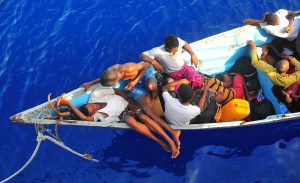
090525-N-4774B-032

December 18 should serve as a time when we look with compassion at the fate of migrants, refugees and the internally displaced. It is especially a time when we must plan and increase resources for creative action.

Prof. René Wadlow is the President of the Association of World Citizens.